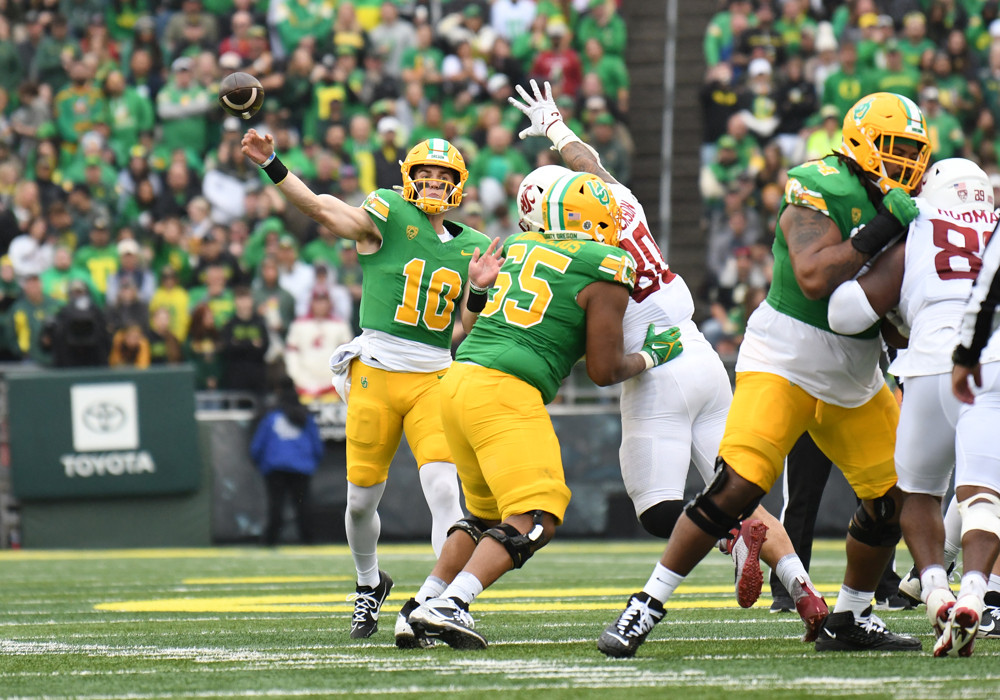
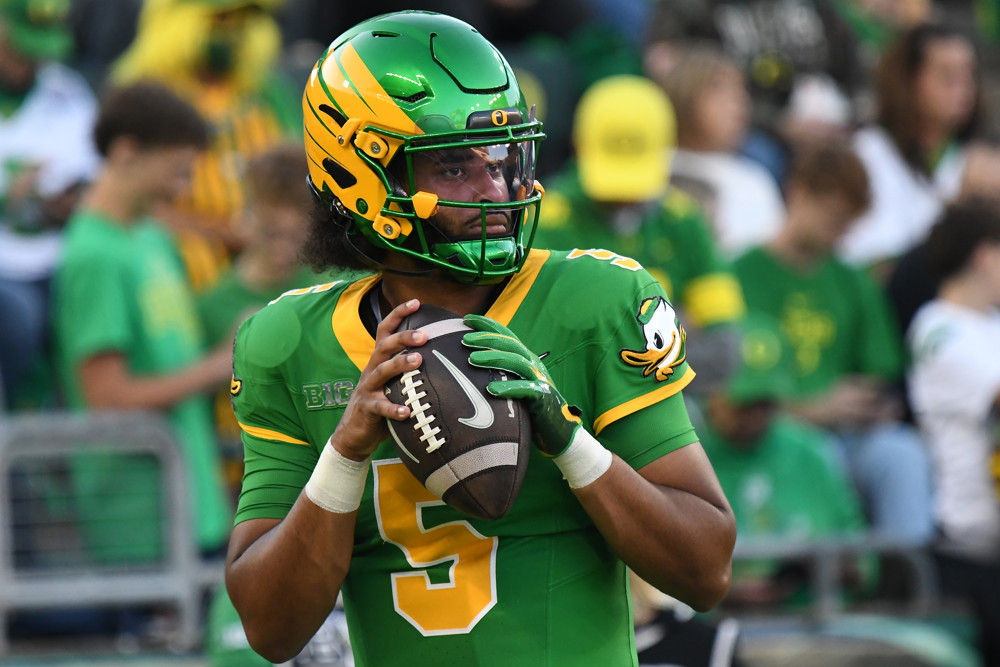
Oregon’s Dante Moore returned to school this year with any or all of a Heisman Trophy, a College Football Playoff run, and the top pick of the 2027 NFL Draft on the table for him. By Week 4 of the season it’s safe to say that all of that is off the table, for different reasons.
The biggest concern for him at the moment is the shot to the head he took from USC defender Desman Stephens II, whose cheap shot as Moore was sliding has resulted in a 1-week suspension by the university. This is the second concussion he’s suffered at Oregon, the first causing a couple missed games in 2023.
He and the training staff should proceed with caution given the potential ramifications of the injury especially given a previous occurrence, but at the same time Moore’s (and Oregon’s) prospects are still optimistic enough that everyone involved will want to push for a relatively speedy return. I wanted to use SIS’s injury charting since 2018 to assess what to expect from Moore both in terms of return to play and his performance after that point.
Concussions sit in a weird spot because so many of them don’t result in any immediate missed games, but they can obviously have lifelong ramifications. The nature of the hit and the resulting treatment on the field makes Moore’s situation more likely to lead to time missed, though.
Players who show only a mild reaction initially or even those for whom play is stopped to pull them off the field are most likely to miss no games after the injury. Having an ambulance, stretcher, etc. brought onto the field makes it much less likely the player returns the next week (although that rate is still a third of the time!), and much more likely for him to miss multiple games. Even if we look only at players with previous concussion history, it is more common for a player to miss no time than to miss a game or more.
Games missed due to concussions by initial severity, FBS
| Initial Severity | 0 Games | 1 Game | 2+ Games |
| No reaction | 80% | 7% | 13% |
| Mild reaction | 67% | 17% | 17% |
| Leaves field on his own |
70% | 16% | 14% |
| Leaves field, play stops |
69% | 18% | 13% |
| Extended stoppage, cart/stretcher |
31% | 26% | 43% |
What might we expect from Moore if and when he comes back? I took a look at a handful of metrics that I thought might show some effect after his return.
To compare roughly apples-to-apples, I took a sample of 39 quarterbacks who played at least 3 games prior to a concussion and at least 4 games afterward, and compared their rolling performance after the concussion to their pre-concussion average. I investigated the following stats to see if there was a trend in how much the player was exposed to risk and how they performed:
- Dropbacks per game
- Scramble rate
- Expected Snap-to-Throw time (based on drop type)
- Snap-to-Throw Plus-Minus (comparing actual to expected)
- Average Depth of Target
- On-Target Rate Plus-Minus (comparing accuracy to expectation based on throw difficulty)
- Total Points (the player’s overall production)
I also took a similar look at NFL concussions with the idea that whatever true phenomenon might exist should be similar across levels of play.
The picture ended up muddy for most of these metrics, honestly. Some just bounced around too much to say anything, and many of them had opposite effects between college and NFL that suggested there wasn’t much to write home about.
One consistent area I found an effect was how quickly the ball is designed to come out. At both the college and NFL level we see a consistent reduction in the expected snap-to-throw time of the drops the player takes after the injury.
And in college the quarterbacks also get the ball out faster than that quicker expectation and throw the ball shorter on average, suggesting there might be a once-bitten-twice-shy effect. The timing effect isn’t large; it’s less than the difference between a 3-step drop and a 5-step drop, for example. But a lot of this is operating within a second or so of play time anyway.
Moore’s an interesting case because he was already operating quickly within an offense designed to get the ball out at about an average rate. To move him an additional 100 milliseconds or so faster starts to have ramifications for what the offense is capable of threatening. Whether by scheme or by quarterback tendency, offenses with faster-than-average snap to throw times throw the ball a little more than a half-yard shorter on average and produce about a point per game less (by EPA) than those that let the play develop a little more. And that EPA number is an overall offense value, not just the passing game.
That said, despite the disappointment of losing to Oklahoma State, Moore was having a solid season that has some room for optimism even if he takes a couple weeks off and plays it safe upon his return. Prior to his injury he had one of the best Independent Quarterback Ratings (our adjusted Passer Rating that isolates factors within the quarterback’s control) in the country, even excluding the 80-point blowout against Portland State.
The win against USC keeps Oregon’s playoff hopes alive, and that’s after they had dropped from 70% to 4% from the preseason to the Week 2 loss by our prediction model. They have a week off now, and so it’s entirely possible that Moore misses just a game, although it’s a big one against a ranked UCLA team. If Moore is cleared by team doctors to return in a couple weeks, both he and Oregon have time and opportunity to recover from a tough start to 2026.