Last year I wrote that I was pleased to see Alex Gordon on the Baseball Hall of Fame ballot. Gordon is the all-time leader in Defensive Runs Saved among left fielders.
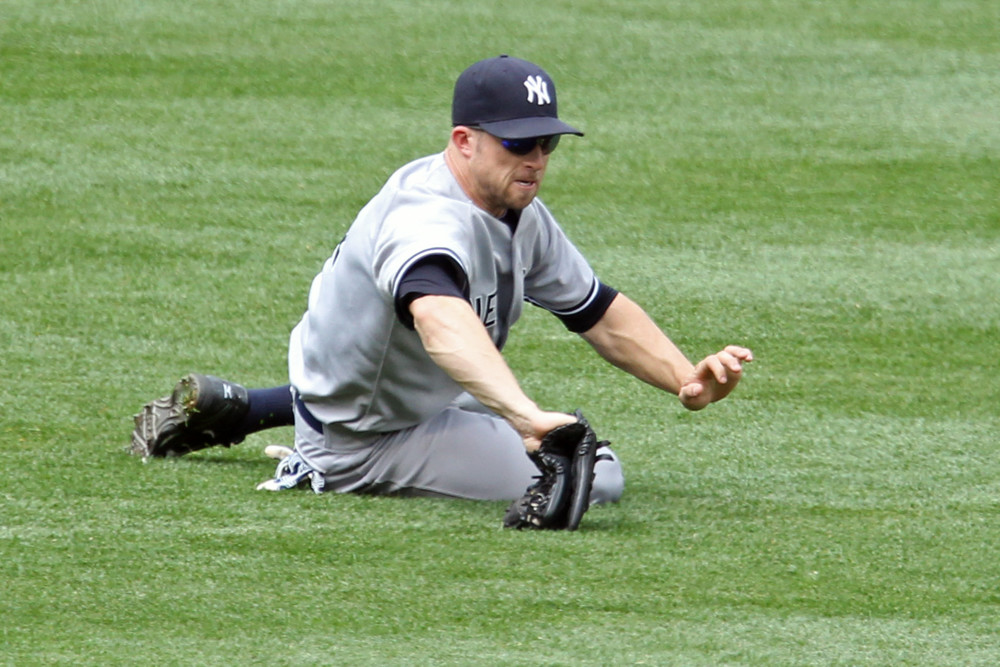
I’m just as psyched to see the guy who ranks No. 2 in left fielder Runs Saved, longtime Yankee Brett Gardner.
Most Defensive Runs Saved – Left Fielders
| Player | Runs Saved |
| Alex Gordon | 117 |
| Brett Gardner | 101 |
| Steven Kwan | 79 |
| Starling Marte | 71 |
| Carl Crawford | 69 |
* Defensive Runs Saved has been tracked since the 2003 season.
Gardner was worth 44 Baseball-Reference WAR over a 14-year career. That’s more than a player I’m strongly considering voting for the Hall of Fame, pitcher Jon Lester. A good chunk of Gardner’s value came from his defense.
However, Gardner is much more likely to get the same number of votes that Gordon got last year (1) than he is to make any sort of run at the Hall of Fame or even getting the 5% of votes needed to stay on the ballot. But he was a very good player.
Gardner wasn’t just good in left field. He was a good defensive center fielder too, with 42 career Runs Saved there. As such, because he was so good at two positions, he has the eighth-most Runs Saved in the history of the stat.
| Player | Runs Saved |
| Adrian Beltré | 203 |
| Andrelton Simmons | 200 |
| Mookie Betts | 188 |
| Yadier Molina | 178 |
| Kevin Kiermaier | 175 |
| Nolan Arenado | 168 |
| Jason Heyward | 162 |
| Brett Gardner | 141 |
Gardner’s best defensive season was 2010 when he led left fielders in Runs Saved, the first of three times he’d do so. He had 25 Runs Saved there and another 8 Runs Saved in center field. He also had an MLB-leading 23 Runs Saved the following season. Gardner had moved from center field to left field to accommodate the acquisition of Curtis Granderson, which gave the Yankees a very strong defensive outfield.
Fifteen years ago, when I was working at ESPN, I collaborated with SIS on a piece about Gardner’s defense. I asked ESPN’s analysts what they thought of Gardner. Former MLB pitcher Orel Hershiser called him a “game changer.” An MLB scout said, “Normally, a team tries to hide a defender in left field, but not him. He’s got so much speed that it enables him to correct misreads on balls in any direction. He has that something that a lot of left fielders don’t have.”
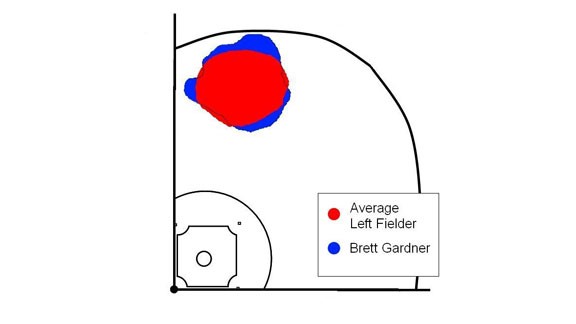
We published this image in support of that statement, showing what Gardner’s range looked like at the time (the blobs in the image show the areas in which Gardner and a league-average left fielder turned batted balls into outs at probabilities of 50% or higher). Gardner’s “blob” extends well beyond an average left fielder.
Gardner’s stats dipped a little bit after that, but he had a resurgence in left field from 2016 to 2018, posting 11, 18, and 10 Runs Saved, respectively.
I also want to note what Gardner did in his debut season, 2008, because he had a statistical line the likes of which you’re highly unlikely to see. In 22 games as a center fielder, he had 12 Runs Saved (4 from range, 4 from his arm, and 4 for Good Fielding Plays). He had 9 Good Fielding Plays, which is a lot for so few games.
Gardner’s speed, which made him a valuable defensive player, also made him quite valuable as a baserunner. He led the AL with 49 stolen bases in 2011 and swiped 274 bases in all at an 81% success rate.
Gardner wasn’t a bad hitter. He was league-average or better in OPS+ in six of the 11 seasons in which he had at least 200 plate appearances. He just wasn’t a great one, which is why we’re not talking seriously about his Hall of Fame candidacy. He wasn’t much of a power hitter until the back end of his career, when he had a 21-homer season at age 33 in 2017 and a 28-homer season at age 35 in 2019. His overall OPS+ is 100 as it took him a few years early in his career to get going as a hitter.
Gardner averaged 16 home runs and 19 stolen bases from 2013 to 2019, a span in which he was one of only two players with seven straight seasons of at least 3 bWAR (the other was Mike Trout, a bit of a different case). That’s cherrypicking a stat that’s favorable to Gardner, but it shows his consistency. Seven straight seasons of 3+ WAR for a position player is pretty good.
Regardless, Gardner was a very good player, a deserving Hall of Pretty Good’er (or Hall of Nearly Great’er) if nothing else. A 44-WAR career is nothing to sneeze at. It’s decently more than left field contemporaries Carl Crawford (39) and Gordon (35), and roughly the same as Matt Holliday. Gardner may not be Cooperstown-worthy, but if we ever start a Defensive Hall of Fame here, Gardner will probably be election-worthy pretty quickly.