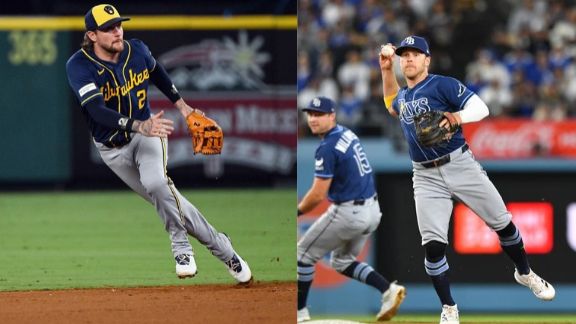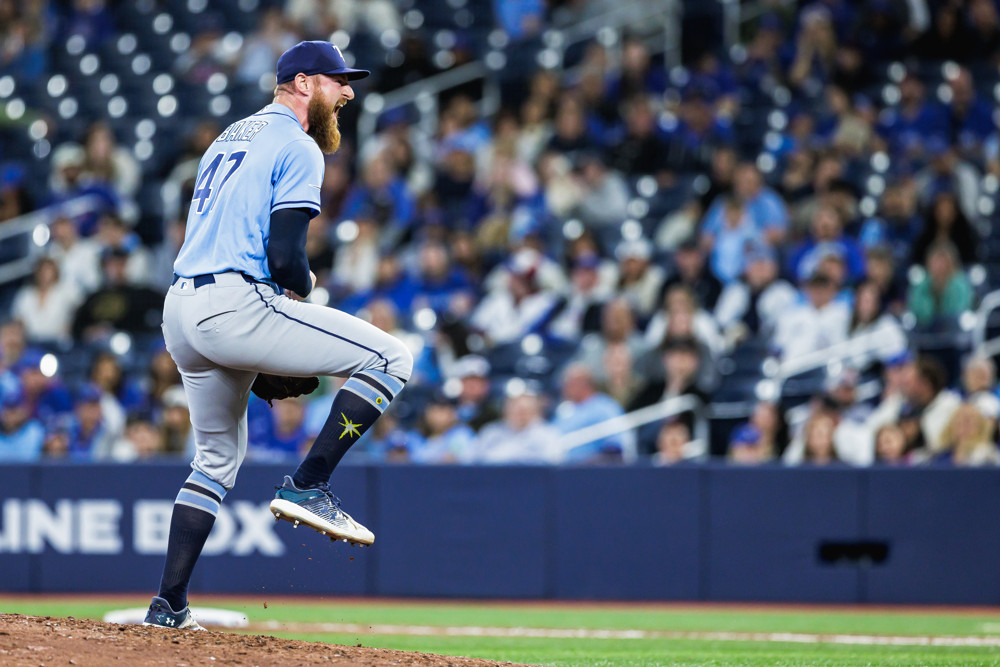
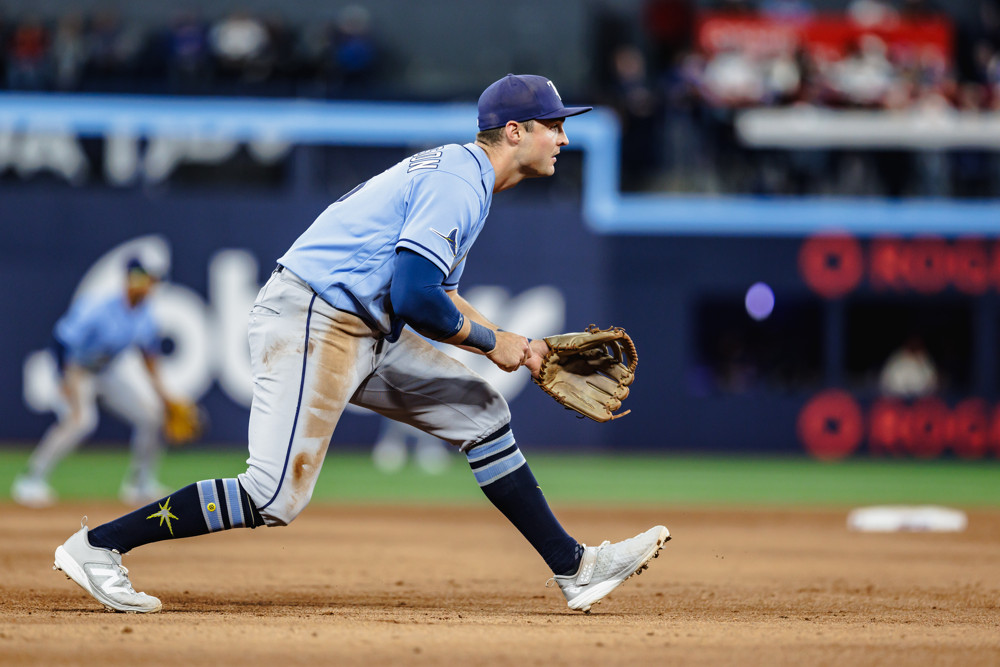
The Tampa Bay Rays are Raysing again. They have been one of the best all-around teams in baseball this year, performing exceptionally well on the defensive side of the ball. They rank second in the majors with 85 Defensive Runs Saved (DRS), trailing only the Cubs. But while the Cubs excel based on the skill of players like Pete Crow-Armstrong and Nico Hoerner, the Rays are doing this by creating opportunities for their defenders to be in the best position to create outs.
We track what we call partial shifts at Sports Info Solutions, which are defensive alignments in which at least two defensive players deviate significantly from traditional positioning. Think of those as ones where one of the middle infielders is almost right in line with second base. The Rays lead the majors with 81% of the batted balls against them coming against a partial shift.
Here are some of the best examples of how their positioning contributes to their Runs Saved.
First, an explanation.
One feature of our overall system is Positioning Runs Saved. It is not attributed to players’ Runs Saved totals because at this point teams drive those decisions.
On any given ball in play, we compute the difference in expected out rate between that play’s positioning and the average for a similar batted ball, and we attribute that difference to the relevant players.
The Rays currently have 41 Runs Saved from shifts and 45 infield positioning Runs Saved in all. That’s more than half of their 85 Runs Saved. Most of that comes from how they move their second baseman and shortstop, as you’ll see with this leaderboard, and which makes sense intuitively.
Rays Infield Positioning Runs Saved – Notables
| Player | Positioning Runs Saved |
| Richie Palacios | 15 (2B) |
| Ben Williamson | 10 (2B) |
| Taylor Walls | 9 (SS) |
| Junior Caminero | 3 (3B) |
To show how they are doing this, here are some examples of these players’ best positioned plays:
May 1 vs Giants
Walls is positioned towards the 5-6 hole here because when Adames hits the ball on the ground, he pulls it 3 times as often as he hits it up the middle and almost never hits it towards the opposite field*. As a result of that shift, Walls’ chance of making an out increases by 51% and the positioning itself saves 0.41 runs.
This is a simplified explanation for the purposes of ease of understanding. In all likelihood, the Rays are considering many factors, including who the pitcher is, what the situation is, and what type of pitch will be thrown.
June 26 vs DBacks
Gurriel is more likely to hit the ball up the middle or to the pull side, with ground balls going to the pull side over 5 times more often than to the opposite field and up the middle 4 times as often. With Palacios being almost directly behind the bag at second, his positioning improved the chances of recording an out by 67%
May 19 vs Orioles
Caminero is decisively shifted here and doing so improved the out probability for him on this ball from 28% to 77% Basallo pulls his grounders more than 7 times as often as he goes opposite-field with them, making the shift decision pretty obvious regardless of who is pitching.
April 3 vs Twins
Much like his positional counterpart, Ben Williamson places himself right at the second bag on this play and increased the chance of an out to be recorded by 66%! That’s because the Rays know that Luke Keaschall hits ground balls to the pull side 5 times more often than to the right of the bag where he would normally be.
Conclusion
What we showed you were some of the best examples. A season’s worth of plays consists of many instances where shifts worked and some in which shifts didn’t (and even some where positioning was good but the play wasn’t made). For the Rays, the pluses outweigh the minuses and their defensive success is not about having many elite infield defenders. Rather, it’s about consistently placing their players in optimal defensive positions. Their league leading shift rate generates outs by leveraging a hitter’s batted ball tendencies and contributes to the overall Positioning Runs Saved.
Strong defensive performers like Taylor Walls and others combine their abilities with this approach to create value on their own and give them the opportunity to maintain starting roles. Overall, the Rays demonstrate how data-driven positioning can elevate an entire defense without having one person carrying the unit.
Most Defensive Runs Saved – Teams in 2026
| Team | DRS | Infield
Pos DRS |
| Cubs | 107 | 33 |
| Rays | 85 | 45 |
| Red Sox | 54 | 22 |
| Dodgers | 48 | 22 |
| Braves | 44 | 7 |