Tag: Fred McGriff

  • Stat of the Week: Contemporary Baseball Hall of Fame Candidates

    Stat of the Week: Contemporary Baseball Hall of Fame Candidates

    If only it were so simple such that we could judge Hall of Fame candidates just on their on-field performance.

    If we did, the Contemporary Baseball Era player ballot would look a lot different than the eight names who will be voted upon by a committee of 16 voters on Sunday.

    Barry Bonds, Roger Clemens, Curt Schilling, and Rafael Palmeiro wouldn’t be on that ballot. They would be in the Hall of Fame.

    Alas, the debate over PED usage and Schilling’s off-field comments and actions continues.

    That leaves four other players on this ballot to consider. We’ll use Bill James’ simple Hall of Fame Value system (HOF-V) to evaluate them. For those unfamiliar, HOF-V equals a player’s Win Shares + 4 times his Baseball-Reference Wins Above Replacement (WS+4xWAR).

    As James noted when he wrote about this in The Bill James Handbook 2019, “The Hall of Fame line breaks right around 500, actually closer to 510.”

    Here’s how these players fare.

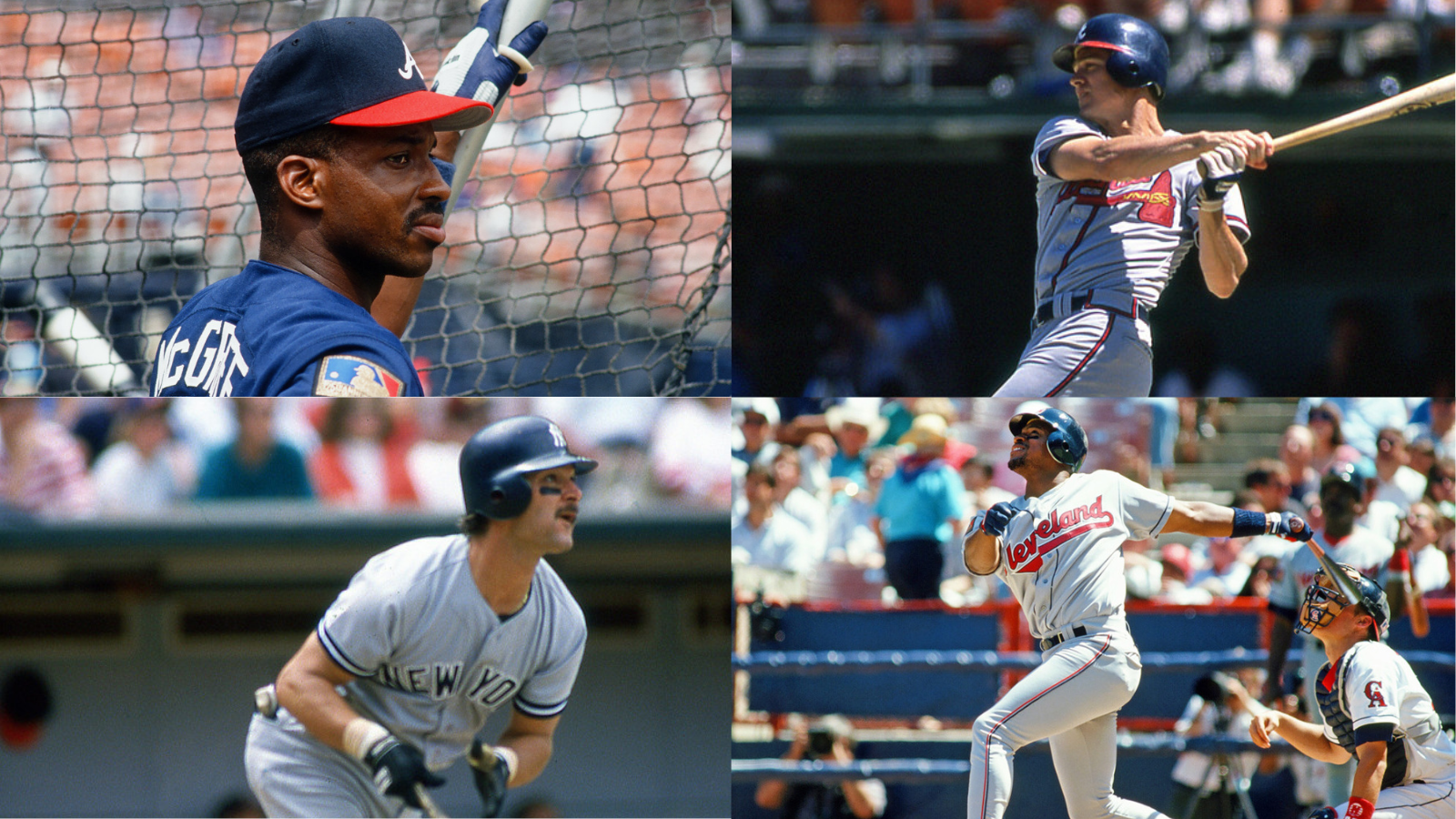
    Fred McGriff

    McGriff is the one player of these four to clear James’ threshold of being Hall of Fame-worthy. He has an HOF-V of 552.4.

    McGriff finished his career with a slash line of .284/.377/.509, 2,490 hits, and 493 home runs. He finished in the top 10 in MVP voting six times. He also was great in the postseason, hitting .303/.385/.532 with 10 home runs and 37 RBI in 50 games.

    James also devised a metric known as Similarity Scores to illustrate how similar one player is to another. The two players rated as most similar to McGriff are Hall-of-Famers Willie McCovey and Willie Stargell.

    McGriff always seemed to be “the other guy” on the crowded Hall of Fame ballots of a few years ago. With former teammates Chipper Jones and Greg Maddux on the Hall’s voting committee, we wouldn’t be surprised to see him elected. He’d be a worthy choice.

    Dale Murphy

    Murphy comes so close to meeting the threshold, with a HOF-V of 483.7

    For those who grew up in the early 1980s (as this writer did), Murphy was an oft-televised superstar (via the cable network TBS).

    In the seven full seasons from 1980 to 1987 (omitting the strike season, 1981), Murphy averaged 36 home runs and 103 RBI, made the All-Star team every year, won five Gold Glove Awards, and was voted MVP in both 1982 and 1983. He also averaged 53 points of Hall of Fame Value in that time.

    The problem for Murphy is that the decline phase of his career was more of a cratering than a decline. With the struggles in his last six seasons, his career batting average dropped from .279 to .265 and his career OPS fell from .862 to .815. He went from surefire Hall of Famer to someone waiting through more than 20 years of balloting to be elected.

    Don Mattingly

    Mattingly is similar to Murphy in that his success is contained to a time period considered brief for a Hall of Fame candidate. His HOF-V is 432.6.

    From 1984 to 1989, Mattingly was a megastar, with a .902 OPS in that span and an average of 27 home runs, 114 RBI, and 51 points of HOF-V for the Yankees. But a back injury cost him skill and ended his career prematurely after 14 seasons. His last game came as a 34-year-old. Had he been healthy and able to keep playing into his late 30s, he’d almost surely have come close to or surpassed the 500-point threshold.

    Albert Belle

    Belle has his own off-field issues plus a corked bat suspension, so he’s already working at a disadvantage with potential voters. His stats leave him considerably short regardless. His HOF-V is 403.4.

    Belle posted incredible offensive numbers from 1991 to 1999, with a .300/.377/.582 slash line and 350 home runs. However, he was not a good defensive player and suffers statistically both for being a left fielder and for playing in the game’s richest offensive era.

    Like Mattingly, Belle had his career shortened, as a hip injury forced him into retirement at age 33. He’s likely on the outside looking in as far as Hall of Fame consideration goes.

  • Fred McGriff has statistical support for Cooperstown

    Fred McGriff has statistical support for Cooperstown

    This article was originally published in December 2018

    Fred McGriff was a really good baseball player. But he’s yet to be recognized as belonging among the elite. McGriff is in his final year of eligibility on the Baseball Hall of Fame ballot. He received 22 percent support in his first year. He received 23 percent last year. He’s not close to the 75 percent needed for election. But perhaps he should be.

    This year, Bill James introduced a new Hall of Fame Value Standard in the 2019 Baseball Handbook (excerpted here). The methodology combines James’ Win Shares metric with four times Wins Above Replacement into one number. The cutoff score for Hall of Fame worthiness is 500.

    McGriff is there. His 552.6 cleared the bar by a little bit. He’s right alongside another player who will be a tough Hall of Fame choice in a few years, recently retired Chase Utley (552.5). James ranks McGriff 19th on the list of those who are Hall of Fame worthy who aren’t special cases (like players with PED histories)

    McGriff finished his career with a slashline of .284/.377/.509, 2,490 hits, and 493 home runs. He didn’t slug like Mark McGwire or Sammy Sosa, but he didn’t have to do that to be an effective player. He finished in the top 10 in MVP voting six times. He also was great in the postseason, hitting .303/.385/.532 with 10 home runs and 37 RBI in 50 games.

    What should solidify McGriff’s argument is this. James also devised a metric known as Similarity Scores, to illustrate how similar one player is to another. The two players rated as most similar to McGriff are Hall-of-Famers Willie McCovey and Willie Stargell.

    McGriff almost surely isn’t making the Hall of Fame this time around. Instead, he’ll likely be forced to wait and hope that someone carries the torch for his candidacy. There are plenty of good reasons to do so.