Month: December 2019

  • Updated 2019 Infield DRS Leaders Using the PART System

    Updated 2019 Infield DRS Leaders Using the PART System

    By Alex Vigderman

    It’s a big day for us at Sports Info Solutions. As of today, we have a new-and-improved version of our flagship statistic, Defensive Runs Saved, available to the public via FieldingBible.com.

    Previously, infielder DRS (specifically the Range and Positioning portion of DRS) used just the information about the ball in play to determine its likelihood of being turned into an out. That meant that we didn’t have the granularity to tell whether a play was made because the fielder went above and beyond or he was just positioned well.

    In essence, the calculation of Range and Positioning Runs Saved boils down to this single question: how well did the fielder do in completing the play given how often similar batted balls are turned into outs?

    A few years ago SIS started tracking infielder starting positions on balls in play, which we’ve collected back to 2013. That allows us to evaluate each infield play (groundball or short line drive) at multiple points in time, so instead of just answering the one question above, we can now answer three questions about a play:

    • Positioning: How much does the expected out rate change once we know how each fielder was positioned?
    • Range: How much does the expected out rate change between when the ball was hit and when the fielder gets to the ball (or fails to), given that we know where everyone started?
    • Throwing: How well did the fielder do in completing the play given where he fielded the ball, how hard the ball was hit, and the speed of the runner?

    Bundle those components with the evaluation of infield air balls and you get the PART System, which serves as the replacement for the Range and Positioning System for infielders.

    We’re really excited to bring all of this work out into the open.  After all, we’ve been collecting the required data for several years! We are releasing it via FieldingBible.com for now, and will work to get the numbers updated on other websites over the offseason.

    For now, here’s a rundown of how we rated infielders previously and how we rate them now. Remember when you’re looking at these changes, there are two big things the new system accounts for that DRS as you know it didn’t handle so well.

    1. We can now split up infielder performance in terms of Positioning, Air balls, Range, and Throwing. Because positioning tends to be a team decision, that positioning value is actually getting removed from a player’s total. Therefore, a player’s total in this new component of DRS really is his ART Runs Saved.
    2. Because it was difficult to evaluate players on shift plays before, we removed them from DRS. Now that we can measure performance independent of positioning, we can add those plays back in, giving a much more complete picture of a player’s value.

    Without further ado, here are the updated leaders at each infield position in 2019.  We’re excluding pitchers and catchers here because any impact that would come from the two changes above would negligibly affect those positions.

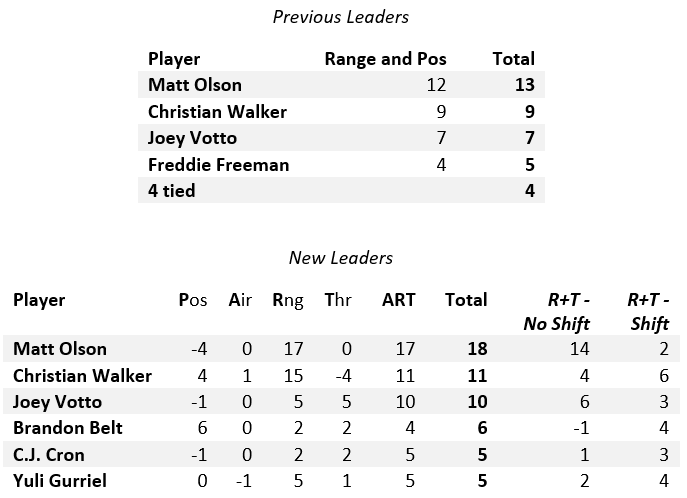
    First Base Defensive Runs Saved Leaders, 2019

    We don’t get a very different picture of the top players at first base as a result of these changes, but we do get a little bit of a picture of different players’ usage and competencies. Matt Olson and Christian Walker separate from each other partially because of the quality of their positioning, with Olson getting some negative positioning removed and Walker losing the benefit of strong positioning (more on the DBacks’ positioning in a bit).

    Another important but subtle thing to note here is that “Throwing” is a bit of a misnomer, especially for first basemen. Technically it’s a measure of how well you turn balls in play into outs once you’ve fielded them. For first basemen, that often involves running to tag first base or flipping to the pitcher as opposed to what we usually think of as throwing. Joey Votto was quite good in this respect in 2019, while Walker was not.

    Second Base Defensive Runs Saved Leaders, 2019

    At second base, the inclusion of shift plays was the biggest factor in who came out on top, as both Kolten Wong and Kiké Hernandez combined strong performance with excellent positioning. This is no surprise given that the Cardinals and Dodgers each netted 30 or more Shift Runs Saved in 2019.

    Falling off the leaderboard was Yolmer Sanchez. His 17 Positioning Runs Saved buoyed his total in the previous system, but the new system rates him as slightly below average in 2019.

    Third Base Defensive Runs Saved Leaders, 2019


    Andrew Kyne has already written about the changes to Matt Chapman’s numbers. He cements himself as the best defender relative to his peers, nearly doubling another mainstay at the hot corner, Nolan Arenado. You can see evidence that Chapman’s arm actually gives the A’s license to position him poorly, because he’s able to make up for it on the back end.

    Shortstop Defensive Runs Saved Leaders, 2019

    The numbers for Javier Baez and Nick Ahmed are really illuminating thanks to the new system’s breakdown. Baez leaps up by 10 runs from the previous system thanks to his excellent performance on shift plays, even with the Cubs ranking second-lowest in shift usage per BIS. His 11 Throwing Runs Saved tied Matt Chapman for the most among infielders, a fact we would not have been able to uncover with the previous system.

    Ahmed benefited from Arizona’s outstanding positioning, saving an additional 16 runs. That great positioning gave him quite the boost relative to his peers in the previous DRS system, so he drops back a bit in the overall rankings. He also didn’t perform as well while shifted, so adding those plays back in didn’t help him like it did Baez and shortstop leader Paul DeJong.

    This data is now available for all Major League players on FieldingBible.com, and it will also be featured in The Fielding Bible – Volume V (coming in the spring of 2020) and in The Bill James Handbook 2020 (out now).

  • Stat of the Week: Walker, Rolen, Abreu & Hall of Fame Worthiness

    By Mark Simon

    This year’s BBWAA Hall of Fame ballot is headlined by Yankees shortstop Derek Jeter and understandably so, given his excellence in both the regular season and postseason, and his longevity.

    Jeter is a lock for election, perhaps even joining Mariano Rivera in receiving unanimous support.

    In the 2019 Bill James Handbook, Bill James unveiled a new stat (explained here and here) to show a player’s Hall of Fame Value and set the standard for election as receiving a HOF-V score of 500 or higher (the score is based on a combination of a player’s WAR and Win Share totals).

    There are 14 candidates on this year’s ballot who meet that threshold. Putting aside those whose cases are hindered by PED-related issues or other matters, let’s touch on three candidates from that list who have gotten varying levels of Hall of Fame-related support and warrant a closer look.

    Larry Walker

    Larry Walker is also going to get a lot of attention. He’s in his final year on the ballot and has a lot of public support. In the 2020 Bill James Handbook, Bill revealed the results of a study of public support for Hall of Fame candidates. Walker ranked in the top tier. Walker rates worthy of election by Bill’s Hall of Fame Value stat (598.8). He’s 12th all-time in slugging percentage and 66th in Runs Created, and won seven Gold Gloves.

    Walker received 54.6% of the vote last year and needs a bump up to 75% to be elected.

    Scott Rolen

    Scott Rolen got 10% of the BBWAA vote in his first year on the ballot and 17% last year. The Athletic senior baseball writer Jayson Stark recently wrote that Rolen could receive a sizable bounce in his third year on the ballot given that the ballot is less crowded with Hall-worthy players than it had been in recent years.

    Rolen’s offensive numbers were very good (he ranks 10th among third basemen in career Runs Created), but it’s his defensive stats that push him across the Hall of Fame line. Rolen’s 114 Defensive Runs Saved rank second among third basemen to Adrian Beltre’s 202 since Baseball Info Solutions began tracking the stat in 2003. He was the only third baseman to record 30 Runs Saved in a season until Matt Chapman did it in 2018.

    Rolen isn’t the perfect Hall of Fame candidate. Injuries cost him time and likely skill, so his numbers aren’t as eye popping as other players from his era. But he rates as worthy by Bill’s Hall of Fame Value stat (584.8) and made it to the second tier of Bill’s list of the most highly-supported players.

    Bobby Abreu

    Bobby Abreu isn’t going to be shut out of the Hall of Fame voting, but he’s not likely to be a popular choice among voters. His level of fan support in Bill’s Twitter polls was modest (he ranked just outside the top 75 in Support Score).

    However, Abreu’s candidacy is statistically credible. He hit .291/.395/.475 with 2,470 hits, 288 home runs and 400 stolen bases, and ranks in the top 20 in walks. He didn’t just clear the Hall of Fame Value bar, he did so with room to spare (596.1).

    Candidates like these three are what make Hall of Fame voting season such an interesting time. If nothing else, they spark more discussion about baseball excellence, which is always a good topic.

    Highest Hall of Fame Value Score – 2020 Ballot

    NameHOF-V
    Barry Bonds1,355.2
    Roger Clemens995.4
    Derek Jeter702.6
    Manny Ramírez685.2
    Gary Sheffield672.0
    Larry Walker598.8
    Bobby Abreu596.0
    Scott Rolen584.8
    Curt Schilling570.4
    Todd Helton562.8
    Jeff Kent560.6
    Sammy Sosa555.4
    Andruw Jones527.2
    Jason Giambi527.0

    To find your favorite player’s Hall of Fame Value, go to Bill James Online. You can also read about Hall of Fame Value and the Modern Era Committee ballot at the SIS Blog.

  • Top Prop Odds in Bears vs. Cowboys

    By Steve Schwartz

    Dallas and Chicago face off Thursday night with identical 6-6 records. However, while the Cowboys lead their division, the Bears are three games behind the Packers and realistically a long shot for any NFC playoff spot down two games to division rival Minnesota.

    The following props are evaluated using SISBets.com (registered users get 10 free queries).

    Our overall record is 24-15, including 4-0,  3-13-14-0 in four of the last six weeks (we went 0-3 last week). Odds from ParxCasino.com

    1) Mitchell Trubisky, under 22.5 completions, -128.

    On a cold night, against a Dallas defense that has allowed fewer than 20 completions in three consecutive games, it’s not likely to be a wild shootout. Throw in the loss of wideout Taylor Gabriel (concussion) and the odds become even more favorable for the under. The SIS data says Trubisky produces 20.8 completions and a fair number should be -191.

    2) Anthony Miller, over 4.5 receptions, +102.

    Miller has seen 33 targets and caught 21 of them over the last three games. Each game he caught at least six balls. He had made himself the clear cut No. 2 option behind Allen Robinson even before Gabriel went down. SIS analysis shows he should see at least eight targets and catch at five balls which puts fair market value at -168, but the line is +102. Take it.

    3) Amari Cooper, under 5.5 receptions, -143.

    Cooper is still dealing with knee issues, but it’s not bad enough to keep him sidelined. He was solid against Buffalo on Thanksgiving, but did miss time late when the injury acted up. Against the low-scoring Bears the Cowboys don’t figure to be down by 19 points as they were to the Bills, so he likely won’t see double-digit targets again. The emergence of Randall Cobb and Michael Gallup and the steady targets for veterans Jason Witten and Ezekiel Elliott will limit Cooper’s upside. SIS data shows just 6.9 targets and 4.6 completions for a fair price of -218, but we are only paying -143.

    Sports Info Solutions has been an innovator in the collection and analysis of sports data for almost two decades. SIS specializes in baseball and football data, using professional scouting practices to collect the most detailed and accurate information in both sports. Their data can be found in the majority of team front offices, and on websites such as FanGraphs and Football Outsiders.

    Quarterback Touchdown Passes

    Dak Prescott, 1.5, over -125/under 100

    Mitchell Trubisky, 1.5, over +115/under -143

    —————————————-

    Quarterback Interceptions

    Dak Prescott, 0.5, over -182/under +145

    Mitchell Trubisky, 0.5, over -200/under +160

    —————————————-

    Quarterback Completions

    Dak Prescott, 23.5 completions, over -108/under -118

    Mitchell Trubisky, 22.5 completions, over +100/under -128

    —————————————-

    Touchdown Scorers

    Dallas:

    Ezekiel Elliott -155

    Amari Cooper +160

    Michael Gallup +250

    Dak Prescott +260

    Randall Cobb +325

    Jason Witten +325

    Tony Pollard +550

    Blake Jarwin +750

    Tavon Austin +850

    Chicago:

    David Montgomery +105

    Allen Robinson +180

    Tarik Cohen +200

    Anthony Miller +240

    Javon Wims +450

    Jesper Horsted +700

    Cordarrelle Patterson +700

    Mitchell Trubisky +700

    —————————————-

    Total Receptions

    Dallas:

    Ezekiel Elliott, 3.5, over 110/under -134

    Randall Cobb, 3.5, over -134/under 110

    Amari Cooper, 5.5, over 120/under -143

    Michael Gallup, 3.5, over -167/under 135

    Jason Witten, 3.5, over 100/under -125

    Chicago:

    Allen Robinson 5.5, over -108/under -118

    Anthony Miller 4.5, over +102/under -130

    Tarik Cohen, 3.5, over -126/under -102

  • Why Elgton Jenkins should be considered for Offensive Rookie of the Year

    by Bruce Schroeder

    Mississippi State offensive lineman Elgton Jenkins was drafted in the second round by the Green Bay Packers in part because of his versatility and ability to back up each position. The Packers’ draft class was founded around versatility. Their general manager, Brian Gutenkenst, wanted a team of players that could play multiple positions. The player that encapsulated this philosophy more than any other Packer may be Jenkins

    A lineman who played all five spots in his four years at Mississippi State was the perfect fit. But coming into a team with five solid starters, he was intended to fill in wherever injuries occurred. The first injury came to left guard, Lane Taylor, who many saw as the weakest link on the Packers’ line. Jenkins replacing Taylor may have been the biggest blessing in disguise for Green Bay this season.

    After seeing action in the Week 2 victory against the Vikings, it was clear Jenkins was the better player. Playing just one drive that resulted in an Aaron Jones rushing touchdown, Jenkins was seen making the key block that put Jones in the end zone. Many expected Jenkins to start the following week, but Taylor’s injury rendered the point moot.

    Since then, Jenkins performance could be argued as the best of the entire line, and Green Bay’s offensive line is considered one of the best in the league. The Packers rank in the top 15 with 27 sacks allowed this season, and of the starting five, the stats show Jenkins has been the most productive.

    Sports Info Solutions data shows that Jenkins has allowed just two sacks on blown blocks this season, out of the 366 pass attempts that he has been on the field for. That’s 0.5% of his snaps, which ranks best out of the Packers’ starters and one percentage point better than starting right guard Billy Turner, who was brought in as a big free agent acquisition.

    As good as he has been in the passing game, Jenkins might be even more impressive in the run game. Aaron Jones has been outspoken about how much credit the offensive line deserves for his success, and out of the five offensive line starters, the numbers show that Jenkins has also been most impressive in the run game.

    Sports Info Solutions records a blown block any time a blocker does not successfully block the defender they attempted to engage with and, as a result, gives the defender an opportunity to negatively affect the play. Of the 20 total blown blocks in the Packers’ run game, Jenkins is responsible for none of them.

    When you watch Jenkins play, he looks like a 10-year veteran. The likelihood of him being Offensive Rookie of the Year is extremely small, but he makes for a great under-the-radar contender in a world where offensive linemen were never considered for these awards.

  • Some midseason updates to the Total Points calculation

    By Alex Vigderman

    Over the course of the year, we occasionally find certain plays or players that highlight something that isn’t quite right in the Total Points System. Also, because there are so many data points to comb through, we sometimes wait a bit to include something because we aren’t sure what to do with it yet. As a result of that, we have some updates to the Total Points calculations, which are now available on both the Pro and public versions of the SIS DataHub.

    Here’s a rundown of the key changes:

    • The back-end basis for Total Points, Points Above Average, is now forced to center at zero for each point type (passing, rushing, pass coverage, etc.). This isn’t a large change because these numbers were already close to zero, but does make the term Points Above Average more appropriate
    • On passing plays, the calculation used to split Air Yards, Yards After Catch, and Yards After Contact between the passer and receiver. The Air category has been split into an initial Throw value which estimates the value of the throw based on the route and depth, and a Catch value that focuses more on the accuracy of the pass and the catching ability of the receiver. Defensive backs split responsibility for the Throw portion, but the primary defender is the only one responsible for the Catch portion.
    • Playoffs are now excluded when calculating the average performance for different statistics (e.g. yards after the catch, blown block rate)
    • Centers are now being evaluated for aborted snaps (or lack thereof), which also gives quarterbacks a little less blame when that happens
    • Some running backs were getting an outsized debit when they failed to convert inside the five yard line because they failed to get enough yards after contact. The calculation was changed to use a different threshold for yards after contact on goal line runs, punishing those players much less.
    • Both offensive and defensive players now have the ability to get credit for recovering a fumble. For offensive players, that’s the inverse of the value that is lost by the fumbling player. For defensive players, it’s the same as the value lost by the fumbling player.
    • Offensive players are now being credited for advancing a recovered fumble based on the yards gained
    • Pass rushers are now being credited for accumulating pressure stats (hurries, hits, knockdowns, sacks) relative to the average for players lined up at their position.
    • On plays where one pass rusher hurries the quarterback and a different player gets the sack, the hurrier is now splitting credit for the sack