Month: March 2021

  • 2021 NPB Pitchers to Watch

    By TED BAARDA

    With Spring Training underway, baseball fans can look forward to enjoying more baseball in 2021 than we had in 2020. While MLB teams are ramping up, so are players in NPB and the KBO, Japan’s and South Korea’s top leagues respectively. NPB is starting up the earliest, on March 26, while the KBO is starting their season about a week later, on April 3. 

    Both leagues will also be taking a break from mid-June through early August to allow players to represent their countries in the Olympics, which should result in both Japan and South Korea fielding competitive teams in the event. In addition to fielding Olympians, both leagues feature players that have the upside to be future Major League contributors.

    Here’s a look at some NPB pitchers to watch in the coming season. The NPB features three starters who, based on talent and not contractual minutia, could easily fit into a MLB rotation today if given the opportunity.

    NPB teams tend to be deep with homegrown talent and use their foreign player slots to round out their rosters, so on the pitching side foreign players will hold bullpen roles or fit in at the back of the rotation. The top starters in this list are homegrown, and if they are all healthy come the Olympics, the Japanese team is set up to dominate the competition on home soil.

    Starting Pitchers:

    Tomoyuki Sugano (Yomiuri Giants): Since arriving at Yomiuri in 2013, Sugano has dominated the Central League and really has nothing left to prove at the NPB level. I wrote about Sugano a couple of months ago, and my opinion of him is still that he is the best pitcher in the world who has yet to appear in MLB. 

    While he did just sign a four year contract to stay with Yomiuri, the deal includes opt-outs after each season, meaning he can again try to come to North America next off-season without having a time crunch from the 30-day posting window. Sugano will also be able to stay in familiar surroundings during the pandemic, represent Japan at home for the Olympics and re-enter the market next year when conditions are hopefully more favorable.

    Masahiro Tanaka (Rakuten Golden Eagles): Tanaka’s decision to return to Japan came as a surprise to many, as he is certainly still a capable MLB starter. While he signed a two-year deal, he may have an opt-out included as well

    His decision likely included accounting for similar factors as Sugano, such as: the pandemic, proximity to family, the ability to participate in the Olympics, and that next year’s free agent market will likely be better for the players. The two-year deal could also serve as insurance for Tanaka should labor negotiations between MLB and the Player’s Association stall out. It will be interesting to see how Tanaka adjusts his game moving back to Japan (he may have to adjust his splitter grip again), and it will be interesting to see how long it takes before he returns to the Majors again.

    Kodai Senga (SoftBank Hawks): Senga, who recently turned 28, is the power pitcher of this group, with a big fastball that can push triple digits. He also features a nasty splitter, a cutter and a slider, per former colleague Will Hoefer. Senga is a power pitcher known for getting strikeouts, pushing close to a 30% strikeout rate in the last couple of years, though last year also featured a slight jump in BB% (from 10% in 2019 to 11% in 2020). Even with the occasional loss of location, he still produces results and makes up for the walks with his career 3-to-1 K-to-BB ratio.

    Outside of Senga’s control, however, is his contract situation. He will not be eligible for domestic free agency until after this season, but more importantly he will not be eligible for international free agency until after 2022. 

    While he has a strong desire to come stateside (he requested to be posted for the fourth consecutive year), SoftBank refuses to utilize the posting system and keeps its players until free agency. The strategy does work for the team, as it has won six of the last seven Japan Series, but it is also certainly frustrating to their best players. 

    For now Senga is a player to watch, but with an eye on two years from now for him to actually make his move to North America.

    Raul Alcantara (Hanshin Tigers): Alcantara can be considered the journeyman of this group, having made his debut in affiliated ball at 17 years old, with 46 1/3 innings for the Athletics spread over the 2016 and 2017 seasons.

    While he limited walks and home runs in the minors, Alcantara was never a big strikeout pitcher, and at the big league level he was crushed for 2.7 HR/9 in his small sample of appearances, and again lacked strikeout stuff to put away big league hitters. He joined the KT Wiz of the KBO for the 2019 season and was his usual self with a 4.01 ERA, 14% K% (good for 5.2 K/9), and a miniscule 4% BB% (1.4 BB/9 and exactly 27 BB in 27 starts).

    Following the 2019 season he signed with the Doosan Bears, who have had success with helping foreign pitchers get back to the Majors. Josh Lindblom’s three-year deal with Milwaukee opened up a spot in the Bears’ rotation for Alcantara, and his rotation-mate Chris Flexen signed a two-year deal with Seattle this off-season. 

    After joining the Bears, Alcantara started throwing more sliders, which he pairs with his mid 90s fastball to overpower KBO hitters, along with a change-up, splitter and curveball. The prioritization of the slider led to Alcantara’s strikeout rate jumping from 14% in 2019 to 23% in 2020 with his walk rate remaining virtually unchanged. Alcantara finished the 2020 season with a 20-2 record and 2.54 ERA, winning the Choi Dong-won award as the KBO’s best pitcher, and if he can build on his success in Japan a return to the Majors may not be far off.

    Yoshinobu Yamamoto (Orix Buffaloes): Yamamoto is by far the youngest starter listed here at 22 years old. He features a deep repertoire, relying on a mid 90s fastball and a hard splitter as his go-to pitches, but also featuring a cut fastball, a big curveball and a slider.

    The results have also been there for Yamamoto, with a 2.42 career ERA in the NPB while his strikeout rate climbed above 30% last season with a career high 10.6 K/9. He also keeps walks in check as his BB/9 has never been above 2.7. Yamamoto is also tough to square up, given that he locates, throws hard and gets good movement on his pitches. While hits allowed is generally a poor stat to use to evaluate a pitcher due to the many factors that can affect the number, it demonstrates the quality of Yamamoto’s stuff as his career H/9 in NPB is only 6.6, with a career low 5.8 last season. While he is a few years away from being considered for a MLB opportunity, he is definitely one to watch for in the future.

    Swingman Pitchers:

    Shintaro Fujinami (Hanshin Tigers): Even though he won’t turn 27 until April, Shintaro Fujinami’s career has had its share of ups and downs already. Fujinami debuted with Hanshin in 2013, the same year that Shohei Ohtani started his NPB career with Nippon-Ham, and prospect analysts were divided on who the better pitcher was. 

    Like Ohtani, Fujinami has a pitcher’s body (listed at 6’6 and 220 lbs) and features a fastball capable of hitting triple digits, a hard splitter, and a sweeping slider. After two strong seasons to start his career, Fujinami’s control started to waver.

    After walking hitters at a 8.5% rate in his first two seasons his walk rate started to slowly increase in the subsequent years, and by 2017 he was no longer a fixture in the Tigers’ rotation. Fujinami still made some starts here and there, but with poor results. From 2017-2019 Fujinami started 25 games, combining to throw 134 1/3 innings of 4.69 ERA ball with an 18% strikeout rate and an ugly 16% walk rate.

    Something seemed to click for Fujinami in 2020. His season started poorly, as he went 1-5 in 8 starts with 48 strikeouts, 26 walks  and a 5.87 ERA in 46 innings before being moved to the bullpen. He shined in a relief role, making 13 appearances with a 2.35 ERA and adding 16 strikeouts against 6 walks in 15 1/3 innings. He ended the season with three starts, allowing only one unearned run while tallying 21 strikeouts and 8 walks in 15 innings. 

    While he showed signs of bouncing back, Fujinami needs to show more than just a month and a half of good performance to be considered a viable MLB arm in the future. He does have a power arm, but harnessing it and showing consistency is the key for him, whether he starts or comes out of the bullpen.

    Yuki Matsui (Rakuten Golden Eagles): A 25-year-old lefty, Yuki Matsui is a nice mix of young and accomplished. Despite being tried as a starter a few times, including 2020, he has racked up 141 career saves, and four seasons of 30 or more. He was dominant in 2019, collecting 38 saves, 12 holds and posting a 1.94 ERA. He struck out a whopping 107 in 69 2/3 innings with a 39.5% strikeout rate. Rakuten tried him as a starter this season, and he went 3-3 with a 3.66 ERA over 10 starts before moving back to the bullpen. 

    In his 16 1/3 relief innings Matsui posted a 1.65 ERA with 25 strikeouts and 6 walks. While his fastball is straight and thrown in the low 90s, Matsui gets lots of swings and misses with both his splitter and slider, and he will also incorporate the occasional change of pace curveball. As a lefty with strikeout stuff, Matsui could find a home in a big league bullpen down the road.

    Carter Stewart (SoftBank Hawks): Stewart’s is one of the more interesting amateur baseball stories in recent years. After being drafted No. 8 overall in the 2018 draft, Stewart was unable to reach a deal with the Atlanta Braves, with the team offering him less than full slot value due to an injury they uncovered.

    Before the 2019 draft, when Stewart would have been eligible to be selected again, he signed a long-term deal with the Hawks which is said to guarantee him $7 million. Stewart only pitched in the Japanese minor leagues last season, and the results were fine for a 20-year-old, but it will be interesting to see how he adapts to Japanese professional baseball and how he performs against top competition.

    Relief Pitchers:

    Robert Suarez (Hanshin Tigers): I wrote a scouting report on Suarez earlier this off-season, and he is set to resume in his role as Hanshin’s closer this year. As noted in the earlier report, Suarez showed promise coming out of Mexico in 2015, but had Tommy John surgery and struggled to find his command post-surgery until last year. He was reportedly being considered for offers from MLB teams before re-signing with Hanshin, and another solid season for the Tigers will get him considered again next off-season.

    Liván Moinelo (SoftBank Hawks): The left-handed Moinelo comes from Cuba, and it is easy to see why he is an intriguing talent. He throws a mid-90s fastball that he can locate above the zone and at the knees. He will mix in a big breaking curveball, a high-80s slider, and a changeup. Exclusively used as a reliever, Moinelo’s K/9 has steadily increased in each season, going from 9.1 in 2017 to 14.4 in 2020 and a 40% strikeout rate. Moinelo’s walk rates are slightly high, but he has maintained better than a 3-to-1 K-to-BB ratio in his last two seasons.

    At only 25 years old Moinelo would certainly be of interest to MLB teams, and that the Cuban government previously stated that it would allow Moinelo to sign with MLB teams in the future, though the initial proposal of how player transfer would work was shot down by the US government. Cuban players do not need to defect from their homeland to sign with NPB teams, but they have had to take that route to join MLB teams in the past. Moinelo’s case is an interesting one to watch, from both a baseball and international relations perspective, and it could mark a significant change in how players move from Cuba to MLB.

    Raidel Martinez (Chunichi Dragons): Martinez is another Cuban pitcher succeeding at the NPB level, like Livan Moinelo, though he is a right-hander in the Central League. Martinez has shown improvement each year, and he became Chunichi’s closer by the end of 2020, picking up 21 saves with a 1.13 ERA for the Dragons.

    Martinez features a four pitch mix with a mid 90s fastball, a hard splitter, a changeup and a slider. Over the last two seasons, covering 80 2/3 innings, Martinez has a 30% strikeout rate and an 8% walk rate for the Dragons. At only 24, his situation is similar to Liván Moinelo’s, with stuff that could play in a MLB bullpen.

  • 2021 KBO Pitchers to Watch

    By TED BAARDA

    With Spring Training underway, baseball fans can look forward to enjoying more baseball in 2021 than we had in 2020. While MLB teams are ramping up, so are players in NPB and the KBO, Japan’s and South Korea’s top leagues respectively. NPB is starting up the earliest, on March 26, while the KBO is starting their season about a week later, on April 3. 

    Both leagues will also be taking a break from mid-June through early August to allow players to represent their countries in the Olympics, which should result in both Japan and South Korea fielding competitive teams in the event. In addition to fielding Olympians, both leagues feature players that have the upside to be future Major League contributors.

    Here’s a look at some pitchers from the KBO who could find their way to MLB teams in the coming years. KBO teams tend to anchor their rotations with foreign pitchers, the max being two on a team (and for most teams those are your numbers one and two in the rotation). Having standout Korean pitchers on your staff can be an incredible advantage. 

    Just look at the reigning champs, the NC Dinos, with a Korean ace in Chang-mo Koo. Their top three instantly becomes one of the best in the league come playoff time. Since teams don’t use foreign players to shore up their bullpens, homegrown pitching becomes important to be able to close out games.

    Starting Pitchers:

    Chang-mo Koo (NC Dinos) – The left-handed Koo dominated in the first half of last season in the KBO with a 9-0 record and 1.74 ERA, and since the KBO was the first league to get underway in 2020 he received international attention for his dominance. While his fastball averaged only 89 MPH last year, he was still highly effective in the KBO with his strikeout and walk rates both making substantial positive strides, and he posted better K% (29%) and BB% (5%) in 2020 than Hyun-jin Ryu did in his best KBO season. Koo relies on his slider as his best breaking pitch, and pairs it with a splitter and a curveball to round out his repertoire.

    While the rate stats have been impressive, Koo’s innings pitched have also dropped in the last few years. He threw only 93⅓  regular season innings in 2020. His career high is just 133. 

    He missed a couple of months with a forearm injury last year, and his velocity wasn’t quite back when he returned, although he was able to ramp up in time to pitch in the Korean Series and make two starts, winning Game 5. Koo looks like he could be the next great Korean starter to make the jump to MLB, but he needs to stay healthy to show teams he can handle a starter’s workload. With two years until he becomes eligible to be posted and age on his side (he is only 24 years old), he has time to prove that he can do just that.

    Dan Straily (Lotte Giants) – The Lotte Giants made a bit of a gamble last year on Dan Straily, as he was coming off a terrible 2019 MLB season, and they signed him to the max contract that a foreign player can sign in their first year in the KBO, at one year for $1 million. The deal worked out for both sides, as Straily was dominant and became the first KBO starter in eight years to reach the 200 strikeout mark, last accomplished by Hyun-jin Ryu in 2012. He ended the season with a 15-4 record, 2.50 ERA in 194.2 innings and a 4-to-1 strikeout to walk ratio.

    Straily’s struggles in 2019 stemmed from his slider, which had been his go-to secondary pitch for his entire career, but lost its effectiveness in 2019. From FanGraphs, Straily’s slider was a positive pitch by run value in every season of his career until 2019, where it plummeted to 14.7 runs below average. 

    His slider was an asset in 2020 for Lotte however, and his 36% slider usage in the KBO was higher than his slider usage was in any of his previous MLB seasons. While the slider performed better in the KBO, it is hard to tell how much better the pitch was. He hung a lot of sliders in 2019, and he appeared to miss his spots with the pitch in 2020 as well. 

    The difference in 2020 was that he didn’t seem to miss belt high quite as much, and the hitters were more willing to chase it out of the zone, and miss it more frequently in the zone. This could be a quirk of quality of competition as opposed to an improvement on Straily’s part. Straily will return to Lotte again in 2021, and if he can demonstrate improved slider command he could be in line for a big league deal before long.

    Aaron Brooks (Kia Tigers) – Aaron Brooks came to the KBO with much less fanfare than Dan Straily, but there are similarities in both of their journeys to Korea. Both spent part of 2019 with the Baltimore Orioles (and both struggled), and they have similar pitch mixes as well, with a fastball, slider, changeup and a little-used curveball to round out the repertoire. 

    Brooks didn’t have the strikeout numbers that Straily had, but he limited walks (only 24 allowed in 151 1/3 innings), throws harder (his fastball averaged just under 93 MPH) and is more than a year younger. Brooks will turn 31 in April which means his window of opportunity is not large, but another strong performance in the KBO could give him a chance to return to the Majors, either as a back-end starter or possibly as a reliever.

    Drew Rucinski (NC Dinos) – The right-handed Rucinski is one of the older players on this list (only about a month younger than Straily), which may limit his contract options in the future, but he is nonetheless one of the best pitchers in the KBO. In his two KBO seasons Rucinski has posted identical 3.05 ERAs, but his strikeout rate jumped from 16% (6.0 K/9) to 22% (8.2 K/9) from 2019 to 2020. Rucinski throws a low 90s fastball with a cutter as his primary secondary pitch, and also incorporates a slider (with vertical break that looks curvy) and a splitter that can flash good drop and fade. Rucinski also pitched very well in the Korean Series, winning Games 1 and 6, while earning a save in Game 4. He may project more as a reliever in the majors, but Rucinski could still put up some good years as a starter in Korea too.

    Eric Jokisch (Kiwoom Heroes) – Eric Jokisch can seem like a pitcher from another era. The soft-throwing lefty averages 89 on his fastball, and mixes in a knuckle-curve with late break, changeup and a slider that he can manipulate to add velocity and work as a cutter inside to righties. Jokisch pitches to contact, and over his two years in the KBO he has had strikeout rates under 20% (less than 7 K/9) and a walk rate under 5% (under 2 BB/9). Despite the low strikeout totals, Jokisch did receive interest from MLB teams over the offseason before resigning with Kiwoom.

    As a contact-oriented pitcher Jokisch was at the mercy of his defense, and luckily for him the Heroes were the best defensive team in the KBO. With a strong defense behind him (and Jokisch himself is no slouch, winning the Fielding Bible Award at pitcher), he was able to win the ERA title at 2.14. With the departures of Addison Russell and Ha-seong Kim, the middle infield defense of the Heroes is in question for next season, and it will be interesting to see how Jokisch has to adjust to a new defensive cast behind him. If Jokisch can continue to find success, and stay healthy (he dealt with a minor shoulder injury last year) he could find his way back to the Majors as teams are always looking for left-handed pitchers.

    Min-ho Lee (LG Twins) – At this point in the list of pitchers, we are starting to look at pitchers who have potential, but still need to prove that they deserve a chance to pitch at the MLB level. Min-ho Lee definitely has potential, with a fastball that averages around 90 MPH (and can touch 94) and has a deep repertoire including a cutter, curve, splitter, and slider.

    The truly impressive part about Lee’s performance is that he is only 19 years old. He spent some time going up and down from the Twins Futures League team, and he had a rough spell in August and early September where he seemed to be running out of gas (a four-start stretch where he allowed 24 earned runs, including 10 in 1 1/3 innings against Lotte on September 7). He rebounded from that rough stretch and finished the season with a 3.69 ERA in 97 2/3 innings, and should be a key member of the team’s rotation moving forward. There is still a lot of time between now and when he could be considered for a MLB role, but he could establish himself as a future MLB arm if he can keep improving in the KBO.

    Relief Pitchers:

    Sang-woo Cho (Kiwoom Heroes) – When I first saw Sang-woo Cho (also listed as Jo) pitch in 2019, he seemed to be MLB ready and the stats backed it up. His fastball averaged 95, and in the KBO he could dominate by just throwing a bunch of fastballs and some sliders, which feature late, two-plane movement. However, he didn’t look the same in 2020. The fastball that used to average 95 was now topping out at 95 and averaging 92, which is a worrying drop. He also dealt with a neck injury that sidelined him for two weeks early in the season, and was rested for the last two weeks of the season to prepare for the playoffs. Despite the injury, Cho set career bests with 33 saves and a 2.15 ERA.

    The drop in velocity did allow Cho to deepen his repertoire, throwing more changeups which feature some fade away from lefties. He also added a splitter to give him a pitch in a different velocity range from his fastball and other offspeed pitches, though he didn’t incorporate it until later in the year and only threw it a handful of times. 

    Cho has seven years in the KBO already, so he could be posted as soon as next off-season, but I doubt the market would favor a reliever with a 30-day negotiation window as dictated by the posting system. He could wait until he is eligible for free agency, and follow the path of Seung-hwan Oh by going to Japan for a couple of years before getting a chance at the big leagues. At 26 years old, Cho has time to build up his stock, and hopefully regain some of his velocity along the way.

    Woo-suk Go (LG Twins) – Go (or Ko, depending on your source) has the typical fastball-slider combination that is common among relievers, and his fastball sat at 94 MPH, and touched 97 last year. Lacking an offspeed pitch to help against lefties, Go started incorporating a cutter into his pitch mix in October, and relied on it during his two playoff appearances as well, throwing it in to jam lefties or to run away from righties. His cutter control is spotty, but since it is a new pitch it will be interesting to see if his control improves following the off-season. 

    He also features a knuckle-curve as his fourth pitch, but it does not distinguish itself from the slider as the pitches overlap in velocity and movement.

    The surface stats from 2020 don’t do Go justice, as his ERA climbed from 1.52 in 2019 to 4.10 last year. His BB% stayed the same (10%) and his K% increased slightly (26% to 28%), but he sustained a knee injury early that caused him to miss two months, and was a bit rusty upon his return. In his first three appearances following the injury he gave up 6 runs (4 earned) in just 1 1/3 innings and allowed a run in 5 of his first 7 appearances off the injured list. He followed with 11 consecutive scoreless appearances. At 22 years old, with four KBO seasons under his belt, Go is a player to watch down the road as a possible MLB bullpen arm.

    Woo-jin Ahn (Kiwoom Heroes) – The right-handed Ahn is the youngest relief pitcher on this list, at just 21 years old, but he is also the tallest at 6’3. He also has the most starting experience of the relievers, starting 20 of his 39 appearances for Kiwoom from 2018 to 2019, before being moved exclusively to the bullpen in 2020. 

    Ahn has the traditional four-pitch mix of fastball, slider, curveball and changeup, though he scrapped the changeup for most of the season before bringing it back just before the playoffs. His stuff played up when he pitched exclusively out of the bullpen: in 2019 his average fastball velocity was 91 MPH in 15 starts and 5 relief appearances, but in 2020 his average velocity jumped to 95 MPH in 42 relief appearances and topped out at 99. 

    The improvement showed in his stats too, as his ERA dropped from 5.20 to 3.00 (though his FIP just went from 4.06 to 3.73) and he raised his strikeout percentage by over 8 points from 20% to 29% (8.2 K/9 to 10.3). 

    Like his teammate Cho, Ahn dealt with some injuries during the 2020 season, getting a late start to the year due to a shoulder problem, and missing close to a month during the season with back issues as well. Ahn is likely being groomed as Kiwoom’s next closer should Sang-woo Cho depart, but in the meantime they combine to give Kiwoom the most powerful back-end relief combination in the KBO.

  • An update to the last few years of Defensive Runs Saved

    BY ALEX VIGDERMAN

    This is a less fun update than what we did during the 2019-20 offseason, in which we were announcing a revamp of how we evaluate defense, but one that is no less crucial.

    The lifeblood of our work at SIS is recording data points from video. Defensive Runs Saved in particular relies on elements like the direction, timing, and trajectory of batted balls. As it turns out, since 2017 MLB games have more and more commonly had a disconnect between the actual timing of a play and what shows on the broadcast. Specifically, when the camera switches away from the center field camera to show the batted ball on balls to the infield, the play appears to take less time than it does in reality. This means that in timing any event on that play from video, the resulting measurement will be a couple hundred milliseconds short on average.

    You can see where this might be a problem for defensive metrics. A ball gets hit at a certain speed, but when recording the time over video it seems like the ball is traveling faster than it is. That means that we’ll end up giving the fielder more credit than he deserves for making that play (or less blame if he fails to make it).

    This isn’t a problem going forward—we’re now able to use a camera angle that will give us the full view of the play from the start—but for recent seasons, we had to resort to an automated method to fix affected balls in play. Going back to 2017, SIS’s ball-in-play times have been retroactively modified using an automated process, one that checks each park each month for the existence of a 100-ms-or-greater offset, and modifies all relevant batted balls to account for that offset. This phenomenon didn’t start until a few years ago, so it affects only a couple parks in 2017, but that number jumped to more than half of parks in 2018 and 2019. In 2020, we had access to the new camera angle, but because Defensive Runs Saved uses multiple years of data as the basis for its evaluation, those numbers do change slightly.

    When and where will I see these changes?

    The updated numbers are currently available on FieldingBible.com. Because there are so many other sites with different preseason work of their own to take care of, we couldn’t make it so that we had a single point in time when all sources of Defensive Runs Saved update in tandem. So what you find on Fangraphs, Baseball-Reference, etc. won’t match with what you find on the Fielding Bible site for a bit. But we’ll be aligned by the start of the MLB season.

    It’s worth noting that this will also affect metrics that depend on our ball-in-play times, like Hard Hit Rate and Ultimate Zone Rating. As mentioned, we’re working with Fangraphs to get their numbers backfilled, but because of the mechanics of it we can’t update them without updating ourselves first.

    Which teams were affected by this?

    As mentioned above, this asynchrony has crept to more and more parks over time. These are the parks that had at least one month where times in that park were offset, by season (excluding 2020 because the offset has been compensated for by the use of the new camera angle).

    201720182019
    Comerica ParkAngel Stadium of AnaheimAngel Stadium of Anaheim
    Tropicana FieldAT&T ParkAT&T Park
     Busch StadiumBusch Stadium
     Chase FieldChase Field
     Comerica ParkCitizens Bank Park
     Dodger StadiumComerica Park
     Great American BallparkDodger Stadium
     Kauffman StadiumGreat American Ballpark
     Marlins ParkKauffman Stadium
     Miller ParkMarlins Park
     O.co ColiseumMiller Park
     PETCO ParkMinute Maid Park
     Progressive FieldO.co Coliseum
     Rangers Ballpark in ArlingtonPETCO Park
     SunTrust ParkProgressive Field
     Target FieldRangers Ballpark in Arlington
     Tropicana FieldSunTrust Park
     Yankee StadiumTarget Field
      Tropicana Field
      Yankee Stadium

    In 2017, only two parks had an asynchrony to speak of. That means that Rays and Tigers players were being artificially buoyed in terms of their Defensive Runs Saved—and, because DRS has to add up to zero, the rest of the league was artificially suppressed to a small extent. More recently, it’s been closer to a 50/50 split in terms of teams who were helped or hurt by this phenomenon.

    To show what the results look like for a full season, here is the extent of the changes by team from the 2019 season. Obviously, this is fairly dramatic, but that’s because the size of the effect depends on the park, so most of the players on a given team will move in the same direction.

    Defensive Runs Saved Changes by Team After This Update, 2019 Season

    TeamPreviousUpdatedDiffTeamPreviousUpdatedDiff
    Mets-86-3452Brewers4027-13
    Cubs-143246Padres174-13
    Orioles-95-5342Indians8267-15
    Mariners-88-4840Marlins2510-15
    Blue Jays04040Reds5841-17
    Red Sox-281038Cardinals9173-18
    White Sox-56-2531Braves4122-19
    Rockies94031Royals5-16-21
    Nationals-32528Diamondbacks11291-21
    Pirates-46-2125Dodgers126105-21
    Phillies516817Tigers-84-111-27
    Astros96960Giants4719-28
    Yankees-5-14-9Twins3-28-31
    Rays5342-11Angels9-23-32
    Rangers-52-65-13Athletics363-33

    How are players impacted by this change?

    In general, players don’t change much as a result of this update. Roughly 90% of player seasons move by +/- 2 runs. But some players do move by more than five runs. That might not make the difference between someone we view as a good defender or a bad defender, but it is definitely noticeable.

    Players Most Affected by the Update to Defensive Runs Saved, 2019 Season

    PlayerPosTeamPreviousUpdatedDiff
    Trevor StorySSRockies14217
    Amed RosarioSSMets-10-37
    Freddy GalvisSSBlue Jays396
    Tim AndersonSSWhite Sox-12-66
    Adam Frazier2BPirates-156
    Kris Bryant3BCubs-606
    Vladimir Guerrero Jr.3BBlue Jays-9-36
    Brandon CrawfordSSGiants-4-10-6
    Kole CalhounRFAngels-1-7-6
    Miguel Sano3BTwins-7-13-6
    Matt Olson1BAthletics1812-6
    Matt Chapman3BAthletics3428-6

    Two Fielding Bible Award winners in the Oakland infield take a dip as a result of this update, but you can see that we’re still quite bullish on the Matts. And on the flip side, a couple of well-regarded shortstops look even more legit, and two less-stellar defenders have their poor numbers tempered a bit.

    As mentioned before, these numbers are updated on FieldingBible.com right now, and we are working with other sites to update previous seasons in advance of the start of the 2021 season. We will make sure to communicate when those updates happen so that you can use whichever source you prefer going forward.

  • The Statistical Side of the 2021 SIS Football Rookie Handboo‪k‬

    The Statistical Side of the 2021 SIS Football Rookie Handboo‪k‬

    LISTEN HERE

    On this episode, Matt Manocherian (@mattmano) and Mark Simon (@MarkASimonSays) are joined by SIS Senior Research Analyst Alex Vigderman (@VigManOnCampus) to discuss the statistical side of the SIS Football Rookie Handbook, including a breakdown of Total Points (1:23), a look at some of the other advanced stats in the book (6:14), how difficult it can be to project college numbers to the NFL (10:45), and some of the most interesting articles, including work on injuries (15:13) and press coverage (18:16).

  • Football Rookie Handbook Scouting Report: Penei Sewell

    Football Rookie Handbook Scouting Report: Penei Sewell

    The following is an excerpt from The 2021 Football Rookie Handbook, which is available now at ACTA Sports. The Kindle edition can be found here.

    Scouting Report by John Todd

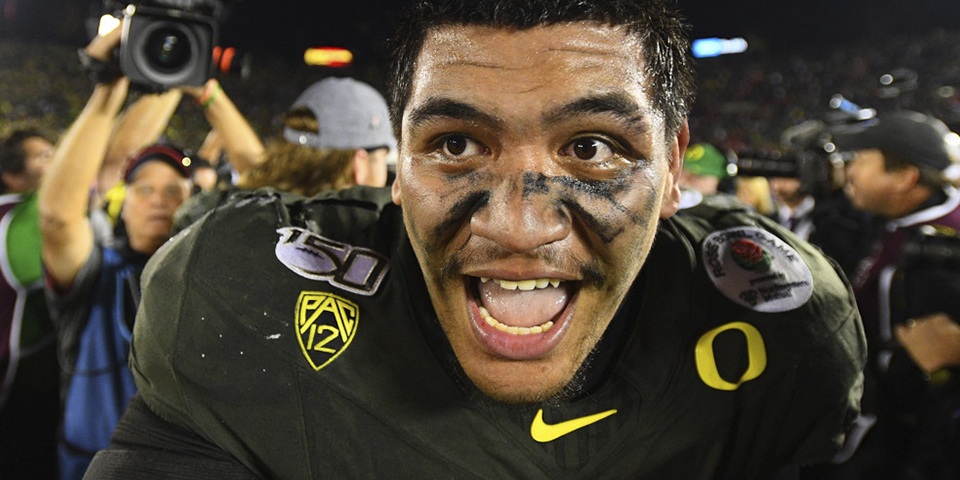
    Penei Sewell: 6-5, 330 poundsTackle – Oregon

    Final Grade: 7.2

    Sewell will immediately upgrade an NFL team’s running game with his strength and fundamentals at all levels, and with minor upper-body refinements as a pass protector will be a more than reliable blind-side protector for years to come.

    Penei Sewell was the left tackle for Oregon’s zone offense for 2 years before opting out of the 2020 season. He had shoulder labrum surgery in 2017 before enrolling but then started as a true freshman from Day 1 for 20 of 21 career games.

    He missed 6 games his first year due to a high ankle sprain that needed surgery, but returned for his bowl game. He was a teenager for every collegiate game he played. He’s high-waisted with ideal size for the position. He’s a very fluid athlete for his size and is abnormally comfortable in space. He’s a physical presence up front who sets a tone and will finish opponents at all levels of the field.

    Pass Game

    As a pass protector, Sewell is difficult to work past, but he isn’t without his faults. He kicks off the ball with fundamentally sound short steps and square footwork to all set levels. He tends to bend at the waist slightly but he sits with good knee flexion and strafes to and through contact beautifully. He seeks work and senses moving parts up front well.

    He’s not a quick-twitch athlete and has shown to be a bit rigid in pass pro with the occasional issue changing direction in tight quarters. Sewell’s biggest issue is his wide hands in his initial punch. He consistently attacks rushers’ shoulder pads instead of keeping his elbows tight and latching onto their chest plate. He can extend early and leave himself open to finesse moves inside.

    However, his anchor strength, sound, quick base, and body control at awkward angles keep him from losing most battles. Additionally, he’s an exceptional blocker ahead of screen passes, stalking and swallowing up smaller defenders in space with ease.

    Strengths Weaknesses
    Dominant run blocker Wide hands
    2nd-Level and space blocking Slight rigidity in pass pro
    Core strength
    Run Game

    The most notable facet of Sewell’s game, however, is his dominance in the run game. He was the anchor of Oregon’s ground attack and a force in any scheme to any run direction. He fires off with good pad level for his size and his core strength and wide base and feet regularly walk defenders off the ball and reset the line of scrimmage.

    On the front side of wide zones he excels at exploding his hips through a straight arm and locking out after contact to clear running lanes. He skip-pulls inside fluidly and arrives with force, and pulls outside into space like a freight train. He sustains well with great grip strength and heavy feet, but he’s at his best combination blocking up to the second level. Sewell’s ability to knock off a lineman in a double team, then advance up to and engulf linebackers is phenomenal and was the staple concept of much of Oregon’s inside run game.

    He still attacks with wide hands too often and can get caught hugging, but the rest of his elements in the run game add up to an ideal road grader.

    Last Word

    Sewell projects as an elite NFL tackle in any offensive scheme. There’s no reason to move him from the blind side, but he’d make for a dominant right tackle or guard if necessary. Sewell can stand to refine his upper-body technique in pass protection with more patience and a tighter punch, but he’s an immediate game-changer in the run and screen games.