Author: Ryan Rubinstein

  • 2025 SIS Big Ten All-Conference Team

    2025 SIS Big Ten All-Conference Team

    It’s time to release our SIS All-Conference teams. We used our all-encompassing player value stat, Total Points, along with other metrics and our scouting work as leading references in putting together our team of selections for 2025, plus some honorable mentions.

    You can learn more about Total Points and the statistics referenced within this article here.

    These picks are meant to honor this season’s best-of-the-best in the Big Ten.

    First Team Offense

    Position Name School
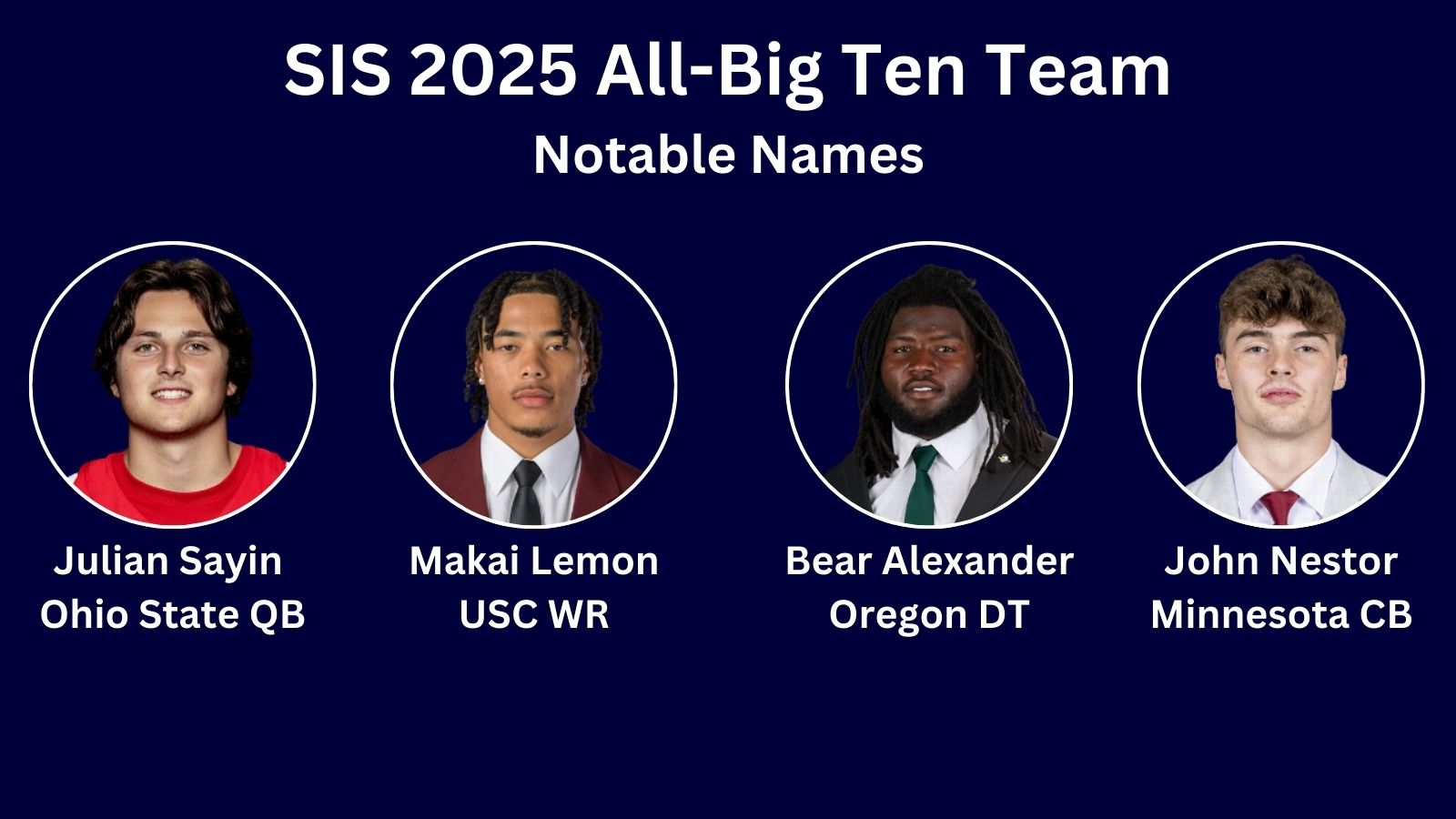
    QB Julian Sayin Ohio State
    RB Antwan Raymond Rutgers
    WR KJ Duff Rutgers
    WR Makai Lemon USC
    TE Luke Lindenmeyer Nebraska
    FLEX Jeremiah Smith Ohio State
    OT Carter Smith Indiana
    OT Caleb Tiernan Northwestern
    OG Emmanuel Pregnon Oregon
    OG Henry Lutovsky Nebraska
    OC Logan Jones Iowa

    Antwan Raymond was a star for Rutgers, and led the nation in Total Points for a running back with 78, a full 9 points higher than second place. In addition to being a valuable runner, he was a valuable protector and led all running backs in Pass Protecting Total Points. Meanwhile his teammate, KJ Duff, earned himself a spot on the list by leading the conference in receiving total points. 

    Julian Sayin not only set a record for completion percentage this year, but he also led a high power passing attack to a Big Ten Championship appearance. His 110 Passing Total Points led the Big Ten. Sayin’s teammate at Ohio State, Jeremiah Smith, was a major part of Sayin’s efficiency. His 3.5 Yards Per Route Run ranked 2nd in the Big Ten, only behind fellow First Team All Big Ten receiver Makai Lemon.

    Iowa’s offensive line was led by center Logan Jones, whose 37 Total points rank first among all centers in the country, and also ranks first in Total Points Per Snap. He was a major factor behind the success of Iowa’s running attack.

    First Team Defense

    Position Name School
    DT Kayden McDonald Ohio State
    DT Bear Alexander Oregon
    EDGE Caden Curry Ohio State
    EDGE Derrick Moore Michigan
    LB Mac Uihlein Northwestern
    LB Amare Campbell Penn State
    CB John Nestor Minnesota
    CB Davison Igbinosun Ohio State
    S Robert Fitzgerald Northwestern
    S Taj Ra-El Purdue
    FLEX Caleb Downs Ohio State

    On the defensive side, edge rushers Caden Curry from Ohio State and Derrick Moore from Michigan lead the way. Curry led the conference in Total Points and Points Saved. Moore was a major impact player this year with 36 Pass Rush Total Points. He was able to hit home often as he was second in the Big Ten in Sack Percentage when pass rushing. 

    Both Northwestern’s Mac Uilein and Penn State’s Amare Campbell ranked top 10 in the country in Total Points amongst off ball linebackers. Campbell’s run defense was excellent this year, as his 2.3 Average Depth of Tackle placed him in the top 5 of all Big Ten linebackers. Uilein’s 29 Pass Defense Total Points was the best in the conference amongst all Big Ten off ball linebackers. Uilein’s teammate, Robert Fitzgerald, was the best defensive back in the conference. His 65 Total Points ranked first, and his 43 Run Defense Total Points was second best in the country, only behind Taj Ra-El of Purdue.

    First Team Specialists

    Position Name School
    K Spencer Porath Purdue
    P Ryan Eckley Michigan State
    Returner Kaden Wetjen Iowa

    Spencer Porath was one of the lone bright spots for Purdue this season and was the definition of consistency. He made all of his extra points and only missed 2 kicks on the year, while remaining perfect from under 40 yards. 

    Michigan State’s sole selection on the First Team All-Big-Ten team is punter Ryan Eckley. He had the most total points out of any punter in the country (20). 

    Iowa’s Kaden Wetjen takes the crown for best returner in the Big Ten, as he brought back 4 different returns for touchdowns. He also averaged over 30 yards per kick return and 28 yards per punt return which rank 1st in the country in both categories among players with at least 10 returns.

    Second Team Offense

    Position Name School
    QB Fernando Mendoza Indiana
    RB Kaytron Allen Penn State
    WR Omar Cooper Jr. Indiana
    WR Hank Beatty Illinois
    TE Lake McRee USC
    FLEX Emmett Johnson Nebraska
    OT Drew Shelton Penn State
    OT Austin Siereveld Ohio State
    OG Kade Pieper Iowa
    OG Ezomo Oratokhai Northwestern
    OC Iapani Laloulu Oregon

    Heisman candidate Fernando Mendoza was amongst the most accurate passers in the country and led the country in Catchable Pass Percentage amongst players with at least 100 passing attempts with 91.2%, and was also top 5 in Yards Per Attempt with 9.4. Omar Cooper Jr. was a big part of that, as his 3.0 Yards Per Route Run was 4th in the Big Ten for players who were targeted at least 15 times.

    Kaytron Allen was 2nd in the Big Ten in Rushing Total Points, and ranked 7th in the country in Rushing Total Points Above Average. His teammate at Penn State, Drew Shelton, was 1st in the Big ten in Pass Blocking Total Points (18) and also had the 5th most Run Blocking Total Points of Big Ten OT’s (17).

    Second Team Defense

    Position Name School
    DT Aaron Graves Iowa
    DT Alex VanSumeren Michigan State
    EDGE CJ Nunnally IV Purdue
    EDGE Teitum Tuioti Oregon
    LB Rolijah Hardy Indiana
    LB Mason Posa Wisconsin
    CB Bo Mascoe Rutgers
    CB TJ Hall Iowa
    S Alex McLaughlin Washington
    S Zach Lutmer Iowa
    FLEX Brandon Finney Jr. Oregon

    Both CJ Nunnally IV and Teitum Tuioti finished top 10 in the conference in both Pass and Run Defense Total Points, as they are some of the best all around defenders in the country. Indiana’s Rolijah Hardy ranked 6th in Pass Rush Total Points per snap as primarily an off-ball linebacker. 

    Brandon Finney Jr. was 9th in the country in Pass Coverage Total Points per snap and was also top 5 in the country in Completion Percentage and Passer Rating Against. TJ Hall showed he’s a true lockdown corner as he was also top 10 in the country in Passer Rating Against amongst players with at least 10 targets against them.

    Second Team Specialists

    Position Name School
    K David Olano Illinois
    P Gabriel Nwosu Penn State
    Returner Jonathan Brady Indiana

    David Olano made all of his extra points for Illinois while maintaining an 85% FG%, and he was tied for second in the Big Ten in kicking total points (14).

    Penn State’s Gabriel Nwosu ranked second in the Big Ten in Punting Total Points (14).

    Jonathan Brady returned 37 punts (the most in the Big Ten) for an average of 18.7 yards per punt return..

    Honorable Mentions

    Name School
    QB Jayden Maiava USC
    OT Melvin Priestly Illinois
    WR Carnell Tate Ohio State
    TE Kenyon Sadiq Oregon
    C Pat Coogan Indiana
    RB Jordan Marshall Michigan
    EDGE Stephen Daley Indiana
    EDGE Gabe Jacas Illinois
    S Anthony Smith Minnesota
    OG Kwabena Asamoah Rutgers
    EDGE Dani Dennis-Sutton Penn State
    LB Daniel Wingate Maryland
    LB Bryce Boettcher Oregon
    S Koi Perich Minnesota
    EDGE Arvell Reese Ohio State
    LB Aiden Fisher Indiana

    Total Points, stats, and ranks as of 12/4/2025

  • A Midseason Review of the Micah Parsons Trade

    A Midseason Review of the Micah Parsons Trade

    Photo: Matthew Pearce/Icon Sportswire

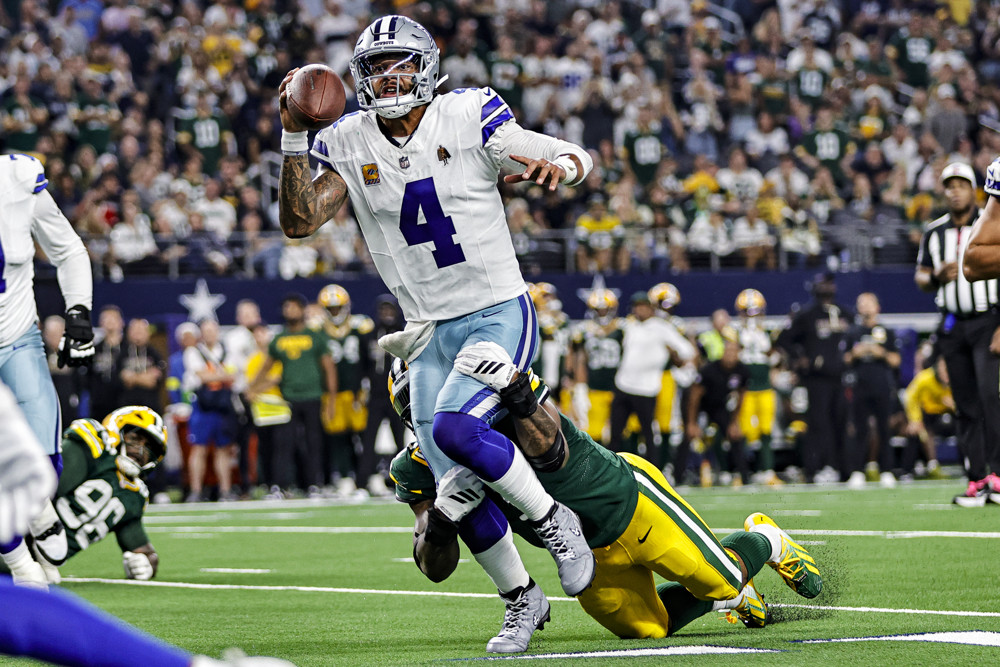
    Now that the dust has settled, we can start to examine the impact of the Micah Parsons trade that happened this offseason. Both teams are experiencing significant changes with their defense this season and not only in terms of results like pressure rate and success rate, but also with how they are structured and operate as a unit. Green Bay’s decision to acquire Parsons addressed its pass rush need, while Dallas believes that Kenny Clark will help improve its run defense.  

    With the Cowboys, Micah Parsons was asked to line up all over the defensive formation but was especially effective as a stand up rusher. In 2024, The Cowboys had pressure rates of 12.9% for stand up rushers on the left and 15% for stand up rushers on the right. This year, those numbers are 13.6% and 11.5%, respectively. 

    Sacks aren’t coming as easy for the Cowboys either. Micah was often asked to mug over the A gap, and rushers from that technique sacked the quarterback 3% of the time with a staggering 21.5% pressure rate for the Cowboys. This year, mugging linebackers don’t have any sacks for the Cowboys and they are only generating pressure on 12.5% of passing plays. 

    Parsons’ versatility was a big part of how the Cowboys were able to generate pressure in 2024, and they are changing how they present themselves to offenses to try and make up for it this year. The Cowboys are lining up with stand-up edge rushers more frequently in order to try and conceal where the rush may be coming from. 

    As the Cowboys try to hunt for a comparable replacement strategy off the edge, the player they got in return, Kenny Clark, does not seem to be living up to expectations in Dallas. He has not been the difference-making run stuffer that Dallas had dreamed of, as the Cowboys defense is giving up 0.9 EPA/30 Rushes with him on the field and 0.6 EPA/30 Rushes when he’s off the field. In other words, he is not improving their run defense like the Cowboys had hoped. The last five games they’ve allowed an average of nearly 170 rushing yards allowed.

    Additionally, the Cowboys are significantly worse against the pass when Clark plays as well, giving up 9.0 EPA/30 Passes when he is on the field and -0.6 EPA/30 Passes when he’s off the field, yet the Cowboys are still playing him on 68% of passing downs. 

    Conversely, and as expected, Micah Parsons is transforming the Packers passing defense. He is a major factor against the pass, as the average EPA/Play on passing downs is nearly a full 0.1 per play better when he is on the field. The Packers’ defense also performs better as a unit against the run while he is in, allowing -3.6 EPA/60 Plays when he is on the field and -2.4 EPA/60 Plays when he isn’t.

    In tangible terms, he is more than doubling Kenny Clark’s pressure percentage as a pass rusher with a 23% pressure rate compared to Clark’s 9%.

    It remains to be seen who will ultimately prosper the most from this trade as the Cowboys are owed multiple first-round picks. But the initial returns have an immensely positive effect for Green Bay as the Packers have ultimately found their star pass rusher while maintaining success against the run. Meanwhile Dallas not only failed to improve its run defense, but is now struggling to replace the passing rushing success it once had with Parsons.

  • Study: The Impact Of The NFL’s Kickoff Rule Changes

    Study: The Impact Of The NFL’s Kickoff Rule Changes

    Through one month of the NFL season the changes to the kickoff have seemingly divided football fans. This year, the NFL decided that a touchback that first lands outside the landing zone (20 yard line back to the goal line) is brought to the 35 yard line rather than the 30 yard line like in 2024.

    Is one minor change producing higher return rates, better average field position, and shorter kick hang times? Kickers are even kicking the ball in different ways to try and combat excelling return rates. We’ll look back and compare to last season to see just how much things have changed. 

    Kick Type

    The 2025 season has featured the highest use of non-normal kick types on kickoffs that we have seen. At SIS, we track kick types, and we classify a “normal” kickoff as a kick with a typical trajectory having a hang time between 3.3 – 3.8 seconds. 

    Through the first four weeks of the season, there has been a non-normal kick on 28% of kickoffs (not including squib or onside kicks). Comparatively in 2024, there was a non-normal kick on only 7% of kickoffs. Kickers are actively reducing their hang time and changing the way they kick the ball to either add or take away spin. 

    Hang time

    The increased frequency of line drive kicks is manifesting itself in the hang time as well. During the 2024 season, the average hang time on NFL kicks was 3.86 seconds. Through the first month this season, the average hang time is down to 3.37 which is about half a second shorter than last season. The difference between 2024 and 2025 gives kick returners more opportunity to create explosive returns with increased return lanes available. 

    The average hang time the two seasons before the Dynamic Kickoff was implemented was 4.00. A big part of this is the kicker allowing the ball to hit the ground before it can be caught by the returner, which in turn gives the kick coverage more time to cover potential return lanes. 

    Even if you look within a given kick type, the kicks are spending less time in the air. On non-line-drives, the average hang time is about a third of a second shorter than it was a year ago.

    Returns

    The decreased hang time on kickoffs is encouraging teams to take a chance and return the ball at a much higher rate than 2024. Last season 65% of kickoffs resulted in touchbacks, whereas so far in 2025 only 17% of kickoffs have resulted in touchbacks. 

    However, the results of returned kicks have been basically the same. The average length of returns are slightly down from last year (27 yards in 2024 and 25 in 2025). That’s made up by the average start of the return increasing from the 2 yard line to the 4 yard line between seasons. With touchbacks outside the landing zone being brought out to the 35, kickers are incentivized to make sure the kick lands in the landing zone thus producing returns at a significantly higher rate and those returns starting slightly farther from the end zone. 

    If you incorporate the touchbacks and returns into a single average, the resulting field position has nudged forward a bit, but not by much. From 2016 to 2024, teams started their drive somewhere between the 23 and 24 yard line on average every year. In 2025 so far, the average is the 26 yard line.

    Injuries

    One of the big talking points around the use of the dynamic kickoff was the potential for getting more action without increasing the rate of injury. Through four weeks of kickoffs, the per-play injury rate has been consistent with previous years, but the dramatic spike in returns leads to more total injuries. 

    SIS has charted more injury events on kickoffs through Week 4 than the previous three years combined. But those have come on a similar increase in returns. If you look per-return, the injury rate is a bit higher than 2023-24 but right in line with 2021-22. 

    Findings

    It’s still early, but a simple change of moving a touchback from the 30 yard line to the 35 yard line is producing some consequential effects in how the game looks, but it may not be changing as much as people initially thought. Contrary to popular belief, the average starting field position for all returned kicks is the 29 yard line, which is the same for both 2024 and 2025. Injuries are up, but that’s just a factor of there being more football happening. 

    One thing we know for sure: return rates are dramatically increasing and kickers are kicking the ball with less hang time in order to keep the length of return down. So far it’s been working.

  • 2023 SIS Mountain West All-Conference Team

    2023 SIS Mountain West All-Conference Team

    It’s finally time to release our SIS All-Conference teams. We used our all-encompassing player value stat, Total Points, along with other metrics and our scouting work as leading references in putting together our team of selections for 2023, plus some honorable mentions.

    You can learn more about Total Points and the statistics referenced here.

    These picks are meant to honor this season’s best-of-the-best in the Mountain West.

    Offense

    Position Name School
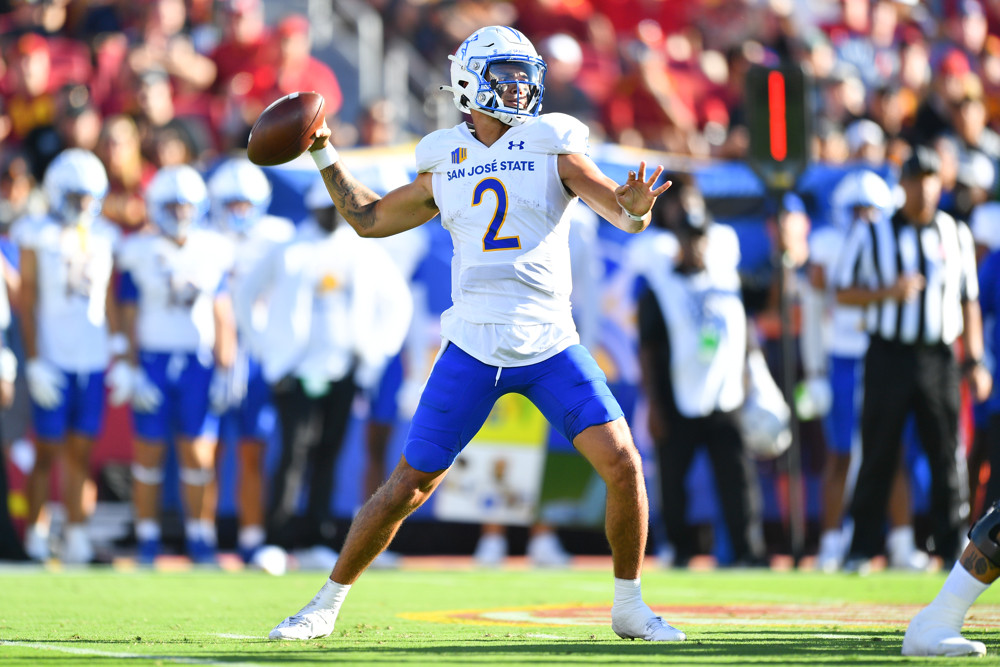
    QB Chevan Cordeiro San Jose State
    RB Ashton Jeanty Boise State
    WR Ricky White UNLV
    WR Tory Horton Colorado State
    TE Dallin Holker Colorado State
    FLEX Jacory Croskey-Merritt New Mexico
    OT Adam Karras Air Force
    OT Tiger Shanks UNLV
    OG Ethan Jackman Air Force
    OG Cade Bennett San Diego State
    OC Thor Paglialong Air Force

    Air Force’s offensive line was dominant all season, and Adam Karras, Ethan Jackman, and Thor Paglialong all ranked top-5 in the conference in Blocking Total Points. Chevan Cordeiro led all quarterbacks in the conference in Passing Total Points and nearly doubled the total points of 2nd place on only nine more passing attempts.

    Running backs Ashton Jeanty and Jacory Croskey-Merritt rank 1st and 2nd, respectively, in Total Points, and both running backs were top-10 in the conference in Broken/Missed Tackles per attempt.

    Ricky White solidified himself as a certified deep threat, and aside from leading all Mountain West receivers in Total Points and EPA, he also led them in yards per route run, air yards, and intended air yards.

    Defense

    Position Name School
    DT Jordan Bertagnole Wyoming
    DT Payton Zdroik Air Force
    EDGE Mohamed Kamara Colorado State
    EDGE Bo Richter Air Force
    LB Alec Mock Air Force
    LB Andrew Simpson Boise State
    CB Jay’Vion Cole San Jose State
    CB A’Marion McCoy Boise State
    S Trey Taylor Air Force
    S Alexander Tuebner Boise State
    FLEX Cameron Oliver UNLV

    Mohamed Kamara led all Mountain West pass rushers with 26 Total Points and 61 total pressures. Bo Richter wasn’t far behind him with 24 Total Points and 24 quarterback hits, good enough for 2nd in both categories. Andrew Simpson was able to generate pressure on 20% of his pass rushes, which ranked 11th out of all Mountain West defenders with at least 10 pressures.

    Alex Mock and Trey Taylor were both fantastic in coverage for Air Force as they each gave up 0.1 and 0.2 Yards per Coverage Snap, respectively. Trey Taylor also boasted the 2nd-lowest Passer Rating Against him with a rating of 8.2. Cameron Oliver was an all-around force for UNLV, tying his teammate and honorable mention, Jaxen Turner, to lead the conference in interceptions with 5 while also having 3 defensive touchdowns.

    Specialists

    Position Name School
    K Jose Pizano UNLV
    P James Ferguson-Reynolds Boise State
    Returner Jacob de Jesus UNLV

    Jose Pizano led the Mountain West in field goals made, attempted, and FG% while knocking in 100% of his extra point attempts (55-of-55).

    James Ferguson-Reynolds was the best at pinning punts inside the 20 and the 10, and also boasted the highest net average in the conference.

    Jacob de Jesus was dynamic as both a kick and punt returner this season. His 807 kick return yards is the highest in the Mountain West and lead 2nd place by nearly 250 yards.

    Honorable Mentions

    Name School
    RB Kairee Robinson San Jose State
    TE Caleb Rillos Air Force
    TE Mark Redman San Diego State
    OL Wesley Ndago Air Force
    ED Ahmed Hassanein Boise State
    LB Easton Gibbs Wyoming
    LB Jackson Woodard UNLV
    CB Morice Norris Jr. Fresno State
    S Jaxen Turner UNLV
    K Jonah Dalmas Boise State

    Air Force was able to run the ball all over, and with 3-of-5 of the offensive line making the all conference team, they still had some honorable mentions. Wesley Ndago and Caleb Rillos both posted a remarkably low Blown Block % of 0.9% in a run-heavy offense.

    Morice Norris Jr. was lockdown all year, giving up only 0.4 yards per cover snap and a 40% completion percentage. Wyoming’s Easton Gibbs was a tackle machine, making nine tackles a game which ranked 5th in the conference.

    Check out this year’s NFL Draft site to see how we feel some of these players project to the NFL.

    Total Points, stats, and ranks as of 3/28/2023