Author: Chris Lee

  • Optimistic and Pessimistic Takeaways for the Seahawks and Rams After Week 16

    Optimistic and Pessimistic Takeaways for the Seahawks and Rams After Week 16

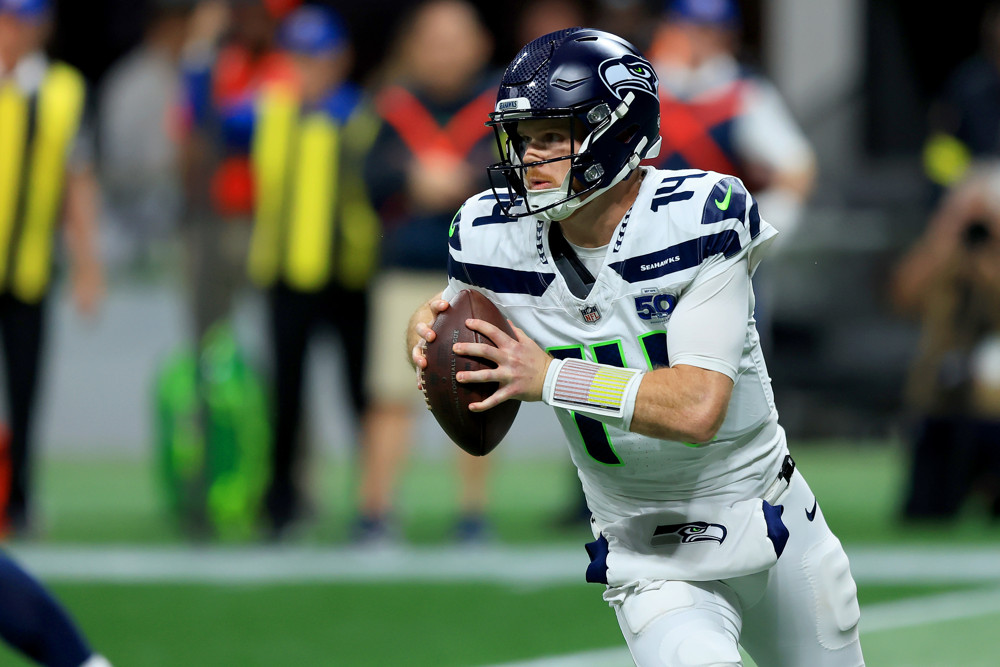
    Photo: David J. Griffin/Icon Sportswire

    Arguably the biggest game of the year so far took place last Thursday night and it did not disappoint. History was made, with us witnessing the first NFL game to end with a walk-off 2-point conversion. The Seattle Seahawks got their revenge and defeated the Los Angeles Rams 38-37, gaining the inside track to representing the NFC as the first seed in the process. 

    The Rams will be kicking themselves for letting go of the game that was all but theirs, but all is not lost. They should still feel confident in their chances come January, backed by the fact that they rank 1st overall in our team Total Points metric.* 

    *For a refresher, here is our primer on Total Points.

    The Seahawks came into the match ranking 2nd themselves, and the two bouts between them so far have further emphasized how neck and neck the two clubs are, well summarized by this stat

    Let’s take a deeper look into why each team should and shouldn’t feel confident about its chances to win it all.


    Why the Seahawks can win the Super Bowl: Improving rushing attack, special teams advantage

    In my previous article, I covered why the Seahawks should still feel like they’re in the mix due to their defense but in order to truly contend, they will need to answer questions about both their running and passing games, especially against elite defenses in high-stakes moments. 

    While they still have more to prove to completely quell those concerns, especially in their passing attack, their showing last Thursday was a step in the right direction. 

    The Seahawks entered the game with the 2nd worst rushing EPA per attempt in the league. Given that placement, it may seem odd that they ranked 14th in rushing Total Points per attempt, but that can be explained by them ranking as the worst run blocking unit in the same metric. 

    They arguably had their best rushing performance of the season so far, gaining 171 yards on 25 carries, with two of those resulting in touchdowns. The numbers matched what our eyes were telling us, improving across the board:

    Rushing EPA/A Rushing TP/A Run Blocking TP/A
    Weeks 1-15 -0.10 0.05 0.15
    Week 16 0.24 0.27 0.25

    Seattle must continue to demonstrate that it can punish opposing defenses on the ground and take pressure off Sam Darnold and the receiving corps. Teams that end up lifting the Lombardi trophy are often the best at problem solving and have other pitches to go to when their fastball is compromised, so to speak.  

    An area they have already proven to be among the league’s elite throughout the season is special teams. The Seahawks rank 6th in special teams Total Points per play, backing up that ranking with top 5 rankings in both punt and kickoff average return yards. 

    The momentum-shifting punt return touchdown by Rashid Shaheed upped Seattle’s combined punt and kick return touchdown total to three, tied for most in the league. They also have three combined punt and field goal blocks, again tied for most in the league, showcasing their penchant for making plays in all phases of special teams.


    Why not the Seahawks: Passing questions remain, turnovers

    To Sam Darnold’s credit, he demonstrated that he could deliver when the team needed him to and win a game with massive stakes, particularly against a team who has given him the most trouble the past couple of seasons. 

    For the last half of the fourth and overtime, Darnold went 8 for 11 (excluding a spike) for 91 yards and two touchdowns, in addition to completing two 2-point conversions. At least for one game, he was able to get the proverbial monkey off of his back. 

    For the first three-and-a-half quarters however, things didn’t seem that way, with Chris Shula and his defense seemingly flummoxing Darnold at every turn and forcing two back-breaking picks, both with disguised coverages. 

    I noted previously that up through Week 11, the Seahawks had a negative passing EPA for the season when facing dime personnel (6+ defensive backs). Things were more of the same last Thursday, with them posting a 10% success rate and -13 EPA against dime (-5 EPA against nickel as well).

    There is still time for Darnold and the Seahawks to establish whether they can perform consistently when in obvious passing down situations, but for now things don’t look fixed.

    In addition to the two aforementioned interceptions, Cooper Kupp also lost a fumble to his former team, bringing Seattle’s turnover total up to 26, second-most in the league. Denver, San Francisco, and Seattle are the only teams over .500 with a negative turnover differential. 

    Teams who have lost the turnover battle are a combined 41-143-1 so far in the 2025 season.  Needless to say, the Seahawks need to turn things around in that department to give themselves the best chance come January.


    Why the Rams can win the Super Bowl: Complete team on offense

    In a lot of ways, the Rams are who the Seahawks want to become on offense. They are 1st in offensive team Total Points per play, in large part due to having top 5 players at both quarterback and wide receiver in Matthew Stafford and Puka Nacua. 

    Even having to face an elite defense, Stafford lit up the Seahawks, throwing for 457 yards and three touchdowns with no picks. Nacua accounted for 12 of those completions, racking up a ludicrous 225 yards and two touchdowns. 

    If that wasn’t enough, they also employ the receiving touchdowns leader, Davante Adams, though it may take a while for him to return to form, as detailed in this piece by Alex Vigderman.

    The passing attack is counterbalanced by a solid run game led by Kyren Williams and Blake Corum, ranking 3rd in rushing success rate and 4th lowest in percentage of runs hit at the line. 

    Since Week 9, the midway point of the season, among tailbacks, Williams ranks 1st in rushing EPA per attempt and 11th in Total Points per play, while Corum ranks 12th and 6th in those same categories respectively. 

    Their offensive line is nothing to sneeze at either, ranking 3rd in blocking Total Points per play. They have the 4th lowest blown block percentage in the league and rank 2nd and 4th in sack and pressure percentage allowed, respectively. The Seahawks couldn’t bring Stafford down even once. 

    Over the full season, both the Rams and Seahawks are among the best teams in keeping the quarterback clean (and doing so without spamming quick game).

    Scatterplot of blown block rate and pressure rate allowed, with a slight trend between them. The Seahawks and Rams are in the bottom-left (good) end.

    * Bottom left is best


    Why not the Rams: Defensive slippage, special teams mistakes

    Honestly a bit of a nitpick here, as I would consider the Rams to employ a good defense. But no team is perfect and they are no exception. 

    The Rams are quietly 19th in run defense Total Points per play. They have allowed over 120 rushing yards in four of their past six games, and two of those four have resulted in losses, including Thursday night. 

    Against play action, they came into the game ranked T-7th-worst in EPA allowed per dropback, 8th-worst in boom percentage allowed, and 2nd-worst in bust percentage forced (where boom plays gain the offense 1 EPA or more and bust plays lose the offense 1 EPA or more). The Seahawks exploited this, with Darnold completing 10 of 13 passes for 167 yards and two touchdowns when in play action. 

    If opposing teams can establish their attacks on the ground and make hay with play action, the Rams have shown themselves to be susceptible. 

    A not-so-quiet underperforming phase of their team that reared its head in this game is special teams, and this proved to be the straw that broke the camel’s back with the firing of their special teams coordinator, Chase Blackburn. 

    The Rams rank 23rd in special teams Total Points per play. Special team blunders played a crucial role in three of their four losses this season, which include allowing two blocked field goals—one of which was returned for the game-deciding touchdown—against the Eagles, allowing a blocked extra point against the 49ers, and then giving up the punt return touchdown to the Seahawks.

    Final Words

    The Seahawks should be feeling great after wrestling away control of the NFC, but they know the job is not finished. They have questions they will need to continue to address through the end of the regular season and into the playoffs. 

    On the other side, even though they lost, the Rams have a solid argument for being the NFC’s best and most complete team. Their questions may prove to be more easily addressable as well. 

    Both the Seahawks and the Rams are top five teams by almost any overall measure of team quality. They are evenly matched through two, and there is a decent chance the two will meet again for a third and final match. 

    The winner may well represent the NFC in Santa Clara. Which of the two will come out victorious? I, for one, can’t wait to find out.  

  • The Seahawks Are Down, But Their Defense Has Shown They’re Not Out

    The Seahawks Are Down, But Their Defense Has Shown They’re Not Out

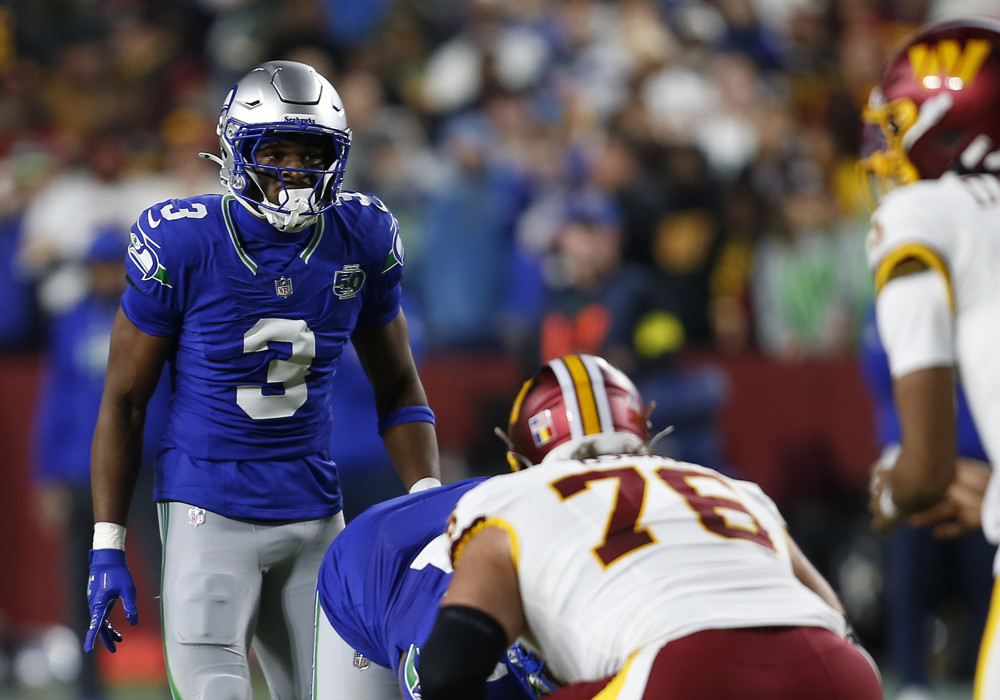
    Photo: Lee Coleman/Icon Sportswire

    The Seattle Seahawks did not get what they were looking for when they visited Los Angeles, leaving town with a loss to an excellent Rams team and taking a significant blow to their odds of capturing the NFC West crown. Much has been made about Sam Darnold’s poor performance in big time games – rightfully so – and that will continue to be the case until he can flip the script. 

    All is not lost in the Emerald City, however. Despite all four interceptions ending up giving the ball back to the Rams in Seattle territory, the Seahawks managed to somehow still have a chance to win it with a kick as time expired, mostly thanks to their defensive unit. 

    Let’s take a deeper look into what makes them one of the best defenses in the league and why they still have a shot to make some noise come January. 

    The Rams came into the matchup ranked as the 2nd-best offense in our Total Points Per Play metric and had been on a heater, dropping 34 points or more in each of their previous three games. The Matthew Stafford MVP campaign was in full swing, with him tossing 13 touchdowns against no interceptions in that span. 

    Stafford had a much less enjoyable time this past Sunday, mustering just 130 yards on 28 pass attempts. 

    Stafford was pressured on 46% of those dropbacks, more than 10 percentage points above his season average. His on-target rate was also down more than 10 percentage points below his season average when pressured, and his average throw depth was four yards shallower than usual. 

    A graph showing the jump in pressure rate and the drop in on-target rate for Matthew Stafford Pressure Rate vs Stafford Through Week 10 35% Week 11 46% On-Target Rate Week 1- 10 67% Week 11 58%

    In a press conference a few days before the game, Seahawks head coach Mike Macdonald said he “agreed to a large extent” when asked about Greg Olsen’s comments on how he would deploy defensive units based on down and distance tendencies rather than match up based on personnel. 

    The Rams deploy 13 personnel (1 running back and 3 tight ends) more than any other team in the league, which is something that could be awkward for a defense to handle if it were inclined to sub players to match. From Weeks 1 to 10, the Rams had both quantity and quality when passing out of 13 personnel, posting a top five success rate.

    So one could think that the deployment based on down and distance approach is better suited to stopping this sort of attack, but it is not so simple. The Rams also posted a top five rushing success rate out of 13 personnel before Week 11. They want to dictate the terms of the matchup. 

    If the opponent tries to meet size with size, they will get those bigger bodies out in space and pressure them to cover. If the defense goes lighter with nickel or dime to defend the pass, they will force those defensive backs to make tackles and defend the run. 

    The Seahawks do have the personnel to win with this aforementioned approach. They play in nickel more than any team in the league, including against 13 personnel. They rank 1st in passes defensed, sacks, and pressures. And in this game, the Rams were able to gain only 4 yards on 6 pass attempts in 13 personnel against the Seahawks (the Rams did score a passing touchdown).

    A graph showing where teams stand in pressures and passes defensed in nickel. The primary point of the chart is to show that the Seahawks have the most in both statistical categories

    Perhaps more impressively, against the run, Seattle ranks 2nd in EPA per carry allowed and 7th in run stuff rate (rushes resulting in 0 or fewer yards).  Kyren Williams did break a 30-yard run, but outside of that, he and Blake Corum were held to 15 yards on 10 carries while in 13 personnel. With Uchenna Nwosu, DeMarcus Lawrence, Leonard Williams, and Byron Murphy II, Seattle has a four-man front capable of stopping the run even when in nickel. 

    A player to keep an eye on is Nick Emmanwori, the South Carolina safety the Seahawks traded up for to take at near the top of the second round in last year’s draft. Emmanwori came into the league with a bit of that athletic but raw stereotype, but he has shown he can still be an all-around playmaker as he continues to develop his game. 

    In seven games, he has already recorded seven passes defensed and five tackles for loss against the run, showcasing the type of versatility necessary to make Macdonald’s scheme soar. They are stylistically different, but one can see what type of impact they envision him to be capable of when you think back about Macdonald’s deployment of a certain All-Pro safety he coached in Baltimore, Kyle Hamilton. 

    In order for the Seahawks to truly be taken seriously and considered among the league’s elite, they must prove that they can dictate the terms on offense. 

    Seattle has enjoyed offensive success up to this point in large part due to its ability to complete explosive plays against base defenses. The Seahawks rank 1st in passing EPA and boom rate when facing base. However, last week’s game showed that teams will not make it so easy for them going forward.

    The Rams invited the Seahawks to try to run on them, primarily playing in dime and nickel. Though not a poor showing overall, Seattle could not truly take advantage when the Rams brought in lighter bodies, gaining only 20 yards on six carries against their dime defense. 

    On the season, Seattle ranks in the bottom 10 in rushing EPA per attempt against both dime and nickel. Teams will continue to encourage the Seahawks to run the ball until they can prove they can punish defenses on the ground.

    Until that happens, Seattle will continue to have to be overly reliant on its passing game to make up ground, which in this matchup turned out to be its death knell. The Seahawks had the most pass attempts versus dime personnel in Week 11. They have a negative passing EPA for the season when facing dime. Darnold needs to demonstrate he can perform consistently when in obvious passing down situations. 

    The Rams visit Seattle for another clash in Week 16. The Seahawks defense will be ready. The question is will the offense be? The answer to that will determine whether or not the result will be different for their rematch that could decide the NFC West crown.

  • Introducing Our Multi-Year Injury Risk Model

    Introducing Our Multi-Year Injury Risk Model

    Injuries. Everyone hates them, and we all can agree injuries are the worst part of sports. 

    Part of the reason is that injuries can occur when you least expect them, and there are so many different variables that can come into play for why they happen, making it very difficult to accurately predict them. Unfortunately we cannot just turn injuries off like we are playing a game of Madden, and so there can be great value in trying to provide something to base expectations off in terms of how much time a player misses. With our multi-year injury risk model, we aimed to do just that.

    Methodology

    Football can vary greatly depending on what position you play, and so we split our player dataset into three different position groups: offensive skill players, offensive linemen, and defensive players. We also wanted to test various time frames, so we made predictions for the number of games players will miss in one-, two-, and three-year spans. Features incorporated in our dataset include biographical data, injury history data, playing time data, and other stats that convey what the player does on the field.

    We used the XGBoost machine learning framework to build our regression model. For our target variable, to lessen the impact of outlier cases, we took the average of the number of games missed in the next year (or two or three) and the number of games the player was expected to miss based on the injury prognosis (which is something that our injury staff logs for most injuries). 

    Findings

    Games Missed Prediction Error by Position Group and Timeframe

    One Year Two Years Three Years
    Offensive Skill Players 3.6 5.9 7.1
    Offensive Linemen 3.7 5.3 7.3
    Defensive Players 3.7 6.2 7.3

    Root mean squared error (RMSE) was used to evaluate the accuracy of our model. As we can see above, overall, the accuracy is similar across positions, with accuracy predictably being better the shorter the time frame is. However, it can also be argued that the three-year model was the most accurate because when you divide the RMSE by the number of games corresponding to that time frame (i.e. 17 games in one year, 51 games in three), the ratio is smallest for the three-year interval. Therefore, the model predicted games missed for the longest time span with the least error percentage-wise. 

    Average Predicted Games Missed by Position Group and Timeframe

    One Year Two Years Three Years
    Offensive Skill Players 2.2 5.2 7.7
    Offensive Linemen 2.4 6.4 8.2
    Defensive Players 2.1 4.6 6.4

    We observe more of a discrepancy across position groups when examining the average predicted games missed. For all three time intervals, offensive linemen were predicted to miss the most games, followed by offensive skill players, and then lastly the defensive players. This is in line with the trend for actual games missed by position group.

    Top 10 Feature Importances by Position Group

    Here are the top 10 features in terms of importance (how much a feature contributes to a model’s predictions) by position group for the three-year interval.

    Offensive Skill Offensive Linemen Defensive
    1. Snap % in the Slot Snap % Playing Tackle Age
    2. Snaps Blocking Projected Snaps Total Points per Snap
    3. Age Games Missed Past Year Projected ST Snaps
    4. Total Points per Snap Blown Block % Snap % Playing Linebacker
    5. Special Team Snaps Total Points per Snap Special Team Snaps
    6. Snaps in Motion BMI Projected Snaps
    7. Projected Snaps Snaps on Pass Plays Snap % Playing Run Defense
    8. Routes Run Age Snap % Pass Rushing
    9. Games Missed Past 3 Years Games Missed Past 3 Years BMI
    10. Snaps Player was Hit Snap % Playing Guard Tackles Made

    We can see that projected snaps and age were among the most significant for each position group. To dive deeper into why, we ran a comparative analysis between players in the top half of predicted games missed and players in the bottom half.

    Comparison of Key Features for Skill Position Players, by Predicted Games Missed

    The table below shows an example of one of our datasets, skill players in a two-year time span. 

    High Prediction Low Prediction
    Predicted Games Missed, Two Years 6.1 4.4
    Snaps Played Past Season 835 554
    Projected Snaps Next Two Years 1,503 1,045
    Age 26.6 27.4

    We can observe that on average, players who are predicted to miss more games have played more snaps in the previous season, are projected to play more snaps the next two years, and are about a year younger than players who are predicted to miss less games. 

    This pattern was more or less present across all our datasets. At first, this may seem counterintuitive. One could think that older players are more injury prone or that players are projected to play less because they got hurt. However, the data is telling a different story; players are predicted to miss more games when they are expected to also play more games. Playing football is itself a hazard.

    One place where this trend reverses is at the very end of a career. Among the 1,700 players we made predictions for 2025 and beyond, about two dozen players were predicted to miss more games in a two-year period than in a three year one, a finding that was quite confounding at first. However, when comparing these players to the rest of the population, an even larger discrepancy in age existed, with them being three years older on average than their counterparts. The model was picking up signals for when a player was close to retirement and inferring reduced playing time over a three-year span. For these cases, we adjusted the number of predicted games missed in three years to be equal to the two-year number. 

    We observed more trends when taking a look at who our model predicted to miss the most games. 

    Top 10 Players Predicted to Miss the Most Games Over a Three Year Span

    Player Position One Year Two Years Three Years
    Kamari Lassiter, HOU CB 4.0 8.7 14.6
    Rashawn Slater, LAC OT 3.5 9.1 13.7
    Paulson Adebo, NYG CB 4.4 8.1 13.6
    Derek Stingley Jr., HOU CB 3.4 8.3 13.3
    Dalton Kincaid, BUF TE 3.3 9.5 12.9
    Kyle Pitts, ATL TE 2.3 7.0 12.9
    Luke Goedeke, TB OT 3.7 9.1 12.8
    Pat Freiermuth, PIT TE 2.8 8.5 12.8
    Alaric Jackson, LAR OT 3.0 7.8 12.6
    Jake Ferguson, DAL TE 3.2 8.1 12.6

    First, every player was drafted in 2021 or later, keeping in line with the propensity of our model to predict younger players missing more games than older players (in large part because younger players are on the field more). 

    Second, all players had sustained a multi-week injury at some point during the last three years. Indeed, though not as prevalent as the other key features, missed games in past years were greater on average for players in the top half of predictions than for those in the bottom half. 

    Lastly, within the three position groups, our model predicted tight ends, offensive tackles, and cornerbacks to be more prone to injury, and accordingly, everyone on this list plays one of those positions.

    Conclusion

    While attempting something as inherently difficult as predicting the number of games a player will miss due to injury in a given time frame may seem like a lemon that is not worth the squeeze, our study shows there is value in going through the exercise and extracting inferences from the data. Chief among them is that the more a player is on the field, the more he invites risk of getting injured. 

    This is a simple premise, but one that is often more overlooked than it should be, and emphasizes even more just how much we should appreciate players who exhibit extraordinary durability. 

  • Evaluating How A Quarterback’s College Accuracy Projects To The NFL

    Evaluating How A Quarterback’s College Accuracy Projects To The NFL

    Photo: Andy Altenburger/Icon Sportswire

    The NFL Draft is always a tricky thing to figure out. Drafting well can propel a franchise for sustained success, but whiffing on picks, especially at the top of the draft, can set a team back for years. This applies even more so when it comes to quarterbacks. Teams are constantly trying to find the slightest edge over their competition, and so there is great value in discerning if an aspect of a player’s play in college can reliably indicate how they will perform in that same aspect in the NFL.

    For that purpose, we wanted to investigate how strong of a correlation existed between a quarterback’s accuracy in college and in the NFL. To give it a little more specificity, we compared on-target percentage between college and the NFL at three specific depths. When running correlation and linear regression tests, we got results that are in line with what one would have expected, in terms of on-target percentage for short passes having the strongest correlation between college and the NFL.

    On-Target Percentage Depth Correlation Coefficient Adjusted R2
    Short (< 11 yards) 0.73 0.50
    Intermediate (11-20 yards) 0.36 0.09
    Deep (> 20 yards) 0.34 0.07

    The above table shows how career college on-target percentage at different depths predicts NFL on-target percentage in the first 2 to 3 years (at least 2 years and 300 passing attempts, at most 3 years). SIS started tracking college football in 2016 and 22 quarterbacks qualified by these criteria since then.

    While the order of correlation may not be the most exciting discovery, just how strong the correlation is for short passes is worth paying attention to. At the very least, a prospect’s college on-target percentage for short passes is a good piece of context to include when considering how accurate he could be at that depth at the next level.

    When observing the graph above, there are other interesting bits of information to take away. Let’s take a moment to compare Josh Allen and Zach Wilson. Both came out of college being described as boom-or-bust prospects with big arms and a penchant for big plays, but questionable accuracy, decision making, and reliance on hero ball at times. We can see that in college they had similar accuracy on short throws (and intermediate throws as well, as seen in the graph below), but at the next level Allen has been able to deliver accuracy above expectations while Wilson’s accuracy has been underwhelming. This offers insight on one potential factor out of many for why their careers have taken different directions.

    Results for correlation testing at the intermediate and deep levels are not as strong, though not insignificant and therefore still worth mentioning. One note to take away from all three charts is that Baker Mayfield was the most accurate at all three depths in college and that has translated into him now being one of the more accurate passers in the NFL, a trait that belies his gunslinger reputation.

    On-Target Percentage and Overall QB Performance

    With these results in mind, we wanted to discover whether they could tell us anything in terms of performance, and therefore we performed correlation testing between on-target percentages and IQR (Independent Quarterback Rating, an SIS quarterback metric that builds on the traditional Passer Rating formula by considering the value of a quarterback independent of results outside of the his control such as dropped passes, dropped interceptions, throwaways, etc.).

    NFL Accuracy by Depth Correlation with NFL IQR
    Short (< 11 yards) 0.55
    Intermediate (11-20 yards) 0.74
    Deep (> 20 yards) 0.24

    First, we wanted to test with NFL accuracy numbers because if there was no significant correlation, then there would not be much reason to check for correlation between college on-target percentage and NFL IQR. We can see that short and especially intermediate accuracy share a strong correlation to QB performance and therefore being more accurate on intermediate throws could be a little more valuable when evaluating prospects than at other depths.

    College Accuracy by Depth Correlation with NFL IQR
    Short (< 11 yards) 0.34
    Intermediate (11-20 yards) 0.38
    Deep (> 20 yards) 0.16

    When testing with college accuracy numbers, the results are understandably not as strong. However, the strength of correlation follows the same order with intermediate on-target percentage coming in first, followed by short, and then lastly deep. Deep accuracy showing weak correlation to QB performance makes some sense on an intuitive level even if solely because long throws are rarer and more volatile in nature.

    2024 Draft Class

    The 2024 draft class was not included in the study above due to having only one season under its belt. However, evaluating their rookie seasons against their college careers (both with a minimum of 300 attempts) could prove useful in terms of identifying bounce back or regression candidates. Among these players, when taking a look at Caleb Williams, his intermediate on-target percentage had the largest drop off at any depth between college and the NFL. If his intermediate accuracy bounces back, we could see better production from him in year two.

    Stats Bo Nix Caleb Williams Drake Maye Jayden Daniels
    Coll OnTgt% Short 83% 84% 79% 78%
    NFL OnTgt% Short 83% 81% 83% 80%
    College OnTgt% Intermediate 60% 63% 63% 63%
    NFL OnTgt% Intermediate 61% 48% 55% 64%
    College OnTgt% Deep 52% 47% 50% 49%
    NFL OnTgt% Deep 44% 40% 43% 54%
    NFL IQR 92.7 88.0 84.8 104.6

    2025 Draft Class

    Looking ahead to the 2025 draft class, outside of Riley Leonard and Tyler Shough, the other eight prospects are fairly bunched together in terms of their short accuracy in college, so making any meaningful predictions for how they will compare to each other at the next level could prove difficult. One nugget to file away is Jaxson Dart’s lead in accuracy on intermediate throws, potentially one positive indicator for his overall performance if he is able to replicate that level of precision in the NFL.

    Player OnTarget% Short OnTarget% Intermediate OnTarget% Deep
    Cameron Ward 82% 67% 46%
    Dillon Gabriel 84% 64% 58%
    Jalen Milroe 82% 56% 51%
    Jaxson Dart 84% 74% 51%
    Kurtis Rourke 83% 62% 51%
    Kyle McCord 81% 61% 55%
    Quinn Ewers 82% 66% 48%
    Riley Leonard 79% 59% 45%
    Shedeur Sanders 83% 69% 55%
    Tyler Shough 79% 58% 47%
    Will Howard 81% 60% 49%

    Conclusion

    While recognizing the limitations of sample size and various factors outside of a quarterback’s control, our study shows there is some value in considering a quarterback’s accuracy in college, especially on short throws, when projecting how accurate he may be at the same distances in the NFL.

    Separately, we found that accuracy on intermediate throws had the strongest correlation with a quarterback’s overall performance, with short throw accuracy coming in second. Deep accuracy had a significantly weaker correlation, presumably due to deep throws inherently being more volatile, at least in part. While dropping a 60 yard bomb right into a receiver’s hands may draw the most applause, a quarterback’s accuracy at shallower depths may prove to be more insightful when projecting how he might perform in the NFL.