Author: Bryce Rossler

  • Are The Seahawks Sam Darnold-Proof?

    Are The Seahawks Sam Darnold-Proof?

    If you ask around at Vegas sportsbooks – or any other legally sanctioned sportsbook, for that matter – they’ll tell you that the Seattle Seahawks have about a 70% chance of winning the Super Bowl this Sunday. I might have a few more coins clinking around in my pocket if I were up to the task of figuring out exactly how they got that number, but I’d imagine the possibility of a Sam Darnold implosion factors in somewhere.

    The wisdom of the herd comes with a big grain of salt, but the consensus win condition for the Patriots goes something like this: Drake Maye plays well against a Seahawks defense that has a bit more firepower than him and his comrades, and Darnold turns into a pumpkin. If one team’s quarterback plays well while the other team’s doesn’t, the better QB wins – cutting-edge analysis, to be sure. But, what if we’re underrating the ability of Seattle to withstand Darnold laying an egg?

    If you look at games in which one quarterback, but not the other, has a net negative EPA, the results are pretty dismal. When quarterbacks go into the red, their teams have historically won just 8% of the time. That obviously gets worse the further negative you go, and no team in our database (2015-present) has ever won if their quarterback netted -15 EPA or worse.

    Darnold is actually pretty remarkable in this regard. Of the 26 quarterbacks who have played 40+ games since 2022, he is one of just three quarterbacks to have a winning record in games in which he had a net negative passing EPA, and his win rate is easily the best at 69% (the average is 27%). It would be absurd to suggest that he has some special quality that allows his team to win in spite of him, but it is nevertheless interesting.

    More interesting is that, despite his reputation for turning into a pumpkin, it doesn’t happen very often relative to the league-average rate. He does, however, sport the third-lowest EPA per dropback in bad games (-0.27) among the aforementioned group. In Darnold’s case, it’s ‘quality’ – if you can even call it that – over quantity that feeds his reputation.

    This year, the Seahawks have gone 4-2 despite such performances by Darnold, including wins over the Texans in Week 7 and the Rams in Week 16 in which Darnold registered -14 EPA both times. Regression to the mean seems more likely than not, but it’s still worth looking at.

    In the wins against Houston, Minnesota (Week 13), and Carolina (Week 17), Seattle’s defense had three of the fifteen best single-game defensive performances by EPA in the NFL this year. That alone seems enough to carry them, but let’s keep in mind that the Vikings and the Panthers were two of the worst passing offenses in the league, and while the Texans were more respectable, all three turned in some of the worst single-game passing performances in those contests. Seattle also held Minnesota and Carolina to 0 and 10 points respectively despite each starting one of their drives in Seattle territory. 

    The Week 16 win over the Rams is the outlier here. It was just one of just two games this year in which a team that had a 99+% win probability at the start of the 4th quarter ended up losing. This is also the only game in which it might be said that the run game carried the Seahawks (+6 EPA), as it was a dismal defensive performance from them.

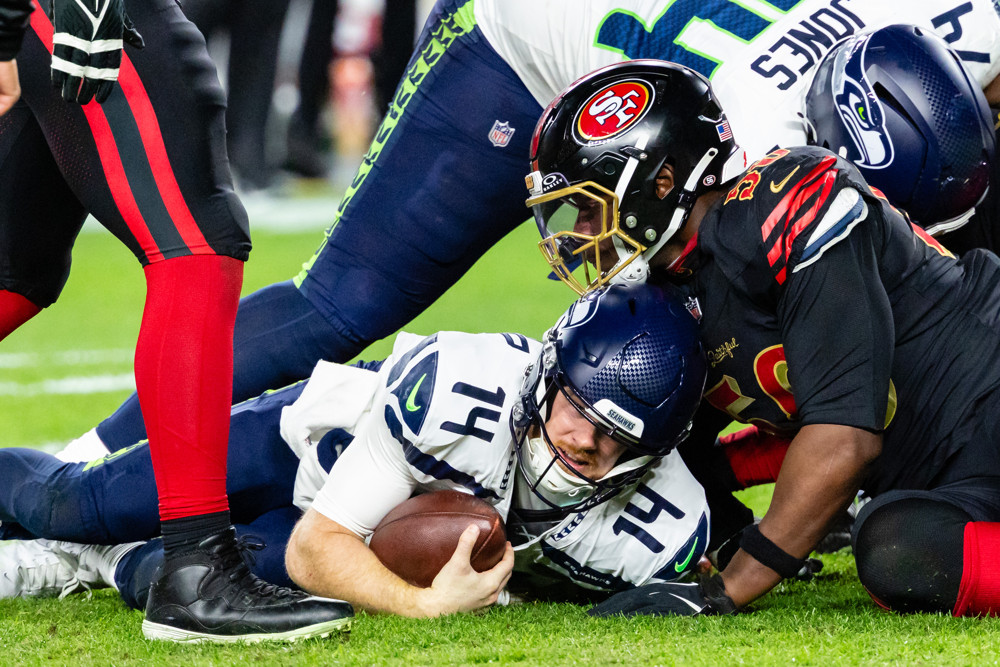
    The losses are perhaps more instructive. They lost to the Rams in Week 11 by just two points in spite of the facts that Sam Darnold threw four interceptions that game and that Los Angeles began four drives in plus territory. Not coincidentally, that was easily the Rams’ worst passing performance by net EPA this season. We’re pretty far removed from Week 1, but the defense also fared relatively poorly in that game against the 49ers as well. Both these games were decided by a single score.

    The Texans win and the overtime win over the Rams were also decided by a single score, and win-loss record in one-score games infamously tends toward 50%, at least year-over-year. But these are still one-score games that were close in spite of poor play from Darnold, which is the point. 

    All the discussion about Darnold coming undone in the final hour as a key to a Pats victory has ignored the fact that a defense that ranks 1st in EPA/play allowed against the run and 5th against the pass, has carried them when Darnold does wet the bed. They’ve kept it close, even in the losses, and it’s been harder to break them than it has been to break Darnold. 

    Perhaps it’s better said that a Patriots win might require a bad showing from Darnold and a lackluster effort from the defense, and that’s much, much more daunting if you’re a New England fan.

  • Why Does Our Player Value Stat Rank Bo Nix No. 1?

    Why Does Our Player Value Stat Rank Bo Nix No. 1?

    In sum: Broncos QB Bo Nix ranks No. 1 in our all-encompassing player value stat, Total Points. That contrasts with Nix’s poor ranks in many measurable quarterback skills.

    Our system is primarily rewarding him for two things that paint over those flaws: 1) his avoidance of sacks, and 2) his high volume of short high-floor throws.

    The Denver Broncos are set to host the Buffalo Bills in the divisional round, and while I’m sure many articles will be devoted to previewing the matchup, we’re instead taking the opportunity to do some housecleaning and investigate something that’s been bothering us for the last several weeks: Bo Nix ranking 1st in our Total Points metric.

    Total Points Leaders – NFL Quarterbacks

    Player Total Points
    Bo Nix 142
    Matthew Stafford 127
    Patrick Mahomes 120
    Jared Goff 119
    Caleb Williams 118
    Josh Allen 107
    C.J. Stroud 107

    For the uninitiated, Total Points is our proprietary player value stat that divides credit for the EPA value on a play among the players involved based on our charting data.

    A full primer on Total Points is beyond the scope of this article, but a quick example might be that Total Points will evaluate a quarterback who throws an interception because a receiver dropped a pass and it caromed into the arms of a defender very differently from one who throws an interception because he overthrew an open receiver, even if the EPA value on the play is the same.

    Because the metric theoretically focuses on process over results, why, then, does it seem to think so highly of Bo Nix? But perhaps the better question to ask – at least initially – is, ‘Why does SIS seem to think this is a problem?’ I’m glad you asked!

    Across most measures, Nix is not very good. In expected on-target rate +/- (xOnTgt+/-), which calibrates quarterback accuracy based on throw location, he ranks 29th. 

    He’s 25th in independent quarterback rating (IQR), an enhancement of passer rating that controls for drops, dropped interceptions, and throwaways, and which the last several MVPs have ranked very highly in.

    He’s also between 18th and 28th in touchdown rate, success rate, explosive play rate, adjusted net yards/attempt (ANY/A), turnover-worthy play rate, and average depth of target (ADoT).

    That’s not No. 1 QB caliber.

    So, what gives? Well, for starters, it’s not all bad. Nix gets a lot of credit for avoiding sacks; his 3.3% sack rate is the lowest in the NFL and he consequently generates more Total Points on sack avoidance than any other player – roughly 20% more than the next. 

    We’re generally comfortable with the principle of giving quarterbacks credit for this because sacks are indeed a quarterback stat, but perhaps we could modulate it in a way that accounts for play design. 

    We’ll elaborate on Nix’s ADoT more shortly, but suffice it to say there’s a difference between a quarterback having a low sack rate because he’s getting the ball out quick by design vs. having a low sack rate because he’s navigating the pass rush well (which is the spirit of the principle).

    With offensive linemen, for example, they receive more credit for sustaining blocks the longer they are expected to hold them given the design of the play. 

    However, there is an existing interaction between blocker credit and passer credit by which QBs get slightly less credit for the result of the play if the offensive line performed well (all else being equal). This would complicate such a revamp given the fact that the credit has to go somewhere, because that’s just how accounting works.

    Nix also avoids highly negative plays reasonably well, largely owing to the fact that a whopping 61% of his throws are attempted 5 yards or fewer downfield. From a Total Points perspective, this means that he is spamming high-floor value propositions as a baseline. 

    Most Total Points – On Throws 5 Yards or Fewer Downfield

    Player Total Points
    Bo Nix 83
    Matthew Stafford 36
    C.J. Stroud 30

    The biggest chunk of Total Points value in general is what we call the throw value, which is an estimate of the average value of a throw with similar distance, route, and receiver openness. Any assessment of accuracy, catching, or yards after catch happens as a modulator to this initial estimate.

    But, on top of that, he’s also getting more credit than league average on these throws – about 50% more – and that adds up over such a large sample.

    Some of this is his targeted receivers having a higher rate of openness than most quarterbacks, but there are also just slight, compounding effects across several situational factors which feed into the throw value component of Total Points. Nothing in particular stands out as a smoking gun, but they do add up.

    Lastly, we believe we’ve identified a potential improvement to how we’re penalizing quarterbacks for inaccurate throws. At SIS, we track both if a throw was accurate and if it was catchable, and we recently implemented the aforementioned xOnTgt+/- into how we evaluate quarterback accuracy from a Total Points perspective.

    The problem, though, is that an uncatchable throw is worse than an inaccurate throw, and we’re not differentiating between the two as much as we’d like in general.

    In Nix’s specific case, we’re talking about a poor deep passer (29th in catchable rate on throws 15+ yards downfield) who also has the sixth-most attempts. That’s a lot of attempts for which we could be penalizing him more severely, and for which he’s receiving a lot of credit in the throw value because it’s a high value proposition (i.e. deeper downfield). Look at his numbers compared to MVP candidates Matthew Stafford and Drake Maye.

    Stafford, Maye, Nix – Pass Attempts, 15+ Yards Downfield

    Player Pass Attempts Catchable %
    Matthew Stafford 145 83%
    Drake Maye 114 76%
    Bo Nix 115 67%

    This combination of small things adds up over the course of a full season, and even if we were able to make enhancements to the model overnight, Nix still probably wouldn’t be as low as we would expect him to be based on other metrics and the eye test. We’re always looking to improve Total Points and we learn as much from the case studies of surprisingly-well-rated players as we do anything else.

    I don’t know that Nix will finally turn into a pumpkin this weekend, but, if he does, please don’t hold our feet to the fire on him ranking higher than his counterpart, Josh Allen. Because rest assured, we’re working on it.

  • Find Us A Good Stat on J.J. McCarthy … Believe Me, We’ve Tried

    Find Us A Good Stat on J.J. McCarthy … Believe Me, We’ve Tried

    I’m not quite sure how we got here. 

    In the summer of 2023, Jonathan James McCarthy, 22, of Evanston, Illinois, was not a player very many people considered to be a future first-round pick. Third-wheeling it on Michigan’s run-first national championship team was probably part of his rise, and he appeared 30th on the consensus mock draft five days after the Wolverines hoisted the CFP Trophy. He’d eventually be taken 10th overall by the Vikings and go on to miss his entire rookie season with a torn right meniscus, but you probably already know all this. 

    What you might not know is: What has inspired the bizarre mythmaking about this particular player? And, furthermore, is there any reason to believe he’ll ever be any good?

    Let’s first set the stage here. Among 37 quarterbacks with 100+ attempts, McCarthy currently ranks 33rd in passing Total Points per play with a number that rounds to 0 from the nearest hundredth. 

    What this means, effectively, is that he has been a replacement-level passer through the first four games of his career (minimum 20 snaps each game), something that can be said of just 24 other quarterbacks in the SIS era (2015-present). 

    This list is filled with names like Nathan Peterman, Josh Rosen, Paxton Lynch, DeShone Kizer, Dorian Thompson-Robinson, Ryan Finley, and Mitch Trubisky. Just two of them ever became long-term NFL starters: Jared Goff and Josh Allen, with the former playing on a hapless Rams team under Jeff Fisher and the second being a consensus developmental guy with freakish physical ability. Neither of those things can be said about McCarthy.

    The highs have been low and the lows have been really low. On plays with an above average Total Points value, he ranks 27th on a per-play basis; on plays with a zero or negative Total Points value, he ranks 34th. Furthermore, his overall positive play rate ranks 32nd at 38%. If your starting quarterback is going to be inconsistent down-to-down with low valleys, these are not the peaks you want. 

    In aggregate, this produces a quarterback who’s 35th in both boom rate (producing high EPA plays) and bust rate (limiting low EPA plays).

    McCarthy has the highest sack rate in the NFL at 11% and the second-highest interception rate at 6%. If those hold, he would be the only player in the SIS era (2015-present) with a sack rate above 10% and an interception rate above 5% in a single season. Before this year, only 11 players ever had a season in which their sack rate was above 8% and their interception rate was above 4%. The last player to do that was Will Levis last season. He was subsequently replaced after just 21 starts.

    It’s not readily apparent what he has to hang his hat on. I’ve seen people claim he’s a good athlete and that he’s been good under pressure, but the numbers certainly don’t bear that out. He turns pressures into sacks 26% of the time, 3rd-worst in the league, and his Independent Quarterback Rating under pressure of 32.5 is 2nd-worst in the league. The only QB with a lower positive play rate on scrambles this year (minimum 5 attempts) is his teammate, Carson Wentz.

    McCarthy’s expected on-target throw rate +/-, which accounts for factors like throw depth, is the worst in the NFL at an atrocious -13%. (For context, -5% is enough to make you one of the worst any given year).

    He barely has a dozen reps of quick game this year, so who’s to say if he’s any good at something his coaching staff isn’t really asking him to do much of? Quick game is typically thought of as easy-to-execute but requires quick processing, touch, and good ball placement, and I think people should be reluctant to prescribe it as a cure-all for struggling, young quarterbacks.

    He has the worst Total Points per play on deep throws (20+ yards) besides a 32-year-old Marcus Mariota.

    So, what’s the excuse? Kevin O’Connell just won Coach of the Year, if that means anything to you.

    The three-deep at wide receiver is one of the best in the NFL with Justin Jefferson, Jordan Addison, and Jalen Nailor; as a group, they rank 6th among top receiving trios in receiving Total Points per route run. 

    The offensive line is missing Ryan Kelly but has four other veterans holding down the fort, and that unit ranks 19th in pass blocking Total Points per snap. Their blown block rate is 9th-worst, but that’s counterbalanced by the fact that McCarthy faces one of the slowest average times to pressure in the NFL and is just one of four QBs who average 3 seconds or more before pressure arrives on their pressured dropbacks.

    It is true that there are things advanced stats can’t capture in McCarthy’s game, like his pre-snap cadence being so bad that the Vikings committed eight false starts at home, the most by any home team in 16 years, per ESPN’s Kevin Seifert.

    More seriously, a lot of these splits are admittedly small sample or, in the case of throwing performance vs pressure, statistically volatile. The point is more so that the film says he’s been bad, the stats say he’s been bad, and that there’s currently nothing encouraging to point to outside of the fact that it’s only been four games. 

    People say that ‘stats don’t lie,’ but if you do enough filtering, you can usually find a split that reflects well on a player. That’s been really difficult to do with McCarthy. For example: on un-pressured throws between 10-19 yards – something a quarterback should look really good at under Kevin O’Connell – he’s 38th in Total Points/pass among 39 quarterbacks with 10 or more attempts.

    We’ve seen people make points about his rookie year injury and even about his recent fatherhood, but caveats like that aren’t that unique, and even with that it should be easier to find a slice of success from his statistical record. We’ve looked at this from a few different angles that should afford him some grace, but so far there isn’t anything too encouraging. All Vikings fans really have right now is mythmaking and wishcasting positive regression.

  • Nevermore? The 1-3 Ravens’ Playoff Path

    Nevermore? The 1-3 Ravens’ Playoff Path

    Photo: William Purnell/Icon Sportswire

    Prior to the season kicking off, the Baltimore Ravens were +400 to win the AFC. Those were the second-best odds behind only the Buffalo Bills, to whom they lost in the opener despite having a 99.1% win probability with 8:36 to go in the fourth quarter. Since then, not much has gone their way and they stand at 1-3 at the quarter pole with injury issues to boot. Even so, ESPN puts their chances of making the playoffs at 70% and their chances of winning the division at 47%, which puts them neck-and-neck with the 3-1 Steelers (71%/46%).

    So, what gives? Let’s start with the fact that, in the past ten years, there have been 11 instances of 1-3 teams going on to make the playoffs. The 2024 Rams were the most recent team to do so, and the Patriots, Steelers, and Eagles all cracked the playoffs in 2021 after dropping three of their first four. That said, 88 teams have gotten off to a 1-3 start over that period, so very few of them have reached the postseason. Put another way: it may not be uncommon, but it is unlikely.

    How teams that started 1-3 finished (2015-2024)
    1-3 Teams 88
    Made Playoffs 11
    Percentage 12.5%

    Now let’s deal with the particulars: The Ravens are dealing with quite a few injuries at the moment and have a two-game homestand before their bye week. Their schedule was a bit frontloaded and is quite soft after the bye, with those first six opponents sporting a combined 8-16 record. All told, they have the sixth-easiest schedule in terms of opponent net EPA/play after the bye – whereas the Steelers have the sixth-hardest – but they certainly don’t want to be 2-4 or 1-5 heading into it.

    In the meantime, they’re missing a lot of key contributors. Nnamdi Madubuike has been ruled out for the season, and several starters did not participate in practice on Wednesday: quarterback Lamar Jackson, left tackle Ronnie Stanley, cornerback Marlon Humphrey, linebacker Roquan Smith, and cornerback Nate Wiggins. 

    With the exception of Wiggins, who currently ranks 7th among corners in Pass Coverage Total Points/snap, all those players are tenured Ravens who have combined for roughly 5 wins above replacement (WAR) over the past two seasons. That’s a lot of firepower missing, with Jackson deemed ‘unlikely’ to play against the Texans, and Humphrey and Smith both expected to miss at least a few weeks with calf and hamstring injuries.

    Assuming they can tread water over the next few weeks, they’ve got some things they’ll have to clean up moving forward. With the caveat being that they’ve faced some of the best passing offenses in the NFL and also the Chiefs, some of their defensive efficiency numbers aren’t the best.

    Defensive coaches usually soapbox about tackling, stopping the run, preventing big plays, getting offenses into long down and distances, and creating turnovers, and the Ravens check only one of those boxes. They rank 6th in broken + missed tackle rate, but rank 27th in EPA allowed/rush, have neither forced nor recovered any fumbles, and have just 1 interception to 3 dropped interceptions. 

    Worse though is the fact that opposing offenses have consistently been in manageable situations. In terms of opponents’ average distance to go on 2nd and 3rd down, the Ravens defense is in the 8th and 15th percentiles, respectively, of all defenses since 2016. That probably has something to do with them allowing a 43% 3rd down success rate, which is 6th percentile over the same timespan. Put more simply: opposing offenses have stayed on schedule and converted 3rd downs at a high rate accordingly.

    There’s also the problematic dynamic of giving up a lot of big plays and not generating any to offset them. The Ravens pass D ranks 30th in boom rate (offensive plays which generate 1+ EPA) and 30th in bust rate (offensive plays which generate -1 EPA or less), which isn’t a great combination. Part of this is they’ve seen the second-most passes of 15+ air yards and have given up the third-most EPA on those passes. They had this problem last year in the aggregate, but corrected in the second half of the year when they ranked 3rd in boom rate and 2nd in bust rate from Week 10 onward.

    Ravens Pass Defense: Big Play Breakdown (2025)
    Big Play Type Rate Rank
    Boom (big play for O) 31st 30th
    Bust (big play for D) 30th 30th

    On the offensive side of the ball, there have been some bad breaks in big games. The Derrick Henry fumbles were particularly unfortunate considering that he had fumbled just three times in the two previous seasons, and Baltimore lost a total of 36 percentage points of win probability on his fumbles against Buffalo and Detroit.

    Matters were made worse by two three-and-outs against the Bills (-17% WPA) and one against the Lions (-14%), and the Ravens offense has just generally taken a downturn in 4th quarters this year. They’re the 7th-best offense in EPA/play through the first three quarters, and the 22nd-best in the 4th quarter. Stripping out turnovers lifts all offenses, but doing so suggests that theirs have been particularly untimely because their 4th quarter EPA/play looks pretty comparable.

    There are also some run game balancing issues. Last year, they were top six in success rate on both zone and gap runs and were top 10 in gap usage, but this year they’ve skewed zone-heavy and have simultaneously fallen to 27th in zone success rate. And we should beware of small samples, but Derrick Henry is also tracking for the lowest broken + missed tackle rate of his career at just 4%.

    The Ravens’ margin for error going forward is slim, especially in light of the injuries they’ve sustained. However, most 1-3 teams have not been as talented as Baltimore and have not had a two-time MVP quarterback. This is also a particularly weak division with Joe Burrow being out and the Browns being in, so the potential to claw back from down two games is there. Some of this stuff should work itself out over the long-term (e.g. fumble luck on both sides of the ball), but they’ll have to win more early downs on defense, which they should be able to do against their remaining schedule. But first, they have to get to the bye in one piece.

  • How Do Tyler Warren and Colston Loveland Compare As Draft Prospects

    How Do Tyler Warren and Colston Loveland Compare As Draft Prospects

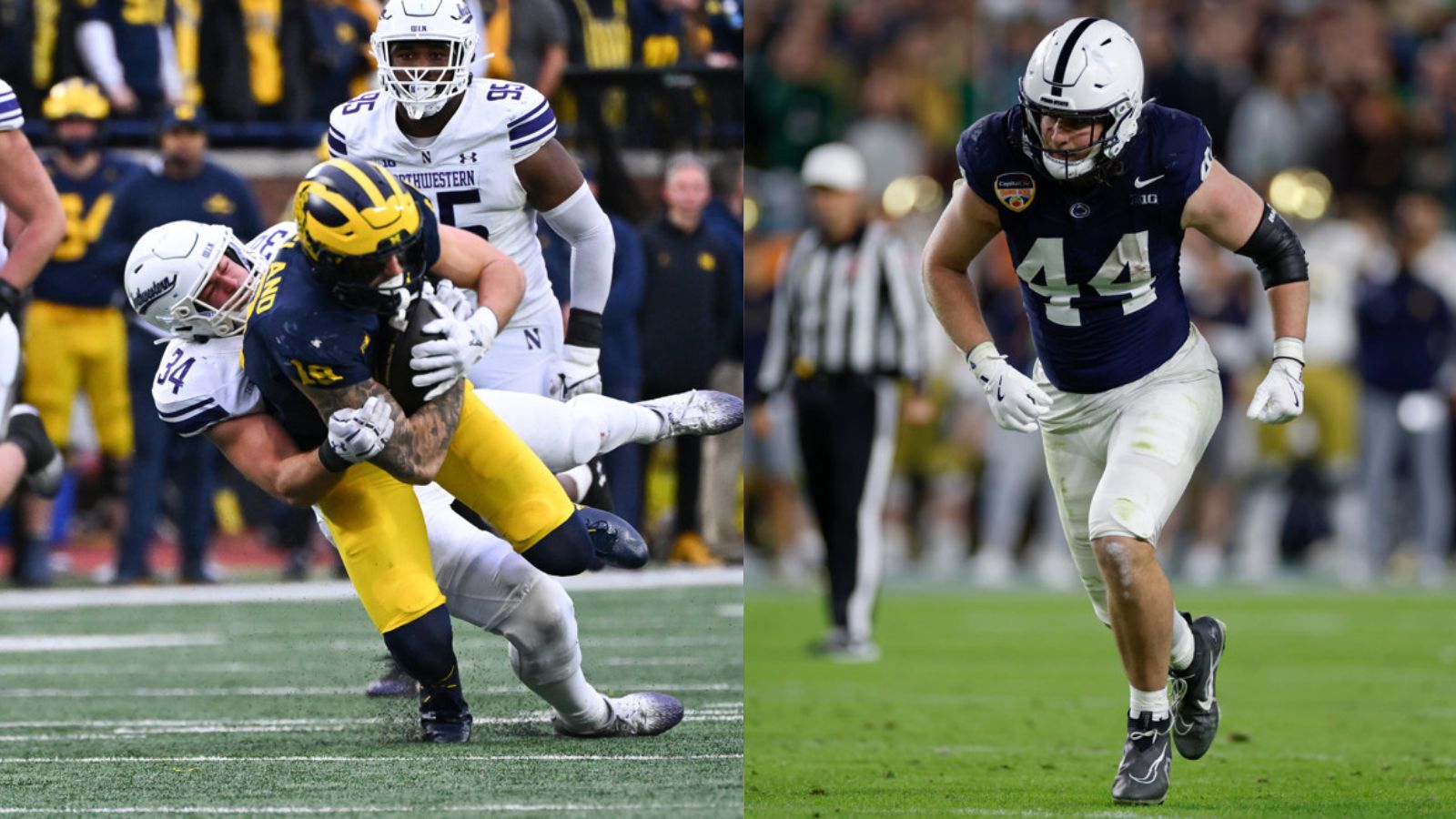
    Photo: Steven King (left) and David Rosenblum (right)/Icon Sportswire

    It has been six years since two tight ends were last taken in the first round of the NFL Draft, when Noah Fant and TJ Hockenson went 8th and 20th overall, respectively. But that trend is likely to change this week, as Penn State’s Tyler Warren (scouting report) and Michigan’s Colston Loveland (scouting report) are both all but guaranteed to have their names called on Day 1.

    These players make an interesting case study because they have similar profiles in a general sense – they’re both F tight ends – but are quite different once you dive into the particulars. 

    Warren is the more powerful of the two and is better with the ball in his hands, whereas Loveland is the better athlete and has true mismatch ability. Both have issues as blockers that we’ll get into.

    Let’s begin with the broad strokes and take a quick look at how their teams deployed them in 2024:

    As you can see, Loveland spent more time lined up as a traditional tight end, but the rates at which they moved out wide (including as an X) or into the slot were pretty similar (41% for Warren, 44% for Loveland). It’s also worth noting that the on-ball and off-ball splits are meaningfully different, particularly because they speak to the types of blocks these players were being asked to execute, which we’ll return to in a moment.

    For now, let’s focus on them as receivers since their positional breakdown indicates they’re receiving threats first and foremost.

    Let’s start with Warren, whose big selling point is that he’s a YAC monster. He had a 22% broken + missed tackle rate (BMT)  and averaged 6.8 yards after the catch in 2024. That’s not quite Brock Bowers territory (31% BMT and 8.7 YAC in 2023), but both are top-15 marks for qualifying Power 5 tight ends (minimum 50 receptions) over the past 10+ years.

    Warren does have some ability to get up the seam and did run a high percentage of vertical routes (19%), but he’s at his best working the short-to-intermediate areas of the field, with his most efficient work from a Total Points perspective coming on out-breakers and under routes (i.e. slants and drags). A middling average depth of target (ADoT) of 6.6 yards rounds out the statistical profile here, although that number is admittedly sandbagged by the fact that screens made up nearly 10% of his targets in 2024.

    Loveland, on the other hand, is a better athlete and more threatening at the second and third levels of the defense. 2023 is more instructive in his case because the Wolverines were largely dysfunctional on offense in 2024 even before his season was cut short by a shoulder injury. 

    During Michigan’s championship season, Loveland ranked 8th among Power 5 tight ends in ADoT (9.6) and was extremely efficient on seams and fades, which made up 10% of his routes. His yards per route run of 2.6 that season was third among tight ends, trailing only Bowers and Jatavion Sanders among tight ends with 50+ targets.

    Loveland has a better catch radius and body control in the air but Warren is much stronger at the catchpoint. Take a look:

    Catch Percentage

    Loveland Warren
    Off-Target but catchable 63% 47%
    Contested but catchable 45% 64%

    There are some similarities, though. Both Loveland and Warren are natural hands catchers who had similar drop rates in 2024 (4.8% and 5.2%, respectively), and both are good route runners who ranked top 10 among tight ends in open rate, although Loveland is the better man separator.

    As I noted atop the article: Warren is the more powerful of the two and is better with the ball in his hands, whereas Loveland is the better athlete and has true mismatch ability. The picture that’s been painted of the former thus far may make him seem more like a traditional Y, but both have shortcomings as blockers that are worth discussing.

    Circling back to the point that was previously alluded to, Warren played off the ball a lot in a zone-heavy Penn State offense and was largely tasked with cutting off the back side – either by initial alignment or by splitting across – or widening out the front side of outside zone. His blocking skills require some projection considering he has mostly been responsible for generating lateral movement on zone runs and executing 2-back run game. He had a lot of good reps from a backfield alignment tracking to the second level but has seldom been a true point of attack player, with just 26 reps blocking power/duo in 2024. While he has the requisite strength and demeanor to grow into such duties and vertically displace edges at the NFL level, his length is a concern (31 ¾” arms).

    Despite having the thinner frame, Loveland was base and down blocking more in Michigan’s offense, especially in 2023 under Harbaugh. He is also a willing blocker and has superior length to Warren, so the question here is not one of experience or length but of functional strength to root out NFL bodies on the edge.

    It could be said that Loveland could get stronger whereas Warren’s arms will not grow anymore, but it may be difficult to accomplish the former without compromising one of his biggest selling points – his quickness and fluidity. Ultimately, both these players project better to zone schemes, albeit for different reasons. That said, most NFL teams skew zone-heavy anyway, and would be perfectly happy to settle for tight ends who are willing blockers provided they check enough boxes as receivers.

    Warren and Loveland are very talented and at this point it should be clear that team fit may be more important than anything in terms of who comes off the board first. However,  we can still tie this off with a general statistical comparison of Loveland and Warren to both each other and tight ends who have been drafted since 2016:

    As you can see, both are pretty good receivers even in comparison to the pool of tight ends who have been drafted over the years, although interestingly enough Warren falls just below the median as a run blocker.

    It should be reiterated that these players excel at different functions and therefore, that this is more of a 1A/1B situation than an exercise in picking a clear-cut better prospect. Risk tolerance likely factors in, as well, with Warren’s game feeling more familiar and therefore more bankable as a security blanket and YAC threat, whereas Loveland seems to have a higher ceiling and more game-breaking potential.

    Both players are worthy of being taken in the top half of the first round, but who ends up TE1 seems like an exercise in picking your poison, and whoever lands these players will be hoping to force defenses to do just that.

  • What Do Analytics Show For Edge Rushers In NFL Draft?

    What Do Analytics Show For Edge Rushers In NFL Draft?

    Quarterbacks, tackles, edges, and corners – those are the premium positions in the NFL right now. The consensus seems to be that, among those positions, this year’s edge group is the deepest, with ESPN ranking six edge prospects in its top 32 and sixteen in its top 100. Both are the highest among any position group, and there are lots of flavors to be had within this class.

    Penn State’s Abdul Carter and Tennessee’s James Pearce Jr. are finesse rushers with a lot of burst off the edge. Texas A&M’s Shemar Stewart and Georgia’s Mykel Williams are long, explosive ends with questions about their production. Mike Green of Marshall is a short, bendy player who led the FBS in sacks. The point of this article is not to give detailed reports on each of these players, but to look at how this year’s edge class fares in some of our advanced metrics, so let’s get into it.

    Pressures Above Expectation

    In the 2020, and 2023, 2024 NFL drafts, the NCAA leader in Expected Pressure Rate +/- (xPressure Rate +/-) among draft prospects was the first EDGE off the board (and in 2022, Aidan Hutchinson was the 2nd EDGE off the board.)

    Player Draft Year xPressure Rate +/-
    Chase Young 2020 +12%
    Tyree Wilson 2023 +11%
    Laiatu Latu 2024 +14%

    For the uninitiated, xPressure Rate +/- (and its analog Pressures Above Expectation) is a metric that measures the probability of a player generating a pressure on a play given factors like down and distance and alignment, and then compares that to whether or not they actually generated a pressure. 

    Were the aforementioned trend to repeat this year, Pearce, Jr. (+8%) would be the first EDGE taken, although that seems unlikely considering Carter is the consensus best player at the position (at least among media).

    Player School Rank Expected Pressure Rate +/-
    James Pearce Jr. Tennessee 2nd +8%
    Mike Green Marshall 4th +8%
    Princely Umanmielen Ole Miss 11th +7%
    J.T. Tuimoloau Ohio State 12th +7%
    Donovan Ezeiruaku Boston College 13th +6%
    Josaiah Stewart Michigan 14th +6%
    Abdul Carter Penn State 16th +6%

    Snap to Pressure Times

    Carter also holds the distinction of having the fastest average time to pressure of any draft-eligible player with at least 20 pressures at a blistering 2.31 seconds, a testament to his get-off and explosiveness. The second-fastest player was at ‘just’ 2.45 seconds. 

    Of course, things aren’t as easy in the pros, but the best NFL pass rushers in this metric any given year typically hover at around 2.5 seconds. Furthermore, the 2023 collegiate leader was Carter’s former teammate Chop Robinson at an insane 2.11 seconds.He averaged 2.69 seconds in his rookie season with the Dolphins (still good for top 15).

    Player School Pressures Avg. Snap to Pressure
    Abdul Carter Penn State 52 2.31s
    Shemar Stewart Texas A&M 21 2.45s
    Mike Green Marshall 50 2.52s
    James Pearce Jr. Tennessee 32 2.54s
    Princely Umanmielen Ole Miss 32 2.55s

    Stewart is a notable inclusion here considering that he’s been knocked for his lack of production. The length, size, and explosion flashed both on tape and at the combine, but it hasn’t shown up in the stat sheet – he had just 11 TFLs and 4.5 sacks in three seasons – and these advanced stats don’t exonerate him either.

    At the other end of this is Arkansas’ Landon Jackson, the only one of the group to exceed an average snap to pressure time of 3 seconds. On top of that, his xPressure Rate +/- is negative. That’s not a great combination, and his pass rush Total Points/snap rank was good but not great (57th among qualifying edge players last season).

    Total Points

    Some notable players from the 2024 draft class fared pretty well in Total Points in 2023. Robinson (1st), Laiatu Latu (2nd), Jared Verse (6th), and Dallas Turner (30th) are sure to be familiar names. It might also be noted that Pearce Jr., who was extremely hyped at the beginning of last fall, trailed only Robinson and Latu in this metric that year. As for the 2024 leaderboard:

    Player School Pass Rush Points/Snap Rank
    Princely Umanmielen Ole Miss 0.16 2nd
    Josaiah Stewart Michigan 0.15 3rd
    Mike Green Marshall 0.14 6th
    Abdul Carter Penn State 0.13 7th
    Donovan Ezeiruaku Boston College 0.11 12th

    Meanwhile, Pearce Jr. lurks at 54th and Stewart lags behind at 168th among qualifying players at their positions after ranking 3rd and 29th last year, respectively.

    It’s not a good year to need a quarterback, but it is a good year to need someone to affect the quarterback. While there’s not a blue chip like a Myles Garrett in this class, there are lots of traitsy, high-upside players. And when you’re dealing with players who you have to project a bit more, advanced stats like the ones we’ve laid out can help paint a more complete picture.

  • What Does The Data Show About Patrick Mahomes and Favorable Officiating?

    What Does The Data Show About Patrick Mahomes and Favorable Officiating?

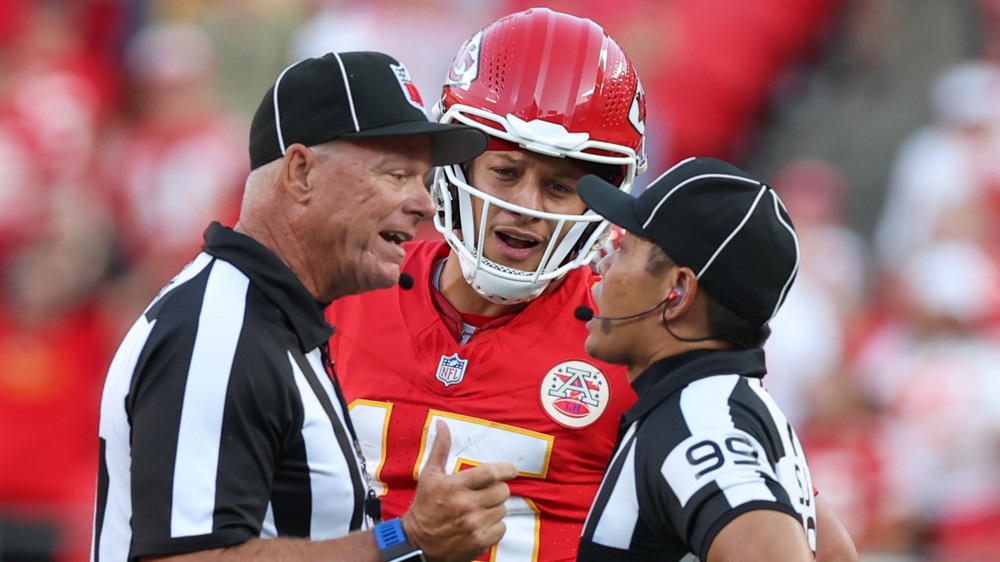
    Photo: Scott Winters/Icon Sportswire

    With Kansas City on the precipice of making NFL history – a Super Bowl threepeat – some NFL fans are feeling a bit of Mahomes fatigue. The 29-year-old signalcaller has already won three Super Bowls, is about to compete for his fourth, and seems poised to be the league’s boogeyman for the foreseeable future. And just like Brady before him, grumbling about favoritism he gets from officiating crews has emerged from those who deny or downplay his greatness.

    This largely seems like infantile coping – it doesn’t take a veteran NFL scout to see that Mahomes is extremely talented – but we at SIS are morbidly curious about whether or not there’s any validity to the idea that Mahomes is the NFL’s favorite son. 

    Fortunately, we track officiating crews as far back as our database goes (2016). We could tell you which crews call the most Defensive Pass Interferences, which crews are more liable to throw flags on the visiting team, which crews throw flags in late-game situations, or which crews get overturned on review the most, and we can also tell you whether or not the Kansas City offense benefits disproportionately from officiating.

    It’s first important to acknowledge that each ref crew officiates a bit differently in a given year. For example, in 2024, Clay Martin’s crew called offensive holding penalties almost twice as often as the NFL average, whereas Tra Blake and company came in below the NFL average and rarely flag holds on passing plays. 

    From here, we can set a baseline for each crew across multiple categories (e.g. home/away, offense/defense, penalty type, situation, etc.) and compare that to a team’s penalty profile in aggregate. If a team consistently sees more (or fewer) penalties than would be expected based on the crews that officiated them, then there’s at least something to talk about.

    There are, of course, other factors that could reasonably result in an officiating crew deviating from their baseline in a given game. For example, a team may have a handsy corner who creates a lot of contact and draws a lot of DPI calls. A quarterback might be really good at drawing offsides or pass interference.

    Even with that in mind, Kansas City’s offense doesn’t stand out in a meaningful way.

    They are one of eight offenses in 2024 who were both penalized below expectation and drew defensive penalties above expectation, but neither of these rates were to an egregious extent. The Chiefs ranked 9th in offensive penalty rate against crew average (-7%) and 12th in defensive penalty rate (+7%), but the latter figure doesn’t compare to the Joe Burrow-led Bengals (+24%) or Josh Allen’s Bills (+26%). Nor does it come even close to the rate at which defenses playing the 2020 Super Bowl champion Buccaneers were penalized (+29%).

    In fact, if anything, Mahomes is enjoying fewer flags against the defense than he ever has. In the beginning of his career, defenses playing Kansas City were consistently penalized at a very high rate relative to expectation. There was a run from 2018-2022 where Kansas City saw opposing defenses flagged at a pretty high rate, ranging from +24% at the low end to +38% at the high end. They’re in no way notable over the last two seasons, though. 

    Graphic showing where the Chiefs ranked in Defensive Penalties Gotten BY Offense. In 2016, they were middle of the league with just below 50. In 2017, 2018, and 2019 they ascended in each year, peaking at the #1 spot with 70 drawn in 2019. They also had the most in the league in 2020, though with just over 60 in a shortened season. Over the next 3 seasons, the total declined each year. The last 2 years they've been in the top-third of the league with around 50.

    How impactful is that imbalance in penalties? The net EPA gained on penalties never exceeded 0.65 EPA per game in any season during that window. That may seem high, but it barely cracks the top 50 of single team seasons over the past 9 years, and it pales in comparison to the 2020 Bucs who were 1st at +1.8 per game. The EPA in and of itself admittedly cannot account for wiping big, negative outcomes off the board, but the number isn’t so high in and of itself.

    Now, is any of this hard evidence that the NFL issued some kind of officiating mandate or that the referees otherwise showed favoritism to Kansas City? No. You’d need a more rigorous model to control for other variables (including the teams and players themselves) and do some investigative reporting to be able to responsibly conclude such a thing. But, is it interesting enough to throw out there and instigate some discourse while remaining on the fence? Yes, and it’s certainly not what we expected to find, either.

    If you’ve already got your tin foil hat on, you’ll have to take it up with the NFL referees’ union, who recently shot down assertions that the Chiefs get favorable calls. That, at the very least, seems to be true the last couple of years, in which penalties have leaned against them on average (in terms of EPA per game). Beyond that, we’re staying out of this for now, and we leave the rest to those of you who are more given to conspiracy theories.

  • Chalk Talk!: NFL Playoff Team Offensive Schemes

    Chalk Talk!: NFL Playoff Team Offensive Schemes

    The Wild Card Round is upon us, and perhaps the only team you were able to keep up with religiously during the season was your own. A lot goes on in the NFL every week, and you’ve likely caught some glimpses at other teams here and there, maybe during island games, but might not have as good a grasp on the other 31 teams as you do your own. 

    That’s where this scheme primer comes in. Here, we’ll be providing you with a brief crash course on the offenses of the Wild Card Round teams, packed with advanced tendency stats and football terms you may want to use to flex on your friends in the group chat this weekend. Without further ado, let’s get started.

    AFC

    #2 Seed Buffalo Bills

    The Bills do some interesting stuff on offense. They put their running backs in motion more than any team but the Dolphins, and their backs have the second-highest ADoT of any team in the league. They get their backs out into the pattern at a high rate, but they’ll get them into corner routes and seams rather than just out into the flats or over the ball, which is symptomatic of a passing game that is generally downfield-oriented with high horizontal stretches (e.g. double post) and outside vertical stretches. 

    They are zone-run heavy (like most teams), which are well-suited to James Cook’s skillset, but they have moving parts gap schemes to supplement it, and will, needless to say, use Josh Allen on designed runs out of these looks. 

    Lastly, they rank sixth in both RPO and screen rate, which is their form of quick game because they rank 24th in traditional short dropbacks.

    Re’stat’ing for emphasis: The Bills’ put their running backs in motion the second-most of any team and have the second-highest ADOT.

    #3 Seed Baltimore Ravens

    This is the bullyball team of the AFC. Two-thirds of the Ravens’ offensive snaps are played in heavy personnel groupings, and they rank last in 11 personnel usage. 

    They run well no matter the design, ranking in the top five in success rate in both gap and zone schemes. Lamar Jackson obviously makes this easier. Teams have tried stacking the box (second-highest rate in the league) but the Ravens rank first in stacked box run success rate. 

    The juice in the passing game comes from intermediate and deep concepts, with Jackson having the second-highest ADoT in the NFL and 30% of his throws targeting verticals, post, corners, and crossers. As a result, he’s the quarterback with the highest Boom Rate in the NFL (plays gaining an expected point or more).

    Re’stat’ing for emphasis: Two-thirds of the Ravens offensive snaps are in heavy personnel

    #4 Seed Houston Texans

    The Texans’ offense has used condensed formations more than any other team in the NFL this year (about 27 plays per game). They don’t make great use of the space this affords, with C.J. Stroud throwing out-breakers at the third-highest rate and about twice as often as crossers. 

    These condensed formations also tend to draw more defenders into the box and contribute, in part, to the top ten rate at which they run into a loaded box. Furthermore, they typically don’t do it very well, ranking sixth-worst in success rate on such carries. 

    Like other Shanahan offenses tend to be, they’re a zone-heavy team and use a lot of motion, but unlike other Shanahan offenses, they disproportionately use motion to pass and run at the fifth-lowest rate in the league on plays with motion.

    Re’stat’ing for emphasis: The Texans use condensed formations more than any other team.

    #5 Seed Los Angeles Chargers

    The arrival of Jim Harbaugh has brought old school football to Los Angeles. This is a gap-scheme, play action-heavy offense that orients itself around power and counter runs and play action shot plays; the Chargers rank 1st in play action rate, 5th in gap run rate, and Justin Herbert is tied for second in ADoT (8.7). 

    With an interior offensive line that ranks 24th in run blocking Total Points, the Chargers haven’t fully grown into their new identity, ranking 24th in rushing success on gap concepts. They’re largely reliant on the play action game to push the ball downfield, ranking 3rd in net passing EPA with play action and 16th without.

    Re’stat’ing for emphasis: The Chargers rank 1st in play action rate.

    #6 Seed Pittsburgh Steelers

    The Russell Wilson offense is the same as ever, and the Steelers’ offense is built around the go-ball. Wilson threw verticals at the 2nd-highest rate in the NFL this year, and outs and flats at the 3rd-highest rate. In fact, half of non-screen attempts by Wilson have targeted a vertical or something relatively short and outbreaking. 

    Considering Wilson averages a paltry 0.02 EPA/attempt against Cover 3 and that the Steelers are a bottom five team in rushing success against stacked boxes, the key to playing them seems to be stacking the box and playing Cover 3. Let them run boot Flood and check it down to the flat for 5 yards every play, who cares.

    Re’stat’ing for emphasis: Russell Wilson threw verticals at the 2nd-highest rate in the NFL this year, and outs and flats at the 3rd-highest rate.

    #7 Seed Denver Broncos

    This is a training wheels offense that relies heavily on screens and boots/sprintouts, ranking 4th and 1st in the NFL in those categories, respectively. Furthermore, they rank dead-last in quick game usage – which makes sense considering Bo Nix wasn’t particularly adept at that in college. 

    This is a static—last in motion rate—point-and-shoot operation that’s overreliant on screens and scrambles to move the ball in the passing game. They’ve generated 28 EPA on scrambles and screens, which is higher than the EPA they’ve netted across all pass plays (23.6).

    Re’stat’ing for emphasis: The Broncos rank 4th in screen usage and 1st in boot/sprintout usage.

    NFC

    #2 Seed Philadelphia Eagles

    The Eagles used more 2×2 formations than anyone in the NFL this year and are more generally motored by West Coast staples which create low, horizontal stretches in zones (think double slants and slant-flat) and triangle reads (like snag), RPOs, and AJ Brown iso concepts. 

    Their run game is a little zone-heavy but is mostly Saquon-heavy. They haven’t benefitted from Jalen Hurts’ legs like they have in the past; he hasn’t averaged a meaningfully positive EPA per attempt on designed non-sneak runs since 2022. This unit is powered more by its personnel at the skill positions than anything else.

    Re’stat’ing for emphasis: The Eagles used more 2 x 2 formations than any team in the NFL in 2024.

     #3 Seed Tampa Bay Buccaneers

    The Buccaneers generated the second-most EPA and the most yardage on screen plays of any team in the SIS database (2015-present). They just generally like to throw near the perimeter, with lots of concepts that feature outbreakers like two-man stick, smash variants, and flood, generally with in-breakers coming into Baker Mayfield’s vision from the other side late in the down. 

    In the running game, they’re the most efficient gap scheme team in the NFL, which was not on anyone’s bingo card headed into the year. They were 27th last season.

    Re’stat’ing for emphasis: The Buccaneers generated the most yardage and second-most EPA on screens of any team in the last 10 seasons.

    #4 Seed Los Angeles Rams

    The Rams don’t look a whole lot different than they have throughout the Stafford era. They’re still running a lot of zone, motion, and play action, and they’re still under center a lot. 

    The passing game has a lot of high low concepts, outside vertical stretches, and crossing patterns, but their receiving corps doesn’t have a legitimate speed element and they’ve struggled mightily against man coverage this year. They rank 28th in success rate against man coverage, but 1st against zone coverage.

    Re’stat’ing for emphasis: The Rams crush it against zone coverage (highest success rate), but rank 28th vs man.

    #5 Seed Minnesota Vikings

    The Vikings are a zone-heavy run team that likes to operate from under center (31st in shotgun usage. However, unlike the Chargers they aren’t aggressive in their pursuit of play action from under center.

    The passing game operates in the intermediate-to-deep area of the field, with 54% of Darnold’s passes landing somewhere between 5 and 20 yards downfield, the 3rd-highest rate in the league. Darnold’s 8.7 ADoT is tied with the previously-mentioned Jackson and Herbert.

    They work the ball to the outside and over the middle in relatively equal measure, with Darnold hunting crossing routes at one of the higher rates in the league.

    Re’stat’ing for emphasis: 54% of Sam Darnold’s passes go 5 to 20 yards downfield, the 3rd-highest rate in the league.

    #6 Seed Washington Commanders

    The upstart Commanders are notable for their varied and successful run game. They’re the most efficient zone running team in the league, but they are 5th-lowest in usage. They are 6th in gap run rate, but their success on such concepts has waned down the stretch. 

    They’re one of the teams that’s tapped into 3×1 gun strong and setting the back to the tight end in 3x1Y formations, ranking third in the usage of such formations to create unbalanced defensive structures. 

    The core passing game is pretty standard Air Raid fare like Y Cross and Stick variants, but to supplement that they’ve just generally tapped into some of the more common ‘cheat codes’ and rank 4th in both RPO and play action rate, and 10th in screen rate.

    Re’stat’ing for emphasis: The Commanders are the most efficient zone running team in the league, but have the 5th-lowest usage rate.

    #7 Seed Green Bay Packers

    The Packers’ offense is interesting because this is largely an offense that stretches you horizontally and creates a lot of conflict with fast motion, but they don’t really run a lot of true quick game. Their ‘quick game’ is being 2nd in RPO rate and screen rate. 

    The quarterback is a big play hunter though, and so this is all spiced up with a dose of shot plays whenever LaFleur needs to appease Jordan Love’s urge to launch the ball. 

    In the run game, they’re a zone-heavy team but rank top 8 in both zone and gap success rate. 

    They line up in 11 personnel most often (as most teams do), but they’re much more balanced out of it than most teams. They led the league with a 41% run rate.

    Re’stat’ing for emphasis: The Packers rank 2nd in RPO rate and screen rate.

  • Chaos Manifest: Measuring How QBs Behave as Passing Plays Break Down

    Chaos Manifest: Measuring How QBs Behave as Passing Plays Break Down

    In the past five years or so, expectation-based metrics have gained traction in the football space as a way to standardize performance across different contexts. An even more recent development is the fixation on anticipation which has largely emerged as a way to sensationalize pedestrian quarterback play under favorable conditions (Tua Tagovailoa’s quick releases come to mind). 

    Expected Snap to Throw +/- (xSTT+/-) fits neatly into this intersection, and I’d like to use it to reframe how we think about dropback outcomes.

    Some passing plays take longer to develop than others. A quick-game concept like double slants-stick develops faster than a play action shot play – at least in theory. And xSTT+/- takes factors like shotgun, drop depth and play action to roughly approximate when the ball should come out, and then compares this baseline to the actual snap to throw time on a play.

    But, once the quarterback crosses the threshold of when the ball is supposed to be thrown, negative outcomes become more likely as the play unfolds. As the structure disintegrates into good, old-fashioned, backyard football, rushers come unblocked, the pocket collapses, and receivers begin to improvise their routes. This seems fairly intuitive and is borne out in the data:

    What is more interesting is what’s occurring within these buckets on a player level. On the front end, when the play still resembles ‘how it’s drawn up,’ quarterbacks do not deviate too much from each other in terms of the rate at which they throw the ball downfield (as outlined in the graph above). Within a quarter of a second – which is a long time in the NFL – on either side of the expected snap to throw time, the middle 80 percent of players (i.e. non-outliers) only deviate from average by about five percent, give or take. 

    And this speaks to the level of automation NFL quarterbacks have trained towards: in neutral conditions, they all consistently perform the same general task (throwing the ball downfield without putting it in harm’s way).

    But, things start to get really weird at a half second beyond the expected snap to throw time. This is when the clock strikes midnight, where deviations ranging from -15% to +25% can be seen even after removing these outliers. And this is where players really begin to differentiate themselves from one another. Let us examine some of these profiles further.

    A ready-made comparison is Joe Burrow and Tua Tagovailoa, who will forever be linked to each other as the first two quarterbacks selected in the 2020 NFL Draft. These are players who throw downfield at pretty similar rates, until the tipping point of 0.5 xSTT+/- is reached:

    Burrow and Tua diverge sharply once we hit the twilight zone, with Burrow suddenly becoming extremely gunshy. On the one hand, Tua is ‘putting the ball into play’ more often than his counterpart; on the other, Burrow has not made a turnover-worthy throw in this range and Tua has a 5% turnover-worthy throw rate.

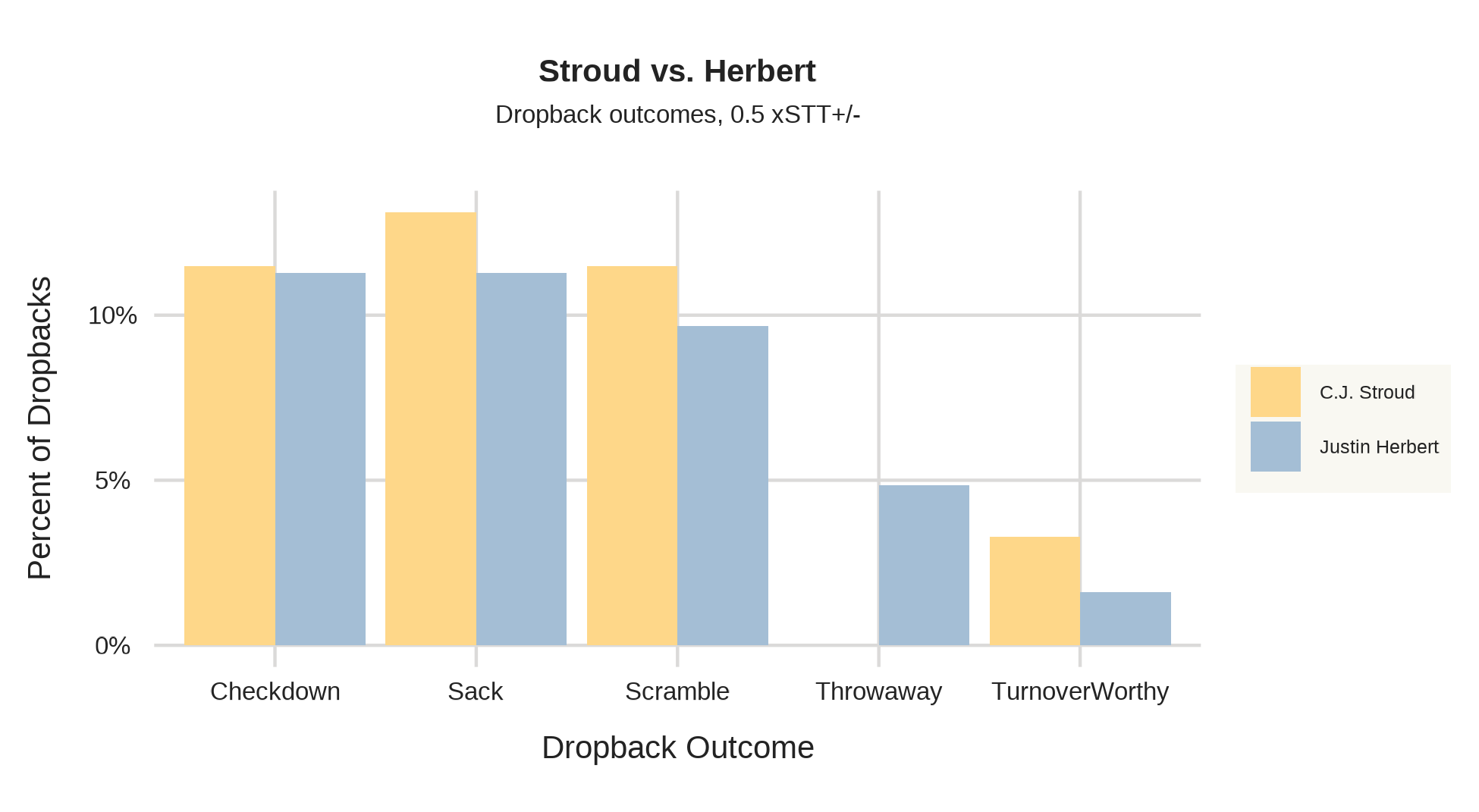
    This is not the only way players differentiate themselves later in downs. Take, for example, Justin Herbert and CJ Stroud, two players who are very close in terms of the rate at which they make non-turnover-worthy attempts downfield in this 0.5s xSTT+/- range. Outside of that, the composition of other outcomes is different, with Herbert scrambling less frequently, taking fewer sacks, and putting the ball in harm’s way less often, largely as a result of throwing the ball away more:

    Herbert averages 0.09 Total Points/dropback here, as opposed to Stroud’s -0.2 Total Points/dropback, largely as a consequence of avoiding bad plays more frequently.

    We can also observe this phenomenon in quarterbacks who are considered to be scramblers. Kyler Murray and Russell Wilson both throw the ball downfield at nearly identical rates but behave rather differently otherwise. Murray tends to hold out hope for the big play (and takes a lot of sacks), whereas the aging Wilson simply opts for checkdowns and scrambles:

    It should not be surprising, then, that Murray’s Total Points/Play of -0.05 here is much lower than Russ’s (0.33). That puts Wilson among the best in the NFL late in the play, while Murray is in the bottom half of the league.

    Ultimately, we’re still talking about a relatively small sample of plays and, therefore, this is subject to variance. These plays could perhaps be bucketed on a more empirical basis – the quarter-second buckets are admittedly a bit arbitrary – in a future study this offseason. There is also an opportunity to examine within-player trends: how behavior at one point in time relates to behavior earlier or later in the play. 

    Furthermore, attempting to control for external variables, like pressures, is likely needed for a more conclusive affirmation of the preliminary findings outlined here. A play with average snap to throw time when there was early pressure might be similar to a late throw with no pressure, for example. Lastly, it might be prudent to take a more longitudinal approach in future studies.

    With few exceptions, quarterbacks in the NFL are too good to be allowed to play under optimal conditions on a down-to-down basis. Efficiency under pressure is crucial, but also has been shown in the past to be noisy. That said, football analytics has come a long way in a short time, and the notion that players can be good or bad under pressure – or even that their behavior under such conditions is somewhat predictable – should be periodically reexamined with newly developed metrics such as xSTT+/-.

  • What should we make of Trevor Lawrence?

    What should we make of Trevor Lawrence?

    Photo:Shaun Brooks/Action Plus/Icon Sportswire

    The Jacksonville Jaguars just spent two weeks of their short, fleeting human lives on a small, damp isle off the western coast of Europe, and, given that they’re 2-5, it’s doubtful that Trevor Lawrence and company have returned home to a hero’s welcome.

    This is a precarious position to be in, and most certainly is not the breakthrough Jags fans had hoped for following consecutive 9-8 seasons. To make matters worse, the Jags’ second-half schedule is not an easy one, with the Texans, the Vikings, the Lions, and the Packers on it.

    There are, of course, some matchups in which they should be favored: the Jets are a sinking ship captained by a quarterback who either checks it down or throws the vertical element in response to playcalls he doesn’t like; the Raiders are a cautionary tale about trying to exit quarterback purgatory; and two games against the Titans means two front-row tickets to watch Will Levis brutally struggle.

    But, the final record of the Jaguars is not the central question. The central question is the assessment of Trevor Lawrence. My friend Diante Lee wrote an excellent, film-based piece on Lawrence for The Ringer a few weeks ago, and, now that Lawrence has broken out of his slump, I would like to discuss the matter with a statistical and systemic focus.

    Let us begin with the formalities. At Sports Info Solutions, our player value discussions are almost always going to start with our proprietary player value metric, Total Points, and go from there. In this regard, we rather like Lawrence’s campaign thus far. He currently ranks seventh in passing Total Points on a per play basis and is on pace to have his best season as a pro in this category. The contradiction here is that the Jags’ passing attack is inept generally, and this deserves further examination.

    Jaguars Passing Offense – Ranks

    Stat Rank
    Positive Play Percentage 15th
    Boom Rate 25th
    Bust Rate 24th

    That is to say, they are not matriculating the ball, they are not generating big plays, and they are finding disaster on about a fifth of their dropbacks. This is all made worse by the fact that their passing success rate in the red zone is even worse.

    It is still possible to nitpick Lawrence, though. His pressure-to-sack ratio, which is a proxy for pocket management, is a bit worse than league average, and he’s good, but not great in expected on-target rate plus-minus (67th percentile) and turnover-worthy throw rate (61st percentile). So, while he’s not a perfect, little angel, he’s still playing reasonably well. Who, then, is to blame for the offensive problems? 

    One problem is that the Jags are not getting much juice out of their under-center play action game right now.  Here are the numbers.

    Season EPA
    2022 0.23
    2023 0.14
    2024 -0.03

    Lawrence also proved during those years that he was capable of executing it, ranking sixth in Total Points/play among quarterbacks with at least 100 such reps from 2022-2023. This season, he ranks just 18th out of 19 signal-callers with 25+ under center play action snaps. This is nearly 1 in every 6 dropbacks, and it’s dragging him down in the aggregate. 

    On the other hand, he’s fared much better with play action out of shotgun and ranks first in Passing Total Points/play in that bucket (minimum 15 snaps). And in pure shotgun dropback game, he ranks fifth behind Lamar Jackson, Joe Burrow, Josh Allen, and Patrick Mahomes, in that order. That’s pretty good company!

    There are more granular offensive design issues that could be critiqued generally. For instance, they are extremely siloed under center, even relative to the NFL average, and their 3×1 gun strong (back to the 3-receiver side) looks are just a mechanism for read option bubble stuff. They also have too many curl routes in their diet – over a fifth of their routes are curls! – largely due to spamming concepts like spacing. But a more thorough treatment of these issues is outside the scope of this article, so let us move to personnel.

    The offensive line is 2nd in pass blocking Total Points, and they share, with Lawrence, the 8th-best pressure rate allowed in the NFL at 28%. The receivers, on the other hand, rank 27th in Total Points/play, 28th in on-target catch rate, and 31st in broken/missed tackles per reception. 

    On top of that, Lawrence has thrown the most catchable passes into the end zone this season, and just half of them have been caught, whereas the NFL average is above 60 percent. Other than rookie Brian Thomas Jr., this is a group that needs to be liquidated following 2024.

    Lawrence just signed a 5-year, $275M contract in June, but there shouldn’t be any feeling of buyer’s remorse. Total Points seeks to identify an individual player’s contribution, and Lawrence is playing well in spite of his lack of receiving talent and problems with the offensive design. Half-hearted efforts to address personnel issues and doubling down on the systemic problems has led us to this point. 

    It seems unlikely that the Jaguars will go above .500 this year, and maybe that’s for the best. The protagonist, while perhaps not as far along in his development as one would like, is beset by those who aren’t helping get the best out of him. The optimistic position is not that Lawrence can and will improve; this would be nice, but is not necessary per se. The optimistic position is that management will be toppled after 2024, at which point the phenomenon of Lawrence playing well in and of himself will be perceived more clearly in a different context.