Author: Brandon Tew

  • MLB Draft Scouting Report: Gage Wood (Phillies)

    MLB Draft Scouting Report: Gage Wood (Phillies)

    Photo: Andy Altenburger/Icon Sportswire

    MLB Draft Scouting Report: Gage Wood

    Skill Grade
    RHP
    Fastball 70
    Cutter/Slider 55
    Curveball 60
    Splitter 50
    Control/Command 50/50
    Future Value 55+

     Name: Gage Wood

    College: University of Arkansas

    Bio: R/R 6-0, 205 lbs.

    DOB: 12/15/2003

    Written by Brandon Tew

     Analysis:

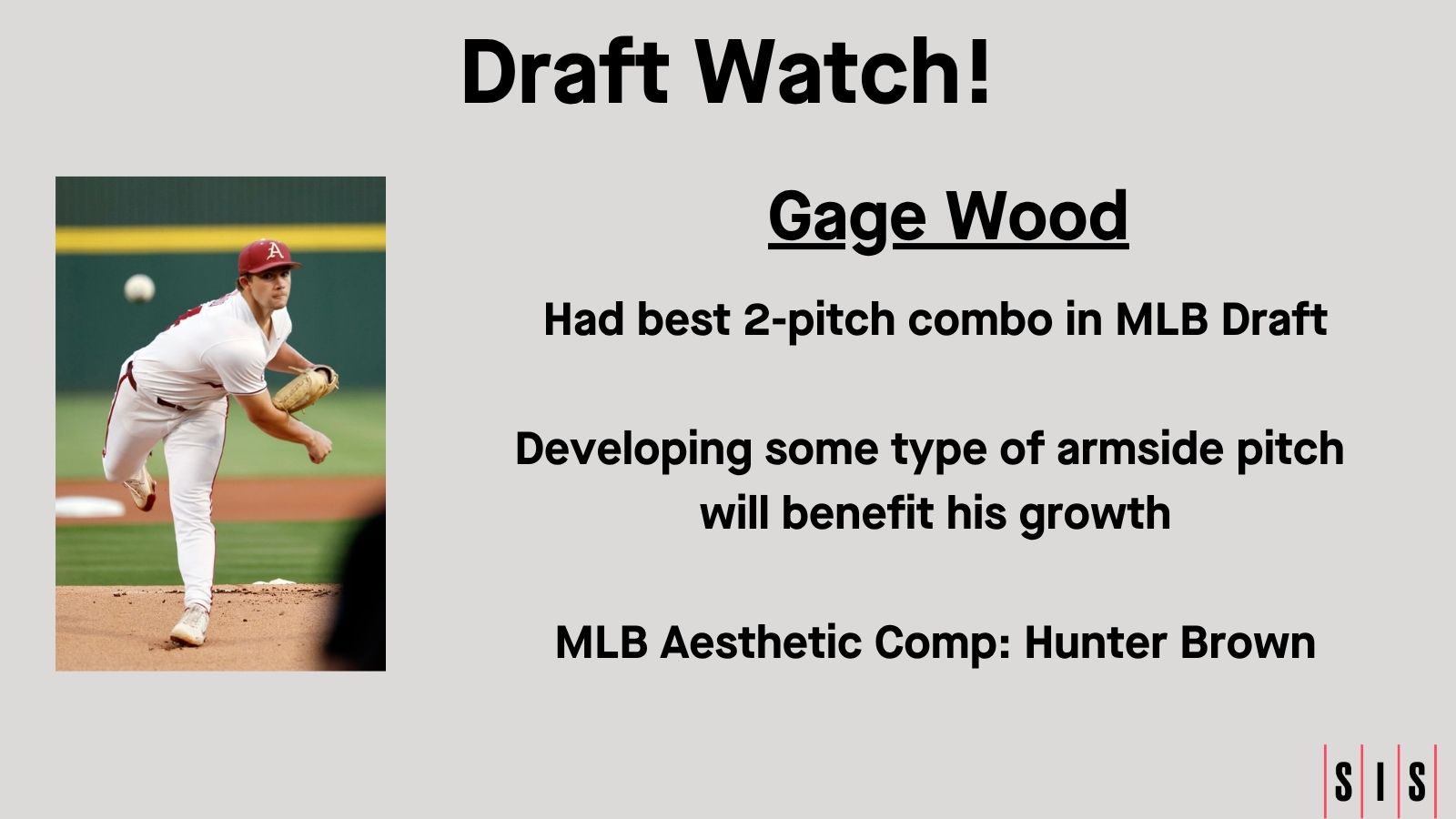
    Gage Wood arguably has the loudest stuff in the entire college draft class. His arsenal is a noisy and brash heavy metal band. He stares with laser focus towards the batter, giving off angry vibes. “Here’s my fiery fastball and buzzsaw curveball, try to hit it…”

    Add in a cutter/slider that is hard with good shape, and you have the makings of three distinct offerings and an aggressive pitcher that knows he has overpowering stuff.

    If Wood succeeds in MLB he will continue to wield an ultra-productive fastball to pair with a big breaking pitch that he can throw in the mid-80s with a downer shape. He’ll do this all while throwing strikes and keeping the ball out of the heart of the plate as he refines his command.

    If Wood hits a snag, it will be possible for him to sustain further injuries. Shoulder injuries can be complex.

    Or he’ll lack true command of his fastball and curve, with no viable, consistent armside pitch to keep hitters honest and never gets a feel or command for the splitter that he rarely threw in 2025, but has been tinkering with.

     College Career:

    In Wood’s first two seasons in Fayetteville, he was a power reliever. After making the transition to the rotation, he had some bad luck, as he was removed from an outing in February against Michigan with a shoulder impingement.

    The Razorbacks shut down Wood until mid-April limiting him to just 10 uneven starts and pitch counts and just 37 ⅔ innings. Wood’s powerful arsenal was on display late in the season when he twirled a 19-strikeout no-hitter vs Murray State in an elimination game at the  College World Series.

    I’m not sure if it was ever a discussion to take the ball out of Wood’s hands, but I would venture to guess he would have told anyone who asked that it was his game and his ball.


    Year ERA IP K% BB%
    2023 4.80 30 30% 16%
    2024 4.46 40 1/3 32% 5%
    2025 3.82 37 2/3 46% 5%


    Pitching Mechanics:


    Out of the windup, Wood starts with his lower half fully turned to face third base. He rotates his upper body to have his glove in front of his face as he peers over the top.

    He steps with his left foot to first base and rocks back, dropping his glove to his stomach. He smoothly brings his leg up to his glove during the leg lift, and as he does so, he counter-rotates his hips, creating momentum forward.

    As he drives his front hip to the plate, he straightens out his lead leg with his toe pointed up to the sky at about a 45-degree angle made with his leg and left foot.

    He holds himself in a close position down the mound as he enters a front-foot strike. He’s smooth getting down the mound, but has a fast arm action as he goes to land.

    With his right arm flipped up around a 45-degree angle, you can see the scap retraction in his throwing shoulder as he enters a power position with his chest and weight leaning into his front foot.

    Finishing with his chest out over his knee, he transfers energy through a lead leg block that drives force up to his throwing arm. He usually recoils his arm quickly in a brief motion. He brings it back to his body quickly after ball release, as his leg swings through in a straightened position.

    One quirk in Wood’s delivery is that he pats the ball throughout his move into hand brake, almost using it as a method of rhythm to keep him on tempo throughout the delivery.

    Wood moved over to the extreme first base side for the Murray State no-hitter, which is likely due to the angles.

    Gage Wood positioning on pitching rubber:

    2 images. On the left, Wood stands with his feet in the center of the pitching rubber. On the right, he stands with his feet on the 3rd base side of the rubber.

    Arsenal:

    4s: 95-97 mph avg, 17” IVB, 10” Arm-side | Release: 5.5’

    Wood throws his four-seam with giddyup behind it, and the ball has good carry through the top of the zone. From a lower release height, the ball zooms past hitters, and he squeezes the pitch hard.

    He has a slight supination bias, meaning he throws the ball with a slight cut at times. Still, on the four-seam, he tries to stay behind the ball and rip down on the seams to create backspin, which he does pretty well based on how his fingers align on the ball in his grip and how they interact at release.

    Against either handedness, his catcher sets up the middle of the plate, up or down—his locations on the fastball against right-handed hitters are slightly more to the top shelf. While against left-handed hitters, Wood’s fastball command was more middle shelf in the zone.

    He was highly aggressive in the zone with his fastball, running an above-average heart-of-the-plate percentage this season, although it was a smaller sample. Arkansas wanted Wood in the zone and with good reason, as he ran a 32% zone-whiff rate on the pitch against righties and a 46% zone-whiff rate versus lefties.

    The pitch, with a flat vertical approach angle of around -4.1, completely obliterates hitters as they swing underneath it. If Wood can continue to refine his command to more average or maybe even above-average at best, he can start to punish hitters at the top rail, leaning into the excellent traits of the pitch that already exist.

    He gets the ball up, but it will start to be scary for hitters if he can throw fastballs away and then work the pitch up with two strikes. That’s when he can start changing eye levels with that pitch.

    Here are some fastball stats from Wood’s 19-strikeout no-hitter:


    Curveball: 82-85 mph avg, -16” IVB, 11” Sweep

    The curve is a banger pitch, and his teammates have aptly named it the banger as well. The pitch is at times a hard vertical snap dragon at 83-85 mph. He can also get more to the side of the ball and create some more sweep on the pitch if needed.

    This manipulation is intriguing and could help him continue to throw it to both right-handed and left-handed hitters. Either way, the pitch with so much depth at that velocity is hard to come by even in MLB. If the pitch tightens up a bit, it should still perform inside of his arsenal.

    It becomes a guessing game when Wood is blazing heaters by a hitter and then rips off a massive breaker out of the high fastball tunnel. In terms of usage, Wood is a two-pitch pitcher with a double-plus fastball and a plus curveball. Maybe he pushes the velocity more to 85-87 mph, and the break is shorter; it could be a double-plus breaker if he starts to have more command.

    With a big spike on his grip, Wood gets to the front of the baseball with intent better than most, creating hard topspin, producing a gnarly curveball because of it.

    Cutter: 87-91 mph avg, 2” IVB, 4” Sweep

    Wood’s Cutter lives in the slider range, and he doesn’t love the pitch, but it has some decent shape to it, and he throws it pretty hard. The problem is that Wood has a tiny sample size of just about 50 cutters thrown this season.

    With 95% of those thrown to right-handed hitters, it became a wrinkle pitch for Wood against right-handed hitters. There’s hope that Wood can probably add some distinct glove-side breakers to his arsenal, given his little bit of supination bias, which should help him get to the side of the ball better to create spin.

    Any version of a gyro slider and cutter at a hard velocity to pair with a possible sweeper could be enticing to the Phillies—a team that promotes a deeper arsenal and cutter usage, in the Majors, and in some of their pitching prospects as well.

    Splitter: 86-90 mph  Specs: 8” IVB, 11” Arm-side

    With only 14 splitters, all thrown to opposite-handed hitters, the pitch just was not thrown much to assess. He does throw the pitch hard and also kills spin on it. Overall, Wood should be able to possess some type of average to fringe-average offspeed pitch.

    Here are the grips on the splitter:

    Wood's first 2 fingers are split as wide as they can be spread on the baseballAdding in a seam-shifted two-seam to push righties off the plate would be nice as well. Perhaps even a traditional sinker, even if of poor quality, could help moderate the four-seam usage a bit.

    The addition of either a somewhat reliable offspeed pitch or multiple glove-side harder breakers like a cutter and/or sweeper will provide value for Wood.

    Projection:

    Wood is a high-ceiling right-handed pitcher with a fastball and curveball pairing that tunnels beautifully. Developing some type of armside pitch will benefit his growth more than anything, and it will be intriguing to see what the Phillies focus on in his development early in pro ball.

    Wood has some questions about the extent of his workload in college. He’s also a smaller pitcher in terms of stature, and while you do have to factor in durability and injury risk.

    From a pure pitch shape and stuff standpoint, Wood has the possible best two-pitch combo in the draft and the foundational building blocks of a mid-rotation starter with some massive upside.

    There’s risk and variance in the profile and some reliever risk if the command backs up, but he’s as talented as any pitcher in this draft and a competitive menace on the mound.


    Aesthetics Comp: Hunter Brown (Similar Arsenal Characteristics)

  • MLB Draft Scouting Report: Liam Doyle (Cardinals Pitcher)

    MLB Draft Scouting Report: Liam Doyle (Cardinals Pitcher)

    MLB Draft Scouting Report: Liam Doyle

    Skill Grade
    LHP
    Fastball 70
    Slider 50
    Slurve 50
    Splitter 55
    Control/Command 50/50
    Future Value 55

    Name: Liam Doyle

    College: University of Tennessee

    Bio: R/L 6-2, 220 lbs.

    DOB: 06/03/2004

    Written by Brandon Tew

    Analysis:

     Liam Doyle, picked 5th overall by the Cardinals, pitches like he just crushed multiple energy drinks in the dugout before his outing, taking the mound like he has a personal feud with every batter. He’s jittery, and his delivery is up-tempo and high energy. His arsenal is fueled by a high-octane fastball that explodes through the top of the zone. The pitch is a legit high-velocity four-seam with carry from an average release height.

    If Doyle succeeds in MLB as a starter, it’s with the rest of his arsenal woven in and out of the fastball usage at an effective rate. He gives off the look of a reliever with a high-effort delivery and snappy movements. However, he zones all his pitches and throws strikes at a high enough rate to be in the starter mold right now.

    If Doyle lands on more of the relief pitcher track, it will be his secondaries not improving from their current shapes, and his control and command backs up to more fringe-average and below.  

    College Career:

    Liam Doyle began his career at Coastal Carolina, posting a decent ERA and a respectable number of strikeouts. After transferring to Ole Miss for his sophomore season, there was an uptick in strikeouts, even through a rocky season in and out of the bullpen as a starter and high-leverage reliever.

    Doyle then found his way to Knoxville, where he pitched with more confidence and improved his conditioning, turning himself into one of the best Friday starters in the SEC. 

    Doyle began throwing his fastball at a higher velocity. While also holding that velocity deep into starts, and still throwing all his pitches at a decent zone rate.

    Year ERA IP K% BB%
    2023 4.15 56 1/3 29% 9%
    2024 5.73 55 35% 9%
    2025 3.20 95 2/3 43% 8%

    Pitching Mechanics:

    In the windup, Doyle starts with his glove at his stomach. He brings the glove up to his nose before stepping back with his glove foot, bringing the glove back down to his belt as he turns to settle on the third base side of the rubber.

    With high-tempo, he enters leg lift with an aggressive move forward, drifting down the mound. There is significant counter-rotation in his front side and hips as he reaches peak leg lift, with the bottom of his cleat pointing out to second base.

    He enters a drop-and-drive move, holding his front side into landing, and he turns his glove hand into his body. As he lands at front foot strike, he pulls his glove arm fully into his chest, and his arm flips up to a solid position as he shifts weight to his front side into a lead leg block.

    His head pulls off to the right with high effort as he spins out to third base to finish his delivery, falling off hard. It’s high-effort and high-tempo, but Doyle gets the most out of his body to throw hard from his high three-quarters slot. 

    There might be less room for projection in terms of adding velocity. Still, Doyle has maintained the high-effort delivery and velocity deep into his outings, so keeping that sustained velocity into a full pro ball season of starts will be key.


    Arsenal

    4s: 94-98 mph avg, 19” IVB, 11” Arm-side | Release: 5.9’

    Doyle’s fastball is a blitzball shape in the mid-to-upper 90s; the pitch whizzes through the top of the zone and has an insanely high 40% zone whiff rate. He keeps the fastball up in the zone and pushes the location of it up and away from right-handed hitters.

    When he gives up damage on the pitch, it usually is on more 94-95 mph fastballs in the heart of the zone. The attack plan, armside from righties, has worked and should continue to work, leaning into the natural run of the pitch.

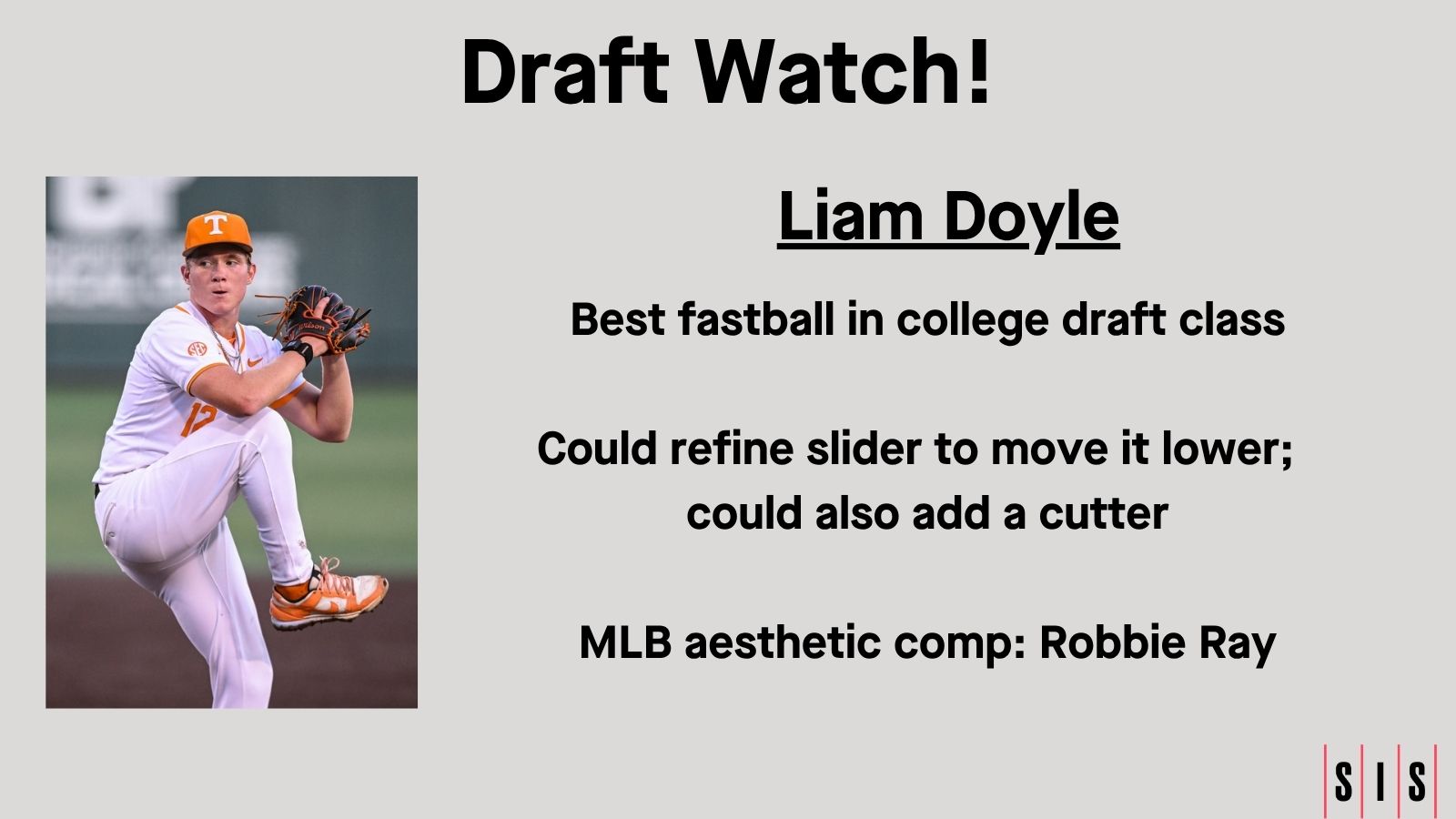
    Doyle’s fastball profile and velocity made it the best fastball of the college draft class. The rest of the development of his arsenal will honestly decide how good he can be as a starter. Still, Doyle should have no issues handling right-handed hitters with his fastball, and the four-seam up can also protect his secondaries against left-handed hitters, too.


    Slider: 85-90 mph avg, 5” IVB, 4” Sweep

    Doyle’s shorter slider lives in the slider to cutter range in terms of velocity and break. He landed the pitch more middle than pushing the location to the glove side, even to left-handed hitters.

    When the velocity exceeds 87+, it is a better offering. He can build on the arsenal and push more of a true cutter 90-92 mph, and have a possible gyro slider shape play off of the cutter. He uses the cutter more inside to righties and using the cutter and slider away from lefties.

    Overall, his feel for zoning the slider is good, but refining the command and moving the location more down in the zone, while also having a more vertical cutter, would be ideal.

    Slurve: 78-82 mph avg, -3” IVB, 10” Sweep

    Doyle’s slurve is an interesting pitch. As a pronator, he throws with his hand and wrist turning over as he stays more behind the ball to apply force to the ball. This allows Doyle to create good backspin and carry on his four-seam.

    The downside is he can’t effectively create a sweep on pitches like a sweeper or slider as easily when getting to the side of the ball. When he forces this shape, it leads to a bigger and significantly slower breaker that should be categorized as more of a slurve than a sweeper because of the depth of the pitch.

    You could have Doyle lean into a more vertical curveball or even a more gyro slider shape, and classify it as a curveball in a “death ball” shape.

    The death ball is a pitch that has the bullet-like spin of a slider but sits with more depth than a traditional bullet slider. Pete Fairbanks, Ben Brown, and Kumar Rocker throw hard death balls that perform well.

    I think the pitch plot above from Lance Brozdowski’s pitcher notes on Bryce Miller’s death ball last season illustrates a possible shape Doyle could get to with a mid-80s breaker.

    A left-hander that gets to this shape and has expanded his arsenal is Cole Ragans, so if Doyle can figure out this bullet-slider shape, he could pair it with the bigger slurve.

    The slurve does create timing issues for both right-handed and left-handed batters and induces swings as well. There’s probably just a harder breaking ball Doyle can get to inside of his mix.


    Splitter: 84-89 mph  Specs: 2” IVB, 10” Arm-side

    Doyle’s splitter is almost purely a two-strike pitch for him, but he will drop offspeeds early in the count if he feels a hitter is on his fastball. (Not many hitters are on his fastball even if they know it’s coming.) 

    In its current form, it’s probably a below-average splitter, but Doyle should be able to get to an above-average offspeed pitch at a hard velocity. The offspeed would most likely be used for opposite-handed hitters, but if he can find more of a breaking ball glove side there’s less concern about the splitter or changeup because of how well his fastball performs against righties.

    An offspeed for the 2nd and 3rd time through the order would be nice as a wrinkle inside of his arsenal for usage purposes.


    Projection:

    Doyle’s fastball is a true double-plus pitch, performing at elite rates in college. The Cardinals are banking on the fastball being a true weapon in his arsenal. Building off a dominant fastball like Doyle’s makes him an intriguing prospect.

    His success as a starter will hinge on continued strike throwing and solid command of his pitches, a foundation he already has in being able to zone multiple offerings at a good rate. 

    Overall, Doyle should be able to add a harder breaking ball to his arsenal to combat left-handed hitters; the fastball’s performance against right-handed hitters should continue if he gets the offering up in the zone.

    The Cardinals are currently evaluating a starter profile with a higher upside due to his fastball, but with a wider variance in his profile if his control and command dip below average. That was something control-wise that didn’t appear to be an issue for Doyle for most of the 2025 college season. 

    Doyle has an exceptional fastball, but the rest of his arsenal will be the driving force behind his success in MLB.

    Aesthetics Comp: Robbie Ray (Body Comp, Up-tempo delivery)

  • MLB Draft Scouting Report: Kyson Witherspoon

    MLB Draft Scouting Report: Kyson Witherspoon

    MLB Draft Scouting Report:

    Kyson Witherspoon

    Skill Grade
    RHP
    Fastball 60
    Slider 55
    Curveball 55
    Cutter 55
    Changeup/Splitter 50
    Control/Command 50/50
    Future Value 50

    Name: Kyson Witherspoon

    College: University of Oklahoma

    Bio: R/R 6-2, 206 lbs.

    DOB: 08/12/2004

    Written by Brandon Tew

    Analysis:

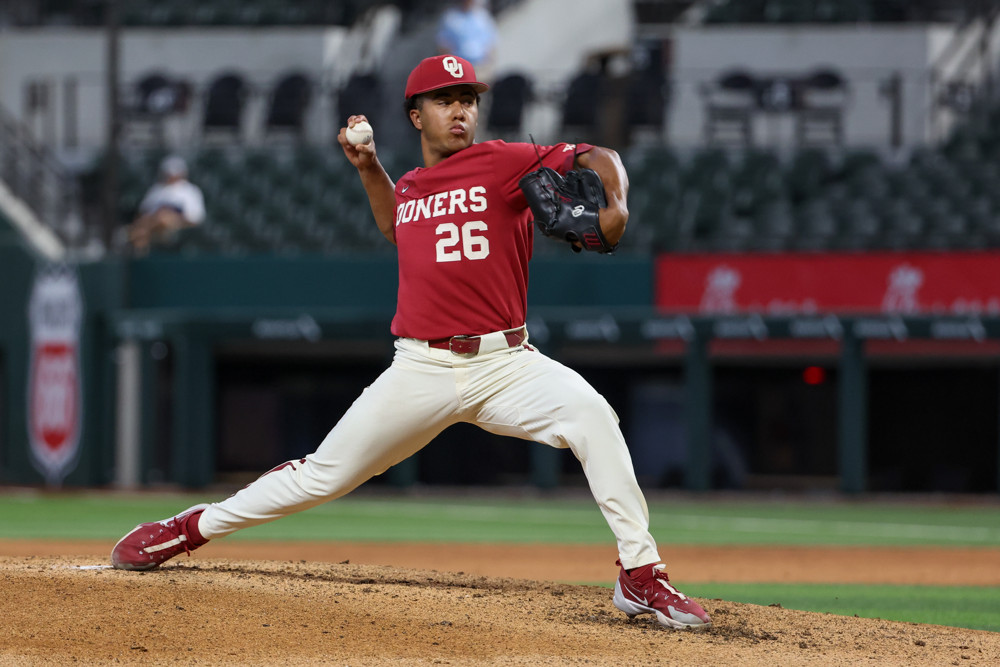
    Kyson Witherspoon is a compact, explosive mover on the mound. With a short extension that doesn’t even reach 6 feet and a short stabby arm path, Witherspoon has some deception and unconventional mechanics with enough strike throwing ability. 

    He has nice shapes on his pitches, including a high velocity cut-ride fastball and a big curveball. Teams will view him as a project they can mold into a starting pitcher, potentially with a deeper and expanded pitch mix than he currently has.

    If Witherspoon succeeds in MLB, it will be by harnessing his explosive movements to command more of his pitches to both sides of the plate while also deepening his arsenal to include multiple distinct glove-side breaking balls and a solid offspeed pitch.

    Witherspoon might run into some trouble in pro ball if he has more fringe-average command. In that case, he will likely be seen as more of a reliever with solid pitches, capable of producing in a bullpen due to his average control; however, not enough stuff to pitch multiple times through the order. 

     College Career:

    After transferring from Northwest Florida State College, Witherspoon was a solid contributor in 2024, striking out 90 hitters in 80 innings. It came with some walks at an 11% walk rate and 40 walks surrendered.

    Fast-forward to 2025, and Witherspoon was one of the most consistent Friday starters in the SEC, cutting his walk rate down while upping his strikeout rate. The improvement in command comes from more comfort in his delivery, but there’s still some upside in terms of commanding the ball even better.

    Year ERA IP K% BB%
    2024 3.71 80 25% 11%
    2025 2.65 95 32% 6%

    Pitching Mechanics:

    Witherspoon pitches exclusively out of the stretch, starting on the 3rd base side of the rubber. As he reaches peak leg lift, he begins to drift down the mound with his front hip significantly.

    As the glove gets to the side of his ear, there’s a bit of counter-rotation created in the drift forward. As he comes out of the leg lift, he tilts his trunk and posture backwards as his hands break at shoulder height.

    Witherspoon then has a bit of jerkiness to him as he stabs his arm downward to get to his arm path. As he sinks into his back hip, he almost pushes down the mound, still trying to stay closed into front foot strike.

    He lands heel to toe and creates a nice stretch across his chest in hip-shoulder separation that is solid as his arm flips up into position at front foot strike. At times, he looks rushed down the mound with possible early trunk rotation into landing. 

    He uses his explosive athleticism to transfer energy into the ball with less effort. He’s more of a short strider with a faster tempo down the mound in a more compact manner, but he’s aggressive down the mound in his moves and tempo.

    Arsenal

    4-seam fastball: 95-98 mph avg, Specs: 19” IVB, 7” Arm-side | Release: 5.9’

    Witherspoon throws a power four-seam with some cutting action to it. He will try to elevate the pitch later in counts to put away hitters. Against either handedness, he will throw the pitch with two strikes.

    He had a 24% whiff rate on the pitch this season and around a 20% in-zone whiff rate to both righties and lefties as well. The cut ride nature of the pitch doesn’t allow the ball to carry as much at times. It’s still an above-average shape, and adding in the velocity, and even with the slightly above-average release height, this is still a plus pitch.

    Witherspoon is more control over command right now with his four-seam in particular, and was very aggressive with the pitch. He allowed some damage on fastballs against left-handed hitters, possibly a byproduct of not getting the pitch inside to lefties.

    Also, lefties sat fastball early against him, as he was more likely to throw a four-seam to start an at-bat or down early to left-handed hitters at a higher rate than right-handed hitters.

    Witherspoon uses pent-up energy and emotion to fuel his fastball when he wants to reach back for some more velocity. In big spots when he finished at-bats against hitters with a high-velocity fastball, he would display some of this energy on his way to the dugout.

    Slider: 84-89 mph Specs: 0” IVB, 5” Sweep  

    Cutter: 88-90 mph Specs: 6” IVB, 3” Sweep

    Witherspoon’s cutter and slider would blend in shape and velocity at points this season. The team drafting Witherspoon would likely push his cutter up a little and get higher velocity around 90-92 mph. 

    While the slider would push more toward the depth slider, he would try to throw down and away to right-handed hitters. If he can consistently get the more down shape at around 85-87 mph, he can use the two separate offerings in the same tunnel. 

    Or he can use the slider down in the zone and the cutter more toward the upper part of the zone, especially to left-handed hitters, to keep them off of his four-seam early in counts.

    Witherspoon loved using the cutter and slider down and away from right-handed hitters and leaned on zoning the cutter a bunch. If he can refine the command of these two offerings, especially the slider after reworking the vertical depth of the pitch, he can start to backfoot lefties to move their feet off the plate, opening up the outside of the plate more. 

    His cutter against left-handed hitters also pushes down and in mostly, so being able to get more carry on that pitch could move the location more in on the hands of left-handed hitters rather than around mid-thigh locations.

    With his supination bias, there’s a chance a team will give him a bigger sweeper shape as well. For both handedness, there’s a multitude of routes Witherspoon can take with his pitch mix. If you add a sinker, you can also protect your other pitches on the outer part of the plate by throwing the sinker inside against righties.  

    These tweaks will likely come with how much you want to touch his mechanics, so there’s a threading-the-needle aspect to all of this, but the possible shapes you can get to from a pitch perspective are intriguing based on his current mix and three-quarters arm slot.

    Changeup: 87-91 mph  Specs: 11” IVB, 15” Arm-side 

    (Also tinkered with a Splitter 89-90 mph)

    On the left side, Witherspoon is gripping the pitch with 3 fingers, using much of his hand. On the right side, he's gripping it almost like a split-fingered fastball

    Rather than talking about the current changeup shape, there’s an interesting tidbit I noticed about Witherspoon. He tinkered with his offspeed a lot this season.

    In the first four starts of the season, he threw what looks like a four-seam changeup. Then, going into his start against South Carolina, he switched to a splitter grip.

    He started in the splitter grip for about six starts before changing back to a four-seam changeup against Georgia in April. Then, to end the season based on the video, he went to a two-seam changeup.

    His changeup and splitter were both firm offerings with little drop. An organization will continue to work with him in pro ball and help him find an orientation and grip that adds drop and reduces spin. He had an okay feel for these offerings, but he mostly threw changeups over the splitter he started gripping. He was also tagged on a couple of poorly-executed changeups late in the season, where the pitch just didn’t fade enough and stayed up.

    There’s enough here to get to an average offspeed shape to use versus left-handed hitters, and maybe an even better one with pitching development continuing to improve with offspeed shapes and their usage.


    Curveball: 76-80 mph  Specs: -16” IVB, 10” Horizontal

    The curve is a big knuckle curve that Witherspoon deployed in two-strike counts off of his fastball to both left-handed and right-handed hitters. He could throw the pitch below the zone or catch a batter unable to pull the trigger on a pitch dropped into the zone out of the sky.

    The pitch had excellent results both in and out of the zone for whiffs to either platoon, and has the makings of an above-average offering that can neutralize hitters off of Witherspoon’s fastball and harder glove-side pitches.

    If the curve can work against opposite-handed hitters in pro ball, even pushing velocity and intent to make it an even better pitch, this could lessen the impact of not having an average offspeed pitch to keep left-handed hitters honest, more than anything.

    Witherspoon, in general, can feel rushed down the mound, and his release of the curve can come and go from pitch to pitch with some terrible misses.

    He does have overall a feel for the pitch, and his willingness to throw it in two-strike counts to both platoons makes the pitch a valuable piece of the puzzle for him.


    Projection:

    Witherspoon has intriguing pitch shapes in his cut ride fastball and breakers. A team will try to refine some pitches and also expand the arsenal, possibly giving him a deeper mix to attack hitters with.

    There is a possibility to get to plus shapes in the slider and fastball, putting him more in a middle rotation spot. As an explosive athlete, there’s also room to get more out of his body, not only from an extension and movement standpoint but also cleaning up his delivery if a team so chooses.

    His success will mainly hinge on maximizing his pitch shapes and either moving well enough in his current delivery as an athletic righthander or making some tweaks to unlock better command of pitches. 

    There’s enough of a floor here to like Witherspoon as more of a back-end bullpen piece. Teams will bet on the upside and molding him into a No.4 Starter with some mid-rotation upside if it all clicks.

    Aesthetics Comp: Zach Plesac (Delivery and arm action)

  • 2025 MLB Draft Scouting Report: Kade Anderson

    2025 MLB Draft Scouting Report: Kade Anderson


    Skill Grade
    Throws LHP
    Fastball 55
    Slider 55
    Curveball 55
    Changeup 55
    Control/Command 55/55
    Future Value 55

    Name: Kade Anderson

    College: LSU

    Bio: L/L 6-2, 179 lbs.

    DOB: 07/06/2004

    Written by Brandon Tew

    Analysis:

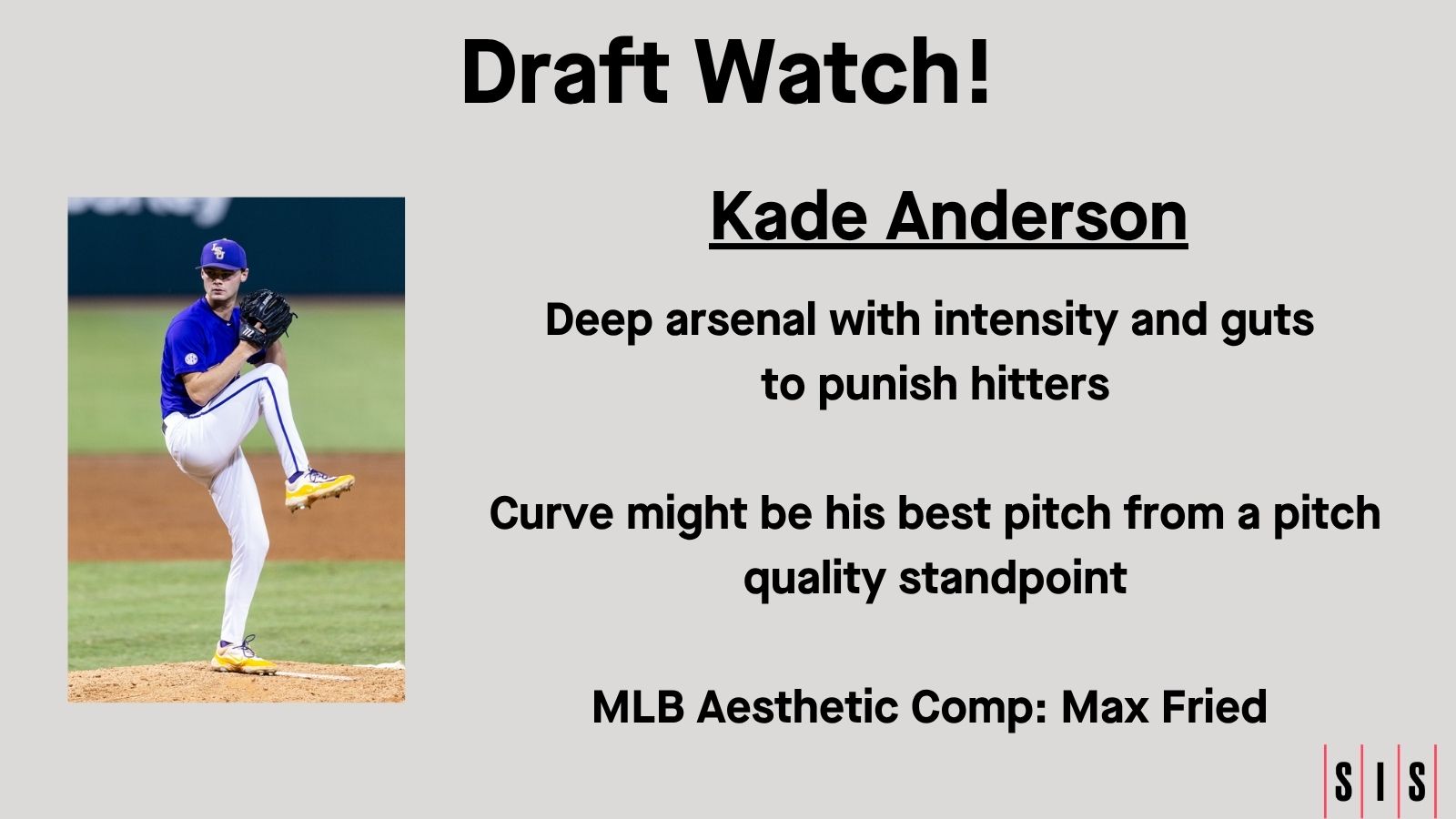
    Kade Anderson blends a deep arsenal with intensity and guts to bully hitters. Anderson possesses above-average stuff across the board, and while his pitch shapes might not be an outlier, his results speak to just how dominant he was at LSU in 2025. When you lead D1 Baseball in strikeouts with 180, you are performing at a high level throughout the season. He also threw the most innings this season (119)

    If Anderson is successful in MLB, it will be because of his deep pitch mix and command of multiple pitches, overwhelming the zone with above-average stuff.

    If he struggles, it will be due to a lack of fastball production, the opposite of what he displayed in college. Rather than tweaking some things, a team pushes him through levels too quickly.

    College Career:

    Anderson, after an outstanding freshman campaign out of the bullpen, continued to pitch better as the season progressed and into the postseason in 2024. Anderson quickly cemented himself as the ace in Baton Rouge in 2025, demanding the ball and pitching deep into starts as much as possible. He averaged 101 pitches a game over 19 starts. 

    Understanding that he pitches once a week is essential to evaluating this workload, but when Anderson had the ball, he rarely gave it up without pitching deep into the game.

    With a 135-pitch shutout versus Oklahoma in April, Anderson pitched his absolute best on the Friday night stage. He then tossed a 130-pitch shutout in the CWS Finals against Coastal Carolina. Anderson’s performance helped the Tigers win another national title and vaulted him into the conversation as the best pitcher in this draft class.

    Year ERA IP K% BB%
    2024 3.99 38 1/3 34% 12%
    2025 3.18 119 37% 7%

    Pitching Mechanics:

    Anderson has a similar delivery to two left-handers that have been compared in the past from a visual standpoint, Max Fried and Cade Povich. The video below shows all three windups in sequence. Anderson also throws from a fluid arm stroke and a high 3/4 slot, similar to Povich and Fried.

    In a windup, Anderson starts with his glove at the belt, but will move it up to his face as he steps to the side, and he brings the glove back down to his belt. As he begins his leg lift, the glove rises to about chin height.

    As he transitions from peak leg lift, he creates a drift and momentum forward, but with little counter-rotation in his front side. He moves smoothly into landing on the front foot, and his arm swing is smooth, and there’s some deception as he hides the ball well. The arm path is in pattern with the rest of his body, finishing in a good position as his front foot lands.

    He throws with a slightly slower, more controlled tempo, but blocks out his lead leg to transfer energy well. While there is no significant uncoiling or unwinding of energy, his delivery is repeatable. With either added mass or even more powerful moves, Anderson could tap into even more velocity.

    Anderson also plays with angles by moving on the rubber based on handedness, going to the first base side against lefties and the 3rd base side against righties.

    This is an interesting choice considering Anderson primarily pitches to the glove side against lefties. Maybe he’s ok with the move over and farther angle to the outside part of the plate because he cuts his fastball.

    He also could be trying to hide the ball better on his breaking balls against left-handed hitters. It would be interesting to see if a team would decide to have him stay on just one side of the mound.

    Arsenal

     4s: 91-96 mph, Specs: 19” IVB   8” Arm-side | Release: 6′

    Anderson slightly cuts his four-seam fastball, and there’s variance in how he will throw the ball game to game or even in certain pitches in an at-bat. What’s intriguing about Anderson is that when looking at catcher locations for his four-seam fastball, he pushes his intended locations up and away from both left- and right-handed hitters.

    He’s arm-side with the pitch against right-handed hitters and glove side with it against left-handed hitters. As mentioned above, since he moves on the pitching rubber based on handedness, the ball must travel farther and at a different angle to reach both targets.

    Anderson is ultra-aggressive in the zone with the pitch and uses the cut he creates to his advantage, especially against left-handed hitters. He uses the offering in first-pitch situations and two-strike ones at a decent rate to both righties and lefties. 

    He’s able to pick up in-zone whiffs on the pitch at an above-average rate, allowing him to get aggressive not only in the zone but also at the top of the zone. Even if the pitch is more middle-up rather than completely getting to the outside part of the plate, he can still win.

    He will need to continue refining his command of the pitch in specific counts and spots, but a team should continue to have him carry the ball to the top of the zone. The frequency at which he does it might change with the baseballs used in the minors and eventually MLB balls.

    The different ball used in college baseball does impact shape, so it would be wise to point out that Anderson would lose some ride on his fastball once in pro ball. Then, an organization would have to figure out if he can still dominate the top shelf with his fastball and if he can also blow it by professional hitters in the zone at the same rates as well.

    That said, when he smells the finish line of an outing or needs a big pitch, he goes to the fastball and pitches with moxy. He can also reach back for one of two more ticks on the fastball as well, so there’s even hope that he can add velocity in pro ball with a few tweaks.

    Slider: 84-87 mph Specs: -1” IVB, 7” Sweep

    Anderson’s second-most-used pitch to both handedness of hitters is his slider. He uses the pitch 24% of the time against righties and ups it to 35% of the time against lefties. He has a solid feel for zoning the pitch and gets aggressive with locations in the zone early in counts. He throws the slider with a little more depth at times so he can get back-foot with the pitch to right-handed hitters underneath the barrel.

    With a high strike rate on all his secondaries, Anderson loves to use them. What I have noticed is that if Anderson doesn’t like a pitch called from the dugout, he will swipe on his pant leg to make it look like he’s shaking off a pitch to another one. His catcher will then sign in the pitch they want; more often than not, it’s a slider. 

    I saw a couple of curveballs as well, and Anderson only swiped a handful of times. Still, it is interesting to note how much he loves throwing his slider in certain spots and even trusts the pitches’ utility to both left- and right-handed hitters. 

    His command of the pitch can be a little finer, but when he needs to place the pitch in the zone or get it down below the zone or out of it for chase, he can execute this particular pitch better than any other in his arsenal.

    The upside for Anderson is that, if he continues to develop his slider, it will become an above-average pitch that will play at higher levels. With his ability to spin the ball and spin efficiency, he should be able to add more to his arsenal, either throwing an actual sweeper to left-handed hitters or adding a true cutter to attack the inside part of the plate for right-handed hitters. 

    Expanding Anderson’s arsenal with glove-side breaking balls is the next step in his development, and it appears to be a very attainable goal.

    Changeup: 82-85 mph  Specs: 9” IVB 12” Arm-side

    Anderson’s change piece has good depth and fade to it, working below the zone for chase. His usage of the pitch leans towards opposite-handed hitters, where he throws it about 16% of the time to righties and targets it down and away, playing into the pitch’s characteristics. He zones the pitch a decent amount for an offspeed pitch, though, and hitters will take it in the zone. However, he allows the most damage when it is left up.

    It’s a balance act between zoning the pitch for a strike or giving up a base hit in those scenarios, but the pitch is at its absolute best when he can dive it down from a right-handed hitter to get a swing over the top.

    Anderson’s ability to utilize his deep arsenal in different counts, as well as zone each pitch, allows him to use the changeup to get hitters out in front of the pitch and catch them off guard.

    Anderson also occasionally used the pitch to left-handed hitters as well, around 5% of the time as an extra wrinkle inside his arsenal. In its current form, he uses the pitch more away from left-handed hitters, avoiding down-and-in pitches to left-handed hitters, which is a safer bet in terms of location.

    It at least shows a trust in the changeup altogether, and he has a nice feel for the pitch, as with all the pitches in his arsenal.

    Curveball: 76-81 mph  Specs: -15” IVB 11” Horizontal

    Anderson’s curve might be his best pitch from a pitch quality standpoint. It’s a big breaker that has a nice shape. He can add and subtract velocity on it, whether he wants to throw a get-me-over strike or bury the pitch in the dirt.

    He would go to the pitch in count advantages when he was ahead by a strike or in some two-strike counts. If Anderson had a good feel for the release of his curve in a given start, he would mix it in the second and third times through the order. He even threw back-to-back curves at times, straying away from his aggressive fastball usage to certain hitters.

    Whatever team drafts Anderson will likely push his curveball velocity towards the higher end of his velocity band. However, there’s a real affinity for Anderson’s shape on the pitch, and he can zone it as a strike stealer early in counts. Additionally, his ability to get the pitch down under the zone for a swing and miss should also help it play with his fastball out of a good tunnel. 

    Ultimately, Anderson’s curve should be able to stay in his arsenal as a nice offering to add a change-of-pace during at-bats and some swing-and-miss as well.

    Projection:

    Anderson has the results to back up a deep arsenal, and he’s a safe bet to be some version of an MLB starter. There are likely some tweaks to be made to help Anderson reach a higher ceiling, and teams will appreciate the deep pitch mix and ability to throw strikes.

    With a real chance to add other pitches in some form of a glove-side pitch, whether a sweeper or even a cutter, teams will like the different avenues they can approach Anderson’s player development in pro ball. This isn’t even to mention a sinker, which adds a nice wrinkle to protect the four-seam.

    Whether the fastball and slider will eat up professional hitters the way they did college hitters might be a sticking point, as will keeping the ball in the park early in his pro ball career, if he’s still very aggressive in the zone. There’s enough command to push Anderson more away from the middle of the plate, though, where he allowed some of his most damage in college.

    Still, with Anderson, you’re getting a bulldog competitor who wants to see outings through to the end. Couple that with the clay to mold in terms of pitch mix, and there’s a solid floor, but if you can tap into more potential, Anderson could be a great return in value.

    Aesthetics Comp: Max Fried (Delivery and Similar Arsenal)

  • 2025 MLB Draft Scouting Report: Jamie Arnold

    2025 MLB Draft Scouting Report: Jamie Arnold

    Skill Grade
    Throws LHP
    Fastball 60
    Sweeper 60
    Cutter 50
    Changeup 55
    Control/Command 55/50
    Future Value 55+

    Name: Jamie Arnold

    College: Florida State University

    Bio: L/L 6-1, 192 lbs.

    DOB: 03/21/2004

    Written by Brandon Tew

    Analysis:

    Jamie Arnold combines a funky cross-body delivery with unique release traits to create both horizontal and vertical approach angles that accentuate his shapes. Arnold possesses a plus sweeper, which he ends up zoning more than his fastballs, making him heavily dependent on the sweepy breaker in high-leverage situations. 

    A team will work on helping Arnold develop better fastball control and command to pair with his outlier release traits, enabling him to effectively pitch to both right-handed and left-handed batters in the zone.

    College Career:

    The Tampa, Florida native pitched at Florida State University for three seasons, posting solid numbers in his freshman year and then achieving excellent results in his last two seasons. 

    As one of the best pitchers in the ACC and also in the nation, Arnold put up high strikeout numbers with decent walk rates. He headlined the front of the Seminoles’ rotation on a title-contending team in 2024 and 2025.

    Year ERA IP K% BB%
    2024 2.98 105 2/3 35% 6%
    2025 2.98 84 2/3 34% 8%

    Pitching Mechanics:

    Out of the windup, Arnold starts with his glove just below chest height, around his stomach. He then smoothly moves the glove up to his face as he begins his rock backward.  

    With good tempo and rhythm, Arnold will drop the glove below his belt as he steps to the right and slides from the middle to the end of the third base side of the rubber. Arnold, with this up-down-up movement to his glove, finishes with the glove beside his ear. 

    His arm swing is long and fluid in the back as he brings both his throwing and glove arm down to knee height as he enters the footstrike phase of his delivery. His arm then flips up into a nice position as his foot hits the ground. He gets into extremely deep positions, and you can see the stretch and flexibility throughout his body, especially the scap retraction of his shoulder at foot plant, as his arm naturally floats into this position. 

    This allows Arnold to unwind and uncoil energy throughout his body with a whippy yet low-effort delivery. The deep positions and extension also create outlier release characteristics for his pitches, as he throws from a slingshot sidearm slot with a low release height.

    Arsenal

     4s: 92-96 mph, Specs: 12” IVB, 14” Arm-side | Release: 4.7′

    Arnold’s four-seam fastball is an odd runner shape that Arnold can throw with an almost rise ball perception at times from his low sidearm slot, with one of the flattest Vertical approach (VAA) angles not only in college but in all of baseball. Arnold can get the ball to carry up to the top shelf.

    He targets down more often than not, and he doesn’t zone the pitch particularly well, with his natural miss being up and arm-side. His control and command of the pitch fluctuate at points in a given start due to a lot of moving parts in his delivery. Even if he targets away from a left-handed hitter, he still runs the ball back across the plate with big misses.

    The most damage he gives up is on four-seamers in the middle of the zone and clear misses in locations where the ball doesn’t carry as much. 

    The performance of the four-seam has backed up this season, especially from a whiff standpoint against left-handed hitters.  Still, there are some interesting aspects to not only his flat approach angle but also the runner aspect of this pitch from his slot. He doesn’t need a big vertical four-seam to get good results at the top of the zone. However, pushing locations more up while still keeping them competitive will be a massive key to success.

    Command of the pitch will need to improve for Arnold to effectively attack hitters with a more balanced approach and a more strategic use of his fastball, even if he doesn’t increase its usage. Having better control and command will help the sweeper play even more effectively.

    Sinker: 92-95 mph Specs: 6” IVB, 18” Arm-side

    Arnold also throws a sinker that he trusts even more than the four-seam, and his natural feel for the pitch is higher. He has a greater willingness to throw the sinker to hitters on both sides of the plate, particularly to righties. Against lefties, he’s more glove-side with his catcher locations. 

    He also zones the sinker more than his four-seam fastball and will be aggressive with his locations before using the four-seam fastball upstairs to try and put away batters.

    Both fastballs return good results in terms of ground balls, and the shapes cause hitters to beat the ball into the dirt. Continued ground ball success will be huge, and improved command will help Arnold get to a plus sinker and four-seam in pro ball.


    Sweeper: 83-87 mph Specs: -1” IVB, 12” Sweep

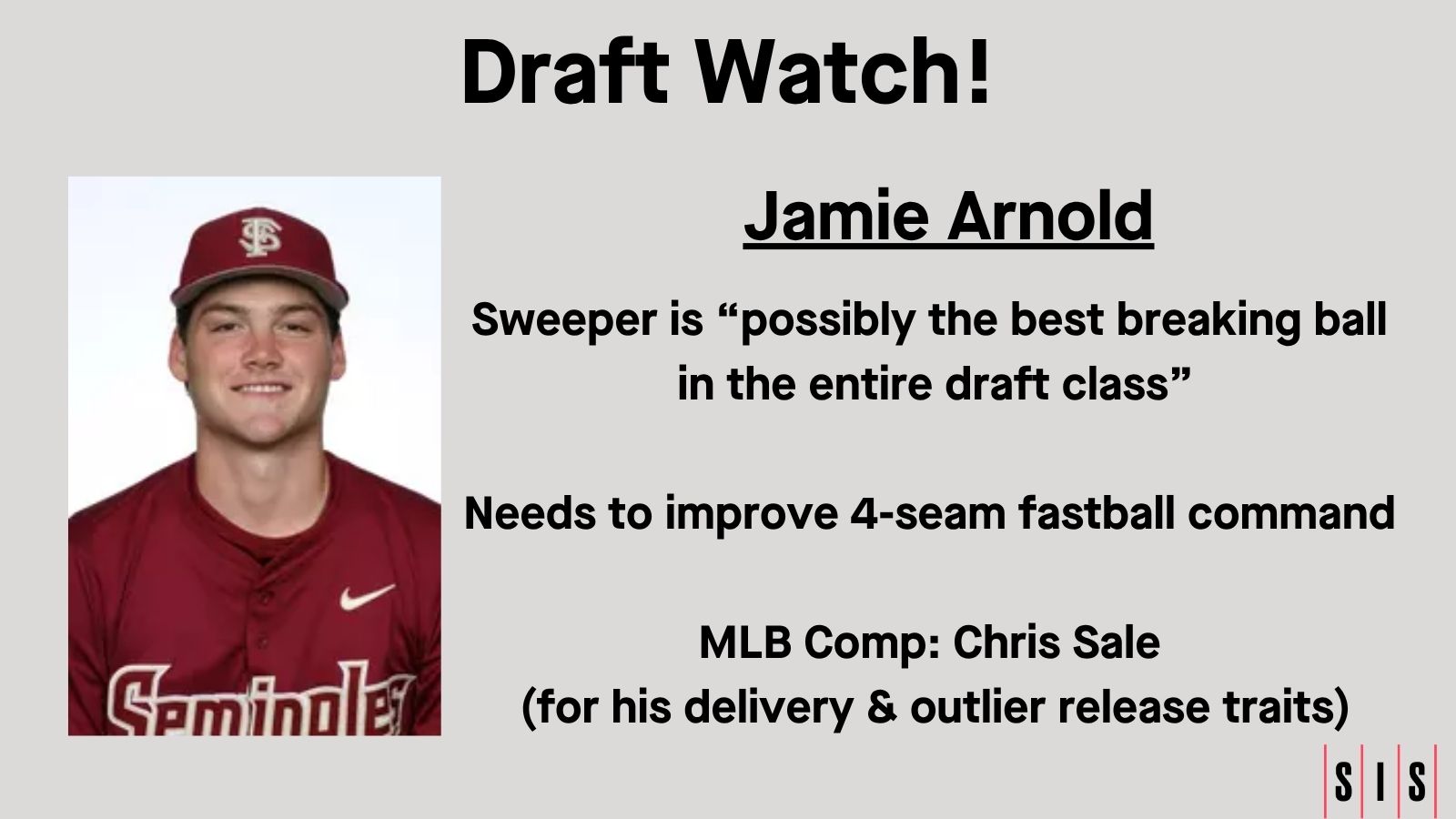
    The sweeper is a dominant plus pitch and is possibly the best breaking ball in the entire draft class. The angles Arnold creates, especially against left-handed hitters, make the pitch a frightening offering for hitters.

    The tunnel he creates with his fastball-slider combo is nasty, and when he can dot glove-side fastballs away from a left-handed hitter, he can just embarrass hitters with the sweeper working out of that same tunnel. He targets down and away from lefties as much as he can.

    There are certain at-bats in games where you can just get out the broom because Arnold’s sweeper is about to make the hitter walk back to the dugout. His feel for the pitch is also impressive, as he zones the big shape at a very good rate. He will lean on the pitch in high-leverage situations. With the bases loaded and a full count; he will bend in a sweeper.

    Arnold also threw the pitch a lot versus opposite-handed hitters, and he can still bury the pitch backfoot against right-handed hitters and create swing-and-miss as well as ground balls. He can manipulate the tilt of the pitch depending on if he wants to zone the pitch or throw it for more chase to either handedness.


    Changeup: 84-87 mph  Specs: -5” IVB 7” Arm-side

    Arnold throws a kick change now with wacky movement as he creates significant drops and decent arm-side movement. With the use of a middle finger spike, Arnold “kicks” the axis of the pitch down while killing the spin of the pitch, having it dive like a pseudo-splitter toward the dirt. 

    He threw a straight changeup in 2024, which was firmer at 88-89 mph. The pitch looked like a change of pace pitch rather than having a good movement profile to create a swing and miss.

    The real crux of the new kick change is whether he can zone it enough to be competitive with the pitch in pro ball or at least have the pitch start more in the zone and fall out of the zone, rather than spiking the pitch in front of the plate or having it spin high and arm side.

    The kick change is an odd shape, so it could work if he’s able to enhance his feel of the pitch, and it’s good to note he still hasn’t thrown it that much yet. His sweeper is so good that if he can find an above-average offspeed in the kick change, it should help him against opposite-handed batters. He won’t have to rely on his sweeper against opposite-handed batters as much.

    Cutter: 86-88 mph  Specs: 5” IVB 0” Horizontal

    Arnold threw an occasional cutter or short slider in 2025, something he was trying to add to his arsenal to play off the big sweeper shape and protect his four-seam, acting as a bridge pitch in the diagonal line on a pitch plot. 

    He uses the pitch to get more vert and throw it up and in on the hands of right-handed batters to keep them from diving over the plate on his fastball and changeup. 

    Arnold probably reworks this short slider and his kick change into more usable offerings, but if he can ultimately command the inner part of the plate against right-handed hitters with his fastball, he might not need as much of a retooling. But to expect that massive leap in command of the four-seam is hard to rely on.

    Hiroya Miyagi, one of the best pitchers in Japan, has similar characteristics and a cross-fire delivery with less loud stuff. He has mastered the glove-side fastball by understanding the differences in direction toward the plate when throwing both arm-side and glove-side fastballs. This is something that probably requires patience in pro ball, to truly start dialing in glove-side fastballs and cutters to opposite-handed hitters.

    Projection:

    Arnold has a solid foundation as a rotation piece if he can zone his fastballs more effectively and play off his dirty sweeper. He has a floor as a nasty reliever but teams will dream on his funky release traits and shapes to try to mold a higher-upside mid-rotation starter. 

    Or they’ll explore the possibility of pushing more towards a high No. 2 in a rotation if the command is dialed in and he can attack hitters in the zone with his fastball and sweeper while getting chases out of those same tunnels created.

    Aesthetics Comp: Chris Sale (Delivery & Outlier release traits)

  • NPB Aces Scouting Report: Liván Moinelo

    NPB Aces Scouting Report: Liván Moinelo

    Liván Moinelo has been one of the best pitchers in NPB for the SoftBank Hawks for eight seasons. The Cuban played a pivotal role in the Hawks bullpen for multiple seasons as one of the most effective relievers in Japan. When Moinelo was the full-time closer in 2022, he shined with a 1.03 ERA, the second-lowest ERA among pitchers with at least 50 innings, just behind fellow Cuban Raidel Martinez, who has also established himself as one of the best closers in NPB.

    In 2023, Moinelo pitched only 27 2/3 innings after arthritis in his left pitching elbow shut him down for the rest of the season in July. He underwent surgery to help fix the inflammation in his joint. For most of the 2023 offseason, the Hawks left him in limbo, contemplating moving him to the starting rotation.

    After much debate, around January 2024, SoftBank decided to make the move official, and Moinelo began preparing as a starter.

    Moinelo’s Recent Seasons (2022-2024)

    Season IP SV ERA ERA+ K-BB
    2022 52. 2/3 24 1.03 312 87-20
    2023 27 2/3 5 0.98 327 37-5
    2024 163 0 1.88 161 155-47

    Moinelo’s first season as a starter did not disappoint as he dazzled and showed durability, pitching deep into games and working his way through NPB lineups with his four-pitch mix. Moinelo, with a new starter’s mentality, was not blowing batters away like he had out of the bullpen. He pitched his way to a Pacific League ERA title with a 1.88 ERA in 163 innings pitched.

    Notably, his 1.88 ERA was the fifth-best in NPB among qualified starters in both leagues. Nonetheless, Moinelo made one of baseball’s best transitions from reliever to starter last season.

    Biggest Strength?

    Moinelo is a smaller pitcher, at 5-10 154 pounds, but the left-hander throws with a smooth, unhurried delivery with some effort at the end. He also pronates and supinates well, opening up a wide array of options for him in terms of an arsenal.

    With a standard four-pitch mix, Moinelo’s pitches are anything but standard with some of the gaudiest stuff in the baseball world. Moinelo had absurd pitch shapes and velocity out of the bullpen. 

    While he lost some shape and velocity, he reined in his effort this past season to try to pitch deep into games. Moinelo paced himself more than in the past. Only four of his 27 starts were fewer than six full innings.

    Moinelo has continued to improve his control over the years. He posted a decent 7% walk rate in 2024 after a 10% in 2022. His K rate was an enormous 43% in 2022, dropping to 24% in 2024. Along with the velocity drop, he pitched to more contact and even ground balls over strikeouts, with a slight dip in his stuff this past season.

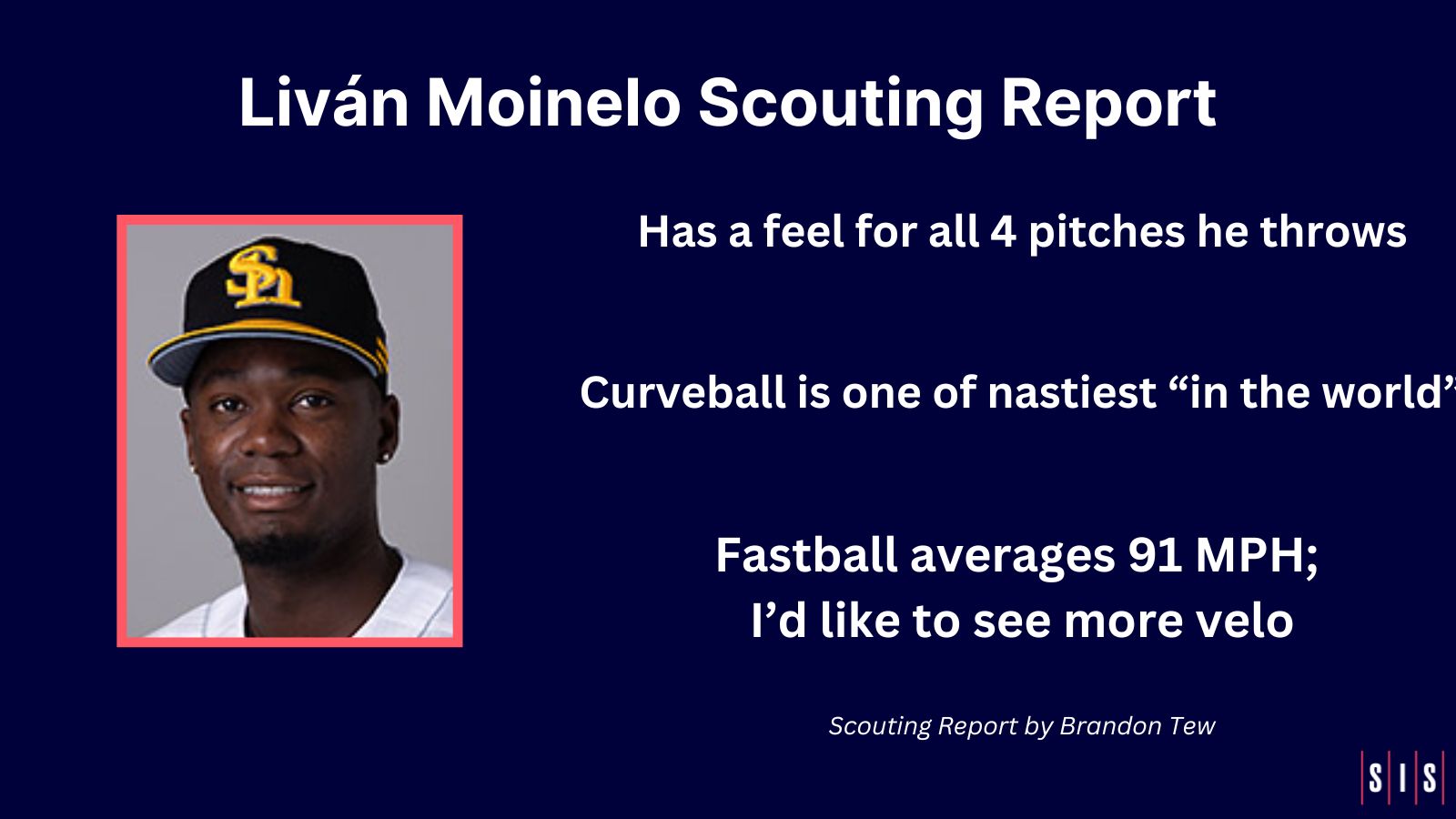
    If there was an argument in 2022 and 2023 that Moinelo had a plus fastball and change to go with at least two plus or better breaking balls, then in 2024, he had more of a 55 on his changeup and fastball on the 20-80 scouting scale, with a plus curve and above-average slider. Moinelo’s biggest strength is that his arsenal is potent, and he has a feel for all four pitches, throwing enough strikes to be highly effective.

    Moinelo sprays the zone more than he possesses command throughout a start. He does have moments when he can concentrate his locations in a specific part of the zone but doesn’t always get to those locations unless he’s locked in.

    You can check out the heatmaps and other relevant stats from this NPB Pitch Profiler. Moinelo elevates the four-seam but tries to keep the rest of his arsenal at the knees, though he does have locations that leak up in the zone.

    RHB

    PITCH USAGE 2024 (2023)
    FASTBALL  42% (44%)
    SLIDER 19% (13%)
    CHANGEUP 24% (24%)
    CURVEBALL 15% (19%)

    LHB

    PITCH USAGE 2024 (2023)
    FASTBALL  51% (60%)
    SLIDER 24% (25%)
    CHANGEUP 10% (3%)
    CURVEBALL 15% (12%)


    Pitch Velocity (MPH)

    PITCH 2024 2023
    FASTBALL  93  95
    SLIDER 86 87
    CHANGEUP 83 84
    CURVEBALL 78 80

    Mechanics

    Moinelo starts with his feet shoulder-width apart, and his first move is a step backward and to the side with his right foot as he slides his left foot across the rubber, settling on more of the 3rd base side. Moinelo will vary his timing and use more of a quick-pitch slide step out of this position or even slow down and twist or dip as he starts his leg lift.

    Front Side with dip:

    via GIPHY

    His initial move into the leg lift and slight drift of forward momentum are consistent when he brings his leg up to chest height. Out of the lift, he turns his lower half back to second base with a slight counter-rotation of his hips as he moves down the slope fluidly, delaying the opening on his front side and hips. Into the front footstrike, Moinelo gets into a strong power position, with his arm and elbow creating a nice, almost 90-degree angle as he flips his arm up from his longer arm swing and loads his power.

    Open Side:

    via GIPHY

    Moinelo lands in an odd position, with his front foot landing slightly open instead of more closed. Hence, he clears his front side and hips more than most pitchers. Energy flows through his body and the kinetic chain really well, and his throwing motion and delivery consistently look relaxed out of his high 3/4s slot. He will even “pimp the finish” with his leg swing coming through, and he will recoil his arm like a whip bringing back slack.

    via GIPHY

    He can also control his effort and tempo down the mound. As a reliever, he threw with much more effort and an abrupt head snap at the end of his delivery, which impacted his control. As a starter last season, Moielo felt more under control, and while there was still some head snap, it lessened. Even though his velocity diminished overall, he had better control and command and could pound the zone more than before, throwing enough strikes to be successful.

    Front Side:

    via GIPHY

    The Arsenal (2024 usage and Average Velocity)

    Four-seam Fastball  45%, 93 mph   CSW% 27%   STRIKE% 66%

    Moinelo throws a four-seam with great ride. He targets the top part of the zone mainly against RHBs but also tries to throw his four-seam up and away from LHBs, coming across his body. Moinelo’s move to the rotation came with a loss of two ticks in his fastball velo as he sat more 91-93 rather than 95. Moinelo is most comfortable throwing cross-body to LHBs, making it hard for hitters to turn on his fastball.

    via GIPHY

    Righties, as suspected, had a way more comfortable at-bat against Moinelo, hitting all 7 of the home runs that Moinelo allowed.

    Opponents vs Moinelo Fastball

    LHB RHB
    OPS .569 .727
    HR 0 7

    via GIPHY

    Moinelo’s four-seam is susceptible to home runs, especially to righties, because of his lack of command at times, as he will yank a pitch down and in to a right-handed batter or have a pitch leak more arm side and middle. He also often goes to the four-seam in both first-pitch and two-strike counts.

    2024 Count Usage

    Pitch 1st Pitch Usage 2-Strike Usage
    Fastball  46% 43%
    Slider 15% 22%
    Changeup 17% 21%
    Curveball 22% 14%

    He leans on the pitch, which returns a plus 19% whiff rate and a plus 18% putaway rate despite below-average locations. Moinelo would rather live with some damage than give in during certain at-bats. However, with the depth of his arsenal, it is a specific choice given his overall average control and command. 

    Considering that the rest of his arsenal produces more ground balls, he would still rather lose on his fastball late and early in counts than on one of his other pitches. It gets hit hard the most as hitters sit on the pitch. He had a 29% hard-hit rate on the fastball in 2024 but a 40% hard-hit rate against righties, compared to 15% for lefties.

    With an average 27% called strike and whiff rate, he gets fewer called strikes than most pitchers because his 19% whiff rate is above-average to plus for NPB. So, hitters are either swinging underneath his fastball or doing decent damage. However, his fastball still has great vertical movement out of his high 3/4 slot. He needs to be more fine with the pitch and his release point. He could fix this damage issue by getting the fastball into the upper part of the zone more.

    via GIPHY

    Slider 21%, 86 mph  CSW% 31%   STRIKE% 69%

    Moinelo’s slider is a tight gyro slider that he can manipulate and turn more into a cutter rather than a slider with depth. He almost exclusively targets down and glove side, trying to bury the pitch back foot to righties and use the movement away from lefties. 

    He will sprinkle backdoor sliders to RHBs, but the pitch is at its absolute best when he can throw it with depth under the barrel—creating a problematic tunnel to navigate as a hitter. when he can also spot the glove-side fastball. With a 31% whiff rate on the pitch last season, Moinelo can miss up with the pitch and still get a swing and miss. His distribution in terms of usage and variety makes it hard to key in on both of his breaking pitches.

    via GIPHY

    Moinelo throws the pitch so that he turns the ball and seams, ripping through the two seams on the side of the ball with a tiny spike of his pointer finger and putting pressure on the middle finger and the outside seam. It looks like this:

    Moinelo can create a tight circle and a lot of gyro spin, but the depth of his slider depends on how it comes off his fingers. If he gets the release point right, his higher slot and release height allow him to drive the ball toward the lower part of the zone more easily, creating a tough angle as the ball enters the zone.

    This angle and the movement away from same-handed hitters make his slider a valuable weapon vs. LHBs since he can pick up whiffs and get hitters to hit the ball down into the ground, with a 60% ground ball rate against lefties on the pitch in 2024.

    via GIPHY

    Curveball 15%,  78 mph   CSW% 38%   STRIKE% 65%

    Moinelo’s curveball is one of the nastiest pitches in the world. With unbelievable bend, it is a topspin menace in the upper 70s and lower 80s. The pitch doesn’t have a significant loopy quality but is an actual top-to-bottom curve.

    Moinelo’s superpower on this type of pitch is his ability to get to the front of the baseball and get the pitch to go over the top of his fingers, creating downward movement from topspin. 

    Moinelo has a real feel for spinning the baseball and can throw breakers that rival his teammate Carter Stewart Jr. in terms of RPMs. With numbers flashing north of 3,000 RPMs, the pitch has incredible drop, and he can bury it for a chase or drop it in the zone for either strike one or strike three.

    The pitch has a 20% putaway rate and a 29% whiff rate, so he can throw it for a chase if needed, especially with two strikes. With a 38% CSW rate, he steals a lot of strikes early in the count, too. He can zone the pitch and has an excellent feel for it given the amount of drop. It has a 65% strike rate. 

    Being able to zone the pitch is incredibly valuable because of the high fastball and curve tunnel he tries to create with the pitch. He gets a lot of swings in the zone and also freezes hitters with it. When there is a swing, it’s most likely a miss over the top of the ball or results in a groundout, as the pitch had a 77% ground ball rate in 2024.

    In comparison, Framber Valdez, who deploys a similar curveball as a lefty and is the ground ball king in MLB, had a 63 GB% on his curve in 2024 with a 40% whiff rate. The two pitchers throw heavy top spin curves around 78-80 mph. Moinelo loves to go to his curve more early than late, but the way he attacks hitters throughout a game will change as he goes deeper, giving batters different looks.

    Changeup 19%, 83mph   CSW% 35%   STRIKE% 65%

    The pitch that made Moinelo’s transition to starter a success was his changeup, which is a good combo of depth and horizontal run. Moinelo can turn the pitch over and pronate, getting the pitch to sink from batters and getting weak swings with batters out on their front side. Some swings are silly, with hitters falling over themselves as they tried to ambush a fastball but got the string pulled on them instead.

    via GIPHY

    With a 55% ground ball rate on the pitch in 2024, he gets a lot of roll-over ground balls to the middle of the infield. Relying on grounders should be a sustainable attribute whether the NBP ball stays dead or not.

    Around the horn, SoftBank’s infield had 20 Defensive Runs Saved in 2024, which outpaced every other NPB team by a wide margin, as did its 65 Runs Saved overall. 

    Moinelo uses his entire arsenal, specifically his curve, and changeup, to induce ground balls, and he has no issue letting his stellar defense behind him gobble up grounders. Moinelo didn’t give up much damage on his changeup. The OPS against it was only .524.

    Moinelo can have the pitch come off his hand wrong and hang in the zone more, which is where any damage comes from. 

    via GIPHY

    As a starter, his changeup usage stayed almost identical against RHBs, around 24% the last two seasons, but he increased it against LHBs to 10% in 2024. That was up from 3% in his shortened 2023 and 6% in 2022. Backing off the four-seam a bit and replacing it with his changeup kept Moinelo less predictable deep into games. At its best, the changeup is suitable for either left-handed or right-handed hitters

    via GIPHY

    Here’s an instance where Moinelo used his changeup against one of the better contact hitters in NPB, Koji Chikamoto, before overpowering him with a fastball, showing a change of pace in this at-bat.

    via GIPHY

    2025 Season Outlook

    Moinelo brilliantly shined as a first-year starter, and with his loud four-pitch mix and propensity for not only strikeouts but ground balls, he is one of the best pitchers in NPB. The next step for Moinelo would be building up his workload and possibly finding the two or so ticks he lost in velocity as a converted reliever.

    It’s also worth noting the diminished effort in his delivery helped him throw strikes. There were times when Moinelo tried to get quicker outs with an early curveball or well-located changeup to keep his pitch count down. 

    You will never see me argue against increasing his curveball usage in favor of his four-seam. I adore the pitch, and he should throw it more. Still, next season will be about adjusting to the league after it adjusts to him. 

    There are different circumstances surrounding Moinelo’s move to MLB, as he’d need to defect from Cuba to pitch in the majors. But he has the stuff and command to be an impact starter someday if he chooses to make the move. 

  • NPB to MLB Scouting Report: Shinnosuke Ogasawara

    NPB to MLB Scouting Report: Shinnosuke Ogasawara

    Shinnosuke Ogasawara requested that the Chunichi Dragons post him this offseason after nine seasons with the club and the team obliged. He’s still a free agent, available for any MLB team to pursue.

    Ogasawara, once considered a top prospect in NPB, has had up-and-down results for the Dragons but has shown glimmers of promise as a stocky lefty. I saw almost all of his starts from the last two seasons and this is my scouting report for him.

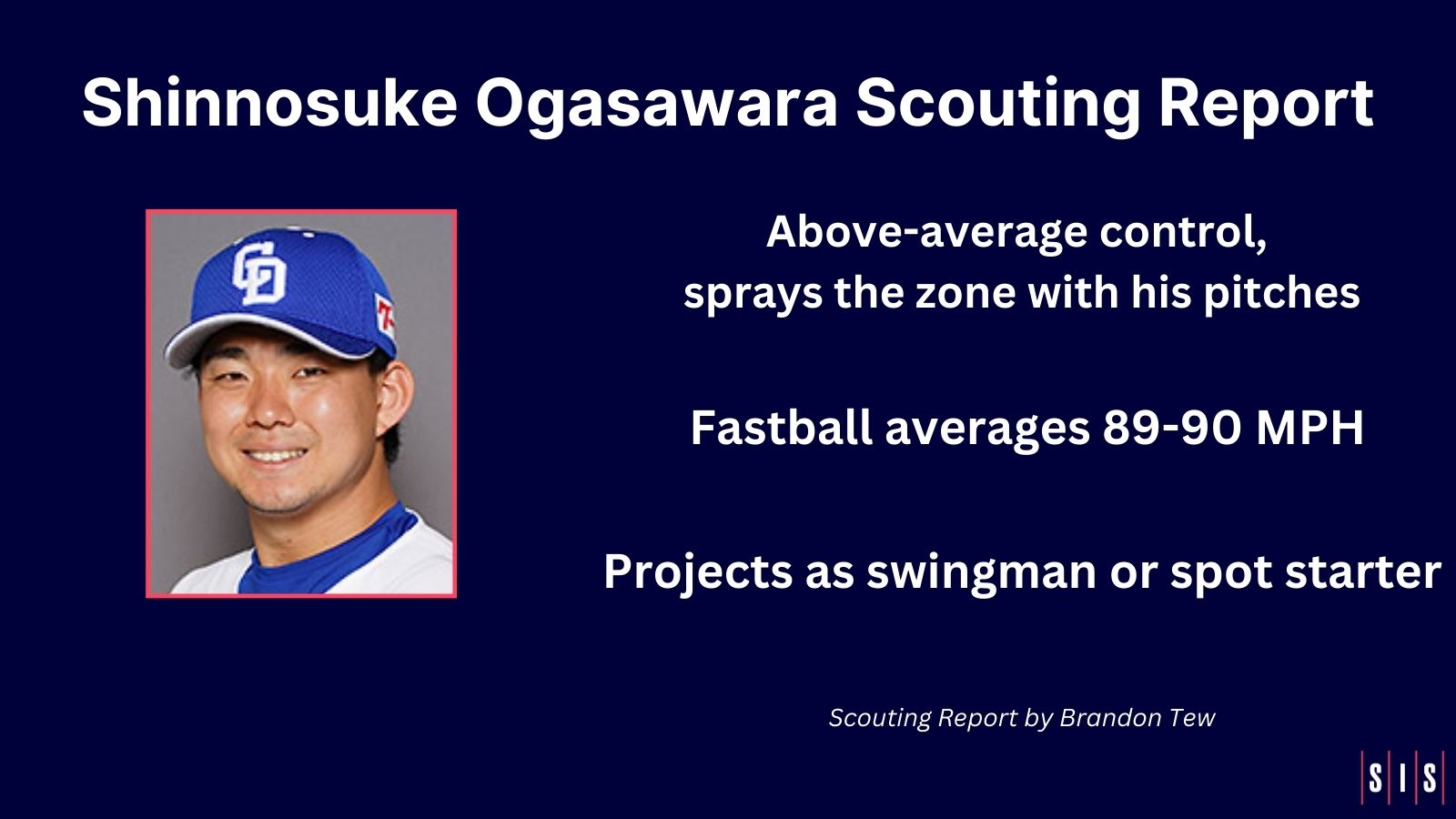
    In sum: Ogasawara projects as a swingman or spot starter in MLB but will get the opportunity, as a strike-throwing lefty, to compete for a rotation spot.

    Ogasawara’s Recent Seasons (2022-2024)

    Season IP ERA ERA+ K-BB
    2022 146.2 2.76 111 142-39
    2023 160.2 3.59 82 134-41
    2024 156.2 3.12 88 82-22

    Ogasawara is 5’11’’ and 185 pounds with a strong lower half. He is similar in build to Shota Imanaga. While some might want to compare the two Japanese lefties, the gap between Ogasawara’s stuff and Imanaga’s is significant. He’s more Kolby Allard than Imanaga. Though Imanaga and Ogasawara both have high IVB (induced vertical break) lower-slot fastballs, Ogasawara’s secondary pitches and command lag behind Imanaga’s. 

    Ogasawara did post a slightly higher K% than Imanaga in 2022, with a 24% strikeout rate to Imanaga’s 23.6%. He has not captured that type of swing-and-miss production since, dropping to 20% in 2023 and 14% this past season.

    And note that while ERAs of 3.59 and 3.12 the last two seasons may not look bad, context matters. He had a below-average ERA+, as NPB’s deader baseball keeps ERAs low.

    Biggest Strength?

    Ogasawara possesses above-average control and sprays the zone with his pitches. He mixes speeds well with his six- to seven-pitch arsenal, though he really focuses on just four pitches, with three of those secondaries. 

    He uses his four-seam about 50% and splits the rest of his usage between his knuckle curve, changeup, and slider – with less usage of his changeup against right-handed hitters.

    Since he possesses fringe-average stuff throughout most of his arsenal, Ogasawara must pound the zone with first-pitch strikes and mix speeds.

    Mechanics

    via GIPHY

    Ogasawara has dabbled with a rhythmic foot move at points in the last two seasons, but he primarily throws out of the stretch. Starting with his glove at his belt, he raises it to his hat brim. He pulls the ball out of his glove with a tiny tap back into the mitt during his initial move forward.

    via GIPHY

    Pushing his hip towards the plate, he stays closed down the mound, Ogasawara uncoils his energy as he shows the bottom of his cleat into front foot strike. Landing in a solid power position, he uses his lower half to drive energy through his lead leg block.

    via GIPHY

    He’s under control and will vary his finish now and then, but he usually lands in a similar position ready to field. Ogasawara throws with tempo and timing more in mind than aggressively transferring energy into his delivery. His timing and sequencing create consistency and repeatability in his mechanics. He will also vary his arm angle, dropping it slightly in a given at-bat.

    An overlay showing one arm angle that is more three-quarters and one that is more overhand

    Pitch Velocity (MPH):

    Pitch 2024 2023
    Fastball  89 MPH 90 MPH
    Knuckle Curve 70 MPH 73 MPH
    Changeup 78 MPH 83 MPH
    Slider 79 MPH 79 MPH
    Splitter 82 MPH 81 MPH
    Hard Slider/ Cutter 84 MPH 84 MPH

    Pitch Usage:

    Pitch RHB: 2024 (2023) LHB: 2024 (2023)
    Fastball  48% (49%) 54% (55%)
    Knuckle Curve 17% (21%) 17% (21%)
    Changeup 24% (25%) 4% (8%)
    Slider 5% (5%) 23% (15%)
    Splitter 5% (<1%) 1% (<1%)

    The Arsenal (2024 usage and Average Velocity)

    Fastball  52%, 89 mph   CSW% 26%   Strike% 75%

    Ogasawara features a high-ride, low-slot fastball though it lacks Imanaga’s 2023 specs in NPB.  The two fit the same mold in terms of usage though. Ogasawara throwing over 50% four-seam is unsurprising given the spin and IVB around 19 inches with an NPB ball from a lower slot. The problem is that the two ticks in velocity Imanaga has on him are vital. Thus, Ogasawara’s fastball command must be cleaner to attack the zone.

    via GIPHY

    In 2024, Ogasawara sprayed his fastball locations more than in 2023, when he was more glove-side with his command. The heat maps from this NPB Pitch Profiler show how spray-heavy his entire arsenal was in 2024.

    Ogaswara sprinkled in a few sinkers with 3 percent usage in 2023, although he basically scrapped the pitch in 2024. He may need to throw the pitch more often in MLB given the sheer velocity of his fastballs; he needs a change in movement between his four-seam and two-seam. Ultimately, he will likely shrink his four-seam usage in MLB, mixing speeds even more. When he does throw his fastball, he will need to stay out of the middle of the plate and get over the top of the ball to drive it to his glove side more.

    via GIPHY

    Knuckle Curve 17%, 70 mph  CSW% 32%   Strike% 58%

    Ogasawara’s slow and loopy knuckle curve is not impressive in velocity or stuff metrics but it is a vital pitch to his arsenal. He needs the slow knuckle curve as a change of pace for his fastball, to survive being in the zone as much as he is.

    Ogasawara utilizes it around 20% of the time on the first pitch to steal strikes and keep hitters honest. While he might drop its usage in MLB, around 15% usage will be important for Ogasawara since he lacks a whiff-pitch glove side.

    2023 Count Usage

    PITCH 1st Pitch Usage 2-Strike Usage
    Fastball  53% 47%
    Knuckle Curve 21% 30%
    Changeup 13% 15%
    Slider 11% 6%
    Splitter 1% 2%
    Harder Slider/Cutter 1%

    2024 Pitch Usage

    PITCH 1st Pitch Usage 2-Strike Usage
    Fastball  52% 45%
    Knuckle Curve 20% 18%
    Changeup 14% 15%
    Slider 11% 13%
    Splitter 2% 9%
    Harder Slider/Cutter 1%

    As seen in the count usage charts above, Ogasawara’s big drop from 2023 to 2024 in two-strike counts was in his use of his knuckle curve late in the count. His two-strike knuckle curve usage plummeted from 30% to 18% between the last two seasons. His curve did provide relief in a high ground-ball rate at 70% in 2024.

    Ogaswara’s curveball has a loopy quality causing batters to swing over the top and pound it in the dirt, because of the velocity differential and mixing speeds rather than pure pitch shape. He also locates the curveball below the zone leading to more grounders. 

    Ogasawara must avoid doubling up on the pitch. If he does, location will be key. These back-to-back curves to Munetaka Murakami display poor location on consecutive pitches.

    via GIPHY

    via GIPHY

    Changeup 16%, 78 mph   CSW% 34%   Strike% 70%

    Ogasawara’s changeup and splitter are his two best pitches. Ogasawara leans heavily on his changeup to righties, throwing it around a quarter of the time the last two seasons. He throws the pitch as more of a straight change with a tiny amount of fade. Throwing it with a two-seam grip he’s able to sink it down and away from right-handed hitters.

    His catcher doesn’t just sit on the outside corner either. There are a lot of times when Ogasawara’s catcher will set up more in the middle of the zone and will try to sink the change below the zone off of a knuckle curve that was middled or a pitch that looks juicy as a middle fastball.

    via GIPHY

    via GIPHY

    Splitter 3%, 82 mph   CSW% 34%   Strike% 63%

    Ogasawara’s splitter is his most intriguing pitch because its characteristics make it a slightly harder offspeed pitch than his changeup. The two pitches will overlap in velocity, though, and the splitter has more sidespin than the backspin of his two-seam change.

    via GIPHY

    The small percentage of pitches he has thrown creates a cause for concern if he can consistently command the pitch and even zone the splitter. There is way more comfort in throwing the changeup with his three-fingered grip rather than the splitter, where he’s splitting more across the horseshoe. His middle finger is not stabilizing in the middle of the ball with his splitter grip.

    Finding more consistency in throwing his splitter and even constant velocity separation could help Ogasawara drop his fastball usage and throw more offspeed. Having an offspeed around 84 mph with a slower one around 79-80 mph could be a valuable weapon for a pitcher who doesn’t have much going for him stuff-wise.

    via GIPHY

    Slider 13%, 79 mph   CSW% 34%   Strike% 57%

    Ogasawara throws a sweeper with a two-seam grip and it hovers in the upper 70s in velocity; it’s an average pitch, in shape and velocity. 

    Living in the glove-side shadow zone, Ogasawara tries to nail the bottom corner at the knees against righties but also pushes the locations more thigh and belt high with the pitch. Ogasawara exclusively throws the pitch away from left-handed hitters, using the sweep he gets on the pitch as a contact suppressor rather than a strikeout pitch. Though he generates some whiffs on the pitch, he throws it late in counts as a putaway pitch.

    via GIPHY

    A close-up of how he throws the slider, with his first 2 fingers touching both sets of seams.

    In MLB, Ogasawara’s slider will need either refinement in his sweeper shape or he could add a harder cutter or slider-type pitch. In fact, Ogasawara threw a rare glove-side breaking ball that was about 84 mph and resembled a cutter-like shape. He throws it with a four-seam grip on the outer side of the ball but he tries to pull down on the top seam heavily. A team could push the harder breaking pitch alongside his sweeper to get more usage out of a pitch other than his four-seam and knuckle curve.

    MLB Projection and Future

    Ogasawara has been a steady performer in NPB since making his debut as an 18-year-old, providing solid yet unspectacular production in Chunichi’s rotation. With lesser velocity and more average to fringe-average pitches, Ogasawara’s control of the zone and mixing of speeds gives him a fighting chance at production stateside.

    In 2022 he got more strikeouts and whiffs, but since then he has not been able to bottle that recipe of success with more of a contact-minimizing and grounders formula the past two seasons. As I noted atop the article, Ogasawara projects as a swingman or spot starter in MLB but will get the opportunity, as a strike-throwing lefty, to compete for a rotation spot.

    His signing with a team might hinge on his promises of starting opportunities, though with his ability to mix speeds and change pace in at-bats, he could be successful in a more prominent bullpen role.

    MLB comparison: Kolby Allard

  • NPB/MLB Scouting Report: Tomoyuki Sugano

    NPB/MLB Scouting Report: Tomoyuki Sugano

    Tomoyuki Sugano is one of the best Japanese pitchers of the past decade. The 35-year-old had spent his professional career with Japan’s most recognizable baseball brand the Yomiuri Giants. 

    After 12 seasons in Tokyo, Sugano exercised his rights as an international free agent and signed a one-year-deal. Sugano previously tested MLB waters during the winter of 2020, when he was posted by the Yomiuri Giants, but ended up signing a player-friendly contract with Yomiuri, where his uncle, Tatsunori Hara, was manager.

    The decision to move to MLB comes as somewhat of a surprise but there’s less holding Sugano in Tokyo now than there used to be, after Hara resigned after the 2023 season.

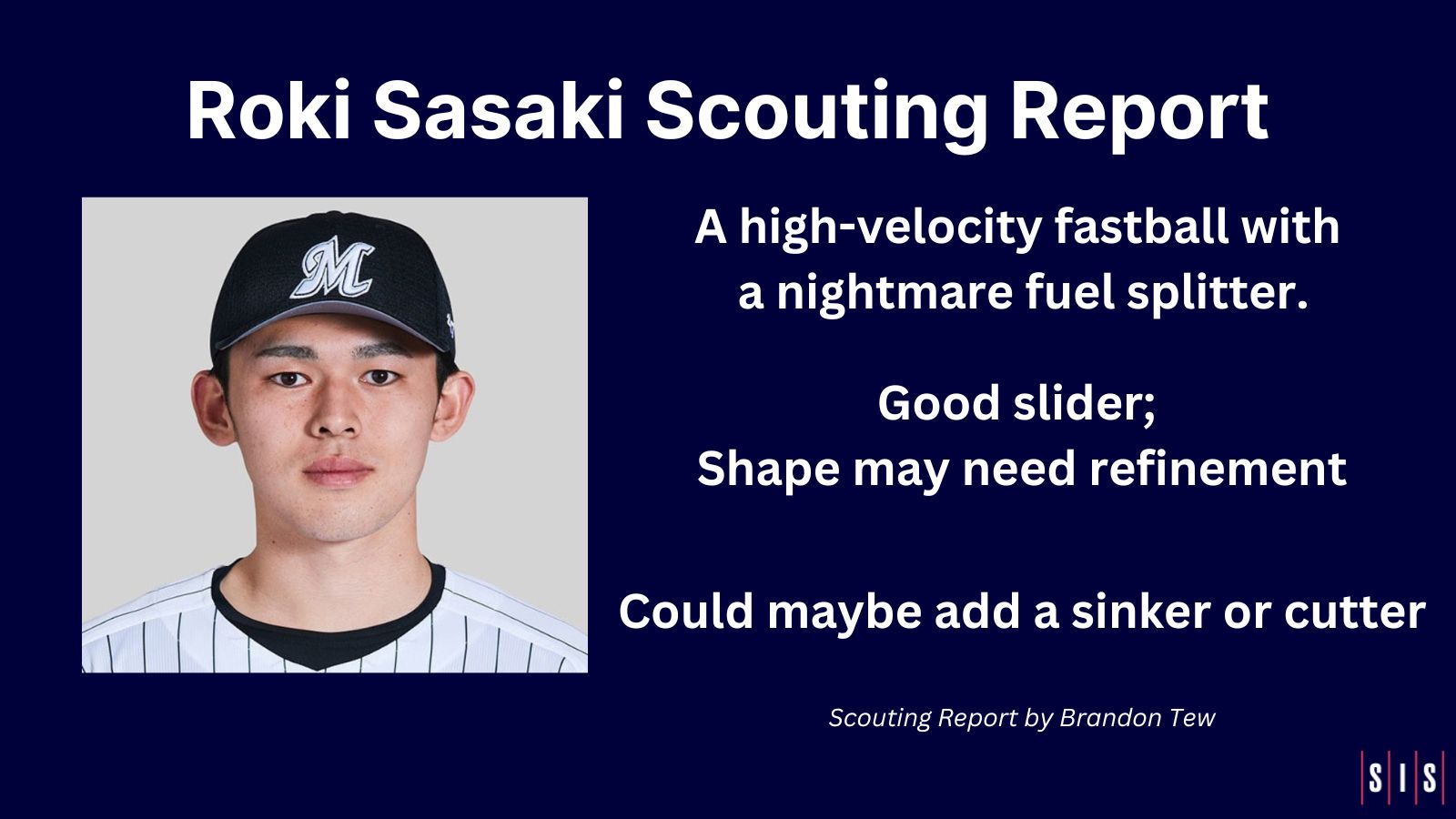
    Having watched and charted every Sugano start in the last two seasons my evaluation of him is more tied to pitchability and command rather than overall stuff. You can also check out my report on Roki Sasaki from last month.

    Sugano’s Recent Seasons (2022-2024)

    Season IP ERA Strikeouts Walks K-BB%
    2022 147.0 3.12 104 26 13%
    2023 77.2 3.36 54 15 12%
    2024 156.2 1.67 111 16 16%

    A two-time Sawamura award winner (NPB’s Cy Young award equivalent), Sugano also won four Central League ERA titles and a 2018 pitching triple crown, He also has three Central League MVPs including a recent 2024 one. While past his prime, Sugano’s 2024 resurgence gives some hope that he can stick with the Orioles.

    Biggest Strength

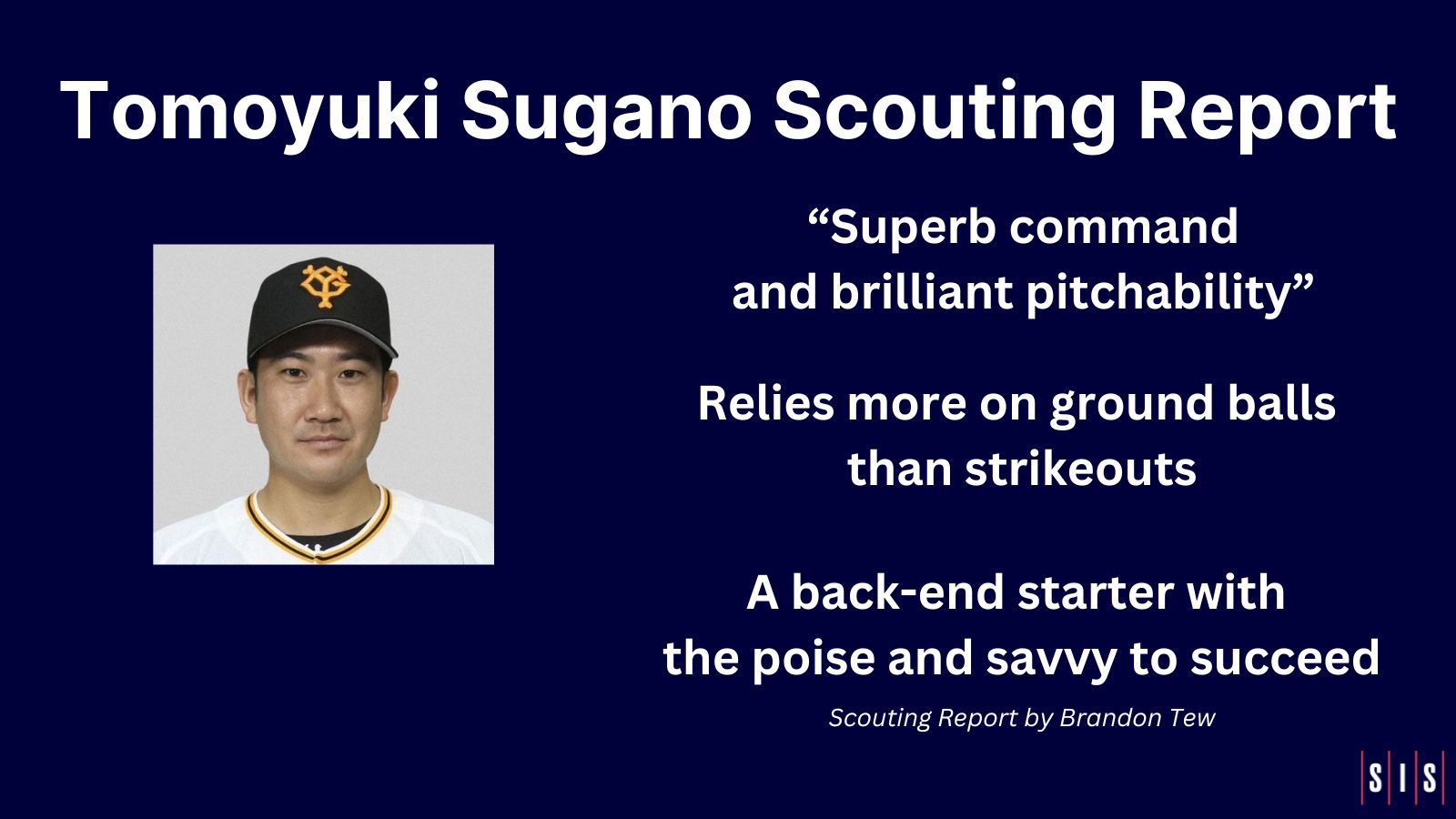
    Sugano is a command artist who paints both edges and paints masterpieces on his canvas that is the pentagonal plate. He spots the ball with precision, or, at the very least, keeps it out of dangerous spots with his misses. While Sugano’s stuff has diminished over the years, he has a knack for cutting and sinking the ball to miss barrels.

    He utilizes the breadth of his arsenal and mirrors the locations of some pitches both to righties and lefties  Sugano’s plan of attack each outing is clear to him and there’s a confidence with which he pitches. The heat maps, which you can find on NPB Pitch Profiler, illustrate the command of his secondary pitches.

    Against same-handed hitters, Sugano peppers the glove side exclusively with his cutter and slider. The two pitches tunnel well, with a slight velocity difference between each and similar shapes. The pitches work in tandem on the left side of the plate.

    Against opposite-handed hitters, Sugano seems more comfortable throwing his cutter and slider in the zone and will backdoor both pitches around the thighs. Sugano occasionally sprinkles traditional cutters up and in to keep hitters from leaning out over the plate. This also protects him for when he goes inside with four-seam fastballs. 

    His command at times borders on exceptional, as he stays on the outer edges of the plate when he needs to and tries to keep the ball out of the middle third unless he is significantly behind in the count.

    via GIPHY

    via GIPHY

    Mechanics

    Sugano starts in a slightly open position with his feet and his body turned slightly to his right. As he steps to the side with a slower pace he pauses for a beat in his windup before raising his left leg.

    There’s not a lot of momentum built up in his delivery but he counter-rotates his pelvis a tiny bit right after peak leg lift, around chest height. He drives his momentum to the plate with his back pocket facing the batter ever so slightly. Sugano opens earlier than most and doesn’t sink deep into his lower half, rather throwing from a more upright position. 

    As he lands into front foot strike, his arm is up at a close to 90-degree angle and he sequences his movements well. With a firm lead leg block, his chest is out over his knee in a solid position, driving his energy down the slope of the mound. With smooth and repeatable actions and consistency in his arm swing, Sugano never looks rushed or off, timing-wise. Sugano also keeps his head incredibly quiet with minimal movement, which plays a big part into his command.

    via GIPHY

    Sugano rarely quick-pitched to throw the timing off of the hitter, something he might try more with the Orioles if he feels like timing is more valuable to MLB hitters.

    via GIPHY

    Pitch Usage (2023-2024):

    Pitch 2024 2023
    Fastball  34% 40%
    Cutter 21% 20%
    Slider 20% 17%
    Splitter 16% 11%
    Curveball 9% 12%

    Pitch Velocity (MPH):

    Pitch 2024 2023
     Fastball  92 MPH 91.5 MPH
    Cutter 87 MPH 87 MPH
    Slider 82 MPH 83 MPH
    Splitter 86 MPH 86 MPH
    Curveball 77 MPH 78 MPH

    Against Right-Handed Batters (RHB):

    Pitch 2024 2023
     Fastball  39% 45%
    Cutter 25% 22%
    Slider 21% 16%
    Splitter 12% 10%
    Curveball 3% 7%

    Against Left-Handed Batters (LHB):

    Pitch 2024 2023
     Fastball  30% 35%
    Cutter 18% 18%
    Slider 19% 18%
    Splitter 20% 12%
    Curveball 13% 17%

    The Arsenal (2024 usage and Average Velocity)

    Fastball   34%, 92 mph   CSW% 30%   STRIKE% 68%

    Sugano throws both a sinker and a four-seam fastball, the usage of which is grouped above, but he throws his sinker about 8% of the time and the four-seam 26%. His four-seam is not spectacular in shape or velocity but he pounds the zone with the pitch against righties and-as mentioned-dots the edges of the zone against lefties.

    The Orioles may utilize Sugano more in a five-and-dive role, rather than the innings eater he was in NPB. With this outcome, there’s a possibility of throwing one or two ticks harder stateside. I would bet on him trying to eat innings some outings and provide value going as deep as he can into games.

    Sugano’s biggest path to success is superb fastball command. When he gets hit hard, he usually leaves fastballs more middle, where he’s susceptible to the long ball. He allowed 6 home runs last season, 3 on fastballs (it was a lot harder to hit a home run in Japan due to the deadened ball there).

    In contrast, he allowed 10 home runs in less than half the innings pitched in 2023. Home run suppression will be vital to his success since he doesn’t produce a lot of strikeouts.

    via GIPHY

    via GIPHY

    Cutter 21%, 87 mph  CSW% 32%   STRIKE% 68%

    Sugano’s cutter is the key pitch in his arsenal; it helps his other pitches out when it’s thrown well and spotted well. While attacking the glove side away from right-handed hitters he slices the outside edge of the zone with the pitch. 

    via GIPHY

    The pitch is a setup for his slider. He starts the tunnel with the cutter and then follows up with his slider in a similar spot that’s competitive but just a little more off the edge. This creates options for him to either go to a different pitch or ride the same rail with his fastball for a take. Sugano will then change the looks batters get throughout a game. He changes up the variety at which he throws his slider and cutter, especially to righties.

    2024 Count Usage

    Pitch 1st Pitch Usage 2-Strike Usage
    Fastball  39% 31%
    Cutter 26% 12%
    Slider 19% 20%
    Splitter 7% 25%
    Curveball 9% 12%

    2023 Count Usage

    Pitch 1st Pitch Usage 2-Strike Usage
     Fastball  46% 35%
    Cutter 19% 20%
    Slider 13% 18%
    Splitter 15% 12%
    Curveball 7% 15%

    Sugano upped his first-pitch usage of the cutter this season. While individually the pitch performed possibly worst out of all his pitches, the upping of the usage, especially early in the count, helped his slider perform better later in the count. He used the slider as a whiff pitch and a two-strike pitch in 2024. The cutter produces a decent amount of ground balls, utilized primarily down in the zone. Its ground ball rate was 56% in 2024 and 49% in 2023.

    Slider 20%, 82 mph   CSW% 34%   STRIKE% 71%

    While his cutter is key against right-handed batters, Sugano’s slider is his bread and butter. While a barrage of glove-side cutters and fastballs establishes the eye level and attack zone, Sugano uses his slider to stay in that same attack zone. With a bit more sweep and lower velocity than his cutter, it stays in that outer lane to righties before sweeping and dropping more as it approaches the plate.

    When Sugano rips a beautifully-located slider it’s become harder for hitters to stay disciplined. Last season his whiff rate jumped to around 25% on the pitch whereas in 2023 and even 2022 his slider whiff rate hovered around 20%.

    via GIPHY

    Sugano started using the cutter and slider in tandem, throwing both pitches around the same usage in 2021. However, his concerted effort to throw more cutters early in the count last season shows a shift in his thinking that he needs to tunnel both the cutter and slider more to protect his fastball and improve his slider’s performance.

    He loves the glove-side cutter and slider tunnel though and has for the last five seasons or so. His propensity to throw his slider and even his cutter more in the zone and backdoor to left-handed hitters also creates a tunnel for his arm-side sinker.

    He also honed his slider and cutter command more this season than in past years, which could explain his boost in success with both pitches.

    Splitter 16%, 86 mph   CSW% 22%   STRIKE% 57%

    A mainstay in Sugano’s arsenal has been his splitter, which he has always been able to pinpoint below the zone. There’s the occasional miss up with the pitch but Sugano has a feel for keeping the pitch just below the zone to try and get grounders and swings over the top of the pitch.

    The bump in usage from Sugano in 2024 compared to 2023 is significant enough with a 5 percentage-point  overall usage bump in 2024 on his splitter and an 8-point bump against left-handed hitters. He threw his splitter the least of any pitch in his shorter 2023 season. However, Sugano started to lean on his splitter in putaway situations in 2024.

    Sugano’s decision to throw his best pitch more in high-leverage situations was a welcomed change. Even increasing the usage of the pitch versus same-handed hitters returned good results.

    Sugano’s walk rate did not spike either, in fact, it lowered from 4.8% in 2023 to 2.6% in 2024, and his splitter, just because of the nature of the pitch, has the lowest strike rate in his entire arsenal. Deciding to throw more cutters and sliders in the zone when behind in the count, and then attack with a splitter when he has a chance to put both righties and lefties away garnered real success for him.

    The pitch doesn’t drop below the zone as violently as other splitters but with its spin and characteristics, it mimics his sinker a lot, with backspin but at lower spin rates, causing more drop to the pitch. He loves to throw the pitch when he needs a whiff or a double-play ball.

    via GIPHY

    via GIPHY

    Curveball 9%, 77 mph   CSW% 27%   STRIKE% 63%

    Sugano’s least-used pitch last season in terms of secondaries was his curve. While he dropped the usage of his curveball in 2024  it was thrown with better spin, and a tick harder velocity, which improved the overall performance of the pitch.

    He did expand the usage of the pitch against same-handed hitters last season, again using the pitch as a first-pitch strike stealer but also burying it down and away from righties to keep hitters off of his cutter and slider tunnel.

    There’s a real possibility that Sugano lessens his fastball usage in the majors, especially the four-seam, and leans more on his breaking balls away from right-handed hitters while dropping the occasional in-zone or backdoor curve to left-handed hitters.

    It will be intriguing to track his curve next season and if it even takes another step forward as a possible putaway pitch after performing quite well in 2024. This is not only because of the wrinkle it provides in his repertoire but also because the velocity disparity keeps hitters off balance. He will need to continue to locate the pitch well and can’t just loop in breaking balls unless he protects it with his other pitches beforehand.

    MLB Projection and Future

    Sugano has been a mainstay at the top of Yomiuri’s rotation and it will be odd to see him don a different uniform. A command specialist with just enough stuff to get hitters out, Sugano projects as a back-end starter with the poise and savvy to succeed as a rotation piece for the Orioles.

    He relies more on ground balls than strikeouts needs to mix speeds and tunnel his pitches well, showcasing his superb command and brilliant pitchability. Sugano is one of the most accomplished Japanese pitchers and should be in the conversation as a Top 10 all-time NPB pitcher. At the tail end of his career, there’s some skepticism, but an outstanding 2024 season provides hope that he has enough left in the tank to yield solid value as he moves stateside.

    MLB comparison: Paul Blackburn, but with Zack Greinke-like command

  • Roki Sasaki Scouting Report (Updated!)

    Roki Sasaki Scouting Report (Updated!)

    Let me start by saying: Rōki Sasaki is one of the most talented young pitchers on the planet.

    I say that having watched each of his NPB starts from 2022, 2023, and 2024.

    He started to turn heads as a high school pitcher in Japan. On April 10, 2022 he threw a perfect game against the Orix Buffaloes in which he struck out 19 batters, including 13 in a row. I wrote about his perfect game later that summer. He followed up perfection with another eight innings a week later, capping off possibly the greatest two-game stretch in major professional baseball. Sasaki has mesmerizing talent and has continued to put up gaudy stats in NPB.

    Sasaki’s Recent Seasons (2022-2024)

    Season IP ERA Strikeouts Walks K%-BB%
    2022 129 1/3 2.02 173 23 31%
    2023 91 1.78 135 17 34%
    2024 111 2.35 129 32 22%

    The Lotte Marines announced they would post the ace, even though he does not meet the current Japanese posting system requirements, as he is under 25. His contract will be restricted by international bonus pool money, limiting how much he can sign for as an international “amateur.” This opens his posting to every MLB team, many of which will surely pursue the young pitcher.

    What makes him so special?

    Sasaki’s arsenal includes a high-velocity, two-plane fastball, and a devastating splitter, both of which have tormented NPB hitters for years. He’s recently increased the use of his slider, turning it into a reliable weapon against both righties and lefties.

    Sasaki is a control-over-command pitcher, but when he’s dialed in he can spot his fastball on the edges of the zone. Here are some well-located fastballs from Sasaki’s 2024 playoff start.

    via GIPHY

    via GIPHY

    His splitter location is exceptional when it needs to be. Look at these heat maps from this NPB Pitch Profiler that show Sasaki’s command of the pitch.

    vs Left-handed batters 

    vs Right-handed batters  


    With a 56.5% whiff rate in 2024, Sasaki’s splitter is among the best in baseball. His ability to induce swings and misses, especially when the pitch darts below the strike zone, has made it a devastating strikeout pitch.

    A mechanical tweak in 2024?

    via GIPHY

    I wrote up a detailed breakdown of Sasaki’s mechanics in my last report on him and still think it captures a lot of what he does as a mover on the mound. However, in 2024 Sasaki added over 6 inches of extension to his delivery.

    2022

    2024

    The increase in stride length down the mound is noticeable. As noted by Lance Brozdowski in his breakdown, Sasaki’s extension increased but his release height stayed almost identical at 6 feet. As Lance suggests, he might have kicked up his arm angle just a tiny bit which is not as clearcut on video but can be seen. There’s possibly a slight overextension in his stride that played a role in his downtick in velocity.

    There’s a sweet spot in terms of mechanics for Sasaki, and an MLB team will try to find the bullseye. They’ll be trying to unlock more of his 2023 pitch shapes while also balancing injury risk and efficient throwing.

    It’s important to note that the big question mark surrounding Sasaki is his health as he has battled various injuries throughout the last three seasons, including an oblique injury and shoulder fatigue.

    Pitch Usage (2022-2024):

    Pitch 2022 2023 2024
    Fastball 56% 50% 46%
    Splitter 34% 35% 28%
    Slider 5% 13% 26%
    Curveball 5%

    Average Pitch Velocity (MPH):

    Pitch 2022 2023 2024
    Fastball 98.3 98.9 96.9
    Splitter 89.1 89.5 88.2
    Slider 87.7 87.5 83.6
    Curveball 79.6 79.5 76

    Against Right-Handed Batters (RHB)

    Pitch 2022 2023 2024
    Fastball 54% 46% 40%
    Splitter 29% 27% 21%
    Slider 12% 26% 39%
    Curveball 5%

    Against Left-Handed Batters (LHB)

    Pitch 2022 2023 2024
    Fastball 57% 53% 50%
    Splitter 36% 41% 33%
    Slider 1% 4% 18%
    Curveball 5%

    The Arsenal (2024 usage and Average Velocity)

    Pitch Grades (20-80 Scale):

    Fastball: currently a 70, was an 80 in 2023

    Splitter: Currently an 80

    Slider: Currently 55, could rise to 60

    Breaking down the pitches:

    Fastball   46%, 97 mph  

    CSW% 26%, 

    Strike% 71%

    Sasaki’s drop in fastball velo has been a topic of conversation for most of the year. In May I speculated that Sasaki was more or less gas pedaling through starts. In other words, easing his way through starts because he was trying to pitch deep into games for the Marines. He was backing off at that point and then would run his fastball up to the upper 90s or triple digits.

    Most notably May 10 in a start vs Nippon-Ham Sasaki produced one of the most disappointing starts of his NPB career,  5 2/3 innings and 5 earned runs. His next start would come seven days later. Against the same Fighters team, he threw his fastest average fastball velocity of the season, averaging 98.4 MPH.

    Sasaki looked like his old self again until he dealt with a couple of injuries that sidelined him for two starts to begin June. Then he suffered another injury that cost him almost two more months. He was up and down with his velocity throughout the season but there were points where he was averaging 98 mph in some starts.

    While having a dip in velocity, Sasaki also lost some movement both horizontally and vertically. He averaged around 16 inches of vertical movement on his fastball rather than the 18 inches he was averaging in 2024.

    His fastball was still good in 2024. It just was not the unicorn-type pitch it had been the previous season. The whiff rate dropped from 24% in 2023 to 13% in 2024. The pitch in this new shape failed to miss as many bats in the zone.

    Now as I have pointed out before, NPB hitters would sit on Sasaki’s fastball and try to foul off the pitch or shoot it the other way for minimal contact but try to get a base hit. There’s a decent chunk of emergency hack foul balls and swings that are late on his heater.

    He allowed an OPS against of .740 on his fastball in 2024 compared to a .595 OPS against it the season prior. A lot of these hits were singles the other way or weaker contact singles blooped into the outfield.

    Not many hitters in NPB squared up Sasaki’s fastball at any point in his career. He’s allowed a total of 6 home runs with it in the last three seasons, and just 2 all last season. Even with the dead balls in Japan, that’s impressive. Compare that to the 26 homers surrendered on fastballs by Shota Imanaga in his last two seasons in Japan. 

    You can see how good Sasaki’s four-seam is at limiting hard contact. In 2024, Sasaki was less sporadic with his four-seam command. He’s a pitcher who tries to cut the plate in half and work one side or the other with more control than command. However, he will still miss in the middle occasionally, which might lead to more damage on this pitch in MLB outside of normal changes in conditions between the two leagues.

    via GIPHY

    Sasaki was more middle-third vertically than the upper part of the zone with his fastball this season. 

    This could explain why he also gave up more contact and had fewer whiffs to go along with the shape change. He was either choosing to be more efficient as a pitcher or the shape change just didn’t carry his pitches routinely to the upper third of the zone as it had in the past.

    One thing that is likely to change as Sasaki comes stateside is the use of his four-seam at the top part of the zone. In the image below, which shows the heights were the catcher target was set for his pitches last season, the black squares are fastballs. Sasaki’s catcher rarely sets up high. Almost all of those dots are plotted in an area close to where the batter’s knees were. 

    The catcher’s mitt is towards the bottom and shades to both corners. This isn’t to say he doesn’t target the catcher’s mask at times but there’s not a concerted effort to throw high fastballs. Even with his two-plane shape, an MLB team will want a higher percentage of top-shelf fastballs especially if he can harness more of the fastball shape he had at the WBC and during the 2023 season.

    Sasaki’s fastball induces a lot of ground balls because of its horizontal movement. He had a 52% ground ball rate on his four-seam last season. Sasaki can keep the ball out of the air, which is always positive, and while there might be a slight uptick in home run production, don’t expect too much unless he starts to miss more in the middle of the plate. This means his command worsens, and his one big miss command-wise is usually high and arm side, with his fastball rather than yanking or pulling it.

    Whichever MLB team gets Sasaki will want to try and bottle the magic of his 2023 fastball shape but it’s still a double-plus pitch in its current state.

    Splitter 28%, 88 mph 

    CSW% 35% 

    Strike% 53%

    Sasaki’s splitter is an oddity compared to other splitters. It’s the best splitter I’ve ever seen on video. It is a buzzsaw that knifes through the bottom of the zone and darts below it at the last possible second. As previously mentioned, his whiff rates on the pitch are astronomical. The way he throws the pitch and how it moves plays into its brilliance.

    Sasaki throws the pitch with gyro spin but also can create a knuckling appearance on it.  Sasaki can almost cut and fade the pitch based on handedness, as I noted previously.

    In what I have decided is intentional to some extent, Sasaki will cut the splitter to his glove side away from right-handed batters, and pronate more to fade it away from lefties. He does this often enough to almost have a feel for his finger pressure on the pitch, though I can’t confirm this. The pitchability he displays with this specific pitch makes him unique in baseball, and his consistency with it is just as impressive.

    What truly intrigues me is that in 2022 he was throwing his splitter with a different orientation and grip.

    2022

    Sasaki's 2022 splitter grip has the seams of the baseball running across the ball

    2024

    Sasaki's splitter grip has the baseball such that the seams have a horseshoe appearance 

    He now splits across the horseshoe with his fingers more down on the ball and has the pitch slip out of his hand, creating a knuckling or tumble effect while still maintaining hard velocity.

    He still cuts and fades the pitch from time to time possibly by using different finger pressure. He’s opted for this type of movement that is closer to (0,0) on a pitch plot and more gyro.

    via GIPHY

    Sasaki pairs his fastball with his splitter exceptionally well. It’s a wicked offering with almost magic-like qualities as it performs a disappearing act below the zone. Sasaki does have a knack for stealing strikes with it in the zone but does occasionally give up hits on hanging splitters that catch way too much of the plate, though that happens more to lefties than righties.

    His ground ball rate on the pitch was near 71% the last two seasons but this past season it dipped to a still-impressive 57%, which bares out the greater number of line drives and fly balls on the pitch when it’s up in the zone. Sasaki’s splitter is one of the best pitches in all of baseball and will likely continue to be that.

    One last note on the splitter is that Sasaki loves to use the rosin bag provided in NPB games and with no pitch clock he routinely goes to the bag, almost as if it’s part of his routine. He’ll be throwing with a different ball in MLB and it will be fun to see what grip he goes with and how he navigates using the rosin bag behind the mound within the confines of the pitch clock. 

    Slider 26%, 84 mph  

    CSW% 39%  

    STRIKE% 62%   

    A pitch that took a massive leap forward is Sasaki’s slider. He’s been workshopping the pitch for some time now, even having fellow countryman Yu Darvish help him during the World Baseball Classic. Love this video below:

    <#Sasaki’s slider has become different, sharper & dominant

    after receiving coaching from #Darvish !! It has improved
    in vertical movement. pic.twitter.com/S4HTnB5I8s

    — Joseph Kim (@blackwings2011) November 13, 2024

    He upped the usage of the pitch considerably and in certain starts would throw his slider more than his fastball. It’s not yet a polished gem like his splitter but he would turn to the pitch against right-handed batters early in counts and then put away both left-handed batters and right-handed batters with his splitter.

    Against RHBs, he tries to hit the opposite corner with the pitch, and while he will have it back up arm side, he is still working through the kinks with it. But his confidence in the pitch has blossomed.

    While facing LHBs, he can drop backdoor sliders in the zone,  especially early in counts as a first-pitch strike-stealer. The table below illustrates that he upped his first pitch slider usage from 13% in 2023 to 40% in 2024, which was most likely to combat hitters sitting on first-pitch fastballs. The fact he could zone the pitch also helped as the season pressed on.

    2024 Count Usage

    Pitch 1st Pitch Usage 2-Strike Usage
    Fastball 46% 34%
    Splitter 14% 48%
    Slider 40% 18%

    The slider is good and even flashes plus. He throws two slider shapes at times. I think it’s mostly manipulation of a slower one with more drop and the other is a true gyro one. But there’s some inconsistency there. 

    The more vertical one used to go backdoor mainly to left-handed batters but he also uses the vertical shape to both sides as well dropping it below the zone. Japanese pitchers will talk about varying shapes a lot more than most. I think a pitcher like Imanaga also has a wider variance on his slider, though he gets more sweeper movement than a pitcher like Sasaki.

    Harder Slider:

    via GIPHY

    Slower Slider:

    via GIPHY

    Overall, the pitch is good and flashes plus at times, but the inconsistency in shape, whether intentional or not, is something an MLB team might look to refine. Based on pure spin rate numbers he lacks some ability to spin the baseball. It’s hard to be amazing at everything, but he does have a slider that has turned into a weapon that hitters must respect.

    His growth on this particular pitch alone signals a chance to at least mold some fashion of a plus third pitch which would be outstanding for a guy who already obliterates hitters with his other two pitches.

    He could opt for a harder slider like he had in the past, increasing the whiff rate on it. He’s most likely chasing more movement rather than velocity since he already sat around the velo of his splitter with his previous iteration of the pitch. 

    Sasaki might believe this new slider helped him stay in the zone more while having the manipulation factor to get more whiffs below the zone. The harder slider is likely better just from a pure pitch standpoint but comfortability in throwing it should play a massive part as well.

    What about another pitch?

    Well as seen in the above tables Sasaki in 2022 featured a curve that he threw about 5% percent of the time that was used sparingly along with his slider, which was also around 5%. He has thrown just three curveballs in the last two seasons, all but phasing the pitch out of his arsenal. He could bring it back though.

    via GIPHY

    His slider at times would get more in the curve territory though. But it did not look exactly like his previous offering in 2022. Again, that’s going back to his manipulation of the slider. 

    An MLB team will likely experiment with a hard arm-side pitch, probably a sinker, although his two-plane fastball creates grounders already. It might not be worth a real development unless he struggles with right-handed batters. 

    Other options include upping velocity on his slider or maybe adding a cutter in the low-to-mid 90s, which could be fun! He could add a harder glove-side pitch to pair with his current slider if there’s not a complete rework of that pitch. He could have-in theory- a cutter and slider to use against right-handed batters although I expect the splitter to uptick in usage anyway.

    There’s clay to mold here and while Sasaki can be dominant with just his splitter and fastball, he knows how valuable more pitches are to him as a pitcher. He’s likely going to add at least one more pitch, if not two, for right-handed batters.

    MLB Projection and Future

    You can count on one hand how many pitchers have as much talent as Sasaki. He has a high-velocity fastball with a nightmare fuel splitter. Add in a possible plus third pitch and he’s got all the tools to succeed.

    His NPB career did not end in any major award wins and there was frustration with his health. He dazzled in his brief stint in NPB though, and like a shooting star streaking across the sky, his time there was too brief.

    Sasaki’s ceiling is as high as any pitcher and while he’s not a finished product he has true ace potential and the chance to be one of the best pitchers in baseball. He’s one of the best pitching talents of my lifetime.

  • MLB Draft Scouting Report: Jurrangelo Cijntje (Mariners)

    MLB Draft Scouting Report: Jurrangelo Cijntje (Mariners)

    Photo: Michael Wade/Icon Sportswire

    Skill Grade Grade
    RHP LHP
    Fastball 60 50
    Slider 55 55
    Curveball 50
    Changeup 55
    Control 50 45
    Future Value 55 40

    Name: Jurrangelo Cijntje (pronounced SAIN-ja)

    College: Mississippi State University

    Drafted by: Seattle Mariners

    Bio: B/B 5-11, 200 lbs.

    DOB: 05/31/2003

    Written by Brandon Tew

    Analysis:

    Jurrangelo Cijntje is the most unique pitcher in baseball, throwing hard mid to upper-90s fastballs with his right arm and low-90s fastballs with his left. The switch-pitcher has incredible talent and is just starting to scratch the surface of his potential.

    Born in the Netherlands and raised in Curaçao, Cijntje learned to throw with both arms at a young age when his dad would drive nails into a baseball and have him throw the DIY weighted ball at a tire. He often left his left-handed glove at home so he could use his father’s catcher mitt and work on throwing from right-handed. Cijntje must have been onto something because he blossomed into a talented right-handed pitcher. 

    Cijntje continued to hone his craft with both arms and added arm strength and command. After high school in Miami he unleashed his talent on the SEC where he took a major step forward in his sophomore season on the mound.

    College Career:

    Cijntje pitched for the Mississippi State Bulldogs for two seasons. He had up-and-down moments during his freshman season, but while starting in the weekend rotation he would flash potential. A 5 ⅔ innings start of 1-run ball against Ole Miss was the real standout performance during SEC play in 2023.

    However; Cijntje finished with an ERA north of eight and while supremely talented, he could never get his walks down enough to be effective (34 in 50 innings).

    Fast forward to 2024 and Cijntje started to dial in his mechanics from both sides of the plate and was more direct to the plate from the right side. He consistently threw more strikes allowing his pitches to play inside the zone. He had a few starts with more walks, but down the stretch of SEC play Cijntje began to throw more from the right side. He used the left arm only as a matchup problem for left-handed hitters.

    While he limited home run damage more frequently in his sophomore campaign, cutting his HR/9 from 2.2 to 1.1 in 2024 there’s still a susceptibility to the long ball. This can be ironed out but T Mobile Park is a pitcher’s ballpark, Cijntje should enjoy pitching in.

    Year ERA IP K% BB% K-BB%
    2023 8.10 50.0 26.5% 14% 12%
    2024 3.67 90 2/3 30% 8% 22%

    Pitching Mechanics:

    Cijntje starts with his body and feet angled comfortably standing with his feet shoulder-width apart and his glove in front of his belt. As he steps with his left foot he turns, facing third base.

    Then he turns his back foot parallel and in rhythm with tiny taps as he pauses his left foot. Moving into his leg kick he creates a significant weight shift forward during his drift. He also counter-rotates his hips as he slightly turns his front half toward second base.

    His lead leg reaches peak lift around his chest and straightens out fully as he brings it down. He then stacks his weight over his backside. Although he does not get into a deep hinge position, he still rides his back hip down the slope.

    Coming into a landing position his shoulders are level and his arm is a tad late at times to get to the flip-up position. (With an arm at a 90-degree angle at the footstrike). However; what Cijntje does very well is pulling his glove across his body, creating a good rotation of his front side. As his foot fully braces the impact, he gets his arm to 90 degrees eventually with this tiny delay in the sequence.

    Even if his arm is a little behind, he clears his body well and then brings the arm through. He has a great amount of hip-shoulder separation and he unwinds the energy his body has coiled up efficiently.

    Cijntje lands in a tiny cross-body action with his front foot barely closed. The separation and stretch allow him to transfer positive energy to ball release. Cijntje could clean up some of the checkpoints in his delivery but he does look natural and the delivery from both the right and left looks smooth.

    There are also very similar movement patterns from both sides displaying his athleticism. From the left, he is more cross-fire rather than directionally towards the plate.

    High School Mechanics Side by Side

    Arsenal RHP:

    Fastball:

    Cijntje’s fastball has great traits in terms of movement with good carry and arm-side movement from a lower slot.  As a pitcher shorter than six feet in height, he’s throwing out of a traditional ¾ arm slot and still has a low release height that helps his fastball stay flat at the top of the zone.

    From his right arm the pitch profiles more at 94-95 mph but he did run the pitch up to 97 and even 98 mph. The pitch shape plays best at the top of the zone where it stays above the barrel of hitters and he held velo deep into starts.

    The command of the pitch fluctuates more because of the timing of his delivery as he sprays the fastball both down and up, but in 2024, he threw strikes with the pitch more consistently, flashing average control. 

    It’s more about getting the ball up in a good spot rather than down and middle of the zone. The more Cijntje pitches the better the control should get. Once he fully understands his movement patterns, especially from the right side, his control should continue to improve.

    Cijntje has also dabbled with a sinker that could be useful in towards righties but it sits in the same velocity band as his changeup. Moving it more consistently into the 93 mph range rather than 90-92 mph and having his changeup sit 88 mph might provide a wrinkle for hitters. 

    The Mariners have an entire rotation of plus fastballs and all of them have attempted to add a sinker. Cijntje should have the usage of that pitch jump up if Seattle finds it useful to incorporate.

    Slider:

    Cijntje’s slider is very intriguing for the Mariners’ pitching development. He has a feel for spinning the ball and would throw lower-end sliders around 85 mph with more depth. He also flashes more of a cutter with lift at 89-90 mph.

    This sometimes felt like intentional manipulation depending on matchups and pitch-to-pitch variance during a start. He threw more of a cutter early to RHHs in his last collegiate start against Virginia in game two of the Super Regionals.

    This feel for the slider could create a separation in the pitch either creating a sweeper to go with a gyro slider, or trying to squeeze out a sweeper, gyro, and cutter. 

    His propensity for spin should help him create above-average offerings no matter what Seattle decides to do and more consistent shapes could help his command as well.

    Changeup:

    Cijntje’s changeup is odd in that it gets a lot of in-zone whiffs, rather than chases. With his hand speed and deception, he gets hitters to swing over the pitch consistently. He also uses the pitch early in counts to speed up the bat, at times following the changeup with a fastball increasing the margin of error for fastball misses. 

    He doesn’t throw the pitch for enough strikes right now but does zone the pitch sometimes. Confidence in throwing the pitch right on right is impressive for a college arm. There’s at least an above-average changeup, maybe even plus, as a real weapon to both righties and lefties.

    Curveball:

    It’s important to point out that  Cijntje does have a slower breaking ball he throws occasionally. The curve was sprinkled throughout his starts but you can see in the video below that when the Bulldogs were using traditional signs with no one on base the catcher would flash a two-sign.

    Curveball usage was more matchup-dependent than anything but it’s at least an average offering in the future, and if the Mariners wants to continue to develop it, maybe they can get more out of the breaker. This will give Cijntje a vertical pitch for opposite-handed hitters as an RHP.

    If Cijntje solely focuses on being an RHP he should improve his pitch shapes and maybe even add velo, which would raise the floor of all his pitches including the curve. Cijntje has more untapped potential than most college arms making him a fun pitching prospect to develop in terms of pitch shapes and velocity.

    Arsenal LHP:

    Fastball:

    Cijntje’s fastball from the left sits more 90-91 mph and doesn’t have the same zip through the zone being more dead-zone in shape from a low slot. The fastball mainly sets up his sweeper. Cijntje also lacks control from the left even as a natural lefty. The cross-body mechanics lead to him being off with the fastball more from the left side than the right.

    Sweeper: 

    A low-80s sweeper bending into the zone from out behind left-handed hitters is Cijntje’s calling card as a southpaw. It’s his putaway pitch when he gets to two strikes. He will also throw the pitch over the plate more than working it out of the zone away. He’s mainly a two-pitch pitcher as a left-handed pitcher but it’s an average fastball and above-average sweeper.

     Cijntje cut down on the number of batters faced as an LHP and saved his unique talent for hitters who struggled against breaking balls mightily. Also, if he’s in a groove as a righty he will let it ride in terms of facing the opposite handedness.

    Projection:

    Cijntje is a freak athlete on the mound with a unicorn skillset. Pat Venditte laid the foundation for ambidextrous pitching but he would have dreamed about having the arm talent Jurrangelo has. 

    As a righty Cijntje has massive upside and the Mainers seemed to love the potential and the fastball traits. Seattle should be able to carve out an MLB role for Cijntje as a solid starter but his switch-pitching is also intriguing as a bullpen option if he never commands the baseball enough to start.

    MLB Comp: Luis Severino (RHP but smaller)