Category: Defense

  • Yankees and Astros Both Make Defensive Upgrades

    Yankees and Astros Both Make Defensive Upgrades

    That the Yankees finished 10th in MLB in Defensive Runs Saved disguised a significant defensive issue. Their corner outfielders rated terribly in that stat last season.

    The Yankees’ left fielders finished with -14 Runs Saved and their right fielders finished with -14 Runs Saved. They ranked tied for last with the Phillies in left field and next-to-last ahead of only the White Sox in right field.

    It was a rough go for almost everyone. The only one of their 10 left fielders to finish with a positive Runs Saved was Everson Pereira (2 Runs Saved in 27 games). None of their 9 right fielders finished with a positive Runs Saved total, not even usual standout Aaron Judge, who tallied -3 in his 54 games there.

    The eye test vindicates the numbers. There were plenty of just misses, miscommunications, and bad botches to go around.

    That’s why the acquisition of Alex Verdugo in a trade from the Red Sox was significant. Verdugo had fallen out of favor in Boston and was benched once due to what manager Alex Cora termed a lack of hustle. But his defensive numbers are good.

    Verdugo had 9 Runs Saved in right field last season, tied for second at the position. He also has a strong track record in right field with 21 Runs Saved in just over 1,900 career innings, though he totaled 0 as the Red Sox most-used left fielder in 2022. Still, 0 would be a major upgrade over what the Yankees had in 2023.

    Verdugo should play one of those two spots regularly depending on whether the Yankees make a bigger acquisition like Juan Soto.

    Another team to make a defensive upgrade was the Astros, who agreed to a deal with catcher Victor Caratini to a 2-year contract. Caratini replaces the team’s primary starting catcher the last 3 seasons, Martín Maldonado, though he’s projected as the backup to Yainer Diaz.

    Maldonado was both a fan favorite and a pitcher favorite who won a Fielding Bible Award in 2017. He was beloved by Astros manager Dusty Baker for his pitching staff work. We don’t dispute that on his best days he was very good. But it’s fair to wonder what he’s got left. Maldonado totaled -10 Runs Saved last season. He still rated as a good pitch blocker, but by our pitch framing stat (Strike Zone Runs Saved), he ranked next-to-last among catchers.

    Caratini has a considerable defensive flaw. He threw out only 3-of-47 runners attempting to steal last season. But even with that, he still got to 0 Runs Saved last season and had 2 Runs Saved in 2022. He’s an adept pitch framer. Over the last 2 seasons he ranks 8th in Strike Zone Runs Saved per 1,000 innings among the 40 catchers who caught the most. 

    Diaz will get an increase in playing time. He totaled 4 Runs Saved in roughly 400 innings last season. Within that small sample, he had the highest block rate on potential wild pitches (96.2%) and totaled 3 Runs Saved for stolen base prevention (only 4 catchers had more). 

    Like Maldonado, Diaz didn’t fare well in pitch framing but Diaz did enough other things his total defensive package was a positive. He finished the season with 4 Runs Saved. Diaz and Caratini bode – at least on paper – as a better defensive combination than the Astros had last season.

  • Stat of the Week: Premier Defenders on Hall of Fame Ballot

    Stat of the Week: Premier Defenders on Hall of Fame Ballot

    Photo: Manny Flores and Jeff Conner/Icon Sportswire

    The 2024 Baseball Hall of Fame ballot features two of the best defensive players to appear on a ballot since Defensive Runs Saved was first tracked in 2003.

    Adrián Beltré ranks No. 1 among third basemen in our time tracking the stat with 200 Runs Saved. He’s one of only two players to reach 200 Runs Saved at a position, along with Andrelton Simmons (201 at shortstop).

    Beltré led third basemen in Runs Saved in 2008, 2010, and 2016 and finished second in 2003 and 2004. He won The Fielding Bible Award in 2006, 2008, 2011, and 2012.

    Beltré played mostly in an era in which SIS credited fielders for positioning as part of their Runs Saved total. Under that system, from 2003 to 2006, he rated an MLB-best 51 plays better than average specifically on balls hit to the right of where a third baseman typically played.

    But he could get outs on balls hit to a variety of spots.

    From 2008 to 2010, he made an MLB-best 48 more plays than average on balls hit to the left of where a third baseman typically played.

    Beltré’s defense combined with his 3,166 hits and 477 home runs elevates him to a plateau among the most skilled players in MLB history. His 93.5 bWAR rank 3rd all-time among those whose primary position was third base, trailing only Mike Schmidt (106.8) and Eddie Mathews (96.0).

    Beltré ranks 7th among third basemen in the offensive component of WAR but vaults past Chipper Jones, George Brett, Wade Boggs, and Paul Molitor because of his defense. He’s a lock to be elected to the Hall of Fame.

    Meanwhile, Chase Utley, also on this year’s ballot, ranks 2nd in Defensive Runs Saved among second basemen since the stat was first tracked in 2003. He trails only Mark Ellis.

    Utley led second basemen in Defensive Runs Saved once, when he totaled 30 in 2008. That matches the most by a second baseman in any season. He won a Fielding Bible Award in 2010. Utley had a clear defensive peak. From 2005 to 2010 he saved an MLB-best 115 Runs Saved at second base, an average of 19 per season.

    For most of his career, Utley was most successful at getting to balls hit to the right of where second basemen typically played, the exception being in 2008 when he was 32 plays better than the average defender on balls hit to the left of average positioning. That +32 is the best for any infielder on balls hit to either the left or right since such data was tracked in 2003.

    In fact, Utley finished the season +46 on all balls, the highest single-season plays saved total by an infielder (plays saved being our version of Statcast’s Outs Above Average). To learn more about Utley’s excellence, click here to read an article written by SIS co-founder John Dewan in 2009.

    Utley ranks 19th in the offensive component of bWAR among those whose primary position was second base but jumps to 15th in WAR among those at the position when other components (including defense) are factored in.

    He’s an interesting Hall of Fame candidate in that his career offensive numbers are light compared to other electees. But over the 6-year period of 2005 to 2010, his offense combined with his defense and baserunning to make him one of the game’s most complete players. His 45.5 bWAR in that time ranks 2nd to Albert Pujols (52.1)

    We’ll do a more comprehensive review of the Hall ballot at another time. But we felt these two players deserved a special salute particularly for what they did on the defensive side.

  • Defensive Excellence Q&A: Nationals Infielder Trey Lipscomb

    Defensive Excellence Q&A: Nationals Infielder Trey Lipscomb

    In his second year in the minor leagues, Nationals prospect Trey Lipscomb got a full workout. He played all four infield positions, earned a promotion to Double-A, and won the Rawlings Minor League Gold Glove Award at third base. He totaled 3 Defensive Runs Saved there, meaning he performed at a slightly above-average level compared to MLB players, which is pretty good for someone in Double-A.

    We spent a good part of 2023 talking to coaches about teaching defensive excellence. So it makes sense that we talk to players about what it’s like to learn defensive excellence too. Trey is the second in what we hope will be an ongoing series of interviews.

    Mark: What does defensive excellence mean to you?

    Trey: When you put those two words together, defensive excellence, it’s just something that I take a lot of pride in. Obviously, you’re not going to be perfect. The game of baseball is not about perfection, but if you can be as physically sound and mentally sound on defense as you can, it can help you a lot.

    One of the mantras I’ve always gone with is: They always say speed doesn’t slump. For me, defense doesn’t slump. It’s something that you should really take pride in. That’s something that I did coming into this season. And I think the end goal is definitely what I achieved.

    Mark: Where did learning defense start for you?

    Trey: It really started when I started to focus on baseball in 6th, 7th grade. I wanted to get along with everybody, and I know the pitcher’s out there working his butt off. If a ground ball is hit to me, I want it to be a sure out every time.

    So I think that’s what I took pride in. I pitched a little bit in college. I definitely want a bunch of defenders behind me that are going to make the play. That’s how you build a bond with each other.

    Mark: You played all four infield positions last season. What was the hardest part of learning them?

    Trey: I told the player development guy when I was in spring training, I can play second base. I can play shortstop. He said, ‘We’ll see.’ I guess I got what I wished for.

    You’ve just gotta get out there and get your feet wet.  One of the biggest things was positioning. At second base and shortstop, there’s no line to guard. You just want to be in the right place at the right time. The biggest thing was learning where to be and where to set myself up so I can make the play every time.

    Mark: When you play third base, is your pre-pitch position low?

    Trey: When I was in college, I was one of those who was as low to the ground as I could be, but as I’ve gotten up here and played in the minor leagues in my first four years, it’s kind of just become wherever I’m comfortable.

    When I was in Double-A, one of our coaches, Delino DeShields asked about my positioning and said, ‘You played basketball, right? How are you going to guard somebody?’

    I showed him [my stance for] how I was gonna guard somebody. And then he was like, all right, we’re gonna start there. We want you to be able to use your athletic ability. I was getting so low into the ground where it was kind of hard to get up out of the ground and have a good first step. I’ve gotten better at forming a position that’s better for me.

    Mark: Are there other people besides Delino that have been instrumental in helping you out, and if so, what did they do?

    Trey: My father’s been there from the jump. He went to The Citadel. He never played baseball growing up, but he was always like ‘We’re going to find a way and we’re gonna get it done.’

    I had a phenomenal infield coach my first three years at Tennessee, Ross Kivett. He taught me a lot of the technique. My last year at Tennessee, it was Ricky Martinez. Those two guys helped build the foundation for how to field a ground ball. And then Cody Ransom with the Nationals helped me out with doing a lot of early work.

    Mark: What is your pre-game routine like?

    Trey: I start by getting my body loose, then go in the outfield grass, start on my knees, and have a coach roll me a few balls. I use my mini-glove and try to catch it in the pocket every time. When you hear that sound, a pop of the ball hitting the pocket, it’s a soothing sound. The more you repeat it the better it gets. Using a mini-glove helps you narrow it down. I’m doing forehands, backhands, balls right at you.

    I use my mini-glove and try to catch it in the pocket every time. When you hear that sound, a pop of the ball hitting the pocket, it’s a soothing sound. The more you repeat it the better it gets.

    Then I’m standing up and getting the feet loose. Five balls right at me, five to my left, five to my right, working on forehand and backhand. Then I get into a stance where I’m going to throw a ball. Then I go on the infield dirt, five at me, five to my left, five to my right. You don’t want to tire yourself out, but 20 to 25 ground balls really help.

    Mark: You’ve got an Instagram with a pretty good highlight reel. Do you have a favorite play?

    Trey: It wasn’t a ground ball, but the diving play that I made, sliding feet first into the gravel over there. That had to be one of my favorites.

    I really take pride in slow rollers.  I was horrendous at slow rollers when I was at Tennessee because I just couldn’t find the arm slot. Then I worked on it for a while, and it got tremendously better and that became my favorite play.

    Mark: What do you see when you’re approaching a slow roller?

    Trey: Barehand are usually such that you don’t have time to think about it. It’s just about instincts. I like the backhand barehand. Just putting my body in a unique position, and then throwing the ball, I just think its satisfying, the way you can see the ball tail back into the first baseman’s glove when you complete one.

    Mark: I saw a quote in one article where you said, ‘I like to ask questions, but when I can get information without asking questions, and then apply it to my game, that’s my type of learning.’ What does that mean?

    Trey: Everyone’s here in the minor leagues trying to make you better. They have their way when they were a stellar player. But it’s just a plan. No one’s going to be the same. No one’s going to have the Mike Trout swing. It’s going to be your swing.

    I know a lot of people who are fielding ground balls like this and like that. There’s no right way and there’s no wrong way. You’re getting a lot of information thrown at you, but the more you can narrow it down and focus it more on yourself is when you’re going to become the player you want to be. I’m by no means anywhere near that, but we’re just getting started.

    Mark: How close to major league ready do you feel on defense?

    Trey: I definitely take pride in my defense. I’m going out there every day getting the work in. I want to make the last out of Game 7 of the World Series every time. That’s what I treat every, every ground ball from warmups to going out there and getting a ground ball in the first inning, second inning, or fourth inning.

    Mark: How do you use data and information in terms of playing?

    Trey: You get your scouting reports before the game about pull hitters, which guys like to bunt. If you can have a head start on getting a good first step to make those bang-bang plays more of a routine play, that’s what I focus on. If you can dominate the average play, I think that’s going to help you a lot in the long run.

    If you make the ESPN Top 10 plays, then you’re gonna get the credit and get to be on tv. But no one shows the ground balls that are right at you, they only show those when you make an error.

    Mark: I saw you had a clinic for kids. What’s it like to teach defense?

    Trey: I was teaching them the fundamentals of just fielding the ground ball and catching the ball, feeling it in that same spot of the glove every time and just getting outs. It’s cool to see kids and build those connections. You never know. Eventually you might be playing against some of those kids and take something you taught them and apply it to your game. I think that’s a cool thing.

  • Stat of the Week: Top Defensive Free Agents

    Stat of the Week: Top Defensive Free Agents

    The MLB hot stove is warming up as free agency begins. It’s a market led by Shohei Ohtani and is top-heavy in starting pitching.

    But what of our favorite topic, defense? Who are the best defensive players currently available in free agency?

    Below is a list of the 5 free agents who recorded the most Defensive Runs Saved in 2023. We’ll go through them one by one and spotlight some other defensive standouts.

    Most Defensive Runs Saved in 2023 – Among Current MLB Free Agents

    Player Position Runs Saved
    Kevin Kiermaier CF 18
    Lourdes Gurriel Jr. LF 14
    Matt Chapman 3B 12
    Carlos Santana 1B 11
    Austin Hedges C 11

    Three-time Fielding Bible Award winner, center fielder Kevin Kiermaier heads the list. Kiermaier won the Award this past season. His 18 Runs Saved ranked tied for second behind Brenton Doyle for the MLB lead. The 2023 season was a prove-it year for Kiermaier, who will be 34 years old a few weeks into the 2024 season. He’s an old man by center field standards but in 2023 posted his best WAR (3.9) in the last 6 years.

    Lourdes Gurriel Jr. finished 3rd in the Fielding Bible Award voting last season and his 14 Runs Saved helped him total a career-high 3.0 WAR in helping the Diamondbacks reach the World Series. Gurriel is known for an arm that deters baserunner advancement. His 5 Outfield Arm Runs Saved ranked tied for 2nd among left fielders.

    Matt Chapman won the AL Gold Glove award at 3rd base and finished 3rd in the voting for the Fielding Bible Award. His track record at 3rd base as both hitter and fielder is strong and he figures to net a big contract this offseason in a market light at his position.

    Carlos Santana upped his defensive game considerably at age 37, leading all 1st basemen with 11 Runs Saved in 2023. Santana isn’t just a DH option, even at his age. He ranked 2nd among those at the position in Good Fielding Plays ending up on highlight reels more often than you might think.

    Austin Hedges may not get a big-money contract but – at least for now with robot umps still a minimum of a year away- he brings value as one of the game’s best pitch framers. He tied for the major league lead in our pitch-framing stat, Strike Zone Runs Saved, in 2023.

    Besides these 5 players, prominent free agents with a degree of defensive excellence to their game include:

    Michael A. Taylor leads all center fielders in Runs Saved over the last 3 seasons. He led the position with 19 in both 2021 and 2022 with the Royals before totaling 5 Runs Saved in 2023 with the Twins.

    Jason Heyward finished with 5 Runs Saved in right field in a part-time role with the Dodgers last season. He might not be the best fit in center field any more and he may not rack up Runs Saved like he did in his younger days but he’s still a stellar defender. Heyward is the overall right field leader in Defensive Runs Saved since their first season of tracking, 2003.

    Joey Wendle is another player along the lines of Hedges, who is limited in offensive contributions but can still be of value in the field. From 2021 to 2023 Wendle has played the equivalent of a little more than one MLB season at shortstop and totaled 18 Runs Saved. He’s also proven to be of similar value when he plays second base, where he amassed 26 Runs Saved between 2018 and 2022.

    And don’t forget about Jung-hoo Lee, who is making the jump from KBO to MLB. Lee saved 9 runs in a 2023 shortened by injury, the most of any KBO center fielder. KBO players are judged using an MLB out probability basis so it stands to reason that Lee can hold his own there in the majors.

    One more name to bring up and that’s Cody Bellinger. Bellinger has totaled -4 Runs Saved in center field the last 3 seasons. But he could be a standout right fielder, as he tallied 18 Runs Saved in winning the Fielding Bible Award there (along with the multi-position Award) in 2019. He also had a solid 5 Runs Saved in part-time duty at first base last season.

  • Defensive Excellence Q&A: Cardinals Outfield Prospect Victor Scott II

    Defensive Excellence Q&A: Cardinals Outfield Prospect Victor Scott II

    Cardinals outfield prospect Victor Scott II was one of the stars of the Arizona Fall League with a .388 on-base percentage and 18 steals in 23 games. That came after a very strong year split between High-A and Double-A in which he hit .303 and stole a combined 94 bases. Baseball America just named him the Cardinals No. 3 prospect, as well as their best defensive outfielder, fastest baserunner, and best athlete among their minor leaguers. On Tuesday, he was named the winner of a Rawlings Minor League Gold Glove Award.

    We spent a good part of 2023 talking to coaches about teaching defensive excellence. So it makes sense that we start talking to players about what it looks like to learn defensive excellence. Victor is the first in what we hope will be an ongoing series of interviews.

    Mark: Where did it all start for you defensively?

    Victor: I was probably 10 to 12 years old and my dad would take me to a local park.

    He would hit fungos, ground balls, fly balls, but he would hit them everywhere. It could be a pop to left center. It could be ground balls. If I ever bobbled it or dropped it, it would be a 50-push-up penalty.

    That made me start taking pride in my defense, because I didn’t want to do 50 push-ups every single time I made a mistake or if I didn’t get to it, or if I didn’t get the best jump to it, I didn’t want to do 50 push-ups. I organized myself so that I could get to the ground ball, or the fly ball that was 20 or 30 yards away.

    Mark: What was the hardest thing to learn as a kid?

    Victor: That with defense, speed is a big factor, but you’re going to need to be able to get a good jump and be able to read a swing. The first stage for me was understanding how a swing works or where the pitch is going to be and how to move off that.

    Mark: You learned the ins and outs of center field in Little League?

    Victor: Yeah, and then also I was just using sheer athleticism at that point.

    I like to refer to the center fielder as a point guard. You’ve got control pretty much over the whole field from a bird’s eye view because you’re behind everybody.

    You’re the last line of defense. Essentially, you’re just the general. You can call off anybody. Nobody has rank over the center fielder.

    Mark: When you made the transition from college to the pros, what’s the difference in terms of how you are as a center fielder now?

    Victor: I would say A, reading swings, and B, knowing the game more. Knowing situations, knowing where to throw the ball before it even is hit. It’s the imagination component. Because I know in college, I was just out there being athletic, playing the game, still like refining what it means to be like a center fielder, and then as I got to pro ball just working on different things, being able to really then understand what I was doing, how to get the best jumps, game situations, all those things put a blend together in order to form a pretty decent year

    Mark: How did you figure out how to use your speed such that you wouldn’t overuse it?

    Victor: Yeah, it’s just learning how to control your body essentially. With fly balls and ground balls, it’s normally getting to a spot. So you would be technically underusing it if you drifted to the ball and then you would be overusing it if you were to sprint to the wrong spot.

    It’s just making sure that you have a feel for where the ball is going to end up and how you’re going to get there.

    Mark: Who were your favorite players?

    Victor: Andrew McCutchen, Byron Buxton, Mookie Betts. As I kept growing up Byron became one of my favorites.

    Victor finished 2023 with 18 Good Fielding Plays, 1 shy of the minor league lead for center fielders. Good Fielding Plays are what it sounds like — including things like home run robberies and Web Gem-type catches, as well as plays like cutting a ball off in the gap to prevent a runner from taking an extra base. 

    Mark: I typed your name into YouTube and there were a lot of great defensive plays you made in the last couple of years.

    Let me ask you about one game where you had a home run robbery and another one that was close to a home run robbery. When you’re making catches like that, what do you see?

    Victor: The first thing is probably ball flight. The second thing is the sound of the ball off the bat. That tells me, especially if a ball is drilled, where to go. On both of those I could tell it was going to be hit to the wall.

    So the order for me is find the ball, find the wall, and then refind the ball. I was essentially running without seeing the ball and just getting to a spot in both cases Especially at a new field, because you don’t necessarily know the dimensions. Knowing how many steps it takes in order to get to the track, is not as great as it would be if you were at your home stadium.

    Mark: When you make mistakes in the field, what are the most common ones that you seem to find that you’ve had trouble with?

    Victor: I know I’ve made a few mistakes. Looking up before I field the ball to ensure that a runner was running. If it’s a first to third situation and the ball was hit, in the left center gap and I’m getting to a spot there and I’m looking up to see if that runner’s gonna round second. I may look up and bobble the ball. That has happened to me probably two or three times. I’m just trying to enhance my focus in that area.

    Mark: Who are the people that have been most instrumental in teaching you defense?

    Victor: My dad, Victor. My personal trainer, Michael Butler. Another coach, Lawrence Pelletier. And Steve Sabins, the outfield coach at West Virginia (where Scott went to school). A lot of the drills and skill-related components of what we would do helped me learn the fundamentals of moving and understanding communication and how to move your other outfielders. That came from him.

    Mark: Okay. How about in the minors the last couple of years?

    Victor: Ryan Ludwick and Patrick Anderson, who was my High-A manager with Peoria.

    They taught me about being on the go before the pitch is swung at, essentially, so you can get that first step jump. Understanding the mechanics that go into hit a ball in the right center gap and where that pitch has to be located in order for a hitter to drive that ball there.

    So that way you’re not guessing, but you have a pretty good thought of where that ball would go. You take a step in that direction before he even makes contact. That and communication, pulling the outfielders with you so they’re covering the ground that you’re losing.

    Mark: Do you prefer coming in on the ball or do you prefer going back on the ball?

    Victor: I would say I prefer coming in on the ball.

    Mark: Do you play deeper then?

    Victor: Yeah normally I play a little deeper for sure.

    Mark: Why do you prefer one over the other?

    Victor: I prefer coming in because normally it’s an easier path to the ball. There’s not many times that you have to flip over your hips and try to sprint backwards, lose the ball and then find the ball again.

    But with the coming in on the ball you normally have sight of it.

    Mark: How far do you think you are from being Major League-ready defensively?

    Victor: I would say I’m there defensively. I feel like a lot of like the instinctual things preparation wise, and I feel like it’s put me in a good position to, to play defense at a Major League level, competitively every day.

    Mark: If you were going to give the kid that is practicing with his father on fungoes and asked to do 50 push-ups advice, what advice would you give him about playing center field?

    Victor: Go 100 percent for every ball, bcause you never know what could happen. The push-ups are gonna help out one day.

  • Stat of the Week: The Rangers Did It With Defense

    Stat of the Week: The Rangers Did It With Defense

    A slightly belated tip of the hat to the Rangers’ infield defense for their dominant work against ground balls and bunts this postseason.

    The Rangers faced 207 grounders and bunts in the playoffs and World Series— more than any other team this postseason— and got at least one out on 77% of them, the highest rate of any team this postseason. All four of their infield regulars deserve recognition for their play in 2023.

    First baseman Nathaniel Lowe went from -9 Defensive Runs Saved in 2022 to 3 in 2023. He won the AL Gold Glove at first base and finished 6th in the Fielding Bible Awards voting at the position (highest among AL first basemen). With the Rangers protecting a 3-2 lead against the Astros in the 7th inning of Game 6 of the ALCS, Lowe had a big stretch and scoop of a throw to complete a double play. The Rangers won that game and then Game 7 the next day.

    Second baseman Marcus Semien has finished tied for 2nd, 4th, and 2nd in Runs Saved at the position the last 3 seasons. But because of that consistency he leads all second basemen in Runs Saved in those 3 years. He likely saved 2 runs with a diving stop in Game 5 of the ALCS against the Astros, 1 of 4 Good Fielding Plays he made in the postseason.

    Shortstop Corey Seager had 5 Runs Saved this season, a respectable total but one that didn’t rank in the Top 10 at the position this season.

    However, Seager tied for the MLB lead among shortstops in Double Play Runs Saved with 3. Seager converted 74% of double play opportunities in the regular season, the 2nd-highest rate among the 35 shortstops with the most opportunities in 2023. Seager was 100% when it mattered most, spearing Ketel Marte’s bid for a hit in the 8th inning and turning it into an inning-ending double play. That helped preserve a 3-1 Rangers win in Game 3 of the World Series.

    Third baseman Josh Jung finished the regular season with 0 Runs Saved but tied for the MLB regular season lead in Good Fielding Plays at the position with 21. Jung rated among the best third basemen in baseball at making plays on balls hit to his right, not surprising given his great arm. He had a pair of Good Fielding Plays on balls hit down the line in the postseason (this one and this one).

    The Rangers’ outfield may not have ranked No. 1 at turning balls hit in the air into outs but they made some terrific plays. Right fielder Adolis Garcia threw Christian Walker out at the plate in a key moment in Game 3 of the World Series. Garcia also won a Gold Glove and finished 2nd to Fernando Tatis Jr. in the Fielding Bible Award voting in right field. Center fielder Leody Taveras robbed Yordan Alvarez of a home run in the ALCS. Left fielder Evan Carter had 3 Good Fielding Plays, all impressive catches.

    In fact, you could say that Carter’s diving catch in the 1st inning of Game 1 of the Wild Card Round against the Rays was the tone setter for what was to come the rest of the postseason. Highly impressive for a rookie to start a highly impressive run for the Rangers, the 2023 World Series winners.

  • 2023 NPB Fielding Bible Awards

    2023 NPB Fielding Bible Awards

    SIS is pleased to announce the winners of the 2023 NPB Fielding Bible Awards. This marks the 4th season that we have honored the best defensive players in NPB. The awards are chosen by a panel of experts who consider statistical analysis, the eye test, and any other factors that they wish to utilize. 

    We are also announcing the winner of our inaugural NPB Defensive Player of the Year award.

    This year’s winners are

    Position Name Team
    Player of the Year Chusei Mannami Nippon-Ham
    1B David MacKinnon Seibu
    2B Naoki Yoshikawa Yomiuri
    3B Toshiro Miyazaki Yokohama
    SS Sosuke Genda Seibu
    LF Kensuke Kondoh SoftBank
    CF Kōji Chikamoto Hanshin
    RF Chusei Mannami Nippon-Ham
    C Takumi Ohshiro Yomiuri
    P Yoshinobu Yamamoto Orix
    Multi-Position Makoto Kadowaki Yomiuri


    Defensive Player of the Year

    Nippon-Ham right fielder Chusei Mannami is our inaugural NPB Defensive Player of the Year. Mannami’s 18 Defensive Runs Saved in right field were by far the most at that position in 2023.

    The driving factor behind Mannami’s Runs Saved was his throwing arm. He totaled 12 Outfield Arm Runs Saved, which are awarded both for assists and for preventing runners from taking an extra base on hits. By comparison, the MLB leader in Outfield Arm Runs Saved, Nolan Jones, had 11.

    “Having a guy like Mannami in the outfield is equivalent to having an outstanding middle linebacker,” said Awards voter John Gibson of the Japan Baseball Weekly Podcast. “He has the speed to run down a lot of plays and also sack your runners on the bases. The arm is not only strong, but he has the footwork and accuracy to produce magical outfield assists. It’s an MLB-caliber arm. Even speedy runners in Japan throttle down when the ball goes his way unless they’re desperate in late-game situations.”

    Other Winners

    Yomiuri had 3 winners – catcher Takumi Ohshiro, second baseman Naoki Yoshikawa, and infielder Makoto Kadowaki, who won our Multi-Position Award.

    Ohshiro ranked as one of the best called strike-getters in the league and led all catchers in Defensive Runs Saved, which measures all-around defensive excellence. Yoshikawa ranked second in Runs Saved at his position. Kadowaki led third basemen in Runs Saved and ranked second among shortstops despite playing part-time at each spot.

    Seibu shortstop Sosuke Genda, who led the position in Runs Saved, won for the 3rd time in the 4-year history of the Award. His teammate, first baseman David MacKinnon was the only former MLB player to win. MacKinnon had the most Runs Saved among Award-eligible players at first base.

    Yokohama third baseman Toshiro Miyazaki won a close vote at the position. Joining Mannami in the outfield were SoftBank left fielder Kensuke Kondoh and Hanshin center fielder Kōji Chikamoto. Kondoh led his position in Defensive Runs Saved. Chikamoto was 1 Run Saved off the center field lead among Award-eligible players and was one of the standouts on a team that led NPB in Defensive Runs Saved.

    Rounding out the awards was Orix pitcher Yoshinobu Yamamoto who was not just  the top pitcher in NPB this season, but also among the top fielding pitchers. Yamamoto was just posted by Orix and will command a large contract from whichever MLB team signs him.

    “Desire, physical skill, mental acuity and the endurance to perform at an elite level for the duration of a major league season,” said SIS VP, Baseball, Bobby Scales. “That is what defines an elite defender. These 10 individuals have displayed elite defense and then some over the course of the NPB season.”

    Our expert panel consisted of NPB media: Jim Allen (Japan Baseball Weekly), Jason Coskrey (Japan Times), John Gibson (Japan Baseball Weekly), and Yuri Karasawa (Yakyu Cosmopolitan), with consultation from Brandon Tew (Sports Info Solutions).

    The history of the NPB Fielding Bible Awards (which began in 2020) can be found online at FieldingBible.com.

  • Stat of the Week: Fielding Bible Awards Runners-Up

    Stat of the Week: Fielding Bible Awards Runners-Up

    Last week we honored so many great defensive players in our announcement of The Fielding Bible Awards.

    But in doing so, we were limiting our selection to one per position. We don’t want to forget about some of the other great players who didn’t win an Award.

    So today is for the runner-ups, the players who finished second for each of the Fielding Bible Awards in 2023.

    First BaseCarlos Santana of the Brewers led all first basemen in Defensive Runs Saved (11) and ranked 2nd in Good Fielding Plays (41). The 11 Runs Saved were a career high. Santana, not known for his defense, has finished with a positive Runs Saved in 7 of the last 8 years.

    Second Base Marcus Semien of the Rangers leads all second basemen in Runs Saved over the last 3 seasons, one better than the 2023 Fielding Bible Award winner, Andrés Giménez, though Giménez beat him out for the lead in 2023

    Third BaseRyan McMahon of the Rockies had the misfortune of going up against the Defensive Player of the Year winner, Ke’Bryan Hayes. McMahon holds up well against every other third baseman in the sport. He ranks 2nd to Hayes in Runs Saved at the position over the last 3 seasons and ranked 2nd in 2023 too. Yes, that means he’s ahead of former Rockies third baseman Nolan Arenado.

    Shortstop – It was a crowded field of players battling for the No. 2 spot behind unanimous winner Dansby Swanson, and it was Swanson’s division rival, Willy Adames of the Brewers, who ended up there. Adames ranked tied for 7th at the position in Runs Saved but was 4th in the component of Runs Saved that comes from turning batted balls into outs.

    Left Field Daulton Varsho of the Blue Jays was the runner-up to Steven Kwan, but just noting that would be an injustice to Varsho, who led all players with 29 Runs Saved in 2023  Unfortunately for him, he ended up with no Fielding Bible Awards to show for it because he split time between left field (where he finished 3rd in Runs Saved) and center field. He qualified for the Award in left field because he played more there but lost to Kwan in the voting. Varsho did finish 4th in Defensive Player of the Year voting.

    Center Field – Brenton Doyle of the Rockies just missed beating out Kevin Kiermaier for the Award. Doyle did beat out Kiermaier for the MLB lead in Runs Saved at the position with 19. That’s remarkable given that the most Runs Saved by a Rockies center fielder in a season prior to that was 6.

    Right Field – Rangers postseason star Adolis García is a defensive star too. He was the runner-up to Fernando Tatis Jr. in right field. García and Tatis tied for the MLB lead in Outfield Arm Runs Saved at the position. García leads all outfielders in that stat over the last 3 seasons.

    Catcher – Patrick Bailey stepped into a big role as a rookie for the Giants and matched up well with Award winner Gabriel Moreno. Bailey tied for the MLB lead in our pitch-framing metric, Strike Zone Runs Saved.

    Pitcher – Jesús Luzardo of the Marlins led all pitchers in Runs Saved in 2023 and finished No. 1 in Runs Saved from turning batted balls into outs. He also ranks 3rd in Runs Saved at the position in the last 3 seasons.

    Multi-Position – Jon Berti of the Marlins didn’t quite match up to winner Mookie Betts but Berti was highly versatile. He played at least 15 games at 4 positions – shortstop (64), third base (41), left field (18), and second base (15) – and finished the season with 5 Runs Saved.

    Full voting results for The Fielding Bible Awards can be found in The Bill James Handbook, Walk-Off Edition, which is available for pre-order at ACTA Sports, and on the Sports Info Solutions website.

  • 2023 Fielding Bible Award Winners

    2023 Fielding Bible Award Winners

    SIS is pleased to announce the winners of the 2023 Fielding Bible Awards. This marks the 18th season that we have honored the best defensive players in MLB. The awards are voted on by a panel of experts who consider statistical analysis, the eye test, and any other factors that they wish to utilize.

    We are also announcing the winner of our inaugural Defensive Player of the Year award.

    This year’s winners are:

    Position Name Team
    Player of the Year Ke’Bryan Hayes Pirates
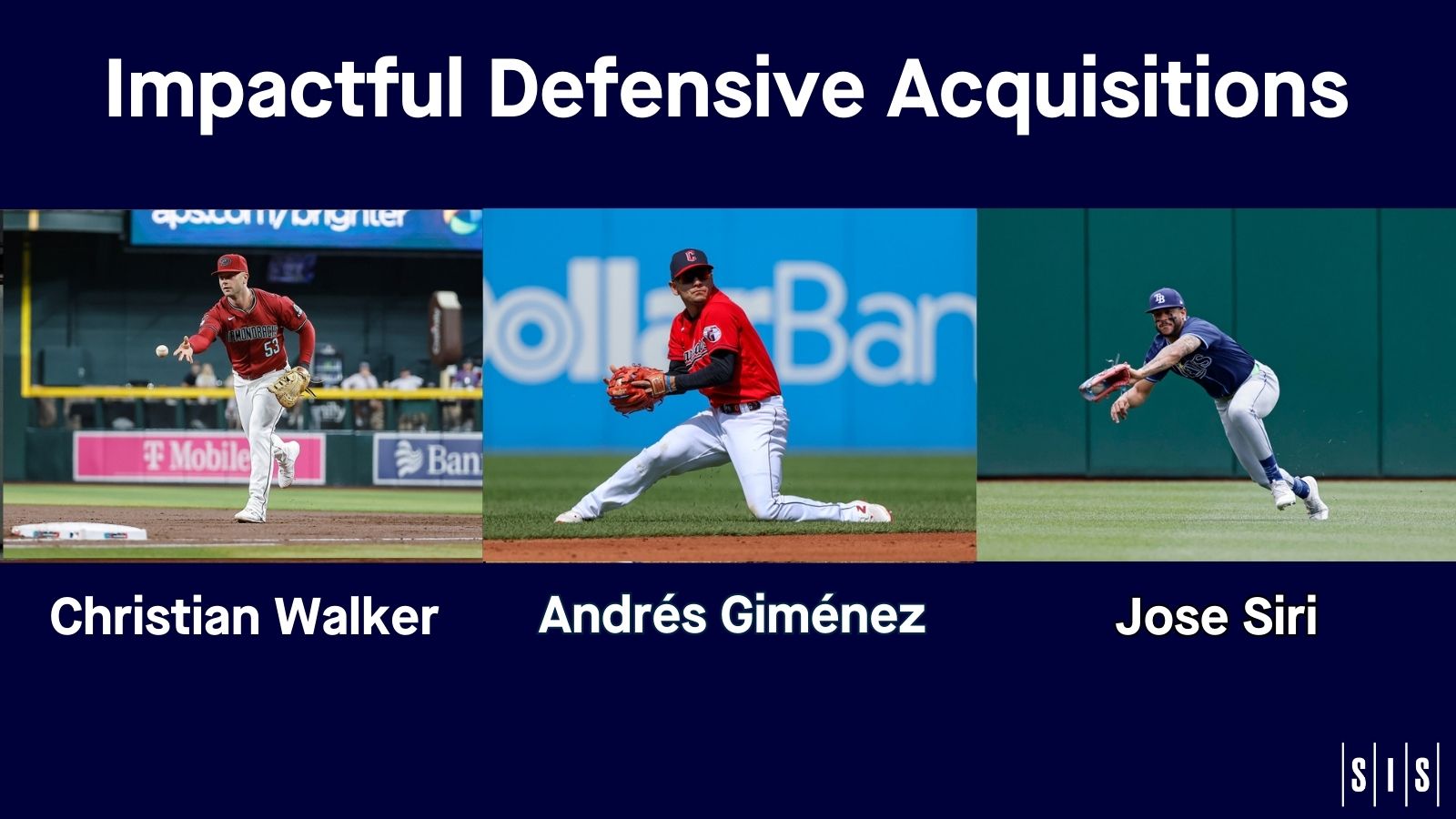
    1B Christian Walker Diamondbacks
    2B Andrés Giménez Guardians
    3B Ke’Bryan Hayes Pirates
    SS Dansby Swanson Cubs
    LF Steven Kwan Guardians
    CF Kevin Kiermaier Blue Jays
    RF Fernando Tatis Jr. Padres
    C Gabriel Moreno Diamondbacks
    P Zack Greinke Royals
    Multi-Position Mookie Betts Dodgers

    Defensive Player of the Year

    Ke’Bryan Hayes is our inaugural Defensive Player of the Year. He led 3rd basemen in Defensive Runs Saved this season and easily leads all 3rd basemen in Runs Saved since his debut season, 2020.

    “Ke’Bryan Hayes had another outstanding season defensively,” said SIS VP Baseball, Bobby Scales. “Since the day he entered the Major Leagues he has displayed a level of defensive excellence that few young players exhibit at this early stage of their careers. This year was truly a special one for him.”

    Individual Positions

    1B – Christian Walker won his 2nd straight Fielding Bible Award. He finished 2nd among 1st basemen with 9 Defensive Runs Saved in 2023. He joins Albert Pujols and Matt Olson as the only 1B to win in consecutive years. Walker cut back on his Misplays & Errors from 19 in 2022 to 11 in 2023 in nearly the same number of innings.

    Walker and Paul Goldschmidt are the only Diamondbacks players to win a Fielding Bible Award at 1st base.

    2B – Andrés Giménez won his 1st Fielding Bible Award. Gimenez led all 2nd basemen with 23 Defensive Runs Saved in 2023. He was our Co-Defensive Player of the Month in September. Giménez was the only infielder to be at least 10 Plays Saved above average on balls hit to both his left and his right in 2023.

    He’s the only Guardians player to win the Award at 2nd base.

    3B – Ke’Bryan Hayes won his 2nd Fielding Bible Award (previously won in 2021) to go along with Defensive Player of the Year honors. He led all third basemen with 21 Defensive Runs Saved. Hayes cut back on his mistakes in 2023. He finished with 13 Defensive Misplays & Errors, down from 25 in 2022. He was also the only third baseman to have at least 10 plays saved on balls hit to his right.

    He’s the only Pirates player to win the award at 3rd base.

    SS – Dansby Swanson won his 1st Fielding Bible Award. He was the only unanimous selection among 2023 winners. Swanson led all shortstops with 18 Defensive Runs Saved. He was +14 Plays Saved on balls hit to his right, the most of any player at the position. Balls hit to that area (the shortstop-third base hole) have been a weakness for Swanson in past seasons but in 2022 and 2023, he’s improved considerably.

    Swanson is the second Cubs player to win a Fielding Bible Award at shortstop, joining Javier Báez (2020).

    LF – Steven Kwan won his 2nd Fielding Bible Award. He’s the first player to win a Fielding Bible Award in each of his first 2 MLB seasons. He led all left fielders in both Defensive Runs Saved (16) and Good Fielding Plays (24) in 2023. He’s the only Guardians player to win the Award for left field.

    CF – Kevin Kiermaier won his 3rd Fielding Bible Award. He finished 2nd among center fielders with 18 Defensive Runs Saved, his most since recording 20 in 2017. Kiermaier made 92 catches on 110 opportunities on balls classified as deep, 11 more than the average center fielder would have made. Kiermaier joins Kevin Pillar as the only Blue Jays to win the Award for center field.

    RF – Fernando Tatis Jr. won his 1st Fielding Bible Award and became the 1st Padres player to win the Award. Every team now has at least one Fielding Bible Award winner. Tatis was the runaway leader with 29 Defensive Runs Saved in right field. He led all right fielders in Plays Saved on medium and deep-hit balls and led the position in Outfield Arm Runs Saved. Tatis’ 29 Runs Saved were the most for any player at any position in 2023. The 20-run gap between Tatis and the next-best right fielder was the largest gap between No. 1 and No. 2 for right field since Runs Saved was first tracked in 2003.

    C – Gabriel Moreno won his 1st Fielding Bible Award. Moreno threw out 21 would-be basestealers in 56 attempts, which equated to an MLB-best 7 Stolen Base Runs Saved. He also earned 5 Runs Saved for pitch blocking, 2nd in MLB to Nick Fortes. Diamondbacks pitchers had a 3.94 regular season ERA when Moreno caught. When he didn’t, their ERA was 5.25. Moreno joins Jeff Mathis as the only Diamondbacks catchers to win a Fielding Bible Award.

    P – Zack Greinke won his 3rd Fielding Bible Award, his first with the Royals (other ones: 2018, 2019). He finished 2nd among pitchers with 6 Defensive Runs Saved this season. In the 21-year history of the stat, Greinke ranks first at the position with 93 Runs Saved. Greinke allowed only 2 stolen bases all season. He picked off 5 baserunners, 1 more than he had in the previous 8 seasons combined. Greinke is the only Royals pitcher to win a Fielding Bible Award.

    Multi-Position – Mookie Betts won his 6th Fielding Bible Award, tying Andrelton Simmons and Yadier Molina for the most in the 18-year history of the Award. It’s the first time that Betts won for multi-position excellence. The other 5 came as a right fielder. Betts saved 6 Runs at 2nd base and 3 runs in right field. He’d never played more than 14 games at 2nd base prior to 2023, when he played 70. He also played 16 games at shortstop, the first time he’d played the position in the major leagues. Betts is the 3rd Dodgers player to win the Multi-Position award joining Cody Bellinger (2019) and Kiké Hernández (2020).

    The 2023 awards were determined by a panel of 16 voters, who ranked the top 10 players at each defensive position (including a spot for multi-position players) at the conclusion of the regular season. A first-place vote gets 10 points, second-place gets nine points, third-place gets eight points, etc. Total up the points for each player, and the player with the most points wins the award. A perfect score is 160 points.

    Our voting panel consisted of SIS co-founder John Dewan and baseball stat pioneer Bill James, along with Daniel Álvarez-Montes (El Extra Base), Chris Dial (sabermetrician), Alyson Footer (MLB.com), Peter Gammons (The Athletic), Tyler Kepner (The Athletic), Bill Ladson (MLB.com), Eduardo Pérez (ESPN), Hal Richman (Strat-O-Matic), Travis Sawchik (The Score), Bobby Scales (SIS), Joe Sheehan (longtime writer), Mark Simon (SIS), Dani Wexelman (MLB Network Radio), and an aggregate vote from the SIS Video Scout staff.

    A complete list of ballots and the history of the Fielding Bible Awards (which began in 2006) can be found online at FieldingBible.com and in The Bill James Handbook: Walk-Off Edition, which is available at ACTASports.com.


  • 2023 Defensive Player of the Year: Ke’Bryan Hayes

    2023 Defensive Player of the Year: Ke’Bryan Hayes

    When we talk about defensive excellence, all too often we talk about great plays. We’re wowed by the spectacular, the diving, the sliding, and the jumping. Whatever makes for good social media and gets shared a million times over is what we see the most.

    And that’s great. It’s fun.  Fans love it. Players love it.

    But maybe with our inaugural Defensive Player of the Year, Ke’Bryan Hayes, we need to look at this differently. Maybe what defensive excellence is for Hayes is a little different than what it is for someone else.

    Hayes’ great plays are high quality but not necessarily high in quantity. Our Video Scouts track Good Fielding Plays. These are largely the highlight-reel plays I mentioned a couple of paragraphs ago, along with (in smaller numbers) things like keeping the ball on the infield to keep a run from scoring.

    Here’s one example, and another. They’re really good plays. By our count, Hayes had 14 Good Fielding Plays in 2023. On a per-1,000-inning basis, he wasn’t close to the MLB leaders at third base. He was middle-of-the-pack.

    I have a theory here, though it’s a hard one to prove statistically. It’s that Hayes doesn’t have a lot of Good Fielding Plays because that’s not how he does things. As Pirates manager Derek Shelton told me “He makes really, really difficult plays look routine.”

    For example, this play doesn’t look that difficult on TV.


    But I watched a ballpark All-9 camera view of it (we can’t show it due to MLB rules). It was a tougher play than you think. Hayes reacted quickly to the ball. Some players might have dove for it. He didn’t need to.

    “The thing that impresses me most is the consistency,” Shelton said. “He’s just so good.”

    That Hayes can make defense look easy makes sense given that he’s basically been preparing to be a major leaguer since he began playing baseball as a kid. In two conversations with him, a few years apart, Hayes brought up how one of the most important things he learned as a kid was how to throw a ball to his first baseman. The first baseman wore a Superman t-shirt, and it was Hayes’ job to throw to the ‘S.’ He picked this up well.

    “I remember his mom asking me why I hit ground balls so hard to him,” said Ke’Bryan’s father, former 14-year major leaguer Charlie Hayes. “He was blessed with great hands. I told her that he was better than most, so I needed to challenge him more. Catching and throwing is the easiest thing to do on a baseball field so there’s no reason not to be great at it. He bought into it all.”

    There’s another point that’s important to consider when watching how Hayes defends.

    What makes Hayes great is not that he makes great plays. It’s that he makes very few mistakes.

    In addition to tracking Good Fielding Plays, our Video Scouts also track Defensive Misplays. Those are things that aren’t scored errors but that have a negative consequence.

    Bobble a ball such that you get only a force out rather than a double play? That’s a Defensive Misplay.

    Slip and fall trying to catch a popup and have the ball drop behind you or in front of you?  That’s a Defensive Misplay.

    At SIS, we combine those Defensive Misplays with Errors to provide another data point for defensive evaluation.

    Let’s compare Hayes’ 2023 Defensive Misplay and Errors per 1,000 innings to five other third basemen considered to be among the best in MLB.

    Player Team Misplays & Errors Per 1,000 Innings
    Ke’Bryan Hayes Pirates 12.5
    Manny Machado Padres 18.5
    Ryan McMahon Rockies 19.0
    Alex Bregman Astros 21.9
    Nolan Arenado Cardinals 21.9
    Matt Chapman Blue Jays 26.4

    Hayes crushed all of those guys this season.

    The only player to have a better rate at third base than Hayes in 2023 was DJ LeMahieu of the Yankees. Hayes played about 450 more innings at third base than LeMahieu did. Look at this stat for the last 4 seasons and it’s LeMahieu and Hayes as the best, with Hayes having played about 1,700 more innings than LeMahieu has.

    This low misplay total is particularly impressive for 2 other reasons.

    And it’s all done very calmly and with an ease that other players don’t necessarily have.

    A high school coach used to tell Hayes to be extraordinary at the ordinary. Hayes lives that saying. To do that he embraced the other side of playing defense.

    “The mental side has been the biggest thing for me,” Ke’Bryan Hayes said. “Playing outcomes in my head before they happen. Knowing the runners, knowing who’s pitching, knowing how they hit the ball off that pitcher.  I try to break down everything and that way, whatever it does happen, I kind of just let my instincts take over. I just trust myself.”

    SIS VP of Baseball Bobby Scales said on our baseball podcast “Ke’Bryan Hayes never panics on any ball.”

    All the work Hayes put in pays off and you can see that if you watch him up close every day.

    “He has the ability to read hops that no one else has,” said Shelton. “That’s not something you can teach. One of the things that elite third basemen do is have the ability to decide if they’re going to come get the ball or if they’re going to take a drop step to get it. It’s not even something he has to think about. It’s just something that he does.”

    Hayes’ role is changing. At age 26, he’s no longer the youngest infielder on the team. He’s now the player the younger infield prospects watch to see how he does things.

    “At the end of the day, I’m just trying to go out there and be an example of just doing things the right way,” Hayes said.