Category: Baseball

  • July’s MLB Defensive Players of the Month

    July’s MLB Defensive Players of the Month

    There was a time not too long ago when it looked like Adolis García could get moved at the trade deadline. But now that the Rangers are winning, even though García isn’t hitting as well as he might like, his defensive value would be tough to lose.

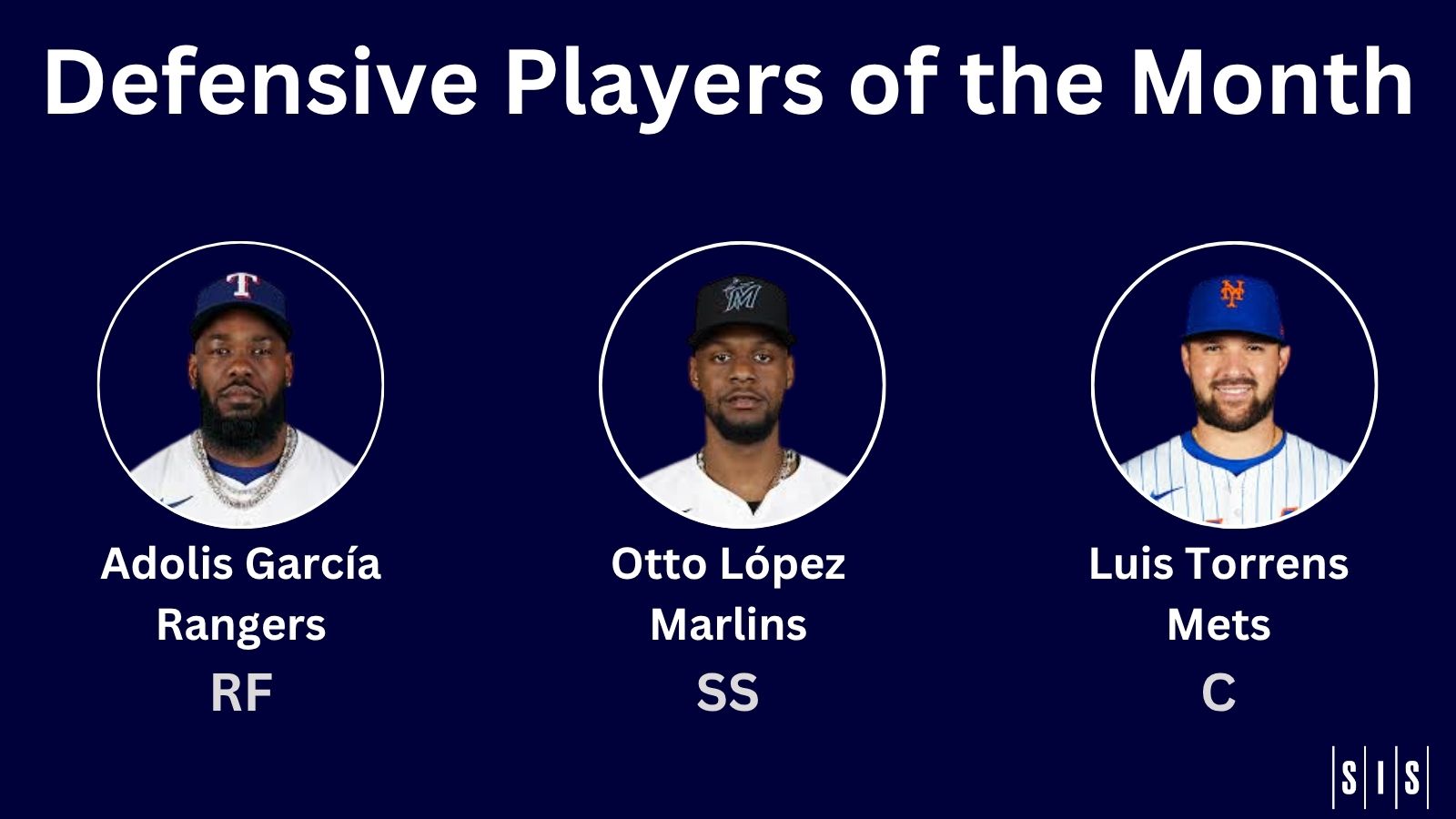
    García was one of three players named Sports Info Solutions Defensive Player of the Month for July along with Marlins shortstop Otto López and Mets catcher Luis Torrens.

    García earned his second such honor this season (he also won it in May) on the strength of a period in which he saved 8 runs, more than anyone else in MLB and 3 more than any right fielder.

    García leads all right fielders with 17 Runs Saved this season. His single-season high at the position is 15 in 2021. Last season he had his worst defensive year, totaling -5 Runs Saved. But that, like the trade rumors, is well in the past.

    In addition to a bevvy of impressive catches, García has 6 Runs Saved from his outfield arm. He’s allowed only 38% of runners to advance an extra base on balls he’s fielded. The major league average is 50%, which comes out to about 11 “runner holds” better than the average player given the number of opportunities he’s had.

    This is not to say that García doesn’t come without risk. He had 7 Defensive Misplays & Errors in July, which also led right fielders, but we’ve deemed the risk is worth the reward here. He’ll be a strong candidate for a Fielding Bible Award at year’s end.

    The Marlins made a position swap in mid-May, moving López to shortstop when Xavier Edwards got hurt. Edwards subsequently moved to López’s old position, second base upon his return and there’s been a very nice defensive payoff.

    López tied for the MLB lead with 5 Runs Saved at shortstop and is now 5th among shortstops with 6 Runs Saved this season. He had played a stellar second base last season and had no problem in a different spot. When López was in the minor leagues, he played shortstop, second base and the outfield about equally, so he’s used to moving.

    Our Data Scouts track “Good Fielding Plays” which are the kind of plays you’d see on a highlight reel but also little things like keeping a ball on the infield to prevent baserunner advancement. López has 9 Good Fielding Plays in 59 games at shortstop. Edwards had only 1 in 41 games prior to the switch.

    For his part, Edwards had 3 Runs Saved at second base in July and he’s 4th among second basemen with 6 Runs Saved after tallying -3 at shortstop. The move worked for him too.

    July was a good example of that. The Marlins ranked 5th in MLB in how often they turned a grounder or bunt into an out (76.4% of the time). The team allowed an MLB low 73 runs in 25 games for the month. No other team allowed fewer than 80.

    Torrens was elevated to the regular starting role when Francisco Alvarez was demoted and recently returned to backup duties when Alvarez returned.

    Undaunted by that, he had a terrific defensive month, with his most notable accomplishment being catching 6 of 9 would-be basestealers. Torrens has perfected making throws to the first base side of second base so that the shortstop can reach to catch the throw and tag the runner at the same time (here’s an example).

    Torrens finished July with 5 Runs Saved, most among catchers despite finishing tied for 19th in innings caught.

    Torrens caught 46% of runners trying to steal last season and is at 44% in 2025. The MLB rate specific to catchers is 19%.

    Honorable mention to a pair of players who got dealt at the trade deadline. Harrison Bader, who led left fielders with 5 Runs Saved in July, heads from the Twins to the Phillies, who rank 28th in Runs Saved this season. Bader could play any outfield spot for them and be respectable.

    Ke’Bryan Hayes co-led all third basemen in July with 5 Runs Saved and is the runaway leader at the position for the season with 16. He’ll be well received by the Reds, who haven’t gotten positive Runs Saved at that position since the 2017 season.

    Defensive Players of the Month

    April – Harrison Bader and Pete Crow-Armstrong

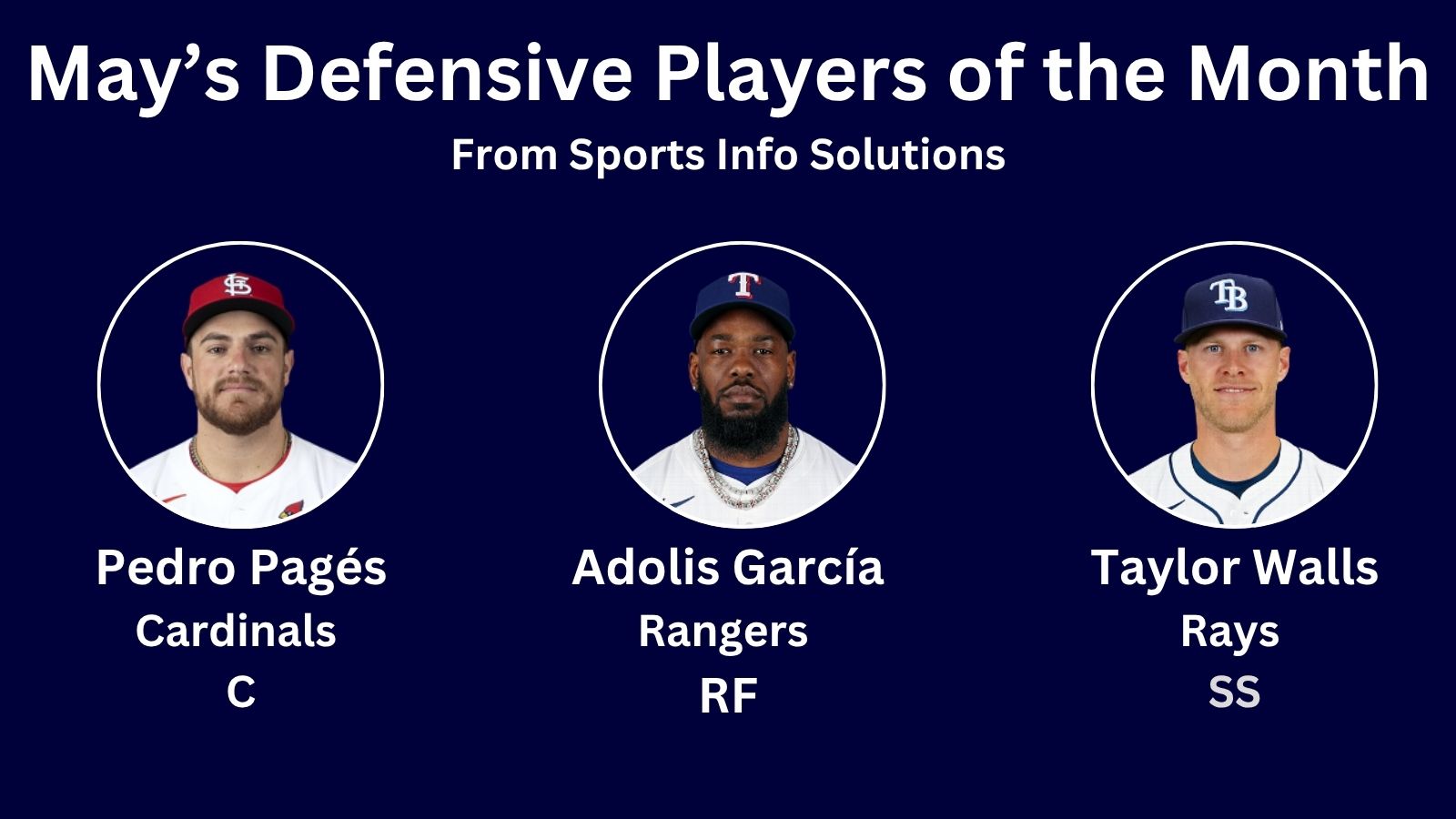
    May – Adolis García, Taylor Walls, Pedro Pages

    June – Julio Rodriguez, Ke’Bryan Hayes, Mookie Betts

    July – Adolis García, Otto López, Luis Torrens

  • Appreciating Steven Kwan’s Defense, Wherever He Ends Up

    Appreciating Steven Kwan’s Defense, Wherever He Ends Up

    Photo: Keith Gillett/Icon Presswire

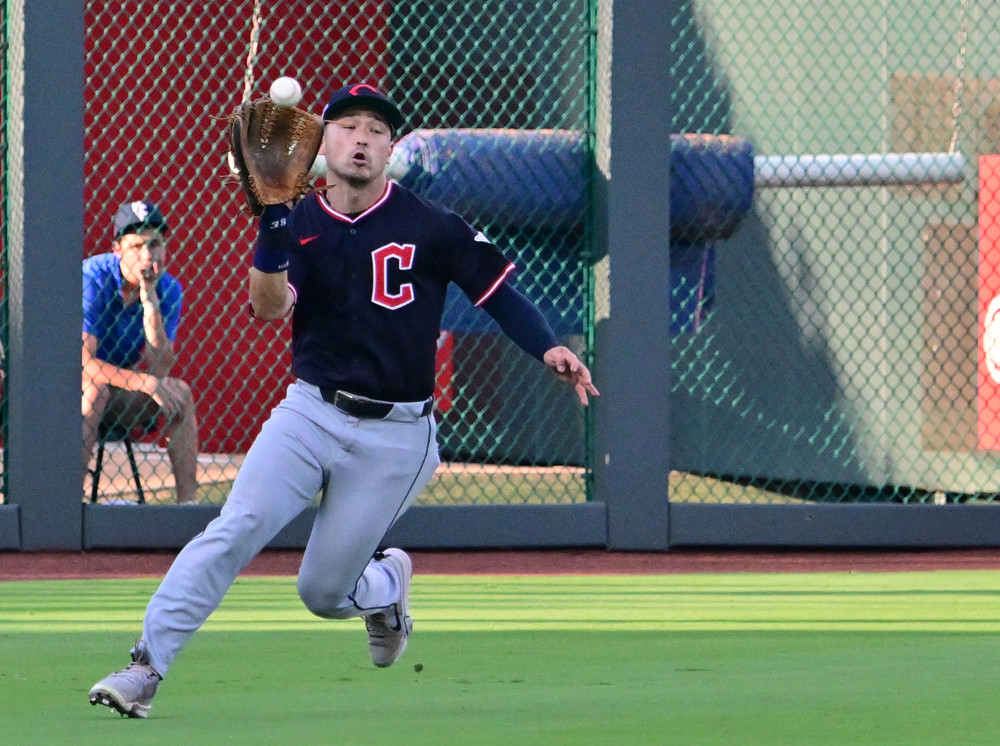
    Whatever team Steven Kwan plays for on August 1, this much is true: Kwan is a terrific defensive left fielder.

    Kwan leads all left fielders with 13 Defensive Runs Saved this season. The next-closest player has 8. He’s probably going to lead the position in Runs Saved for the third time in his four MLB seasons. The year he didn’t lead was 2024 when he finished third.

    Most Defensive Runs Saved – LF in 2025

    Name Team Runs Saved
    Steven Kwan Guardians 13
    Harrison Bader Twins 8
    Wyatt Langford Rangers 8
    Ian Happ Cubs 7
    Tommy Pham Pirates 7

    Over the last four seasons, Kwan has 59 Runs Saved. The next-closest player is Ian Happ with 31. The only position with a bigger gap between No. 1 and No. 2 is third base where Ke’Bryan Hayes has a 30-run edge over Ryan McMahon. And though Kwan has played the second-most innings of anyone there, he crushes others who play the position often.

    Most Innings Played – LF – Last 4 Seasons

    Player Innings (DRS)
    Ian Happ 4,648 (31)
    Steven Kwan 4,224 (59)
    Randy Arozarena 4,211 (-10)
    Andrew Benintendi 3,677 (-20
    Lourdes Gurriel Jr. 3,554 (12)
    Jurickson Profar 3,447 (-25)

    Kwan has good range numbers this season, though they’re not the best at the position. Where he’s differentiated himself from others is in his throws. He leads left fielders with 7 assists without the help of a cutoff man (among his 9 assists overall). Those impact both his outfield arm stats and what we refer to as his “Good Fielding Play Runs Saved.”

    Additionally, Kwan has been credited for 5 instances in which he held a batter to a single by getting to a ball quickly or playing a ball off the wall well. As was said on a Guardians broadcast- he plays the left field wall “like he built it.” That play is something our Data Scouts do via video review and is a component of his Runs Saved. He’s tied for the MLB lead with Jarren Duran for such plays.   

    We should point out too that Kwan doesn’t have the strongest arm among left fielders. He averages 87 MPH on the top 10% of his throws, which is right around average at the position.  

    But he knows what he’s doing out there, as evidenced by the play above and these too.


    And this

    As such, Kwan has 8 Runs Saved from the combination of outfield throws and all of his Good Fielding Plays. Duran ranks second with 4 Runs Saved. The players ahead of Kwan in Range Runs Saved, Wyatt Langford, Harrison Bader, and Isaac Collins, have -1, 1, and -2 Runs Saved for things outside of their range, respectively.

    The Guardians have maximized the value they’ve gotten from Kwan in the nearly four seasons he’s been with the team. His 16 WAR is higher than all but one player taken in the first round of the 2018 MLB Draft (in which Kwan went in the 5th round). The only player to top him from that group is another great defender, Nico Hoerner (just shy of 20 WAR). 

    There’s a lot to like about Kwan beyond his glove given that he usually hits for a high average, rarely strikes out, and can steal a base. The defense is one component in what is a pretty complete player.

    Kwan has reportedly been coveted by teams like the Dodgers and Blue Jays. With the Dodgers, he’d be filling a defensive need. The team has gotten a combined -7 Runs Saved from its left fielders. With the Blue Jays, it would be a case of the rich getting richer (they already have one of the top center fielders in Myles Straw). 

    Whoever he’s playing for, we suspect they’re going to be pretty happy with what they got.

  • MLB Draft Scouting Report: Gage Wood (Phillies)

    MLB Draft Scouting Report: Gage Wood (Phillies)

    Photo: Andy Altenburger/Icon Sportswire

    MLB Draft Scouting Report: Gage Wood

    Skill Grade
    RHP
    Fastball 70
    Cutter/Slider 55
    Curveball 60
    Splitter 50
    Control/Command 50/50
    Future Value 55+

     Name: Gage Wood

    College: University of Arkansas

    Bio: R/R 6-0, 205 lbs.

    DOB: 12/15/2003

    Written by Brandon Tew

     Analysis:

    Gage Wood arguably has the loudest stuff in the entire college draft class. His arsenal is a noisy and brash heavy metal band. He stares with laser focus towards the batter, giving off angry vibes. “Here’s my fiery fastball and buzzsaw curveball, try to hit it…”

    Add in a cutter/slider that is hard with good shape, and you have the makings of three distinct offerings and an aggressive pitcher that knows he has overpowering stuff.

    If Wood succeeds in MLB he will continue to wield an ultra-productive fastball to pair with a big breaking pitch that he can throw in the mid-80s with a downer shape. He’ll do this all while throwing strikes and keeping the ball out of the heart of the plate as he refines his command.

    If Wood hits a snag, it will be possible for him to sustain further injuries. Shoulder injuries can be complex.

    Or he’ll lack true command of his fastball and curve, with no viable, consistent armside pitch to keep hitters honest and never gets a feel or command for the splitter that he rarely threw in 2025, but has been tinkering with.

     College Career:

    In Wood’s first two seasons in Fayetteville, he was a power reliever. After making the transition to the rotation, he had some bad luck, as he was removed from an outing in February against Michigan with a shoulder impingement.

    The Razorbacks shut down Wood until mid-April limiting him to just 10 uneven starts and pitch counts and just 37 ⅔ innings. Wood’s powerful arsenal was on display late in the season when he twirled a 19-strikeout no-hitter vs Murray State in an elimination game at the  College World Series.

    I’m not sure if it was ever a discussion to take the ball out of Wood’s hands, but I would venture to guess he would have told anyone who asked that it was his game and his ball.


    Year ERA IP K% BB%
    2023 4.80 30 30% 16%
    2024 4.46 40 1/3 32% 5%
    2025 3.82 37 2/3 46% 5%


    Pitching Mechanics:


    Out of the windup, Wood starts with his lower half fully turned to face third base. He rotates his upper body to have his glove in front of his face as he peers over the top.

    He steps with his left foot to first base and rocks back, dropping his glove to his stomach. He smoothly brings his leg up to his glove during the leg lift, and as he does so, he counter-rotates his hips, creating momentum forward.

    As he drives his front hip to the plate, he straightens out his lead leg with his toe pointed up to the sky at about a 45-degree angle made with his leg and left foot.

    He holds himself in a close position down the mound as he enters a front-foot strike. He’s smooth getting down the mound, but has a fast arm action as he goes to land.

    With his right arm flipped up around a 45-degree angle, you can see the scap retraction in his throwing shoulder as he enters a power position with his chest and weight leaning into his front foot.

    Finishing with his chest out over his knee, he transfers energy through a lead leg block that drives force up to his throwing arm. He usually recoils his arm quickly in a brief motion. He brings it back to his body quickly after ball release, as his leg swings through in a straightened position.

    One quirk in Wood’s delivery is that he pats the ball throughout his move into hand brake, almost using it as a method of rhythm to keep him on tempo throughout the delivery.

    Wood moved over to the extreme first base side for the Murray State no-hitter, which is likely due to the angles.

    Gage Wood positioning on pitching rubber:

    2 images. On the left, Wood stands with his feet in the center of the pitching rubber. On the right, he stands with his feet on the 3rd base side of the rubber.

    Arsenal:

    4s: 95-97 mph avg, 17” IVB, 10” Arm-side | Release: 5.5’

    Wood throws his four-seam with giddyup behind it, and the ball has good carry through the top of the zone. From a lower release height, the ball zooms past hitters, and he squeezes the pitch hard.

    He has a slight supination bias, meaning he throws the ball with a slight cut at times. Still, on the four-seam, he tries to stay behind the ball and rip down on the seams to create backspin, which he does pretty well based on how his fingers align on the ball in his grip and how they interact at release.

    Against either handedness, his catcher sets up the middle of the plate, up or down—his locations on the fastball against right-handed hitters are slightly more to the top shelf. While against left-handed hitters, Wood’s fastball command was more middle shelf in the zone.

    He was highly aggressive in the zone with his fastball, running an above-average heart-of-the-plate percentage this season, although it was a smaller sample. Arkansas wanted Wood in the zone and with good reason, as he ran a 32% zone-whiff rate on the pitch against righties and a 46% zone-whiff rate versus lefties.

    The pitch, with a flat vertical approach angle of around -4.1, completely obliterates hitters as they swing underneath it. If Wood can continue to refine his command to more average or maybe even above-average at best, he can start to punish hitters at the top rail, leaning into the excellent traits of the pitch that already exist.

    He gets the ball up, but it will start to be scary for hitters if he can throw fastballs away and then work the pitch up with two strikes. That’s when he can start changing eye levels with that pitch.

    Here are some fastball stats from Wood’s 19-strikeout no-hitter:


    Curveball: 82-85 mph avg, -16” IVB, 11” Sweep

    The curve is a banger pitch, and his teammates have aptly named it the banger as well. The pitch is at times a hard vertical snap dragon at 83-85 mph. He can also get more to the side of the ball and create some more sweep on the pitch if needed.

    This manipulation is intriguing and could help him continue to throw it to both right-handed and left-handed hitters. Either way, the pitch with so much depth at that velocity is hard to come by even in MLB. If the pitch tightens up a bit, it should still perform inside of his arsenal.

    It becomes a guessing game when Wood is blazing heaters by a hitter and then rips off a massive breaker out of the high fastball tunnel. In terms of usage, Wood is a two-pitch pitcher with a double-plus fastball and a plus curveball. Maybe he pushes the velocity more to 85-87 mph, and the break is shorter; it could be a double-plus breaker if he starts to have more command.

    With a big spike on his grip, Wood gets to the front of the baseball with intent better than most, creating hard topspin, producing a gnarly curveball because of it.

    Cutter: 87-91 mph avg, 2” IVB, 4” Sweep

    Wood’s Cutter lives in the slider range, and he doesn’t love the pitch, but it has some decent shape to it, and he throws it pretty hard. The problem is that Wood has a tiny sample size of just about 50 cutters thrown this season.

    With 95% of those thrown to right-handed hitters, it became a wrinkle pitch for Wood against right-handed hitters. There’s hope that Wood can probably add some distinct glove-side breakers to his arsenal, given his little bit of supination bias, which should help him get to the side of the ball better to create spin.

    Any version of a gyro slider and cutter at a hard velocity to pair with a possible sweeper could be enticing to the Phillies—a team that promotes a deeper arsenal and cutter usage, in the Majors, and in some of their pitching prospects as well.

    Splitter: 86-90 mph  Specs: 8” IVB, 11” Arm-side

    With only 14 splitters, all thrown to opposite-handed hitters, the pitch just was not thrown much to assess. He does throw the pitch hard and also kills spin on it. Overall, Wood should be able to possess some type of average to fringe-average offspeed pitch.

    Here are the grips on the splitter:

    Wood's first 2 fingers are split as wide as they can be spread on the baseballAdding in a seam-shifted two-seam to push righties off the plate would be nice as well. Perhaps even a traditional sinker, even if of poor quality, could help moderate the four-seam usage a bit.

    The addition of either a somewhat reliable offspeed pitch or multiple glove-side harder breakers like a cutter and/or sweeper will provide value for Wood.

    Projection:

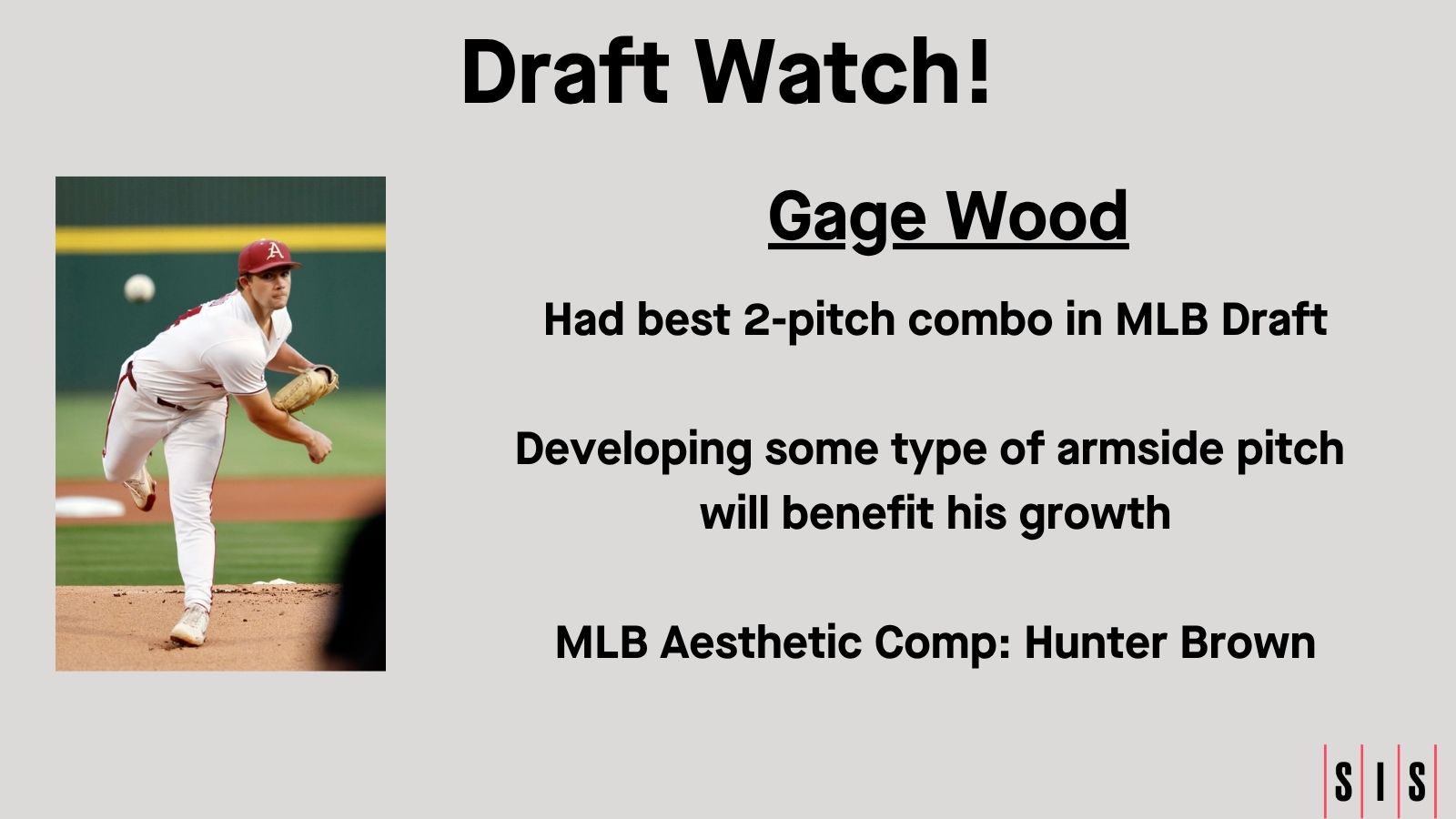
    Wood is a high-ceiling right-handed pitcher with a fastball and curveball pairing that tunnels beautifully. Developing some type of armside pitch will benefit his growth more than anything, and it will be intriguing to see what the Phillies focus on in his development early in pro ball.

    Wood has some questions about the extent of his workload in college. He’s also a smaller pitcher in terms of stature, and while you do have to factor in durability and injury risk.

    From a pure pitch shape and stuff standpoint, Wood has the possible best two-pitch combo in the draft and the foundational building blocks of a mid-rotation starter with some massive upside.

    There’s risk and variance in the profile and some reliever risk if the command backs up, but he’s as talented as any pitcher in this draft and a competitive menace on the mound.


    Aesthetics Comp: Hunter Brown (Similar Arsenal Characteristics)

  • MLB Draft Scouting Report: Kyson Witherspoon

    MLB Draft Scouting Report: Kyson Witherspoon

    MLB Draft Scouting Report:

    Kyson Witherspoon

    Skill Grade
    RHP
    Fastball 60
    Slider 55
    Curveball 55
    Cutter 55
    Changeup/Splitter 50
    Control/Command 50/50
    Future Value 50

    Name: Kyson Witherspoon

    College: University of Oklahoma

    Bio: R/R 6-2, 206 lbs.

    DOB: 08/12/2004

    Written by Brandon Tew

    Analysis:

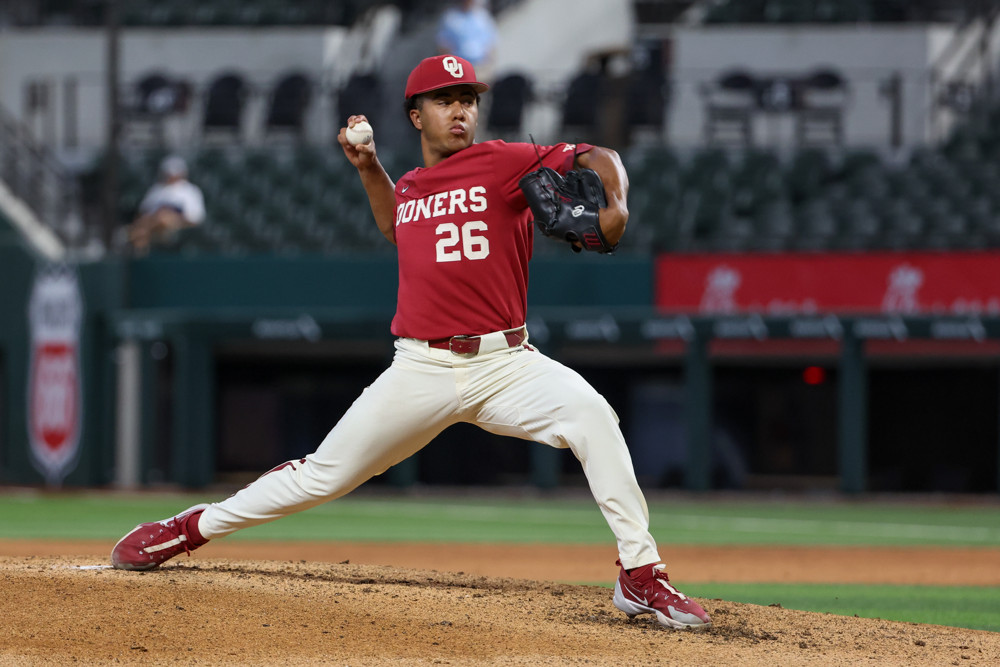
    Kyson Witherspoon is a compact, explosive mover on the mound. With a short extension that doesn’t even reach 6 feet and a short stabby arm path, Witherspoon has some deception and unconventional mechanics with enough strike throwing ability. 

    He has nice shapes on his pitches, including a high velocity cut-ride fastball and a big curveball. Teams will view him as a project they can mold into a starting pitcher, potentially with a deeper and expanded pitch mix than he currently has.

    If Witherspoon succeeds in MLB, it will be by harnessing his explosive movements to command more of his pitches to both sides of the plate while also deepening his arsenal to include multiple distinct glove-side breaking balls and a solid offspeed pitch.

    Witherspoon might run into some trouble in pro ball if he has more fringe-average command. In that case, he will likely be seen as more of a reliever with solid pitches, capable of producing in a bullpen due to his average control; however, not enough stuff to pitch multiple times through the order. 

     College Career:

    After transferring from Northwest Florida State College, Witherspoon was a solid contributor in 2024, striking out 90 hitters in 80 innings. It came with some walks at an 11% walk rate and 40 walks surrendered.

    Fast-forward to 2025, and Witherspoon was one of the most consistent Friday starters in the SEC, cutting his walk rate down while upping his strikeout rate. The improvement in command comes from more comfort in his delivery, but there’s still some upside in terms of commanding the ball even better.

    Year ERA IP K% BB%
    2024 3.71 80 25% 11%
    2025 2.65 95 32% 6%

    Pitching Mechanics:

    Witherspoon pitches exclusively out of the stretch, starting on the 3rd base side of the rubber. As he reaches peak leg lift, he begins to drift down the mound with his front hip significantly.

    As the glove gets to the side of his ear, there’s a bit of counter-rotation created in the drift forward. As he comes out of the leg lift, he tilts his trunk and posture backwards as his hands break at shoulder height.

    Witherspoon then has a bit of jerkiness to him as he stabs his arm downward to get to his arm path. As he sinks into his back hip, he almost pushes down the mound, still trying to stay closed into front foot strike.

    He lands heel to toe and creates a nice stretch across his chest in hip-shoulder separation that is solid as his arm flips up into position at front foot strike. At times, he looks rushed down the mound with possible early trunk rotation into landing. 

    He uses his explosive athleticism to transfer energy into the ball with less effort. He’s more of a short strider with a faster tempo down the mound in a more compact manner, but he’s aggressive down the mound in his moves and tempo.

    Arsenal

    4-seam fastball: 95-98 mph avg, Specs: 19” IVB, 7” Arm-side | Release: 5.9’

    Witherspoon throws a power four-seam with some cutting action to it. He will try to elevate the pitch later in counts to put away hitters. Against either handedness, he will throw the pitch with two strikes.

    He had a 24% whiff rate on the pitch this season and around a 20% in-zone whiff rate to both righties and lefties as well. The cut ride nature of the pitch doesn’t allow the ball to carry as much at times. It’s still an above-average shape, and adding in the velocity, and even with the slightly above-average release height, this is still a plus pitch.

    Witherspoon is more control over command right now with his four-seam in particular, and was very aggressive with the pitch. He allowed some damage on fastballs against left-handed hitters, possibly a byproduct of not getting the pitch inside to lefties.

    Also, lefties sat fastball early against him, as he was more likely to throw a four-seam to start an at-bat or down early to left-handed hitters at a higher rate than right-handed hitters.

    Witherspoon uses pent-up energy and emotion to fuel his fastball when he wants to reach back for some more velocity. In big spots when he finished at-bats against hitters with a high-velocity fastball, he would display some of this energy on his way to the dugout.

    Slider: 84-89 mph Specs: 0” IVB, 5” Sweep  

    Cutter: 88-90 mph Specs: 6” IVB, 3” Sweep

    Witherspoon’s cutter and slider would blend in shape and velocity at points this season. The team drafting Witherspoon would likely push his cutter up a little and get higher velocity around 90-92 mph. 

    While the slider would push more toward the depth slider, he would try to throw down and away to right-handed hitters. If he can consistently get the more down shape at around 85-87 mph, he can use the two separate offerings in the same tunnel. 

    Or he can use the slider down in the zone and the cutter more toward the upper part of the zone, especially to left-handed hitters, to keep them off of his four-seam early in counts.

    Witherspoon loved using the cutter and slider down and away from right-handed hitters and leaned on zoning the cutter a bunch. If he can refine the command of these two offerings, especially the slider after reworking the vertical depth of the pitch, he can start to backfoot lefties to move their feet off the plate, opening up the outside of the plate more. 

    His cutter against left-handed hitters also pushes down and in mostly, so being able to get more carry on that pitch could move the location more in on the hands of left-handed hitters rather than around mid-thigh locations.

    With his supination bias, there’s a chance a team will give him a bigger sweeper shape as well. For both handedness, there’s a multitude of routes Witherspoon can take with his pitch mix. If you add a sinker, you can also protect your other pitches on the outer part of the plate by throwing the sinker inside against righties.  

    These tweaks will likely come with how much you want to touch his mechanics, so there’s a threading-the-needle aspect to all of this, but the possible shapes you can get to from a pitch perspective are intriguing based on his current mix and three-quarters arm slot.

    Changeup: 87-91 mph  Specs: 11” IVB, 15” Arm-side 

    (Also tinkered with a Splitter 89-90 mph)

    On the left side, Witherspoon is gripping the pitch with 3 fingers, using much of his hand. On the right side, he's gripping it almost like a split-fingered fastball

    Rather than talking about the current changeup shape, there’s an interesting tidbit I noticed about Witherspoon. He tinkered with his offspeed a lot this season.

    In the first four starts of the season, he threw what looks like a four-seam changeup. Then, going into his start against South Carolina, he switched to a splitter grip.

    He started in the splitter grip for about six starts before changing back to a four-seam changeup against Georgia in April. Then, to end the season based on the video, he went to a two-seam changeup.

    His changeup and splitter were both firm offerings with little drop. An organization will continue to work with him in pro ball and help him find an orientation and grip that adds drop and reduces spin. He had an okay feel for these offerings, but he mostly threw changeups over the splitter he started gripping. He was also tagged on a couple of poorly-executed changeups late in the season, where the pitch just didn’t fade enough and stayed up.

    There’s enough here to get to an average offspeed shape to use versus left-handed hitters, and maybe an even better one with pitching development continuing to improve with offspeed shapes and their usage.


    Curveball: 76-80 mph  Specs: -16” IVB, 10” Horizontal

    The curve is a big knuckle curve that Witherspoon deployed in two-strike counts off of his fastball to both left-handed and right-handed hitters. He could throw the pitch below the zone or catch a batter unable to pull the trigger on a pitch dropped into the zone out of the sky.

    The pitch had excellent results both in and out of the zone for whiffs to either platoon, and has the makings of an above-average offering that can neutralize hitters off of Witherspoon’s fastball and harder glove-side pitches.

    If the curve can work against opposite-handed hitters in pro ball, even pushing velocity and intent to make it an even better pitch, this could lessen the impact of not having an average offspeed pitch to keep left-handed hitters honest, more than anything.

    Witherspoon, in general, can feel rushed down the mound, and his release of the curve can come and go from pitch to pitch with some terrible misses.

    He does have overall a feel for the pitch, and his willingness to throw it in two-strike counts to both platoons makes the pitch a valuable piece of the puzzle for him.


    Projection:

    Witherspoon has intriguing pitch shapes in his cut ride fastball and breakers. A team will try to refine some pitches and also expand the arsenal, possibly giving him a deeper mix to attack hitters with.

    There is a possibility to get to plus shapes in the slider and fastball, putting him more in a middle rotation spot. As an explosive athlete, there’s also room to get more out of his body, not only from an extension and movement standpoint but also cleaning up his delivery if a team so chooses.

    His success will mainly hinge on maximizing his pitch shapes and either moving well enough in his current delivery as an athletic righthander or making some tweaks to unlock better command of pitches. 

    There’s enough of a floor here to like Witherspoon as more of a back-end bullpen piece. Teams will bet on the upside and molding him into a No.4 Starter with some mid-rotation upside if it all clicks.

    Aesthetics Comp: Zach Plesac (Delivery and arm action)

  • 2025 MLB Draft Scouting Report: Kade Anderson

    2025 MLB Draft Scouting Report: Kade Anderson


    Skill Grade
    Throws LHP
    Fastball 55
    Slider 55
    Curveball 55
    Changeup 55
    Control/Command 55/55
    Future Value 55

    Name: Kade Anderson

    College: LSU

    Bio: L/L 6-2, 179 lbs.

    DOB: 07/06/2004

    Written by Brandon Tew

    Analysis:

    Kade Anderson blends a deep arsenal with intensity and guts to bully hitters. Anderson possesses above-average stuff across the board, and while his pitch shapes might not be an outlier, his results speak to just how dominant he was at LSU in 2025. When you lead D1 Baseball in strikeouts with 180, you are performing at a high level throughout the season. He also threw the most innings this season (119)

    If Anderson is successful in MLB, it will be because of his deep pitch mix and command of multiple pitches, overwhelming the zone with above-average stuff.

    If he struggles, it will be due to a lack of fastball production, the opposite of what he displayed in college. Rather than tweaking some things, a team pushes him through levels too quickly.

    College Career:

    Anderson, after an outstanding freshman campaign out of the bullpen, continued to pitch better as the season progressed and into the postseason in 2024. Anderson quickly cemented himself as the ace in Baton Rouge in 2025, demanding the ball and pitching deep into starts as much as possible. He averaged 101 pitches a game over 19 starts. 

    Understanding that he pitches once a week is essential to evaluating this workload, but when Anderson had the ball, he rarely gave it up without pitching deep into the game.

    With a 135-pitch shutout versus Oklahoma in April, Anderson pitched his absolute best on the Friday night stage. He then tossed a 130-pitch shutout in the CWS Finals against Coastal Carolina. Anderson’s performance helped the Tigers win another national title and vaulted him into the conversation as the best pitcher in this draft class.

    Year ERA IP K% BB%
    2024 3.99 38 1/3 34% 12%
    2025 3.18 119 37% 7%

    Pitching Mechanics:

    Anderson has a similar delivery to two left-handers that have been compared in the past from a visual standpoint, Max Fried and Cade Povich. The video below shows all three windups in sequence. Anderson also throws from a fluid arm stroke and a high 3/4 slot, similar to Povich and Fried.

    In a windup, Anderson starts with his glove at the belt, but will move it up to his face as he steps to the side, and he brings the glove back down to his belt. As he begins his leg lift, the glove rises to about chin height.

    As he transitions from peak leg lift, he creates a drift and momentum forward, but with little counter-rotation in his front side. He moves smoothly into landing on the front foot, and his arm swing is smooth, and there’s some deception as he hides the ball well. The arm path is in pattern with the rest of his body, finishing in a good position as his front foot lands.

    He throws with a slightly slower, more controlled tempo, but blocks out his lead leg to transfer energy well. While there is no significant uncoiling or unwinding of energy, his delivery is repeatable. With either added mass or even more powerful moves, Anderson could tap into even more velocity.

    Anderson also plays with angles by moving on the rubber based on handedness, going to the first base side against lefties and the 3rd base side against righties.

    This is an interesting choice considering Anderson primarily pitches to the glove side against lefties. Maybe he’s ok with the move over and farther angle to the outside part of the plate because he cuts his fastball.

    He also could be trying to hide the ball better on his breaking balls against left-handed hitters. It would be interesting to see if a team would decide to have him stay on just one side of the mound.

    Arsenal

     4s: 91-96 mph, Specs: 19” IVB   8” Arm-side | Release: 6′

    Anderson slightly cuts his four-seam fastball, and there’s variance in how he will throw the ball game to game or even in certain pitches in an at-bat. What’s intriguing about Anderson is that when looking at catcher locations for his four-seam fastball, he pushes his intended locations up and away from both left- and right-handed hitters.

    He’s arm-side with the pitch against right-handed hitters and glove side with it against left-handed hitters. As mentioned above, since he moves on the pitching rubber based on handedness, the ball must travel farther and at a different angle to reach both targets.

    Anderson is ultra-aggressive in the zone with the pitch and uses the cut he creates to his advantage, especially against left-handed hitters. He uses the offering in first-pitch situations and two-strike ones at a decent rate to both righties and lefties. 

    He’s able to pick up in-zone whiffs on the pitch at an above-average rate, allowing him to get aggressive not only in the zone but also at the top of the zone. Even if the pitch is more middle-up rather than completely getting to the outside part of the plate, he can still win.

    He will need to continue refining his command of the pitch in specific counts and spots, but a team should continue to have him carry the ball to the top of the zone. The frequency at which he does it might change with the baseballs used in the minors and eventually MLB balls.

    The different ball used in college baseball does impact shape, so it would be wise to point out that Anderson would lose some ride on his fastball once in pro ball. Then, an organization would have to figure out if he can still dominate the top shelf with his fastball and if he can also blow it by professional hitters in the zone at the same rates as well.

    That said, when he smells the finish line of an outing or needs a big pitch, he goes to the fastball and pitches with moxy. He can also reach back for one of two more ticks on the fastball as well, so there’s even hope that he can add velocity in pro ball with a few tweaks.

    Slider: 84-87 mph Specs: -1” IVB, 7” Sweep

    Anderson’s second-most-used pitch to both handedness of hitters is his slider. He uses the pitch 24% of the time against righties and ups it to 35% of the time against lefties. He has a solid feel for zoning the pitch and gets aggressive with locations in the zone early in counts. He throws the slider with a little more depth at times so he can get back-foot with the pitch to right-handed hitters underneath the barrel.

    With a high strike rate on all his secondaries, Anderson loves to use them. What I have noticed is that if Anderson doesn’t like a pitch called from the dugout, he will swipe on his pant leg to make it look like he’s shaking off a pitch to another one. His catcher will then sign in the pitch they want; more often than not, it’s a slider. 

    I saw a couple of curveballs as well, and Anderson only swiped a handful of times. Still, it is interesting to note how much he loves throwing his slider in certain spots and even trusts the pitches’ utility to both left- and right-handed hitters. 

    His command of the pitch can be a little finer, but when he needs to place the pitch in the zone or get it down below the zone or out of it for chase, he can execute this particular pitch better than any other in his arsenal.

    The upside for Anderson is that, if he continues to develop his slider, it will become an above-average pitch that will play at higher levels. With his ability to spin the ball and spin efficiency, he should be able to add more to his arsenal, either throwing an actual sweeper to left-handed hitters or adding a true cutter to attack the inside part of the plate for right-handed hitters. 

    Expanding Anderson’s arsenal with glove-side breaking balls is the next step in his development, and it appears to be a very attainable goal.

    Changeup: 82-85 mph  Specs: 9” IVB 12” Arm-side

    Anderson’s change piece has good depth and fade to it, working below the zone for chase. His usage of the pitch leans towards opposite-handed hitters, where he throws it about 16% of the time to righties and targets it down and away, playing into the pitch’s characteristics. He zones the pitch a decent amount for an offspeed pitch, though, and hitters will take it in the zone. However, he allows the most damage when it is left up.

    It’s a balance act between zoning the pitch for a strike or giving up a base hit in those scenarios, but the pitch is at its absolute best when he can dive it down from a right-handed hitter to get a swing over the top.

    Anderson’s ability to utilize his deep arsenal in different counts, as well as zone each pitch, allows him to use the changeup to get hitters out in front of the pitch and catch them off guard.

    Anderson also occasionally used the pitch to left-handed hitters as well, around 5% of the time as an extra wrinkle inside his arsenal. In its current form, he uses the pitch more away from left-handed hitters, avoiding down-and-in pitches to left-handed hitters, which is a safer bet in terms of location.

    It at least shows a trust in the changeup altogether, and he has a nice feel for the pitch, as with all the pitches in his arsenal.

    Curveball: 76-81 mph  Specs: -15” IVB 11” Horizontal

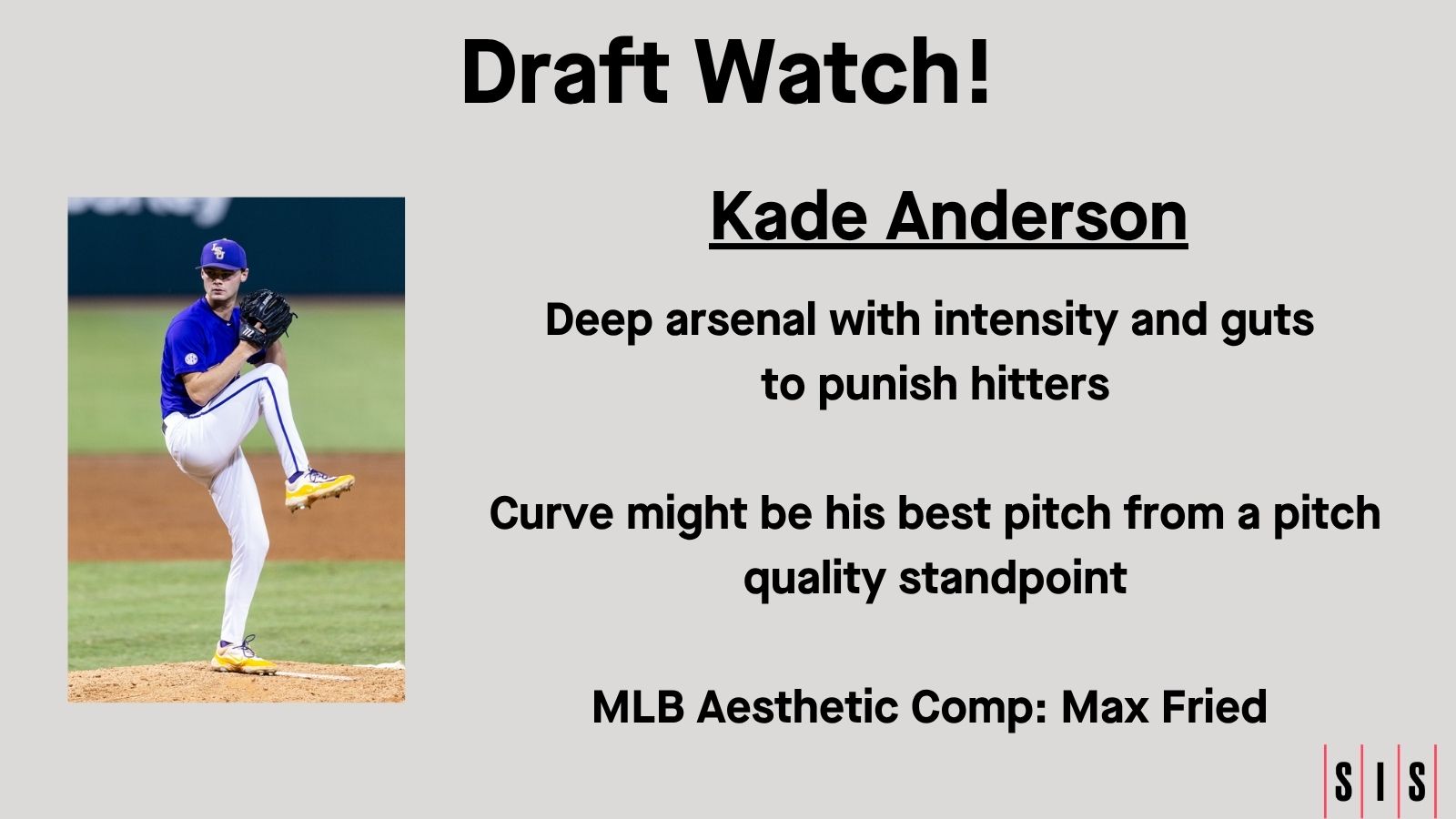
    Anderson’s curve might be his best pitch from a pitch quality standpoint. It’s a big breaker that has a nice shape. He can add and subtract velocity on it, whether he wants to throw a get-me-over strike or bury the pitch in the dirt.

    He would go to the pitch in count advantages when he was ahead by a strike or in some two-strike counts. If Anderson had a good feel for the release of his curve in a given start, he would mix it in the second and third times through the order. He even threw back-to-back curves at times, straying away from his aggressive fastball usage to certain hitters.

    Whatever team drafts Anderson will likely push his curveball velocity towards the higher end of his velocity band. However, there’s a real affinity for Anderson’s shape on the pitch, and he can zone it as a strike stealer early in counts. Additionally, his ability to get the pitch down under the zone for a swing and miss should also help it play with his fastball out of a good tunnel. 

    Ultimately, Anderson’s curve should be able to stay in his arsenal as a nice offering to add a change-of-pace during at-bats and some swing-and-miss as well.

    Projection:

    Anderson has the results to back up a deep arsenal, and he’s a safe bet to be some version of an MLB starter. There are likely some tweaks to be made to help Anderson reach a higher ceiling, and teams will appreciate the deep pitch mix and ability to throw strikes.

    With a real chance to add other pitches in some form of a glove-side pitch, whether a sweeper or even a cutter, teams will like the different avenues they can approach Anderson’s player development in pro ball. This isn’t even to mention a sinker, which adds a nice wrinkle to protect the four-seam.

    Whether the fastball and slider will eat up professional hitters the way they did college hitters might be a sticking point, as will keeping the ball in the park early in his pro ball career, if he’s still very aggressive in the zone. There’s enough command to push Anderson more away from the middle of the plate, though, where he allowed some of his most damage in college.

    Still, with Anderson, you’re getting a bulldog competitor who wants to see outings through to the end. Couple that with the clay to mold in terms of pitch mix, and there’s a solid floor, but if you can tap into more potential, Anderson could be a great return in value.

    Aesthetics Comp: Max Fried (Delivery and Similar Arsenal)

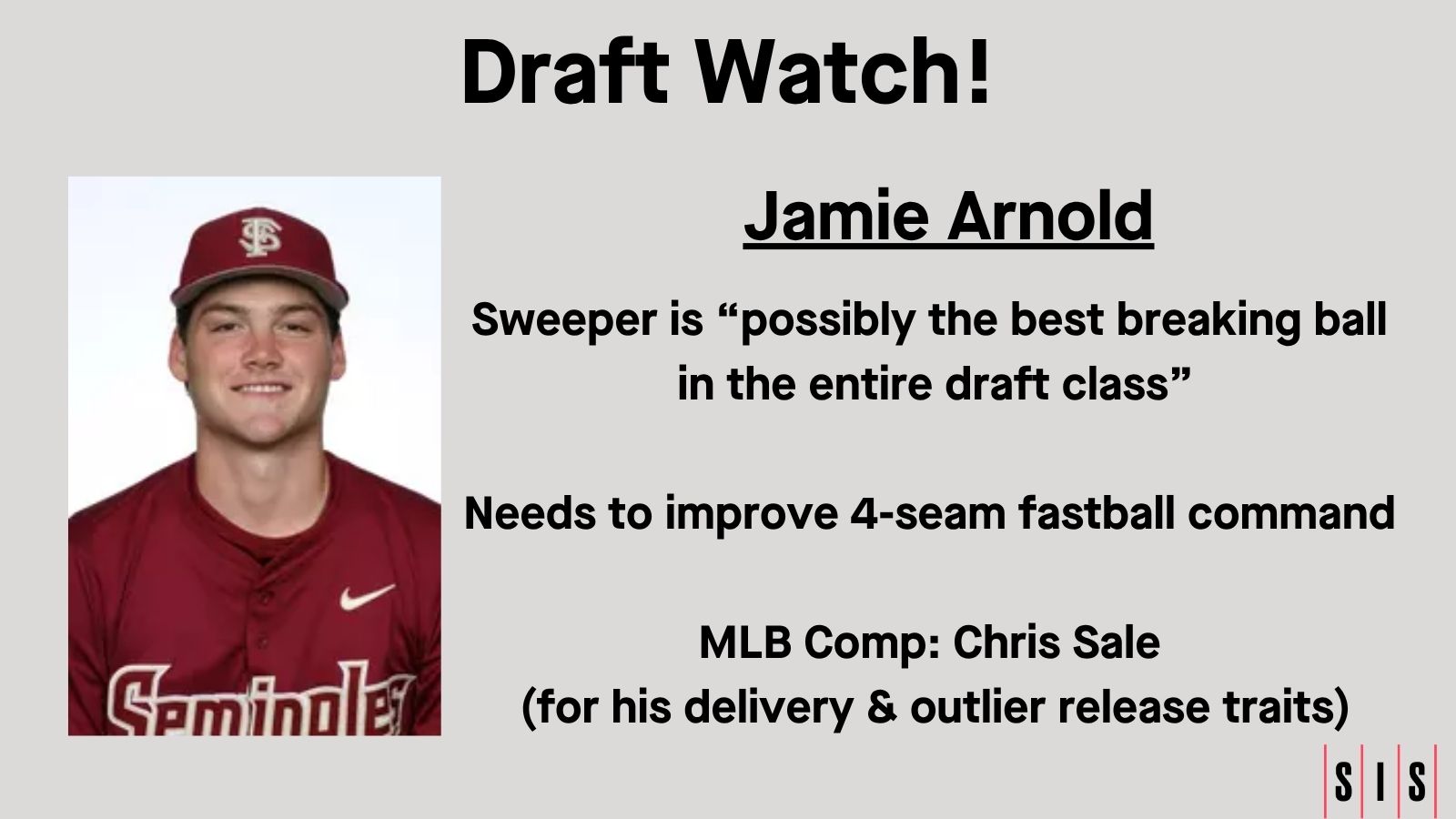
  • 2025 MLB Draft Scouting Report: Jamie Arnold

    2025 MLB Draft Scouting Report: Jamie Arnold

    Skill Grade
    Throws LHP
    Fastball 60
    Sweeper 60
    Cutter 50
    Changeup 55
    Control/Command 55/50
    Future Value 55+

    Name: Jamie Arnold

    College: Florida State University

    Bio: L/L 6-1, 192 lbs.

    DOB: 03/21/2004

    Written by Brandon Tew

    Analysis:

    Jamie Arnold combines a funky cross-body delivery with unique release traits to create both horizontal and vertical approach angles that accentuate his shapes. Arnold possesses a plus sweeper, which he ends up zoning more than his fastballs, making him heavily dependent on the sweepy breaker in high-leverage situations. 

    A team will work on helping Arnold develop better fastball control and command to pair with his outlier release traits, enabling him to effectively pitch to both right-handed and left-handed batters in the zone.

    College Career:

    The Tampa, Florida native pitched at Florida State University for three seasons, posting solid numbers in his freshman year and then achieving excellent results in his last two seasons. 

    As one of the best pitchers in the ACC and also in the nation, Arnold put up high strikeout numbers with decent walk rates. He headlined the front of the Seminoles’ rotation on a title-contending team in 2024 and 2025.

    Year ERA IP K% BB%
    2024 2.98 105 2/3 35% 6%
    2025 2.98 84 2/3 34% 8%

    Pitching Mechanics:

    Out of the windup, Arnold starts with his glove just below chest height, around his stomach. He then smoothly moves the glove up to his face as he begins his rock backward.  

    With good tempo and rhythm, Arnold will drop the glove below his belt as he steps to the right and slides from the middle to the end of the third base side of the rubber. Arnold, with this up-down-up movement to his glove, finishes with the glove beside his ear. 

    His arm swing is long and fluid in the back as he brings both his throwing and glove arm down to knee height as he enters the footstrike phase of his delivery. His arm then flips up into a nice position as his foot hits the ground. He gets into extremely deep positions, and you can see the stretch and flexibility throughout his body, especially the scap retraction of his shoulder at foot plant, as his arm naturally floats into this position. 

    This allows Arnold to unwind and uncoil energy throughout his body with a whippy yet low-effort delivery. The deep positions and extension also create outlier release characteristics for his pitches, as he throws from a slingshot sidearm slot with a low release height.

    Arsenal

     4s: 92-96 mph, Specs: 12” IVB, 14” Arm-side | Release: 4.7′

    Arnold’s four-seam fastball is an odd runner shape that Arnold can throw with an almost rise ball perception at times from his low sidearm slot, with one of the flattest Vertical approach (VAA) angles not only in college but in all of baseball. Arnold can get the ball to carry up to the top shelf.

    He targets down more often than not, and he doesn’t zone the pitch particularly well, with his natural miss being up and arm-side. His control and command of the pitch fluctuate at points in a given start due to a lot of moving parts in his delivery. Even if he targets away from a left-handed hitter, he still runs the ball back across the plate with big misses.

    The most damage he gives up is on four-seamers in the middle of the zone and clear misses in locations where the ball doesn’t carry as much. 

    The performance of the four-seam has backed up this season, especially from a whiff standpoint against left-handed hitters.  Still, there are some interesting aspects to not only his flat approach angle but also the runner aspect of this pitch from his slot. He doesn’t need a big vertical four-seam to get good results at the top of the zone. However, pushing locations more up while still keeping them competitive will be a massive key to success.

    Command of the pitch will need to improve for Arnold to effectively attack hitters with a more balanced approach and a more strategic use of his fastball, even if he doesn’t increase its usage. Having better control and command will help the sweeper play even more effectively.

    Sinker: 92-95 mph Specs: 6” IVB, 18” Arm-side

    Arnold also throws a sinker that he trusts even more than the four-seam, and his natural feel for the pitch is higher. He has a greater willingness to throw the sinker to hitters on both sides of the plate, particularly to righties. Against lefties, he’s more glove-side with his catcher locations. 

    He also zones the sinker more than his four-seam fastball and will be aggressive with his locations before using the four-seam fastball upstairs to try and put away batters.

    Both fastballs return good results in terms of ground balls, and the shapes cause hitters to beat the ball into the dirt. Continued ground ball success will be huge, and improved command will help Arnold get to a plus sinker and four-seam in pro ball.


    Sweeper: 83-87 mph Specs: -1” IVB, 12” Sweep

    The sweeper is a dominant plus pitch and is possibly the best breaking ball in the entire draft class. The angles Arnold creates, especially against left-handed hitters, make the pitch a frightening offering for hitters.

    The tunnel he creates with his fastball-slider combo is nasty, and when he can dot glove-side fastballs away from a left-handed hitter, he can just embarrass hitters with the sweeper working out of that same tunnel. He targets down and away from lefties as much as he can.

    There are certain at-bats in games where you can just get out the broom because Arnold’s sweeper is about to make the hitter walk back to the dugout. His feel for the pitch is also impressive, as he zones the big shape at a very good rate. He will lean on the pitch in high-leverage situations. With the bases loaded and a full count; he will bend in a sweeper.

    Arnold also threw the pitch a lot versus opposite-handed hitters, and he can still bury the pitch backfoot against right-handed hitters and create swing-and-miss as well as ground balls. He can manipulate the tilt of the pitch depending on if he wants to zone the pitch or throw it for more chase to either handedness.


    Changeup: 84-87 mph  Specs: -5” IVB 7” Arm-side

    Arnold throws a kick change now with wacky movement as he creates significant drops and decent arm-side movement. With the use of a middle finger spike, Arnold “kicks” the axis of the pitch down while killing the spin of the pitch, having it dive like a pseudo-splitter toward the dirt. 

    He threw a straight changeup in 2024, which was firmer at 88-89 mph. The pitch looked like a change of pace pitch rather than having a good movement profile to create a swing and miss.

    The real crux of the new kick change is whether he can zone it enough to be competitive with the pitch in pro ball or at least have the pitch start more in the zone and fall out of the zone, rather than spiking the pitch in front of the plate or having it spin high and arm side.

    The kick change is an odd shape, so it could work if he’s able to enhance his feel of the pitch, and it’s good to note he still hasn’t thrown it that much yet. His sweeper is so good that if he can find an above-average offspeed in the kick change, it should help him against opposite-handed batters. He won’t have to rely on his sweeper against opposite-handed batters as much.

    Cutter: 86-88 mph  Specs: 5” IVB 0” Horizontal

    Arnold threw an occasional cutter or short slider in 2025, something he was trying to add to his arsenal to play off the big sweeper shape and protect his four-seam, acting as a bridge pitch in the diagonal line on a pitch plot. 

    He uses the pitch to get more vert and throw it up and in on the hands of right-handed batters to keep them from diving over the plate on his fastball and changeup. 

    Arnold probably reworks this short slider and his kick change into more usable offerings, but if he can ultimately command the inner part of the plate against right-handed hitters with his fastball, he might not need as much of a retooling. But to expect that massive leap in command of the four-seam is hard to rely on.

    Hiroya Miyagi, one of the best pitchers in Japan, has similar characteristics and a cross-fire delivery with less loud stuff. He has mastered the glove-side fastball by understanding the differences in direction toward the plate when throwing both arm-side and glove-side fastballs. This is something that probably requires patience in pro ball, to truly start dialing in glove-side fastballs and cutters to opposite-handed hitters.

    Projection:

    Arnold has a solid foundation as a rotation piece if he can zone his fastballs more effectively and play off his dirty sweeper. He has a floor as a nasty reliever but teams will dream on his funky release traits and shapes to try to mold a higher-upside mid-rotation starter. 

    Or they’ll explore the possibility of pushing more towards a high No. 2 in a rotation if the command is dialed in and he can attack hitters in the zone with his fastball and sweeper while getting chases out of those same tunnels created.

    Aesthetics Comp: Chris Sale (Delivery & Outlier release traits)

  • May’s MLB Defensive Players of the Month

    May’s MLB Defensive Players of the Month

    Sports Info Solutions went three deep in our Defensive Player of the Month selections for May and there was no shortage of credible candidates to choose from.

    In the end, we picked a catcher who helped his team to a 19-8 record in May, a right fielder whose numbers look a lot different from last season, and a shortstop who took advantage of the abundance of ground balls to come his way.

    These are our three selections:

    Pedro Pagés, Cardinals C

    Pedro Pagés led all catchers with 8 Defensive Runs Saved in May. He entered the month with -2 Runs Saved for the season and finished it with 6 Runs Saved. Only Patrick Bailey (8) and Alejandro Kirk (7) have more for the season.

    For the season, Pagés has added value in Stolen Base Runs Saved as well as our stats for pitch blocking and pitch. framing

    He’s thrown out 8 of 32 baserunners attempting to steal (25%) and picked off two others. The average caught stealing rate for a catcher is 18%.

    He’s successfully blocked 94% of potential wild pitches. The average block rate is typically around 91% or 92%.

    Staff ace Sonny Gray seems to enjoy pitching to Pagés. Gray had six starts in May. His three scoreless ones featured 28 strikeouts and 3 walks. Pagés caught all three. For the season, Gray has a 2.32 ERA in 9 starts with Pagés catching. He’s allowed 14 runs in 14 2/3 innings with others catching.

    Adolis García, Rangers RF

    Adolis García led all right fielders with 7 Defensive Runs Saved in May. His 8 this season are tied for the MLB lead at the position with 2023 Fielding Bible Award winner, Fernando Tatis Jr.

    Garcia has engineered a major turnaround when it comes to his Range stats. Last season he had a career-worst -8 Range Runs Saved. This season, he already has 7 Range Runs Saved. He’s never finished a season with more than 6.

    Our Data Scouts award Good Fielding Plays based on their observation of specific defensive moments in games. García has 10 and has already exceeded his 2024 total of 9.

    Those include two terrific plays going to the right field line and diving to make a catch (see them here and here).

    Additionally, García has racked up most of his Runs Saved on shallow fly balls. The Rangers have played Garcia at an average depth of 294 feet in Globe Life Field this season, compared to 299 feet last season.

    He’s also improved considerably in MLB’s jump stats from last year to this year, going from ranking 70th among outfielders to placing in the Top 10 in terms of how much ground he covers above an average right fielder.

    Taylor Walls, Rays SS

    Taylor Walls has been a dominant defensive shortstop by Runs Saved since he first came up in 2021. He actually leads shortstops in Runs Saved in that time despite ranking 29th in innings played.

    Shorter term, he had the most Runs Saved of any shortstop in May with 7. He’s been very good this season both fielding balls hit to his left and to his right.

    Walls has also been given more of an opportunity to stand out. Rays pitchers have yielded many more ground balls, ranking 8th in ground ball percentage compared to 29th last season. He’s handling an average of 5 chances per 9 innings played compared to last year’s rate of 3.7.

    Sports Info Solutions has been naming Defensive Players of the Month since 2012 (with ESPN from 2012 to 2017 and then on its own since then), using a combination of statistical analysis and the eye test. Defensive Runs Saved has tracked MLB player defensive value since the 2003 season and is considered one of the industry-leading defensive stats.

  • Stat of the Week: 1st In Their Division, 29th in Defensive Runs Saved

    Stat of the Week: 1st In Their Division, 29th in Defensive Runs Saved

    Photo: Kyle Ross/Icon Sportswire

    Here are the current MLB division leaders and how they rank in Defensive Runs Saved.

    Division Leader DRS Rank Runs Saved
    Dodgers 5th 24
    Tigers 7th 19
    Cubs 8th 17
    Yankees 9th 16
    Mariners 24th -6
    Phillies 29th -34

    You’ll notice that one is far removed from the others here.

    The Phillies, who just jumped ahead of the Mets for the NL East lead this week, rank 29th among teams in Runs Saved.

    It looked like the Phillies had made considerable strides defensively last season. The primary starters on the right side of the infield—Bryce Harper at first base and Bryson Stott at second—were Gold Glove finalists and the numbers backed up their legitimacy, as well as that of another finalist, left fielder Brandon Marsh.

    The Phillies have gotten negative Defensive Runs Saved from every position other than left field (which is at 0). That includes first base and second base where Harper and Stott are slightly below average (-2 Runs Saved apiece). They are the worst team in terms of effectiveness turning double plays. Only one team rates worse in Outfield Arm Runs Saved. Only one rates worse in our pitch-framing stat, Strike Zone Runs Saved. Only one team has done worse in value from defensive positioning.

    The Phillies are not bereft of good defenders. Max Kepler has a good history in left field and has 3 Runs Saved there this season. Pitchers Taijuan Walker and Zack Wheeler have 3 and 2 Runs Saved, respectively. But there are 17 players with negative Runs Saved.

    So how are the Phillies managing to be so good without having a good defense?

    It’s simple. They don’t let opponents hit the ball. They lead the majors in strikeout percentage.

    They also outhit their mistakes. They rank 7th in the majors in runs per game. And they’ve won the close games. They’re 9-3 in one-run games.

  • Harrison Bader, Pete Crow-Armstrong Named Defensive Players of the Month

    Harrison Bader, Pete Crow-Armstrong Named Defensive Players of the Month

    Twins outfielder Harrison Bader and Cubs center fielder Pete Crow-Armstrong are the SIS Defensive Players of the Month for March/April.

    In his first month-plus with the Twins, Bader led all players with 7 Defensive Runs Saved and led all outfielders with 9 Good Fielding Plays.

    The Twins signed Bader this past offseason knowing that they could use him in a couple of ways. They could play him in left field, giving themselves a pair of highly-skilled outfielders if Byron Buxton stayed healthy in center field. And they knew that they could slide Bader over to center if Buxton had any issues.

    Thus far, though the team is struggling, Bader’s defense has given it a boost. He has 4 Runs Saved in 22 games in left field and 3 in six games in center field. His specialty has been coming in to make a diving catch, as he earned a Good Fielding Play for doing that 6 times (like this run-saving one).

    He has 5 Runs Saved for his range and 2 Outfield Arm Runs Saved, for plays like this one against the Mets.

    Crow-Armstrong finished April with 6 Runs Saved, the most by any center fielder. He’s tied with Red Sox center fielder Ceddanne Rafaela with 17 Runs Saved for the most by anyone at the position since the start of last season.

    Crow-Armstrong has made a couple of nifty grabs on deep fly balls (like this one).

    He has 5 Runs Saved from his range and 1 Run Saved via a couple of assists (here’s one that wowed the announcers and was overturned to an out on replay review).


    Crow-Armstrong’s strong start on defense has helped the Cubs rank second in Runs Saved, trailing only the Rays. His strong start at the plate, with an OPS 170 points higher than his 2024, has buoyed the team as well.

    Other strong contenders for Defensive Player of the Month were Red Sox catcher Carlos Narváez, who leads the position with 6 Runs Saved, shortstop leaders Anthony VolpeCorey Seager, and Taylor Walls, left field leader Tommy Pham, and Padres right fielder Fernando Tatis Jr.

    Sports Info Solutions has been naming Defensive Players of the Month since 2012 (with ESPN from 2012 to 2017 and then on its own since then), using a combination of statistical analysis and the eye test. Defensive Runs Saved has tracked MLB player defensive value since the 2003 season and is considered one of the industry-leading defensive stats.

  • Stat of the Week: 10 Seasons Of Strike Zone Runs Saved Part II

    Stat of the Week: 10 Seasons Of Strike Zone Runs Saved Part II

    Last week we looked back at 10 seasons of data for our pitch-framing stat, Strike Zone Runs Saved, which puts a run value on the result of taken pitches, and we looked at which catchers have fared best and worst in those measurements.

    One of the neat things about Strike Zone Runs Saved (SZRS) is its flexibility. It can also be used to evaluate hitters, pitchers, and umpires. We can see which batters and pitchers are getting more or fewer called strikes than expected. We can also see which umpires are calling more or fewer strikes than expected. 

    Batters

    Batters With Most Extra Called Strikes, 2015-2024 (minimum 5 seasons)

    SZRS per season
    Xander Bogaerts 1.0
    Curtis Granderson 0.9
    Wilmer Flores 0.9
    Alcides Escobar 0.9
    Luis Garcia Jr. 0.8

    Batters With Most Extra Called Balls 2015-2024 (minimum 5 Seasons)

    SZRS per season
    Rhys Hoskins -1.5
    Bryce Harper -1.4
    Charlie Blackmon -1.4
    Ryan McMahon -1.3
    Carlos Santana -1.3

    What these tables are showing is that Xander Bogaerts is getting more called strikes against him than he should be (and the most above what he should be of any hitter in the majors in the last 10 seasons). Rhys Hoskins and Bryce Harper are at the other end of the spectrum. They get a more favorably called strike zone than other hitters.

    The scale for batters isn’t mind-blowing, just a run per season at the extremes. And that’s not shocking, considering there isn’t some obvious direct mechanism by which the batter might influence a strike call, other than maybe how close he stands to the plate. 

    However, there does seem to be some kind of a reputation effect at play. You don’t see it as clearly in the top five, but here are the top 20 in each group:

    • Extra strikes: Xander Bogaerts, Curtis Granderson, Wilmer Flores, Alcides Escobar, Luis Garcia Jr., Carlos Correa, Nomar Mazara, Thairo Estrada, Ian Kinsler, Yolmer Sanchez, Mark Canha, Joey Wendle, Logan Forsythe, Isaac Paredes, Brock Holt, Jorge Polanco, Eloy Jimenez, Donovan Solano, Hunter Pence, Domingo Santana
    • Extra balls: Rhys Hoskins, Bryce Harper, Charlie Blackmon, Ryan McMahon, Carlos Santana, Russell Martin, J.P. Crawford, Jed Lowrie, Dustin Pedroia, Cody Bellinger, Freddie Freeman, Yasmani Grandal, Yadier Molina, Nathaniel Lowe, Buster Posey, Carlos Gonzalez, Corey Seager, Shohei Ohtani, Joey Votto, Yonder Alonso

    There are several MVPs and a few near-misses in the hitter-friendly group, and none in the pitcher-friendly group. That seems unlikely to be a coincidence. 

    It’s also notable that there are four catchers in the hitter-friendly group and none in the pitcher-friendly group. At a more macro level, only one player who had at least five years at catcher in the last 10 had more than a quarter of a run per season go against him (Ryan Jeffers). There were 19 catchers on the positive side of that.  

    You often hear about catchers not wanting to get into a tiff with an umpire when they’re batting because they want to get good calls as a catcher, but they seem to get a little bit of favoritism regardless.

    Pitchers

    Pitchers With Extra Called Strikes, 2015-24 (minimum 5 seasons)

    SZRS per season
    Jon Lester 1.6
    Gio Gonzalez 1.2
    Masahiro Tanaka 1.1
    Clayton Kershaw 1.1
    Steven Wright 1.0

    Pitchers With Fewer Called Strikes, 2015-2024 (minimum 5 seasons)

    SZRS per season
    Framber Valdez -1.4
    Zack Wheeler -1.2
    Yusei Kikuchi -0.9
    Eric Lauer -0.7
    Jake Arrieta -0.7

    For those who have believed that Clayton Kershaw gets strike calls because he’s Clayton Kershaw, perhaps his inclusion on the list adds a little something to that belief. He’s among the pitchers who have gotten more calls than expected. That Framber Valdez and Zack Wheeler are still succeeding in spite of having arguably the least pitcher-friendly strike zone is illustrative of their reliance on ground balls and missed swings, respectively.

    We’re not sure what to otherwise make of these lists other than that the strike zone is tighter for current pitchers. The calculation of Strike Zone Runs Saved uses a rolling two-year window, so slight changes to rules are accounted for, but it isn’t going to move immediately when guidelines change.

    Umpires

    More Called Strikes Than Expected (2015-2024, Minimum 5 Seasons)

    SZRS per season
    Doug Eddings 11.7
    Bill Miller 9.5
    Lance Barrett 6.2
    Phil Cuzzi 6.0
    Mike Estabrook 5.3

    Fewer Called Strikes Than Expected (2015-2024, Minimum 5 Seasons)

    SZRS per season
    Alfonso Márquez -6.7
    Edwin Moscoso -6.2
    Mark Wegner -5.3
    Carlos Torres -5.2
    Tom Woodring -4.6

    As we’ve previously noted in Stat of the Week, Doug Eddings and Bill Miller have and have had the most pitcher-friendly strike zones in baseball. They’ve largely gone unchanged over the years. Lance Barrett, Phil Cuzzi, and Mike Estabrook are all big strike zone umpires, though they don’t occupy the same ballpark as Eddings and Miller.

    At the opposite end of things are the umpires with the most hitter-friendly strike zones in baseball. Alfonso Márquez has been known to have a smaller strike zone than most of his peers for years. The spread among the five umpires listed above with the most hitter-friendly zones isn’t as vast as the gap between Eddings, Miller, and their fellow umpires.

    One other note about Eddings, Miller, and Márquez is that though these numbers indicate they favor either the pitcher or hitter more than any other umpires, this does not seem to have impacted how they are viewed by the MLB office. They each been given prominent postseason assignments the last few years. Miller and Márquez worked the 2023 World Series. Eddings was on the World Series crew in 2024.