Category: Baseball

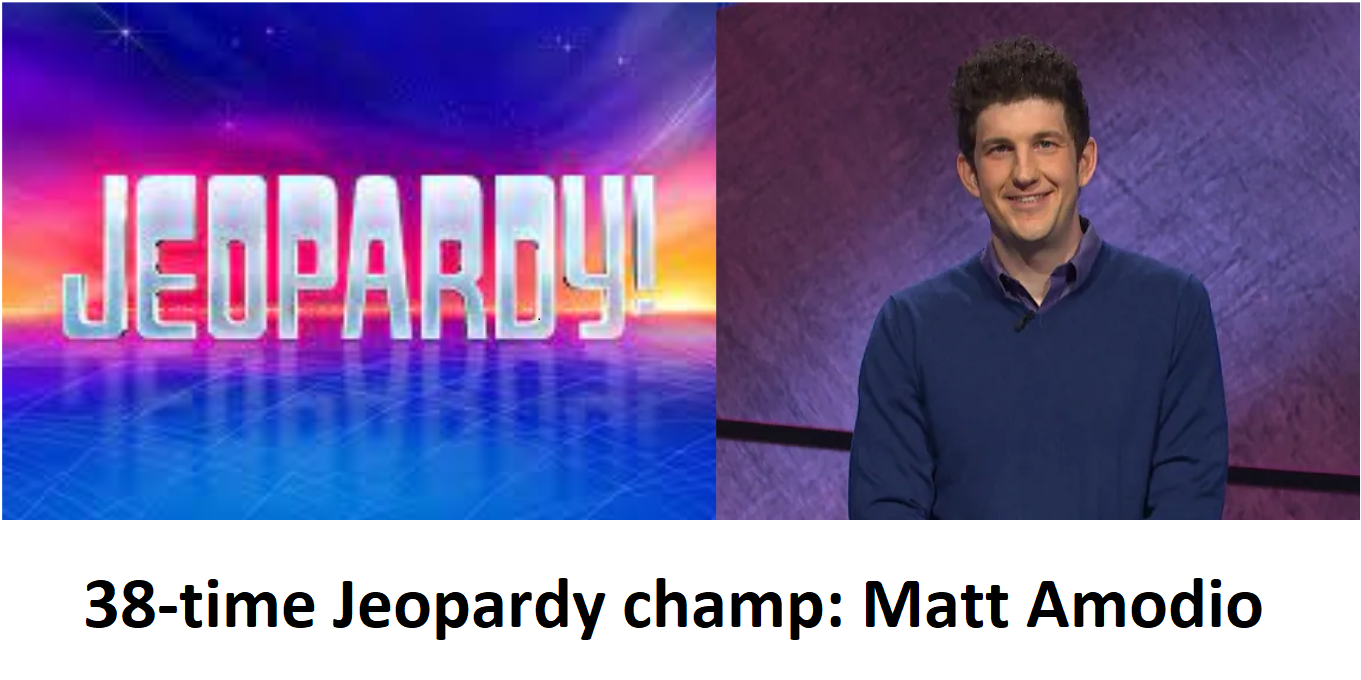
  • New baseball podcast episode: Jeopardy champion Matt Amodio!

    New baseball podcast episode: Jeopardy champion Matt Amodio!

    On this episode, Mark Simon (@markasimonsays) is joined by 38-time Jeopardy champion and baseball aficionado Matt Amodio (@AmodioMatt) for a lengthy, fun conversation about Jeopardy strategy and analysis, Matt’s favorite players, stats, and baseball interests, and the work he’s currently doing in data science.

    A transcript, lightly edited to shorten some of the questions, is below.


    Mark Simon: On today’s show we’re joined by Matt Amodio, who just recently concluded a 38 day run as Jeopardy champion, where he won $1.5 million. He’s currently a doctoral candidate in artificial intelligence at Yale university. And what makes him particularly pertinent for us? His hobby is studying baseball stats!


    Hey Matt, how you doing?


    Matt Amodio: Fantastic. How about you?


    Baseball Talk

    Mark Simon: We’re great here. So today, we talk the ins and outs of Jeopardy, Matt’s work in the field of big data and we talk about baseball.

    And we start there, let’s establish some of your baseball credentials. People who listen to this podcast regularly know that when we have players on, we always ask the same first question.

    Can you tell us the story of a great defensive play you made as a kid?

    Now, I saw a picture of you at an Akron River Ducks game with a very nice baseball glove. So I’m going to guess that there’s a play in your past that you made, that you can tell us about.

    Matt Amodio: Absolutely. Yeah, so I was primarily a pitcher, but I played some third base too.

    I was never good at hitting. And so anytime I was in the lineup and playing third, I felt very nervous. And I had to make my value with my glove. And I remember one of those pop-ups in short left field, down the line, you have to run backwards and Omar Vizquel made them look so easy, but they’re actually really hard because you’re worried and holding your head back to see the ball behind you. And I made an over the shoulder basket catch. I think I’ve missed about five or six of them  exactly like it, but there was one I made and that one I’ll always remember.

    Mark Simon: Very nice. So give us your baseball origin story.

    Matt Amodio: I have been watching baseball since before I can remember, an Indians fan who grew up around Cleveland. Growing up in the nineties was a very fun time to be an Indians fan. I didn’t know what it was like to go to a stadium that wasn’t sold out until I was like 14. And so it was just the right time and the right place and I watched winning teams over and over again.

    Mark Simon: So nineties, there are a number of different ways that you could’ve gone for a favorite player. Who was yours?

    Matt Amodio: Kenny Lofton.

    I didn’t properly appreciate him at the time. So I love that he was always good with the glove, but he also carried himself with a flair that appealed to me as a kid.

    So anytime he would see Ball 4, a fastball just off the plate outside, he would flip the bat enthusiastically and then take his gloves off right in front of the umpire. And he got called on strike three looking a couple of those times. But when he just predicted the call ahead of time, it was so fun.

    Mark Simon: People who studied the numbers will tell you that Kenny Lofton actually has a pretty good Hall of Fame case, particularly when you compare it to Tim Raines. Make the case for Kenny for the Hall of Fame.

    Matt Amodio: Yeah. So I, this is where I was saying I could not appreciate him properly at the time because I loved those singles that he would leg out with his amazing speed.

    What I did not know is how valuable his walks were. And when you have somebody who is walking close to a hundred times in a season who also has the speed to leg those into stolen bases. He has more value when you look at the on-base percentage than I ever thought before. So he’s putting up the OPS+ that put him as a well above average hitter, and then also playing a great defensive center field.

    At the same time, the WAR numbers don’t lie. He belongs in the Hall.

    Mark Simon: Who’s your favorite obscure Indian/Guardians player?

    Matt Amodio: Yeah. So I really can’t explain it, but I always loved watching Einar Díaz. So he didn’t do particularly well, but he always looked in control of the bat and he’s got a big body type. And so it just looked like the ball would carry off of his bat. It was always fun to watch.

    Mark Simon: Were you at Game 7 of the 2016 World Series?

    Matt Amodio: I was not, I was at Games 1 and 2, which were the right ones to be at there if you’re an Indian fan.

    Mark Simon: You also said that your favorite ballpark was Progressive field. The I’m curious why you would say that.

    Matt Amodio: You should have heard the screaming that was going on inside my head as soon as I said Progressive Field, I was like, no, can we take that back and retape?

    I should’ve said Jacobs Field, I never call it progressive field to my friends or family, but just, I felt like being PC in the moments that those traditional names never die.

    Mark Simon: Have you ever sat in left field with the drummer, John Adams?

    Matt Amodio: Yeah. So the bleachers are a great seat, but then also John Adams is so welcoming to the random strangers who just want to shake his hand and get to meet him. And so it’s a cross off the bucket list type item.

    Mark Simon: You also mentioned that you’re a ballpark traveler.

    What’s your favorite ballpark?

    Matt Amodio: Yeah, I think the Giants park is my favorite non hometown one to see because there are so many great views. They have a lot of aisleways where you can watch. When I go, I like getting a cheap seat up in the upper deck and then not spending a single second at it and walk around.

    I love the ones where you can get a great view from the aisle somewhere. I watched several lenings from from the right field porch there and it’s fantastic.

    Mark Simon: You list baseball data as a hobby. So just give us the brief overview. We’ll come back to it, but I want to just get a brief overview.

    Matt Amodio: Yeah. So this has been like a long-term thing in my life, and you can trace my growth through the baseball stats as well. I remember when I was in high school, all I would do is look at Baseball-Reference and look for black ink and sort by leaders and the main stats.

    And I thought that I was doing baseball stats when I did that. And then gradually I got a little more comfortable on a computer. And so I would get some Pitch FX data and look at a sequencing. And I was also studying probability at the time. So I liked saying, okay how do probabilities of this pitch change with nobody on versus with runners on and that kind of thing.

    And now I read stuff that’s more advanced than I could do. That’s for sure. Super interesting. And I’ve always been most interested in pitching aspects as a pitcher myself.


    Jeopardy

    Mark Simon: Let’s segue to Jeopardy.

    On your first show, they go to the first commercial break come out of the break and you get interviewed.

    And your fun fact was that you self-identified as a coward because you were afraid to take the escalators in Washington, DC, where they’re very steep. But your game, for the most part, is anything but cowardly.

    And I’m gonna read you a scouting report that I’ve compiled, that I think describes it pretty well.

    As a pitcher,  you’re Cliff Lee. You worked down in the zone, you finish up top, you take your time and think things out, but you can change the tempo of the game quickly. Like changing categories. There’s not much muss or fuss to his game (thanks Alex Vigderman for helping on that one).

    As a hitter, you’re José Ramírez and Jim Thome. José Ramírez, because of the high batting average. You hit on something like 90% of the clues that you buzzed in on. If you buzz in, you get it right.

    Thome, because you like to take big swings. That’s intimidating. You’ll live with the strikeouts. You don’t get a lot wrong. The home runs will be more valuable over time. And you hit a lot of home runs.

    Defensively, you’re Franklin Gutierrez with great range. You’ve covered the whole field of questions from baseball to the Bible, geography to music.

    And as a game manager, you’re Terry Francona or, as we wrote, Gabe Kapler.

    When the situation calls for it, you manage smartly. You know the rule book inside and out. You’re well-prepared thanks to Wikipedia. Fair?

    Matt Amodio: That’s better than fair. That is the highest praise I’ve heard in a long time. And I especially loved the Franklin Gutierrez pull. That’s a little deep. I approve.

    Mark Simon: Explain how you played and manage the game for us.

    Matt Amodio: Yeah. So I think you put it well in a lot of those cases.

    So I think that you really have to view the wagering chances in the game as your opportunities, and either you can use the opportunities to put the game out of reach and that might seem risky, but actually just as risky to see an opportunity and in the face and pass it up.

    So a lot of people come on and take a Daily Double that they land on a, in a late game situation and say ‘What if I don’t know?’ And they sit on it. They bet a couple thousand and they get it right. And later on in the game, they lose control a little bit. Maybe they get Final Jeopardy wrong and they end up losing the game.

    All of it hinged on getting a Daily Double and betting too low. So I went in saying, I’m not going to let that happen. I am going to take an opportunity and take a swing. I might go down, that might happen, but I’m not going to look at a fastball down the plate and go down that way.

    And so I think that’s just the right way to do it. And it seemed to work.

    Mark Simon: And I’ll run down, just list the different approaches that all relate to that one. You started from the bottom row and you worked across, and then occasionally I noticed you would skip one, but I noticed that you always worked across. What was the value in that?

    Matt Amodio: So a couple of things. One thing I think when you go in there, you’re going to be a little intimidated and you might be a little off your game and then gradually get more comfortable.

    I wanted the most expensive clues, the highest leverage stuff to go when my opponents are uncomfortable. Let’s make most of the money when they’re rough and then make the cheap clues when they’re in the groove. So that was a big thing.

    And then also going across the board, I found from practice, I can bounce from Bible to geography, to sports, to movies pretty quickly. And other people, I think that’s something other people struggle on.

    And so I view it as if I’m a .350 hitter and somebody else is a .300 hitter, I’m okay taking this down to being a .330 hitter, if their drop is even worse. So, if I can make the terrain rough for everybody, but I acclimate a little bit better, even if it’s hard on me, I’m still going to be better off for having done it.

    Mark Simon: With Daily Doubles, if you got them in the opening round, you went all-in automatically. Even if the category was – cringe – motorcycles. In Double Jeopardy you basically took the approach that if you could end the game right there, you go big. If you had a very comfortable lead, you went relatively small.

    I want to get to one other thing. You buzzed in sometimes not knowing the answer. What was that about?

    Matt Amodio: I buzzed in a lot of times not knowing the answer. So I would always read the clue in my head and then just say ‘Do I recognize it? Are there clues I recognize?’

    I’m a really visual thinker. So if I could picture the answer, then I would say ok, time to buzz in. And sometimes I would picture the answer and immediately the word would come to me. And then that’s 10 seconds before I have to buzz in, no problem. But other times I’ve pictured it and said, ah, the word isn’t coming to me, but it will, so I press the buzzer.

    And then I have five seconds. Hopefully the word will come to me. A lot of times it did. Sometimes it didn’t. Including in my last game, several of those where I know that wasn’t spawn, but venom just wasn’t popping into my head.

    Mark Simon: We’re going to talk some Jeopardy situational stuff, just cause I think it’s pretty cool.

    In Game 10, you’re playing and it’s a tough game. You have $13,000. Your opponent has a little more than $10,000. You hit a daily double on Australian History and you said, ‘Oh my goodness.’

    And you bet everything. That’s living on the edge. What were you trying to do?

    Matt Amodio: Yeah. So I think if I remember correctly, this is the first time that I had to actually put my money where my mouth was on this.

    So I played this situation out in my head prior to going on the show and said, ‘If you have the chance to do this, you’re not going to lay down and I hope that the rest of the game goes your way. You’re going to try to put the nail in the coffin here. But this is not just a strategy. Now, this is actually doing it.

    And so I thought the situation was pretty good for me because it’s a geography question or a history question and then it’s also somewhere in the middle of the board. So it isn’t even at the bottom level of difficulty. And then also one of my brothers lives in Australia now.

    And I said, okay if I underbet on this, and then I lose because I didn’t bet enough, I’m not going to be able to visit him ever again. And so I just gotta go for it.

    Mark Simon: That’s awesome. And you got it right.

    You could feel the air was let out of the balloon right there. And you won handily. There was no catch-up.

    Another game: This was much later in the run. You had a game where you were negative going into Double Jeopardy. Thanks to, I think it was motorcycles and a little bit of a rough go on Muhammad Ali.

    You go into Double Jeopardy and in three clues, you undid all of the damage that had previously been done. The people that played you, one of them commented on Reddit about the intimidation factor of playing you and the stress of playing you. And all of a sudden you had this momentum and it was boom, up the mountain and you were gone.

    Is there a momentum component to Jeopardy?

    Matt Amodio: I think there’s gotta be a momentum component, especially with the buzzer. So that’s one big aspect of the game that often goes untalked about. There’s a rhythm to it. And if you get in the right rhythm, you’re going to get in on 1. 2 3, 4 in a row.

    And that builds momentum, builds confidence. It makes other people think they’re doing something wrong. And so they might overcompensate and get themselves out of their own rhythm. And so there’s a lot to that momentum.

    Mark Simon: The buzzer requires the right timing. And in some cases, a timing mechanism, sometimes you can see it You appeared to have the timing mechanism of what I call – the hip pivot – where you twisted as you were buzzing in trying to time it to the last word that the host was saying.

    This seems like coming up with a batting stance. How did you come up with your timing?

    Matt Amodio: Absolutely. It’s like a batting stance because I was imagining myself in the cage as I was doing it.

    I remembered I would always have a couple of touchpoints on when I was swinging. You do a toe tap to start things. You bring the hands up. But my big analogy here is that you have to be ready for a fastball, but also be ready to adapt to a curve ball if you identify it mid-pitch.

    The buzzer is not done by a computer. it’s done by a human who presses a switch and that turns on lights.

    And then you can buzz in. So you can’t be ready for a 95 mile an hour fastball because what if the guy is just a little bit later than usual, that one turn. And so I would anticipate it, but then be ready to adjust. Having a little bit of curl and physical movement really helped me get primed, but also adjust.

    Mark Simon: Do you think that being a baseball player helps? And I asked that because a couple of years ago at the SABR Analytics Conference, they did comparisons of people buzzing in to light as a study and they found that baseball players were considerably better at pressing a buzzer than your average human beings.

    Matt Amodio: I’m not sure it helped. I think they’re at least strongly correlated. So you need to have good vision, fast-twitch muscles and the ability to coordinate the two. And it doesn’t surprise me that baseball players are better at that because it’s necessary.

    Mark Simon: Unquestionably.

    You hit a final jeopardy in mythology because you remembered a school project that I think you said you had done in fifth grade. And I’m curious about the memory retention skills of a Jeopardy player.

    And again, I’m thinking baseball, thinking about pitchers that you faced over time and things of that sort and how your brain compartmentalizes knowledge.

    Matt Amodio: Yeah. So I think that this was a very memorable thing to me. I don’t like to think about all the stuff that I should have remembered.

    So who knows what I read in seventh grade that would have made me $2,000 on Jeopardy if I had just remembered it.

    But it’s always great when you can tie something to a physical memory. So that, often helps with me whenever I try to remember stuff for school, as well as trivia for general purposes – that I wouldn’t just try to remember the fact – that I would try to tie it to something around me.

    I listen to audiobooks. A lot. And I walk around when I do it and it’s amazing to me, five years later, I don’t just remember that scene in the book. I remember the tree and my neighborhood that I was walking past when I listened to that. It’s something that’s always been helpful to me.

    Mark Simon: It’s amazing. How memory like sticks with someone.

    Was there a clue or moment where you were like, wow this thing’s meant to be? Like Tolkien?

    Matt Amodio: So that’s a good one. So I am very conservative in terms of getting things right, where I don’t trust myself actually knowing that until I hear confirmation that is right.

    I can be really confident in something and it still happens. I could have sworn that guy’s name was JD Ballenger, not Salinger. So I’m always worried about something that I’m sure of, being wrong. The one time in Final Jeopardy where I wrote it down and said that I am so sure of this, I’m going to give a smile to the camera as it passes by was the Tolkien question. There are bigger Tolkien nerds than me, but I want to meet them.

    Mark Simon: You’re the ultimate Tolkien fan. One of your fun facts was that you watch all of the Lord of the Rings movies in succession in a given day.

    Matt Amodio: And the hardest thing was keeping it to just one fun fact. I could have done all 38 on Tolkien.

    Mark Simon: I want to review some stats here. You had one game where you swept the bottom row in Double Jeopardy on consecutive clues. That website J-archive.com said that had never been done in their records.

    You had a game where you got 44, right. That was one shy of what is the known record by Ken Jennings. You pitched two perfect games.

    You had a 40-question perfecto, which if I’m not mistaken was your 15th game in three days. Your first 19 wins, you averaged $34,000. Your last 19 wins, you averaged $46,000. You got smarter over the break time in-between seasons.

    There was another where your 10th game in two days was probably your most exciting game, where you had to hit a daily double for everything. And even still, you wound up at the end of Double Jeopardy with exactly twice as much money as your opponent (so it was still a game). Nicolle Neulist.

    At the end of Double Jeopardy,  you looked like you were ready to pass out.

    So explain how Jeopardy is a game of stamina, especially as a pitcher, I think you can appreciate it.

    Matt Amodio: I was ready to pass out. Yeah. One thing that I didn’t even really realize until I went on, is you don’t just tape a show and then 24 hours later that show airs.

    So you’ll do a Monday night show and then on Tuesday night, the next game’s played. But that’s not how they’re taped. They’re taped in rapid succession. So you play a game. Sometimes you have a lunch break or something, but often it’s just 15 minutes later, you’re playing the new game and you might have won by a ton.

    You might’ve just squeaked by, but you start a 0, 0, 0 tie with the other two contestants in the next game. And so I had some embarrassing final Jeopardy’s where I lost more money than I make in a year on a trivia question. And I had to be ready to beat two other smart people. 15 minutes later, I had games where I was close to the record for the highest game. And then 15 minutes later had to be ready to start 0, 0, 0 with two other opponents. And so a big part of the stamina is knowing that you can’t coast on the previous day, or you can’t obsess over your mistakes from the previous day. You always have to focus on the one question at hand and then they just keep coming for 12 hours straight in a day sometimes.

    Mark Simon: Yeah that’s insane. It’s like if a reliever had to pitch in three consecutive doubleheaders.

    Matt Amodio: I think that the inning break is a great analogy because you might get out of a basis loaded situation and just squeak by, you held your one run lead. That’s great.

    Now you have to come back and somebody could take you out of the park if you leave a fast ball right down the middle to start the next inning. So you have these stress situations and then a short break. But then any one pitch could do you in in the next inning. And so you have to, you can’t just give a get-me-over curve ball at any point, or you’re going to be done. You always have to be on your game

    Mark Simon:. And we go back to your very first game in the 38 straight wins. This is super interesting to me and this combines my baseball nerdery and what amounts to my Jeopardy nerdery. Matt trailed his opponent by nearly $11,000 with 17 clues left and no daily doubles left on the board, which is an important fact.

    I don’t know if you realize the score at that point, but it looked bleak. But like it was for the 1986 Mets, the 2004 Red Sox and the 2011 Cardinals. And I guess we could even say the 2016 Indians in the eighth inning of Game 7 in 2016, this one wasn’t over till it was over. And not only did you come back, but it required something unusual to happen at the end.

    And I’m fascinated by little things that happen along the way. There were a couple in this game. If a traffic engineer in Boise, Idaho, who is a very sharp opponent, doesn’t confuse Andrew Lloyd Webber and Stephen Sondheim at the end of the Double Jeopardy, he’s winning at the end and going into Final Jeopardy. And your run never ever happens.

    What do you remember about your first win?

    Matt Amodio: One, one part where the analogy breaks down to baseball though, is that if you’re on a roll and even if it’s the bottom of the ninth, two outs, you get to keep playing until they get that last out. So doubles, homers in a row, keeps everything going.

    There’s a clock in Jeopardy. There are only X number of questions to play, but then there’s also a literal clock that keeps the time going. And we don’t know exactly what that is, but you have a sense of it. And you got a one-minute warning. So you have a sense of when exactly is one minute to play. And so I remember frantically playing to the clock in a way that as a baseball player just felt very foreign to me.

    Mark Simon: So relating this all to baseball, I like a stat called win probability. What are the team’s chances of winning at any point during a game. You can do it for baseball, football, basketball, presidential elections.

    You can do all those things with win probability and with Jeopardy there’s a website, TheJeopardyFan.com run by Andy Saunders. That after each victory, it list, the winners chance of winning the next game, 2, 3, 4, et cetera. But I like to go deeper than that. I like in-game win probability.

    And I would guess Matt, that your in-game win probability was comparable to what the Indians win probability was when Rajai Davis faced Chapman in Game Seven. I’m thinking something like 5%. That led to a conversation I had with a colleague about what factors should go into a Jeopardy in-game win probability.

    And I’m curious if you have a thought on that.

    Matt Amodio: Absolutely. So one factor has gotta be part of the board left. So you have more innings to play. You have more chances to come back. So how many questions are there, but how many Daily Doubles are left to reveal. Now you could get super intricate in this because Daily Doubles are going to be more likely at the bottom of the board.

    And so if you picked off bottom of the board clues and not found them, that means that one $1,200 square is almost certain to be the location. And so you can adjust this win probability matrix or the Daily Double location matrix square by square each time, but then you also have to keep in mind your chance of getting it right. And where in the game you are when you got it.

    So if I’m in a position where I need to bet it all, and then I get it wrong. I might be done for. If I get that same Daily Double late in the game where I only bet a little, because I already have a cushion, I can get it wrong and still win.

    And so there’s so much game dynamics because your actions are going to change based on the game play, which is different from baseball, because you always want to hit grand slams, whether it’s the seventh and you’re up by one, or it’s the second and you’re up 10 already.

    You always want to just score more and give up less.

    Mark Simon: One of the things that we were trying to ascertain was the idea of knowledge base, meaning that if you had gotten three right in a category, let’s say it was Muhammad Ali, and you got the four, the eight and the 12. Does that mean that you have a higher probability of getting the 16 and the 20, because it’s established that you know Muhammad Ali?

    Matt Amodio: Ooh, that’s a good question. I I actually think that it might get a little more complicated because they put some questions in the top that I think are designed for the kiddie pool. So if you’re just dipping your toes into Muhammad Ali, maybe you’ve never seen a boxing match in your life, but they’ll ask you about his famous catchphrase. And so somebody who doesn’t know anything about boxing at least knows the catch phrase. So I think that there might be some component to that, but I wouldn’t be surprised if it’s a smaller relationship than we would expect.

    Mark Simon: also want to give a shout out to the question writers at Jeopardy, who I know you like. I love writing trivia questions as much as I like answering them. So I appreciated that you said that, and I think that they do a fantastic job.

    Matt Amodio: Absolutely.

    And the only sad part is they read them so quickly. And then you move off that a lot of the intricate intricacies of language and everything, you just get flown over again.

    Baseball Stats

    Mark Simon: So segueing to baseball stat topics.

    One that you brought up to me when I asked you what you’d like to talk about is pitch tunneling. And as a former pitcher I’m curious for your appreciation of it. I was reading an article on Pitcher List the other day about Shane Bieber and Jacob deGrom’ usage of it, and the different stats that you can find on it on a place like Baseball Prospectus, or in our Bill James Handbook. We’ve got an essay on Pitch Mix Index, about which pitchers best mix their pitches. I’m curious for a pitcher/statistician take on the subject of tunneling.

    Matt Amodio: I was a pitcher in school and this was something I was obsessed over before I even knew the proper word for it. So I wanted to make my fastball and curveball look exactly the same and then fork into different directions.

    And you not only need the pitches to do that, but you need the location. So like a fastball up and in, and a curve ball in the dirt, aren’t going to tunnel, but a fastball on the outside corner and a curve ball off the outside will tunnel.

    And so coming up with pairs of these and then working them into a whole sequence, it made me feel like I was playing chess except instead of chess, I was successful.

    Sometimes I’m a terrible chess player.

    Mark Simon: Can I ask what your ERA was?

    Matt Amodio: It was good. In the 2s for my career.

    I never threw hard and my other teammates were throwing fastballs like 15 miles an hour faster than me. And so I had to work a lot on deception there. One of my favorite things is seeing somebody like Aaron Civale, who not only has two directions that he can tunnel with a fast ball and a cutter, but what I could never do is make the baseball go in the opposite direction as well.

    So his two seamer/cutter and straight four-seamer just form a three-prong tunnel.

    Mark Simon: And he had a much improved season this year. Another topic that you seem to have an interest in is defensive metrics and the different things that you can tell from them.

    Matt Amodio: Yeah, absolutely. With the shift, it has made this whole problem a lot harder to keep track of, because one thing I think that people would realize quickly is that the defensive shift makes some balls easier to get to than others just in terms of where they’re located on the field.

    But one thing that’s interesting to me is also momentum, which you had talked about before.

    So with the shift you’re also going to be moving a little bit, and on a ball towards the line, f your shading yourself up the middle is going to look only five, six feet away, but be impossible to get to cause your weight’s in the wrong position. And so defensive strategies are getting so much more complicated.

    Mark Simon: That’s something that you’d like to study on the baseball side, but because you’re dissertating and doctoring that you haven’t had the chance to really look at.

    Matt Amodio: A lot of the stuff that is really getting close to physics is really interesting to me, but so far above what I’m capable of, understanding that would just be a deep dive just to get myself set.

    But a lot of the spin rate stuff where you can analyze spin rate as just an arbitrary column and a dataset, and then see what it predicts. But then to have something deeper and understanding like how to get a better spin rate out of your fastball, or whyfastballs up in the zone are more effective than high spin rate fastballs elsewhere in the zone, with everything else held constant. That stuff’s really interesting to me, but I haven’t delved in yet.

    Professional Career

    Mark Simon: After you complete your doctorate, which we’ll get to in a second, I certainly recommend the SABR Analytics Conference, Saberseminar, all these different events at which you can certainly learn more about.

    Let’s get to your professional career and your professional experience. You’ve built predictive models for massive data sets in fields, such as social media, networking, natural language processing, spacial routing, cyber security, and computational advertising. Tell us about that.

    Matt Amodio: So one of the cool things about my type of research is we build the models and they’re largely dataset independent.

    So I know a lot of math and the math is about extracting information and patterns out of the data and really what the data is on doesn’t play that much into the models themselves. And so that allows me to move from one area to one vastly different area quickly, which is helpful.

    Mark Simon: There are some differences between what I just read and what you’re currently working on, which is in the medical field in immunology.

    Matt Amodio: Yeah. And again I don’t know that much about any of the things that you listed that I worked on. I learned a little bit on each, enough to get by, but don’t consider myself an expert in those at all.

    Mark Simon: So how do you approach working on these things.

    Matt Amodio: So I think it requires a lot of just comfort with the unknown.

    So one of the things I go in to any dataset with is the expectation that I don’t understand most of the interesting stuff about it. I start looking at what you can visualize. I use common techniques to embed things in two dimensions, so you can plot them and you just try to understand it from a numbers perspective, as well as you can.

    Mark Simon: What languages do you work in? I know that my colleagues are gonna wanna know that one.

    Matt Amodio: Almost exclusively Python. I did other stuff in research or in my work careers beforehand, but now that I’m on my own, I don’t force myself to work with any nasty languages.

    Mark Simon: Two fun questions for you. As we near the close here, you won in, I think it was April initially. And your first episode aired in July (and you couldn’t talk about it for months), and then you had to keep it from people for a month that you lost.

    You are in the elite class of secret holders.

    What’s the secret to keeping a secret.

    Matt Amodio: Yeah. So there were different secrets there. So for the first season, I had three months knowing that I won a whole bunch of games and my streak wasn’t over yet. So that was great where I could just be ecstatically happy that I won my first game. And the people didn’t know that I’m actually ecstatically happy, because there were 17 more that you don’t know about yet.

    So keeping that secret was pretty easy. The harder one was the loss. Because I am a perfectionist. No matter how many games I won, if the most recent thing I did was lose, I would feel like a loser. And so it took a little bit of skill to cheer on the wins, knowing the inevitable was coming.

    But it’s like a team sport. I actually felt quite a bit like when I was in high school and I wanted my high school team pitchers to do just a little poorly so that I would get to be brought on in relief or that I would get the ball in Game 1 of our playoffs. So I wanted us to win, but there was also some little bit of jealousy. And so I know how to project a happiness that’s different when I feel on the inside.

    Fun Jeopardy Stats

    Mark Simon: I wanted to do something special for your appearance. We wanted to invent a stat and we’re a company that loves details. We chart everything. So with the help of a woman named Lily, who goes by the Twitter handle @OneEclecticMom, I’ve got one for you.

    It’s called WAR-  Wardrobe Above Replacement. The intersection of UniWatch and jeopardy. So about an hour after you said yes to being interviewed, I went to this woman, Lily, she’s basically done in an encyclopedic work of what you’ve worn when you’ve been on Jeopardy. She’s done charts, she’s done images.

    And I asked her if he could look into any connections between clothing worn and money won. I have the information in front of me.

    We start with the idea of sweater jacket tie.

    When you wore a sweater on jeopardy, you averaged $40,000 (11 times). When you wore a jacket on jeopardy, you average $33,900 per win. So sweater is greater than jacket. However, when you wore a tie, you averaged $46,000 per win in the nine episodes in which you wore a tie..

    Matt Amodio: This is actionable information that I need to keep track of. So I have more games to play in my future. I’m going to be wearing those ties.

    Mark Simon: This is silly stuff, but you give the people that they want. And on Twitter, people seem to like this stuff.

    And especially in baseball, like you look at like, when the Mets went to their black jerseys, people went nuts and then they were terrible in them. People are very into apparel and I’m fully embracing of that. And we can even get into this. It’s the sabermetrics of apparel color.

    You wore a pumpkin orange shirt once and won $70,000. You wore a blue plaid shirt with a white color twice and won $57,000. Those are your two highest shirt wins.

    Among things that you were frequently: A maroon shirt, worn eight times, was a little over $40,000, and then a purple shirt, worn nine times was also about $40,000.

    Thank you, Lily, @OneEclecticMom on Twitter.

    Matt Amodio: Thank you, Lily. I love it. And we can even take a little learning lesson out of this because this is the dangers of extrapolation. One might assume that I could then wear a tie with the orange shirt underneath it, and then a sweater on top, and now I’ve got James Holzhauer’s single-day record in hand right now. You can’t necessarily stack these things,

    Mark Simon:. So to wrap up, I do want to note that you won over a million dollars for yourself. You won considerable money for a number of charities

    Be The Match – a national bone marrow donor program

    Reading is Fundamental – literacy

    Kidsmart – a charity for providing school supplies

    The Robin Hood Foundation – poverty.

    Alex Trebek, in his last episode, made comments to the effect of kindness should always win out. You have been first-class with people on social media to an extreme. I am very impressed with how you have handled social media.

    As Andy Warhol once said in the future, everybody will be famous for 15 minutes. I know that you know that, because that quote was in a question you answered during your run.

    How has celebrity been and what has it been like to spread a little kindness?

    Matt Amodio: Yeah. So I’m a shy, introverted person. I didn’t know how the celebrity was going to go with me at all. I was shocked at how mostly nice people were on the internet.

    That just is not at all what I expected and it made it easier to be nice myself. If I was dealing with a hundred percent haters and trolls, it might’ve brought out some negative aspects of me, but other people give support, gave me kindness to feel, and that’s what I’m trying to spread to other people. So maybe you give one little nice comment you give will make that person brighter and then spread it. And so it can easily just pass on.

    Mark Simon: I recommend Matt on Twitter. @AmodioMatt. And also you can find him on Wikipedia. There’s a Wikipedia bio for Matt. Thank you for joining us.

    Matt Amodio: My pleasure.


  • Stat of the Week: Fielding Bible Awards Preview – Part I

    Stat of the Week: Fielding Bible Awards Preview – Part I

    By MARK SIMON

    For the next two weeks, this space will feature a two-part series on the top candidates for The Fielding Bible Awards, which will be announced later this month.

    The Fielding Bible Awards are voted on by a panel of 12 experts who can vote based on whatever criteria they choose, including observation and subjective judgement, as well as statistical analysis. Each position has one overall winner, different from the Gold Gloves, which has one in each league.

    This week, Part I of our preview looks at catchers and infielders.

    (Defensive Runs Saved totals in parentheses)

    Catcher

    Fielding Bible Favorites: Jacob Stallings (21), Austin Hedges (12)

    NL Gold Glove Favorite: Stallings; AL Favorite: Hedges
    Other Top Contenders: (NL) Elias Diaz (9) (AL) Sean Murphy (10), Max Stassi (10)

    Stallings was the runaway leader in Defensive Runs Saved this year and for good reason, given that he rates among the game’s top pitch framers and pitch blockers. The absence of Roberto Pérez left a hole both behind the plate for the Indians and on the Runs Saved leaderboard. Hedges did his best to fill it. In a little more than a half-season, he had the most Runs Saved of any AL catcher, though he’ll be challenged for a Gold Glove by the likes of Murphy and Stassi, the latter of whom led the majors in our pitch-framing stat, Strike Zone Runs Saved.

    First Baseman

    Fielding Bible Favorites: Paul Goldschmidt (9), Max Muncy (6), Matt Olson (6)

    NL Gold Glove Favorite: Goldschmidt; AL Favorite: Olson
    Other Top Contenders: (NL) Pete Alonso (5) (AL) Ty France (5), Yuli Gurriel (5)

    Goldschmidt and the Cardinals picked things up in the latter part of the season on the way to making the playoffs. The 2021 season marked the second time that he’s co-led the position in Runs Saved, the first coming in 2015 when he won his second Fielding Bible Award.

    Goldschmidt’s top challenger for a Fielding Bible Award will probably be Olson, who has won the last three of them. That’s the same number that Goldschmidt has won. Both trail Albert Pujols for the most at first base. Pujols has won five since the award was first handed out in 2006.

    Second Baseman

    Fielding Bible Favorites: Whit Merrifield (14), Marcus Semien (11), David Fletcher (11)

    NL Gold Glove Favorites: Adam Frazier (7), Tommy Edman (6), Kolten Wong (6) AL Favorite: Merrifield
    Other Top Contenders (NL): Jake Cronenworth (5), Jean Segura (5), Jazz Chisholm (5) (AL) Jorge Polanco (3)

    Wong has won the last three years here but there are a few players who could supplant him, led by Merrifield, who was basically a full-time second baseman this season after previously moving to center field. Merrifield’s 14 Runs Saved far exceeded his previous high of 3.

    Semien is another strong contender. He made the move from shortstop and excelled both with the bat and the glove.

    Shortstop

    Fielding Bible Favorites: Carlos Correa (20), Andrelton Simmons (15)

    NL Gold Glove Favorite: Trevor Story (9); AL Favorite: Correa
    Other Top Contenders: (NL) Edmundo Sosa (8), Kevin Newman (7), Brandon Crawford (6), Paul DeJong (6) (AL) Isiah Kiner-Falefa (10), J.P Crawford (8).

    Simmons has won this award six times. Correa never has. But after finishing fourth in the voting last year, this may be Correa’s best shot. He played in 148 games, his most since 2016 (153) and easily led shortstops in Runs Saved.

    The intrigue here may be in the Gold Glove at shortstop in the NL, where there are several formidable contenders. Story had the most Runs Saved among them but Brandon Crawford impressed throughout the year in a season in which he seemed to turn the clock back to past excellence.

    Third Baseman

    Fielding Bible Favorites: Ke’Bryan Hayes (16), Austin Riley (13), Ryan McMahon (13)

    NL Gold Glove Favorite: Hayes; AL Favorites: Matt Chapman (10), José Ramírez (10)
    Other Top Contenders: (NL) Nolan Arenado (6), Manny Machado (6) (AL) Yoan Moncada (3)

    The idea that this award wouldn’t go to Arenado (who has won 4 of the last 6) or Chapman (who took the other 2) will seem ridiculous to some people. But for those who watched baseball this year, Hayes and McMahon in particular were outstanding both statistically and via the eye test. That’s why we labeled them as this year’s favorites along with Riley, who might be one of the most improved defensive players in baseball.

    Next week’s Stat of the Week will preview outfielders, pitchers, and the multi-position award.

  • The World’s Best Batter

    Reprinted from The Bill James Handbook 2022

    1. Who is the best hitter in baseball?
    2. It’s still Mike Trout.

    That was easy.   Are we done here?

    We here at Sports Info Solutions have maintained a “World’s #1 pitcher” list for 10 or 15 years, which is based on Game Scores.  The ranking scores are adjusted every day.  If a pitcher pitches a good game, he moves up; if he has a poor game, he moves down.

    A year ago and some, I developed a system of Game Scores for Batters.  Well then, somebody asked, why don’t we do a World’s Number One Batter system?

    I agreed to try it, and here is the first publication of that effort.  I modified the system as necessary to make it work for hitters, and I will probably need to tweak it some more in the future.  A batter’s score is adjusted more cautiously than a pitcher’s, since batters play every day rather than every fifth day.  A pitcher’s score drops after a few days of inactivity, whereas a batter’s score does not, since batting ability is much more stable than pitching ability.  A batter’s score drops between seasons so that the batter has to re-establish his level of ability every season, but it doesn’t drop by nearly as much as a pitcher’s score drops.  The systems are the same, but different.

    To be honest, 2021 wasn’t a great year to push the Go button on the new system.  Mike Trout started the season with a big lead, followed by Mookie Betts and Freddie Freeman:

    START OF SEASON
    Rank Player Score
    1 Mike Trout 591
    2 Mookie Betts 552
    3 Freddie Freeman 551
    4 George Springer 550
    5 Anthony Rendon 550
    6 Juan Soto 547
    7 Alex Bregman 547
    8 Ronald Acuña Jr. 537
    9 Christian Yelich 536
    10 Corey Seager 535


    Trout came out red hot, even for Mike Trout.  Through May 1 he was hitting .429 with an .805 slugging percentage and a 1.332 OPS.  He had widened his lead to 47 points, while the list behind him had already churned to a significant extent.

    May 1, 2021
    Rank Player Score
    1 Mike Trout 605
    2 Ronald Acuña Jr. 558
    3 George Springer 553
    4 Mookie Betts 553
    5 Anthony Rendon 551
    6 Freddie Freeman 550
    7 Juan Soto 550
    8 Alex Bregman 546
    9 Nelson Cruz 545
    10 Corey Seager 536

    Then, however, Trout went into a 6-for-40 slump.  By May 18 his score had dropped 16 points:

    May 18, 2021
    Rank Player Score
    1 Mike Trout 589
    2 Mookie Betts 555
    3 Freddie Freeman 552
    4 George Springer 551
    5 Alex Bregman 549
    6 Ronald Acuña Jr. 549
    7 Anthony Rendon 548
    8 Juan Soto 542
    9 Jose Abreu 537
    10 Jose Ramirez 535


    And then, of course, Trout’s season ended.   This locked his score in place, but it allowed plenty of time for other hitters to make a run at him.  Mookie Betts appeared at that time to be best positioned to make that run, and then Ronald Acuña did.

    On May 7 Fernando Tatis was hitting just .218, and had a ranking score of 524, which put him in 20th place.  He started blasting homers and having 4-hit games, however, and a 2-homer, 6-RBI game on May 23 lifted him into the top 10.  By June 23 Tatis was in third place.  On June 25 he hit three home runs.  This pushed him ahead of Acuña, making him the #2 man, Trout’s top competitor:

    June 25, 2021
    Rank Player Score
    1 Mike Trout 589
    2 Fernando Tatis Jr. 570
    3 Ronald Acuña Jr. 560
    4 Jose Altuve 559
    5 Mookie Betts 555
    6 George Springer 550
    7 Freddie Freeman 550
    8 Vladimir Guerrero Jr. 546
    9 Matt Olson 545
    10 Alex Bregman 542


    Tatis had gained 46 points in five weeks.  He needed only 19 more to claim the position as baseball’s best hitter.  He homered on June 30, pushing him to 572. He stayed in that range, moved up slowly.  By August 15 he was at 579:

    August 15, 2021
    Rank Player Score
    1 Mike Trout 589
    2 Fernando Tatis Jr. 579
    3 Mookie Betts 574
    4 George Springer 567
    5 Ronald Acuña Jr. 565
    6 Freddie Freeman 561
    7 Juan Soto 561
    8 Max Muncy 558
    9 Matt Olson 556
    10 Jose Altuve 552

    And where, you might ask, is the pitcher dude, Ohtani?   Why isn’t he on this list?  Why isn’t he #1 on the list?

    Shohei Ohtani ranked #85 on April 12 and dropped to #92 on Apr 20 before he started to rip.  He climbed into the top 80 on April 25, and into the top 70 the following day.  He was in the top 60 by May 7.  He reached the top 50 on May 18, the same day that Trout went out for the year.   On June 18 he was in the top 40; on June 20, in the top 30.  By June 29 he was in the top 20.  By July 18 we had him ranked as the #13 hitter in baseball.

    And then he stopped hitting.  He didn’t COMPLETELY stop hitting, of course, but in June and July he hit .295 with 22 homers, 42 RBI.  From August 1 to the end of the season he hit .216 with 9 homers and 18 RBI.   He started to slide down the list.  By the end of the season he had dropped back to 42nd place.

    This is just about hitting.  Being a hitter/pitcher doesn’t help you at all; this is just a hitter’s ranking.  A similar story is Vladimir Guerrero Jr.  He started the season ranked 111th, but he started out a-wallopin’.  He moved into the top 90 on April 9, into the top 80 on April 10, into the top 70 on April 15, into the top 60 on April 17.  A couple of hot weeks, and he has passed half the list of hitters who were around him, because that is all that it takes when you are in that territory.  On April 27 he hit 3 home runs and drove in 7 runs, which put him not only into the Top 50, but into the top 40. He flattened out a little, but he moved into the top 30 on May 19, and into the top 20 on May 25.  On June 12 he moved into the #10 spot, then 9, 8, 7, 6, 5.  By July 7 he was ranked as the #5 hitter in baseball.

    In that time period, I heard several reporters say that Guerrero was probably the best hitter in baseball now.  But like Ohtani, that was as high as he got in 2021; he started to slip after that, and wound up the season ranked 12th.

    Vladimir may in fact be the best hitter in baseball, or Shohei might, but I want to see them prove it before I put them there.  There is always a sensation of the moment, and there are always people who want to say that the sensation of the moment is the brightest star in the firmament.  But I look at it this way:  that the variations in performance within each player’s career are significantly larger than the actual differences in skill levels.  That means, when you think about it, that it is rarely true that the player who is playing the best right now, over the last two weeks or the last two months.…it is rarely true that the player who is playing the best right now is actually the best player.   You need to be skeptical.  If one of these men is actually the best hitter in baseball, 2022 will give them another chance to prove it.

    But Mike Trout actually did NOT hold the #1 spot until the end of the season.  There’s this young fella, Juan Soto.  Juan Soto did not start out the season in the 90s.  He started the season #6.  He drifted a little bit after that, dropping as low as the 16th spot on the list on June 28.   He was back in the top 10 by early July.  By mid-July he was 5th.   On August 30th he was 6th.

    And then he got hot.  He homered and drove in 4 runs on September 2.  He homered again on the third.   Beginning September 7 he had 29 hits in 16 games.  On September 23, he moved ahead of Trout, to be ranked as the #1 hitter in baseball.

    September 23, 2021
    Rank Player Score
    1 Juan Soto 592
    2 Mike Trout 589
    3 Fernando Tatis Jr. 574
    4 Bryce Harper 573
    5 Freddie Freeman 571
    6 Mookie Betts 569
    7 Ronald Acuña Jr. 565
    8 Vladimir Guerrero Jr. 563
    9 Matt Olson 560
    10 Jose Altuve 559


    And all of a sudden, out of nowhere, he was an MVP candidate.  He finished the season in a 3-for-28 slump, which put the static Mr. Trout back in first place;

    End of Season
    Rank Player Score
    1 Mike Trout 589
    2 Juan Soto 583
    3 Bryce Harper 572
    4 George Springer 566
    5 Mookie Betts 566
    6 Ronald Acuña Jr. 565
    7 Fernando Tatis Jr. 565
    8 Freddie Freeman 565
    9 Paul Goldschmidt 561
    10 Trea Turner 561


    By the end of 2022 any of those men may be the best hitter in baseball, or Ohtani might, or Guerrero might.  My money would be on Soto, but Mike Trout is Mike Trout.  He’s probably got a few hits in him.

  • Stat of the Week: An Unlikely Defensive Runs Saved Champion

    Stat of the Week: An Unlikely Defensive Runs Saved Champion

    By MARK SIMON

    The 2021 team leader in Defensive Runs Saved was … the Rangers.

    Yes, the 60-102 Rangers. That’s not a misprint. They finished with 85, three more than the second-place Cardinals.

    The Rangers had by far the worst winning percentage of any team to lead the majors in Defensive Runs Saved. No other leader had won fewer than 75 games in a full season in the 18 previous seasons for which Defensive Runs Saved was calculated.

    The next four teams behind the Rangers were all playoff teams: the Cardinals, Astros, Rays, and Brewers.

    But we’re here to focus on what went right for the Rangers rather than what went wrong.

    That starts in right field where Texas got 30 Runs Saved, the most for any team at any position this season. Joey Gallo had 13 of those before he was traded to the Yankees. After the trade, rookie Adolis García became the team’s everyday right fielder. He too finished with 13 Runs Saved there, doing that in only 51 games.

    The Rangers’ top infielder was shortstop Isiah Kiner-Falefa, who was one season removed from winning the Gold Glove Award at third base. He finished with 10 Runs Saved at shortstop, which trailed only Carlos Correa (21) and Andrelton Simmons (14).

    Kiner-Falefa played in 156 games for the Rangers, a luxury the Rangers didn’t have at third base, where they used seven players. But those seven combined for 15 Runs Saved, the third-most in the majors and the most of any AL team.

    Three Rangers had 4 Runs Saved at the hot corner: Brock Holt, Charlie Culberson, and Yonny Hernández.

    Though the Rangers were lacking in pitching, they had two solid catchers in Jose Trevino and Jonah Heim.

    Rangers catchers finished tied with the Rays for second in MLB in our pitch-framing metric, Strike Zone Runs Saved, just behind the Dodgers. Both Trevino and Heim rated well in that stat and Trevino was also top-notch in pitch blocking.

    In all, the Rangers got 14 Runs Saved from their catchers. Only the Pirates (20) had more.

    The combination of catcher, shortstop, third base and right field proved key for the Rangers in pushing them to the top of the leaderboard. General Manager Chris Young has plenty of work to do this offseason, but he knows where his team’s strength lies.

    Most Defensive Runs Saved – 2021 Season

    Team DRS
    Rangers 85
    Cardinals 82
    Astros 76
    Rays 72
    Brewers 65
    Rockies 60
  • A New Way Of Looking At Lucky and Unlucky Hitters – Meet ‘Fielding Play Adjusted (Batting) Average’

    A New Way Of Looking At Lucky and Unlucky Hitters – Meet ‘Fielding Play Adjusted (Batting) Average’

    By TED BAARDA

    “It will balance itself out,” is a commonly quoted saying among baseball people when a player gets robbed of a hit. And for the most part, in a large enough sample, that will roughly hold true. However things rarely balance out perfectly, and that disconnect in baseball is often regarded as ‘luck’ or randomness.

    There are some stats that can be used to support a claim that a hitter is lucky or unlucky. BABIP is one of the original luck indicators, but more recent stats like xBA, which focuses on quality of contact, have tried to determine what a player’s “true talent” batting average should have been based on what a hitter did at the plate.

    I wanted to try a similar approach, but instead focused on the question from a defensive perspective. Using our Good Fielding Play (GFP) and Defensive Misplay (DM) data, we can adjust a player’s batting average for exceptionally good or bad defensive plays made against them.

    Imagine an alternate reality where defenders are perfectly sound fundamentally, but are unable to make exceptional plays to rob players of hits

    Imagine an alternate reality where defenders are perfectly sound fundamentally, but are unable to make exceptional plays to rob players of hits, and that’s the environment in which we are judging hitters. 

    Admittedly, this alternate reality sounds quite boring. But let’s give it a try.

    The model is quite simple: if a player was robbed of a hit by an exceptional defensive play, we are now giving them theoretical credit for a hit. 

    If a player is credited with a hit but was aided by a defensive blunder, they now are not credited with that hit. 

    If a player is credited with a hit but was aided by a defensive blunder, they now are not credited with that hit. 

    Calling this new average “Fielding Play Adjusted Average” (FPAA), we can compare it to a player’s actual average and determine who is getting lucky or unlucky based on the plays made against them.

    This model has a few differences from xBA (expected batting average) that are worth pointing out. 

    There are a couple of different versions of xBA. The version you see on Statcast focuses solely on how hard a ball was hit and it’s launch angle, but that ignores the effects of fielder positioning and shifting. 

    The reasoning for this is that xBA removes defense from their equation entirely, since hitters “have no control over what happens to a batted ball once they put it in play.” This isn’t fully true though, as hitters will have a tendency to hit the ball to some areas of the field more than others. 

    Hitters who pull the ball a lot, for example, will have more defenders set up where they hit the ball more often. This makes turning those balls into outs easier, and will drive down a hitter’s batting average and FPAA, since great plays are less likely to be necessary due to better positioning.

    Conversely, hitters who spray the ball around the whole field are less likely to be shifted, which opens up more holes and gives them a chance to hit for a higher average and FPAA.

    Another difference is in how they handle foul balls. The advantage of using our Defensive Misplay data is that we have some DMs that are assigned for foul balls that should have been caught but were not, which are ignored from xBA calculations. 

    For foul balls with a DM, FPAA credits an extra at-bat to the hitter. So if a hitter hits a foul ball that is missed due to a misplay, but recovers to get a hit, our stat will treat that AB as the hitter going 1-for-2. 

    If a hitter is robbed on a foul ball, FPAA will take away an AB from the hitter, basically treating that plate appearance as a 0-for-0.

    You can find the data for all players with at least 300 at-bats here.

    Here are the luckiest hitters this season by FPAA (minimum 300 AB):

    Luckiest Hitters in MLB

    Batter Actual_AVG FPAA Diff
    Victor Robles .204 .177 .027
    Gregory Polanco .208 .182 .026
    Starling Marte .308 .285 .024
    Juan Lagares .236 .214 .022
    Josh Rojas .264 .244 .021
    Harold Ramirez .268 .248 .021
    Abraham Toro .239 .218 .021

    It is a little surprising to see players who struggled so much this season, in Robles and Polanco, as the ‘luckiest’ hitters in baseball. 

    Here’s one example of what were talking about as it relates to Robles. The pitcher being slow to cover the base eliminated any chance of it being an out. We score it a Defensive Misplay. The official scorer scores it a hit.

    And this was scored a hit too. A tough play yes, but since the center fielder got his glove on it, it’s a Defensive Misplay in our accounting.

    There are some possible explanations that can explain how certain players can be more prone to being lucky than others. 

    For instance, ground balls are inherently more difficult to turn into outs since they require a ball to be fielded and usually thrown to a base in less time than the average fly ball is in the air. 

    Marte and Ramírez both take advantage of that, with ground ball rates above 50%. In addition, having good speed, like Marte and Robles, can put more pressure on the defense to handle the ball quickly and cleanly, which can force extra miscues.

    At the opposite end of the spectrum, we have the unluckiest hitters:

    2021’s Unluckiest Hitters

    Batter Actual_AVG FPAA Diff
    Eugenio Suarez 0.198 0.226 -0.028
    Maikel Franco 0.210 0.233 -0.023
    Sean Murphy 0.216 0.239 -0.022
    Carson Kelly 0.240 0.258 -0.018
    Dansby Swanson 0.248 0.266 -0.017
    Joey Wendle 0.265 0.282 -0.017
    Jonathan Villar 0.249 0.266 -0.017

    Like with the lucky hitters we can point to some similarities among the three unluckiest hitters, as none are particularly fast, and as power hitters they are typically trying to hit more balls in the air than on the ground. However Swanson and Villar do not fall into that category of hitter.

    Another way we can try to evaluate luck is just by looking at the raw hits robbed or hits “gifted”. 

    While Eugenio Suárez is the unluckiest hitter by FPAA, Kevin Newman has been robbed of the most hits this season with 17, though Suárez is second with 16. 

    Newman, however, has received 10 gifted hits (or hits due to a DM) on the season, compared to just 2 for Suarez. 

    Here’s one of Suarez’s tough-luck outs.

    In terms of the gifted hits leaders, there is a three way tie at 17 for Mark Canha, Whit Merrifield and Alex Verdugo. Merrifield and Verdugo have also been robbed a lot (13 and 14 times respectively), so they didn’t get the same bump in FPAA that Canha, who was robbed only 7 times, received, 

    Here’s an example of a play that was ruled a hit for Canha but rightfully scored a Defensive Misplay.

    Looking at this data, it serves as a reminder that “luck” does seem to be randomly distributed. It tends to stand out more when a player performing poorly has bad luck, or a player performing well has good luck, but players can have good luck in a bad season, or bad luck in a good season. Luck is also a subjective topic, as there are different ways to interpret luck.

    FPAA suggests that during a full season, the luck does tend to even out somewhat, as the vast majority of players had a difference between their batting average and FPAA of less than .020. Lowering the at-bat threshold gives larger outliers (especially among pitchers hitting), but no player with 50 AB had a difference between their batting average and FPAA greater than .050.

    You can find data for all players with 300 at-bats here.

  • A few players who were very good … and even better than they showed in 2021

    A few players who were very good … and even better than they showed in 2021

    By COREY EIFERMAN

    Last year, I published breakdowns of two new statistics I created with the help of BIS’ R&D staff. I created a metric called Offensive Expected Value, which is meant to use and weigh out types of ways to reach base but also place a value on the different type of outs a batter can make.

    The pitching metric, Split Run Average, uses BIS’ Defensive Misplay system to eliminate the concept of “earned” runs, while also splitting the debit between pitchers who bequeathed runners who scored and the pitchers who inherited them.

    I looked at a couple players with teams that made the postseason, or came up just short, who performed well in either statistic. I found a couple hitters who are higher in their team’s Offensive Expected Value rankings (minimum 300 plate appearances), and pitchers whose Split Run Average is significantly better than their ERA.

    A.J. Pollock, Los Angeles Dodgers: .944

    Pollock is having his best offensive season since his lone All-Star campaign in 2015. A late September run where Corey Seager emulated his 2020-postseason self, boosted him up to the top of the Dodger’s wOBA leaderboard, but Pollock finished second among the Dodgers in OEV, ahead of Seager’s .915.

    While Pollock is no longer a threat to steal 20 bases a year, he’s making up for it by hitting for a little more power, with 11.6% of his plate appearances ending with an extra base hit compared to a rate of 9.7% of the time in 2015.

    Pollock finished with eight more extra base hits than Seager, and hit into five fewer double plays, a factor that neither wOBA nor OPS, take into account.


    Mitch Haniger, Seattle Mariners: .853

     Like Pollock, Mitch Haniger, another former Diamondback outfielder, has also had injury issues, and didn’t see a major league field for a year and a half prior to the start of 2021.

    Haniger’s .853 OEV led the Mariners, while he’s second on the team in wOBA, behind Ty France. France’s higher on-base percentage propels him to the top of the Mariners’ wOBA leaderboard, but Haniger has been crushing a 5.6% home run rate this year, almost double France’s 2.8%.

    Haniger finished one homer shy of being the sixth different Mariner to have a 40-homer season. By BIS’ Hard Hit Rate, Haniger finished just below his career high in hard hit rate at 37.0%. Now that he’s played a full season for the first time since 2018, Haniger could be all the way back to the hitter he was at that time.


    Logan Webb, San Francisco Giants: 2.70 spRA, 3.03 ERA

     Logan Webb has been as good a No.2 as you could want, for the team that finished with the best record in baseball. The 24-year-old’s 2.70 Split Run Average is outperforming his regular ERA by 0.33 runs.

    Any time a pitcher leaves the bases loaded and the next reliever allows all three runners score, the formula for spRA balances out the blame, rather than just charging three to the pitcher who loaded the bases.

    Webb had one start against the Rockies early in 2021 where Matt Wisler let all three inherited runners score, and Webb was charged with six earned runs that day. But that’s only 4.5 Split Runs.

    Webb also had a few starts where his defense was more to blame for putting the Giants behind than his own pitching was.

    In a September 12 start against the Cubs, the Giants made a DM on two separate triples by Cubs hitters. On the first one, Austin Slater was given a Defensive Misplay for Losing the Ball in the Sun, and on the second one, both Slater and Bryant were given DMs for a Collision. Both runners scored on a groundout by the next hitter, so that’s two runners that shouldn’t have scored.

    Even so, Webb was outstanding through much of 2021. But he could have been even better.


    Luis A. Garcia, St. Louis Cardinals: 2.43 spRA, 3.24 ERA

    After being picked up by the Cardinals in July, veteran right-hander Luis Garcia has pitched to a 2.43 spRA. On the season, Garcia was charged with 12 total earned runs, with half of them being runners that were inherited by the next reliever on the mound.

    Somehow, the 34 year old has found new life, averaging 98.3 mph on both his four-seam, and two-seam fastball the fastest in his career, among seasons tracked by Statcast. He’s gotten some important work holding down leads in the sixth inning for the Cardinals, in front of Genesis Cabrera, Alex Reyes, and Giovanny Gallegos.

    Garcia’s spRA is even lower than his ERA, at 3.24. Garcia had a rough start with St. Louis, though not as rough as his ERA would say it was. In his first three appearances, Garcia was charged six earned runs, but since five of those six runs were runners Garcia bequeathed that ended up scoring, those six earned runs come out to 3.75 Split Runs.


    Michael Kopech, Chicago White Sox: 2.92 spRA, 3.50 ERA

    After opting out of the 2020 season, Kopech has excelled as a reliever for the Southsiders. His impressive 3.50 ERA isn’t even as shiny as his 2.92 spRA. Kopech has been used as a super-Reliever, getting two, sometimes three innings where he holds opposing batters in close games.

    One instance of his defense dinging his ERA came on July 31 when the White Sox made three Defensive Misplays in the sixth inning: a failed dive by Andrew Vaughn on a double, then on this triple by Yu Chang, Brian Goodwin had a double-misplay for a ball bouncing off his glove, and then for being slow to recover in fielding it.

    Kopech was charged with 3 earned runs by normal scoring, but just 1.75 in Split Runs for that. Then, in the seventh inning, he left with runners on second and third, and both runners scored. That cost him two more runs, though by Split Runs, it cost him only 1.25.

  • Baseball Podcast: Biggest Surprises of 2021 With Tyler Kepner

    Baseball Podcast: Biggest Surprises of 2021 With Tyler Kepner

    On this episode, Mark Simon is joined by NY Times national baseball writer Tyler Kepner for their second annual discussion of the biggest surprises of the MLB season.Among the things they touch on are the Giants and Rays (), the pitching of Nestor Cortes and Ranger Suarez (), the craterings of the Mets, Padres, and Cody Bellinger (), the up-and-coming Tigers (), an unlikely MVP candidate (), and the amazing defense of the Rockies third basemen ().Thank you as always for listening. Please rate and review if you can. Stay safe and stay well.

  • Stat of the Week: 2021 MLB Surprises

    Stat of the Week: 2021 MLB Surprises

    By MARK SIMON

    On this week’s edition of The SIS Baseball Podcast, we spoke with New York Times national baseball writer Tyler Kepner about the biggest surprises of the 2021 MLB season.

    These are some of the highlights:

    The Giants are the biggest surprise, as they were projected to finish below .500 but have cleared 100 wins and are about to conclude one of the best regular seasons in franchise history.

    Perhaps the most impressive and surprising thing about the Giants is that their roster is deep. They’ve had an MLB-record 17 players hit at least 5 home runs this season. Their players have been largely interchangeable. If one player sits, another steps in and the team doesn’t miss a beat.

    One of the best examples of that is that when the team starts Curt Casali at catcher rather than Buster Posey, the Giants are 42-12.

    In the American League, the Mariners were also not expected to be a contender but are within reach of an AL Wild Card spot as their extremely unusual season nears the finish line. The Mariners rank 14th in the AL in OPS, 11th in runs scored, and 8th in team ERA but entered Thursday 89-70 largely due to a 33-18 record in one-run games.

    Among the Mariners’ biggest individual surprises is reliever Paul Sewald, who changed his pitching delivery to one with a three-quarter release. Sewald’s fastball averages only 92 MPH, but he’s averaged the second-most strikeouts per 9 innings (14.2) among AL pitchers with at least 50 innings pitched. Not bad for someone who had a 5.50 ERA in four seasons with the Mets prior to 2021.

    As Tyler pointed out, the Rays also qualify as a surprise to some extent, though calling a 2020 World Series team a surprise seems a little odd. But the way that they’ve gotten to an AL East title and nearly 100 wins was unexpected.

    Tampa Bay traded one of its three top starters from last season’s team (Blake Snell), lost another to free agency (Charlie Morton) and had the other (Tyler Glasnow) for only 88 innings before a season-ending injury. Three of the Rays’ top four pitchers in innings pitched have ERAs over 5.

    The Rays lead the AL in runs scored because their lineup is loaded. Of their top 13 players in plate appearances, 11 are above average in OPS+ and the other two hitters are only a smidge below average.

    We’ll close with our favorite player stat surprise of 2021, one we’ve shared a few times as the season has moved along.

    The Rockies certainly felt Nolan Arenado’s absence after trading him to the Cardinals this past offseason. But that was more so in terms of Arenado’s bat than his glove.

    Rockies third basemen (led by Ryan McMahon and Joshua Fuentes) have combined for 24 Defensive Runs Saved this season. Arenado has only 7.

    One of the beauties of baseball is its unpredictability. These are just a few of the unpredictable highlights of 2021. Hope you’ll listen to this episode to hear a few more.

  • Carlos Correa’s offense-defense combo is a potent punch

    Carlos Correa’s offense-defense combo is a potent punch

    By MARK SIMON
    Yes, Shohei Ohtani’s combination of hitting and pitching has been at a near-unprecedented level. And Vladimir Guerrero Jr. is chasing a Triple Crown.

    But can I interest you in the season that Astros shortstop Carlos Correa is having?

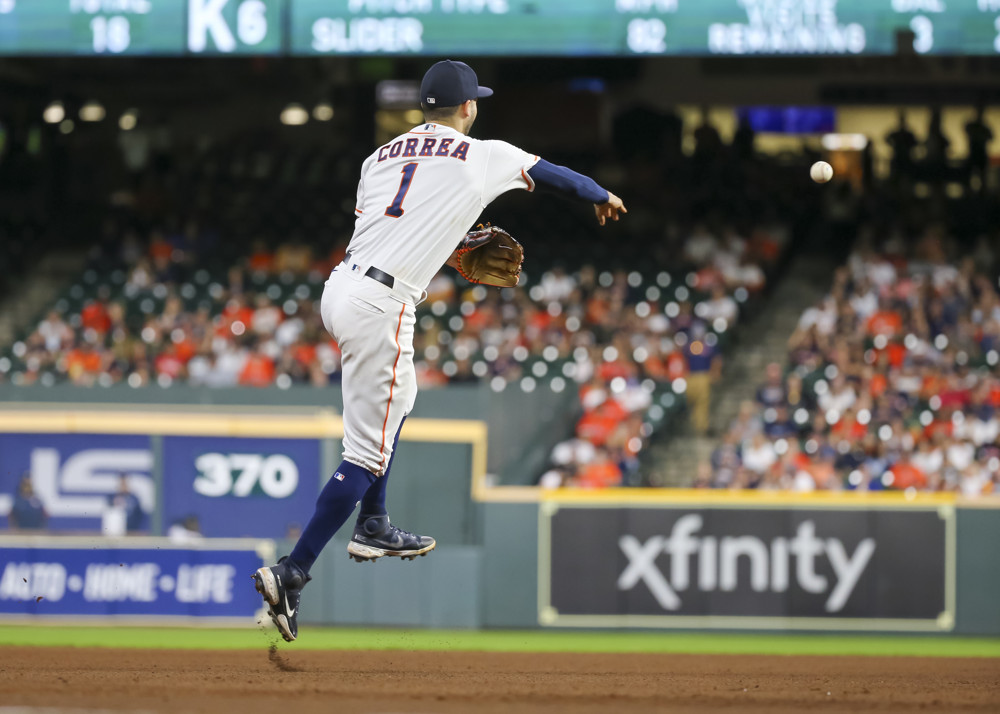
    Correa’s offensive numbers don’t differ too much from his established norms. He’s at .278/.364/.479 with a career-high tying 24 home runs and 34 doubles.

    But his defensive numbers are worth pointing out too. He’s playing a premier position and pacing the field. He leads all shortstops with 20 Defensive Runs Saved.

    The hitting-fielding combination is worth bringing up.

    Per Baseball-Reference, Correa is the leader in Defensive WAR (he’s at 2.8 – the stat rewards players who play tougher defensive positions, like shortstop and center field) and has by far the most dWAR among players whose OPS+ is at least 120. He’s more than one win clear of the next-closest player, Marcus Semien (1.7). Those two players have arguably the most impressive offense-defense combination (we previously wrote about Semien here).

    Correa is about to be worth 20 Fielding Runs and 20 Batting Runs per Baseball-Reference’s numbers. Only one other shortstop has done that since Defensive Runs Saved became a stat in 2003 – Trevor Story in 2019. No other player in MLB is even 15 and 15 this season.

    With free agency looming, Correa has picked a good time to have the most valuable defensive season of his career. What makes him so good on defense is his combination of making great plays and avoiding mistakes.

    Over the last three seasons, Correa ranks second among shortstops in Good Fielding Plays per 100 Innings and has the second-lowest rate of Defensive Misplays and Errors per 100 Innings.

    When we say great, here are a few examples.

    Here’s one of him playing the equivalent of second base in a defensive shift and robbing Matt Olson.

    Here’s something similar from the shortstop position against David Fletcher.

    Those plays going to his right are a key component of his excellence. Correa has the second-most plays saved among shortstops on balls hit to his right in 2021. He’s the only player in the top five of that stat who has a positive rating on balls hit to his left.

    Going to your right means sometimes having to make long throws or throws from odd angles to complete plays. Correa has done that with aplomb. His 8 Runs Saved from his arm ranks second among shortstops to Nicky Lopez’s 11.

    In short, Correa has a pretty good case for MVD (Most Valuable Defender) and he’s providing offensive numbers that are tough to match.

  • Stat of the Week: 2021 Minor League Standouts

    Stat of the Week: 2021 Minor League Standouts

    By MARK SIMON

    The Braves have a long line of excellent defensive center fielders, from Marquis Grissom and Andruw Jones to more recently with Ender Inciarte. There’s another pretty good one in the pipeline in Michael Harris.

    Harris, a 20-year-old who was born in Dekalb, Georgia, not far from Atlanta, led all minor league center fielders with 14 Defensive Runs Saved this season for the Class-A Rome Braves.

    “Defensively, I feel like I can cover a lot of ground, have pretty good instincts out there, a decent arm,” Harris said recently on the SIS Baseball Podcast. “I can typically read where a ball is going to land or how hard it’s hit. I know what spot to get to when the ball is hit.”

    Harris should move up the prospect rankings heading into 2022. He had a .798 OPS, 58 points better than the High-A East league average and ranked tied for third in the league with 27 stolen bases in 31 attempts.

    One of the top minor league prospects, catcher Keibert Ruiz, was traded from the Dodgers to the Nationals in the deal that sent Max Scherzer and Trea Turner to the Dodgers.

    Ruiz, who has gotten a brief look in the majors in 2021, only helped his status in Triple-A this season. His 33% hard-hit rate (percentage of at-bats ending in a hard-hit ball) was the highest of anyone at that level.

    Ruiz hit .310 with a .993 OPS in 72 games in Triple-A this season. He spent much of the season with Oklahoma City in the hitter-friendly Triple-A West, but hit .308 with five home runs in 78 at-bats with Rochester in the less hitter-friendly Triple-A East.

    Ruiz has been in Baseball America’s Top 100 preseason prospect rankings in each of the last four seasons. There will be high expectations for him in 2022.

    If you’ve been paying attention to the Brewers recently, you might have noticed their usage of left-handed pitcher Aaron Ashby, who has a 2.77 ERA and 28 strikeouts in 26 innings in nine games.

    After allowing seven runs in 2/3 of an inning in his MLB debut, Ashby has settled down. In his last three appearances, he’s pitched eight scoreless innings.

    Ashby had a 4.41 ERA at Triple-A Nashville, but perhaps that number was a little deceiving. The 23-year-old had the lowest hard-hit rate in Triple-A at 9%.

    Part of the reason for that – batters weren’t able to hit the ball at all. He had 100 strikeouts in 63 1/3 innings pitched. The SIS version of hard-hit rate uses at-bats as a denominator rather than batted balls, thus rewarding a high-strikeout pitcher like Ashby.

    Ashby’s hard-hit rate so far in the majors is 16%, basically a match for closer Josh Hader. He’s worth keeping on your radar through the end of the season and into October.