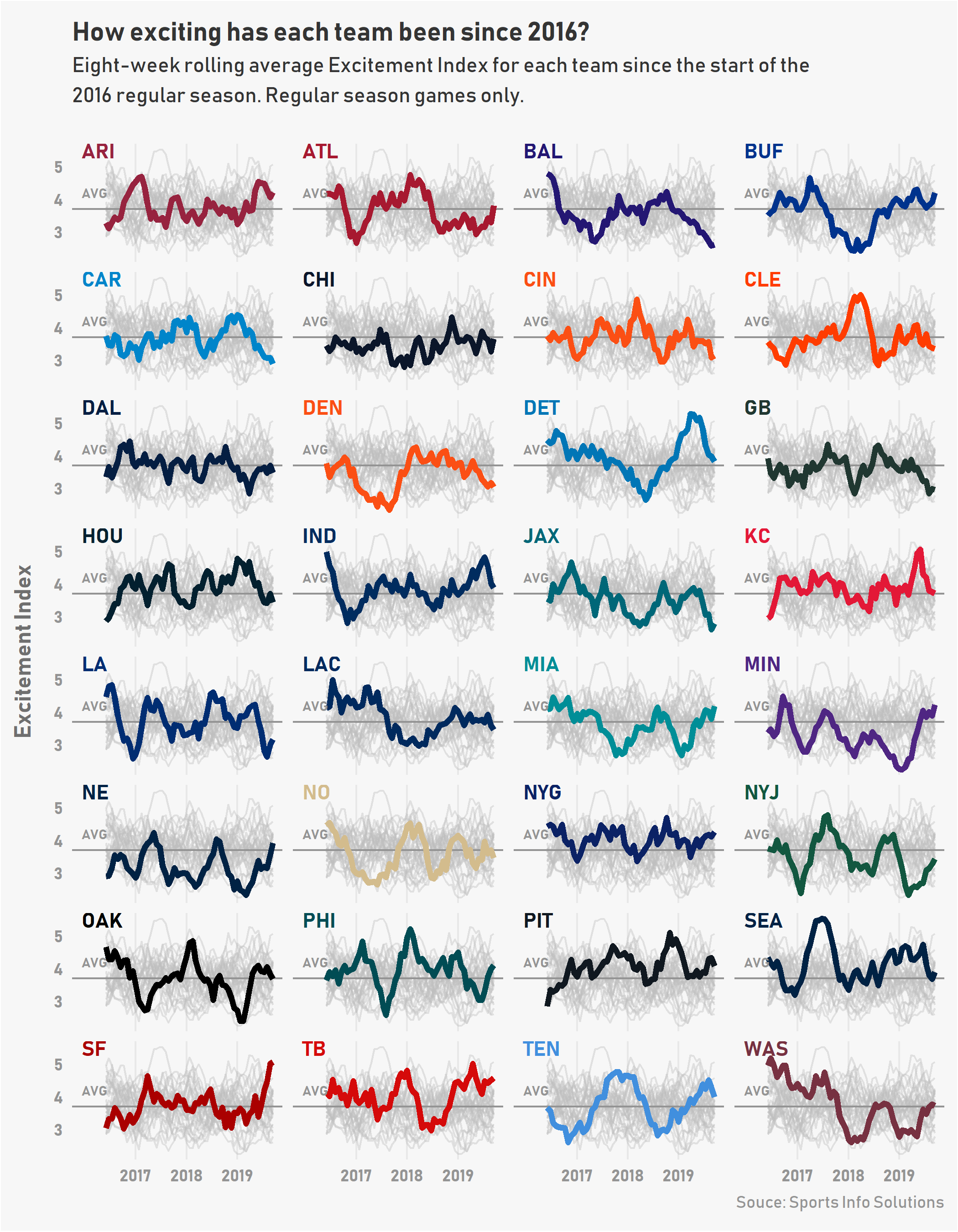
The basic idea is to calculate the total change in win probability throughout the course of the game, and use that as a proxy for excitement, meaning games that are tightly contested or feature large comebacks and swings in win probability will be the most “exciting.”
For a slightly different look at things, EI can also be aggregated at the team level or turned into rolling averages. In this case, we will use the SIS win probability model to calculate eight-week rolling average EI. This way, we will see which teams have put together the most exciting stretches of football in recent memory, and not just the most exciting game.
The 2017 Seattle Seahawks
This could just as easily read “Seattle in General.” Since the beginning of the 2016 season Seattle’s games have had an average EI of 4.2, putting them comfortably in the top spot. Seattle has also participated in the two most exciting games within the SIS database by our index. All of this has earned them a reputation for “literally never playing in a normal game.”
But even by their own lofty standards, 2017 was wild.
Their run from Week 3 to Week 11 was the most exciting eight-game stretch within SIS’s database with an average EI of 5.5. Beyond that, four other eight-game iterations from that same season rounded out the top five.
The Seahawks Week 8 win over the Texans was the most exciting game of the stretch, and also is the most exciting game since 2016 with an EI of 8.3. The Seahawks were down to about a 20% chance to win in the fourth quarter before taking the lead with 21 seconds left on an 18-yard Russell Wilson touchdown pass to Jimmy Graham. The game featured more than 400 passing yards from both Deshaun Watson and Russell Wilson and more than 200 yards receiving from DeAndre Hopkins.
The 2019 Detroit Lions (Yes, Really)
A record of 3-4-1 isn’t exactly what comes to mind when you think of exciting football, but the 2019 Lions were truly one of the most exciting average football teams we have seen. Their average EI of 5.2 from Weeks 1-9 trails only the aforementioned 2017 Seahawks for the most exciting stretch of football we’ve seen over the last four seasons.
The “excitement” in this case though is mostly driven by two gut-wrenching losses in back-to-back games against the Chiefs and Packers. In each game the Lions eclipsed a 90% chance to win, and in both cases were north of 75% in the fourth quarter before losing late.
Honorable Mention: The 2017/2018 Philadelphia Eagles
After a thoroughly unexciting stretch of football at the end of 2016 that spilled into 2017, the Eagles put together one of the most exciting stretches of football in the back half of their 2017 season. Even excluding the Nick Foles’ playoff run and Super Bowl victory, the Eagles had an average EI of 5.1 from Week 14 of 2017 to Week 4 of 2018.
Sports Info Solutions (SIS) brings you the second annual edition of The SIS Football Rookie Handbook, with scouting reports and statistical breakdowns on over 280 college football players (a glossary for the below stats can be found here). New features for this year include unique and informative NFL team pages, research deep-dives by the SIS R&D team, and—for the first time —the NCAA version of their flagship football statistic, Total Points.
With each offseason comes the hopes and dreams of former college football stars being either fulfilled or dashed based on the results of the NFL Draft. While there are only a limited number of draft picks, their remains hope for those players who may not have been fortunate enough to be selected. Shortly after Mr. Irrelevant is selected, there is a scramble to sign top prospects who went undrafted.
These undrafted free agents (UDFAs) can provide significant value for teams, should they make the final roster. Teams can receive three years of production at a rock-bottom price for those UDFAs who are success stories. Below is a look at the top players from the SIS Football Rookie Handbook who went undrafted:
Top Undrafted Free Agents – 2020
Player
Position
School
Grade*
Signed By
Jared Pinkney
TE
Vanderbilt
6.7
Falcons
Rodney Clemons
S
Southern Methodist
6.7
Chiefs
Hunter Bryant
TE
Washington
6.6
Lions
Thaddeus Moss
TE
Louisiana State
6.6
Redskins
Cale Garrett
MLB
Missouri
6.5
Titans
A.J. Green
CB
Oklahoma State
6.5
Browns
*The meaning of prospect grades varies by position, but they are intended to reflect the value of a player relative to their own position and when compared to players at other positions (grades are based on what the player projects to become by their second season).
The overall grade scale ranges from 1 to 9, but the grades of players included in the FRH ranges from 5.8 to 7.3 (note that 5.4 is the grade for quality training camp players across all positions).
Jared Pinkney
As the number one ranked tight end in the Rookie Handbook, it comes as a surprise that Pinkney went undrafted, especially given the lack of depth in this year’s TE position group. The Falcons replaced starting tight end Austin Hooper with Hayden Hurst, who ranked 8th in Total Points per snap in a limited role in Baltimore. While Hurst will take over the role of starting tight end, Pinkney should see the field a fair amount next season if he can win the No. 2 spot at the position. In the team’s first season under OC Dirk Koetter, Atlanta lined up with two or more tight ends on 23% of plays.
Based on his scouting report, Pinkney has the ability to become a 3-down starter by the start of his second season, and is able to play both the Y and H roles. While Atlanta is able to field 11 personnel using exclusively former first rounders this season, the team receives great value for the next three seasons in Pinkney, at the cost of a cheap UDFA contract.
Rodney Clemons
Clemons joins Kansas City as the fifth ranked safety in the FRH. He adds to a defensive back room that includes All-Pro Tyrann Mathieu and 2019 first-rounder Juan Thornhill at safety, along with 2020 fourth round pick L’Jarius Sneed. The Chiefs ranked third in the league in percentage of defensive plays run with three or more safeties (47%).
Clemons has the ability to become a strong three-down starter by the start of his second season based on his scouting report, and he has the skills to play both free and strong safety. Thornhill may be forced to miss time this season because of recovery from a torn ACL suffered in Week 17, meaning there are open snaps at free safety. Pending the results of an uncertain offseason (which includes a position battle), Clemons may see the field with the Chiefs’ defense in 2020.
Hunter Bryant
Ranking as SIS’s No. 4 tight end, Bryant signed with the Lions. Detroit’s TEs tied for 20th in Total Points in 2019, led by five-year veteran Jesse James, 2019 first round pick T.J. Hockenson, and Logan Thomas, who joined the Redskins this offseason. The Lions offense used two or more tight ends on 26% of plays last season and should remain consistent with Darrell Bevell returning for a second season as offensive coordinator.
Bryant’s scouting report states that he has the ability to develop into a low end starting H-TE by the start of his second season. Facing no competition for the TE3 role, Bryant provides a solid depth option while he grows in his rookie year. If Hockenson can’t stay healthy in his second season, Bryant should see an expanded role.
Thaddeus Moss
Moss ranked right behind Bryant in SIS’s tight end rankings and was signed by the Redskins. Washington’s TE group finished tied for 30th in Total Points last season and returns two contributors in Jeremy Sprinkle and Hale Hentges.
The Redskins also added Logan Thomas this offseason, who played in a backup role for the Lions in 2019. Calling the shots on offense in Washington is Scott Turner, who took over as interim OC in Carolina for the final four weeks of last season. Though it was only a small sample of games, Turner used multiple TE sets on 21% of offensive plays.
SIS’s scouting report on Moss projects him to become a low end starting Y-TE by the start of his second season. With no single dominant player at the position in Washington, there is a good chance that Moss sees the field often in his rookie season, even potentially carving out a starting role for himself.
Cale Garrett
Garrett ranked fourth among Mike linebackers in the FRH and signed with the Titans. The team enters 2020 without a Defensive Coordinator after the retirement of Dean Pees. Mike Vrabel is expected to take over defensive play calling responsibilities. However this shouldn’t change the Titans 3-4 defense. Tennessee’s primary off-ball linebackers Rashaan Evans and Jayon Brown ranked 86th and 75th in Total Points among the position, respectively, in 2019.
Garrett projects to become a low-end starter at MLB by the start of his second season based on his scouting report. There is an open battle for the third off-ball linebacker spot on the depth chart with the departure of Wesley Woodyard. Though his 2019 season was cut short by injury, Garrett has a chance to contribute in a key depth role in his rookie season if he can stay healthy and win his position battle.
A.J. Green
Green ranked 13th among corners graded by SIS and became the second of his name in the AFC North after signing with the Browns. Cleveland enters 2020 with a new coaching staff, which includes Joe Woods at Defensive Coordinator. Woods previously served in this role with the Broncos from 2017-2018. While in Denver, Woods employed a man coverage-heavy defense (top five in percentage of plays run with man coverage in both years). Though Woods’ defensive squads ranked top five in percentage of plays from base packages (4 DBs) they also ranked top five in percentage of plays from dime packages (6+ DBs).
Based on his scouting report, Green projects to become a capable starting CB who possesses both inside and outside flexibility. With the loss of Cleveland’s two primary slot defenders from last season (T.J. Carrie and Eric Murray), along with the team’s leader in Total Points at corner (Juston Burris), Green has the potential to see the field often in his rookie season, especially given Joe Woods’ extensive use of dime packages.
Other Notable UDFAs
Tyler Huntley; QB, Utah; Grade: 6.4 – Signed with Ravens
Kalija Lipscomb; WR, Vanderbilt; Grade: 6.4 – Signed with Chiefs
Jeff Thomas; WR, Miami (FL); Grade: 6.4 – Signed with Patriots
By ALEX VIGDERMAN There is already a veritable corpus of NFL Draft recap content out there. So, to differentiate, here’s a recap that features few opinions and hinges on a statistic that no one else is in a position to use as the basis for their recap.
We’ve told you before that we implemented a college version of our catch-all football statistic, Total Points. We use a player’s full body of work (provided he went to an FBS school) and tabulate his value in terms of Expected Points Added, tacking on an adjustment for the quality of competition he faced.
I suspect that by next year we’ll have a model for draft pick value, but for now I’m not so comfortable with implementing such a thing because we only have two seasons of Total Points data in college. I’m certainly excited for that to come.
For this piece, to keep things nice and clean, I calculated a weighted average of each player’s Total Points over the past couple seasons and added up these averages for every pick for every team. That gives us a rough estimate for how much value a team got from its picks.
Each team’s needs were based on the data used for the Football Rookie Handbook team pages, but updated for changes post-free-agency. I estimated the extent of a need by subtracting from 100 percent each team’s percentile rank at a position. For example, the Bengals were in the third percentile at QB before drafting Joe Burrow No.1, so they had a need denominator of 97 percent.
To measure how well a team met its needs, I took a simple measure. If you drafted a player in the first three rounds at a position, you got credit for filling the need. If you only took players on Day Three to fill that need, you got half credit.
Sum up the need totals and divide the acquired player totals by that, and you get a percentage of needs filled. Simple, clean, and pretty accurate of how we’d evaluate a team. The Bengals and Packers each took a quarterback in the first round, but because the Bengals had a much larger need they get much more credit for their selection.
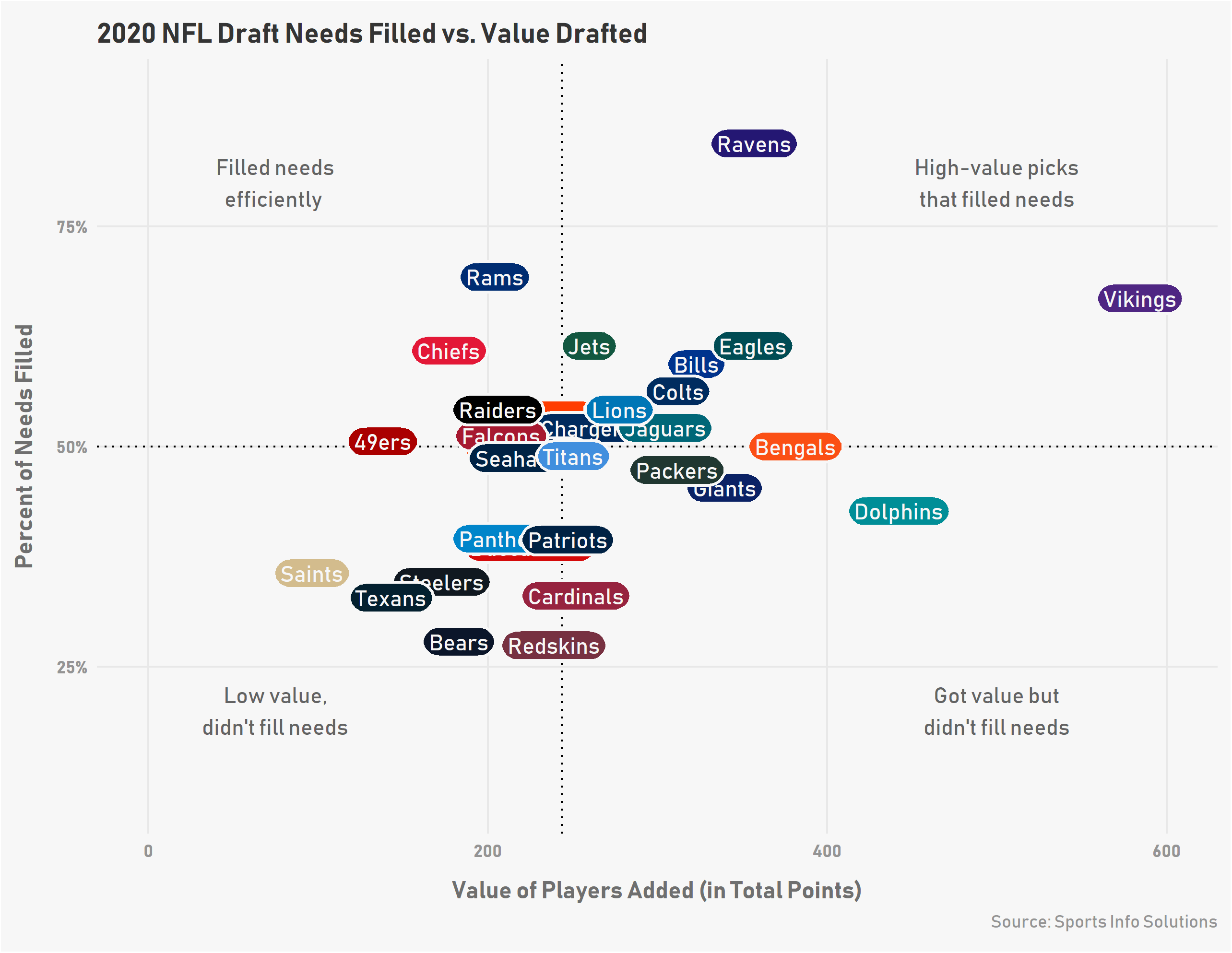
Let’s take a look at how teams fared by this method.
* A few teams are hidden in clusters of teams in the image above. The Browns, Broncos, and Cowboys are right in the middle of the graph, and the Buccaneers are clustered with the Panthers and Patriots a little below that.
High-value picks that filled needs
The Vikings have gotten a lot of credit for accumulating picks over the course of the draft, and you can see the fruits of their labor by how far ahead of everyone else they are in terms of Total Points acquired. Taking a quarterback at all (Iowa’s Nate Stanley) helps, but they also loaded up on high-performing defensive players in the back end of the draft.
The Ravens didn’t have a glut of selections, but they targeted holes really efficiently. Their three biggest needs by a mile were at defensive tackle, wide receiver, and linebacker. They spent four picks in the first three rounds on those positions alone.
Got value but didn’t fill needs
The other team that had a ton of picks to work with was the Dolphins, who get a lot of credit for taking Tua Tagovailoa at the top of the first round. Their other picks in the first round were a mixed bag in terms of filling needs, though, as they addressed a dire need along the offensive line with USC’s Austin Jackson, but their selection of cornerback Noah Igbinoghene from Auburn comes off as odd considering that was a position of relative strength last season.
Filled needs efficiently
Teams that fell into this category tended to be Super Bowl 54 participants, interestingly.
The 49ers only made five selections in the draft, but they attacked spots that made sense. They traded Marquise Goodwin during the draft, and then drafted multiple wide receivers (including first rounder Brandon Aiyuk of Arizona State) after also losing Emmanuel Sanders to free agency. They filled another need created by a trade by taking Javon Kinlaw to replace DeForest Buckner at defensive tackle.
The reigning Super Bowl Champion Chiefs were also short-handed from a draft pick perspective, but they did well with the resources they had. Kansas City struggled at linebacker in 2019, so the selection of Willie Gay Jr. from Mississippi State in the second round was crucial to their draft success. And while there is reason to quibble with the draft capital used, adding a dynamic running back to the mix in Clyde Edwards-Helaire from LSU makes that offense even more threatening.
Low value, didn’t fill needs
To some extent it’s unfair to punish teams that had few picks, but the Saints didn’t use their limited bullets to the same effect that the teams above did. Their first round pick, Cesar Ruiz from Michigan, is more of a depth selection from a 2020 perspective considering the current state of New Orleans’ offensive line. And while it’s still prudent to take shots at quarterbacks with Drew Brees nearing the end of the line, by this method spending one of your four picks on a QB doesn’t look very efficient.
The Bears‘ draft was unlikely to be evaluated very well by this method, considering they already traded for Nick Foles to bolster their quarterback room and just drafted David Montgomery so they were unlikely to use a lot of capital to replace him. That said, besides spending multiple picks on their biggest need (cornerback) they failed to address any of their next five biggest needs from a Total Points perspective.
The NFL Draft wrapped on Saturday, leaving most fans with a feeling of hope and optimism for the upcoming season. Unfortunately this doesn’t apply to Packers fans, who were left wondering what their team was thinking throughout the three-day process.
The Packers left their fan base speechless on the Draft’s opening night by trading up in the first round for quarterback–and future Aaron Rodgers replacement–Jordan Love. Then they continued to torture fans who desperately begged for a receiver by taking an old school power back and a lowly rated H-Back in the second and third rounds, respectively. The later rounds were not well received either, as the team took an injured linebacker, a trio of offensive linemen, two seventh-round defenders, and continued to ignore fans’ pleas for any receiving help in what could be the deepest receiver draft in memory.
If all of these sources have unanimously panned the Packers draft haul, what exactly should fans be optimistic about?
The Packers might have caught lightning in a bottle, again.
Barring an injury to Rodgers, we won’t know much about the Jordan Love selection for at least two years. That is the earliest the Packers could get out of Rodgers’ contract, but they have stated they hope he continues to be a Packer. Love will have to sit and wait, which should help him after a rocky junior season.
The Good (2018) and The Bad (2019) of Jordan Love
Metric
Jordan Love (2018)
Jordan Love (2019)
Comp%
64%
62%
Catchable%
81%
78%
Yds/Att
8.5
7.2
Yds/Dropback
8.1
6.6
EPA/Att
0.27
0.01
EPA/Dropback
0.22
-0.04
EPA/Att (Clean Pocket)
0.34
0.10
EPA/Att (Deep Throws)
3.00
2.62
If, after a few years watching and learning, the Packers can get more of 2018 Love than 2019 Love, they might have just captured lightning in a bottle for a third time and provided themselves good-to-great QB play from 1992 to 10-plus years in the future. Part of that process might be asking Love to be a little more conservative, as he rated as the most aggressive QB in this draft class by ADoT +/- (Average Distance of Target Above Expectations).
Of course that is all a best case scenario for the Packers, and Love is a boom-or-bust type player. But, based on college metrics that have shown stability between college and the NFL (mainly Accuracy, Downfield Aggression, and Propensity to Scramble), Love’s junior season compares most similar to Sam Darnold.
The drafted offensive weapons make more sense than fans think.
Fans clamored for receivers, and instead the Packers drafted a running back and a tight end. Both A.J. Dillon and Josiah Deguara were probably drafted a round or two early, so the value of the selections has rightfully been criticized. But, ignoring the round/positional value for a second, because the picks are in and there’s no going back now, these two selections do make some sense for the Packers offense.
The Packers top two running backs, Aaron Jones and Jamaal Williams, both have expiring contracts at the end of this season. The Packers also have a handful of other expiring contracts that should take priority over the running back position. So, drafting another back to take some of the load in 2020 and most likely a larger role in the future makes some sense.
Dillon is also a solid player, who produced for Boston College despite being run into loaded boxes on an incredibly high 44% of his carries. For perspective, Clyde Edwards-Helaire ran into a heavy box on only 12% of his carries, J.K. Dobbins 10%, Cam Akers 13%, D’Andre Swift 21%, and Jonathan Taylor 20%. And of these other highly-rated backs, only Edwards-Helaire and Swift join Dillon in having a Positive% (Percent of Carries w/ a Positive EPA) on the majority of both inside runs and outside runs. Dillon had a Positive% of 53% on both.
As for Deguara, one just has to look at head coach Matt LaFleur’s past to see the plan for him. The comparisons have already been made between Deguara and how LaFleur’s former boss, Kyle Shanahan, has used Kyle Juszczyk, and that is definitely an intriguing comparison for the versatile tight end. Over the past two seasons, Deguara aligned in the slot on 36% of his snaps and also lined up in the backfield a handful of plays.
LaFleur’s tenure as the Titans OC also offers a glimpse of how the Packers will be aligning on offense in 2020. In 2018, LaFleur’s offense used two or more tight ends on 41% of their snaps, which ranked third-highest in the league. In contrast the 2019 Packers only used two or more tight ends on 27% of their snaps. With versatile tight ends Jace Sternberger, Robert Tonyan, Marcedes Lewis, and now Deguara on the roster, look for the 2020 Packers to heavily use two tight end sets, which LaFleur seems to favor.
They created offensive line depth for the future
Similar to the running back situation, this draft class provides the Packers with depth this season and insurance policies against expiring contracts in the future. Guard Lane Taylor’s contract expires after this season, and could be a cap casualty sooner than that. Starting center Corey Linsley’s contract is also up at the end of 2020.
One of the interior line spots should be locked down for years by Elgton Jenkins, but the two spots could be open in 2021. With Taylor and Linsley’s expiring contracts and Billy Turner’s spotty performance–he rated as the team’s worst starting offensive lineman in 2019 by our player value metric, Total Points–it makes sense for the Packers to load up on depth in the draft.
Jon Runyan rated as SIS’s 17th-rated tackle prospect, but the Packers are most likely moving him to guard. He provided solid value for Michigan last season with 33 Total Points, and his 0.04 Total Points/Snap ranked 34th in the country among all lineman with at least 500 snaps (essentially those who played regularly or semi-regularly). Jake Hanson was a longtime starter for Oregon and finished 2019 with 24 Total Points. Simon Stepaniak finished 2019 with 22 Total Points for Indiana.
The elephant in the room: the need at WR
In SIS’s season review of the Packers, it was mentioned that they needed to improve their receiving corps if they want to contend in 2020. They are now banking on that improvement to come from within or from free agent acquisition Devin Funchess. It also looks like No.1 receiver Davante Adams will again see a large workload. He has been targeted on 27% of passing snaps he was on the field for over the past two seasons, the third highest rate in the NFL behind only Michael Thomas and Julio Jones.
Although fans desperately wanted the Packers to draft multiple receivers, this plan never fully made sense for their roster. They usually keep six receivers on their roster and based on contracts and potential, five of those spots have already been locked up for the most part.
Adams is clearly not going anywhere, Funchess was signed for a reason, third year pros Equanimeous St. Brown and Marquez Valdes-Scantling have shown promise, and former undrafted free agent Allen Lazard showed he belonged by being the team’s second-best receiver last year. That only leaves a single open spot for Jake Kumerow, Darrius Shepherd, another free agent veteran, or a rookie.
The two most intriguing options for internal improvement are St. Brown, who showed promise his rookie season before missing all of 2019 with an injury, and Lazard, who stepped up late last season after being on the practice squad in September. Both of these players have shown flashes of being able to take over the No. 2 role next to Adams.
In 2018 with St. Brown on the field, the Packers averaged 1.1 yards more per pass attempt and 5 more Expected Points Per 60 Plays than when he was off the field. In 2019, the Packers showed similar improvement when Lazard was on the field, averaging 1 yard more per pass attempt and 5 more Expected Points Per 60 Plays than when he was off the field.
Aaron Rodgers should be happy with the potential to get both of these young receivers on the field together, as he has performed much better with either one of them over the last two seasons.
Rodgers Performance w/ and w/o St. Brown or Lazard on the Field
(2018-2019 Regular Seasons)
St. Brown & Lazard
Att
Comp%
Yds/Att
TD / INT
EPA/Att
Both Off Field
691
61.2%
6.9
26 / 6
0.14
St. Brown On Field
211
64.0%
8.2
8 / 0
0.29
Lazard On Field
261
64.0%
7.6
16 / 0
0.26
Final Word
Is it disappointing that the Packers didn’t add a single receiver from a historically deep draft class? Should they have waited to draft a running back until a later round? Did they reach on an H-back? Do they deserve some of the criticism currently circulating the internet? The answer to all of these questions is: Yes.
However, there does seem to be a specific plan in place with this draft class, even if that plan is wildly different from fan’s expectations. The plan is to tailor the offense to LeFleur’s liking, give the roster much needed flexibility over the next few years as contracts start expiring, focus on internal development of WRs, and hope Love follows in his predecessor’s footsteps as the next great Packer quarterback. It might not seem like it at the moment, but in two to three years this plan could look a lot better than it does now.
This was the second season of the SIS Football Rookie Handbook being published. The idea is to have the top players at their respective positions make the book. With 284 players, not every player from the Handbook would be drafted and not every player drafted was in the Handbook. After having 174 of 254 (69%) drafted players in the book in 2019, we bumped that number up to 199 of 255 (78%) this year.
When taking out special teams players and one XFL player, which we don’t cover, and 22 players that we had reports on but didn’t think were good enough to make the book, it comes out to only 27 draftees that didn’t have a report on them.
Now using the Handbook, we attempted to grade each team’s draft class. Just like in our article from last season, we assigned all grades from the Handbook and gave all players that weren’t in the book a 5.7 and divided that by the number of selections the team had.
The 2020 Best Draft Class, with an average grade of 6.5, went to the Cleveland Browns. They had seven draft picks and all of them were featured in the SIS Football Rookie Handbook. After only two teams selected Handbook players for their entire draft class in 2019, five teams did in 2020. In addition to the Browns, the Ravens (both seasons), Bengals, Raiders, and Cardinals all selected their entire draft class from players profiled in the SIS Football Rookie Handbook.
The Browns draft class is seen in the table below.
Cleveland Browns 2020 Draft Class
Pick
Position
Player
College
Grade
10
OT
Jedrick Wills
Alabama
6.8
44
S
Grant Delpit
LSU
6.9
88
NT
Jordan Elliott
Missouri
6.3
97
LB
Jacob Phillips
LSU
6.2
115
TE
Harrison Bryant
Florida Atlantic
6.5
160
OC
Nick Harris
Washington
6.4
187
WR
Donovan Peoples-Jones
Michigan
6.4
In our opinion, the Browns drafted a lot of players that we feel can contribute to both sides of the ball early on in their careers. Jedrick Wills and Grant Delpit have the ability to come in and make impacts right away, working into a high-end starting role by Year 2. Jordan Elliott, Harrison Bryant, Nick Harris, and Donovan Peoples-Jones should all develop into low-end or limited starters.
Here are the draft classes ranked in order of their grade.
Final Rankings
Team
# of Picks
Draft Grade
Browns
7
6.50
Bengals
7
6.49
Cardinals
6
6.45
Cowboys
7
6.44
Bills
7
6.43
Saints
4
6.40
Rams
9
6.38
Raiders
7
6.36
Dolphins
11
6.35
Ravens
10
6.31
Lions
9
6.31
Panthers
7
6.27
Redskins
8
6.26
Jets
9
6.26
Buccaneers
7
6.26
Eagles
10
6.23
Falcons
6
6.22
49ers
5
6.20
Jaguars
12
6.17
Broncos
10
6.17
Chargers
6
6.17
Seahawks
8
6.15
Vikings
15
6.13
Titans
6
6.13
Patriots
10
6.08
Colts
9
6.08
Chiefs
6
6.07
Bears
7
6.07
Texans
5
6.06
Giants
10
6.04
Steelers
6
6.02
Packers
9
5.97
The Bengals, Cardinals, and Bills make the top five for the second straight season. Consistently having top draft classes are how teams build rosters and have success.
With just a 0.01 separation from the top spot, the Bengals garnered our No. 2 Draft Grade with a 6.49 average. No. 1 pick Joe Burrow was a selection that could change the dynamic of the entire football team for many years to come. With the first pick of Day 2, Tee Higgins is a game changer at the receiver position and should pair nicely across from A.J. Green as a lethal target for Burrow. Logan Wilson and Akeem Davis-Gather should fill in nicely at the linebacker position, as well as 7th-round pick Markus Bailey if he can prove to stay healthy. 5th and 6th round picks Khalid Kareem and Hakeem Adeniji are rotational pieces that could be valuable depth players moving forward.
The bottom three teams for 2020 were the Packers, Steelers, and Giants.
The Giants started off with two really good picks, but ultimately took five of ten players that weren’t in the book, including Matt Peart in the 3rd round. The Steelers took four of six players from the Handbook, but their highest graded player was Anthony McFarland Jr. in the 4th round.
Green Bay earned this year’s worst draft grade. Out of their nine picks, only five were included in the Handbook. Jordan Love was their highest graded player at a 6.6 while AJ Dillon was graded 6.5, but no other players graded higher than a 6.2. The Chiefs earned the 2019 worst draft grade and went on to win the Super Bowl, and while that was a little different situation than the Packers, you never know what could happen.
How the Handbook Compared to the Draft
Taking a look at our top five position ranks compared to the first five players drafted at each position, the SIS Rookie Handbook and the NFL had the same group of five running backs and wide receivers in different orders.
Our No. 1 player at every position but running back, wide receiver, tight end, guard and safety was also the NFL’s top drafted player. We also matched the first four quarterbacks off the board in order, had the same first group of four offensive tackles, and had four of the first five centers, nose tackles, defensive tackles, edge rushers, and safeties grouped in lockstep with the League.
Players we believe were drafted much higher than they should have been include Matt Peart, Alex Highsmith, Joshua Kelley, Charlie Heck, and Shaquille Quarterman. Over 650 reports were written on players for this year’s Rookie Handbook, including on these five. However, this group received grades that were not high enough to be included, while NFL teams drafted these players as high as the third and fourth rounds. First round picks AJ Terrell, Brandon Aiyuk and Isaiah Wilson also received role-based grades lower than their draft selections warranted in our eyes.
On the other hand, some players we thought were great value picks based on their Handbook grades include Netane Muti, Prince Tega Wanogho, Markus Bailey, Eno Benjamin, Kenny Willekes, and Clay Johnston. All of these players were taken in the sixth and seventh rounds, yet received at least a lower-end starting grade from us. Whether they fell due to injury concerns or were just overlooked in their position groups, we feel they each could pay dividends to the teams that took a chance on them.
Players who were rated in the top five at their positions in the Handbook who were not drafted include Jared Pinkney (our No. 1 TE), Hunter Bryant (No. 4 TE), Thaddeus Moss (No. 5 TE), Josiah Coatney (No. 4 NT), Cale Garrett (No. 4 Mike LB), and Rodney Clemons (No. 5 S). We’re looking forward to them catching on with teams soon, if they haven’t already, and potentially making a year-one impact like 2019 SIS Top-Five-to-Undrafted darling Nik Needham.
Looking back on this article from last year, we noted that we didn’t have reports at all on four players taken in the top five of their position group by NFL teams, and that we were already implementing plans to improve our process and hopefully mitigate this glaring issue moving forward. We’re very pleased to report that we assigned and received reports on every player taken within the top five of his position group in 2020.
Along with the percentage increases noted at the beginning of this article, we’re happy to see statistical improvements year over year, especially as data analytics providers ourselves. We aren’t satisfied with this year’s results, however. The first non-Handbook selection going 99th (Peart) and the first player without a report written going 129th (Cameron Clark) are improvements, but we need to aim higher. We can’t wait to continue building upon the progress we’ve continued to make, and we’ve already begun scouting for the 2021 class.
The SIS Football Rookie Handbook will be back again next year, filled with even more data, more accuracy, better reports, and the same combination of deep-dive analytics and pre-Combine scouting we’re proud to share. In the meantime, if you want to learn about the players your team got, you can buy the book now at ACTA Sports.
Around this time last year, it was all but a foregone conclusion that Tua Tagovailoa would be the first quarterback taken in the 2020 NFL Draft.
We all know how that story went.
Tagovailoa was the prohibitive favorite entering 2019 and even improved his efficiency on a per-snap basis despite dealing with injuries. This was enough to distance himself from other first-round quarterback prospects like 2017 Academic All-American Justin Herbert and Jordan Love, but it wasn’t enough to win him the Heisman and it’s wasn’t enough to get him drafted first overall, either.
Those honors were claimed by Joe Burrow, whose pedestrian 2018 had painted him as yet another LSU quarterback destined to become a practice squad refugee at the NFL level. But 5,671 yards and 60 touchdowns later, he’s the No. 1 overall pick.
If you missed out this time around, fear not — you’ll get another chance to bet on the first pick of the NFL Draft with Trevor Lawrence opening as the heavy favorite for next year. In fact, Lawrence has been the favorite for some time, as some oddsmakers enticed bettors with even money for his chances to go first overall just hours after he hoisted the National Championship trophy.
Simply put, Lawrence, who was the top-rated high school recruit in the 2018 class, has been destined to go first overall for some time. But, as we’ve seen, destiny has a funny way of working. Take the case of Justin Fields, the second-rated high school recruit in the 2018 class. Fields played his high school ball just half an hour away from Lawrence’s school, chose to stay in-state, and committed to Georgia.
Despite his apparent confidence that he would usurp Jake Fromm, Fields was limited to package plays and garbage- time duty and summarily transferred. As differently as their college careers may have begun, Lawrence and Fields are inextricably linked and the race to be the best at the next level is once again neck-and-neck.
In fact, Total Points suggests that Lawrence and Fields are already much closer than one might think. Fields outperformed Lawrence in 2019, adding 39.9 Total Points/100 Dropbacks to Lawrence’s 30.3.
While Lawrence had some early-season struggles, the sophomore slump narrative has been overblown and it is a testament to Fields that he outperformed Lawrence across the season, even if Lawrence did get the best of the Buckeyes in the semifinals. Having to languish on the bench for a year may have hindered his development, so the fact that Fields performed comparably is a great sign.
Scouting Report
From a physical perspective, Fields was ready to compete in the NFL yesterday. At 6’3”, 228 lbs, he has a pro-ready frame and plenty of gunpowder to make all the landmark throws. Although the hashes are tighter in the NFL, Fields has demonstrated the willingness and requisite arm strength to drive the ball towards the sideline from the far hash with velocity and timing. Seven percent of all his throws struck between 10-20 yards downfield and outside the numbers when the ball started on the opposite hash. That figure, which excludes fades, ranked 8th out of 165 qualifying players (minimum 5 attempts).
Fields has shown similar aggression going downfield and found success doing so. Among quarterbacks with at least 100 attempts, Fields ranked 21st in deep throw percentage (20%) and 19th in catchable rate (66%) on such throws. He does have a tendency to step into the bucket when going long to his non-dominant side, as reflected by the dichotomized catchable splits of 58% to the deep left and 69% to the deep right.
More generally, Fields’ middling on-target numbers belie his vertical orientation and the difficulty of his throws. His ADOT of 11.7 was 12th-highest among QBs with at least 100 attempts, so it would be unreasonable to expect raw accuracy metrics to cast him in a favorable light.
This is where predicted Completion Percentage Plus/Minus (pComp +/-) is valuable. Fields completed his passes 10.1% more often than you would have expected based on throw depth and location, the fourth-best mark in college football last season. For comparison’s sake, Trevor Lawrence ranked 19th (+5.4%).
Most of Fields’ errant short-to-intermediate throws on film stem from timing and not arm talent. And while he is still honing his anticipatory skills, it’s important to note that 2019 was his first year as a starter at the college level. Furthermore, Ohio State’s offense is more advanced than a lot of other college systems. Its heavy utilization of shotgun, the rate at which the team tags runs with reads and screens, and its check-with-me calls are noticeably amateur but should not distract one from the number of concepts they use that are seen on Sundays.
Classical west coast triangle reads litter Fields’ film and looking beyond the four-open formations reveals a system that – while still distinguishable from a pro offense – is more thoughtful than the simplistic spread-and-shred philosophies that have dominated the college ranks the past decade. With that said, another year to internalize the offense and further develop rapport with teammates could strongly benefit Fields’ development as a passer.
One of Fields’ biggest selling points will be his ability to extend plays, as he reportedly ran a 4.42 in the 40-yard dash last spring and is a dangerous runner who averaged 7.7 yards on scrambles. He showed great play strength and suddenness to make rushers miss, ranking 13th in the country with a broken sack rate of 36% (minimum 30 sack opportunities), and showed a propensity to keep his eyes downfield and maintain a good base while stepping up in the pocket or throwing on the move.
Old school evaluators and analysts may ultimately dock Fields for his propensity to void structure, though, as he had the 30th-highest scramble rates under pressure in the NCAA this past season (16%). Of the pressured dropbacks that did not result in scrambles, just over half ended within the pocket — effectively a coin toss. That was one of the lowest rates in college football last year, but it should be noted that Russell Wilson (55%) and Deshaun Watson (53%) have made it work in the pros and that Kyler Murray (50%) improvises similarly and was the No. 1 pick regardless.
Murray is also one of the three most recent No. 1 picks who weren’t even in consideration prior to their final college seasons. Baker Mayfield was a system quarterback who was too short to play in the NFL. Murray was a professional baseball player with no meaningful college football production. Burrow was a sub-60% passer who played in yet another outdated, dysfunctional LSU offense.
Fields, on the other hand, is a rising player with good production, an exciting pedigree, and a tantalizing skillset, and if recent history is any indication, we shouldn’t write anybody’s name in ink for 2021.
Sports Info Solutions (SIS) brings you the second annual edition of The SIS Football Rookie Handbook, with scouting reports and statistical breakdowns on over 280 college football players who are likely to be drafted or signed as rookie free agents in 2020 (a glossary for the below stats can be found here). New features for this year include unique and informative NFL team pages, research deep-dives by the SIS R&D team, and—for the first time ever—the NCAA version of their flagship football statistic, Total Points.
Last night’s broadcast of the first-ever virtual NFL Draft went off seemingly without a hitch, providing fans with a much-needed return to sports. Today we’ll use the Football Rookie Handbook in a recap of the first round, highlighting the most active teams along with the biggest steals and reaches of the round. Additionally, we’ll look ahead to the upcoming rounds by highlighting the top prospects remaining.
Active Teams
Four teams stood out in terms of their activity level in Round 1: the Dolphins, Chargers, 49ers, and Vikings.
The Dolphins entered the night with three first round picks and were able to fill three holes on their roster while gaining additional draft capital in the process (by sending pick 26 to Green Bay in return for pick 30 and a fourth-round pick). Miami gained its presumptive starting quarterback in Tua Tagovailoa with the fifth pick.
Picked at number 18, Austin Jackson fits nicely into Chan Gailey’s zone-heavy offensive scheme and will improve an offensive line group which finished last in Total Points in 2019. Finally at pick 30, the Dolphins added Noah Igbinoghene who fits well into their man-coverage based defense. With Xavien Howard facing league discipline, Igbinoghene could play a significant role in this secondary early on in his career.
The Chargers made waves with their new uniforms earlier this week and continued to do so in the first night of the draft. With the sixth pick, Los Angeles staked its future under center in Justin Herbert. Following this, the Chargers traded back into the first round (sending a second and third-round pick to New England) to add SIS’s top graded Mike linebacker in Kenneth Murray, with the 23rd pick. Murray joins a linebacker group who ranked 24th in Total Points in 2019 and lost their Total Points leader, Thomas Davis Sr., this offseason to the Redskins.
After a static start to round one, the 49ers and Buccaneers swapped picks 13 and 14 to test Zoom’s draft trade feature, opening the floodgates for trades throughout the night. San Francisco used pick 14 to replace DeForest Buckner, who ranked 4th among defensive tackles in Total Points in 2019.
Javon Kinlaw was the second ranked defensive tackle in the class and his rookie contract will come at a steep discount from what Buckner is due in 2020. The 49ers then traded up from pick 31 to 25 to select Brandon Aiyuk, who should see work immediately given the loss of Emmanuel Sanders this offseason.
Through this offseason, Minnesota lost productive players at both receiver and corner; these needs were addressed towards the end of the first round. With the 22nd pick (acquired from Buffalo in the trade for Stefon Diggs), the Vikings drafted Justin Jefferson. Jefferson has the shoes to fill of the 24th-ranked WR in Total Points, and will attempt to do so in an offense that lined up in two-receiver sets (12 and 21 personnel) on 57% of plays in 2019.
After trading with San Francisco back to the 31st pick, Minnesota partially addressed their need at corner with Jeff Gladney. This offseason, the Vikings lost three of their top four corners in terms of Total Points (Trey Waynes, Mackensie Alexander, and Xavier Rhodes). Gladney was SIS’s 4th-ranked corner and has the ability to play both inside and outside.
Biggest Steals
The biggest steals of the night come at the receiver position. There was only one receiver off the board by the time Denver picked, at number 15. Both Denver and Dallas (pick 17) were able to snag receivers in Jerry Jeudy and CeeDee Lamb who grade as Pro Bowl-level prospects. All other prospects to receive such a grade were off the board by the seventh pick (Chase Young, Jeffrey Okudah, Derrick Brown).
Biggest Reach
The biggest reach of the night came with Tennessee’s selection of Isaiah Wilson at pick 29. Wilson was ranked 19th out of 19 offensive tackles in the Football Rookie Handbook, projecting to become a backup right tackle by the start of his second season.
Furthermore, though Wilson fits best into a gap running scheme Tennessee ranked third in the league in zone rushing percentage in 2019. While Tennessee needed help at right tackle after the departure of Jack Conklin this offseason, there were several options still available which graded higher than Wilson and better complemented the team’s primarily zone-rushing scheme.
Inactive Teams
There were several teams which did not make a selection on the draft’s opening night: the Bills, Bears, Texans, Colts, Rams, Patriots, and Steelers. New England entered the night holding pick 23, but chose to trade down and now owns five picks on Day 2 of the draft.
Top Players Remaining
The following is a list of the top-graded players (in no particular order) from the Football Rookie Handbook remaining, entering Day 2. All project to become strong starters by the beginning of their second season.
After looking at where the Athletics’ corner info combo stacked up against others in the Defensive Runs Saved era (since 2003), it made sense to continue the theme and look at middle-infield combos to see which ones ranked best.
In terms of having a current interest, a logical question would be whether the 2019 Cardinals combination of Paul DeJong and Kolten Wong is the top one, given how good they were last season.
Let’s use Defensive Runs Saved to take a look. We’ll do it slightly differently from our look at corner infields in that we’ll look at specific players rather than overall team performance.
2017 Angels – Andrelton Simmons and Danny Espinosa (49 Runs Saved)
It shouldn’t come as a surprise that the Angels end up here given that they have the player selected the top defender of the 21st century. The 2017 season was Andrelton Simmons’ best year. He saved 40 runs with his defense, the most that any player has had in a season since 2003, the first season that the stat tracks.
All Simmons needed was a good second baseman for this combination to end up at the top and he had that, at least for a little while in Danny Espinosa, an infielder with a good defensive reputation who saved nine runs in 71 games playing second base there.
2008 Phillies – Jimmy Rollins and Chase Utley (48 Runs Saved)
The Phillies won a World Series in 2008 with this revered pair manning the middle infield. Chase Utley’s 30 Runs Saved match the most that a player has had at the position in a season (Craig Counsell also saved 30 runs at second base in 2005). The most important run Utley saved that year didn’t count in his stats – it came on a play in Game 5 of the World Series.
The 18 runs saved by Jimmy Rollins led shortstops that season, equaled his career high and turned out to be his peak (he’d never save more than six runs at shortstop after that). Regardless, he’s held in high regard. Arguing that this season’s work is one of the best middle-infield defensive combos of all-time isn’t that much of a stretch.
2019 Cardinals – Paul DeJong and Kolten Wong (45 Runs Saved)
It’s a case of close but not quite for the Cardinals top infielders last season. Nonetheless, Kolten Wong saved 19 runs and won his second straight Fielding Bible Award at second base. Paul DeJong’s 26 Runs Saved tied Javier Báez for the MLB lead at shortstop and brought to light that he deserved to be mentioned when discussing some of the game’s top defenders at the position.
https://www.youtube.com/watch?v=Pb0lIQQnJqU
2007 Blue Jays – John McDonald and Aaron Hill (45 Runs Saved)
This is probably one you wouldn’t have guessed (unless you’re from Toronto), but it’s worth noting because this is the only instance of a team having a shortstop and a second baseman who each had at least 20 Runs Saved in a season.
Shortstop John McDonald had 23 in 102 games, the most he played at that position in his career. McDonald is now the Indians’ Field Coordinator after previously working as the organization’s Defensive Coordinator. Hill had back-to-back seasons of 26 and 22 Runs Saved in 2006 and 2007 but was never able to quite return to that level again. Nonetheless, he had a solid 13-year career in the big leagues, starring both in Toronto and Arizona.
Strong middle-infield defense played a role in the Rockies’ incredible late-season run that culminated with a trip to the World Series. This year was Troy Tulowitzki in peak defensive form (31 Runs Saved) and Kaz Matsui performing at a level he hadn’t reached before or since, with 14 Runs Saved. Tulowitzki, who wore No. 2 as a tribute to Derek Jeter, excelled at fielding the ball in the shortstop-third base hole that year at a level that was tough to match. And let’s not forget he turned an unassisted triple play (albeit on a relatively easy play)!
It’s going to happen. It remains to be seen who. But on Thursday night, some NFL GM is going to invest a first-round pick in a flawed quarterback.
Usually, it’s some wild-eyed, strong-armed archetype who lacks a command of both ball placement and the nuances of the position. These players are full of untapped potential according to the evaluators who are full of excuses as to why ‘their guy’ never produced in college. Teams seem willing to bank on development of traits that have typically proven to be difficult to iron out, and have been equally unwilling to take chances on talented, albeit productive college players whose usage at the amateur level does not resemble that of the traditional NFL passer.
Oklahoma’s Jalen Hurts is one such player whose unique skill set will give him an opportunity to succeed in the NFL, but it will take the right set of circumstances to maximize his talents. Hurts appears unlikely to go in the first round and it is difficult to envision an organization immediately building around a quarterback who is not a top pick, but it is not difficult to see the value he can bring to a team.
Designed Quarterback Runs and RPOs
If a team wants to win with Hurts as a starter, it will need to optimize his talents as a runner. This is not to say that he’s a glorified wildcat quarterback or that he can’t win throwing. There is no honor in winning exclusively as a dropback passer. Some teams have found considerable success employing their quarterback as a designed runner. Lamar Jackson, Cam Newton, and pre-injury Robert Griffin III all come to mind as legitimate dual threats who were used extensively and to great effect in the run game.
In 2019, we saw Oklahoma coach Lincoln Riley maximize Hurts’ vision, elusiveness, and power to the tune of 0.26 EPA/Carry on designed runs, which ranked 5th among QBs with at least 50 attempts. Although the Sooners had a diverse option game that featured the traditional zone read, power read, bash, GT read, and Riley’s patent-pending counter speed option, Hurts also had his number called on QB Power, QB Counter, QB Draw, and QB Lead. Some of these concepts were married to the Run Pass Option (RPO) game, another area that Hurts thrived in.
16% of Oklahoma’s offensive snaps featured some sort of RPO element in 2019. The Sooners ranked third in the country in RPO success rate (58%), thanks in part to Hurts’ pre-snap identification of numbers and leverage advantages and post-snap decisionmaking.
Intermediate and Deep Passing
Hurts did some of his best work as a passer when addressing the intermediate areas of the field. He ranked first in Total Points/Attempt (0.77) on throws between 10 and 19 yards downfield among 94 quarterbacks with at least 50 such attempts. For reference, Trevor Lawrence was second while averaging 0.74 on just five more attempts (78). Furthermore, Hurts’ on-target rate of 95% was second-best in the country when targeting seams, digs, and crossers in this sweet spot (minimum 15 attempts).
Some NFL quarterbacks have made a living on these kinds of throws. For example, Jared Goff (64) and Tom Brady (56) had the first- and second-most attempts on these throws in the 2018 season when their teams met in the Super Bowl. Hurts was also more than competent at attacking downfield. His on-target rate of 67% on his 54 throws at least 20 yards downfield was good for seventh-best among 128 eligible QBs (minimum 25 attempts). He ranked fifth among that same group in pComp+/- with +12% (this stat measures a quarterback’s completion percentage compared to his expected completion percentage).
Last Word
Hurts’ path to success as an NFL starter will depend on organizational fit and schematic flexibility from the coaching staff.
In my estimation, this would be a team that
1) is willing to leverage its quarterback in the run game
2) is comfortable incorporating RPO concepts into their quick game
3) carries several staple plays which target the intermediate areas of the field
4) has a penchant for shot plays, particularly off play action
Coach Riley was willing and able to do all these things for Hurts and it worked well most of the time. NFL offenses are a far cry from the offenses seen in the Big 12, though, and it remains to be seen whether Hurts will land with the right team. If all the stars align, he could end up being a steal for a team, regardless of when he is drafted.
Talking with Matt Olson on the latest Sports Info Solutions Baseball Podcast got me thinking about great corner infield combos. And I figured there was a good chance that the A’s got more defensive value out of first and third base in 2019 (50 Defensive Runs Saved) than any team previously had from those two positions in the 17-year history of the stat.
It turned out that a couple of teams had them beat.
2003 Rangers (60 Runs Saved From 1B and 3B)
What a luxury the Rangers had at first base in 2003. They had a rookie, Mark Teixeira, who went on to win five Gold Gloves and a three-time Gold Glove winner at DH in Rafael Palmeiro.
Teixeira saved 19 runs in his debut season, living up to his status as one of the game’s top prospects with both the bat and the glove. Palmeiro gets knocked for winning a Gold Glove in a season in which he barely played (1999), but he was legit when he did take the field. He saved 11 runs in 55 games as Teixeira’s alternate. Add in a run saved each for Mike Lamb and Todd Greene and the Rangers got 32 Runs Saved from first base.
On top of that, they got 28 more out of second-year man Hank Blalock at third base. Blalock didn’t win a Gold Glove that year, but he probably should have. Between the two-headed monster at first base and Blalock’s work at third, the Rangers got 60 Runs Saved. Olson and Chapman couldn’t quite beat that.
2007 Cardinals (51 Runs Saved)
I can’t knock this one. This is a season in which Albert Pujols played the best first base that anyone has played in the DRS era (I wrote about it for The Athletic). Pujols saved 31 runs by playing well off the bag, and he was still able to recover to get back to catch throws without issue. On the opposite side of the diamond, perennial defensive star Scott Rolen saved 12 runs in 112 games and five backups showed they were in sync with “The Cardinal Way,” combining to save nine more runs.
In all, the Cardinals corner infielders combined for 51 Runs Saved, just edging out the A’s.
So about Olson and Chapman …
All right, so the A’s don’t come out on top here. Though Olson saved 18 runs, his backups cost the Athletics five runs. Combining their 13 with Chapman and company’s 37 gives the Athletics 50 runs, good for third best on this list. Oakland’s corner infielders also combined for 43 Runs Saved in 2018, which ranks tied for fourth with the 2005 Phillies (of Ryan Howard and Scott Rolen fame).
However, if we just look at combos and take the backups out of the mix, Olson and Chapman combined for 52 Runs Saved last season. No other third-first combination beats them out. They’re the best of the DRS era.