Tag: MLB Draft

  • MLB Draft Scouting Report: Vance Honeycutt

    MLB Draft Scouting Report: Vance Honeycutt

    You can find all our MLB Draft scouting reports here.

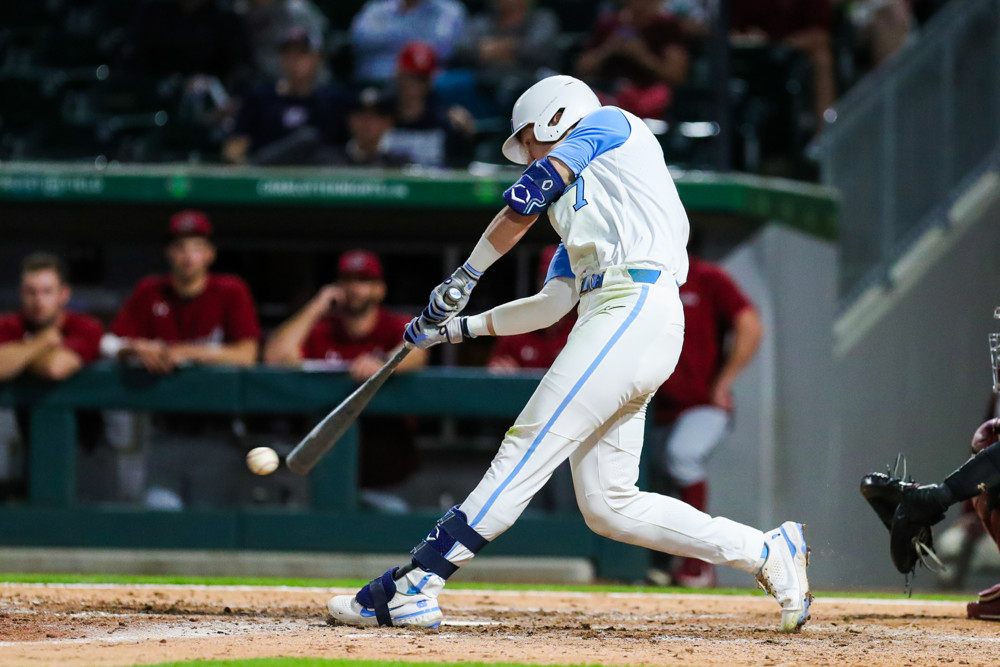
    Photo: David Jensen/Icon Sportswire

    Name: Vance Honeycutt

    College: University of North Carolina

    Bio: R/R 6-3, 205 lbs.

    DOB: 05/17/2003

    Skill Grade
    Hit 45
    Power 60
    Run 70
    Arm 55
    Field 70
    Future Value 60

    Written by Brandon Tew

    Analysis:

    Vance Honeycutt is the most exciting and most volatile player in the country. He’s one of the best athletes in the draft. He possesses the best physical tools with a combo of speed and strength that is hard to find. He’s built like an NFL safety and runs like a deer with long strides.

    Honeycutt put his supreme athleticism on display for three seasons in Chapel Hill and impacted games in multiple ways. Ultimately, Honeycutt’s biggest flaw is his inconsistency as a hitter which will decide his future in pro ball.

    College Career

    The career home run king for the Tar Heels mashed 65 dingers which he paired with 76 stolen bases, becoming the first Division I player in the career 60-70 club. 

    He strikes out too often (with a 26.5% career strikeout rate), but in 2024 he posted a slash line of .318/.410/.714.

    In the table below, you can see the dichotomy of Honeycutt who in 2024 decided to revert to his pulling and lifting ways to increase production. However, this upped his strikeout rate and his aggressiveness led to his lowest walk rate in college.

    Year HR SB WRC+ OPS K% BB%
    2024 28 28 151 1.124 27.5% 11.9%
    2023 12 19 121 .910 20.4% 19.6%
    2022 25 29 146 1.082 29.7% 13.5%

    Honeycutt capped off his North Carolina career with an absolute heater of a run. He put on an aircraft carrier performance for the Tar Heels, accounting for 38% of their offense in the NCAA tournament. His launching 6 big flies during the postseason run is the definition of clutch.

    Batting Stance:

    Honeycutt starts his stance with his feet and weight distributed in a comfortable position with his front foot a smidge outside of his left shoulder. As the pitcher breaks his hands, Honeycutt starts his leg lift, a simple medium-height lift that allows him to shift his weight into his back hip as he stacks his lower half.

    At the peak of his leg kick, Honeycutt moves his hands back, turning his front shoulder closed and shifting his front foot to show the bottom of his cleat. Moving forward he creates a stretch in his swing and extends his front arm back with his barrel snapping into an almost 45-degree angle behind his head.

    He brings his barrel through with quick hand speed that translates to the bat as he stops the momentum in his swing on his front leg decelerating his swing and momentum after contact

    At times, there is extra movement in Honeycutt’s swing with his lower half and hands not being fully synced. When he is on time with a good hand path, he impacts baseball as well as any other prospect. He also can produce damage in different parts of the zone but loves to get his hands extended.

    Approach:

    Here’s Honeycutt explaining his approach at the plate: 


    As a hitter, Honeycutt tries to get his “A Swing” off as much as he can, pulling and lifting the ball but can adjust and manipulate or delay his swing to stay on breaking pitches. 

    His walk-off against Virginia in the College World Series is a great at-bat as he stays on this slider after getting doubled up on the pitch. He is a little out in front but does well to get his bat to this ball and hook it into left field.

    Honeycutt is a definite guess-hitter which leads to some terrible-looking swings and non-competitive at-bats. His low swing percentage numbers both in and out of the zone suggest he’s looking for specific pitches early in at-bats. 

    His chase and whiff percentages especially on breaking balls further illustrate this point. Since Honeycutt is aggressive he will swing at spin hard. In certain at-bats, Honeycutt can look overmatched or in-between on his decisions, but he can deposit a ball over the fence at any point in a game if given a mistake pitch.

    Honeycutt crushes these mistake pitches, on both badly located fastballs and hanging changeups or breaking balls. He also pulls the ball a lot. By keeping the ball off the ground, the loft in his swing takes full advantage of his plus power on bad pitches.

    The biggest strides Honeycutt must make in his offensive profile is limiting swings and misses while still producing power. Improvement will come if his spin recognition improves and he stays in good-hitter counts in pro ball.

    In 2023, Honeycutt was getting pitched around at points and was a much more patient hitter in the box taking a high amount of walks (19.6% rate) and cutting his  strikeout percentage to 20.4%.

    However; a team might decide that the best version of Honeycutt generates a threat from a power standpoint even if it comes with swing and miss. Honeycutt provides hard contact when he squares the ball up and drives the ball from foul pole to foul pole. 

    We track college baseball data across Division I, charting as many games as we can. That allows us to use what we call our “Synthetic Statcast” tool to calculate some statistics that you normally wouldn’t be able to get. Here’s where Honeycutt ranks in Hard-Hit Rate and Barrel Rate among players in major conferences

    Hard Hit % Barrel %
    49.4% (97th) 12.8% (93rd)

    Defense: 

    Honeycutt is the best defender in college baseball. He won the Rawlings Gold Glove for Division I outfield last year and led the college center fielders we tracked with 7 Runs Saved in 2024. He’s a converted infielder who spent a couple of days on the dirt in Chapel Hill before moving to the outfield and then began patrolling centerfield a short time after that.

    There’s a natural ease at which Honeycutt moves and tracks the baseball. Not many base hits fall when Honeycutt is roaming in center and his ball-tracking skills have improved with time. His superb jumps and closing speed allow him to catch balls that other center fielders don’t come close to.

    Here’s a video of some of the outstanding plays Honeycutt made in his freshman and sophomore seasons.

    Add to it, this remarkable diving catch where he comes zooming into the right-center gap.

    And one more of him going back on this missile by Seaver King.

    Using our “Defensive Misplays” stat that we track for every game we chart throughout the season, we can take a closer look at what types of misplays each fielder is making. We define defensive misplays as “any play on which the fielder surrenders a base advance or the opportunity to make an out when a better play would have gotten the out or prevented the advancement.”

    We also track “Good Fielding Plays” where a fielder prevents an advance or records an unexpected out. He’s an excellent fielder and sometimes will dive or try to make plays that no one else can, and these numbers reflect that. Here’s a breakdown of Honeycutt’s last two seasons. 

    GFP Fly ball GFP Hr Robbery GFP OF Assist DM on Throw or Allowing Advance DM For Dropped Fly Ball or Bad Route
    10 2 3 9 3

    Honeycutt had a combined 15 Good Fielding Plays and 12 Defensive Misplays of those types. By comparison, Enrique Bradfield Jr., an Orioles first-round pick last year had 11 Good Plays and 7 Misplays in the games we tracked for him last season. So Honeycutt may be a little more high-risk, high-reward than Bradfield, who currently leads minor league center fielders in Defensive Runs Saved.

    Honeycutt uses his excellent timing, jumps, route efficiency, athleticism, as well as, a plus arm to make what feels like every play. With Gold Glove defense in center field that should take him to the big leagues at some point even if he doesn’t consistently hit.

    Projection:

    As an uber-athletic center fielder, Vance Honeycutt has star potential and on any given day can be the best player on the field. Impacting the game with his power, speed, and defense. When it comes down to it when he’s locked in his hit tool is a 50 and other days he might look bad with it showing more 40 and below. 

    His tools and raw talent are something to behold and his propensity to come up big in the big moments makes me think he can be a good enough hitter to thrive at the next level. 

    MLB Comp: Trea Turner production and speed. (Brenton Doyle with more power)

  • MLB Draft Scouting Report: Dakota Jordan

    MLB Draft Scouting Report: Dakota Jordan

    You can find all our MLB Draft scouting reports here.

    Photo: Michael Wade/Icon Sportswire

    Leading up to the MLB Draft, Sports Info Solutions Video Scouts will provide scouting reports on some of the top college players available.

    The reports will also feature some of the customized data that we’ve tracked this season. If you have any questions about that data, you can reach out to mark@ww2.sportsinfosolutions.com.

    Lightning-fast hands and thunderous raw power make Dakota Jordan one of the most captivating hitters in this year’s draft class. He has power to all fields, but struggled with strikeouts during his time in college which has left some scouts doubtful about his production at the plate.

    Name: Dakota Jordan

    College: Mississippi State University

    Bio: R/R 6-0, 220 lbs.

    DOB: 05/03/2003

    Scouting Grades on 20-80 Scale

    Skill Grade
    Hit 40
    Power 60
    Run 60
    Arm 50
    Field 50
    Future Value 50


    Analysis:

    Dakota Jordan is as intriguing as any prospect in this year’s draft class after two highly productive years at Mississippi State. He was a Day 1 contributor at State, starting 104 games across all three outfield spots.

    Jordan’s an exceptional athlete who in addition to being a highly touted baseball recruit, was a three-star wide receiver recruit who was committed to playing football at Mississippi State as well. He is known for his massive raw power and electric bat speed, both of which stem from a physically mature body in a medium-sized frame.

    College Career:

    Jordan showed marked improvement over his two years, with significant increases in his power and run production year over year.

    Year HR ISO K% BB%
    2023 10 .268 25% 14%
    2024 20 .317 29% 15%

    Jordan burst onto the scene as a freshman, earning Perfect Game Freshman All-American honors by slashing .307/.397/.575 with 40 RBI. He followed that up with an impressive .354/.459/.671 and 72 RBI’s this year, earning third team All-American team honors in 2024. While he did make strides at the plate with his quality of contact, there still was a great deal of swing and miss, with his strikeout rate increasing to 29% in 2024.

    We track college baseball data across Division I, charting as many games as we can. That allows us to use what we call our “Synthetic Statcast” tool to calculate some statistics that you normally wouldn’t be able to get.

    Here’s how Jordan stacks up to some of the other premier outfield prospects in this class in hard-hit rate and barrel rate for games we’ve tracked:

    Name Hard Hit % (percentile) Barrel %
    Dakota Jordan 50% (98th) 13% (93rd)
    Vance Honeycut 48.5% (97th) 12% (92nd)
    James Tibbs 44.5% (92nd) 12% (92nd)

    Stance:

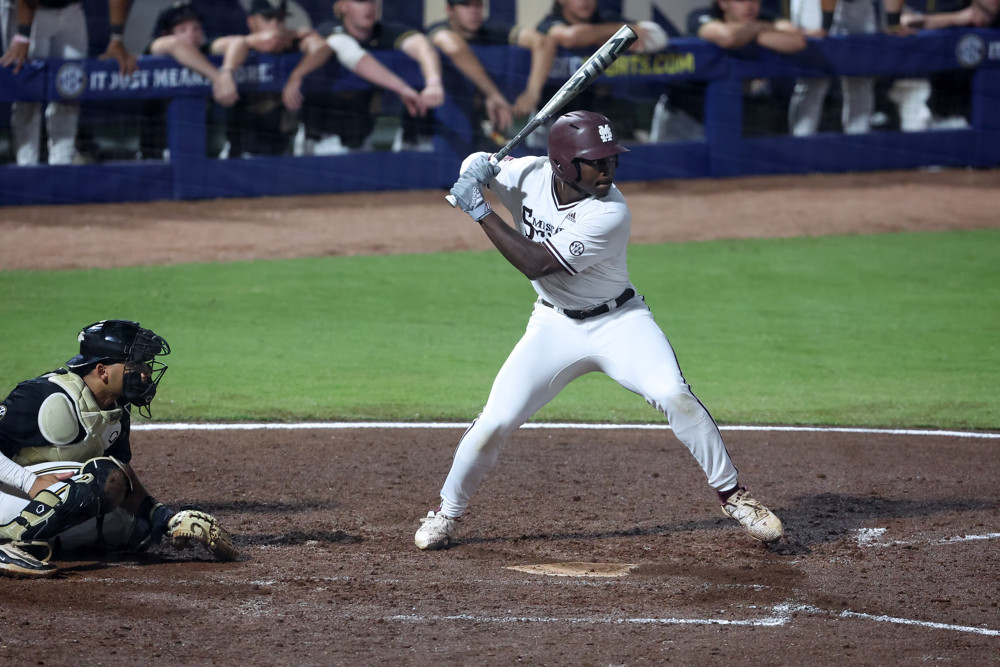
    Jordan sets up at the plate with a very wide base, his feet wider than his shoulders. He sinks into his legs as he waits for the pitcher, which helps him tap into the raw strength in his lower half.

    He keeps his bat almost parallel to the ground as he waits for the pitcher to make his move to the plate. Once the pitcher’s hands break in his delivery, Jordan initiates his swing with a short leg kick and turns his barrel up slightly to get into his launch position. As he drifts towards the pitcher, Jordan drags his hands back to create a stretch across his midsection before firing his hands at the ball.

    Jordan creates significant force and bat speed throughout his swing and as the barrel moves through the zone his lead leg straightens as he posts against it. He concludes his swing with a one-handed finish low over his left shoulder and his back foot slightly kicking out behind him.

    Approach:

    Jordan hunts fastballs middle-up in the zone, and with his elite bat speed he is able to turn around fastballs at any level. His aggressiveness on the fastball does leave him susceptible to breaking balls from both right- and left-handed pitchers, with a tendency to get beat by curves and sliders from right handers and changeups from lefties.

    This aggressive approach and tendency to try to catch the ball out in front does lead to a lot of strikeouts. Jordan struck out over 27% of the time over his two years at Mississippi State.

    His quick hands and power do allow him to make adjustments on pitches that he is fooled on and still do damage, which may lead to an adjustment in his approach at the next level. Jordan doesn’t need to sell out for the fastball to hit the ball hard, and by letting the ball get deeper, he will be able to stay on the offspeed pitches better.

    Take this pitch for example. He’s able to delay his hands enough on this fastball that is way outside the zone and hammer it out to right-center field.

    Defense:

    Jordan isn’t an above-average outfield defender presently but has the athletic traits to become a suitable corner outfielder at the major league level. Possessing plus straight-line speed, his range will improve with more reps in the outfield as he gets more comfortable reading the ball off the bat. Coupled with an average arm, Jordan should have no problem holding down either of the corners of the outfield, with the ability to fill in at center field if needed.

    Projection:

    Oozing with physical tools, Dakota Jordan projects to be a power hitting corner outfielder at the major league level. He may experience some growing pains early in his minor league career as he adjusts to higher-level offspeed pitches, but his elite bat speed and strength should continue to produce loud contact as long as he makes better swing decisions.

    MLB Comp: Marlins outfielder Jesús Sánchez

    Draft projection: Between picks 15 and 30

  • Which Teams Are Best at Drafting, Developing and Displaying DRS?

    Here at Sports Info Solutions, we have lots of data. One subset of data we have is MLB Draft data. In exploring it, it got me thinking: which teams are the best at drafting players who end up producing lots of Defensive Runs Saved for the team that drafted them?

    Here are the top five and bottom five teams since we began tracking DRS in 2003.

    TeamDRS
    Cardinals412
    Braves366
    Blue Jays294
    Red Sox293
    Giants277
    —–—–
    Rockies-58
    Tigers-61
    Phillies-77
    Yankees-122
    Pirates-182

    A lot of this checks out; the Cardinals are known for prioritizing good defense and also home-grow lots of players. On the other side of things, the Pirates have had a lot of really bad teams since 2003, and really bad teams tend to have really bad defenses.

    Now, let’s take a look at who the main contributors and culprits are for the top and bottom teams. Let’s start with the good: who’s padded that Cardinals number? Keep in mind there are plenty of other players who’ve posted a positive DRS, and also a handful whose DRS is negative.

    PlayerPosition(s)DRS
    Yadier MolinaC169
    Albert Pujols1B/3B/LF/RF119
    Brendan RyanSS/3B/2B52
    Kolten Wong2B/CF42
    Harrison BaderCF/RF27

    Just about every national broadcast–and Cardinals broadcast to boot–finds a way to talk about how good Molina’s defense is, and with good reason: he’s really good! More than any other aspect of his game, Molina’s value has come from throwing out runners on the bases, having saved 54 runs doing so. But he also excels at making Good Fielding Plays without making many Defensive Misplays or Errors (46 GFP/DME Runs Saved) and framing pitches (41 Strike Zone Runs Saved).

    Now with the Angels, Pujols is no longer the relatively fleet-of-foot multi-positional star he once was, but back in the day, he was the guy on defense. His 2007 season, in which he saved 31 runs, remains the single-season DRS zenith for a first baseman. Since DRS started in 2003, we’ll never know what Pujols’ all-over-the-diamond rookie season was like, but, for what it’s worth, most of his value came from his time at first base: he’s at -4 in left field from his time there in 2003, and at a net zero at 3B (-1 in his last season with the Cardinals, +1 in his first season with the Angels). Even without Pujols, though, the Cardinals would still be the sixth-best team; that’s how good they’ve been at drafting MLB-quality bats who can also produce positive defense.

    And now, for the not so good. Here are the five biggest culprits of the Pirates’ league-low defensive drafting.

    PlayerPosition(s)DRS
    Andrew McCutchenCF-68
    Jose Bautista3B/RF/CF-45
    Pedro Alvarez3B/1B-40
    Ryan DoumitC/RF/1B-36
    Nate McLouthCF/RF/LF-25

    McCutchen was a perfectly adequate center fielder in his first five years in the majors, with a DRS of -5; not good, but not horrible. It’s his last four years as a Pirate that really tanked his defensive value, with seasons of -13, -8, -28 and -16. He wasn’t even close to average in any direction in those last four seasons in Pittsburgh; his total Plays Saved in that time was -14 on shallow fly balls, -15 on medium fly balls, and a staggeringly low -28 on deep fly balls.

    For Bautista–the very same player who ended up slugging hundreds of memorable home runs while finding a home in right field as a Blue Jay–the main issue was in his time at third base. From 2006-07, he played about 1,300 innings at the hot corner, and combined to put up a -34 Plays Saved, including -11 on just 82 total defensive chances in 2006. His time in center field didn’t help either, where his DRS in 2006 was -10.

    Teams draft players based on not just offense, but projected defensive contribution as well, and while teams may be willing to give up a little bit on the defensive side of the ball when they have hitters as good as McCutchen, most teams can’t afford to. When looking at all 30 teams, it’s no surprise that the Cardinals are competitive just about every year, racking up homegrown DRS like nobody else. On the flip side, the teams at the bottom of the list are going to need better defense from their draftees.

  • 2019 Top College Baseball Draft Prospects: Middle Infield (Part 2)

    Over the next month leading up to the 2019 MLB Amateur Draft, Baseball Info Solutions will be publishing a series of position-by-position scouting reports from our Video Scouts for the top-50 collegiate draft prospects. Each player is graded by the 20-80 scouting scale, given a comprehensive evaluation, and assigned a floor and a ceiling comparison, which indicate–if a player makes the Major Leagues–the range of the type of player into which he can develop.

    Full coverage:
    Catchers
    Corner Infield (Part 1)
    Corner Infield (Part 2) 
    Middle Infield (Part 1)
    Middle Infield (Part 2)
    Outfield (Part 1)
    Outfield (Part 2)
    Left-Handed Pitching (Part 1)
    Left-Handed Pitching (Part 2)
    Right-Handed Pitching (Part 1)
    Right-Handed Pitching (Part 2)

    This post covers the second half of our middle infielders. Though none of these players should be drafted in the first round, the group offers an exciting mix of toolsy shortstops and a high-floor second baseman. All of these middle infielders are projected to be drafted between the second and fourth rounds.

    Each one of these players has played the majority of his time this season at shortstop. Cameron Cannon is the only player to be projected as a second baseman. Greg Jones and Will Holland are future shortstops with the best speed of the group. Brady McConnell has the largest build and power of the bunch, while Josh Smith is the smallest but best pure hitter.


    Josh Smith, SS
    Louisiana State University (JR, 2019)
    L/R 5-10, 172 lbs.
    Date of Birth: 08/07/1997

    Hit- 45 (60) Power- 35 (50) Run- 50 (50) Arm- 50 (50) Field- 50 (50)

    Written by Mitch Glessner

    Analysis
    A former 38th-round pick out of high school, Smith began his collegiate career in 2017 with high expectations. He exceeded those expectations by earning Freshman All-American honors, playing in 71 games for the Tigers. After missing most of the 2018 season due to injury, Smith has made a strong case to be one of the first shortstops taken this upcoming draft, posting a .348/.444/.525 batting line this season.

    Smith holds the bat vertically and stands with a slightly open stance in his setup. Normally he has roughly a six-inch stride with a small leg kick involved. With two strikes, he will get lower to the ground and take away his stride for a more simplified approach. He will also do this when facing pitchers who rely on their off-speed stuff. Smith possesses rare talent in his ability to utilize his hands in his swing. He is able to use his hands so well because of how far back he keeps them. They start back, and remain behind the rest of his body as he initiates his swing. This allows him to keep the barrel in the hitting zone for a long time and spray the ball to all fields. Power is not Smith’s biggest strength, but he does drive the ball on pitches low in the zone. He has a flat bat plane, which results in a lot of line drives and a high contact rate. He takes an aggressive approach early in counts, and has the ability to become a pest by dragging out at-bats when behind in the count.

    In the field, Smith has an above-average arm that plays well at shortstop. His quick transition out of the glove and good internal clock make up for his average foot speed. He consistently makes accurate throws with good carry. He has the range to stick at shortstop and is better moving to his left on balls up the middle.

    Outlook
    What makes Smith so attractive is his natural swing with flashes of power despite being slightly undersized. He should be able to tap into more of his raw power as he gets stronger. The learning curve at the next level should not be a problem given the natural instincts he has on both sides of the ball. Smith has the skills and makeup to be an above-average major league shortstop.

    Projection: Everyday shortstop with well-rounded skill set and elite intangibles.

    Ceiling: Jason Kipnis
    Floor: Eric Sogard
    Draft Expectation: Rounds 2-3


    Greg Jones, SS
    UNC Wilmington (SO, 2019)
    B/R 6-02, 190 lbs.
    Date of Birth: 7/24/1997

    Hit- 35 (45) Power- 40 (50) Run- 70 (70) Arm- 55 (55) Field- 50 (55)

    Written by Will Hoefer

    Analysis
    Greg Jones is a draft-eligible sophomore out of a mid-major program, but has gotten opportunities to see ACC pitching in 2019 due to UNC Wilmington’s proximity to major programs like UNC and NC State. Early in the year, Jones was more inclined to utilize legitimate plus-plus speed to generate his offensive output. He had a controlled, compact stroke from both sides of the plate that he kept flat to generate as much line drive and ground ball contact as possible.

    Later in the season, Jones showed a more concerted effort to try and get to his above-average raw power. It was, and still is, very much a work in progress; he had trouble planting his back leg to drive the ball, and the increased length of his swing exacerbated his issues with hitting advanced breaking balls. Still, he has flashed plus bat speed and used his hands better of late, generating more loft on contact.

    Defensively, Jones looks every bit like a guy who can handle shortstop. He has smooth and quick lateral movements and enough arm strength to make the throws he needs to make. He sometimes looks like he lacks urgency when making plays, but there’s nothing attitude- or effort-wise to suggest this will be any sort of issue.

    Outlook
    On tools alone, Jones is easily a top-10 talent. However, he’s very raw offensively and will be a project for any team that takes him in this year’s draft. There’s star potential here if Jones can stick the landing with the adjustments he’s making in the batter’s box, with a floor of a bottom-of-the-order middle infielder who sprays the ball and causes havoc on the basepaths.

    Projection: High-upside speedster with raw offensive tools and an ability to stick at short.

    Ceiling: Adalberto Mondesi
    Floor: Jonathan Villar
    Draft Expectation: Rounds 2-3


    Cameron Cannon, 2B/SS
    University of Arizona (JR, 2019)
    R/R 5-10, 196 lbs.
    Date of Birth: 10/16/1997

    Hit- 45 (55) Power- 40 (45) Run- 50 (50) Arm- 50 (50) Field- 50 (55)

    Written by Dominic Asta

    Analysis
    Cameron Cannon is a compact 5-foot-10, 196-lb. middle infielder at the University of Arizona. He is in the midst of an outstanding junior season, hitting .370/.462/.587. Cannon has been moved around the infield this season, playing both second base and shortstop. He is a capable defender at either spot, but will most likely end up at second base long term. He has had a very impressive college career and has a ton of experience with wood bats, playing each collegiate summer in a different wood bat league. He is a contact hitter with sneaky power and the ability to play multiple positions. This tool set should get him selected in the first three rounds in June’s draft.

    Cannon sets up deep in the batter’s box and leans heavily on his back leg. He has a wide, low stance and a small toe tap as he loads for the pitch. He has a quick bat and an uppercut swing that produces a good deal of fly balls and line drives. He uses his lower body and great hip rotation to explode on the ball and spray line drives gap to gap. He currently leads the country in doubles and should grow into close to average power at the next level. Cannon excels at putting the ball in play, as he has struck out in less than 12 percent of his plate appearances this year (which is higher than his minuscule 8.4 percent last season). He is a selective hitter at the plate and is willing to take walks if he does not get his pitch. He currently has 74 walks compared to 58 strikeouts in his college career. He has the makings of a great contact hitter with doubles power and low strikeout numbers.

    Cameron has played all over the infield throughout his college career. He has played mostly second base and shortstop at Arizona, but played third base in the Cape Cod League this past summer. He has made a concerning number of errors this season and will most likely be moved off of shortstop at the next level. He possesses an accurate arm, but not the type of zip you want to see at shortstop. He has solid arm strength that plays better at second or third, and his great footwork and sure hands allow him to play those positions adequately. Cannon does not have great speed out of the box and is consistently 4.4-4.5 from home to first. He is a bit quicker when he is underway and at full effort.

    Outlook
    Cameron Cannon has solid tools across the board and a track record of success with wood bats. He has a high floor and the ability to play multiple positions in the infield. He is a good defender at second and third base, while also being capable of filling in at shortstop. He has the swing mechanics and plate coverage to hit for average and mostly doubles power. Based on his skill set, Cannon should be drafted in the first few rounds.

    Projection: Strong-hitting second baseman with solid tools and a high floor.

    Ceiling: Mark Ellis
    Floor: Gordon Beckham
    Draft Expectation: Rounds 3-4


    Brady McConnell, SS
    University of Florida (SO, 2019)
    R/R 6-03, 195 lbs.
    Date of Birth: 05/24/1998

    Hit- 45 (60) Power- 45 (60) Run- 55 (50) Arm- 60 (60) Field- 50 (60)

    Written by Harris Yudin

    Analysis
    Brady McConnell is one of the tougher collegiate players to project considering he has less than one full season of college experience under his belt. The draft-eligible sophomore totaled just 22 plate appearances as a freshman, but has enjoyed a terrific 2019 campaign in his first — and perhaps last — real taste of college ball. Across 204 plate appearances this season, the Gators’ shortstop has slashed .360/.415/.602 with 12 homers and five stolen bases, driving in 40 runs and scoring 42 more. His 1.017 OPS as of May 8th puts him fifth in the SEC.

    McConnell displays an open stance at the plate, utilizing a small leg lift towards the plate as the pitch approaches. He waves his bat around pre-pitch, but keeps his head and body quiet throughout his smooth, uppercut swing. He uses a quick bat and strong lower half to generate big raw power, and there is plenty of room for more power projection as he fills out over the next couple of years.

    A notorious fastball hitter, McConnell will often jump on the first pitch. He can get jammed on inside pitches, and occasionally makes the decision to swing too late. While he does have a tendency to chase breaking balls low and away, he has flashed the ability to get down and drive them. An overall aggressive hitter, he could benefit from being more selective and trying to draw more walks.

    The 21-year-old possesses above-average speed that he uses to his advantage on the basepaths and in the field. He has a quick reaction time and gets a good jump on stolen base attempts, but can be overly aggressive at times.

    Defensively, McConnell flaunts solid range both up the middle and in the hole, and can track down fly balls in the shallow outfield. He has good instincts charging in, and uses his soft hands to eat up hard-hit balls. He has a knack for making highlight reel-type plays, but can occasionally get complacent and make avoidable errors. He has an incredibly strong arm, with the ability to throw on the run and across his body, although he has a habit of double clutching before making a throw. While there are no concerns about McConnell’s ability to stick at shortstop for the immediate future, a move to third base — where he could be a plus defender — isn’t out of the question if he were to bulk up and lose some of his mobility.

    Outlook
    McConnell has off-the-charts tools and athleticism, but a limited college track record by age 21 — plus the possibility that he could choose to return to Gainesville — may hurt his draft stock a bit. Whichever team pulls the trigger on the sophomore, however, could be getting a cornerstone-type infielder at a great price. McConnell has some of the highest upside in this class, but has to go a very long way to reach it.

    Projection: Potential five-tool shortstop with All-Star upside but limited track record.

    Ceiling: Troy Tulowitzki
    Floor: Trevor Plouffe
    Draft Expectation: Rounds 3-4


    Will Holland, SS
    Auburn University (JR, 2019)
    R/R 5-10, 180 lbs.
    Date of Birth: 04/18/1998

    Hit- 30 (40) Power- 35 (40) Run- 60 (60) Arm- 60 (60) Field- 50 (50)

    Written by David Salway

    Analysis
    Will Holland is a 5-foot-10, 180-lb. shortstop from Auburn University who has had an up-and-down college career. During his freshman campaign in 2017, he was a below-average hitter, but the cornerstone of Auburn’s defense. Between 2017 and 2018, he made a huge leap on offense, hitting .313 with a .530 slugging percentage thanks to 12 home runs and 18 doubles, to go along with a .406 on-base percentage. However, he has regressed in the 2019 season, with his batting average and slugging both down over 100 points year over year.

    He has quick bat speed, but has a lot of swing and miss in his game. Holland is a patient hitter at the plate and will draw walks at an above average rate. He has a small load and can occasionally get lazy in his lower half, leading to a lack of contact or weak contact. When he does make contact, he is prone to popping the ball up due to his uppercut swing. While this could lead to the possibility of more home runs, he struggles with pitches low in the zone. So far in 2019, Holland has struck out 23 percent of the time, up seven percentage points from 2018.

    On defense, Holland is one of the best current-tool shortstop prospects in the draft. He is quick, shows great range and flashes a plus arm. The Auburn SS is prone to making errors, typically with the glove, which is average. However, his arm can make up for his lack of soft hands and tendency to not move his feet to get in proper position. Holland’s movements are smooth and he makes playing SS look easy compared to his peers. Occasionally, he will lack effort and it will seem as if he is not giving it his all, but more often than not he is able to perform as one of the premier defenders in the SEC.

    Outlook
    Holland will likely top out as a utility player, with the possibility of becoming a Quad-A type of middle infielder. If he reaches his full potential, though, he could become an MLB regular at SS, with the prospect of 10-15 HR per year to go along with above-average defense.

    Projection: Defense-first middle infielder who will need to maximize his hitting ability to become an impact player.

    Ceiling: Orlando Cabrera
    Floor:
    Taylor Featherston
    Draft Expectation: Rounds 3-4


    Other middle infielders to keep an eye on:
    Christian Koss, UC Irvine
    Grae Kessinger, University of Mississippi
    Michael Massey, University of Illinois
    Chris Cornelius, University of Missouri

  • 2019 Top College Baseball Draft Prospects: Corner Infield (Part 2)

    Over the next month leading up to the 2019 MLB Amateur Draft, Baseball Info Solutions will be publishing a series of position-by-position scouting reports from our Video Scouts for the top-50 collegiate draft prospects. Each player is graded by the 20-80 scouting scale, given a comprehensive evaluation, and assigned a floor and a ceiling comparison, which indicate–if a player makes the Major Leagues–the range of the type of player into which he can develop.

    Full coverage:
    Catchers
    Corner Infield (Part 1)
    Corner Infield (Part 2) 
    Middle Infield (Part 1)
    Middle Infield (Part 2)
    Outfield (Part 1)
    Outfield (Part 2)
    Left-Handed Pitching (Part 1)
    Left-Handed Pitching (Part 2)
    Right-Handed Pitching (Part 1)
    Right-Handed Pitching (Part 2)

    This next piece covers the remaining corner infielders. There are 10 total first and third basemen in our top 50, all of whom are likely to come off the board in the first four or five rounds of the draft.

    As with the first group of corner infielders, these players all possess a robust offensive profile, albeit with less upside. However, as a whole, these five players exhibit stronger defensive skills and more versatility. Kody Hoese and Nick Quintana can play all over the infield; Michael Toglia projects as an above-average defender at first base or in left field; and Aaron Schunk’s plus arm is valuable no matter where he plays. Spencer Brickhouse is the lone exception here, but even he could be a passable defender at first.


    Kody Hoese, 3B
    Tulane University (JR, 2019)
    R/R 6-04, 200 lbs.
    Date of Birth: 07/13/1997

    Hit- 40 (55) Power- 55 (65) Run- 45 (50) Arm- 50 (55) Field- 50 (60)

    Written by Quinn Ireland

    Analysis
    Kody Hoese is perhaps the highest and quickest riser in the college ranks this year. His main appeal comes from his ability to hit the ball all over the field while having a great feel for the strike zone. He has shown steady improvement each year at Tulane, and currently boasts an impressive .415/.500/.872 slash line. While those numbers won’t be realized at the next level, he should continue to hit for average and power as he moves up the ranks.

    Hoese is a strong-bodied guy with a hit tool that could push him into the late first round. More likely to be a compensation round pick, he does most of his damage with extra-base hits all around the park. Not a pull-dominant player, he has shown gap-to-gap power as well as over-the-fence ability — he has 20 homers already this year, and 52 percent of his hits have gone for extra bases. Hoese is never going to be a burner on the base paths, but has shown an ability to swipe bases (four steals in four attempts this year) and could potentially keep that up at the next level. His competition has not been exceptional this year in the American Athletic Conference, which does leave some question marks, but his whole body of work seems to speak for itself.

    The size/power combo he is showing currently would generally push him into a corner of the infield. At third base, he looks to move well (he was a shortstop in high school) and has a decent feel for the position. His arm hasn’t impressed, but with progression, it should at least be average, and maybe even a step above. His glove is solid, and with traditional progression could turn into a plus as well. Hoese should stick at third, but be could probably slide over to the keystone and be above-average.

    Outlook
    A team that is looking for an impact bat at a corner infield spot is going to have to take a long, hard look at Hoese. Should the recent power surge turn out to be more than a one-year wonder, he could turn into a top-flight offensive third baseman. Even if the power production is unsustainable, Hoese walks more than he strikes out and should get on base at a high rate, making him a valuable player at either second or third base.

    Projection: Offensive-minded third baseman with on-base skills and decent power.

    Ceiling: Mike Lowell
    Floor: Hunter Dozier
    Draft Expectation: Rounds 1-2


    Nick Quintana, 3B
    University of Arizona (JR, 2019)
    R/R 5-10, 190 lbs.
    Date of Birth: 10/13/1997

    Hit-  40 (50) Power- 50 (60) Run- 50 (50) Field- 60 (65) Arm- 60 (60)

    Written by Dominic Asta

    Analysis
    Nick Quintana has been on the radar of scouts for a long time. He was drafted in the 11th round by the Red Sox in the 2016 MLB Draft. He has been a regular in the Wildcats lineup for three years and has been a force with the bat his last two seasons. Quintana has a pretty right-handed swing that has produced great power in college. He looked good in the Cape Cod League last summer and has improved his walk percentage in his junior year. He has some swing-and-miss in his offensive game but his power combined with a good glove at third should make him very appealing on draft day.

    Quintana gets the most out of his small frame at the plate. He has a big stride and leg kick as he transfers his weight forward that produces hard-hit balls and swings-and-misses. He gets up on his front foot too often and his hands do not stay back, which makes him off balance in his swing. He will make the pitcher work and get himself into deep counts that will lead to some of his strikeouts. Quintana has great bat speed. Quintana could benefit from quieting his approach and focusing more on contact than power. A jump in his BB% has been very encouraging even though he is still striking out at a 23 percent clip. His pitch recognition needs work and his struggles with breaking pitches needs improvement.

    Quintana has played third base while in college but has the athleticism and glove to play at second base and shortstop. He will most likely be a third baseman at the next level, but could fill in at second or shortstop if need be. He has fluid actions at third and arm strength to make throws on the run and deep in the hole. He will make Web Gem-like plays and looks very comfortable at the hot corner, but will need to improve his lateral range and consistency if he wants to be a plus-plus defender.

    Outlook
    Nick Quintana has an exciting package of tools and is a player that makes it look easy at times. He is also a player that has some concerning question marks. His strikeout numbers and lack of contact are concerns that he has not addressed in Cape Cod or in his junior year. He should be a plus defender with good athleticism and above average power at the next level.

    Projection: Versatile infielder with good power and potential Gold Glove defense.

    Ceiling: Brandon Inge
    Floor: Brett Lawrie
    Draft Expectation: Rounds 2-3


    Michael Toglia, 1B/OF
    UCLA (JR, 2019)
    S/L 6-05, 226 lbs.
    Date of Birth: 08/16/1998

    Hit- 45 (55) Power- 55 (65) Run- 50 (45) Arm- 50 (50) Field- 55 (60)

    Written by Harris Yudin

    Analysis
    Following an ice-cold start to the 2019 season, Michael Toglia began Pac-12 play on a torrid pace. As of April 29, the 20-year-old switch hitter owns a 1.112 OPS with eight home runs and 31 RBI across his last 133 plate appearances. He has a history of slow starts and streaky play — slashed just .209/.307/.388 in 36 games in the Cape Cod League in 2018 — but the upside is enormous.

    Toglia flaunts a big, projectable frame with huge power upside from both sides of the plate. He has filled out a bit in his junior, but there should be even more to come in terms of physical development. He utilizes an open stance from both sides, striding towards the plate and getting his foot down before the pitch arrives. He generates good bat speed and turns on the ball well by shifting his weight, making consistent hard contact to all fields and finishing with good extension. His stroke is a bit smoother from left side — there’s a habit of occasionally dropping his hands from the right side, leading to a less direct path to the ball — but there are no concerns about his being a switch hitter at the next level.

    A patient hitter, Toglia prefers to attack high pitches, and is much more selective on lower pitches, which helps him draw walks but also leads to too many strikeouts looking. While he is adept at driving fastballs up, he can sometimes pull his body out, lose his balance and not stay in on the ball, causing him to whiff or foul off pitches he’d normally crush. Additionally, he has a tendency to get out ahead of breaking balls.

    Toglia doesn’t possess much speed, but he can move on basepaths due to his long strides and athleticism. That athleticism helps him play an above-average first base, where he has good footwork around the bag and uses his length to stretch for throws from infielders. Despite his size, he can get low to field grounders and snag throws in the dirt. A move to a corner outfield spot could be an option — his average arm would play better in left — but UCLA’s first baseman should be able to stick at his natural position in pro ball.

    Outlook
    Toglia is a streaky hitter and, overall, still a bit raw, but the combination of athleticism, patience and power points to a future of high offensive production. He will likely fall outside the first round on draft day, but has the upside to provide a ton of value in the second or third round.

    Projection: Athletic, switch-hitting first baseman with plus power and defense.

    Ceiling: Brandon Belt
    Floor: Ike Davis
    Draft Expectation: Rounds 2-3


    Spencer Brickhouse, 1B/DH
    East Carolina University (JR, 2019)
    L/R 6-04, 235 lbs.
    Date of Birth: 04/10/1998

    Hit- 45 (55) Power- 50 (60) Run- 40 (30) Field- 40 (50) Arm- 50 (50)

    Written by Dominic Asta

    Analysis
    Spencer Brickhouse has displayed some of the most consistent power out of any hitter in the 2019 draft class. Based on his power numbers and his strong 6-foot-4, 235-lb. frame, he can be described as a slugger. He has launched double-digit home runs in each of his three years as a starter. He is not only a power hitter, though — he also has a patient offensive approach and an ability to make contact. Brickhouse has been a first baseman, left fielder and designated hitter at East Carolina, and has shown a solid arm and soft hands at first. The 2018 Cape Cod All-Star Game MVP has continued his climb up draft boards with a very impressive junior campaign. He has improved each year at ECU, and should be one of the first college first basemen taken in the draft.

    Brickhouse has a unique swing that has no stride and very little lower body movement. He has a stiff upper body with his hands at his head and a wide, crouched stance. He lifts his front heel and sets it back down as he loads his hands forward. He uses his upper body strength to drive the ball to all fields and good bat speed to make consistent hard contact. His pull-side power is plus, and most of his home runs this season have been to right field. His power numbers have increased in his junior year, with 12 home runs and a .348 isolated power. Brickhouse is short to the ball with an uppercut swing path. He doesn’t utilize his lower body in swing and struggles with plate coverage because of his stiff upper half. As a result, he may be exposed at the next level with velocity up in the zone. His swing does allow him to recognize pitches and keep his head on the ball, however, and he has improved his plate discipline each year at East Carolina– he is currently sporting an impressive 19 percent walk rate.

    Brickhouse will need to maintain his weight and body if he intends to stick at first base and not be relegated to designated hitter. He is a good enough athlete currently to stick at first, but doesn’t have the range or lateral movement to be a plus defender. A move to left field would be an aggressive position switch. He has only played left field a couple of times his junior season. His below-average speed and agility would make him a below-average defender in left. Although he derives most of his value from his bat, a move to DH would place even more pressure on his offensive game.

    Outlook
    Brickhouse has shown the ability to be a high on-base, slugging first baseman this year at ECU. His upper body strength has allowed him to be a great power hitter at the college level, but he could struggle at the next level when he faces stiffer competition and higher velocity. His swing may be modified after he gets drafted to help incorporate his lower body more. He will most likely be limited to first base unless a team wants to be aggressive and put him in left field, where his below-average speed would be tested. His advanced bat should help him rise through the minors fairly quickly and provide a team with a powerful lefty bat.

    Projection: Patient slugger with potential for 20-plus homers per year.

    Ceiling: Ryan Klesko
    Floor: Justin Bour
    Draft Expectation: Rounds 3-4


    Aaron Schunk, 3B
    University of Georgia (JR, 2019)
    R/R 6-02, 205 lbs.
    Date of Birth: 7/24/1997

    Hit- 45 (50) Power- 55 (55) Run- 50 (45) Arm- 60 (60) Field- 45 (45)

    Written by Will Hoefer

    Analysis
    Aaron Schunk has had a breakout year at the hot corner in his junior season at Georgia. He currently owns a .908 OPS with seven home runs on the season. He has also been a very reliable closer for the Bulldogs, posting a 2.14 ERA with 11 saves. His future will be as a hitter regardless of what position he ends up playing. Schunk has greatly improved his draft stock this year and should hear his name called in the first five rounds.

    Schunk is a large-framed, thick third baseman who has finally tapped into his raw power during his junior year at Georgia. A fairly aggressive contact hitter at the plate (only 16 percent of his plate appearances end in a walk or a strikeout), he demonstrates decent hand speed and a bit of length in his swing, but controls the bat well. He generates above-average bat speed and should continue to generate above-average power at the professional level.

    Unsurprising for a relief pitcher, Schunk has a plus arm but slightly below-average range at third base. With good positioning he could stick at the hot corner, and that’s starting to become less of a specific fit as organizations learn how to use defensive data to place their infielders. His skillset in the field, despite strong instincts at third, projects better in right field where his plus arm plays very well amidst a decline in foot speed.

    Outlook
    Schunk has solid tools across the board, with intriguing raw power and a plus arm that buoys some of his limitations in the field. He’s a tweener in about every sense of the word; if he can get some more power out of his aggressive approach as a pro then there’s a strong chance he sticks as a starter in either RF or 3B. Even if he doesn’t, there’s a solid floor here as a right-handed platoon bat who isn’t a liability on defense.

    Projection: Power bat and power arm profiles best at third or right field.

    Ceiling: Chase Headley
    Floor: Brandon Guyer
    Draft Expectation: Rounds 3-4


    Other corner infielders to keep an eye on:
    Tristin English, Georgia Tech
    Brandon Lewis, UC Irvine
    Edouard Julien, Auburn
    Evan Edwards, North Carolina State