Author: alecjdopp

  • How has Mike Trout’s Glove Declined?

    How has Mike Trout’s Glove Declined?

    “Five-tool player” is a term that gets thrown around in baseball circles a bit more than it probably should these days, but one player we can unequivocally agree who fits that mold is the man patrolling center for the Angels most nights: Mike Trout. The 24-year-old comfortably leads baseball with 42.5 Wins Above Replacement according to FanGraphs (fWAR) since 2012. He is the only player with at least 100 home runs and 100 stolen bases in that span, too. And according to Bill James’ Skills Assessment metrics, Trout ranks at or above the 92nd percentile of all hitters with respect to hitting for average, hitting for power, running, and plate discipline; and, among center fielders, he ranks in the 78th percentile for fielding. In other words, Trout is as close to the prototype of a five-tool player as one can hope to find.

    Given the way 2016 has started for Trout—he ranks second in fWAR and has 17 home runs and 11 stolen bases—his reputation doesn’t appear to be in much danger. However, one of those five important tools might be on the decline: his glove.

    Trout’s outfield defensive chops looked elite at the start of his career. In his rookie season of 2012, Trout finished second among center fielders with 21 Defensive Runs Saved (DRS). However, since then, Trout has cost the Angels 19 runs, tied for sixth worst at the position.

    The surface numbers suggest a decline for Trout’s glove in recent seasons, a trend supported by some of BIS’s categorical data: Descriptive Defensive Information and Play Difficulty Grades. In 2013, BIS video scouts began tracking the lateral movements (back, forward, right, left, everything in-between), fielding approach (standing, jogging, sprinting, diving, jumping, etc.), fielding method (forehand, backhand, over the shoulder) and difficulties (routine, easy, moderate, difficult, impossible) of every play over the course of the entire regular season. The data serves as a valuable means in understand and evaluating defense.

    After sifting through Trout’s Descriptive Defensive Information, I identified several areas in which Trout may have already taken a step backward this season. We will begin with the following graph:

    [googleapps domain=”docs” dir=”spreadsheets/d/1hCnNZV8vrE8xLdr7ikAkJORffYWKhOSigNqLZ_7niMI/pubchart” query=”oid=1507324198&format=image” width=”600″ height=”371″ /]

    The data presented above shows Trout’s fielding conversion rate by specific Play Difficulty Grade from 2013-16. What is important to notice here is the decline shown on plays in the two most difficult categories: 50/50 plays, and difficult plays. Generally speaking, moderate plays are plays that a league-average fielder could get to roughly half the time; a “toss-up” one might say. Difficult plays take things to the next level; any play filtered under this category by BIS video scouts are plays that might be considered Web Gem quality. As such, conversion rates on moderate and difficult plays are a good way to identify fielders with above-average range at their respective position on the diamond.

    Having said that, the trends above now appear to be rather concerning. This season, Trout has had 12 fielding opportunities classified under “moderate” for an average center fielder and has converted only 7 (58.3 percent) of them into outs. Additionally, he has had 22 opportunities to convert a “difficult” play into an out and has yet to convert one. Those are both considerable drop-offs from past seasons. In fact, from 2013-2015, Trout converted 88.6 percent of moderate plays and 18 percent of difficult plays as a center fielder. For comparison, the league-average center fielder converted 73 percent of moderate plays and 18.3 percent of difficult plays during that stretch. So, Trout could have been considered slightly above average in making tough outs.

    What reason(s) could be behind this plunge in defensive ability? Certainly, there is evidence to suggest that defense and running are two tools that peak the earliest in a player’s career. Perhaps Trout could already be experiencing some decline in this respect. According to BIS’s baserunning data, Trout’s average home-to-first time in double-play opportunities is 4.17 seconds this season. That still grades out well for most right-handed hitters, but it does represent his slowest average home-to-first time in a season since BIS began tracking that data in 2013 (4.07 in 2013, 4.12 in 2014, 4.16 in 2015).

    Another theory? Perhaps Trout has simply become more risk-averse.

    [googleapps domain=”docs” dir=”spreadsheets/d/1hCnNZV8vrE8xLdr7ikAkJORffYWKhOSigNqLZ_7niMI/pubchart” query=”oid=495043280&format=image” width=”600″ height=”371″ /]

    We have already established that Trout was a better defender earlier in his career, specifically due to his ability to convert difficult balls in play into outs. Part of the reason he was able to get to those balls? Perhaps it had something to do with his “all-out” approach in center. As you can see above, Trout was much more likely to dive for a ball in order to convert an out earlier in his career than he is in 2016. In fact, of his 265 fielding opportunities in center field this season, Trout has yet to attempt one dive for a ball in play. That is a remarkable statistic considering where he has come from in this respect. In 2013, Trout was far more likely to dive than the league-average center fielder, with 2.17 percent of his fielding chances classified as “diving.” Every year since, that has decreased.

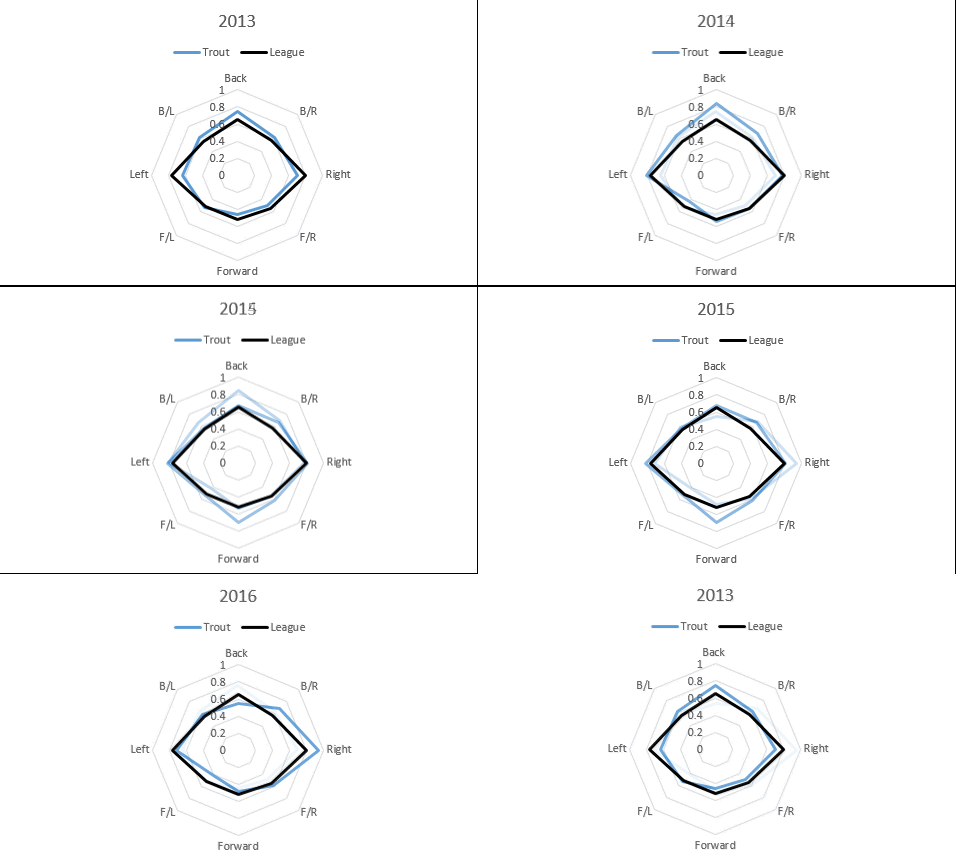
    Trout Movement

    As a possible net result, Trout’s overall range in center field has been compromised. Above, you will see a GIF image comparison of Trout’s fielding success rates based on movement type from 2013-16. This is another important component of BIS Descriptive Defense, as it quantifies defensive strengths and weaknesses based on a fielder’s route to balls hit in play. Essentially, we are looking at a birds-eye view of Trout in center field and his conversion percentage based on how he moved to each ball; straight back, straight forward, to the left (again, from that bird’s eye view), to the right, and so on. To help contextualize everything, I have included a league-average number for center fielders and directly compared it to Trout in each season. This gives us a good reference point as to where Trout might be lagging behind in 2016.

    What we are noticing this season is clear: Trout isn’t getting to balls hit in front of him or behind him. In fact, Trout has converted only 54.2 percent of balls in play against which he would need to move directly backward. That is the worst mark BIS has on record for Trout, and also serves as the latest point in a three-straight-year decline in this department (84.2 percent in 2014; 67.3 percent in 2015). The story is similar on balls hit directly in front of him. This season, Trout’s conversion rate when attempting to field a ball “straight forward” is 48.6 percent. That is significantly lower than the mark he managed last season, when he converted 69.7 percent of such fieldable balls into outs.

    We don’t need to dig deep into the metrics to understand Trout’s place in baseball history. His career trajectory looks better than Ken Griffey Jr.’s at this point in his career, and, by all accounts, he still is the prototypical ‘five-tool’ player. As we have discovered, however, Trout’s defensive ability in center has declined markedly in 2016. Already losing some of his top-end speed, Trout isn’t getting to difficult or moderate balls at the pace he once did. He isn’t rolling the dice with all-out dives, either, and his range and overall defensive value has diminished because of it.

    The Griffey comparison seems particularly appropriate and makes me wonder whether his diminished range and more conservative approach in center could be somewhat tactical. Trout is set to make roughly $138 million from 2016 through 2020 with Los Angeles, and logic supports the argument that a healthy Trout is the best Trout. If the Angels decide to take the approach of the Mariners and Reds in Griffey’s prime—allowing the focal point of the franchise put his body in harm’s way for the sake of a few highlight-reel catches—they would inherit the risk of not having Trout at his best sometime down the road. Is it the smart move? Truthfully, only time will tell.

  • Quantifying 2016’s Most Dominant Pitches

    Quantifying 2016’s Most Dominant Pitches

    What makes a dominant pitch dominant? Sometimes all we need is the eye test. That upper-90s heater elevated above the letters for a whiff? Yep, that is dominant. That mid-80s slider thrown down and away to a right-handed batter for a hapless swing and equally hapless chopper? No doubt, that’s nasty. Perhaps that late-breaking cutter, fading changeup, hammer curve or Hector Neris-esque splitter that delivers a routine popup for the infield? You know the drill.

    Of course, in the saber-slanted era in which we currently find ourselves, we know there are other methods to determine what is (and what isn’t) a dominant pitch. Velocity aside, PITCHf/x data gives us insight into the precise movements of every pitch. And that’s certainly a key to a dominant pitch, right? Vertical drop, horizontal tilt, spin rate and perhaps even deception—though we don’t quite know how to quantify it, yet—are all required for a pitch to be considered, well, dominant.

    Another thing that’s important: results. No, we’re not talking batting average or home runs allowed here. Those factors are important, but they are not as important as the underlying causes of those results, the pitch attributes. BIS President Ben Jedlovec wrote about the most dominant pitches in baseball for ESPN a few years back, and in his research, he used three attributes to evaluate an offering’s dominance: whiffs, groundballs and popups. I’m going to use the same criteria now to identify the most dominant pitches in 2016 this season.

    Here are the details of my research. For whiffs, I’m using whiffs per swing. For groundballs, I’m using groundballs per batted ball. And for popups, I’m using popups per batted ball. In addition, I’ve set a minimum of 100 total pitches thrown through the games on Sunday, May 8, 2016, so qualifiers can be starters or relievers.

    I’ve used z-scores to formulate pitch values for each of the three categories. Z-scores are a great way to measure a score’s relationship to the average in a set of data. A “0” z-score means that a pitch was equal to the mean; anything below zero means is was below-average, and anything above zero shows that the pitch was above-average, with “1” indicating that it was one standard deviation above (or below) the mean, and so on. So, each pitch here is assigned three z-scores. I then added them up to formulate what I’m going to call a “Dom-Score”, an abbreviated version of “Dominance Score.”

    (All data courtesy Baseball Prospectus’ PITCHf/x Database)

    [googleapps domain=”docs” dir=”spreadsheets/d/1V0T3gFJCB2f0J_8vJM4J1lf6QjluSDihoPIhFdX72bk/pubhtml” query=”widget=true&headers=false” width=”650″ height=”600″ /]

    You’ll note that most of the top pitches by Dom-Score this season are thrown by relievers, particularly 4-seamers and 2-seamers. That’s not too much of a surprise given that fastballs and their velocities tend to play up for relievers in their shorter outings. Of course, Stephen Strasburg’s changeup gives those relievers a decent run for their money; his 3.27 Dom Score means his changeup is a whole three standard deviations above the mean changeup in our three categories. If you click on the “change” section of the table, you can see just how much of a gulf there is between Strasburg’s change and the next closest. Guess we know why the Nationals are extending him, huh?

    Still, let’s not forget the leader, who quite clearly wields the best pitch in baseball this year: Zach Britton. Once again, not particularly surprising—it’s been good for a while. But you’ll notice that the offering absolutely excels in generating whiffs above the standard for 2-seamers; overall, opponents have missed on 42.6 percent of their swings against it this year. By comparison, the league-average 2-seamer in 2016 had generated misses at just a 13.8 percent clip entering play Monday night. Sinkers are typically thrown low in the zone for weak contact purposes, so the fact that it’s missing barrels at such a pace is nothing short of jaw-dropping. Let’s all enjoy it while its still here.

    On the opposite end of the spectrum, we find Jered Weaver’s fastball. Shocked? I know I am. Seriously, though, perhaps it is a bit shocking to see Felix Hernandez’s curve in the cellar. We know his fastball has lost a tick or two early this season, but from the looks of it, the hammer has already lost about an inch of vertical movement from just two years ago. Similarly, it does look a bit ominous that Adam Wainwright has two pitches—his 2-seamer and curve—checking in at nearly -2 in Dom Score this year. Perhaps that’s partially to blame for his slow start?

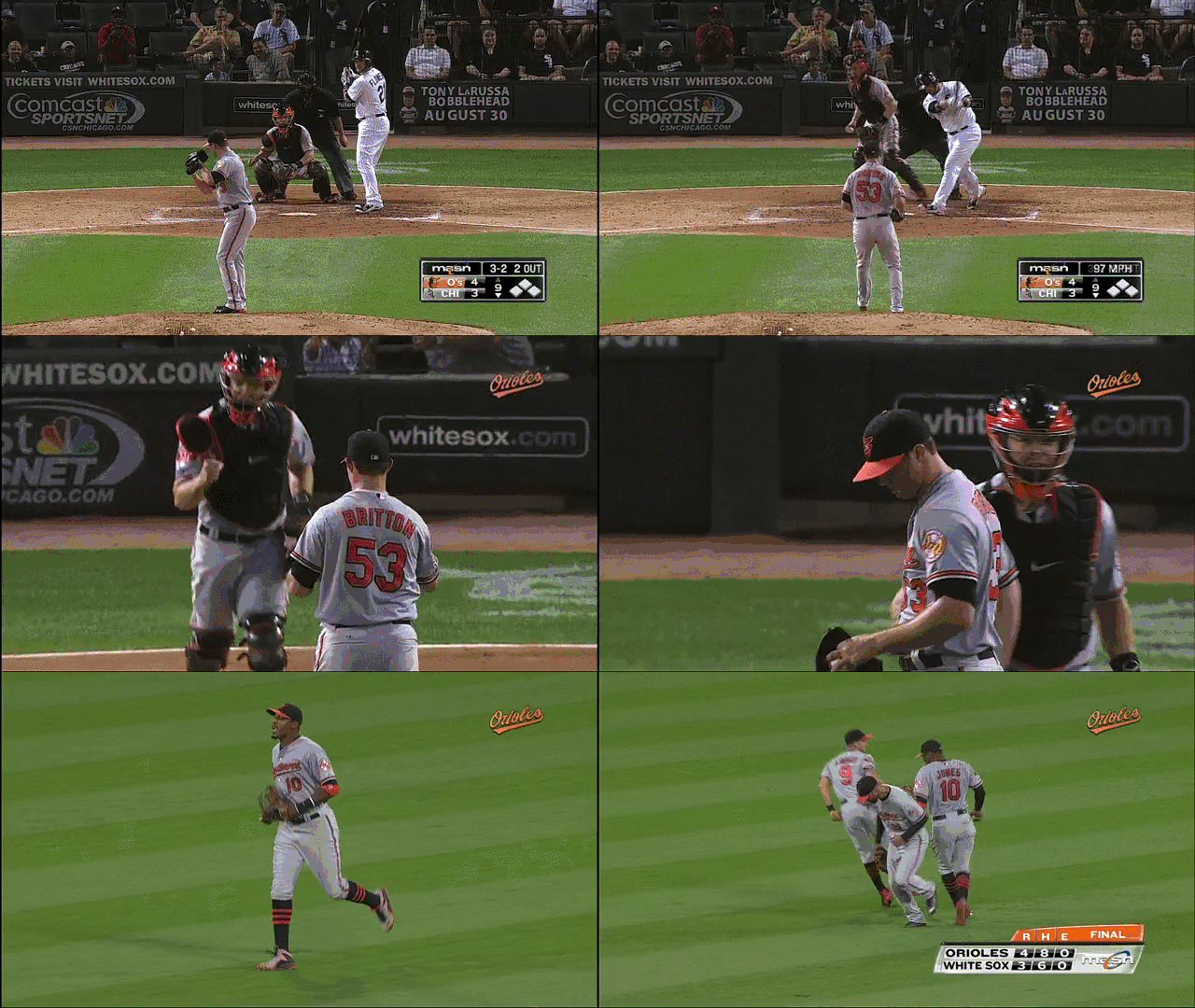
    We will continue to update this list throughout the season. Until then, though, we leave you with this Zach Britton sinker, doing what it does best:

    Britton2Seamer


  • Starting Pitcher Command Report: April 2016

    Starting Pitcher Command Report: April 2016

    Major League Baseball officially flipped its calendar from April to May this past weekend, which means we’ve arrived at a juncture of the season—roughly 15 percent through 2015’s total plate appearances, if you want to get overly specific—where player performance, trends and adjustments can be dissected with a certain amount of legitimacy and conviction.

    So with that in mind, why not pose the question that seems to be increasing in its importance: who’s commanding the baseball most efficiently? Walk rates in April jumped to 8.3 percent league-wide for starting pitchers, a healthy buoy from 7.1 percent last season, and, notably, the highest single-season mark for rotation arms since the turn of the millennium. Indeed, the season remains relatively young, but that increase might serve to explain why offensive production has witnessed an early rebound.

    Of course, there are better ways to evaluate command than simply a passing glance at walk rates. One example? Hitting the catcher’s target. Video scouts at Baseball Info Solutions (BIS) track the location of each pitch relative to catcher setup in (or out of) the strike zone, after which the analysts in BIS’s Research and Development department compile and formulate the data into easy-to-understand metrics with which to evaluate command.

    BIS categorizes all pitches thrown into four categories of precision: A.) Pitches “closest” to the mitt, B.) “close” to the mitt, C.) “far” from the mitt, and D.) “farthest” from the mitt. Generally speaking, the league-average pitcher will throw roughly 25 percent of his total pitches within each category. In other words, pitchers will hit the target with precision about as often as they miss badly, and vice versa.

    So without further ado, here are the top five and bottom five command leaders from April 2016 based on our “closest” to the mitt category. (All starting pitchers who qualified for the ERA title last month—100 in total, as luck would have it—were included in this sample.)

    Best “Mitt Rates”, April 2016
    Pitcher Hit Mitt %
    Kyle Hendricks 35%
    Aaron Nola 32%
    Mike Pelfrey 31%
    Noah Syndergaard 30%
    Alex Wood 30%
    Chase Anderson 29%
    Zack Greinke 29%
    Mike Leake 29%


    Worst “Mitt Rates”, April 2016
    Pitcher Hit Mitt %
    Rich Hill 9%
    Danny Salazar 10%
    Steven Wright 11%
    R.A. Dickey 12%
    Taijuan Walker 12%
    A.J. Griffin 13%
    Max Scherzer 13%
    Edison Volquez 13%

    Kyle Hendricks is far from a stranger to employing exceptional command. In fact, no right-handed starter who qualified for the ERA title last season located a higher percentage (36 percent) of his total pitches “closest” to the mitt. Neither is Aaron Nola, for that matter. At just 21 years young in 2015, Philadelphia’s budding ace pounded the leather at a 30 percent frequency. That number is up a healthy 2 percent this season, perhaps due in large part to his April 11 start against San Diego, during which he located an absurd 51 percent of his offerings “closest” to the glove.

    Max Scherzer isn’t used to being at or near the bottom of this list, but he is this season, having placed just 13 percent of his pitches closest to the catcher’s setup thus far (which could explain why his walk rate has more than doubled last year’s total). The same goes for Oakland’s Rich Hill, who found himself at the cellar of April’s Mitt-Rate leaderboard, with only 9 percent of his pitches closest to the glove, down from 15 percent last season and perhaps partially to blame for his surging walk rate to open up the 2016 campaign.

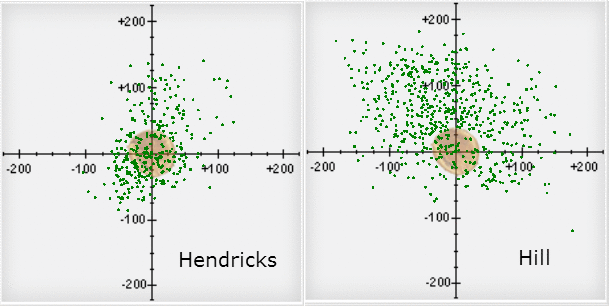
    Along with supplying the raw data to evaluate command, BIS also has visually means to represent and compare command over specific spans. So, how do Hendricks and Hill—pitchers with the best and worst command, respectively, during the month of April—compare visually? To wrap up our April 2016 report, here’s a look:

    Command Comparison