Author: Brad Beatson

  • Brian Flores The Bogeyman

    Brian Flores The Bogeyman

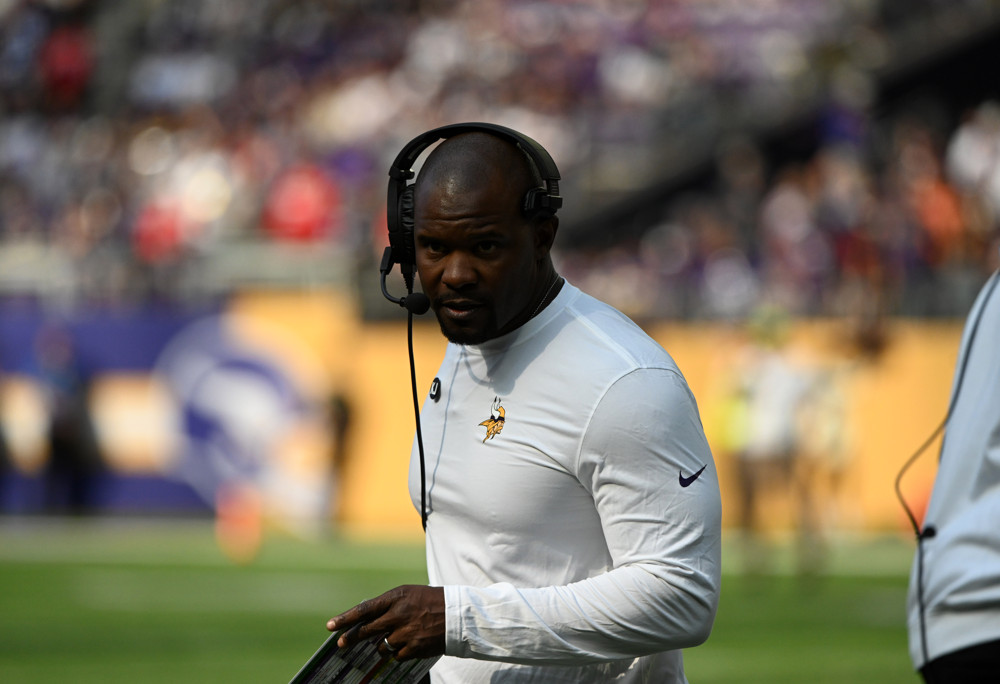
    Photo: John Rivera/Icon Sportswire

    If he were alive today, Nobel Prize-winning psychologist Daniel Kahneman may have gotten a kick out of what Brian Flores is doing to quarterbacks on a weekly basis. 

    His Vikings are bringing the house on every play. Blitz after blitz after blitz, or so it seems. This constant pressure, or the threat of a free rusher on every snap, activates the part of our brain that Kahneman called “System 1.” 

    System 1 is responsible for our thoughts that are fast, automatic, and emotional. 

    On the football field, the constant threat of a Vikings’ blitz is making offenses think fast, not slow and all but ensures mistakes will follow.

    Through their first seven games, Vikings’ opponents have committed more than three dozen offensive penalties. In Week 3 against the Texans, three separate offensive linemen were flagged for false starts on consecutive plays.

    That type of pressure must be getting to teams early. Worming its way through their psyche in the days before they have to face the Vikings. 

    Offenses have to spend the necessary time to think through their gameplan, slowly and carefully, to try and come up with answers to slow this unit down.

    That type of effortful thinking takes place in “System 2.” Kahneman described it as when the brain kicks into high gear and you’re able to hyperfocus on the task at hand. 

    A color commentator might say it’s when the game starts to slow down for a young player. You may have also heard it described as “entering a state of flow.”

    Brian Flores isn’t reading all that. His defense is doing everything in its power to speed things up and shift opponents’ into System 1 so they’re prone to negative plays.

    What’s really crazy about his defense, though, is how they’ve been able to create roughly the same amount of pressure regardless of whether or not they bring the blitz.

    YOY Sample Pass Rushers


    Pressure% NFL Rank
    2023 Season 5 or More 39% 25
    Weeks 1-8

    2024 Season

    4 or Fewer

    5 or More

    26%

    34%

    29

    27

    Weeks 1-8 4 or Fewer 35% 6

    It’s not that Brian Flores has changed his blitz-happy ways. Not in the slightest. His defense is among the most aggressive in the league and has sent five or more pass rushers on 40% of dropbacks. 

    But that’s a far cry from the 52% blitz rate he unleashed on quarterbacks by this time last season. So what exactly has changed?

    Even though Flores has slashed his rates, the Vikings have kept offenses on their toes by crowding the line of scrimmage and “simulating pressure” with a roving cast of characters. 

    His defense is able to line up in disguised formations before the snap that present one coverage before morphing into another. Here’s how that can look. 

    A pair of diagrams showing what a defense does pre-snap and post-snap

    A simulated pressure is a 4-man rush with a player dropping into coverage from an alignment that typically rushes, and a player rushing the passer from an alignment that typically drops into coverage.

    Ted Nguyen of The Athletic has talked about “simulated pressures” and their rising popularity with defensive coordinators around the league.

    Nguyen explained simulated pressure as when there are multiple defenders on the line of scrimmage showing blitz but the defense only ends up rushing four and dropping seven into coverage. With these sim pressures “one of your rushers is going to come from the second or third level and you drop a defensive end,” he added.

    In the play below, safety Harrison Smith rushes from the second level as Patrick Jones II drops into coverage.

    The Vikings simulated pressure with single-high coverage. After the snap, the center shifted right and opened a runway for Harrison Phillips (#97) to dive at the quarterback.

    Jerry Tillery (#99) occupied three offensive linemen. He shoved the right guard and tackle before circling back to engage the center.

    On the right, Harrison Smith (#22) and Jonathan Greenard (#58) collided with the running back and left tackle and used their impact to switch assignments. 

    The quarterback was able to spin away from Phillips but turned his back to the defense as they shifted into zone coverage. 

    The Vikings’ switch got them into a favorable matchup with their defensive end (6’3”, 259 lbs.) on a running back (5’6”, 185 lbs.) and the fight was over in a flash. 

    The Vikings collected their fourth sack on the day and their third on second down.

    Second down, in particular, had been the money down for the Vikings during their undefeated 5-0 start. They ranked second in the league in pressure rate (42%) when sending four or fewer pass rushers. 

    In their losses to the Lions and Rams, that pressure rate dropped to 33%.

    To better understand the Vikings’ success and what may have caused this downturn, I watched all their second-down blitzes and pressures so far this season.

    Typically, the Vikings have their cornerbacks drop into coverage while their defensive tackles and/or defensive ends rush the passer on second down.

    Cornerback Pass Snaps Rush%
    Byron Murphy Jr. 292 1%
    Stephon Gilmore 272 0%
    Shaquill Griffin 193 0%
    Defensive Tackle Pass Snaps Rush%
    Harrison Phillips 169 100%
    Jonathan Bullard 133 100%
    Jerry Tillery 119 99%
    Defensive End Pass Snaps Rush%
    Jonathan Greenard 246 93%

    At safety, the Vikings like to roll with a trio of Camryn Bynum, Harrison Smith, and Josh Metellus. Bynum drops into coverage; Smith rushes the passer once in a blue moon; and Metellus gets after it about once every five plays.

    On second down, Flores typically plays two or three defensive tackles alongside DE Jonathan Greenard; the safety trio and two cornerbacks; and his green-dot linebacker.

    With most of the spots already filled, the remaining void is divvied up between a deep bench of linebackers who cause chaos and confusion by any means necessary.

    To keep opponents guessing, the Vikings have shown more than 20 different linebacker pairings on these second-down pressure and blitz packages. 

    Linebacker Pass Snaps Rush% Sack% Pressure%
    Andrew Van Ginkel 98 59% 5% 12%
    Blake Cashman 85 26% 5% 24%
    Patrick Jones II 59 78% 4% 4%
    Ivan Pace Jr. 56 29% 6% 24%
    Kamu Grugier-Hill 34 24% 0% 13%
    Jihad Ward 27 100% 0% 7%
    Dallas Turner 18 56% 0% 0%

    Making matters worse is the Vikings’ complete rejection of typical “three-level” defensive structure. Linebackers shift and prowl and blur the lines between levels as safeties creep up and mug the gaps. 

    Through the first five weeks of the season, it seemed as though anyone could rush the passer on second down. But things have changed since Blake Cashman picked up an injury in London and has been out of the lineup. 

    Against the Lions and Rams, the Vikings’ weaknesses were exposed. Instead of reacting to their simulated pressures, Jared Goff and Matthew Stafford stood in the pocket and calmly executed the offense. 

    When the pressure did come, they were decisive and got the ball out quickly or side-stepped the rush to take downfield shots.

    Both knew the pass rush was inevitable and they were going to get hit. Sometimes, that’s just the cost of doing business. 

    When teams are able to withstand the threat of every down pressure—both real and imagined—they can take advantage of a defense frequently out of position.

    The Lions and Rams have left a light on for teams looking to face their fears and beat this Vikings defense. Just remember, for sixty minutes, the bogeyman doesn’t exist.

  • Jameson Williams Expands His Route Tree

    Jameson Williams Expands His Route Tree

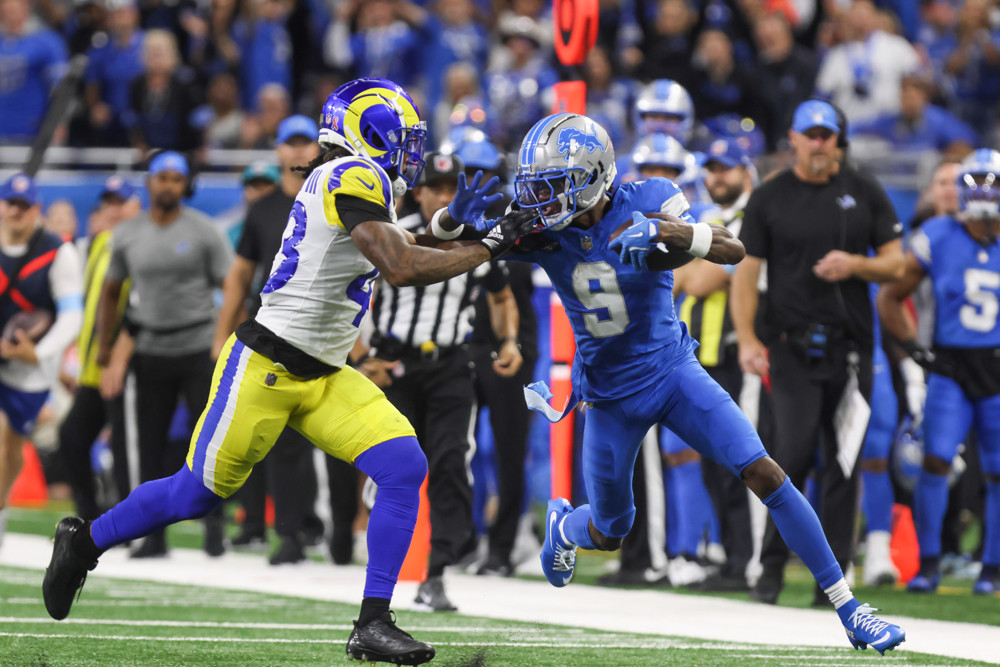
    Photo: Scott Grau/Icon Sportswire

    Back in February 2023, Detroit Lions’ OC Ben Johnson said the team planned on using Jameson Williams “all over” the formation, lining him up at X, Z and Slot receiver.

    “I know this: When you get speed in the slot, that’s very hard to defend,” he said.

    So far, the Lions have kept opponents guessing as to where Williams will line up throughout his young NFL career, dividing his time almost evenly out wide and in the slot. He’s lined up more than 20% of the time in each spot (left wide, left slot, right slot, right wide).

    Detroit began ramping up his overall route rate after their Week 9 bye last season. By the time the playoffs rolled around, Jameson Williams was running about as many routes per game as Josh Reynolds and Sam LaPorta.

    Now, with an entire offseason under his belt and his salad days firmly behind him, the kid they call Jamo looks poised to ascend and fully unleash his speed on the league.

    Through Week 4, he has run the same number of routes as Amon-Ra St. Brown.

    The big change? Williams is running a more complete route tree to stress the defense at all three levels of the field, earning targets on playbook staples like curls, digs and outs.

    If we add a couple more branches to the tree, we can get a better sense of how Jamo can perform as a full-time WR by first looking back at how often he ran key routes at Alabama.

    In college, Williams earned most of his targets on curls (87), digs (43), slants (34), outs (28), corners (23), deep crosses (18), drags (16), and whips (3). He also had 19 targets on screens but those haven’t been as prevalent in his NFL route tree.

    If we dig a little deeper, though, the SIS DataHub Pro can provide a more nuanced understanding of how he compared to some of his peers on these routes in 2021-22.

    WR Catchable Target % Catchable Catch% AirYard% YAC%
    Chris Olave 86% 82% 74% 26%
    Drake London 81% 84% 72% 28%
    Garrett Wilson 76% 92% 71% 29%
    Jameson Williams 77% 81% 59% 41%
    Wan’Dale Robinson 84% 84% 74% 26%

    Jameson Williams caught 81% of his targets on key routes that were deemed catchable during his junior season at Bama. That’s generally in line with other top performers, if a smidge low. 

    Once the ball was in his hands, though, Jamo’s receiving yardage splits paint the portrait of a downfield menace who could create after the catch.

    Fast-forward to the NFL and it’s encouraging to see similar splits through his past 15 games, especially when compared against others during the same timeframe (since Week 10 of the 2023 season, including playoffs).

    WR Catchable Target % Catchable Catch  %  AirYards% YAC%
    Amon-Ra St. Brown 79% 86% 67% 33%
    Jameson Williams 79% 85% 62% 38%
    CeeDee Lamb 85% 87% 58% 42%
    Nico Collins 80% 92% 73% 27%
    Rashee Rice 85% 83% 45% 55%

    Looking at Detroit, Dallas, Houston, and Kansas City — all playoff teams from a year ago that retained their offensive play callers — Jamo compares favorably to teammate Amon-Ra St. Brown and Nico Collins.

    Perhaps most impressive is how often Williams is able to consistently generate YAC further downfield, as evidenced by his YAC relative to his deeper Average Depth of Target (ADoT).

    WR ADoT YAC/Rec
    Amon-Ra St. Brown 8.9 4.2
    Jameson Williams 11.6 6.3
    CeeDee Lamb 6.5 4.5
    Nico Collins 10.2 3.7
    Rashee Rice 5.6 6.8

    As Alex Vigderman recently wrote, Nico Collins had the best receiving season in the NFL on a per-route basis in 2023. Through the first four weeks of 2024, the star wideout is picking up right where he left off.

    Nico Collins is currently tops in the NFL among wideouts with 15 Receiving Total Points. Essentially, this means Collins was responsible for adding 15 points to the Texans’ scoreboard through their first four games. Jameson Williams is currently 5th among wideouts with 11 Total Points.

    ⇒ If you’re curious as to what goes into Total Points and how we arrived at that calculation, our signature metric received a major overhaul this offseason. ⇐

    Now, it would be extremely bullish to project a third-year breakout for Jamo on par with what Nico accomplished in 2023.

    However, it wouldn’t be all that surprising if Williams and Collins ended up with similar stat lines in 2024, as both play opposite target-commanding WRs in Amon-Ra St. Brown and Stefon Diggs and each have plenty of receiving competition elsewhere with Sam LaPorta and Jahmyr Gibbs, Tank Dell and Dalton Schultz.

    Head coach Dan Campbell called Jameson Williams a “man on a mission” and the most improved player throughout the Lions offseason. If he keeps up this pace and continues to stretch the defense, Jamo will be a major factor in the Lions reaching their first Super Bowl.