
Author: Brian Reiff

  • How Good Is the Patriots’ Defense, Really?

    By Brian Reiff

    The Patriots are again one of the NFL’s top teams. Not something that’s surprising to anyone, but the way in which they’re doing it has made headlines.

    The Patriots’ defense has been other-worldly this season, ranking first by an assortment of metrics: points allowed, yards per play, total yards allowed (among teams that have played six games), turnovers forced, Adjusted Net Yards per Attempt (ANY/A), and pretty much any other stat you can find on Pro-Football Reference. In fact, the Patriots are so good that they’re actually forcing turnovers on a higher percentage of drives (20%) than they’re allowing the opposing team to score (6%).

    Even when looking at more advanced metrics, the Patriots still come out on top. A good way to measure performance is through Expected Points, specifically looking at Expected Points Added (EPA) per 60 plays. By this metric, the Patriots have still been the top defense, but their gap at the top is narrower than some might’ve thought.

    2019 EPA Allowed Per 60 Plays Leaders

    TeamEPA Allowed Per 60 Plays
    Patriots-22.2
    49ers-19.8
    Bills-9.6
    Titans-6.0
    Vikings-5.4

    A negative number here is good for the defense, indicating the offense was losing an average of 22.2 Expected Points every time they ran a game’s worth of plays against the Patriots defense. However, the 49ers are right there with them, with both enjoying a large lead over the rest of the league.

    However, there is still a notable factor being left out of this analysis. The Patriots have played one of the easiest schedules in the league, feasting on the likes of the Steelers (2-4), Dolphins (0-5), Jets (1-4), Redskins (1-5) and Giants (2-4). Has their defense actually been as good as the number show, or have they just played bad teams that have inflated their numbers?

    To determine this, we can look at what the Patriots’ opponents have done in their games against teams other than the Patriots.

    For example, the Jets averaged -28.8 EPA per 60 plays against the Patriots, but they’ve averaged -15.0 EPA per 60 plays in the rest of their games against the Bills, Browns, Eagles and Cowboys. With those numbers, we could say that the Patriots were 13.8 points better than an “average” team was against the Jets (the Jets have likely not played an exactly “average” schedule, but in the aggregate among all teams it should be close enough).

    All of the Patriots’ opponents this season have combined to average -5.4 EPA per 60 plays in their games against teams that weren’t the Patriots, which ends up being the second-lowest mark by a team (the Cowboys’ opponents have averaged -7.2 EPA per 60 plays). If we take the Patriots’ overall number (-22.2) and compare it against their opponents’ average (-5.4), we see that the Patriots’ defense was 16.8 points better than an average team. Doing this for all teams, we can produce an opponent-adjusted leaderboard that should provide a better answer to the question of which defense has reigned supreme in the NFL so far this season.

    2019 EPA Allowed Per 60 Plays Leaders
    Adjusted for Opponent

    TeamEPA Allowed Per 60 PlaysOpponent Avg EPA Per 60 PlaysDiff
    49ers-19.8-1.8-18.0
    Patriots-22.2-5.4-16.8
    Panthers-5.43.6-9.0
    Titans-6.01.8-7.8
    Steelers-4.23.0-7.2

    Three of the top five teams remain the same, but there is a new leader—the San Francisco 49ers. After adjusting for the teams they’ve played, the 49ers have actually stifled their opponents more so than the Patriots, despite trailing behind them in the raw numbers (albeit slightly). The Patriots are a close second, so it’d be improper to say their defense hasn’t been great. However, it’s clear that the two teams comprise a top-two rather than the Patriots sitting alone at the top.

    For more advanced NFL stats, visit the SIS DataHub and for more information about Sports Info Solutions, visit our website.
  • World Series Defensive Preview

    The Red Sox are a good offensive team. They scored 876 runs this season, 25 more than any other team. It’s not surprising—or at least not shocking, given their playoff opponents—that they managed to get to the World Series, as they had an offense that featured a potential MVP in addition to a near–Triple Crown winner.

    However, their defense leaves much to be desired. Of all the teams to make the World Series since 2003—when Sports Info Solutions started reporting Defensive Runs Saved (DRS)—the 2018 Red Sox team has the third-fewest DRS at minus-26 (tied with the 2004 Red Sox, coincidentally enough). The infield has been the primary force behind that total, as Red Sox infielders combined to cost the team 60 runs this season, worst in the majors.

    With the news that Mookie Betts may see time at second base to squeeze J.D. Martinez into the lineup in games at Dodger Stadium, an already-shaky defense could become even more concerning. Betts is the best fielder (at least compared to an average player at his position) on the Red Sox, saving 20 runs this season to lead right fielders.

    We can’t be sure exactly how the Betts situation will play out, but, being fairly confident about who will be manning the other positions, it’s worth taking a look at some of the more interesting defensive storylines between the two teams to find where one might have an edge over the other.

    Catcher

    Both teams were at or near the top of their respective leagues in terms of runs saved by their catchers. Sandy Leon saved 12 runs this season, which was tied for the second-highest total at the position. Christian Vazquez, though, was merely average, and has shared time relatively evenly with Leon.

    The Dodgers have two catchers who excelled on defense: Yasmani Grandal and Austin Barnes. Both saved at least nine runs this season, which ranked them top 10 at the position. Based on how much mixing and matching both teams have employed throughout the season, having two solid defensive catchers figures to pay off for the Dodgers.

    Shortstop

    Manny Machado’s transition back to shortstop was a rocky one, as he cost his teams a combined 13 runs at the position, third-worst in baseball (he saved the Dodgers three runs at third base in about 150 innings). He’s shown some improvement, though. Through July 14—or just about the first half of the season—Machado had cost the Orioles 20 runs at shortstop. Since then, he’s worked his way back up to his final total, saving seven runs over the last two and a half months of the season.

    Given that, you’d think that the Red Sox have the advantage defensively. But their shortstop, Xander Bogaerts, cost the most runs of any shortstop in baseball (19). They struggled in opposite areas (Bogaerts was 36 plays below average on plays in the third base–shortstop hole, while Machado was minus-13 on plays up the middle), but Machado has to be given the slight edge here, especially given his improvements as the season wore on.

    Center Field

    Many will say that Jackie Bradley Jr. is the best defensive center fielder in baseball, or if not the best, then at least in the conversation. DRS has largely agreed with that notion in the past, with Bradley finishing no worse than seventh among center fielders in his qualifying seasons between 2014 and 2017 and saving more runs (39) than all but five other center fielders during that timeframe.

    This year, though, Bradley has cost the Red Sox two runs, in large part due to balls that he’s allowed to fall behind him. Despite making three more plays than the average center fielder on balls hit shallow, he’s been five plays worse on balls hit deep, likely due to his playing nine feet shallower on average compared to last year. Those balls lead to extra-base hits, which in turn hurt Bradley Jr. more than balls in front of him help.

    Meanwhile, Cody Bellinger has displayed his athleticism for the Dodgers, saving six runs in center field in his first real season there. That’s not to say Bellinger is decidedly a better fielder than Bradley Jr., but the Red Sox may not have as clear of an advantage at the position as some may think.

    Right Field

    If Mookie Betts remains stationed in right field, the Red Sox have the clear advantage—not just over the Dodgers, but over anyone. Betts has won two straight Fielding Bible Awards, which recognize the best fielder in baseball at each position, and has saved 83 runs since taking over the full-time role in 2016, 22 more than the next-best outfielder (Kevin Kiermaier).

    Of course, if J.D. Martinez sees action there, it’s an entirely different story. For his career, Martinez has cost his teams 31 runs in right field. Admittedly, that’s largely affected by his 2016 season where he cost the Tigers 22 runs. Even ignoring that season, he’s still been average defensively at best.

    For the Dodgers, Yasiel Puig certainly holds his own in right field, at least tying for the ninth-most runs saved at the position each of the last three years. His recent contributions to the team have come from his bat, but he’s more than capable of making a defensive play when he’s called upon.

  • Stat of the Week: Shifting is at an all-time high

    Stat of the Week: Shifting is at an all-time high

    Something monumental happened in baseball this past weekend—and it wasn’t the Orioles being given a nationally televised game.

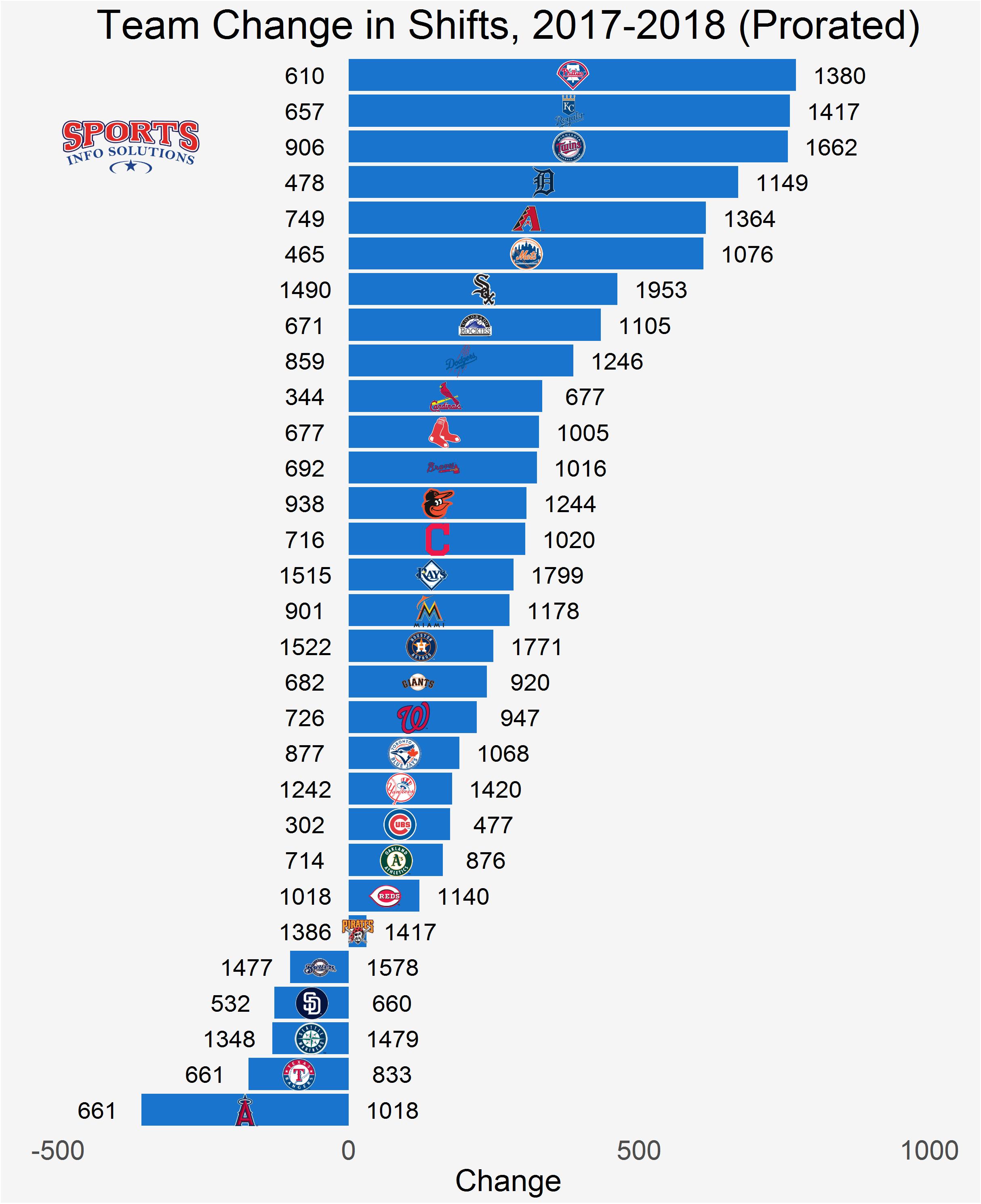
    By the end of play on Sunday, teams had shifted on balls in play 28,249 times, surpassing the previous record of 28,130 set in 2016. They are now on pace to shift just under 35,000 times this season, which would represent a 31 percent increase over last season’s total.

    Shifts had been increasing steadily since 2009, when Sports Info Solutions first started tracking them, until declining slightly in 2017. But they now appear to be on the rise again. It’s not just one or two teams carrying the pack, either—25 of the 30 teams have increased their shift usage this season.

    SeasonChangePlotVert

    The Phillies have made numerous headlines this year for their proclivity toward shifting under new manager Gabe Kapler. This shows itself in the data, with no other team on pace to increase their shift usage more than the Phillies. If they continue shifting at their current rate, they will shift nearly 800 more times on balls in play in 2018 than they did in 2017.

    Three AL Central teams follow right behind the Phillies in the Royals, Twins and Tigers, all on pace to increase their shift totals by more than 600. Whether those increases are related or not is hard to say, although all three teams still trail the White Sox, who shifted 1,490 times on balls in play last season and could potentially become the first team to reach the 2,000-shift mark this season.

    While teams are shifting more than ever, there are still improvements that can be made. SIS’s BIS-D software provides a recommendation for every player in MLB as to whether that player is a shift candidate or not, and about one-third of shifts this season have been against players for whom the software recommends playing a standard defense. There have also been about 18,000 balls in play where the defense did not shift when the system suggested one.

    How has the shift impacted the performance of those who get shifted? On the whole, the shift lowered shift candidates’ batting average on grounders and short line drives (BAGSL) by 23 points, while it had the opposite effect against all other batters, raising their BAGSL by 4 points.

    Weighted* Batting Average on Groundballs and Short Line Drives, 2017-18 

    BIS-D Recommendation No Shift Shift Difference
    Shift Candidate .271 .248 Helps by 23 points
    Non Shift Candidate .275 .279 Hurts by 4 points

    *The averages are weighted such that players with extreme shift tendencies (high or low) are not over-represented, thus separating the effect of the shift from batter quality. 

    With shifts comprising a larger percentage of balls in play than ever before, it’s never been more important to make sure that the correct batters are being shifted.