Author: Bryce Rossler

  • What a difference one change in alignment makes for the Dolphins

    What a difference one change in alignment makes for the Dolphins

    PHOTO: Mark Goldman/Icon Sportswire

    (All charting numbers in this piece are through Week 16)

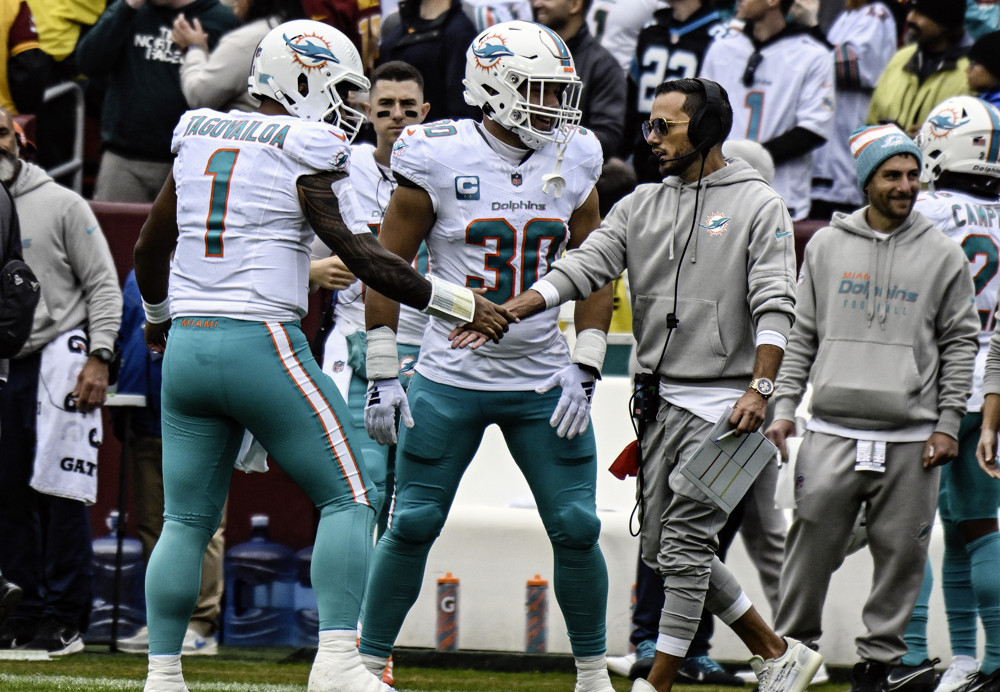
    On Sunday night, the Dolphins will host the Bills for a chance to claim their first AFC East title since Tom Brady’s knee popped back in 2008. This game will feature some of the most exciting offensive players in all of football, as well as one of the most exciting coaches. Miami Dolphins head coach Mike McDaniel is the league’s newest offensive genius, and he’s also a media darling who has charmed journalists and fans alike with his earnest and energetic pressers.

    We could spend all day saying nice things about Mike McDaniel. In fact, we’ve spent most of the past year saying nice things about him. So, having established that we love and appreciate Mike for what he’s contributing to this great sport, let’s take a moment to talk about a strange phenomenon happening within his offense right now.

    Miami has been far and away the best 3×1 gun (three receivers to the strong side, one to the weak side in shotgun) team in the NFL this season. On 172 neutral script plays, they’ve averaged a whopping 0.39 EPA/play in this family of formations, which is three times better than the second-best team. It would behoove every coach, offensive or defensive, at every level to take some time this offseason to study what Miami does in 3×1 (and we’ll get into what exactly they do in a bit).

    On the other hand, they have been bad in their 2×2 gun formations (137 plays). They average -0.24 EPA/play – which is 30th in the league, just barely ahead of the New York teams – and the absolute difference between these two formation shells is easily the biggest for any team at a massive 0.63 EPA/play.

    Scatterplot of offensive shotgun efficiency by team in the NFL in 2023, with 2x2 and 3x1 formations on each axis. The Dolphins are the only team off-trend.

    This is seemingly not confounded by any basic scheme split. The pass rates are virtually identical, the motion usage is similar, and they actually use a bit more play action in 2×2. They have had worse fumble luck in 2×2, but even if you strip out the fumbles they’ve lost, there’s still a gap of 0.5 EPA/play. This is also not a single-season aberration, as they ranked 3rd and 27th in these formation shells last year.

    So, let’s first set the table with what they do in 3×1 gun.

    3×1 gun pass game overview

    They attack the intermediate area extremely well (their bread-and-butter is a double overs concept they rake on); they are ruthless about isolating Waddle/Hill on the backside, particularly on digs and skinny posts; they have a variety of outside vertical stretch concepts they use (e.g. Smash, Flood); and they do a good job of abusing their speed via motions in order to stress the back end of the defense horizontally (for example, picture a Cover 1 safety having two seams running at him). 

    Their best motion comes out of 3×1 where they trade a receiver across the formation towards a condensed split X. Most defenses respond with stack checks, which tends to create cushion for the motion player and often exploitable outside leverage for the new #2. Of course, they are also capable of abusing man-to-man in these looks. They try to accomplish a similar thing in 2×2 by motioning #2 outward behind #1 in condensed flanks, but the results have been mixed.

    3×1 run game overview

    Their use of motion in the run game is also effective. Their creativity with TE motion in 3Yx1 (3-receiver side with a tight end/Y attached) formations to create favorable blocking angles on both zone and gap concepts might be first thing you notice, but the way they marry their pass and run game is what stands out the most.

    Screen cap of Dolphins lined up in a 3x1 formation

    3×1 Tight Bunch Gun Strong vs. Patriots 4-2 under front (an even front with a defensive lineman in the A gap to the strength)

    Defensive coverages and fronts go hand in hand, and Miami does an excellent job of abusing the fronts that they get. Take, for example, their same-side power concept in 3×1 gun strong. Teams are willing to play Cover 4 against the Dolphins in 3×1 because they aren’t spamming low horizontal stretches that typically abuse this 4-deep, 3-under coverage, which has a couple of implications:

    1) Defenses generally don’t want the MIKE linebacker to be significantly out-leveraged by #3 (in the above case, the TE) in Cover 4, so it’s difficult for him to fit the strong A gap against the run, which means that, and

    2) Defenses will often be playing an under front to alleviate the MIKE’s run-pass conflict.

    ‘[The problem, then, is that same-side power is typically free real estate against under fronts. Over the last five seasons, power runs against under fronts have averaged 4.6 YPC and 0.02 EPA/play.

    2×2 alignment tendencies

    Their 2×2 gun has deeper issues, but it’s worth briefly mentioning they have a few specific tells that opposing teams may be keying on. For example, any time they’re in 2x2Y gun strong with one of Waddle/Hill aligned on the ball at #2 on the strong side and the other at #1 on the weak side in a condensed split, they run a gap play action shot with a post from one side and a dig from the other. This resulted in the field safety intercepting the post in the Raiders game, although Tua sailing it admittedly didn’t help.

     Screen cap of the Dolphins lined up in a 2x2 formation2x2Y gun strong formation with a 2-open side and a 2-closed side with a cut split from the Z

    Now, to be clear, such trends are not endemic to the Dolphins. Every team has quirks like this that can and will be found if you look hard enough, and sometimes these plays only get called every few games. Furthermore, coaching staffs regularly self-scout to correct for things like this and break tendencies in future games. In fact, Miami seemingly self-identified a tendency in 3×1 earlier this year, in which an outward motion by Tyreek towards a stack would be a tunnel screen if and only if the on-ball player was a tight end. They broke this tendency against the Cowboys by motioning him towards a standard split with Braxton Berrios on the ball, and it went for 10 yards to convert a critical 3rd & 3 in the final drive of the game.

    What is probably more useful is to identify generalizable alignment tendencies, such as the one they have in 2×2 where Tyreek aligning on or off the line of scrimmage sends a pretty strong signal about the verticality of the offense.

    Table showing the effect of Tyreek Hill's alignment (on or off the ball) on the Dolphins' average throw depth. The team's average throw depth is higher when he's on the ball, but the drop-off is much more when Hill is off the ball in 2x2 formations.

    The value proposition of 2×2 pass game and Tua’s compatibility

    Moving onto the nuts and bolts of it all, the Dolphins are generally integrating the back into their dropback passing game more often. They fast-release the back (i.e. he is not staying in to protect, or to chip or check for a blitz before releasing) 10% more often in 2×2 than they do in 3×1, and that’s largely a function of the concepts they’re running. You see more of the classical, West Coast, Shanahan influence in this family of formations; more low horizontal stretch concepts and triangle reads. Slant-flat. Snag. Texas. Stuff like that. And these concepts are fine – Miami runs them a bit in 3×1, as well – but they’re just inherently a lower value proposition compared to what they do in trips.

    Setting aside the relative value of these things, there’s also an argument to be made that Tua just isn’t as good at some of them. He’s checking it down more often, with 17% of his non-screen attempts coming at or behind the line of scrimmage in 2×2, compared to just 5% of the time in 3×1. His turnover-worthy throw rate on passes past the line of scrimmage also jumps from 5% to 8%. More risky throws and more checkdowns is not a good combination!

    Four-open 2×2 (i.e., two receivers to each side with nobody lined up tight) has been particularly tough sledding for the Dolphins. 53% of their passing attempts in 2×2 gun have come from these looks, and they are averaging an NFL-worst -0.53 EPA/pass out of them. They see the sixth-highest rate of middle field open (MOFO) coverage in such formations at 53%, and that is not a function of them being pass-heavy. The league-wide, neutral-script passing rate within these formations is a staggering 90%, so the problem here is that the Dolphins simply have not been good at forcing the issue.

    Defenses playing split field coverages and getting 4 defenders over 3 offensive players (4-over-3) to the strongside and 3-over-2 to the weakside is a tough hill for any offense to climb, and opposing teams can afford to do this to the Dolphins with relative impunity for a couple of reasons. Arguably the most critical factor is that Tua struggles to make some of the throws that typically punish such structures. There are a lot of routes that he excels at throwing, but the slot out/flat is not one of them.

    Among non-screen throws he’s attempted at least 25 times in the last two years, flat routes and out routes from the slot are bottom five in EPA/attempt, On-Target Rate Over Expectation (xOnTgt+/-), and passing Total Points/play. This is where critiques of his arm strength come into play; it’s not that he can’t throw rainbows 50 yards downfield, it’s that he doesn’t consistently have the velocity to beat defenders on throws like these.

    This is not conducive to beating Cover 4. This is not true of all quarters variants, but, as a general rule, these coverage structures are susceptible in the flats. Furthermore, if a defense wants to play split field coverage and is less concerned about throws to that area, they can have their corners play looser techniques in Cover 2 that allow for sinking a bit longer if the outside receiver releases vertically. Anecdotally, the Dolphins are partial to Ohio (#1 on a go, #2 on an out) in 2×2, especially when Tyreek is in the slot, and they typically do well on it. However, some teams have had success playing Cover 2 to the Dolphins’ 2-open flanks despite that route concept being 1) a common pattern for Miami in those looks, and 2) a traditional Cover 2 beater.

    2×2 run game cat-and-mouse

    The run game has been another issue. They average 2 fewer yards per carry in gun 2×2, and have been more zone-heavy whereas in 3×1 they are gap-heavy. This is possibly a function of the fronts they’re getting. A lot of teams have liked to place a 3-tech away from the back against these looks and the Dolphins have a 39% success rate on RB handoffs against such fronts, compared to a 67% success rate when the 3-tech is to the back. There could be a lot of reasons teams are setting their front this way, but it can be difficult to run zone at that 3-tech. 

    Now, what’s interesting is that, in the past few weeks, McDaniel has made a concerted effort to counteract this. When Miami has been getting a 3-tech away from the offset back, they’ve started to do two things: 1) get the offensive linemen on a zone track one way, and path the back the opposite way, which essentially washes down the 3-tech, and 2) run toss away from the 3-tech, which is an unusual mechanism in shotgun but something they’ve also done on pin-pull concepts. Both of these have generally been paired with a TE splitting across the formation to either kick out or serve as a lead blocker, and it’s led to a spike in their overall efficiency in 2×2 gun runs.

    Whether or not this will be some Achilles heel remains to be seen. This umbrella of formations makes up approximately 20% of their offense – so we’re talking about roughly a dozen plays a game – and they’re still 4th in the league in EPA/play regardless. Furthermore, it is difficult for defenses to dictate to the offense what formations they have to use, and players ultimately have to execute on the field, anyways. If nothing else, it’s interesting that the same team can look so different just because someone moved an X on a board. It may not end up being significant, but not everything needs to be. Football is just cool like that.

  • Reiterating The Statistical Case Against Brock Purdy for MVP

    Reiterating The Statistical Case Against Brock Purdy for MVP

    Photo: David Rosenblum/Icon Sportswire

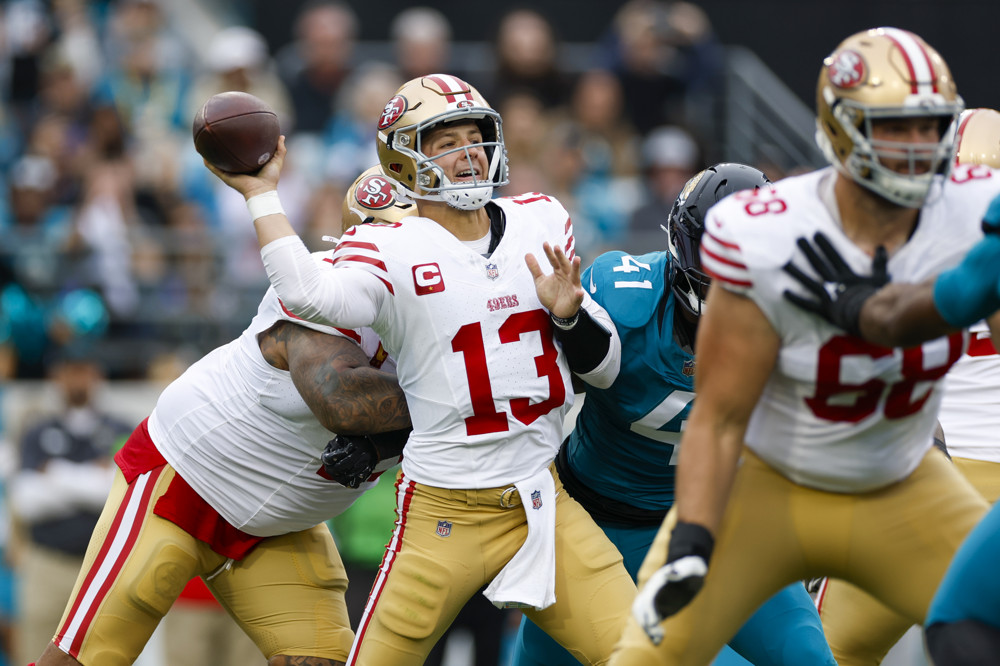
    As of this moment, Brock Purdy has the best odds to win MVP at -200. Mr. Irrelevant has had a meteoric rise to being Shanahan’s second MVP-caliber quarterback this decade, and is now the preferred candidate among 49ers fans, aging sportswriters, and Disney adults. And as fun as that narrative arc may be, it should be met with some skepticism (as we pointed out last week). Let’s go even deeper in our analysis today.

    Americans love a good sports underdog story – which is really just a toxic masculinity fairytale, if you think about it – but hate participation trophies, and MVP awards are not participation trophies. They’re given to outstanding players with impressive production who considerably elevate their team, and although Purdy has outplayed his draft slot, he does not fit that bill. But, any good-faith attempt to reconcile his production with his individual skill is met with circular references back to his stats, so let’s dig into those.

    His dropbacks have indeed been very efficient from an EPA perspective, let’s just get that out of the way. A positive play rate of 55% is comfortably first in the league, and, if the season ended today, 0.26 EPA/dropback would be the second-best season in the SIS era behind only 2016 Matt Ryan, which is very interesting considering who called plays for them. He would even rank first in EPA/dropback and yards/attempt this year if you took out his throws past the line of scrimmage, as originally pointed out by Steven Ruiz of The Ringer.

    But, these numbers belong to the 49ers passing offense as a whole, and not just Purdy. There are a lot of good players on that unit. Trent Williams, Christian McCaffrey, and Deebo Samuel are All-Pros, and Brandon Aiyuk – who is currently 2nd in first down percentage, 2nd in yards/route run and 3rd in Total Points/route behind only Tyreek Hill and Samuel – should join them come awards season. Furthermore, they have a pretty good young guard tandem in Aaron Banks and Spencer Burford; Kyle Juszcyk is as valuable as fullbacks can possibly be in the modern NFL; and, to top it all off, they have arguably the best offensive coach in the league in Kyle Shanahan.

    The 49ers do not need, and have never needed, Purdy to be a Top 10 quarterback, and he isn’t. They just need him to not screw things up, and he hasn’t.

    There’s a lot of mythmaking surrounding Purdy’s game, but it is fair to say that he’s accurate. He’s 80th percentile in xOnTgt +/- among qualifying quarterbacks with at least 200 attempts, which is pretty good. But, all this fluff about how he’s such a good processor and manages the game so well is just flat-out embellishment.

    His turnover-worthy throw rate (3.5%) is pretty bad – 26th percentile – and he doesn’t get the ball out particularly quickly, either. His expected snap to throw +/- (xSTT+/-), which approximates how quickly the quarterback should throw the ball based on his drop (among other factors), is 47th percentile. It’s not horrible, but it’s also not great.

    The fairest comparison here might be another Shanahan-adjacent quarterback in Tua Tagovailoa, who ranks third in xSTT+/- at a full two-tenths of a second faster than Purdy. In fact, you could make the case that Tua predetermines throws and shoots first and asks questions later, but even then, his turnover-worthy throw rate (3%) is 47th percentile – a bit better than Purdy’s.

    However, you don’t need to be an elite processor when you get to make so many gimme throws. Purdy’s attempts have been contested at the second-lowest rate in the league this year at 22%. And, if you’re wondering how that might affect his EPA numbers: contested throws are a terrible value proposition.

    The average EPA on such throws this season has been -0.38. Purdy, meanwhile, is averaging -0.09 EPA on those throws. So, not only does he get to make more easy throws, he’s losing about 25% of the value most quarterbacks do on the difficult throws he does make. That seems very fortunate!

    Some of that is probably just pure luck, but the 49ers receivers deserve a lot of credit in this regard. They rank 7th in contested catch percentage (39%) and 1st in both average yards after catch (6.9) and yards after contact (2.2). In fact, the difference between San Francisco and the next-best receiving corps in average yards after contact, is as big as the difference between the 2nd and 28th ranked teams. And if the season ended today, their average yards after catch would be the 3rd-best we’ve ever recorded, just behind the 2018 Chiefs and the 2018 49ers, and just ahead of the 2021, 2022, and 2019 49ers.

    Which brings us to the next point; a common rebuttal to the notion that Purdy is largely a beneficiary of an excellent playcaller and a star-studded supporting cast, is that Jimmy Garoppolo didn’t perform at this level. Interestingly enough, though, Jimmy G was actually never good.

    Among 49 quarterbacks with at least 500 attempts from 2020-2022, Garoppolo ranked 38th in turnover-worthy throw rate (4%), and 31st in On-Target Rate Over Expectation (xOnTgt +/-). He was also 30th in Passing Total Points/play while getting hit.

    Purdy is tougher and more willing to stand in against the rush, ranking 6th in passing Total Points/play while getting hit this season. He’s also more accurate, ranking 6th in xOnTgt +/-, and those are the big distinctions between the two. The difference we’re seeing is the difference between a warm body and Tom Brady’s sleep paralysis demon. That’s it.

    We could go on and on about splits. EPA/play on third downs is extremely volatile – with Patrick Mahomes being the only player who’s proven the ability to sustain high performance year-to-year – and Purdy’s 0.30 EPA/play on 3rd down is 12th out of 294 quarterbacks with at least 50 3rd-down attempts since 2016, just behind 2018 Nick Foles. His EPA/play on play action is the highest in the league since 2016 and 5.5 times the average EPA on play action during that span, and it’s already a cheat code.

    All this to say, Kyle Shanahan is doing parlor tricks again. Our wins above replacement (WAR) has Purdy 5th – just behind Tua Tagovailoa – at 2.7, and even that might be generous. He’s a decent player capable of functioning within an extremely efficient ecosystem, but that’s not what this award is about. It’s about recognizing players who stand out from all their peers – not just stand out from Jimmy Garoppolo.

  • Empirically quantifying the worst NFL one-and-dones

    Empirically quantifying the worst NFL one-and-dones

    Photo: John Byrum/Icon Sportswire

    In the last 10 years, 10 NFL head coaches have been fired in their first season. And Frank Reich, having served as the Panthers head coach for just 305 days, was the fastest among them to be fired. It’s the second-shortest tenure in NFL history, second to only Pete McCulley’s 9 games with San Francisco in 1978.

    To further contextualize how pissed off owner David Tepper must be, please note the general tyranny among the organizations on this list. Two franchises had back-to-back one-and-dones – the 49ers with Jim Tomsula and Chip Kelly, and the Texans with David Culley and Lovie Smith – and a third was responsible for two within 6 years of each other (the Browns). Even Nathaniel Hackett lasted four weeks longer than Reich; Urban Meyer, a full month. All told, there’s a lot of organizational dysfunction among the teams on that list, so this firing would have made the Roman emperor Commodus proud.

    This seems like more of an indictment on Tepper – who has seen five head coaches come and go since he bought the franchise in 2018 – than Reich, especially considering drafting Bryce Young was the former’s decision, but we just might be able to empirically measure how he stacks up against fellow one-and-dones.

    The contestants are:

    Coach Season Time on job Preseason Win Totals Record
    Frank Reich 2023 305 days 7 1-10
    Nathaniel Hackett 2022 333 days 10.5  4-11
    Lovie Smith 2022 335 days 4.5 3-13-1
    Urban Meyer 2021 336 days 6.5 2-11
    David Culley 2021 349 days 4 4-13
    Freddie Kitchens 2019 351 days 9 6-10
    Steve Wilks 2018 343 days 6 3-13
    Chip Kelly 2016 353 days 5.5 2-14

    One way to do this would be to compare the preseason win totals to the coach’s record. This is a bit fraught considering that some of these coaches didn’t even make it a full season (among other reasons), but it can give us some sense for performance relative to expectation. By this measuring stick, Reich and Hackett appear to be the worst, falling 6 games below their preseason Vegas win total odds.

    We can gauge this slightly more robustly using player-level Total Points to compare player performance before and after the coach arrived. This is likewise shaky because of factors like player development, scheme fit, and rookie production, but it’s still worth examining. It is, however, a wash. None of these teams manage to meaningfully distinguish themselves from the others in this regard, with the differences between the team-wide average Total Points/play being a few thousandths of a decimal point. It is worth noting, however, that the 2023 Panthers (0.04) and the 2021 Jaguars (0.04) were the most talented of these teams.

    Perhaps it may be better to just measure how bad they were on the field.

    Among these teams, Carolina has had the second-worst offense by EPA/play (-0.19). Only the 2018 Arizona team (-0.21) was worse, and the Cardinals famously replaced Josh Rosen after just one season. Rosen’s performance that year ranks 310th out of 321 quarterback seasons in passing Total Points/play, and Young currently isn’t too far above at 304th – he’s that bad. None of these offenses were any good, though. The best among them was Freddie Kitchens’ Browns (-0.06), whose unit ranked 23rd that year. 

    Defensively, Reich’s Panthers team was second only to the 2022 Broncos, allowing -0.04 EPA/play, but that’s not saying much considering this collection of teams features Kelly’s 49ers (0.06) and Meyer’s Jags (0.06), who were the 20th- and 21st-worst defenses of the last eight years, respectively. Considering some of the defensive players Reich inherited, this may not come as a surprise, but it’s also disconcerting that an offensive coach by trade was getting carried by the defensive side of the ball (to the extent that a 1-10 team can be carried, anyway).

    Reich’s fourth down decision-making is more directly in his purview, and while he’s had worse seasons by SIS’s fourth down model, he wasn’t particularly good this year. He ranked 120th out of 270 coach seasons since 2016, costing his team an average of -1% expected win probability (xWP) on fourth downs. Among the one-and-dones, only Meyer (188th), Smith (228th) and Hackett (267th) were worse.

    Speaking of win probability, the 2023 Panthers had the third-highest percentage of plays that fell between 40% and 60% win probability – more or less a coin flip– at 30%, so it could be said that his team was more competitive than most of the teams on this list. It’s not by much, though; the average across all these squads is 27%.

    In some aspects, Reich was worse than his one-and-done cohorts. He arguably had the most talented team of all the coaches on this list – which should induce cognitive dissonance among people who say Young has no talent around him – and he obviously failed to meet expectations, regardless of whether or not you believe those expectations were reasonable. 

    It’s not clear if things will get any better next year. Whereas teams like the Broncos and the Texans have seen immediate improvement this year, other teams had to wait years to get back above .500.

    One thing is for certain, though: Frank Reich signed a 4-year contract and will be just fine.

  • Bryce Young Was A College Legend But He’s Not A Good Fit For The Pros

    Bryce Young Was A College Legend But He’s Not A Good Fit For The Pros

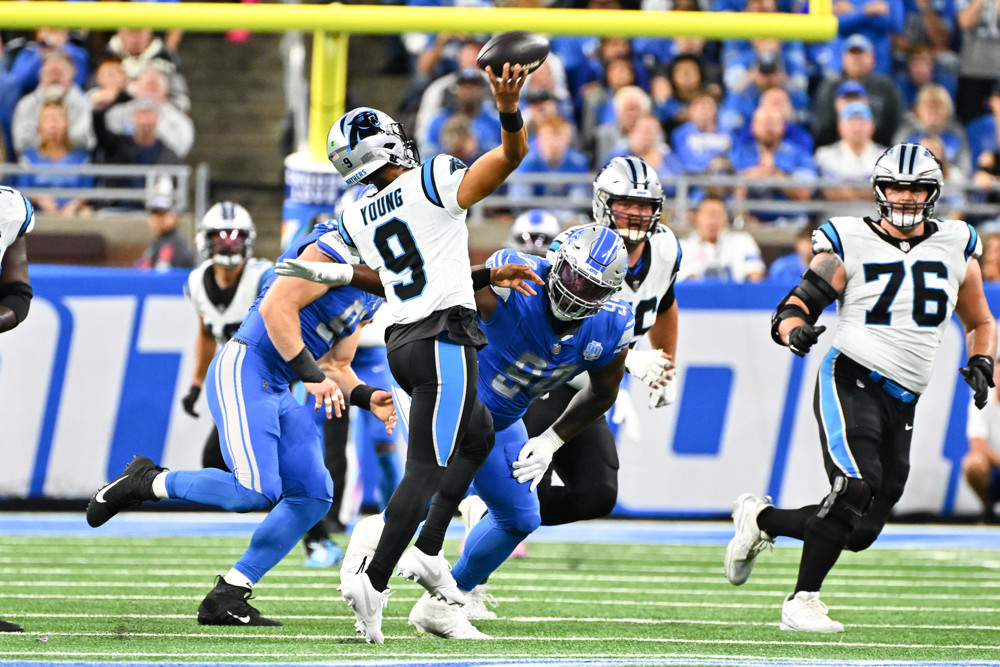
    Thursday, the Carolina Panthers (2-6) and the Chicago Bears (1-7) will square off in one of the worst primetime matchups in recent memory. The only thing really on the line here is draft position, or it would be if Carolina hadn’t traded their pick to Chicago for the right to draft Bryce Young, who currently ranks 31st in Passing Total Points/snap, right below Tyson Bagent. That’s right – Young is arguably not even the best quarterback in a game where his counterpart is an undrafted rookie out of a Division II school in West Virginia. And, if you were curious: just ahead of those two is Mac Jones, whom Young lost a quarterback competition to in college, and who presumably will be out of work come 2024.

    The Bryce Young experiment has failed in Carolina. It would be one thing if Young was struggling early and had some bankable traits, but this is what happens when you take size outliers with no distinguishing qualities outside of collegiate production. Kyler Murray may be tiny, but at least he runs a 4.3 and can throw the football a country mile. What’s Young got up his sleeve? He was a ‘winner’ and a ‘playmaker’ in college? Okay, sure, but there are a lot of guys like that who never pan out in the NFL. Are we even working with any tangible traits here?

    Yes, his supporting cast is bad. Life in Carolina would not be easy for any quarterback, but he is not the only one who has to make the best of a bad situation. Zach Wilson, Jimmy Garoppolo, Josh Dobbs, Mac Jones, and Tyson Bagent have all, to varying degrees, played under suboptimal conditions this year, and they’ve all been more efficient than Young has. The No. 1 pick should be able to do better than this.

    Trevor Lawrence played on the Urban Meyer-led Jaguars in 2021 and struggled quite a bit as a rookie, but he wasn’t below replacement level through the first nine weeks of the season. He wasn’t being outperformed by a 36-year-old Andy Dalton on his fourth team in as many years. And since we’re talking about Dalton, his 58 attempts and 3 sacks have resulted in 79 more EPA than Young’s 252 throws and 26 sacks – entirely because Young is so far in the red.

    So, what the hell, man?

    The receivers aren’t great at getting open, sure. They’re 20th in our receiving Total Points metric as a group, and I’m certainly not gonna go to bat for a unit that’s led by Adam Thielen in the twilight of his career. But, they could be worse, and Dalton has the highest contested throw rate in the league among quarterbacks with 50+ attempts (37%) while Young has one of the lowest at 24%. Part of that is a function of aggressiveness, but why was Dalton able to perform better while a higher percentage of his attempts were contested?

    The answer is in all of our hearts, and it’s that Young is not as well-suited to the NFL as he was to the college game.

    This is not a Josh Allen rookie season we’re talking about. Young is listed at a generous 5’10”, 204 lbs., doesn’t have outstanding arm talent, and is not particularly fast or elusive. If your physical profile sets your floor, his is pretty low. This is a player who drew pre-draft comparisons to Drew Brees, and it’s clear he will have to win in other areas to succeed in the NFL. As of right now, that is very discouraging.

    He’s not seeing the pro game quickly at the moment. He has the fifth-highest expected snap-to-throw +/- time, with scramblers and Jimmy Garoppolo being the only players who get the ball out slower than him. And, in spite of that, he also has the second-lowest ADOT in the league. 63% of his throws travel 5 yards or less downfield, which is the second-highest rate in the league. Taking a long time to check the ball down or execute quick game concepts is not good. Some would even say it’s bad!

    Now, to his credit, his turnover-worthy throw rate is slightly better than average (he ranks 16th). But, as we saw on Sunday against the Colts, he’s not exactly playing mistake-free football, either. And, on that note, his interceptions have been ghoulishly bad. The only quarterbacks whose picks have hemorrhaged more EPA are Sam Howell (who has no object permanence) and Mac Jones (who, as a reminder, beat Young out in college when Young came in as the No. 1 recruit).

    When he finally throws the ball, he hasn’t been particularly accurate. He ranks 32nd in the league in expected on-target over expectation (xOnTgt +/-) at -5%, which is well below average and weighed down by his abhorrent xOnTgt +/- on contested throws (-23%). On throws to open targets, he ranks 22nd. 

    He hasn’t, however, thrown the ball a lot because he’s not been navigating the rush well. He’s been sacked at the 8th-highest rate in the league and he has the 6th-worst sack-to-pressure ratio (i.e. a lot of hurries turn into sacks against him). A good part of that is his offensive line, which is 27th in blown block rate on pass plays, but he has ownership of this, too.

    So, we’re talking about a player who takes a long time to get the ball out, who checks it down a lot, whose pocket presence isn’t great, who isn’t a run threat, who doesn’t have the arm talent to access tight windows or make circus throws, but can deliver the ball accurately at a slightly below average rate if the pocket is clean and his receivers get open.

    That’s not a No. 1 pick.

    That’s not a franchise quarterback.

    That’s terrible.

    All due respect to Bryce Young – he’s a Heisman winner and a legend of the sport. People will remember him for decades to come. He’s immortal. But, this is the NFL. Everybody was good in college, and none of that matters now. On Sundays, he’s a historic size outlier with average traits swimming upstream. I hope he proves me wrong. The NFL is a much better spectator sport when the quarterback play is good, and recently it seems we’re losing more than we’re gaining. I guess we’ll always have college.

  • Are the Lions For Real? A Resounding ‘Maybe’

    Are the Lions For Real? A Resounding ‘Maybe’

    The Lions are off to their best start in over a decade, and while that’s not saying much, there are plenty of reasons for their fans to be excited. At 6-2, they hold a two-game lead in the division and should cruise into the postseason if their remaining slate of games is to be believed; They have the 4th-easiest remaining strength of schedule by current opponent win percentage (42%), and the easiest by opponent defensive EPA. So, barring a complete meltdown, they should crack double-digit wins (which hasn’t happened since 2014), win the NFC North for the first time ever and return to the playoffs after a six-year drought. And if you don’t know any Lions fans, rest assured: that would be a very big deal for them.

    But, people outside of the fanbase don’t care a whole lot about that. Sure, the head coach is adorable and watching a cursed franchise succeed gives most well-adjusted sports fans – if there is such a thing – the warm fuzzies, but people will never be satisfied and they’ll always want more, and that’s why most of us die with regrets. So, the existential question at hand becomes: are the Lions a legit contender?

    The answer is a resounding ‘maybe.’

    We’ve already covered the back half of their schedule, but it’s also worth noting that most of the teams they’ve played so far have, by NFL standards, sucked. Sure, they beat the Chiefs by a point when Kansas City 1) did not have Travis Kelce, 2) did not have Chris Jones, and 3) dropped 17% of their passes en route to one of the worst offensive performances in the Patrick Mahomes era, but, outside of that, do they really have a signature win? Ending the Baker Mayfield Comeback Player of the Year story arc? Sending Josh McDaniels – who was fired at 1 AM eastern time the day after the trade deadline, by the way – to hell? To borrow a college football term, they ain’t played nobody.

    Furthermore, their games against the current NFC West and AFC North division leaders – the only teams on their schedule with winning records – both resulted in losses. The Seattle game at least could have gone either way, but the Baltimore game was a snuff film. That said, teams are entitled to learning experiences (i.e. horrible losses) and you can only beat who you play, so none of this is sufficient to pass judgment. It is, however, relevant because it muddies the waters a bit.

    We could go a lot of different directions from here, but let’s start with Jared Goff. He’s received a lot of praise for his recent performance and is 4th in the league in passing yards, but his advanced statistical profile paints a very distinct picture of him as a game manager type.

    He is by no means a playmaker; his expected on target rate +/- (xOnTgt+/-) – which measures whether or not a throw was accurate relative to factors like depth of target – is poor on both contested throws (-5%, 26th) and throws made off-platform or outside the pocket (-2%, 24th). He is, however, a relatively smooth operator from within structure.

    He currently has the fifth-lowest turnover-worthy throw rate at 1.6%(a career best for him and about half his average in his last three Rams seasons), and he’s getting the ball out quickly with an expected snap to throw +/- of -0.2 seconds, which ranks 4th. Goff also manages the pocket well and doesn’t take a lot of sacks; he has the 4th-lowest sack rate in the league at 5% and the 7th-lowest pressure rate at 31%.

    That is an unexciting, albeit useful player, and offensive coordinator Ben Johnson has done an excellent job of tailoring the passing game to Goff’s strengths, and that actually doesn’t entail a lot of play action like it did when Goff was in LA. They’re largely a dropback team and – like almost every NFL offense – they run just about every concept under the sun, but they have their preferred flavors. They spam the outside vertical stretch concepts (e.g. Smash), the intermediate high-lows (e.g. Dagger), and the weakside choice plays that Goff does so well on. Johnson has also designed a diverse screen game that they call upon often; the team has called the 5th-most screens in the NFL this year at an average of about 5 per game.

    And all that has gone a surprisingly long way. Despite his limitations, Goff is 8th in passing Total Points/play and 5th in positive play rate (49%).

    There are less talented, more mistake-prone quarterbacks with better statistical output (see: Tua Tagovailoa, Brock Purdy), but we haven’t yet stumbled upon the ‘quarterbacks don’t matter’ variant of hobbyist wage suppression masquerading as analytics, so it’s fair to wonder if you can win a Super Bowl with someone like Goff – especially when he doesn’t have the Space Jam supporting casts of the aforementioned, generic Shanahan quarterbacks.

    He does have some pieces at his disposal, though. Amon-Ra St. Brown ranks 10th in Points Earned/Play (0.07), 8th in YPRR, and 8th in YAC, but he is a bit of an underneath merchant; his average depth of target (ADoT) ranks 127th out of 169 WRs/TEs with at least 10 targets. They’d surely like to be getting more downfield production out of 2022 first rounder Jameson Williams, but Josh Reynolds is picking up the slack with a league-best 96% first down catch rate, and Sam LaPorta is developing nicely.

    The offensive line deserves its flowers, as well. Despite some injuries to that unit, they rank 11th in Blocking Points Earned/snap, and have gotten some excellent performance from their bookends. Right tackle Penei Sewell ranks 2nd in pass blocking Points Earned/snap, and left tackle Taylor Decker ranks 3rd in run Blocking Points Earned/snap. This is an athletic unit that can successfully execute a big menu of moving parts gap runs, and it stands to reason that the run game can improve from 10th in EPA/play and 13th in positive play rate if both the offensive line and the running backs can get healthy.

    The defense has been serviceable as well this year. After a disastrous start to 2022 in which they were on pace to be the worst defense of the SIS era – yes, even worse than the 2020 unit led by Matt Patricia – they leveled out in the second half and have carried that into this season. They rank 11th in EPA/play allowed and they’ve seen encouraging growth from some of their younger players.

    Rookie slot corner Brian Branch appears to be a star-in-the-making; he ranks 5th in Coverage Points Saved/play among corners with 10+ targets and 3rd in Run Defense Points Saved/play among all players with 50+ run down snaps. Second-year edge Aidan Hutchinson has likewise taken a leap and leads the league in pressures and ranks 20th in pressure rate +/-. Third-year corner Jerry Jacobs has also had something of a breakout year and ranks 12th among corners in Points Saved/play, though his historical performance might suggest he’s due for regression.

    They have a few complementary pieces along the defensive line – Charles Harris is 20th in pressure rate among DL, and Alim McNeill is a pretty good pass rusher for a nose tackle – but the aforementioned players constitute the bulk of this team’s passing game impact. They do not, for example, have a linebacker who ranks better than 50th in Coverage Points Saved/play. If defense is a weak-link system, and it is, then there are reasons to be concerned about a Detroit back 7 that is mired by injuries to the secondary and shoddy coverage from its linebackers.

    Their run defense has been good, but weird. They rank 11th in positive play rate and 2nd in explosive play rate, but 28th in stuff rate and 26th in broken/missed tackle rate. They don’t allow many positive runs, much less big ones, but they also don’t generate many negative plays and they also miss a lot of tackles. To their credit, they are a swarming unit so we might allow for some broken and missed tackles, but it’s fair to wonder if this holds up over the course of the season.

    At the end of the day, this team feels like more than the sum of its parts. That’s a credit to Dan Campbell and the rest of the coaching staff, and it bodes well for the franchise that he was able to turn things around relatively quickly. That said, there are other NFC teams with more star power than them, and they’re pretty firmly outside of the triumvirate of leading NFC contenders (San Francisco, Philadelphia, Dallas). A Super Bowl is obviously the ceiling here, but it’s pretty unlikely within the distribution of their probabilities. Are they a contender? Maybe as a dark horse, and that’s fine. For younger Lions fans, this could be the best the team’s been in their lifetime. They haven’t won a playoff game since before I was born, and this looks like the year they’ll do it, Super Bowl be damned.

  • Looking For Hope in The Ravens … But Will We Find It?

    Looking For Hope in The Ravens … But Will We Find It?

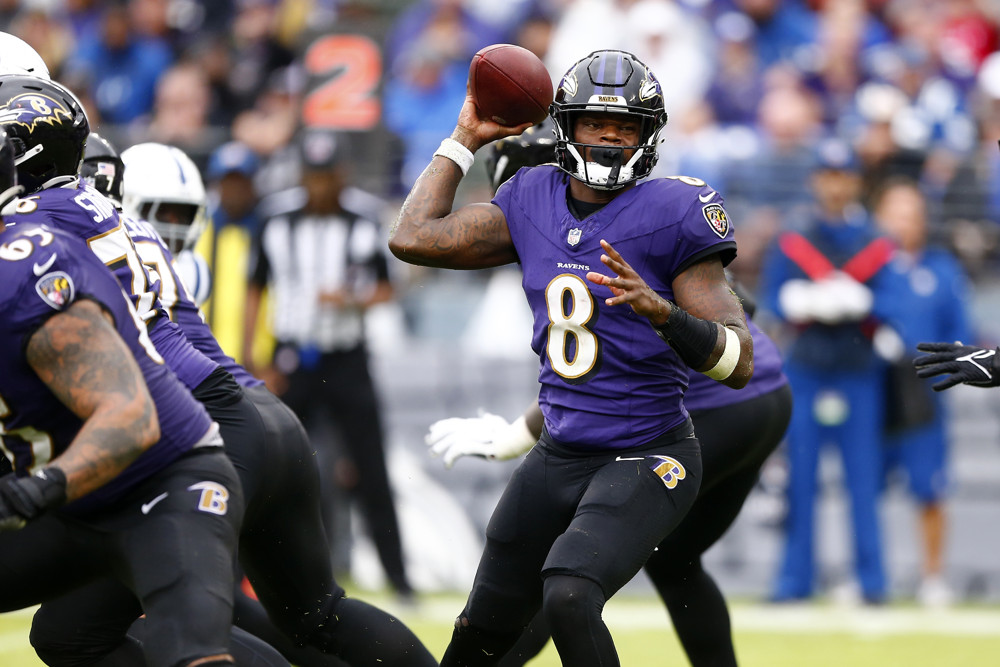
    The NFL is a what-have-you-done-for-me-lately league, and Lamar Jackson winning the MVP in 2019 feels like it was forever ago. Three NFL seasons is a lifetime for most players, and since then, Jackson has finished 17th, 21st, and 20th in passing EPA/play. That was more than enough to get former offensive coordinator Greg Roman fired, and lots of people, myself included, were bullish on his successor, Todd Monken. And through three games, the results have been middling. 

    Lamar ranks 16th in passing Total Points/play after finishing in the bottom half three years running, and the Ravens rank 13th in offensive EPA/play (-0.04). In short, the new-look Baltimore offense hasn’t looked quite as good as we thought it would coming into the year.

    If you’re a fan of Lamar, it was easy to get excited about the offense this year, even beyond the coordinator change. The receiving group, on paper, is the best it’s been in years. They used a first round pick on Boston College WR Zay Flowers, and they brought a still-effective Odell Beckham, Jr. into the fold. But, this group has been beset by injuries.

    Tight end Mark Andrews missed Week 1 with a quad injury, and now Rashod Bateman and Beckham are dealing with hamstring and ankle injuries, respectively. The team has averaged 0.15 EPA/play with all four of them on the field, but they’ve played just 13 snaps together so far. And at the end of the day, the Ravens receiving corps hasn’t performed as well to start as last year’s rendition did, as they rank 25th in receiving Total Points/play in contrast to a 2022 unit that ranked 2nd through Week 3.

    Lamar also ranked 6th in passing Total Points/play during that span, so this year’s start shouldn’t seem as meaningful as it maybe does, especially in light of the injury issues they’re having. The offensive design is better than it was last year, but that’s a low bar and there are still a few spacing issues in the passing game from time-to-time. Furthermore, this is still not a particularly balanced offense.

    They are balanced in the traditional sense that they skew closer towards a 50/50 run-pass split than most NFL offenses, but that’s generally suboptimal and their hit chart (essentially, what part of the field the ball goes to) is eerily similar to last year’s. In 2022, about 40% of their plays were outside runs; this year, that number is 41%. 35% of their plays last year were short passes (under 10 yards); it’s about a third of plays this year. In both 2022 and 2023 thus far, only 5% of their plays have been passes to the intermediate area of the field. The nuts and bolts – the X’s and O’s – have changed, as have the players who represent them, but philosophically, it’s the same stuff.

    Hit 2022 2023
    Outside Run 40% 41%
    Inside Run 14% 16%
    Short Outside 14% 13%
    Short Middle 21% 20%
    Intermediate 5% 5%
    Deep Middle 4% 2%
    Deep Outside 2% 3%

    Arguably the biggest manifestation of the changes thus far is that Lamar is getting the ball out a lot faster this year than he was last year. His average snap to throw time has dropped nearly a full half-second, and his Expected Snap to Throw +/- is hovering at around league average – that is, he’s getting the ball out more or less when he’s supposed to, per the design of the play. Not Tom Brady fast, not Bryce Young slow, and that’s fine!

    But, that’s what’s so unsettling about all this. The story of the Baltimore offense the past four years has been the story of Lamar Jackson. They have, more or less, only gotten as far as he’s been able to drag them. There have been systemic improvements so far, but this isn’t a unit reborn. 

    It feels like we’ve been here before with the Ravens. In reality, there’s no place for – I don’t know if you could even call it this – superstition in quantitative football analysis, but it just seems like we’re approaching boy-who-cried-wolf territory in regards to hyping the Baltimore offense. Even if the coordinator change proves to be little more than addition by subtraction, I am hopeful that the skill players can get healthy and that these small improvements are enough to allow Lamar to regain his MVP form. The Ravens face a big test this weekend in a Browns unit led by an absolute monster, as well as the No. 1 defense that features an early DPOY favorite in Myles Garrett. An offseason of excitement has been tempered by reality, as reality often does, but an impressive road performance against a divisional rival that allows -0.37 EPA/play on defense would be a dream come true.

  • Scouts vs. Stats: Top 10 NFL Quarterbacks

    Scouts vs. Stats: Top 10 NFL Quarterbacks

    Photo: Ian Johnson and Dustin Bradford/Icon Sportswire

    Over the spring/summer, the SIS R&D staff is convening on the Off the Charts Podcast to talk about their top ten players at a position. To do this, we pit two methodologies against each other: 

    • The “Scouts,” which comes down to the film-based opinions of Matt Manocherian and Bryce Rossler, each of whom has a lot of experience breaking down film and scouting players (Matt having been a scout for NFL teams).
    • The “Stats,” which involves James Weaver and Alex Vigderman devising a ranking based on a suite of metrics, and having that ranking speak for itself.

    Officially, Sports Info Solutions does not condone the dichotomy between scouting and statistical analysis. Each of them provides data in their own way and should inform our evaluation of a player. 

    When we originally produced the Football Rookie Handbook before transitioning that content to our NFL Draft site, we put the scouting reports and stats side-by-side with the idea that the reader would bounce back and forth between them and leverage both to come to a conclusion about a prospect.

    This week, we flipped sides, with Alex and James providing their scouting insights while Bryce and Matt assumed the mantle of the nerds. With quarterbacks, it was easy for everyone to agree on the No. 1 guy, but there were some differences of opinion along the way.

    Scouts’ Opinion Statistical Analysis
    1. Patrick Mahomes 1. Patrick Mahomes
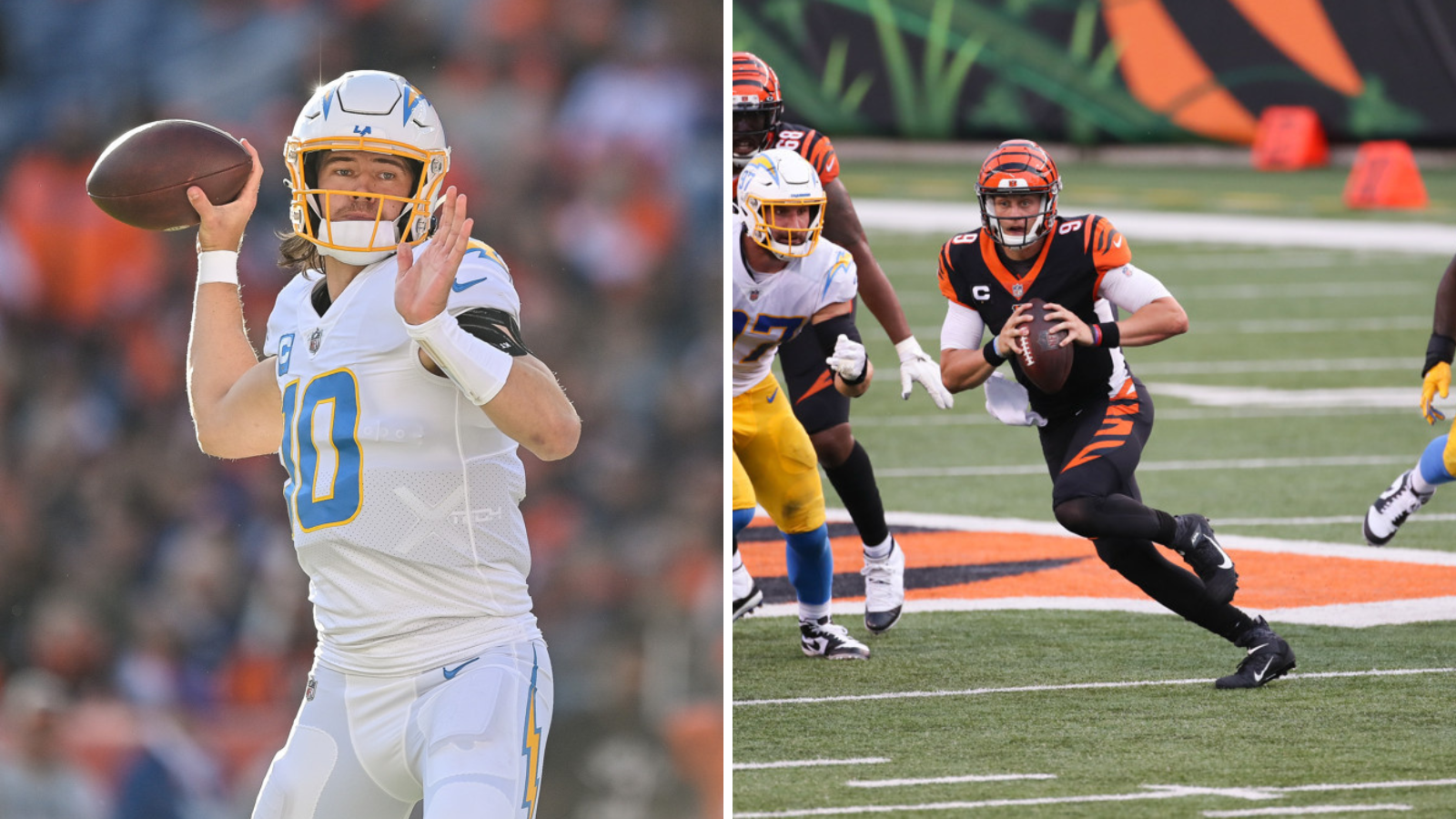
    2. Joe Burrow 2. Justin Herbert
    3. Josh Allen 3. Josh Allen
    4. Jalen Hurts 4. Aaron Rodgers
    5. Justin Herbert 5. Jalen Hurts
    6. Trevor Lawrence 6. Joe Burrow
    7. Aaron Rodgers 7. Tua Tagovailoa
    8. Lamar Jackson 8. Dak Prescott
    9. Dak Prescott 9. Kirk Cousins
    10. Russell Wilson 10. Derek Carr

    The Stats List Methodology

    The stats-based ranking includes a three-year recency-weighted average of a player’s per-snap performance in Total Points, with their most recent season having a weight of 3, the second-most recent having a weight of 2, and their third-most recent having a weight of 1.

    Total Points arguably evaluates quarterback performance better than any other position, if only because there is an abundance of data points related to quarterback play that factor into it.

    Matt and Bryce initially thought to blend it with a second weighted EPA model that incorporated variables like Expected On-Target +/- (xOnTgt+/-) and throw depth, but concerns about historical sample with respect to xOnTgt+/- ultimately led them to decide that keeping it simple was best.

    It should also be noted that this methodology was not limited to Passing Total Points; Rushing Total Points is equally factored in, and that is reflected in the placement of players like Josh Allen and Jalen Hurts, both of whom have been extremely productive on the ground.

    What the Stats Showed

    As Matt noted, it would have been difficult to tweak the model in a way to dethrone Patrick Mahomes.

    “In terms of Z-scores, the difference between Patrick Mahomes and the second-ranked player, Justin Herbert, was bigger than the difference between Herbert and Derek Carr [the 10th-ranked player],” Matt said, “Mahomes was two standard deviations above average; the next-highest Z-score was Herbert, who was a little over one standard deviation above average.” 

    After a clear tier break, Herbert and Allen rounded out the top three, being the two of the remaining three players on the list to have ranked in the top 10 in Passing Total Points/play each of the last two years. (Herbert ranked 6th and 1st in 2022 and 2021, respectively; with Allen ranking 10th and 8th.)

    Allen’s rushing also proved to be a windfall for him, with Bryce pointing out that, in 2022, the Bills generated 11 EPA on running plays, with Allen himself accounting for 33 rushing EPA.

    Dak Prescott also ranked in the Top 10 in Passing Points/snap each of the past two years, but missed most of 2020 with an injury. Another player whose 2020 hurt them a bit in the stats ranking was Joe Burrow, whose ill-fated rookie season dampened his placement, despite performing well each of the past two years. 

    Following Burrow was Tua Tagovailoa, whose extremely efficient Year 3 with Mike McDaniel and Tyreek Hill was enough to propel him into the Top 10, despite not ranking in the Top 20 in Passing Total Points in either of his first two seasons in the league.

    What the Scouts Thought

    The scouts’ list likewise featured Patrick Mahomes at No. 1 and Josh Allen at No. 3, but Alex and James opted to place Burrow second rather than Herbert.

    Their reasoning?

    Burrow just has that ‘It’ factor and has produced more results at this point than Herbert,” James said, “He went into Kansas City and beat Patrick Mahomes, which is something Herbert hasn’t done yet, and there’s something to be said for that.”

    After that, there was a tier break with Jalen Hurts and the aforementioned Herbert placed at No. 4 and No. 5, respectively. The scouts expressed a bit of apprehension about Hurts simply because the Philadelphia offense was an extremely good fit for him last year, but still asserted that his leadership, his running ability, and his deep ball are reasons to be optimistic about him moving forward.

    The scouts also included Trevor Lawrence (No. 6), Lamar Jackson (No. 8), and Russell Wilson (No. 10) in their list, despite all of them having bad statistical years at some point within the last three seasons. James was bullish on Lawrence’s prospects moving forward, citing his arm talent, his mobility, and his command of the offense in Year 2 as very positive signs. Jackson was given the benefit of the doubt with respect to his injuries and the supporting cast around him the last few seasons, and Wilson likewise got a pass for a dysfunctional first year in Denver, but the scouts did note that he’s likely past his prime.

    Want to hear more discussion and debate? Check out this episode of the podcast:

  • Amidst Patriots’ offensive woes, Rhamondre Stevenson is an emerging talent

    Amidst Patriots’ offensive woes, Rhamondre Stevenson is an emerging talent

    As hard as it was to watch New England’s offense last year, it’s even harder to have sympathy for Patriots fans. Six Super Bowls, 9 conference championships, and 17 divisional titles the past 22 years is a lot of vicarious living for the NFL’s most spoiled fanbase, and a 25-25 record since Tom Brady left isn’t even that bad.

    If anything, this kind of mediocrity has prevented the rest of us from enjoying full-blown schadenfreude. There’s not even a grave to dance upon. There’s just some milquetoast, third-year quarterback and a defense that’s still pretty good. Greater misfortunes have befallen teams who have won a single Super Bowl and yet the Patriots still just…exist.

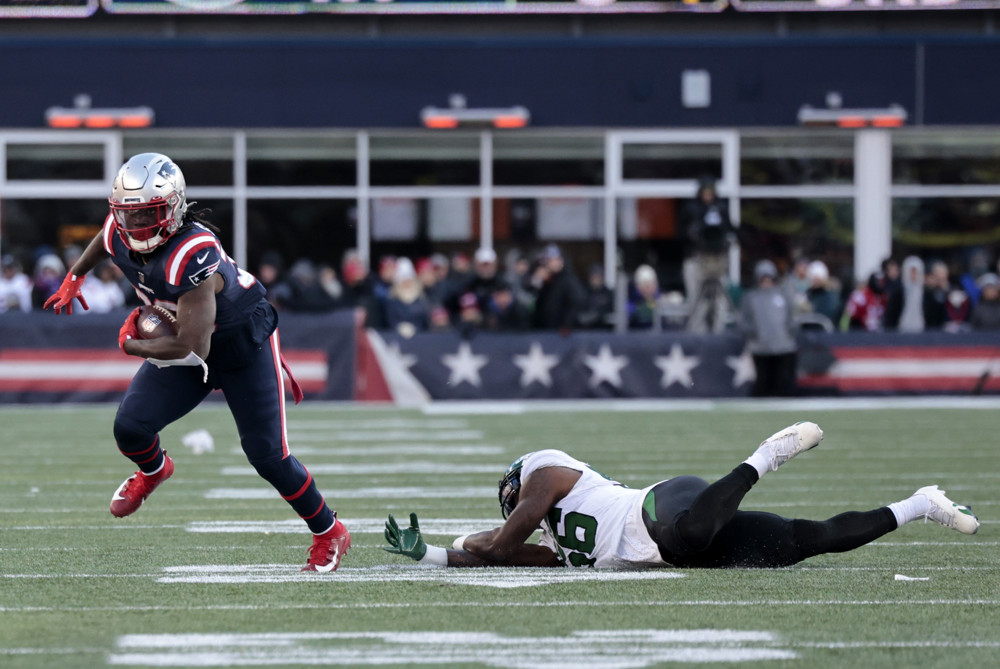
    So, you’d be forgiven for not watching much of their offense last year. And truthfully, 2023 may not be much more exciting, even after the ousting of Matt Patricia. But, if you do watch them, keep an eye on third-year running back Rhamondre Stevenson, who is already quietly a Top 10 running back in the league.

    Stevenson saw a decent amount of work in his first season (despite being out of shape entering the NFL),  but nearly doubled his touches from 147 as a rookie to 279 in 2022. His emergence likely factored into New England’s decision to let Damien Harris walk in free agency, and, barring any unforeseen developments, he should be the workhorse in Foxborough going forward.

    It’s not hard to understand why, either – Stevenson has very good three-down ability. Backs who are built like him (6’0”, 230 lbs.) are not typically thought of as passing-down backs, but Stevenson is an exception to that rule, if it even is one.

    Pass protection is an underrated trait for running backs in the modern NFL, and he’s been excellent in that regard since his time at Oklahoma. In fact, he ranked 1st at his position in Pass Blocking Total Points on both a total and a per-snap basis last year.

    He also expanded his role considerably as a receiver and finished fourth in receptions among running backs. He’s not a dynamic route runner who can consistently embarrass linebackers in man coverage, but his feel for settling into open spaces is good and he can make defenders miss after the catch; Among running backs with at least 20 targets, his broken/missed tackle rate on receptions (37%) was fifth-best in the league.

    And of course, the running ability is legit, though it was hard to notice at times behind the Patriots offensive line. That unit ranked 30th in the percentage of carries that were stuffed (23%) or hit at the line (45%), and 31st in yards before contact (1.5). In spite of that, Stevenson made it work. He was tied for 2nd in yards after contact/attempt (3.4) and finished 5th in Total Points per play (0.11). The vision, power, and contact balance are obviously good, and those translate well to short yardage and goal line work, where he was 7th in the NFL in Total Points per play among running backs.

    Stevenson is not just a bruiser, though. He has good speed for his size and, despite lacking explosive acceleration, has great body control and the ability to gather himself to create awkward tackling angles for pursuers. His broken and missed tackle rate was 14th in the league (minimum 100 carries) and he was actually 7th in boom rate (plays with >1 EPA) at 10.3%. His production was admittedly a bit uneven – ranking 22nd in positive play rate and 34th in bust rate (plays with ≤-1 EPA) – and some of that is on him, but there’s only so much you can do behind that line.

    Entering his third year, Stevenson has already proven himself to be both versatile and effective. He may not be as flashy as some of the other big name guys, but he does pretty much everything you want a feature back to do, well. As good as his 2022 campaign was, he should have an even bigger role this year. For a New England offense that has a lot of question marks entering this year, Stevenson isn’t one of them. Look for the 25-year-old to have his best season yet in 2023.

  • Anthony Richardson’s Accuracy: A Closer Look

    Anthony Richardson’s Accuracy: A Closer Look

    While each quarterback in this year’s draft class has their flaws, Anthony Richardson is the one who has unanimously been labeled a project. And, at first glance, that may be fair. Richardson was a first-year starter with a 54% completion rate on a 6-7 team, and he didn’t really start to generate serious buzz until he lit up the drills at the combine. 

    We’ve seen athletic quarterbacks decline to compete in the underwear olympics (the combine) before–Lamar Jackson comes to mind–but perhaps that wasn’t a luxury that Richardson could afford. At any rate, it turned out to be a good business decision, as the Florida signal-caller is now being talked about as a Top 10, or even a Top 5 selection.

    But Richardson is more than just a physically-gifted fixer-upper. He’s consistently shown some high-level quarterback play on film and is more refined than most people think. He generally does a good job of getting through his progressions and throwing with anticipation, and his pocket movement is already very good, especially for a 21-year-old. The results haven’t been there, though, and that’s largely due to issues with accuracy.

    Completion percentage can be misleading, but there’s no getting around the fact that anything in the 50s is worrisome. On-target rate is a better representation of accuracy because it actually seeks to measure the precision of the throw–rather than just the result–but can likewise be muddied by factors such as throw depth.

    Indeed, Richardson attempted higher difficulty throws than most quarterbacks, as his average depth of target (10.7) ranked 10th in the country. Furthermore, his receivers’ ball skills left much to be desired with the Gators ranking 52nd and 58th among Power 5 schools in on-target catch rate and drop rate, respectively. Still, it’s a bad sign that he ranked 95th in catchable rate (79.8%) and 106th in on-target rate (65.4%) among 114 FBS quarterbacks who attempted at least 200 passes last year.

    If there were a holy grail of accuracy metrics (there isn’t), that would be On-Target +/- , which sets a baseline on-target rate for each throw based on factors like throw depth and field location, and then compares the actual result to that expectation. Unfortunately, Richardson also fared poorly in this metric, ranking 104th among the aforementioned group at -4%. Even Kentucky’s Will Levis, another subject of accuracy concerns, ranked 35th at +3%.

    What’s interesting, though, is that if you break this metric down to the route level, Richardson isn’t generally inaccurate. That is, he’s not consistently performing below expectation on most routes. 

    He’s good at throwing a few routes, slightly above average at most routes, and then abysmally bad at a handful of routes. He struggled a lot with in- and out-breakers, with an on-target rate 20% below expectation, and those routes made up about 10% of his attempts. Bubbles and arrow routes proved to be even more difficult at a clip of -25%, and also made up approximately 10% of his throws. 

    Lastly, his OnTgt+/- on scramble drills was -23%, which comprised about 5% of his throws. That component might be especially concerning considering his playmaking ability is a big selling point for him.

    I’m not sure that there’s a smoking gun here that would allow us to wave off these accuracy concerns. These route clusters are different enough from each other that it’s difficult to identify a recurring cause of the symptom. Even then, his On-Target +/- would only be +2% if we stripped all those routes out of the sample, and it’s important to remember that these benchmarks are relative to college play and not the NFL level, where windows get tighter. 

    It would also be disingenuous to assert that a team could scheme to avoid him throwing all of these routes. Whichever franchise takes him will simply have to bank on improvement and live with it in the meantime. Quarterbacks with similar draft profiles like Josh Allen and Justin Herbert have been huge successes, so taking a risk here is tantalizing considering both these recent anecdotes and the fact that there’s no consensus franchise prospect this year like an Andrew Luck or a Trevor Lawrence.

    Even for people like myself who are fans of his game, the accuracy issues have to be reconciled in some way, and the statistics outlined herein cannot do that. It’s my belief that he has fewer obstacles to overcome to become a good NFL starter than most people believe, but the obstacle he does have is a pretty big one. Accuracy is arguably the most important trait for pro quarterbacks, so whoever takes this on will have to fix one big problem rather than several small ones. And whoever does will be making a dart throw.

  • Snub Season: Who Should Have Made The Pro Bowl

    Snub Season: Who Should Have Made The Pro Bowl

    It’s the most wonderful time of the year – the time where we all gather round to complain about our favorite players missing the Pro Bowl. The NFL’s annual all-star event has lost some of its luster in recent years, but this otherwise-frivolous institution is still used as a benchmark for contract incentives. It’s just a popularity contest to fans, but making or missing the Pro Bowl has real, financial implications for the players. And because it’s a popularity contest, a lot of deserving players miss the cut.

    NFC

    Fred Warner was rightfully selected to the Pro Bowl, but his cohort Dre Greenlaw probably should have made it too. Greenlaw is the only NFC linebacker to rank in the top 10 in both run defense Total Points and pass coverage Total Points, with Greenlaw ranking 8th and 1st in those respective categories. He’s also averaging 8.5 tackles/game with an average tackle depth of just 1.2 yards, which is 2nd-best in the NFC (minimum 30 tackles). Greenlaw was a fifth-round pick in 2019 and has performed really well in a contract year, so making the Pro Bowl could have helped him a ton in contract negotiations this offseason.

    One man’s trash is another man’s treasure. Just a few months after being released by the Giants, new Eagles cornerback James Bradberry leads the NFL in coverage Total Points (49), is 3rd in coverage Total Points/snap (0.09), and ranks 2nd among qualifying corners (200+ cover snaps) in yards/cover snap (0.4). He’s done all this while seeing a high volume of targets across from teammate Darius Slay, who did make the Pro Bowl. 

    Bradberry has been thrown at 62 times and has allowed the lowest completion percentage in the NFL at 34%. Ideally, the goal is to suppress targets, but corner play is volatile and very few players achieve that consistently. Bradberry deserved a Pro Bowl nod this year, and it was surprising he didn’t get it considering just how good the Eagles have been.

    Honorable mention: PHI DT Javon Hargrave ranks 2nd in pressure rate (10.4%) and 3rd in Total Points/pass rush among NFC DTs, but it’s hard to bump any of Aaron Donald, Jonathan Allen, and Dexter Lawrence, especially when all three are better run defenders.

    AFC

    The 6-8 Jaguars don’t get a lot of fanfare, and second-year corner Tyson Campbell predictably did not get a Pro Bowl bid over some of the household names on winning teams. However, he’s had a really good sophomore campaign and, quite frankly, deserved the Pro Bowl slot over Dolphins corner Xavien Howard, who is having an uncharacteristically bad year and ranks last in the NFL in yards allowed. Campbell, meanwhile, ranks 2nd in the NFL in pass coverage Total Points and has the 6th-best positive play rate (33%) among corners who have been targeted at least 10 times. Unfortunately, emergent players on losing teams have a tough time making the Pro Bowl.

    In another instance of a household name making it over a less-established, albeit more deserving player, T.J. Watt, who has played just seven games this year due to injury, made the Pro Bowl as an outside linebacker over the Dolphins’ Jaelan Phillips. Miami’s second-year edge ranks 4th in the AFC in both pressure rate (17.4%) and pass rush Total Points Saved (21) among players with 100+ pass rushes. His 57 pressures rank 9th in the NFL this season, but a low sack rate (2%) and a middling sack total (7) bely just how good he’s been.

    Honorable mention: CIN WR Tee Higgins has had a really good year. He ranks 4th in the NFL in Total Points/route run among wide receivers with 50+ targets, behind Davante Adams, Stefon Diggs, and Tyreek Hill, but it’s hard to argue he’s better than those guys, and the fourth AFC WR is his teammate, Ja’Marr Chase, who draws more attention from opposing defenses.

    This year’s Pro Bowl voting seems to have been a bit better than previous seasons. As always, there were some selections that were based on name-brand recognition more than anything, but the snubs seemed few and far between. As disappointing as that is for a Scrooge like me who loves to complain, it is nice to see that a lot of emerging young stars got their due. Players like Quinnen Williams and Talanoa Hufanga should soon become household names in their own right, and maybe some of this year’s snubs aren’t too far behind.