Author: Colin Sanders

  • MLB Draft Scouting Report: Jacob Cozart

    MLB Draft Scouting Report: Jacob Cozart

    You can find all our MLB Draft scouting reports here.

    Photo: Nicholas Faulkner/Icon Sportswire

    Name: Jacob Cozart

    College: North Carolina State University

    Bio: L/R 6-3, 222lbs.

    DOB: 01/09/2003

    Scouting Grades on 20-80 Scale

    Skill Grade
    Hit 40
    Power 50
    Run 30
    Arm 55
    Field 50
    Future Value 50

    Analysis

    Jacob Cozart comes from a family of baseball players. His dad was an accomplished player at the University of Central Florida and his brother, Caleb, is a senior and played UNC-Greensboro this past season. 

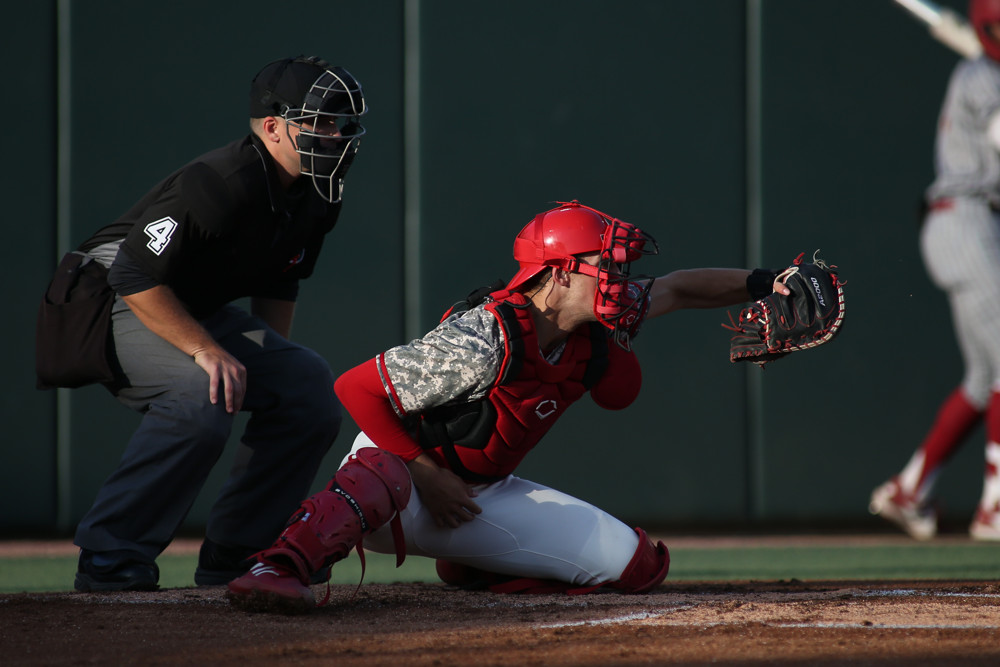
    Cozart’s athletic traits shine in his movements behind the plate. He is explosive in his movements from the crouch which enhances his skills as a blocker and allows him to control the run game when coupled with his plus arm. 

    He shows some solid tools in the batter’s box with a strong lower half that he’s able to tap into to produce solid power numbers in game.  

    College Career

    Cozart amassed 150 starts over his three years at North Carolina State after immediately stepping into a starting role during his freshman year. He provided more defense than offense in 2022, putting up a respectable .240/337/.377 as a newcomer in the ACC before breaking out during his sophomore year. 

    In 2023, Cozart cemented himself as an all-conference performer, earning All-ACC second-team honors as he saw a significant offensive improvement. His newfound power stroke led him to belt 10 home runs and 14 doubles on his way to a .301/.392/.546 line. Increasing his OPS by over 200 points while maintaining his defensive prowess caught the attention of scouts heading into the summer of 2023. He also competed in the USA collegiate national team trials that summer before heading to fall camp at NC State.

    Year ISO K% BB%
    2022 .137 15% 10%
    2023 .245 17% 11%
    2024 .296 17% 19%

    2024 was another impressive year for Cozart. He helped lead NC State back to Omaha for the first time since 2021. He had another jump offensively, increasing his OPS by another 100 points on his way to a .305/.437/.601 line for the season. He socked 19 home runs this past year, but what may be a more impressive development is his plate discipline. He walked more than he struck out this season, raising his walk rate from 11% in 2023 to 19% in 2024. He was a key cog in Pack9’s run to Omaha with timely hits like this: 


    Stance

    Cozart does a great job creating favorable angles with his setup to maximize his power and simplify his swing. 

    With his lower half, he starts with a wide base and a slightly open stance. He internally rotates his lead leg and sinks into his back hip, stacking most of his weight onto his backside and creating tension in his legs.  

    On top, he closes his shoulders to the pitcher, allowing you to see a glimpse of his number from a normal center field camera. This allows him to create some tension across his midsection as he waits for the pitcher to move toward the plate. He keeps the bat almost completely flat as he holds his hands a few inches behind his left ear. 

    As the pitcher breaks his hands there is almost no movement from Cozart’s upper half. His hands and head stay remarkably still as he starts a medium-sized leg kick. He squats a little further into his legs during his load and as he shifts his weight toward the pitcher he gets into a strong launch position and he fires his hands. 

    When he is swinging well, this is a very compact operation that can do serious damage to his pull side against all pitch types. 

    Approach

    Cozart likes to pull the ball in the air so he looks for pitches middle-in early in counts. These are the pitches he can do the most damage on and he does a great job at punishing mistakes in this zone.

    Using our “Synthetic Statcast” tool, we can see that when he got his pitch this year, he made the most of it. 

    Name Barrel % (percentile) Average Launch Angle Hard Hit %
    Jacob Cozart 10% (85th) 16° (87th) 37.9 (76th)

    He does a good job limiting his chase below the zone on offspeed pitches and has proven that he is willing to take a walk. However, he did have some struggles this season chasing fastballs that ride above the zone above his bat path. Cozart doesn’t have top-of-the-line hand speed like others in this class and struggles to get to the top rail at times. 

    His tendency to want to wrap the barrel around the ball and drive it to right field also leaves him susceptible to spin in and out of the zone. If he gets fooled and gets onto his front foot too early he can’t always delay his hands enough to make contact and that can also result in weak ground balls to the first and second basemen. 

    His offensive profile will take a back seat to his defensive responsibilities as a pro given his position, but Cozart should be able to tap into his raw strength at a high enough level to be a factor at the plate with a slightly refined approach. 

    Defense

    Much like shortstops and centerfielders, the most important factor in evaluating a catcher is whether or not they can handle the position in the major leagues. 

    Cozart gained the reputation of being one of the top defensive catchers in all of college baseball over his three years in Raleigh. He is a great framer who is adept at stealing strikes in all parts of the zone. He does very well at beating the ball to its spot and has soft hands when receiving. 

    Cozart is a very good athlete and does a great job moving from his preferred one-knee-down stance, but blocking is the area where he has the most room for improvement. His larger-than-average frame and good mobility allow him to pull off acrobatic stops like this: 

    At his best, he has great blocking range and deadens the ball right in front of his body allowing him to easily recover and prevent advancements. However, he did get caught this year lifting his glove off the ground on blocks to both sides, allowing the ball to slip underneath his glove and get to the backstop. 

    Cozart’s other calling card is his arm and his ability to slow down the run game. He threw out 33% of base stealers in 2024 and has consistently produced sub-two second pop times on throws to second base. His plus arm speed and mobility allows him to throw from multiple windows with authority. He generates good carry on his throws like the one you see here:

    One of the trademark stats that we curate in the major and minor leagues is Defensive Runs Saved, a wholesale evaluation of a player’s defensive performance. 

    We calculate the DRS for college players in power conferences as well. Here is how the top catchers in this years draft class compare defensively: 

    Name: Defensive Runs Saved Innings
    Malcolm Moore 2 415
    Jacob Cozart 1 428
    Caleb Lomavita -2 402

    *Our college Runs Saved calculations do not include a framing component 

    **These calculations are scaled to MLB fielding averages. 

    Projection

    He doesn’t have eye-popping hand speed but does a good job punishing mistakes and can tap into his raw power consistently. He will likely see an uptick in his strikeout rate in pro ball as he sees better offspeed offerings, but his improved plate discipline should help him get on base consistently. 

    His carrying tool will be his defense and he already showcases above-average framing ability. Cozart projects as an above-average defensive catcher with solid run-producing potential.

    Comp: Austin Wells

    Draft Projection: 1st Round

  • MLB Draft Scouting Report: Kaelen Culpepper

    MLB Draft Scouting Report: Kaelen Culpepper

    You can find all our MLB Draft scouting reports here.

    Photo: John Bunch/Icon Sportswire

    Kaelen Culpepper is a versatile player with sound athletic traits and a solid offensive skill set whose future defensive position is a bit of a question mark.

    Name: Kaelen Culpepper

    College: Kansas State University

    Bio: R/R 6-0, 190lbs.

    DOB: 12/29/2002

     Scouting Grades on 20-80 Scale

    Skill Grade
    Hit 50
    Power 40
    Run 60
    Arm 55
    Field 45
    Future Value 45

     Analysis:

    Culpepper stepped into a starting role immediately at Kansas State, playing third base during his freshman and sophomore years before becoming the everyday shortstop in 2024. He logged over 150 games over his three years for the Wildcats and earned All-Big 12 Second Team honors this past season.

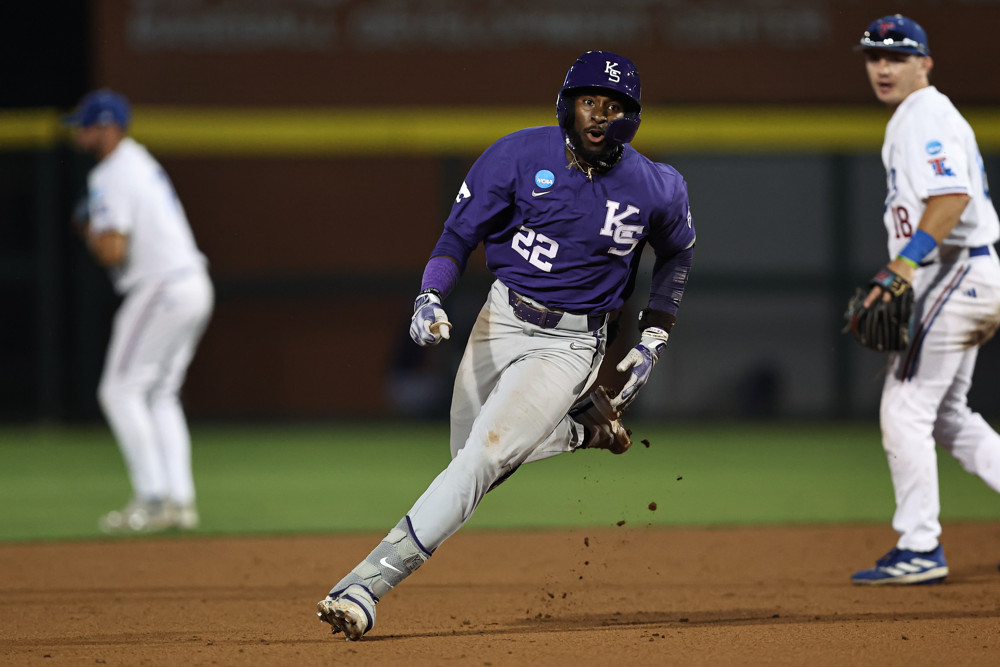
    He’s an excellent athlete who makes everything he does on the diamond look smooth. Whether it’s making a sliding stop on a ground ball or bat-flipping a towering homerun, Culpepper never looks like he’s in a hurry.

    College Career:

    Culpepper showed consistent improvement year over year at Kansas State. In 2022, he slashed .283/.356/.428 before making a significant offensive leap his Sophomore year. He upped his slash line to .325/.423/.576 and had a significant increase in his power production by doubling his home run total. His improved offensive profile saw him earn an invite to the Team USA collegiate national team trials in the summer of 2023 where he led the team with a .853 slugging percentage over 9 games.

    His exposure with the national team vaulted him up draft boards coming into 2024, and he produced another good season at the plate and in the field. He put up a .324/.416/.570 line and led the Big 12 in triples, all while making the transition to being a full-time shortstop.

    Year OPS K% BB%
    2022 .784 14% 6%
    2023 .999 15% 9%
    2024 .985 14% 12%

    Stance:

    He sets up at the plate with a slightly open stance and almost no bend in his knees. He keeps his feet wider than shoulder-width apart and evenly distributes his weight between them.

    Culpepper keeps his hands by his right ear while waiting for the pitcher to come to the plate. The first move in his action is a short leg kick that helps him stack his weight over his back leg. At the same time, he bends slightly at the hips and knees which allows him to get his upper body in a more natural hitting position. As his weight shifts back towards the pitcher his hands drift slightly back which helps him get into a powerful launch position.

    He likes to keep his hands close to his body as he fires them through the zone, allowing him to keep his barrel in the strike zone for as long as possible. He always finishes his swing on balance as his hands bring the bat over his left shoulder.

    Approach:

    Culpepper developed into a disciplined hitter over his three years at Kansas State, doubling his walk rate throughout his collegiate career. His advanced approach led him to walk almost as much as he struck out in 2024.

    He has a line-drive approach and likes to spray the ball to all parts of the field, and his tendency to keep his hands inside the baseball allows him to stay on pitches in any part of the zone. He likes to drop the barrel on the baseball and hunts pitches low in the zone, which can leave him susceptible to breaking balls that fall out of the zone late.

    He is not very explosive with his lower half and can struggle a bit to create optimal home run launch angles on pitches down in the zone which has limited his power production in college, but his plus hand speed allows him to catch up to velocity higher in the zone. The height of the pitch allows him to generate a little more lift and launch the ball out of the park like this:

    (Hello again Hagen Smith…)

    We track college baseball data across Division I, charting as many games as we can. That allows us to use what we call our “Synthetic Statcast” tool to calculate some statistics that you normally wouldn’t be able to get.

    Here’s a snapshot of his batted ball numbers from this year:

    Name Barrel % (percentile) Average Launch Angle Hard Hit %
    Kaelen Culpepper 9% (84th) 10° (41st) 33% (54th)

    Defense:

    The biggest question when drafting a shortstop is whether will they be able to stick at the position in the major leagues.

    Culpepper made the move to shortstop from third base this past year and proved that he could be more than a corner infielder at the next level. He has good lateral quickness and average range, coupled with soft hands which will allow him to be a solid defender at several positions in the major leagues.

    The biggest area for development in his game defensively will be improving his arm accuracy. He shows great arm strength from his low ¾ arm slot but tends to lose the ball high over the first baseman’s head.

    Using our “defensive misplays” stat that we track for every game we chart throughout the season, we can take a closer look at what types of misplays each fielder is making. We define defensive misplays as “any play on which the fielder surrenders a base advance or the opportunity to make an out when a better play would have gotten the out or prevented the advancement.”

    We can see the disparity between Culpepper and other top draft-eligible shortstops in this class when it comes to misplays credited to bad or offline throws compared to fielding misplays:

    Name Fielding DMs Throwing DMs
    Kaelen Culpepper 4 9
    Griff O’Ferrall 4 4
    Colby Shelton 7 1

    Projection:

    Culpepper is a smooth mover who has a knack for making every movement on the baseball field seem easy. He won’t have a gaudy offensive profile like some of the other players in this draft class, but his simple approach and reluctance to chase will allow him to consistently get on base at any level. His plus speed and athletic traits make him a factor on the basepaths and in the field, giving him the ability to play multiple spots across the infield. He projects as a utility infielder in the major leagues who can provide average defense at three positions.

    Comp: J.P. Crawford

    Draft Projection: Late 1st round/Competitive Balance Round A

  • MLB Draft Scouting Report: Tommy White

    MLB Draft Scouting Report: Tommy White

    You can find all our MLB Draft scouting reports here.

    Photo: Michael Wade/Icon Sportswire

    With plus barrel control, hand speed, impressive raw strength, and an aggressive approach over 3 years at North Carolina State and LSU, Tommy White has some of the highest offensive upside of any player in this year’s MLB Draft. 

    Name: Tommy White

    College: Louisiana State University

    Bio: R/R 6-1, 228 lbs.

    DOB: 03/02/2003

    Scouting Grades on 20-80 Scale

    Skill Grade
    Hit 60
    Power 60
    Run 40
    Arm 50
    Field 40
    Future Value 55

    Analysis

    Appearing in 161 games over an illustrious three-year career, White has cemented himself as an all-time college performer. He is a three-time All-American whose 75 home runs are good for 8th all-time in NCAA history. 

    While not an explosive athlete, White is physically mature with strength throughout his frame, which helped him produce top-of-the-line hard-hit and barrel rates throughout his college career.

    College Career

    White began his collegiate career at North Carolina State, setting a new NCAA freshman home run record by swatting 27 home runs and slashing .362/.425/.757 on his way to Freshman of the Year honors from the ACC and Baseball America.  

    Then, White entered the transfer portal and headed to Louisiana to join Paul Skenes and Dylan Crews at LSU. White was a key contributor in the middle of that star-studded Tigers lineup, putting up a slash line of .377/.435/.729 with 24 home runs including one of the most historic blasts in CWS history to send LSU to the finals: 

    White enhanced his status as one of the top third base prospects in the country in 2024 by posting another excellent offensive season, slashing .330/.401/.638. 

    Year HR ISO K% BB%
    2022 27 .396 19% 9%
    2023 24 .352 13% 7%
    2024 24 .308 12% 9%

    Stance

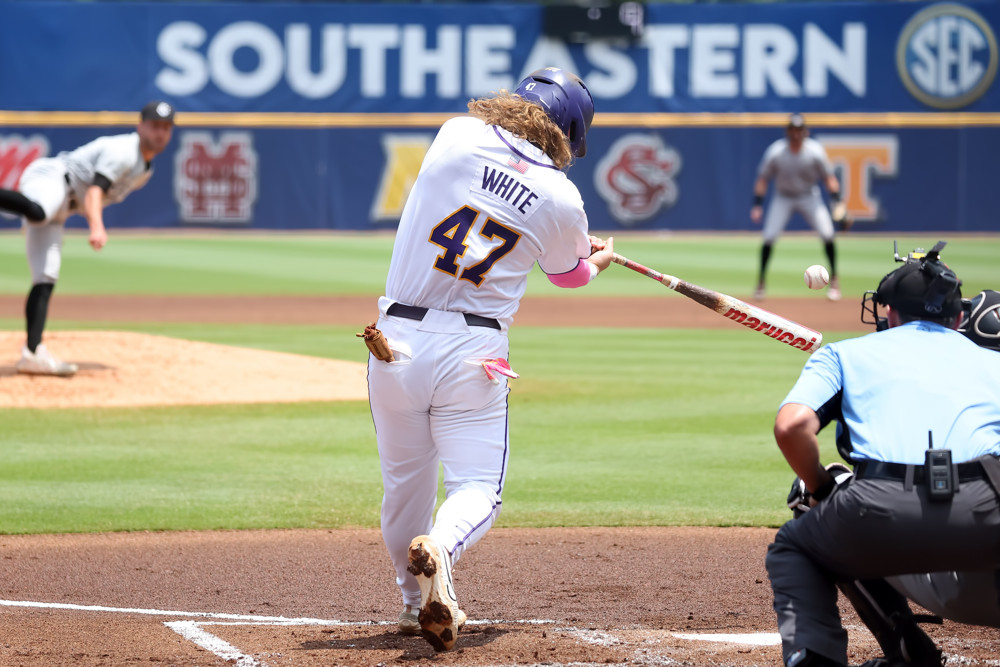
    White sets up at the plate with an open stance and his feet wider than his shoulders. He gets into a deep knee bend and stacks most of his weight on his back leg.

    He rests the bat flat on his back shoulder as he waits for the pitcher to move towards the plate. As the pitcher breaks his hands, White flicks the bat off his shoulder and gets the barrel almost vertical as he starts his load. His hands work on two planes, coming down below his right shoulder at the beginning and then working back and up which helps him create a big stretch across his chest at his launch position.  

    Using his toe-tap timing mechanism, White gets all his weight stacked over his back leg with his first step back. As he steps back toward the pitcher, he creates significant momentum throughout his kinetic chain and fires his hands toward the baseball with a powerful punch. He posts against his front leg as his barrel works through the zone and finishes with a high one-handed finish. 

    Approach

    White said it best when describing his approach at the plate during an interview with SEC Network during the SEC Tournament in Hoover this year. “A lot of hitters decide when to swing. I decide when not to swing.” 

    He is aggressive in the zone early and often, regardless of pitch type. If he gets a pitch in the zone that he can handle, he’s going to swing, and given his advanced feel for the barrel he hits the ball hard very often. 

    We track college baseball data across Division I, charting as many games as we can. That allows us to use what we call our “Synthetic Statcast” tool to calculate some statistics that you normally wouldn’t be able to get.

    Here’s how White stacks up to some of the other premier infield prospects in this class in hard-hit rate and barrel rate for games we’ve tracked:

    Name Hard Hit % (percentile) Barrel %
    Tommy White 45% (93rd) 12.6% (93rd)
    Cam Smith 44% (92nd) 7.5% (68th)
    Seaver King 34% (60th) 3.9% (29th)

    White also has a very unique two-strike approach. He gets very wide with his base and presets the internal rotation of his back leg, allowing him to eliminate his stride without giving up all of his power. He minimizes his head movement, which helps with pitch recognition and tracking, and focuses on firing his hands at the ball.

    He doesn’t lose the ability to generate power with this setup due to the strength in his wrists and forearms. Here he is with this same approach against projected top-10 pick Hagen Smith: 

    Defense

    The only thing that will keep White from being a bona fide star at the next level will be the uncertainty of his defense. After DH’ing for most of his time his freshman year at North Carolina State, White took over every day 3B duties for LSU.The 2023 season, was a struggle defensively for him at the hot corner, with 13 errors and an .859 fielding percentage. 

    Much has been made about how he was able to make improvements defensively this year, and while he was able to decrease the number of errors he committed, down to 3, and increase his fielding percentage, up to.971, I’m still skeptical about his ability to stick at third base long-term. 

    Another stat we track is the number of “defensive misplays” that each fielder makes throughout the season. These are plays that go beyond what you would find in a normal box score. We define defensive misplays as “any play on which the fielder surrenders a base advance or the opportunity to make an out when a better play would have gotten the out or prevented the advancement.” 

    Here’s how White performed last year vs this year: 

    Year Errors  DMs  GFPs 
    2023 13 15 0
    2024 3 14 7

    We can see that while White did make improvements in cutting down on his errors and increasing his good fielding plays(think highlight reel-type plays and smart baseball plays), he still has work to do defensively to stick at the position in the major leagues. With limited range and an average arm, White is likely more suited for first base.

    Projection

    Tommy White is an extremely talented offensive prospect who is known for his above-average hand speed and advanced feel for hitting. He’s an aggressive hitter who can do damage on any type of pitch to any area of the field and organizations will love his offensive profile. His defensive shortcomings will likely force him into a 1B/DH role long term, but a college hitter with his track record of production should help him move through a minor league system quickly.  

    Comp: Pete Alonso 

    Draft Projection: Top 20

  • MLB Draft Scouting Report: Dakota Jordan

    MLB Draft Scouting Report: Dakota Jordan

    You can find all our MLB Draft scouting reports here.

    Photo: Michael Wade/Icon Sportswire

    Leading up to the MLB Draft, Sports Info Solutions Video Scouts will provide scouting reports on some of the top college players available.

    The reports will also feature some of the customized data that we’ve tracked this season. If you have any questions about that data, you can reach out to mark@ww2.sportsinfosolutions.com.

    Lightning-fast hands and thunderous raw power make Dakota Jordan one of the most captivating hitters in this year’s draft class. He has power to all fields, but struggled with strikeouts during his time in college which has left some scouts doubtful about his production at the plate.

    Name: Dakota Jordan

    College: Mississippi State University

    Bio: R/R 6-0, 220 lbs.

    DOB: 05/03/2003

    Scouting Grades on 20-80 Scale

    Skill Grade
    Hit 40
    Power 60
    Run 60
    Arm 50
    Field 50
    Future Value 50


    Analysis:

    Dakota Jordan is as intriguing as any prospect in this year’s draft class after two highly productive years at Mississippi State. He was a Day 1 contributor at State, starting 104 games across all three outfield spots.

    Jordan’s an exceptional athlete who in addition to being a highly touted baseball recruit, was a three-star wide receiver recruit who was committed to playing football at Mississippi State as well. He is known for his massive raw power and electric bat speed, both of which stem from a physically mature body in a medium-sized frame.

    College Career:

    Jordan showed marked improvement over his two years, with significant increases in his power and run production year over year.

    Year HR ISO K% BB%
    2023 10 .268 25% 14%
    2024 20 .317 29% 15%

    Jordan burst onto the scene as a freshman, earning Perfect Game Freshman All-American honors by slashing .307/.397/.575 with 40 RBI. He followed that up with an impressive .354/.459/.671 and 72 RBI’s this year, earning third team All-American team honors in 2024. While he did make strides at the plate with his quality of contact, there still was a great deal of swing and miss, with his strikeout rate increasing to 29% in 2024.

    We track college baseball data across Division I, charting as many games as we can. That allows us to use what we call our “Synthetic Statcast” tool to calculate some statistics that you normally wouldn’t be able to get.

    Here’s how Jordan stacks up to some of the other premier outfield prospects in this class in hard-hit rate and barrel rate for games we’ve tracked:

    Name Hard Hit % (percentile) Barrel %
    Dakota Jordan 50% (98th) 13% (93rd)
    Vance Honeycut 48.5% (97th) 12% (92nd)
    James Tibbs 44.5% (92nd) 12% (92nd)

    Stance:

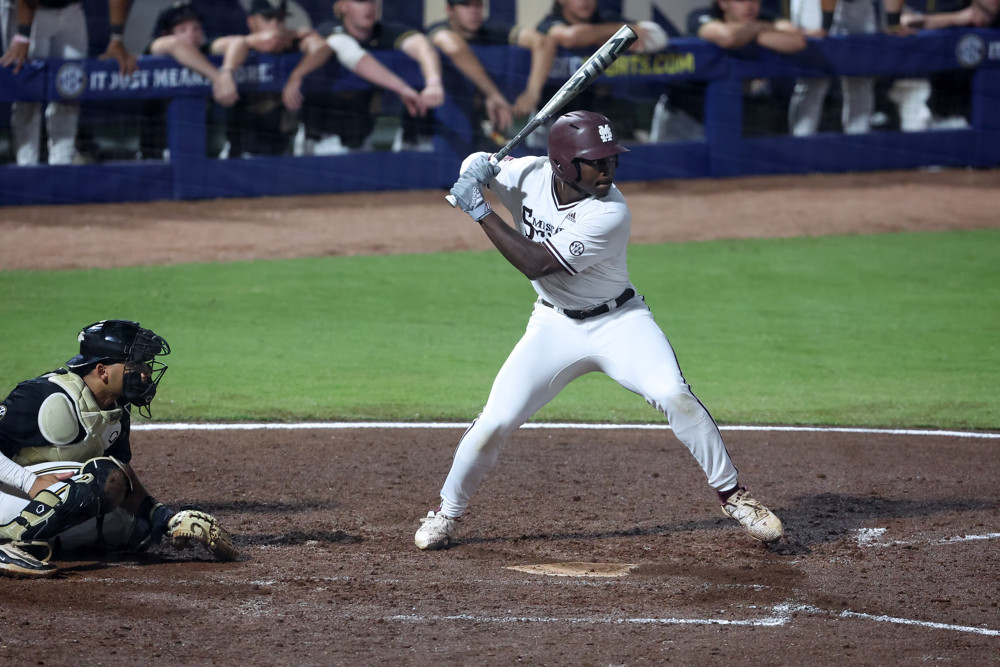
    Jordan sets up at the plate with a very wide base, his feet wider than his shoulders. He sinks into his legs as he waits for the pitcher, which helps him tap into the raw strength in his lower half.

    He keeps his bat almost parallel to the ground as he waits for the pitcher to make his move to the plate. Once the pitcher’s hands break in his delivery, Jordan initiates his swing with a short leg kick and turns his barrel up slightly to get into his launch position. As he drifts towards the pitcher, Jordan drags his hands back to create a stretch across his midsection before firing his hands at the ball.

    Jordan creates significant force and bat speed throughout his swing and as the barrel moves through the zone his lead leg straightens as he posts against it. He concludes his swing with a one-handed finish low over his left shoulder and his back foot slightly kicking out behind him.

    Approach:

    Jordan hunts fastballs middle-up in the zone, and with his elite bat speed he is able to turn around fastballs at any level. His aggressiveness on the fastball does leave him susceptible to breaking balls from both right- and left-handed pitchers, with a tendency to get beat by curves and sliders from right handers and changeups from lefties.

    This aggressive approach and tendency to try to catch the ball out in front does lead to a lot of strikeouts. Jordan struck out over 27% of the time over his two years at Mississippi State.

    His quick hands and power do allow him to make adjustments on pitches that he is fooled on and still do damage, which may lead to an adjustment in his approach at the next level. Jordan doesn’t need to sell out for the fastball to hit the ball hard, and by letting the ball get deeper, he will be able to stay on the offspeed pitches better.

    Take this pitch for example. He’s able to delay his hands enough on this fastball that is way outside the zone and hammer it out to right-center field.

    Defense:

    Jordan isn’t an above-average outfield defender presently but has the athletic traits to become a suitable corner outfielder at the major league level. Possessing plus straight-line speed, his range will improve with more reps in the outfield as he gets more comfortable reading the ball off the bat. Coupled with an average arm, Jordan should have no problem holding down either of the corners of the outfield, with the ability to fill in at center field if needed.

    Projection:

    Oozing with physical tools, Dakota Jordan projects to be a power hitting corner outfielder at the major league level. He may experience some growing pains early in his minor league career as he adjusts to higher-level offspeed pitches, but his elite bat speed and strength should continue to produce loud contact as long as he makes better swing decisions.

    MLB Comp: Marlins outfielder Jesús Sánchez

    Draft projection: Between picks 15 and 30