Author: Jack Klein

  • Heat Check: A Different Offensive Approach Than Any Other Team

    Heat Check: A Different Offensive Approach Than Any Other Team

    One of the NBA’s most effective offenses is doing it differently than everyone else. The Miami Heat rank 5th in Points Per Chance (PPC), up from 18th last season, and have done so with an offense that has abandoned screening to an extent without recent precedent. In our five seasons of tracking NBA data, the 2025-26 Heat’s 27.8 Ball Screen’s per 100 possessions through their first 10 games is the lowest we’ve seen by a wide margin. 

    Fewest Ball Screens/100 possessions (2021-22 to 2024-25 seasons)

    Team (Year) Ball Screens per 100 possessions
    Memphis Grizzlies (2024-25) 63.4
    Denver Nuggets (2024-25) 77.1
    Sacramento Kings (2022-23) 78.5
    Golden State Warriors (2024-25) 81.4
    Golden State Warriors (2021-22) 81.6

    >> Miami Heat (2025-26): 27.8 Ball Screens per 100 possessions

    Yes, you’re reading that correctly. The team that used the fewest Ball Screens per 100 possessions still used over double what this Miami Heat team is using. Not only that, but this is quite the deviation for Miami, who ranked 14th last season with 99.9 Ball Screens per 100. 

    Here’s this year’s bottom five teams in ball screen usage.

    Team Ball Screens per 100 possessions
    Heat 27.8
    Jazz 62.9
    Nuggets 72.3
    Rockets 74.9
    76ers 75.6

    So how has Miami’s offense found such early success? Notably, the Heat have relied on creating advantages through 1-on-1 matchups more than any other team. They rank 1st in the NBA in Closeout, Downhill*, Initiation** and Isolation Opportunities (Opps) per 100 possessions.

    * Downhill = the attacking player catches on the perimeter with momentum going toward the basket pre-catch

    **Initiation = the attacking player brings the ball into the frontcourt and makes an initial 1-on-1 attack in a non-transition possession.

    In the clip below, Miami immediately looks to space the floor and gives it to Jaime Jaquez Jr. on the wing. With his teammates and their defenders all on the weak side of the court, Jaquez Jr. can attack the defender downhill in a 1-on-1 and get to his spot in the paint.


    Interestingly, when the Heat does choose to create through a Ball Screen, they’re incredibly good at it. The 2025-26 Heat’s 1.13 Points Per Chance on Ball Screen Opportunities is very high. If maintained for 82 games (a big ‘if’), it would be the best we’ve seen in the last five seasons, meaning the team that runs the least Ball Screens also happens to be the most effective when running them.

    Some may have the preconceived notion that an offense predicated on 1-on-1 matchups means an offense that lacks fluidity and ball movement, but such is not the case in Miami. The Heat rank 5th in Passes, 2nd in Assists and 1st in Hockey Assists*** per 100. 

    ***Hockey assists = shots or shooting fouls directly created for teammates one pass prior to the result

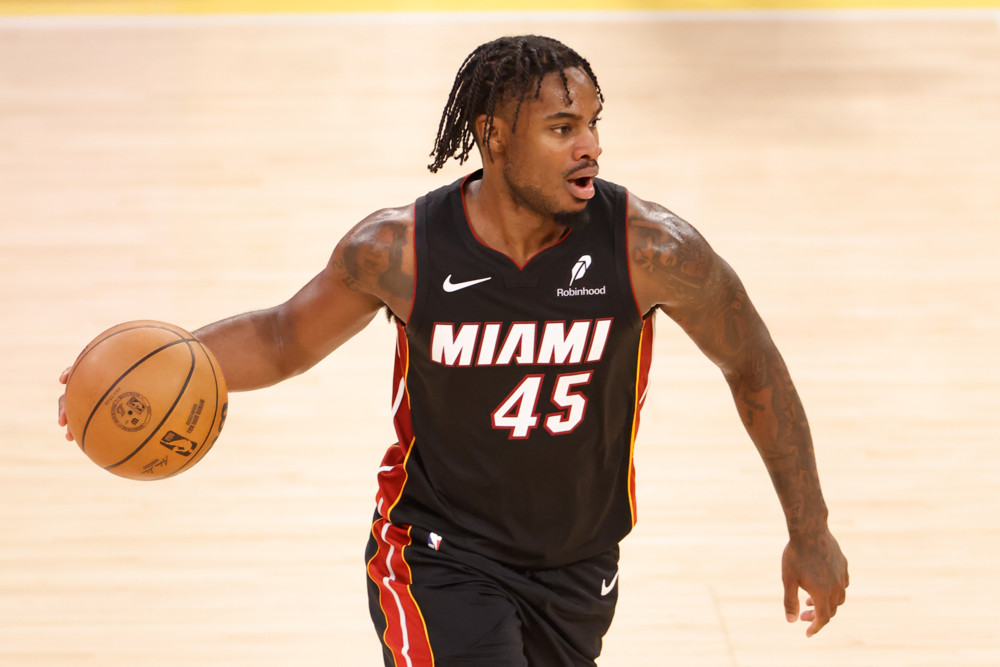
    Miami’s passing proficiency has plenty to do with the ability of Davion Mitchell as a creator in its offense. A look at this table shows just how efficient Mitchell has been as a passer despite a relatively low number of opportunities.

    Category (all per 100 possessions) Percentile 
    Assists 96th
    Potential Assists 96th
    Hockey Assists 96th
    Assist:Turnover Ratio 97th
    Opportunities 75th

    >> minimum 500 possessions to qualify

    In the situation shown below, many offenses would opt for an early screen to get into their action. With Miami’s approach, Mitchell has space to go 1-on-1 at the defender and kick to the corner when the defense rotates. 


    The emergence of Jaquez Jr. has also played a key role in Miami’s early season success. Jaquez Jr. has seen an increase in creation responsibilities, going from 49.2 Opps per 100 in the 2024-25 season to 60.9 through 10 games this season. With the additional offensive duties, Jaquez Jr.’s main improvement has not come from creating more advantages, but rather in his ability to maintain created advantages and capitalize as a scorer.

    Season Advantages Reduced

    (per 100 possessions)

    Advantages Maintained

    (per 100 possessions)

    PPC (percentile)
    2024-25 6.9 5.5 19th
    2025-26 4.9 9 81st

    It must also be mentioned that Jaquez Jr. has increased his value with his play on the defensive side of the ball, specifically as an on-ball defender. Last season, he was in the 55th percentile in Points Per Chance against when defending the ball-handler (minimum 1,000 possessions). So far this season, he ranks 1st in the NBA in PPC against.

    In the clip below, we see Miami’s philosophy on display again, with Jaquez Jr. attacking in space with the initial attack of the possession. Even though Jaquez Jr. doesn’t beat his man off the dribble, the penetration draws defensive eyes and allows for Pelle Larsson to cut from the slot resulting in a simple look at the basket. 


    Miami’s unique offensive scheme has helped it achieve a 7-4 record, good enough for 3rd in the Eastern Conference. Will the Heat keep up this rate of avoiding Ball Screens? Can they? Recent NBA history suggests it unlikely, but recent NBA history has not seen a team play the way this Miami Heat team is playing.

  • How The Milwaukee Bucks Offense Has Changed Under Doc Rivers

    How The Milwaukee Bucks Offense Has Changed Under Doc Rivers

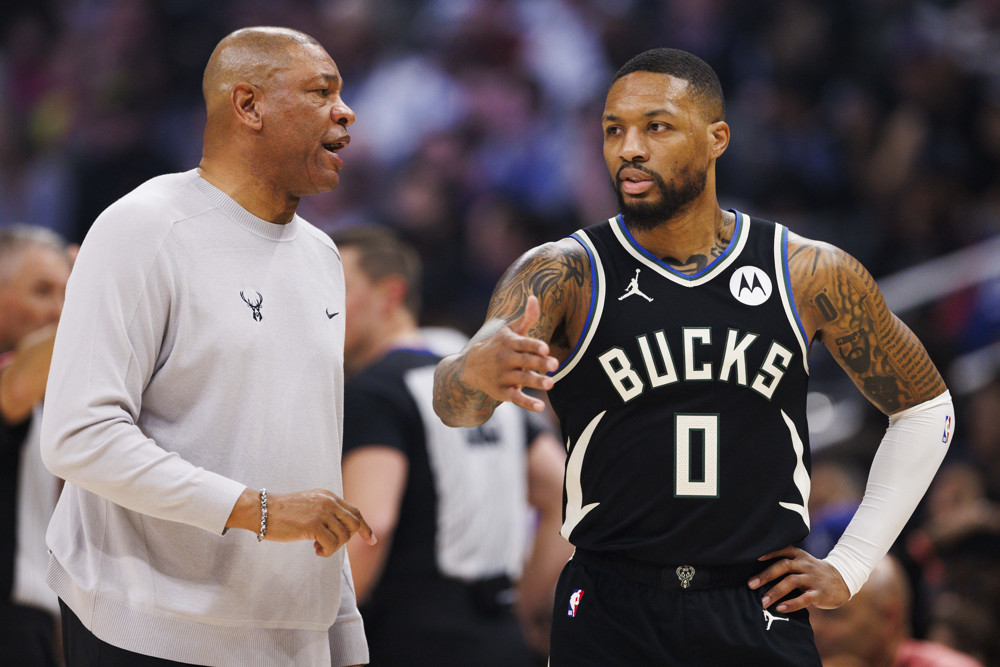
    Photo: Ric Tapia/Icon Presswire

    The Milwaukee Bucks surprised the basketball world when they parted ways with Head Coach Adrian Griffin. After his 30-13 start to the season, the Bucks replaced Griffin with Doc Rivers, who won a championship in 2008 with the Boston Celtics and has since had stints with the Los Angeles Clippers and Philadelphia 76ers. 

    Despite Griffin’s seemingly successful start to the regular season, Milwaukee presumably brought Rivers in to shake things up and better position themselves for a run to the NBA Finals. 

    But what exactly has changed with Milwaukee in the 26 games since Rivers took over?

    Damian Lillard: Offensive Engine

    For starters, Rivers’ offense in Milwaukee has put Damian Lillard in more situations to create and initiate. After Rivers’ first game as coach, Giannis Antetokounmpo told reporters, “[Rivers] emphasized like, go more to Dame. When I have the ball, kick the ball ahead to Dame. Set more screens, roll out of the post, dribble handoffs – he wants more and we have to do it more. Because at the end of the day, when Dame has the ball in his hands…we can cause some damage”. 

    A look at this table shows an increase in on-ball opportunities and in Lillard getting the first crack at an on-ball opportunity.

    Damian Lillard

    Under Griffin Under Rivers
    On-ball opportunities per 100 possessions 67 (35th in NBA*) 82 (7th*)
    Possessions with first on-ball opportunity 47% 58%

    *Minimum 1,000 offensive possessions.

    Giannis Still A Focal Point

    Lillard’s uptick in opportunities has been achieved without sacrificing opportunities for Antetokounmpo. Here’s the table for Giannis.

    Giannis Antetokounmpo

    Under Griffin Under Rivers
    On-ball opportunities per 100 possessions 67 (34th in NBA*) 74 (19th*)
    Possessions with first on-ball opportunity % 36% 39%

    When either Lillard or Giannis are on the court, one of them has the first on-ball opportunity 72.5% of the time under Doc, up from 66% before he was hired.

    Ball Movement and Spacing

    As on-ball opportunities for their star players increase, Milwaukee is generally playing at a faster pace with more ball movement. Under Griffin, Milwaukee posted the lowest totals in the NBA for both on-ball opportunities (about 269 per 100 possessions) and passes (almost 99 per 100). These figures have seen a sizable increase under Rivers. On-ball opportunities have increased by 19 per 100 possessions. Passes are up about 17 per 100.

    With the increase in ball movement, the Bucks are having their players catch the ball in more advantageous positions. The Bucks went from ranking 27th in the NBA in inherited advantages* per 100 possessions to 21st. They’ve also jumped from 24th to 15th in maintained advantages** per 100. The table below shows the difference in inherited advantages for Milwaukee’s key role players:

    Inherited Advantages per 100

    Under Griffin Under Rivers
    Bobby Portis 12.4 13.7
    Brook Lopez 10.2 11
    Malik Beasley 9 10.3

    *Advantage Inherited: Player inherits at least a semi-advantageous situation in their on-ball Opportunity.

    **Advantage Maintained: Player inherits at least a semi-advantage and at minimum maintains their team’s advantage on their on-ball Opportunity.

    When asked by reporters about Lillard and Antetokounmpo’s playmaking, Rivers said, “They’re very unselfish. They know that they’re in the action, but they know it’s team action. So, they’re just making the simple pass to the open guy.”

    Milwaukee’s increased spacing during Rivers’ tenure could be one reason the team has improved at inheriting and maintaining advantages. Through player-tracking data, we can create convex hulls of the offensive shape (essentially, how spaced out the offensive perimeter players are). 

    Before Rivers became coach, the Bucks had the 6th-highest average convex hull in the NBA. With Doc in charge, the Bucks’ average convex hull ranks 1st.

    Conclusion

    Although the Bucks got off to a bit of a slow start with Rivers at head coach (they lost 5 of his first 6 games but are 13-7 since), they still hold the No. 2 seed in the Eastern Conference and a 2.5-game lead over the Cleveland Cavaliers in the Central Division.

    It’s still yet to be seen if their offensive changes will lead to playoff success, but Milwaukee and Rivers are seemingly trying to model what their offense will look like in a potential playoff run, where Lillard and Antetokounmpo will need to be at their best to make a push for an NBA Championship.