Category: 2025 NFL

  • Introducing Our Multi-Year Injury Risk Model

    Introducing Our Multi-Year Injury Risk Model

    Injuries. Everyone hates them, and we all can agree injuries are the worst part of sports. 

    Part of the reason is that injuries can occur when you least expect them, and there are so many different variables that can come into play for why they happen, making it very difficult to accurately predict them. Unfortunately we cannot just turn injuries off like we are playing a game of Madden, and so there can be great value in trying to provide something to base expectations off in terms of how much time a player misses. With our multi-year injury risk model, we aimed to do just that.

    Methodology

    Football can vary greatly depending on what position you play, and so we split our player dataset into three different position groups: offensive skill players, offensive linemen, and defensive players. We also wanted to test various time frames, so we made predictions for the number of games players will miss in one-, two-, and three-year spans. Features incorporated in our dataset include biographical data, injury history data, playing time data, and other stats that convey what the player does on the field.

    We used the XGBoost machine learning framework to build our regression model. For our target variable, to lessen the impact of outlier cases, we took the average of the number of games missed in the next year (or two or three) and the number of games the player was expected to miss based on the injury prognosis (which is something that our injury staff logs for most injuries). 

    Findings

    Games Missed Prediction Error by Position Group and Timeframe

    One Year Two Years Three Years
    Offensive Skill Players 3.6 5.9 7.1
    Offensive Linemen 3.7 5.3 7.3
    Defensive Players 3.7 6.2 7.3

    Root mean squared error (RMSE) was used to evaluate the accuracy of our model. As we can see above, overall, the accuracy is similar across positions, with accuracy predictably being better the shorter the time frame is. However, it can also be argued that the three-year model was the most accurate because when you divide the RMSE by the number of games corresponding to that time frame (i.e. 17 games in one year, 51 games in three), the ratio is smallest for the three-year interval. Therefore, the model predicted games missed for the longest time span with the least error percentage-wise. 

    Average Predicted Games Missed by Position Group and Timeframe

    One Year Two Years Three Years
    Offensive Skill Players 2.2 5.2 7.7
    Offensive Linemen 2.4 6.4 8.2
    Defensive Players 2.1 4.6 6.4

    We observe more of a discrepancy across position groups when examining the average predicted games missed. For all three time intervals, offensive linemen were predicted to miss the most games, followed by offensive skill players, and then lastly the defensive players. This is in line with the trend for actual games missed by position group.

    Top 10 Feature Importances by Position Group

    Here are the top 10 features in terms of importance (how much a feature contributes to a model’s predictions) by position group for the three-year interval.

    Offensive Skill Offensive Linemen Defensive
    1. Snap % in the Slot Snap % Playing Tackle Age
    2. Snaps Blocking Projected Snaps Total Points per Snap
    3. Age Games Missed Past Year Projected ST Snaps
    4. Total Points per Snap Blown Block % Snap % Playing Linebacker
    5. Special Team Snaps Total Points per Snap Special Team Snaps
    6. Snaps in Motion BMI Projected Snaps
    7. Projected Snaps Snaps on Pass Plays Snap % Playing Run Defense
    8. Routes Run Age Snap % Pass Rushing
    9. Games Missed Past 3 Years Games Missed Past 3 Years BMI
    10. Snaps Player was Hit Snap % Playing Guard Tackles Made

    We can see that projected snaps and age were among the most significant for each position group. To dive deeper into why, we ran a comparative analysis between players in the top half of predicted games missed and players in the bottom half.

    Comparison of Key Features for Skill Position Players, by Predicted Games Missed

    The table below shows an example of one of our datasets, skill players in a two-year time span. 

    High Prediction Low Prediction
    Predicted Games Missed, Two Years 6.1 4.4
    Snaps Played Past Season 835 554
    Projected Snaps Next Two Years 1,503 1,045
    Age 26.6 27.4

    We can observe that on average, players who are predicted to miss more games have played more snaps in the previous season, are projected to play more snaps the next two years, and are about a year younger than players who are predicted to miss less games. 

    This pattern was more or less present across all our datasets. At first, this may seem counterintuitive. One could think that older players are more injury prone or that players are projected to play less because they got hurt. However, the data is telling a different story; players are predicted to miss more games when they are expected to also play more games. Playing football is itself a hazard.

    One place where this trend reverses is at the very end of a career. Among the 1,700 players we made predictions for 2025 and beyond, about two dozen players were predicted to miss more games in a two-year period than in a three year one, a finding that was quite confounding at first. However, when comparing these players to the rest of the population, an even larger discrepancy in age existed, with them being three years older on average than their counterparts. The model was picking up signals for when a player was close to retirement and inferring reduced playing time over a three-year span. For these cases, we adjusted the number of predicted games missed in three years to be equal to the two-year number. 

    We observed more trends when taking a look at who our model predicted to miss the most games. 

    Top 10 Players Predicted to Miss the Most Games Over a Three Year Span

    Player Position One Year Two Years Three Years
    Kamari Lassiter, HOU CB 4.0 8.7 14.6
    Rashawn Slater, LAC OT 3.5 9.1 13.7
    Paulson Adebo, NYG CB 4.4 8.1 13.6
    Derek Stingley Jr., HOU CB 3.4 8.3 13.3
    Dalton Kincaid, BUF TE 3.3 9.5 12.9
    Kyle Pitts, ATL TE 2.3 7.0 12.9
    Luke Goedeke, TB OT 3.7 9.1 12.8
    Pat Freiermuth, PIT TE 2.8 8.5 12.8
    Alaric Jackson, LAR OT 3.0 7.8 12.6
    Jake Ferguson, DAL TE 3.2 8.1 12.6

    First, every player was drafted in 2021 or later, keeping in line with the propensity of our model to predict younger players missing more games than older players (in large part because younger players are on the field more). 

    Second, all players had sustained a multi-week injury at some point during the last three years. Indeed, though not as prevalent as the other key features, missed games in past years were greater on average for players in the top half of predictions than for those in the bottom half. 

    Lastly, within the three position groups, our model predicted tight ends, offensive tackles, and cornerbacks to be more prone to injury, and accordingly, everyone on this list plays one of those positions.

    Conclusion

    While attempting something as inherently difficult as predicting the number of games a player will miss due to injury in a given time frame may seem like a lemon that is not worth the squeeze, our study shows there is value in going through the exercise and extracting inferences from the data. Chief among them is that the more a player is on the field, the more he invites risk of getting injured. 

    This is a simple premise, but one that is often more overlooked than it should be, and emphasizes even more just how much we should appreciate players who exhibit extraordinary durability. 
  • World’s No. 1 QB Rankings 2025 – Do We Buy Bo Nix?

    World’s No. 1 QB Rankings 2025 – Do We Buy Bo Nix?

    In the 2024 NFL Draft quarterbacks went early and often, and it didn’t take long to find out why. We saw some impressive rookie campaigns last season and it’s clear that these quarterbacks have bright futures ahead.

    One of those quarterbacks is Bo Nix, who Denver took with the 12th overall pick a year ago. He was actually the sixth quarterback taken in the draft, behind Caleb Williams, Jayden Daniels, Drake Maye, Michael Penix Jr., and J.J. McCarthy.

    Nix went on to finish third in NFL Offensive Rookie of the Year voting, but how much did his play justify that?

    Well, by our World’s No. 1 Quarterback Rankings methodology, he’s pretty much arrived.

    The World’s No. 1 Quarterback Ranking uses our player value stat, Total Points, to make a cumulative evaluation of game performance over a three-year period. The key to our calculation is Points Above Average (PAA), the statistical underpinning of Total Points that is centered at zero so that positive numbers are above average and negative numbers are below average.

    Success over time is key to maintaining a good ranking. Prolonged inactivity results in a ranking drop. The most recent performances carry the most weight.

    Here are the rankings heading into 2025, grouped into tiers:

    Tier 1

    1. Lamar Jackson

    Tier 2

    2. Josh Allen

    3. Joe Burrow

    Tier 3

    4. Jayden Daniels

    Tier 4

    5. Justin Herbert

    6. Patrick Mahomes

    Tier 5

    7. Bo Nix

    8. Jordan Love

    Tier 6

    9. Jared Goff

    10. Baker Mayfield

    You might be able to quibble with the order of some of these names, but the inclusion of Nix here is the most surprising thing. Is that a reasonable assessment of his value?

    Nix’s Rookie Season Stats and Analysis

    The Broncos’ quarterback had some solid counting stats last season, especially his 29 passing touchdowns.

    He also proved he can make plays happen with his legs, picking up 41 first downs by rushing, which ranked 29th among all players, not just quarterbacks.

    Counting stats move the needle for awards voting, but by taking a closer look at Nix’s Total Points and other advanced metrics, we can get a better idea of just how good he was last season.

    First, let’s take a look at some general advanced statistics, with Nix’s rank among the 46 quarterbacks with at least 100 attempts:

    Stat Value QB Rank
    Passing Total Points Per Play 0.166 9th
    Positive Play % 48% T-20th
    Boom % 25% 26th
    Bust % 19% 20th

    * Boom and Bust Rate are the rate of plays gaining or losing at least one EPA, respectively.

    Nix was 9th in Total Points Per Play last season, but he wasn’t particularly consistent, and he wasn’t frequently making splash plays either. You would think that a good quarterback would fit into at least one of these categories, but Nix didn’t last season.

    So why did Nix rank so highly in terms of Total Points? Well for that, we have to dig a little deeper.

    Pass Attempts

    Nix’s average throw depth was 7.3 yards last season, which ranked 27th among QBs. A big reason for this was the number of screens he threw (90, 3rd-most). On non-screen passes, Nix’s average throw depth was 9.7 (tied for 15th).

    There was a solid effort for big plays in Denver, the Broncos just struggled to convert on them. In fact, Nix was 5th in Intended Air Yards, but he ranked a lot lower in completed Air Yards at 17th. Broncos receivers had the fifth-most targets of at least 20 yards, but they posted a 10.3% drop rate (7th-worst). Total Points gives Nix credit for being aggressive downfield, and those drops get credited to him as though they were completed. But he was below average in how often he delivered an accurate throw on those deep targets.

    And finally, his completion percentage was right in the middle of the pack (66%), and his catchable pass percentage was tied for 21st (85%).

    Sack and Turnover Avoidance

    Young quarterbacks tend to struggle with pressures, sacks, and turnovers. Caleb Williams, Drake Maye, and Jayden Daniels all had a sack rate at or above 7.8%, which ranks 34th or worst among quarterbacks.

    This is an area where Nix shined. His sack rate was 3.8%, which was 5th-best in the NFL. He threw 12 interceptions, but he did not lose any fumbles on the year.

    Sacks are drive killers, and they hurt most quarterbacks more than Nix last year. If you exclude sacks from the ledger of every quarterback, Nix’s rank in Passing Total Points per play drops from 9th to 20th.

    Nix is a tough player to sack, despite not forcing a lot of broken or missed tackles like Daniels and Williams. Instead, Nix would find a way to gain positive yardage on a scramble, rather than take a drive-killing sack. He had 49 scrambles last season, which was second-most in the NFL (Daniels had 72). Nix was also the league leader in pass attempts on designed rollouts (65). Combine these with the high amount of screen passes, and you have a good idea of how Denver kept Nix on his feet last season.

    Looking Ahead to 2025

    Is there a sophomore slump in store for Bo Nix in 2025? He still has Sean Payton calling the plays, a stellar offensive line, and some new pass catchers to throw to as well. They got a big upgrade at tight end when they signed Evan Engram, and they drafted Pat Bryant in the third round of the 2025 NFL Draft as well.

    Marvin Mims made some big plays in the second half of last season, and Troy Franklin is also entering Year 2. Denver also added J.K. Dobbins and RJ Harvey in the backfield, which will make defenses have to respect the run.

    One thing Nix will have to deal with this year is that opposing defenses now have a year’s worth of film on him. Screens and designed rollouts can only get you so far. Nix is going to have to prove he can make throws in the pocket and to all three levels of the field.

    Is Bo Nix a Top 10 Quarterback?

    Bo Nix was the 6th QB taken in the draft just a year ago, but are the teams who passed on him already regretting their decision?

    Our advanced metrics show that Nix has desirable traits that Sean Payton’s offensive scheme can take advantage of. However, there are some underlying statistics that make it difficult to rate him as a top 10 quarterback already.

    If you remove screens, Bo Nix drops from 6th to 11th in passing Total Points. He’s willing to push the ball downfield, but he’s not particularly strong at it. From a rushing perspective, he’s got enough mobility to extend plays and scramble for additional yardage, but he’s not evading tackles at an elite rate. That very low sack rate might not hold up.

    Nix could have a very solid career as an NFL quarterback, but let’s not rush to place MVP bets on him just yet.

  • Which NFL Teams Have Been Most and Least Impacted By Injuries?

    Which NFL Teams Have Been Most and Least Impacted By Injuries?

    Photo: Matthew Pearce/Icon Sportswire

    This article has gotten an inordinate number of pageviews and we believe that those clicking on it are looking for the most updated info.

    This article is entering Week 13 of 2025. The original version of this article (covering 2024) is below it.

    Look, if you’ve followed along with the 2025 NFL season, you probably know what team I’m about to focus on here. If the conversation is about the cumulative effect of injuries on a team this year, that starts and ends with the 49ers.

    They already knew they were going to be missing Brandon Aiyuk for much of the season, and from that point have also sustained injuries to Nick Bosa, George Kittle, Fred Warner, Ben Bartch, Brock Purdy, and Ricky Pearsall, among others. As a result, they’ve lost the most potential productivity to injury of any team in the NFL.

    Most Value Lost To Injury, 2025 NFL season (through Week 13)

    Team Games Missed Total Points Missed
    49ers 206 156
    Cardinals 177 151
    Bengals 115 142
    Commanders 143 136
    Dolphins 169 123
    Bills 212 123
    Giants 192 116
    Buccaneers 186 116
    Falcons 140 114
    Chargers 194 109
    Saints 152 103
    Panthers 133 95
    Colts 176 91
    Lions 226 89
    Bears 240 84
    Steelers 183 83
    Ravens 128 73
    Chiefs 123 71
    Jaguars 110 70
    Texans 167 65
    Packers 157 64
    Titans 116 63
    Vikings 122 63
    Cowboys 177 62
    Raiders 62 57
    Jets 130 54
    Seahawks 160 53
    Broncos 128 49
    Eagles 111 40
    Browns 113 35
    Rams 97 35
    Patriots 107 25

    The value we’re measuring here is each injured player’s Total Points per game over his previous 17 games, multiplied by the number of games missed due to injury. This only counts injuries sustained since August 1.

    The Walking Wounded

    The Bengals have had substantially fewer total games missed to injury, but Joe Burrow’s loss alone cost them as many points as half the teams in the NFL have suffered in total this year. Without that injury they’d rank in the fortunate half of teams.

    The Commanders are at the top of this list because of Jayden Daniels’ injury-plagued season. But they have also missed wide receiver Terry McLaurin, running back Austin Ekeler, safety Will Harris, and defensive end Deatrich Wise.

    Kyler Murray’s injury has not affected the Cardinals’ fortunes as much as you’d think because backup Jacoby Brissett has been more than serviceable, but he still ranks among the most impactful injuries of the year by Total Points. Running back James Conner has been a favorite of Total Points for a little bit now, so his absence also looms relatively large.

    Others Receiving Votes

    A training camp injury to tackle Rashawn Slater started the ball rolling early for the 10th-ranked Chargers, and the hits kept coming as opposite tackle Joe Alt has dealt with multiple ailments. Los Angeles has more games missed than all but the 49ers and Bills in terms of Total Points missed.

    The Lions and Bears have the most games missed due to injury in the league, but they rank just 14th and 15th respectively in Total Points missed. They’ve been fortunate to not have their biggest names go down so far this year, although the Lions’ fortunes have turned a bit recently with injuries to Sam LaPorta and Amon-Ra St. Brown. 

    Dodging Raindrops

    The Patriots and Rams are the most fortunate teams so far in terms of health, which sheds a little light on their strong showings this year. The five teams with the fewest Total Points missed due to injury (adding in the Browns, Eagles, and Broncos) are currently a combined 41-20, compared to 24-37 from the top 5 teams.


    ——————————————————–

    For those curious, this is the original version of the article, which is through 2024 Week 16

    By Brett Barnes

    As we finish out the final two weeks of the regular season, we can take a look back at the amount of injuries that each team has had to endure throughout this 2024 season. While the sheer amount of injuries a team has to deal with certainly takes its toll, most of the time the quality of players being lost is the more important variable. 

    When a team’s depth is tested, fans can really see the caliber of coaching staff and front office their organization has. The Lions are a great example this season of being a team that hasn’t missed a beat while dealing with a ‘next man up’ mentality all season. They top the NFL with the most Total Points missed due to injury this season.

    Most Total Points Missed Due To Injury

    Team Total Points Missed due to Injury
    Lions 158
    Saints 149
    Browns 141
    Buccaneers 136
    49ers 132
    Raiders 119
    Panthers 117
    Steelers 109
    Texans 108
    Titans 101

    Along with the Lions, the Buccaneers, Texans, and Steelers find themselves in the middle of the playoff picture while dealing with a lot of talent loss during the season. 

    That number will continue to grow for the Texans as they lost one of their best playmakers in Week 16 to a gruesome left knee injury. Tank Dell has had a nice connection with QB C.J. Stroud since the two made their NFL debuts together last season. Dell missed the end of last season after breaking his fibula on that same leg in Week 13. 

    The Texans passing offense took a big hit when he wasn’t on the field last season. 

    Houston Texans in 2023 (Through Week 16)

    Dell On the Field Dell Off the Field
    EPA/60 Plays 4 -6
    EPA/60 Passing Plays 9 -4
    Completion % 65.6% 61.5%
    Yards per Attempt 9.2 6.7

    Among players with at least 50 targets, Dell ranked 15th in the league last season with 9.5 yards per target. The Texans were already dealing with the loss of Stefon Diggs and now losing Dell for the very end of the season again can make you wonder if their offense is going to have enough explosiveness to make a deep playoff run (they didn’t score on offense in Wednesday’s loss).

    On a more positive note let’s look at the teams that have been relatively healthy this season. 

    Fewest Total Points Missed Due To Injury

    Bottom 10 Total Points Missed due to Injury
    Ravens 33
    Commanders 34
    Falcons 45
    Eagles 46
    Chiefs 47
    Vikings 49
    Packers 50
    Patriots 50
    Chargers 52
    Bills 55

    Unsurprisingly, health might be one of the biggest indicators of playoff chances a team has in a season, as 9 of the 10 teams listed here are in the playoff chase. That the Patriots are not in playoff contention despite so few injuries shows the talent deficit that the team has been dealing with in 2024.

    There are plenty of examples of the teams on this list keeping key players on the field or getting them back from injury in a reasonable amount of time. For example, the Packers have benefited from their injured players being out for  recently welcomed back 2nd-round rookie linebacker Edgerrin Cooper in Week 15. He missed 3 games with a hamstring injury, but has been one of the most impactful players at his position the past two weeks. 

    The Packers will look to continue expanding his role and have him be an important piece of their defensive puzzle as they head into the playoffs.

    During Weeks 15 and 16 Cooper ranked 8th among all linebackers in Points Saved in pass coverage, 2nd in Points Saved per pass rush, and 17th in Points Saved during rushing plays. He’s shown his versatility these past few games and opposing offenses have felt his presence for the Packers defense all season.

    Green Bay Packers in 2024

    Cooper On the Field Cooper Off the Field
    EPA/60 Plays -6 -4
    EPA/60 Passing Plays -11 -1
    Sack % 9.5% 6.6%

    Cooper is an under-the-radar player who has a chance to make a name for himself in his first season as a pro as the Packers look to build off of their playoff success last season.

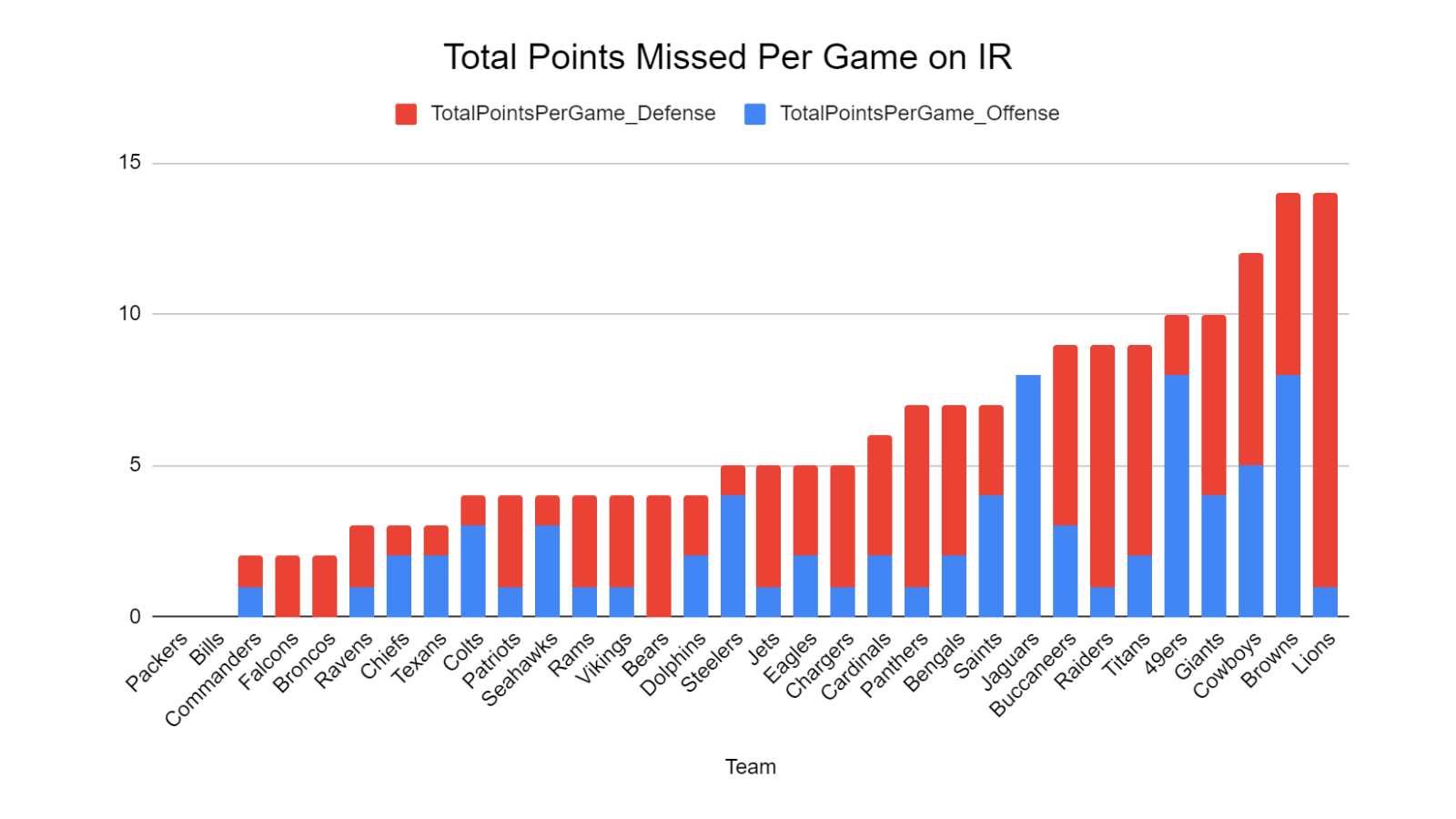
    Looking ahead to the playoffs, we can see what teams are going to be missing with the current players on injured reserve. We can also break that down into offensive and defensive players to see if teams are going to be hurting more on one side of the ball. Note where the Packers are:

    Bar graph showing a breakdown of which teams have missed the most Total Points on the offensive side and the defensive side. The point of emphasis is on the Lions, whose losses are overwhelmingly on the defensive side (Aidan Hutchinson).

    It’s been well documented that the Lions defense has been decimated, and that’s represented here. The Seahawks and Steelers are missing more on the offensive side, with most of that being tied to offensive linemen. The Broncos will continue to miss the services of tackling machine Alex Singleton, but the offensive side of the ball remains healthy at the right time of year. 

    Injuries can happen at any time, and we know losing key players can sometimes be too much to overcome. We wish every team a clean bill of health as we head towards the most exciting time of the NFL season.