Category: Learning Defense

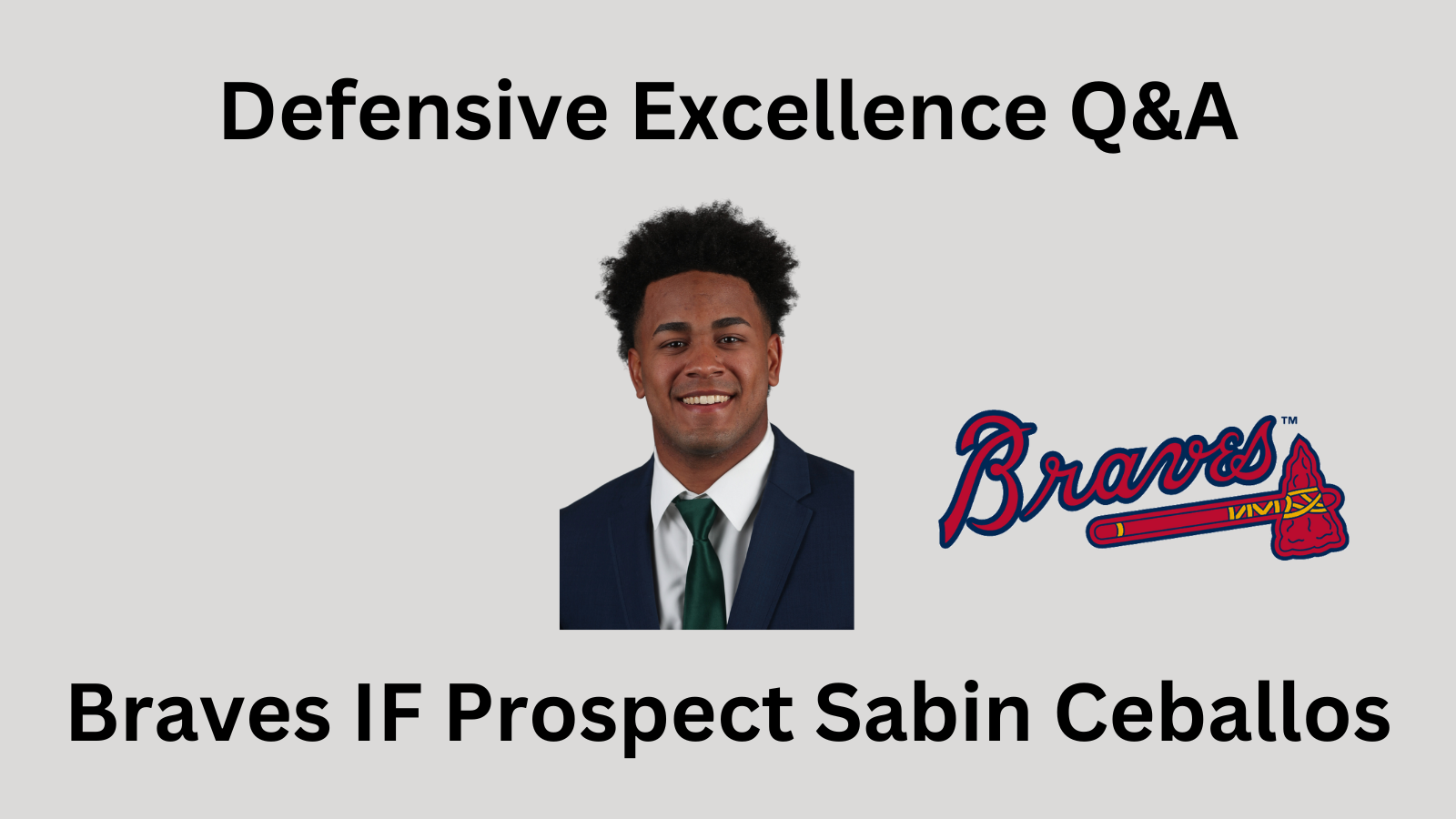
  • Defensive Excellence Q&A with Braves Prospect Sabin Ceballos

    Defensive Excellence Q&A with Braves Prospect Sabin Ceballos

    Sabin Ceballos won a Rawlings College Gold Glove Award last season at Oregon and was drafted in the third round of the MLB Draft by the Braves. The San Juan, Puerto Rico native has aspirations of being a great infielder, whether it be at third base (his college position) or possibly at shortstop (which he’s played in the past). We talked to him as part of our series of interviews with minor league and college Gold Glove winners about learning defensive excellence. Click here to see other pieces in the series.

    The conversation has been edited for clarity and length.

    Mark: What does defensive excellence mean to you?

    Sabin: Defensive excellence starts days before the game, preparing myself for the team we’re gonna play. We do scouting reviews where I sit with my coach about who the good baserunners and bunters are. Then, I like to apply everything I’ve been practicing before the game. Then when the game comes, just have fun.

    Mark: Were did learning defense really start for you?

    Sabin:  When I was 12 years old, my first infield coach was Luis Avila. He was my head coach from when I was 12 to 14.

    With him, I started to see the difference, that there’s a second part of the game and an important part of the game. And I started to take defense a little more seriously.

    Mark: What position did you start out at?

    Sabin: I was playing center field when I was three (confirmed, he said age 3). The first position I played seriously was shortstop.

    Mark: So, what has been the hardest things you’ve had to learn?

    Sabin:  A few years ago, some people were telling me they thought I had the talent to catch in the big leagues. I had been playing infield all my life. So, I said yeah, let’s try it. That was the hardest part. But when I got to Oregon they said, don’t worry about catching, you’re going to be a nice third baseman.

    At third base, it’s about being consistent on defense, minimizing the little things, recognizing when I miss a little thing. Sometimes a little thing is not making an error, it’s having the baseball sense to anticipate things.

    Mark: What’s an example of a little thing?

    Sabin: Knowing the scouting reports. We have the cards in our hands now. That’s going to help me for the rest of my life. Being able to anticipate, knowing a guy could hit the ball to my side. That makes defense easier.

    Little things are also mental things, like not carrying at-bats over to the defensive side. Sometimes you can end an inning with a bases-loaded at-bat and then the next pitch of the next half-inning, the ball is coming to you while you’re thinking about that past at-bat.

    Mark: What kind of drills have helped you out the most?

    Sabin: So right now, I’ve been doing middle infield drills because I want to have the agility to move like a shortstop. I’m bigger now and I’m supposed to be slower, but I want to still move like a middle infielder.

    So, I’ve been doing some legwork. We’ve been doing short hops, and picks, and barehands, fielding ground balls in the middle of the infield so I can go to both sides.

    Mark: Do you have a favorite defensive play?

    Sabin:  This past year at regionals against Vanderbilt. They had bases loaded in the seventh inning. The batter, Alan Espinal (coincidentally also from Puerto Rico), I played baseball for his dad (Rafael). He hit a chopper to me. I made the play. Crazy things happened for me at Oregon after that play (you can read about how he became a campus celebrity here).

    Mark: When you’re watching that play develop in the field, what do you see?

    Sabin: Before that pitch came, I was anticipating what I was going to do. If it’s hit right at me, I step on the bag. If it’s hit to my left, throw to second. If it’s a chopper, my only chance is barehanded.

    [People think] oh, he improvised. No, I worked for it. That’s why I’m talking with my coaches. If I’m not practicing it, I’m not going to be able to make it. Coaches are hitting me choppers before games and I’m barehanding them.

    We prepare for that kind of thing coming at the right moment. It was a crazy play.

    Mark: Who are the people that have been most helpful to you in coaching you on defense? And what did they teach you?

    Sabin: Luis Avila was the first one to show me how you can win games by playing defense. And then Marcus Hinkle at Oregon was one who pushed me to come in early for fielding and to be better every day in the field during drills.

    Mark: What are you working on?

    Sabin: The organization’s plan is to see if I can play shortstop again. I want to prove to them that I can make that move and be the defender that I was at Oregon at third base.

  • Defensive Excellence Q&A: Endicott College Catcher John Mulready

    Defensive Excellence Q&A: Endicott College Catcher John Mulready

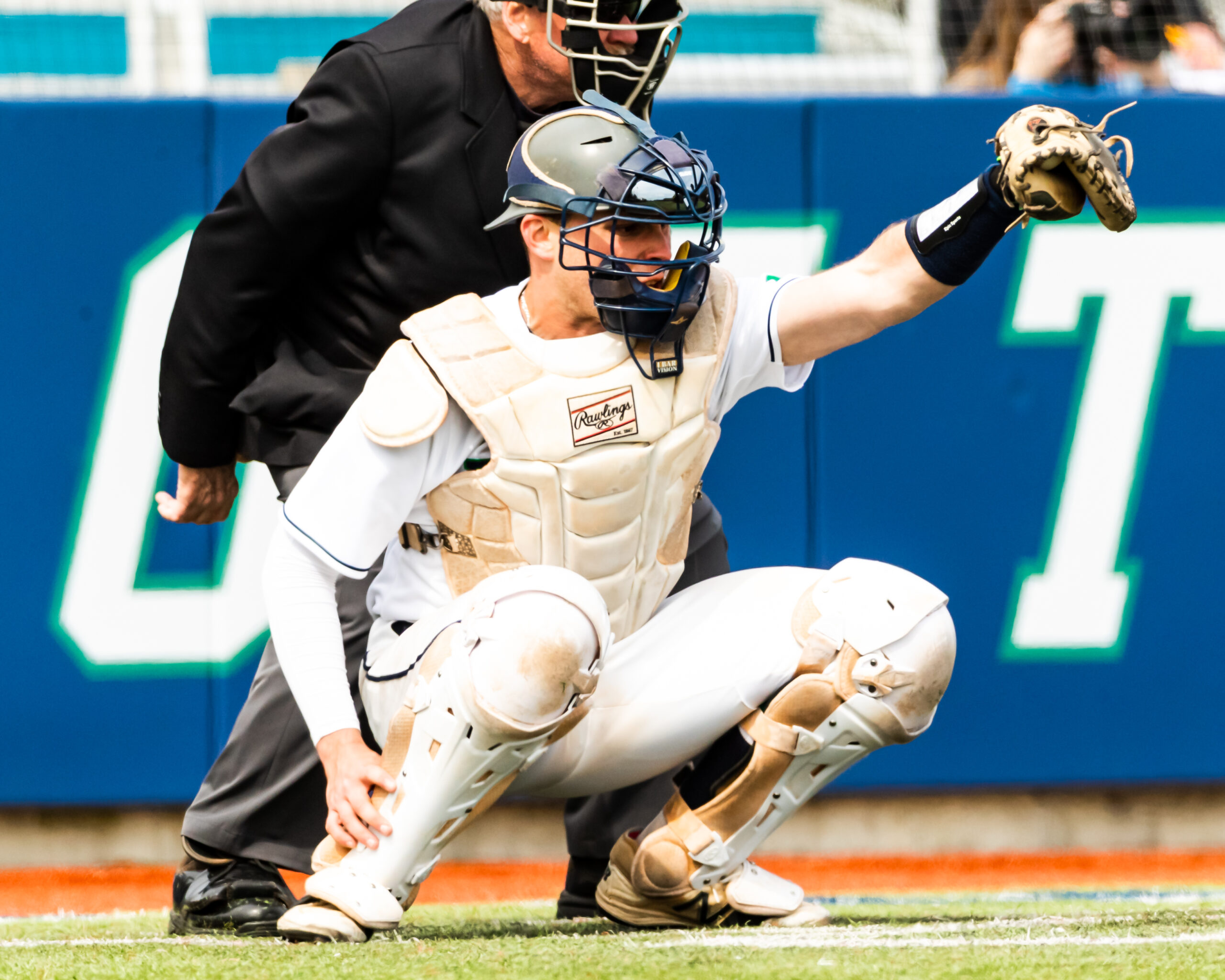
    Photo by David Le

    John Mulready is one of the best college catchers you probably don’t know much about. The Peabody, Mass. native is a senior at Endicott College, a Division III program in Massachusetts that last year went to that level’s College World Series. Mulready won a ABCA/Rawlings College Baseball Gold Glove Award for his work behind the plate.

    We spent a good part of 2023 talking to coaches about teaching defensive excellence. So it makes sense that we also talk to players about what it’s like to learn defensive excellence. John is the third interview in our series.

    Mark: What does defensive excellence mean to you?

    John: Defensive excellence sums up the way you win baseball games. Having a sound defense both in front of and behind the plate is the key to winning championships.

    Since a young age, I’ve always heard pitching and defense wins championships. And growing up playing a bunch of different sports, playing soccer, football and obviously baseball, I’ve always heard defense is one of the most important things on the field because if you can’t protect your own goal, net, plate, whatever sport it is, you’re not really gonna have a good chance to win that game,

    Mark: Where did it all begin for you defensively?

    John: My father got me involved at a really young age and baseball was something that clicked with me early. I fell in love with the game really fast and it fell in love with me at the same time. Every day I’d be in the backyard playing catch. He’d be throwing balls in the air, hitting me ground balls.

    When I was 9 years old, he signed me up for an AAU program and every skills camp they had to offer. So aside from being in the backyard with him every day or going down to the batting cages with him for offensive work, he’d be signing me up and driving me to defensive clinics every day. And I’d just grind, defensive rep after rep. Kevin Kelly, now the head coach at our rival, Roger Williams University, used to run all of the defensive skills clinics.

    Mark: When did you start catching?

    John: I always wanted to be the pitcher or the shortstop as a kid. But one day we needed a catcher, and nobody wanted to step up, so I was like, I’ll do it.

    I shied away from catching for a bunch of years and focused on pitching. When I got to high school, I went to St. Mary’s and played for Derek Dana, who got drafted as a catcher by the Giants. Having a catcher as a coach in high school is amazing.

    Coach Dana knew that I caught here and there growing up, and we talked and decided that I would transform back to being a catcher after a couple of injuries to my shoulder.

    And then coach (Bryan) Haley and (Harry) Oringer at Endicott have been a big part of my development since I got to college.

    Mark: What was the hardest thing to learn as you were getting into it?

    John: Getting back into it was definitely difficult because I didn’t know everything that went into it.

    When I was younger, everything was easy. I was always one of the bigger kids, always had a strong arm.

    High school, You’re taking foul balls off the mask, you’re blocking balls in the dirt, you’re throwing just as much as the pitcher is, which takes a toll on your arm. Understanding the amount of endurance and physical preparation that goes into being able to catch a full season was eye opening to me, but something I was able to adjust to well by being with such an experienced coach. I’ve worked on knowing that it’s not always gonna be pretty, but that you’ve gotta be a beast behind the plate.

    Mark: You’ve gotta be a beast behind the plate. What does that mean?

    John: The way I look at it is if any ball gets by me, it’s my fault and I don’t want to let my teammates down. You give your team the best chance to win by working hard on every pitch, getting your eyes behind the ball to give the umpire the best chance to call a strike. You want to be a beast in every aspect of the position.

    Mark: Explain some of what you do technique wise in the different aspects of catching.

    John: The catchers call ourselves Team 2. And we’ll dedicate certain days of the week to receiving. We’ll dedicate certain days of the week to blocking, so on and so forth. We’re putting our full attention and focus into that day and really taking everything that we can from that day and translating that to game scenarios.

    If we’re blocking balls, we’re not just blocking balls right at us, we’re trying to block the balls that nobody should be able to get to. Preparing ourselves for real game scenarios, things that probably aren’t going to happen but might, that’s really important to me.

    With framing we have different training mitts that we use, always catching the ball in between your pointer finger and thumb, right in the pocket of the glove, always keeping your eyes behind the ball, and shifting your shoulders rather than dropping the arms or reaching to a side.

    Framing is rhythmic. It’s just something that you get into a rhythm of doing. It just becomes second nature after so many reps.

    Before a game we work to get our eyes loose, just like we get our bodies and arms loose.

    Mark: What do you do to get your eyes loose?

    John: Just progressions of receiving, working from bare hands to gloves, working up to the pitching machine, working on footwork and transfers from glove to hand.

    Photo by David Le

    Mark: What does your pre-game routine look like?

    John: The catchers will be off to the side, playing receiving games like two ball to work on our hand-eye coordination.

    With two ball, you have a ball in your hand, you’re in a circle of four or five people, everybody has a ball in their hand, and then there’s one other ball that you throw around the circle.

    If a ball’s coming at you, you’ve got to catch it with your empty hand and throw the ball that’s in your other hand at somebody else. And it’s just like a speed reaction, hand-eye coordination drill. Then, after batting practice is over, some guys will go into our field house and work on light blocking. Working your breath. Exhaling while blocking has really helped me. It softens up your chest and kills the ball when it hits you and leaves the ball right in front of you.

    We’re always working our hands. Another thing we do is throw a ball up in the air and just work on finding that four-seam grip to give us the best chance of throwing a strike down to second base.

    Mark: What’s an example of something you do to manage a pitching staff?

    John: I’m fortunate to be given the ability to call the game from behind the plate. I put myself in the shoes of the batter and with the count in mind, thinking of where they are in the batting order, what type of hitters are at the plate. The first time through the lineup, especially for a team we haven’t played in a while or never played before, it’s just about feeling it out and trying to get on the same mental wavelength as the pitcher.

    Mark: Is there one play you’ve made that stands out?

    John: We were playing Pomona-Pitzer on our California trip over spring break. It was a dogfight. We go ahead by a run in the ninth inning and in the bottom of the ninth, man on second, base hit up the middle, the guy’s rounding third, our center fielder comes up firing. It’s a tweener-hop and it takes a funny hop but I’m able to stay down. There’s a pretty big collision at home plate and I hang on to the ball (watch the play here).

    That’s a thing I struggled with in high school. I can remember my sophomore year, the same type of play in a tie game, and throw is a tweener hop that squeaks by me. They end up walking us off.

    Taking pride and taking care of the ball and the little things like short hops, tweener hops, long hops working on those for so long, I feel like it translated into finding success on that play.

    Mark: When there’s a play like that, what do you see?

    John: I’m able to see the whole field, which is obviously one of the main reasons I love the position. But in my head, I’m trying to think two plays ahead, if this guy hits it here what am I calling? Where am I going? Is the play coming home? Is the play going to second? Do we not have a chance for this guy?

    I see a guy on second base who’s got a short lead, so we end up going fastball, we challenge the guy up, and he ends up turning it right around, up the middle, I’m thinking, oh boy, there we go, because it wasn’t hit too hard, we were playing kind of shallow. So I’m like, alright, we’ve got a chance here.

    And having the center fielder we did, Caleb Shpur has an absolute cannon for an arm. I threw my mask off. I’m thinking, all right, I’m checking in with the runner on third. He’s rounding third. And I’m thinking all right, we’ve got a chance.

    We have calls whether to cut off the ball or throw straight through. And so I saw the ball. It’s a nice low throw looking like it’s gonna be a nice long hop. So I’m screaming ‘let it go.’ I see the guy digging. He tried to dive on the inside of the plate, but the ball took me that way.

    From where the hop was coming, I was able to grab the ball with my glove and I immediately put my hand onto the ball obviously, just trying to hold the ball through contact. The kid’s shoulder goes in between my legs and knocks my glove off my hand, but I held onto the ball with my throwing hand and was able to show that to the umpire.

    I got up and spiked the ball and we had a little celebration on the mound. There’s just so many thoughts going through my head. But at the same time it was completely shut off and I was just so focused on tracking that ball from the tweener hop into my glove and just so focused on holding on to the ball

    Mark: Are there catchers who you model your game after?

    John: I model part of my game after coach Dana with the things he taught me. In terms of major league catchers, J.T. Realmuto is one of my favorites. Everything he does is smooth as silk. A 1.8 pop time (on stolen base attempts) is ridiculous. All the catching coaches I follow on Twitter and Instagram are preaching ‘be like J.T.’ He plays the game smooth and fast.

    Mark: If a kid said that they wanted to catch the way that you caught, what advice would you give them.

    John: Obviously the first step is just to work hard and every day you show up, don’t just be there to be there or be there to show somebody else you’re there. You have to want to be successful. It’s not one of those things like hitting where you can stick your bat out and find a hole. Being behind the plate you’re involved in every pitch and can’t take a pitch off.

    Everybody’s looking at you to tell them what to do because you can see what they can’t see. There’s just as much of a mental aspect to it as there is a physical aspect.

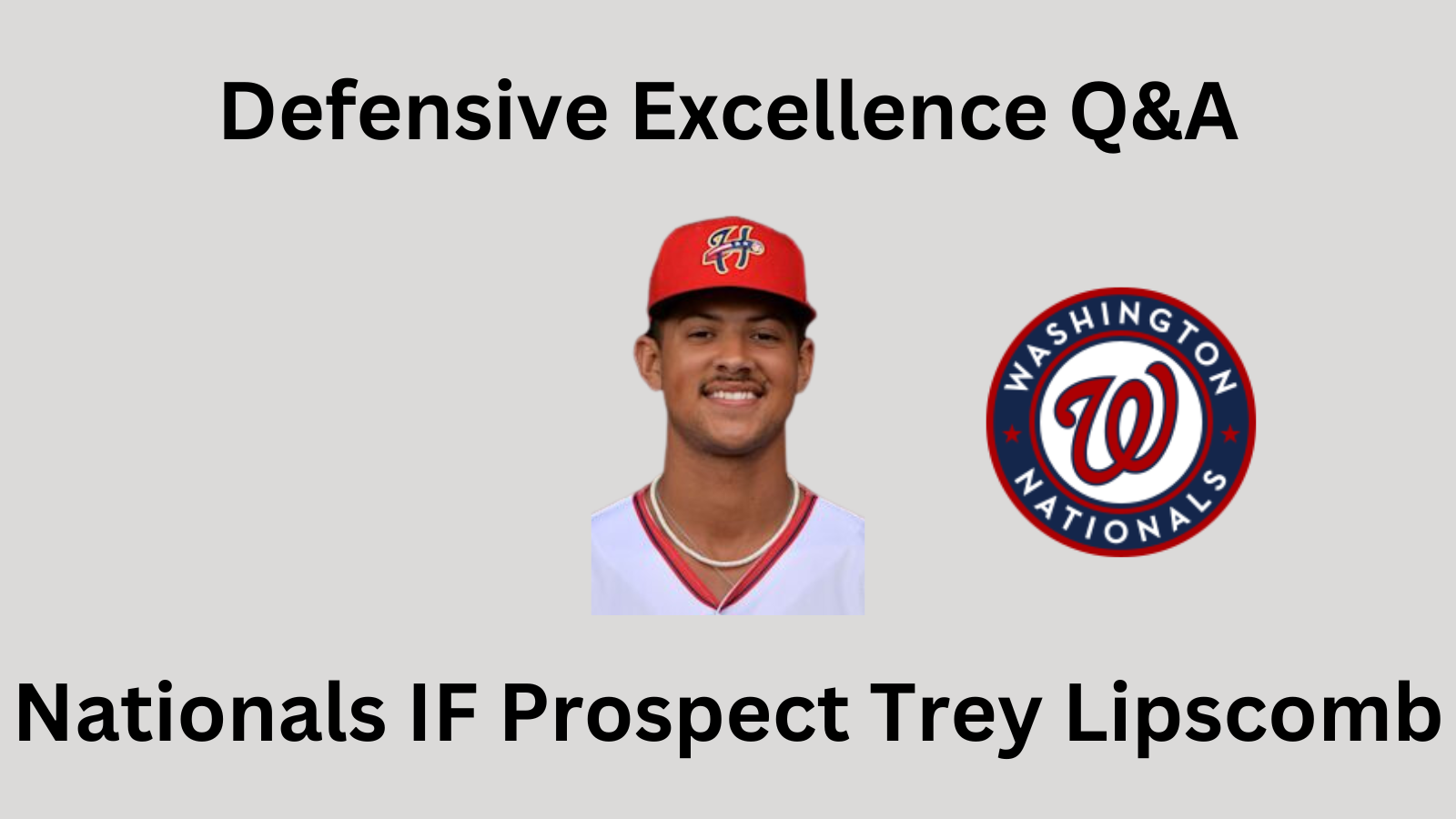
  • Defensive Excellence Q&A: Nationals Infielder Trey Lipscomb

    Defensive Excellence Q&A: Nationals Infielder Trey Lipscomb

    In his second year in the minor leagues, Nationals prospect Trey Lipscomb got a full workout. He played all four infield positions, earned a promotion to Double-A, and won the Rawlings Minor League Gold Glove Award at third base. He totaled 3 Defensive Runs Saved there, meaning he performed at a slightly above-average level compared to MLB players, which is pretty good for someone in Double-A.

    We spent a good part of 2023 talking to coaches about teaching defensive excellence. So it makes sense that we talk to players about what it’s like to learn defensive excellence too. Trey is the second in what we hope will be an ongoing series of interviews.

    Mark: What does defensive excellence mean to you?

    Trey: When you put those two words together, defensive excellence, it’s just something that I take a lot of pride in. Obviously, you’re not going to be perfect. The game of baseball is not about perfection, but if you can be as physically sound and mentally sound on defense as you can, it can help you a lot.

    One of the mantras I’ve always gone with is: They always say speed doesn’t slump. For me, defense doesn’t slump. It’s something that you should really take pride in. That’s something that I did coming into this season. And I think the end goal is definitely what I achieved.

    Mark: Where did learning defense start for you?

    Trey: It really started when I started to focus on baseball in 6th, 7th grade. I wanted to get along with everybody, and I know the pitcher’s out there working his butt off. If a ground ball is hit to me, I want it to be a sure out every time.

    So I think that’s what I took pride in. I pitched a little bit in college. I definitely want a bunch of defenders behind me that are going to make the play. That’s how you build a bond with each other.

    Mark: You played all four infield positions last season. What was the hardest part of learning them?

    Trey: I told the player development guy when I was in spring training, I can play second base. I can play shortstop. He said, ‘We’ll see.’ I guess I got what I wished for.

    You’ve just gotta get out there and get your feet wet.  One of the biggest things was positioning. At second base and shortstop, there’s no line to guard. You just want to be in the right place at the right time. The biggest thing was learning where to be and where to set myself up so I can make the play every time.

    Mark: When you play third base, is your pre-pitch position low?

    Trey: When I was in college, I was one of those who was as low to the ground as I could be, but as I’ve gotten up here and played in the minor leagues in my first four years, it’s kind of just become wherever I’m comfortable.

    When I was in Double-A, one of our coaches, Delino DeShields asked about my positioning and said, ‘You played basketball, right? How are you going to guard somebody?’

    I showed him [my stance for] how I was gonna guard somebody. And then he was like, all right, we’re gonna start there. We want you to be able to use your athletic ability. I was getting so low into the ground where it was kind of hard to get up out of the ground and have a good first step. I’ve gotten better at forming a position that’s better for me.

    Mark: Are there other people besides Delino that have been instrumental in helping you out, and if so, what did they do?

    Trey: My father’s been there from the jump. He went to The Citadel. He never played baseball growing up, but he was always like ‘We’re going to find a way and we’re gonna get it done.’

    I had a phenomenal infield coach my first three years at Tennessee, Ross Kivett. He taught me a lot of the technique. My last year at Tennessee, it was Ricky Martinez. Those two guys helped build the foundation for how to field a ground ball. And then Cody Ransom with the Nationals helped me out with doing a lot of early work.

    Mark: What is your pre-game routine like?

    Trey: I start by getting my body loose, then go in the outfield grass, start on my knees, and have a coach roll me a few balls. I use my mini-glove and try to catch it in the pocket every time. When you hear that sound, a pop of the ball hitting the pocket, it’s a soothing sound. The more you repeat it the better it gets. Using a mini-glove helps you narrow it down. I’m doing forehands, backhands, balls right at you.

    I use my mini-glove and try to catch it in the pocket every time. When you hear that sound, a pop of the ball hitting the pocket, it’s a soothing sound. The more you repeat it the better it gets.

    Then I’m standing up and getting the feet loose. Five balls right at me, five to my left, five to my right, working on forehand and backhand. Then I get into a stance where I’m going to throw a ball. Then I go on the infield dirt, five at me, five to my left, five to my right. You don’t want to tire yourself out, but 20 to 25 ground balls really help.

    Mark: You’ve got an Instagram with a pretty good highlight reel. Do you have a favorite play?

    Trey: It wasn’t a ground ball, but the diving play that I made, sliding feet first into the gravel over there. That had to be one of my favorites.

    I really take pride in slow rollers.  I was horrendous at slow rollers when I was at Tennessee because I just couldn’t find the arm slot. Then I worked on it for a while, and it got tremendously better and that became my favorite play.

    Mark: What do you see when you’re approaching a slow roller?

    Trey: Barehand are usually such that you don’t have time to think about it. It’s just about instincts. I like the backhand barehand. Just putting my body in a unique position, and then throwing the ball, I just think its satisfying, the way you can see the ball tail back into the first baseman’s glove when you complete one.

    Mark: I saw a quote in one article where you said, ‘I like to ask questions, but when I can get information without asking questions, and then apply it to my game, that’s my type of learning.’ What does that mean?

    Trey: Everyone’s here in the minor leagues trying to make you better. They have their way when they were a stellar player. But it’s just a plan. No one’s going to be the same. No one’s going to have the Mike Trout swing. It’s going to be your swing.

    I know a lot of people who are fielding ground balls like this and like that. There’s no right way and there’s no wrong way. You’re getting a lot of information thrown at you, but the more you can narrow it down and focus it more on yourself is when you’re going to become the player you want to be. I’m by no means anywhere near that, but we’re just getting started.

    Mark: How close to major league ready do you feel on defense?

    Trey: I definitely take pride in my defense. I’m going out there every day getting the work in. I want to make the last out of Game 7 of the World Series every time. That’s what I treat every, every ground ball from warmups to going out there and getting a ground ball in the first inning, second inning, or fourth inning.

    Mark: How do you use data and information in terms of playing?

    Trey: You get your scouting reports before the game about pull hitters, which guys like to bunt. If you can have a head start on getting a good first step to make those bang-bang plays more of a routine play, that’s what I focus on. If you can dominate the average play, I think that’s going to help you a lot in the long run.

    If you make the ESPN Top 10 plays, then you’re gonna get the credit and get to be on tv. But no one shows the ground balls that are right at you, they only show those when you make an error.

    Mark: I saw you had a clinic for kids. What’s it like to teach defense?

    Trey: I was teaching them the fundamentals of just fielding the ground ball and catching the ball, feeling it in that same spot of the glove every time and just getting outs. It’s cool to see kids and build those connections. You never know. Eventually you might be playing against some of those kids and take something you taught them and apply it to your game. I think that’s a cool thing.

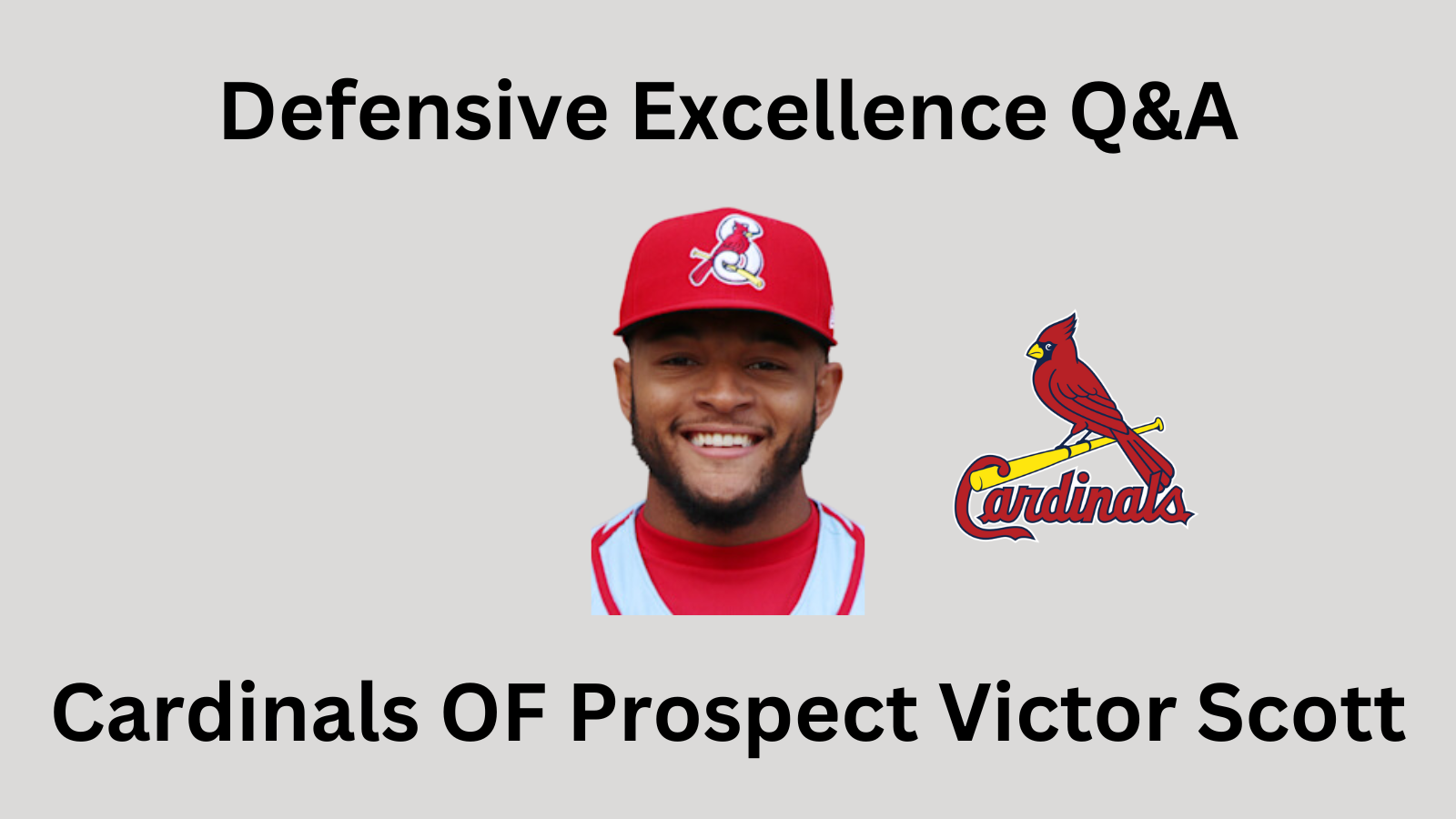
  • Defensive Excellence Q&A: Cardinals Outfield Prospect Victor Scott II

    Defensive Excellence Q&A: Cardinals Outfield Prospect Victor Scott II

    Cardinals outfield prospect Victor Scott II was one of the stars of the Arizona Fall League with a .388 on-base percentage and 18 steals in 23 games. That came after a very strong year split between High-A and Double-A in which he hit .303 and stole a combined 94 bases. Baseball America just named him the Cardinals No. 3 prospect, as well as their best defensive outfielder, fastest baserunner, and best athlete among their minor leaguers. On Tuesday, he was named the winner of a Rawlings Minor League Gold Glove Award.

    We spent a good part of 2023 talking to coaches about teaching defensive excellence. So it makes sense that we start talking to players about what it looks like to learn defensive excellence. Victor is the first in what we hope will be an ongoing series of interviews.

    Mark: Where did it all start for you defensively?

    Victor: I was probably 10 to 12 years old and my dad would take me to a local park.

    He would hit fungos, ground balls, fly balls, but he would hit them everywhere. It could be a pop to left center. It could be ground balls. If I ever bobbled it or dropped it, it would be a 50-push-up penalty.

    That made me start taking pride in my defense, because I didn’t want to do 50 push-ups every single time I made a mistake or if I didn’t get to it, or if I didn’t get the best jump to it, I didn’t want to do 50 push-ups. I organized myself so that I could get to the ground ball, or the fly ball that was 20 or 30 yards away.

    Mark: What was the hardest thing to learn as a kid?

    Victor: That with defense, speed is a big factor, but you’re going to need to be able to get a good jump and be able to read a swing. The first stage for me was understanding how a swing works or where the pitch is going to be and how to move off that.

    Mark: You learned the ins and outs of center field in Little League?

    Victor: Yeah, and then also I was just using sheer athleticism at that point.

    I like to refer to the center fielder as a point guard. You’ve got control pretty much over the whole field from a bird’s eye view because you’re behind everybody.

    You’re the last line of defense. Essentially, you’re just the general. You can call off anybody. Nobody has rank over the center fielder.

    Mark: When you made the transition from college to the pros, what’s the difference in terms of how you are as a center fielder now?

    Victor: I would say A, reading swings, and B, knowing the game more. Knowing situations, knowing where to throw the ball before it even is hit. It’s the imagination component. Because I know in college, I was just out there being athletic, playing the game, still like refining what it means to be like a center fielder, and then as I got to pro ball just working on different things, being able to really then understand what I was doing, how to get the best jumps, game situations, all those things put a blend together in order to form a pretty decent year

    Mark: How did you figure out how to use your speed such that you wouldn’t overuse it?

    Victor: Yeah, it’s just learning how to control your body essentially. With fly balls and ground balls, it’s normally getting to a spot. So you would be technically underusing it if you drifted to the ball and then you would be overusing it if you were to sprint to the wrong spot.

    It’s just making sure that you have a feel for where the ball is going to end up and how you’re going to get there.

    Mark: Who were your favorite players?

    Victor: Andrew McCutchen, Byron Buxton, Mookie Betts. As I kept growing up Byron became one of my favorites.

    Victor finished 2023 with 18 Good Fielding Plays, 1 shy of the minor league lead for center fielders. Good Fielding Plays are what it sounds like — including things like home run robberies and Web Gem-type catches, as well as plays like cutting a ball off in the gap to prevent a runner from taking an extra base. 

    Mark: I typed your name into YouTube and there were a lot of great defensive plays you made in the last couple of years.

    Let me ask you about one game where you had a home run robbery and another one that was close to a home run robbery. When you’re making catches like that, what do you see?

    Victor: The first thing is probably ball flight. The second thing is the sound of the ball off the bat. That tells me, especially if a ball is drilled, where to go. On both of those I could tell it was going to be hit to the wall.

    So the order for me is find the ball, find the wall, and then refind the ball. I was essentially running without seeing the ball and just getting to a spot in both cases Especially at a new field, because you don’t necessarily know the dimensions. Knowing how many steps it takes in order to get to the track, is not as great as it would be if you were at your home stadium.

    Mark: When you make mistakes in the field, what are the most common ones that you seem to find that you’ve had trouble with?

    Victor: I know I’ve made a few mistakes. Looking up before I field the ball to ensure that a runner was running. If it’s a first to third situation and the ball was hit, in the left center gap and I’m getting to a spot there and I’m looking up to see if that runner’s gonna round second. I may look up and bobble the ball. That has happened to me probably two or three times. I’m just trying to enhance my focus in that area.

    Mark: Who are the people that have been most instrumental in teaching you defense?

    Victor: My dad, Victor. My personal trainer, Michael Butler. Another coach, Lawrence Pelletier. And Steve Sabins, the outfield coach at West Virginia (where Scott went to school). A lot of the drills and skill-related components of what we would do helped me learn the fundamentals of moving and understanding communication and how to move your other outfielders. That came from him.

    Mark: Okay. How about in the minors the last couple of years?

    Victor: Ryan Ludwick and Patrick Anderson, who was my High-A manager with Peoria.

    They taught me about being on the go before the pitch is swung at, essentially, so you can get that first step jump. Understanding the mechanics that go into hit a ball in the right center gap and where that pitch has to be located in order for a hitter to drive that ball there.

    So that way you’re not guessing, but you have a pretty good thought of where that ball would go. You take a step in that direction before he even makes contact. That and communication, pulling the outfielders with you so they’re covering the ground that you’re losing.

    Mark: Do you prefer coming in on the ball or do you prefer going back on the ball?

    Victor: I would say I prefer coming in on the ball.

    Mark: Do you play deeper then?

    Victor: Yeah normally I play a little deeper for sure.

    Mark: Why do you prefer one over the other?

    Victor: I prefer coming in because normally it’s an easier path to the ball. There’s not many times that you have to flip over your hips and try to sprint backwards, lose the ball and then find the ball again.

    But with the coming in on the ball you normally have sight of it.

    Mark: How far do you think you are from being Major League-ready defensively?

    Victor: I would say I’m there defensively. I feel like a lot of like the instinctual things preparation wise, and I feel like it’s put me in a good position to, to play defense at a Major League level, competitively every day.

    Mark: If you were going to give the kid that is practicing with his father on fungoes and asked to do 50 push-ups advice, what advice would you give him about playing center field?

    Victor: Go 100 percent for every ball, bcause you never know what could happen. The push-ups are gonna help out one day.