Category: MLB

  • May’s MLB Defensive Players of the Month

    May’s MLB Defensive Players of the Month

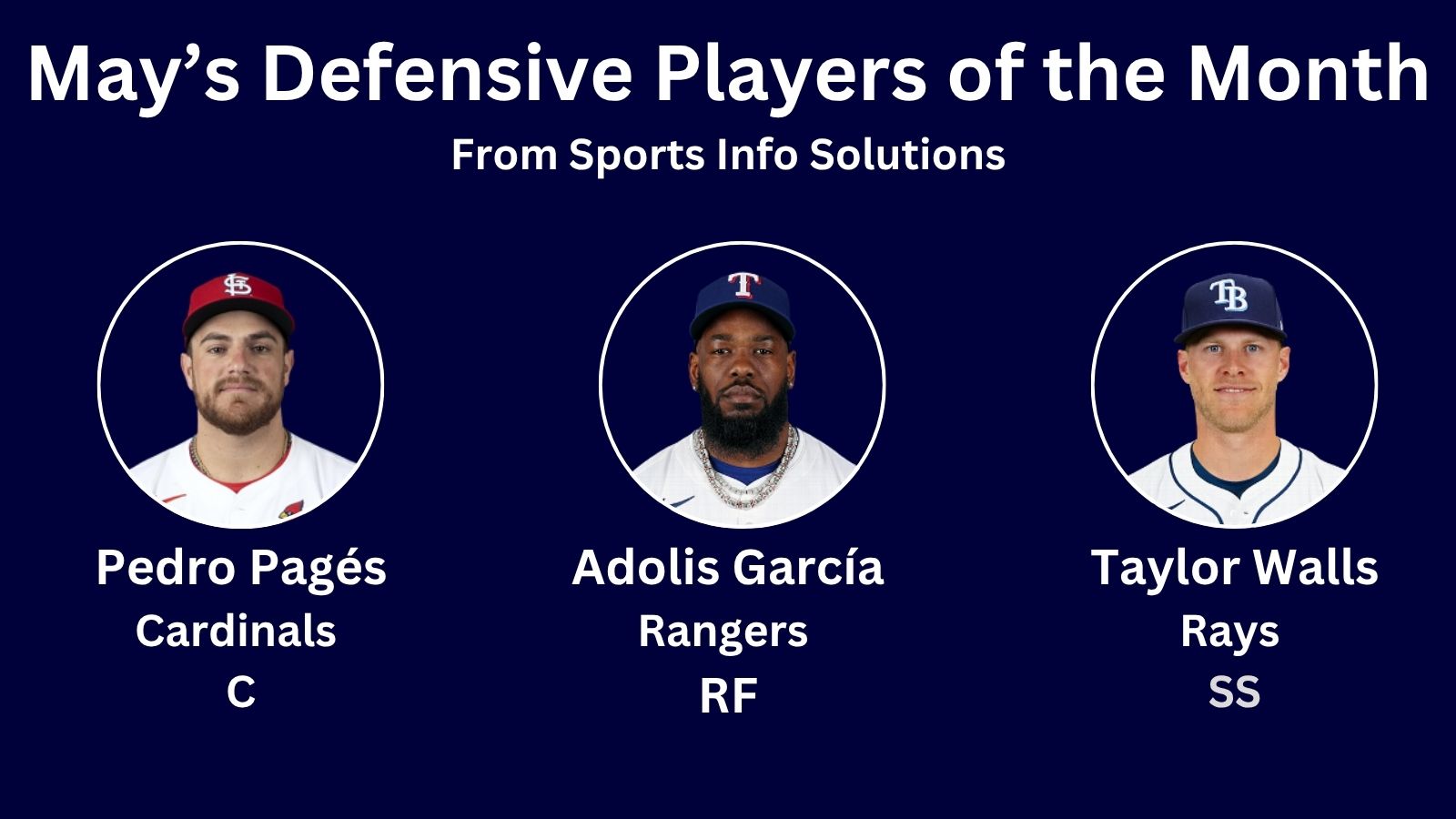
    Sports Info Solutions went three deep in our Defensive Player of the Month selections for May and there was no shortage of credible candidates to choose from.

    In the end, we picked a catcher who helped his team to a 19-8 record in May, a right fielder whose numbers look a lot different from last season, and a shortstop who took advantage of the abundance of ground balls to come his way.

    These are our three selections:

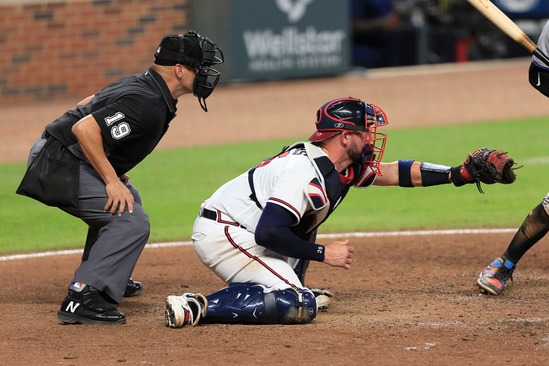
    Pedro Pagés, Cardinals C

    Pedro Pagés led all catchers with 8 Defensive Runs Saved in May. He entered the month with -2 Runs Saved for the season and finished it with 6 Runs Saved. Only Patrick Bailey (8) and Alejandro Kirk (7) have more for the season.

    For the season, Pagés has added value in Stolen Base Runs Saved as well as our stats for pitch blocking and pitch. framing

    He’s thrown out 8 of 32 baserunners attempting to steal (25%) and picked off two others. The average caught stealing rate for a catcher is 18%.

    He’s successfully blocked 94% of potential wild pitches. The average block rate is typically around 91% or 92%.

    Staff ace Sonny Gray seems to enjoy pitching to Pagés. Gray had six starts in May. His three scoreless ones featured 28 strikeouts and 3 walks. Pagés caught all three. For the season, Gray has a 2.32 ERA in 9 starts with Pagés catching. He’s allowed 14 runs in 14 2/3 innings with others catching.

    Adolis García, Rangers RF

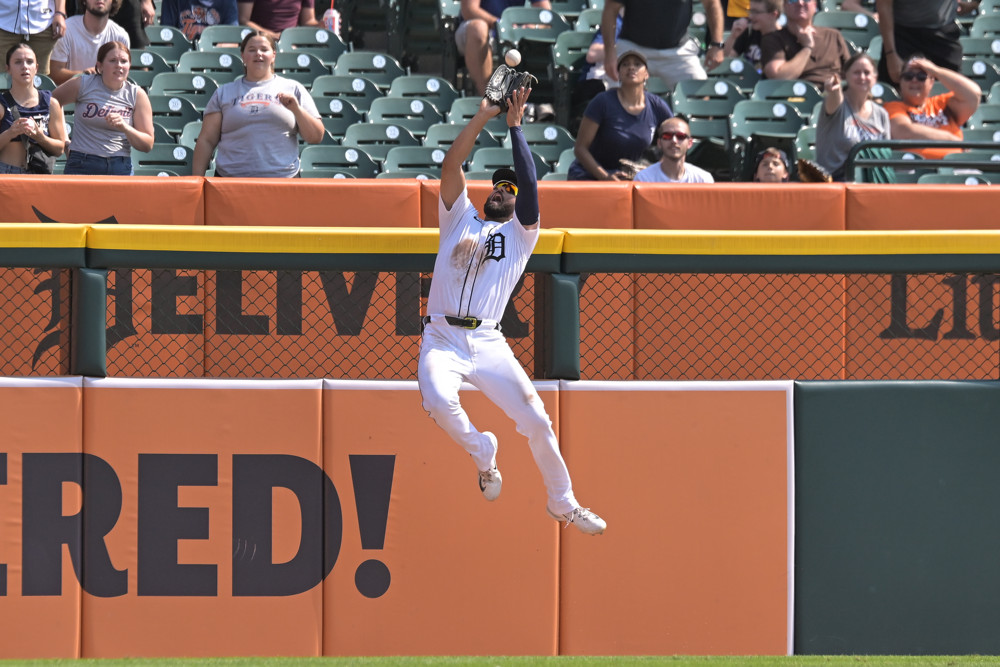
    Adolis García led all right fielders with 7 Defensive Runs Saved in May. His 8 this season are tied for the MLB lead at the position with 2023 Fielding Bible Award winner, Fernando Tatis Jr.

    Garcia has engineered a major turnaround when it comes to his Range stats. Last season he had a career-worst -8 Range Runs Saved. This season, he already has 7 Range Runs Saved. He’s never finished a season with more than 6.

    Our Data Scouts award Good Fielding Plays based on their observation of specific defensive moments in games. García has 10 and has already exceeded his 2024 total of 9.

    Those include two terrific plays going to the right field line and diving to make a catch (see them here and here).

    Additionally, García has racked up most of his Runs Saved on shallow fly balls. The Rangers have played Garcia at an average depth of 294 feet in Globe Life Field this season, compared to 299 feet last season.

    He’s also improved considerably in MLB’s jump stats from last year to this year, going from ranking 70th among outfielders to placing in the Top 10 in terms of how much ground he covers above an average right fielder.

    Taylor Walls, Rays SS

    Taylor Walls has been a dominant defensive shortstop by Runs Saved since he first came up in 2021. He actually leads shortstops in Runs Saved in that time despite ranking 29th in innings played.

    Shorter term, he had the most Runs Saved of any shortstop in May with 7. He’s been very good this season both fielding balls hit to his left and to his right.

    Walls has also been given more of an opportunity to stand out. Rays pitchers have yielded many more ground balls, ranking 8th in ground ball percentage compared to 29th last season. He’s handling an average of 5 chances per 9 innings played compared to last year’s rate of 3.7.

    Sports Info Solutions has been naming Defensive Players of the Month since 2012 (with ESPN from 2012 to 2017 and then on its own since then), using a combination of statistical analysis and the eye test. Defensive Runs Saved has tracked MLB player defensive value since the 2003 season and is considered one of the industry-leading defensive stats.
  • Stat of the Week: 1st In Their Division, 29th in Defensive Runs Saved

    Stat of the Week: 1st In Their Division, 29th in Defensive Runs Saved

    Photo: Kyle Ross/Icon Sportswire

    Here are the current MLB division leaders and how they rank in Defensive Runs Saved.

    Division Leader DRS Rank Runs Saved
    Dodgers 5th 24
    Tigers 7th 19
    Cubs 8th 17
    Yankees 9th 16
    Mariners 24th -6
    Phillies 29th -34

    You’ll notice that one is far removed from the others here.

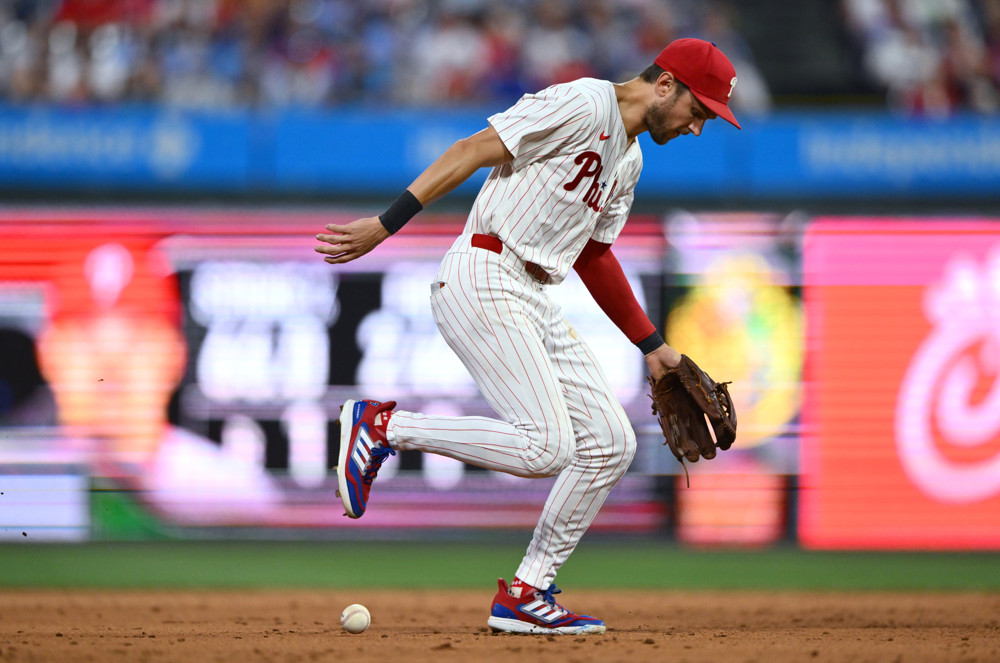
    The Phillies, who just jumped ahead of the Mets for the NL East lead this week, rank 29th among teams in Runs Saved.

    It looked like the Phillies had made considerable strides defensively last season. The primary starters on the right side of the infield—Bryce Harper at first base and Bryson Stott at second—were Gold Glove finalists and the numbers backed up their legitimacy, as well as that of another finalist, left fielder Brandon Marsh.

    The Phillies have gotten negative Defensive Runs Saved from every position other than left field (which is at 0). That includes first base and second base where Harper and Stott are slightly below average (-2 Runs Saved apiece). They are the worst team in terms of effectiveness turning double plays. Only one team rates worse in Outfield Arm Runs Saved. Only one rates worse in our pitch-framing stat, Strike Zone Runs Saved. Only one team has done worse in value from defensive positioning.

    The Phillies are not bereft of good defenders. Max Kepler has a good history in left field and has 3 Runs Saved there this season. Pitchers Taijuan Walker and Zack Wheeler have 3 and 2 Runs Saved, respectively. But there are 17 players with negative Runs Saved.

    So how are the Phillies managing to be so good without having a good defense?

    It’s simple. They don’t let opponents hit the ball. They lead the majors in strikeout percentage.

    They also outhit their mistakes. They rank 7th in the majors in runs per game. And they’ve won the close games. They’re 9-3 in one-run games.

  • Stat of the Week: 10 Seasons Of Strike Zone Runs Saved Part II

    Stat of the Week: 10 Seasons Of Strike Zone Runs Saved Part II

    Last week we looked back at 10 seasons of data for our pitch-framing stat, Strike Zone Runs Saved, which puts a run value on the result of taken pitches, and we looked at which catchers have fared best and worst in those measurements.

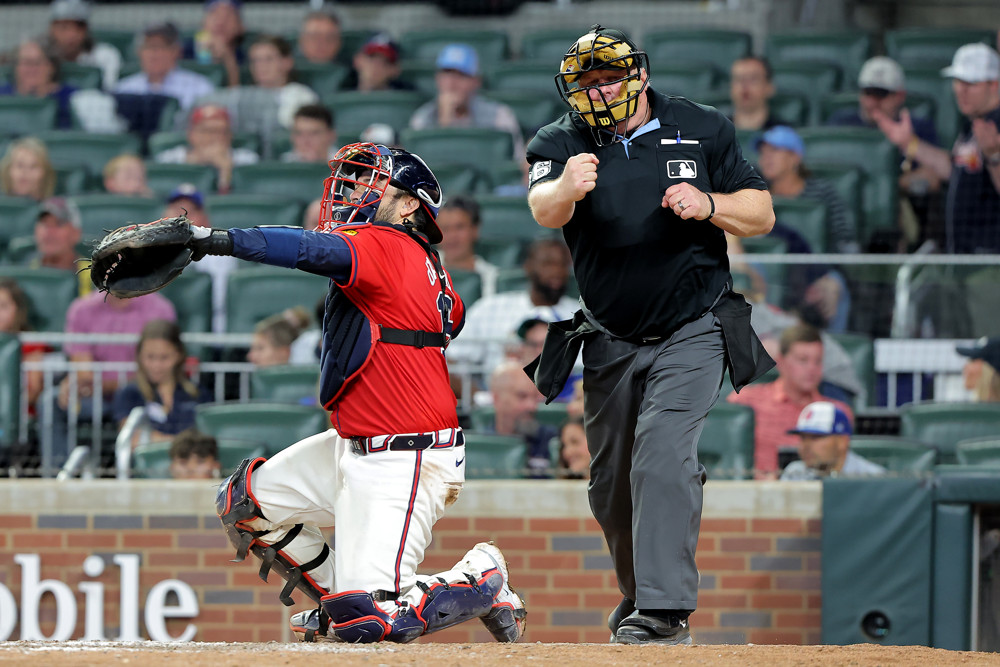
    One of the neat things about Strike Zone Runs Saved (SZRS) is its flexibility. It can also be used to evaluate hitters, pitchers, and umpires. We can see which batters and pitchers are getting more or fewer called strikes than expected. We can also see which umpires are calling more or fewer strikes than expected. 

    Batters

    Batters With Most Extra Called Strikes, 2015-2024 (minimum 5 seasons)

    SZRS per season
    Xander Bogaerts 1.0
    Curtis Granderson 0.9
    Wilmer Flores 0.9
    Alcides Escobar 0.9
    Luis Garcia Jr. 0.8

    Batters With Most Extra Called Balls 2015-2024 (minimum 5 Seasons)

    SZRS per season
    Rhys Hoskins -1.5
    Bryce Harper -1.4
    Charlie Blackmon -1.4
    Ryan McMahon -1.3
    Carlos Santana -1.3

    What these tables are showing is that Xander Bogaerts is getting more called strikes against him than he should be (and the most above what he should be of any hitter in the majors in the last 10 seasons). Rhys Hoskins and Bryce Harper are at the other end of the spectrum. They get a more favorably called strike zone than other hitters.

    The scale for batters isn’t mind-blowing, just a run per season at the extremes. And that’s not shocking, considering there isn’t some obvious direct mechanism by which the batter might influence a strike call, other than maybe how close he stands to the plate. 

    However, there does seem to be some kind of a reputation effect at play. You don’t see it as clearly in the top five, but here are the top 20 in each group:

    • Extra strikes: Xander Bogaerts, Curtis Granderson, Wilmer Flores, Alcides Escobar, Luis Garcia Jr., Carlos Correa, Nomar Mazara, Thairo Estrada, Ian Kinsler, Yolmer Sanchez, Mark Canha, Joey Wendle, Logan Forsythe, Isaac Paredes, Brock Holt, Jorge Polanco, Eloy Jimenez, Donovan Solano, Hunter Pence, Domingo Santana
    • Extra balls: Rhys Hoskins, Bryce Harper, Charlie Blackmon, Ryan McMahon, Carlos Santana, Russell Martin, J.P. Crawford, Jed Lowrie, Dustin Pedroia, Cody Bellinger, Freddie Freeman, Yasmani Grandal, Yadier Molina, Nathaniel Lowe, Buster Posey, Carlos Gonzalez, Corey Seager, Shohei Ohtani, Joey Votto, Yonder Alonso

    There are several MVPs and a few near-misses in the hitter-friendly group, and none in the pitcher-friendly group. That seems unlikely to be a coincidence. 

    It’s also notable that there are four catchers in the hitter-friendly group and none in the pitcher-friendly group. At a more macro level, only one player who had at least five years at catcher in the last 10 had more than a quarter of a run per season go against him (Ryan Jeffers). There were 19 catchers on the positive side of that.  

    You often hear about catchers not wanting to get into a tiff with an umpire when they’re batting because they want to get good calls as a catcher, but they seem to get a little bit of favoritism regardless.

    Pitchers

    Pitchers With Extra Called Strikes, 2015-24 (minimum 5 seasons)

    SZRS per season
    Jon Lester 1.6
    Gio Gonzalez 1.2
    Masahiro Tanaka 1.1
    Clayton Kershaw 1.1
    Steven Wright 1.0

    Pitchers With Fewer Called Strikes, 2015-2024 (minimum 5 seasons)

    SZRS per season
    Framber Valdez -1.4
    Zack Wheeler -1.2
    Yusei Kikuchi -0.9
    Eric Lauer -0.7
    Jake Arrieta -0.7

    For those who have believed that Clayton Kershaw gets strike calls because he’s Clayton Kershaw, perhaps his inclusion on the list adds a little something to that belief. He’s among the pitchers who have gotten more calls than expected. That Framber Valdez and Zack Wheeler are still succeeding in spite of having arguably the least pitcher-friendly strike zone is illustrative of their reliance on ground balls and missed swings, respectively.

    We’re not sure what to otherwise make of these lists other than that the strike zone is tighter for current pitchers. The calculation of Strike Zone Runs Saved uses a rolling two-year window, so slight changes to rules are accounted for, but it isn’t going to move immediately when guidelines change.

    Umpires

    More Called Strikes Than Expected (2015-2024, Minimum 5 Seasons)

    SZRS per season
    Doug Eddings 11.7
    Bill Miller 9.5
    Lance Barrett 6.2
    Phil Cuzzi 6.0
    Mike Estabrook 5.3

    Fewer Called Strikes Than Expected (2015-2024, Minimum 5 Seasons)

    SZRS per season
    Alfonso Márquez -6.7
    Edwin Moscoso -6.2
    Mark Wegner -5.3
    Carlos Torres -5.2
    Tom Woodring -4.6

    As we’ve previously noted in Stat of the Week, Doug Eddings and Bill Miller have and have had the most pitcher-friendly strike zones in baseball. They’ve largely gone unchanged over the years. Lance Barrett, Phil Cuzzi, and Mike Estabrook are all big strike zone umpires, though they don’t occupy the same ballpark as Eddings and Miller.

    At the opposite end of things are the umpires with the most hitter-friendly strike zones in baseball. Alfonso Márquez has been known to have a smaller strike zone than most of his peers for years. The spread among the five umpires listed above with the most hitter-friendly zones isn’t as vast as the gap between Eddings, Miller, and their fellow umpires.

    One other note about Eddings, Miller, and Márquez is that though these numbers indicate they favor either the pitcher or hitter more than any other umpires, this does not seem to have impacted how they are viewed by the MLB office. They each been given prominent postseason assignments the last few years. Miller and Márquez worked the 2023 World Series. Eddings was on the World Series crew in 2024.

  • Stat of the Week: The Last 10 Years of Strike Zone Runs Saved

    Stat of the Week: The Last 10 Years of Strike Zone Runs Saved

     Photo: David John Griffin/Icon Sportswire

    BY ALEX VIGDERMAN

    This year feels somewhat special to us at SIS because it’s the 10 year anniversary of a pretty cool honor, our Strike Zone Runs Saved research winning the Sloan Sports Analytics Conference’s award for the best research paper. The paper was called Who Is Responsible For A Called Strike?

    For those not familiar, Strike Zone Runs Saved (SZRS) is our method of capturing catchers’ skill in gaining extra strikes by framing the pitch as it comes in.

    The core concept is pretty simple. We start with an expectation for how likely the pitch is to have been a strike, and we compare that to what actually happened. That expectation takes into account handedness, the count, the location, and even how much the catcher’s glove had to move off its initial target. We then attach a run value which is basically the value of turning a ball into a strike, which is about a tenth of a run.

    Here are the leaders among catchers who played at least five years in that span, both in total and per season.

    Strike Zone Runs Saved leaders, 2015-24

    Total SZRS
    Tyler Flowers 68
    Yasmani Grandal 66
    Austin Hedges 64
    Christian Vázquez 50
    Roberto Pérez 33

    Strike Zone Runs Saved per season leaders, 2015-24 (min 5 seasons)

    SZRS per season
    Tyler Flowers 11.3
    Yasmani Grandal 6.6
    Buster Posey 5.3
    Austin Hedges 5.3
    Christian Vázquez 5.0

    Tyler Flowers is one of those players who is primarily known because of our ability to measure this skill, and you can see why. We talked with him a couple years ago about it, when Defensive Runs Saved turned 20.

     This range of years covered the back half of Buster Posey’s career, but that half a win (by WAR standards) per year of framing value makes a big impact for a player who didn’t play into his mid-to-late thirties.

    Here are the year-by-year leaders in Strike Zone Runs Saved. Flowers either shared the lead or led outright four straight years.

    Year-By-Year Leaders in Strike Zone Runs Saved

    2015 to 2024

      SZRS
    2015- Tyler Flowers 13
    2016- Flowers & Yasmani Grandal 15
    2017- Tyler Flowers 20
    2018- Flowers, Grandal & Max Stassi 10
    2019- Austin Hedges 18
    2020- Yasmani Grandal 5
    2021- Max Stassi 10
    2022- Jose Trevino 12
    2023- Hedges, Patrick Bailey & Francisco Alvarez 11
    2024- Patrick Bailey 15

    Our Strike Zone Runs Saved data actually dates back further than 10 years. We’ve been tracking it since the 2010 season. An overall leaderboard has Yasmani Grandal (87) at the top, followed by Flowers (85), Jonathan Lucroy (80), Russell Martin (72) and Posey (71).

    Which organizations have developed framing the best?

     It’s hard to know what teams are doing in terms of specific player development practices, but we can try to get at it from different angles.

    For example, over the last decade three teams set themselves apart in how much improvement their acquired players showed year-over-year. Players acquired by the Athletics, Yankees, and Brewers over this decade averaged improving by at least 5 runs saved per 900 innings caught. (We’d give more credit to the A’s and Brewers, though, because they did this across many more players.)

    A team that falls just short of that distinction is the Diamondbacks, who had 18 catcher acquisitions and averaged just under 4 additional runs saved per 900 innings. That’s a big deal because they had some of the worst performance from homegrown catchers (-5 runs saved per 900 innings from 4 players).

    Bringing up a successful player from your system might just be about the player’s talent, and we have a hard time teasing out those elements, but it’s still worth noting that the Guardians clearly outpace the rest of the league in average SZRS from homegrown players (7 runs per 900 innings). The Astros are the only team within a run of them (6.4 per 900 innings) and we should give credit to the Giants, who had similar production (5 runs per 900 inn) with more homegrown catchers (7 compared to 5 for the leaders).

    How much better are today’s framers than catchers a decade ago?

    The strike zone gets adjudicated differently over time, but we can approximate the change in how good catchers are by placing them into each other’s context.

    In other words, we can throw pitch results from the catchers in 2014 (the year before the Strike Zone Runs Saved presentation) in with the 2024 season sample, or vice versa, and compare our evaluation in this blended environment to their original context.

    As an example, Cal Raleigh saved 11 runs with his framing in 2024. If we threw 2014 catchers into the mix, by virtue of that comparison we’d have him estimated at about 14 Runs Saved.

    Correspondingly, Mike Zunino tied for the MLB lead with 16 Strike Zone Runs Saved in 2014. If he had been compared to 2024 players, he would have been more in the 12-13 run range.

    Because every catcher saw different pitches the changes wouldn’t be entirely consistent, but on average the gap is about 4 runs per 900 innings.

    That might not feel like a lot, but it certainly manifests itself at the bottom end of the population. Just based on actual Strike Zone Runs Saved, there were four catchers in 2014 who were worse relative to their context than any 2024 catcher was last year. With this merged group, the bottom 18 catchers are all from 2014.

    Next week, we’ll look at Strike Zone Runs Saved from another angle: how it evaluates the batter, pitcher, and umpire (yep, the stat can do that too). What can we learn about the players who had the most (and least) success over the last 10 years? And we’ll have notes on the umps too.

  • Are The Tigers A Good Defensive Team?

    Are The Tigers A Good Defensive Team?

    Photo: Allan Dranberg/Icon Sportswire

    Part of a series of articles previewing the defensive performance of all 30 MLB teams by asking the question … are they good? To see the full series, click here.

    2024 Defensive Runs Saved Rank: 5th

    Strengths

    Riley Greene won a Fielding Bible Award in left field, a position he was moved to with the emergence of rookie Parker Meadows. Greene led all left fielders in Runs Saved despite playing only 84 games there. 

    Meadows is another strength. He had 5 Runs Saved in center field in about a half-season’s worth of games. He’s currently dealing with a nerve issue in his arm that prevents him from throwing and will not be ready to go on Opening Day.

    Jake Rogers finished tied for 4th in Runs Saved among catchers. He ranked among the best pitch framers in baseball and is an impactful defender.

    There are also big expectations for shortstop Trey Sweeney, who saved 3 runs in 36 games there, and though he didn’t hit much, the Tigers went 23-10 in games he started.

    The team has good defenders but the positioning of those players was integral to the team’s success in 2024. Of their 50 Runs Saved, 33 were credited to the team for defensive positioning.

    Most Defensive Runs Saved

    Team Runs Saved Positioning Runs Saved
    Blue Jays 102 26
    Guardians 89 28
    Dodgers 66 51
    Brewers 64 12
    Tigers 50 33

    Weaknesses

    The Tigers have two dicey spots in their infield. Gleyber Torres totaled -11 Runs Saved at second base last year with the Yankees and -4 the year before that. Third base is also going to be interesting. 

    Jace Jung, brother of Rangers third baseman Josh Jung, had -6 Runs Saved in 27 games at third base in 2024, and figure to be the starter eventually. He’ll start the season in the minor leagues. For now with Matt Vierling also injured, FanGraphs lists Javier Báez, who has 8 Runs Saved in a little over 600 career innings there. Báez hasn’t played the position since 2019.

    Other Things To Know

    First base is a question mark because Spencer Torkelson hasn’t hit enough to warrant staying in the lineup. For now, it looks like the Tigers will take Colt Keith, who had a shaky start at second base last season before settling in, and play him at first base, where he’s never played as a professional. Seems a little risky.

    Are The Tigers A Good Defensive Team?

    Collectively at the end of last season, the Tigers were a very good defensive team that maximized the player’s skills with good positioning. This year’s team could be as good as that one, but it could be in for some rough patches, particularly in the infield.

  • Are The Dodgers A Good Defensive Team?

    Are The Dodgers A Good Defensive Team?

    Part of a series of articles previewing the defensive performance of all 30 MLB teams by asking the question … are they good? To see the full series, click here.

    2024 Defensive Runs Saved Rank: 3rd

    Team Strengths

    The biggest strength for the Dodgers isn’t necessarily a player but rather their defensive positioning. The Dodgers aggressively move both their infielders and outfielders and the payoff is that they give their players a better chance to make defensive plays. Last year 51 of their 66 Runs Saved came from positioning.

    The Dodgers’ best defensive player actually comes off the bench, shortstop Miguel Rojas. Over the last four seasons he leads all players at the position in Runs Saved, though he’ll be behind starting shortstop Mookie Betts.

    Another strength is the Dodgers’ multi-positional flexibility. Tommy Edman can play center field, second base, and shortstop and play them all well. Betts is capable at shortstop and has a great track record in right field. Rojas has at least 80 games of experience at each infield position. Chris Taylor and Kiké Hernandez can play anywhere on the field.

    Team Weaknesses

    If someone isn’t working out at a position, the Dodgers have the flexibility to move him off that spot pretty quickly. An exception is catcher where – after four straight seasons with a positive Runs Saved – Will Smith totaled -4 Runs Saved, rating below average in both strike getting and pitch blocking. The 2024 season was the first time since 2014 that the Dodgers catchers finished with a negative Runs Saved.

    However, it’s not all bad. Smith threw out 28% of baserunners trying to steal on him, one of the better rates in the majors. The alternative at catcher, Austin Barnes, is a good defender but allowed 48 steals against only 3 caught stealing last season.

    Other Things To Know

    The Dodgers will try Hye-Seong Kim, formerly of the KBO, at second base at some point this season. He’ll start the year in the minors. Kim’s defense, very good by KBO standards, translates to MLB average or thereabouts.

    Are The Dodgers A Good Defensive Team?

    Yes, though it’s more the product of their defensive system than it is the skill of their players. It works very well though, so it’s hard to argue with.

  • Are The Cubs A Good Defensive Team?

    Are The Cubs A Good Defensive Team?

    Photo: Keith Gillett/Icon Sportswire

    Part of a series of articles previewing the defensive performance of all 30 MLB teams by asking the question … are they good? To see the full series, click here.

    2024 Defensive Runs Saved Rank: 9th

    Strengths

    The Cubs have a lot of defensive strengths, arguably as many as any team in MLB.

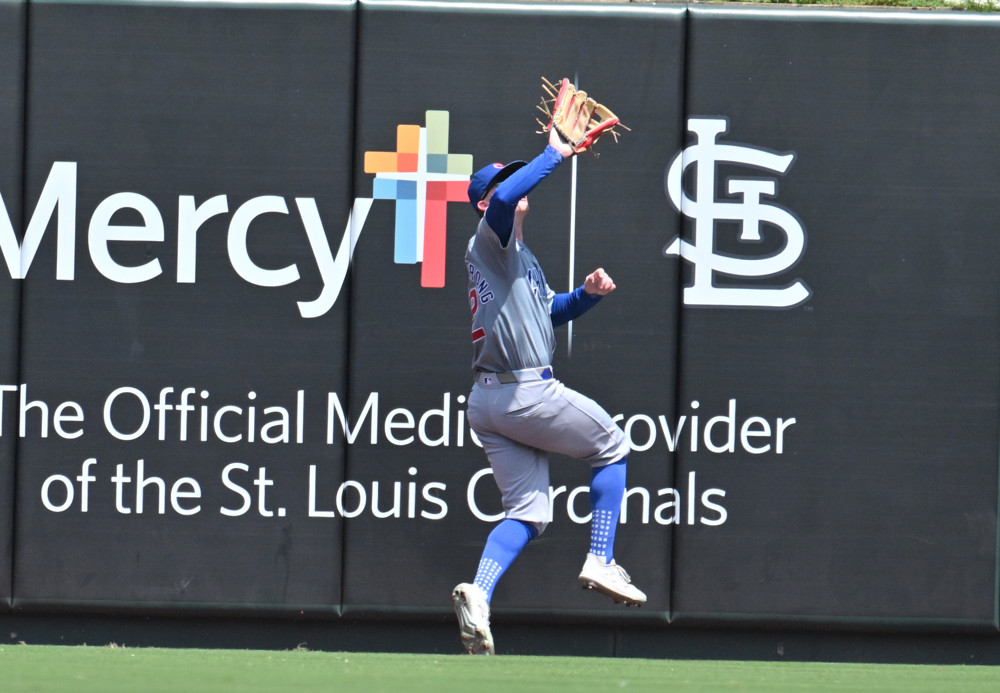
    Pete Crow-Armstrong had an abundance of excellent defensive plays and throws in center field last year. He finished tied for 7th with 11 Runs Saved, contended for a Fielding Bible Award, and expectations are high for him in 2025.

    Dansby Swanson finished 2nd in the range component of Runs Saved among shortstops last season, one year after winning a Fielding Bible Award. 

    Swanson’s double play partner Nico Hoerner has been consistently above-average at second base. He’s averaged almost 9 Runs Saved per 1,000 innings there over the last four years.

    Ian Happ has won three straight Gold Gloves in left field, where he ranks second in Runs Saved to Steven Kwan since the start of 2022. Happ has ably braved the elements and frequently sacrificed his body to make good plays.

    Kyle Tucker comes over from Houston to play right field. Tucker has an MLB-best 30 Runs Saved there over the last four seasons, though a chunk of that is tied to an MLB-leading 7 home run robberies. Tucker goes from one of the easiest right fields to steal a home run in Minute Maid Park to a home park in which it’s impossible to rob a homer, Wrigley Field.

    Weaknesses

    Cubs pitchers finished with -9 Runs Saved and the worst range numbers of any pitching staff last season. Their catcher, Miguel Amaya, had good Runs Saved numbers overall. Most of that came from pitch blocking. He threw out 11 of 89 runners attempting to steal (12%).

    Other Things To Know

    A subtle but notable pickup for the Cubs this winter was utility man Jon Berti, who can play anywhere in the infield or outfield if needed (best position by Runs Saved is third base, worst is center field). He’ll be a useful fill-in.

    Matt Shaw’s development at third base is to be determined. Shaw projects as a 55 Overall Future Value on defense from FanGraphs, which praised his “enthusiastic understanding of defense.” Our numbers had him with -6 Runs Saved in the minors last season.

    Are The Cubs A Good Defensive Team?

    Yes and they could be as good as any team in the National League defensively. They should have an excellent outfield and a solid infield.

  • Are The Cardinals A Good Defensive Team?

    Are The Cardinals A Good Defensive Team?

    Photo: Mark Goldman/Icon Sportswire

    Part of a series of articles previewing the defensive performance of all 30 MLB teams by asking the question … are they good? To see the full series, click here.

    2024 Defensive Runs Saved Rank: 13th

    Team Strengths

    If Nolan Arenado is still on the team, he’s a strength, though not close to what he once was. Pre-pandemic, he’d recorded eight straight seasons of double-digit Runs Saved. Post-pandemic, he’s had seasons of 9, 20, 0, and 6, with the latter being boosted largely by his play in September.

    Masyn Winn led shortstops in Defensive Runs Saved and won a Fielding Bible Award last season. Though not every defensive metric holds him in that high a regard, we view Winn as excellent, and particularly great at turning double plays.

    Michael Siani is going to have to earn a spot in center field, after a year in which he hit .228 with a .570 OPS. But Siani has the potential to be spectacular. He had 8 Runs Saved there last season and was particularly good at chasing down deep fly balls.

    Team Weaknesses

    With Willson Contreras now entrenched at first base (where he’s an unknown, with only 11 MLB games), Ivan Herrera is the starting catcher. Herrera threw out 2 of 57 runners trying to steal against him, which accounted for almost all of his -7 Runs Saved. His one plus is that he’s a good pitch blocker.

    Jordan Walker has not been good in either of his two years in right field, tallying -13 Runs Saved. Same for Nolan Gorman at second base in his three years (-11 Runs Saved). 

    Other Things To Know

    Besides Contreras and how he handles first base, a wild card for the Cardinals will be how Lars Nootbaar fares in center field. In 109 career games in center field, he’s basically been league-average. He’s been very good in right field, with 13 Runs Saved in 213 games.

    One of the reasons the Cardinals finished 13th in Runs Saved was defensive positioning. They netted the 3rd-most Runs Saved of any team in Outfield Positioning area, but that’s not something they can count on again (-1 in 2023). If we looked solely at Runs Saved from defensive skill, they ranked 17th.

    Are The Cardinals A Good Defensive Team?

    If they trade Arenado and don’t play Siani much, it’s going to be a hard sell to say they’re a good defensive team (unless they get a great defender back in trade). Average, probably. Good, probably not. But if they keep both of them, and Arenado plays to past form, they could be pretty good.

  • Are the Rockies A Good Defensive Team?

    Are the Rockies A Good Defensive Team?

    Photo: Steven King/Icon Sportswire

    Part of a series of articles previewing the defensive performance of all 30 MLB teams by asking the question … are they good?

    To see the full series, click here.

    2024 Defensive Runs Saved Rank: 14th

    Team Strengths

    Defense is what the Rockies do best and that starts with three players: center fielder Brenton Doyle, third baseman Ryan McMahon, and shortstop Ezequiel Tovar.

    Doyle is the reigning Fielding Bible Award winner at his position. In his first two MLB seasons, he’s posted the two best defensive seasons by a Rockies center fielder since Runs Saved was first tracked in 2003. He covers a lot of ground and he can throw with a velocity in the high 90s.

    McMahon has four straight seasons of at least 10 Runs Saved at third base and finished in the top four in Runs Saved there in each of those seasons. Simply put, he’s an excellent defensive player.

    Tovar is one of baseball’s best defensive shortstops. He’s saved 12 and 10 runs respectively in his first two seasons as a full-time player.

    Defensive Runs Saved Leaders

    Shortstops – Last 2 Years Third Base – Last 4 Years
    1. Dansby Swanson 1. Ke’Bryan Hayes
    2. Ezequiel Tovar 2. Ryan McMahon
    3. Anthony Volpe 3. Matt Chapman

    Additionally, Michael Toglia put up good defensive numbers in his first year as a full-time first baseman. Toglia rated as pretty good at getting to balls hit in the ‘34’ hole and finished with 10 Runs Saved, which ranked 2nd at the position.

    Team Weaknesses

    The Rockies signed Thairo Estrada to play second base this offseason. By our measures, he hasn’t been great there in two of the last three years, with Runs Saved totals of -12, 1, and -7. 

    In 2021, we’d have listed catcher Jacob Stallings as a strength, but his numbers have faltered the last three seasons and look similar to Estrada’s (-9, 0, and -6).

    Other Things To Know

    Nolan Jones looks like he could be a regular starter in left field. Which Jones will the Rockies get? The one who had 8 Runs Saved there in 2023 or the one who had -4 in 2024? Jones has a high-value arm, but he’s got to find a way to get to more balls in Colorado’s spacious outfield.

    Are The Rockies A Good Defensive Team?

    Yes. It wouldn’t be a stretch for the Rockies to have three Gold Glove winners this season. They’re so good where they’re good that it makes up for any deficiencies elsewhere. Now, about the rest of the team …

  • Are The Reds A Good Defensive Team?

    Are The Reds A Good Defensive Team?

    Photo: Nick Wosika/Icon Sportswire

    Part of a series of articles previewing the defensive performance of all 30 MLB teams by asking the question … are they good?

    To see the full series, click here.

    2024 Defensive Runs Saved Rank: 28th

    Team Strengths

    Matt McLain replaces defensively-challenged Jonathan India at second base, which should be an upgrade. In a small sample (37 games), McLain had 0 Runs Saved at second base, but in a little bit larger sample, he had 4 Runs Saved at shortstop.

    Despite -8 Runs Saved last season, Austin Hays’ defense in left field could be a strength now that he’s past a calf injury and kidney infection. From 2020 to 2023, Hays had 19 Runs Saved in the equivalent of about two full seasons in left field.

    Jose Trevino was added this offseason to improve the Reds backup catcher spot. His 45 Runs Saved over the last 4 seasons lead all catchers and he’s an excellent pitch framer. He should come into any game with a small lead entering the 8th or 9th inning given how much better he is defensively than anyone else the Reds have.

    Most Defensive Runs Saved – Catchers

    Last 4 Seasons

    Player Runs Saved
    Jose Trevino 45
    Alejandro Kirk 36
    Austin Hedges 36
    Patrick Bailey 33
    Gabriel Moreno 32
    Cal Raleigh 32

     Team Weaknesses

    The Reds need Tyler Stephenson’s bat, as his 2024 OPS as a catcher was more than  250 points higher than his backup, Luke Maile. But Stephenson could stand to improve behind the plate, where his -19 Runs Saved over the last two seasons ranked 3rd-worst among catchers. 

    Jeimer Candelario is penciled in at third base, where for his career he’s at -25 Runs Saved. Center field is another position where the numbers don’t look good. T.J. Friedl has -10 Runs Saved in the equivalent of about 1 1/2 seasons for his career.

    Other Things To Know

    We didn’t list Elly De La Cruz as a strength or a weakness. For those unfamiliar, De La Cruz is among the players on whom Defensive Runs Saved and MLB’s Fielding Run Value (an offshoot of Outs Above Average) differ most strongly.

    De La Cruz totaled -2 Runs Saved last season, as the stat recognized his excellence on plays in the 56 hole, but penalized him significantly for failing to make as many plays as expected on balls hit up the middle. He also didn’t rate well at turning double plays.

    At the moment, he’s a high-risk, high-reward defensive player who will make both great plays and frustrating mistakes. He has the skills to be quite good. Maybe this year his Runs Saved will show that.

    Are The Reds A Good Defensive Team?

    No, because the positives don’t offset the negatives and because they have one good starting defender at the four up-the-middle positions.