Category: MLB

  • New podcast: Royals GM Dayton Moore on analytics, leadership, breaking into baseball

    LISTEN HERE

    Apple Podcast LINK

    Stitcher LINK

    Anchor LINK

    Spotify LINK

    Episode Summary

    On this month’s edition of the SIS Baseball Podcast, senior research analyst Mark Simon (@MarkASimonSays) shares interesting things he’s learned about Matt Chapman, Fernando Tatis Jr., and Didi Gregorius from the new Defensive Runs Saved (1:06).

    Mark is then joined by Kansas City Royals general manager Dayton Moore. They discuss the state of the Royals rebuild (3:05), what an MLB manager should be expected to know about analytics and performance science (6:53), how the Royals shift and how they evaluate whether their defensive shifts are working (9:52), the importance of chase rate in evaluating draft prospects (12:33), Dayton’s interest in learning about leadership (16:18), and his advice for those who want to work in baseball (listen before you speak!) (19:37).

    Andrew Kyne (@Andrew_Kyne) also joins Mark to talk about The Fielding Bible Volume V, which will be out March 1 (23:12). Andrew also answers a listener question about how different aspects of defensive performance factor into a pitcher’s value (27:18).

    For more information, check out FieldingBible.com and SportsInfoSolutionsBlog.com. Thanks for listening!

  • Stat of the Week: The Fielding Bible All-Decade Team

    By Mark Simon

    Since 2006, Baseball Info Solutions has used The Fielding Bible Awards as its means of honoring the top defensive players in baseball. The Fielding Bible Awards have been voted on by a panel of experts – baseball writers, broadcasters, statistical analysts, and former major league players. Voting is based on both visual observation and performance in objective fielding metrics. With that in mind, we decided to take the voting from past Fielding Bible Awards and use it to come up with a team of the best defensive players in the 2010s.

    Our methodology for picking the All-Decade representatives was to use the Fielding Bible voting that was conducted annually throughout the decade. The player with the highest summed vote total from the 10 seasons was deemed the winner at that position. Note that for the years 2010 to 2012, each player’s vote total was multiplied by 1.2 to account for the use of 10 voters in those years compared to 12 in the other years.

    Fielding Bible Award Vote Leaders, 2010-2019
    PositionPlayer
    First BasePaul Goldschmidt
    Second BaseDustin Pedroia
    ShortstopAndrelton Simmons
    Third BaseNolan Arenado
    Left FieldAlex Gordon
    Center FieldLorenzo Cain
    Right FieldJason Heyward
    CatcherYadier Molina
    PitcherZack Greinke
    Multi-PositionJavier Báez

    Paul Goldschmidt starred for the Diamondbacks for most of the decade. His three Fielding Bible Awards (2013, 2015, 2017) were the most of anyone at first base in the 2010s. Goldschmidt’s 9.5 Scoop Runs Saved rank second to Freddie Freeman among first basemen this decade.

    Dustin Pedroia’s four Fielding Bible Awards (2011, 2013, 2014, 2016) are the most for any second baseman since BIS began presenting the honor in 2006. Known for a distinct and sizable crow hop that he combined with great anticipatory skills, Pedroia twice led the position in Defensive Runs Saved during the 2010s and had four straight seasons with at least 10 Runs Saved.

    Andrelton Simmons is the only player to win a Fielding Bible Award in six straight seasons. He did it in his first six full seasons in the major leagues (2013 to 2018). His 193 Defensive Runs Saved are the most of any player at any position for the decade, 115 more than the shortstop with the next-highest total (Brandon Crawford, 78).

    Nolan Arenado didn’t win a Fielding Bible Award until his third major league season, but once he did, he won three in a row (2015 to 2017). Arenado’s 105 Defensive Runs Saved were the most of any third baseman this decade, even though he didn’t start playing until 2013.

    Alex Gordon has had staying power. His four Fielding Bible Awards (2012, 2013, 2014, 2018) are the most of any left fielder, edging Brett Gardner and Carl Crawford by one. His 45 Outfield Arm Runs Saved this decade were the key to his success. They are the most by any outfielder in the 2010s.

    Lorenzo Cain became the first center fielder to win the Fielding Bible Award in consecutive seasons (2018, 2019) and also won the Multi-Position award in 2014. Cain’s specialty has been chasing down the deep fly ball. In 2019 he tied the single-season mark for home run robberies (5) since BIS began tracking them in 2004.

    Jason Heyward’s consistently excellent defense won him three Fielding Bible Awards (2012, 2014, 2015). He reached double-digits in Defensive Runs Saved in right field in each of the first eight years of the decade. His 141 Runs Saved from Range & Positioning are more than double the next-highest total of any right fielder this decade.

    Yadier Molina won three Fielding Bible Awards in the 2000s and three more in the 2010s, giving him six in total. That ties Andrelton Simmons for the most such awards won. Molina set the mark for most Defensive Runs Saved by a catcher with 30 in 2013 (since tied by Roberto Pérez in 2019). He also totaled 29 in 2012 and 26 in 2010.

    Zack Greinke’s only Fielding Bible Awards came the last two seasons. But he’s been in the hunt frequently, finishing second four times this decade. Greinke’s kept himself in top shape and been a standout athlete throughout his career. That’s allowed him to get off the mound aggressively to make plays that other pitchers don’t make.

    Javier Báez won the Multi-Position award in three consecutive seasons (2016, 2017, 2018) so he comes out on top. This award comes with an asterisk in that it wasn’t given out until 2014. Had it been awarded for the entirety of the decade, there’s a chance that Ben Zobrist, who played excellent defense at second base and in the outfield, would have edged Báez out.

    For more statistical leaders, check out the 2020 Bill James Handbook and the Sports Info Solutions blog.

  • Evaluating Infielder Throwing with the DRS PART System

    Baseball Info Solutions recently introduced a major update to Defensive Runs Saved that will be rolling out this offseason. We’re splitting DRS for infielders into Positioning, Air, Range, and Throwing components.

    In that introductory blog post, we mostly covered how this will affect the Positioning and Range components (which were previously reported together as one “Range & Positioning” metric). However, it’s also important to note how this system can estimate the value an infielder adds with his arm.

    So how do we calculate the Throwing component of the improved DRS?

    Using ball in play and positioning data charted by BIS Video Scouts, we estimate the chance that the play will be made at the point that the fielder obtains the ball, given the distance he must throw and how long he has to complete the play before the batter/runner reaches safely.

    This number is then subtracted from whether the play is made (0 or 1). That value gives us how many plays were saved by throwing, which is then multiplied by an expected run value to generate runs saved.

    Consider this play by Javier Baez. The chance that he would make the play from the point at which he obtained the ball – given his distance from first base and time to make the play – is estimated at approximately 39 percent. Baez made the play, so he’s credited with 0.61 plays saved (1 – 0.39).

    Baez is a standout with his strong throwing arm at shortstop. With our new methodology, he tied Matt Chapman at +11 Throwing Runs Saved to lead all infielders in 2019.

    Here’s a look at the top ten:

    Throwing Runs Saved Leaders, 2019

    Player Position Runs Saved
    Javier Baez SS 11
    Matt Chapman 3B 11
    Yolmer Sanchez 2B 8
    Amed Rosario SS 7
    Andrelton Simmons SS 7
    Jonathan Schoop 2B 7
    Nick Ahmed SS 7
    Tim Anderson SS 7
    Carlos Correa SS 6
    Kyle Seager 3B 6

    Over the past three seasons, the leaders are Nick Ahmed (+23), Kyle Seager (+23), Matt Chapman (+23), Jean Segura (+17), and Yolmer Sanchez (+17).

    This update to DRS allows us to not only split out the Positioning and Range components, but also to better understand an infielder’s value added with his arm. The data is now available on FieldingBible.com and will be featured in The Fielding Bible – Volume V (coming in the spring of 2020).

    Stay tuned for more information and updates regarding this improvement to DRS.

  • Updated 2019 Infield DRS Leaders Using the PART System

    Updated 2019 Infield DRS Leaders Using the PART System

    By Alex Vigderman

    It’s a big day for us at Sports Info Solutions. As of today, we have a new-and-improved version of our flagship statistic, Defensive Runs Saved, available to the public via FieldingBible.com.

    Previously, infielder DRS (specifically the Range and Positioning portion of DRS) used just the information about the ball in play to determine its likelihood of being turned into an out. That meant that we didn’t have the granularity to tell whether a play was made because the fielder went above and beyond or he was just positioned well.

    In essence, the calculation of Range and Positioning Runs Saved boils down to this single question: how well did the fielder do in completing the play given how often similar batted balls are turned into outs?

    A few years ago SIS started tracking infielder starting positions on balls in play, which we’ve collected back to 2013. That allows us to evaluate each infield play (groundball or short line drive) at multiple points in time, so instead of just answering the one question above, we can now answer three questions about a play:

    • Positioning: How much does the expected out rate change once we know how each fielder was positioned?
    • Range: How much does the expected out rate change between when the ball was hit and when the fielder gets to the ball (or fails to), given that we know where everyone started?
    • Throwing: How well did the fielder do in completing the play given where he fielded the ball, how hard the ball was hit, and the speed of the runner?

    Bundle those components with the evaluation of infield air balls and you get the PART System, which serves as the replacement for the Range and Positioning System for infielders.

    We’re really excited to bring all of this work out into the open.  After all, we’ve been collecting the required data for several years! We are releasing it via FieldingBible.com for now, and will work to get the numbers updated on other websites over the offseason.

    For now, here’s a rundown of how we rated infielders previously and how we rate them now. Remember when you’re looking at these changes, there are two big things the new system accounts for that DRS as you know it didn’t handle so well.

    1. We can now split up infielder performance in terms of Positioning, Air balls, Range, and Throwing. Because positioning tends to be a team decision, that positioning value is actually getting removed from a player’s total. Therefore, a player’s total in this new component of DRS really is his ART Runs Saved.
    2. Because it was difficult to evaluate players on shift plays before, we removed them from DRS. Now that we can measure performance independent of positioning, we can add those plays back in, giving a much more complete picture of a player’s value.

    Without further ado, here are the updated leaders at each infield position in 2019.  We’re excluding pitchers and catchers here because any impact that would come from the two changes above would negligibly affect those positions.

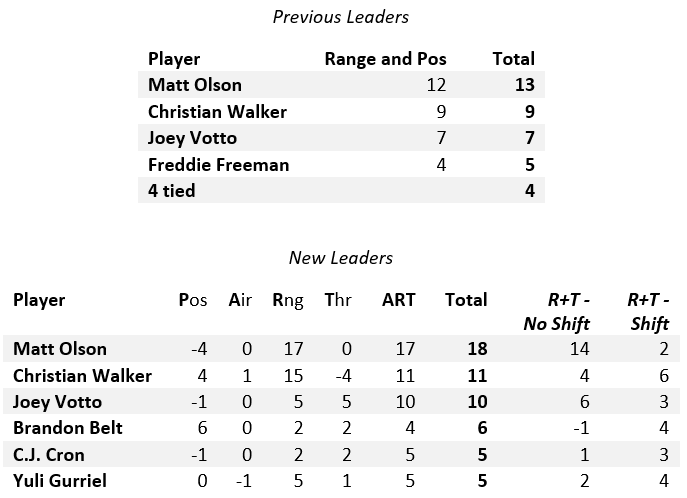
    First Base Defensive Runs Saved Leaders, 2019

    We don’t get a very different picture of the top players at first base as a result of these changes, but we do get a little bit of a picture of different players’ usage and competencies. Matt Olson and Christian Walker separate from each other partially because of the quality of their positioning, with Olson getting some negative positioning removed and Walker losing the benefit of strong positioning (more on the DBacks’ positioning in a bit).

    Another important but subtle thing to note here is that “Throwing” is a bit of a misnomer, especially for first basemen. Technically it’s a measure of how well you turn balls in play into outs once you’ve fielded them. For first basemen, that often involves running to tag first base or flipping to the pitcher as opposed to what we usually think of as throwing. Joey Votto was quite good in this respect in 2019, while Walker was not.

    Second Base Defensive Runs Saved Leaders, 2019

    At second base, the inclusion of shift plays was the biggest factor in who came out on top, as both Kolten Wong and Kiké Hernandez combined strong performance with excellent positioning. This is no surprise given that the Cardinals and Dodgers each netted 30 or more Shift Runs Saved in 2019.

    Falling off the leaderboard was Yolmer Sanchez. His 17 Positioning Runs Saved buoyed his total in the previous system, but the new system rates him as slightly below average in 2019.

    Third Base Defensive Runs Saved Leaders, 2019


    Andrew Kyne has already written about the changes to Matt Chapman’s numbers. He cements himself as the best defender relative to his peers, nearly doubling another mainstay at the hot corner, Nolan Arenado. You can see evidence that Chapman’s arm actually gives the A’s license to position him poorly, because he’s able to make up for it on the back end.

    Shortstop Defensive Runs Saved Leaders, 2019

    The numbers for Javier Baez and Nick Ahmed are really illuminating thanks to the new system’s breakdown. Baez leaps up by 10 runs from the previous system thanks to his excellent performance on shift plays, even with the Cubs ranking second-lowest in shift usage per BIS. His 11 Throwing Runs Saved tied Matt Chapman for the most among infielders, a fact we would not have been able to uncover with the previous system.

    Ahmed benefited from Arizona’s outstanding positioning, saving an additional 16 runs. That great positioning gave him quite the boost relative to his peers in the previous DRS system, so he drops back a bit in the overall rankings. He also didn’t perform as well while shifted, so adding those plays back in didn’t help him like it did Baez and shortstop leader Paul DeJong.

    This data is now available for all Major League players on FieldingBible.com, and it will also be featured in The Fielding Bible – Volume V (coming in the spring of 2020) and in The Bill James Handbook 2020 (out now).

  • New podcast: Nationals assistant GM, free agents and more awards

    LISTEN HERE

    On this week’s edition of the Sports Info Solutions Baseball podcast, senior research analyst Mark Simon ( @MarkASimonSays) opens the show by talking about the defensive analytics concepts he hopes a manager would know (1:16). Mark then talks with Nationals assistant general manager for baseball research and development, Samuel Mondry-Cohen.

    They discuss Sam’s path from batboy to front office executive (4:19), how the Nationals analytics department is structured (7:57), what it’s like to work with the coaching staff and with ace pitcher Max Scherzer (9:53), what his group was working on when the team was 19-31 (12:54), what role the analytics group played in the team’s acquisition of Daniel Hudson (14:12), and tips for pursuing a job in sports analytics (spoiler: Learn to code!) (15:59).

    Afterwards Mark is joined by SIS research associate Andrew Kyne ( @Andrew_Kyne). They review the White Sox signing of Yasmani Grandal and look at three other free agents of note (20:16). They also offer their own version of 8 MLB Awards ranging from “Hall of Framer” to “Flat Bat.” (25:20)

    Next podcast episode will be in December. See you then!

    Supplemental links

    Mark’s article in The Athletic on how free agents will impact a team on Defense

    Tyler Kepner on Samuel Mondry-Cohen


  • Stat of the Week: Who does the public want elected to the Hall of Fame?

    By Mark Simon

    The 2020 Baseball Hall of Fame ballot came out on Monday, which will inevitably lead to discussion on who deserves to go into the Hall of Fame and who meets the standards of being a Hall of Famer.

    But what about the question of whom the public would most like to see go into the Hall of Fame?

    Bill James attempted to answer this question in the lead article in the 2020 Bill James Handbook. He made a list of 156 current and retired players whom he felt would receive some suport and had each candidate polled six times over a three-month period this past summer, comparing that player’s Hall of Fame support to three other candidates on each poll.

    That resulted in 234 polls and nearly 290-thousand votes, which were analyzed by 12 formulas to measure each player’s Hall of Fame support.

    The result of all of the polling was that each player received a Support Score, indicative of how much public support they received. From that, Bill grouped players into six levels of Hall of Fame support. There were 14 players who received overwhelming support – a Support Score of more than 200 (an average score is 100). Some of them are still active. Some are long retired. One (Lou Whitaker) is on the Modern Era Committee Ballot. Four who are on the 2020 BBWAA ballot are marked in bold.

    Highest Hall of Fame Support Score
    NameSupport Score
    Barry Bonds1,445
    Justin Verlander772
    Adrián Beltré742
    Clayton Kershaw558
    Roger Clemens473
    Max Scherzer439
    Pete Rose414
    David Ortiz343
    Joe Jackson335
    Larry Walker292
    Alex Rodriguez258
    Lou Whitaker247
    Manny Ramírez223
    Carlos Beltrán220

    “The most striking thing about the list of players most-favored for Cooperstown selection is the concentration on the list of those who have been kicked out of baseball in gambling scandals (two) or kept out of the Hall of Fame in righteous indignation about PEDs or suspended for some period of time for failing a PED test,” Bill wrote, referring to Barry BondsRoger ClemensPete Rose, and Joe Jackson. Further, he pointed out that this isn’t a case of the public being willing to let PED usage slide. The public does care about PED usage, as evidenced by Rafael Palmeiro’s low Support Score (53).

    Granted, the polling system was imperfect because it was only polling Twitter users, but Bill noted that any system is going to have sampling issues, and he thinks this survey is “the largest and most extensive study ever of who the public WANTS to get into the Hall of Fame. That’s the goal, anyway.”

    Clemens, Bonds, and Walker are within sight of the 75% of votes needed to be elected, but still have a ways to go. Clemens received 59.5% on the last ballot, Bonds 59.1%, and Walker 54.6%.

    Clemens and Bonds have inched their way up slowly the last two years, making a gain of about 5 percentage points in that time. They have three ballots left to pick up the remaining votes needed. Walker made a jump of 20.5 percentage points from 2018 to 2019. He needs to do that again this year, in his final year on the ballot, to be elected. Ramirez has much more of an uphill climb, having received 23% of the votes in the last BBWAA balloting.

    If it were up to the Twitter-voting public, those four players would be on their way to Cooperstown. We’ll see if there’s any change among the writers to reflect that sentiment. In the meantime, buy the Handbook and check out the rest of Bill’s article to see how the public feels about the rest of the 156 notable players he included in the study.

    For more baseball content, check out the Sports Info Solutions Blog or the SIS Baseball Podcast.

  • Stat of the Week: A Surprising Win Shares Leader

    By Brian Reiff

    Everybody loves a good surprise.

    One example might be winning the lottery. You may claim that it wasn’t a surprise, that you knew playing the birthday of your father’s brother’s nephew’s cousin’s former roommate was always going to win, but you’d be lying to yourself.

    There are also things that are not all that surprising. One of those things is Mike Trout being good at baseball. He’s led MLB in Win Shares four of the last six years, with fellow AL West player José Altuve surpassing him the other two times. Therefore, it’s not all that surprising that, for a seventh consecutive season, the (as-of-yet-unreal) Win Shares trophy is staying in the division. What may be surprising is its recipient.

    Marcus Semien led the way in 2019 with 36 Win Shares, three more than any of his competitors (Trout, Christian Yelich, and DJ LeMahieu all had 33). It was a career year for the shortstop, who accumulated more Win Shares this season than in his previous two combined and increased his career total (dating back to 2013) by 50%.

    Eight other players had at least 29 Win Shares, the threshold set forth by this book’s namesake to designate MVP candidates: Trout, LeMahieu and Alex Bregman from the AL, and Yelich, Cody BellingerAnthony RendonKetel Marte and Ozzie Albies from the NL.

    The AL MVP finalists are Trout, Bregman, and Semien. The NL finalists are Yelich, Bellinger, and Rendon. The winners will be announced Thursday at 6pm ET on MLB Network.

    This essay was an excerpt from a section on Win Shares in the 2020 Bill James Handbook, which is on sale now at ACTA Sports and wherever you buy your books.

    Most Win Shares – 2019 Season
    Name Win Shares
    Marcus Semien 36
    Christian Yelich 33
    DJ LeMahieu 33
    Mike Trout 33
    Anthony Rendon 31
    Cody Bellinger 31
    Alex Bregman 31
    Ozzie Albies 29
    Ketel Marte 29
    Gleyber Torres 28
    Freddie Freeman 28
    Ronald Acuna Jr. 28

    For more baseball content, check out the Sports Info Solutions Blog or the SIS Baseball Podcast.

  • Who has the best chance to reach MLB milestones? (Bill James Handbook excerpt)

    The following is an excerpt from the 2020 Bill James Handbook, available now at ACTA Sports, Barnes & Noble, Amazon, and wherever you buy your books

    By Andrew Kyne
    Bill James devised “The Favorite Toy” to estimate a player’s probability of breaking a record or reaching a milestone.

    In last year’s Handbook, the highest probability of such an event belonged to Albert Pujols, who was projected to have a 97% chance to someday reach 2,000 career runs batted in. With 1,982 RBI entering the season, Pujols was very likely to not only reach the milestone, but to do so early in 2019. Sure enough, he notched his 2,000th with a solo home run on May 9 in Detroit.

    This year, the highest probability of reaching a career batting target belongs to another generational talent, Miguel Cabrera. He is now estimated to have a 75% chance of reaching 3,000 hits. Although his power numbers were limited this season, Cabrera still hit for a .282 average and added 139 hits to his career ledger. He now sits 185 hits shy of 3,000.

    Some records may never be broken, and the rest of the batting targets feature many longshots. But an obvious player to keep an eye on is Mike Trout, whose name can be found in several places in this section. After hitting a career-best 45 home runs in 2019, Trout is now projected to have a 43% chance to hit 500 home runs, a 29% chance to hit 600 home runs, and a 14% chance to hit more than 762 home runs, the all-time record.

    Additionally, BIS has developed a system, separate from The Favorite Toy, that estimates the likelihood that a pitcher will throw a no-hitter. Free agent pitcher Gerrit Cole is currently the most likely to do so at an astonishing 62%, far ahead of any other pitcher. In 2019, Cole had two outings in which he allowed only one hit and three outings in which he allowed two hits. He also found his strikeout touch with the Astros, recording double-digit strikeouts in 21 starts this year.

    A couple new names to watch on the most likely no-hitter list are Lucas Giolito (27%) and Luis Castillo (21%). Young pitchers Jack Flaherty (23%) and Blake Snell (23%) were featured on last year’s list as well.

    Justin Verlander, Cole’s teammate in Houston, was listed as having a 32% chance at a future no-hitter in last year’s Handbook. Verlander held the Blue Jays without a hit on September 1 for the third no-hitter of his career. Only Nolan Ryan and Sandy Koufax have thrown more than three career no-hitters. With a 26% chance of another, it’s possible that Verlander could join them.

    % Chance to Reach 762 HR
    Name % Chance
    Mike Trout 14%
    Cody Bellinger 6%
    Nolan Arenado 1%
    Pete Alonso <1%
    % Chance to Reach 800 HR
    Name % Chance
    Mike Trout 10%
    Cody Bellinger 3%
    % Chance to Reach 600 HR
    Name % Chance
    Mike Trout 29%
    Nolan Arenado 21%
    Eugenio Suárez 16%
    Bryce Harper 16%
    Manny Machado 15%
    Cody Bellinger 13%
    Francisco Lindor 11%
    Pete Alonso 11%
    Christian Yelich 10%
    % Chance to Reach 500 HR
    Name % Chance
    Miguel Cabrera 68%
    Edwin Encarnación 66%
    Mike Trout 43%
    Nolan Arenado 32%
    J.D. Martinez 31%
    Nelson Cruz 29%
    Giancarlo Stanton 27%
    Bryce Harper 26%
    Manny Machado 24%
    % Chance to Reach 2,298 RBI (Record)
    Name % Chance
    Albert Pujols 7%
    Nolan Arenado 3%
    Bryce Harper < 1%
    % Chance to Reach 2,296 Runs (Record)
    Name % Chance
    Mookie Betts 11%
    Mike Trout 6%
    Francisco Lindor 1%
    % Chance to Reach 793 Doubles (Record)
    Name % Chance
    Nicholas Castellanos 16%
    Xander Bogaerts 14%
    Mookie Betts 11%
    Francisco Lindor 7%
    Rafael Devers 6%
    Alex Bregman 5%
    Ozzie Albies 2%
    José Ramírez 2%
    Anthony Rendon 2%
    Freddie Freeman 1%
    % Most Likely To Throw No-Hitter 
    Name % Chance
    Gerrit Cole 62%
    Robbie Ray 32%
    Chris Sale 29%
    Lucas Giolito 27%
    Justin Verlander 26%
    Blake Snell 23%
    Jack Flaherty 23%
    Max Scherzer 22%
    Luis Castillo 21%
    Yu Darvish 21%
    % Chance to Reach 3,000 Hits
    Name % Chance
    Miguel Cabrera 75%
    Nick Markakis 30%
    Robinson Canó 26%
    Starlin Castro 25%
    José Altuve 24%
    Freddie Freeman 23%
    Elvis Andrus 20%
    Eric Hosmer 20%
    Nolan Arenado 19%
    Manny Machado 17%
    Christian Yelich 16%
    Mookie Betts 15%
    Xander Bogaerts 15%
    Nicholas Castellanos 15%
    Francisco Lindor 13%
    Adam Jones 12%
    Mike Trout 12%
    DJ LeMahieu 10%
    Jean Segura 9%
    Bryce Harper 9%
    Ozzie Albies 7%
    Alex Bregman 7%
    Cody Bellinger 7%
    Rafael Devers 6%
    Anthony Rizzo 6%
    Andrew Benintendi 5%
    Trevor Story 4%
    Anthony Rendon 4%
    Paul Goldschmidt 4%
    Charlie Blackmon 3%
    Javier Báez 2%
    José Ramírez 2%
    J.D. Martinez 2%
    Trea Turner 2%
    Ketel Marte 2%
    Amed Rosario 1%
    Ronald Acuña Jr. 1%
    Eddie Rosario < 1%
    Marcus Semien < 1%
    Michael Brantley < 1%
    Tim Anderson < 1%
    Eugenio Suárez < 1%
  • Bill James Handbook excerpt: The year in fathers and sons

    The following is an excerpt from the 2020 Bill James Handbook, available now at ACTA Sports, Barnes & Noble, Amazon, and wherever you buy your books

    By Mark Simon

    A Guerrero excelled at the Home Run Derby.

    A Biggio reached double figures in home runs and stolen bases.

    A Yastrzemski stood in front of the Green Monster at Fenway Park.

    No, this was not the 1970s, 1980s or 1990s. It was the 2019 season, in which a new generation of young stars lived up to their family legacies. This was a great year for sons and even a grandson of former major leaguers to make their mark in the major leagues for the first time.

    Vladimir Guerrero Jr. (son of Vladimir)

    The Blue Jays had three prominent sons of former major leaguers begin their big league careers.

    The game was a challenge early on for one of the team’s and game’s top prospects, but in the shadow of the 2019 All-Star Game, Guerrero Jr. thrived.

    At the Home Run Derby in Cleveland, he hit 91 home runs before falling to Pete Alonso in the finals. His father, Vladimir Guerrero, won the 2007 Home Run Derby.

    Guerrero’s season took a more positive turn after the Derby, as he fared better against the offspeed pitches that were a bugaboo in the early part of his season. He hit .293/.349/.452 in his last 62 games, besting his OPS in his first 61 games by 60 points. He’ll try to carry that momentum into the Blue Jays’ 2020 season.

    Vladimir Guerrero Jr. – Season Highlights

    –     Finished 2nd at HR Derby (Hit 91 HR)

    –     Hit .293/.349/.452 after All-Star Break

    Vladimir Guerrero – Career Highlights

    –     2018 Baseball Hall of Fame inductee

    –     449 HR (tied for 40th all-time)

    Cavan Biggio (son of Craig)

    Don’t look at batting average when it comes to judging Biggio’s first season. Though Biggio hit .234, he showed a great eye, modest power, and good baserunning instincts.

    Biggio’s 16% chase rate was the second-lowest in the majors among players with at least 250 plate appearances. His .364 on-base percentage bested the career mark of his father, Hall of Famer Craig Biggio, by one point.

    Cavan scratched the surface of the 26-homer power he showed in Double-A in 2018 by hitting 16 home runs with the Blue Jays. He was perfect on the basepaths, with 14 steals in 14 attempts. Biggio also fared well in taking extra bases on hits and wild pitches, enough to finish tied for eighth in our Net Baserunning Gain stat (+ 33 bases).

    Cavan Biggio – Season Highlights

    –     .364 OBP, 16% chase rate (2nd-lowest)

    –     14-for-14 in SB attempts (T-8th in Net Baserunning Gain)

    Craig Biggio – Career Highlights

    –     2015 Baseball Hall of Fame inductee

    –     3,060 hits, 668 doubles (5th all-time), 414 stolen bases

    Bo Bichette (son of Dante)

    Bichette was an instant star for the Blue Jays, as he set major league records by hitting a double in nine straight games and recording 15 extra-base hits within the first 15 games of his career. He posted a .311/.358/.571 slashline in a season shortened to 46 games by a concussion.

    Bichette showed he could catch up to major league fastballs, hitting .376 against them. That’s league-leader caliber if maintained for a full season. He also played a respectable shortstop, saving three runs with his defense.

    Bichette’s presence made his team better. Toronto was 22-24 when he started, 45-71 when he didn’t.

    Bo Bichette – Season Highlights

    –     .311/.358/.571

    –     First player to double in nine straight games

    Dante Bichette – Career Highlights

    –     .299 BA, 274 HR in 14 MLB seasons

    –     Runner-up for 1995 NL MVP (led NL with 40 HR, 128 RBI)

    Fernando Tatis Jr. (son of Fernando)

    When he was on the field, Tatis Jr. was one of the best players in baseball. Tatis hit .317/.379/.590 with 22 home runs and 16 stolen bases in 84 games but missed two long stretches due to injuries.

    How impressive was Tatis? The last two players to match or better all three of his slashline stats in their debut season were Ted Williams (1939) and Albert Pujols (2001) (minimum 300 at-bats). Tatis’ .969 OPS was 12 points better than his father’s best season. Fernando Sr. had a .957 OPS in 1999, the year he hit two grand slams in the same inning.

    Tatis Jr. didn’t do that, but he did do just about everything else. Though he finished two runs below average in Defensive Runs Saved, he had his share of highlight-reel plays.

    Fernando Tatis Jr. – Season Highlights

    –     .317/.379/.590

    –     22 HR and 16 SB in 84 games

     Fernando Tatis Sr. – Career Highlights

    –     .265 BA, 113 HR in 11 MLB seasons

    –     34 HR in 1999 (including 2 grand slams in one inning)

    Mike Yastrzemski (grandson of Carl)

    One of the coolest moments of 2019 came when the Giants visited the Red Sox in September and Mike Yastrzemski got to walk around the Fenway Park outfield with his grandfather, who spent much of his Hall of Fame career in left field there.

    For the younger Yastrzemski, homering that night capped an improbable rookie season. It was a long path to the majors  but he found a home in the Giants outfield. He tied for the team lead in home runs with 21 and ranked second on the Giants in Defensive Runs Saved with eight.

    Mike Yastrzemski established himself as one of the top hitters in the game against low pitches. He slugged .582 on pitches in the bottom-third of the strike zone or below. Only Mike Trout slugged better against those pitches (.623).

    Mike Yastrzemski – Season Highlights

    –     21 HR tied for team lead

    –     Homered in first game at Fenway Park

    Carl Yastrzemski – Career Highlights

    –     Hall of Fame inductee, 1989

    –     3,419 hits, 452 HR, all with Red Sox

    These five join a long line of second and third-generation players thriving in the major leagues. At the top of that list is Cody Bellinger (son of Clay), who had himself an MVP-caliber year for the Dodgers this season. The level that Bellinger reached is one to which these young standouts can aspire.

  • Which ‘Modern Era’ candidates are Hall of Fame worthy?

    If you like this article, you’ll probably like The 2020 Bill James Handbook, available now at ACTA Sports and wherever baseball books are sold.

    By Mark Simon

    The Baseball Hall of Fame recently announced that its Modern Game ballot for this year will be comprised of nine players who had standout careers in the 1970s, 1980s, and 1990s, and labor leader Marvin Miller.

    By Bill James’ Hall of Fame Value stat, four of these players clear the threshold for being Hall of Fame caliber – Lou Whitaker, Dwight Evans, Ted Simmons, and Tommy John.

    Hall of Fame Value is a stat introduced in the 2019 Bill James Handbook that combines Win Shares with Baseball-Reference’s Wins Above Replacement. You can read a full description of it here. A score of 500 or better indicates that a player has cleared the Hall of Fame Value standard for induction.

    Whitaker fared very well in this statistic (as you can see the list at the bottom of this article). Last year, Bill declared him the second-most deserving position player not in the Hall of Fame who should be in the Hall of Fame (trailing 19th century star Bill Dahlen).

    As Bill noted, Whitaker had more Wins Shares and more WAR than Alan Trammell, who was elected to the Hall of Fame in 2018. By Bill’s Similarity Scores, Whitaker’s three most comparable players from a statistical perspective are Hall of Famers – Ryne Sandberg, Trammell, and Roberto Alomar.

    Evans ranked right behind Whitaker on Bill’s ‘Most Deserving’ list. He’s an eight-time Gold Glove winner who ranks in the top 90 players in home runs, RBI, times on base, and Runs Created. Had Evans played in an era in which on-base percentage was more highly valued than batting average, the perception of his career among Hall of Fame voters from the BBWAA might have been different. Alas, he’s had to wait patiently for an opportunity like this to come up.

    Simmons is a catcher who rates well compared to his contemporaries, even if his basic statistical line doesn’t scream “Hall of Famer” to those unfamiliar with his play. The most comparable player to him for the prime years of his career is Iván Rodríguez. Simmons ranks fourth all-time in Runs Created among catchers, accumulating that over 21 seasons from 1968 to 1988. The only players to have more Runs Created  who caught at least 40% of their games are Rodríguez, Mike Piazza, and Carlton Fisk.

    John’s legacy is the surgery that bears his name. But he was a very good pitcher too, one who lasted from 1963 to 1989. He pitched more than 4,700 innings to a 3.34 ERA (as well as a 2.65 postseason ERA in 88 1/3 innings). John’s best argument is that eight of his 10 most statistically similar pitchers are in the Hall of Fame. He’s 20th all-time in innings pitched, 26th in shutouts.

    Two players fell a smidge below the Hall of Fame Value standard – Dave Parker and Dale Murphy. Parker was one of the most dominant players of the mid-to-late 1970s, posting a .909 OPS with an average of 23 home runs and 17 stolen bases from 1975 to 1979. Murphy had a .913 OPS averaging 36 home runs and 18 stolen bases over a six-season span from 1982 to 1987. There’s a Hall of Fame case to be made for each, but Hall of Fame Value isn’t necessarily the best stat for it.

    Hall of Fame Modern Era Ballot
    Name Hall of Fame Value
    Lou Whitaker 651
    Dwight Evans 615
    Ted Simmons 606
    Tommy John 537
    Dave Parker 487
    Dale Murphy 484
    Thurman Munson 467
    Don Mattingly 433
    Steve Garvey 431
    * 500 is threshold for Hall of Fame status