Category: NFL Draft

  • How Does Donovan Jackson Fit With the Minnesota Vikings?

    How Does Donovan Jackson Fit With the Minnesota Vikings?

    Photo: Ian Johnson/Icon Sportswire

    The Minnesota Vikings came into the 2025 NFL Draft with major needs at defensive back and offensive line. Many mock drafters, including ourselves, had Minnesota taking a safety to provide a spark for their secondary. However, Vikings general manager Kwesi Adofo-Mensah had other ideas.

    The Vikings selected left guard Donovan Jackson with their first pick to reinforce their offensive line for years to come. Jackson had a 6.7 grade on our draft site, which ranks at the top of our positional ranking next to Alabama guard Tyler Booker. He was number one in FBS for Total Points among ALL offensive linemen last season, regardless of position. The Vikings hope he can come in and start straight away, continuing his reign of terror against his opponents.

    Here is a look at Jackson and how he can contribute in Minnesota immediately:

    Jackson’s Strengths And Weaknesses

     Donovan Jackson measures out at 6’4’’ 315 pounds, which is sufficient for the left guard position. He started 40 games at Ohio State, with 9 of those starts coming at left tackle. He has some flexibility to play both sides and positions, but will do his best work from the interior.

    Jackson possesses good play strength and drive ability that allows him to move defenders on the run. He isn’t a dominant finisher, but he can certainly create run lanes. He uses his lower half well to stay balanced through contact and can recover quickly by using his fluid hips to stay upright in uncomfortable positions. He also has the mobility to combo-block up to the second level.

    In pass protection, he can anchor well against bigger defenders to give the quarterback enough space to do his work. However, he will occasionally lose leverage by keeping his hands too wide on the shoulder pads, which leaves him vulnerable to blown blocks and holding penalties in the NFL. He will need to clean that up before his rookie season or else teams will quickly learn to exploit it.

    With good coaching, Jackson has all of the tools necessary to succeed at the left guard position. There are no physical limitations for him. He will be tested early, but he should adapt to NFL competition relatively quickly.

    Minnesota Team Needs

     Last year, Minnesota’s offensive line went through a lot over the course of the season. Left tackle Christian Darrisaw went down with a torn ACL and MCL in Week 8, knocking him out for the remainder of the year. The interior offensive linemen, while mostly healthy, performed poorly

    Center Garrett Bradbury, who has since been released, led ALL interior linemen in blown blocks.

    Player Team Position Blown Blocks
    Garrett Bradbury Vikings C 43
    Alex Cappa Bengals RG 40
    Dominick Puni 49ers RG 33
    Liam Eichenberg Dolphins RG 32
    Cordell Volson Bengals LG 32

    Left guard Blake Brandel was not far behind, ranking 9th among interior offensive linemen in blown blocks with 30. If you combine Ed Ingram and Dalton Risner, who started 9 and 8 games at RG, respectively, they had a total of 33 blown blocks.

    Minnesota desperately needed some new blood in its offensive line room. This offseason, the Vikings have replaced their entire interior. Former Colts center Ryan Kelly and guard Will Fries will come in and immediately inject some stability. They both missed substantial time due to injury last year, however they were much more effective (only 12 blown blocks between them) with just under a full season of snaps.

    Jackson is coming in at the perfect time. The Vikings are competitive. The offensive line room is fresh and ready to turn the page after an ugly year. JJ McCarthy is healthy. Minnesota’s 2025 season outlook looks very promising entering training camp.

    How Jackson fits in Minnesota

     Minnesota primarily used a zone rushing scheme last season (72% zone, 8th highest clip in the NFL). They operated mainly out of 11 or 12 personnel formations and were the 2nd-most effective team in 12 personnel last year. Kevin O’Connell likes to mix things up pre-snap as well, using a motion on nearly 60% of plays last year (59% to be exact).

    Jackson has experience working in a zone-heavy scheme at Ohio State, which they ran at a 69% rate. He can pull when asked, however his strength is in his ability to move defenders and create running lanes. Last season, ball carriers averaged 3.7 yards before contact when running to his gap.

    At Ohio State, Jackson led ALL FBS offensive linemen in Total Points in 2024.

    Rank Player Team Position Total Points
    1 Donovan Jackson Ohio State G 49
    2 Josh Conerly Jr. Oregon T 44
    3 Brady Small Army C 42
    4 Aamil Wagner Notre Dame T 42
    5 Isaiah World Nevada T 41

    30 of those 49 Total Points came from his run blocking, which ranked 2nd among all FBS offensive linemen last year. His 19 pass blocking Total Points ranked 13th. His effectiveness is evident in both areas.

    Overall, Jackson is a well-rounded blocker who can be very effective in zone but still possesses the mobility to pull through to the 2nd level. He should plug right into the left guard spot next to new additions Ryan Kelly and Will Fries. If Darrisaw goes down again, the Vikings will have the option to use Jackson at left tackle as well.

    How Good a Fit Is He?

    The Vikings will get someone who has been a part of a winning culture before and knows what it takes to win at a high level. His solid base and mobility will make him effective in Minnesota’s zone-heavy run scheme. In pass protection, he can anchor well against bigger defenders to give JJ McCarthy time in the pocket.

    Since he played at Ohio State, Jackson is no stranger to cold weather and should be able to adapt to the frigid NFC North games at Soldier Field and Lambeau Field toward the end of the season.

    Final Word: Jackson is an excellent fit and should contribute immediately in Minnesota’s revamped offensive line room.

  • How Does Nic Scourton Fit With The Carolina Panthers?

    How Does Nic Scourton Fit With The Carolina Panthers?

    Photo: Matthew Visinsky/Icon Sportswire

    The Panthers addressed a couple of needs on the first two days of the Draft. After selecting wide receiver Tetairoa McMillan with their first pick, they doubled down at edge rusher in the second and third rounds with Nic Scourton and Princely Umanmielen, respectively. We will focus on Scourton in this article as he is a great fit to fill the void in their pass rush after they traded Brian Burns to the Big Apple. 

    What He Brings

    Our scouting report describes Scourton as a big, physical, explosive EDGE who should earn a starting job early on and could develop into a high-end player if he continues his trajectory. His explosive power and expansive pass rush repertoire are certainly strengths in his game. He also possesses a hair-on-fire mentality, but this can get him in trouble with his positioning in the run game. He has all the tools to be a reliable run defender on the edge if he can become more disciplined in his run fits. 

    After two productive years at Purdue including 8.5 sacks in 2023, he had a disappointing 2024 season at Texas A&M where his numbers fell in a new scheme and conference. The table below highlights these differences: 

    Nic Scourton – Last 2 Seasons

    2023 2024
    Sacks 8.5 5
    Pressures 40 27
    Pressure Percentage 18% 10%
    Pass Rush Total Points 21 10

    Despite a disappointing 2024 season, Scourton’s production in 2023 at Purdue gives us reason to believe that the Panthers can develop him at the next level. He is not just a pass rusher as he earned 18 and 12 Total Points against the run the past two seasons (click the link to learn more about Total Points, our all-encompassing player value stat). His ability to play the pass and run should earn him a starting role early on, as the Panthers desperately need talent off the edge. 

    The Need He Fills

    The Panthers pass rush was non-existent last season after the departure of Brian Burns and an early season injury to star DT Derrick Brown. The table below highlights the struggles of the Panthers pass rush last season: 

    Carolina Panthers

    2024 League Rank
    Sacks 32  T-29
    Pressures 153 Last
    Pressure Percentage 26% Last
    Pass Rush Total Points 21 Last

    It doesn’t paint a pretty picture. The Panthers need their young additions to inject some life into their pass rush. To be fair to last year’s group, it wasn’t pretty the year before either with Burns and Brown, as the team ranked last in 2023 with 27 sacks. 

    How Scourton Fits What Carolina Does

    Scourton played in college around 280 pounds before weighing in at the combine at 255. Our scouting report mentioned body composition work to help improve functional strength. It doesn’t seem like this was just for combine testing either as the Panthers roster lists him at 257 pounds. The weight loss should prepare him well for his new role with the Panthers as a stand-up EDGE. 

    Panthers EDGEs primarily play in a 2-point stance instead of putting their hand in the dirt. The aforementioned weight loss should help as he played exclusively with his hand in the dirt at Purdue and 71% of his snaps at Texas A&M. If he can maintain his strength, the weight loss could help him unlock some speed and bend to raise an already high ceiling even higher. 

    Scourton is a perfect fit for the Panthers and great value to address a need in the second round. They get a player who plays unbelievably hard and should see the field early and often while possessing a high ceiling. His drop in weight at the Combine was certainly unique, but a body transformation could unlock new parts of his game, as long as he can maintain his strength. 

    Bryce Young and the Panthers started to turn the corner at the end of last season. To build on that success and challenge Tampa Bay for the NFC South crown, they desperately need to find some pass rush success. Scourton might just be the guy to provide it.

  • How Does Carson Schwesinger Fit With The Cleveland Browns?

    How Does Carson Schwesinger Fit With The Cleveland Browns?

    Photo: Gregory Fisher/Icon Sportswire

    The Cleveland Browns were our top graded draft class this year, so it wouldn’t have felt right to not highlight one of their selections. After taking our top-graded DT in Mason Graham, the Browns continued to reinforce their defense by selecting linebacker Carson Schwesinger with the first pick of the second round.

    Schwesinger graded out as a 6.6 on our draft site, ranking second among WLBs behind Jihaad Campbell (click the link to read the full scouting report). The Browns had no shortage of other needs, but taking a linebacker with this selection proved that they were not shying away from what they do best: winning against the run.

    Here is a look at Schwesinger and how he fits this Browns defense.

    Schwesinger’s Strengths

     Despite only one full season as a starter at UCLA, Schwesinger has the instincts of a veteran with excellent awareness for where the receivers are around him. He is able to drop back into coverage and make life difficult for the quarterback, while also having the athleticism to move sideline-to-sideline and chase down runners from behind. He has an explosive first step and can pivot downhill quickly, allowing him to make a difference in almost all facets of the game.

    He is not going to blow anyone away with his power or pass rush ability. His game is predicated on his motor and competitiveness off the ball. His effort level is unwavering and he will consistently play until the final whistle.

    Schwesinger is more of a lanky-sized linebacker, but his fluid athleticism and high football intelligence should allow him to contribute immediately on defense and also be a core special teams player.

    How Schwesinger Fits With Cleveland

    Cleveland looked directionless following an abysmal season in 2024. The team sustained numerous injuries and there were a lot of questions heading into the offseason. However, when they made Myles Garrett the highest-paid non-quarterback in NFL history with a contract extension worth $160 million, it was clear that they weren’t going to be throwing in the towel for 2025.

    There was one thing that Cleveland did exceptionally well during its disastrous season: defend the run. The Browns led the entire NFL in Total Points against the run by a relatively wide margin.*

    * Total Points is our all-encompassing player value stat that attempts to capture everything that happens on a football field. You can learn more about it here.

    Team Points Saved
    Browns 189
    Colts 180
    Giants 180
    Bills 175
    Jets 173

    While this was to some extent the result of playing behind often while the other team ran the clock out, it still displayed an area of strength in an otherwise unremarkable season. With too many holes on both sides of the ball, the Browns were likely thinking of taking the best player overall with their early picks.

    After swapping first round picks with the Jaguars and moving back three spots, the Browns elected to take Graham out of Michigan. Coincidentally, Graham led all NCAA defensive tackles in Total Points against the run, giving Cleveland more strength along the interior defensive line. The rich get richer, so they say.

    PLAYER SCHOOL POINTS SAVED
    Mason Graham Michigan 26
    Ty Hamilton Ohio State 23
    Alfred Collins Texas 23
    Walter Nolen Ole Miss 23
    Blake Boenisch Rice 22

    Which brings us back to the topic of this article, Cleveland’s second round selection, Schwesinger. It was somewhat of a surprise selection, with many expecting them to take a player on the offensive side of the ball. However, here is one reason why this pick made sense: he can defend the run. Schwesinger was second among all NCAA linebackers in Total Points against the run, giving Cleveland even more firepower against run-heavy offenses.

    Player School Points Saved
    Shaun Dolac Buffalo 43
    Carson Schwesinger UCLA 41
    Jackson Woodard UNLV 37
    Jack Kiser Notre Dame 37
    Jaylen Smith North Texas 35

    This gives Cleveland two bona fide studs on the defensive side of the ball who can play tough and dominate in the trenches. Schwesinger will be able to use his elite instincts and hot motor to snuff out runs from inside the box, while also possessing the ability to move sideline to sideline when the situation calls for it.

    How can Cleveland use Schwesinger?

    With Jeremiah Owusu-Koramoah set to miss the 2025 season, Schwesinger will have the opportunity to contribute immediately in Week 1. He will step right into that WLB role where he’ll be asked to cover tight ends and running backs in man coverage. His fluidness and overall athleticism will come in handy for him, and he should be able to compete against the best early and often.

    He will likely be an every-down player, but they may use him on a rotational basis to start the season. He will be effective on third downs and can be used as a blitzer off of the weak side. Since Cleveland operates out of a base 4-2 S/W, Schwesinger will spend most of his time playing off the line of scrimmage in coverage or being used in various blitz packages.

    Cleveland also utilized a stacked box (8 or more players) at a 32% clip last season, which led all NFL teams in 2024. Schwesinger will need to be comfortable with congestion while still keeping his eyes open through contact and traffic, as he operated out of a stacked box only 13% of the time at UCLA.

    Schwesinger is a well-rounded player overall, so Cleveland has a lot of options on how to use him. For the most part, he should be a plug-and-play LB with few limitations early on. He also projects to be a core special teams player for the whole season.

    How Good A Fit is Schwesinger?

     Ultimately, Schwesinger is an ideal fit for Cleveland’s defense as they both play to each other’s strengths. Cleveland was great against the run in 2024, and they drafted a LB who was one of the best against the run in college. It’s a perfect match for both the player and team, and Schwesinger will have an opportunity to prove himself early in his career.

  • How Does Omarion Hampton Fit With The San Diego Chargers?

    How Does Omarion Hampton Fit With The San Diego Chargers?

    Jim Harbaugh’s first season as the Chargers’ head coach featured a lot of smashmouth football on offense. They are looking to take a step forward in Year 2, and their first-round pick in the 2025 NFL Draft, running back Omarion Hampton, will help them do exactly that.

    What Hampton Brings to the Table

    Hampton has the skills to be a star at the next level. Jeremy Percy’s scouting report highlighted his contact balance, big-play ability, and attitude with the ball. He has true three-down potential due to his ability as a rusher, receiver, and pass blocker.

    In 2024, Hampton ranked second in rushing yards per game (138.3), which only trailed Ashton Jeanty’s otherworldly average (185.8). He was also one of three college running backs who had over 1,000 yards after contact last season (Jeanty, Cam Skattebo). The 22-year-old forced a broken or missed tackle on 26.3% of his attempts from last season, which ranked 6th among the nation’s top rushers (minimum 200 carries).

    In the passing game, Hampton ranked 11th in yardage among RBs with 363. He was 4th in terms of Total Points (16.5), and 13th in yards per target (8.3). These numbers were especially impressive considering he caught most of his passes behind the line of scrimmage (-2.2 Average Depth of Target, 2nd-lowest).

    Overall, Hampton has the skillset to be a three-down back with the Chargers.

    Analyzing the Chargers’ Rushing Attack

    The Chargers put a major emphasis on their rushing attack last season, and it started when they hired Greg Roman as their offensive coordinator. Most NFL teams are running ‘11’ personnel, which means 1 running back, 1 tight end, and 3 wide receivers. Los Angeles went in the other direction, using more ‘21’ and ‘22’ personnel.

    They ran 21p on 17% of plays (4th-most), and 22p on 13% of plays (2nd-most). Despite their efforts, they had mediocre results in these heavy packages. Los Angeles ranked 20th in success rate out of 21p, and 13th out of 22p.

    From a schematic standpoint, the Chargers leaned more towards man/gap blocking schemes over zone. They ranked 5th in usage for gap runs, but 24th in success rate. For zone runs, they ranked 27th in usage, and 31st in success rate.

    The run-first offense didn’t result in elite offensive output for the Chargers last season. They are hoping that by bringing in a potential star running back like Hampton can take them to the next level.

    How Should the Chargers Use Hampton?

    Hampton figures to play a healthy amount in his rookie season, even with the Chargers adding Najee Harris to the mix on a one-year deal worth up to $9.25 million. The other running backs on their roster include Hassan Haskins, Kimani Vidal, Jaret Patterson, and Raheim Sanders. In terms of Total Points for running backs, Harris ranked 7th as a rusher and 20th as a receiver last season.

    Los Angeles has two running backs in Harris and Hampton that are capable of playing on all three downs. This should keep both running backs relatively fresh, or the Chargers can do the ‘ride the hot hand’ approach. Harris might get more work this season since he has more NFL experience and is on the one-year deal, but Hampton is the clear running back of the future and could get the lead role if Harris fails to impress.

    The Chargers had a diverse rushing approach last season, with 55% of their runs being zone schemes, and 44% being man/gap. Their zone-run success rate was just 34%, which was second-worst in the NFL. North Carolina had a zone-heavy rushing scheme (82% of runs) and had a higher success rate at 47%. Hampton’s effectiveness and experience in a zone-heavy scheme should give the Chargers a boost.

    Another area that Hampton might have some influence in on screens. The Chargers ran the 4th-fewest screens in 2024 (43), while Hampton led all NCAA receivers by a wide margin with 10 Total Points off screen passes.

    Is Hampton a Good Fit for Los Angeles?

    A successful rushing attack requires above-average play out of your offensive line, quarterback, and running back. The Los Angeles Chargers are hoping that they added the final piece to their puzzle with Omarion Hampton.

    Their offensive scheme last season was mainly under-center, man/gap run schemes, with play-action. Hampton is coming out of an offense that ran a lot of inside/outside zone out of shotgun, so the Chargers would be wise to diversify their rushing gameplan. Not only that, but Hampton’s impact on screens should have Los Angeles running more of those in 2025 as well.

    Overall, Hampton is a great fit for the Chargers’ offensive plan-of-attack.

  • How Does Colston Loveland Fit With The Chicago Bears? (Spoiler: Quite Well)

    How Does Colston Loveland Fit With The Chicago Bears? (Spoiler: Quite Well)

    Photo: Zacbon Durant/Icon Sportswire

    It is easy to see why Colston Loveland was the first draft pick of the Ben Johnson era in Chicago. He is a lengthy TE with enough athleticism to cause mismatches all over the field. Adding Loveland to a skill group of DJ Moore, Rome Odunze, and D’Andre Swift creates endless possibilities for Johnson to create advantageous looks for Caleb Williams. 

    What Loveland Brings

    Loveland possesses a lot of traits to excel in the NFL. Our NFL Draft scouting report describes him as an aggressive blocker and powerful receiver who seeks to win on every play. His experience in a pro-style offense makes it easy to see how he will translate to the next level. Recently, we compared Loveland to fellow 1st round TE Tyler Warren. At the end of the article, there is a great graphic showing the completeness of Loveland’s game not only as a receiver, but as a blocker, too.  

    Bears tight ends ranked 26th with 4 receiving Total Points* last season. To fit Ben Johnson’s style of offense, the Bears needed an injection of talent to the room. Cole Kmet is a fine blocker, but he has not become a presence in the passing game like expected.

    * Total Points is our all-encompassing player value metric that attempts to capture everything that happens during a play. You can read about it here or watch a short video about it here.

     How He Fits With What Ben Johnson Did In Detroit

    The Lions added a dynamic, young TE in Sam Laporta before Johnson’s first full season as offensive coordinator. Loveland offers more of a natural downfield receiving threat while being less dynamic with the ball in his hands. The Loveland/Kmet duo is similar to the Laporta/Brock Wright pairing Johnson had in Detroit. Kmet, akin to Wright, is a better blocker while Loveland, akin to Laporta, brings the mismatch and receiving ability. 

    Johnson utilized 12 personnel (1 RB, 2 TE, 2 WR) at a high rate in Detroit, even doubling down on it last season to quite a bit of success. The table below highlights the usage and impact of 2 TE sets in Johnson’s offenses, compared to what the Bears put out there:

    2023 Lions 2024 Lions 2024 Bears
    12 Personnel% 22% (13th) 38% (2nd) 19% (20th)
    12 Personnel Success Rate 52% (2nd) 49% (6th) 36% (32nd)

    The Bears were a disaster in 12 personnel last year, ranking last in success rate. That is an area where Johnson clearly wanted to address as 12P was a staple of his offenses in Detroit. Pairing Loveland and Cole Kmet together will allow Johnson to deploy each player to his strengths.

    Kmet established himself as a top blocking TE last season, finishing fifth at the position with 12 Blocking Total Points. This will take the pressure off Loveland and he can add strength and grow as a blocker, all while allowing Johnson to get creative with formations to attack defenses based on how they counter. He can line up both tight ends attached to the line of scrimmage and pound the rock against nickel defenses or split Loveland out wide against base defenses to create a mismatch against a linebacker or safety. The possibilities are endless for an offensive mastermind like Johnson. 

    Johnson and the Lions had a lot of success throwing over the middle of the field, partly due to Jared Goff’s skills. Johnson will tweak his offense to fit Caleb Williams’ skills and preferences, but we can expect Johnson to continue finding creative ways to access the middle of the field. 

    The table below shows the stats for Goff and Williams when throwing between the numbers during the 2024 season:

    Throwing Between The Numbers

    Jared Goff Caleb Williams
    Attempts 336 269
    On-Target% 81% 77%
    IQR* 114.0 96.4
    Success% 62% 55%
    Total Points per att 0.23 0.23

    * IQR (Independent Quarterback Rating) is an adjusted version of the traditional Passer Rating that emphasizes competitive throws and removes factors outside the passer’s control, like dropped passes.

    As you can see, Goff did a lot more damage over the middle than Williams, but on a per-play basis Williams held his own when you focus on his contributions. The addition of Loveland should help as his frame offers a big, reliable target over the middle. On in-breaking routes (digs, posts, slants, crossing routes), his yards per route run (YPRR) was 3.5 in 2024, compared to 2.9 on all routes. Laporta had a 2.6 YPRR along with 11 Total Points on these in-breaking routes in his rookie season with Johnson. Expect Loveland to have a similar impact in his rookie season.

    Another area where Loveland’s addition should elevate their offense is his ability to help Williams on broken plays. Loveland accumulated 4 Total Points on broken plays in 2023 with JJ McCarthy as his QB. This is an area where Williams struggled last year despite his success off-script in college. Williams ranked 8th in broken play attempts last year but 18th in Total Points per play, suggesting there is ample room for growth. 

    Summing it up

    Loveland to the Bears is a perfect match. His skillset will allow him to play early while landing in a situation where he can improve on his weaknesses without them getting exposed. Kmet and his blocking skills will allow Loveland to add strength before he becomes the main guy at the point of attack. Johnson’s creativity will generate Loveland free releases and leverage advantages while he refines his separation abilities. 

    The Bears not only added a top talent in the draft, but at a position that will allow Ben Johnson to use 12P to the extent he did in Detroit. The Bears have brought in plenty of reinforcements to help Williams reach his full potential. Securing Loveland after fortifying the interior offensive line in free agency is the cherry on top.

  • How Malaki Starks Fits With The Baltimore Ravens

    How Malaki Starks Fits With The Baltimore Ravens

    Photo: Jeffrey Vest/Icon Sportswire

    Malaki Starks was a player that had a wide range of possible outcomes coming into the 2025 NFL Draft. Some mock drafts had him going around the top 10, while others had him going towards the end of the first round. Eventually, the Baltimore Ravens scooped him up with the 27th overall pick, and he should make an immediate impact in their secondary.

    Let’s take a look at how the former Georgia Bulldog will fit in with his new team.

    Starks’ Strengths and Weaknesses

    Malaki Starks is an incredibly well-rounded player who can help out the Ravens’ defense in a variety of ways. Nathan Cooper’s scouting report of Starks highlights his 3-level impact, FBI/instincts, ball skills, zone coverage, and more. He will create headaches for opposing quarterbacks in coverage, and he’s also an aggressive run defender.

    Starks is not an outlier in terms of size and speed, and he also lacks consistency as a tackler. He’s not as reliable in man coverage as he is in zone either, but he’s adequate enough to get the job done.

    Overall, Starks does have the skills to be a playmaker in the secondary for Baltimore.

    Baltimore Ravens’ Team Needs

    The selection of Starks got even more important after the NFL Draft. Unfortunately, Baltimore’s starting free safety from last year, Ar’Darius Washington, suffered a torn Achilles while conditioning for the upcoming season. Although he plans to make a comeback later in the season, this is still a huge blow to the Ravens’ secondary.

    Washington’s injury happened after the NFL Draft, so why did free safety feel like a position of need for Baltimore before then? The main reason is because the Ravens use Nickel (5 DBs) and Dime (6 DBs) personnel at a very high rate. Baltimore mainly used a 3-3-5 personnel last season, which accounted for 37% of its defensive snaps (3rd-most). The Ravens also ranked 4th in Dime usage.

    In addition to safety, Baltimore needed to address its offensive line, defensive line, and interior linebackers in the draft. After drafting Starks, the Ravens also took edge rusher Mike Green (59th overall), offensive tackle Emery Jones Jr. (91st overall), and linebacker Teddye Buchanan (129th overall).

    The Ravens did a good job addressing their needs with their first four selections. However, they were not one of the top teams when it came to our 2025 SIS NFL Draft Grades.

    How Should the Ravens Use Starks?

    The injury to Ar’Darius Washington essentially makes Malaki Starks the starting free safety immediately. Prior to the injury, it might’ve been a positional battle between the two players, but that’s not the case anymore.

    Starks has the ability to play in both one-high and two-high safety schemes, but there should be a preference for the latter. The decision to draft Starks makes sense because the Ravens played out of two-high looks on 62% of snaps last season (7th-most).

    Starks is an incredibly smart player, which will allow him and Kyle Hamilton to disguise coverages and confuse opposing quarterbacks. Last season, Baltimore mainly played in two-high looks, but used Cover 1 or 3 on 52% of snaps (6th-highest). This means the defense likes to give a two-high shell look before they rotate into a coverage that the quarterback might not be expecting.

    Baltimore allowed 264 passing yards per game last year, which ranked 3rd-worst in the NFL. Adding Starks to the mix will give the Ravens a better chance to shut down opposing aerial attacks. Starks will also get some reps in the slot, as a blitzer, and in the box, but Kyle Hamilton will get more work in these areas between the two Ravens’ safeties.

    Is Starks a Good Fit in Baltimore?

    The Ravens were already an elite team heading into the draft, which is why they had the 27th overall pick in the first place. However, they still had areas of need: offensive line, defensive line, and inside linebacker. Instead of drafting one of those positions with their first-round pick, they opted to take Starks.

    Baltimore’s heavy use of Nickel and Dime personnel, as well as two-high shells, requires smart, physical, and instinctive players. Starks has the exact traits that fit the Ravens’ scheme and the injury to Ar’Darius Washington only makes him more important to their roster.

    It’s clear that the Ravens want to improve their pass defense from last season, and Starks will help them do exactly that. The real question is, will it be enough to help take the Ravens to the Super Bowl?

  • Which Teams Had The Best Draft Classes: 2019-2022?

    Which Teams Had The Best Draft Classes: 2019-2022?

    Photo: Scott Winters/Icon Sportswire

    Overall Total Points Score Rankings from 2019-2022

    In 2019, we began the SIS Football Rookie Handbook. Every year since, we have written scouting reports and graded players for the NFL Draft. While it’s not a bad thing to grade draft classes immediately after the draft each year, it’s much more productive and accurate to wait until they’ve played for three years in the NFL. With that, we’ve now been able to grade each of the 2019, 2020, 2021, and 2022 draft classes’ first three seasons.

    To catch the first part of the article which lays out how the 2022 draft class did specifically, click here.

    Overall TP Score Ranks

    Now that we’re four years into this, we can begin to take a broader look across seasons. 

    – With that, the Chiefs have the highest average TP Score across the last four seasons with 64.41, over ten points higher than the Jaguars (54.08) in 2nd. The Lions, with 51.08, round out the top 3. Check out the entire list in the Appendix.

    – Conversely, the Rams are the only team with an average ranking in the bottom 6, and they also rank dead last with an average TP Score of just 23.47, though the Vikings are on their heels thanks to their  No. 31 ranking this year. Like the past three years, the Rams haven’t made a 1st-round pick in any of these seasons, so it’s likely they aren’t going to get a high-end impact player, but it’s telling that they’ve struggled to find much value in the later rounds of drafts.

    Now the real question is how do our initial rankings compare to those numbers? 

    – The Chiefs have had the highest average TP Score in four years, but we’ve given them the 3rd-worst cumulative ranking post-draft. Omitting L’Jarius Snead in 2020 played into that, and that’s clearly the biggest miss on our part. However, it’s worth noting that they’ve been able to take players who fit their scheme perfectly and make them work when those same players may not fit elsewhere.

    – Additionally, our average top 10 post-draft teams who also have an average TP Score rank in the top 10 include the Jaguars, Lions, and Bengals. Conversely, matches in the bottom 10 include Steelers, Vikings, and Rams. Teams we match in the middle 12 include the Cowboys, Bills, Dolphins, Packers, Commanders, and Titans.

    – While we’ve been way too low on the Chiefs post-draft each year, conversely, we’ve been way too high on the Panthers. We’ve averaged giving them the 3rd-best (tied) class across the four seasons immediately after the draft, but they have just the 29th-best TP Score. Aside from ranking 5th in 2020, they’ve ranked exactly 29th the other three years. Panthers fans hope Bryce Young and team can improve their ranking next season.

    How do we compare to the consensus?

    Rene Bugner, @RNBWCV on X, puts out a consensus report card based on many of the post-draft grades each year to find a consensus ranking of the teams. His post for the 2022 draft class grades can be found here. Using this, we can determine how our post-draft rankings compared to the consensus three years later based on TP Score.

    If we compare ourselves against the consensus for the 2022 draft class, we were closer on 15 of the teams, the consensus was closer on 11, and both either had the same consensus ranking or tied in terms of differential for the remaining six teams.

    Our post-draft ranking agreed with the consensus for the Jets (No. 1), Browns (No. 21), 49ers (No. 28), and Rams (No. 31).

    Some of our biggest misses, as referenced in the other article, were the Panthers, Colts, and Cowboys.

    The consensus felt the Panthers would be middle of the pack (No. 15), which was much closer to their No. 29 ranking than our No. 5.

    The Colts ranked No. 12 by the consensus and finished No. 13, much closer than us at No. 30.

    Finally, while the Cowboys had the 3rd-best TP Score, we ranked them No. 20 and consensus felt they were No. 24.

    The biggest wins for us compared to the consensus were the Saints, Jaguars, and Titans.

    The consensus felt New Orleans had the 25th-best class, but we hit them exactly at No. 10.

    The Jaguars finished No. 12 in TP Score, and we had them No. 9 against the consensus at No. 22.

    Finally, the Titans finished ranked 24th in TP Score, and we had them ranked No. 16 while the consensus felt they had the No. 7 class.

    While our grades and rankings are far from perfect, they have stacked up well against the consensus. Considering ties count as a half-point, only one year have we not equaled or bettered the consensus, and that was our first season in 2019 (48%). We were closer on 59% of teams in 2020, we tied the consensus in 2021 at 50%, and we were at 56% in 2022.

    If you want to see each individual year’s article, you can find 2019 here, 2020 here, 2021 here, and 2022 here.

    Our scouting and grading process is much different than most non-NFL team evaluators out there, and one could argue that TP Score isn’t a sufficient means for grading the classes, but we’ll stack our numbers up against any of them.

    Appendix

    Average TP Score and ranking across all four seasons (the 2019-2022 draft classes each after their first three seasons in 2021-2024)

    Team Avg TP Rank Avg TP Score
    Chiefs 1 64.41
    Jaguars 2 54.08
    Lions 3 51.08
    Saints 4 47.90
    49ers 5 47.10
    Chargers 6 46.86
    Broncos 7 46.70
    Bengals 8 45.45
    Jets 9 45.21
    Buccaneers 10 44.70
    Cowboys 11 44.32
    Bears 12 43.76
    Bills 13 43.47
    Dolphins 14 41.13
    Packers 15 40.87
    Seahawks 16 40.81
    Commanders 17 39.50
    Falcons 18 38.59
    Titans 19 38.52
    Ravens 20 36.95
    Colts 21 36.49
    Cardinals 22 36.37
    Steelers 23 36.14
    Eagles 24 36.11
    Giants 25 35.85
    Texans 26 35.84
    Browns 27 35.77
    Raiders 28 35.46
    Panthers 29 28.15
    Patriots 30 27.90
    Vikings 31 23.55
    Rams 32 23.47


  • Reviewing Our Grades for the 2022 NFL Draft Class

    Reviewing Our Grades for the 2022 NFL Draft Class

    Photo: Brandon Sloter/Icon Sportswire

    Introduction

    While many crave all the NFL Draft Team Grades that publications put out the day after the draft, including us on both accounts, there are a lot of unknowns at that point. Of course, we all have our own NFL Draft prospect rankings heading into that weekend, but those players have yet to play a snap in the NFL. So, how can we really grade a team’s draft class if those players haven’t yet stepped onto an NFL field?

    It usually takes at least three years to see how well a draft class turned out. While said publications, including us, don’t want to wait three years before putting out their grades on a draft class, we do both. This is the time that teams must decide on 5th-year options for their 1st-round picks. Additionally, this gives these players a rookie season and two full years after that to get settled in and playing time under their belt.

    Three years ago, Sports Info Solutions published our very first NFL Draft website. After three years in book form, we moved our reports, articles, stats, leaderboards, and team pages onto the web for the first time. After the 2022 NFL Draft, we, just as many others, posted our NFL Draft Team Grades, which can be seen here. It’s worth noting we don’t give out letter grades like most. We rank the teams from 1 to 32 in terms of how much talent they got as an entire class based on our pre-draft player grades.

    Just as I did last year, in the article you can see here, I’ve developed a system to evaluate the draft classes using Total Points relative to position as the foundation. Three seasons have now gone by since the 2022 NFL Draft. So, let’s use that to truly see how each team did with getting value from its selections and draft class as a whole.

    Our TLDR Top Things to Know

    1. We ranked the Jets No. 1 in our 2022 post-draft ranking. Three years later, the Seahawks rank No. 1 according to our stat for assessing it, Total Points Score (TP Score), followed by the Jets, Cowboys, Lions, and Packers.
    2. The Dolphins ranked last both in our original rankings in 2022 and in TP Score three years later.
    3. The Seahawks, Packers, and Chiefs accrued the most raw Total Points from their draft classes.
    4. Brock Purdy, Kerby Joseph, and Kyle Hamilton were top 3 in Total Points across the past three seasons.

    How much value did teams get?

    Let’s take a look at how we ranked teams after the 2022 NFL Draft and then who got the most and least value. See the Appendix at the bottom to see how all 32 teams ranked in our 2022 rankings and in TP Score.

    Here are the teams we ranked at the top immediately following the draft back in 2022. To see our scouting grading scale, check out our NFL Draft site.

    Top 5 Teams in 2022 Post-Draft Rankings
    Team Book Rank Grade
    Jets 1 6.53
    Eagles 2 6.46
    Lions 3 6.45
    Ravens 4 6.43
    Panthers 5 6.40

    TP Score will be defined below, but here are the top 5 teams based on how much value they received from their draft class.

    Top 5 Teams in TP Score
    Team TP Rank TP Score
    Seahawks 1 76.67
    Jets 2 75.43
    Cowboys 3 66.96
    Lions 4 66.00
    Packers 5 64.54

    In our post-draft rankings in 2022, we tabbed the Jets as the No. 1 draft class, and they just got edged out by the Seahawks for No. 1 three years later. The Jets drafted the two Rookies of the Year in Garrett Wilson and Sauce Gardner, not to mention adding Jermaine Johnson, all in the 1st round.

    While we felt the Seahawks drafted a strong class post-draft, we ranked them 7th, we were a little low on Riq Woolen (6.4) and Abraham Lucas (6.3) compared to how they performed. Not only did the Seahawks accumulate the best TP Score, they also had the most raw Total Points among the class with 414.

    Seattle Seahawks

    Player College Grade Total Points 2022-2024
    OT Charles Cross Mississippi State 6.9 67
    ED Boye Mafe Minnesota 6.6 73
    RB Kenneth Walker III Michigan State 6.6 79
    OT Abraham Lucas Washington State 6.3 45
    CB Coby Bryant Cincinnati 6.7 45
    CB Riq Woolen UTSA 6.4 97
    ED Tyreke Smith Ohio State 5.9 0
    WR Bo Melton Rutgers 5.9 6
    WR Dareke Young Lenoir-Rhyne 5.8 2

    We also had the Lions in our top 5, and they ended up there again three years later. Despite a midseason injury in 2024, Aidan Hutchinson has been dominant and has only continued to improve each year he’s been in the league. Additionally, drafting Kerby Joseph in the 3rd round was arguably one of the biggest steals of the draft. His 136 Total Points over the past three seasons was 2nd-most overall and most among all non-QBs. It’s easy to see how the Lions are up here after drafting two players who were top 5 in Total Points.

    As for the Cowboys, we were high on Tyler Smith (SIS No. 5 OT), Damone Clark (SIS No. 2 MLB), and Jalen Tolbert (SIS No. 16 WR), as all received 6.4 or above grades from us, but Sam Williams (33 TP), Jake Ferguson (51 TP), DaRon Bland (91 TP), and John Ridgeway (20 TP) were also above-average players and big-time contributors who we had graded as backups.

    The Packers rounded out the top 5 in TP Score with the 2nd-most raw Total Points (411). We ranked them 12th immediately following the 2022 Draft, having given 6 of their 11 picks a 6.3 grade or better. However, we were a little lower on Romeo Doubs (SIS No. 32 WR) and Zach Tom (SIS No. 16 OT), who combined for 97 Total Points.

    Conversely, here are the bottom 5 teams from our 2022 rankings.

    Bottom 5 Teams in 2022 Post-Draft Rankings
    Team Book Rank Grade
    49ers 28 5.98
    Buccaneers 29 5.94
    Colts 30 5.90
    Rams 31 5.86
    Dolphins 32 5.80

    Based on TP Score, here are the worst teams in terms of getting value from their 2021 draft picks.

    Bottom 5 Teams in TP Score
    Team TP Rank TP Score
    Rams 28 23.13
    Panthers 29 19.44
    Raiders 30 14.97
    Vikings 31 13.97
    Dolphins 32 1.50

    The big bullseye here was the Dolphins. We were very low on their draft class initially, and they haven’t done anything to disprove that. Even though they had only four picks in the draft, and none until late in Round 3, only one of them was one we had graded above a 5.8. We graded Channing Tindall a 6.6, but he has only accumulated 1 Total Point in the past three seasons, as he’s hardly played any defense and mainly been a special teams player. Erik Ezukanma was our top 5.8 receiver (SIS No. 36 WR) and has only 2 Total Points. Their other two picks we didn’t have on the site and have combined for 3 Total Points. So, the grand total for Miami’s draft class was 6 Total Points.

    While we ranked the Rams (31st) low initially, we were a little off on the Raiders (17th) and Vikings (19th) and completely missed on the Panthers (5th).

    The Panthers have gotten 100 Total Points from their six draft picks. Ikem Ekwonu (SIS No. 3 OT) and Cade Mays (SIS No. 6 OG) have been about what we expected, but they haven’t gotten much of anything from the rest of their class, especially Amare Barno (SIS No. 14 ED), who only has 8 Total Points despite our 6.5 starting grade.

    Determining Total Points Score

    In case you missed previous articles, let’s explain the process of creating each team’s TP Score. When looking back to see how good or bad a specific draft class was, there are two main points to detect:

    1. How productive were the draft picks on the field?
    2. How much talent did the team draft relative to the amount of picks they made? 

    As in: Did they hit on one player or did they hit on multiple players?

    To determine the value of the draft classes, I used Total Points, our flagship player value stat, from across the last three seasons. However, for those of you who are familiar with Total Points, it gives a lot of extra weight to quarterbacks. With that said, Brock Purdy alone would have had the 17th-best draft class with his 195 Total Points if we just used raw Total Points.

    While there is a reason we weigh quarterbacks so much more compared to other positions (they are pretty important), using that raw number in this sense isn’t going to make for a perfect match. While getting your franchise quarterback is a huge win, especially with the last pick of the draft, it doesn’t automatically give you a top class. This year, San Francisco ended up 18th in TP Score, and I think most would agree they had an average-at-best class aside from Purdy.

    Answering question 2 takes into account how well a team drafted throughout the entirety of the draft class. I found the average Total Points per player from the 2022 class at each position, including UDFAs who have taken at least one offensive or defensive snap, since they were also available to be selected.

    The positional averages are shown in the table below.

    Pos TP per Player
    QB 36.4
    RB 12.3
    WR 12.1
    TE 15.3
    OL 27.1
    DE 22.1
    DT 7.1
    LB 17.6
    CB 35.9
    S 29.3

    The TP Score, as referenced earlier, is what’s used to rank the teams. It is calculated as follows:

    1. Add up the Total Points from the entire team’s draft class
    2. Divide that number by the number of selections the team had
    3. Multiply that number by the percentage of draft picks that were above the average Total Points for their given position
    4. Add that to the original Total Points per draft pick

    In these 4 steps, we are essentially answering how productive the draft class was and how many picks were “hits”. Let’s run through an example using our No. 2 team, the New York Jets.

    Here is their draft class:

    Pos Player Total Points
    CB Sauce Gardner 112
    WR Garrett Wilson 53
    DE Jermaine Johnson 45
    RB Breece Hall 41
    TE Jeremy Ruckert 10
    OL Max Mitchell 17
    DE Micheal Clemons 30


    Add up the Total Points from the entire team’s draft class

    308

    Divide that number by the number of selections the team had

    308 Total Points divided by 7 selections equals 44.00

    Multiply that number by the percentage of draft picks that were above the average Total Points for their given position

    Gardner, Wilson, Johnson, Hall, and Clemons all accumulated a Total Points number that was above average compared to their position groups

    44.00 times 71.4% (5 out of 7) equals 31.43

    Add that to the original Total Points per draft pick

    44.00 plus 31.43 equals 75.43, which is their TP Score

    So, to summarize, we took the team’s Total Points gained from these players, dispersed it throughout the entire class and then gave a bump based on how many above-average players they drafted.

    Now that we know how the teams ranked and how the TP Score is calculated, let’s dive into some of the other details.

    Other Key Takeaways

    – The Cowboys and Eagles hit on at least 75% of their picks in 2022. Dallas hit on 7 of 9 picks, while Philadelphia hit on 4 of 5. Interestingly enough, none of the three players who weren’t hits among the teams accumulated any Total Points. Additionally, the Packers, Giants, and Jets get shoutouts for being just under 75%. The Packers and Giants hit on 8 of their 11 picks, while the Jets hit on 5 of their 7.

    – The Packers and Giants having eight hits were the most of any team. The Packers ranked 5th in TP Score and the Giants ranked 11th. Both were top 7 in raw Total Points. Of Green Bay’s eight hits, all but 1 had more than 32 Total Points, suggesting massive contribution from their draft class. Funny enough, the same can almost be said for the Giants, as only one hit was under 31 Total Points. The kicker in the difference between these two teams is that the Packers had four players with 56+ Total Points, while the Giants only had two.

    – The Dolphins were the only team to not draft at least one player who has played above the positional average compared to the rest of the draft class. Additionally, the Vikings drafted only 1 in their 10 picks and the Raiders had just 1 in their 6 selections. Furthermore, in addition to Miami (Channing Tindall) and Buffalo (Kaiir Elam), the Vikings (Lewis Cine), 49ers (Drake Jackson), Rams (Logan Bruss), and Titans (Treylon Burks) were the only teams whose first draft selection wasn’t an above-average player. This is now the third year in a row that’s been the case for Tennessee and Los Angeles.

    – The three teams with the most raw Total Points are the Seahawks (414), Packers (411), and Chiefs (408). It’s funny how things change, as Seattle accumulated the least amount of Total Points with their 2021 class. Green Bay and Kansas City ranked 5th and 6th, respectively. We detailed Seattle and Green Bay already, so for the Chiefs, they hit a huge home run with Trent McDuffie (SIS No. 3 CB), in addition to getting huge contributions from George Karlaftis (SIS No. 4 ED), Bryan Cook (SIS No. 7 S), Leo Chenal (SIS No. 3 MLB), and Jaylen Watson (SIS No. 41 CB). That’s not to mention Joshua Williams (SIS No. 28 CB), whose 34 Total Points actually just missed the average in a deep cornerback class.

    – The Dolphins (6), Raiders (77), and Panthers (100) totaled the least amount of Total Points from their draft class. For Las Vegas, it received 73 of their 77 Total Points from Dylan Parham (SIS No. 4 OG), their first selection. Thayer Munford (SIS No. 9 OG) did get 21 Total Points, but Zamir White (SIS No. 5 RB) has been a huge disappointment, accumulating -19 Total Points during his time.

    – Of the 18 players whose options were picked up, minus Derek Stingley Jr. since he received an extension, the only two who didn’t rank in the top 8 of their position group among the class were Ikem Ekwonu, whose 65 Total Points placed him 10th among offensive linemen, and Daxton Hill, whose 44 Total Points placed him 11th among safeties.

    How do our Initial Grades Compare?

    75% (24/32) of our initial ranks were in the correct half, meaning a team we ranked between 1 and 16 or 17 and 32 was ultimately in that tier, which is a huge success compared to last season and our best percentage ever. Not only did we get three direct hits, 12 teams were within three spots and 24 teams were only a single-digit difference from post-draft to now.

    The biggest differences in our initial grades and these final rankings were the Panthers (24 spots), Cowboys (17 spots) and Colts (17 spots). While we were way too high on Carolina post-draft, as previously mentioned, we were far too low on Dallas and Indianapolis. We had the Cowboys 20th post-draft and they ended up 3rd, whereas the Colts were initially ranked 30th and ended up 13th.

    For Indianapolis, Bernard Raimann (SIS No. 6 OT) and Alec Pierce (SIS No. 12 WR) were the only players we graded above a 5.9. We missed on including Rodney Thomas II and Drew Ogletree on the site at all, as they combined for 73 Total Points. Additionally, we graded Nick Cross (SIS No. 19 S) as a 5.8 backup, but he’s accumulated 59 Total Points himself.

    Some other players we unfortunately omitted from the site were Christian Benford, Kader Kohou, and Tony Adams. Benford’s 93 Total Points is tied for 6th-most among CBs in big-time CB class and not too far outside the top 10 overall. Kohou and Adams each have accumulated 90 and 64 Total Points, respectively.

    What were some of our biggest misses elsewhere? Brock Purdy is one of the biggest names in the class. While he’s a bit of an anomaly as the last selection in the draft, we graded him as a 5.8 and the 10-best QB in the class, yet he led all 2022 draftees in Total Points. Additionally, Martin Emerson Jr. was our 37th-ranked CB, but his 103 Total Points put him in the top 10.

    Let’s take a look at some of our biggest wins.

    Four of our top 5 safeties going into the draft ended up top 5 in Total Points at the position, with only Daxton Hill (SIS No. 3 S) missing out and Reed Blankenship (SIS No. 28 S) in his place. Additionally, Rasheed Walker (SIS No. 7 OT), who was drafted in the 7th round, has accumulated 56 Total Points for the Packers which is 13th-best among all OL.

    Tyquan Thornton was our 27th-ranked WR and was drafted in the 2nd round, but has only 12 Total Points in 28 games. Velus Jones Jr. (SIS No. 25 WR) was drafted in the 3rd round and has just 3 Total Points in 29 games. JT Woods, our 30th-ranked safety, was also drafted in the 3rd round and has only accumulated 1 Total Point in 13 games. Finally, Montrell Washington, who was the first non-ST player drafted that we didn’t get a formal look on, was drafted in the 5th round and has just 1 Total Point in 22 games, primarily as a returner on special teams.

    The table below shows the top Total Points earners across the past three seasons from the draft class and how we graded and ranked them on our site pre-draft.

    Rank Position Player Total Points SIS Grade SIS Pos Rank
    1 QB Brock Purdy 195 5.8 10
    2 S Kerby Joseph 136 6.7 5
    3 S Kyle Hamilton 120 7.0 1
    4 DE Aidan Hutchinson 116 7.0 1 (ED)
    5 CB Derek Stingley Jr. 115 6.9 1
    6 CB Trent McDuffie 113 6.8 3
    7 CB Sauce Gardner 112 6.8 2
    8 CB Martin Emerson Jr. 103 5.8 37
    9 C Tyler Linderbaum 97 6.8 1
    10 CB Riq Woolen 97 6.4 14

    As mentioned before, we were a bit low on Purdy, Emerson, and Woolen. However, the other seven were in our top 5 at the position, including our top 3 cornerbacks. It’s easy to see why the Lions and Ravens ranked so high in TP Score and in our post-draft rankings, as each has two players on this list. That’s not to mention each of our top 2 in TP Score, the Seahawks and Jets, having a player here as well.

    Conclusion

    Nobody really knows how a draft class is going to turn out immediately after the draft, yet it still makes sense to grade and/or rank the teams based on player grades for an initial reaction. 

    Post-draft grades are great in a sense, but they should be taken with a grain of salt. Once three years go by and we’ve seen what these players have done in the NFL, we can get a better sense of how good the team drafted.

    These rankings are all about finding which teams drafted the best draft class as a whole, not just who got the best player. While there are some players who didn’t play for the team that drafted them for the entirety of the past three seasons, that wasn’t taken into account since those decisions came after the initial drafting of these players, which is what this is based on. 

    An example of that from this class is Jack Jones. He was drafted by the Patriots and has 93 Total Points, but played only 18 games and 575 snaps for them across 2022 and part of 2023 before playing 24 games and nearly 1,400 snaps across the past season and a half for the Raiders, where he had five interceptions and three pick-sixes.

    It’s not a perfect science, but it does a good job at pulling player value and seeing how well teams drafted as a whole class relative to the amount of selections they were afforded.

    Three years later, the comparison between our initial rankings and these rankings are the best they’ve ever been (in both our grading and our scouting process). Considering this was the first year of our new website, we were afforded more time during the draft process. Previously, the Handbook was completed by the end of January, so we didn’t have the luxury of factoring in Combine or Pro Day results. Having a website allowed us to also spend February, March, and April finalizing these reports and grades and using all the data available up to the draft to be sure they were the best they could be. With that extra time, we were able to add 92 more players to the site for a total of 410 compared to just 318 in 2021. That also allowed us to get 8 more players featured on the site who were drafted.

    We hope this article next year continues to show the growth we made in Year 2 of our website and Year 5 overall. As with everything we do here, we hope this improves year over year and can look back and say we kept getting better every day.

    Appendix

    2022 SIS Post-Draft Rankings based on the SIS NFL Draft site

    Team Site Rank Grade
    1 Jets 6.53
    2 Eagles 6.46
    3 Lions 6.45
    4 Ravens 6.43
    5 Panthers 6.40
    6 Texans 6.38
    7 Seahawks 6.34
    8 Falcons 6.30
    9 Jaguars 6.30
    10 Saints 6.30
    11 Giants 6.28
    12 Packers 6.27
    13 Chiefs 6.27
    14 Bengals 6.23
    15 Commanders 6.19
    16 Titans 6.17
    17 Raiders 6.15
    18 Patriots 6.14
    19 Vikings 6.10
    20 Cowboys 6.10
    21 Browns 6.09
    22 Cardinals 6.08
    23 Bears 6.05
    24 Bills 6.04
    25 Broncos 6.02
    26 Steelers 6.01
    27 Chargers 6.00
    28 49ers 5.98
    29 Buccaneers 5.94
    30 Colts 5.90
    31 Rams 5.86
    32 Dolphins 5.80

    TP Rank based on TP Score and how much value each team got from their draft picks over the last three seasons

    Team TP Rank TP Score
    Seahawks 1 76.67
    Jets 2 75.43
    Cowboys 3 66.96
    Lions 4 66.00
    Packers 5 64.54
    Chiefs 6 61.20
    Ravens 7 54.37
    Eagles 8 54.00
    Bills 9 53.81
    Saints 10 53.44
    Giants 11 50.88
    Jaguars 12 49.80
    Colts 13 48.14
    Buccaneers 14 45.38
    Texans 15 42.05
    Bengals 16 41.75
    Falcons 17 41.06
    49ers 18 39.52
    Steelers 19 36.73
    Chargers 20 32.83
    Bears 21 28.69
    Commanders 22 26.06
    Cardinals 23 25.71
    Titans 24 25.63
    Patriots 25 24.18
    Browns 26 24.15
    Broncos 27 23.26
    Rams 28 23.13
    Panthers 29 19.44
    Raiders 30 14.97
    Vikings 31 13.97
    Dolphins 32 1.50


  • 2025 SIS NFL Draft Grades

    2025 SIS NFL Draft Grades

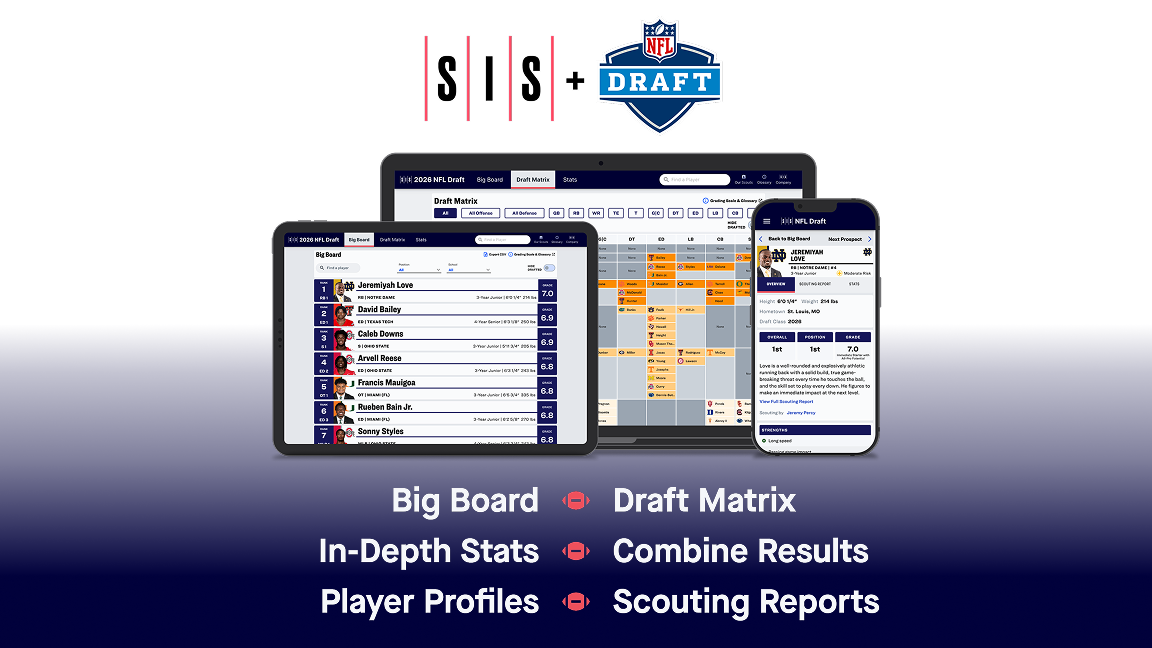
    If you want our full thoughts on the players your team has added plus any UDFA, you can check out our Big Board for tons of great information. And if you’d like to contribute to next year’s draft cycle, consider applying to our Football Data Scout position.

    Welcome to our annual NFL Draft Report Card, in which we grade both the teams and ourselves on how well they fared in this NFL Draft.

    Using our grades, we attempted to rank each team’s draft class. Just like in our article from last season, we assigned all players who were drafted but not on the site a 5.4, which is the equivalent to a training camp body. We took those grades for each player and divided that by the number of selections the team had.

    These rankings do not account for positional value, the value of where players were drafted, or trades teams made; it is literally based on the grades we gave the players who were drafted and how much talent we feel teams got from their selections compared to the number of picks they made.

    And with that, the 2025 Best Draft Class, with an average grade of 6.50, goes to the Cleveland Browns. Much of the talk will be getting Shedeur Sanders in the 5th Round, but they grabbed our No. 2 overall prospect, Mason Graham, at pick No. 5 as well.

    The Browns draft class is in the table below.

    Cleveland Browns 2025 Draft Class
    Pick Position Player College Grade
    5 DT Mason Graham Michigan 6.9
    33 WLB Carson Schwesinger UCLA 6.6
    36 RB Quinshon Judkins Ohio State 6.6
    67 TE Harold Fannin Jr. Bowling Green 6.6
    94 QB Dillon Gabriel Oregon 5.9
    126 RB Dylan Sampson Tennessee 6.2
    144 QB Shedeur Sanders Colorado 6.7

    The Browns take our top spot after having our 2nd-worst spot in 2024. They made a shocking trade early in the draft by trading away the chance to take Travis Hunter and moving back three spots with the Jaguars. However, they did still get the chance to take the No. 2 overall player on our board in DT Mason Graham.

    Due to the trade with Jacksonville, Cleveland ended up with 2 of the first 4 picks in Round 2. The Browns used the first one on Carson Schwesinger out of UCLA. The linebacker class was thin overall. Schwesinger was our No. 2 WLB behind Jihaad Campbell.

    Cleveland doubled up at two separate positions during the draft, and running back was one of them. With their second Round 2 selection, they took Quinshon Judkins out of Ohio State, 1 of 2 in-state players they drafted. We had Judkins ranked No. 4 among RBs, just behind his Ohio State teammate, who was still on the board. Then, in the 4th round, they selected Dylan Sampson (SIS No. 13 RB) out of Tennessee.

    Arguably the most notable thing to come out of the entire draft was the fact the Browns selected two quarterbacks, and not only that, but who they were and the order they took them in. Late in Round 3, they opted to take Dillon Gabriel from Oregon, who was the 5th QB taken to that point, but the No. 10 QB on our board. Then, they traded up in the 5th round to finally end Shedeur Sanders’ fall. Both Gabriel and Sanders create a very crowded and competitive QB room, as they join Joe Flacco, Kenny Pickett, and Deshaun Watson.

    Not to be forgotten is Harold Fannin Jr. (SIS No. 3 TE, No. 44 Overall), who they selected early in Round 3. Another in-state player from Bowling Green, Fannin crushed numerous TE records in 2024 and should look to compete for snaps in the passing game from day 1.

    SIS Top Draft Classes
    Year Team Previous Season Following Season 2nd Season
    2019 Tennessee Titans 9-7 (No Playoffs) 9-7 (L, AFC Champ) 11-5 (L, Wild Card)
    2020 Cleveland Browns 6-10 (No Playoffs) 11-5 (L, Divisional) 8-9
    2021 Detroit Lions 5-11 (No Playoffs) 3-13-1 9-8
    2022 New York Jets 4-13 (No Playoffs) 7-10 7-10
    2023 Carolina Panthers 7-10 (No Playoffs) 2-15 5-12
    2024 Chicago Bears 7-10 (No Playoffs) 5-12 ?
    2025 Cleveland Browns 3-14 (No Playoffs) ? ?

    Since we grade players based on what they will be at the beginning of Year 2, let’s widen the table of our recent Draft Class winners. 

    After winning as top class in 2019, the Titans made consecutive playoff appearances. While the Browns made the playoffs the next year, the turmoil in that locker room in 2021 forced a fall to 8-9. The Lions did take a dip in 2021 in the first year of a new regime, but they took a huge step forward in 2022, nearly making the playoffs, and then making consecutive playoff appearances the past two seasons. 

    As for the Jets, they improved their record in 2022 and had both the Offensive (Garrett Wilson) and Defensive (Sauce Gardner) Rookies of the Year, but expectations fell in 2023 when Aaron Rodgers went down in Week 1. The Panthers were tough to watch in 2023, but he showed a lot of confidence and a big turnaround in the back half of 2024. The Bears and Caleb Williams went through some growing pains during his rookie season, but they’ve revamped the roster under new head coach Ben Johnson to be able to compete with the rest of the NFC North.

    What does that mean for the Browns this time around? This is the second time they’ve made our top spot immediately after the draft. The last time, they made the playoffs the next season. They now have five QBs competing for the starting job. They’ve revamped the RB room with Nick Chubb’s recent injury history. And, they added Graham and Schwesinger to a defense that already has Myles Garrett, and his new contract, and Denzel Ward. The AFC North is a tough division, and whether or not they are banking on one of these QBs to be their franchise guy or wait for next year’s class, they are building a solid foundation.

    Now, let’s check out how the rest of the teams fared in our rankings. Here are the draft classes ranked in order of their grade:

    2025 Final Rankings
    Rank Team # of Picks Draft Grade
    1 Browns 7 6.50
    2 Falcons 5 6.44
    3 Bengals 6 6.42
    4 Giants 7 6.34
    5 Chiefs 7 6.33
    6 Titans 9 6.30
    7 Cardinals 7 6.29
    8 Jets 7 6.27
    9 Panthers 8 6.26
    10 Saints 9 6.24
    11 Jaguars 9 6.23
    12 Cowboys 9 6.23
    13 Bears 8 6.23
    14 Buccaneers 6 6.22
    15 Bills 9 6.17
    16 Eagles 10 6.16
    17 Dolphins 8 6.15
    18 Steelers 7 6.14
    19 Lions 7 6.14
    20 Texans 9 6.12
    21 Commanders 5 6.12
    22 Seahawks 11 6.12
    23 Raiders 11 6.11
    24 Colts 8 6.09
    25 Vikings 5 6.08
    26 Packers 8 6.08
    27 Ravens 11 6.07
    28 Chargers 9 6.06
    29 Rams 6 6.05
    30 Patriots 11 6.02
    31 Broncos 7 6.01
    32 49ers 11 6.00

    The Falcons were aggressive to address their edge group, drafting Jalon Walker (SIS No. 2 ED, No. 9 Overall) and then trading back into the 1st round for James Pearce Jr. (SIS No. 7 ED, No. 29 Overall), en route to our No. 2 class. The Bengals, Giants, and Chiefs rounded out the top 5. New York took Abdul Carter (SIS No. 1 ED, No. 4 Overall) at pick No. 3 and then traded back into Round 1 for their potential franchise quarterback in Jaxson Dart, then took three straight players with a 6.5 grade. Additionally, the Titans got Cam Ward No. 1 overall on their way to our No. 6 class.

    The bottom three teams for 2025, listed 30 to 32, were the Patriots, Broncos, and 49ers

    Philadelphia had our No. 30 class last year and won the Super Bowl. Much like the Eagles last year where they crushed their first two picks (Quinyon Mitchel and Cooper DeJean), the Patriots took LSU’s Will Campbell (SIS No. 1 OT, No. 5 Overall) and Ohio State’s TreVeyon Henderson (SIS No. 3 RB, No. 33 Overall) with their first two picks. They also drafted Georgia’s Jared Wilson (SIS No. 2 OC), Florida State’s Joshua Farmer (SIS No. 5 DT), and LSU’s Bradyn Swinson (SIS No. 14 ED), who we had graded at 6.4 or 6.5. While Kyle Williams (SIS No. 13 WR) has some upside, we felt he’s a No. 4 receiver and they took him early in Round 3. Their final four selections weren’t included on our site and included two special teamers.

    The top 2 players on our board that the Broncos took were Texas’ Jahdae Barron (SIS No. 3 CB, No. 36 Overall) and Illinois’ Pat Bryant (SIS No. 11 WR). UCF’s RJ Harvey (SIS No. 17 RB) and LSU’s Sai’vion Jones (SIS No. 19 ED) graded out as versatile backups for us. Their other selections included a top backup edge rusher, a punter, and a multi-sport developmental tight end.

    This year’s worst class goes to the 49ers. San Francisco had 11 selections, and while grading out high for us can be difficult with a lot of selections, they still had a chance to do so. Georgia’s Mykel Williams (SIS No. 8 ED, No. 34 Overall) was a solid 1st round selection, despite them having their pick of any EDGE besides Abdul Carter. Texas’ Alfred Collins (SIS No. 4 DT) and Oregon’s Jordan James (SIS No. 7 RB), both with 6.5 grades, should be strong role players. Their other eight selections graded out as 5.9 top backups or worse according to our scouts, including Nick Martin (SIS No. 6 MLB) and Upton Scout (SIS No. 16 CB) who were both selected in Round 3.

    How we did

    We always grade ourselves on how many players were drafted that we had featured on our NFL Draft website. 

    On Site/Drafted Pct
    2025 241-of-257 94%
    2024 241-of-257 94%
    2023 238-of-259 92%
    2022 226-of-262 86%
    2021 218-of-259 84%
    2020 199-of-255 78%
    2019 174-of-254 69%

    When taking out specialists, which we currently don’t write up, there were only 12 players drafted who weren’t on the site and only 5 of which we didn’t formally watch. That’s over 98% of the NFL Draft covered! Plus, many players we had on the site who didn’t get drafted have already signed free agent deals with teams.

    Key Facts

    * With only 16 players drafted this year who weren’t featured on the site, many teams added a lot of talent in this year’s draft. Only four teams drafted more than one player who wasn’t featured on the site: the Patriots (4), Bears (2), Packers (2), and Broncos (2), though New England and Denver selected special teamers, who we don’t feature.

    * All four teams in the NFC South ranked in our top 14 this year, further suggesting that it can be any team’s division this year and moving forward.

    * The Panthers still have the best average SIS Draft Class rank and grade average over our seven seasons doing this. While it certainly hasn’t translated to wins, maybe this class will get them back on track in an open division. The Titans, Lions, Bengals, and Falcons round out the top 5 draft class ranks. 

    The Colts continue to bring up the rear. Their No. 11 ranking in 2023 is the only time they’ve ever ranked better than this year’s No. 24, so it may be a while before they climb up the rankings and the standings.

    * For the first time ever, our entire Top 100 Big Board was selected during the draft. Our top 5 UDFAs were Cobee Bryant (SIS No. 12 CB, No. 101 Overall), Seth McLaughlin (SIS No. 3 OC, No. 103 Overall), Xavier Restrepo (SIS No. 12 WR, No. 105 Overall), Zy Alexander (SIS No. 15 CB, No. 111 Overall), and Logan Brown (SIS No. 11 OT, No. 114 Overall). Restrepo has reportedly signed a UDFA deal with the Titans, pairing him up with his former QB in Cam Ward. The top UDFA on our board the past two seasons (Ivan Pace Jr. in 2023 and Leonard Taylor III in 2024) made our All-Rookie Team, so that could bode well for Bryant this year.

    How the NFL Draft Site Compared to the Draft

    Let’s take a look at how the website stacks up to the NFL’s thinking of where players were selected. 

    On offense, the first player drafted at every position except TE was the No. 1 player on our board. Colston Loveland was the first TE off the board, but was our No. 2 ranked TE.

    On defense, the top player at each position matched the first player drafted for all except MLB. Demetrius Knight Jr. was the first MLB taken, while he was our No. 2 player at the position.

    Wide receiver and offensive tackle were the only two positions in which the top 5 drafted matched our top 5 of the position in some order. Every other position with the exception of NT, ED, MLB, WLB, and CB had only one player off, while those just mentioned each had two.

    Overdrafted?

    Only two players graded below a 6.6 were drafted in Round 1. Jaxson Dart (SIS No. 4 QB, No. 90 Overall) by the Giants at No. 25 and Maxwell Hairston (SIS No. 9 CB, No. 94 Overall) by the Bills at No. 30 were both given a 6.4 grade by our scouts.

    Only two non-Top 100 players were drafted in Round 2: Louisville’s Tyler Shough (SIS No. 5 QB) and the aforementioned RJ Harvey. Shough has a great shot to start in New Orleans and just missed our Top 100 while we feel Harvey is a three-down backup.

    Two players graded at 5.8 were selected by the end of Round 3. Minnesota’s Justin Walley (SIS No. 25 CB) by the Colts and USC’s Jaylin Smith (SIS No. 27) by the Texans. Both were near the top of our 5.8 CBs, but that was a bit rich based on who we had graded higher.

    The first eligible player (non-specialist) taken who we did not give a strong enough grade to reach the threshold we set for the website was Maryland LB Ruben Hyppolite II, drafted by the Bears in the 4th round, No. 132 overall. There were only four other players drafted that we didn’t get a formal look at. Those were Tommy Mellott, Marcus Bryant, Junior Bergen, and Kobee Minor.

    Underdrafted?

    The only 6.7 or better player not drafted in the top three rounds was Shedeur Sanders (SIS No. 2 QB, No. 32 Overall), and he went No. 144 to Cleveland.

    Kyle Kennard (SIS No. 9 ED, No. 43 Overall) was the only 6.6 not drafted by day 3, and he was selected No. 125 by the Chargers.

    All of our 6.5 or better players were drafted by the end of Round 5, so there wasn’t much top-end talent left for picking in the final rounds of the draft this year.

    Conclusion

    Every year the SIS scouting department looks to make improvements, and this year was no different. With the SIS Football Operation growing the way it is and us assisting some other departments for much of the draft process this year, our time scouting was even more limited than normal. However, we got a huge help from some of our Data scouts and Live Data scouts in January and February to knock out many of the final first looks we needed to get on players.

    Our six-man scouting team, consisting of Nathan Cooper, Jordan Edwards, Jeff Dean, Ben Hrkach, Chad Tedder, and Jeremy Percy, with the help of the rest of our full-time football operations staff, put in the hard work to finalize over 625 reports, of which 389 were featured on our NFL Draft site, plus get looks at another 60+ players to see if they were worthy of being written up.

    Having nearly the same amount of players on the site this year compared to last year, seeing the same amount of players drafted who were featured on the site is encouraging. While the number of players we didn’t get looks on grew from 2 to 5, we still consider this year a success. As we noted, our Top-100 evaluations were a big success with 82 of our top 100 drafted in the first 100 picks, a 10-point improvement from our previous best from last year. Plus, it was great to see all of our Top 100 players off the board by the end of Round 5.

    We want to thank the hard work our engineering, R&D, and product teams put in this year to get our own internal draft site back up and running and looking better than ever! We’re excited to continue to grow it each year and make it the best one out there.

    Please continue to check out our NFL Draft website as the offseason continues. If you’d like to be involved in our scouting and charting processes next year, consider applying to our Football Data Scout position. We’re taking applications and interviewing for next year’s class now.

  • Future First Round Pick Trades Are Back In The NFL Draft!

    Future First Round Pick Trades Are Back In The NFL Draft!

    Photo: Brian Lynn/Icon Sportswire

    The first handful of picks in the 2025 NFL Draft were pretty chalky in terms of who was picked in what order, but not in terms of which teams took those picks.

    The Jaguars offered up essentially a 2026 first round pick and a second rounder (with some late-round picks going both directions as well) for the privilege to select Colorado’s Travis Hunter with the second overall pick. 

    A lot had been made about the fact that each team owned its first round pick at the start of the draft, which hadn’t happened in modern NFL history. I know at least one person (me) thought that there had been somewhat of a reckoning with how teams had viewed those picks, because there had been only one draft-pick-for-draft-pick trade involving a future first rounder over the previous three drafts (the Texans moving up for Will Anderson Jr.)

    However, this first round featured both the Hunter deal and a later trade where the Falcons landed edge rusher James Pearce Jr. Atlanta moved up 20 spots to get back into the first round, which cost them next year’s first.

    Why might I have taken the relative lack of such deals as an indication that teams have re-evaluated their stance on trading future first round picks? In part because the math is pretty hard to reconcile.

    At SIS we have a model for draft pick value, which is based on our Total Points player value system. Using that model, we can compare the projected four-year value of each pick to approximate how fair a draft-pick-only trade was.

    Models of draft pick value generally agree that trading up is bad practice. Teams pay a premium over a fair deal to “get their guy”, when there isn’t that much certainty about whether any one player will pan out over another (with similar grades at least). 

    Taking the first round trades over the last handful of drafts, the average trade involving only current picks involved moving up 5 slots and cost 24 Total Points of excess expected production over the next four years. That’s the equivalent of what you’d expect for the 109th pick, an early fourth-rounder. If a team truly had more certainty in the production or fit for a player, then that extra value should exceed that premium they’re paying compared to a fair deal.

    For the purposes of this article, I’m going to ignore the potential imbalance there, the whole “always trade down” thing. Let’s just say that’s the cost of doing business if you want to trade up.

    Those trades are apples-to-apples though. Future picks have an (understandable) implied discount relative to current picks, so the math gets funkier.

    There have been nine trades in the first round involving future picks over the last five drafts. We can’t do the same math as we did for the other trades, because there’s a discount rate that we need to build in, but we don’t know what that is. 

    What we can do, though, is try to infer what the discount rate would need to be to make the deal fair by the standards of trades teams make. 

    One way we might conceive of this (using the data we have available) is to say that a future pick is worth one less year of production than the equivalent pick in the current year. If we compare pick values over four years to those over three years for the same pick, first rounders are worth about 72 percent of their current value a year later.

    But if we use a discounting function like that, the excess value given by teams trading up is much higher than that of current-pick-only trades. Instead of a fourth-rounder, teams would be averaging giving up an early second-rounder in value. And that checks out, considering trading anything close to an additional current first round pick to move up a handful of spots is excessive.

    So what rate are teams actually using (roughly)? If we try to tune the discount rate so that the excess value for future-pick trades matches with what we see with current-pick trades, future picks are discounted to just one-third of their current counterparts. 

    In a world where a front office doesn’t have a ton of confidence that they’ll be around for more than a year or two it does make sense to discount the future a bit, but to assume a loss of more than half the value in the span of a year feels like a bit much.

    To me, teams trading next year’s first round pick should have to answer multiple of these questions in the affirmative:

    – Are you acquiring a known-quantity star player?

    – Are you a great team with a high chance of that pick being in the back end of the round?

    – Are you getting a top 10 pick, and moving up more than 10 picks?

    – Are you getting additional value back that mitigates the cost?

    That last bit I added to account for the Falcons’ trade for Pearce, because by our math this deal actually works out in favor of Atlanta, which is the only one in this sample that can claim such a thing.

    Of course, the market bears what the market bears, and the team moving down has to agree to it. But that’s the sort of calculus I’d want to see teams adopting when mortgaging the future.