Category: NFL Draft

  • NFL Draft AnalySIS: Seattle Seahawks

    NFL Draft AnalySIS: Seattle Seahawks

    Leading up to the NFL Draft, SIS will be publishing team previews for those with Top 10 picks in the draft. Each preview will look at the players who most make sense for that team at that selection based on stats and scouting factors and will include quotes from that player’s scouting report.

    You can find more than 300 scouting reports and much more team analysis at our NFL Draft website.

    The State of the Seahawks:

    While the Seahawks final 2022 record of 9-8 and a first-round playoff exit may seem mediocre, they showed the football world they were a much better team than anyone expected prior to last season. After trading away franchise quarterback Russell Wilson last year, many projected the Seahawks to be a shoo-in for the #1 overall selection in the 2023 Draft. 

    Despite the rumblings of last offseason, the Seahawks made the 12th Man proud by finding success through trusting in the vision of long-time GM and HC tandem of John Schneider and Pete Carroll and a surprising upgrade in QB play in previous journeyman Geno Smith. The Seahawks now find themselves in the top five of this month’s draft and in a better situation than most predicted, but are not without shortcomings (or holes, you pick) that can be addressed with this prime selection at No. 5 overall. 

    # 5 Overall

    Jalen Carter – DT – Georgia 

    There are almost no flaws in Carter’s on-field play and with an increased effort and professionalism combined with his ability to force teams to change gameplans, he can put himself in the NFL DPOY discussion every year.

    Carter is one of the premier talents in this draft class. He would step in and immediately provide support to a Seahawks defensive unit that gave up the third-most rush yards per game in the NFL last season while also providing much coveted pass rush production from the inside.

    Will Anderson Jr. – EDGE – Alabama

    Anderson has impressed from his first game at Alabama to his last as a deadly pass rusher and strong run defender, and he has everything it takes to be a top-end EDGE at the next level.

    Anderson has been anticipated as a high profile draft prospect since he was an 18-year-old true freshman at Alabama and has grown into an elite prospect. If he is available, it will be very tough for Schneider and Co. to pass him up.

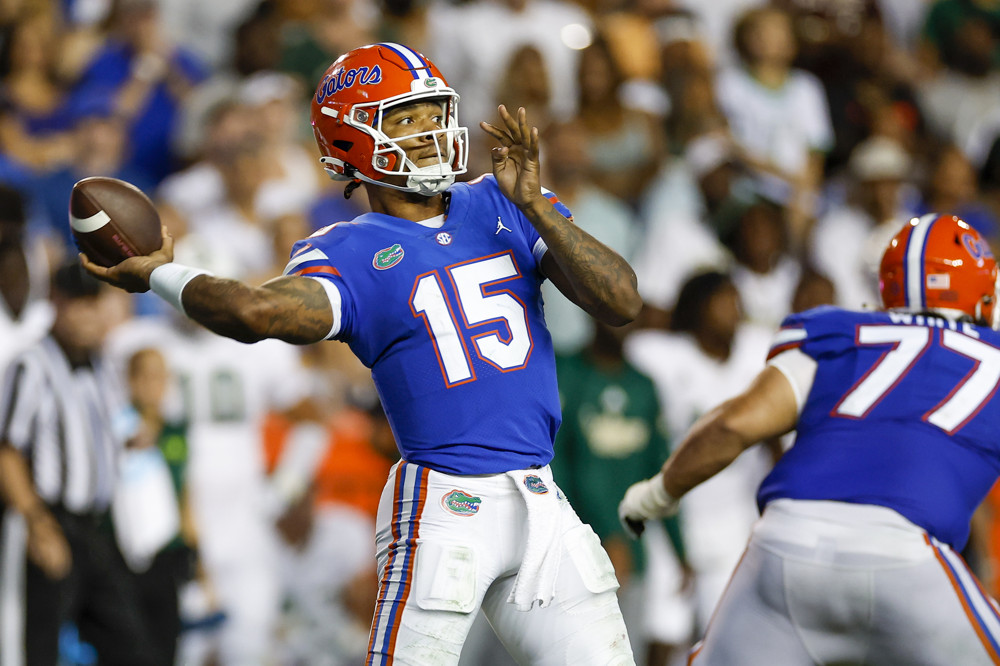
    Anthony Richardson – QB – Florida

    Richardson is the full package talent wise with the dual-threat ability and arm strength coveted at the next level, but he will need to refine his mechanics and simplify his decision-making to be a more consistent player.

    Although the Seahawks found consistent quarterback play last season and extended Geno Smith, the franchise has a potential out after this season. This could provide a perfect time frame to allow the Seahawks to further evaluate Smith while allowing Richardson to grow and develop his otherworldly traits and serve as a contingency plan early in his career. 

    Christian Gonzalez – CB – Oregon

    Gonzalez is a versatile corner with the reactive athleticism, speed, and ball skills to make a huge impact in the NFL, but he may struggle with bigger targets at times.

    Gonzalez is a long and uber-athletic cornerback prospect with a knack for making a play on the ball. He stays in the Pacific Northwest here and joins Tariq Woolen, Coby Bryant, and a top tier safety duo to form a versatile and opportunistic defensive backfield. 

    To learn more about the Seahawks and their needs, visit their team page on our NFL Draft website here.

  • NFL Draft AnalySIS: Detroit Lions

    NFL Draft AnalySIS: Detroit Lions

    Leading up to the NFL Draft, SIS will be publishing team previews for those with Top 10 picks in the draft. Each preview will look at the players who most make sense for that team at that selection based on stats and scouting factors and will include quotes from that player’s scouting report.

    You can find more than 300 scouting reports and much more team analysis at our NFL Draft website.

    The State of the Lions:

    The Detroit Lions have strung together two outstanding Draft classes in the Brad Holmes/Dan Campbell era, and are looking to make it a third in 2023. Although they missed the playoffs last season, they finished with a winning record and won 8 of their last 10 to knock Green Bay out of the playoffs and nearly make it themselves. If they can finish close games, win the games they are supposed to, and continue building the team the right way, look for this team to compete for NFC North titles and make runs in the playoffs in the immediate future.

    #6 Overall

    Devon Witherspoon – CB – Illinois

    Witherspoon has the press-man coverage and ball skills to be a solid starter in any NFL defense, but he will need to improve his open-field tackling and off-man ability to hit his ceiling as a true No. 1, shutdown corner.

    Even with the additions Detroit has made in the secondary this free agent period, and especially now with Jeff Okudah traded away, there’s a good chance they add to it with their first pick. Witherspoon is a physical, press-man corner who should thrive in Detroit’s defensive scheme.

    Christian Gonzalez – CB – Oregon

    Gonzalez is a versatile corner with the reactive athleticism, speed, and ball skills to make a huge impact in the NFL, but he may struggle with bigger targets at times.

    Arguably the best cover corner in this Draft, Gonzalez would fill a huge long-term hole at corner that they haven’t had since Darius Slay. Plus, he’s got the versatility to work inside and outside.

    Jalen Carter – DT – Georgia

    There are almost no flaws in Carter’s on-field play and with an increased effort and professionalism combined with his ability to force teams to change gameplans, he can put himself in the NFL DPOY discussion every year.

    The Lions are revamping their defensive front with hard-nosed football players. If Carter can shore up the off-field issues and play with a more consistent motor, he’s going to be a force to be reckoned with and improve upon Detroit’s last-ranked DT position group in Total Points.

    Will Anderson Jr. – Edge – Alabama

    Anderson has impressed from his first game at Alabama to his last as a deadly pass rusher and strong run defender, and he has everything it takes to be a top-end EDGE at the next level.

    With the talk that Tyree Wilson is rated higher than Anderson on some team’s boards and the possibility that 4 QBs go in the top 4-5 picks, there’s a real chance that Anderson could be here at No. 6 on Draft night. It could be the third straight season that arguably the best player in the Draft falls to the Lions (Penei Sewell in 2021 and Aidan Hutchinson in 2022).

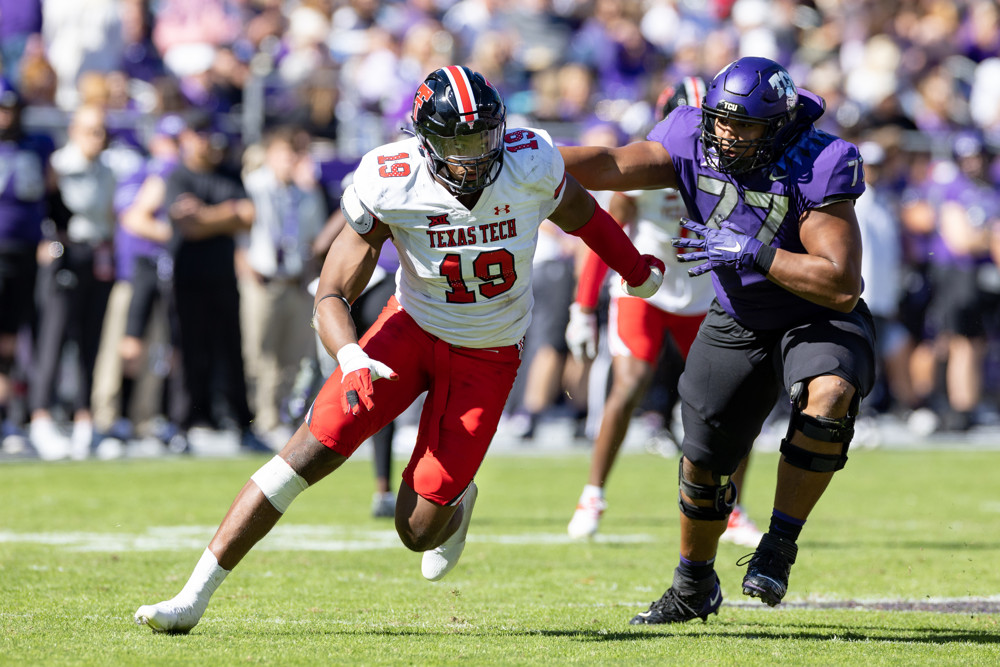
    Tyree Wilson – Edge – Texas Tech

    Wilson is a long, strong power rusher who can rush the quarterback and defend the run, but a lack of speed and agility may be traits that hold him back early in his career.

    Wilson’s versatility allows him to be a moveable piece along the line against both the run and pass and would be a great addition opposite Aidan Hutchinson along Detroit’s defensive front.To learn more about the Lions and their needs, visit their team page on our NFL Draft website here.

  • 2023 NFL Draft AnalySIS: Las Vegas Raiders

    2023 NFL Draft AnalySIS: Las Vegas Raiders

    Leading up to the NFL Draft, SIS will be publishing team previews for those with Top 10 picks in the draft. Each preview will look at the players who most make sense for that team at that selection based on stats and scouting factors and will include quotes from that player’s scouting report.

    You can find more than 300 scouting reports and much more team analysis at our NFL Draft website.

    The State of the Raiders:

    The Raiders and 2nd year head coach Josh McDaniels move into the 2023 season without their long-time QB Derek Carr. They have, for the time being, filled that hole with the signing of Jimmy Garoppolo. However a long term answer at the position is still looming and could be addressed here in the draft. 

    The Raiders are also looking to rebuild defensively in a highly-challenging division with the likes of Patrick Mahomes, Justin Herbert, and Russel Wilson. The free agent signings of Marcus Epps, Robert Spillane, Duke Shelley, and Brandon Facyson will help but they may not be done bolstering their defense with their plethora of 2023 draft picks.

    #7 Overall

    Devon Witherspoon – CB – Illinois

    Witherspoon has the press-man coverage and ball skills to be a solid starter in any NFL defense, but he will need to improve his open-field tackling and off-man ability to hit his ceiling as a true No. 1 shutdown corner.

    The Raiders need plenty of help on the defensive side of the ball and Witherspoon, with his high-end ball skills, can provide immediate help to their secondary. 

    Christian Gonzalez – CB – Oregon

    Gonzalez is a versatile corner with the reactive athleticism, speed, and ball skills to make a huge impact in the NFL, but he may struggle with bigger targets at times.

    Gonzalez’s speed and versatility can be of great value to the Raiders’ secondary and position him to be a Day 1 starter. 

    Tyree Wilson – ED – Texas Tech

    Wilson is a long, strong power rusher who can rush the quarterback and defend the run, but a lack of speed and agility may be traits that hold him back early in his career.

    Wilson’s power and proven production at the college level allows him to be a good complement opposite Maxx Crosby to get after the QB.

    Anthony Richardson – QB – Florida

    Richardson is the full package talent wise with the dual-threat ability and arm strength coveted at the next level, but he will need to refine his mechanics and simplify his decision-making to be a more consistent player.

    If Richardson is still available, the Raiders can take a shot at a very talented QB that can learn and develop in an NFL system. 

    Will Levis – QB – Kentucky

    Levis is a boom-or-bust prospect who has high-end physical traits and upside to be an All-Pro, but he needs massive improvements to his decision making and accuracy in order to achieve his potential.

    Levis has plenty of high-end traits to make him a quality pickup who can grow as a part of the Raiders future plans at QB.

    To learn more about the Raiders and their needs, visit their team page on our NFL Draft website here


  • 2023 NFL Draft AnalySIS: Atlanta Falcons

    2023 NFL Draft AnalySIS: Atlanta Falcons

    Leading up to the NFL Draft, SIS will be publishing team previews for those with Top 10 picks in the draft. Each preview will look at the players who most make sense for that team at that selection based on stats and scouting factors and will include quotes from that player’s scouting report.

    You can find more than 300 scouting reports and much more team analysis at our NFL Draft website.

    The State of the Falcons:

    The Falcons are entering into year three of the Terry Fontenot and Arthur Smith General Manager-Head Coach pairing. Year 3 is often a make it or break it season for an NFL Head Coach, as the average tenure for a NFL coach is 3.2 seasons, according to Guiding Metrics. With the NFC South perceived to be wide open, this could be a window of opportunity for the Falcons to reach the playoffs for the first time since 2017.

    The Falcons have added some valuable weapons to the offensive side of the ball through the draft the last two seasons in Kyle Pitts, Drake London and Tyler Allgeier. Even with the Falcons success on offense, the defensive side of the ball has been less than stellar. They did add some key veterans in safety Jesse Bates, and defensive lineman Calais Campbell and David Onyemata, but could benefit even more by adding some young elite defensive prospects as well. 

    #8 Overall

    The Falcons are entering into year three of the Terry Fontenot and Arthur Smith General Manager-Head Coach pairing. Year three is often a make it or break it season for an NFL Head Coach, as the average tenure for a NFL coach is 3.2 seasons, according to Guiding Metrics. With the NFC South perceived to be wide open, this could be a window of opportunity for the Falcons to reach the playoffs for the first time since 2017.

    The Falcons have added some valuable weapons to the offensive side of the ball through the draft the last two seasons in Kyle Pitts, Drake London and Tyler Allgeier. Even with the Falcons success on offense the defensive side of the ball has been less than stellar to say the least. They did add some key veterans in safety Jesse Bates, and defensive lineman Calais Campbell and David Onyemata, but could benefit even more by adding some young elite defensive prospects as well. 

    #8 Overall

    Jalen Carter – Edge – Georgia

    There are almost no flaws in Carter’s on-field play and with an increased effort and professionalism combined with his ability to force teams to change gameplans, he can put himself in the NFL DPOY discussion every year.

    The off the field concerns have started to lower Carter’s floor to be selected in this draft, and if he makes it down to the 8th pick it would be difficult for Atlanta to pass up. Carter’s combination of explosiveness and power would immediately strengthen the interior of the Falcons defensive front.

    Nolan Smith – Edge – Georgia

    Smith is a supremely athletic prospect with elite speed and explosive ability to go with eye-opening strength held together by good football intelligence and a very disciplined game overall.

    Terry Fontenot and the Falcons value elite athletes in the first round, and there aren’t many more in this class outside of Smith. The Georgia native would bring a different body type and skill set to a subpar edge group. 

    Tyree Wilson – Edge – Texas Tech

    Wilson is a long, strong power rusher who can rush the quarterback and defend the run, but a lack of speed and agility may be traits that hold him back early in his career.

    Wilson has a towering frame with a long wingspan to match. The Falcons recently signed seasoned veteran Calais Campbell who has a similar size and athletic profile to Wilson, and Campbell could serve as a mentor to the young athletic edge rusher. 

    Anthony Richardson – Quarterback – Florida

    Richardson is the full package talent wise with the dual-threat ability and arm strength coveted at the next level, but he will need to refine his mechanics and simplify his decision-making to be a more consistent player.

    This is the offensive wild-card selection of the group the Falcons could target. Continuing the theme of elite athletes, Richardson is one of the most athletic quarterback prospects in draft history. While the Falcons did just draft Desmond Ridder in the 3rd round a season ago, Richardson’s athleticism would be a match made in heaven in Arthur Smith’s offense. 

    To learn more about the Falcons and their needs, visit their team page on our NFL Draft website here. (https://nfldraft.sportsinfosolutions.com/nfl-draft/teams/atlanta-falcons)

  • 2023 NFL Draft AnalySIS: Chicago Bears

    2023 NFL Draft AnalySIS: Chicago Bears

    Leading up to the NFL Draft, SIS will be publishing team previews for those with Top 10 picks in the draft. Each preview will look at the players who most make sense for that team at that selection based on stats and scouting factors and will include quotes from that player’s scouting report.

    You can find more than 300 scouting reports and much more team analysis at our NFL Draft website.

    The State of the Bears:

    The Bears rebuild is in full force, as they finished with their lowest winning percentage since 1969. Since hiring general manager Ryan Poles, the team has been aggressive in acquiring draft capital and surrounding Justin Fields with talent. This led them to deal the first overall pick to the Carolina Panthers for the 9th and 61st pick in 2023 as well as Carolina’s 2024 first, 2025 second, and wide receiver D.J. Moore.

    The Bears are still in the talent acquisition phase of the rebuild with multiple positions they can address. Offensive tackle, defensive tackle, edge, and cornerback are their four biggest areas of concern. Here are a handful of players the Bears could be targeting.

    #9 Overall

    Devon Witherspoon – CB – Illinois

    Witherspoon has the press-man coverage and ball skills to be a solid starter in any NFL defense, but he will need to improve his open-field tackling and off-man ability to hit his ceiling as a true No. 1, shutdown corner.

    Witherspoon would provide an upgrade to a cornerback room that ranked 27th in positional Total Points last season*.

    Total Points is our all-encompassing player value stat, which measures everything a player does on his field.

    Peter Skoronski – OT – Northwestern

    Skoronski may not have the standard measurements for an NFL left tackle, but his athleticism, strength, and technique show a high-floor offensive line prospect who should be a quality starter early in his career.

    The Bears are serious about getting Fields protection and native son Skoronski would cement their offensive line with his ability to play either tackle or guard.

    Paris Johnson Jr. – OT – Ohio State

    Johnson is an incredible athlete for his size with the footwork and recover ability to win his fair share of battles. As long as he gets a little stronger and can improve his anchor, he’ll be a big-time force at LT moving forward.

    Fields could prefer the team drafting his old college teammate, who may be the best pure left tackle prospect in the draft.

    Tyree Wilson – Edge – Texas Tech

    Wilson is a long, strong power rusher who can rush the quarterback and defend the run, but a lack of speed and agility may be traits that hold him back early in his career.

    Wilson can step into a starting role immediately for a Bears edge rushing group, who was the worst in the NFL according to positional Total Points.

    Jalen Carter – DT – Georgia

    There are almost no flaws in Carter’s on-field play and with an increased effort and professionalism combined with his ability to force teams to change gameplans, he can put himself in the NFL DPOY discussion every year.

    If Carter were to slide due to off-the-field concerns, the Bears would have a hard time passing up a talent they were considering taking No. 1 overall due to his game-breaking ability.

    To learn more about the Bears and their needs, visit their team page on our NFL Draft website here.

  • 2023 NFL Draft AnalySIS: Philadelphia Eagles

    2023 NFL Draft AnalySIS: Philadelphia Eagles

    Leading up to the NFL Draft, SIS will be publishing team previews for those with Top 10 picks in the draft. Each preview will look at the players who most make sense for that team at that selection based on stats and scouting factors and will include quotes from that player’s scouting report.

    You can find more than 300 scouting reports and much more team analysis at our NFL Draft website.

    The State of the Eagles:

     From the first night of the 2022 NFL Draft to the last game of the season, the Philadelphia Eagles were arguably the hottest team in the league. The front office took big swings to show their trust in QB Jalen Hurts, and they were rewarded tenfold. Hurts took a leap in his game that allowed the Eagles to introduce a high-scoring, smashmouth style of football that is predicated on his ability to do everything.

    With Hurts now in position to reset the QB market and both coordinators finding head coaching gigs elsewhere, the Eagles will need to hit on their draft picks and fill the roster with both starters and role players on rookie deals.  

    #10 Overall

    Jalen Carter – DT – Georgia

    There are almost no flaws in Carter’s on-field play and with an increased effort and professionalism combined with his ability to force teams to change gameplans, he can put himself in the NFL DPOY discussion every year.

    Though Carter is one of the best prospects in recent memory, off-field questions and a poor showing at his Pro Day may cause him to slide and the Eagles have a track record of valuing IDL, as well as being aggressive when moving up in the draft.

    Peter Skoronski – OL – Northwestern

    Skoronski may not have the standard measurements for an NFL left tackle, but his athleticism, strength, and technique show a high-floor offensive line prospect who should be a quality starter early in his career.

    It is not the sexiest pick, but the Eagles always look for impact OL early in the draft and with Cam Jurgens’ inexperience at guard, along with Landon Dickerson’s penchant for getting dinged up, they may view Skoronski as a 4-position starter at the next level and someone they will need moving forward.

    Jaxon Smith-Njigba – WR – Ohio State

    While Smith-Njigba has only one year of production and recent injury concerns, he is a starting-level receiver who will work best in the slot due to his route savvy, elusiveness, and body control.

    With one of the best WR duos in the league and a QB that runs the RPO game with Bach-esque orchestration, the Eagles would be a dream landing spot for Smith-Njigba, whose innate route savvy and separation skills would be unstoppable as the 3rd option.

    Brian Branch – S – Alabama

    Branch is a starting free safety who should spend most of his time playing in the slot. He has exceptional coverage skills, awareness, and physicality.

    After losing both starters in free agency, Branch is a high-intellect player that brings versatility and should start immediately for new defensive coordinator, Sean Desai, who uses Nick Saban concepts in his playcalling. 

    Bijan Robinson – RB – Texas

    Robinson is a consistent playmaker who has the size, speed, power, and vision to be an every-down back at the NFL level, but he will need some improvement in pass pro to reach his full potential.

    This would be the shock of the draft for anyone familiar with the Eagles and there is a better chance they pass on Robinson at 30 than take him at 10, but he is the best RB prospect since Saquon Barkley. The Eagles came one win (arguably one unlucky turnover) away from a Super Bowl victory, meaning that a high-end talent at a position of need could be the move.

    To learn more about the Eagles and their needs, visit their team page on our NFL Draft website here.

  • Revisiting Our Draft Pick Value Curve

    Revisiting Our Draft Pick Value Curve

    Last year we dipped our toes into the conversation about draft pick value. Stephen Polacheck took two-year Total Points as the measure of performance and computed a curve that represents what you can expect from a selection throughout the draft.

    This year we’ll take that work and extend it to two particular lines of inquiry: the potential value over a full contract, and the value teams are ascribing to future picks.

    Production over a full rookie deal

    Our previous iteration looked only at the Total Points accumulated in a player’s first two years. This is in line with how our scouting process works, as our grades project a player through his second NFL season. But there are enough players who jump up or fall off in the final years of their rookie deals that we wanted to look at a longer time horizon as well.

    Here are the draft curves that we generate after each year in the first four. 

    The biggest thing I notice when looking at these plots is that, in general, the differences between the curves are pretty consistent year-over-year. That basically means that we’re not seeing some kind of dramatic change in production of players in their third season, or something like that.

    We can see a production advantage for early first round picks that persists throughout the player’s first contract. A player taken at the top of the first round essentially doubles the productivity of a player taken at the end of the first round at each step. That suggests top picks are overvalued by the rookie wage scale, which gives top draft picks roughly three times the contract value of a player selected at the end of the first.

    You should notice the little hitch in the curve at around the end of the second round. That’s in part because these curves are actually made by blending a steeper first round curve with a more gradual full-draft curve, which results in a curve that doesn’t have a single smooth trajectory. But it’s also a kind of quirky peak of productivity over the past several years that is hard to fully smooth out. Just picks 62 to 64 from 2016 to 2021 have produced Carlton Davis, Kevin Byard, James Bradberry, Creed Humphrey, JuJu Smith-Schuster, and DK Metcalf.

    Applying the value curve to previous trades

    At this point we’re pretty familiar with the notion that the relatively flat curve of draft pick value past the top of the first round suggests that trading back is generally a pretty valuable proposition. 

    For example, all of the seven pick-for-pick trades in the first round of the 2022 draft yielded more total expected production for the team moving down than the team moving up. How much value that is depends on which of the above curves you use, but the general trend is the same.

    What I’ve found more interesting of late is the trading of future picks. Just in the first round of the 2021 draft, three pick-for-pick trades involved a future first round pick changing hands:

    • The 49ers moving up 9 slots to take Trey Lance
    • The Dolphins moving up 6 slots to take Jaylen Waddle
    • The Bears moving up 9 slots to take Justin Fields

    It’s tough to build a model that prescriptively assigns value to a future draft pick, because teams should place different value on future assets based on their franchise trajectory. But trades that have already been made can tell us something about how much temporal discounting teams are building in.

    Let’s run these three trades through our model, comparing the projected four-year Total Points for the picks going each direction. We can assume that the difference between these values should be roughly the value teams are ascribing to the future picks included in those deals. 

    Projected Four-Year Total Points of Picks Traded in 2021

    2021 pick value  given up 2021 pick value received Suggested Value

    Rest of Trade

    49ers -> Lance 88 119 31*
    Dolphins -> Waddle 107 119 12
    Bears -> Fields 83 101 19*

    * Multiple future picks were traded

    For a little bit of context, that “rest of trade” value can be compared to the value of a single pick in the current draft. The 31 projected Total Points that make up the remainder in the Lance deal—and therefore roughly what we think the future picks are worth—is comparable to the 87th pick in the current draft. The future picks in the Waddle deal compare to the 153rd pick in the current draft, and for Fields it’s the 121st pick.

    So, if those trades were to be fair—which we actually shouldn’t expect them to be, because the team trading up is almost always going to pay a bit of a premium—the future picks would be valued at somewhere between a third rounder and a fifth rounder in total. Compared to a conventional-wisdom heuristic that a pick next year is worth one round less than a pick this year, we’re seeing some pretty heavy devaluing of future first round picks. 

    We can also think of this through the lens of the implied discounting rate for a pick year-over-year. The Waddle example suggests that a future first round pick—which we can assume is the 16th pick in the next draft, for simplicity—is getting discounted by about 85% within one year (from 79 projected Total Points to 12). The Fields deal has a similar implied discounting rate.

    Virtually all people employed by NFL teams are living in a world where you can’t guarantee your employment for very long, so it’s not unreasonable for teams to heavily devalue future draft picks. After all, even a draft pick this year might not bear fruit for two more seasons. But if teams are so willing to make trades to move up a few spots in the first round, it seems odd that they would value creating a first round pick from nothing, even if it’s deferred a year, would be more valuable than it seems to be.

    Future Directions

    With each year that we accumulate data, we also gather more firepower to build frameworks to evaluate the long-term value of players (and draft picks). Integrating draft pick value with long-term player projections will allow player-for-pick trades to be analyzed more usefully, and of course bringing in salary information (for player trades and for incoming rookies) informs teams’ decisions greatly.

    Look for us to reference these draft pick values in evaluating trades during the upcoming draft season. Of course, keep in mind that these models are still a work in progress when it comes to measuring some of the “softer” factors that contribute to trade decisions. We still have some work to do to measure how much we should expect a team to overpay for the right to move up, and how much scarcity of available players at the position being acquired moves the needle.

  • The Top Ranked NFL Draft Prospect At Every Position

    The Top Ranked NFL Draft Prospect At Every Position

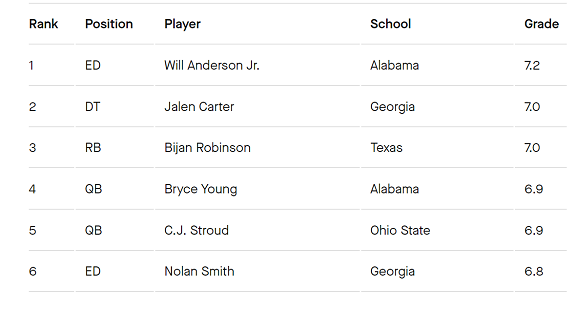
    Each year, the SIS scouting staff puts their money where their mouth is and grades hundreds of the top players in the NFL Draft player pool. The SIS NFL Draft site combines those reports with advanced metrics to provide as complete a picture of each prospect as you can find.

    To celebrate the launch of the 2023 version of the site, let’s run through the staff’s top prospects at each position.

    (Of course, if you want, you can just look at the full big board, which still has more players coming in!)

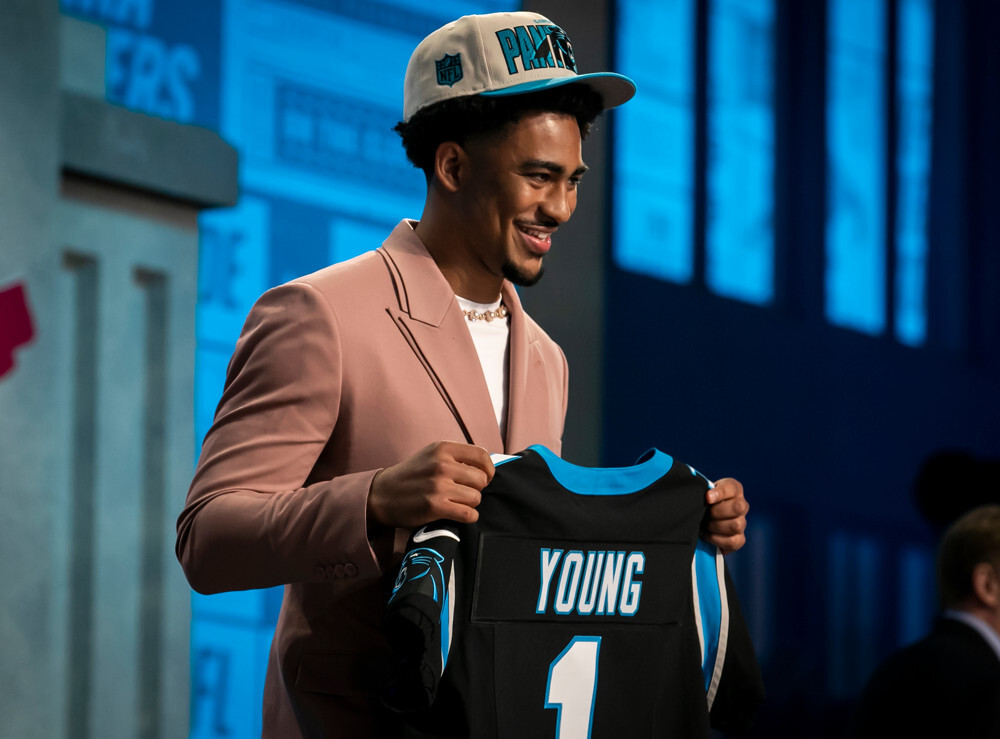
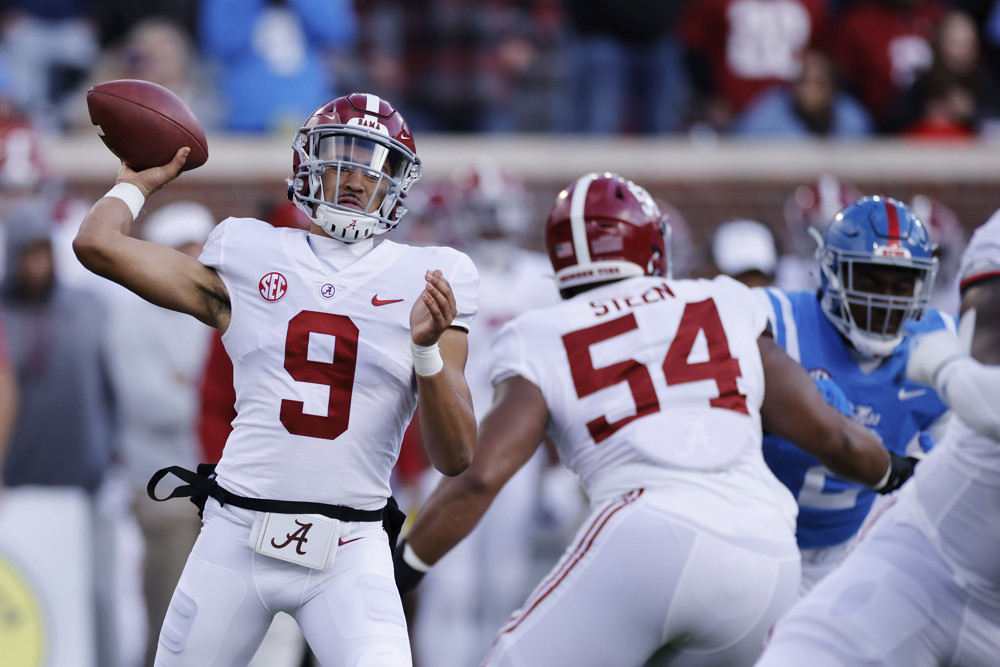
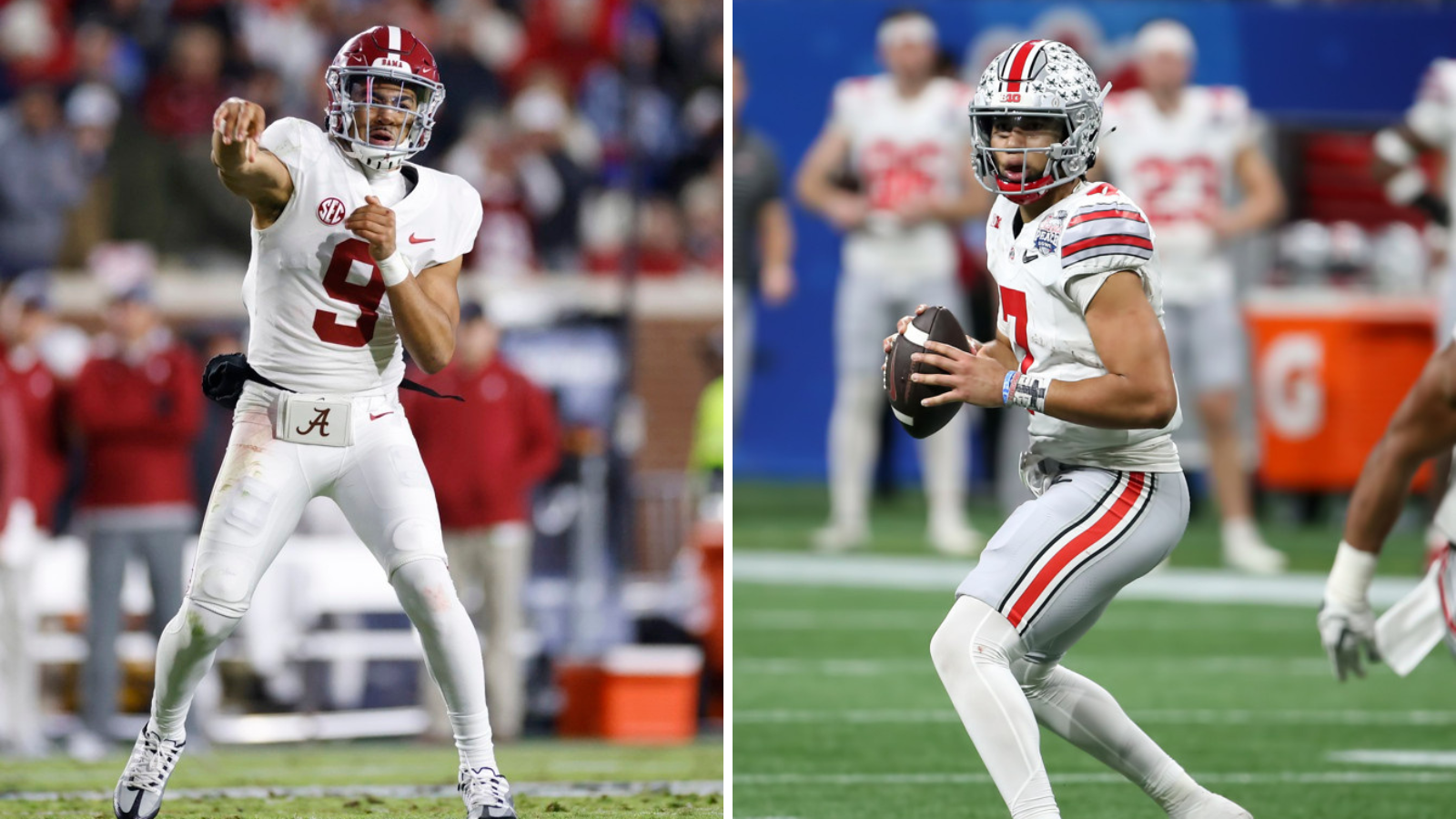
    Quarterback: Bryce Young

    School: Alabama

    Grade: 6.9 (Solid starter)

    The SIS staff has Young and C.J. Stroud graded the same, but while Young’s body composition is the weakest trait between them, he only had three traits graded as sufficient or worse compared to Stroud’s five. Young’s poise, decision making, and pocket awareness and creativity are his biggest strengths.

    From Jordan Edwards’ report:

    “Young has a smooth and lightning-quick release while also showing the comfort and effectiveness to throw from different arm angles. He is consistently accurate especially in the short and intermediate areas of the field. While his deep ball accuracy is still good overall, he can miss his targets under pressure or when he can’t set his base. He has the arm strength to make most throws downfield and can put enough velocity on throws into tight windows.”

    On the statistical side, our measures of his arm strength and his ability to get the ball out show some flaws, but all other measures of production and accuracy compare very favorably to the rest of the class. His Total Points and Independent Quarterback Rating put him at the top of the group.

    For more stats on the rest of the quarterback class, check out the positional leaderboards.

    Running Back: Bijan Robinson

    School: Texas

    Grade: 7.0 (High-end 3-down starter)

    Robinson is the consensus top back in the draft, with an unimpeachable statistical record. He easily led draft-eligible running backs in Total Points per game, and did so while running into a heavy box twice as often as he did in previous years.

    Chad Tedder highlighted his vision in his scouting report:

    “Off the handoff, he does a good job at scanning the line and seeing where openings are going to be. He watches the movements of second-level defenders and can often set them up flowing one way before using his lateral agility to cut back behind them. If the space is not opening, he has the patience and trust of his line to allow for enough space to open for him to accelerate through.”

    He’s an asset in the passing game as a receiver, but his worst trait grade came as a pass blocker, where his vision and anticipation in the run game doesn’t quite translate as well.

    For more stats on the rest of the running back class, check out the positional leaderboards.

    Wide Receiver: Jaxon Smith-Njigba

    School: Ohio State

    Grade: 6.8 (Solid 3-down starter)

    C.J. Stroud didn’t rank as our top quarterback, but one of his receivers does top that positional group. Smith-Njigba didn’t play much in 2022, but his 2021 season would have put him at the top of the position in terms of Total Points on a total and per-play basis.

    He’s not an explosive athlete with big top speed, but he’s smooth and fluid with a good understanding of how to run routes running mostly from the slot.

    From Ryan Rubinstein:

    “In the passing game, Smith-Njigba excels in the slot. He consistently shows burst off the line and can beat press coverage with a studder step or by swiping the defender’s hands away. He mainly finds separation with quickness and route running, stemming to open holes in zone coverage or by manipulating defenders at the top of his route. Occasionally, he tends to get thrown off by contact at his stem but shows the ability to use his off hand to get separation and to recover back into his route.”

    For more stats on the rest of the wide receiver class, check out the positional leaderboards.

    Tight End: Michael Mayer

    School: Notre Dame

    Grade: 6.8 (Solid starter with Y & H ability)

    Mayer isn’t head and shoulders above other tight end prospects from a scouting grade perspective, but from a statistical perspective he dominated in his last year at Notre Dame. He ranked as the top tight end in 15 out of 22 tight end leaderboards.

    The scouting report from Jeremy Percy and Seamus Rooney highlights his hands and his solid blocking fundamentals.

    “Mayer has very good hands overall. He has great manual dexterity and is extremely smooth when using his hands independently from his body. He is also adept at extending fully and catching the ball away from his body, regardless of where the pass is.”

    “He showcases very good blocking fundamentals, plays under control, and makes getting in the way of his man his top priority while rarely lunging or whiffing.”

    Offensive Line: Peter Skoronski (OT)

    School: Northwestern

    Grade: 6.8 (Solid starter with positional flexibility)

    Skoronski ties with center John Michael Schmitz as the top graded offensive linemen, but the former takes the top spot in the rankings. 

    He excels in generating power from awkward positions. To hear Jeff Dean say it:

    “Power rushers have their work cut out for them, as he has a very good anchor and uses leverage to take away the opponent’s leg drive on these rushes. Even when dropped to one knee, he generates power to keep the rusher at bay and reestablishes himself in proper position.”

    On the statistical side, the team context around him makes him look a bit worse than he should, but even the stats that separate him from his context—like blown block rate—don’t show him as an elite producer.

    For more stats on the rest of the offensive line class, check out the positional leaderboards.

    Interior Defensive Line: Jalen Carter

    School: Georgia

    Grade: 7.0 (High-end 3-down starter)

    Carter’s generally viewed as a better prospect than his former teammates who were first round picks a year ago, but one who also has some red flags in terms of his off-field behavior.

    Ben Hrkach’s scouting report alludes to Defensive Player of the Year upside, but with some inconsistency as well. His elite disruption in the running game is communicated most strongly:

    “In terms of stopping the run, Carter has a collection of traits that are rarely found outside of a video game. With ideal size and bulk, Carter blends excellent base and upper-body strength with malleable power that allows him to work from awkward angles and reestablish the [line of scrimmage] while moving laterally.”

    Inconsistency often leads to less inspiring on-field metrics, and Carter is a victim of that to some extent. He shows elite run defense production—tackling ballcarriers much further upfield than typical—but the pass rush numbers are less stellar, even considering that he’s lining up inside.

    For more stats on the rest of the interior defensive line class, check out the positional leaderboards.

    Edge Rusher: Will Anderson Jr.

    School: Alabama

    Grade: 7.2 (High-end 3-down starter)

    The highest-graded player on the SIS board, Anderson burst onto the scene in 2021 with 4 more sacks and 13 more pressures than Aidan Hutchinson in his best season. His production slipped to merely quite-good in 2022, but the traits are still there to be a top performer.

    His best trait is his strength, which gives him some margin for error in terms of pass rush technique. Jeff Dean noted that he still has room for improvement in his repertoire of rush moves.

    “Due to his physical gifts, his pass rushing moves are still a work in progress. Outside of his impressive bull rush, the cupboard is a little lacking. He will flash promising swipe, spin, and push-pull moves, but they are not second nature at this point. Developing more effective counter moves will also be key to his growth, as he can seem a little lost when his initial attack fails. He appears content to stalemate the opponent or take more of a containing role if thwarted.”

    Dean also notes that Anderson has a high floor because of his skill setting the edge in the running game (although he could use improvement as a tackler).

    For more stats on the rest of the edge rusher class, check out the positional leaderboards.

    Off-ball Linebacker: Trenton Simpson (WLB)

    School: Clemson

    Grade: 6.6 (Lower-end starter)

    Simpson is one of four off-ball linebackers to be given the top grade at the position, with athleticism and versatility that make him particularly appealing.

    He might struggle to make an impact in the running game initially despite his size, but his flexibility as a coverage defender (particularly in zone) and a pass rusher on third down could have evaluators squinting and seeing visions of Micah Parsons.

    Jordan Edwards put his coverage ability this way:

    “He can close and gain ground quickly as a zone coverage defender to limit yards after the catch. He is a sure tackler and makes his presence felt on contact, using his length and physicality to bring ballcarriers down. His speed and ability to close quickly also allow him to play in the slot where he can cover and also blitz from depth.”

    Simpson’s limitations in the run game come through in his statistical performance as well. He had the worst Adjusted Tackle Depth Plus among off-ball linebackers on the SIS draft board, meaning he was tackling ballcarriers a good bit further downfield than typical.

    For more stats on the rest of the linebacker class, check out the positional leaderboards.

    Cornerback: Devon Witherspoon

    School: Illinois

    Grade: 6.8 (Solid 3-down starter)

    Witherspoon isn’t the same kind of press-man prospect that Sauce Gardner was coming out last year, but his experience playing primarily man coverage at the college level gives him intriguing upside.

    Here’s how Ben McClure described his ability playing up on the line in man coverage:

    “He has very good mirror/match technique in press coverage and rarely finds himself out of phase when pressing. He has the ability to run with receivers on crossing routes in press, and also be physical with the opponent off the line and stay tight to vertical routes.”

    Statistically, Witherspoon’s flexibility and dominance stand out. He allowed an insane 3.9 Passer Rating in 2022, and was among the best cornerbacks in the class in yards allowed per coverage snap in both man and zone coverage. And despite playing from the slot just a quarter of the time, he tied for the lead in Total Points per game from the slot.

    For more stats on the rest of the cornerback class, check out the positional leaderboards.

    Safety: Brian Branch

    School: Alabama

    Grade: 6.8 (Solid 3-down starter)

    Branch is a particular kind of safety prospect, as he played from the slot more than two-thirds of the time at Alabama. He shows natural ability as a coverage player, with his best trait grade being his football intelligence and instincts.

    From Ryan Rubinstein:

    “He displays good footwork at the top of routes and has very good reactive athleticism when flipping his hips, He shows the ability to consistently stick with his man in either press or off-man technique and shows very good mirror/match ability. He puts himself in positions to consistently contest catches and often is able to make plays on the ball to swat it away or try and go up for an interception.”

    In the run and pass game he plays with physicality. That shows particularly strongly in his run tackling numbers, which show he makes a lot of plays upfield and doesn’t miss many tackles.

    For more stats on the rest of the safety class, check out the positional leaderboards.

  • The 2023 QB Conversation: How Teammate and Schematic Context Impacts It

    The 2023 QB Conversation: How Teammate and Schematic Context Impacts It

    Every year, another group of interesting quarterbacks. Every year, another conundrum about how to project them effectively, given how complex the position is and how different the context around them will be in the NFL.

    C.J. Stroud is a great example of the context part of this. He’s thrown to the likes of Chris Olave, Garrett Wilson, Marvin Harrison Jr. and Jaxon Smith-Njigba over the last two years. It’s not surprising that Stroud has put up big numbers.

    So with this group of four top prospects—Stroud of Ohio State, Bryce Young of Alabama, Anthony Richardson of Florida, and Will Levis of Kentucky—I want to try to identify some of the bits of context that might be relevant to their evaluation. 

    Establishing a Starting Point

    It’s probably good to just start with a standard measure of total production to align on how to compare these players. Ignoring any kinds of situational factors, we can take EPA as a good measure of overall production, and then we’ll get to trying to split out the individual contributions in a second.

    QB Passing EPA Ranks, 2022 

    (out of 98 QBs with 250 attempts)

    Pass EPA Rank
    C.J. Stroud

    4

    Bryce Young

    6

    Anthony Richardson

    52

    Will Levis

    55

    That makes for some pretty obvious tiers as passers. 

    Richardson has the extra dimension with elite running ability, and obviously that’s not included here. This is just to show that Stroud and Young stand on their own from a passing production standpoint (which is, naturally, the most relevant kind of production for a QB).

    It’s difficult to advocate for Will Levis from a production perspective. His candidacy for a top pick relies on things a data analyst is ill-equipped to evaluate. So keep that in mind as we compare him to the rest of the crew.

    Now, let’s get onto trying to evaluate the offenses these players generated this production from.

    Teammates

    Let’s start with the interlocking parts of the players around each of these players. The Total Points system endeavors to disentangle the performance of each player, so let’s use that.

    Here are the team ranks in Total Points per play by the pass catchers and pass blockers around each of these prospects in 2022.

    Team Total Points per Play FBS Ranks

    Receiving Pass Blocking
    Ohio State (Stroud)

    2nd

    54th

    Alabama (Young)

    11th

    76th

    Florida (Richardson)

    26th

    18th

    Kentucky (Levis)

    16th

    16th

    Richardson’s receiving corps was definitely the most limited among this group. Their on-target catch rate was below average, which wasn’t true of the other three schools. It’s the same with contested-catch situations: Florida receivers came down with just 25% of such throws, compared to an FBS average of 32%.

    None of these players had poor offensive lines that might tilt our evaluations, but Levis and Richardson did benefit from pretty stout pass blocking overall. That’s something to keep in mind when looking at their pressure rates, which are both higher than average. That suggests they’re inviting pressure to an extent that could prove troublesome at the next level. 

    Easy Completions

    Another big talking point is how often quarterbacks are given really easy throws that can inflate their numbers. The screen game is one example of this, but so is throwing to a lot of open windows. In theory we want players who don’t rely too much on these plays.

    While only Levis was given specifically more screens than average, all of these prospects had their fair share of easy throws in 2022. Only Stroud ended up with fewer total easy throws than the FBS average.

    Top Prospects’ Easy Pass Rates, 2022

    Screen% Wide Open % (Non-Screen) Total
    C.J. Stroud

    10%

    14% 24%
    Bryce Young

    11%

    19%

    30%

    Anthony Richardson

    9%

    21%

    30%

    Will Levis

    16%

    13% 29%
    FBS Average

    13%

    14%

    27%

    On these easy throws, Richardson’s accuracy numbers are the worst of the group.  That could be seen as a large problem with his mechanics, or as low-hanging fruit to achieve quick improvement.

    If we’re trying to choose the “winner” of this comparison, we might give Stroud the advantage for having fewer “gimmes”. 

    Simplifying Reads

    Scheme can help by creating open throwing lanes, but it can also streamline the decisions the quarterback has to make. We know the hallmarks: play action, RPOs, and designed rollouts. Deceive the defense, split the field up, sharpen your focus to a limited number of players on both sides of the ball.

    Team Offense Play Type Percentages and Ranks, 2022

    Play Action % RPO % Designed Rollout %
    Ohio State (Stroud) 19% (39) 14% (95) 11% (17)
    Alabama (Young) 18% (57) 32% (14) 3% (112)
    Florida (Richardson) 31% (1) 29% (22) 12% (16)
    Kentucky (Levis) 17% (65) 10% (113) 7% (58)

    Richardson stands out here, but in a way that is probably somewhat consistent with how he’d be used at the NFL level. (Well, maybe not quite so many RPOs, since both he and Young used them at a rate higher than any NFL team.) It makes sense to get him on the move on designed rollouts to leverage his athleticism outside the pocket, but he was productive as a passer in those situations, too.

    Stroud has benefited from the simpler reads that come from designed rollouts, ranking in the top 10 in Independent Quarterback Rating each of the last two years on those plays. He’s not the same athlete as Richardson, so the threat to the defense isn’t the same, but it’s something that the team that drafts him probably would like to integrate.

    If we take out all these scheme elements and just try to isolate “straight up” pass plays, we’re sort of squinting to see what the player can do without some of the bumpers (to use a bowling reference). And when we do that, we get a result that looks a lot like the initial findings we had up top: Young and Stroud >>>.

    QB Ranks without Play Action, RPO, or Rollouts, 2022 

    (out of 101 QBs with 150 attempts)

    Total Points / Play IQR
    C.J. Stroud 2 7
    Bryce Young 1 2
    Anthony Richardson 38 87
    Will Levis 66 59

    Looking as far back as 2018, Young and Stroud each have two seasons in the top ten in the Total Points per play split (over 400 player seasons qualify). They’re joined exclusively by first round picks at the top: Kyler Murray, Justin Fields, and Mac Jones have the three best seasons. 

    Young coming at the top here is particularly compelling because of how RPO-dependent the Alabama offense is. Even if we remove those elements—which we know to be utilized less at the next level—he shows outstanding performance worthy of a top selection. 

    It’s an interesting contrast with Stroud, whose production is hard to claim is superior, but who arguably did so with fewer schematic supports to lean on.

  • Study: Combine Measurements and Total Points – Do they Correlate?

    Study: Combine Measurements and Total Points – Do they Correlate?

    After a week of workouts, drills, and interviews, combine week has come to an end and NFL teams are now deep in draft evaluation. Some players have had record-setting performances, while others might have more work to do at their Pro Day to shoot their name up big boards. The data is now there for everyone to analyze, but the question is: 

    What do these combine numbers actually mean?

    There has been a lot of discussion over the past few years as to whether or not combine results translate to a better performance on the field. Does the height, weight, arm length, hand size, 40-yard dash time, number of 225-lb. bench presses, vertical jump measurement, broad jump measurement, 20-yard shuttle run time, or 3-cone drill time of a player truly predict immediate future performance for a 1st- or 2nd-year player in the NFL?

    There have been studies done in the past (here and here) in finding correlations from combine  measurements to draft order, salary, and player performance. In regards to the latter, player performance was measured in total yards, yards in rates, and quarterback rating.

    At SIS, we can use our Total Points metric as the proxy to player performance to find correlations to combine measurements. For the purpose of this article, combine data from players who participated between 2016-2020 was collected and compared to the respective player’s first two-year Total Points sum. Correlations were computed between both Total Points and categorical Total Points (ex. Passing Total Points) based on positions to find any signal for a specific skill. 

    Without any further ado, let’s dive into the numbers…

    Quarterbacks

    When it comes to quarterbacks, it is not a big surprise that Total Points and Passing Total Points are very similar. The main skill the quarterback has to perform is throwing the football, so seeing that these two align for most measurements make sense. 

    Three measurements that stand out from the rest in terms of correlating to Total Points. The broad jump takes the cake as the highest correlated at 0.39 (0.35 Pasing Total Points), followed by the three cone drill at 0.33 (faster times lead to more Total Points) and the 40-yard dash at 0.23.

    Contradicting some of the discourse about quarterback hand-size, this measurement has a 0 correlation to Passer Points. Turns out Kenny Pickett might have a chance after all!

    Running Backs

    When looking strictly at Rushing Total Points, there are three measurements that clear the 0.2 correlation threshold. Weight, vertical jump, and broad jump measurements correlate the most to Rushing Total Points. 

    This suggests that explosiveness and leg strength translate well to the next level and can be a potential indicator of running back performance. Across the board, being bigger and faster correlates with success.

    When it comes to Receiving Total Points, the 40-yard dash and the broad jump correlate the most by far. This suggests that the ‘explosive pass-catcher out of the backfield’ moniker truly does exist.

    Looking at Pass Block Total Points for running backs, the three cone drill and vertical jump seem to predict some success at the next level.

    Wide Receiver

    The vertical jump and bench reps stand out as the two highest correlated measurements to Receiving Total Points. Even though the average Run Blocking Total Points value among receivers is small, height, weight, arm length, and the shuttle run correlate the most out of these measurements when projecting success.

    No measurements for Receiving Total Points reach the 0.2 threshold. One point to note is that pass blocking correlations in height and weight for receivers are much higher than those for the running backs.

    Offensive Linemen

    Pass Blocking and Run Blocking Total Points correlations for offensive linemen are similar for each measurement, with the 40-yard dash, arm length, and height having some difference between the two. Surprisingly, height and arm length seem to correlate more with run blocking than pass blocking.

    Overall, the 40-yard dash, three cone drill, vertical jump, and broad jump are the highest correlations when it comes to offensive line play. Bench reps have a low correlation, once again showing that leg strength and explosiveness predict higher success.

    Tight Ends

    For tight ends, the 40-yard dash and the broad jump have high correlations to Total Points, as they both nearly reach the 0.4 correlation threshold. The vertical jump does not fall that far behind either.

    The difference in broad jump, shuttle times, and three cone times between tight ends and receivers in Receiving Total Points is interesting. The get-off speed for a tight end might result in higher Total Points, which can be measured in explosiveness from the legs.

    Defensive Linemen

    Moving along to defense, we start with the defensive line. All of the speed measurements, height, weight, vertical jump, and broad jump correlate well to Pass Rush Total Points. This is very different when compared to Run Defense Total Points, as the higher the weight and more bench reps, the higher the Total Points value.

    All in all, an athletic freak on the defensive line when getting to the passer seems to be a good thing to have. On run defense, a strongly built defensive linemen is the key for success. The contrast between these two skill sets in one position group is the biggest from this analysis. 

    Linebackers

    Once again, for the linebacker position, athletic freaks tend to have the most success. All but 3 measurements reach the 0.2 correlation threshold for Pass Rush Total Points. After being significant for defensive linemen, the shuttle run and three cone times correlate to 0 and below, respectively, for linebackers. From a run defense perspective, the vertical jump and 40-yard dash times show the strongest correlations. Finally, both the 40-yard dash and shuttle runs are where the highest correlations are for linebacker pass coverage.

    Defensive Backs

    There are no correlations for Pass Coverage Total Points that reach the 0.2 threshold for defensive backs. The 40-yard dash and arm length are the two highest correlations for Pass Coverage Total Points. On run defense, only the 40-yard dash reached the 0.2 threshold. 

    Conclusion

    Overall, there are no correlations that exceed the 0.4 threshold across any position, measurement, and Total Points category. This is consistent with the previous studies that suggest there is no strong correlation between measurements and skill sets. 

    Two measurements that seem to find themselves at the top of most positions were the vertical jump and broad jump. 

    A strong and explosive lower body tends to predict more success, generally speaking, when looking at Total Points. On defense, speed is the key, as 40-yard dash, three cone, and shuttle times were some of the highest correlated measurements for all 3 defensive skills.

    All in all, don’t be fooled by the insane numbers seen at the combine. Yes, some are more meaningful than others, but there is a lot more that factors into having success in the NFL.