Category: Football

  • What a difference one change in alignment makes for the Dolphins

    What a difference one change in alignment makes for the Dolphins

    PHOTO: Mark Goldman/Icon Sportswire

    (All charting numbers in this piece are through Week 16)

    On Sunday night, the Dolphins will host the Bills for a chance to claim their first AFC East title since Tom Brady’s knee popped back in 2008. This game will feature some of the most exciting offensive players in all of football, as well as one of the most exciting coaches. Miami Dolphins head coach Mike McDaniel is the league’s newest offensive genius, and he’s also a media darling who has charmed journalists and fans alike with his earnest and energetic pressers.

    We could spend all day saying nice things about Mike McDaniel. In fact, we’ve spent most of the past year saying nice things about him. So, having established that we love and appreciate Mike for what he’s contributing to this great sport, let’s take a moment to talk about a strange phenomenon happening within his offense right now.

    Miami has been far and away the best 3×1 gun (three receivers to the strong side, one to the weak side in shotgun) team in the NFL this season. On 172 neutral script plays, they’ve averaged a whopping 0.39 EPA/play in this family of formations, which is three times better than the second-best team. It would behoove every coach, offensive or defensive, at every level to take some time this offseason to study what Miami does in 3×1 (and we’ll get into what exactly they do in a bit).

    On the other hand, they have been bad in their 2×2 gun formations (137 plays). They average -0.24 EPA/play – which is 30th in the league, just barely ahead of the New York teams – and the absolute difference between these two formation shells is easily the biggest for any team at a massive 0.63 EPA/play.
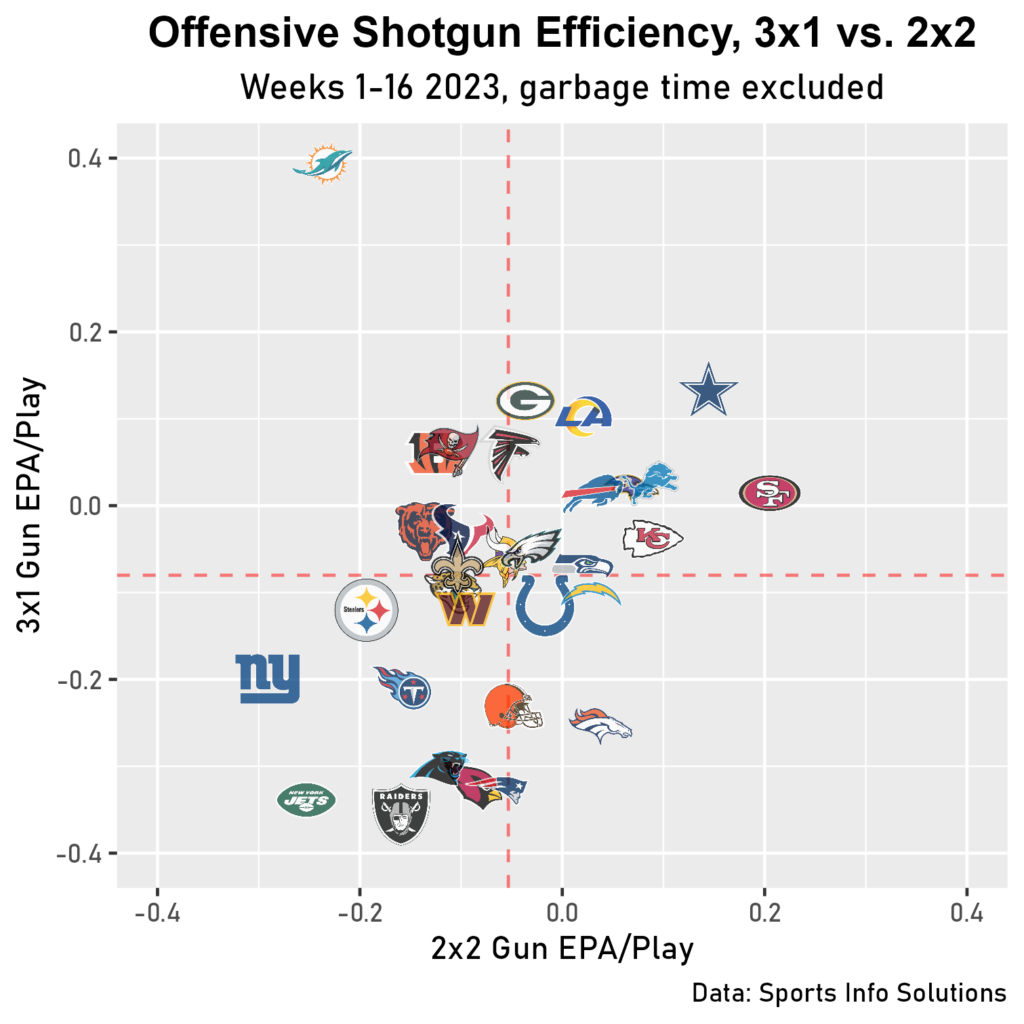
    Scatterplot of offensive shotgun efficiency by team in the NFL in 2023, with 2x2 and 3x1 formations on each axis. The Dolphins are the only team off-trend.

    This is seemingly not confounded by any basic scheme split. The pass rates are virtually identical, the motion usage is similar, and they actually use a bit more play action in 2×2. They have had worse fumble luck in 2×2, but even if you strip out the fumbles they’ve lost, there’s still a gap of 0.5 EPA/play. This is also not a single-season aberration, as they ranked 3rd and 27th in these formation shells last year.

    So, let’s first set the table with what they do in 3×1 gun.

    3×1 gun pass game overview

    They attack the intermediate area extremely well (their bread-and-butter is a double overs concept they rake on); they are ruthless about isolating Waddle/Hill on the backside, particularly on digs and skinny posts; they have a variety of outside vertical stretch concepts they use (e.g. Smash, Flood); and they do a good job of abusing their speed via motions in order to stress the back end of the defense horizontally (for example, picture a Cover 1 safety having two seams running at him). 

    Their best motion comes out of 3×1 where they trade a receiver across the formation towards a condensed split X. Most defenses respond with stack checks, which tends to create cushion for the motion player and often exploitable outside leverage for the new #2. Of course, they are also capable of abusing man-to-man in these looks. They try to accomplish a similar thing in 2×2 by motioning #2 outward behind #1 in condensed flanks, but the results have been mixed.

    3×1 run game overview

    Their use of motion in the run game is also effective. Their creativity with TE motion in 3Yx1 (3-receiver side with a tight end/Y attached) formations to create favorable blocking angles on both zone and gap concepts might be first thing you notice, but the way they marry their pass and run game is what stands out the most.
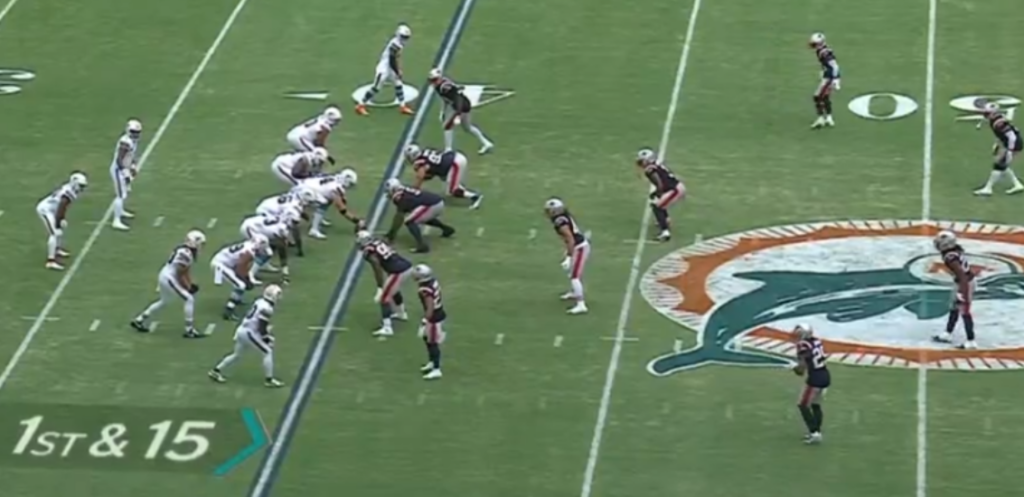
    Screen cap of Dolphins lined up in a 3x1 formation

    3×1 Tight Bunch Gun Strong vs. Patriots 4-2 under front (an even front with a defensive lineman in the A gap to the strength)

    Defensive coverages and fronts go hand in hand, and Miami does an excellent job of abusing the fronts that they get. Take, for example, their same-side power concept in 3×1 gun strong. Teams are willing to play Cover 4 against the Dolphins in 3×1 because they aren’t spamming low horizontal stretches that typically abuse this 4-deep, 3-under coverage, which has a couple of implications:

    1) Defenses generally don’t want the MIKE linebacker to be significantly out-leveraged by #3 (in the above case, the TE) in Cover 4, so it’s difficult for him to fit the strong A gap against the run, which means that, and

    2) Defenses will often be playing an under front to alleviate the MIKE’s run-pass conflict.

    ‘[The problem, then, is that same-side power is typically free real estate against under fronts. Over the last five seasons, power runs against under fronts have averaged 4.6 YPC and 0.02 EPA/play.

    2×2 alignment tendencies

    Their 2×2 gun has deeper issues, but it’s worth briefly mentioning they have a few specific tells that opposing teams may be keying on. For example, any time they’re in 2x2Y gun strong with one of Waddle/Hill aligned on the ball at #2 on the strong side and the other at #1 on the weak side in a condensed split, they run a gap play action shot with a post from one side and a dig from the other. This resulted in the field safety intercepting the post in the Raiders game, although Tua sailing it admittedly didn’t help.
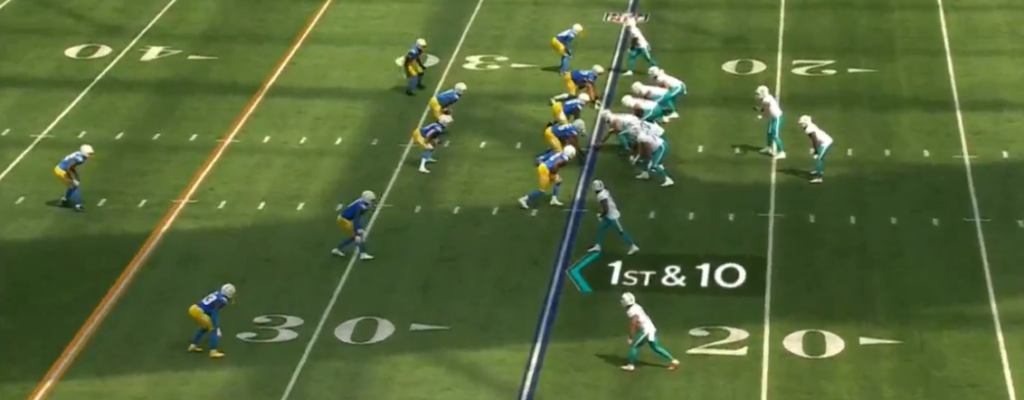
     Screen cap of the Dolphins lined up in a 2x2 formation2x2Y gun strong formation with a 2-open side and a 2-closed side with a cut split from the Z

    Now, to be clear, such trends are not endemic to the Dolphins. Every team has quirks like this that can and will be found if you look hard enough, and sometimes these plays only get called every few games. Furthermore, coaching staffs regularly self-scout to correct for things like this and break tendencies in future games. In fact, Miami seemingly self-identified a tendency in 3×1 earlier this year, in which an outward motion by Tyreek towards a stack would be a tunnel screen if and only if the on-ball player was a tight end. They broke this tendency against the Cowboys by motioning him towards a standard split with Braxton Berrios on the ball, and it went for 10 yards to convert a critical 3rd & 3 in the final drive of the game.

    What is probably more useful is to identify generalizable alignment tendencies, such as the one they have in 2×2 where Tyreek aligning on or off the line of scrimmage sends a pretty strong signal about the verticality of the offense.
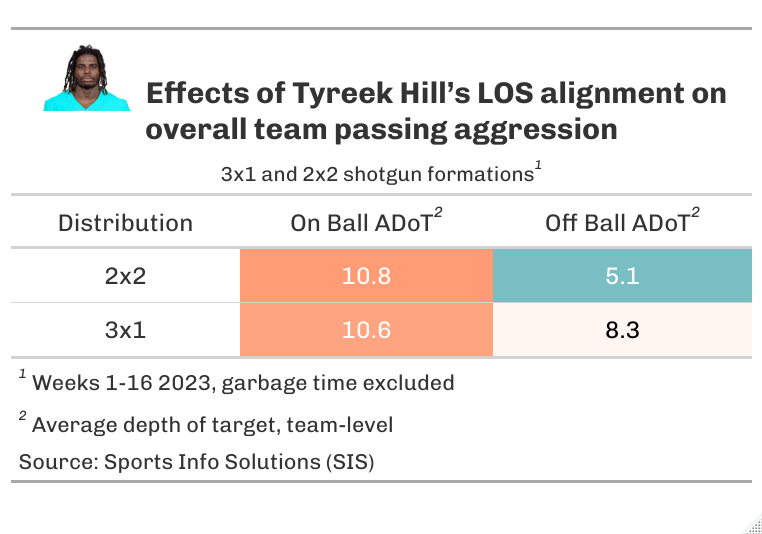
    Table showing the effect of Tyreek Hill's alignment (on or off the ball) on the Dolphins' average throw depth. The team's average throw depth is higher when he's on the ball, but the drop-off is much more when Hill is off the ball in 2x2 formations.

    The value proposition of 2×2 pass game and Tua’s compatibility

    Moving onto the nuts and bolts of it all, the Dolphins are generally integrating the back into their dropback passing game more often. They fast-release the back (i.e. he is not staying in to protect, or to chip or check for a blitz before releasing) 10% more often in 2×2 than they do in 3×1, and that’s largely a function of the concepts they’re running. You see more of the classical, West Coast, Shanahan influence in this family of formations; more low horizontal stretch concepts and triangle reads. Slant-flat. Snag. Texas. Stuff like that. And these concepts are fine – Miami runs them a bit in 3×1, as well – but they’re just inherently a lower value proposition compared to what they do in trips.

    Setting aside the relative value of these things, there’s also an argument to be made that Tua just isn’t as good at some of them. He’s checking it down more often, with 17% of his non-screen attempts coming at or behind the line of scrimmage in 2×2, compared to just 5% of the time in 3×1. His turnover-worthy throw rate on passes past the line of scrimmage also jumps from 5% to 8%. More risky throws and more checkdowns is not a good combination!

    Four-open 2×2 (i.e., two receivers to each side with nobody lined up tight) has been particularly tough sledding for the Dolphins. 53% of their passing attempts in 2×2 gun have come from these looks, and they are averaging an NFL-worst -0.53 EPA/pass out of them. They see the sixth-highest rate of middle field open (MOFO) coverage in such formations at 53%, and that is not a function of them being pass-heavy. The league-wide, neutral-script passing rate within these formations is a staggering 90%, so the problem here is that the Dolphins simply have not been good at forcing the issue.

    Defenses playing split field coverages and getting 4 defenders over 3 offensive players (4-over-3) to the strongside and 3-over-2 to the weakside is a tough hill for any offense to climb, and opposing teams can afford to do this to the Dolphins with relative impunity for a couple of reasons. Arguably the most critical factor is that Tua struggles to make some of the throws that typically punish such structures. There are a lot of routes that he excels at throwing, but the slot out/flat is not one of them.

    Among non-screen throws he’s attempted at least 25 times in the last two years, flat routes and out routes from the slot are bottom five in EPA/attempt, On-Target Rate Over Expectation (xOnTgt+/-), and passing Total Points/play. This is where critiques of his arm strength come into play; it’s not that he can’t throw rainbows 50 yards downfield, it’s that he doesn’t consistently have the velocity to beat defenders on throws like these.

    This is not conducive to beating Cover 4. This is not true of all quarters variants, but, as a general rule, these coverage structures are susceptible in the flats. Furthermore, if a defense wants to play split field coverage and is less concerned about throws to that area, they can have their corners play looser techniques in Cover 2 that allow for sinking a bit longer if the outside receiver releases vertically. Anecdotally, the Dolphins are partial to Ohio (#1 on a go, #2 on an out) in 2×2, especially when Tyreek is in the slot, and they typically do well on it. However, some teams have had success playing Cover 2 to the Dolphins’ 2-open flanks despite that route concept being 1) a common pattern for Miami in those looks, and 2) a traditional Cover 2 beater.

    2×2 run game cat-and-mouse

    The run game has been another issue. They average 2 fewer yards per carry in gun 2×2, and have been more zone-heavy whereas in 3×1 they are gap-heavy. This is possibly a function of the fronts they’re getting. A lot of teams have liked to place a 3-tech away from the back against these looks and the Dolphins have a 39% success rate on RB handoffs against such fronts, compared to a 67% success rate when the 3-tech is to the back. There could be a lot of reasons teams are setting their front this way, but it can be difficult to run zone at that 3-tech. 

    Now, what’s interesting is that, in the past few weeks, McDaniel has made a concerted effort to counteract this. When Miami has been getting a 3-tech away from the offset back, they’ve started to do two things: 1) get the offensive linemen on a zone track one way, and path the back the opposite way, which essentially washes down the 3-tech, and 2) run toss away from the 3-tech, which is an unusual mechanism in shotgun but something they’ve also done on pin-pull concepts. Both of these have generally been paired with a TE splitting across the formation to either kick out or serve as a lead blocker, and it’s led to a spike in their overall efficiency in 2×2 gun runs.

    Whether or not this will be some Achilles heel remains to be seen. This umbrella of formations makes up approximately 20% of their offense – so we’re talking about roughly a dozen plays a game – and they’re still 4th in the league in EPA/play regardless. Furthermore, it is difficult for defenses to dictate to the offense what formations they have to use, and players ultimately have to execute on the field, anyways. If nothing else, it’s interesting that the same team can look so different just because someone moved an X on a board. It may not end up being significant, but not everything needs to be. Football is just cool like that.
  • Week 17 Parlay Picks: Jahmyr Gibbs, Kyren Williams, and Dak Prescott

    Week 17 Parlay Picks: Jahmyr Gibbs, Kyren Williams, and Dak Prescott

    Photo: Steven King/Icon Sportswire

    “There is no great genius without a touch of madness.” – Aristotle

    I may have been told by my boss to not be too arrogant, but unfortunately I couldn’t really hear him from up here on my high-horse. For I am the self-described Sultan of Spreads, Lord of Long-Odds, Paladin of Parlays, or more commonly known, the intern who won you $764.00 last week. Kiss the rings.

    To briefly recap; Jake Browning didn’t have his best stuff in Pittsburgh, but still cleared the 221.5 mark with ease after Cincinnati abandoned the run early. Cleveland dominated Houston in a game that was 36-7 midway through the 4th. And Breece Hall, my Underdog of the Week, gouged Washington for 191 total yards, passing his 100+ prop before halftime.

    All three lines saw a ton of movement prior to their respective kickoffs, but we locked in this parlay at +764. Based on a $100.00 weekly wager, that win gives us a running payout total of $864.00 heading into Week 17.

    Each of my parlays will have an underdog (+120 to +245) or superdog (+250), with the remaining 2 legs consisting of a combination of even money (-115 to +115), favorite (-120 to -245), and heavy favorite (-250) lines. I’ll also incorporate teasers to achieve a degree of balance where possible.

    With this format and expected odds, my goal is to hit 20% of these “lottery ticket” style attempts. This is the lineup I’m playing this week.


    Underdog – Jahmyr Gibbs Alternate Rushing Yards Over 66.5: +210

    Among running backs with 100+ carries, Gibbs is leading the league in yards per attempt (5.7) by almost half of a yard (.3). Over the last four weeks he’s averaged 6.8 yards per attempt and 76.5 yards per game. 

    Gibbs also has a broken or missed tackle on 27% of his rush attempts and is averaging 3.0 yards after contact per attempt, good enough for 2nd and 6th respectively among running backs with 100+ carries. He’s been better in both metrics over the last four weeks.

    While Gibbs is electric, he’s bankable because of the quality of the offensive line in Detroit. Four-fifths of the Lions’ starting offensive lineman are ranked in the top 25 for run blocking Total Points this season. 

    The only two other teams with four lineman in the top 25 of that list are the Eagles and Bills. Both teams rushed for 100+ yards in all three of their matchups with Dallas, including a 266 yard explosion from Buffalo in Week 15.


    Even – Kyren Williams Rushing Yards Over 94.5: -115

    Williams is averaging a league-best 120.2 yards per game since returning from injury Week 12, clearing 100 in 4 out of 5 contests. For the full season, he’s leading all rushers with 96.1 yards per game and 30 Total Points. He’s also averaging the 4th most yards per attempt among running backs with 100+ carries (5.1). 

    Across the ball, the Giants have given up 3rd most rushing yards (1,709) and the 4th highest yards per carry (4.6) to running backs. Their run defense has the 5th worst Total Points per play this season.

    Our model is projecting Williams to rush for 108.1 yards this week. That’s 13.6 yards above his current over/under line, and the largest such gap currently available on DraftKings.


    Heavy Favorite – Dak Prescott Alternate Passing Yards Over 250.5: -265

    Prescott has cleared the 250 passing yard mark in seven of nine games since the Cowboys’ Week 7 bye. On the year, he’s 3rd in the league in Independent Quarterback Rating (104.8) and 6th in yards per attempt (7.5) among passers with at least 100 attempts.

    According to our model, he’s projected to throw for 284.8 yards, the 2nd highest total this week. CeeDee Lamb is also projected by the same model to lead the league in receiving yardage against Detroit. Lamb is the only receiver projected to top the 100 yard mark, and is 18.5 yards ahead of our 2nd highest projection.

    Detroit, conveniently, is vulnerable to the big play. Their pass defense is allowing big-EPA pass plays at the 2nd highest rate and is allowing the 5th highest average air yards per game to opposing quarterbacks (284.5). Overall, the Lions are allowing the 11th worst passer rating against and 8th most pass yards per attempt (7.6).


    Total Parlay Odds: +621

    All odds available through DraftKings and current as of 10:47 AM 12/28/2023

    Sports Info Solutions is not an online gambling website or gambling operator. If you choose to wager on sports, we encourage you to do so responsibly. If you or someone you know has a sports betting or gambling problem, please call 1-800-GAMBLER or visit The National Council on Problem Gambling for more information and further assistance.

  • The NFL’s Best Pass-Catching Groups By Total Points

    The NFL’s Best Pass-Catching Groups By Total Points

    In the ever-evolving landscape of the NFL, the importance of a dynamic and potent receiver corps cannot be overstated. As teams strive for offensive excellence, pass catchers – whether they be wide receivers, tight ends or running backs – play a pivotal role in creating explosive plays, stretching defenses, and ultimately putting points on the board. 

    Who have been the top receiving groups?

    To delve into the comparison, we’ll assess each team’s pass catchers based on a set of criteria: Total Points, Boom%, and depth, with an eye on how these factors contribute to the overall success of the team.

    Total Points Rank Team Total Points Boom%
    1 49ers 117 33%
    2 Seahawks 85 23%
    T3 Lions 74 27%
    T3 Texans 74 29%
    5 Chiefs 71 24%
    6 Titans 69 25%
    7 Dolphins 68 28%
    8 Buccaneers 67 26%
    9 Bears 63 22%
    10 Ravens 61 25%
    11 Cowboys 61 24%

    Here’s our rundown of the Top 5.

    1. San Francisco 49ers

    The 49ers boast a wide receiver corps led by the dynamic trio of Deebo Samuel, Christian McCaffery, and Brandon Aiyuk. Their creative play caller and efficient quarterback reveal a group that consistently challenges defenses, earning them the top spot. They’re the runaway leaders in Total Points.

    Future Outlook: So long as the injuries don’t pile up and the offense can keep clicking on all cylinders the 49ers are all but certainly the best corps in the playoff picture. 

    2. Seattle Seahawks

    The Seahawks corps is led by the strong and physical trio of DK Metcalf, consistent veteran Tyler Lockett, and the young and rising Jaxon Smith-Nijigba. Factor in a confident quarterback in Drew Lock the Seahawks find themselves No. 2 on this list. 

    Future Outlook: The Seahawks have a good starting WR corps. However, some of their woes might come from the lack of consistent production from Lockett or Smith-Nijigba. So long as those two can contribute at a decent clip they are a force to be reckoned with.

    T3. Detroit Lions

    Jared Goff’s return to his old self has boosted the effectiveness of his young receivers. Amon-Ra St. Brown and Sam Laporta make up about two-thirds of the Total Points receiving contribution.  

    Future Outlook: A tip of the hat should be awarded to GM Brad Holmes. He came in and revitalized the WR corps, drafting St. Brown and snagging a handful of other significant WR pieces. Aside from the possible age of Goff in the distance, the Lions wide receivers should be one of the best in the playoffs this year and to come.  

    T3. Houston Texans

    CJ Stroud and the Texans have done a great job of spreading the ball around their young wide receiver corp. Their up-and-coming stud receivers Nico Collins and Tank Dell have carried the team’s Total Points significantly. 

    Future Outlook: The Texans have a bright future with a young and talented quarterback and receiving group they will have time to develop together for the future and have a chance to make noise in the playoffs if Dell and Stroud come back healthy.

    5, Kansas City Chiefs

    The Chiefs have accrued significant contributions from Travis Kelce and Rashee Rice. Andy Reid’s adaptability and implementation of getting Rice in space has created another weapon for Mahomes placing them at No. 5. 

    Future Outlook: Although the Chiefs sit at No. 5 on this list they will need to look to bolster their WR group this offseason. The continuous growth of Rice will help a ton coupled with the consistent production from Kelce. However, they are definitely lacking depth. 

    And here are 5 other playoff contenders’ whose receiving groups I like a lot.

    7. Miami Dolphins 

    Though they didn’t crack the Top 5, the Dolphins still pose great challenges for opposing defenses. With a mastermind offensive coach, one of the fastest players in the NFL in Tyreek Hill, and young and talented Jaylen Waddle, they have the tools to create damage in a hurry against defenses. 

    Future Outlook: Barring any significant injuries the Dolphins wide receivers should easily be able to compete at the top and be the best in the playoffs.

    8. Tampa Bay Buccaneers 

    The Buccaneer’s strong WR corps stems from years of experience and a couple of All-Pro-caliber players. Chris Godwin leads the team with 28 Total Points (12th in the NFL) and very closely behind is Mike Evans with 26 (16th). Tampa Bay’s pass-catchers lead the NFL in Points Earned on intermediate length passes (110-19 yards), with Godwin ranking 2nd individually.

    Future Outlook: Aside from age becoming a factor for Evans and Godwin, right now they are still producing at an elite level. But if Mayfield and company can find a way to keep spreading the ball out they should be able to compete.

    11. Dallas Cowboys 

    Dak Prescott’s elite connection with Total Points leader CeeDee Lamb makes up more than half of their Total Points production as a team. The importance for the Cowboys is figuring out ways of getting others involved to climb this list and to be successful for a deep playoff run. 

    Future Outlook: The Cowboys have a tall task ahead of them going into the playoffs. All it takes is for a defense to minimize Lamb and their gameplan is in need of significant adjustments. McCarthy needs to find and implement ways for more people to be involved for them to have a deep run in the playoffs.

    13. Los Angeles Rams

    The Rams have a nice emerging wide receiver corps that was in the Top 10 a week ago. Puka Nacua’s development into a reliable target and the veteran presence of Cooper Kupp provide Matthew Stafford with formidable options. The Rams’ ability to integrate new and established talents secures their place among the league’s top wide receiver groups.

    Future Outlook: The Rams have the smart offensive mind, the smart quarterback, and the consistent weapons to make a splash in the playoffs. Some of Nacua’s inexperience might hurt him now but will prove significant in his development as the sole No. 1 when Cooper Kupp retires or moves on. 

    14. Green Bay Packers 

    The Packers have the youngest active WR corps in the NFL which caused some growing pains in the beginning of the season. However, as of late they have produced the most Total Points since Week 10 thanks to the heavy contributions of Christian Watson, Romeo Doubs, Jayden Reed, Dontayvion Wicks and Tucker Kraft. Their consistent development together with Love can pose great success in the future. 

    Future Outlook: The Packers just like the Texans have a bright future ahead of them. They appear to have their franchise quarterbacks (again…) and plenty of weapons around him that can grow with him. If they sneak into the playoffs they should pose a decent headache for opposing defenses. 

    The top receiving corps in the NFL showcase the league’s diverse talent and strategic prowess. From established stars to emerging talents, each team brings a unique dynamic to the field. As we continue to witness the evolution of offensive strategies and individual performances, dynamic pass catchers remain a cornerstone of NFL success.

  • Reiterating The Statistical Case Against Brock Purdy for MVP

    Reiterating The Statistical Case Against Brock Purdy for MVP

    Photo: David Rosenblum/Icon Sportswire

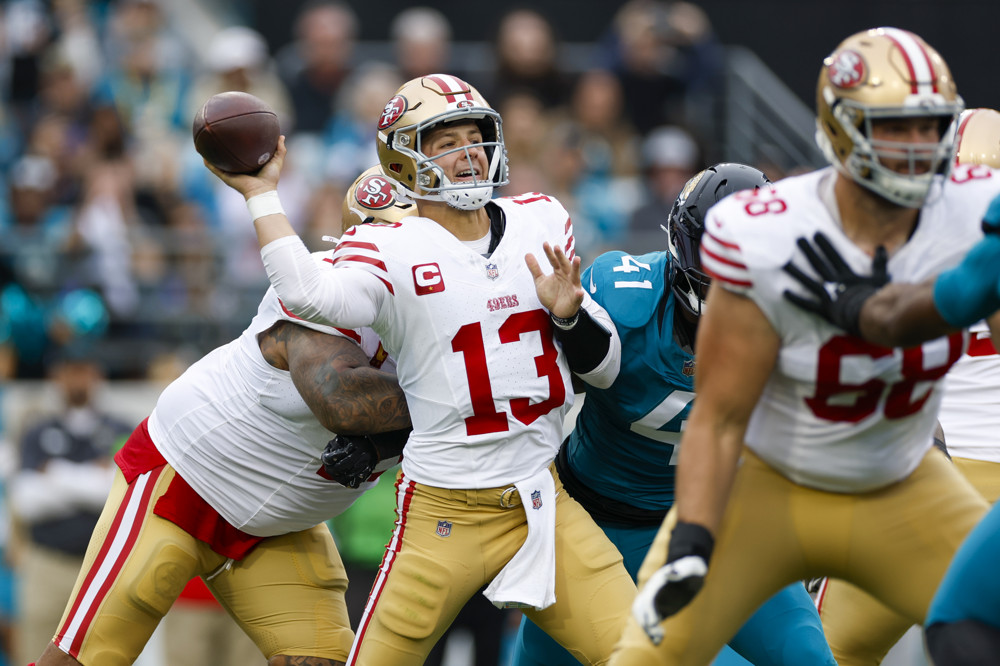
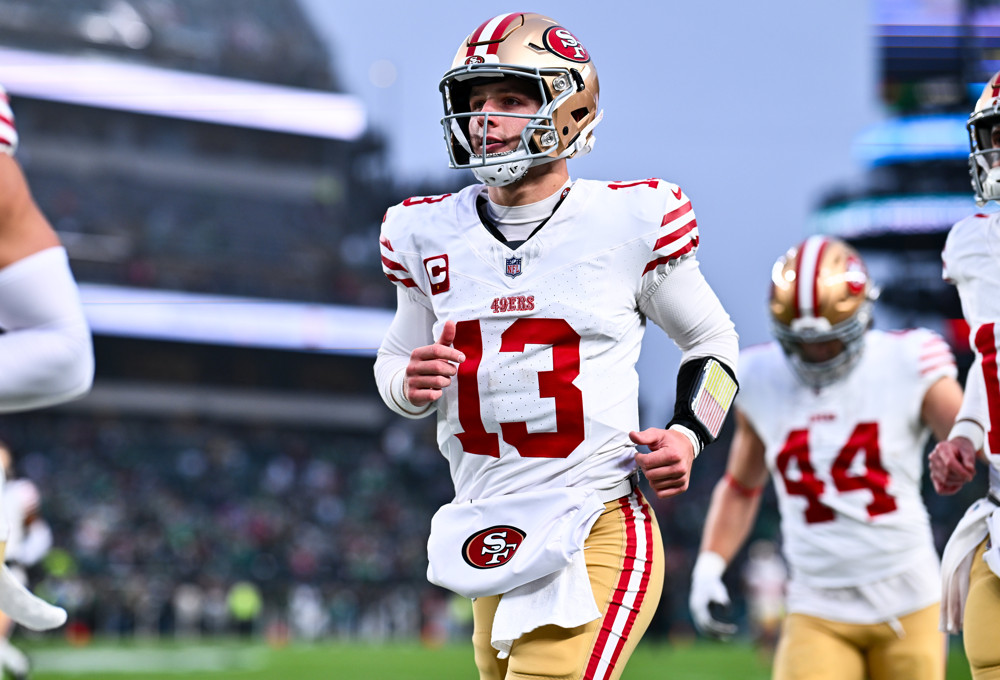
    As of this moment, Brock Purdy has the best odds to win MVP at -200. Mr. Irrelevant has had a meteoric rise to being Shanahan’s second MVP-caliber quarterback this decade, and is now the preferred candidate among 49ers fans, aging sportswriters, and Disney adults. And as fun as that narrative arc may be, it should be met with some skepticism (as we pointed out last week). Let’s go even deeper in our analysis today.

    Americans love a good sports underdog story – which is really just a toxic masculinity fairytale, if you think about it – but hate participation trophies, and MVP awards are not participation trophies. They’re given to outstanding players with impressive production who considerably elevate their team, and although Purdy has outplayed his draft slot, he does not fit that bill. But, any good-faith attempt to reconcile his production with his individual skill is met with circular references back to his stats, so let’s dig into those.

    His dropbacks have indeed been very efficient from an EPA perspective, let’s just get that out of the way. A positive play rate of 55% is comfortably first in the league, and, if the season ended today, 0.26 EPA/dropback would be the second-best season in the SIS era behind only 2016 Matt Ryan, which is very interesting considering who called plays for them. He would even rank first in EPA/dropback and yards/attempt this year if you took out his throws past the line of scrimmage, as originally pointed out by Steven Ruiz of The Ringer.

    But, these numbers belong to the 49ers passing offense as a whole, and not just Purdy. There are a lot of good players on that unit. Trent Williams, Christian McCaffrey, and Deebo Samuel are All-Pros, and Brandon Aiyuk – who is currently 2nd in first down percentage, 2nd in yards/route run and 3rd in Total Points/route behind only Tyreek Hill and Samuel – should join them come awards season. Furthermore, they have a pretty good young guard tandem in Aaron Banks and Spencer Burford; Kyle Juszcyk is as valuable as fullbacks can possibly be in the modern NFL; and, to top it all off, they have arguably the best offensive coach in the league in Kyle Shanahan.

    The 49ers do not need, and have never needed, Purdy to be a Top 10 quarterback, and he isn’t. They just need him to not screw things up, and he hasn’t.

    There’s a lot of mythmaking surrounding Purdy’s game, but it is fair to say that he’s accurate. He’s 80th percentile in xOnTgt +/- among qualifying quarterbacks with at least 200 attempts, which is pretty good. But, all this fluff about how he’s such a good processor and manages the game so well is just flat-out embellishment.

    His turnover-worthy throw rate (3.5%) is pretty bad – 26th percentile – and he doesn’t get the ball out particularly quickly, either. His expected snap to throw +/- (xSTT+/-), which approximates how quickly the quarterback should throw the ball based on his drop (among other factors), is 47th percentile. It’s not horrible, but it’s also not great.

    The fairest comparison here might be another Shanahan-adjacent quarterback in Tua Tagovailoa, who ranks third in xSTT+/- at a full two-tenths of a second faster than Purdy. In fact, you could make the case that Tua predetermines throws and shoots first and asks questions later, but even then, his turnover-worthy throw rate (3%) is 47th percentile – a bit better than Purdy’s.

    However, you don’t need to be an elite processor when you get to make so many gimme throws. Purdy’s attempts have been contested at the second-lowest rate in the league this year at 22%. And, if you’re wondering how that might affect his EPA numbers: contested throws are a terrible value proposition.

    The average EPA on such throws this season has been -0.38. Purdy, meanwhile, is averaging -0.09 EPA on those throws. So, not only does he get to make more easy throws, he’s losing about 25% of the value most quarterbacks do on the difficult throws he does make. That seems very fortunate!

    Some of that is probably just pure luck, but the 49ers receivers deserve a lot of credit in this regard. They rank 7th in contested catch percentage (39%) and 1st in both average yards after catch (6.9) and yards after contact (2.2). In fact, the difference between San Francisco and the next-best receiving corps in average yards after contact, is as big as the difference between the 2nd and 28th ranked teams. And if the season ended today, their average yards after catch would be the 3rd-best we’ve ever recorded, just behind the 2018 Chiefs and the 2018 49ers, and just ahead of the 2021, 2022, and 2019 49ers.

    Which brings us to the next point; a common rebuttal to the notion that Purdy is largely a beneficiary of an excellent playcaller and a star-studded supporting cast, is that Jimmy Garoppolo didn’t perform at this level. Interestingly enough, though, Jimmy G was actually never good.

    Among 49 quarterbacks with at least 500 attempts from 2020-2022, Garoppolo ranked 38th in turnover-worthy throw rate (4%), and 31st in On-Target Rate Over Expectation (xOnTgt +/-). He was also 30th in Passing Total Points/play while getting hit.

    Purdy is tougher and more willing to stand in against the rush, ranking 6th in passing Total Points/play while getting hit this season. He’s also more accurate, ranking 6th in xOnTgt +/-, and those are the big distinctions between the two. The difference we’re seeing is the difference between a warm body and Tom Brady’s sleep paralysis demon. That’s it.

    We could go on and on about splits. EPA/play on third downs is extremely volatile – with Patrick Mahomes being the only player who’s proven the ability to sustain high performance year-to-year – and Purdy’s 0.30 EPA/play on 3rd down is 12th out of 294 quarterbacks with at least 50 3rd-down attempts since 2016, just behind 2018 Nick Foles. His EPA/play on play action is the highest in the league since 2016 and 5.5 times the average EPA on play action during that span, and it’s already a cheat code.

    All this to say, Kyle Shanahan is doing parlor tricks again. Our wins above replacement (WAR) has Purdy 5th – just behind Tua Tagovailoa – at 2.7, and even that might be generous. He’s a decent player capable of functioning within an extremely efficient ecosystem, but that’s not what this award is about. It’s about recognizing players who stand out from all their peers – not just stand out from Jimmy Garoppolo.

  • Week 16 Parlay Picks – Breece Hall, the Browns, and Jake Browning

    Week 16 Parlay Picks – Breece Hall, the Browns, and Jake Browning

    Photo: John Rivera/Icon Presswire

    For the last couple of weeks of the NFL season, I’m going to try something different with our analytic data by testing how useful it is on parlays. We’ll use Total Points, our player projections, and other information at our disposal.

    Each of my parlays will have an underdog (+120 to +245) or superdog (+250), with the remaining 2 legs consisting of a combination of even money (-115 to +115), favorite (-120 to -245), and heavy favorite (-250) lines. I’ll also incorporate teasers to achieve a degree of balance where possible.

    With this format and expected odds, my goal is to hit 20% of these “lottery ticket” style attempts. This is the lineup I’m playing this week.

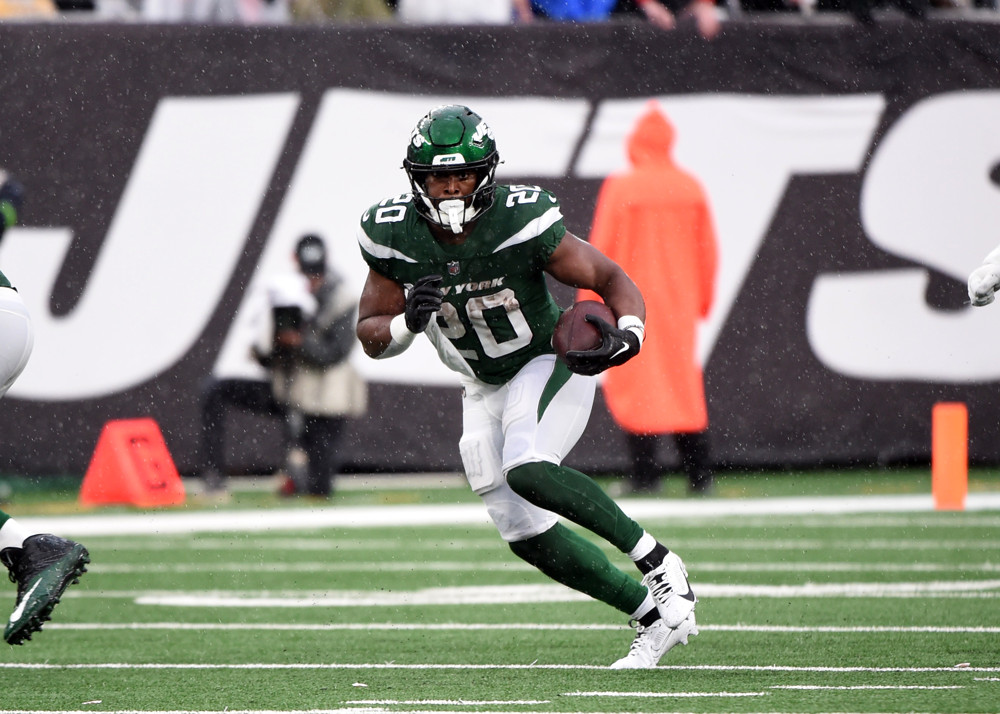
    Underdog: Breece Hall- Alternate Rushing + Receiving Yards, 100+: +225

    Our projections models project Breece Hall to pick up 58 yards on the ground and 42 yards through the air this week; 100 total yards right on the nose. 

    Washington has been awful against the run since trading away the majority of its starting defensive line prior to Week 9. The defense is allowing the 5th-most yards per carry (4.8) of any team in the league over that time frame. Hall has two 100-yard rushing games this year. Both came against teams that have struggled to stop the run (Bills and Broncos).

    The Commanders have also struggled to contain running backs in the passing game since those deadline moves, having given up the 2nd-most receiving yards (291) and 4th-most yards per reception (8.3) over that span. 

    On the flip side, Hall has 53 receptions this year, 3rd in the NFL. He also ranks 3rd in targets and 4th in receiving yards.

    Hall is also averaging just under 5 targets per game and has at least 5 receptions in 4 out of his last 5 contests. 

    Yes, the Jets rank 30th in both Passing and Rushing Total Points Per Play but their reliance on Hall in the passing game is what gives me the confidence to make him my underdog/superdog pick this week.

    Favorite: Cleveland Browns Moneyline: -148

    The Trenches Matchup Tool, available on The 33rd Team website, views the matchup between the Texans offensive line and Browns defensive line as the 2nd-largest Week 16 mismatch among all line matchups. 

    Myles Garrett has the second-most Points Saved (38) of any pass rusher and most Points Saved Per Play of any defensive lineman this year, and has been far from the only contributor up front. 

    With Laremy Tunsil and Shaq Mason both questionable and trending towards not playing this weekend for the Texans, expect the Browns defensive front to fare well against whichever backup QB Houston decides to roll with as its starter.

    Favorite: Jake Browning- Alternate Passing Yards Over 221.5: -170

    Since taking over as the Bengals starter in Week 12, Jake Browning has the 3rd-most Total Points (33.6), 2nd-highest EPA (22.1), 3rd-best passer rating (109.3), and 4th-highest IQR (111.3) in the entire league. 

    Browning has thrown for over 225 yards in every single game he’s started while averaging 295 per game. His completion percentage (74%), on-target percentage (80%) and catchable percentage (95%) are all top-tier. 

    Our models are currently projecting 250.9 yards passing from Browning this week, making his alternate over/under of 221.5 my confidence play.

    Total Parlay Odds: +764

    All odds available through DraftKings and current as of 10:10 AM 12/21/2023

    Sports Info Solutions is not an online gambling website or gambling operator. If you choose to wager on sports, we encourage you to do so responsibly. If you or someone you know has a sports betting or gambling problem, please call 1-800-GAMBLER or visit The National Council on Problem Gambling for more information and further assistance.

  • 2023 SIS NCAA All-America Teams

    2023 SIS NCAA All-America Teams

    By Nathan Cooper and Jeff Dean

    With the end of the College Football regular season, we’re proud to release our SIS All-America teams.

    In addition to voting done by our Operations staff, we used our all-encompassing player value stat, Total Points, along with other metrics and our scouting work as leading references in putting together two teams of All-SIS selections for 2023, plus a few honorable mentions.

    You can learn more about Total Points and the statistics referenced here.

    These picks are meant to honor this season’s best-of-the-best in the sport.

    First Team Offense

    Position Name School
    QB Jayden Daniels LSU
    RB Omarion Hampton North Carolina
    RB Audric Estime Notre Dame
    WR Malik Nabers LSU
    WR Marvin Harrison Jr. Ohio State
    TE Ben Sinnott Kansas State
    OT Josh Simmons Ohio State
    OT Delmar Glaze Maryland
    OG Cooper Beebe Kansas State
    OG Kyle Hergel Boston College
    OC Jackson Powers-Johnson Oregon

    QB – Jayden Daniels, LSU

    This year’s Heisman Trophy winner, Daniels was a force through the air and on the ground. His 40 passing touchdowns tied for the FBS lead and his overall IQR of 148.2 is 10 points higher than Bo Nix, who was second. 

    Of his 211 Total Points, 67 of them have come on the ground. That number would rank 2nd among all RBs. Not only did he blow all other QBs out of the water with his rushing, his 1,134 rushing yards ranked 22nd among RBs and his 28 missed tackles forced tie for 4th-most among QBs and RBs.

    RB – Omarion Hampton, North Carolina

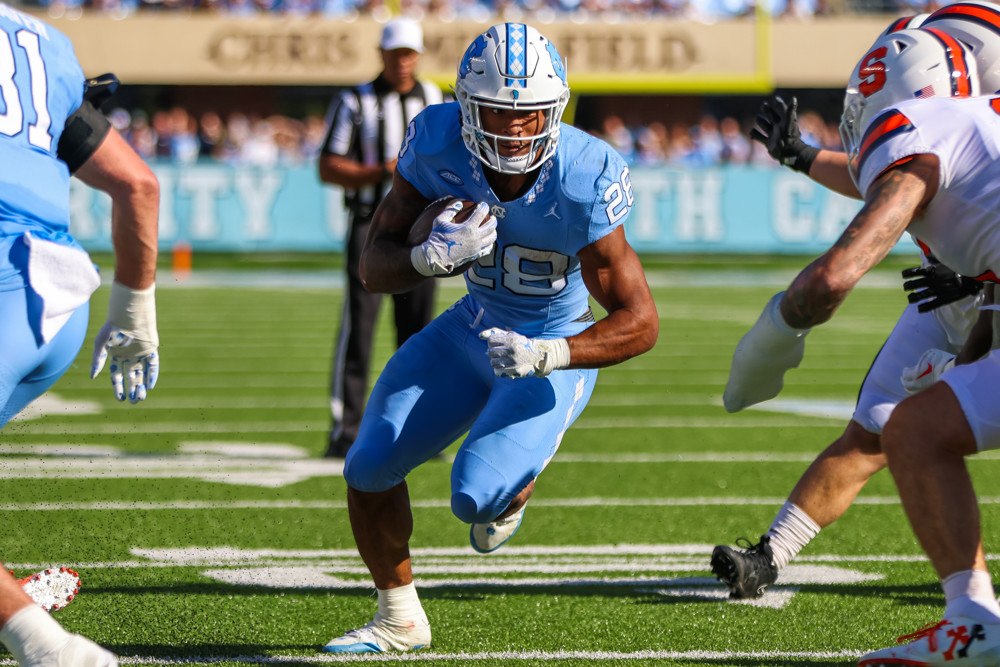
    Hampton leads all RBs in Total Points with 68, 13 better than second place. Of his 1,439 rushing yards, 1,020 came after contact, best in the FBS. Among RBs with at least 150 carries, his yards per attempt (6.1), 1st down rate (32.5%), and Stuff rate (11.1%) all rank Top 15.

    RB – Audric Estime, Notre Dame

    Estime was 2nd among RBs in Rushing Total Points with 51, and T-3rd in Total Points overall. The 41 EPA gained on his runs led the FBS, and his 6.4 Yards per Carry was the best of any player with over 200 attempts. 

    WR – Malik Nabers, LSU

    Nabers was a force all season on his way to leading the FBS with over 1,500 receiving yards. He led all FBS WRs with 52 Total Points and 69 first downs gained while finishing Top-10 in Yards After the Catch and Yards After Contact. 

    WR – Marvin Harrison Jr., Ohio State

    Harrison nearly repeated his incredible 2022 campaign in 2023 and topped it off with a Biletnikoff Award. Harrison’s 14 receiving touchdowns ranked tied for 2nd. His 48 Total Points rank 2nd among FBS receivers. 

    Among WRs with at least 75 targets, Harrison ranked 7th in 1st Down rate (76.1%) and tied-4th in yards per route run (3.6), as well. He figures to be a Top 5 selection in the upcoming NFL Draft.

    TE – Ben Sinnott, Kansas State

    Sinnott led all FBS Tight Ends with 40 Total Points in 2023. His 673 receiving yards ranked 3rd and his 6 touchdowns tied for 5th among all TEs. Sinnott’s 26.2 Receiving Points Earned and 19.9 Points Above Average both far-and-away led the position.

    OT – Josh Simmons, Ohio State

    Simmons had a Blown Block Rate of just 1.1% on the year. He was 2nd among FBS tackles in Total Points Earned per Snap and Points Above Average per Snap. His balance was impressive as he was able to earn at least 18 Total Points as both a pass blocker and as a run blocker.

    OT – Delmar Glaze, Maryland

    Glaze’s 0.9% Blown Block rate on 767 snaps was tied for 5th-best among all FBS OTs with at least 500 snaps played. His 7 Blown Blocks were tied for 7th-fewest, with only two coming as a run blocker. However, his 22.6 Points Earned as a pass blocker was the best in the country.

    OG – Cooper Beebe, Kansas State

    Beebe has been regarded as one of the best guards in all of college football the past few seasons. Among his 37 Total Points, 23 came as a run blocker, which was 7th-best among FBS guards with at least 500 snaps. His 0.5% Blown Block rate as a pass blocker was Top 15.

    OG – Kyle Hergel, Boston College

    Hergel was an ironman, playing over 800 snaps on the season. His 0.9% Blown Block Rate was noteworthy, but he also led FBS guards in Points Above Average. Scroll down and you’ll see that Boston College had a guard make 2nd team as well.

    OC – Jackson Powers-Johnson, Oregon

    Powers-Johnson won a spot on the 1st Team with his very low 0.6% Blown Block Rate and ranked 2nd among FBS centers in Points Above Average. He was the only center to earn at least 17 Total Points as both a pass blocker and a run blocker..

    First Team Defense

    Position Name School
    DT T’Vondre Sweat Texas
    DT Jamree Kromah James Madison
    EDGE Laiatu Latu UCLA
    EDGE Adisa Isaac Penn State
    LB Payton Wilson NC State
    LB Danny Stutsman Oklahoma
    CB Terrion Arnold Alabama
    CB Tykee Smith Georgia
    S Dillon Thieneman Purdue
    S Beau Freyler Iowa State
    FLEX Xavier Watts Notre Dame

    DT – T’Vondre Sweat, Texas

    While not known as a pass rusher, Sweat did rank Top-25 among DTs in pressures with 22. His run defense was the main selling point as he led DTs in Total Points per Snap, Run Defense Total Points, and Run Defense Total Points per Snap to boot. A well-deserved place after a monster season.

    DT – Jamree Kromah, James Madison

    James Madison proved to be one of the best stories in college football this season, and Kromah’s play on defense was a big reason why. Among DTs, his 10 sacks tops the list and his 41 pressures ranked 2nd. Additionally, his Pass Rush Points Saved (21.1) rank 2nd and Points Above Average (4.6) rank 10th.

    EDGE – Laiatu Latu, UCLA

    Latu, a first round lock in the upcoming NFL Draft, was absolutely dominant as a pass rusher in 2023. His 35 pass rush Points Saved tops all FBS DE/LBs, his 21% Pressure rate ranked 2nd among all with at least 200 pass rushes, his 59 pressures ranked 2nd, and his 12 sacks ranked tied for 5th.

    EDGE – Adisa Isaac, Penn State

    Isaac led FBS DEs in Total Points per Snap, was 1st in Pass Defense per Snap, 10th in Run Defense per Snap. While he may not be as heralded as his teammate, he was 3rd in Total Points per Pass Rush among FBS players with at least 25 pressures.

    LB – Payton Wilson, NC State

    Wilson is an athletic linebacker who makes plays all over the field, which is evidenced by his Total Points numbers. His 71 Total Points were tied for 7th-best among all FBS defenders in 2023. Among LBs, his 41 Total Points as a pass rusher/defender ranked 1st and his 29 Total Points ranked 2nd,  his 0.12 Total Points per Snap in run defense was best. He ranked Top 25 in sacks (6) and pressures (24) as well.

    LB – Danny Stutsman, Oklahoma

    Another player who can do it all. Stutsman was 4th among FBS LBs in Run Defense Total Points, 3rd in Pass Defense Total Points, and 2nd in overall Total Points. Stutsman was all over the field, earning at least 10 Total Points in coverage, against the run, and rushing the passer.

    CB – Terrion Arnold, Alabama

    Arnold sort of came out of nowhere for Alabama’s defense this season. Playing opposite of Kool-Aid McKinstry, Arnold allowed the 5th-lowest completion percentage among players with at least 50 targets defensed. Additionally, his 5 interceptions tied for 2nd, 12 passes defended tied for 12th, 54.7 Points Saved in coverage ranked 3rd, and his 37.7 Points Above Average ranked 5th.

    CB – Tykee Smith, Georgia

    Another in a line of productive Georgia defenders, Smith was 2nd among FBS CBs in Total Points per Snap. He gave up a lowly 0.2 Yards per Coverage Snap and just a 29.6 QB Rating when targeted. He allowed only 11 receptions on the year and snagged 4 interceptions for himself as well.

    SAF – Dillon Thieneman, Purdue

    An unbelievably impressive true freshman season for the Boilermaker that saw him lead FBS safeties in Total Points. His 45 Pass Defense Total Points are good for 4th and his 27 Run Defense Total Points are good for 6th, showing the ability to affect both aspects of the game. His 6 INTs were good for 2nd in the FBS and a clear warning to not throw his way.

    SAF – Beau Freyler, Iowa State

    For an Iowa State defense that lost some big-time playmakers after the 2022 season, Freyler stepped up in a big way in 2023. His 72 Total Points ranked 2nd among FBS safeties, as does his 50 Total Points against the pass. Among safeties who saw at least 25 targets, his 7.7% Boom rate ranked 2nd and 38.5% Bust rate ranked 4th. Additionally, his 21.9 Passer Rating Against is 3rd-best.

    FLEX – Xavier Watts, Notre Dame

    Watts was a major impact player for the Notre Dame defense all season. He led FBS safeties in Pass Defense Total Points with 55, and he led the FBS with 7 INTs. He had a QB Rating Against of 42.9 when targeted, and his game against USC was one of the most impressive player performances of the year.

    First Team Specialists

    Position Name School
    K Graham Nicholson Miami (OH)
    P Tory Taylor Iowa
    Returner Jayden Harrison Marshall

    K – Graham Nicholson, Miami (OH)

    Nicholson was nearly automatic in 2023. He was 26-of-27 on field goals, with his only miss coming in the MAC Championship. Those 26 makes were tied for 2nd-most in the FBS. He also went 36-of-37 on extra points.

    P – Tory Taylor, Iowa

    Absolutely phenomenal all season, Taylor led all FBS punters with 29 Total Points. He led the FBS with 87 punts and had just 6 touchbacks (a few should’ve been prevented) with 30 landing inside the 20 and 11 inside the 10. If a punter gets a unanimous selection, as Taylor did, it was a dominant season.

    Returner – Jayden Harrison, Marshall

    Harrison was one of only five returners in 2023 to return two kicks for touchdowns. His total kick return yards were Top 5 in the FBS and his 30.9 average was 6th-best among returners with at least 10 kick returns.

    Eleven players on our First Team list were unanimous selections among all 14 of our voters. 

    They are: Jayden Daniels, Omarion Hampton, Malik Nabers, Marvin Harrison Jr., Cooper Beebe, T’Vondre Sweat, Laiatu Latu, Payton Wilson, Terrion Arnold, Xavier Watts, and Tory Taylor.

    Second Team


    Position Name School
    QB Caleb Williams USC
    RB Ashton Jeanty Boise State
    RB Ollie Gordon II Oklahoma State
    WR Rome Odunze Washington
    WR Malik Washington Virginia
    TE Cade Stover Ohio State
    OT Kelvin Banks Jr. Texas
    OT Adam Karas Air Force
    OG Christian Mahogany Boston College
    OG X’Zauvea Gadlin Liberty
    OC Jordan White Liberty


    Position Name School
    DT Braden Fiske Florida State
    DT James Carpenter James Madison
    EDGE Brennan Jackson Washington State
    EDGE Jalen Green James Madison
    LB Edgerrin Cooper Texas A&M
    LB Jaylan Ford Texas
    CB Ricardo Hallman Wisconsin
    CB Jarius Monroe Tulane
    S Tyler Nubin Minnesota
    S Trey Taylor Air Force
    FLEX Jared Verse Florida State


    Position Name School
    K Jose Pizano UNLV
    P Ryan Eckley Michigan State
    Returner Zachariah Branch USC

    Last year’s Heisman Trophy winner, Caleb Williams, gets the nod for Second Team. Additionally, the offense features the leading rusher (Ollie Gordon II), the second and third-leading receivers (Rome Odunze and Malik Washington), and our three highest Total Points getters along the offensive line (Adam Karas, X’Zauvea Gadlin, and Jordan White).

    On defense, the players with the second-most sacks (Jalen Green) and second-most interceptions (Ricard Hallman) are featured.

    Honorable Mentions

    Position Name School
    QB Michael Penix Jr. Washington
    QB Bo Nix Oregon
    QB Jordan Travis Florida State
    RB Jonah Coleman Arizona
    RB Damien Martinez Oregon State
    WR Luther Burden III Missouri
    TE Mason Fairchild Kansas
    TE Brock Bowers Georgia
    OT Will Campbell LSU
    OT Riley Mahlman Wisconsin
    OT Josh Connerly Oregon
    OT Jordan Morgan Arizona
    OT Joe Alt Notre Dame
    OG Trevor Keegan Michigan
    OG Hayden Conner Texas
    OC Drake Nugent Michigan
    DT Howard Cross III Notre Dame
    DT Jer’Zhan Newton Illinois
    CB Nate Wiggins Clemson
    CB Cooper DeJean Iowa
    S Hunter Wohler Wisconsin
    K Will Reichard Alabama
    K Joshua Karty Stanford
    P James Ferguson-Reynolds Boise State
    P Ryan Rehkow BYU
    Returner Jacob De Jesus UNLV

    Jordan Travis, Brock Bowers, and Cooper DeJean make the Honorable Mention team due to their injuries. Without them sustaining injuries, we feel like there’s a significant chance they could’ve made it onto the First or Second Team lists. The rest of the players on the Honorable Mention list all received high marks from the full-time Ops staff, but just missed the cut on the first two teams.

    All 11 conferences, which includes the Independents, are represented by our teams. Our scouts put in a lot of hard work and dedication this season charting games and scouting players for every FBS team. After a successful reveal of our second annual All-America teams last year, we feel this was another great season of college football as shown by these selections.

    Total Points, stats, and ranks as of December 12, 2023

  • Should Brock Purdy be NFL MVP? He’s Good But Not That Good

    Should Brock Purdy be NFL MVP? He’s Good But Not That Good

    It was unclear what the 49ers were going to do with Trey Lance prior to the season start, but they gave Brock Purdy a vote of confidence when they traded the former No. 3 overall pick to the Dallas Cowboys back in August.

    Fast forward to now, this turned out to be the right decision for the 49ers. Purdy has put up some impressive numbers and the 49ers have one of the best records in the NFL. The soon-to-be 24-year-old has put himself on the map, to say the least.

    In fact, he’s the betting favorite to win the NFL’s Most Valuable Player award. We still have a long way to go before the winner is announced, but it’s currently Purdy’s to lose.

    The real question is, would he deserve this honor? He’s been playing well enough to at least be in the MVP conversation, but are we sure that he is worthy enough to win and not some industry plant by the oddsmakers?

    As discussed in the latest episode of the Off the Charts Football Podcast, you can make the argument that he’s not even the most valuable player on his own team. It would be a disservice to give the award to Purdy when players like Trent Williams and Christian McCaffrey deserve recognition as well.

    Not only that, but Kyle Shanahan is one of the best offensive minds in the league. His play designs are so good that all Purdy pretty much has to do is not screw it up. When the play doesn’t go as designed, it’s typically McCaffrey, Brandon Aiyuk, Deebo Samuel, or George Kittle who picks up the slack.

    The 49ers rank as the number one team in receiving Total Points (105), our best measure of the pass catchers’ value alone, by a wide margin. That dynamic quartet deserves the most recognition for the team’s production, not Purdy exclusively.

    Also, Williams missed Weeks 7 and 8 for the 49ers and they ended up losing both games to the then 2-4 Vikings and 3-3 Bengals, respectively.

    San Francisco doesn’t have a great record solely because of its offense either. The 49ers’ defense ranks best in points allowed per game (15.8). It’s a lot easier to win in the NFL when you only have to muster up 16 points each week.

    For every statistical category that Purdy is excelling in, there appears to be one that offsets it.

    Category Purdy’s 2023 Stats NFL Rank
    Completion % 70.2% 1st
    On-Target % 75.3% 11th
    Adjusted Net Yards Per Attempt 9.9 1st
    Average Throw Depth 8.0 8th (tied)
    Passing EPA 93.7 1st (by a mile)
    Passing Total Points 100.3 5th

    Purdy is the league leader in completion percentage, ANY/A, and EPA. However, he ranks a little lower when it comes to on-target percentage, average throw depth, and Total Points.

    The latter statistics separate the quarterback from his receivers more than the former group. He rates well, but maybe not MVP level.

    In the end, the MVP award would need to be renamed if Purdy were to win. If you were to take Purdy out of the 49ers’ lineup and insert a replacement-level quarterback, this team is probably still a strong contender.

    I challenge you to apply that same way of thinking to the Chiefs, Cowboys, and even the Texans (and we’ve got an article coming about Dak Prescott). Their quarterbacks do a lot more for their teams with less supporting talent. They are players you win because of, not players you simply win with.

    Purdy is having a great year, but I wouldn’t say he’s the main reason for San Francisco’s success. The MVP award should be given to a player who carries his team to victory, not one whose teammates and coach are giving him a boost.

  • DaRon Bland’s Overall Production Makes Him A Strong DPOY Candidate

    DaRon Bland’s Overall Production Makes Him A Strong DPOY Candidate

    Two years ago, I wrote about Cowboys cornerback Trevon Diggs’ ridiculous start to the 2021 season, intercepting six passes in five games. Through that point in the season, he was an obvious Defensive Player of the Year candidate based on that productivity alone. But his value in totality didn’t add up to that, because he was performing very poorly on the other 99% of plays.

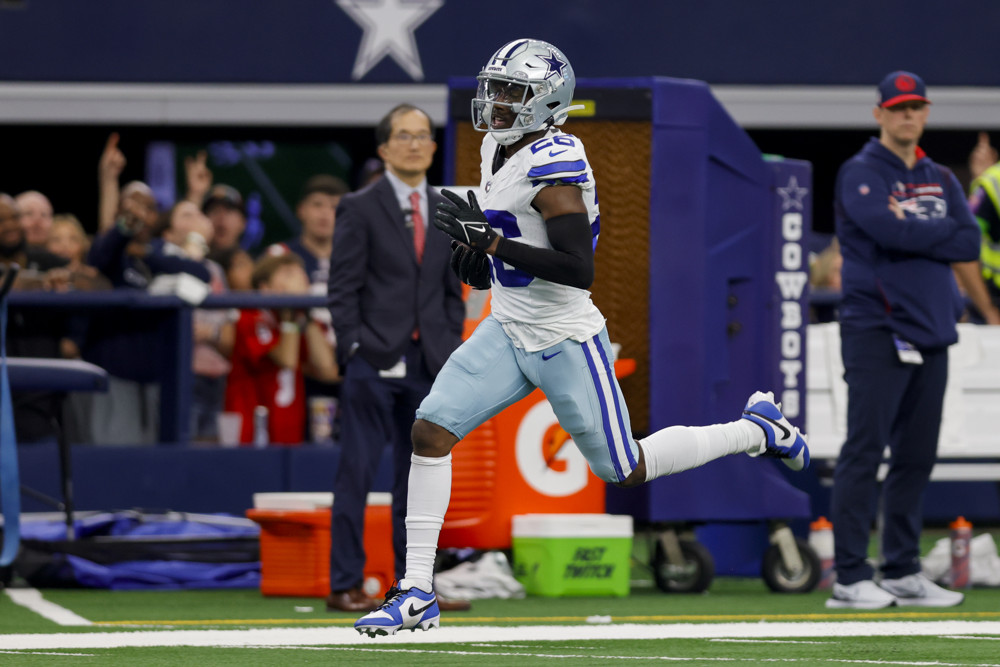
    This year, in Diggs’ absence, the Cowboys are again benefiting from a ridiculous turnover season, this time in the form of pick-six record holder DaRon Bland. But this time, that’s resulting in truly elite value (even if the stats that don’t care about interceptions aren’t transcendent). 

    DaRon Bland ranks, 2023 CB (min 30 targets)

    Rank (out of 77)
    Pass Coverage Total Points per play 1st
    Positive% Allowed 39th
    Deserved Catch % 16th
    Yards per Cover Snap T-68th

    Through Week 13, Bland has generated 61 Total Points, which puts him at the top of the list of non-quarterbacks. That’s 40 points—more than three points per game—above an average cornerback. Corners are admittedly more likely to have extreme seasons like this because of their ability to generate defensive touchdowns, but this total already puts him among the most productive non-quarterback seasons Total Points has seen (i.e. since 2016).

    When you think about how pick-sixes work from an Expected Points Added (EPA) perspective, this isn’t shocking. Each one turns a situation where the offense might expect a point or two into one where they’ve locked in negative-six, for a swing of more than a touchdown on average. Just those five plays basically account for the difference between Bland and an average corner.

    The bigger difference between Bland’s 2023 and Diggs’ 2021 is what the former is doing on the rest of his snaps. Diggs was outright bad when he wasn’t ending up with the football, which resulted in his overall numbers looking average.

    Trevon Diggs ranks, 2021 CB (min 45 targets)

    Rank (out of 72)
    Pass Coverage Total Points per play 43rd
    Positive% Allowed 48th
    Deserved Catch % 50th
    Yards per Cover Snap 72nd

    If we break down their Total Points contributions on interceptions versus other plays, we see that Bland has been more valuable regardless of the turnovers.

    Pass Coverage Total Points comparison

    Interceptions Other plays
    DaRon Bland, 2023 52 (on 8 plays) 6 (on 615 plays)
    Trevon Diggs, 2021 39 (on 11 plays) -16 (on 941 plays)

    Bland is generating more than six points per interception (and return), which is insane. That’s like if he scored eight 90-yard touchdowns as a receiver. 

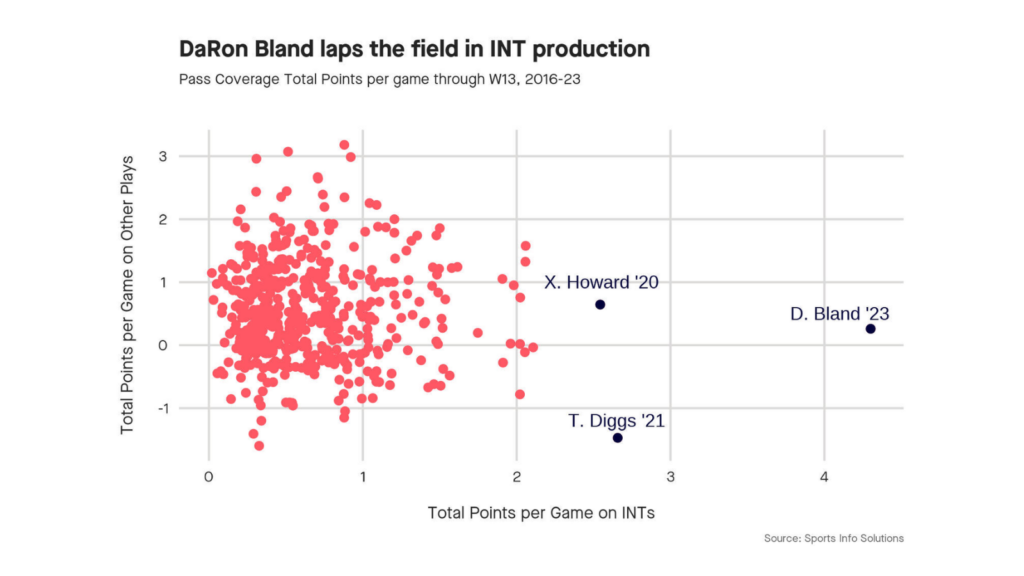
    To put some more context on that production, here is a look at the value defensive backs have generated with interceptions versus other plays through 13 weeks of the last eight seasons. A few outstanding interception seasons are highlighted, including Xavien Howard’s 10-pick 2020.

    Bland blows everyone out of the water on interceptions because of all those touchdowns, blending that with middle-of-the-road production overall. This puts him solidly ahead of Diggs in both respects, and in line with Howard (plus some touchdowns tacked on top).

    We generally don’t see big turnover numbers from true shutdown corners, because the big play guys are often trying to jump routes and bait quarterbacks, which results in a lot of completions when they don’t get there. Bland is keeping his head above water when he doesn’t pick off the quarterback, though, which makes him a legit contender for Defensive Player of the Year.

  • Empirically quantifying the worst NFL one-and-dones

    Empirically quantifying the worst NFL one-and-dones

    Photo: John Byrum/Icon Sportswire

    In the last 10 years, 10 NFL head coaches have been fired in their first season. And Frank Reich, having served as the Panthers head coach for just 305 days, was the fastest among them to be fired. It’s the second-shortest tenure in NFL history, second to only Pete McCulley’s 9 games with San Francisco in 1978.

    To further contextualize how pissed off owner David Tepper must be, please note the general tyranny among the organizations on this list. Two franchises had back-to-back one-and-dones – the 49ers with Jim Tomsula and Chip Kelly, and the Texans with David Culley and Lovie Smith – and a third was responsible for two within 6 years of each other (the Browns). Even Nathaniel Hackett lasted four weeks longer than Reich; Urban Meyer, a full month. All told, there’s a lot of organizational dysfunction among the teams on that list, so this firing would have made the Roman emperor Commodus proud.

    This seems like more of an indictment on Tepper – who has seen five head coaches come and go since he bought the franchise in 2018 – than Reich, especially considering drafting Bryce Young was the former’s decision, but we just might be able to empirically measure how he stacks up against fellow one-and-dones.

    The contestants are:

    Coach Season Time on job Preseason Win Totals Record
    Frank Reich 2023 305 days 7 1-10
    Nathaniel Hackett 2022 333 days 10.5  4-11
    Lovie Smith 2022 335 days 4.5 3-13-1
    Urban Meyer 2021 336 days 6.5 2-11
    David Culley 2021 349 days 4 4-13
    Freddie Kitchens 2019 351 days 9 6-10
    Steve Wilks 2018 343 days 6 3-13
    Chip Kelly 2016 353 days 5.5 2-14

    One way to do this would be to compare the preseason win totals to the coach’s record. This is a bit fraught considering that some of these coaches didn’t even make it a full season (among other reasons), but it can give us some sense for performance relative to expectation. By this measuring stick, Reich and Hackett appear to be the worst, falling 6 games below their preseason Vegas win total odds.

    We can gauge this slightly more robustly using player-level Total Points to compare player performance before and after the coach arrived. This is likewise shaky because of factors like player development, scheme fit, and rookie production, but it’s still worth examining. It is, however, a wash. None of these teams manage to meaningfully distinguish themselves from the others in this regard, with the differences between the team-wide average Total Points/play being a few thousandths of a decimal point. It is worth noting, however, that the 2023 Panthers (0.04) and the 2021 Jaguars (0.04) were the most talented of these teams.

    Perhaps it may be better to just measure how bad they were on the field.

    Among these teams, Carolina has had the second-worst offense by EPA/play (-0.19). Only the 2018 Arizona team (-0.21) was worse, and the Cardinals famously replaced Josh Rosen after just one season. Rosen’s performance that year ranks 310th out of 321 quarterback seasons in passing Total Points/play, and Young currently isn’t too far above at 304th – he’s that bad. None of these offenses were any good, though. The best among them was Freddie Kitchens’ Browns (-0.06), whose unit ranked 23rd that year. 

    Defensively, Reich’s Panthers team was second only to the 2022 Broncos, allowing -0.04 EPA/play, but that’s not saying much considering this collection of teams features Kelly’s 49ers (0.06) and Meyer’s Jags (0.06), who were the 20th- and 21st-worst defenses of the last eight years, respectively. Considering some of the defensive players Reich inherited, this may not come as a surprise, but it’s also disconcerting that an offensive coach by trade was getting carried by the defensive side of the ball (to the extent that a 1-10 team can be carried, anyway).

    Reich’s fourth down decision-making is more directly in his purview, and while he’s had worse seasons by SIS’s fourth down model, he wasn’t particularly good this year. He ranked 120th out of 270 coach seasons since 2016, costing his team an average of -1% expected win probability (xWP) on fourth downs. Among the one-and-dones, only Meyer (188th), Smith (228th) and Hackett (267th) were worse.

    Speaking of win probability, the 2023 Panthers had the third-highest percentage of plays that fell between 40% and 60% win probability – more or less a coin flip– at 30%, so it could be said that his team was more competitive than most of the teams on this list. It’s not by much, though; the average across all these squads is 27%.

    In some aspects, Reich was worse than his one-and-done cohorts. He arguably had the most talented team of all the coaches on this list – which should induce cognitive dissonance among people who say Young has no talent around him – and he obviously failed to meet expectations, regardless of whether or not you believe those expectations were reasonable. 

    It’s not clear if things will get any better next year. Whereas teams like the Broncos and the Texans have seen immediate improvement this year, other teams had to wait years to get back above .500.

    One thing is for certain, though: Frank Reich signed a 4-year contract and will be just fine.

  • Bryce Young Was A College Legend But He’s Not A Good Fit For The Pros

    Bryce Young Was A College Legend But He’s Not A Good Fit For The Pros

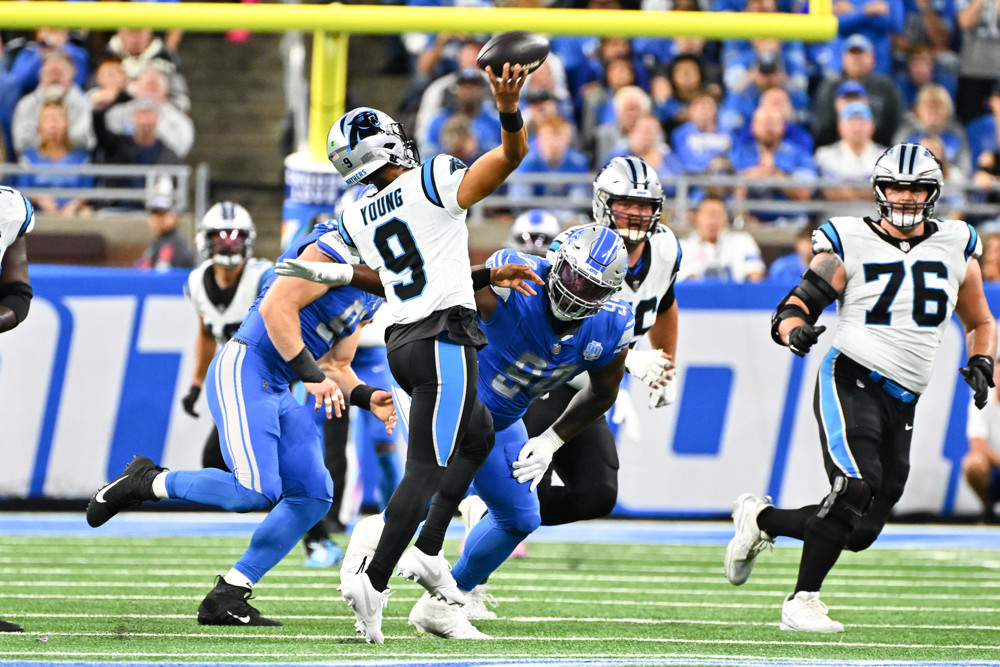
    Thursday, the Carolina Panthers (2-6) and the Chicago Bears (1-7) will square off in one of the worst primetime matchups in recent memory. The only thing really on the line here is draft position, or it would be if Carolina hadn’t traded their pick to Chicago for the right to draft Bryce Young, who currently ranks 31st in Passing Total Points/snap, right below Tyson Bagent. That’s right – Young is arguably not even the best quarterback in a game where his counterpart is an undrafted rookie out of a Division II school in West Virginia. And, if you were curious: just ahead of those two is Mac Jones, whom Young lost a quarterback competition to in college, and who presumably will be out of work come 2024.

    The Bryce Young experiment has failed in Carolina. It would be one thing if Young was struggling early and had some bankable traits, but this is what happens when you take size outliers with no distinguishing qualities outside of collegiate production. Kyler Murray may be tiny, but at least he runs a 4.3 and can throw the football a country mile. What’s Young got up his sleeve? He was a ‘winner’ and a ‘playmaker’ in college? Okay, sure, but there are a lot of guys like that who never pan out in the NFL. Are we even working with any tangible traits here?

    Yes, his supporting cast is bad. Life in Carolina would not be easy for any quarterback, but he is not the only one who has to make the best of a bad situation. Zach Wilson, Jimmy Garoppolo, Josh Dobbs, Mac Jones, and Tyson Bagent have all, to varying degrees, played under suboptimal conditions this year, and they’ve all been more efficient than Young has. The No. 1 pick should be able to do better than this.

    Trevor Lawrence played on the Urban Meyer-led Jaguars in 2021 and struggled quite a bit as a rookie, but he wasn’t below replacement level through the first nine weeks of the season. He wasn’t being outperformed by a 36-year-old Andy Dalton on his fourth team in as many years. And since we’re talking about Dalton, his 58 attempts and 3 sacks have resulted in 79 more EPA than Young’s 252 throws and 26 sacks – entirely because Young is so far in the red.

    So, what the hell, man?

    The receivers aren’t great at getting open, sure. They’re 20th in our receiving Total Points metric as a group, and I’m certainly not gonna go to bat for a unit that’s led by Adam Thielen in the twilight of his career. But, they could be worse, and Dalton has the highest contested throw rate in the league among quarterbacks with 50+ attempts (37%) while Young has one of the lowest at 24%. Part of that is a function of aggressiveness, but why was Dalton able to perform better while a higher percentage of his attempts were contested?

    The answer is in all of our hearts, and it’s that Young is not as well-suited to the NFL as he was to the college game.

    This is not a Josh Allen rookie season we’re talking about. Young is listed at a generous 5’10”, 204 lbs., doesn’t have outstanding arm talent, and is not particularly fast or elusive. If your physical profile sets your floor, his is pretty low. This is a player who drew pre-draft comparisons to Drew Brees, and it’s clear he will have to win in other areas to succeed in the NFL. As of right now, that is very discouraging.

    He’s not seeing the pro game quickly at the moment. He has the fifth-highest expected snap-to-throw +/- time, with scramblers and Jimmy Garoppolo being the only players who get the ball out slower than him. And, in spite of that, he also has the second-lowest ADOT in the league. 63% of his throws travel 5 yards or less downfield, which is the second-highest rate in the league. Taking a long time to check the ball down or execute quick game concepts is not good. Some would even say it’s bad!

    Now, to his credit, his turnover-worthy throw rate is slightly better than average (he ranks 16th). But, as we saw on Sunday against the Colts, he’s not exactly playing mistake-free football, either. And, on that note, his interceptions have been ghoulishly bad. The only quarterbacks whose picks have hemorrhaged more EPA are Sam Howell (who has no object permanence) and Mac Jones (who, as a reminder, beat Young out in college when Young came in as the No. 1 recruit).

    When he finally throws the ball, he hasn’t been particularly accurate. He ranks 32nd in the league in expected on-target over expectation (xOnTgt +/-) at -5%, which is well below average and weighed down by his abhorrent xOnTgt +/- on contested throws (-23%). On throws to open targets, he ranks 22nd. 

    He hasn’t, however, thrown the ball a lot because he’s not been navigating the rush well. He’s been sacked at the 8th-highest rate in the league and he has the 6th-worst sack-to-pressure ratio (i.e. a lot of hurries turn into sacks against him). A good part of that is his offensive line, which is 27th in blown block rate on pass plays, but he has ownership of this, too.

    So, we’re talking about a player who takes a long time to get the ball out, who checks it down a lot, whose pocket presence isn’t great, who isn’t a run threat, who doesn’t have the arm talent to access tight windows or make circus throws, but can deliver the ball accurately at a slightly below average rate if the pocket is clean and his receivers get open.

    That’s not a No. 1 pick.

    That’s not a franchise quarterback.

    That’s terrible.

    All due respect to Bryce Young – he’s a Heisman winner and a legend of the sport. People will remember him for decades to come. He’s immortal. But, this is the NFL. Everybody was good in college, and none of that matters now. On Sundays, he’s a historic size outlier with average traits swimming upstream. I hope he proves me wrong. The NFL is a much better spectator sport when the quarterback play is good, and recently it seems we’re losing more than we’re gaining. I guess we’ll always have college.