Category: KBO

  • New Padres Pitchers: Yuki Matsui and Woo-suk Go Scouting Reports

    New Padres Pitchers: Yuki Matsui and Woo-suk Go Scouting Reports

    The San Diego Padres signed two relievers this off-season to bolster its bullpen, bringing in Yuki Matsui and Woo-suk Go. Matsui comes to MLB as an international free agent after 10 seasons with NPB’s Rakuten Eagles, while the more recent signing of Go came as a surprise after Go was posted by KBO’s LG Twins. Both will be pieces in a revamped Padres bullpen.

    Yuki Matsui

    Season IP ERA Saves/Save Opp. Strikeouts Walks K-BB%
    2022 51 2/3 1.92 32/34 83 19 33%
    2023 57 1/3 1.57 39/42 72 13 26%

    What does he do well?

    Standing at 5’8”, Matsui is on the smaller side for MLB pitchers (he’d have been the 3rd-shortest pitcher in the majors last season) but uses his small stature to create some good pitch-shape characteristics. His fastball creates some carry from a lower release point due to his height, especially through the top of the zone. 

    His splitter is a nasty platoon-neutral pitch that disappears at the bottom of the zone, with an insane 56% whiff rate in 2023. He used the pitch more down and away from RHHs, but he can also throw it below the zone to left-handed batters with good results. 

    Mechanics

    Matsui also has a glove tap as he gathers himself at the top of his delivery. Creating a weight shift back as he lifts his leg, there’s a little pause as he balances. With a tiny pat of the ball in his glove he then comes forward and extends his leg out as his hip leads.

    One quirk is that Matsui darts his eyes up to the sky as he comes into foot strike, and the eyes don’t fixate back on the target until after the ball is released.

    via GIPHY

    The Arsenal

    Pitch Type Usage Velocity Strike % Whiff %
    Fastball 52% 92.5 mph 66% 23%
    Splitter 35% 87.5 mph 64% 56%
    Slider 11% 86 mph 69% 35%
    Curve 2% 76 mph 74% N/A

    Matsui’s go-to pitches are his fastball and splitter. He works the fastball up and away from right-handed batters, tunneling his splitter out of that same spot the majority of the time, throwing the two pitches on the outer part of the plate. 

    via GIPHY

    via GIPHY

    Against left-handed batters, his splitter works more middle of the zone down and he still tries to spot his fastball away from lefties on the glove side. One weapon for Matsui, especially against lefties, is Matsui’s slider. With good movement, he’s able to pound the bottom of the zone glove side. He would usually break out the slider and curve against the better left-handed hitters in Japan.

    Here’s a slider and fastball against Kensuke Kondoh, the best pure hitter in Japan:

    via GIPHY

    The video below is a splitter and curveball followed by a slider. I cut out some pitches in the at-bat for the sake of time, but this seven-pitch at-bat against Yuki Yanagita displayed Matsui’s full arsenal. 

    via GIPHY

    The pitch becomes an offering that moves away from lefties, but he is unafraid to bury the pitch down and in toward righties knees. With flashes of above-average command last season, Matsui found a formula that worked for him. 

    While he has displayed below-average control in some past seasons, he might have turned the corner with a 5.9 BB% in 2023. You don’t become the youngest player in NPB history to 200 saves without having some control and nasty offerings.

    What to Expect

    Matsui will compete for the closer role in San Diego but also could work well as a setup man or seventh-inning guy to start the season. He has two above-average to plus secondaries that should help against both right and left-handed hitters. He might alter his pitch usage slightly, but his high carry four-seam should prove a weapon even if thrown more 92-93 mph.

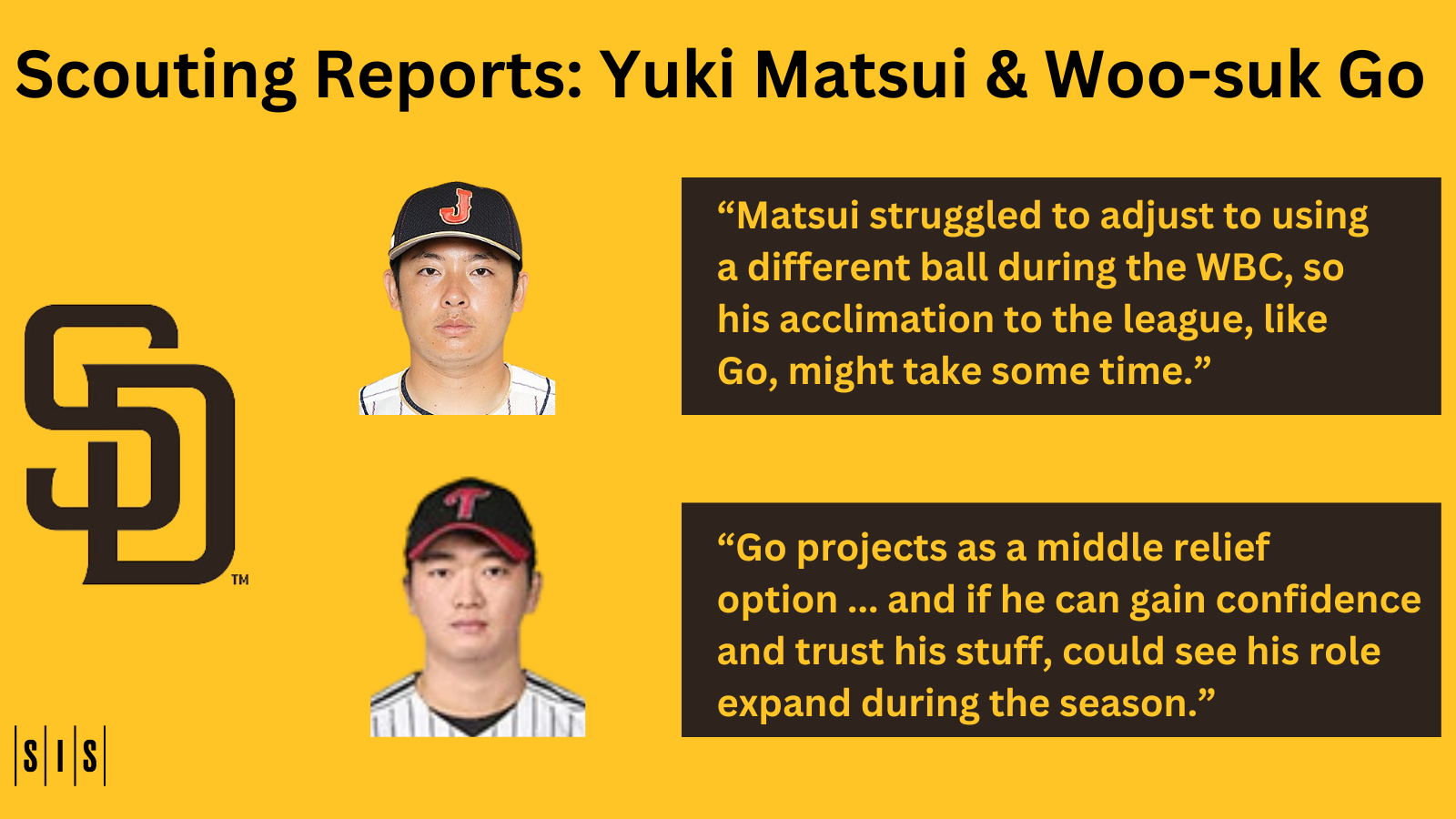
    Matsui struggled to adjust to using a different ball during the WBC, so his acclimation to the league, like Go, might take some time. Still, if he can keep his walks down like he did in 2023 success as a high-leverage reliever should follow.

    Woo-suk Go

    Season IP ERA Saves/Save Opp. Strikeouts Walks K-BB%
    2022 60 2/3 1.48 42/44 80 21 24%
    2023 44 3.68 15/17 59 22 19%

    After seven seasons with the LG Twins, Go was posted with a more shallow market for his services after an injury-plagued 2023 in which he missed time in May and his ERA ballooned after some bad outings. The most notable clunker came on April 30 when he walked two and gave up a weird high chopper for an RBI single. Then, three pitches later, he threw his slowest fastball of the year on a three-run home run. He was lifted and didn’t pitch again until June 4 due to an injury in his lower back. 

    He compiled a 31% strikeout rate last season to go with a high 12% walk rate. Go is a power pitcher who aggressively sprays the ball in and out of the zone and is an uncomfortable at-bat when he’s hitting his spots.

    What does he do well?

    Go is the hardest-throwing reliever in KBO, touching 98 mph on his fastball and comfortably sitting around 95 mph. His fastball gets flat at times, but he still has decently loud stuff for an MLB bullpen.

    Go’s arsenal is MLB caliber but with spotty control and command; he must consistently harness his secondary pitches and keep his fastball out of the middle of the zone. At times, he tries to be too fine with his pitches instead of trusting his stuff to play in the zone.

    There are numerous examples of cycling through pitch types with the catcher and trying to spot pitches perfectly on the edges.

    LG combatted by having their catcher set up in the middle of the zone and letting him rip pitches. Middle-of-the-zone fastballs won’t play as well in MLB, but he still throws 95 mph with a decent curve.

    via GIPHY

    Go pitches and feeds off of emotion and confidence so when he’s rolling he becomes even better. Bad outings can get away from him quickly because of walks. His stuff in KBO would just overpower lineups but stateside he needs to limit the walks for success.

    via GIPHY

    Mechanics

    Go has tinkered with his windup mechanics in terms of rhythm and timing. At points, he incorporated a glove tap into his movements and then he would completely scrap it during some outings or lessen it. To end 2023, he went back to a more substantial glove tap at the top of his leg lift.

    The Arsenal 

    Pitch Type Usage Velocity Strike % Whiff %
    Fastball 57% 94.5 mph 60% 25%
    Cutter 24% 91 mph 64% 28%
    Curve 15% 83 mph 65% 49%
    Slider 3% 85 mph 50% 46%

    Go tunnels his arsenal best when he works the zone vertically. Peppering the top of the zone with fastballs and then snapping off sharp breakers below the zone for chase. His curve has a baby spike grip and he can work the pitch both in and out of the zone.

    Curveball Grip

    via GIPHY

    He gets some gnarly chase swings at pitches and uses his curve to both righties and lefties. Against lefties, he will backdoor curves deeper into counts as well.

    via GIPHY

    Go primarily uses his cutter to keep hitters off his fastball. He is comfortable throwing the pitch glove so that it’s in on the hands of lefites or down and away to righties. He  occasionally throws it arm side on the edge versus left-handed batters.

    via GIPHY

    via GIPHY

    He also has a slider that he will use against better hitters. His cutter and slider have very similar grips. 

    Slider

    Cutter


    With the cutter, Go stays behind the ball, and on the slider, he tries to get to the outside of the ball. There are subtle differences in movement and velocity but based on signs he has thrown both pitches. 

    via GIPHY

    In San Diego, the team might try to tweak his slider and play around with grips to get even more horizontal movement, and with pitchers like Darvish on the team who helped Rōki Sasaki with his slider, Go might find a tunnel horizontally that works for him.

    With his sporadic control, a more consistent slider could help Go pitch not only north and south but also east and west so he doesn’t have to be as fine and can still generate whiffs.

    What to Expect

    Go projects as a middle relief option who has experience at the back of a bullpen and if he can gain confidence and trust his stuff, could see his role expand during the season. With his fastball and curveball, he should have no issues facing both lefties and righties out of the pen.

  • How Good is Jung-hoo Lee? Here’s Our Scouting Report

    How Good is Jung-hoo Lee? Here’s Our Scouting Report

    Jung-hoo Lee is a 25-year-old outfielder who after seven seasons playing for the Kiwoom Heroes in KBO was posted for MLB teams to sign. Lee has been one of the best players in Korea winning Rookie of the Year in 2017 and a league MVP in 2022 with 5 Gold Gloves during his 7 seasons.

    Lee has posted some gaudy offensive numbers in the last few seasons: 

    Season AVG OBP SLG OPS WRC+
    2020 .333 .397 .524 .921 139
    2021 .360 .438 .522 .959 162
    2022 .349 .421 .575 .996 175
    2023 .318 .406 .455 .860 139

    In comparison, Lee’s former teammate Ha-Seong Kim had a 141 WRC+ in 2020 in his last season in KBO. While Kim had more power in his swing before leaving Korea, Lee still drives the ball. His 150 doubles since 2020 are the most in KBO in that time.

    Lee had his 2023 season cut short after a fractured left ankle in July playing just 86 games but he did come back for one at-bat in October after surgery.

     What does he do well?

    Lee doesn’t have outlandish exit velocities but since March 2022, according to our Synthetic Statcast data, he has the highest average exit velocity of any KBO player at 89.6 mph. He consistently touches low-end hard-hit velocities as well. His 561 hard hits since 202 are easily the most in KBO. Lee also has high bat-to-ball skills and rarely strikes out with a 5.1% and 5.9% strikeout rate the last two seasons.

    Hitting Mechanics

    via GIPHY 

    Lee’s setup is unusual. Starting with an open stance with his feet shoulder-width apart. Lee then loads into his backside, storing energy and putting almost no weight on his front foot. He gets to this position early, before the pitcher’s hands break.

    He then has his head fully turned to the mound with both eyes fixated on seeing the ball early. With this move, he also loads his hands back slightly and puts his bat at an acute angle behind his helmet.

    As he moves forward he unleashes this energy with a short and quick swing finishing with high hands and either a one-handed or two-handed finish. His barrel control is impressive and his ability to spoil pitches and adjust his posture and bat head is an asset.

    Offensive Profile

    Lee is a patient hitter who tries to hit the ball hard and gets full swings off even in two-strike counts, and he’s a really good two-strike hitter. His contact in and out of the zone deep in counts lets him look for certain pitches early and work the count.

    Lee likes the ball on the inner-third and many teams in Korea tried to pitch him away because of this. He punished pitches on the inner third of the plate.

    Since 2020 he has hit .320  with a .616 slugging percentage and 1.071 against inner-third pitches with 27 HRs on those pitches. He understands his best chance to drive the baseball in the air is on inside pitches.

    Teams tried to pitch Lee away to neutralize his power but he takes his base hits the other way as well.

    via GIPHY


    Season Pull% Center% Oppo%
    2020 39% 35.5% 25%
    2021 46% 33% 22%
    2022 40% 38.5% 21%
    2023 44% 32% 24%


    He keeps the ball up the middle to his pull side for the most part but is disciplined enough to stay on off-speed pitches and fastballs away, displaying gap power to both left and right field. With a 37% hard-hit rate in 2023 and 32% in 2022, it makes sense that Lee wants to inflict damage on the pull side.

    via GIPHY

    Even though he doesn’t cut down on his swing often, he makes a lot of contact with only an 8% whiff rate since 2020. His ability to put the bat on the ball, especially in the zone, stands out. While he will ultimately face better pitching in MLB, the contact ability should translate.

    With a 41% swing rate he hunts pitches early in the count and while he does have some chase his knack for making contact out of the zone is also impressive. He has only 84 swinging Ks in 1,888 at-bats since 2020.

    Lee hits the ball on the ground a lot, sometimes hard enough to get it through the infield. With a ground ball rate of 58% in 2022 and 59% in 2023, it can explain his lack of power production. A 59% ground ball rate would have ranked 3rd in MLB among those with at least 300 plate appearances last season.

    via GIPHY

    This also led to Lee being “Full Ted” shifted (what we at SIS call three infielders on one side of the field.) As well as shaded up the middle (or what we call Partial Shifts) with two infielders on the weak side playing closer to 2nd base. To put this into perspective Lee was shifted on 55% of the balls he put in play in 86 games last season. That was second in the league behind Jose Rojas at 56%.

    With the limits placed on shifting in MLB Lee could still try and pull the ball even on the ground, but to tap into his power potential he will need to get the ball in the air more.

    With a high finish to his swing, when he gets the right pitch, he can backspin the ball out of the park. Lee hunts pitches to lift and pulls both when he has an advantage in the count and early on first and second pitches as well.

    via GIPHY

    via GIPHY

    Lee also does his most damage on fastballs, with a .358 batting average and .991 OPS, and 27 home runs against them since 2020. KBO fastballs sit more high-80s and low-90s so as with any player making the jump to MLB he will have to deal with consistently higher velos.

    He “struggles” against sliders and cutters if you can even call it that, still slashing .290 BA/.840 OPS against sliders and .273 BA/.724 OPS against cutters since 2020. Easily his worst performance against pitch types although he faced only ~300 cutters and ~1,600 sliders in that time frame compared to ~ 4,200 fastballs.

    His biggest adjustment will most likely come against not only higher velocity fastballs, more mid-90s than low-90s, but also more quality sliders and sweepers. Lee will probably be tested by high velocity early in MLB and then teams will start to mix in breaking balls and off-speeds if he shows the ability to routinely handle high velocity.

    Defense

    Lee’s defense is interesting. In 2022 Lee had -13 DRS in CF but would still flash moments of highlight-type grabs. Inconsistency and forcing throws contributed to this number. In his 2023 shortened season he had an outstanding 9 DRS. KBO players are judged using an MLB out probability basis and he performed very well last season.

    via GIPHY

    This huge fluctuation probably leaves Lee somewhere in the middle, as someone who can hold his own in CF for an MLB team, and with his athleticism he can make the plays he needs to. He profiles better as a corner outfielder though and with a strong enough arm to play RF over LF but he might get some run in CF for whatever MLB team he signs with.

    He’s comfortable going back or coming in. One quirk I noticed watching him is that he routinely tries to get around the ball to catch fly balls on backhands even when going to his forehand side and displays comfort in tracking the ball.

    OF Jumps:

    via GIPHY

    Backhands:

    via GIPHY

    With his above-average speed and solid ball tracking, he should be average to slightly above depending on what position he plays. He also uses his speed on the base paths but more to take extra bases rather than rack up stolen bases, with only 69 swiped bags in his KBO career. Although, the “Grandson of the Wind” can scoot when he needs to.

    via GIPHY

    The nickname is an homage to his legendary father Jong-Beom Lee, who won an MVP award in 1994. The older Lee also holds the record for the most stolen bases in a season with 84 during his MVP campaign, earning him the nickname “Son of the Wind”.

    What to Expect

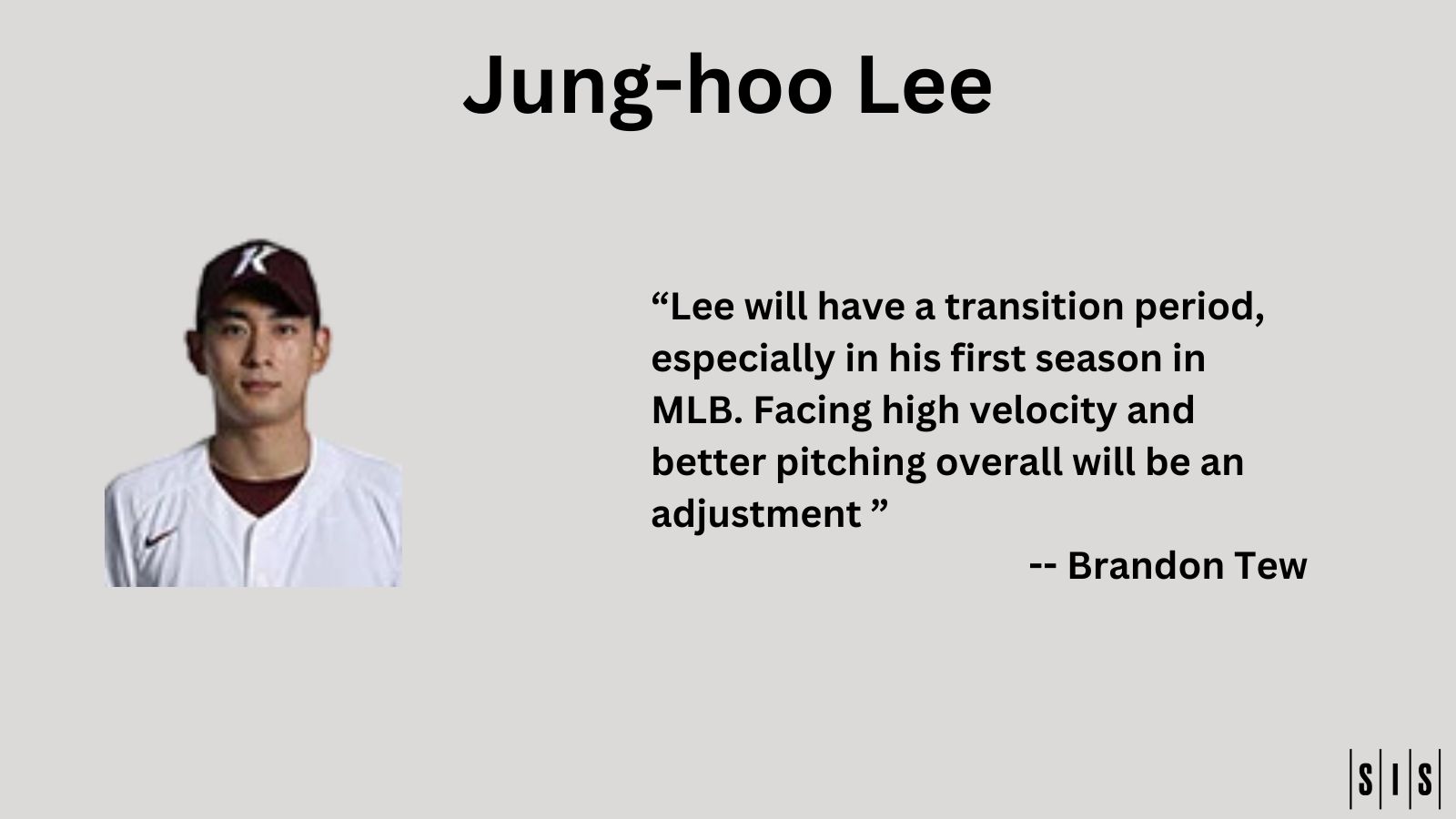
    Lee will have a transition period, especially in his first season in MLB. Facing high velocity and better pitching overall will be an adjustment. While he might never hit for much power, if he’s able to lift the ball a little bit more he can still pull the ball for home runs but might have modest homer totals overall.

    Lee projects as a high average and on-base leadoff hitter who is just entering his prime. He has the contact skills and batter’s eye to make an impact along with the defensive acumen and athleticism to hold his own at any of the outfield spots, with left field probably being his best fit.  Lee should turn into a solid to above-average player with some upside, a la Jeff McNeil, if he hits for more power.

  • 2023 KBO Fielding Bible Awards

    2023 KBO Fielding Bible Awards

    SIS is pleased to announce the winners of the 2023 KBO Fielding Bible Awards. This marks the 4th season that we have honored the best defensive players in KBO. The awards are chosen by a panel of experts who consider statistical analysis, the eye test, and any other factors that they wish to utilize. 

     We are also announcing the winner of our inaugural KBO Defensive Player of the Year award.

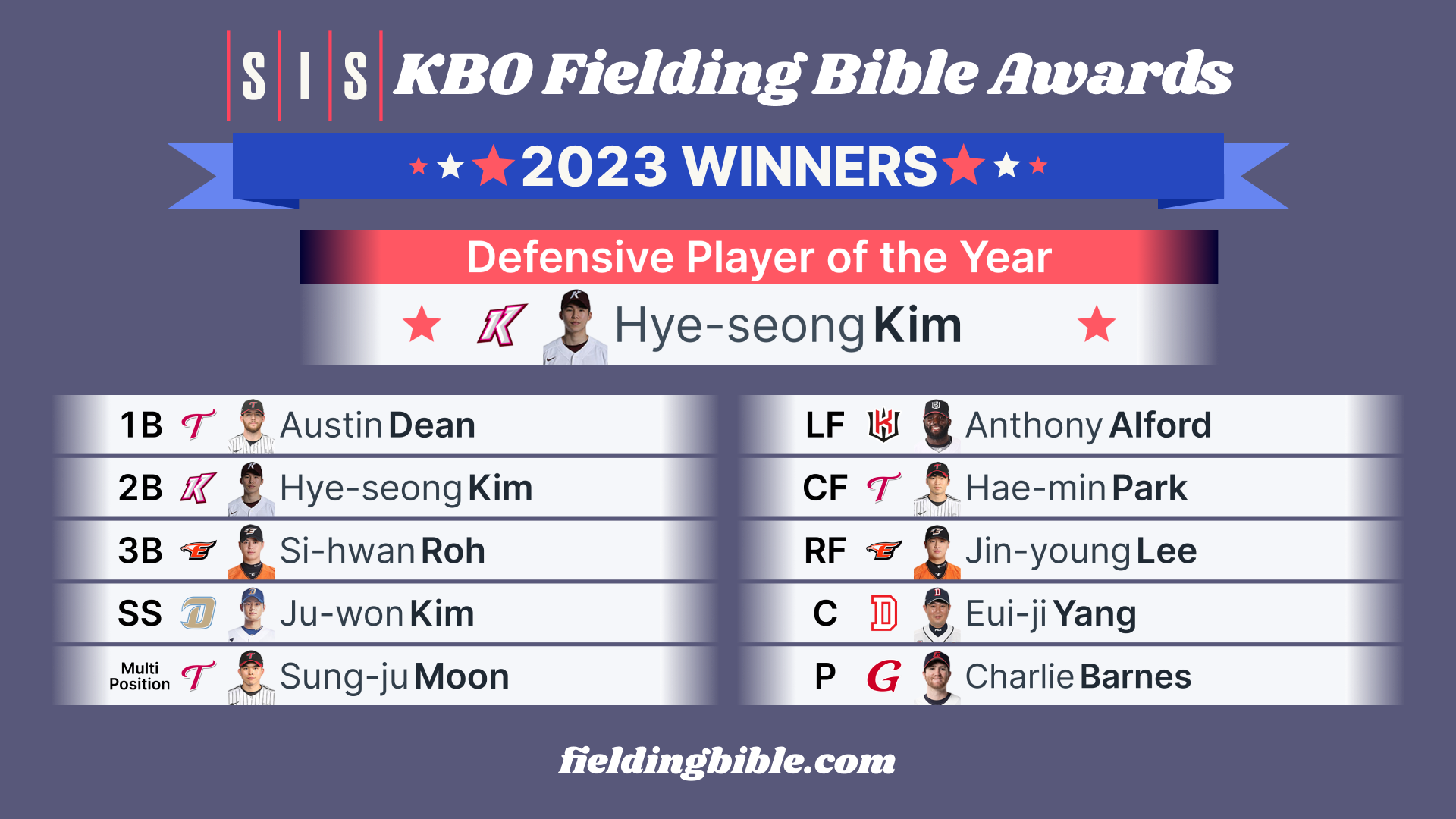
     This year’s winners are: 

    Position Name Team
    Player of the Year Hye-seong Kim Kiwoom Heroes
    1B Austin Dean LG Twins
    2B Hye-seong Kim Kiwoom Heroes
    3B Si-hwan Roh Hanwha Eagles
    SS Ju-won Kim NC Dinos
    LF Anthony Alford KT Wiz
    CF Hae-min Park LG Twins
    RF Jin-young Lee Hanwha Eagles
    C Eui-ji Yang Doosan Bears
    P Charlie Barnes Lotte Giants
    Multi-Position Sung-Ju Moon LG Twins


    Defensive Player of the Year

    Kiwoom Heroes second baseman Hye-Seong Kim is our inaugural KBO Defensive Player of the Year as well as the winner at his position. Kim had the most Defensive Runs Saved among the second basemen who qualified for the Fielding Bible Awards.

    Kim also led second basemen in Good Fielding Plays, a data point we track that includes plays that appear to have a high degree of difficulty, along with things like keeping the ball on the infield to prevent baserunner advancement.

    Kim has won the Fielding Bible Award at second base 3 times in 4 years.

    Other Winners

    Three former major leaguers won Fielding Bible Awards: LG Twins first baseman Austin Dean, KT Wiz left fielder Anthony Alford, and Lotte Giants pitcher Charlie Barnes

    Dean had played only 6 games at first base as a major leaguer and 32 as a minor leaguer but succeeded in a full-time role there in his first season in KBO for the league champions. Dean, Alford, and Barnes each led the pool of candidates at their respective positions in Defensive Runs Saved.

    Joining Dean were a pair of Twins teammates, center fielder Hae-min Park, and outfielder Sung-ju Moon, who won for multi-position excellence. This marked the 3rd straight year that LG had multiple Fielding Bible Award winners.

    The other KBO team with multiple players selected was the Hanwha Eagles, who were represented by third baseman Si-hwan Roh and right fielder Jin-young Lee.

    Joining Kim as a three-time Fielding Bible Award winner is LG Twins center fielder Hae-min Park. Doosan Bears catcher Eui-ji Yang won for the 2nd time.

    “Desire, physical skill, mental acuity and the endurance to perform at an elite level for the duration of a major league season,” said SIS VP, Baseball, Bobby Scales. “That is what defines an elite defender. These 10 individuals have displayed elite defense and then some over the course of the KBO season.” 

    Our expert panel that helped pick the winners were KBO media: Jeeho Yoo (Yonhap News) and Dan Kurtz (MyKBO.Net). Our Defensive Runs Saved stat was used to assist with the voting process.

    The history of the KBO Fielding Bible Awards (which began in 2020) can be found online here

  • WBC Players to Watch: Cuba, Chinese Taipei, China

    WBC Players to Watch: Cuba, Chinese Taipei, China

    There are many players participating in the World Baseball Classic that will be familiar to MLB fans. Team USA, among others, will be made up entirely of current Major League players. However, many teams will be featuring professional players outside of North America. In previous pieces, we looked at prominent NPB hitters & fielders and pitchers and KBO hitters, fielders, and pitchers.

    That doesn’t quite cover everyone that we want to talk about. Remember, we cover the game globally, and thanks to our NPB and KBO data we can tell you about players on some of the other WBC teams that you might want to check out.

    Cuba

    Team Cuba features many talented Cuban players and for the first time Major League stars will be participating in WBC play as well. Team Cuba features a nasty bullpen with two relievers from NPB who have been at times dominant out of the pen in Japan. 

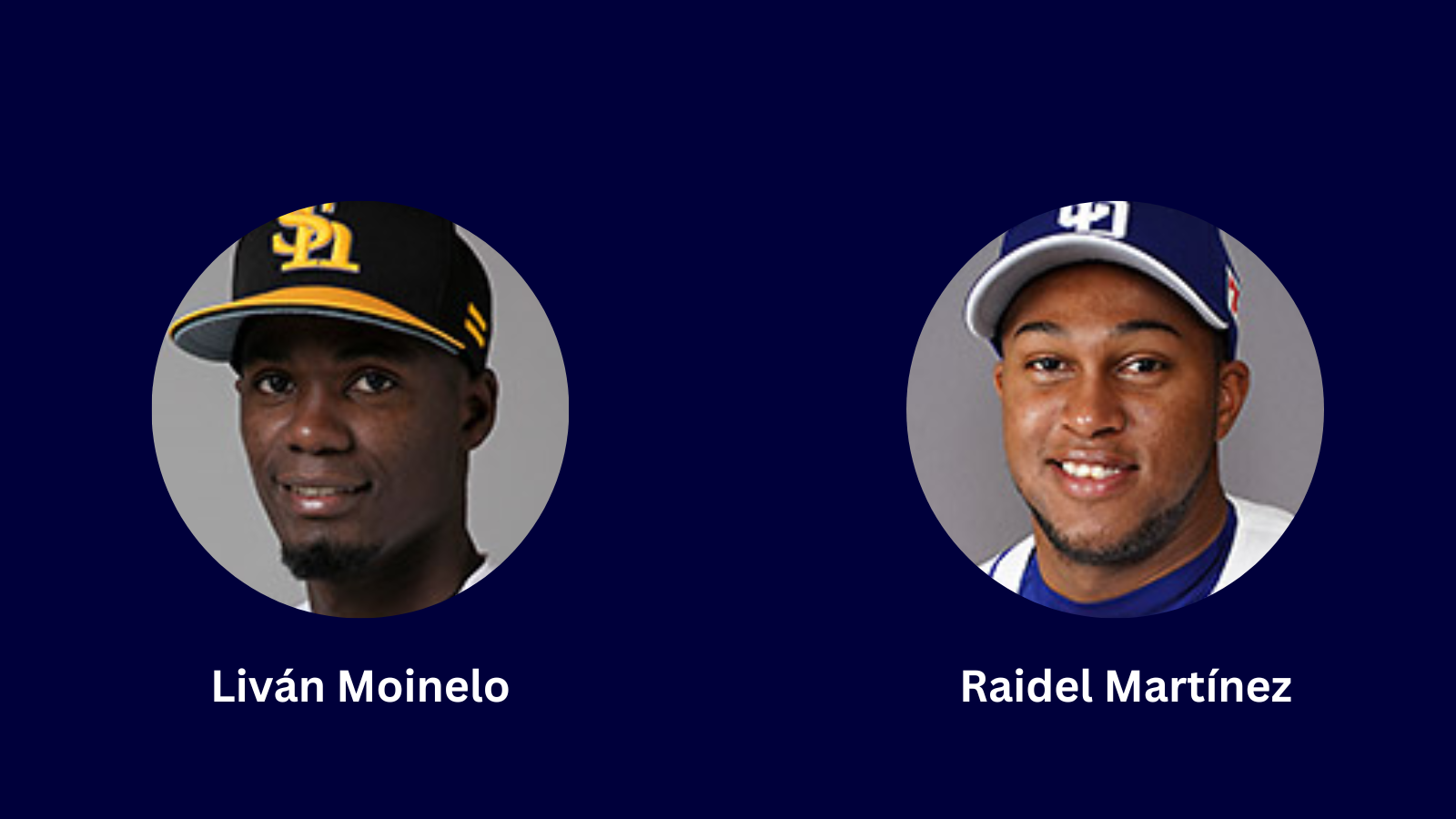
    Starting with Liván Moinelo who is as nasty as they come. Moinelo took over the closer role this season for the Softbank Hawks and produced his best season so far in NPB. Last season he posted his best K/9 at 14.9 and actually got his BB/9 down to 3.4, the lowest of his career last season. 

    The stuff is there but control has always been the question mark for him as he can snap his head off target causing him trouble in locating his pitches consistently. His 43% strikeout rate ranks 1st among the 66 pitchers with at least 35 innings pitched. His 9.9 % walk rate was the 15th-highest. 

    He has a 12.7 K/9 and 4.2 BB/9 in his six seasons in Japan. Moinelo is a wild card in terms of control but if he is throwing strikes, Team Cuba will have a menace on the mound because of his pure stuff. 

    Moinelo’s heater sits around 94-95 mph and has amazing ride at the top of the zone. Here he is slamming the door shut for one of his 24 saves last season. 

    via GIPHY

    Add in a slider at 88 mph and a changeup around 83 mph and Moinelo at times is unhittable in NPB. The lefty power pitcher has racked up his fair share of swords with all of his offerings. Here’s a look at the slider and changeup. His stare in after a decent take on his changeup shows just how much he expects to strike guys out when he’s dialed in.

    via GIPHY

    via GIPHY

    By the numbers, his changeup is his best offering with an opponent batting average of just .036 and a whiff rate of 35% on the pitch. His ability to neutralize right handed hitters with the pitch was a big step this season.

    To me his curveball has the most potential though, and is arguably one of the best curveballs not in MLB. The breaking pitch is a lethal mix of spin and velocity. The curve just drops out of the sky and into the strike zone at around 80 mph.

    via GIPHY

    Raidel Martinez was the most successful closer last season in NPB. He led the league in saves with 39 and had a sub one ERA at 0.97 Moinelo was at 1.03. Pitching for the last-place Chunichi Dragons in the Central league, Martinez was lights out. 

    He’s 95-97 mph with the fastball from the right side mainly thrown at the top of the zone.It has good ride when it’s on, but can flatten out if he doesn’t stay on top of the ball and repeat his delivery well. At its best it stays above the barrel as a swing-and-miss pitch.

    via GIPHY

    He also has a slider that generates depth hovering around 90 mph. It’s average but flashes potential and is a pitch he can mix in to keep hitters off of his fastball up.

    via GIPHY

    His splitter is late diving and his best secondary offering. He racks up a lot of strikeouts with the pitch but has also been using it as a weak contact inducer. Getting lefthanded hitters to roll over on the pitch a lot this past season.

    via GIPHY

    He keeps mixing in a slower changeup as a change of speed pitch especially early last season this one was around 82 mph. It’s solid but the splitter is always going to be his main secondary.

    via GIPHY

    Something in his back pocket is the ability to quick-pitch with such a high leg kick and slower tempo Martinez does speed up his delivery at times and catches batters looking. This at-bat ended in a quick pitch as Shiomi Yasutaka goes back to the dugout shaking his head. With major strides in control, Martinez is able to do more things like this to disrupt timing.

    via GIPHY

    Both of these Cubans will get a chance to display their talents to scouts this WBC and both might have futures as high-leverage relievers in MLB if they choose to ever sign with a team. After battling control issues early both seem to have turned the corner and are ready to shut down teams when the bullpen door swings open for Team Cuba.

    Chinese Taipei (Taiwan)

    Team Chinese Taipei will showcase many players with brief MLB experience, such as pitchers C.C. Lee and Chih-Wei Hu, and defensive standout infielder Tzu-Wei Lin. Current Red Sox infielder Yu Chang will likely also play a big role on the team.

    The most interesting pitcher on Team Chinese Taipei is 21 year old right hander Jyun-Yue Tseng. Tseng has a very small frame for a pitcher (he’s listed at 5’8” and 149 lbs), but he can still generate high velocity. Here he is throwing 96 MPH with some tailing action:


    Tseng has been a dominant reliever in Taiwan so far, striking out 126 hitters and posting a 2.31 ERA over 105 ⅓ innings. The WBC is a good opportunity for Tseng to showcase his stuff against teams with multiple major leaguers like The Netherlands and Cuba in pool play.

    On the position player side, Po-Jung Wang and Nien-Ting Wu both have significant playing time in NPB.

    Wang is a legend in Taiwanese baseball, though he has struggled recently in Japan. The 2016 season was his first full season playing in Taiwan, and he dominated the league. He became the first player in CPBL history to reach 200 hits in a season (the previous record was 176), and finished the year with a .414 batting average.

    From 2015 through 2018 Wang hit .386 with a 1.100 OPS and 86 home runs in 378 games in Taiwan. He was posted after the 2018 season and signed with the Nippon-Ham Fighters. While he has punished farm team pitching, he has struggled in NPB games, as the outfielder has managed only a .235 career average since the move.

    Wang has primarily played left field for Nippon-Ham, with occasional appearances in right field and at DH. He grades out really well as a left fielder by DRS, but his playing time has diminished as his hitting struggles have continued. Wang will hope that getting some games against lesser pitching in WBC pool play will jump-start his bat for this season.

    Wu is a utility infielder who spent time at first, second, and third base last year for Seibu and graded out as serviceable at all three spots, with his range holding him back.

    As a hitter, Wu has struggled to hit for average in NPB, but has managed to post on-base percentages above .300 in each of the last three years due to his approach at the plate. Like Wang, Wu will hope to have a surprise showing facing pitching that is not of the same caliber he is used to facing in NPB.

    China

    Team China does not have many familiar names to North American fans. Veteran minor leaguer Ray Chang is the most accomplished player on the team, having spent 12 seasons in the minor leagues. However, Chang has not played affiliated baseball since 2016.

    On the pitching side, Team China features an interesting KBO pitcher Kwon Ju of the KT Wiz. Ju has spent the last 4 seasons pitching exclusively in relief, and has averaged less than an inning per appearance in the last three seasons.

    Ju takes the idea of pitching backwards to the extreme. He only averages 89 MPH with his fastball, but he only threw a fastball 31% of the time last year. He leans on his changeup and the occasional splitter (he threw them a combined 62% of the time) to mess with a hitter’s timing.

    Since Ju’s changeup is not as taxing on the arm, Team China may opt to use him in longer outings or potentially as a starter (he has 51 career KBO starts). Regardless of how he is used, hitters will have to adjust to his unique approach on the mound.

  • World Baseball Classic Preview: KBO Hitters & Fielders

    World Baseball Classic Preview: KBO Hitters & Fielders

    South Korea is typically a strong nation in international baseball competitions, and this year’s World Baseball Classic team is a favorite to advance out of their pool. Team Korea’s lineup will be headlined by Cardinals shortstop Tommy Edman and Padres infielder Ha-seong Kim, with former Orioles outfielder Hyun-soo Kim playing a supporting role, among others. 

    Outside of those three, many players in key spots will be unfamiliar to many North American fans. So let’s preview some of their key players from the KBO, a league that we watch intently here at Sports Info Solutions:

    The Young Bats

    Team Korea has two young left-handed hitters who will line up in the middle of the order for the WBC. The first is Jung-hoo Lee, a 24-year-old outfielder for the Kiwoom Heroes. Lee is the best pure hitter in the KBO, with a career batting average of .342 and more career walks than strikeouts. Last season Lee did his best Tony Gwynn impression, posting a tiny 5% strikeout rate with an 11% walk rate.

    His bat to ball skills and discipline are paired with modest game power, though his raw power suggests more room for growth. Lee ranked fourth in the KBO last season with an average exit velocity of 89 MPH according to our Synthetic Statcast model (SIS replicates Statcast data for non-MLB leagues), and he also finished in the top 10 in hard-hit rate (38%) and expected BABIP (.388). His swing currently produces a lot of line drives, which limits his ability to drive balls out of the park, though the raw power he has suggests he could sacrifice some batting average for more power with mechanical changes.

    Defensively Lee has played exclusively in center field the last two seasons, and will likely line up in center for Team Korea. He is a natural athlete, but doesn’t have the elite instincts needed to play a high-end center field and profiles better in a corner spot long-term. His baserunning is similar, as he is a good baserunner due to his natural athleticism, but does not have elite speed or base stealing ability.

    Lee will be hoping to use the WBC as a chance to showcase his hitting skills against elite pitchers, as he is expected to be posted by Kiwoom after the 2023 season. His first chance to test himself will be against Team Japan in pool play, with Japan having one of the deepest pitching staffs in the tournament.

    Joining Lee in the heart of the lineup will be KT Wiz first baseman Baek-ho Kang. Kang is very much a bat-first player who has adjusted his approach during his time in the KBO. In his rookie season Kang set his career highs in home runs (29) and strikeouts (124), but since then has traded some home run power for more contact and gap power.

    Despite his strong performances in the KBO, there are some storylines worth following with Kang in the WBC. He took a lot of criticism for how he reacted to Korea’s disappointing fourth- place finish in the Tokyo Olympics, though he did hit .308 with a double and 4 RBI over the tournament.

    Kang also dealt with some adversity in the KBO for the first time last year. He missed the first couple of months of the season with a toe injury, and also missed a month and a half with a hamstring injury. Between the injuries Kang struggled to produce at the plate for the first time in his career, posting career lows in many categories in his statline. 

    His advanced metrics show how much the injuries limited his game. His hard-hit rate dropped from 33% to 26%, and his average exit velocity was down by 1 MPH. Despite increasing his average launch angle in 2022, he set a new career low with only 6 home runs and a .371 SLG over 62 games. He will be looking to rebound in 2023, and hopefully a strong showing in the WBC will help him get off to a good start this year.

    The KBO Veterans

    Beyond the MLB players and potential future stars, Team Korea has some veteran players rounding out the lineup from the KBO. Alongside Hyun-soo Kim, who fans likely remember from his time in Baltimore, Byung-ho Park is the other position player with MLB experience. Park signed a four-year deal with the Minnesota Twins before 2016, but struggled in his limited MLB opportunities. He requested his release two years into the contract to return to the KBO.

    Park was a notable prospect for his power, which he did show in his brief MLB look, hitting 12 home runs in 62 games. Now 36 years old, Park is still hitting the ball hard as he led the KBO in hard hit rate last year at 41%, while also finishing second in average exit velocity (just under 90 MPH) and sixth in average launch angle (just over 18 degrees).

    Park’s continued success hitting for power has him fourth all-time in KBO home runs despite a slow start to his career and missing two of his prime years playing in North America. At 362 career home runs, he is only 12 behind Dae-ho Lee for third all-time.

    Park will likely line up at first base for Team Korea, with fellow KT Wiz teammate Baek-ho Kang will likely be the DH. The veteran Park is a much better defender, and won the KBO Fielding Bible Award at first base this past season.

    Across the diamond at third base will be another KBO veteran, and one of the most accomplished KBO hitters in history, in Jeong Choi. He produced a SLG above .500 in each season since 2010 and from 2010-2021 he had an OPS of .900 or better every year, falling just below that benchmark in 2022 (.891).

    Choi ranks 17th in KBO history in hits and is second all-time in home runs. He is only 7 hits away from reaching 2,000 career KBO hits, and is 38 home runs behind Seung-yeop Lee  in all-time KBO home runs.

    Choi’s formula for success is quite simple, as he hits the ball hard and in the air. Choi led the KBO in average launch angle last season, checking in just under 22 degrees. Combining that with his good raw power (he’s in the top 25 in average exit velocity and hard hit rate) allows him to maximize his power output.

    Team Korea will also rely on a veteran behind the plate, with 14-year veteran catcher Eui-ji Yang of the NC Dinos. Yang is a solid defender, having won the 2020 KBO Fielding Bible Award at catcher, and has plenty of experience calling games and leading pitching staffs.

    However, Yang really shines in the batter’s box. He has always been able to make contact, evidenced by high batting averages and low strikeout rates, but he tapped into more power later in his career by increasing his launch angle. He has walked more than he has struck out in four of the last five seasons, while posting his best power numbers during that time as well.

    In the outfield, Sung-bum Na will look to add some power from the left side of the plate to Team Korea’s lineup. Na attracted some interest from MLB teams after the 2020 season, but was unable to find a contract to his liking and returned to the KBO. Na has big power, and in 2021 he finished in the top 5 in average exit velocity and hard hit rate in the KBO. He didn’t quite match that in 2022 but still had solid numbers in those areas.

    Na also features some flaws in his game that can be exploited. He strikes out a lot, with his strikeout rate sitting between 20% and 25% each of the last few seasons. He has been in the top three in the KBO in strikeouts in each of the last three seasons.

    Na also dealt with a gruesome injury in 2019, and his mobility has suffered since returning. He is not a threat on the bases, and he has lost range in the outfield. Expect him to be replaced with a defensive replacement or pinch runner in the WBC.

    The KBO Fielding Bible Award Winners

    The KBO is not a league known for having elite defense. Most position players in the league are rated below MLB average by DRS, and some drastically so. However, Team Korea has made sure to fill the roster with some of the best defensive players in the country, particularly ones who grade out as MLB average or better.

    On the infield, Hye-seong Kim of Kiwoom has won two KBO Fielding Bible Awards at second base (2020 and 2022), as well as the 2020 multi-position Fielding Bible Award. Primarily a second baseman with Kiwoom, he was the double play partner of Ha-seong Kim before he joined the Padres. Hye-seong Kim has also played shortstop and left field in recent seasons, and could also pinch run for Team Korea in the WBC (he has three seasons of at least 30 steals, with a career best of 46).

    Also available on the infield is Ji-hwan Oh, who has won the KBO Fielding Bible Award at shortstop in each of the last two seasons. He likely would have battled Hye-seong Kim for a starting role on Team Korea had Tommy Edman not joined the team for the WBC.

    Since we started awarding the KBO Fielding Bible Awards in 2020, the center field award has been won by either Hae-min Park (2020 and 2022) and Ji-hoon Choi (2021). Both players are on Team Korea for the WBC, and could either start in center field (moving Jung-hoo Lee to a corner) or more likely come off the bench to upgrade the corner outfield defense in the late innings.

    Park is a speedster who covers a lot of ground and can steal bases, though he has cut back on his stolen bases a little as he entered his thirties. At 25 years old, Ji-hoon Choi is 7 years younger than Park, though he is a very similar player as a left-handed hitting speedster with modest power.

    Team Korea has built a well-balanced roster for the WBC, with some young stars, veteran leaders and quality supporting players. A big test for this position player group in pool play will be how they manage to do against the powerful pitching staff of Team Japan. Once out of pool play, the pitching it faces is expected to be much tougher, and their hitters ability to adjust to high-end pitchers will determine how far the team goes.

  • WBC Preview: Team Korea Pitchers to Watch

    WBC Preview: Team Korea Pitchers to Watch

    Almost every team in the World Baseball Classic struggles with pitching depth. With pitch counts and pitchers still stretching out for the season, teams need contributions from all over their roster. Team Korea is no exception, as it will be missing two pitchers who could have been rotation anchors in Hyun-jin Ryu and KBO ace Woo-jin An (note, you may see some of these names differently depending on where you see them – Korean naming convention is traditionally last name first).

    Team Korea will still feature pitchers with plenty of experience in the KBO, and a couple with MLB experience as well in Kwang-hyun Kim (2020-21 with St. Louis) and Hyeon-jong Yang (2021 with Texas). Beyond those two, the team features pitchers who have performed well domestically in the KBO as well.

    At Sports Info Solutions, we watch a lot of KBO as part of the data tracking we do. So we’re well-versed in their players. We will be highlighting some of their top pitchers here.

    Potential Starters

    Kwang-hyun Kim will be the ace of Team Korea, but how the rest of the rotation lines up is still up in the air. Fellow lefty Chang-mo Koo will likely also start in the WBC, and is one of the best KBO pitchers when healthy. Health is a bit of a concern for Koo, who has thrown only 205 innings over the past three seasons, and missed all of the 2021 season.

    Koo gained popularity for his lights-out performance early in the 2020 KBO season, before getting hurt later in the season. Koo commands his fastball well, which is necessary as he averages 89 MPH with the pitch. His slider is one of the best breaking balls in the KBO, and while he doesn’t throw it very hard at 82 MPH, it has good horizontal movement and had a 36% whiff rate last season.

    Koo also throws a good splitter almost exclusively to right-handed hitters, who clearly struggled with it as evidenced by a 38% whiff rate against the pitch. He also rounds out his repertoire with a slow, loopy curveball that he uses as a change of pace pitch.

    Tae-in Won from the Samsung Lions will also likely start games for Team Korea. Won lacks a power fastball (he averaged 90 MPH last season), but he has a great changeup with a strong 12 MPH velocity differential from his fastball with really good two-plane fade. He also has improved his slider and added a cutter, as we covered last season.

    Won is also a good fielder at his position, winning the 2022 KBO Fielding Bible Award at pitcher. For a right-handed pitcher, Won is exceptional at controlling the running game. In 2022 he allowed only 6 stolen bases all season, while also picking off 6 runners.

    Eui-lee Lee  may start or come out of the bullpen for Team Korea, but the Kia Tigers’ lefty is one of the best young pitchers in the KBO. Lee can be effectively wild at times, but he provides Team Korea with their strongest arm from the left side (his average fastball velocity was 91 MPH as a starter last year).

    Lee also throws one of the hardest curveballs in the KBO, which averages 78 MPH. He rounds out his repertoire with a slider that he will use against left-handed and right-handed hitters, and a changeup that he uses exclusively against right-handers. The slider and changeup are his least used pitches, but he sets them up well which makes them his best swing-and-miss pitches.

    Doosan Bears starter Been Gwak is the most likely of the starters to transition to the bullpen for Team Korea, as he is less established than the other starters. Gwak has more velocity on his fastball than most KBO starters, averaging 92 MPH as a starter last season. Team Korea could be hoping that his fastball plays up in short stints, but it is also worth noting that his fastball was hit quite hard by KBO hitters last year.

    Gwak brings a deep repertoire to the table, and he could cut it down to just his best pitches working in shorter stints. His slider, splitter and curveball all had whiff rates above 30% last season.

    LG Twins Relievers

    As a league, the KBO does not feature a lot of pitchers with high velocity, with most pitchers featuring high 80s fastballs and good offspeed pitches. The LG Twins have two of the best power relief prospects in the league, and both will be featured on Team Korea.

    Woo-suk Go is LG’s closer, and the hardest throwing relief arm in the KBO. His fastball sits at 95 MPH and touched 98 last year, and he has thrown it over 50% of the time. Instead of featuring a changeup or splitter, Go relies on three breaking balls (a cutter, slider and curveball). His breaking balls can all overlap in shape and velocity, but he throws them all well above the KBO average velocity for each pitch type.

    Go is still young at 24 years old, and he has steadily brought his walk rate down the last few years. He also has a lot of experience in high leverage situations with 124 career KBO saves, including a career best 42 saves in 44 opportunities in 2022. Expect him to be pitching high- leverage innings for Team Korea.

    While having a flamethrower like Go in the bullpen is a luxury for most KBO teams, the Twins have two relievers with big fastballs to shut down opponents late in games. Woo-young Jung, LG’s 23 year old setup man, just trails Go in average velocity at 94 MPH on his fastball which still makes him one of the hardest throwers in the KBO.

    Unlike Go, who primarily pitches from a standard ¾ arm slot, Jung is a sidearming righty who gives batters a bit of a different look. Due to his arm slot, Jung’s fastball gets a lot of sink and tail which makes it difficult to square up and elevate. In 2022 Jung’s fastball produced grounders on 72% of balls in play and he  gave up only 3 home runs all season. This is even more impressive when you consider he threw the fastball over 90% of the time, so hitters were often sitting on fastballs.

    Overall, Team Korea may be light on power in the pitching department, but the staff is fairly deep with pitchers who have had success in a strong league. Should the team make it out of pool play, the depth of their staff will be tested by the strong offenses of teams that make it to the knockout rounds.

  • 2022 NPB & KBO Fielding Bible Awards

    2022 NPB & KBO Fielding Bible Awards

    For the third straight year, Sports Info Solutions is rewarding defensive excellence on a global level. Today, we announce the winners of the NPB and KBO Fielding Bible Awards.

    The awards were voted on by a panel of experts and members of SIS’ operations staff, who spent the entire season tracking NPB and KBO games. Among our voters were Jeeho Yoo (Yonhap News Agency, South Korea), John Gibson (Japanese Baseball Weekly Podcast), and Jason Coskrey (Japan Times).

    Each voter ranked their top three players at each position in the league they covered, as well as a multi-position (utility) player, with 5 points awarded for a first-place vote, 3 for second and 1 for third. Eligibility for voting was based on playing-time requirements.

    (note that in accordance with Japanese and Korean customs, we are listing the players with their family name first)

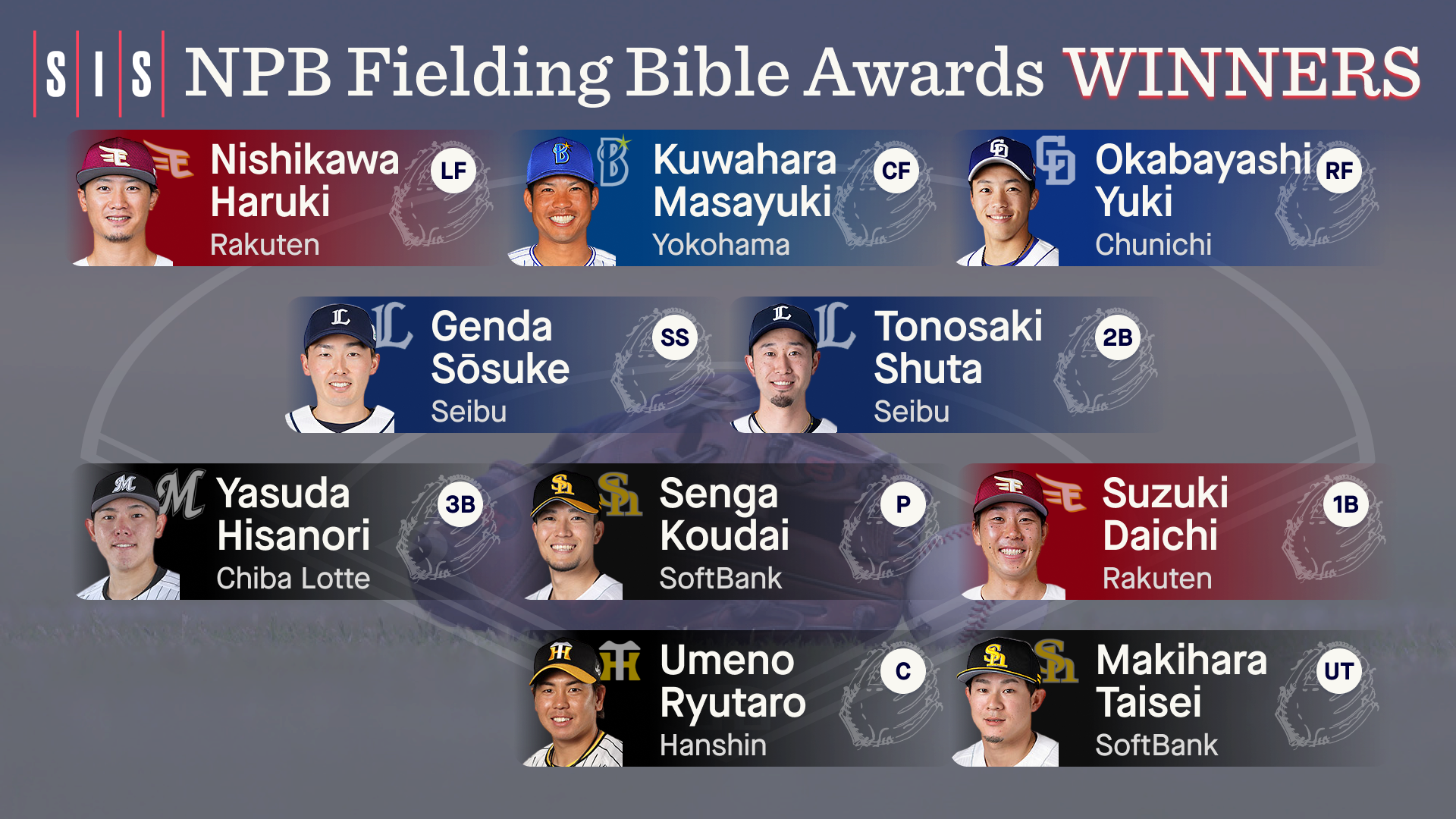
    Seibu Lions shortstop Genda Sōsuke became the first NPB player to win a Fielding Bible Award at the same position twice in the award’s three-year history. Genda, who previously won the award in 2021, saved 20 runs with his defense this season, easily the most among NPB shortstops

    Genda’s Seibu teammate, second baseman Tonosaki Shuta, also won the Fielding Bible Award at his position. Tonosaki led NPB second basemen with 26 Runs Saved. Genda and Tonosaki had more Runs Saved at their positions than any MLB player.

    Two other pairs of teammates won, first baseman Suzuki Daichi and left fielder Nishikawa Haruki of the Rakuten Golden Eagles and pitcher Senga Koudai and multi-position player Makihara Taisei of the Fukuoka SoftBank Hawks. Senga is one of the top free agent pitchers and is available to MLB teams this offseason. Makihara goes by the nickname “King Joker” because of his utility role.

     Nishikawa, Genda, Tonosaki, Okabayashi Yuki (right field), and Umeno Ryutaro (catcher) were the winners who recorded at least 10 Runs Saved at their respective positions. Umeno had arguably the most dominating season in the league, finishing with 23 Runs Saved. The next-closest catcher among eligible candidates had only 12.

    The LG Twins led KBO in Defensive Runs Saved in 2022 and their players earned the rewards of that. Five of them won a Fielding Bible Award at their respective position.

    Catcher Yoo Kang-nam, shortstop Oh Ji-hwan, third baseman Moon Bo-gyeong, center fielder Park Hae-min, and right fielder Hong Chang-ki all were winners for LG. Oh, Kim, and Park each won at their positions for the second time, the only three players who have won twice at their positions in the three-year history of the award

    Yoo, Moon, and Hong were the three winners to finish with at least 5 Runs Saved at their respective positions. Defensive Runs Saved are calculated using an MLB basis and KBO Runs Saved totals are generally considerably lower than their MLB counterparts.

    Two former major leaguers won a Fielding Bible Award. First baseman Park Byung-ho, who played for the Twins in 2016, won in his first season with the KT Wiz, for whom he also hit 35 home runs. And left fielder José Pirela, who also had a great offensive season, was one of two winners on the Samsung Lions along with pitcher Won Tae-in. Pirela formerly played in the majors from 2014 to 2019 for the Yankees, Padres, and Phillies.

  • KBO Scouting Report: Eui-lee Lee

    KBO Scouting Report: Eui-lee Lee

    Despite not being known as a league with great pitching, the subset of players who have transitioned best from the KBO to MLB are left-handed pitchers. Last season Hyun-jin Ryu, Kwang-hyun Kim and Hyeon-jong Yang all pitched for MLB teams.

    Unfortunately for the South Korean national team, that meant all three of those pitchers were unable to participate in the Olympic baseball tournament last summer. Add in that the top KBO lefty, Chang-mo Koo, missed the whole season with injury, South Korea had to dig deeper for a left-handed pitcher to add to their staff.

    It was still surprising to see Eui-lee Lee of the Kia Tigers be named to the team, as he had just turned 19 less than two months before the Olympic tournament started. But he held his own against both the Dominican Republic and the United States.

    That showing was impressive for a teenager, and Lee has continued to perform well in the KBO. For his career he has a 3.86 ERA, and is averaging roughly a strikeout per inning in a league in which pitchers typically strike out about 7 batters per 9 innings. His 4.07 ERA in 2022 is right around the KBO average of 4.05. 

    It is unclear if he will be part of the South Korean team at next spring’s World Baseball Classic as Kim, Yang and Koo should all be available, but he is a name to keep an eye on.

    What are the keys to Lee’s success?

    By KBO standards, he is a power arm, averaging 91 MPH on his fastball which makes him one of the harder left-handed throwers in the league. He leverages that advantage by using his fastball 64% of the time, and it is the pitch he can locate best, getting strikes on 69% of his them.

    He will often sit around 92 with the fastball in his starts, but he will occasionally lose some velocity deeper into games.

    Lee has also proven to be adaptable, and is still refining his secondary pitches, though the results are encouraging 

    Pitch Avg Speed Usage % Whiff % Whiff % vs RHB/LHB
    Curveball 78 13% 31% 40%/20%
    Slider 82 12% 38% 50%/33%
    Changeup 84 11% 42% 43%/0*

    *Only 2 changeups thrown to left handed batters this season with 1 swing against.

    His secondary offerings are still works in progress, though it is interesting to note he has better whiff rates versus right handers on all four of his pitches.

    His curveball has good shape, and he has improved his confidence with the pitch. He threw only 9 curveballs over his first 5 starts, but it has become his most trusted secondary pitch this summer.

    His slider will sweep across the zone, and he tends to use it in favorable matchups, with the usage of the pitch varying drastically from start to start.

    The changeup was his go-to secondary offering to start the season, as he threw 68 over his first 4 starts. He has cut his changeup usage since then but, like with his slider, he will vary the usage depending on matchups.

    The changeup has improved during the season in terms of shape as well. Early on, it was very straight, essentially looking like a slower version of his four-seam fastball. He has added some fade to the pitch as the year has progressed.

    Where can he improve?

    Lee’s success is due largely to the quality and power of his pitches, and how he plays them off each other. As he gets older and continues to develop, he will need to get better at locating his pitches.

    I already mentioned that his fastball is his best pitch for getting strikes, at 69%. Despite the big whiff rates on his secondary pitches, he still struggles to get strikes with them. 

    All of his secondary pitches result in strikes 60% of the time (the slider) or less (curveball and changeup both have a 52% strike rate). By comparison, MLB strike rates are 63% for sliders, 61% for curveballs and changeups.

    A lot of his balls thrown are non-competitive pitches as well, and what jumped out the most to me on video was the number of pitches he throws in the dirt.

    First, a look at the pitchers with the most pitches that have not reached home plate:

    Most Pitches Bounced in Front of Home Plate – KBO
    Eui-Lee Lee Kia Tigers 44
    Min-woo Kim Hanwha Eagles 39
    Woo-jin An  Kiwoom Heroes 32
    Hyeon-jong Yang Kia Tigers 31
    Je-seong Bae KT Wiz 29

    Obviously some pitches in the dirt are intentional, particularly breaking balls in two-strike counts. But looking at breaking balls in the dirt shows where his command issues are most obvious. 

    KBO Percentage of Non-Fastballs Thrown in Dirt
    Eui-Lee Lee Kia Tigers 22%
    Casey Kelly LG Twins 17%
    Je-seong Bae KT Wiz 17%
    Eric Jokisch Kiwoom Heroes 16%
    Hyeon-jong Yang  Kia Tigers 16%

    *Note for this leaderboard “in dirt” can refer to pitches that bounce before or on/after the plate

    What does it all mean?

    Overall, Eui-lee Lee is still one of the better pitchers in the KBO, even with his ERA being what it is. His power from the left side overpowers hitters, regardless of the location of his pitches. Lee is one of only four KBO pitchers with 80 innings pitched who is averaging more than a strikeout per inning, with the others being Woo-jin An, Drew Rucinski, and Glenn Sparkman.

    He is still very young, and has shown that he is still developing as he works on his secondary pitches. He has the opportunity to be an elite KBO starter if he can improve his control.

    Despite his wildness, his walk rate has dropped from 14% last season to 9% in 2022. My theory is that as his stuff improves and he adds some velo while he fills out, hitters will cheatmore to catch up to the fastball, and are more prone to chasing bad pitches when they guess wrong. But then as hitters adapt, his walk rate will likely start to climb again.

    Even if his control does not improve, he could still have a solid career as a mid-rotation power pitcher in the KBO, and his power stuff gives him a chance to be a high-end bullpen arm for both Kia and the National Team for years to come.

  • KBO Watch: Tae-in Won Changes His Approach

    KBO Watch: Tae-in Won Changes His Approach

    KBO teams are always trying to piece together a rotation to get them to the playoffs, and the best way to do that is to develop a pitcher who can stick with your team for the better part of a decade (or longer). 

    Of course pitching development is complicated, but finding a pitcher who figures out how to be successful early is a great competitive advantage in the league.

    That’s how 22-year-old Tae-in Won of the Samsung Lions came into the league a few years ago. He was a teenager who was struggling more than dominating as he kept his ERA just under 5.00 in his first two years in the league. Last season he took a huge jump forward, adding strikeouts, cutting walks and going 14-7 with a 3.06 ERA.

    This season, he is still pitching well, though some of his numbers have taken a slight slide back (3.60 ERA in 105 innings). What’s most interesting, however, is that he seems to have changed how he is attacking hitters.

    Who is Tae-in Won?

    Before diving too far into this subject, it may be a good idea to give an overview of who Tae-in Won is as a pitcher. While he is one of the better young pitchers in Korea, he is a tier below the elite arms like Woo-jin An and Chang-mo Koo.

    Won is in his fourth year in the KBO, having debuted a few weeks shy of his 19th birthday in 2019. International fans may recognize him as one of the pitchers from the Korean Olympic team that just missed a medal in 2021. 

    Won has been a starting pitcher exclusively for the last three seasons in Korea, and has thrived, using his changeup as his best pitch. He throws it 12 MPH slower than his fastball on average, and it gets great two-plane fade, with many hitters both swinging over it and being well out in front of it.

    The Change in Approach

    At the start of this season, Won was doing the same thing that he had always done, working off his fastball-changeup mix. However, he started to make a change in his approach a little over a month ago:

    Pitch Type Usage in first 11 starts

    (through June 17)

    Usage in last 6 starts

    (Since June 23)

    Fastball 46% 39%
    Changeup 32% 21%
    Slider 18% 30%
    Cutter 2% 8%
    Curveball 3% 3%

    The basic trend here is that Won has nearly doubled his combined slider and cutter usage, at the expense of his fastball and changeup, which had been his primary two pitches since entering the KBO.

    Why would someone who has been so consistent in his pitch usage suddenly make such a dramatic change?

    To start with, Won’s fastball is quite unimpressive. It has averaged 90 MPH in each of the last two seasons. It’s not that he is holding back for longevity and reaching back for a big fastball when needed, as his maximum fastball velocity this year is 93 MPH.

    His fastball is also getting hit harder this season. Last year was Won’s best season to date, but hitters still managed a .304 average and whiffed on only 8% of swings against his fastball. This year the whiff rate was up moderately to 13%, but hitters were hitting .343 against the fastball.

    The drop in changeup usage is a bit harder to justify, as I think the changeup is still his best pitch and it is one that he locates very well to both sides of the plate. However, the league may have been catching on to his strategy. 

    In 2021 the whiff rate on his changeup was 40% and he recorded 83 strikeouts on his changeup. This season the whiff rate against his changeup has fallen a bit to 34%, and he has only recorded 33 strikeouts with the change. 

    Conversely, his pedestrian fastball has already recorded more strikeouts this season (26) than he had in a full year last season (23). This suggests that hitters are looking for the changeup more with two strikes, and so a change in approach was needed.

    This change in approach was made possible by the strides he has taken with his slider. 

    An initial glance will tell you that his slider averages 80 MPH, but that doesn’t tell the whole story. Won’s slider is a very versatile pitch, and he can manipulate it very well.

    Many pitchers today will try to throw all of their pitches with max effort every time, either to throw them as fast as possible or to get as much break as they can. There are some MLB pitchers that like to manipulate their pitches and add or subtract to them, such as Zack Greinke, Johnny Cueto, Yu Darvish, and Marcus Stroman

    Won is similar with how he throws his slider. 

    Is the batter likely taking a pitch? He can throw a slow breaker at 73 MPH to steal a strike. 

    Is he looking for a strikeout against a tough right hander? 84 MPH that starts at thigh-height and breaks below the zone can get the job done. 

    It also helps that he locates the pitch very well to his glove side (the first base side of the plate).

    This also extends to his cutter, which is essentially a harder version of his slider that he throws inside to lefties. There doesn’t appear to be a big difference in how he grips or throws the slider and cutter, but he can reach back for one at 87 or 88 that runs inside to jam left handed hitters. Mixing the cutter in with his changeup makes for a very uncomfortable at bat for lefties.

    Won’s Future

    What the future holds for Tae-in Won is still up for debate, since he is still quite young. He still has three years beyond this one before he is even eligible to be posted for MLB teams, and a lot can change between then and now as he develops.

    The word ‘pitchability’ gets thrown around a lot for pitching prospects that don’t throw hard, but Won actually demonstrates pitchability with his ability to manipulate his slider and cutter into three or four different pitches.

    Pitchability right handers have very little margin for error in becoming MLB pitchers, but Won’s changeup and diverse slider give him a shot. 

    He reminds me of Marco Estrada with his fastball and changeup combo, though the MLB landscape is constantly changing. Relative to league average, the 90 MPH that Estrada was throwing in 2015 won’t play the same as Won’s 90 MPH when he could debut in MLB (2026 at the earliest).

    If he were to take on a bullpen role in the Majors, I could see him filling a middle relief role similarly to Trevor Richards. Depending on how South Korea fills out its WBC roster, this could be a role that he fills on the international stage next spring.

    He could also play out his career in Korea, as his fastball velocity is actually above KBO average, and his secondary pitches play well there too. Economically, there could be more money available to him as a front-end KBO starter versus what MLB teams will pay for a swingman or back end starter. 

    But it’s a while before he needs to worry about that. For now, we’ll just watch him continue to develop.

  • Woo-jin An: A Most Unusual KBO Pitcher

    Woo-jin An: A Most Unusual KBO Pitcher

    The KBO is not known for producing power pitchers. The top pitchers that the KBO has exported to North America recently can be classified as control pitchers who lack power. Hyun-jin Ryu, Kwang-hyun Kim, Josh Lindblom, and Chris Flexen are not at the top of anyone’s list of power arms.

    However, one KBO pitcher is breaking that mold by becoming a homegrown Korean power arm. Woo-jin An of the Kiwoom Heroes is the KBO’s version of Jacob deGrom, a flamethrower who also has a feel for pitching, and whose starts are must-see events (though we’re not saying they are comparable skills-wise).

    If we were going to compare him to a current MLB pitcher, we’d say he somewhat resembles the good version of Rockies pitcher Germán Márquez in that they throw fastballs at similar velocities and throw a hard breaking ball.

    An will likely become eligible to be posted after the 2024 season, but he’s worth taking a closer look at now, during the KBO All-Star Break. He currently has a 2.02 ERA and an 0.96 WHIP, and is averaging 10.1 strikeouts per 9 innings.

    An has the build of a traditional starter, though he is a bit lean, listed at 6’4” and 202 lbs. At 22 years old, he could add some muscle to his frame if desired.

    His bread-and-butter are his fastball and slider. And he throws both hard, relative to the rest of the league.

    While he uses these pitches frequently, he has incorporated his other pitches (a curveball and changeup) more frequently over the last few years. He threw the fastball and slider a combined 83% of the time in 2020 when pitching out of the bullpen, but is down to 73% so far this year.

    Woo-jin An 2022 Pitch Usage
    Pitch Type Avg. Velocity (MPH) Pitch Usage
    Fastball 95 45%
    Slider 89<< 28%
    Curveball 81 18%
    Changeup 84 9%

    >> Average slider velocity is same as KBO average fastball velocity

     While his fastball averages 95, An will take some velocity off it in obvious bunt situations to save his arm and get the free out, similar to what Zack Greinke will do in similar situations. When throwing at max effort, An’s fastball will sit around 95-97 MPH, with the ability to touch triple digits. He throws the hardest fastball in the KBO, as LG Twins closer Woo-suk Go is the only other pitcher who averages 95 MPH.

    An’s slider is a great weapon, as its average velocity of 89 MPH is right around the league average fastball velocity. Since he throws it so hard, it usually does not get a lot of downward break, and can look more like a cutter at times. Despite that, he does not use it to try to jam left handed hitters, but when he throws it to lefties he usually tries to use it more as a backfoot slider.

    He uses the slider vs right handers about as often as he uses his fastball. It’s his go-to strikeout pitch. Right-handed hitters as a whole are whiffing on 44% of their swings vs his slider. In MLB, that miss rate by right-handed hitters would rank in the 83rd percentile for pitchers this season (we’re not saying he’d duplicate that for MLB, just pointing out how impressive it would be).

    In the last couple of years An has made an effort to improve his curveball and changeup, and those are showing encouraging results. His curveball has a good, downward action  and, like his fastball, he can vary speeds on it. He has a slower version that he can throw around 75 MPH to try to steal a strike early in an at-bat, but he also can reach back for a harder mid 80s breaker when looking for a strikeout.

    Having a strong fastball/slider combo at high velocity helps make his curveball more effective. Batters are hitting only .119 vs the curveball this season, and are whiffing on 34% of their swings. An MLB pitcher with that opponents’ batting average against the pitch would rank among the 10 lowest. 

    An’s changeup has been a work in progress, but that work is paying off this year. He has already thrown more changeups this season than he did in the previous two seasons combined, and is his best swing and miss pitch, with hitters whiffing on 47% of swings. In MLB, a pitcher with a similar rate is Devin Williams of the Brewers, who has one of the best changeups in the game.

    His changeup does not feature a lot of drop, but it will show good fade sometimes. The key to his changeup’s success is how slow he can throw it. He averages an 11-MPH velocity differential between his fastball and changeup, and with hitters gearing up to hit high velocity they end up way out in front when he throws a changeup.

    An uses the changeup almost exclusively to left handed hitters, as he has only thrown 9 changeups to right handed hitters this season. 17% of his pitches to lefties have been changeups, with the usage jumping to 30% with two strikes. He has struck out 21 left handed hitters with the changeup so far, which is more than the 13 total changeups he threw in the 2020 season.

    An looks like a future major league pitcher, and at 22 years old he is still fine-tuning his craft. If you had to drop a current KBO pitcher into a MLB rotation today, the best options would be Kwang-hyun Kim (who spent the last two seasons in St. Louis) or An.  

    His MLB prospects also look encouraging as his team has had a tendency to allow their players to be posted. Players such as Ha-seong Kim, Byung-ho Park, and Jung-ho Kang were all Heroes before being posted. Hopefully we’ll get to see him down the road.