Photo: Matthew Pearce/Icon Sportswire
New Hall of Fame inductee AdriĂĄn BeltrĂ© is the overall leader in Defensive Runs Saved since the stat was first tracked in 2003.Â
His 203 Runs Saved at third base far surpass the next-closest player. Beltré won 5 Gold Gloves and 4 Fielding Bible Awards (he could have won more of the latter if the Award existed prior to 2006).
This is the story of BeltrĂ©âs defensive excellence. Over the last several months we talked to 17 of BeltrĂ©âs former teammates, coaches, managers, and friends to get a better sense of what made him into the defensive player he became.Â
Itâs a story that began in 1979 when he was born in Santo Domingo, Dominican Republic. The Dodgers signed him in July 1994, at age 15. He began his minor league playing career in 1996.
John Shoemaker (BeltrĂ©âs Class-A minor league manager, 1996-1997): âSeventeen years old. Full of energy, full of talent, full of the player who could make a play when a big play was needed.â
âOne game that came to mind, he hit an extra-inning home run to give us the lead, then made two consecutive terrific defensive plays with a runner in scoring position. One was a check-swing from a left-handed batter that was like a bunt. I doubt many people could have made that play except AdriĂĄn. He followed that up by fielding a high bouncer over the mound. I doubt any third baseman would have made that play, except AdriĂĄn.â
Beltré was called up to the Dodgers from Double-A San Antonio at age 19 in 1998 and, at the very beginning, he had a rough patch.
Shoemaker: âSometimes he tried to make a play when there wasnât a play. Gradually his errors became less and less just because of the experience and playing on better fields and just having a better idea of what he was doing.â
Alex Cora (Dodgers teammate, 1998-2004): âI think Tommy Lasorda kind of rushed him into the scene. He was just erratic, not making the routine play. But little by little, the game slowed down for him and became the guy he became. He was a freak athlete, a gigantic guy with big thighs who moved like a smooth shortstop. He had an uncanny way of learning on the job and gradually he became a beast.â
One thing that was immediately impressive was BeltrĂ©âs throwing arm. He had a nontraditional way of throwing to first base. It stung a lot of hands but it was highly effective.
Travis Barbary (coach, Savannah Sand Gnats, 1996): âHeâs just firing the ball across the infield with very little effort and it’s just like oh my gosh, this guy’s got a bazooka attached to his shoulder.â
Ian Kinsler (Rangers teammate, 2011-2013): âHe had a unique way of getting the ball to first base with a little step that he did to stop his momentum. We asked him why he does that, and he said his arm was too good when he was younger, that he would throw the ball into the stands all the time, or the first baseman couldnât catch it. He had to figure out how to control his live arm and thatâs what he came up with.â
Barbary: âYou wouldn’t teach a guy to throw to first base by coming to a standstill and just throwing it over there.”
Cora: âFor feeds to second base, it was the toughest for me. It was a low arm slot, sinking, like 100 miles-per-hour. Catching it was like trying to hit Kevin Brown.â
Colby Lewis (Rangers teammate, 2011-2016) âHe said he could never throw the ball soft because he would mess up.â
By 2003, the first year Defensive Runs Saved was calculated, Beltré was a stud defender. He saved 25 runs that season. In 2004, which also happened to be the best offensive season of his career, he saved 22. Each year, his total ranked 2nd among third basemen.
That offseason, he signed a big free agent contract with the Mariners and his run of defensive success continued. He won the Fielding Bible Award in its first year, 2006, then won his first Gold Glove the next year. In 2008, he won both Awards. He had two more seasons in his career with at least 20 Runs Saved and another season with 19.
After five seasons in Seattle and one year in Boston, BeltrĂ© signed with the Rangers and was beloved in Texas both by the fans and his teammates. He played with the Rangers from 2011 until his retirement in 2018 and was consistently one of the top defensive players at third base in MLB.Â
Kinsler: âMy wife did not like him when he was on Seattle. He took away countless hits from me.â
The hitter who hit into the most outs on balls fielded by Beltré was both an AL and NL rival who had a lot of respect for his nemesis.
Jason Kendall (MLB catcher, 1996-2010): âHe was fun to watch as long as it wasnât me. But apparently it was me, often. There are certain guys that you know if you hit a ball towards, youâre out. Iâve done that 50 times (actually, 48, per the Elias Sports Bureau). I knew I was out before I even ran down the baseline.â
Most Defensive Runs Saved, 3rd Base
| Player |
Runs Saved |
| Adriån Beltré |
203 |
| Nolan Arenado |
160 |
| Scott Rolen |
114 |
| Manny Machado |
104 |
| Evan Longoria |
98 |
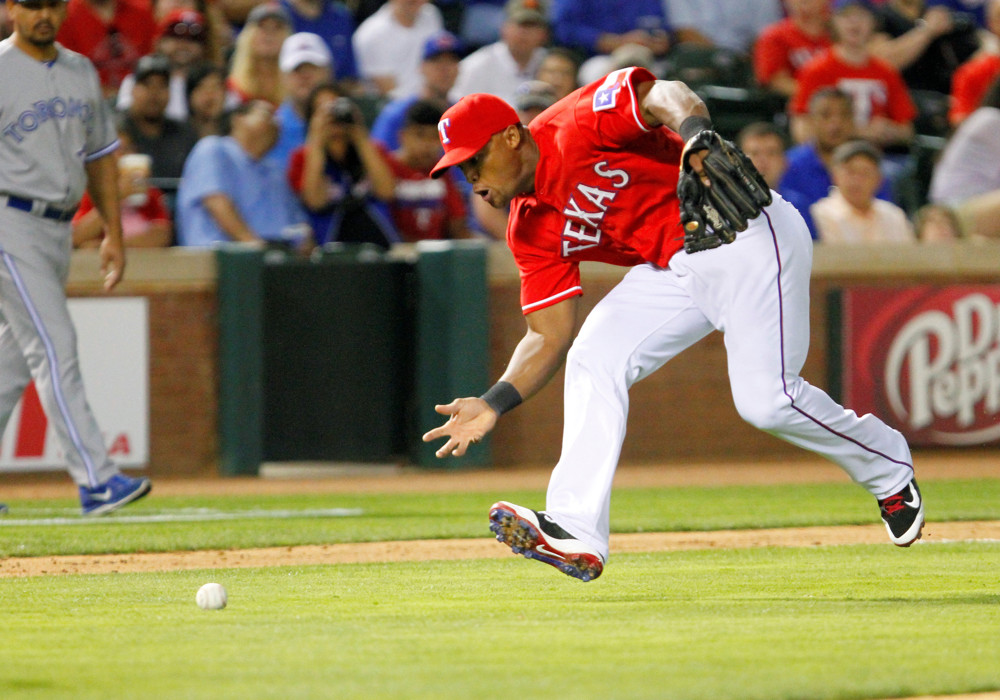
One of the things that Beltré became best known for was making plays when he had to come in to field the ball.
Eric Young (Dodgers teammate, 1998-1999): âThe best at coming in on balls that Iâve ever seen.â
Eduardo Perez (Mariners teammate, 2006): âHe was one of those guys you couldnât take your eyes off of on defense.â
Willie Bloomquist (Mariners teammate, 2005-2008): âThe play that he often made coming in on a bunt or a slow roller where he would literally be moving toward the third base dugout, drive back across his body and try to throw a frozen rope to first base, I donât think Iâve seen anybody do it that way.
âHe was phenomenal at it. I would go try and imitate it and Iâd hurt myself.â
Cora: âI was in awe [of his bunt defense]. Talking about it now, Iâm still in awe.â
Eric Nadel (Rangers broadcaster): âThat’s the indelible memory that I have of him defensively, making that off balance throw from down under and then going flying.â
6-foot-8 Mariners first baseman Richie Sexson had a game he would play with Beltré when they took infield practice.
Richie Sexson (Mariners teammate, 2005-2008) âI would just hold my glove in a certain area, off to the side. I literally wouldnât move my glove. If he missed it with a throw, I let it go. I wouldnât catch it because it wasnât perfect. He had to hit the glove, or it didnât count.â
BeltrĂ© could field the hard-hit balls well too. He developed a pre-game routine early in his career where heâd take ground balls in large volumes.
Pedro Grifol (Mariners various roles, 2005-2009) âHe absolutely wore me out because he wanted me to hit the hardest ground balls I could ever hit. And he wanted ball after ball, and bucket after bucket.â
Nadel: âHe made every type of play. And you get to a point where you weren’t surprised by any kind of miraculous play that he made.â
And yes, the stories youâve heard are true.
Kinsler: âHe really did not wear a protective cup. That is correct. He said his hands were good enough that he didnât need a cup.â
BeltrĂ© played at a time when the player was more responsible for his positioning than he is now (that is reflected in much of his Defensive Runs Saved total, as SIS started giving teamsârather than playersâcredit for positioning in 2013).
Ron Washington (BeltrĂ©âs Rangers manager, 2011-2014): âHe was just very anticipative. He knew the league. He knew what these guys did when they did it. He didn’t have what you might call a ton of range, like in today’s game, the way they talk about range. But he was an expert at positioning himself.”
Sexson: âHe didnât need a chart. He knew where everyone was gonna hit it, where to stand, how deep to play.â
Elvis Andrus (Rangers teammate, 2011-2018): âHe used to help me with positioning myself. We didnât have cards like we have now. He taught me how to read swings. He taught me how to play the guy who was 0-for-3 versus the guy who was 3-for-3.Â
He would say, âAlways put yourself in the hitterâs mind. If you want to be a good defender, you have to think like a good hitter.â And you know how you feel when youâre 3-for-3, you know how you feel when youâre 0-for-3. The guy thatâs 0-for-3 probably isnât going to pull the ball. Heâs probably going to try to go up the middle. The guy whoâs 3-for-3 is thinking big and trying to pull the ball or hit a home run. Those little insights mean a lot when youâre playing defense. They can change the game in a lot of ways.â
Most Defensive Runs Saved â All Positions
| Player |
Runs Saved |
| Adriån Beltré |
203 |
| Andrelton Simmons |
200 |
| Yadier Molina |
170 |
| Kevin Kiermaier |
165 |
| Mookie Betts |
162 |
BeltrĂ©âs garnered a reputation for incredible durability. From his age-23 to age-27 seasons, BeltrĂ© averaged 157 games played. From his age-33 to age-37 seasons, he averaged 152.Â
Cora: âWhen he really took off in 2004, he did it on one leg. I think it was his ankle. He was banged up the whole time. He was limited, but 75% of AdriĂĄn BeltrĂ© was a lot better than whoever else we had.â
Bloomquist: âI do remember there was a time that (Mariners manager) Mike Hargrove gave him the day off. He said to BeltrĂ©, âIâm giving you a day off.â And BeltrĂ© said, âNo, youâre not.â I watched him play a whole season with a torn UCL.â
Washington: âHe had a rib cage injury, and we wanted to put him on the DL, but he fought it. We wanted to take him out the lineup. He fought it. So one day, (Rangers GM) Jon Daniels and I decided that we’re just going to take him out the lineup and not tell him. So he came to the ballpark. Of course, he was upset. And when he came over telling me about it, he said heâll let me know when he can’t play. I got down on my knees and I said, âI’m down on my knees. I’m begging you to take the night off.âÂ
That did it.
Suddenly everyone wanted to play through pain and injuries because BeltrĂ© did it.â
As Beltré aged, he seemed to have more fun on the field. He appreciated that he was playing a game and visibly showed how much he enjoyed it.
Bloomquist: âElvis Andrus was the Rangers shortstop and heâd call off AdriĂĄn on a popup. BeltrĂ© would still pretend to make the catch and Elvis would catch it right next to him.â
Emily Jones (Fox Sports Southwest sideline reporter): âOn balls that were well over his head, he would toss his glove in the air.â
Andrus: â(At the end of innings), we were always looking at the fans, trying to find funny fans, or see if a couple was fighting or having a discussion. AdriĂĄn and I would be asking each other, âWhat are they talking about?ââ
Jonathan Lucroy (Rangers teammate, 2016-2017): âHe was just a big kid out there. I think that’s why he played so long is because he treated the game like it was a game, it wasn’t a job to him.
Matt Vinnola (Rangers director of baseball operations, 2009-2017): âHe went above and beyond with my family, like throwing BP and playing wiffleball with my kids. He was incredibly kind. And his son, A.J. was the most professional and respectful kid I ever encountered.â
Lewis: âThree words to describe BeltrĂ©? Intense, fun, and fearless. He was so intense, but he’d make it look fun, you know?â
Jones: âIt was that rare combination of being an elite player at your position and just being comfortable in your own skin that you can just go out and play and display the amount of joy that he was able to play with.âÂ
The legacy of AdriĂĄn BeltrĂ© is that of an all-time great player, and in a few months, heâll have a plaque in Cooperstown to immortalize his well-rounded career.
Kinsler: âI think when you play with a player of AdriĂĄn’s caliber, you tend to take a lot of things for granted until you have another third baseman standing over there and you realize the difference that he made in the game day in and day out.â
Bloomquist: âI’ve never seen anybody remotely that good defensively at third base.â
Vinnola: âI remember when we were signing him, Don Welke (who worked in baseball for 50 years), when we were talking about BeltrĂ©, he just said âspecial.â When Don Welke said ‘special,’ it got peopleâs attention.
Nadel: âI came back to the hotel one night at the Hall of Fame and Brooks Robinson called out to me from across the lobby. He said, âEric, Iâd like you to do me a favor. Tell AdriĂĄn BeltrĂ© that I watch as many games of yours as I can so I can watch him play third base.â I told AdriĂĄn that and he was really moved by it. Brooks Robinson said that? A huge smile came across his face.â
Grifol: âHe wanted to be a Hall of Famer. He trained like it, he worked like it, and he lived like it.â