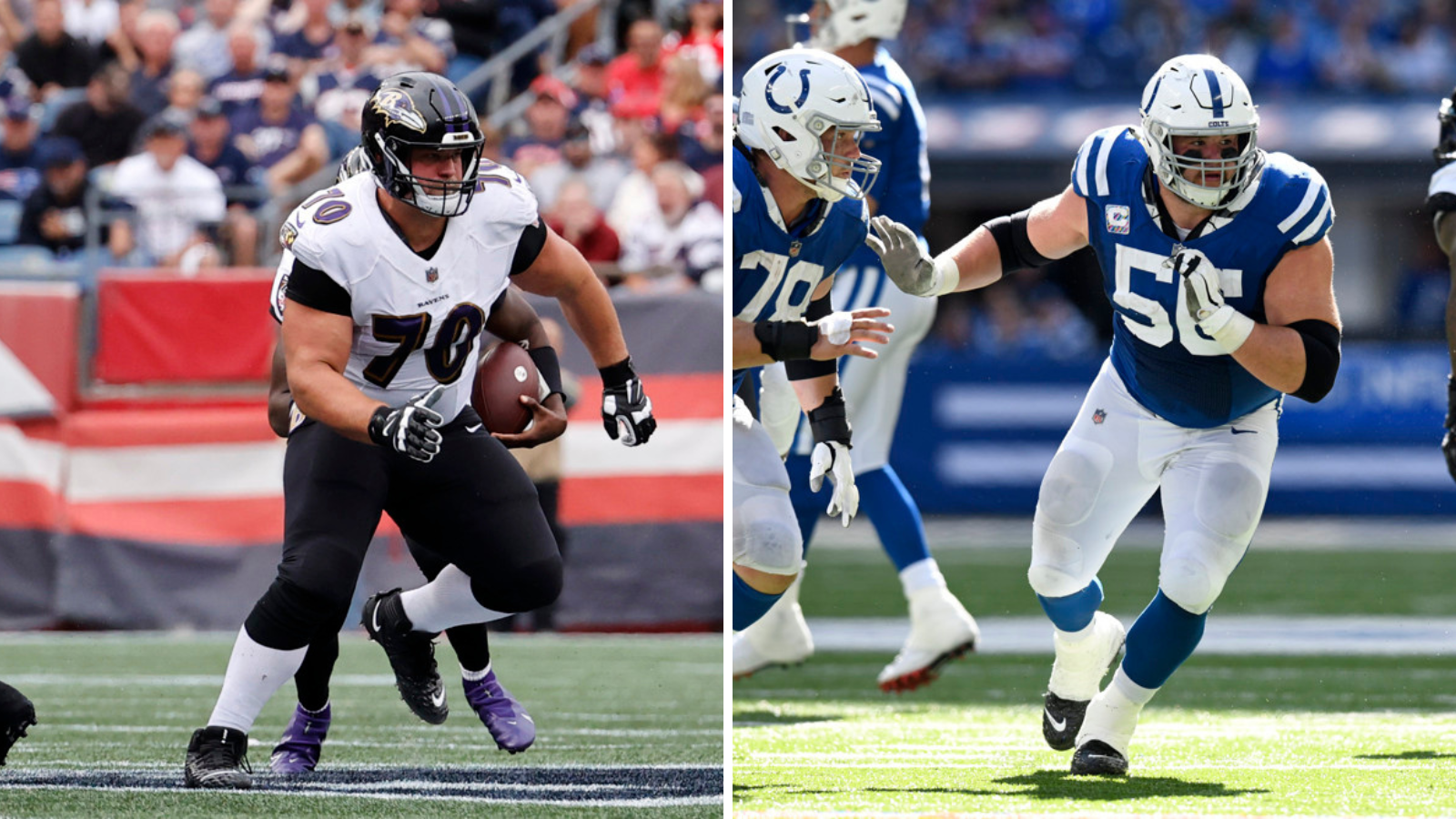
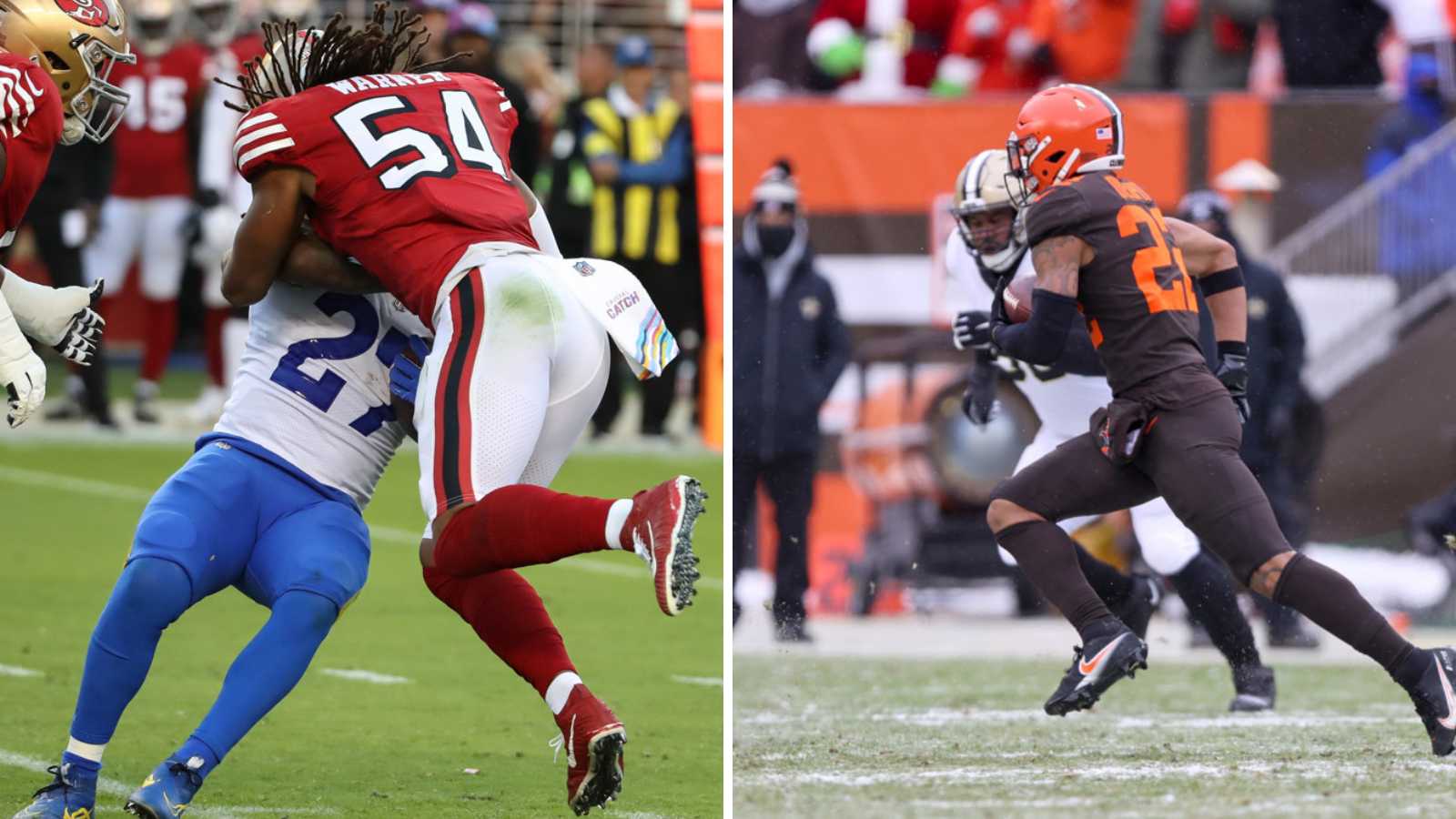
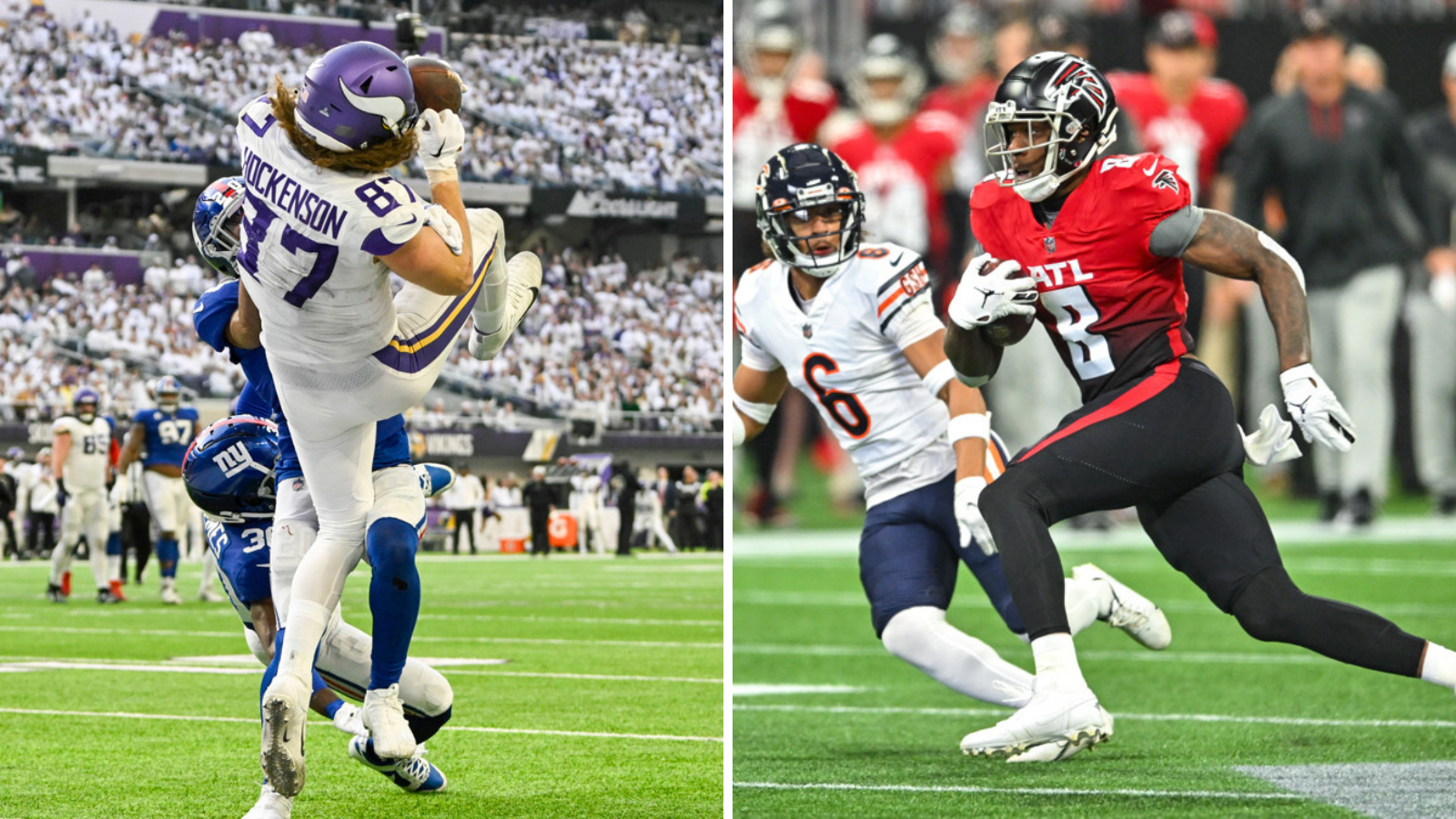
Category: NFL

  • Breaking Down The NFC Over-Unders, Team-By-Team

    Breaking Down The NFC Over-Unders, Team-By-Team

    Recently on the Off The Charts podcast, our panel of football experts – Matt Manocherian, Alex Vigderman, Bryce Rossler, and James Weaver – compared the Vegas over-unders on team win totals for what the Sports Info Solutions projection model came up with for each team.

    They then drafted from each conference based on how much confidence they had in each projection. In other words, they selected the Vikings No. 1 and the Eagles No. 2 because they were most confident in the Vikings being under their 8.5 win projection  and the Eagles being over their 10.5 win projection.

    The results of the Draft are below along with highlights from the dialogue and reasoning for each pick.

    If you’re interested in listening to the podcast episode, click the link at the top of the article.

    Team Over/Under (Model) Team Over/Under (Model)
    1. Vikings 8.5 (Under) 9. Panthers 7.5 (Over)
    2. Eagles 10.5 (Over) 10. 49ers 11.5 (Over)
    3. Giants 8.5 (Under) 11. Saints 9.5 (Over)
    4. Lions 9.5 (Over) 12. Rams 6.5 (Under)
    5. Bears 7.5 (Under) 13. Cardinals 4.5 (Under)
    6. Buccaneers 6.5 (Under) 14. Commanders 6.5 (Either*)
    7. Packers 7.5 (Under) 15. Cowboys 9.5 (Over**)
    8. Falcons 8.5 (Over) 16. Seahawks 8.5 (Avoid***)

    * Panel was split on which to take though model projected “Under”

    ** Computer model projected “Over” but all panelists disagreed

    *** Model projected “Under” but panelists agreed this is a tough team to project 

    VikingsUnder 8.5 wins (Model = 6 wins)  

    James: It’s pretty chalky considering what everyone thought of the Vikings at the end of last year and their line reflects the thought that their record last year was somewhat of a fluke. They were 19th in offensive EPA per play and 25th in defensive EPA per play and 11-0 in the regular season in one-score games.

    Alex: Their floor is high. Six wins might be on the lower end of their range of outcomes but we’d say that to repeat what they did last year would be within their range of outcomes, but at the very high end.

    EaglesOver 10.5 (Model = 14.5)

    Bryce: Our model has them with a win total of 14.5, which is probably a little high but this is a really talented team. Ten and a half seems super low with all the talent on their roster. They’re one of the best teams in the NFL, especially if Jalen Hurts continues on his upward trajectory.

    Alex: The 10.5 is a reflection of a team that shows up and looks like a world beater for one season, so I buy the skepticism (of it only being 10.5). There’s a lot of theoretical uncertainty but the organization is pretty stable. It’s hard to think of ways they don’t get there with their roster.

    GiantsUnder 8.5 (Model = 8)

    Alex: Our model has them just under 8 wins. It’s the same story as the Vikings. The Giants were all about running it back. Mostly, this is just a bet against Daniel Jones. He didn’t have the kind of improvement this past year that Jalen Hurts and Josh Allen had. We’re not talking about that level jump that some people might think of. They weren’t lucky the way the Vikings were lucky, but they’re due for the same level regression. 

    Lions – Over 9.5 (Model = 13)

    Matt: The model has them for 13 wins, which I’m trying to wrap my head around, but the over under set at 9.5 and I like the over.

    Bryce: I think that’s a very risky proposition. This isn’t a situation like the 49ers, where basically every spot on the roster is better than positional average, except quarterback. Jared Goff is probably a little bit better than a Brock Purdy, but we’ve done this song and dance before.

    Alex: I think Bryce is arguing that Jared Goff has within his range of outcomes to be good enough to lead a double-digit win team. But it might not be something that he would choose as his expectation.

    Bryce: Yeah, I also think within that range of outcomes, he could be a complete dumpster fire.

    Bears – Under 7.5 (Model = 5.5)

    Matt: Their line is 7.5. That seems unbelievably high to me. Our model has them at 5.5. That sounds more accurate. Another easy pick.

    Alex: You’re out on Justin Fields, huh?

    Matt: I didn’t say that. I’m out on his team. I’m not out on him.

    James: Did this team do anything in the offseason to get better? Yeah, they got a DJ Moore, but I don’t know defensively. This team still isn’t great. I think it’s asking a lot for a four-win bump from what they were last year. 

    Buccaneers – Under 6.5 (Model = 4.5)

    Alex: The division is not awesome, but I’m a little higher on the other teams in the NFC South. I think there’s a pretty high probability that the Bucs are the worst team in that division, and there’s enough range of outcomes for the other teams in the NFC South where a couple of them are actually kind of good that I think that’ll contribute a little bit. But it’s mostly just, like, the quarterback situation drops off a cliff and everybody else is just kind of a year older.

    Packers – Under 7.5 (Model = 5.5)

    Bryce: Rodgers is obviously gone, but he’s so far gone. As great as he was, he was so far gone last year and we have no idea what Jordan Love is.

    The defense is weird because they have some really talented players at some really key positions, like Jaire Alexander and Rashawn Gary, but there’s a lot of holes in that defense in general. (They were) an eight-win team last year with Rodgers, and things don’t be seem to be getting better there.

    James: I think this is a team where you can absolutely look alt win totals. If you think that the drop off is a lot, then you can take an under 4.5, under 5.5 at a better number. If you think Love can take off, then bet higher than 9 wins. I think the extreme outcomes for this team are the better value.

    Falcons – Over 8.5 (Model = 9.5)

    James: You have no idea what Desmond Ritter is. Defensively, though, this team’s putting some things together…. I kind of like the upside with this team, the division’s in flux, like the whole NFC is. Theme of the day.

    Matt: My concern is the defense. I think the defense is trash. I have concerns about their strength being at safety. I don’t really know how you build a defense that way. I think that they have weaknesses at corner, in pass rush, and in run defense. So it’s hard to say that I find them to be very strong in defense in any meaningful regard.

    Panthers – Over 7.5 (Model = 9.5)

    James: I like the coaching staff that the Panthers brought in with Frank Reich and Josh McCown, and Ejiro Evero is a really good get…. I think bringing him in with having guys like Brian Burns and Jaycee Horn coming back from injury, this Panthers defense – last year 20th in EPA per play on defense – it’s not great, but I think they’re certainly upside there with the new scheme that Evero brings in.

    Now obviously it’s not one of those rookie quarterback situations where you frankly just don’t know. But I think there’s a lot of good things in place that the Panthers could potentially get over this win total, especially with that division that they’re in.

    Alex: I wish I liked their offense better. I think trading out DJ Moore for Adam Thielen is not inspiring a lot of confidence.

    Bryce: I absolutely hate it. I’m not a believer in Bryce Young at all.

    49ers – Over 11.5 (Model = 12)

    Bryce: I don’t like betting on bad and or inconsistent quarterbacks, and the 49ers, I think, don’t even have their quarterback situation figured out this year, but that team is so talented. The defense is really, really good. Their offensive skill positions are really good.

    They won 13 games last year, Brock Purdy starting in five of them. I’m not sure how much the quarterback situation even matters at this point. With Kyle Shanahan, plus the division is not very good. I’ll take it over 11.5, but I don’t think it’s a slam dunk.

    Saints – Over 9.5 (Model = 10.5)

    Alex: Again, the NFC South has a lot of uncertainty…. I feel probably the best about them in the division.

    This is another team where I don’t expect them to win 12 games, but I think that they have decent quarterback play and pretty good skill position players.

    I’m responsible for Total Points, and Total Points loves Derek Carr. Ipso facto, I love Derek Carr. Also, “love” is a very strong word.

    Rams – Under 6.5 (Model = 4.5)

    Matt: Aaron Donald represents one of the only bright spots remaining on their defense. I look at the Sonar Depth Chart that we have for them at The 33rd Team, and it’s really trash all around. The offensive line was garbage last year. I think the offensive line promises to be garbage again.

    They tried to trade Stafford because he’s a shell of himself and is no longer a healthy, functioning NFL quarterback. So, for a lot of reasons I want the under on the Rams.

    Bryce: I’m going to get you a shirt that says, “I am not scared of Aaron Donald.”

    Cardinals – Under 4.5 (Model = 4)

    Matt: Number one, pull up their depth chart. It is really, really ugly looking at a lot of positions. But even more so than that, I’m worried about this franchise.

    I think this franchise has already reached rock bottom and they’re in the phase over the next year where they can’t even begin to climb out of rock bottom. I think that the sort of malice that’s gone on in this franchise is on that level.

    Unlike the way that I like the over on the Texans wins because they don’t have to tank, I think this team is organizationally tanking this year. 

    Commanders – Under 6.5, Over 6.5 (Model = 5)

    Alex (under): The Commanders have a couple of guys on both sides of the ball. And their quarterback situation is not great. And the Commanders are in that same category as the Panthers. It’s just that they have less upside, in my opinion.

    I tend to lean towards whatever the quarterback situation is and kind of trust that. And so that’s why I’m on the low end for the Commanders.

    Bryce: I would feel a bit worse about taking the Commanders under if I had any confidence that they would name Jacoby Brissett the starter, because I think Brissett is actually somewhat capable, whereas I think Sam Howell will be a dumpster fire.

    James (over): I want to call out all of you Sam Howell haters, because I like the Commanders over this year. That defense last year was still 5th in EPA per play. And if they can do something with Taylor Heinicke the last three years and have a minimum 7 wins from each season, I like this team.

    I like the weapons that they have. Terry McLaurin, Jahan Dotson, both a solid 1-2 punch at receiver.

    Brian Robinson came into his own at the end of last year, as well. It’s a new day in Washington. It’s a new day, and I think they break through the 6.5 wins this year.

     Cowboys – Over 9.5 (Model = 8)

    Bryce: I am an outspoken believer in Dak Prescott. I think they have strengths elsewhere on the roster. I really like CeeDee Lamb. The offensive line is not as dominant as they were during the first couple of years of Dak’s career, but they’re still pretty good. I think they have some difference-makers on defense.

    Matt: I had a really hard time with them because that over/under was set at 9.5. And the model came out at just eight wins for them. So this was one of those situations where I was kind of a ‘stay away.’

    James: When our model was run, this win total was definitely the one that I disagreed with the most. I was really surprised that it came out that low on the Cowboys. 

    Seahawks – No bet at 8.5 (Model = 7)

    James: I’d kind of lean towards their over, mostly because of the fact that the NFC is garbage, and in terms of a staple, this is probably as close as it gets to a fringe, playoff, wildcard level team.

    In the NFC West, we’re pretty low on the Rams and the Cardinals. The 49ers have some question marks at quarterback. For the Seahawks, if somehow Geno Smith can turn into a Top 10 quarterback again, then they certainly have the weapons there. I think I can see ‘Hawks going over this win total.

    Matt: Playing the Rams a couple of times, playing the Cardinals a couple of times, if Geno can be as good as he was last year, certainly you would think that they hit it.

  • Scouts vs. Stats: Top 10 NFL Quarterbacks

    Scouts vs. Stats: Top 10 NFL Quarterbacks

    Photo: Ian Johnson and Dustin Bradford/Icon Sportswire

    Over the spring/summer, the SIS R&D staff is convening on the Off the Charts Podcast to talk about their top ten players at a position. To do this, we pit two methodologies against each other: 

    • The “Scouts,” which comes down to the film-based opinions of Matt Manocherian and Bryce Rossler, each of whom has a lot of experience breaking down film and scouting players (Matt having been a scout for NFL teams).
    • The “Stats,” which involves James Weaver and Alex Vigderman devising a ranking based on a suite of metrics, and having that ranking speak for itself.

    Officially, Sports Info Solutions does not condone the dichotomy between scouting and statistical analysis. Each of them provides data in their own way and should inform our evaluation of a player. 

    When we originally produced the Football Rookie Handbook before transitioning that content to our NFL Draft site, we put the scouting reports and stats side-by-side with the idea that the reader would bounce back and forth between them and leverage both to come to a conclusion about a prospect.

    This week, we flipped sides, with Alex and James providing their scouting insights while Bryce and Matt assumed the mantle of the nerds. With quarterbacks, it was easy for everyone to agree on the No. 1 guy, but there were some differences of opinion along the way.

    Scouts’ Opinion Statistical Analysis
    1. Patrick Mahomes 1. Patrick Mahomes
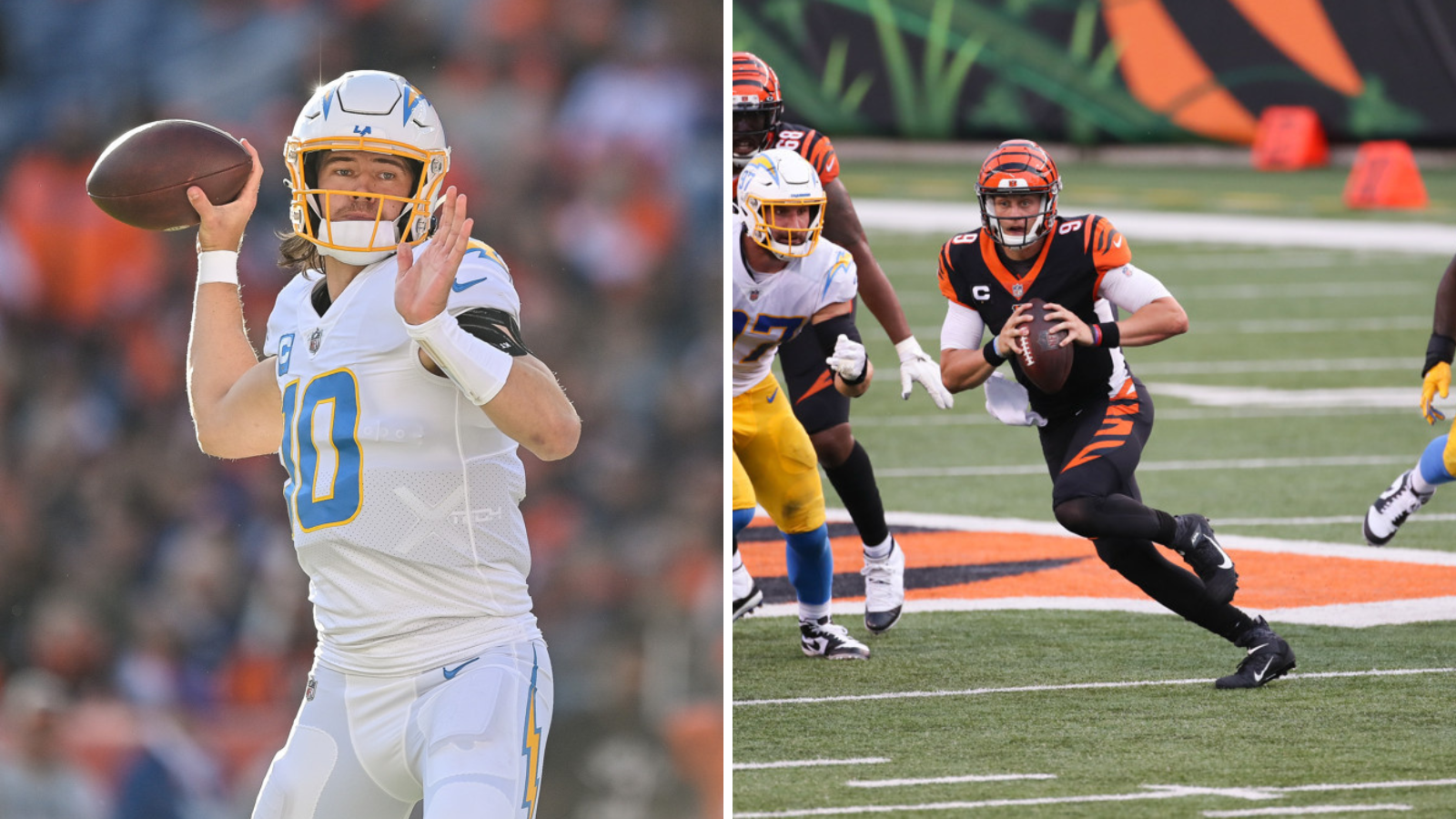
    2. Joe Burrow 2. Justin Herbert
    3. Josh Allen 3. Josh Allen
    4. Jalen Hurts 4. Aaron Rodgers
    5. Justin Herbert 5. Jalen Hurts
    6. Trevor Lawrence 6. Joe Burrow
    7. Aaron Rodgers 7. Tua Tagovailoa
    8. Lamar Jackson 8. Dak Prescott
    9. Dak Prescott 9. Kirk Cousins
    10. Russell Wilson 10. Derek Carr

    The Stats List Methodology

    The stats-based ranking includes a three-year recency-weighted average of a player’s per-snap performance in Total Points, with their most recent season having a weight of 3, the second-most recent having a weight of 2, and their third-most recent having a weight of 1.

    Total Points arguably evaluates quarterback performance better than any other position, if only because there is an abundance of data points related to quarterback play that factor into it.

    Matt and Bryce initially thought to blend it with a second weighted EPA model that incorporated variables like Expected On-Target +/- (xOnTgt+/-) and throw depth, but concerns about historical sample with respect to xOnTgt+/- ultimately led them to decide that keeping it simple was best.

    It should also be noted that this methodology was not limited to Passing Total Points; Rushing Total Points is equally factored in, and that is reflected in the placement of players like Josh Allen and Jalen Hurts, both of whom have been extremely productive on the ground.

    What the Stats Showed

    As Matt noted, it would have been difficult to tweak the model in a way to dethrone Patrick Mahomes.

    “In terms of Z-scores, the difference between Patrick Mahomes and the second-ranked player, Justin Herbert, was bigger than the difference between Herbert and Derek Carr [the 10th-ranked player],” Matt said, “Mahomes was two standard deviations above average; the next-highest Z-score was Herbert, who was a little over one standard deviation above average.” 

    After a clear tier break, Herbert and Allen rounded out the top three, being the two of the remaining three players on the list to have ranked in the top 10 in Passing Total Points/play each of the last two years. (Herbert ranked 6th and 1st in 2022 and 2021, respectively; with Allen ranking 10th and 8th.)

    Allen’s rushing also proved to be a windfall for him, with Bryce pointing out that, in 2022, the Bills generated 11 EPA on running plays, with Allen himself accounting for 33 rushing EPA.

    Dak Prescott also ranked in the Top 10 in Passing Points/snap each of the past two years, but missed most of 2020 with an injury. Another player whose 2020 hurt them a bit in the stats ranking was Joe Burrow, whose ill-fated rookie season dampened his placement, despite performing well each of the past two years. 

    Following Burrow was Tua Tagovailoa, whose extremely efficient Year 3 with Mike McDaniel and Tyreek Hill was enough to propel him into the Top 10, despite not ranking in the Top 20 in Passing Total Points in either of his first two seasons in the league.

    What the Scouts Thought

    The scouts’ list likewise featured Patrick Mahomes at No. 1 and Josh Allen at No. 3, but Alex and James opted to place Burrow second rather than Herbert.

    Their reasoning?

    Burrow just has that ‘It’ factor and has produced more results at this point than Herbert,” James said, “He went into Kansas City and beat Patrick Mahomes, which is something Herbert hasn’t done yet, and there’s something to be said for that.”

    After that, there was a tier break with Jalen Hurts and the aforementioned Herbert placed at No. 4 and No. 5, respectively. The scouts expressed a bit of apprehension about Hurts simply because the Philadelphia offense was an extremely good fit for him last year, but still asserted that his leadership, his running ability, and his deep ball are reasons to be optimistic about him moving forward.

    The scouts also included Trevor Lawrence (No. 6), Lamar Jackson (No. 8), and Russell Wilson (No. 10) in their list, despite all of them having bad statistical years at some point within the last three seasons. James was bullish on Lawrence’s prospects moving forward, citing his arm talent, his mobility, and his command of the offense in Year 2 as very positive signs. Jackson was given the benefit of the doubt with respect to his injuries and the supporting cast around him the last few seasons, and Wilson likewise got a pass for a dysfunctional first year in Denver, but the scouts did note that he’s likely past his prime.

    Want to hear more discussion and debate? Check out this episode of the podcast:

  • Scouts vs Stats: Top 10 Interior Offensive Linemen

    Scouts vs Stats: Top 10 Interior Offensive Linemen

    Over the spring/summer, the SIS R&D staff is convening on the Off the Charts Podcast to talk about their top ten players at a position. To do this, we pit two methodologies against each other: 

    • The “Scouts,” which comes down to the film-based opinions of Matt Manocherian and Bryce Rossler, each of whom has a lot of experience breaking down film and scouting players (Matt having been a scout for NFL teams).
    • The “Stats,” which involves James Weaver and Alex Vigderman devising a ranking based on a suite of metrics, and having that ranking speak for itself.

    Officially, Sports Info Solutions does not condone the dichotomy between scouting and statistical analysis. Each of them provides data in their own way and should inform our evaluation of a player. 

    When we originally produced the Football Rookie Handbook before transitioning that content to our NFL Draft site, we put the scouting reports and stats side-by-side with the idea that the reader would bounce back and forth between them and leverage both to come to a conclusion about a prospect.

    So, without further ado, let’s head into the trenches and break down the ‘Best Interior Offensive Linemen in the NFL’ Top 10 lists.

    Scouts’ Opinion Statistical Analysis
    1. Zack Martin 1. Jason Kelce
    2. Jason Kelce 2. Kevin Zeitler
    3. Creed Humphrey 3. Joel Bitonio
    4. Quenton Nelson 4. Isaac Seumalo
    5. Joel Bitonio 5. Zack Martin
    6. Erik McCoy 6. Tyler Linderbaum
    7. Joe Thuney 7. Joe Thuney
    8. Brandon Scherff 8. Jon Runyan Jr.
    9. Corey Linsley 9. Ben Powers
    10. Frank Ragnow 10. Creed Humphrey

    The Stats List Methodology

    The stats-based ranking includes a three-year recency-weighted average of a player’s results across several different metrics, with the following weights applied to each:

      • 25% Pass Blocking Total Points 
      • 20% Run Blocking Total Points
      • 10% Pass Blown Block Rate
      • 10% Run Blown Block Rate
      • 10% Holding penalty avoidance
    • 5% Positional versatility

    Total Points does as good a job of evaluating offensive line play as anything in our arsenal, so we leveraged that most, leaning a bit more into pass blocking than run blocking. These are both season totals, so to give more credit to play-to-play effectiveness we added in blown block rates as well.

    Total Points doesn’t account for penalties (yet), so we wanted to ascribe some value to avoiding holding penalties. Typically linemen aren’t being called for these more than a few times a year, but they’re absolute drive killers.

    And lastly, we wanted to give players credit for playing multiple positions. Most of the top players aren’t moving around because they’re so good at their primary position, but being able to provide support at multiple alignments is absolutely a valuable aspect of a player.

    What the Stats Showed

    The top three players on the stats list have two things in common: they are strong in both the pass game and run game, but they’re better as run blockers. That’s a bit surprising because the passing game was weighted more strongly in the metric the stats group used.

    Each of Eagles C Jason Kelce, Ravens G Kevin Zeitler, and Browns G Joel Bitonio ranked in the top 15 in both Pass Blocking and Run Blocking Total Points (out of over 200 candidates), but all of their Run Blocking Total Points ranks were the higher of the two. Kelce separated himself by ranking in the top 20 in blown block rate both passing and running, which no one else could claim.

    One feature that contributed to Kelce’s Total Points ranking (and is somewhat relevant for other players on the list) is that it’s difficult to disentangle responsibility for quarterback designed runs, particularly sneaks. With how much the Eagles leaned into the sneak in 2022, there are a lot of high-value plays for which Kelce is getting some Total Points credit. 

    Almost every player outside the top few was a good bit more productive at one type of blocking than the other. Cowboys G Zack Martin (No. 5) and Chiefs G Joe Thuney (No. 7) were the notable exceptions, ranking in the top 25 in each, but down years by their standards in 2022 dropped them down the list.

    First-year Ravens center Tyler Linderbaum cracked the list at No. 6, thanks to excellent production in the run game. He ranked second in the Run Blocking Total Points category, and 12th in run blown block rate. It’s worth noting that he does have the quarterback-run caveat that affects Kelce (and former teammate Isaac Seumalo, now of the Steelers), but he was a top pick who was expected to deliver “out of the box”, so to speak, so this isn’t surprising.

    What the Scouts Thought

    The scouts’ list was chalky at the very top, featuring two perennial All-Pros in Martin and Kelce. A slightly less chalky No. 3 ranking went to Chiefs C Creed Humphrey

    The Chiefs are the only team to have two players on the list for both groups, with Humphrey showing up higher on the scouts’ list but below Joe Thuney on the stats list. Humphrey came in and helped transform the Kansas City line in 2021, and has done so with a difficult role, being asked to reach block and sometimes take on interior pass rushers 1-on-1. 

    Arguably the biggest discrepancy between the lists came with Colts G Quenton Nelson coming in at No. 4. 

    Per Matt, “when [Nelson’s] at his best, he’s just an absolute mauler, somebody who can move defensive tackles off the ball in the duo game when you have double teams on the inside.” Nelson helped make the Indy offensive line what it was the last few years, but a down year in 2022 did give some pause as to where he’d rank.

    No. 6 ranked Erik McCoy (Saints C) plays with control and power, with exceptional processing ability in the passing game. Bryce would easily rank him a top-three center, while Matt has concerns about his skill in the run game and his ability to stay on the field consistently. The stats back that up to some extent, as he ranked in the Top 10 in avoiding blown blocks in the passing game and in the 60s in the run game.

    Matt and Bryce each advocated for Chargers C Corey Linsley and Lions C Frank Ragnow to make the list at Nos. 9 and 10, respectively. They actually ranked first and second in three-year pass blown block rate, but other factors took them out of the Top 10 on the stats-based list.

    Matt contends that the Chargers did well to build “inside-out” by bringing in Linsley to play center a couple years ago, taking pressure off their guards. Bryce notes that Ragnow allows the Lions to “do a lot of wacky stuff” with the complexity in their run game, and his intelligence allows him to pick up pass rush games on the interior.

    Want to hear more discussion and debate? Check out this episode of the podcast:

  • Scouts vs Stats: The NFL’s Top Linebackers & Safeties

    Scouts vs Stats: The NFL’s Top Linebackers & Safeties

    Over the spring/summer, the SIS R&D staff is convening on the Off the Charts Podcast to talk about their top players at a position. To do this, we pit two methodologies against each other: 

    • The “Scouts,” which comes down to the film-based opinions of Matt Manocherian and Bryce Rossler, each of whom has a lot of experience breaking down film and scouting players (Matt having done it for NFL teams).
    • The “Stats,” which involves James Weaver and Alex Vigderman devising a ranking based on a suite of metrics, and having that ranking speak for itself.

    Officially, Sports Info Solutions does not condone the dichotomy between scouting and statistical analysis. Each of them provides data in their own way and should inform our evaluation of a player. 

    When we originally produced the Football Rookie Handbook before transitioning that content to our NFL Draft site, we put the scouting reports and stats side-by-side with the idea that the reader would bounce back and forth between them and leverage both to come to a conclusion about a prospect.

    This week, we decided to do a 2-for-1 special and break down the Top 5 Off-Ball Linebackers and Top 5 Safeties in the NFL. So, without further ado, let’s get into the fun!

    Off-Ball Linebackers

    Scouts’ Opinion Statistical Analysis
    1. Fred Warner 1. Roquan Smith
    2. Roquan Smith 2. Fred Warner
    3. Matt Milano 3. Shaquille Leonard
    4. Dre Greenlaw 4. Bobby Wagner
    5. Demario Davis 5. Matt Milano

    The Stats List Methodology

    The stats-based ranking includes a three-year recency-weighted average of a player’s results across several different metrics, with the following weights applied to each:

    • 20% Run Defense Total Points
    • 15% Pass Rush Total Points
    • 10% Pass Coverage Total Points
    • 10% Broken+Missed Tackle Allowed %
    • 10% Adjusted Tackle Depth
    • 10% Pressure % Plus Minus
    • 5% Hand On-Ball %
    • 5% Deserved Catch %
    • 5% Targets Per Cover Snap
    • 5% Positive % Allowed Zone Scheme
    • 5% Positive % Allowed Man Scheme

    From an off-ball linebackers perspective, the stats team felt that weighting run defense and pass rush more than pass coverage was appropriate when considering Total Points. To indirectly increase the weighting, we included five supplemental metrics with 5% weights that analyzed different aspects of a linebacker’s coverage skills. A player like Matt Milano benefits from including these pass coverage metrics, as he ranked in the Top 10 in Hand On-Ball %, Deserved Catch %, and Positive Play % Allowed Zone Scheme while also ranking 3rd in Pass Coverage Total Points.

    Rounding out the rest of the metrics, Adjusted Tackle Depth compares actual tackle depth to the expected tackle depth based on personnel, intended run gap, and the defender’s pre-snap alignment. Hand On-Ball % is the percentage of plays where a defender got their “hand on the ball.” This includes breaking up or intercepting a pass as well as forcing or recovering a fumble. Deserved Catch % is the percentage of targets as the primary defender that the receiver either caught or dropped the ball when the pass was catchable.

    What the Stats Showed

    Roquan Smith, the leader in the clubhouse on the stats side, finished in the Top 3 in all of the Total Points categories. He also accumulated these numbers without getting his hand on the ball much, ranking 97th. 

    Fred Warner came in 6th and 7th respectively in Run Defense and Pass Rush Total Points. What propelled him to 2nd was his supplemental metrics. He finished 3rd in Deserved Catch % (1st in Top 5), 7th in Pressure % +/- (2nd in Top 5), and 12th in Targets Per Cover Snap (2nd in Top 5). 

    Shaq Leonard finished 1st in both Run Defense and Pass Rush Total Points at this position, even with only playing in 3 games all of last year. Unlike Smith, he had his fingerprints all over the football when he played, ranking 2nd in Hand On-Ball %. His pass coverage metrics aren’t anything to write home about, ranking 17th in Pass Coverage Total Points and not any higher than 73rd in the supplemental pass coverage metrics.

    What the Scouts Thought

    The scouts had Fred Warner as their number 1 and Roquan Smith as their number 2. This was a clear cut decision for both Bryce and Matt, who said that he tried to make this a conversation with Bryce, but ultimately couldn’t argue for Smith ahead of Warner. 

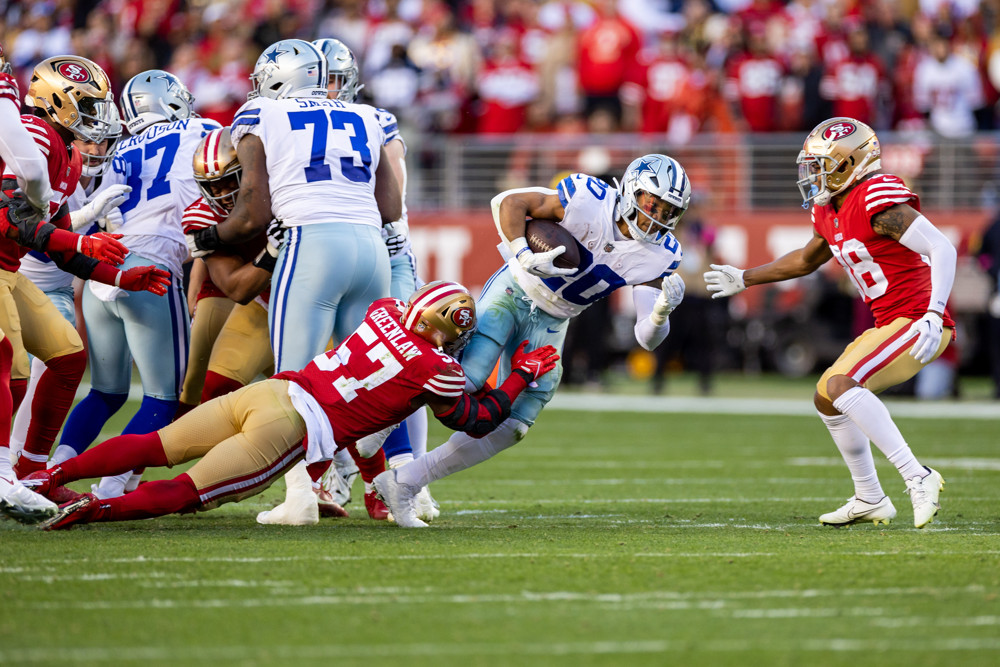
    In regards to Warner’s pass coverage skills, Bryce is still in awe of the play in the NFC Divisional Game where Warner ran stride for stride with CeeDee Lamb,

    “He was 40 yards downfield stride-for-stride with one of the best receivers in the NFL. Nobody else can do that,” Bryce said. “There are corners who can’t even do that.” 

    On Smith, Matt said

    “At the center of your defense, this is someone who will make your entire defense faster.” Bryce added on, “He will hit you and will materialize out of nowhere on a perimeter run and make a tackle. His range is crazy.”

    One player that the scouts had on their list that the stats team didn’t was Demario Davis. Matt highlighted his versatility, strength, and tackling ability all as positives. He stated that he isn’t great in pass coverage, but Bryce thought that he has some athletic juice and showed some quality skills. They both credit his pass rushing ability as well as his availability.

    Safeties

    Scouts’ Opinion Statistical Analysis
    1. Derwin James 1. Grant Delpit
    2. Talanoa Hufanga 2. Budda Baker
    3. Minkah Fitzpatrick 3. Justin Simmons
    4. Budda Baker 4. Minkah Fitzpatrick
    5. Antoine Winfield Jr. 5. Talanoa Hufanga

    The Stats List Methodology

    The stats-based ranking includes a three-year recency-weighted average of a player’s results across several different metrics, with the following weights applied to each:

    • 25% Pass Coverage Total Points
    • 15% Run Defense Total Points
    • 10% Broken+Missed Tackle Allowed %
    • 10% Adjusted Tackle Depth
    • 10% Hand On-Ball %
    • 10% Deserved Catch %
    • 10% Pass Rush Total Points
    • 5% YAC Per Completion
    • 5% Targets Per Cover Snap

    The categories here are very similar to off-ball linebackers, with the only differences being the removal of the man Positive %, Zone Positive %, and Pressure % over expectation, while adding in YAC Per Completion. The weights are changed with pass coverage taking over as the most important Total Points category. Run defense is still prominent, and pass rush drops to a 10% weight.

    What the Stats Showed

    Grant Delpit took the top spot for the stats team. He ranked 2nd in both Run Defense and Pass Rush Total Points as well as 1st in the Top 5 in Adjusted Tackle Depth. He was 17th in Pass Coverage Total Points 

    Budda Baker came in 2nd, even though he finished 1st in both Run Defense and Pass Rush Total Points. He finished 31st in Pass Coverage Total Points, but was the best in the Top 5 in Targets Per Cover Snap. He only faced 16 targets in 2022 with 526 cover snaps, meaning his impact is known when you try to throw at him.

    Talanoa Hufanga cracked the Top 5 with only having meaningful playing time in one season. He ranked 12th in Pass Coverage Total Points, but was 20th and 23rd in Run Defense and Pass Rush, respectively. He ranked the best in the Top 5 in Deserved Catch % as well as YAC Per Completion.

    What the Scouts Thought

    Coming in No. 1 on the scouts list was Derwin James.

    “This is a player who athletically is 1 of 1,” Matt said. “He’s faster than anyone else on this list, he hits like a linebacker, he can guard any tight end.” Bryce continued the praise, “He’s a problem-solving player. You can put him on Kelce. He’s a matchup eraser. He’s a prototype.”

    In 3rd, the scouts had Minkah Fitzpatrick. Bryce discussed how good of an athlete he is and how you can ask him to do whatever you need him to do. Matt added that he is as versatile as they come, and that he can play slot, corner, strong, or free safety. 

    Cracking into the 5th spot was Antoine Winfield Jr. Matt said:

    “He plays the game with a sixth sense about him. Just like the Honey Badger.” He continued, “You have to be careful throwing the ball when Antoine Winfield is in the vicinity.”

    Want to hear more discussion and debate? Check out this episode of the podcast:

  • Scouts vs Stats: Debating The Top 10 NFL Tight Ends

    Scouts vs Stats: Debating The Top 10 NFL Tight Ends

    Over the spring/summer, the SIS R&D staff is convening on the Off the Charts Podcast to talk about their Top 10 players at a position. To do this, we pit two methodologies against each other: 

    • The “Scouts,” which comes down to the film-based opinions of Matt Manocherian and Bryce Rossler, each of whom has a lot of experience breaking down film and scouting players (Matt having done it for NFL teams).
    • The “Stats,” which involves James Weaver and Alex Vigderman devising a ranking based on a suite of metrics, and having that ranking speak for itself.

    *This week, Matt called for some backup, so we brought in Jeff Dean from our Football Ops department

    Officially, Sports Info Solutions does not condone the dichotomy between scouting and statistical analysis. Each of them provides data in their own way and should inform our evaluation of a player. 

    When we originally produced the Football Rookie Handbook before transitioning that content to our NFL Draft site, we put the scouting reports and stats side-by-side with the idea that the reader would bounce back and forth between them and leverage both to come to a conclusion about a prospect.

    So, without further ado, let’s celebrate Tight End University week and break down the ‘Best Tight Ends in the NFL’ lists.

    Scouts’ Opinion Statistical Analysis
    1. Travis Kelce 1. Travis Kelce
    2. George Kittle 2. George Kittle
    3. Mark Andrews 3. Mark Andrews
    4. T.J. Hockenson 4. Kyle Pitts
    5. Dallas Goedert 5. Dallas Goedert
    6. Darren Waller 6. Dalton Schultz
    7. Kyle Pitts 7. Darren Waller
    8. Evan Engram 8. Cole Kmet
    9. David Njoku 9. Hunter Henry
    10. Dalton Schultz 10. Pat Friermuth

    The Stats List Methodology

    The stats-based ranking includes a three-year recency-weighted average of a player’s results across several different metrics, with the following weights applied to each:

    • 35% Pass Game Total Points (Receiving and Pass Blocking)
    • 15% Run Blocking Total Points
    • 15% Targets Above Expectation
    • 15% On-Target Catch %
    • 10% YAC/Rec
    • 5% ADoT
    • 5% Broken Tackles + Missed Tackles/Rec

    For tight ends, we decided to combine Receiving and Pass Block Total Points into an all-encompassing passing game metric. This was created so that a player who rarely pass blocks is not punished if he does well in the receiving game. 

    Run Blocking Total Points are also factored in to highlight the secondary responsibility of a good tight end. This metric is what shot Cole Kmet up the stats’ leaderboard, playing in an offense that is run heavy.

    The rest of the metrics all measure how good a tight end is in the receiving game. Of note, Kyle Pitts was 1st in the ADoT metric and Travis Kelce was 6th in the Broken Tackles and Missed Tackles Per Rec.

    What the Stats Showed

    The Top 4 players in the pass game Total Points metric were all in the Top 4 of the stats’ list.

    Mark Andrews finished ahead of George Kittle in the metric, but Kittle finished ahead of Andrews in Run Blocking Total Points, Broken and Missed Tackles Per Reception, Yards After Catch Per Reception, and On-Target Catch Percentage. Kyle Pitts was 4th in the pass game metric despite playing in only 10 games (and in a very low-volume pass offense) last season, emphasizing how productive he was in his rookie season. Travis Kelce, who was first in this metric, nearly doubled the value of second place Kittle, with 42 Total Points per season compared to 24. His production in Receiving Total Points over the last 3 years would make him a Top 5 receiver overall. 

    The Top 4 in the stats’ list also all came in the Top 10 in Targets Above Expectation. This metric measures how many targets the player themselves generates based on contextual factors like alignment, coverage, and route type. Other than No. 10-ranked Pat Friermuth (14th), no other player in the Top 10 on the stats’ list came in the Top 15. Generating one’s own targets was a separator for the Top 4 on the list.

    Yards After Catch Per Reception numbers for Kelce (2nd in Top 10) and Kittle (3rd in Top 10) separated themselves from Andrews (Last in Top 10). Dallas Goedert, who placed fifth overall, came out the best in this metric among the top ten players, ranking 14th among tight ends with 6.7 YAC/R. Goedert was also solid in all other metrics, coming in 7th overall in pass game Total Points, 8th in Run Blocking Total Points, and 25th (3rd in the Top 10) in Broken and Missed Tackles Per Reception.

    What the Scouts Thought

    This one lacks a little suspense. Both lists had Travis Kelce as the best tight end in the league.  From a scouts’ perspective, Bryce Rossler states, “He is one of the best tight ends of all-time. Probably only Gronk above him. His route-running is amazing, his yards after the catch ability is amazing, and he’s a pretty good athlete.” 

    Both groups also had the same players at No. 2 and No. 3. The scouts found T.J. Hockenson to be 4th on their list while the stats guys did not have them in their Top 10.

    As to why, Jeff said, “His ability to produce no matter who his quarterback is, no matter what kind of offense he’s in, is something you don’t find in a lot of tight ends.” He goes on to say, “Not to mention his huge wingspan, being able to post up linebackers over the middle, and challenge cornerbacks on out routes is something that is really hard to find in the position.”

    One of the differences on the scouts’ list was that they included Jaguars tight end Evan Engram at number 8. “He might not have the gaudy numbers you look for, but when you watch him play, he’s a guy the defense has to account for. He’s a legitimate receiving threat,” Jeff said. “I would not be surprised if he has a bigger year than he did last year in this upcoming season.” 

    Want to hear more discussion and debate? Check out this episode of the podcast:

  • Amidst Patriots’ offensive woes, Rhamondre Stevenson is an emerging talent

    Amidst Patriots’ offensive woes, Rhamondre Stevenson is an emerging talent

    As hard as it was to watch New England’s offense last year, it’s even harder to have sympathy for Patriots fans. Six Super Bowls, 9 conference championships, and 17 divisional titles the past 22 years is a lot of vicarious living for the NFL’s most spoiled fanbase, and a 25-25 record since Tom Brady left isn’t even that bad.

    If anything, this kind of mediocrity has prevented the rest of us from enjoying full-blown schadenfreude. There’s not even a grave to dance upon. There’s just some milquetoast, third-year quarterback and a defense that’s still pretty good. Greater misfortunes have befallen teams who have won a single Super Bowl and yet the Patriots still just…exist.

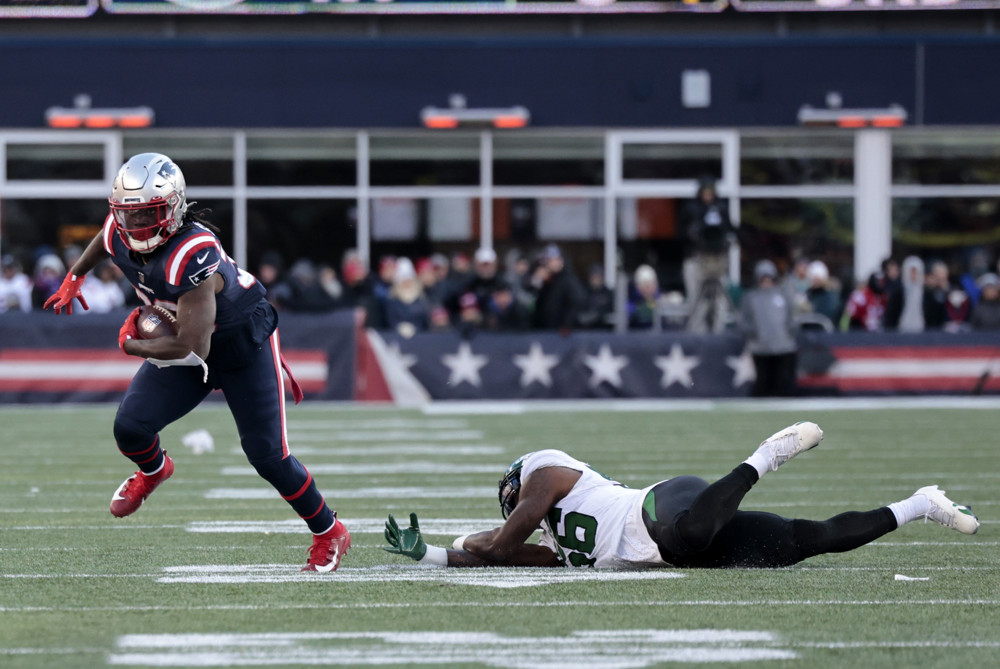
    So, you’d be forgiven for not watching much of their offense last year. And truthfully, 2023 may not be much more exciting, even after the ousting of Matt Patricia. But, if you do watch them, keep an eye on third-year running back Rhamondre Stevenson, who is already quietly a Top 10 running back in the league.

    Stevenson saw a decent amount of work in his first season (despite being out of shape entering the NFL),  but nearly doubled his touches from 147 as a rookie to 279 in 2022. His emergence likely factored into New England’s decision to let Damien Harris walk in free agency, and, barring any unforeseen developments, he should be the workhorse in Foxborough going forward.

    It’s not hard to understand why, either – Stevenson has very good three-down ability. Backs who are built like him (6’0”, 230 lbs.) are not typically thought of as passing-down backs, but Stevenson is an exception to that rule, if it even is one.

    Pass protection is an underrated trait for running backs in the modern NFL, and he’s been excellent in that regard since his time at Oklahoma. In fact, he ranked 1st at his position in Pass Blocking Total Points on both a total and a per-snap basis last year.

    He also expanded his role considerably as a receiver and finished fourth in receptions among running backs. He’s not a dynamic route runner who can consistently embarrass linebackers in man coverage, but his feel for settling into open spaces is good and he can make defenders miss after the catch; Among running backs with at least 20 targets, his broken/missed tackle rate on receptions (37%) was fifth-best in the league.

    And of course, the running ability is legit, though it was hard to notice at times behind the Patriots offensive line. That unit ranked 30th in the percentage of carries that were stuffed (23%) or hit at the line (45%), and 31st in yards before contact (1.5). In spite of that, Stevenson made it work. He was tied for 2nd in yards after contact/attempt (3.4) and finished 5th in Total Points per play (0.11). The vision, power, and contact balance are obviously good, and those translate well to short yardage and goal line work, where he was 7th in the NFL in Total Points per play among running backs.

    Stevenson is not just a bruiser, though. He has good speed for his size and, despite lacking explosive acceleration, has great body control and the ability to gather himself to create awkward tackling angles for pursuers. His broken and missed tackle rate was 14th in the league (minimum 100 carries) and he was actually 7th in boom rate (plays with >1 EPA) at 10.3%. His production was admittedly a bit uneven – ranking 22nd in positive play rate and 34th in bust rate (plays with ≤-1 EPA) – and some of that is on him, but there’s only so much you can do behind that line.

    Entering his third year, Stevenson has already proven himself to be both versatile and effective. He may not be as flashy as some of the other big name guys, but he does pretty much everything you want a feature back to do, well. As good as his 2022 campaign was, he should have an even bigger role this year. For a New England offense that has a lot of question marks entering this year, Stevenson isn’t one of them. Look for the 25-year-old to have his best season yet in 2023.

  • Scouts vs Stats: Top 10 NFL Running Backs

    Scouts vs Stats: Top 10 NFL Running Backs

    Over the spring/summer, the SIS R&D staff is convening on the Off the Charts Podcast to talk about their top ten players at a position. To do this, we pit two methodologies against each other: 

    • The “Scouts,” which comes down to the film-based opinions of Matt Manocherian* and Bryce Rossler, each of whom has a lot of experience breaking down film and scouting players (Matt having done it for NFL teams).
    • The “Stats,” which involves James Weaver and Alex Vigderman devising a ranking based on a suite of metrics, and having that ranking speak for itself.

    *This week, Matt called for some backup, so we brought in Jeff Dean from our Football Ops department

    Officially, Sports Info Solutions does not condone the dichotomy between scouting and statistical analysis. Each of them provides data in their own way and should inform our evaluation of a player. 

    When we originally produced the Football Rookie Handbook before transitioning that content to our NFL Draft site, we put the scouting reports and stats side-by-side with the idea that the reader would bounce back and forth between them and leverage both to come to a conclusion about a prospect.

    So, without further ado, let’s get to these ‘Best Running Backs in the NFL’ lists and then do a deep dive on why each group ranked as it did.

    Scouts’ Opinion Statistical Analysis
    1. Josh Jacobs 1. Nick Chubb
    2. Christian McCaffrey 2. Derrick Henry
    3. Nick Chubb 3. Christian McCaffrey
    4. Derrick Henry 4. Tony Pollard
    5. Jonathan Taylor 5. Josh Jacobs
    6. Dalvin Cook 6. Rhamondre Stevenson
    7. Rhamondre Stevenson 7. Javonte Williams
    8. Aaron Jones 8. A.J. Dillon
    9. Kenneth Walker III 9. Aaron Jones
    10. Saquon Barkley 10. Cordarrelle Patterson

    The Stats List Methodology

    The stats-based ranking includes a two-year recency-weighted average of a player’s results across several different metrics, with the following weights applied to each:

    • 35% Rushing Total Points
    • 15% Receiving Total Points
    • 5% Pass Blocking Total Points
    • 10% Broken + Missed Tackle Rate
    • 10% Heavy Box %
    • 10% Positive% (when hit at the line)
    • 5% Average Depth of Target
    • 5% Positive% Balance – Gap/Zone
    • 5% Positive% Balance – Inside/Outside

    Once again, the stats team leans heavily into Total Points. This catch-all metric incorporates many of the elements that we would care about when evaluating a player’s performance. In this case, receiving impact is less relevant than rushing, but has a sizable impact for certain players in the Top 10. A key element of passing game impact for running backs is the ability to threaten the defense with more than just dump-offs, which is captured in Average Depth of Target.

    Multiple stats measure the back’s ability to make people miss and to get past initial contact at the line. This is particularly relevant when the box is stacked, which is perhaps as relevant a contextual factor as any when it comes to rushing productivity.

    The Positive% Balance stats take Positive%—the rate of successful plays from an EPA standpoint—and compare their performance across different splits. The players get rated on whichever is the lower of the two (gap vs. zone, or inside vs. outside). This basically gives credit to players who are good regardless of what they’re asked to do, as opposed to being a scheme specialist.

    What the Stats Showed

    4 out of the top 5 players on the stats list came in the Top 5 in Rushing Total Points. The outlier was Christian McCaffrey, who was the most productive receiver in the sample and ranked in the Top 3 on each list.

    The player who stands out at the top of the stats-based list is Tony Pollard, who has been excellent in limited usage and exemplifies the challenge of evaluating running backs in this era. The Stats list ranked Pollard No. 4. The Scouts list did not put him in their Top 10. Often running backs are being given a limited scope of opportunities that helps them be successful, and it’s difficult to identify statistically if a player is only excelling because he’s being kept away from suboptimal run contexts.

    Josh Jacobs was No. 5 on the Stats list and No. 1 on the Scouts list. He probably has the most polarizing statistical profile. He ranked in the Top 10 in Rushing Total Points, Broken + Missed Tackle Rate, and both Positive% Balance metrics. He ranked in the bottom half of the rest of the metrics.

    The bottom half of the stats-based list was less solid due to questions about role, age, and health. No. 7 Javonte Williams was outstanding in 2021 and was set to have a good follow-up until he suffered a devastating knee injury. We elected to give him credit for what he did in a season-plus, acknowledging that it’s unlikely he maintains that performance going forward.

    In that same vein, Cordarrelle Patterson makes the list at No. 10 in part because of excellent receiving production in 2021. His age and the direction of the roster make it extremely unlikely that he could make this list next year, but he was still acceptably productive as a rusher while seeing a ton of heavy boxes in an offense that struggled in the passing game.

    Both Packers backs make the stats list, in an order that most people would probably disagree with. No. 8 A.J. Dillon had a much more successful 2021 than 2022 and failed to unseat No. 9 Aaron Jones in the way that some might have expected, producing a lot fewer eluded tackles than expected given his frame. But Jones has run into a lot of light boxes and didn’t differentiate himself in terms of passing game impact relative to Dillon.

    What the Scouts Thought

    The scouts were wowed by what their No. 1, Josh Jacobs, has put on film, not just in his 2022 campaign. Per Bryce, the things that stand out are his elusiveness and the contact balance. He’s extremely hard to tackle and runs with great leverage and tempo, and also brings speed in the open field. 

    Their second pick went to Christian McCaffrey, who stands out compared to the other top choices because of, as Jeff put it, his “gravity as a receiver,” with defenses having to account for him in multiple ways.

    The scouts admit that their top three choices were pretty interchangeable, and that mostly aligns with how the stats list worked out. 

    No. 4 Derrick Henry falls just short of that group, in part because of his age (which proved to be a distinguishing factor between the lists, because the stats didn’t build in any sort of projection going forward). Bryce jokingly notes that his reduced broken and missed tackle rate compared to his reputation is partly because defenders just don’t want to get in his way once he builds up momentum.

    The most notable discrepancies between the lists come in the middle of the scouts’ rundown, with Jonathan Taylor and Dalvin Cook.

    Taylor came out 12th on the stats list because of a very unproductive 2022, but he cracks the scouts’ list at No. 5 as maybe one of the three best pure rushers in the league. He combines speed, vision, and elusiveness that few runners do, as shown in what he put on film in 2021. Jeff noted that the 2022 film was not great, but he gets a fresh start this year to show which of those two seasons to believe.

    No. 6 Cook has been the topic of a lot of discussion with his release from the Vikings. According to Jeff (who just wrote an article about the flaws in Minnesota’s offseason plan), he brings breakaway ability that NFL teams value a lot, and he could be a bigger asset in the passing game for a team that uses him in more dynamic ways. He does have ball security issues at times and doesn’t always express that breakaway ability, but the tools are there to be a lead back.

    The last name on the scouts’ list—Saquon Barkley—was debated on their end, which aligns with the stats in the sense that he does not have the statistical profile that his talent suggests. 

    Per Jeff, “The talent is obvious…when he’s on the field, he’s a difference maker. He’s a guy that provides value as both a receiver and a rusher, and when he’s in your backfield, you consider running back a ‘plus’ position.” Bryce pointed out that he’s gotten more disciplined as a runner—and the numbers back that up—which was a point of concern when he was coming out of college.

    Overall, the lists aligned on six out of 10 players, with a couple players from each list being “off the board” for the other. However, four of the top five players on each list matched up, which says a lot for what those players have been able to put on film and the stat sheet the last couple years.

    Want to hear more discussion and debate? Check out this episode of the podcast:

  • Jordan Addison: Great Solution, Too Many Problems

    Jordan Addison: Great Solution, Too Many Problems

    The Minnesota Vikings are facing an important season. Kirk Cousins is in the final year of his contract, and while he is a polarizing player, he has at least provided stability at the quarterback position. Whether Cousins re-signs with the Vikings could hinge on the success of the team this season, but are the Vikings going to take a step forward, backward, or laterally this year? Let us take a step back and see why this question is difficult to answer.

    After finishing with 10+ losses 3 times in a 4-year stretch between 2010-2013, with the one exception being due to an All-World performance by Adrian Peterson, the Vikings decided to hire Mike Zimmer. 

    While the Vikings are remembered as an overall “good” team during his tenure, the team went to the playoffs only 3 times in his 8-year tenure. To understand Kevin O’Connell’s impact, we need to see what he was stepping into. Basic stats do not tell the whole story, but they can be useful in the right context. Below is a table showing the year-by-year comparison with ranks in the NFL.

    Season Coach Off Points Off Yards Def Points Def Yards Points Dif Yards Dif
    2014 Zimmer 20th 27th 11th 14th 18th 24th
    2015 Zimmer 16th 29th 5th 13th 9th 21st
    2016 Zimmer 23rd 28th 6th 3rd 15th 18th
    2017 Zimmer 10th 11th 1st 1st 5th 1st
    2018 Zimmer 19th 20th 9th 4th 12th 7th
    2019 Zimmer 8th 16th 5th 14th 7th 13th
    2020 Zimmer 11th 4th 29th 27th 22nd 15th
    2021 Zimmer 14th 12th 24th 30th 18th 22nd
    2022 O’Connell 8th 7th 28th 31st 15th 26th

    The Vikings last season were not remarkable in basic stats. Their numbers were quite similar to their 2020 season when the team went 7-9 and their point differential was eerily similar to their 2021 season. The 2022 team scored 1 fewer point and gave up 1 more point than the 2021 season, but its win total jumped by 5 wins. The difference was, as it has been pointed out many times before, their one-score game record. They went 11-0 in one-score games in the regular season last year and 6-8 the year before. The logical thought process shows a future where they regress to the norm if given the same team. 

    But maybe they got better over the off-season. Let’s examine their moves.

    One of the clearest writings on the wall was letting defensive coordinator Ed Donatell go. That defense was atrocious and the numbers may not do it justice with how bad it truly was. They brought in Brian Flores to take the vacant job which should provide a big jolt, but a complete overhaul of a defense is always risky. Below is a list of defensive players lost and added over the offseason along with their 2022 Total Points.

    Player 2022 Total Points Added/Lost
    Patrick Peterson 67 Lost
    Za’Darius Smith 39 Lost
    Chandon Sullivan 33 Lost
    Duke Shelley 28 Lost
    Eric Kendricks 28 Lost
    Dalvin Tomlinson 16 Lost
    Byron Murphy Jr. 14 Added
    Marcus Davenport 13 Added
    Cameron Dantzler Sr. 11 Lost
    Dean Lowry 7 Added
    Mekhi Blackmon Added
    Jay Ward Added
    Jaquelin Roy Added

    Now there may not be a sure-fire “big loss” in the group depending on personal preference, but losing 6 defensive starters in one offseason with almost all of the spots being filled with unproven talent is a bold strategy. 

    Four experienced secondary members will not be a part of the 2023 team with those spots being up for grabs. Murphy fills one spot, but the other positions are up for grabs between mid-round rookies and a very underwhelming 2022 draft class. Injuries were a major factor for sure, but banking on immediate success from Lewis Cine, Andrew Booth, and Akayleb Evans is a long-odds play.

    While the secondary is a crapshoot, the linebacking core is a little more stable. Letting Eric Kendricks go paves the way for Brian Asamoah to step up, and while there is a lot to like about the former Oklahoma linebacker, losing a reliable, veteran presence like Kendricks leaves big shoes to fill and is in no way a slam dunk improvement. The defensive line, including EDGE, is currently limited. Danielle Hunter is a monster (at the time of publishing, he is still a Viking, and losing him would further emphasize the points made here), but losing Za’Darius Smith means the other EDGE position is between a player on a one-year-prove-it deal in Marcus Davenport, a couple reserve players, or maybe an undrafted rookie in Andre Carter. 

    The other EDGE player opposite Hunter has to get pressure because the entire defensive front is full of run-stuffing, line-controlling, space eaters. Harrison Phillips, Khyiris Tonga, and Dean Lowry are not going to get after the quarterback consistently, which puts more pressure on the EDGEs. While the Vikings need help all over the field on defense, they used their only top-100 selection in the 2023 NFL Draft on a wide receiver.

    Yes, the Vikings lost Adam Thielen, and yes, they needed help at wide receiver, but this should not have been a No. 1 priority. Thielen accumulated 15 Total Points last season; 0.8 per game. KJ Osborn accumulated 1.1 per game, and a significant Year-3 leap is not out of the question. Losing Dalvin Cook is a big blow, and while he may not have been the most effective running back last year, he is an electric playmaker who is hard to replace. Unless Alexander Mattison can exceed the wildest expectations, and Jordan Addison is a significant upgrade from Adam Thielen, the offense will be marginally better, if at all. 

    Jordan Addison was graded as a solid starting wide receiver by our scouting department, taken right where he should have been, and he should be a quality NFL player, but he likely will not be talked about like Justin Jefferson and Ja’Marr Chase’s rookie impact. Addison and Thielen’s skillsets actually align fairly well, but Thielen was significantly bigger, had more top-end speed, showed better hands in college, and was a menace on special teams. A Thielen-esque impact is likely the ceiling for Addison early in his career, and this does not look like an offense-changing weapon. This leads to a fairly logical conclusion that the Vikings misused their resources.

    The whole argument comes down to “Did the Vikings get better over the offseason?” Their offense was average to above-average last year, but elite in very few areas. Their defense was, to put it mildly, an eye-sore. The basic stats did not show an exceptional team, and their 2022 advanced stats below do not inspire confidence either.

    Stat Off Value Off Rank Def Value Def Rank
    Overall EPA/Play -0.05 19th -0.02 25th
    Overall Positive % 44% 17th 44% 24th
    Early Down EPA/Play -0.04 19th 0.03 29th
    Early Down Positive % 44% 17th 45% 25th
    Late Down EPA/Play -0.06 16th -0.16 7th
    Late Down Positive % 44% 14th 41% 5th
    Red Zone EPA/Play 0.00 10th -0.03 19th
    Red Zone Positive % 46% 9th 51% 32nd
    Middle of Field EPA/Play -0.06 21st -0.02 23rd
    Middle of Field Positive % 43% 21st 42% 15th

    Those stats do not scream “13-win team.” Their offensive talent is relatively the same as last season—again depending on personal preference—with O’Connell’s growth as a head coach as a wild card, but it is still not anywhere near “elite.” The defense will be a bigger mystery, but having a bad defense, removing most of the quality players, and replacing them with unknowns is not a proven strategy. Not to mention that Danielle Hunter may not be a part of their 2023 defense which would be a big loss. Flores should have been given carte blanche to remake this defense, but instead, for the 2nd offseason in a row, the Vikings missed the mark on meaningful changes.

    In a division that is ripe for the taking, Minnesota appears to have been passed this offseason. The Bears, Lions, and Packers forge ahead in their new identities while the Vikings cling to hope, and hope is not a strategy. The 13 wins last season look impressive, until you look at the facts—that team severely overperformed.

    Final summary: The Minnesota Vikings will take a lateral step in terms of play quality, but unless lady luck blankets them like Sauce Gardner, they will see a regression in the win column. A 9-8 finish and no playoffs will lead the Vikings and Kirk Cousins to part ways without a quarterback plan in place (Jaren Hall is not a high-upside pick). Justin Jefferson will cost more than $30 million a year (rightfully so) leaving the organization cash-strapped, and a Top-10 draft pick in the 2025 NFL Draft may not be far behind.

  • Scouts vs Stats: Debating The Top 10 NFL Offensive Tackles

    Scouts vs Stats: Debating The Top 10 NFL Offensive Tackles

    Over the spring/summer, the SIS R&D staff is convening on the Off the Charts Podcast to talk about their top ten players at a position. To do this, we pit two methodologies against each other: 

    • The “Scouts”, which comes down to the film-based opinions of Matt Manocherian and Bryce Rossler, each of whom has a lot of experience breaking down film and scouting players (Matt having done it for NFL teams).
    • The “Stats”, which involves James Weaver and Alex Vigderman devising a ranking based on a suite of metrics, and having that ranking speak for itself.

    Officially, Sports Info Solutions does not condone the dichotomy between scouting and statistical analysis. Each of them provides data in their own way and should inform our evaluation of a player. 

    When we originally produced the Football Rookie Handbook before transitioning that content to our NFL Draft site, we put the scouting reports and stats side-by-side with the idea that the reader would bounce back and forth between them and leverage both to come to a conclusion about a prospect.

    So, without further ado, let’s get to these ‘Best Offensive Tackle in the NFL’ lists and then do a deep dive on why each group ranked as it did.

    Scouts’ Opinion Statistical Analysis
    1. Trent Williams 1. Tristan Wirfs
    2. Tristan Wirfs 2. Kelvin Beachum
    3. Lane Johnson 3. Orlando Brown Jr.
    4. Laremy Tunsil 4. Taylor Moton
    5. Andrew Thomas 5. Rob Havenstein
    6. Rashawn Slater 6. Lane Johnson
    7. Penei Sewell 7. Ryan Ramczyk
    8. Ryan Ramczyk 8. Brian O’Neill
    9. Taylor Moton 9. Jake Matthews
    10. Terron Armstead 10. Braden Smith

    We’ll explain the methodology that generated the Stats list in a little bit, but the biggest discrepancies between the lists came as a result of the ‘Stats’ crew leaning so hard on volume numbers. Only three players from the stats-based list accrued fewer than 2,700 snaps over the last three years (Lane Johnson, Ramczyk, and Braden Smith). By contrast, none of the four players who the scouts ranked fourth through seventh cracked that threshold.

    If we had to re-do this exercise, some percentage of the Total Points weighting that the Stats crew generated would have been repurposed towards per-snap performance in the same metric, to give excellence a bit more credit.

    What the Scouts Thought

    One of the things that Matt and Bryce realized while doing this exercise is that there aren’t as many outstanding tackles in the league as there sometimes are. There are a few potential Hall-of-Fame players at the top of the list, but the rest of the top ten felt a bit less impressive than they’d typically expect. 

    “It’s been harder to find tackles who can play right now coming out of college the way the game has developed right now,” Matt said.

    There are more excellent right tackles right now than left tackles, at least subjectively. Trent Williams tops the list as one of those elite LTs because, as Bryce argues, “he’s a freak, he’s an absolute monster, probably the most athletic guy in space even in his old age.” 

    There was some dissent in the ranks, with Matt arguing in favor of Tristan Wirfs, who he feels stands out more in terms of his performance relative to his peers than Williams at this point, though the greater dissent was with the Stats folks not ranking Williams at all.

    The scout rankings are effectively in three tiers, with the top three players in that HoF range, Laremy Tunsil and Andrew Thomas occupying the next tier (at different points in their careers, of course), and Rashawn Slater and Penei Sewell in the might-be-top-five-in-a-year tier. 

    “I think Sewell took a huge leap this year for the Lions,” Bryce said. “The thing that impresses me the most about Slater is how much control he plays with. He’s very balanced. Rep-in and rep-out he always seems to be in control of the rep.”

    None of those players made the Top 10 on the Stats list, because of either injury history or rookie growing pains. Thomas in particular has improved a lot since his rookie year, when he looked like he was overmatched but now has established himself as one of the most powerful tackles in the NFL. “The turnaround has been incredible,” Bryce said. “The amount of power he plays with is probably Top 3 in the league.”

    Tunsil not making the Stats list due to one season with significant missed time was a stunner to the Scouts. “A blue chipper for sure,” Bryce said. “Still relatively young. Can pass-block with the best of them. Really good run blocker (though the Run Blocking Total Points numbers didn’t agree). Long, athletic, technical. He’s gotta be Top 10.”

    Ryan Ramczyk was similarly rated on both lists, and while he doesn’t stand out as much as the top handful of tackles, he has shown well against top pass rushers like Brian Burns and Maxx Crosby.

    Terron Armstead was a tough rank because of how much time he’s missed, but if we didn’t have to worry about age and injury risk, Armstead could have easily made it higher on the list.

    The Stats List Methodology

    The stats-based ranking includes a three-year recency-weighted average of a player’s results across several different metrics, with the following weights applied to each:

    • 40% Run Blocking Total Points
    • 10% Holding penalty avoidance
    • 5% Positional versatility

    Total Points does as good a job of evaluating offensive line play as anything in our arsenal, so we leveraged that heavily, leaning a bit more into pass blocking than run blocking. These are both season totals, so the fact that teams pass more than they run already builds in some preference for the passing game, but we elected to lean a bit more into that.

    Total Points doesn’t account for penalties (yet), so we wanted to ascribe some value to avoiding holding penalties. Typically linemen aren’t being called for these more than a few times a year, but they’re absolute drive killers.

    And lastly, we wanted to give players credit for playing multiple positions. Most of the top players aren’t moving around because they’re so good at a valuable spot, but being able to provide support at multiple alignments is absolutely a valuable aspect of a player.

    What the Stats Showed

    The volume accumulators who surprised the scouts were Kelvin Beachum, Orlando Brown Jr., Rob Havenstein, Brian O’Neill, and Jake Matthews. Each of them ranked in the top ten in at least one of the pass blocking or run blocking Total Points categories, with the exception of Matthews, who was no worse than 13th in either.

    “Matthews to me is the epitome of the old scouting trope,” Bryce said, explaining why he didn’t make the scouts list. “‘This guy’s gonna be a 10-year NFL vet.’ He’s a solid starter. I could make a case for him in the Top 10, maybe. But I’m not super-inspired.”

    Getting back to our point about volume: We don’t want to focus entirely on play-to-play success, because being on the field is crucial, but a little more balance would have, if nothing else, kept this list more in line with the breakdown of weights for the previous exercises.

    There were also some cases—more so than in previous position discussions—where that third year in the three-year weighted average really skewed things. Brown Jr. had a very productive final year in Baltimore, particularly as a run blocker (he ranked No. 1 in Run Blocking Total Points) which buoyed him to the top rank in that dimension. The Stats guys pointed out that Brown Jr. ranked 8th and 11th in Total Points on a per-play basis over the last two seasons, and thus should have been considered more highly by the Scouts.

    There was a similar story for Havenstein, whose productivity has declined since the Rams’ Super Bowl year.

    The holding penalty category moved the needle for a couple players, including Sewell, who just missed the stats-based list in part because he drew the ire of referees too often. O’Neill, on the other hand, has been called for just three holding penalties in three years.

    One stat that was discussed often on the podcast was Run Behind %, which measures how often a team designs runs behind a lineman. Moton’s run game production (ranked 24th) lags in a way that doesn’t match the eye test, in part because in 2022 the Panthers ran behind him a little more than half as often as they had the year prior.

    Want to hear more discussion and debate? Check out this episode of the podcast:

  • Study: Where does “NFL-Ready” talent come from in the NFL Draft?

    Study: Where does “NFL-Ready” talent come from in the NFL Draft?

    Everyone has heard the term “NFL-Ready” prospect. These are players who are deemed to have the skills, talent, and football IQ to make an immediate impact when their time comes to take the field. This opportunity usually comes sooner rather than later for these types of players, but some situations arise where they still have to wait their turn (looking at you, Patrick).

    In trying to quantify this immediate production, we looked at a player’s draft position to see if there were any significant differences in their Total Points production in their first handful of games. Are these immediate impact players all taken early, or are there more to be found in later rounds? We try to answer this question here with our company’s favorite stat, Total Points.

    Methodology

    Going back to the 2016 NFL Draft, we looked at players who have played in at least 4 games and played at least 40 snaps in their first 4 games. We then took the average Total Points value of those first 4 games for each relevant category (e.g. Receiving Total Points for WR). After accumulating the player averages, we then took the overall average at each position based on if that player was selected in the first round or not and if a player was taken in the early rounds (1, 2, or 3) or the late rounds (4, 5, 6, 7, or undrafted).

    Once the averages were taken, we used a Standard T-Test, Welch T-Test, or a Wilcoxon Signed Rank Test to compare the averages and test whether or not first round or early round players have a higher average compared to their counterparts. The test used was decided based on whether or not the data subsets were normal based on a Shapiro-Wilk test. If the data subset was normal, we used a version of a T-Test. If not, we used the Wilcoxon Signed Rank Test. The type of T-Test was determined by whether or not the two data subsets shared the same variance (Standard or Welch).

    In each case, we are testing the null hypothesis that the Total Points means between each group are equal to each other. If the test yields a p-value less than 0.01, our alpha level, then we reject that the null hypothesis is true. In the tables below, you will find whether or not the test was found to be significant (p-value less than 0.01) and the average Total Points per game value of each group that was compared.

    This is not a test of the complete performance of a player’s career, but rather the chance of having an immediate impact once they get their opportunity. 

    Enough stat talk, let’s dive into some of the results!

    Quarterbacks

    Total Points Category Draft Groups Significant? First/

    Early Round

    Mean

    Other/

    Late Round Mean

    Passer Points First Round/

    Not First Round

    No 2.50 1.16
    Passer Points Early Round/

    Late Round

    No 2.11 1.20

    Analyzing Passer Total Points among quarterbacks, we see that we cannot reject the null hypothesis that the means of a quarterback’s first 4 games are the same regardless of how we split players up. Even though the means look different, we cannot statistically infer that the compared populations have different average production.

    Consider this when a quarterback makes his first start. Regardless of the round selected, quarterbacks have produced right away from all rounds within the draft. The Top 3 quarterback Passer Total Points averages come from Patrick Mahomes (1st Round, 10.2), Dak Prescott (4th Round, 9.5), and Cody Kessler (3rd Round, 7.9). Immediate production from the signal caller can be found at any point throughout the draft.

    Wide Receivers/Tight Ends

    Position Total Points Category Draft Groups Significant? First/

    Early Round Mean

    Other/

    Late Round Mean

    WR Receiver Points First Round/

    Not First Round

    Yes 0.92 0.16
    WR Receiver Points Early Round/

    Late Round

    Yes 0.51 0.08
    TE Run Block Points First Round/

    Not First Round

    No 0.34 0.25
    TE Run Block Points Early Round/

    Late Round

    No 0.26 0.25
    TE Receiver Points First Round/

    Not First Round

    Yes 0.53 0.09
    TE Receiver Points Early Round/

    Late Round

    Yes 0.30 0.03


    For both wide receivers and tight ends, Receiving Total Points shows a significant difference in both tests favoring the first/early rounds. 

    Among receivers, Terry McLaurin (1st Round, 4.30), Will Fuller V (1st Round, 2.69), Justin Jefferson (1st Round, 2.40), Marquise Brown (1st Round, 2.16), and Ja’Marr Chase (1st Round, 2.06) all come in the Top 5 for Receiving Total Points. No shortage of top end talent and pedigree for sure.

    The Top 3 tight ends in Greg Dulcich (3rd Round, 1.38), Gerald Everett (2nd Round, 1.31), and Kyle Pitts (1st Round, 1.28) all came in the early rounds as well. Run Blocking Total Points from a tight end perspective are not statistically different from one another depending on when they were selected. 

    Defense

    When comparing the first to the other rounds, every defensive position and relevant Total Points Category is statistically significantly better. This suggests that defensive talent that is taken in the first round has a higher impact when it takes the field in its first 4 games than a player that is taken later. When comparing the early and late rounds, there were several other positions with Total Points categories that were significant, but the more consistent effect was found in the first and other round comparisons.

    Furthermore, below is a table of the players with the highest impact of each position at the most relevant Total Points Category. All of these players come from either the first or second round.

    Position Player Total Points Category Total Points Value Round Drafted
    DT Derrick Brown Run Defense 1.44 1st
    DE Nick Bosa Pass Rush 3.07 1st
    LB Devin Bush Run Defense 1.67 1st
    DB Asante Samuel Jr. Pass Coverage 6.11 2nd

    Other Positions

    The two positions not covered above, running backs and offensive linemen, yielded different results. There was no Total Points category that showed a significant difference for running backs when considering Rushing and Receiving Total Points. On the other hand, both Pass Block and Run Block Total Points showed significant differences in both group types for offensive linemen.

    Conclusion

    The TLDR summary of this study would be: The idea that early draft picks outperform late picks in the receiving game from the jump is interesting, particularly because that hasn’t been the case for passing or rushing.

    All in all, only quarterbacks, running backs, and run blocking tight ends did not show significantly different averages between players selected in the first/early rounds when compared to the other/late rounds. Again, these results suggest performance differences for players playing in their first 4 games. These results do not conclude anything about long-term performance. To put it in fantasy terms, think picking up a receiver on the waiver wire for one week vs. picking a receiver in a rookie draft for a dynasty league.

    Getting early production can come from a lot of different places in the draft. Finding that production is very position dependent, but can also vary among different situations. Consider these findings when building expectations for the new players on your favorite team in what they might be able to accomplish early on in their careers.