Category: NFL

  • Forecasting Aidan Hutchinson’s Performance When He Returns

    Forecasting Aidan Hutchinson’s Performance When He Returns

    The only negative that came out of the Lions’ Week 6 throttling of the Cowboys was losing one of their best players, edge rusher Aidan Hutchinson. A gruesome leg injury, that occurred on a play where he’s getting a sack no less, will put an end to his season.

    At this point in the 2024 season he led the NFL in sacks (7.5) and pressures (39), with the latter by a wide margin over 2nd place (28). Among defensive ends with at least 5 pressures he ranks first in Pass Rush Total Points and second in Points Saved per rush. Before his leg injury Hutchinson was the betting favorite for Defensive Player of the Year. 

    That’s a tough blow for the Lions team that has Super Bowl aspirations. The team brought in DE Marcus Davenport in the offseason to try and complement Hutchinson on the opposite side, but he already suffered a season-ending triceps injury. The depth of the Lions’ edge rushers is going to be tested and the team might address the issue via trade if they don’t like their in-house solutions.

    After suffering a severe injury like that, it’s easy to wonder not only how long Hutchinson will be out, but how he will look once he gets back onto the field. Reports of a successful surgery point him on the positive road to recovery.

    There have been a few edge rushers who have suffered lower leg/ankle fractures that required surgery that we can look at to gauge production when they return to the field. To get a big enough sample size of games we looked at the production of 8 games prior to injury and then the first 8 games after they returned. Since 2018, four players fit all of these parameters, and the stats we looked at were; snaps per game, tackles per game, pressure rate, Total Points per pass rush, and Total Points per run defense snap.  

    Kemoko Turay

    Snaps Tackles Pressure Rate TP/Pass Rush TP/Run Defense
    8 Game Average Before Injury 15.1 0.9 18% 0.07 0.04
    8 Game Average After Injury 12.6 0.6 8% 0.02 0.05

    Kemoko Turay never really came back to form once he came back from the injury with the Colts. Almost every stat category is down, and a few by a significant margin. The second player we look at has much more success.

    Brian Burns

    Timeframe Snaps Tackles Pressure Rate TP/Pass Rush TP/Run Defense
    8 Game Average Before Injury 55.8 3.4 12% 0.08 0.02
    8 Game Average After Injury 47.3 3.1 11% 0.08 0.03

    Brian Burns was eased back into action for the Panthers, with fewer snaps upon his return, which helps him stay consistent in his effectiveness as a player. 

    Taco Charlton

    Timeframe Snaps Tackles Pressure Rate TP/Pass Rush TP/Run Defense
    8 Game Average Before Injury 18.4 1.4 13% 0.10 0.05
    8 Game Average After Injury 21.8 2.1 10% 0.01 0.05

    Taco Charlton of the Chiefs received an uptick in workload but a big drop off in his effectiveness as a pass rusher. So far every player up to this point has had their pressure rate decrease.

    Jihad Ward

    Timeframe Snaps Tackles Pressure Rate TP/Pass Rush TP/Run Defense
    8 Game Average Before Injury 27.1 0.8 9% 0.03 -0.03
    8 Game Average After Injury 24.8 0.6 8% 0.04 -0.02

    Our last example, Jihad Ward, who had the surgery while with the Raiders, was the weakest player of the group before the injury. He stays consistent with the drop in pressure rate like the previous players, but is similarly productive overall.

    Now we can look at the cumulative percent changes for all four players from their stats before and after their lower leg/ankle fracture.

    Percentage Change Snaps Tackles Pressure Rate TP/Pass Rush TP/Run Defense
    Cumulative -5% +0%  

    -26%

    -30% +4%

    Overall the production of each player is less when they immediately come back, which is to be expected, but only pressure rate was a consistent negative for all four players. Now looking at Aidan Hutchinson’s 8 games prior to his injury on Sunday, we can forecast what he might look like out of the gates next season.

    Aidan Hutchinson

    Timeframe Snaps Tackles Pressure Rate TP/Pass Rush TP/Run Defense
    8 Game Average Before Injury 51.8 3.6 22% 0.13 0.02
    *8 Game Average After Injury *48.9 *3.6 *16% *0.09 *0.02

    * Projection

    Hutchinson’s stats align most closely with Brian Burns, playing a lot of snaps, being extremely effective as a pass rusher, and a solid run defender.  I think it would be reasonable to expect the Lions to limit his workload out of the gate as well as he gets back up to speed. It might not look like it right away, but taking into account Hutchinson’s age and talent level, I think he has a great chance of getting back to Defensive Player of the Year-type production. 

  • NFL Statpack Entering Week 6

    NFL Statpack Entering Week 6

    The last few years we’ve been sending out a weekly stat package e-mail to help get you ready for the weekend’s games.

    Hopefully you’ll think this year’s version is been even better. One thing we noticed: Not many people are downloading the attachment. So we’re putting more information into the body of this e-mail. Scroll to the end. There’s lots of good stuff here.
    Our goal is to bring the stats to you so that you don’t have to go hunting them down.
     
    Let us know that we’ve done that. Please share any feedback on these info packages. You can contact us at mark@ww2.sportsinfosolutions.com
    Total Points Leaderboards
    Highlights from the leaderboards in our flagship stat, Total Points, which attempts to measure everything that happens on the field (full primer here).


    * Are you familiar with Packers tight end Tucker Kraft? Maybe you should be. He leads all tight ends with 12 Total Points, one more than George Kittle. Kraft, a 2023 3rd-round pick out of South Dakota State, already has 3 touchdown receptions, one more than he had last season. 

    * The Broncos have the top 2 cornerbacks in the league by Total Points in Patrick Surtain II (30 Total Points) and Riley Moss (21). As such, the Broncos’ defense leads the NFL in Points Saved on a per-snap basis.

    Click here for the full Total Points StatPack

    Total Points Power Rankings

    The Top 10 teams in the NFL when taking into account Total Points Per Play for offense, defense, and special teams.

    1. 49ers

    T2. Ravens, Seahawks, and Vikings

    5. Broncos

    6. Chiefs

    T7. Falcons & Bills

    T9. Bears, Commanders, Lions, Saints

    Full list

    Top 5 Offenses

    1. Ravens, 2. Commanders, 3. Falcons, 4. Bengals, T5. Bills, Lions, Chiefs

    Full list

    Top 5 Defenses

    1. Broncos, 2. Chargers, 3. Bears, 4. Vikings & Dolphins

    Full list

    Total Points Leaders: Quarterbacks

    1. Jayden Daniels

    2. Patrick Mahomes

    T3. Lamar Jackson

    T3. Joe Burrow

    5. Josh Allen

    Top 10 list

    Total Points Leaders: Running Backs

    1. Kenneth Walker III

    2. Zach Charbonnet

    T3. Derrick Henry 

    T3. Austin Ekeler

    T5. Tank Bigsby & Brian Robinson 

    Top 10 list

    Total Points Leaders: Wide Receivers

    1. Nico Collins

    T2. Ja’Marr Chase

    T2. Jayden Reed

    T2. Chris Godwin

    5. Jauan Jennings

    Top 10 list

    Total Points Leaders: Defensive Ends

    1. Aidan Hutchinson

    2. Myles Garrett 

    3. T.J. Watt

    T4. Nick Bosa & Calais Campbell

    Top 10 list

    Total Points Leaders: Linebackers

    1. Fred Warner

    T2. Andrew Van Ginkel

    T2. Jeremiah Owusu-Koramoah

    T4. Kyle Van Noy

    T4. Troy Andersen

    Top 10 list

    Total Points Leaders: Cornerbacks

    1. Patrick Surtain II

    2. Riley Moss

    T3. Jaylon Jones

    T3. D.J. Reed

    5. Kamari Lassiter

    Top 10 list

    Total Points Leaders: Safeties

    T1. Julian Love

    T1. Jaquan Brisker

    T3. Kerby Joseph

    4. Amani Hooker

    5. Nick Cross

    Top 10 list

  • Study: Is Consistency Desirable in Football?

    Study: Is Consistency Desirable in Football?

    Best-ball fantasy football strategies aside, people in and around sports generally consider consistency to be a virtue. You want a guy who comes to work every day with a lunch pail mentality and you know what you’re going to get day-in, day-out. That sort of thing.

    There are benefits to players being consistent, to be sure. To take this idea to its logical extreme, if you knew exactly what every player on your team would do each game you could make much more effective roster decisions and game plans.

    We wanted to take a look at whether there was a tangible on-field benefit to consistency, specifically in football. Are consistent players better than inconsistent ones?

    But first, what does consistency look like?

    Let’s start with a quick aside to show what different levels of consistency look like. 

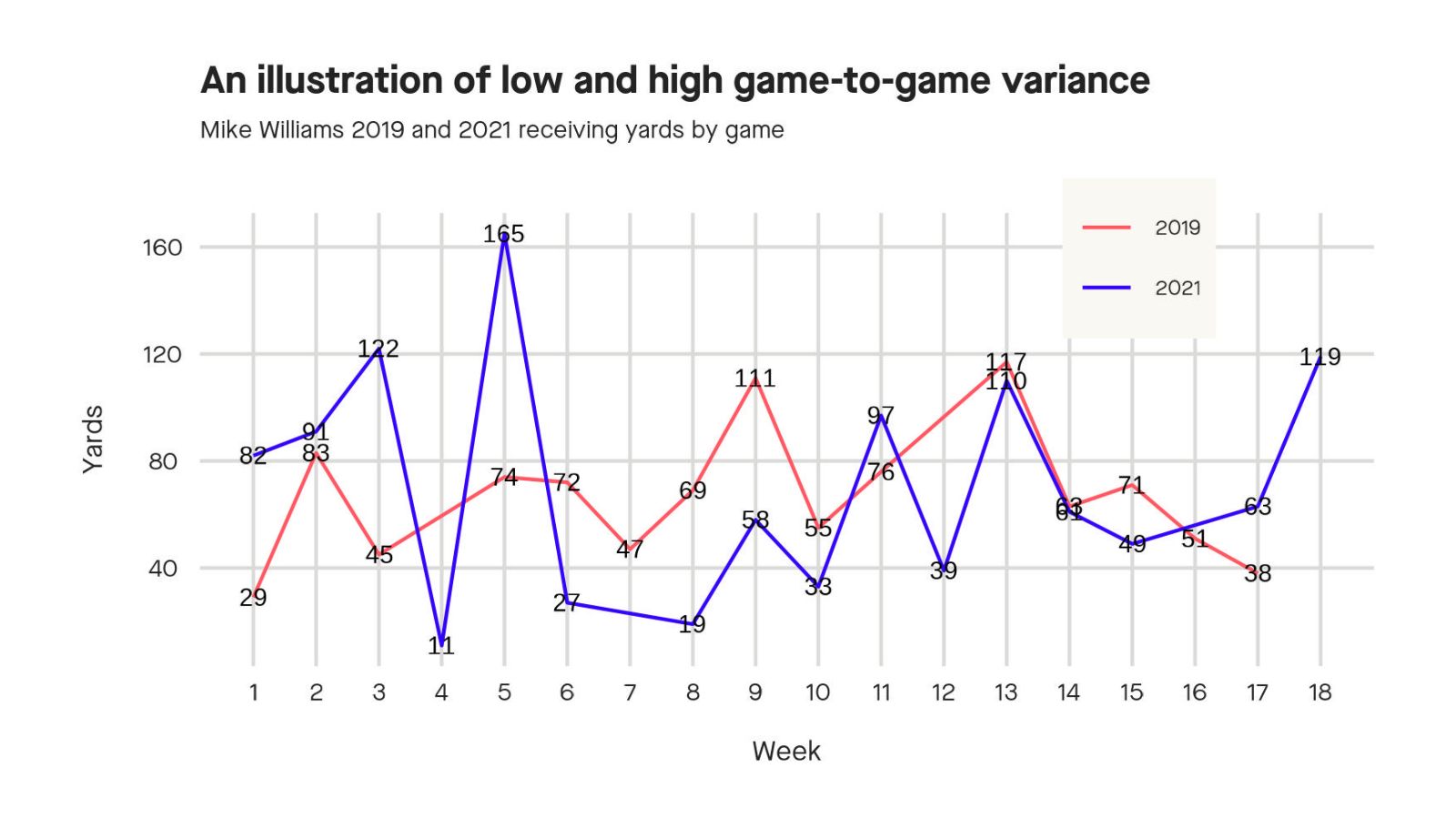
    Here are two different seasons from generally-considered-inconsistent wide receiver Mike Williams. The first one (2019) actually was pretty consistent, and the other (2021) pretty inconsistent, with the overall production being quite similar (between 1,000 and 1,200 yards across 14-15 games).

    That Williams pulled off these two opposing seasons with similar production suggests that we might overvalue the concept of a consistent or inconsistent player, but we’ll get to that.

    Is consistency good? A naive approach

    When trying to value consistency, the first answer we arrive at is the opposite of what people might presume. 

    I took 8 years of Total Points data on NFL players, and analyzed players two ways:

    • Full seasons (min. 12 games), for season-to-season projection
    • First halves (min. 6 games), for In-season projection


    In each case, I split players up by how much game-to-game variation they had in their Total Points. Those in the upper quartile were considered high-variance players, and the lower quartile considered low-variance.

    I started just by looking at how productive those groups of players were overall, and what happened to each group in the following time period (year or half-year). 

    What I found was that higher-variance players were more productive on average than low-variance players. The plot below relates the season-to-season numbers, but the in-season phenomenon is the same.

    There’s also an interesting finding, which we’ll return to. In the following time period, the players in those high and low variance groups regressed towards the middle in both average and variance, more so on the variance side of things. (The axes on the above chart are equal to make it easier to see this.)

    What we seem to find is that inconsistency is correlated with productivity, and the gap in productivity between consistent and inconsistent players maintains itself over time more than the gap in consistency.

    But there’s a problem: production is skewed positively. That is to say, players are more likely to have great games than terrible games, in large part because benches and backups exist. So a qualifying high-variance player is more likely to be good than bad, all else equal. And in terms of Total Points, a position like quarterback has both high variance and high production, which messes things up as well. 

    Is consistency good? A player-matching approach

    Instead of just taking the overall average, we can take a more precise approach. We can pair up players at the same position with similar overall production but different variance profiles, and check how the consistent players perform compared to the inconsistent ones. This would strip out the aforementioned issues with positional differences, biased samples, etc.

    To do this, I took the above sample of players and paired up those at the same position in the same season who had opposing variance profiles (upper quartile and lower quartile). From those candidate pairings, I took the pairings that were closest in terms of average Total Points production. 

    If consistency is valuable from an on-field perspective, we should see players with similar total production but more consistency outperform their inconsistent counterparts going forward. Which we… generally don’t.

    Per-game Total Points changes year-over-year, 325 player pairs

    Avg Before Avg After Std Dev Before Std Dev After
    Consistent 1.4 1.5 1.1 1.7
    Inconsistent 1.4 1.5 2.4 1.9


    Per-game Total Points changes in-season, 547 player pairs

    Avg Before Avg After Std Dev Before Std Dev After
    Consistent 1.4 1.3 0.9 1.5
    Inconsistent 1.4 1.5 2.5 1.8

    There isn’t a meaningful difference in the players’ overall production between previously-consistent and previously-inconsistent players. There’s a small difference when comparing in-season production, but it’s not practically significant. A gap of 0.2 points per game is equivalent to a field goal over the course of a full season.

    Bundling all the positions together to come up with these averages can be a bit fraught, especially considering quarterback value is so different from other positions. If we look position-by-position we do see some suggestion that pass-catching positions (WR and TE) benefit from inconsistency, to the tune of close to a half-point per game (regardless of which type of time frame we look at). But then we’re talking about just a few dozen pairings of players, so it’s not a very robust finding.

    We also see a continuation of the phenomenon from above, where the consistency level that we observe in one time period mostly disappears by the next one. Turns out even consistency isn’t very consistent.

    I’m still of the opinion that there are types of consistency—in effort, in demeanor—that are somewhat reliable and can offer some value. But I don’t have any evidence that consistency in on-field production is either reliable or valuable.

    Maybe Oscar Wilde was right when he said, “Consistency is the last refuge of the unimaginative.”

  • NFL Total Points and Statistical Leaders – Entering Week 5

    NFL Total Points and Statistical Leaders – Entering Week 5

    We’re back with our NFL Statpack for another season.

    The last few years we’ve been sending out a weekly stat package e-mail to help get you ready for the weekend’s games.

    Hopefully you’ll think this year’s version is been even better. One thing we noticed: Not many people are downloading the attachment. So we’re putting more information into the body of this e-mail. Scroll to the end. There’s lots of good stuff here.
    Our goal is to bring the stats to you so that you don’t have to go hunting them down.
     
    Let us know that we’ve done that. Please share any feedback on these info packages. You can contact us at mark@ww2.sportsinfosolutions.com
    Total Points Leaderboards
    Highlights from the leaderboards in our flagship stat, Total Points, which attempts to measure everything that happens on the field (full primer here).

    Among them:

    * Geno Smith and Jayden Daniels are now 1-2 in Total Points among quarterbacks. Daniels leads the NFL with an 82% completion percentage, nearly 10 full percentage points higher than the next-closest QB (who happens to be Smith). That includes 20-of-29 completions on passes thrown at least 10 yards downfield (NFL-best 69%).

    * Ravens running back Derrick Henry now has 16 broken tackles this season. Only two other players have at least 10: Josh Jacobs (11) and Jordan Mason (10). Coincidentally, 16% of Henry’s runs have featured a broken tackle, the third-highest rate in the NFL (Miles Sanders 20%, Jaylen Wright 19%).

    * 49ers linebacker Fred Warner has the most Total Points of any defensive player (24). In addition to his 28 tackles, he has 3 forced fumbles and 2 interceptions.

    * Kamari Lassiter of the Texans currently ranks No. 1 in Total Points among cornerbacks. Lassiter, a 2nd-round pick out of Georgia, has held opponents to 5 completions on 15 targets and has an interception through 4 games.

    Last season for the Bulldogs, Lassiter yielded only 8 completions on 29 targets against Power-5 competition.

    Click here for the full Total Points StatPack

    Total Points Power Rankings

    The Top 10 teams in the NFL when taking into account Total Points Per Play for offense, defense, and special teams.

    T1. 49ers & Seahawks, T3. Vikings & Ravens, T5. Bills, Saints & Bengals, T8. Falcons & Texans, 10. Chiefs

    Full list

    Top 5 Offenses

    T1. Commanders & Ravens, T3. Seahawks & Bengals, T5. Falcons & Bills

    Full list

    Top 5 Defenses

    1. Chargers, 2. Broncos, 3. Dolphins, T4. Bears & Vikings

    Full list

    Total Points Leaders: Quarterbacks

    1. Geno Smith

    2. Jayden Daniels

    3. Lamar Jackson

    4. Joe Burrow

    T5. Brock Purdy, Patrick Mahomes & Josh Allen

    Top 10 list


    Total Points Leaders: Running Backs

    1. Zach Charbonnet

    2. Justice Hill

    3. Kenneth Walker III

    T4. Antonio Gibson & Derrick Henry

    Top 10 list

    Total Points Leaders: Wide Receivers

    T1. Chris Godwin & Nico Collins

    T3. Jayden Reed & Jauan Jennings  

    T5. Jameson Williams & Chris Olave

    Top 10 list


    Total Points Leaders: Defensive Ends

    1. Aidan Hutchinson

    2. Myles Garrett 

    3. Calais Campbell

    4. Emmanuel Ogbah

    5. T.J. Watt

    Top 10 list


    Total Points Leaders: Linebackers

    1. Fred Warner

    T2. Robert Spillane & Troy Andersen

    4. Kyle Van Noy

    5. Zack Baun

    Top 10 list


    Total Points Leaders: Cornerbacks

    1. Kamari Lassiter

    2, Shaquill Griffin 

    3. Riley Moss

    T4. Paulson Adebo & Kristian Fulton

    Top 10 list


    Total Points Leaders: Safeties

    1. Kerby Joseph

    2. Amani Hooker

    T3. Julian Love & Jaquan Brisker

    5. Quentin Lake

    Top 10 list

    Charting Leaderboards

    Leaderboards in various statistical categories based on video review by our staff, including long passes, yards after contact, and pressures.

    Most Completions, Pass Attempts 20+ Yards Downfield

    1. Sam Darnold 8 

    2. Brock Purdy  7

    T3. Anthony Richardson, Jordan Love, Matthew Stafford 6

    Top 10 list

    Most Receptions, Targets 20+ Yards Downfield

    1. George Pickens 5

    T2. Jauan Jennings & DK Metcalf 4

    T4. 9 players tied   3

    Top 10 list

    Most Yards After Contact (Rushing)

    1. Jordan Mason 261

    2. Derrick Henry 222

    3. Rhamondre Stevenson 214

    4. Brian Robinson Jr. 205

    5. Aaron Jones 200

    Top 10 list

    Most Broken/Missed Tackles (Rushing)

    1. Derrick Henry 18

    T2. Rhamondre Stevenson & Jordan Mason 17

    T4. 7 players tied 12

    Top 10 list

    Most QB Pressures

    1. Aidan Hutchinson 30

    T2. Micah Parsons & Keion White 19

    4. Carl Granderson 18 

    5. Myles Garrett, YaYa Diaby, Chris Jones 17

    Top 10 list

    Most Pressures Above Expectation

    1. Aidan Hutchinson 13.5

    2. Myles Garrett 8.8 

    3. Micah Parsons 7.7

    4. Kyle Van Noy 6.9

    T5. Keion White 6.8

    Top 10 list

    Matchups and Mismatches

    When we look at matchups by unit and comparing the teams playing a particular game, there are intriguing matchups and mismatches each week.

    Here are 5 we noticed

    (All references to rankings are in the context of Total Points Per Play)

    * The Ravens rank among the top 6 teams in Passing, Rushing, Receiving, and Blocking. They face the Bengals, who have a vulnerability. They rank 30th in Pass Rush.

    * The Jaguars and Colts rank 3rd and 5th in Rushing, respectively. They also rank 28th and 29th, respectively, in Run Defense, so this could be a big game for both team’s running backs.

    * The Commanders rank No. 2 in rushing but may face challenges running against a Browns defense that ranks No. 4 in Run Defense. Jayden Daniels will also have to contend with the Browns 6th-ranked Pass Rush.

    * Kyler Murray may have to do it all himself against the 49ers. The Cardinals rank 30th in Rushing and are facing a 49ers team that ranks No. 3 in Run Defense.

    * The Saints’ No. 1 Blocking group will be tested on Monday night by the Chiefs, who have the No. 4 Pass Rush and No. 9 Run Defense.

    Please let us know if you have any feedback on these info packages. You can contact me at mark@ww2.sportsinfosolutions.com
  • Jameson Williams Expands His Route Tree

    Jameson Williams Expands His Route Tree

    Photo: Scott Grau/Icon Sportswire

    Back in February 2023, Detroit Lions’ OC Ben Johnson said the team planned on using Jameson Williams “all over” the formation, lining him up at X, Z and Slot receiver.

    “I know this: When you get speed in the slot, that’s very hard to defend,” he said.

    So far, the Lions have kept opponents guessing as to where Williams will line up throughout his young NFL career, dividing his time almost evenly out wide and in the slot. He’s lined up more than 20% of the time in each spot (left wide, left slot, right slot, right wide).

    Detroit began ramping up his overall route rate after their Week 9 bye last season. By the time the playoffs rolled around, Jameson Williams was running about as many routes per game as Josh Reynolds and Sam LaPorta.

    Now, with an entire offseason under his belt and his salad days firmly behind him, the kid they call Jamo looks poised to ascend and fully unleash his speed on the league.

    Through Week 4, he has run the same number of routes as Amon-Ra St. Brown.

    The big change? Williams is running a more complete route tree to stress the defense at all three levels of the field, earning targets on playbook staples like curls, digs and outs.

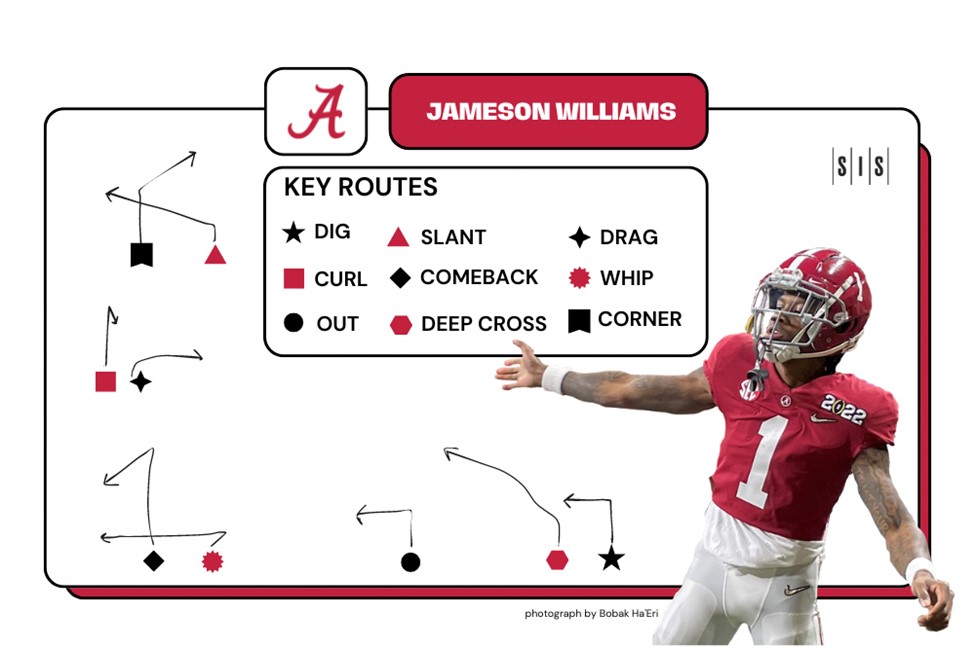
    If we add a couple more branches to the tree, we can get a better sense of how Jamo can perform as a full-time WR by first looking back at how often he ran key routes at Alabama.

    In college, Williams earned most of his targets on curls (87), digs (43), slants (34), outs (28), corners (23), deep crosses (18), drags (16), and whips (3). He also had 19 targets on screens but those haven’t been as prevalent in his NFL route tree.

    If we dig a little deeper, though, the SIS DataHub Pro can provide a more nuanced understanding of how he compared to some of his peers on these routes in 2021-22.

    WR Catchable Target % Catchable Catch% AirYard% YAC%
    Chris Olave 86% 82% 74% 26%
    Drake London 81% 84% 72% 28%
    Garrett Wilson 76% 92% 71% 29%
    Jameson Williams 77% 81% 59% 41%
    Wan’Dale Robinson 84% 84% 74% 26%

    Jameson Williams caught 81% of his targets on key routes that were deemed catchable during his junior season at Bama. That’s generally in line with other top performers, if a smidge low. 

    Once the ball was in his hands, though, Jamo’s receiving yardage splits paint the portrait of a downfield menace who could create after the catch.

    Fast-forward to the NFL and it’s encouraging to see similar splits through his past 15 games, especially when compared against others during the same timeframe (since Week 10 of the 2023 season, including playoffs).

    WR Catchable Target % Catchable Catch  %  AirYards% YAC%
    Amon-Ra St. Brown 79% 86% 67% 33%
    Jameson Williams 79% 85% 62% 38%
    CeeDee Lamb 85% 87% 58% 42%
    Nico Collins 80% 92% 73% 27%
    Rashee Rice 85% 83% 45% 55%

    Looking at Detroit, Dallas, Houston, and Kansas City — all playoff teams from a year ago that retained their offensive play callers — Jamo compares favorably to teammate Amon-Ra St. Brown and Nico Collins.

    Perhaps most impressive is how often Williams is able to consistently generate YAC further downfield, as evidenced by his YAC relative to his deeper Average Depth of Target (ADoT).

    WR ADoT YAC/Rec
    Amon-Ra St. Brown 8.9 4.2
    Jameson Williams 11.6 6.3
    CeeDee Lamb 6.5 4.5
    Nico Collins 10.2 3.7
    Rashee Rice 5.6 6.8

    As Alex Vigderman recently wrote, Nico Collins had the best receiving season in the NFL on a per-route basis in 2023. Through the first four weeks of 2024, the star wideout is picking up right where he left off.

    Nico Collins is currently tops in the NFL among wideouts with 15 Receiving Total Points. Essentially, this means Collins was responsible for adding 15 points to the Texans’ scoreboard through their first four games. Jameson Williams is currently 5th among wideouts with 11 Total Points.

    ⇒ If you’re curious as to what goes into Total Points and how we arrived at that calculation, our signature metric received a major overhaul this offseason. ⇐

    Now, it would be extremely bullish to project a third-year breakout for Jamo on par with what Nico accomplished in 2023.

    However, it wouldn’t be all that surprising if Williams and Collins ended up with similar stat lines in 2024, as both play opposite target-commanding WRs in Amon-Ra St. Brown and Stefon Diggs and each have plenty of receiving competition elsewhere with Sam LaPorta and Jahmyr Gibbs, Tank Dell and Dalton Schultz.

    Head coach Dan Campbell called Jameson Williams a “man on a mission” and the most improved player throughout the Lions offseason. If he keeps up this pace and continues to stretch the defense, Jamo will be a major factor in the Lions reaching their first Super Bowl.

  • Which NFL Teams Have Been Most/Least Impacted By Injuries?

    Which NFL Teams Have Been Most/Least Impacted By Injuries?

    Photo: Steven King/Icon Sportswire

    Click here to read an updated version of this article.

    Let’s get right to the point: This article will take a look at which teams have lost the most Total Points due to injuries during the 2024 season.

    Injuries Games Missed Total Points Lost
    Browns 11 26 33
    Buccaneers 11 23 32
    Rams 6 15 24
    49ers 6 9 20
    Buccaneers DBs 3 7 20
    Dolphins 8 14 18

    As you can see, the top 5 teams in Total Points Lost due to in-season injuries were all playoff teams last season, with the Browns and the Buccaneers leading the way. The Bucs secondary comes in at fifth overall as they’ve been without their newly-paid safety, Antoine Winfield Jr.

    Tampa Bay Buccaneers

    The Bucs sit atop of the NFC South at 3-1 despite being ravaged by injury to start the season. Injuries to Vita Vea and Calijah Kancey have impacted their defensive front, but the back-end losses of Winfield and Bryce Hall might sting more.

    Among all safeties in 2023, Winfield led the league in Total Points along with being the best in run support. Now, he’s played in only one game in 2024, but there appears to be a schematic change to account for the absences of Winfield (and Hall).

    Antoine Winfield Jr. On/Off Splits, 2024

    On Field Off Field
    Man Coverage 24% 9%
    Zone Coverage 52% 80%
    Blitz 45% 30%
    Avg Pass Rushers 5 4
    Avg Defenders in Box 6 7

    Despite adding an extra man to the box, the Bucs are still feeling the loss of Winfield in the run game as their run defense has dropped 6 EPA per 60 plays with him sidelined due to injury.

    In the pass game, they’ve actually been pretty successful, leaning more heavily into single-high looks despite missing their top back-end weapon. Excluding screen plays, the Bucs have run single-high coverages on 51% of pass plays in Weeks 2 through 4, compared to just 27% in Week 1 against the Commanders.

    Bucs fans should be hoping that Winfield’s eventual return from his foot injury will yield better results against the run and build on their recent success against the pass.

    Cleveland Browns

    The Browns are banged up at seemingly every position group, affecting both the offense and defense equally, with 16 Total Points lost on each side of the ball. This doesn’t even account for superstar DE Myles Garrett playing through injury or Nick Chubb, as he was injured last season and does not count in this dataset.

    Total Points Lost Position Group Ranking
    Secondary 8 5
    Front 7 8 3
    Offensive Line 8 2
    Skill Players 8 4

    The Browns rank top 5 in Total Points lost due to in-season injury in every position group, excluding quarterbacks. The Browns need key players OT Jack Conklin and TE David Njoku to return along with some of the several key players they have on Injured Reserve, such as S Juan Thornhill, OG Wyatt Teller, and LB Tony Fields II, to try and salvage their season before it spirals out of control after a 1-3 start.

    Los Angeles Rams

    The Rams have embodied the “Next Man Up” philosophy this year offensively as their WR and OL rooms have been without several key players. They have adjusted their offensive scheme by running the ball more, with their last two games at a near 50/50 Run/Pass split. The emphasis in the run game has paid off dividends, as we can see in the table below:

    Weeks 1 & 2 Weeks 3 & 4
    Passing EPA/Play -0.19 -0.02
    League Passing EPA/Play -0.05 -0.01
    Rushing EPA/Play -0.03 0.17
    League Rushing EPA/Play -0.04 -0.04

    Granted, they played about one good half of football the first two weeks, but their overall offensive numbers have improved since they’ve had to play without Kupp and Nacua. Credit needs to be given to the Rams offensive coaching staff and QB Matthew Stafford, as he ranks 9th in Total Points among QBs this year despite a weakened supporting cast due to injury. The Rams seem to have figured out something that is working for them while shorthanded and they get a much-needed bye week in Week 6 to get healthy.

    Healthiest teams so far

     These teams have lost the least Total Points due to in-season injury in 2024.

    Total Points Lost
    Chiefs 0.2
    Ravens 1.1
    Broncos 2.2
    Cowboys 2.3
    Titans 3.8

    The Chiefs and Cowboys show up on this list, but both of these teams lost key players to injury on Sunday in WR Rashee Rice and ED Micah Parsons. Parsons suffered a high ankle sprain and does not expect to be out as long as Rice, but both will be sorely missed, as Parsons ranked 5th last year in Pass Rush Total Points and Rice was a top-20 receiver by Total Points per route so far this year.

    The Cowboys travel to Pittsburgh on Sunday night before four straight games against NFC foes in the Lions, 49ers, Falcons, and Eagles. Cowboys’ fans will be hoping Parsons can return during that key stretch that could have playoff seeding implications.

  • Study: What’s Going On With Red Zone Offense?

    Study: What’s Going On With Red Zone Offense?

    You have probably heard this before, but once again, scoring in the NFL is down. At a measly 42.3 points per game, the league is scoring at the lowest rate in the last 10 years. This is a (disturbing?) trend that has continued in 2024 after we also saw drops in 2023 (43.5) and 2022 (43.8).

    What is contributing to the dearth of scoring across the league? Some are arguing it is shoddy quarterback play, others are saying play calling has gotten worse, and some are saying defenses have adapted too much and are calling for the banning of basic principles (looking at you, Mel).

    All of these have a legitimate argument to be the winner. However, looking at these items as a whole is very complex and rather difficult to evaluate. What if we could evaluate these hypotheses by shrinking the field by 80 yards and still account for nearly 70% of all scoring plays? Oh wait, we can!

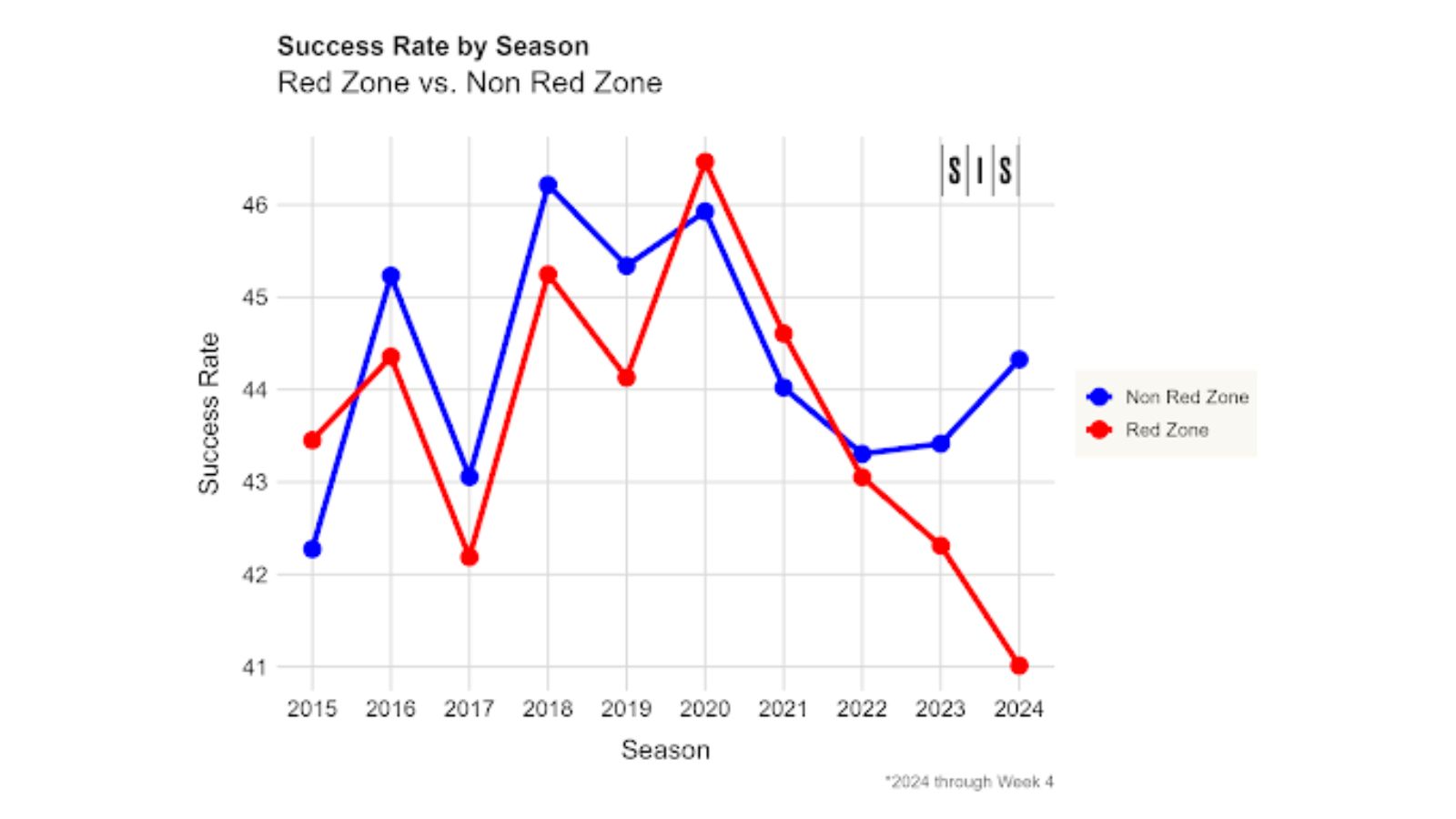
    By looking at red zone success, we can see whether or not the decrease in efficiency is even more stark than that of non-red zone plays. As it turns out, the overall trend correlates heavily with the red zone trend.

    Overall Red Zone vs. Non Red Zone

    Over the past two seasons, red zone success rate decreased year-over-year while non red zone success rate increased. These are the only two seasons where this occurs over the last ten; otherwise, these success rates generally have mirrored each other. 

    Additionally, this season and the previous two are in the bottom four of red zone success, with 2017 coming in as the other season. There is a clear trend in decreasing efficiency in the red zone, one that does not hold true for non red zone plays.

    Why does this trend exist? What has happened in the last few seasons relative to non red zone plays? To help answer, let’s look at the pass/run splits when in the red zone.

    Pass vs. Run

    Generally speaking, it is hard to convince someone in today’s game that running the ball is more efficient than passing. In fact, there isn’t much of an argument, as passes have a success rate of 46.7% while runs are at 40.5% over the past decade. This trend holds on plays in the majority of the field.

    However, the red zone is a different story. Running the ball has resulted in a 46.2% success rate, while passing is only at 42.1%. When there is less space to work with and the field shrinks, gaining yards on the ground becomes the preferred method of advancement.

    Breaking out the splits by season and play type, we see that running in the Red Zone overwhelmingly is the more efficient option, with only two running seasons coming below the top passing season. Additionally, there were more pass plays in all of the seasons, suggesting that play calling can improve at the basic run or pass decision.

    So far in 2024, passing has been the worst it has been in the past decade at a putrid 37.3% success rate. Rushing is at the middle of the pack at roughly 45.3% when strictly looking at rushing seasons.

    The ratio of pass plays to run plays is at 1.15 in 2024, which is in line with what it has been the past few seasons (1.09 in 2023, 1.15 in 2022). More pass plays is not the problem, but rather what is happening on those plays.

    No Fly Zone

    On-Target Throw Percentage

    Season Red Zone On-Target Percentage Non Red Zone On-Target Percentage
    2018 75.0% 79.7%
    2019 73.1% 76.5%
    2020 74.7% 78.9%
    2021 72.7% 77.2%
    2022 71.3% 75.3%
    2023 71.6% 73.9%
    2024 68.5% 78.7%

    Accuracy in the red zone has been on a steady decline since 2016 and has hit the sub 70% marker for the first time through four weeks in 2024. Specifically, crossing routes, flat routes, hook routes, and vertical routes are all at their lowest accuracy levels during this time. Given this applies to multiple routes with different depths, we are unable to point at specific increases or decreases in targeted routes that solely contribute to the drop in percentages, but rather a phenomenon that is happening at a general level in the red zone.

    On the contrary, accuracy on non red zone passes has increased in 2024. So much so that we haven’t seen these levels since 2020. Only the post route is at its lowest level of accuracy in this time period outside of the red zone.

    There is a clear struggle on making tighter throws when it matters most and is the difference between success in the red zone and the other areas of the field. Also, this phenomenon isn’t a result of making more difficult throws in the red zone than in the open field, as this holds when looking at Expected On-Target Percentage as well (which accounts for factors like throw depth and pressure). Defenses are allowing the completions underneath in exchange for not allowing the big play (see 2 High discourse), and are able to tighten in the red zone to prevent points on the board.

    Conclusion

    Overall, success in the red zone has declined faster than success in non red zone situations. Specifically, the accuracy of quarterbacks has dropped off a cliff in the red zone but has increased in non red zone situations. Running the ball leads to more success when the field gets smaller, so teams that can do that successfully have an advantage. 

    Scoring is hard, so it is imperative to take advantage of the opportunities given when in the red zone. Everyone loves the downfield pass, but when it comes down to it, success in the red zone relies on more balance than the rest of the field.

  • NFL Total Points and Statistical Leaders Statpack: Week 4

    Hi!

    We’re back with our NFL Statpack for another season.

    The last few years we’ve been sending out a weekly stat package e-mail to help get you ready for the weekend’s games.

    Hopefully you’ll think this year’s version is been even better. One thing we noticed: Not many people are downloading the attachment. So we’re putting more information into the body of this e-mail. Scroll to the end. There’s lots of good stuff here.
    Our goal is to bring the stats to you so that you don’t have to go hunting them down.
    You can receive this in your e-mail via free subscription. Just fill out our form here. 
     
    Let us know that we’ve done that. Please share any feedback on these info packages. You can contact us at mark@ww2.sportsinfosolutions.com
    Total Points Leaderboards
    Highlights from the leaderboards in our flagship stat, Total Points, which attempts to measure everything that happens on the field (full primer here).

    Among them:

    * Josh Allen ranking No. 1 in Total Points is no surprise, but Geno Smith being No. 2 is one of the most notable stories of the season so far. And rookie Jayden Daniels isn’t far behind.

    * Aidan Hutchinson is off to a monster start this season. He’s No. 1 at his position and it’s not even close. He leads the NFL with 22 pressures, about 11 more than expected based on the situation and his alignment (more on pressures above expectation here).

    * Jordan Mason has 32 more yards after contact than the next-closest player. His 19 missed and broken tackles also leads the NFL. However, he currently ranks tied for 8th in Total Points for a running back, a stat in which Zach Charbonnet leads the way.

    * Sam Darnold is off to a great start throwing deep passes (those thrown at least 20 yards downfield). He’s completed 6-of-8 for 238 yards, with only one pass thrown off target.

    At the other end of things, Caleb Williams is 3-of-18 on deep pass attempts, with only 3 on-target passes. Dak Prescott, who completed just over half his deep attempts last season, is 5-of-15.

    Click here for the full Total Points StatPack

    Total Points Power Rankings

    The Top 10 teams in the NFL when taking into account Total Points Per Play for offense, defense, and special teams.

    1. Bills, 2. Seahawks, 3. Vikings, 4. Steelers, 5. Saints, T. 6. Bengals & Ravens, T8. 49ers and Packers, 10. Chargers

    Top 5 Offenses

    1. Bills, T2. Ravens & Commanders, T4. Seahawks & Bengals

    Top 5 Defenses

    1. Steelers, 2. Seahawks, 3. Chargers, T4. Broncos & Bills


    Total Points Leaders: Quarterbacks

    1. Josh Allen

    2. Geno Smith

    T3. Jayden Daniels & Lamar Jackson

    T5. Kirk Cousins and Patrick Mahomes


    Total Points Leaders: Running Backs

    1. Zach Charbonet

    2. Derrick Henry

    3. Austin Ekeler

    T4. Antonio Gibson & Zack Moss


    Total Points Leaders: Wide Receivers

    1. Chris Godwin

    2. Nico Collins 

    T3. Malik Nabers & Khalil Shakir ,

    T5. Jauan Jennings, Chris Olave, Jayden Reed, Justin Jefferson, Tyreek Hill9


    Total Points Leaders: Defensive Ends

    1. Aidan Hutchinson

    2. Myles Garrett 

    T3. Calais Campbell & T.J. Watt

    5. Will McDonald


    Total Points Leaders: Linebackers

    1. Fred Warner

    T2. Tremaine Edmunds, Andrew Van Ginkel, Robert Spillane, Quincy Williams 


    Total Points Leaders: Cornerbacks

    T1. Kamari Lassiter & Jaylon Jones

    3, Devon Witherspoon 

    T4. Paulson Adebo & Jaire Alexander


    Total Points Leaders: Safeties

    1. Julian Love

    T2. Kerby Joseph, Damar Hamlin, Chuck Clark, Amani Hooker

    Charting Leaderboards

    Leaderboards in various statistical categories based on video review by our staff, including long passes, yards after contact, and pressures.

    Most Completions, Pass Attempts 20+ Yards Downfield

    1. Sam Darnold 6 

    T2. Gardner Minshew, Matthew Stafford, Derek Carr, Anthony Richardson, Kyler Murray, Brock Purdy, Dak Prescott


    Most Receptions, Targets 20+ Yards Downfield

    T1. Ja’Marr Chase, Josh Reynolds, Justin Jefferson, Jauan Jennings, George Pickens, Alec Pierce, Marvin Harrison Jr., Nico Collins

    * Each has 3


    Most Yards After Contact

    1. Jordan Mason 204

    2. Derrick Henry

    3. Rhamondre Stevenson

    4. Saquon Barkley

    5. J.K. Dobbins


    Most Broken/Missed Tackles

    1. Jordan Mason 19

    2. Rhamondre Stevenson

    3. Derrick Henry

    4. Jahmyr Gibbs

    T5. Breece Hall & Josh Jacobs


    Most QB Pressures

    1. Aidan Hutchinson 22

    T2. Micah Parsons & Carl Granderson

    T4. Trey Henderickson & Max Crosby 


    Most Pressures Above Expectation

    1. Aidan Hutchinson 10.9 (has 22 pressures)

    2. Micah Parsons 

    3. Trey Hendrickson 

    4. Zach Allen 

    T5. Myles Garret & Kyle Van Noy


    Matchups and Mismatches

    When we look at matchups by unit and comparing the teams playing a particular game, there are  intriguing matchups and mismatches each week.

    Here are 5 we noticed (All references to rankings are in the context of Total Points Per Play)

    * The Saints rank No. 1 in Blocking Total Points Per Play and they’re facing a Falcons team that ranks last in the NFL in Pass Rush and 27th in Run Defense.

    * The Colts rank No. 1 in Rushing and they’re facing a Steelers team that ranks No. 1 in Run Defense. The Colts also have to deal with a Steelers group that ranks No. 1 in Pass Rush. The Colts rank 29th in Passing.

    * The Ravens Pass Rush (ranked 20th) and Pass Coverage (18th) look vulnerable against a Bills offense that ranks No. 1 in Passing, No. 1 in Receiving, and No. 2 in Blocking.

    * The Commanders have Top 10 units in Passing (8th), Rushing (4th), and Receiving (7th) in Total Points Per Play. The Cardinals Run Defense (ranks 31st) seems like it could be in for a long day.

    * It’s a battle of the bads! The Browns rank 31st in Passing and 30th in Receiving. But, they’re facing a Raiders team that ranks 28th in Pass Rush and 30th in Pass Coverage. Will one of these teams have a good day?

    Please let us know if you have any feedback on these info packages. You can contact me at mark@ww2.sportsinfosolutions.com
  • Study: How Quickly Do QBs Return to Form Following Major Injury?

    Study: How Quickly Do QBs Return to Form Following Major Injury?

    Photo: Scott Winter/Icon Sportswire

    Jon Gruden once asked Tom Moore why Peyton Manning’s backups didn’t get more reps, to which Moore replied: ‘Fellas, if 18 goes down we’re f*****, and we don’t practice f*****.’

    According to both conventional wisdom and every modern metric, the quarterback is the most important player on a football field. If you’ve ever seen an Adam Schefter tweet about a quarterback’s contract extension, or looked at an expected points added (EPA) or wins above replacement (WAR) leaderboard, you already know this. And so you also understand why the quarterback is the most protected player on the field.

    There are all sorts of rules in place to protect these players. You cannot hit the quarterback late. You cannot hit him high. You cannot hit him low. You cannot land on him. And may God smite you if your hands get anywhere near his face.

    But bloodsport is bloodsport, and quarterbacks still can – and still do – get injured. And when quarterbacks go to IR, dreams go to die. This, too, is widely understood. Just last year, an Achilles rupture cost Aaron Rodgers and the Jets their season, and a torn ligament in Joe Burrow’s throwing wrist contributed to the Bengals falling short down the home stretch.

    Both of these teams are happy to have their respective signal-callers back in the saddle, but it’s obvious through two weeks of action that neither player is quite right just yet.

    63% of Burrow’s throws have traveled five yards downfield or less, and he ranks 19th among in accuracy rate on the (admittedly few) throws he has made further downfield. Meanwhile, Rodgers, who has made a career out of extending plays, currently ranks 30th in Total Points/play on off-platform throws (and he’s been excellent with his feet planted). Burrow is not ripping the ball, and Rodgers is not moving well, even for his age.

    So, these players have returned to play, but the question is when will they return to form? We at Sports Info Solutions feel we are well qualified to attempt to answer such a question given the fact that we collect and maintain the most comprehensive football injury database.

    In looking at quarterbacks who have missed at least four consecutive games since 2017 and then played meaningful snaps upon their return – i.e. quarterbacks who are not spot starters/backups – we can use Total Points to compare their post-injury performance to their pre-injury performance and determine when the two more or less equalize.

    We used an eight-game rolling average up to the game in which the player was injured to establish ‘pre-injury performance’ and then looked at their cumulative, per-play performance through n weeks back from injury. That is, what was their Total Points/play after their first game back, what was their Total Points/play through two games back, and so on.

    What we found was that it takes, on average, about four weeks for players to stabilize close to their pre-injury efficiency levels.

    A graph showing the percent change in performance for a quarterback in returning from injury. The line starts at 40% below their typical level and then rises to 0% in Week 4.

    ‘Stabilize’ is the operative term here. If a player’s pre-injury Total Points/play was 0.2, and he averaged 0.0 Total Points/play on 30 plays in Week 1, and then 0.2 Total Points/play on 30 plays in Week 2, his Week 2 performance will match how he was playing before injury, but it has not yet stabilized in the aggregate there because his Total Points/play over two weeks is still only 0.1.

    It is also important to make the distinction that this does not mean that quarterbacks are guaranteed to stabilize at their own pre-injury standards after four weeks. It should only be interpreted to mean that it is generally unrealistic to expect them to stabilize in the aggregate at their own standards until about four weeks. Therefore, there is not much that can be reliably and meaningfully said about these first few weeks of performance. It is, of course, possible that an injury permanently affects a player in some way. The key takeaway here is that the first month after a quarterback returns from a significant injury should not be seen as any sort of indictment against him.

    Injuries obviously vary from each other in terms of severity, region, and the ways in which they compromise player movement, but there is one common theme in terms of returning from them: the mental component. Sports Info Solutions’ head of injury operations John Verros, a trained kinesiologist, regards this as an inevitable obstacle for players:

    “There is a subconscious, uncontrollable feeling that players have – to protect the body part that was injured,” he said, “And that alters their decision-making.” 

    Note that Verros refers specifically to decision-making, which is arguably the most important trait for quarterbacks. 

    “If a player has a full offseason to recover, then it is more likely that they’ll be 100% physically and mentally, but there are no reps like game reps for the mental component,” Verros said.

    Burrow and Rodgers, as well as Kirk Cousins and Anthony Richardson, who we’ve yet to mention up to this point, are all getting back into the swing of things physically and mentally. Jordan Love is likely to find himself in the same boat in the not-too-distant future. It’s optimistic to expect them to hit the ground running, but, as they say, time heals all wounds.

  • On Derek Carr and Creating a Quarterback Ranking System

    On Derek Carr and Creating a Quarterback Ranking System

    Right before the NFL season began, we put out a tweet with a link to our “World’s No. 1 QB Rankings.”

    Patrick Mahomes was No. 1. Josh Allen was No. 2.

    And Derek Carr was No. 3.

    This looks smarter now, thanks to Carr’s unusually great start.  We’re not here to take a victory lap though.

    At the time we sent the tweet, the Twitterverse didn’t like it, and understandably so. We heard from a bunch of members of the “Delete Your Account” club.

    One of the issues with the tweet is that it didn’t offer anything in the way of context or explanation as to what the “World’s No. 1 QB Rankings” was other than to say it was “Based on 3-year statistical evaluation of all aspects of QB performance.”

    Another is that it didn’t offer any explanation as to why Carr ranked so high and how he could rate above Lamar Jackson and Dak Prescott, among others.

    So let’s address both those things here.

    What is the World’s No. 1 QB Rankings?

     A bunch of years ago, Bill James created something called The World’s No. 1 Starting Pitcher Rankings. Bill wanted a way to rank starting pitchers and thought it would be the kind of thing that would catch on with the statistical populace and the general fan population.

    He calculated rankings with a multi-year system that utilized Game Score, a stat he devised to evaluate individual pitching performances, as its chief stat. The rankings ran on his website and The Bill James Handbook each year.

    A few years ago, our content lead, Mark Simon, asked the R&D team if it could build something similar for World’s No. 1 QB. Our now director of football analytics, Alex Vigderman, obliged.

    The World’s No. 1 Quarterback Ranking uses our player value stat Total Points to make a cumulative evaluation of game performance over a three-year period.

    The key to our calculation is Points Above Average (PAA), the statistical underpinning of Total Points, which is centered at zero so that positive numbers are above average and negative numbers are below average.

    Success over time is key to maintaining a good ranking on the World’s No. 1 QB list. Prolonged inactivity due to injury or benching results in a ranking drop. The most recent performances carry the most weight.

    What’s up with Derek Carr ranking No. 3 overall?

    Imagine making a Top 10 quarterbacks list in which the following three factors were the most important:

    • Performance (most recent = most important)
    • Track record (same)
    • Playing time

    Most lists probably would have included the following eight names:

    Patrick Mahomes, Josh Allen, Lamar Jackson, Dak Prescott, Jalen Hurts, Justin Herbert, Matthew Stafford, and Jared Goff

    Track record rules out C.J. Stroud and Brock Purdy. Injuries take out Aaron Rodgers, Joe Burrow, and Kirk Cousins. You could make a case for Tua Tagovailoa and Trevor Lawrence, but we’ll leave them off for now.

    Carr belongs in that Top 10 list too.

    He ranked 9th in Total Points in 2021, 11th in 2022 (when he missed two games), and 7th in 2023. He shows up to work every week and puts in solid, albeit unspectacular efforts.

    If we’d had Carr 10th, you wouldn’t have batted an eye. It wouldn’t be an outlandish statement.

    If we’d had him 8th, you would have said eh, ok, and moved on.

    If we’d had him 6th, you would have given us the raised eyebrow.

    But 3rd … geez.

    So let’s recollect about a prominent chunk of the 2023 season.

    Through Week 6, Carr ranked 9th in the World’s No. 1 Quarterback Rankings. Carr was … just there. Every week. Respectable, not superstarish. The Saints were a non-factor.

    We mentioned how Points Above Average was the key stat within the calculation.

    Here are the Points Above Average Rankings and Totals from Week 7 on

    1. Josh Allen 66
    2. Patrick Mahomes 60
    3. Jordan Love 50
    4. Derek Carr 41
    5. Lamar Jackson 38
    6. Matthew Stafford 25
    7. Justin Herbert 22
    8. Jalen Hurts 22
    9. Justin Fields 21
    10. Joe Burrow 21
    11. Dak Prescott 21
    12. Jared Goff 18

    Carr wasn’t just better than most quarterbacks in the final 12 weeks of the season. He was a lot better. A lot better than Stafford, Herbert, Hurts, Prescott, and Goff.

    What exactly does Carr do to merit this? One thing that’s important – his on-target percentage was a lot higher than his expected on-target percentage (based on factors such as length of pass and pressure).

    That’s wordy, so let’s simplify. Did you see the two on-the-money long throws he made on Sunday? He put those throws in just the right spot.

    He’s good at that.

    The other aspect of this is that the timing of his ‘bad’ was the best possible time per the stats. Half of his interceptions and sacks were on 3rd and 4th down with at least 6 yards to go. So the penalty for these wasn’t steep. On early downs, Carr did his job (heck, he ranked 2nd in passing EPA on early downs for the season).

    This was all there for everyone to see. But some things you just don’t notice. That’s what these stats are for.

    The thing you might notice on that PAA list is that Carr and Jackson were nearly equal. And entering Week 7, Jackson was 6th, three spots ahead of Carr in the World’s No.1 QB Rankings.

    Why was a 3-PAA edge enough for Carr to jump Jackson?

    This goes to how the World’s No. 1 QB system functions. The most recent body of work is most important.

    Obviously Jackson went on to win the MVP last year, so he had some good games on his ledger. In the five games leading up to Week 7, he had three PAA marks that were higher than any of Carr’s from that same time period,

    In the two playoff games at the end of his year, though, Jackson totaled 0.8 PAA and -0.7 PAA.

    That didn’t sit well with World’s No. 1 QB. For better or worse, the system does not consider strength of opponent nor that you are playing playoff games. So Jackson dropped. Is that fair? Maybe. Maybe not.

    That gets to a larger point. It’s very difficult to build a QB ranking system, especially one that is going to consider everything and please everyone. In fact, if there was such a system, it wouldn’t be worth making, because it wouldn’t tell you anything you didn’t already know.

    No one at SIS agrees entirely and blindly with what our metrics say. You can rate No. 3 in a statistical system  and not be the No. 3 quarterback by one’s opinion.

    But we feel strongly that our process is thorough and well-thought-out, and that there are important phenomena being captured that we wouldn’t otherwise note.

    It’s clear to us that Derek Carr is more consistently productive than most anyone gives him credit for, and not just because an offensive scheme is propping him up. And with a hot start to 2024, a scheme improvement might have unlocked a new level of appreciation for his ability.