Category: NFL

  • Reviewing Our Grades for the 2021 NFL Draft Class

    Reviewing Our Grades for the 2021 NFL Draft Class

    Introduction

    While many crave all the NFL Draft Team Grades that publications put out the day after the draft, including us on both accounts, there are a lot of unknowns at that point. Of course, we all have our own NFL Draft prospect rankings heading into that weekend, but those players have yet to play a snap in the NFL. So, how can we really grade a team’s draft class if those players haven’t yet stepped onto an NFL field?

    It usually takes at least three years to see how well a draft class turned out. While said publications, including us, don’t want to wait three years before putting out their grades on a draft class, we do both. This is the time that teams must decide on 5th-year options for their 1st Round picks. Additionally, this gives these players a rookie season and two full years after that to get settled in and playing time under their belt.

    Three years ago, Sports Info Solutions published the 3rd edition of The SIS Football Rookie Handbook. After the 2021 NFL Draft, we, just as many others, posted our NFL Draft Team Grades, which can be seen here. It’s worth noting we don’t give out letter grades like most. We rank the teams from 1 to 32 in terms of how much talent they got as an entire class.

    Just as I did last year, in the article you can see here, I’ve developed a system to evaluate the draft classes using Total Points relative to position as the foundation. Three seasons have now gone by since the 2021 NFL Draft. So, let’s use that to truly see how each team did with getting value from its selections and draft class as a whole.

    Our TLDR Top Things To Know

    1. We ranked the Lions No. 1 in our 2021 post-draft ranking. Three years later the Chiefs rank No. 1 according to our stat for assessing it, Total Points Score (TP Score), followed by the Lions, Jaguars, Dolphins, and Bears.
    2.  The Rams ranked last both in our original rankings in 2021 and in TP Score three years later.
    3. The Jaguars, Broncos, and Jets accrued the most Total Points from their draft classes

    How much value did teams get?

    Let’s take a look at how we ranked teams after the 2021 NFL Draft and then who got the most and least value. See the Appendix below to see how all 32 teams ranked in our 2021 rankings and in TP Score.

    Here are the teams we ranked at the top immediately following the draft back in 2021. To see our scouting grading scale, check out our NFL Draft site.

    Top 5 Teams in 2021 Post-Draft Rankings
    Team Book Rank Grade
    Lions 1 6.60
    Dolphins 2 6.46
    Browns 3 6.44
    Jaguars 4 6.40
    Falcons 5 6.38

    TP Score will be defined below, but here are the top 5 teams based on how much value they received from their draft class.

    Top 5 Teams in TP Score
    Team TP Rank TP Score
    Chiefs 1 83.33
    Lions 2 80.82
    Jaguars 3 80.72
    Dolphins 4 66.22
    Bears 5 65.39

    In our post-draft rankings in 2021, we tabbed the Lions as the No. 1 draft class, and they just got edged out by the Chiefs for No. 1 three years later. In Brad Holmes’ first draft with the Lions, he was able to draft two of the top 10 players in Total Points over the last three years: Penei Sewell and Amon-Ra St. Brown, with both signing contract extensions just before the Draft.

    We also had the Jaguars and Dolphins in our top 5 who also ended up there after three seasons. Trevor Lawrence has been a mixed bag, but when he’s looked good, he’s been really good, amassing the most Total Points in the draft class. Additionally, Tyson Campbell’s 116 Total Points is the 6th-most. The Dolphins nailed their first four picks in Jaylen Waddle (59 Total Points), Jaelan Phillips (80), Jevon Holland (91), and Liam Eichenberg (61).

    As for the Chiefs, we were high on Nick Bolton, Creed Humphrey, and Trey Smith, grading them as 6.6 or 6.7 players, but they even surpassed those expectations, as we ranked them 21st post-draft. Between the three of them, they totaled 263 Total Points and would’ve ranked 10th among full teams themselves. While Joshua Kaindoh and Cornell Powell didn’t contribute much, they still hit on four of their six picks, which is a great percentage.

    The Bears round out the top 5 of TP Score, and we originally ranked them 16th immediately following the 2021 Draft. Justin Fields finally started to turn the corner, though he was traded to Pittsburgh this offseason. We were also high on Teven Jenkins, but the other five members of their class graded out between a 5.9 and 6.3 for us. We felt they would all contribute, but most, especially Larry Borom and Khalil Herbert, exceeded our expectations.

    Conversely, here are the bottom 5 teams from our 2021 rankings.

    Bottom 5 Teams in 2021 Post-Draft Rankings
    Team Book Rank Grade
    Bills 28 6.14
    Saints 29 6.12
    Cowboys 30 6.11
    Colts 31 6.07
    Rams 32 5.82

    Based on TP Score, here are the worst teams in terms of getting value from their 2021 draft picks.

    Bottom 5 Teams in TP Score
    Team TP Rank TP Score
    Giants 28 20.22
    Panthers 29 20.02
    Seahawks 30 20.00
    Vikings 31 17.08
    Rams 32 15.48

    The big bullseye here was the Rams. We were very low on their draft class initially, and they haven’t done anything to disprove that. While we admit omitting Ernest Jones from the book was a big miss on our part, he garnered 75 of their 114 Total Points from the entire class. He and Ben Skowronek were the only picks to play above average relative to their position among the draft class.

    While we ranked the Seahawks (26th) and Vikings (23rd) low initially, we missed on the Giants (12th) and Panthers (9th).

    Kadarius Toney and Azeez Ojulari have been above-average players, but Aaron Robinson and Rodarius Williams (SIS No. 5 CB) have been disappointing in New York. As for Carolina, aside from their three above-average players (Jaycee Horn, Brady Christensen, and Tommy Tremble), six of their eight other picks we felt were 6.4s or better, but they’ve only combined for a total of 26 Total Points.

    Determining Total Points Score

    In case you missed last year’s article, let’s explain the process of creating each team’s TP Score. When looking back to see how good or bad a specific draft class was, there are two main points to detect:

    1. How productive were the draft picks on the field?
    2. How much talent did the team draft relative to the amount of picks they made? 

    As in: Did they hit on one player or did they hit on multiple players?

    To determine the value of the draft classes, I used Total Points, our flagship player value stat, from across the last three seasons. However, for those of you who are familiar with Total Points, it gives a lot of extra weight to quarterbacks. With that said, Trevor Lawrence alone would have had the 14th best draft class with his 232 Total Points if we just used raw Total Points.

    While there is a reason we weigh quarterbacks so much more compared to other positions (they are pretty important), using that raw number in this sense isn’t going to make for a perfect match. While getting your franchise quarterback is a huge win, it doesn’t automatically give you a top class. This year, Jacksonville ended up with the 3rd-highest TP Score, and I think most would agree they had a good class, but not the best.

    Now, answering question 2 takes into account how well a team drafted throughout the entirety of the draft class. I found the average Total Points per player from the 2021 class at each position, including UDFAs who have taken at least one offensive or defensive snap, since they were also available to be selected.

    The positional averages are shown in the table below.

    Pos TP per Player
    QB 56.7
    RB 8.5
    WR 12.6
    TE 15.2
    OL 30.1
    DE 17.2
    DT 12.4
    LB 23.2
    CB 34.3
    S 30.1


    The TP Score, as referenced earlier, is what’s used to rank the teams. It is calculated as follows:

    1. Add up the Total Points from the entire team’s draft class
    2. Divide that number by the number of selections the team had
    3. Multiply that number by the percentage of draft picks that were above the average Total Points for their given position
    4. Add that to the original Total Points per draft pick

    In these 4 steps, we are essentially answering how productive the draft class was and how many picks were “hits”. Let’s run through an example using our No. 1 team, the Kansas City Chiefs.

    Here is their draft class:

    Pos Player Total Points
    LB Nick Bolton 75
    OL Creed Humphrey 103
    DE Joshua Kaindoh 0
    TE Noah Gray 37
    WR Cornell Powell 0
    OL Trey Smith 85


    Add up the Total Points from the entire team’s draft class

    300

    Divide that number by the number of selections the team had

    300 Total Points divided by 6 selections equals 50.00

    Multiply that number by the percentage of draft picks that were above the average Total Points for their given position

    Bolton, Humphrey, Gray, and Smith all accumulated a Total Points number that was above average compared to their position groups

    50.00 times 66.7% (4 out of 6) equals 33.33

    Add that to the original Total Points per draft pick

    50.00 plus 33.33 equals 83.33, which is their TP Score

    So, to summarize, we took the team’s Total Points gained from these players, dispersed it throughout the entire class and then gave a bump based on how many above-average players they drafted.

    Now that we know how the teams ranked and how the TP Score is calculated, let’s dive into some of the other details.

    Other Key Takeaways

    – No teams hit on at least 75% of their picks that year. At least two teams did that in each of the past two seasons, but none did with this class. However, the Bears and Lions went 5-of-7 (71%), the Chiefs went 4-of-6 (67%), and the Jets went 6-of-10 (60%). Levi Onwuzurike of the Lions came less than a half-point short of the DT average or he would’ve given Detroit a sixth hit and the No. 1 class.

    – The Jets’ six hits were the most of any team. They ranked 7th in TP Score. They hit on six of their first seven picks, getting at least 30 Total Points from each of them, though three of them have played significant snaps for other teams. Zach Wilson has been traded to Denver and hasn’t been anything like what Jets fans hoped, but he did sneak into being an above-average player in what was a brutal quarterback class.

    – Every team drafted at least one player who has played above the positional average compared to the rest of the draft class. However, the Saints (Payton Turner), Raiders (Alex Leatherwood), 49ers (Trey Lance), Titans (Caleb Farley), Seahawks (Dee Eskridge), Rams (Tutu Atwell), and Texans (Davis Mills) were the only teams whose first draft selection wasn’t an above-average player. This is the second year in a row that’s been the case for Las Vegas, Tennessee, Los Angeles, and Houston.

    – The three teams with the most raw Total Points are the Jaguars (467), Broncos (388), and Jets (360). Jacksonville leading the way isn’t a surprise given how valuable Trevor Lawrence has been. Denver and New York ranked No. 6 and No. 7 in TP Score, as well. We detailed the Jets already, so for the Broncos, they hit a massive home run with Patrick Surtain II, who has accumulated 161 Total Points, 2nd-most in the class behind Lawrence.

    – The Seahawks (45), Giants (91), and Rams (114) totaled the least amount of Total Points from their 2021 draft class. Seattle didn’t have a pick in Round 1 and had only three picks total. They missed with their first selection Dee Eskridge in Round 2. Their only hit was Tre Brown in the 4th Round, as he’s accumulated 35 of their 45 Total Points.

    – Of the three first-rounders who weren’t above-average players (not including Alex Leatherwood), it’s no surprise none of them got their 5th-year Option picked up. Of the 16 players whose options were picked up, minus those who received extensions, the only one who didn’t rank in the top 8 of their position group among the class was Alijah Vera-Tucker. His 48 Total Points placed him 16th among the offensive linemen.

    – Now that we’re three years into this, we can begin to take a broader look across seasons. 

    The Chiefs have the highest average TP Score across the last three seasons with 65.48, nearly 10 points higher than the Jaguars in 2nd. Check out the entire list in the Appendix.

    – Conversely, the Rams are the only team with an average ranking in the bottom 8, and they also rank dead last with an average TP Score of just 23.58. As a whole, this does make some sense. They haven’t made a 1st-Round pick in any of these seasons, so it’s likely they aren’t going to get a high-end impact player, but it’s telling that they’ve struggled to find much value in the later rounds of drafts.

    – Now the real question is how do our initial rankings compare to those numbers? 

    The Chiefs have had the highest average TP Score in three years, but we’ve given them the 2nd-worst cumulative ranking post-draft. Omitting L’Jarius Snead in 2020 played into that, but that’s clearly the biggest miss on our part. However, it’s worth noting that they’ve been able to take players who fit their scheme perfectly and make them work when they may not elsewhere.

    Additionally, our average top 10 post-draft teams who also have an average TP Score rank in the top 10 include the Bengals, Dolphins, Jaguars, and Broncos. Conversely, matches in the bottom 10 include the Colts, Seahawks, and Vikings. Teams we match in the middle 12 include the Titans, Cowboys, and Jets.

    While we’ve been way too low on the Chiefs post-draft each year, conversely, we’ve been way too high on the Ravens. We’ve averaged giving them the 5th-best (tied) class across the three seasons immediately after the draft, but they have just the 25th-best TP Score.

    How do our Initial Grades Compare?

    44% (14/32) of our initial ranks were in the correct half, meaning a team we ranked between 1 and 16 or 17 and 32 was ultimately in that tier, which is a dip from the last two seasons. However, we hit 3 of the top 5 and the last-ranked Rams. Additionally, 17 of the teams were only a single-digit difference from post-draft to now.

    The biggest differences in our initial grades and these final rankings were the Chiefs (20 spots), Saints (20 spots), and the Panthers (20 spots). We had Kansas City and New Orleans fairly low post-draft and we were high on Carolina. The Saints and Panthers flip-flopped, as we ranked the Saints 29th initially and they ended up 9th, whereas the Panthers were initially ranked 9th and ended up 29th. The 20-spot difference as the biggest difference is an improvement over previous years.

    For New Orleans, even with Payton Turner, who we felt was a versatile backup with a 6.2 grade, not working out, Pete Werner and Paulson Adebo have been outstanding and exceeded our initial grades. We graded them as a 6.2 and 6.4, respectively.

    Some players we unfortunately omitted from the Handbook were Brandon Stephens, Ernest Jones, and Dan Moore Jr. Stephens’ 94 Total Points is 4th-most among CBs in the class and just outside the top 10 overall. Jones and Moore each have accumulated 75 and 68 Total Points, respectively.

    What were some of our biggest misses elsewhere? All three players selected in Round 3 that we didn’t feature in the book have been big contributors. That includes Stephens, Jones, and Milton Williams. Additionally, while we felt Tyson Campbell (6.5 grade, SIS No. 12 CB) and Paulson Adebo (6.4 grade, SIS No. 15 CB) would be No. 3 CBs by Year 2, which is a strong role given today’s NFL, they’ve outperformed those grades, ranking No. 2 and No. 3, respectively, among CBs in the class and were top 6 in Total Points overall.

    Let’s take a look at some of our biggest wins. 

    Excluding Dan Moore Jr., the other five players selected in Round 4 that we didn’t feature in the book (Kene Nwangwu, Zech McPhearson, Janarius Robinson, Buddy Johnson, and Jacob Harris), have combined for -1 Total Point.

    Anthony Schwartz was our 36th-ranked WR and was drafted in the 3rd Round, but has -5 Total Points in 25 games, worst among all WRs in the class. Three other players drafted in the 4th Round ranked low on our boards and have struggled. Josh Ball (SIS No. 20 OT) has -1 Total Point (worst among OL). Jordan Smith (SIS No. 26 ED) has -1 Total Point (worst among DE/EDGE). Joshua Kaindoh was our last-ranked EDGE (No. 31) and has 0 Total Points, only played in three games, and is no longer on the team.

    The table below shows the top Total Points earners across the past three seasons from the draft class and how we graded and ranked them in the Handbook pre-draft.

    Rank Position Player Total Points SIS Grade SIS Pos Rank
    1 QB Trevor Lawrence 232 7.2 1
    2 CB Patrick Surtain II 161 7.0 1
    3 LB Micah Parsons 148 6.7 4
    4 CB Paulson Adebo 132 6.4 15
    5 QB Justin Fields 132 6.9 2
    6 CB Tyson Campbell 116 6.5 12
    7 OG Landon Dickerson 113 6.7 3 (OC)
    8 WR Amon-Ra St. Brown 111 6.4 11
    9 QB Mac Jones 111 6.6 5
    10 OT Penei Sewell 106 7.2 1

    As mentioned before, we were a bit low on Adebo and Campbell. We graded Parsons as a Will linebacker with some pass-rush upside, but had no idea the impact he’d eventually make in the NFL. It’s easy to see why Detroit and Jacksonville ranked in our top 3 in TP Score, and top 4 post-draft, as each have two players on this list.

    Conclusion

    Nobody really knows how a draft class is going to turn out immediately after the draft, yet it still makes sense to grade and rank the teams based on player grades for an initial reaction. 

    Post-draft grades are great in a sense, but they should be taken with a grain of salt. Once three years go by and we’ve seen what these players have done in the NFL, we can get a better sense of how good the team drafted.

    These rankings are all about finding which teams drafted the best draft class as a whole, not just who got the best player. While there are some players who didn’t play for the team that drafted them for the entirety of the past three seasons, that wasn’t taken into account since those decisions came after the initial drafting of these players, which is what this is based on. 

    An example of that from this class is Jason Pinnock, who was drafted by the Jets and has 54 Total Points, but played only 12 games and about 200 snaps for them in 2021 before playing 30 games and nearly 1,500 snaps across the past two seasons for the Giants.

    It’s not a perfect science, but it does a good job at pulling player value and seeing how well teams drafted as a whole class relative to the amount of selections they were afforded.

    Three years later, the comparison between our initial rankings and these rankings aren’t terrible for Year 3 (in both our grading and our scouting process). We made some improvements from Year 2 to Year 3, like adding 34 more players to the Handbook and featuring 19 (6%) more who were drafted. Though, we hope this article next year takes a large positive swing as we went into Year 4 in the 2022 draft cycle and the first year with our new website. As with everything we do here, we hope this improves year over year and can look back and say we kept getting better every day.

    Appendix

    2021 SIS Post-Draft Rankings based on the SIS Football Rookie Handbook

    Team Book Rank Grade
    Lions 1 6.60
    Dolphins 2 6.46
    Browns 3 6.44
    Jaguars 4 6.40
    Falcons 5 6.38
    Packers 6 6.37
    Chargers 7 6.37
    Broncos 8 6.36
    Panthers 9 6.35
    Patriots 10 6.35
    Bengals 11 6.34
    Giants 12 6.32
    49ers 13 6.30
    Titans 14 6.30
    Raiders 15 6.30
    Bears 16 6.30
    Texans 17 6.30
    Ravens 18 6.28
    Eagles 19 6.26
    Steelers 20 6.23
    Chiefs 21 6.23
    Jets 22 6.22
    Vikings 23 6.20
    Cardinals 24 6.20
    Buccaneers 25 6.20
    Seahawks 26 6.20
    Washington 27 6.14
    Bills 28 6.14
    Saints 29 6.12
    Cowboys 30 6.11
    Colts 31 6.07
    Rams 32 5.82


    TP Rank based on TP Score and how much value each team got from their draft picks over the last three seasons


    Team TP Rank TP Score
    Chiefs 1 83.33
    Lions 2 80.82
    Jaguars 3 80.72
    Dolphins 4 66.22
    Bears 5 65.39
    Broncos 6 58.20
    Jets 7 57.60
    Commanders 8 47.55
    Saints 9 46.89
    Texans 10 45.12
    Bills 11 41.42
    49ers 12 39.75
    Eagles 13 39.32
    Falcons 14 36.89
    Steelers 15 36.00
    Cowboys 16 35.83
    Patriots 17 35.23
    Colts 18 35.02
    Raiders 19 34.29
    Chargers 20 33.04
    Ravens 21 32.31
    Browns 22 31.88
    Packers 23 29.37
    Cardinals 24 28.98
    Titans 25 24.00
    Bengals 26 22.75
    Buccaneers 27 22.59
    Giants 28 20.22
    Panthers 29 20.02
    Seahawks 30 20.00
    Vikings 31 17.08
    Rams 32 15.48


    Average TP Score and ranking across all three seasons (the 2019-2021 draft classes after their first three seasons in 2022-2024)


    Team Avg TP Rank Avg TP Score
    Chiefs 1 65.48
    Jaguars 2 55.50
    Broncos 3 54.52
    Dolphins 4 54.34
    Chargers 5 51.53
    49ers 6 49.63
    Bears 7 48.78
    Bengals 8 46.69
    Lions 9 46.10
    Saints 10 46.06
    Buccaneers 11 44.48
    Commanders 12 43.97
    Titans 13 42.82
    Raiders 14 42.29
    Bills 15 40.02
    Cardinals 16 39.92
    Browns 17 39.65
    Falcons 18 37.77
    Cowboys 19 36.77
    Steelers 20 35.94
    Jets 21 35.14
    Texans 22 33.77
    Packers 23 32.98
    Colts 24 32.60
    Ravens 25 31.15
    Panthers 26 31.05
    Giants 27 30.84
    Eagles 28 30.14
    Patriots 29 29.14
    Seahawks 30 28.85
    Vikings 31 26.75
    Rams 32 23.58


  • Drafting Breakout Pro Bowlers for the 2024 NFL Season

    Drafting Breakout Pro Bowlers for the 2024 NFL Season

    With the majority of impactful offseason moves complete, it’s time to turn to the upcoming season. We’ve decided to keep the optimism from draft season going by talking about breakout players for 2024. 

    To keep things simple, we’re just looking for players who haven’t yet made a Pro Bowl but who we think might this year. Some of these selections take into consideration the depth at the position in that player’s conference, but every player has shown hallmarks of opportunity and production that suggest they could take a leap this year.

    The SIS Football R&D crew of former NFL scout (and SIS COO) Matt Manocherian, our director of football analytics, Alex Vigderman, and research analysts James Weaver and Bryce Rossler, named their choices via a draft format, and they each provided their own notes below (with some occasional commentary from others sprinkled in).

     To listen along with their selections, check out this Off the Charts Football Podcast episode.

    1. Matt Manocherian – Rashan Gary, Packers EDGE

    Who made these rules? This is the easiest pick. It’s so easy that it’s uninteresting. I’m not sure how it’s possible that Gary hasn’t made a Pro Bowl yet, but this seems like a matter of time. 

    One of my favorite metrics for pass rushers is Pressure Rate Above Expectation (Pressure % +/-), which looks at how often a pass rusher in a given situation and alignment creates pressure compared to an average player in that context. Gary has been among the leaders in this stat for each of the last three seasons, and that doesn’t even reflect the 10 holding penalties that he drew over that time. 

    Gary is 26 years old and was 5th among linebackers in Pass Rush Total Points in 2023. If he can stay healthy and play with some leads this year, it feels more likely than not that he ends up in the Pro Bowl.

    2. Alex Vigderman – Jayden Reed (or Dontayvion Wicks), Packers WR

    Reed and Wicks were each taken by the Packers in the 2023 Draft, and they proceeded to have identical per-play production. They were within 0.1 yards per route run of each other, and had identical Total Points per route run to three decimals. 

    Coming out of the draft, I viewed them as possible overachievers based on their (also nearly identical) performance against press coverage and otherwise, which I’ve found to be a positive indicator. So this is a bet on that phenomenon, with Reed winning my vote because we (and the Packers) graded him as a much better prospect.

    It also doesn’t hurt that after the bye week last year (Week 6), Jordan Love ranked among the best in passing Total Points per play and first in Boom Percentage (the rate of plays gaining at least 1 EPA).

    3. James Weaver – Drake London, Falcons WR

    As a Top 10 pick in 2022, London was expected to come in and make an immediate impact to a Falcons offense going through a transition period. The problem has been below-average quarterback play at best and an offensive scheme that has limited his potential.

    Even battling those two issues, London still put up 866 and 905 receiving yards in his first two seasons in Atlanta. Now, Kirk Cousins steps in as QB1 and Zac Robinson from the Rams takes over as offensive coordinator, each coming from potent offenses at their previous stops. 

    With London’s 6’4” frame, look for him to get more than 7 end zone targets and 2 touchdowns like he had in 2023.

    4. Bryce Rossler – Chris Olave, Saints WR

    Olave has recorded 1,000-yard seasons in each of his first two seasons with the Saints, but the touchdowns haven’t been there. He had just 8 end zone targets in 2023, which is pretty pedestrian considering the overall volume he sees, but he did rank 5th in deep targets (20+ yards)with 28. An uptick in red zone usage could spell a breakout year for him in 2024.

    5. Bryce – Devonte Wyatt, Packers DT

    Wyatt didn’t see a lot of playing time in his rookie season, but he flashed considerably in Year 2. He ranked first in Pressure Rate +/- and second in raw pressure rate among DTs last year, and his combination of power and explosiveness is evident on film. He’ll be a better fit under a new defensive coordinator this year, and the staff has already said they’ll let him pin his ears back going forward.

    6. James – Bryce Huff, Eagles EDGE

    Huff had the best year of his career with the Jets in 2023, recording 10 sacks on 60 pressures and had the 11th-highest Pressure Rate +/- at 5% above expectation. He also accounted for the highest tackle total of his career at 29.

    Now part of a talented Eagles defense coordinated by Vic Fangio, look for Huff to take advantage of more 1-on-1 opportunities to get to the opposing quarterback. He will be part of a rotation with Nolan Smith and Josh Sweat and have the opportunity to be fresh when needing to make an impact play.

    7. Alex – Martin Emerson Jr., Browns CB

    This was the only “Who?” pick of the draft, which comes with pride and shame. Emerson was taken in the 3rd round of the 2022 Draft and has been quietly productive in both of his NFL seasons. He’s been one of the better pass defenders in the league across a few compelling metrics: Total Points per play, Boom Percentage Allowed, and Deserved Catch Rate (an adjusted catch rate accounting for drops and uncatchable passes).

    2022 2023
    Total Points per play 16th 10th
    Boom% Allowed 9th 6th
    Deserved Catch Rate 7th 11th

    * Among players targeted at least 50 times

    8. Matt – Jalen Carter, Eagles DT

    You guys really stink at this game. You are making it too easy for me. Jalen Carter didn’t even start on the Eagles’ broken defense last year, and he still was a Will Anderson away from winning Defensive Rookie of the Year.

    In terms of advanced stats, Carter was good-but-not-elite last year. With a new defensive staff, a larger role, and an Aaron Donald-sized hole in the conference, I think this will be the first of many Pro Bowls in Carter’s career.

    I’m sure Martin Emerson is great though…

    9. Matt – Marvin Harrison Jr., Cardinals WR 

    (or Bijan Robinson, if you prefer to play by the spirit of the activity)

    Seriously?! You made the rules! It’s not my fault that you are all bad at this game. Marvin Harrison Junior has never made a Pro Bowl. How is this pick even controversial?

    If you take rookies off the table, Bijan Robinson and Kyle Pitts are attractive picks for me for similar reasons to James’ pick of Drake London. I also like Devone Achane’s chances to take Raheem Mostert’s Pro Bowl spot.

    You know what? I take it back. I’m bad at this game. My picks are too good, so they are boring. I prefer the “spirit” of Alex taking Martin Emerson Jr. because he deserves legitimate credit if that dude makes the Pro Bowl.

    10. Alex – Jaquan Brisker, Bears S

    Brisker shows some markers of being a playmaking safety who puts up a variety of statistics that can wow awards voters. SIS graded him as a probable strong starter coming out of the draft in 2022, so there’s some upside and pedigree here.

    He got his hand on the ball (via a pass breakup, forced fumble, etc.) at the second-highest rate of any defender in the league, including 9 pass breakups (second at the position to not-exactly-a-safety Brian Branch). That also included 4 dropped interceptions, which could easily go the other way and make a huge impact.

    While he’s not a box safety or anything, he did rush the passer a couple dozen times in 2023, generating pressure almost half the time. If he pairs a few sacks with some turnovers, that’s a recipe for a breakout.

    11. James – Chase Brown, Bengals RB

    With Joe Mixon out of the picture, Brown will have every opportunity to fight for the RB1 role in a productive offense with Joe Burrow back in the picture. 

    Last year as a rookie, Brown started to see an increase in usage from Week 13 on and took advantage. He was tied for third in yards after contact per attempt and eighth in broken or missed tackles per attempt. He will be battling for time with newly acquired Zack Moss, but Brown being in a familiar system in year two will give him a slight advantage.

    12. Bryce – Anthony Richardson, Colts QB

    Richardson looked like a star in the making before an unfortunate injury derailed his rookie season. He ranked 10th in passing Total Points per play up to the point of his season ending in Week 5–which is pretty good for a rookie–and his ability as a rusher was obvious. Dual threats who produce on the ground tend to get a lot of fanfare, and Richardson is poised to pump the box score in 2024 if he can come back full strength.

  • Nathan Cooper’s First & Final 2024 7-Round Mock Draft

    Nathan Cooper’s First & Final 2024 7-Round Mock Draft


    Every year since before I can remember, I do my own Mock Draft. I only do one, and it’s done within a day or two prior to Draft Day.

    Not only do I try to tackle the first round, but I predict the entire draft, all 257 picks.

    What order do the QBs go in at the top? How many offensive tackles and wide receivers land in Round 1? Who will be Mr. Irrelevant?

    Without projecting trades and, instead, trying to match players to teams, I attempt to answer those questions and more now.

    Round 1
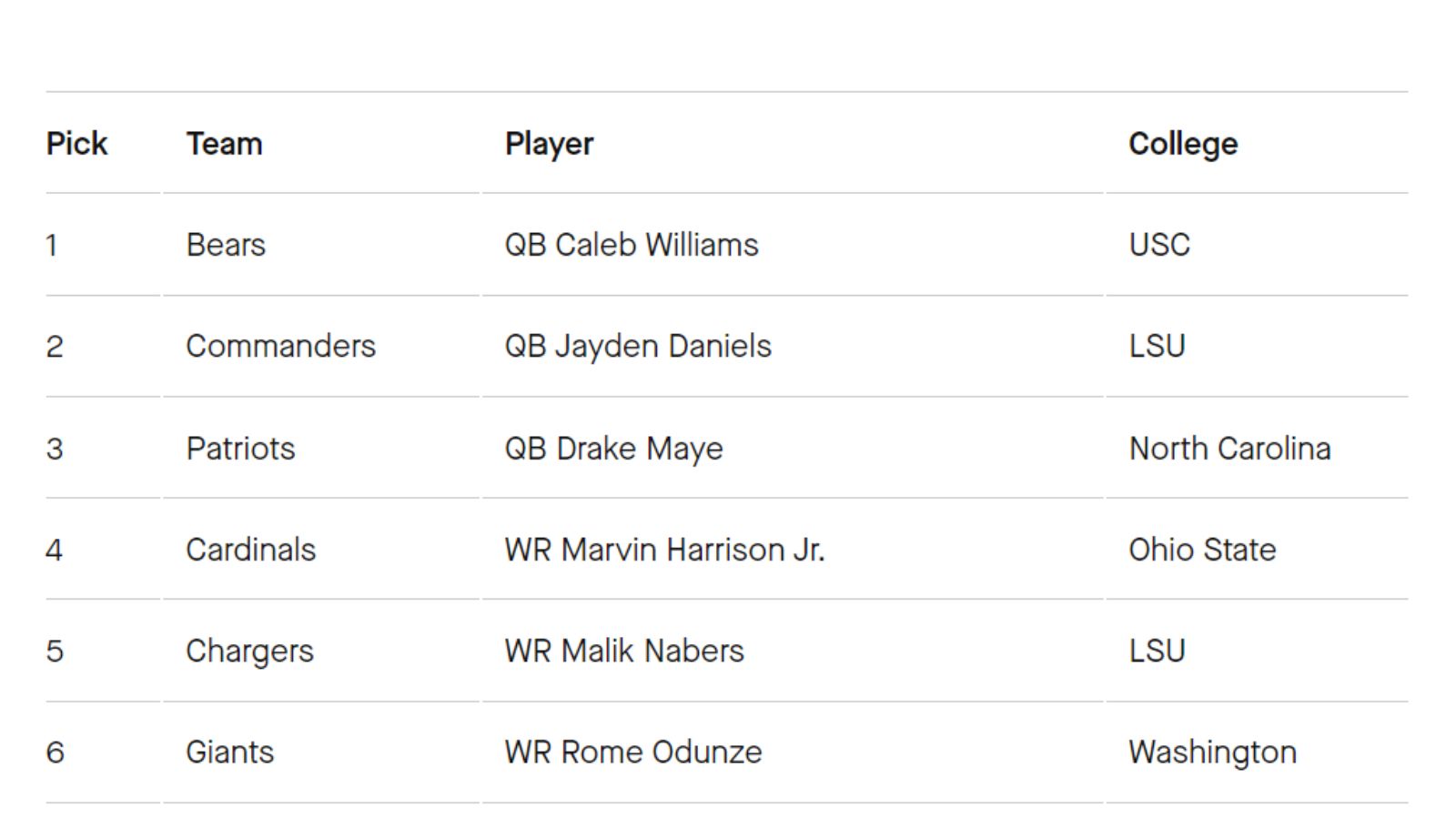
    Pick Team Player College
    1 Bears QB Caleb Williams USC
    2 Commanders QB Jayden Daniels LSU
    3 Patriots QB Drake Maye North Carolina
    4 Cardinals WR Marvin Harrison Jr. Ohio State
    5 Chargers WR Malik Nabers LSU
    6 Giants WR Rome Odunze Washington
    7 Titans OL Joe Alt Notre Dame
    8 Falcons ED Dallas Turner Alabama
    9 Bears DT Byron Murphy II Texas
    10 Jets TE Brock Bowers Georgia
    11 Vikings QB J.J. McCarthy Michigan
    12 Broncos ED Jared Verse Florida State
    13 Raiders OL JC Latham Alabama
    14 Saints OL Olu Fashanu Penn State
    15 Colts CB Quinyon Mitchell Toledo
    16 Seahawks OL Troy Fautanu Washington
    17 Jaguars CB Terrion Arnold Alabama
    18 Bengals DT Jer’Zhan Newton Illinois
    19 Rams ED Laiatu Latu UCLA
    20 Steelers OL Taliese Fuaga Oregon State
    21 Dolphins OL Amarius Mims Georgia
    22 Eagles OL Tyler Guyton Oklahoma
    23 Vikings OL Graham Barton Duke
    24 Cowboys OL Jackson Powers-Johnson Oregon
    25 Packers CB Cooper DeJean Iowa
    26 Buccaneers ED Chop Robinson Penn State
    27 Cardinals CB Kool-Aid McKinstry Alabama
    28 Bills WR Brian Thomas Jr. LSU
    29 Lions DT Darius Robinson Missouri
    30 Ravens OL Jordan Morgan Arizona
    31 49ers CB Nate Wiggins Clemson
    32 Chiefs WR Adonai Mitchell Texas
    Round 2
    Pick Team Player College
    33 Panthers CB Ennis Rakestraw Jr. Missouri
    34 Patriots WR Xavier Worthy Texas
    35 Cardinals OL Zach Frazier West Virginia
    36 Commanders OL Kingsley Suamataia BYU
    37 Chargers CB Mike Sainristil Michigan
    38 Titans ED Chris Braswell Alabama
    39 Panthers WR Troy Franklin Oregon
    40 Commanders ED Marshawn Kneeland Western Michigan
    41 Packers LB Edgerrin Cooper Texas A&M
    42 Texans CB Kamari Lassiter Georgia
    43 Falcons S Tyler Nubin Minnesota
    44 Raiders QB Michael Penix Jr. Washington
    45 Saints WR Xavier Legette South Carolina
    46 Colts WR Keon Coleman Florida State
    47 Giants S Jaden Hicks Washington State
    48 Jaguars WR Ladd McConkey Georgia
    49 Bengals OL Roger Rosengarten Washington
    50 Eagles CB T.J. Tampa Iowa State
    51 Steelers WR Ja’Lynn Polk Washington
    52 Rams QB Bo Nix Oregon
    53 Eagles OL Cooper Beebe Kansas State
    54 Browns DL Michael Hall Jr. Ohio State
    55 Dolphins ED Austin Booker Kansas
    56 Cowboys RB Jonathon Brooks Texas
    57 Buccaneers CB Max Melton Rutgers
    58 Packers OL Kiran Amegadjie Yale
    59 Texans LB Trevin Wallace Kentucky
    60 Bills S Kamren Kinchens Miami FL
    61 Lions CB Caelen Carson Wake Forest
    62 Ravens OL Christian Haynes UConn
    63 49ers OL Patrick Paul Houston
    64 Chiefs OL Christian Mahogany Boston College
    Round 3
    Pick Team Player College
    65 Panthers TE Ben Sinnott Kansas State
    66 Cardinals RB Trey Benson Florida State
    67 Commanders CB Jarvis Brownlee Jr. Louisville
    68 Patriots DT Kris Jenkins Michigan
    69 Chargers OL Dominick Puni Kansas
    70 Giants RB MarShawn Lloyd USC
    71 Cardinals ED Adisa Isaac Penn State
    72 Jets OL Blake Fisher Notre Dame
    73 Lions S Javon Bullard Georgia
    74 Falcons DT Ruke Orhorhoro Clemson
    75 Bears ED Bralen Trice Washington
    76 Broncos CB Kris Abrams-Draine Missouri
    77 Raiders WR Ricky Pearsall Florida
    78 Commanders S Cole Bishop Utah
    79 Falcons WR Malachi Corley Western Kentucky
    80 Bengals WR Roman Wilson Michigan
    81 Seahawks QB Spencer Rattler South Carolina
    82 Colts S Calen Bullock USC
    83 Rams DT T’Vondre Sweat Texas
    84 Steelers OL Beaux Limmer Arkansas
    85 Browns LB Payton Wilson NC State
    86 Texans TE Ja’Tavion Sanders Texas
    87 Cowboys DT Braden Fiske Florida State
    88 Packers DT Leonard Taylor III Miami FL
    89 Buccaneers LB Junior Colson Michigan
    90 Cardinals ED Gabriel Murphy UCLA
    91 Packers OL Zak Zinter Michigan
    92 Buccaneers S Dadrion Taylor-Demerson Texas Tech
    93 Ravens WR Jalen McMillan Washington
    94 49ers LB Cedric Gray North Carolina
    95 Chiefs CB Andru Phillips Kentucky
    96 Jaguars DT Brandon Dorlus Oregon
    97 Bengals TE Theo Johnson Penn State
    98 Steelers CB Khyree Jackson Oregon
    99 Rams WR Devontez Walker North Carolina
    100 Commanders WR Javon Baker UCF
    Round 4
    Pick Team Player College
    101 Panthers DT Maason Smith LSU
    102 Seahawks LB Jeremiah Trotter Jr. Clemson
    103 Patriots CB D.J. James Auburn
    104 Cardinals LB Jaylan Ford Texas
    105 Chargers RB Blake Corum Michigan
    106 Titans DT Mekhi Wingo LSU
    107 Giants CB Josh Newton TCU
    108 Vikings ED Jonah Elliss Utah
    109 Falcons OL Matt Goncalves Pittsburgh
    110 Chargers DT DeWayne Carter Duke
    111 Jets WR Johnny Wilson Florida State
    112 Raiders OL Tanor Bortolini Wisconsin
    113 Ravens S Malik Mustapha Wake Forest
    114 Jaguars OL Brandon Coleman TCU
    115 Bengals LB Edefuan Ulofoshio Washington
    116 Jaguars ED Brennan Jackson Washington State
    117 Colts RB Audric Estime Notre Dame
    118 Seahawks TE Jared Wiley TCU
    119 Steelers DT Gabe Hall Baylor
    120 Eagles WR Jermaine Burton Alabama
    121 Broncos QB Michael Pratt Tulane
    122 Bears OL Travis Glover Georgia State
    123 Texans RB Jaylen Wright Tennessee
    124 49ers WR Brenden Rice USC
    125 Buccaneers OL Hunter Nourzad Penn State
    126 Packers S Tykee Smith Georgia
    127 Texans DT Justin Eboigbe Alabama
    128 Bills RB Braelon Allen Wisconsin
    129 Vikings WR Malik Washington Virginia
    130 Ravens ED Mohamed Kamara Colorado State
    131 Chiefs RB Bucky Irving Oregon
    132 49ers S Kitan Oladapo Oregon State
    133 Bills CB Renardo Green Florida State
    134 Jets S Jaylin Simpson Auburn
    135 49ers OL Sedrick Van Pran Georgia
    Round 5
    Pick Team Player College
    136 Broncos ED Jalyx Hunt Houston Christian
    137 Patriots S Dominique Hampton Washington
    138 Cardinals OL Javion Cohen Miami FL
    139 Commanders WR Jamari Thrash Louisville
    140 Chargers QB Joe Milton III Tennessee
    141 Panthers ED Xavier Thomas Clemson
    142 Panthers CB Chau Smith-Wade Washington State
    143 Falcons QB Austin Reed Western Kentucky
    144 Bills ED Cedric Johnson Ole Miss
    145 Broncos OL Walter Rouse Oklahoma
    146 Titans LB James Williams Miami FL
    147 Broncos LB Tommy Eichenberg Ohio State
    148 Raiders ED Myles Cole Texas Tech
    149 Bengals CB Jarrian Jones Florida State
    150 Saints OL Mason McCormick South Dakota State
    151 Colts CB Cam Hart Notre Dame
    152 Commanders P Austin McNamara Texas Tech
    153 Jaguars OL Javon Foster Missouri
    154 Rams RB Will Shipley Clemson
    155 Rams OL Delmar Glaze Maryland
    156 Browns WR Jacob Cowing Arizona
    157 Vikings LB Ty’Ron Hopper Missouri
    158 Dolphins TE Tanner McLachlan Arizona
    159 Chiefs LB Marist Liufau Notre Dame
    160 Bills OL Layden Robinson Texas A&M
    161 Eagles ED Javon Solomon Troy
    162 Cardinals CB Nehemiah Pritchett Auburn
    163 Bills DT McKinnley Jackson Texas A&M
    164 Lions OT Christian Jones Texas
    165 Ravens LB Jackson Sirmon California
    166 Giants LB Tyrice Knight UTEP
    167 Vikings S Sione Vaki Utah
    168 Saints DT Jordan Jefferson LSU
    169 Packers DT Khristian Boyd Northern Iowa
    170 Saints CB Kalen King Penn State
    171 Eagles S Josh Proctor Ohio State
    172 Eagles CB Decamerion Richardson Mississippi State
    173 Chiefs OL Caedan Wallace Penn State
    174 Cowboys OL Garret Greenfield South Dakota State
    175 Saints S Jaylen Key Alabama
    176 49ers OL Sataoa Laumea Utah
    Round 6
    Pick Team Player College
    177 Vikings DT Tyler Davis Clemson
    178 Steelers LB Curtis Jacobs Penn State
    179 Seahawks CB Qwan’tez Stiggers CFL
    180 Patriots OL Tylan Grable UCF
    181 Chargers S Beau Brade Maryland
    182 Titans WR Luke McCaffrey Rice
    183 Giants QB Sam Hartman Notre Dame
    184 Dolphins OL Andrew Raym Oklahoma
    185 Jets QB Jordan Travis Florida State
    186 Cardinals S Evan Williams Oregon
    187 Falcons LB Aaron Casey Indiana
    188 Texans OL Charles Turner III LSU
    189 Texans CB Johnny Dixon Penn State
    190 Saints TE Tip Reiman Illinois
    191 Colts OL Jalen Sundell North Dakota State
    192 Seahawks ED Jaylen Harrell Michigan
    193 Patriots TE Jaheim Bell Florida State
    194 Bengals DT Justin Rogers Auburn
    195 Steelers OL LaDarius Henderson Michigan
    196 Rams OL Kingsley Eguakun Florida
    197 Falcons CB Elijah Jones Boston College
    198 Dolphins DL Keith Randolph Jr. Illinois
    199 Saints LB Kalen DeLoach Florida State
    200 Bills WR Jordan Whittington Texas
    201 Lions OL Trevor Keegan Michigan
    202 Packers RB Ray Davis Kentucky
    203 Jets LB Jordan Magee Temple
    204 Bills OL Isaiah Adams Illinois
    205 Lions WR Bub Means Pittsburgh
    206 Browns TE Cade Stover Ohio State
    207 Broncos RB Blake Watson Memphis
    208 Raiders CB Dwight McGlothern Arkansas
    209 Rams K Joshua Karty Stanford
    210 Eagles TE Brevyn Spann-Ford Minnesota
    211 49ers RB Isaac Guerendo Louisville
    212 Jaguars S Evan Williams Oregon
    213 Rams CB Marcellas Dial South Carolina
    214 Bengals WR Joshua Cephus UTSA
    215 49ers CB Carlton Johnson Fresno State
    216 Cowboys LB Nathaniel Watson Mississippi State
    217 Rams DT Marcus Harris Auburn
    218 Ravens TE AJ Barner Michigan
    219 Packers OL Dylan McMahon NC State
    220 Buccaneers QB Carter Bradley South Alabama
    Round 7
    Pick Team Player College
    221 Chiefs OL Nick Gargiulo South Carolina
    222 Commanders TE Dallin Holker Colorado State
    223 Raiders S Trey Taylor Air Force
    224 Bengals OL Giovanni Manu British Columbia
    225 Chargers WR Cornelius Johnson Michigan
    226 Cardinals WR Jalen Coker Holy Cross
    227 Browns CB M.J. Devonshire Pittsburgh
    228 Ravens RB Tyrone Tracy Jr. Purdue
    229 Raiders WR Jha’Quan Jackson Tulane
    230 Vikings CB Jarius Monroe Tulane
    231 Patriots OL Donovan Jennings USF
    232 Vikings LB Tatum Bethune Florida State
    233 Cowboys CB Daequan Hardy Penn State
    234 Colts ED Braiden McGregor Michigan
    235 Seahawks DT Jowon Briggs Cincinnati
    236 Jaguars CB Deantre Prince Ole Miss
    237 Bengals RB Dylan Laube New Hampshire
    238 Texans OL Nathan Thomas Louisiana
    239 Saints S Tyler Owens Texas Tech
    240 Panthers WR Ainias Smith Texas A&M
    241 Dolphins CB Josh Wallace Michigan
    242 Titans S Isaiah Johnson Syracuse
    243 Browns OL Andrew Coker TCU
    244 Cowboys LB JD Bertrand Notre Dame
    245 Packers S Jaylon Carlies Missouri
    246 Buccaneers TE Erick All Iowa
    247 Texans S Mark Perry TCU
    248 Bills RB Frank Gore Jr. Southern Miss
    249 Lions ED Javontae Jean-Baptiste Notre Dame
    250 Ravens OL Karsen Barnhart Michigan
    251 49ers DT Logan Lee Iowa
    252 Titans OL Matt Lee Miami FL
    253 Chargers DT Levi Drake Rodriguez Texas A&M-Commerce
    254 Rams S Millard Bradford TCU
    255 Packers WR Ryan Flournoy Southeast Missouri State
    256 Broncos CB Chigozie Anusiem Colorado State
    257 Jets CB Micah Abraham Marshall

    Be sure to check my pre-Draft content on Twitter @ncoopdraft, the SIS Football account @football_sis, and check out all of our content on this year’s class on the NFL Draft site.

  • The One Key To Winning Super Bowl LVIII for the Chiefs and 49ers

    The One Key To Winning Super Bowl LVIII for the Chiefs and 49ers

    Let’s get right to the point: What’s the most important thing for each team going into Super Bowl LVIII?

    Chiefs: Catch the ball!

    As a preface, let’s talk about Brock Purdy a bit (and this is Chiefs-related).

    Perhaps the biggest reason the 49ers are in this game is that Brock Purdy delivered four interceptable passes that the Lions got their hands (or faces) on, but they only converted one into a turnover. 

    Purdy has been a revelation for the 49ers, but he has lived a charmed life, for sure. Ignoring the embarrassment of riches available to him at the skill positions, he has delivered quite a few turnover-worthy throws that have fallen for (relatively) harmless incompletions.

    Of the top 10 quarterbacks in EPA per pass attempt this year (minimum 300 attempts including playoffs), he’s the only one to have more than 4 percent interceptable throws—and he’s at 5 percent. Purdy has also been intercepted less than half those times, which puts him among the more fortunate passers in this regard. 

    Let’s compare with a noted gunslinger, Josh Allen.

    Turnover-worthy throws in 2023

    Turnover Worthy % Intercepted Dropped
    Brock Purdy 5.1% 12 14
    Josh Allen 3.2% 18 3

    Our own Bryce Rossler has driven this home on our podcast multiple times over the last month: as a defense facing the 49ers, Brock Purdy is going to throw you the ball. You just need to catch it.

    Unsurprisingly, the hands thing matters for the offense as well. The Lions pass catchers dropped multiple late-down attempts themselves, not wanting their defense to have all the fun. 

    The Chiefs are as likely as any team to have hands issues. Only the Browns dropped more passes during the regular season, and Chiefs pass catchers were in the bottom ten in On-Target Catch Rate, wasting some good throws by Patrick Mahomes. The group has been better overall as the season has gone on, but they still have dropped multiple passes in four of the last seven games, and they don’t have as much margin for error as an offense as they did a few years ago. 

    49ers: Run with your advantage in the run game

    If the Lions showed the blueprint for how not to beat the 49ers, the Ravens might have shown how not to beat the Chiefs. 

    Kansas City was in the bottom group of teams in both EPA and Success Rate allowed against the run through 20 weeks, and despite having a 50% success rate on eight designed runs in the first half, Baltimore called just 3 in the second half in a winnable game.

    So here come the 49ers, who rank in the top 2 in both EPA and Success Rate on designed runs. Their reliability as an offense as a whole hinges on their ability to make hay on the ground, in part because of that note above about Brock Purdy’s penchant for pickable passes.

    EPA/Attempt (Rank) Success Rate (Rank)
    49ers offense 0.00 (1st) 46% (3rd)
    Chiefs defense -0.03 (29th) 42% (26th)

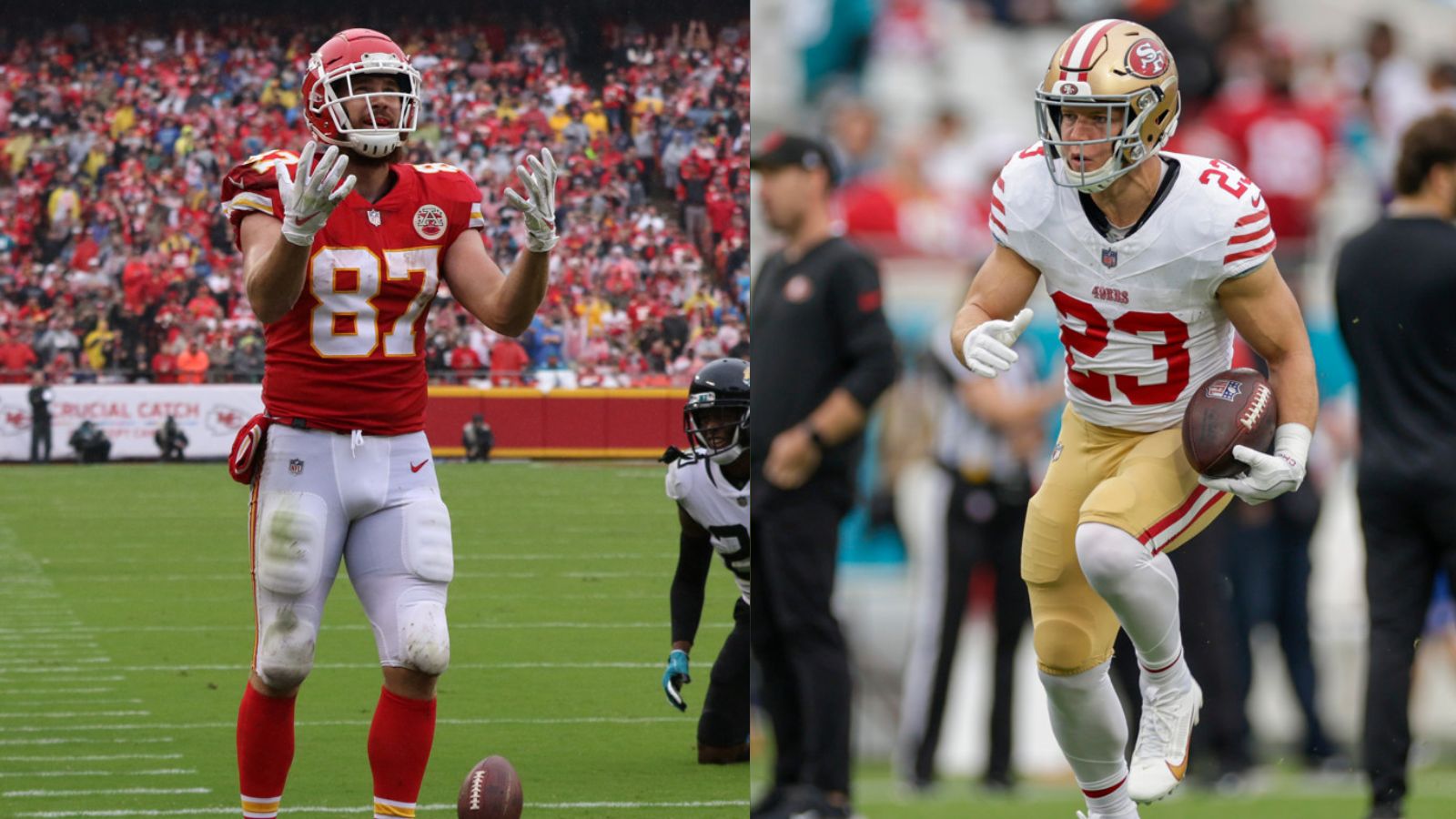
    They have the most consistent running back in the league in Christian McCaffrey, who had some workload concerns in Carolina but combined top-of-the-league efficiency with top-of-the-league volume in his first full year in San Francisco.

    If this team gets away from the run in this spot, something has gone horribly wrong.

    And if we like building narratives about establishing the run and using play action alongside it, the Chiefs offer a real opportunity. They saw as much play action on defense as anyone and ranked in the middle of the pack in EPA per play allowed, while they ranked as the best defense in the NFL on other pass attempts. 

    San Francisco (somewhat surprisingly) doesn’t rely on play fakes much, but whether the 49ers actually hand it off or not it makes sense for them to show run quite a bit in this matchup.

  • Where Did It All Go Wrong For The Eagles?

    Where Did It All Go Wrong For The Eagles?

    BY ALEX VIGDERMAN AND BRYCE ROSSLER

    In what is inarguably one of the most surprising collapses in NFL history, the Eagles are out of the 2023 playoffs. They had gone 26-5 since the start of 2022, and then finished the 2023 season losing six of seven games. Jason Kelce is apparently retiring, Nick Sirianni is on the hot seat apparently. It’s all bad.

    For a team with this one’s preseason and midseason expectations, the loss to the Buccaneers is a major disappointment. But throughout the season the Eagles had shown themselves to be a shadow of their 2022 selves, so it’s not entirely surprising.

    Looking just at the per-game scoring differential, the Eagles had led the league in 2022 (including the playoffs), while they were only seventh through their 10-1 start to 2023. And remember, that included consecutive wins against the Chiefs, Bills, and Cowboys at the end of that stretch.

    After that point, Philly posted the second-worst per-game point differential in the NFL (including their loss a couple days ago). 

    And that doesn’t tell the whole story, because their opponents were also notably worse in this stretch than they’d faced prior. Per the team strength model that SIS uses within its win probability model, their poor performance came against substantially worse opponents than their previous ones.

    The Eagles played worse against worse opponents down the stretch
     

    Time Frame Record Point Diff Rank Strength of Schedule
    2022 (All) 16-4 1st 7th
    2023 (Through W12) 10-1 7th 7th
    2023 (W13 and on) 1-6 31st 22nd

    But even before the crash the team wasn’t exactly running on all cylinders, as a 10-1 start might suggest. By Total Points per play they ranked outside the 10 best teams, ranking 9th on offense and 16th on defense. Heck, the 5-6 Falcons were better than the Eagles in Total Points Per Play to that point in the season.

    Through the rest of the 2023 season, the Eagles lost their edge on defense while maintaining solid (if slightly disappointing) offense.

    Eagles Total Points per Play Ranks

    Time Frame Offense Rank Defense Rank
    2022 (All) 2nd 5th
    2023 (Through W12) 9th 16th
    2023 (W13 and on) 10th 29th

    With that setting the scene, let’s take a look at some of the key failings of the 2023 version.

    Dropping the opposing quarterback

    Perhaps the most noticeable difference between these consecutive Eagles seasons is the performance of the pass rush. They pressured the quarterback at nearly identical rates (36% and 35%), but in 2023 the sacks didn’t come nearly as often (6% in 2023 compared to 11% in 2022). 

    That’s just straight up regression that anyone could have seen coming. The 2022 Eagles led the NFL with 29% of pressures becoming a sack, a rate that only one team in the last several seasons has gotten close to (the 2021 Bears). In the seasons surrounding those seasons, neither of those top teams achieved even a 20% rate. Even with the addition of Defensive Rookie of the Year candidate Jalen Carter, they weren’t going to retain that production.

    Big holes in the middle of the field

    It turns out that acquiring a big-name player that had been released midseason isn’t a slam-dunk move. The Shaquille Leonard addition didn’t help a linebacker group that ended the season with both starting linebackers in the bottom quintile on a per-play basis by Total Points.

    With those limitations and the loss of slot corner Avonte Maddox for most of the year, the Eagles allowed 24% of 15-yard or shorter throws between the numbers to go for a big EPA gain, which was the sixth-worst rate in the league. These underneath defenders were very visible on Monday (in a bad way), and while they didn’t yield monster plays over the middle, they were beaten consistently to the tune of 8.3 Y/A.

    RP-Oh-No

    For years the Eagles’ offensive calling card has been the RPO game. It was the crutch that supported Nick Foles’ outstanding 2017 playoff run. 

    In 2022 the Eagles gained almost a quarter of an Expected Point per play on RPOs. That was the best SIS has charted (since 2018). In 2023, they were almost exactly league average. 

    This drop-off drove the overall offensive downturn in both the passing and running game.

    Eagles RPO Success Rate in the passing game
     

    RPO No RPO
    2022 59% 43%
    2023 49% 45%

    Eagles RPO Success Rate in the running game

    RPO No RPO
    2022 52% 48%
    2023 45% 46%

    A limited Jalen Hurts capped their upside

    Jalen Hurts was famously successful on quarterback sneaks this year. He had 12 more first downs on sneaks than any other quarterback had sneak attempts in 2023. And that resulted in a lot of successful drives that other teams wouldn’t have had.

    But especially with a nagging knee injury, his designed runs outside of those sneaks were dramatically less effective. He not only attempted 10 fewer designed runs, but he was stuffed for no gain or worse more than twice as often, and had one-quarter the broken and missed tackles per attempt.

    Going back to the RPO point, Hurts struggled with quick-game accuracy. He ranked 8th in On-Target Rate on RPOs and 1-step drops in 2022 and 24th in 2023 (minimum 50 attempts). And there wasn’t a similar fall-off on deeper drops, for what it’s worth.

    With a simplified offensive scheme and an RPO-heavy approach, you need the skill position players to be elite and/or the quarterback to be precise to be a top offense. The Eagles had only one of those things this year.

    How do they look going forward?

    The Eagles can’t confidently run it back and say they just suffered from weird variance in the second half. They were a good-not-great team when they were running well.

    There have to be changes made on the defensive side to shore up an extremely leaky unit from the end of the year. They will have to grapple with questions in the secondary and at linebacker, with aging cornerbacks on the outside and an extremely flawed interior. It’ll be another offseason talking about the impending departure of Fletcher Cox and Brandon Graham, who each flashed but generally had down years (understandably for old fogeys).

    The offense has the talent to be a top-five unit and should with little effort be a Top 10 unit provided Hurts is healthier and the offensive line can coalesce without All-Pro (and Total Points leader) Jason Kelce. But it’s clear at this point that the quarterback isn’t an MVP candidate without dynamic athleticism, so the scheme needs to elevate him as much as he elevates the offense.

  • Wild Card Week Parlay Picks: Baker Mayfield, Jaylen Warren, Amon-Ra St. Brown

    Wild Card Week Parlay Picks: Baker Mayfield, Jaylen Warren, Amon-Ra St. Brown

    Photo: Cliff Welch/Icon Sportswire

    For the last couple of weeks of the NFL season, I’m trying something different with our analytic data by testing how useful it is on parlays. We’ll use Total Points, our player projections, and other information at our disposal to make picks.

    Each of my parlays will have an underdog (+120 to +245) or superdog (+250), with the remaining 2 legs consisting of a combination of even money (-115 to +115), favorite (-120 to -245), and heavy favorite (-250) lines. I’ll also incorporate teasers to achieve a degree of balance where possible.

    After starting this run with a win, we’ve missed on our last two attempts, with last week’s effort doomed by George Pickens and his mystifying zero targets. But again, the odds here are always long, and many Baseball Writers Association members would consider a .333 career batting average to be Hall-of-Fame worthy. 

    Without further ado, here are my picks for Wild Card Weekend:

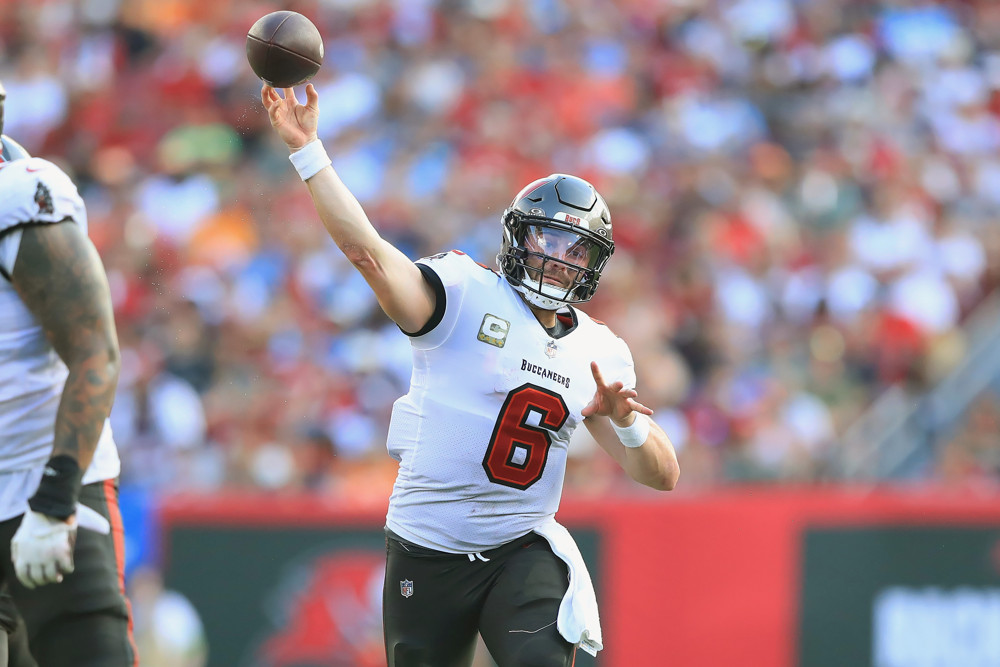
    Underdog – Baker Mayfield Alternate Passing Yards, Over 246.5 @ +135

    Our Trenches Matchup Tool, available on The33rdTeam.com, gives the Tampa Bay offensive line the best pass blocking matchup across the league this week. 

    On the year, the Eagles have given up the fifth most passing yards and second most completions, with opposing teams averaging 270 yards per game against them. They’ve allowed an opposing QB Rating of 97.9, a number that ballooned to 104.3 over their past six games. 

    On the other hand, the Bucs offense has been on a roll recently. Mayfield has averaged 277.5 over his last four games with a couple of 300+ yard performances mixed in. Factor in that Mayfield has topped 246.5 in 4 of his last home 5 games and he’s our pick.

    Even – Jaylen Warren Receiving Yards, Over 17.5 @ -115

    Warren has the 20th most yards after catch (492) of any player this season, and forces broken or missed tackles at a rate of 36 per 100 receptions, the 12th-highest rate in the league.

    He’s averaged 21.8 receiving yards per game, and 25.4 over his last 5 contests. He cleared our 17.5 yard goal in four of those contests, with the lone miss being by half of a yard last weekend against Baltimore.

    The Bills also gave up an average of 21.2 yards per game and 6.2 yards per attempt (12th- worst) on screen targets this year. With weather conditions in Buffalo expected to limit the ability to throw the ball downfield, Warren could see additional opportunities on screens.

    Favorite – Amon-Ra St. Brown Alternate Receiving Yards, Over 79.5 @ -165

    Our projection model projects a big week for the Sun-God, with an estimated total of 90.5 yards. DraftKings has his Over/Under set at 88.5. We’re going to take a lower alternate total here, to make St. Brown the anchor of our final parlay this season.

    St. Brown has accumulated over 79.5 yards in 11 of 16 games this season and averaged 106 yards per game in Ford Field.

    Total Parlay Odds: +605

    All odds available through DraftKings and current as of 11:15 AM 01/12/2024

    Sports Info Solutions is not an online gambling website or gambling operator. If you choose to wager on sports, we encourage you to do so responsibly. If you or someone you know has a sports betting or gambling problem, please call 1-800-GAMBLER or visit The National Council on Problem Gambling for more information and further assistance.

  • Josh Allen is the World’s No. 1 Ranked QB

    Josh Allen is the World’s No. 1 Ranked QB

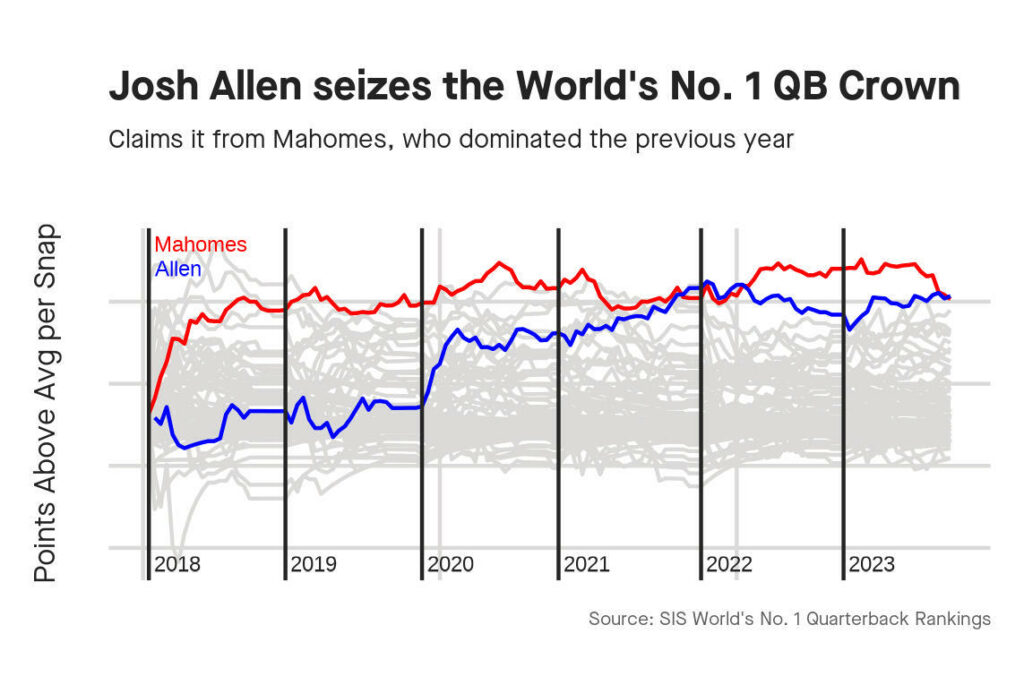
    Josh Allen is The World’s No. 1 Quarterback entering this postseason.

    It took the entire season for Allen to supplant Mahomes for the No. 1 spot in our statistical ranking system but it finally happened when, with Mahomes sitting out, Allen threw for 359 yards and 2 touchdowns and ran for 67 more yards in a division-clinching win over the Dolphins.

    Allen spent all but one week this season in the No. 2 spot, the exception being after Week 1 when he threw 3 interceptions in a loss to the Jets and dropped to No. 3 behind Justin Herbert.

    The World’s No. 1 Quarterback Ranking is based on a model devised by Bill James to evaluate The World’s No. 1 Starting Pitcher. Bill’s model was based on cumulative evaluation of individual starts over an extended time period using the metric Game Score.

    The World’s No. 1 Quarterback Ranking uses our player value stat, Total Points to make a cumulative evaluation of game performance over a three-year period. The key to our calculation is PAA, the statistical underpinning of Total Points that is centered at zero so that positive numbers are above average and negative numbers are below average.

    Success over time is key to maintaining a good ranking. Prolonged inactivity results in a ranking drop. The most recent performances carry the most weight.

    Allen led the NFL in Total Points for the first time after ranking in the Top 5 in that stat, but never atop, in each of the past 3 seasons. He also fared better than Mahomes (and everyone except Tyrod Taylor) in that stat on a per-snap basis.

    Allen finished 2023 with a career-best 88% catchable pass percentage (one of SIS’ proprietary stats) and the NFL’s lowest sack percentage (4%). 

    He had by far the best game of any quarterback in Week 5, throwing for 359 yards in a win over the Dolphins and the best game of any quarterback in a Week 12 loss to the Eagles when he threw for 339 yards and ran for 81 and 2 touchdowns.

    From Week 12 on, Allen led the NFL in Points Above Average (36.7), ahead of Dak Prescott (31.1), Jordan Love (26.1), Derek Carr (23.8) and Lamar Jackson (22.7). Mahomes was nowhere in sight. In fact, he finished with -2.1 Points Above Average, a drop that actually began in Week 13 against the Packers. Neither Mahomes nor Allen had a positive EPA when their teams went head-to-head in Week 14. Allen bounced back from that, Mahomes has not yet.

    Here’s a comparison of the Top 10 quarterbacks in these rankings entering the regular season and at the end of the regular season.

    Entering Season End Of Season
    1. Patrick Mahomes 1. Josh Allen
    2. Josh Allen 2. Patrick Mahomes
    3. Justin Herbert 3. Dak Prescott
    4. Jalen Hurts 4. Jared Goff
    5. Joe Burrow 5. Jalen Hurts
    6. Jared Goff 6. Brock Purdy
    7. Dak Prescott 7. Tua Tagovailoa
    8. Kirk Cousins 8. Lamar Jackson
    9. Tua Tagovailoa 9. Derek Carr
    10. Daniel Jones 10. Justin Herbert

    Brock Purdy and Lamar Jackson were the big gainers here, with Purdy showing that his close to 2022 was no fluke. He jumped from No. 17 entering the season to No. 6 ending it. 

    Jackson climbed from No. 19 to a season-ending No. 8, though public perception of his skills is higher than that. He’s the favorite to win the league’s MVP. Dak Prescott moved up from No. 7 to No. 3, a spot he’s held the last 8 weeks as he supplanted Jared Goff. Derek Carr, who consistently ranked in the Top 10 from 2019 to 2021 found his way back in during the final 2 weeks of the 2023 season. He sits at No. 9. 

    Herbert had dropped to No. 8 before his injury and his missing the last few weeks bumped him to the bottom of the Top 10. Joe Burrow’s injury dropped him just out of the Top 10. He’s now No. 12.  Daniel Jones’ presence in the Top 10 is a distant memory to Giants fans. His Opening Day struggles pushed him out, never to return. He currently stands at No. 30.

    Here’s the full list.

    Rk Player PAA Per 60 LastRk StartOfSeasonRk
    1 Josh Allen 6.4 2 2
    2 Patrick Mahomes 6.2 1 1
    3 Dak Prescott 5.4 3 7
    4 Jared Goff 3.9 7 6
    5 Jalen Hurts 3.9 4 4
    6 Brock Purdy 3.6 5 17
    7 Tua Tagovailoa 3.6 6 9
    8 Lamar Jackson 3.0 8 19
    9 Derek Carr 2.6 10 15
    10 Justin Herbert 2.2 9 3
    11 Matthew Stafford 1.6 11 22
    12 Joe Burrow 1.6 12 5
    13 C.J. Stroud 1.3 15 N/A
    14 Kirk Cousins 1.2 13 8
    15 Geno Smith 1.0 14 21
    16 Jordan Love 0.8 16 60
    17 Trevor Lawrence 0.1 17 18
    18 Gardner Minshew -0.2 19 38
    19 Baker Mayfield -0.2 18 81
    20 Tyrod Taylor -0.3 22 45
    21 Justin Fields -0.5 20 23
    22 Jacoby Brissett -0.6 21 12
    23 Kyler Murray -1.0 26 20
    24 Jake Browning -1.0 24 N/A
    25 Andy Dalton -1.0 23 13
    26 Deshaun Watson -1.3 25 28
    27 Aaron Rodgers -1.5 27 11
    28 Russell Wilson -1.7 29 29
    29 Tom Brady -1.8 30 16
    30 Daniel Jones -2.0 32 10
    31 Mason Rudolph -2.0 31 55
    32 Joshua Dobbs -2.0 33 64
    33 Sam Howell -2.1 28 35
    34 Aidan OConnell -2.2 45 N/A
    35 C.J. Beathard -2.3 35 48
    36 Carson Wentz -2.4 54 39
    37 Sam Darnold -2.4 38 24
    38 Ryan Tannehill -2.4 34 14
    39 Teddy Bridgewater -2.4 36 25
    40 Anthony Richardson -2.5 37 N/A
    41 Brian Hoyer -2.7 39 51
    42 Jarrett Stidham -2.8 61 40
    43 Zach Wilson -2.8 40 70
    44 Blaine Gabbert -2.8 53 49
    45 Matt Ryan -2.8 41 33
    46 Davis Webb -2.8 42 36
    47 Bryce Perkins -2.8 43 41
    48 Josh Johnson -2.8 44 37
    49 Drew Lock -2.9 46 58
    50 Joe Flacco -2.9 48 34
    51 Skylar Thompson -2.9 49 47
    52 Chad Henne -2.9 50 46
    53 Nathan Peterman -2.9 53 52
    54 Chris Streveler -3.0 56 63
    55 Ian Book -3.0 57 62
    56 Tyler Huntley -3.0 80 80
    57 Kenny Pickett -3.0 58 31
    58 Sean Mannion -3.0 59 N/A
    59 Brandon Allen -3.0 60 65
    60 Trey Lance -3.1 62 71
    61 Colt McCoy -3.1 63 68
    62 Malik Willis -3.1 65 77
    63 Mitch Trubisky -3.1 64 30
    64 Jake Fromm -3.1 66 N/A
    65 Tommy DeVito -3.1 67 N/A
    66 David Blough -3.2 68 72
    67 Sam Ehlinger -3.2 69 73
    68 Mike White -3.2 70 74
    69 Marcus Mariota -3.2 47 43
    70 Nick Mullens -3.2 84 66
    71 Cooper Rush -3.2 72 75
    72 Tyson Bagent -3.2 73 N/A
    73 Jimmy Garoppolo -3.2 71 27
    74 Anthony Brown -3.3 76 76
    75 Jaren Hall -3.3 75 N/A
    76 John Wolford -3.3 77 78
    77 Easton Stick -3.4 78 N/A
    78 Jeff Driskel -3.4 55 57
    79 Jameis Winston -3.5 79 42
    80 Kyle Allen -3.6 81 82
    81 Nick Foles -3.6 83 84
    82 Case Keenum -3.6 82 44
    83 Brett Rypien -3.6 85 59
    84 Desmond Ridder -3.6 91 67
    85 Tim Boyle -3.8 86 69
    86 Dorian Thompson-Robinson -3.8 87 N/A
    87 Taylor Heinicke -3.8 88 83
    88 Will Levis -3.9 89 N/A
    89 Trace McSorley -4.0 90 86
    90 Davis Mills -4.2 92 85
    91 Clayton Tune -4.3 93 N/A
    92 Bailey Zappe -4.3 74 32
    93 Trevor Siemian -4.7 94 56
    94 Mac Jones -4.7 95 26
    95 Bryce Young -5.5 96 N/A
    96 P.J. Walker -5.5 97 79


  • 2023 SIS NFL All-Rookie Teams

    2023 SIS NFL All-Rookie Teams

    Photo: Ian Johnson/Steven King, Icon Presswire

    Sports Info Solutions, a leader in the football analytics space, is pleased to announce its 4th annual NFL All-Rookie Teams. 

    The teams were selected using a combination of advanced stats and voting among members of our football operations staff, with emphasis placed upon SIS’ player value stat, Total Points. 

    As we do every year, we adjust the positional structure of this team to make sure to honor as many top performers as possible from this season.

    Here are the 2023 Sports Info Solutions award winners and All-Rookie Teams:

    Rookies of the Year

    After breaking multiple rookie passing records and putting together one of the best rookie seasons of all time by a quarterback, C.J. Stroud of the Texans takes home our Offensive Rookie of the Year.

    There were a lot of ways Defensive Rookie of the Year could have gone. There likely would have been a different winner at each quarter of the season. Ultimately, we went with arguably the biggest steal in the 2023 NFL Draft and the rookie defensive Total Points leader, Brian Branch of the Lions.

    Jake Moody of the 49ers takes home Special Teams Rookie of the Year. Moody lived up to his Draft slot as a 3rd-Round pick, helping lead a stacked roster back into the playoffs.

    For the first time, we also are announcing a Rookie Class of the Year. That award goes to the Los Angeles Rams. This was another close call, but with Puka Nacua leading the way, five Rams made our two teams, including four 1st Teamers.

    1st-Team Offense
    Position Player Team Total Points
    Quarterback C.J. Stroud Texans 103
    Running Back De’Von Achane Dolphins 26
    Running Back Bijan Robinson Falcons 24
    Wide Receiver Puka Nacua Rams 37
    Wide Receiver Zay Flowers Ravens 25
    Tight End Sam LaPorta Lions 41
    Tackle Darnell Wright Bears 31
    Tackle Anton Harrison Jaguars 22
    Guard O’Cyrus Torrence Bills 37
    Guard Steve Avila Rams 28
    Center Joe Tippmann Jets 20


    Quarterback: C.J. Stroud, Texans

    The Texans winning their final game in 2022 actually pushed them from picking No. 1 to No. 2. However, it doesn’t look like it’s going to haunt them. C.J. Stroud was 1 of only 10 passers to go over 4,000 yards in 2023. His 103 Total Points led all rookies and ranked 10th among QBs, helping lead the Texans back to the playoffs for the first time since 2019.

    Running Back: De’Von Achane, Dolphins

    In just 11 games, De’Von Achane ran for 800 yards on nearly eight yards per carry. His speed and playmaking ability fit in perfectly with the Dolphins offense. Being limited due to injury, he made his snaps count, creating the 2nd-most rushing Total Points per snap among RBs and making defenders miss 18.4% of the time, which was good for 7th.

    Running Back: Bijan Robinson, Falcons

    While we can all speculate if he was used properly the entirety of the season in Atlanta, Bijan Robinson didn’t disappoint when he was called upon. He led all rookie RBs with 976 rushing yards and added 487 yards through the air, which was 4th-most among all RBs. Additionally, he ranked 5th with a 19.2% Broken + Missed Tackle rate as a rusher among all RBs who had at least 100 carries.

    Wide Receiver: Puka Nacua, Rams

    No question the biggest steal of the Draft on the offensive side of the ball was 5th-round pick Puka Nacua. If not for a great year by Stroud, Nacua is by far the runaway Offensive Rookie of the Year. Nacua only managed to break the rookie records for receptions (105) and receiving yards (1,486) in a season. His 2.7 Yards per Route Run also ranked him 9th among all WRs with at least 75 targets.

    Wide Receiver: Zay Flowers, Ravens

    Another big-play receiver, Zay Flowers improved the Ravens receiving corps exponentially in 2023. While he caught for over 850 yards and 6 TDs, his most impressive stat is a 37.7% Broken + Missed Tackle rate, which ranked just behind Deebo Samuel among all WRs with at least 50 targets. 

    Tight End: Sam LaPorta, Lions

    The Lions’ 2023 2nd-round picks proved to be huge hits, and Sam LaPorta was one of them. LaPorta broke the rookie TE record for receptions in a season with 86. He also caught 10 TDs, which were four more than the 2nd-most by a tight end.. He and Jahmyr Gibbs teamed up to be the only pair of rookie teammates to each produce at least 10 TDs in the same season. Elsewhere, his 12 Total Points as a run blocker ranked 3rd among all TEs and his 2.0 Yards per Route Run tied-5th among TEs with at least 30 targets.

    Tackle: Darnell Wright, Bears

    Darnell Wright started every game and logged over 1,000 snaps for the Bears this season. While he did have 31 Blown Blocks in the pass game, which comes with the territory of a young NFL tackle, he notched a miniscule 0.9% Blown Block rate on run plays, tied for 5th-best among all tackles with at least 500 snaps.

    Tackle: Anton Harrison, Jaguars

    Anton Harrison took his lumps as an NFL rookie tackle, committing 40 Blown Blocks, but he made huge strides as the season went on. He started every game for Jacksonville and played over 1,000 snaps, gaining valuable experience. Plus, his 22 Total Points were just behind Wright for most among all rookie tackles.

    Guard: O’Cyrus Torrence, Bills

    O’Cyrus Torrence’s 37 Total Points were tops among all rookie offensive linemen and 6th-best among all NFL guards. Additionally, his 19.3 Total Points as a run blocker ranked 3rd among guards with at least 500 snaps and his 5.6 Points Above Average in the run game ranked 4th.

    Guard: Steve Avila, Rams

    While Steve Avila did commit 33 Blown Blocks in 2023, he didn’t commit a hold in 448 run snaps and only one in 640 pass snaps. Also, his 28 Total Points ranked just behind Torrence among rookie guards and was 3rd among all rookie linemen.

    Center: Joe Tippmann, Jets

    Joe Tippmann proved his worth across multiple positions this season. After starting off playing some guard, Tippmann switched to center when injuries became an issue across the Jets OL. Across 14 starts in 16 games, he posted just a 2.5% Blown Block rate and only 1.9% in the run game, good for top 10 among centers with at least 500 snaps.

    1st-Team Defense
    Position Player Team Total Points
    Interior Defensive Lineman Jalen Carter Eagles 21
    Interior Defensive Lineman Kobie Turner Rams 19
    Edge Will Anderson Jr. Texans 29
    Edge Byron Young Rams 24
    Linebacker Jack Campbell Lions 17
    Linebacker Ivan Pace Jr. Vikings 16
    Cornerback Devon Witherspoon Seahawks 48
    Cornerback Joey Porter Jr. Steelers 42
    Defensive Back Deonte Banks Giants 39
    Safety Brian Branch Lions 58
    Safety Christian Izien Buccaneers 33

    Interior Defensive Lineman: Jalen Carter, Eagles

    If the Defensive Rookie of the Year was crowned at the midpoint of the season, there’s a great chance Jalen Carter wins the award. Carter was dominant as an interior pass rusher. He compiled 6 sacks and 39 pressures in 2023 with an 11% Pressure rate that was good for top 15 among all defensive tackles.

    Interior Defensive Lineman: Kobie Turner, Rams

    Kobie Turner blew up in the second half of the season and made a case of his own for DROY. Since Week 9, Turner’s 8 sacks led all NFL defensive tackles and his 32 pressures ranked 5th. Additionally, his 3.4% Sack rate was Top 5 and his 13.1% Pressure rate ranked 8th.

    Edge: Will Anderson Jr., Texans

    Will Anderson Jr., the top player on the SIS 101 Big Board ahead of the NFL Draft, led all rookie front-seven defenders with 29 Total Points. Anderson’s 56 pressures were good for Top 20 among all DE/LBs and went along with a 16.1% Pressure rate.

    Edge: Byron Young, Rams

    An underrated Edge going into the Draft, Byron Young’s athleticism popped off the tape and translated incredibly well to the NFL with a strong 2023 season. Young led all DE/LB rookies with 8 sacks and was 2nd behind Anderson with 47 pressures. His 24 Total Points also ranked just behind Anderson among all rookie front-seven defenders.

    Linebacker: Jack Campbell, Lions

    A heavily criticized pick during the Draft, Campbell has been a large part of the Lions LB corps, especially over the last half of the season. With 17 Total Points overall, he’s been able to contribute against both the run and pass, gaining nearly 8 Total Points against the pass and 9.5 versus the run. Campbell played nearly 60% of the defensive snaps his rookie season, and also contributed on over one-third of special teams snaps.

    Linebacker: Ivan Pace Jr., Vikings

    Arguably the top undrafted rookie of 2023, Ivan Pace Jr. played a vital role for Minnesota’s defense the entire season. The top-ranked MLB by SIS heading into the Draft, Pace played over half of the defensive snaps and special teams snaps his rookie season. Eight of his 16 Total Points came in coverage. A rookie season with 100 tackles, 2.5 sacks, an interception, and a forced fumble is a great season to build off of, especially for someone who wasn’t even drafted.

    Cornerback: Devon Witherspoon, Seahawks

    Devon Witherspoon teamed up with sophomore CB Riq Woolen to provide a strong 1-2 tandem in Seattle in 2023. Witherspoon’s 48 Total Points led all rookie CBs and was 2nd-most among all rookie defenders. His 0.6 Yards per Cover Snap tied him for 9th-best among all CBs with at least 25 targets, as did his 12 passes defensed. However, his presence wasn’t just felt in the pass game. His 13 Total Points in run defense was 14th-best at the position.

    Cornerback: Joey Porter Jr., Steelers

    The son of a former Steeler-great, Joey Porter Jr. picked up right where his dad left off in Pittsburgh. Targeted 52 times in 17 games, Porter had 6 pass break ups, an interception, and didn’t allow a touchdown all season. His 38.8 Passer Rating Against and 0.5 Yards per Cover Snap rank 6th and tied-6th, respectively, among all CBs with at least 25 targets. If he can cut down on the penalties, he’ll be a top-end CB in the league at this pace.

    Defensive Back: Deonte Banks, Giants

    Deonte Banks was tested during his rookie season in 2023. He was targeted 78 times, which was 11th-most in the league. However, teams only completed half their passes thrown his way. His 39 Total Points was 3rd-best among rookie CBs and his 14 Total Points against the run was best among rookie CBs and 11th-best among all CBs.

    Safety: Brian Branch, Lions

    Our DROY, Brian Branch played a huge part in the defensive turnaround in Detroit. Starting his career off with a pick-six to help beat the reigning Super Bowl champs in Kansas City on opening night, Branch’s 58 Total Points led all rookie defenders. He also led all qualifying safeties in Total Points Per Play.. Due to his role that is mainly in the slot, Branch saw the most targets among all listed safeties with 50 and had the most pass breakups with 10.

    Safety: Christian Izien, Buccaneers

    Christian Izien is a small, but feisty safety out of Rutgers that reminded us of the defensive version of Isiah Pacheco. Izien secured the 2nd-most Total Points among rookie safeties with 33. Additionally, his 12.3 Total Points Above Average in coverage ranked 11th among all safeties with at least 10 targets, and he ranked 16th in Total Points Per Play.

    1st-Team Specialists
    Position Player Team Total Points
    Kicker Jake Moody 49ers 7
    Punter Bryce Baringer Patriots 5
    Returner Marvin Mims Jr. Broncos N/A

    Kicker: Jake Moody, 49ers

    Jake Moody had a strong season for San Francisco. While a 3rd-round pick is quite high for a special teamer, he proved it was a worthy selection. He finished the season 21-of-25 on field goals, hitting twice from beyond 50 yards and went 60-of-61 on extra points, making the most extra points of any kicker in the league.

    Punter: Bryce Baringer, Patriots

    While Bryce Baringer doesn’t have the elite leg of some of the other punters in the league, his finesse is right up there with the best. Across 98 punts, 2nd-most in the league, he pinned opposing teams inside the 20-yard-line 37 times (tops in the NFL)  and inside the 10-yard-line 7 times.

    Returner: Marvin Mims Jr., Broncos

    Although Marvin Mims Jr. didn’t make the big-time contribution on offense most were expecting in Denver, he did contribute admirably in the return game. His 400 kick return yards were 7th-most in the NFL, including taking one back 99 yards for a touchdown. Additionally, he returned 21 punts with a 15.1 average, ranking 2nd among those with at least 10 punt returns.

    In all, three offensive 1st Teamers and five defensive 1st Teamers received a 6.7 final grade or higher from us, as seen on our NFL Draft site, suggesting those players will at least be high-end three-down starters beginning their second season. Additionally, all eleven offensive players and nine defenders received a grade of at least 6.4. We’ll see if they begin 2024 the way they played this season to warrant those final grades, but we like their chances.

    Below, you can find our All-Rookie 2nd Teams which include big names like Jahmyr Gibbs, Rashee Rice, Tuli Tuipulotu, and Tyrique Stevenson.

    2nd-Team Offense
    Position Player Team Total Points
    Quarterback Aidan O’Connell Raiders 34
    Running Back Keaton Mitchell Ravens 21
    Running Back Jahmyr Gibbs Lions 10
    Wide Receiver Rashee Rice Chiefs 23
    Wide Receiver Jayden Reed Packers 21
    Tight End Michael Mayer Raiders 23
    Tackle Paris Johnson Jr. Cardinals 22
    Tackle Broderick Jones Steelers 16
    Guard Matthew Bergeron Falcons 22
    Guard Cody Mauch Buccaneers 21
    Center John Michael Schmitz Giants 14


    2nd-Team Defense
    Position Player Team Total Points
    Interior Defensive Lineman Bryan Bresee Saints 14
    Interior Defensive Lineman Calijah Kancey Buccaneers 11
    Edge Tuli Tuipulotu Chargers 19
    Edge YaYa Diaby Buccaneers 14
    Linebacker Nick Herbig Steelers 13
    Linebacker Marte Mapu Patriots 6
    Cornerback Tyrique Stevenson Bears 38
    Cornerback Clark Phillips III Falcons 28
    Defensive Back Jakorian Bennett Raiders 18
    Safety Jordan Battle Bengals 30
    Safety Sydney Brown Eagles 23


    2nd-Team Specialists
    Position Player Team Total Points
    Kicker Anders Carlson Packers 5
    Punter Ethan Evans Rams 7
    Returner Derius Davis Chargers N/A

    We want to highlight some of the close calls and honorable mentions who didn’t quite make the cut.

    Some players on offense who just missed out include Tyjae Spears (RB), Tank Dell (WR), Jordan Addison (WR), Tucker Kraft (TE), Dawand Jones (OT), Peter Skoronski (OG), and Sidy Sow (OG). Dell had a good chance to make it onto one of the teams had he not gotten injured in early December. While Addison did score 10 touchdowns, he didn’t gain much value with his receptions.

    Some players on defense who just missed the cut include Karl Brooks (IDL), Keion White (EDGE), and Ji’Ayir Brown (S). It’s also worth mentioning Christian Gonzalez (CB) accumulated 15 Total Points in just four games before going on season-ending IR.

    On special teams, Xavier Gipson just missed out on the 2nd Team Returner selection. While he’s not eligible by NFL’s standards to be a rookie, Brandon Aubrey deserves a shout out here. A former college soccer player turned USFL kicker, Aubrey went 36-of-38 in his first NFL season with his only two misses coming in Week 18.

    While there was some clear delineation between both teams, there were a couple close calls between the two. There was a heavy conversation for the second 1st-Team Edge spot between Byron Young and Tuli Tuipulotu. Also, Bryce Baringer and Ethan Evans were neck-and-neck, but Baringer won out for the top Punter spot.

    As mentioned earlier, each year we change some of the positions to account for the depth at certain areas specific to this draft class. This year, there was a fair amount of talent across the board, so we didn’t have to adjust much. We were able to go back to two DTs, which we veered away from last year. Additionally, with the secondary as packed as it was, we went with the 5th DB position again instead of a normal hybrid position.

    You can check out last year’s article here to see how the positional structure changed. Again, the entire idea of these teams is to highlight the best players across the league, and we feel we did that.

    With all but just six teams represented among these selections, this once again signifies that plenty of talent is being dispersed throughout the league. Over our four years of selecting these teams, the Detroit Lions have the most selections with 13, one more than the Pittsburgh Steelers. On the flipside, the Tennessee Titans have only had 2, while the Arizona Cardinals, Buffalo Bills, and Washington Commanders have just 3.

    Go check out the SIS NFL Draft site to see what we said about these players coming into their NFL careers, and stay tuned to see what we’ll have to say about the next generation of NFL stars as they head into the 2024 NFL Draft.

  • Week 18 Parlay Picks: Josh Allen, George Pickens, Falcons/Saints

    Week 18 Parlay Picks: Josh Allen, George Pickens, Falcons/Saints

    Photo: Oliver McKenna/Icon Sportswire

    For the last couple of weeks of the NFL season, I’m trying something different with our analytic data by testing how useful it is on parlays. We’ll use Total Points, our player projections, and other information at our disposal to make picks.

    Each of my parlays will have an underdog (+120 to +245) or superdog (+250), with the remaining 2 legs consisting of a combination of even money (-115 to +115), favorite (-120 to -245), and heavy favorite (-250) lines. I’ll also incorporate teasers to achieve a degree of balance where possible.

    In Week 16, I hit with a Breece Hall, Cleveland Browns, Jake Browning combo. Last week was a rough one for the parlay, but you can’t win them all. We hit with Dak Prescott’s passing yardage total but missed on Kyren Williams and Jahmyr Gibbs rushing yardage totals. Williams finished 8 yards shy. Gibbs would have eclipsed his total if not for a penalty that negated a 35-yard run.

    Regardless, we’re 1-for-2 so far, so we’re off to a good start. Here are the 3 options that our models like this week as we hope our 3rd try is a charm.

    Underdog – Josh Allen Alternate Passing Yards, 275+ @ +185

    Our model projects Allen to throw for 271.2 yards on 37.4 attempts in Miami on Sunday night, both of which are the 2nd highest estimates this week. On the year, Allen’s 122.8 Passing Points Earned ranks 2nd in the NFL.

    Allen completed 84% of his passes while throwing for 320 yards against the Dolphins in Week 4. Miami will be without one of its top pass rushers this time around, as Bradley Chubb was lost last week to a season-ending knee injury. Chubb has the 20th-most Points Saved on pass rushes (23.5) of any defender league wide.

    Finding an underdog that gives me confidence this week was like finding a needle in a haystack. I would have preferred a different George Pickens yardage prop here (more on him below) with an even-money Josh Allen total below, but no other Pickens lines are currently available on DraftKings. 

    Even – George Pickens Receiving Yards, Over 50.5 @ -115

    Pickens has compiled 326 yards in the last 2 games as the favorite target with Mason Rudolph at the helm, reeling in 4-of-5 deep balls (passes thrown at least 20 yards downfield) aimed his way. 

    Our projection model has Pickens estimated to accrue 83 yards against the Ravens, good enough for the 2nd highest estimated total in the league, only 1.4 behind CeeDee Lamb. The 32.5 yard gap between his line and projection is also the largest such gap available on DraftKings for Week 18 (we specifically looked for an over here).

    And a heads-up that DraftKings published yardage props for Pickens after our article came out. An 80-yard prop is at +340 as of noon ET on Friday.

    Speaking of Rudolph, over the last 2 weeks he’s totaled the 3rd-most EPA. His projection of 286.2 yards is also our model’s highest estimated total for the week.

    With the Steelers only recently finding offensive success and fighting for their playoff lives, I expect them to rely heavily on the tools that have worked for them as of late.

    Heavy Favorite – Falcons @ Saints Alternate Total, Under 49.5 @ -302

    These teams combined for 39 points in a 25-14 Falcons victory in New Orleans. Our model indicates the price at Under 49.5 points should be -595, a gap that I expect to close significantly between now and kickoff on Sunday. 

    My main reasoning for this pick is that these are the teams with the 2 best pass coverage units in the NFL in terms of Total Points Per Play (as noted in our weekly look at matchups and mismatches). A high-scoring shootout is not likely.

    The current O/U for this matchup on DraftKings is set at 42, and I’ve teased this up to 49.5 to be my confidence pick this week. 

    Total Parlay Odds: 6.09-to-1

    All odds available through DraftKings and current as of 11:42 AM 1/4/2024

    Sports Info Solutions is not an online gambling website or gambling operator. If you choose to wager on sports, we encourage you to do so responsibly. If you or someone you know has a sports betting or gambling problem, please call 1-800-GAMBLER or visit The National Council on Problem Gambling for more information and further assistance.


  • What a difference one change in alignment makes for the Dolphins

    What a difference one change in alignment makes for the Dolphins

    PHOTO: Mark Goldman/Icon Sportswire

    (All charting numbers in this piece are through Week 16)

    On Sunday night, the Dolphins will host the Bills for a chance to claim their first AFC East title since Tom Brady’s knee popped back in 2008. This game will feature some of the most exciting offensive players in all of football, as well as one of the most exciting coaches. Miami Dolphins head coach Mike McDaniel is the league’s newest offensive genius, and he’s also a media darling who has charmed journalists and fans alike with his earnest and energetic pressers.

    We could spend all day saying nice things about Mike McDaniel. In fact, we’ve spent most of the past year saying nice things about him. So, having established that we love and appreciate Mike for what he’s contributing to this great sport, let’s take a moment to talk about a strange phenomenon happening within his offense right now.

    Miami has been far and away the best 3×1 gun (three receivers to the strong side, one to the weak side in shotgun) team in the NFL this season. On 172 neutral script plays, they’ve averaged a whopping 0.39 EPA/play in this family of formations, which is three times better than the second-best team. It would behoove every coach, offensive or defensive, at every level to take some time this offseason to study what Miami does in 3×1 (and we’ll get into what exactly they do in a bit).

    On the other hand, they have been bad in their 2×2 gun formations (137 plays). They average -0.24 EPA/play – which is 30th in the league, just barely ahead of the New York teams – and the absolute difference between these two formation shells is easily the biggest for any team at a massive 0.63 EPA/play.

    Scatterplot of offensive shotgun efficiency by team in the NFL in 2023, with 2x2 and 3x1 formations on each axis. The Dolphins are the only team off-trend.

    This is seemingly not confounded by any basic scheme split. The pass rates are virtually identical, the motion usage is similar, and they actually use a bit more play action in 2×2. They have had worse fumble luck in 2×2, but even if you strip out the fumbles they’ve lost, there’s still a gap of 0.5 EPA/play. This is also not a single-season aberration, as they ranked 3rd and 27th in these formation shells last year.

    So, let’s first set the table with what they do in 3×1 gun.

    3×1 gun pass game overview

    They attack the intermediate area extremely well (their bread-and-butter is a double overs concept they rake on); they are ruthless about isolating Waddle/Hill on the backside, particularly on digs and skinny posts; they have a variety of outside vertical stretch concepts they use (e.g. Smash, Flood); and they do a good job of abusing their speed via motions in order to stress the back end of the defense horizontally (for example, picture a Cover 1 safety having two seams running at him). 

    Their best motion comes out of 3×1 where they trade a receiver across the formation towards a condensed split X. Most defenses respond with stack checks, which tends to create cushion for the motion player and often exploitable outside leverage for the new #2. Of course, they are also capable of abusing man-to-man in these looks. They try to accomplish a similar thing in 2×2 by motioning #2 outward behind #1 in condensed flanks, but the results have been mixed.

    3×1 run game overview

    Their use of motion in the run game is also effective. Their creativity with TE motion in 3Yx1 (3-receiver side with a tight end/Y attached) formations to create favorable blocking angles on both zone and gap concepts might be first thing you notice, but the way they marry their pass and run game is what stands out the most.

    Screen cap of Dolphins lined up in a 3x1 formation

    3×1 Tight Bunch Gun Strong vs. Patriots 4-2 under front (an even front with a defensive lineman in the A gap to the strength)

    Defensive coverages and fronts go hand in hand, and Miami does an excellent job of abusing the fronts that they get. Take, for example, their same-side power concept in 3×1 gun strong. Teams are willing to play Cover 4 against the Dolphins in 3×1 because they aren’t spamming low horizontal stretches that typically abuse this 4-deep, 3-under coverage, which has a couple of implications:

    1) Defenses generally don’t want the MIKE linebacker to be significantly out-leveraged by #3 (in the above case, the TE) in Cover 4, so it’s difficult for him to fit the strong A gap against the run, which means that, and

    2) Defenses will often be playing an under front to alleviate the MIKE’s run-pass conflict.

    ‘[The problem, then, is that same-side power is typically free real estate against under fronts. Over the last five seasons, power runs against under fronts have averaged 4.6 YPC and 0.02 EPA/play.

    2×2 alignment tendencies

    Their 2×2 gun has deeper issues, but it’s worth briefly mentioning they have a few specific tells that opposing teams may be keying on. For example, any time they’re in 2x2Y gun strong with one of Waddle/Hill aligned on the ball at #2 on the strong side and the other at #1 on the weak side in a condensed split, they run a gap play action shot with a post from one side and a dig from the other. This resulted in the field safety intercepting the post in the Raiders game, although Tua sailing it admittedly didn’t help.

     Screen cap of the Dolphins lined up in a 2x2 formation2x2Y gun strong formation with a 2-open side and a 2-closed side with a cut split from the Z
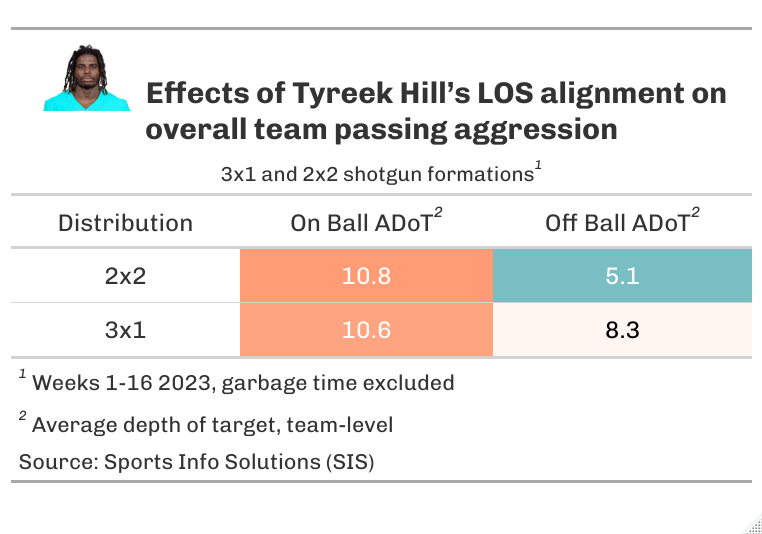
    Now, to be clear, such trends are not endemic to the Dolphins. Every team has quirks like this that can and will be found if you look hard enough, and sometimes these plays only get called every few games. Furthermore, coaching staffs regularly self-scout to correct for things like this and break tendencies in future games. In fact, Miami seemingly self-identified a tendency in 3×1 earlier this year, in which an outward motion by Tyreek towards a stack would be a tunnel screen if and only if the on-ball player was a tight end. They broke this tendency against the Cowboys by motioning him towards a standard split with Braxton Berrios on the ball, and it went for 10 yards to convert a critical 3rd & 3 in the final drive of the game.

    What is probably more useful is to identify generalizable alignment tendencies, such as the one they have in 2×2 where Tyreek aligning on or off the line of scrimmage sends a pretty strong signal about the verticality of the offense.

    Table showing the effect of Tyreek Hill's alignment (on or off the ball) on the Dolphins' average throw depth. The team's average throw depth is higher when he's on the ball, but the drop-off is much more when Hill is off the ball in 2x2 formations.

    The value proposition of 2×2 pass game and Tua’s compatibility

    Moving onto the nuts and bolts of it all, the Dolphins are generally integrating the back into their dropback passing game more often. They fast-release the back (i.e. he is not staying in to protect, or to chip or check for a blitz before releasing) 10% more often in 2×2 than they do in 3×1, and that’s largely a function of the concepts they’re running. You see more of the classical, West Coast, Shanahan influence in this family of formations; more low horizontal stretch concepts and triangle reads. Slant-flat. Snag. Texas. Stuff like that. And these concepts are fine – Miami runs them a bit in 3×1, as well – but they’re just inherently a lower value proposition compared to what they do in trips.

    Setting aside the relative value of these things, there’s also an argument to be made that Tua just isn’t as good at some of them. He’s checking it down more often, with 17% of his non-screen attempts coming at or behind the line of scrimmage in 2×2, compared to just 5% of the time in 3×1. His turnover-worthy throw rate on passes past the line of scrimmage also jumps from 5% to 8%. More risky throws and more checkdowns is not a good combination!

    Four-open 2×2 (i.e., two receivers to each side with nobody lined up tight) has been particularly tough sledding for the Dolphins. 53% of their passing attempts in 2×2 gun have come from these looks, and they are averaging an NFL-worst -0.53 EPA/pass out of them. They see the sixth-highest rate of middle field open (MOFO) coverage in such formations at 53%, and that is not a function of them being pass-heavy. The league-wide, neutral-script passing rate within these formations is a staggering 90%, so the problem here is that the Dolphins simply have not been good at forcing the issue.

    Defenses playing split field coverages and getting 4 defenders over 3 offensive players (4-over-3) to the strongside and 3-over-2 to the weakside is a tough hill for any offense to climb, and opposing teams can afford to do this to the Dolphins with relative impunity for a couple of reasons. Arguably the most critical factor is that Tua struggles to make some of the throws that typically punish such structures. There are a lot of routes that he excels at throwing, but the slot out/flat is not one of them.

    Among non-screen throws he’s attempted at least 25 times in the last two years, flat routes and out routes from the slot are bottom five in EPA/attempt, On-Target Rate Over Expectation (xOnTgt+/-), and passing Total Points/play. This is where critiques of his arm strength come into play; it’s not that he can’t throw rainbows 50 yards downfield, it’s that he doesn’t consistently have the velocity to beat defenders on throws like these.

    This is not conducive to beating Cover 4. This is not true of all quarters variants, but, as a general rule, these coverage structures are susceptible in the flats. Furthermore, if a defense wants to play split field coverage and is less concerned about throws to that area, they can have their corners play looser techniques in Cover 2 that allow for sinking a bit longer if the outside receiver releases vertically. Anecdotally, the Dolphins are partial to Ohio (#1 on a go, #2 on an out) in 2×2, especially when Tyreek is in the slot, and they typically do well on it. However, some teams have had success playing Cover 2 to the Dolphins’ 2-open flanks despite that route concept being 1) a common pattern for Miami in those looks, and 2) a traditional Cover 2 beater.

    2×2 run game cat-and-mouse

    The run game has been another issue. They average 2 fewer yards per carry in gun 2×2, and have been more zone-heavy whereas in 3×1 they are gap-heavy. This is possibly a function of the fronts they’re getting. A lot of teams have liked to place a 3-tech away from the back against these looks and the Dolphins have a 39% success rate on RB handoffs against such fronts, compared to a 67% success rate when the 3-tech is to the back. There could be a lot of reasons teams are setting their front this way, but it can be difficult to run zone at that 3-tech. 

    Now, what’s interesting is that, in the past few weeks, McDaniel has made a concerted effort to counteract this. When Miami has been getting a 3-tech away from the offset back, they’ve started to do two things: 1) get the offensive linemen on a zone track one way, and path the back the opposite way, which essentially washes down the 3-tech, and 2) run toss away from the 3-tech, which is an unusual mechanism in shotgun but something they’ve also done on pin-pull concepts. Both of these have generally been paired with a TE splitting across the formation to either kick out or serve as a lead blocker, and it’s led to a spike in their overall efficiency in 2×2 gun runs.

    Whether or not this will be some Achilles heel remains to be seen. This umbrella of formations makes up approximately 20% of their offense – so we’re talking about roughly a dozen plays a game – and they’re still 4th in the league in EPA/play regardless. Furthermore, it is difficult for defenses to dictate to the offense what formations they have to use, and players ultimately have to execute on the field, anyways. If nothing else, it’s interesting that the same team can look so different just because someone moved an X on a board. It may not end up being significant, but not everything needs to be. Football is just cool like that.