Tag: Dallas Goedert

  • Appreciating The Value of The Tight End

    Appreciating The Value of The Tight End

    Photo: Andy Lewis/Icon Presswire

    When comparing the top 10 tight ends in Receiving Total Points from the 2023 season and the 2024 season, there is a lot of turnover. Only a few names find themselves on both lists at this point of the season. Along with that, there have been a handful of players who have missed significant time due to injury as well, which have impacted their respective teams one way or another.

    2023 Total Points
    George Kittle* 28
    Jake Ferguson 28
    David Njoku* 27
    Travis Kelce 25
    Kyle Pitts 18
    Michael Mayer* 18
    Cole Kmet 18
    Dallas Goedert* 17
    Sam LaPorta 17
    Dalton Schultz 16

    * Missed multiple games this season due to injury

    This season’s top 10 list features a breakout rookie along with a few other young players. Half of the list features tight ends who are still within their first 3 seasons in the NFL. This seems to signal a youth movement at the position.

    2024 Total Points
    Brock Bowers 21
    George Kittle* 18
    Jonnu Smith 16
    Kyle Pitts 15
    Trey McBride* 15
    Hunter Henry 14
    Isaiah Likely* 11
    Dalton Kincaid* 11
    Mike Gesicki 10
    Cade Otton 10

    * Missed at least one game this season due to injury

    The only players who are on both lists are George Kittle and Kyle Pitts. While Pitts has been healthy all year, Kittle has been banged up while still being very productive and a vital piece for the 49ers.

    The 49ers are 0-2 when Kittle doesn’t suit up this season and 1-4 without him since the start of the 2022 season. He’s been dealing with a lingering hamstring injury as well as rib and foot injuries throughout the season. 

    When he doesn’t play the 49ers offense operates virtually the same in terms of personnel groupings, motion percentage, and play action percentage. To my surprise most of the passing stats improve when he’s off the field. Completion percentage is way up, touchdown percentage is up and interception percentage goes down. The one passing area that diminishes without Kittle is yards after catch. Kittle averages 29.5 yards after catch per game, trailing only Brock Bowers among tight ends. The 49ers definitely miss that skill when trying to extend drives in Kittle’s absence.

    That doesn’t tell the whole story though. When Kittle doesn’t suit up the 49ers might miss his presence in the blocking and run game more than the passing game.

    Kittle On the Field Kittle Off the Field
    Yards per Carry 5.6 4.0
    Sack % Allowed 5.2% 7.3%
    Blown Block % 13.3% 17.6%

    He’s such a well rounded tight end that his absence affects the offensive line and the running backs. It’s evident because Kittle is second among tight ends in Total Points on blocking snaps.

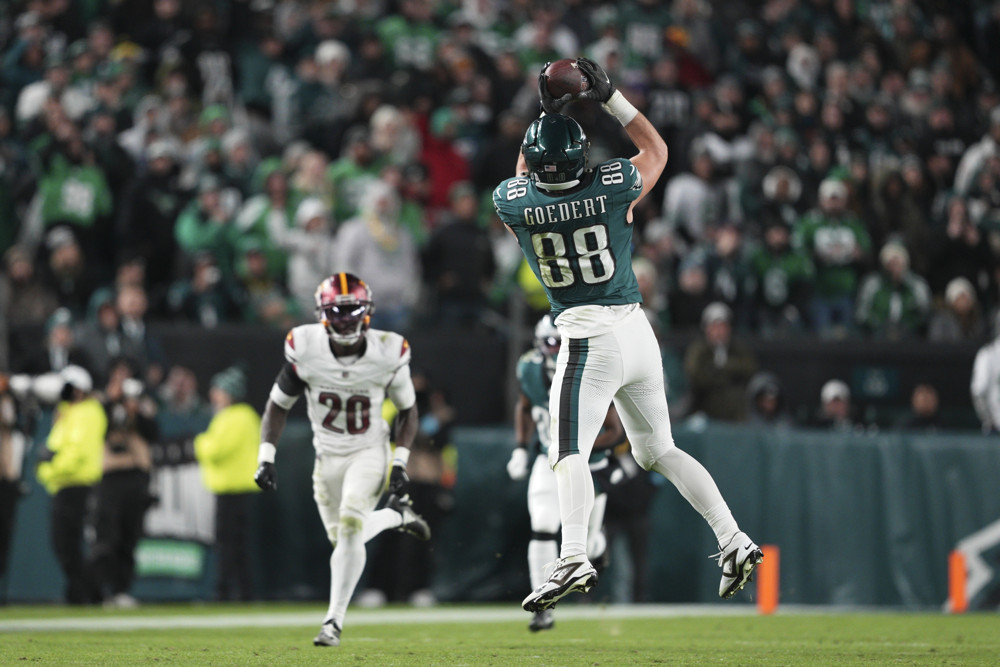
    There is a different tight end who was on the top 10 of 2023 who I wanted to look into. Like Kittle, he has missed multiple games this season. His team is currently over .500 though, Eagles tight end Dallas Goedert.

    A hamstring injury cost Goedert three games this season. One big change in the Eagles’ offense this season when Goedert is on field is the amount of passes to the short middle part of the field. 

    44% of throws by Jalen Hurts go to this area compared to 28% when he’s sidelined. Hurts also takes care of the ball much better when he has his reliable tight end. 

    Goedert On the Field Goedert Off the Field
    Touchdown % 6% 3.4%
    Interception % 0% 3.4%

    Another sign of Goedert’s importance for the Eagles is how he steps up on 3rd down to be a major threat. Among tight ends with at least 5 targets on 3rd down, he ranks first in Total Points per route run. For what it’s worth, Kittle ranks third on that list.

    The similarities with Goedert and Kittle don’t stop there; Goedert has a huge impact on the Eagles’ blocking and run game. Just like the 49ers, the Eagles’ sack allowed percentage and blown block percentage go up without Goedert on the field. Also the yards per carry goes from 4.8 without him to 5.8 with him on the field. He’s one of only five tight ends with at least 100 snaps to have 0 blown blocks on the season. For an Eagles team that ranks first in run play percentage, Goedert’s presence as a blocker might get overlooked as a key piece to their whole offensive attack.

    Another “tight end” worth mentioning that doesn’t appear on either top 10 list is Taysom Hill. The unique swiss army knife tight end is asked to do more things on the offensive side of the ball than just about any other player. He’s also missed time this season due to injury and the Saints are 0-4 when he doesn’t play this season (with overlap from Derek Carr’s absence). He’s definitely not a traditional TE, as he has 34 carries on the season with 6 rushing touchdowns and averages a robust 7.9 yards per carry.

    The Saints offense operates with multiple tight ends about 90% of the time when he is on the field compared to about 30% when he is off of it. Hill is usually sharing the field with other tight ends which gives the Saints the freedom to have him in different alignments all over the formation. The offense as a whole has been significantly worse when he is on the sideline.

    On the Field Off the Field Difference
    Total EPA/60 Plays 11 -3 14
    Passing EPA/60 Plays  0 -2 2
    Rushing EPA/60 Plays 23 -5 28

    An individual player who benefits a ton when he is on the field is Alvin Kamara. With teams having to deal with the threat of Hill getting the ball, Kamara has more room to be effective. His yards per carry goes from 3.8 without Hill to 5.9 with him sharing the field. We’ll see if interim head coach Darren Rizzi has more plans to keep Hill heavily involved moving forward, not only as an option himself, but as a decoy as well.

    Diving into the tight end position opened my eyes to how important they are to their teams because of the versatility. Whether it be an extension of the offensive line, catching a 3rd down throw, or even running the ball, having an impactful tight end opens up a team’s offense. We see the large impact missing these high end players have on their respective teams, and we hope everyone stays healthy as the season reaches the stretch run.

  • Scouts vs Stats: Debating The Top 10 NFL Tight Ends

    Scouts vs Stats: Debating The Top 10 NFL Tight Ends

    Over the spring/summer, the SIS R&D staff is convening on the Off the Charts Podcast to talk about their Top 10 players at a position. To do this, we pit two methodologies against each other: 

    • The “Scouts,” which comes down to the film-based opinions of Matt Manocherian and Bryce Rossler, each of whom has a lot of experience breaking down film and scouting players (Matt having done it for NFL teams).
    • The “Stats,” which involves James Weaver and Alex Vigderman devising a ranking based on a suite of metrics, and having that ranking speak for itself.

    *This week, Matt called for some backup, so we brought in Jeff Dean from our Football Ops department

    Officially, Sports Info Solutions does not condone the dichotomy between scouting and statistical analysis. Each of them provides data in their own way and should inform our evaluation of a player. 

    When we originally produced the Football Rookie Handbook before transitioning that content to our NFL Draft site, we put the scouting reports and stats side-by-side with the idea that the reader would bounce back and forth between them and leverage both to come to a conclusion about a prospect.

    So, without further ado, let’s celebrate Tight End University week and break down the ‘Best Tight Ends in the NFL’ lists.

    Scouts’ Opinion Statistical Analysis
    1. Travis Kelce 1. Travis Kelce
    2. George Kittle 2. George Kittle
    3. Mark Andrews 3. Mark Andrews
    4. T.J. Hockenson 4. Kyle Pitts
    5. Dallas Goedert 5. Dallas Goedert
    6. Darren Waller 6. Dalton Schultz
    7. Kyle Pitts 7. Darren Waller
    8. Evan Engram 8. Cole Kmet
    9. David Njoku 9. Hunter Henry
    10. Dalton Schultz 10. Pat Friermuth

    The Stats List Methodology

    The stats-based ranking includes a three-year recency-weighted average of a player’s results across several different metrics, with the following weights applied to each:

    • 35% Pass Game Total Points (Receiving and Pass Blocking)
    • 15% Run Blocking Total Points
    • 15% Targets Above Expectation
    • 15% On-Target Catch %
    • 10% YAC/Rec
    • 5% ADoT
    • 5% Broken Tackles + Missed Tackles/Rec

    For tight ends, we decided to combine Receiving and Pass Block Total Points into an all-encompassing passing game metric. This was created so that a player who rarely pass blocks is not punished if he does well in the receiving game. 

    Run Blocking Total Points are also factored in to highlight the secondary responsibility of a good tight end. This metric is what shot Cole Kmet up the stats’ leaderboard, playing in an offense that is run heavy.

    The rest of the metrics all measure how good a tight end is in the receiving game. Of note, Kyle Pitts was 1st in the ADoT metric and Travis Kelce was 6th in the Broken Tackles and Missed Tackles Per Rec.

    What the Stats Showed

    The Top 4 players in the pass game Total Points metric were all in the Top 4 of the stats’ list.

    Mark Andrews finished ahead of George Kittle in the metric, but Kittle finished ahead of Andrews in Run Blocking Total Points, Broken and Missed Tackles Per Reception, Yards After Catch Per Reception, and On-Target Catch Percentage. Kyle Pitts was 4th in the pass game metric despite playing in only 10 games (and in a very low-volume pass offense) last season, emphasizing how productive he was in his rookie season. Travis Kelce, who was first in this metric, nearly doubled the value of second place Kittle, with 42 Total Points per season compared to 24. His production in Receiving Total Points over the last 3 years would make him a Top 5 receiver overall. 

    The Top 4 in the stats’ list also all came in the Top 10 in Targets Above Expectation. This metric measures how many targets the player themselves generates based on contextual factors like alignment, coverage, and route type. Other than No. 10-ranked Pat Friermuth (14th), no other player in the Top 10 on the stats’ list came in the Top 15. Generating one’s own targets was a separator for the Top 4 on the list.

    Yards After Catch Per Reception numbers for Kelce (2nd in Top 10) and Kittle (3rd in Top 10) separated themselves from Andrews (Last in Top 10). Dallas Goedert, who placed fifth overall, came out the best in this metric among the top ten players, ranking 14th among tight ends with 6.7 YAC/R. Goedert was also solid in all other metrics, coming in 7th overall in pass game Total Points, 8th in Run Blocking Total Points, and 25th (3rd in the Top 10) in Broken and Missed Tackles Per Reception.

    What the Scouts Thought

    This one lacks a little suspense. Both lists had Travis Kelce as the best tight end in the league.  From a scouts’ perspective, Bryce Rossler states, “He is one of the best tight ends of all-time. Probably only Gronk above him. His route-running is amazing, his yards after the catch ability is amazing, and he’s a pretty good athlete.” 

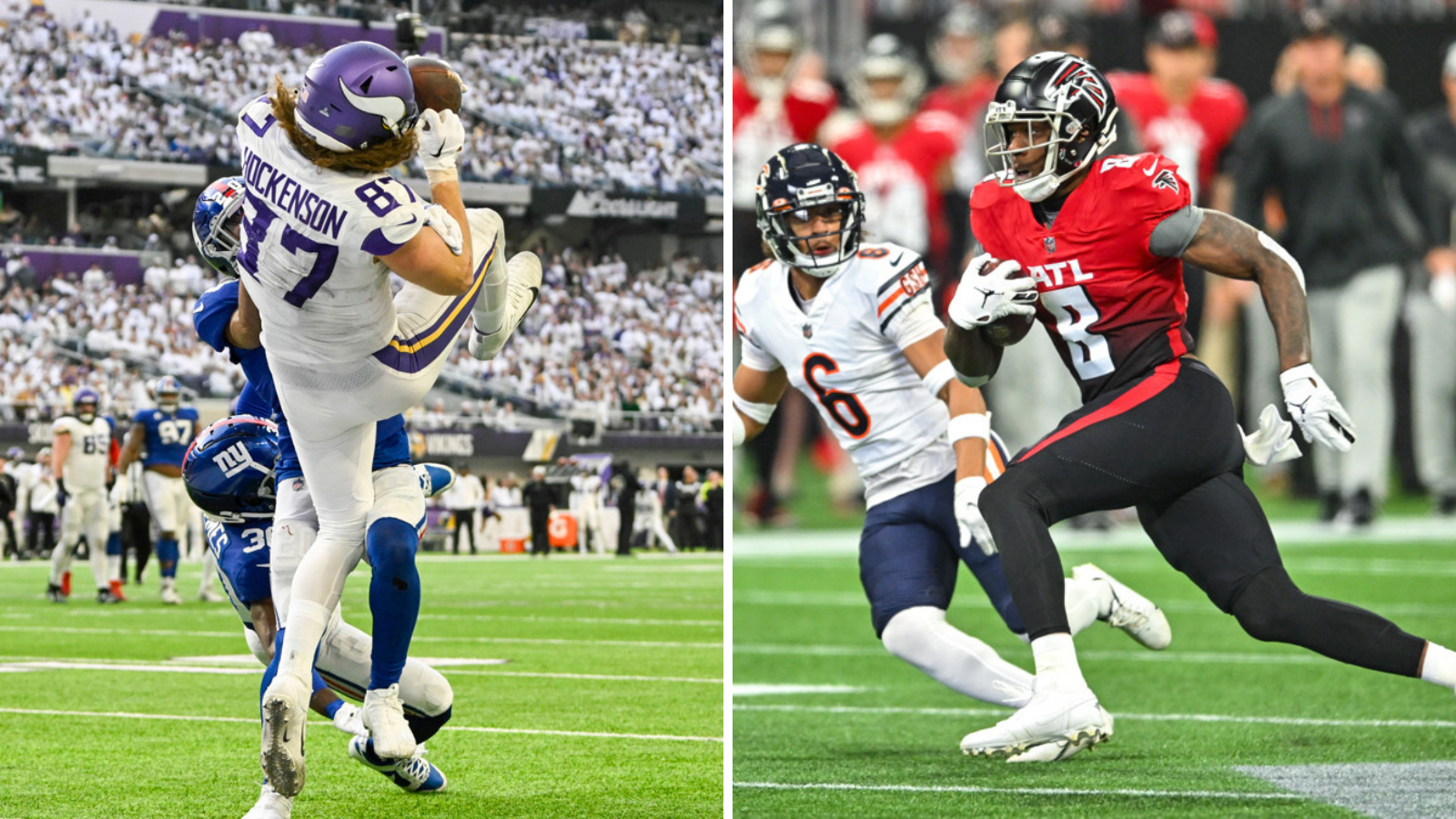
    Both groups also had the same players at No. 2 and No. 3. The scouts found T.J. Hockenson to be 4th on their list while the stats guys did not have them in their Top 10.

    As to why, Jeff said, “His ability to produce no matter who his quarterback is, no matter what kind of offense he’s in, is something you don’t find in a lot of tight ends.” He goes on to say, “Not to mention his huge wingspan, being able to post up linebackers over the middle, and challenge cornerbacks on out routes is something that is really hard to find in the position.”

    One of the differences on the scouts’ list was that they included Jaguars tight end Evan Engram at number 8. “He might not have the gaudy numbers you look for, but when you watch him play, he’s a guy the defense has to account for. He’s a legitimate receiving threat,” Jeff said. “I would not be surprised if he has a bigger year than he did last year in this upcoming season.” 

    Want to hear more discussion and debate? Check out this episode of the podcast: