Tag: Injuries

  • No Worse For Wear: The Best at Taking HBPs Like a Champ

    By Jon Becker

    All stats through Sunday’s games

    Hit by pitches are obviously pretty common, with about one every one-and-a-quarter games this season (1198 of them in the first 1,490 games). Some players are more prone than others; the Reds’ Derek Dietrich has gotten hit 22 times in just 260 plate appearances!

    It doesn’t seem fun to walk to the plate and have an 8% chance of getting drilled by a projectile, but that’s a big part of his game. I don’t want to investigate who’s gotten hit the most or at the greatest rate, though; that’s easy enough for anyone to find on their own.

    What I do want to know is this: who’s most adept at getting hit by pitches without getting harmed by pitches?

    SIS has been tracking player injuries since the onset of the 2015 season. With each injury, our Video Scouts assign an Injury Severity on a scale of 1 to 5, which is then validated by our expert, a former clinical research specialist. This is completely separate from any diagnosis, and is based almost entirely on observing the player’s reaction. The most basic way to describe each level of severity is:

    1: No visible reaction, no stoppage of play
    2: Slight visible reaction, possible delay in game
    3: Definite visible reaction, longer delay of game
    4: Looks very painful, gets trainer visit, needs extensive time to recover
    5: Very bad injury, basically immobile, needs help leaving field

    So, with those descriptions in mind, I wanted to categorize hit-by-pitch types. It’s an inexact science, but I decided to group severity types 1 and 2 together, calling them “No Big Deal Hit By Pitches” (NBD HBP, for short).

    These are hit by pitches where a batter doesn’t react much if at all, and is no worse for wear as he takes his base almost immediately. When dividing their NBD HBP by all HBP, we can get a percentage of HBP where the batter was basically totally fine.

    Amazingly, of the 167 players to be hit by at least 15 pitches since 2015, 29 of them (17%) haven’t had a hit-by-pitch of severity 3 or greater, for a perfect 100% “NBD HBP rate.” Here are those players (Reminder: all stats through Sunday):

    PlayerTeam(s)HBP
    Jon JaySTL/SD/CHC/KC/ARZ/CWS36
    Adam EatonCWS/WSH34
    Joc PedersonLAD33
    Russell MartinTOR/LAD32
    Chase UtleyPHI/LAD29
    J.T. RealmutoMIA/PHI25
    Chris DavisBAL24
    Jose PerazaLAD/CIN24
    Lucas DudaNYM/TB/KC/ATL24
    Jung Ho KangPIT23
    Joey VottoCIN22
    Curtis GrandersonNYM/LAD/TOR/MIL/MIA22
    Paul GoldschmidtARZ/STL22
    Brian AndersonMIA22
    Yolmer SanchezCWS20
    Aaron AltherrPHI/SFG/NYM19
    Matt OlsonOAK18
    Logan MorrisonSEA/TB/MIN18
    Chase HeadleyNYY/SD18
    Joe PanikSF17
    Jose BautistaTOR/ATL/NYM/PHI17
    Mitch MorelandTEX/BOS17
    Addison RussellCHC16
    Ryan BraunMIL15
    Cesar HernandezPHI15
    Whit MerrifieldKC15
    Neil WalkerPIT/NYM/MIL/NYY/MIA15
    Scooter GennettMIL/CIN15
    Jake LambARZ15

    Bringing up the rear of the list is Jean Segura, who has reacted with a severity of 3 or greater on 12 of his 28 hit-by-pitches (43%). Only six of the 167 players have an NBD HBP rate below 70%. The league-average rate is 89% since we’ve begun tracking severity (103 of the players who’ve been plunked at least 15 times are above the league average).

    When looking at the above list and considering our injury severity system in general, it’s important to note that severity doesn’t necessarily line up with diagnoses or long-term effects or whether or not the player had to go on the Injured List.

    Segura isn’t necessarily the most unlucky of our sample of 167 players, but he has reacted to hit-by-pitches the worst severely, on average. Everyone reacts to injuries differently, and this isn’t a measure of toughness or mental fortitude so much as it is an exercise in determining who’s “best” at not getting too hurt by baseballs being hurled right at them.

  • On Catcher Injury Risk and Managerial Decision-Making

    On Catcher Injury Risk and Managerial Decision-Making

    In April, ESPN published an excellent feature on Farhan Zaidi and his path to becoming the Giants’ President of Baseball Operations. One story details how Zaidi, while in the doctorate program at UC Berkeley, studied irrational decision-making and the human tendency to “overweight low-probability events and underweight high-probability events.” The article explains:

    “…in baseball, Zaidi’s favorite small-probability event is the industry-wide reluctance to use the backup catcher. ‘Oh, what if he gets hurt? Then we don’t have a catcher and disaster will strike.’ … ‘The likelihood of the catcher getting hurt in the last two or three innings of a game is tiny. But when you’re making this decision, you’re not thinking, There’s a tiny chance. You’re thinking, There’s a chance.’”

    It’s an interesting dilemma. Being forced to play a non-catcher behind the plate is suboptimal, but should managers fear that scenario?

    Baseball Info Solutions has been tracking detailed injury information for a few seasons, so let’s take a look at some data on catcher injuries.

    First, how often does a catcher sustain an injury that forces him to leave the game immediately? Since the start of 2017, there have been 12,870 instances of a player appearing in a game behind the plate. Of those players, only 53 left any of those games immediately because of an injury. That’s 0.4% — or as Zaidi calls it, a tiny chance.

    All 53 of those players were the starting catcher in the game — so in this time frame, no player came off the bench, appeared behind the plate, and had to leave immediately due to injury.

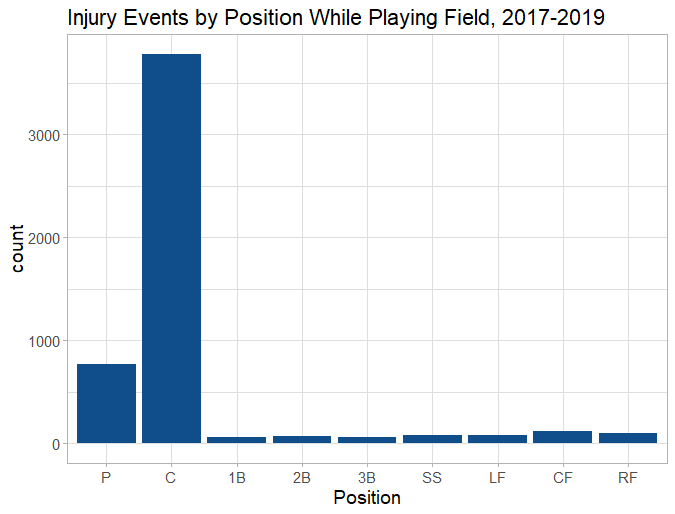
    Though those extreme injuries are rare, playing behind the dish does include more injury risk overall relative to other positions. Looking at injuries that occurred while playing the field, catchers come out way ahead of the pack in terms of total injury events.

    This is a little deceiving. We try to be as comprehensive as possible with our injury data collection and track even the slightest incidents on the field (like hit by pitches or foul balls off the body that may not incur much of a reaction). So a lot of those catcher injuries are low-risk.

    But our Video Scouts also provide a severity rating of each injury on a scale of 1 to 5. Ratings 1 and 2 are injuries with no or slight visible reactions, while 3 and up include clearly visible reactions and are more severe. To focus on higher-risk injury events, here’s the positional breakdown of injuries with a severity of 3 or higher:

    Pitchers surpass catchers in terms of severe injury events, but catchers are still at far more risk than other positions in the field. The more significant takeaway is that out of over 5,000 games played since the beginning of 2017, there have only been about 250 injury events to catchers (while on defense) that warranted a severity 3 rating or higher.

    The most common of our charted injury events to catchers fall under the category of being struck by a ball or bat. Recently, Roberto Perez of the Indians and Francisco Cervelli of the Pirates have suffered concussions on such events. Given the catcher’s exposure to foul tips and backswings, they’re certainly at more risk than someone in the infield or outfield.

    But overall, the chance of an extremely severe injury is rare. Perhaps more managers should be willing to use the backup catcher if the situation warrants it, even if it presents the low-probability risk of needing an emergency catcher to step in.