Tag: jackie bradley jr.

  • Playing The Field: Targeting Defensive Improvements At The Trade Deadline

    Playing The Field: Targeting Defensive Improvements At The Trade Deadline

    Defense is incredibly important for sustained success. We’ve written about it before and it’s still true.

    In 2021 the Yankees and Red Sox were the only playoff teams not ranked in the top 15 of Defensive Runs Saved. The World Series champion Braves finished the season 8th in Runs Saved. One of their midseason additions was Adam Duvall, the 2021 Gold Glove winner in right field. The Dodgers and Astros are consistently Top 10 in Runs Saved and both teams consistently make deep postseason runs.

    The Yankees subsequently made major improvements in the infield and at catcher and have gone from 29th in 2021 to 1st this season. The Red Sox, who spent much of the season in the Top 10, currently rank 11th. But not every team has made that kind of climb

    So, I wanted to see which teams with realistic postseason aspirations can improve defensive holes in their roster at the trade deadline.

    Defense gets somewhat overlooked at the trade deadline but the Braves in 2021 showed how important trading for defense can be. Most players mentioned here aren’t big splash trades. They are role players that can take these teams to the next level.

    The current 2022 team rankings in Runs Saved can be found here.

    Atlanta Braves (+11 DRS, T-16 in MLB) 3 GB in NL East, 1st in Wild Card

    Last season the Braves were one of the most active teams at the trade deadline, trading for Duvall and Eddie Rosario. This season, the need may be there again. Duvall was just shut down for the season with a wrist injury so the Braves will need to fill that void.

    Michael Harris II has been exceptional in CF since being called up, posting 5 Runs Saved. He needs a little more support in the corners, where Ronald Acuna Jr. is at -3 Runs Saved and left field has been a revolving door among Rosario, Marcell Ozuna and Guillermo Heredia. All are offense-first players.

    The Braves offense is one of the best in baseball, so adding someone who is defense-first shouldn’t cause them too much of a hit.

    Left Field -10
    Right Field -4

    Michael A. Taylor would be an interesting defensive addition. Taylor led center fielders in Runs Saved last season and ranks tied for first in 2022. He’s played both corner outfield positions and his presence would allow the Braves to essentially have two center fielders in the game at the end of the game. Taylor and Harris next to each other would be an incredibly exciting defense to watch.

    The Royals might not want to trade Taylor. He’s theirs for a reasonable $4.5 million next season if they don’t deal him. But he’d be a great glove for any team in this pennant race.

    Tampa Bay Rays (14 DRS, 14th in MLB) 3rd in Wild Card

    After finishing 4th in Runs Saved in 2021, Tampa Bay has dipped slightly, this season. Tampa Bay is usually closer to the top 5 in Runs Savedbut currently ranks 14th. The Rays had some major injuries, with Wander Franco missing time and now Kevin Kiermaier being shut down for the season. Thankfully for them they have Taylor Walls to back up Franco but other positions have been problematic for their defense.

    Kiermaier is annually in the discussion for best defensive outfielder in baseball. His loss is going to be huge down the stretch for the Rays. He’s finished top 5 in CF in Runs Saved in every season since 2015. Brett Phillips has been a good replacement for Kiermaier in past seasons but his numbers are underwhelming in center field (-5 Runs Saved) in 2022. He’s been much better in right field (8 Runs Saved).

    One thought is that the Rays didn’t want the extra year of Taylor (mentioned above as a Braves option), that they could try to snag Bradley Zimmer from the Blue Jays but it seems unlikely the teams would trade given that they are playoff rivals.

    First base is the other problem area for Tampa to try to shore up and a position that has plenty of options. Ji-Man Choi has played the majority games at first. He currently has -2 Runs Saved but he isn’t known for his defense.

    An addition of Christian Walker would make Tampa’s infield defense one of the best in baseball. Walker is the runaway leader in Defensive Runs Saved at first base but would be a more expensive piece to trade for since he’s not a free agent until 2025.

    Josh Bell is the other first baseman Tampa Bay can go after. The reason to get Bell is for his bat, but he’s been much better defensively than he has been in previous seasons. He’s currently at 2 Runs Saved, though he’s never finished a season with a positive Runs Saved total. He averaged -6 Runs Saved from 2016 to 2019 but has progressed to the point of rating slightly above average.

    Other names to watch would be Dominic Smith of the Mets and Michael Chavis of the Pirates, both of whom have played the position at about an average level for their respective careers.

    Seattle Mariners (38 DRS, 8th in MLB) 2nd in Wild Card

    While it’s hard to criticize the 6th-best defense in baseball the Mariners have a big hole in left field (-10 Defensive Runs Saved). Jesse Winker gets the majority of playing time there and currently has -11 Runs Saved, the worst out of all LFs in baseball. Winker’s never been known for his defense but this season has been even worse than past seasons. It’s hard to see them getting an everyday left fielder to play over Winker but I think a defensive replacement and someone who could hit would be a great fit.

    Tommy Pham is one for them to consider. Pham has 4 Runs Saved in left field, would be a solid late-game replacement for Winker, and could play vs left-handed pitching. He’s never been great defensively but is definitely an upgrade over Winker, because of his speed and ability to cover more ground.

    The only issue with Pham being acquired is the price, he’s signed through 2023.

    Robbie Grossman is a potentially cheaper option for whom 2023 wouldn’t be a concern (he’d be one for the Braves too). He’s a little better than Winker in the field, currently has 2 Runs Saved, and is a potential useful bat as a switch-hitter.

    San Francisco Giants (-30 DRS, 28th in MLB) 3 games out of Wild Card

    The Giants have been one of the biggest disappointments defensively in 2022 and their bad defense has caused them to sink, to the point where they might not be buyers any more.

    Here are some of the positions that have been the biggest problem.

    Second Base -13
    Third Base -14
    Shortstop -8
    Left Field -18

    They need help all over the field so there are plenty of options available for them. The Giants love to move players around and use utility players. There are a couple players that fit that bill that shouldn’t cost too much to acquire.

    Joey Wendle of the Marlins would be the perfect fit in San Francisco. Wendle has played 2B, 3B, and SS for Miami this season and has positive career Runs Saved in all three positions (3 Runs Saved overall in 2022). His contract includes a club option for 2023 so he could be more than just a one-year rental. Wendle would dramatically improve the defense at any position they decide to play him.

    In left field Joc Pederson, Luis Gonzalez, and Darin Ruf have played the most. All three of these guys have struggled, with each at -4 Runs Saved or worse there. Options like those previously mentioned (Taylor, Grossman) are out there. Another potential fit could be Sam Hilliard of the Rockies as a late-game replacement. He has experience at all three outfield spots and would be a defensive upgrade.

    Philadelphia Phillies (-22 DRS, 26th in MLB) Tied for 3rd Wild Card

    Going into the season the Phillies knew defense would be an issue. Signing Nick Castellanos and Kyle Schwarber were moves meant to bolster the offense. The Phillies planned on having Bryce Harper play RF but once he started to have shoulder issues, he could only DH.

    Castellanos has been the worst defensive right fielder this season with -12 Runs Saved. Schwarber is second to last in left with -7. The outfield isn’t the only problem area for the Phillies defensively though. The entire team has had defensive issues.

    Third Base -11
    Shortstop -8
    Left Field -5
    Center Field -7
    Right Field -14

    Wendle is a great fit here too. As I mentioned for the Giants, Wendle has been exceptional in multiple infield positions. He’s a match for any team looking to add a glove at the deadline.

    Matt Reynolds of the Reds could be an infield option for Philly as a useful defensive replacement. Reynolds has 1 Run Saved at third base and 3 Runs Saved at at shortstop.

    Reynolds would be a defensive upgrade over Didi Gregorius and Bryson Stott at shortstop and/or a potential ninth-inning replacement for Alec Bohm at third base. It’s a very small pickup that could have a good payoff.

    Considering how bad the outfield defense has been, a big-time defensive stud would make a nice splash for the Phillies. Jackie Bradley Jr. of the Red Sox would give them an elite defender to put between Schwarber and Castellanos … if the Red Sox were willing to trade him.

    Bradley Jr. has played mostly right field for Boston this season and has 6 DRS there. In center field he’s at -1 Runs Saved but his track record is excellent. He makes defense look incredibly easy and could cover ground like few other outfielders.

    Bradley another player for whom next season is a consideration, as he has a mutual option in his contract, but given the Phillies’ desire to win, the price could be worth it.

  • Jackie Bradley Jr. still a center of attention

    By MARK SIMON

    Over the last two seasons, the most we heard from fans about a player’s Defensive Runs Saved total were tied to Jackie Bradley Jr. finishing with -1 and -2 Runs Saved in center field.

    Bradley had previously had seasons of 16 (2014), 14 (2016) and 15 (2017) Runs Saved and people wondered why his totals weren’t at that level.

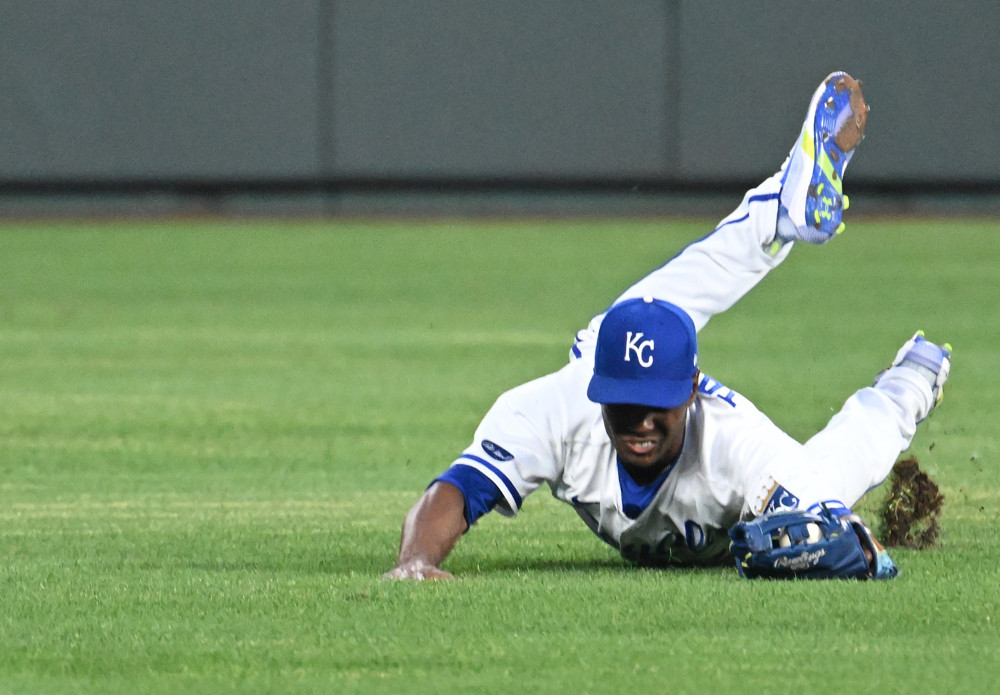
    Well, in what has been a miserable year for Red Sox fans, we can tell you that for at least 40 games, Bradley’s defense has been very good. He’s saved 6 runs, which ranks tied for 4th in MLB.

    Bradley’s highlight tape has a good array of terrific catches. He’s tied with Kevin Kiermaier for the MLB lead in Good Fielding Plays among center fielders with 9. Three plays from that list rank as the catches that netted him the most run value this season.

    Two of them came in the first three days of the season.

    This one had a catch probability of 32%

    And this one had a catch probability of 24%

    The other came in early August and also had a catch probability of 32%

    Bradley has since had a busy last two weeks, recording 5 more Good Fielding Plays, four for catches, and a throw to nail Jonathan Villar of the Blue Jays at second base. This one required an impressive reach to track down.

    Last season, MLB introduced its jump stats, which showed that Bradley had on average the most feet covered within the first 1.5 seconds that the ball was in flight. However, his overall routes to balls ranked last.

    A week into the season, our Video Scouts gave Bradley a Defensive Misplay for a bad route on a ball hit by Andrés Giménez of the Mets. Bradley has not gotten one of those since then. He rates as the center field leader in sliding and diving catches with 8 and is in a tight race for the most sprinting catches at the position.

    Bradley will be a free agent after this season. Though he’s now in his 30s, he’s shown that he may still have something left on the defensive side.

  • Which Batters Have Changed Their Hard-Hit Rate The Most?

    By Jon Becker

    Now that we’re after the All-Star Game and have seen more than half of 2019’s regular season games come and go, we’ve got a plenty large sample to evaluate players this season. One of my favorite things to do is look at players who’ve changed drastically–positively or negatively–from season to season. Today, I’ll be taking a look at the batters who’ve changed their hard hit rates the most, for better or for worse.

    Note that this version of hard-hit rate is calculated as Hard-hit balls/(At-Bats + Sacrifice Flies). Our denominator penalizes a hitter for strikeouts. Those you would see from Statcast and on FanGraphs use a denominator of “Batted Balls” which does not incorporate strikeouts.

    The number you get from our calculation allows you to say “Player X has recorded a hard-hit ball in Y% of his times at bat.”

    Let’s start with the top three hard-hit rate improvements, from the 2018 season to the first half of this season. A minimum of 400 at-bats last season and 200 at-bats this season are required to qualify.

    1. Scott Kingery, 19.2% to 34.7% (15.5% increase)

    When you increase your triple-slash from .226/.267/.338 (.605 OPS) to .292/.344/.545 (.889 OPS), you have to have changed something. For Kingery, that’s hitting the ball way harder. He’s made an even more dramatic increase against left-handed pitching, raising his hard-hit rate against southpaws from 16.9% to 53.7%. That’s the highest hard-hit rate against lefties this year of those with at least 50 at-bats against them.

    2. Cody Bellinger, 29.3% to 42.7% (13.4% increase)

    As Mark Simon noted on Monday, the NL’s leader in OPS+ and leader in DRS amongst non-catchers and its leading MVP candidate is also its leader in hard-hit rate. He was middle of the pack in 2018 (75th out of 179 hitters with at least 400 at-bats), but has been anything but this season. His most pronounced change has been against sliders, raising his hard-hit rate against those pitches from 28.2% to 50%. He has the highest hard-hit rate this season against that pitch type (minimum 25 at-bats ending with sliders).

    3. Josh Bell, 26.9% to 38.1% (11.2% increase)

    Perhaps the biggest breakout of the season, Bell came into the season with a career OPS of .784 and a WAR  of 2.2 (per Baseball-Reference), largely due to well-below-average defense at first base. This season? A 1.024 OPS and 3.0 WAR to go along with vastly improved defense (-9 DRS last year, 0 this year). The switch-hitting Bell has gotten better from both sides of the plate, with a 11.1 percentage-point increase as a righty and 10.9 percentage-point jump from the left side.

    And now, for those who’ve seen their hard-hit rates plummet the most:

    1. Jackie Bradley Jr., 29.3% to 22.9% (6.4% decrease)

    Bradley’s put his March/April funk (.406 OPS) behind him, slashing .272/.377/.497 (.874 OPS) since May 1, but his hard-hit rate hasn’t quite rebounded yet. His hard-hit rate since the beginning of May is actually lower than his season average, at 21.4%.

    2. Rougned Odor, 33.4% to 27.4% (6% decrease)

    After a slightly below-average season in 2018 (.253/.326/.424, for a 97 OPS+), Odor’s production has cratered in 2019, as he is batting just .198/.264/.407 (an OPS+ of 69). The lefty swinger actually hasn’t been much worse against same-sided pitching (a 4 percentage-point decrease), but righties have given him trouble (a 6.9 percentage-point decrease). Fortunately for Odor, he’s still just 25 years old, so there is time to improve.

    3. Matt Carpenter, 35.4% to 29.6% (5.8% decrease)

    Of the three trailers on this list, Carpenter was by far the best in 2018, putting up a  .257/.374/.523 triple-slash, setting a career high with 36 homers, and finishing 9th in NL MVP voting. He’s currently in the midst of his first career below- average season (88 OPS+) and has struck out in almost a quarter of his plate appearances, by far the highest rate of his career. 

    Here’s the top 15 and bottom 15:

    Batter 20182019Change
    Scott Kingery19.2%34.7%15.5%
    Cody Bellinger29.3%42.1%12.8%
    Josh Bell26.7%37.9%11.2%
    Carlos Santana27.3%38.0%10.7%
    Justin Smoak23.2%33.6%10.4%
    Cesar Hernandez17.9%27.6%9.7%
    Jonathan Schoop20.5%29.9%9.4%
    Anthony Rendon32.3%41.1%8.8%
    Rhys Hoskins25.0%33.0%8.0%
    George Springer26.1%34.0%7.9%
    Yasmani Grandal29.3%37.2%7.9%
    Ozzie Albies28.2%35.5%7.3%
    Nomar Mazara28.6%35.8%7.2%
    Dansby Swanson26.6%33.7%7.1%
    Marcus Semien25.8%32.7%6.9%
    Freddie Freeman32.7%39.6%6.9%
    Nick Markakis35.6%33.2%-2.4%
    Edwin Encarnacion30.8%28.1%-2.7%
    Freddy Galvis30.2%26.4%-3.8%
    Mitch Haniger28.0%24.0%-4.0%
    Nick Ahmed30.8%26.8%-4.0%
    Stephen Piscotty33.5%29.0%-4.5%
    David Peralta37.7%33.0%-4.7%
    Yonder Alonso28.9%24.2%-4.7%
    Todd Frazier30.4%25.6%-4.8%
    Lorenzo Cain31.5%26.7%-4.8%
    Andrew McCutchen32.5%27.4%-5.1%
    Nicholas Castellanos36.3%31.2%-5.1%
    Matt Carpenter35.3%29.9%-5.4%
    Rougned Odor33.3%27.1%-6.2%
    Jackie Bradley Jr.29.1%22.6%-6.5%
  • Opening Act: Stats and scouts evaluate rookies’ defense

    Nearly a month into the MLB season, the signal in the Defensive Runs Saved data is beginning to break free of the noise. The elite defenders are steadily climbing toward the top of the leaderboards, while the less talented gloves are falling to the back of the pack. With that in mind, this seems like a good time for a (very) preliminary evaluation of this year’s crop of rookies.

    We don’t have nearly as much data to go on at the minor league level, so there is very little about a player’s defensive game we can be confident of statistically before he reaches the majors. This is where scouts come in, using their highly trained eyes to fill in the gaps in the data and providing a honed but still subjective understanding of what the player is and what he could be. With some of those rookies off to excellent starts and others struggling as they acclimate to the speed of the major league game, it’s time to compare what scouts saw from the player in the minors to what he’s shown in his small sample of chances in the majors.


    The Rookie: Chris Owings, SS, Arizona Diamondbacks

    The Scenario: Framed as the bat-first option in contrast to Didi Gregorius’ slick glove, Owings (the club’s top positional prospect) won the starting job in camp.

    The Scouts: Baseball Prospectus’ Jason Parks graded Owings out with an average glove and a plus arm, while Baseball America’s Bill Mitchell called him “an average defender at short with enough range, solid infield actions and an average arm.”

    The Numbers: Owings’ defensive numbers have outpaced the scouts lukewarm projections, as his six Runs Saved trail only Troy Tulowitzki for the lead among all infielders so far. Owings has made eight more plays than we would expect from an average shortstop, suggesting that so far, his range has surpassed the scouts’ projections of a near-neutral performance.


    The Rookie: Jackie Bradley Jr., CF/RF, Boston Red Sox

    The Scenario: Last season, Bradley won the job out of Spring Training only to lose it after a disastrous April. Jacoby Ellsbury’s departure and Shane Victorino’s early-season injury woes have forced Bradley into a key role on a club with hopes of repeating last season’s October success.

    The Scouts: Parks hung a 6+ (on the 2-8 scouting scale) on Bradley’s glove to go with a 6 arm, and Baseball America’s Alex Speier agreed that Bradley’s instincts allow him to provide plus defense in center despite lacking the elite speed generally associated with the best defenders at that position.

    The Numbers: Thus far, Bradley’s Defensive Runs Saved totals back up the scouts’ assertions, as he’s been three runs above average between center and left. Between the two positions, Bradley has accumulated seven Good Fielding Plays against five Defensive Misplays and Errors.


    The Rookie: Billy Hamilton, CF, Cincinnati Reds

    The Scenario: The undisputed fastest man in organized baseball made the switch from shortstop to center last season and will roam the outfield at the Great American Ball Park in 2014.

    The Scouts: BA’s JJ Cooper and BP’s Parks agree that Hamilton’s transition to the outfield in 2013 was a success, with Parks noting his “easy plus potential” at the position and Cooper stating that “while his jumps and routes can continue to improve, he has the speed to outrun mistakes.”

    The Numbers: Thus far, Hamilton saved one run for the Reds in center, while committing two Defensive Misplays and recording one Good Fielding Play. He still has a lot to learn about the position, so it would not be a surprise to see his Runs Saved total climb as the year goes on and he grows more comfortable in the outfield.


    The Rookie: Jose Abreu, 1B, Chicago White Sox

    The Scenario: The $68M Cuban slugger was a star in his home country and a former Serie Nacional MVP but faces a clean slate and high expectations stateside as he takes over for longtime face-of-the-franchise Paul Konerko.

    The Scouts: Largely limited to scouting Abreu based off of looks in international tournaments, scouts developed a wide range of opinions regarding his glovework. ESPN’s Keith Law suggested that without a strong commitment to conditioning, Abreu could end up at DH, while Law’s ESPN colleague Jerry Crasnick spoke to a number of scouts who suggested his size belies respectable athleticism that could make him a “solid” first baseman. BA’s John Manuel’s opinion was similar to Crasnick’s source, although he shared some of Law’s concerns, calling Abreu “an adequate defender… as long as he maintains his fitness.”

    The Numbers: Abreu has displayed below-average but not atrocious glovework, costing the South Siders three runs at first base through his first month. Six Defensive Misplays and Errors have more than neutralized the positive value provided by his nine Good Fielding Plays. However, three of those six negative plays occurred in his first five games, so it’s possible that he’s begun to adjust to the American brand of baseball after a rocky introduction to the league, at least as far as his glovework is concerned.


    The Rookie: Xander Bogaerts, SS, Boston Red Sox

    The Scenario: The Aruban phenom, a consensus top prospect in the game, was handed the reins at short after the departure of Stephen Drew.

    The Scouts: Parks grades Bogaerts as an average shortstop with a plus arm, suggesting his less-than-elite range plays up due to excellent instincts. Writing for Baseball America, Sox beat writer Alex Speier expressed confidence in Bogaerts’ performance at short despite a body much larger than the prototypical frame for the position.

    The Numbers: Bogaerts’ performance thus far has not been up to par, as the five runs he’s cost his team land him with the worst fielders in the league. However, Bogaerts’ performance is at the toughest defensive position, an excuse not available to other bottom-dwellers like Ryan Howard and Torii Hunter. While he’s generally made the plays he’s gotten to, Bogaerts’ range has been well below average among shortstops, resulting in a Plus/Minus of -5 that accounts for most of his low Runs Saved total. His outstanding bat and tremendous upside will keep him in the lineup, but if Bogaerts can’t make significant improvements to his defensive game, he could very well end up shifting to the hot corner.


    For most of these rookies, their statistical performance thus far largely mirrors previous reports from the Internet’s most respected prospect writers. For Bogaerts, who has largely underperformed the scouts’ expectations, there’s a long season ahead and still a chance to establish himself as the defensive asset he was projected to be. Each of these elite prospects has a long career ahead of them, with their defensive value a story that has just begun to be written.