Tag: Nicholas Castellanos

  • Who has the best chance to reach MLB milestones? (Bill James Handbook excerpt)

    The following is an excerpt from the 2020 Bill James Handbook, available now at ACTA Sports, Barnes & Noble, Amazon, and wherever you buy your books

    By Andrew Kyne
    Bill James devised “The Favorite Toy” to estimate a player’s probability of breaking a record or reaching a milestone.

    In last year’s Handbook, the highest probability of such an event belonged to Albert Pujols, who was projected to have a 97% chance to someday reach 2,000 career runs batted in. With 1,982 RBI entering the season, Pujols was very likely to not only reach the milestone, but to do so early in 2019. Sure enough, he notched his 2,000th with a solo home run on May 9 in Detroit.

    This year, the highest probability of reaching a career batting target belongs to another generational talent, Miguel Cabrera. He is now estimated to have a 75% chance of reaching 3,000 hits. Although his power numbers were limited this season, Cabrera still hit for a .282 average and added 139 hits to his career ledger. He now sits 185 hits shy of 3,000.

    Some records may never be broken, and the rest of the batting targets feature many longshots. But an obvious player to keep an eye on is Mike Trout, whose name can be found in several places in this section. After hitting a career-best 45 home runs in 2019, Trout is now projected to have a 43% chance to hit 500 home runs, a 29% chance to hit 600 home runs, and a 14% chance to hit more than 762 home runs, the all-time record.

    Additionally, BIS has developed a system, separate from The Favorite Toy, that estimates the likelihood that a pitcher will throw a no-hitter. Free agent pitcher Gerrit Cole is currently the most likely to do so at an astonishing 62%, far ahead of any other pitcher. In 2019, Cole had two outings in which he allowed only one hit and three outings in which he allowed two hits. He also found his strikeout touch with the Astros, recording double-digit strikeouts in 21 starts this year.

    A couple new names to watch on the most likely no-hitter list are Lucas Giolito (27%) and Luis Castillo (21%). Young pitchers Jack Flaherty (23%) and Blake Snell (23%) were featured on last year’s list as well.

    Justin Verlander, Cole’s teammate in Houston, was listed as having a 32% chance at a future no-hitter in last year’s Handbook. Verlander held the Blue Jays without a hit on September 1 for the third no-hitter of his career. Only Nolan Ryan and Sandy Koufax have thrown more than three career no-hitters. With a 26% chance of another, it’s possible that Verlander could join them.

    % Chance to Reach 762 HR
    Name % Chance
    Mike Trout 14%
    Cody Bellinger 6%
    Nolan Arenado 1%
    Pete Alonso <1%
    % Chance to Reach 800 HR
    Name % Chance
    Mike Trout 10%
    Cody Bellinger 3%
    % Chance to Reach 600 HR
    Name % Chance
    Mike Trout 29%
    Nolan Arenado 21%
    Eugenio Suárez 16%
    Bryce Harper 16%
    Manny Machado 15%
    Cody Bellinger 13%
    Francisco Lindor 11%
    Pete Alonso 11%
    Christian Yelich 10%
    % Chance to Reach 500 HR
    Name % Chance
    Miguel Cabrera 68%
    Edwin Encarnación 66%
    Mike Trout 43%
    Nolan Arenado 32%
    J.D. Martinez 31%
    Nelson Cruz 29%
    Giancarlo Stanton 27%
    Bryce Harper 26%
    Manny Machado 24%
    % Chance to Reach 2,298 RBI (Record)
    Name % Chance
    Albert Pujols 7%
    Nolan Arenado 3%
    Bryce Harper < 1%
    % Chance to Reach 2,296 Runs (Record)
    Name % Chance
    Mookie Betts 11%
    Mike Trout 6%
    Francisco Lindor 1%
    % Chance to Reach 793 Doubles (Record)
    Name % Chance
    Nicholas Castellanos 16%
    Xander Bogaerts 14%
    Mookie Betts 11%
    Francisco Lindor 7%
    Rafael Devers 6%
    Alex Bregman 5%
    Ozzie Albies 2%
    José Ramírez 2%
    Anthony Rendon 2%
    Freddie Freeman 1%
    % Most Likely To Throw No-Hitter 
    Name % Chance
    Gerrit Cole 62%
    Robbie Ray 32%
    Chris Sale 29%
    Lucas Giolito 27%
    Justin Verlander 26%
    Blake Snell 23%
    Jack Flaherty 23%
    Max Scherzer 22%
    Luis Castillo 21%
    Yu Darvish 21%
    % Chance to Reach 3,000 Hits
    Name % Chance
    Miguel Cabrera 75%
    Nick Markakis 30%
    Robinson Canó 26%
    Starlin Castro 25%
    José Altuve 24%
    Freddie Freeman 23%
    Elvis Andrus 20%
    Eric Hosmer 20%
    Nolan Arenado 19%
    Manny Machado 17%
    Christian Yelich 16%
    Mookie Betts 15%
    Xander Bogaerts 15%
    Nicholas Castellanos 15%
    Francisco Lindor 13%
    Adam Jones 12%
    Mike Trout 12%
    DJ LeMahieu 10%
    Jean Segura 9%
    Bryce Harper 9%
    Ozzie Albies 7%
    Alex Bregman 7%
    Cody Bellinger 7%
    Rafael Devers 6%
    Anthony Rizzo 6%
    Andrew Benintendi 5%
    Trevor Story 4%
    Anthony Rendon 4%
    Paul Goldschmidt 4%
    Charlie Blackmon 3%
    Javier Báez 2%
    José Ramírez 2%
    J.D. Martinez 2%
    Trea Turner 2%
    Ketel Marte 2%
    Amed Rosario 1%
    Ronald Acuña Jr. 1%
    Eddie Rosario < 1%
    Marcus Semien < 1%
    Michael Brantley < 1%
    Tim Anderson < 1%
    Eugenio Suárez < 1%
  • Hey, Nicholas Castellanos: Don’t be such a grump about analytics!

    By Mark Simon

    Chicago Cubs right fielder Nicholas Castellanos recently expressed his distaste for analytics in an interview with Bob Nightengale of USA Today.

    In a way, that’s unfortunate. The analytics show that Castellanos has made considerable defensive progress this season, his second full season playing right field.

    In 2018, Castellanos had about as rough a season in right field as any player did anywhere. He cost the Tigers 19 runs, almost entirely based in his struggles hit to the deepest part of ballparks.

    But this season, he’s fared far better at turning those balls into outs, thus taking away potential doubles and triples. Here’s the comparison:

    Balls Hit to Deepest Part of Right Field
    Year Plays Made Opportunities Plays Below Average
    2018 81 134 17
    2019 83 118 1

    Castellanos has gone from performing terribly on those balls to becoming an average fielder on them. He’s got a ways to go to be Cody Bellinger (80 plays made on 95 opportunities) but he’s improved to a reasonable level of adequacy.

    The improvement could be rooted in any number of things, with positional familiarity being the most likely. He’s also played a little deeper than he did last season — moving from an average starting position of 289 feet to 292 feet at Comerica Park, and playing 294 feet deep at Wrigley Field. The one or two steps he may have gained in this could be difference makers.

    Granted, Castellanos still has a ways to go. He’s cost his teams a combined six runs this season and his arm could use improvement in terms of baserunning deterrence. But the analytics are showing something positive for him, and perhaps giving him a reason to give them a chance.

  • Analyzing the Impact Bats Added at the Trade Deadline

    By Jon Becker

    The MLB trade deadline has come and gone, and as is usually the case, it was pitching that dominated the headlines. Trevor Bauer went to the Cincinnati Reds, Shane Greene to the Atlanta Braves, and Zack Greinke to the Houston Astros. While there weren’t names quite as big or seasons quite as good acquired on the offensive side of things, there were still a small handful of meaningful position players acquired. Let’s take a look at some of them.

    OF/DH Franmil Reyes, traded from San Diego Padres to Cleveland Indians

    Reyes has been one of the most under-the-radar hitters in baseball this year, with a 34% hard-hit rate that puts him in the top 50 among the nearly 200 batters with 300-plus at-bats. His 27 home runs this year gives him 43 for his career in under 600 at-bats, though interestingly enough he’s hit only 18 doubles and driven in 77 runs. The righty swinger actually does most of his damage against same-sided pitching, with a 36% hard-hit rate against such pitchers (25% against southpaws) and 24 of his 27 round-trippers.

    A big factor in the Padres’ willingness to trade Reyes was likely his poor defense, which our Sam Weber wrote about yesterday. He’ll probably spend most of his time in Cleveland as the designated hitter.

    RF Nicholas Castellanos, traded from Detroit Tigers to Chicago Cubs

    Despite this being the most homer-happy season in MLB history, Castellanos hasn’t quite gotten the memo, hitting just 11 home runs after clubbing 23 last year. He has hit 37 doubles, to lead MLB, only 9 off of his career-high with one-third of the season still to be played. The Cubs’ biggest offensive woes have come against lefties, and Castellanos will definitely help there. He’s hitting .347 this year when holding the platoon advantage, with four of his home runs and a 43% hard-hit rate. That hard-hit rate puts him just outside the top 10 of the 200+ hitters with at least 50 at-bats against lefties.

    One thing that ought to worry the Cubs, though, is Castellanos’ defense; he’s improved, but has still been well below average, with a -6 DRS after -19 last year. The acquisition will also give Jason Heyward more time in center and less in right; Heyward’s fifth amongst right fielders with 9 DRS, but has cost the Cubs six runs when playing up the middle.

    RF Yasiel Puig, traded from Reds to Indians

    It’s been a weird season for Puig, who slashed just .218/.268/.391 through the end of May but was excellent in the next two months, batting .290/.340/.568. His hard-contact rate has improved a lot as well; it’s been 33% over the last two months after having a hard-hit ball in less than a quarter of his at-bats prior. Similarly to new teammate Reyes, he’s a bit of a reverse-splits hitter: his batting average is 14 points higher against lefties but his hard-hit rate is almost two percentage points higher against righties, against whom he’s hit 17 of his 22 home runs.

    Puig, unlike the other two names above, is an above-average fielder, with 3 DRS in right field this year and four outfield assists, with runners taking the extra base on less than 50% of opportunities. Puig has 16 Good Fielding Plays, one shy of the MLB lead at the position. He does sometimes try to do too much — he has 13 Defensive Misplays & Errors — but that doesn’t offset his positives.

    INF/OF Eric Sogard, traded from Toronto Blue Jays to Tampa Bay Rays

    The most out-of-nowhere impact trade candidate on the market, Sogard parlayed a minor-league deal with the Blue Jays into an excellent .300/.363/.477 slashline, hitting 10 home runs in 330 plate appearances after slugging just 11 in over 1,700 career plate appearances prior. He hasn’t hit the ball particularly hard, with a hard-hit rate of just over 30%, but that still represents a career high. He’s also been excellent at using the whole field, pulling just 37% of batted balls and hitting 63% up the middle or to the left side.

    The bespectacled Sogard has started games at second base, third base, shortstop, left field and right field this year.  He’s cost his teams four runs at second base, and has been +1 at the other positions.

  • Visualizing the Range of MLB’s Best and Worst Outfielders in 2018

    Visualizing the Range of MLB’s Best and Worst Outfielders in 2018

    By ANDREW KYNE

    The primary component of Baseball Info Solutions’ Defensive Runs Saved metric is the Range & Positioning system, which rates each fielder’s success at converting batted balls into outs.

    Fielding Bible Award winners Alex Gordon (LF), Lorenzo Cain (CF), and Mookie Betts (RF) were among the best at their respective positions in 2018 according to Range & Positioning Runs Saved.

    Using BIS’s batted ball location data, let’s visually compare the outfield range of Gordon, Cain, and Betts with other defenders at their positions who did not fare quite as well.

    A few notes on the following graphics…

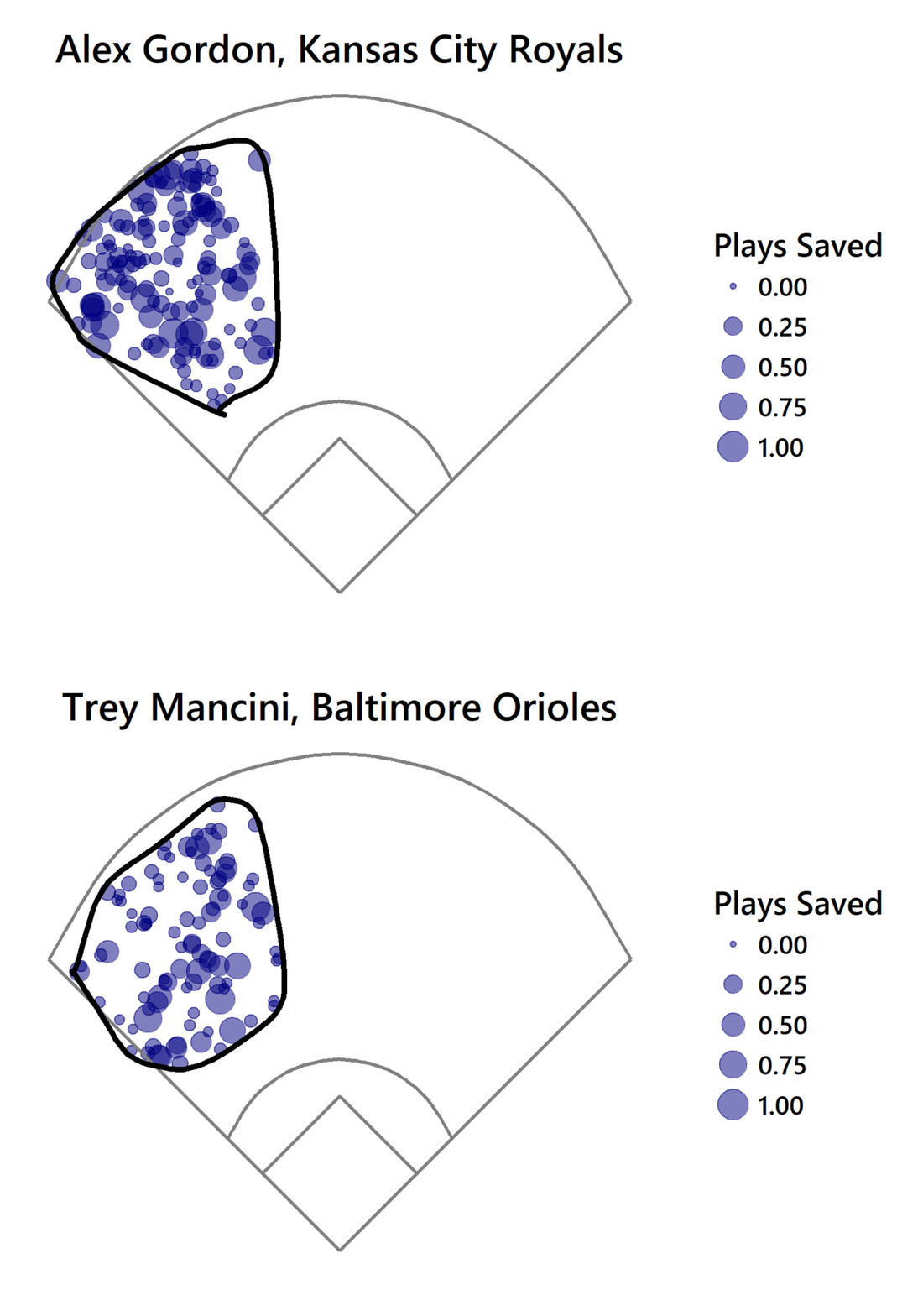
    • Each point on the plot represents a catch made by the outfielder.
    • The points are sized relative to the “Plays Saved” value for each out. If our system determines a play should be made 60% of the time and the outfielder makes the catch, he gets credit for 0.4 Plays Saved (1-0 minus .6). The better the play, the bigger the scatter point on the plot.
    • Outs with a Plays Saved credit of 0 were removed (meaning 100% expectation of making the catch — “a can of corn” for the outfielder).

    Left Field

    Excellent: Alex Gordon (+10)
    Poor: Trey Mancini (-14)

    LeftField

    Having split time between left field, first base, and DH, Mancini did not have as much volume here, yet he still cost the Orioles 14 runs with his range and positioning in left. The numbers back up what the image shows: Mancini was particularly poor on medium and deep balls (16 plays below average).

    On the other hand, Gordon was excellent en route to his fourth career Fielding Bible Award. The only outfielder with more “Good Fielding Plays” than Gordon this year was Cincinnati’s Billy Hamilton.


    Center Field

    Excellent: Lorenzo Cain (+13)
    Poor: Adam Jones (-19)

    CenterField

    As the image illustrates, Cain was excellent on deep balls — the best among any outfielder, in fact, at +13 plays.

    Jones rated negatively on both shallow and deep balls, while also not exhibiting as much lateral ability as Cain, especially to right-center (possibly a product of defensive positioning).


    Right Field

    Excellent: Mookie Betts (+12)
    Poor: Nicholas Castellanos (-17)

    RightField

    Betts’ dominance reveals itself in the right-center gap. The American League MVP and World Series Champion also did well on deep balls, while still making a bunch of high-quality plays in front of him.

    The image nicely shows Betts’ ability to cover all of right field. He registered +6 on shallow balls, +4 on medium, and +4 on deep. Betts and Adam Duvall were the only outfielders to save at least four plays in all three areas at one position.

    Castellanos appears to have made a decent number of plays going towards the line, but struggled in other areas. He rated particularly poorly on deep balls (17 plays below average).