Tag: NPB

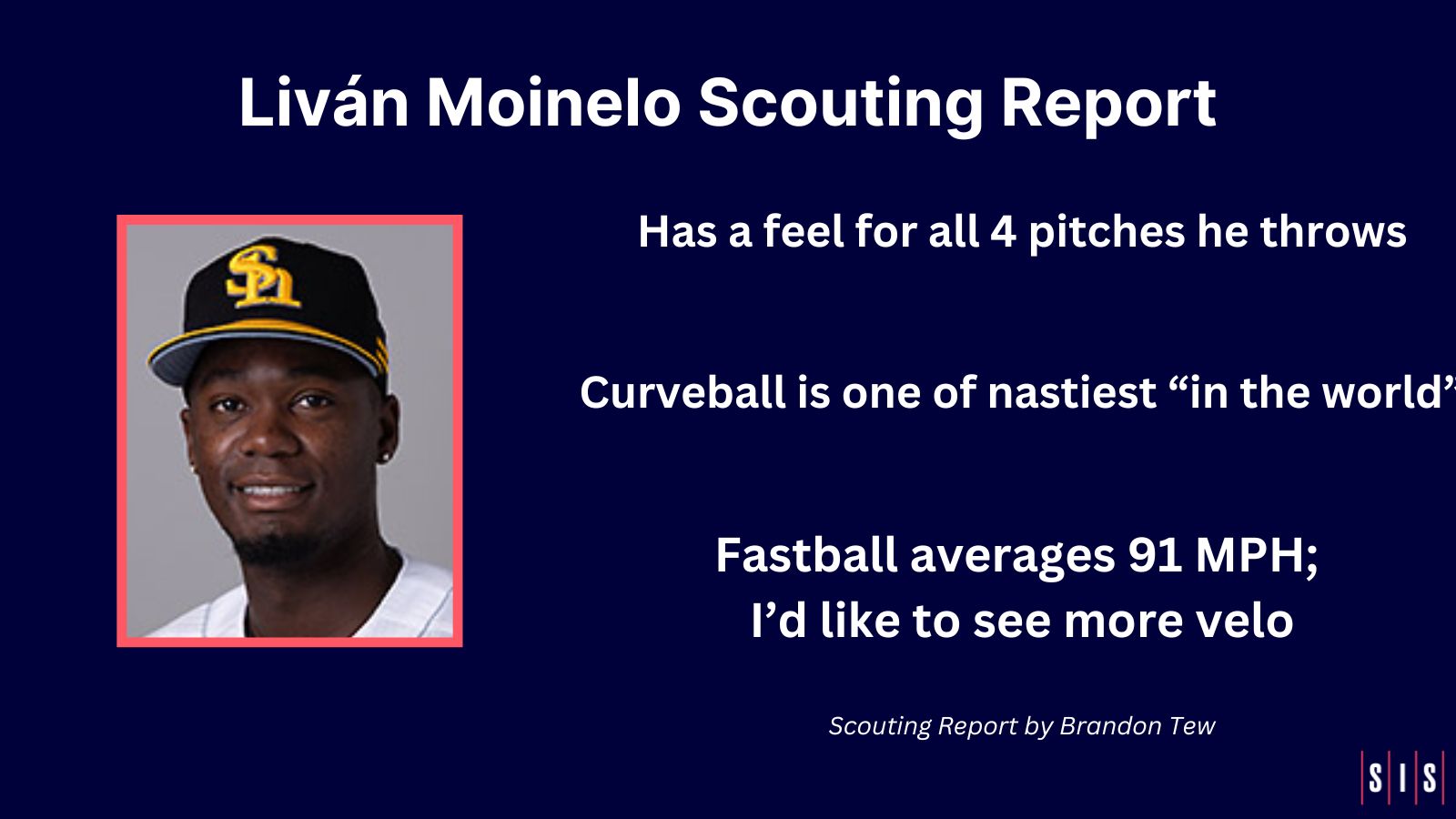
  • NPB Aces Scouting Report: Liván Moinelo

    NPB Aces Scouting Report: Liván Moinelo

    Liván Moinelo has been one of the best pitchers in NPB for the SoftBank Hawks for eight seasons. The Cuban played a pivotal role in the Hawks bullpen for multiple seasons as one of the most effective relievers in Japan. When Moinelo was the full-time closer in 2022, he shined with a 1.03 ERA, the second-lowest ERA among pitchers with at least 50 innings, just behind fellow Cuban Raidel Martinez, who has also established himself as one of the best closers in NPB.

    In 2023, Moinelo pitched only 27 2/3 innings after arthritis in his left pitching elbow shut him down for the rest of the season in July. He underwent surgery to help fix the inflammation in his joint. For most of the 2023 offseason, the Hawks left him in limbo, contemplating moving him to the starting rotation.

    After much debate, around January 2024, SoftBank decided to make the move official, and Moinelo began preparing as a starter.

    Moinelo’s Recent Seasons (2022-2024)

    Season IP SV ERA ERA+ K-BB
    2022 52. 2/3 24 1.03 312 87-20
    2023 27 2/3 5 0.98 327 37-5
    2024 163 0 1.88 161 155-47

    Moinelo’s first season as a starter did not disappoint as he dazzled and showed durability, pitching deep into games and working his way through NPB lineups with his four-pitch mix. Moinelo, with a new starter’s mentality, was not blowing batters away like he had out of the bullpen. He pitched his way to a Pacific League ERA title with a 1.88 ERA in 163 innings pitched.

    Notably, his 1.88 ERA was the fifth-best in NPB among qualified starters in both leagues. Nonetheless, Moinelo made one of baseball’s best transitions from reliever to starter last season.

    Biggest Strength?

    Moinelo is a smaller pitcher, at 5-10 154 pounds, but the left-hander throws with a smooth, unhurried delivery with some effort at the end. He also pronates and supinates well, opening up a wide array of options for him in terms of an arsenal.

    With a standard four-pitch mix, Moinelo’s pitches are anything but standard with some of the gaudiest stuff in the baseball world. Moinelo had absurd pitch shapes and velocity out of the bullpen. 

    While he lost some shape and velocity, he reined in his effort this past season to try to pitch deep into games. Moinelo paced himself more than in the past. Only four of his 27 starts were fewer than six full innings.

    Moinelo has continued to improve his control over the years. He posted a decent 7% walk rate in 2024 after a 10% in 2022. His K rate was an enormous 43% in 2022, dropping to 24% in 2024. Along with the velocity drop, he pitched to more contact and even ground balls over strikeouts, with a slight dip in his stuff this past season.

    If there was an argument in 2022 and 2023 that Moinelo had a plus fastball and change to go with at least two plus or better breaking balls, then in 2024, he had more of a 55 on his changeup and fastball on the 20-80 scouting scale, with a plus curve and above-average slider. Moinelo’s biggest strength is that his arsenal is potent, and he has a feel for all four pitches, throwing enough strikes to be highly effective.

    Moinelo sprays the zone more than he possesses command throughout a start. He does have moments when he can concentrate his locations in a specific part of the zone but doesn’t always get to those locations unless he’s locked in.

    You can check out the heatmaps and other relevant stats from this NPB Pitch Profiler. Moinelo elevates the four-seam but tries to keep the rest of his arsenal at the knees, though he does have locations that leak up in the zone.

    RHB

    PITCH USAGE 2024 (2023)
    FASTBALL  42% (44%)
    SLIDER 19% (13%)
    CHANGEUP 24% (24%)
    CURVEBALL 15% (19%)

    LHB

    PITCH USAGE 2024 (2023)
    FASTBALL  51% (60%)
    SLIDER 24% (25%)
    CHANGEUP 10% (3%)
    CURVEBALL 15% (12%)


    Pitch Velocity (MPH)

    PITCH 2024 2023
    FASTBALL  93  95
    SLIDER 86 87
    CHANGEUP 83 84
    CURVEBALL 78 80

    Mechanics

    Moinelo starts with his feet shoulder-width apart, and his first move is a step backward and to the side with his right foot as he slides his left foot across the rubber, settling on more of the 3rd base side. Moinelo will vary his timing and use more of a quick-pitch slide step out of this position or even slow down and twist or dip as he starts his leg lift.

    Front Side with dip:

    via GIPHY

    His initial move into the leg lift and slight drift of forward momentum are consistent when he brings his leg up to chest height. Out of the lift, he turns his lower half back to second base with a slight counter-rotation of his hips as he moves down the slope fluidly, delaying the opening on his front side and hips. Into the front footstrike, Moinelo gets into a strong power position, with his arm and elbow creating a nice, almost 90-degree angle as he flips his arm up from his longer arm swing and loads his power.

    Open Side:

    via GIPHY

    Moinelo lands in an odd position, with his front foot landing slightly open instead of more closed. Hence, he clears his front side and hips more than most pitchers. Energy flows through his body and the kinetic chain really well, and his throwing motion and delivery consistently look relaxed out of his high 3/4s slot. He will even “pimp the finish” with his leg swing coming through, and he will recoil his arm like a whip bringing back slack.

    via GIPHY

    He can also control his effort and tempo down the mound. As a reliever, he threw with much more effort and an abrupt head snap at the end of his delivery, which impacted his control. As a starter last season, Moielo felt more under control, and while there was still some head snap, it lessened. Even though his velocity diminished overall, he had better control and command and could pound the zone more than before, throwing enough strikes to be successful.

    Front Side:

    via GIPHY

    The Arsenal (2024 usage and Average Velocity)

    Four-seam Fastball  45%, 93 mph   CSW% 27%   STRIKE% 66%

    Moinelo throws a four-seam with great ride. He targets the top part of the zone mainly against RHBs but also tries to throw his four-seam up and away from LHBs, coming across his body. Moinelo’s move to the rotation came with a loss of two ticks in his fastball velo as he sat more 91-93 rather than 95. Moinelo is most comfortable throwing cross-body to LHBs, making it hard for hitters to turn on his fastball.

    via GIPHY

    Righties, as suspected, had a way more comfortable at-bat against Moinelo, hitting all 7 of the home runs that Moinelo allowed.

    Opponents vs Moinelo Fastball

    LHB RHB
    OPS .569 .727
    HR 0 7

    via GIPHY

    Moinelo’s four-seam is susceptible to home runs, especially to righties, because of his lack of command at times, as he will yank a pitch down and in to a right-handed batter or have a pitch leak more arm side and middle. He also often goes to the four-seam in both first-pitch and two-strike counts.

    2024 Count Usage

    Pitch 1st Pitch Usage 2-Strike Usage
    Fastball  46% 43%
    Slider 15% 22%
    Changeup 17% 21%
    Curveball 22% 14%

    He leans on the pitch, which returns a plus 19% whiff rate and a plus 18% putaway rate despite below-average locations. Moinelo would rather live with some damage than give in during certain at-bats. However, with the depth of his arsenal, it is a specific choice given his overall average control and command. 

    Considering that the rest of his arsenal produces more ground balls, he would still rather lose on his fastball late and early in counts than on one of his other pitches. It gets hit hard the most as hitters sit on the pitch. He had a 29% hard-hit rate on the fastball in 2024 but a 40% hard-hit rate against righties, compared to 15% for lefties.

    With an average 27% called strike and whiff rate, he gets fewer called strikes than most pitchers because his 19% whiff rate is above-average to plus for NPB. So, hitters are either swinging underneath his fastball or doing decent damage. However, his fastball still has great vertical movement out of his high 3/4 slot. He needs to be more fine with the pitch and his release point. He could fix this damage issue by getting the fastball into the upper part of the zone more.

    via GIPHY

    Slider 21%, 86 mph  CSW% 31%   STRIKE% 69%

    Moinelo’s slider is a tight gyro slider that he can manipulate and turn more into a cutter rather than a slider with depth. He almost exclusively targets down and glove side, trying to bury the pitch back foot to righties and use the movement away from lefties. 

    He will sprinkle backdoor sliders to RHBs, but the pitch is at its absolute best when he can throw it with depth under the barrel—creating a problematic tunnel to navigate as a hitter. when he can also spot the glove-side fastball. With a 31% whiff rate on the pitch last season, Moinelo can miss up with the pitch and still get a swing and miss. His distribution in terms of usage and variety makes it hard to key in on both of his breaking pitches.

    via GIPHY

    Moinelo throws the pitch so that he turns the ball and seams, ripping through the two seams on the side of the ball with a tiny spike of his pointer finger and putting pressure on the middle finger and the outside seam. It looks like this:

    Moinelo can create a tight circle and a lot of gyro spin, but the depth of his slider depends on how it comes off his fingers. If he gets the release point right, his higher slot and release height allow him to drive the ball toward the lower part of the zone more easily, creating a tough angle as the ball enters the zone.

    This angle and the movement away from same-handed hitters make his slider a valuable weapon vs. LHBs since he can pick up whiffs and get hitters to hit the ball down into the ground, with a 60% ground ball rate against lefties on the pitch in 2024.

    via GIPHY

    Curveball 15%,  78 mph   CSW% 38%   STRIKE% 65%

    Moinelo’s curveball is one of the nastiest pitches in the world. With unbelievable bend, it is a topspin menace in the upper 70s and lower 80s. The pitch doesn’t have a significant loopy quality but is an actual top-to-bottom curve.

    Moinelo’s superpower on this type of pitch is his ability to get to the front of the baseball and get the pitch to go over the top of his fingers, creating downward movement from topspin. 

    Moinelo has a real feel for spinning the baseball and can throw breakers that rival his teammate Carter Stewart Jr. in terms of RPMs. With numbers flashing north of 3,000 RPMs, the pitch has incredible drop, and he can bury it for a chase or drop it in the zone for either strike one or strike three.

    The pitch has a 20% putaway rate and a 29% whiff rate, so he can throw it for a chase if needed, especially with two strikes. With a 38% CSW rate, he steals a lot of strikes early in the count, too. He can zone the pitch and has an excellent feel for it given the amount of drop. It has a 65% strike rate. 

    Being able to zone the pitch is incredibly valuable because of the high fastball and curve tunnel he tries to create with the pitch. He gets a lot of swings in the zone and also freezes hitters with it. When there is a swing, it’s most likely a miss over the top of the ball or results in a groundout, as the pitch had a 77% ground ball rate in 2024.

    In comparison, Framber Valdez, who deploys a similar curveball as a lefty and is the ground ball king in MLB, had a 63 GB% on his curve in 2024 with a 40% whiff rate. The two pitchers throw heavy top spin curves around 78-80 mph. Moinelo loves to go to his curve more early than late, but the way he attacks hitters throughout a game will change as he goes deeper, giving batters different looks.

    Changeup 19%, 83mph   CSW% 35%   STRIKE% 65%

    The pitch that made Moinelo’s transition to starter a success was his changeup, which is a good combo of depth and horizontal run. Moinelo can turn the pitch over and pronate, getting the pitch to sink from batters and getting weak swings with batters out on their front side. Some swings are silly, with hitters falling over themselves as they tried to ambush a fastball but got the string pulled on them instead.

    via GIPHY

    With a 55% ground ball rate on the pitch in 2024, he gets a lot of roll-over ground balls to the middle of the infield. Relying on grounders should be a sustainable attribute whether the NBP ball stays dead or not.

    Around the horn, SoftBank’s infield had 20 Defensive Runs Saved in 2024, which outpaced every other NPB team by a wide margin, as did its 65 Runs Saved overall. 

    Moinelo uses his entire arsenal, specifically his curve, and changeup, to induce ground balls, and he has no issue letting his stellar defense behind him gobble up grounders. Moinelo didn’t give up much damage on his changeup. The OPS against it was only .524.

    Moinelo can have the pitch come off his hand wrong and hang in the zone more, which is where any damage comes from. 

    via GIPHY

    As a starter, his changeup usage stayed almost identical against RHBs, around 24% the last two seasons, but he increased it against LHBs to 10% in 2024. That was up from 3% in his shortened 2023 and 6% in 2022. Backing off the four-seam a bit and replacing it with his changeup kept Moinelo less predictable deep into games. At its best, the changeup is suitable for either left-handed or right-handed hitters

    via GIPHY

    Here’s an instance where Moinelo used his changeup against one of the better contact hitters in NPB, Koji Chikamoto, before overpowering him with a fastball, showing a change of pace in this at-bat.

    via GIPHY

    2025 Season Outlook

    Moinelo brilliantly shined as a first-year starter, and with his loud four-pitch mix and propensity for not only strikeouts but ground balls, he is one of the best pitchers in NPB. The next step for Moinelo would be building up his workload and possibly finding the two or so ticks he lost in velocity as a converted reliever.

    It’s also worth noting the diminished effort in his delivery helped him throw strikes. There were times when Moinelo tried to get quicker outs with an early curveball or well-located changeup to keep his pitch count down. 

    You will never see me argue against increasing his curveball usage in favor of his four-seam. I adore the pitch, and he should throw it more. Still, next season will be about adjusting to the league after it adjusts to him. 

    There are different circumstances surrounding Moinelo’s move to MLB, as he’d need to defect from Cuba to pitch in the majors. But he has the stuff and command to be an impact starter someday if he chooses to make the move. 

  • NPB Scouting Report: Rōki Sasaki

    NPB Scouting Report: Rōki Sasaki

    Rōki Sasaki is one of the best pitching talents on the planet with a combo of nasty stuff and good command. He has obliterated his competition in Japan for three seasons now. He firmly holds the title of the best pitcher in NPB after Yoshinobu Yamamoto signed this offseason with the Los Angeles Dodgers.

    Season IP ERA Strikeouts Walks K-BB%
    2022 129 1/3 2.02 173 23 30.6%
    2023 91 1.78 135 17 34.2%

    Sasaki has made his MLB aspirations known to the Lotte Marines, but for now, he will continue to torment hitters for at least one more season in Japan. Sasaki’s biggest hurdle is staying healthy throughout an entire season and continuing his stellar production. Sasaki most recently missed two months with a left oblique injury in late July before pitching sparingly with 3 more starts in September and October.

    I’ve watched all of Sasaki’s starts the last 2 seasons and from that I’ve made the following evaluation:

    What makes him so special?

    Sasaki’s exceptional fastball and splitter allow him to be a dominant two-pitch pitcher using his devastating splitter off of his triple-digit fastball. Sasaki added in a good slider during 2023 but continued to lean on his fastball over half the time.

    His command of the fastball and consistency in throwing his splitter below the zone have batters guessing and whiffing a bunch. With a 51.5% whiff rate on his splitter last season it’s one of the best pitches in Japan, if not all of baseball.

    Mechanics

    via GIPHY

    Sasaki shows explosive athleticism out of a wiry frame on the mound while throwing exclusively out of the stretch. Working from the third base side of the rubber as a right-hander he picks up his front leg and brings it high into the air with his knee finishing close to shoulder height for his 6’2” frame. 

    With his leg and foot out in front of him and a slight knee bend, he points his toes to the sky. He creates momentum down the mound with his leg and knee returning to his chest. He’s coiling and counter-rotating his hips during this initial move forward. With his foot turned towards center field, he leads with his front hip in a drop-and-drive delivery sinking into his back leg. He stays closed throughout this move down the mound.

    At foot strike his arm doesn’t always get to 90 degrees, but the hip-to-shoulder separation he creates with his chest facing third base and his hip towards the plate is good. He sequences extremely well, letting the energy flow. A firm lead leg block, allows him to transfer energy to his arm. Throwing with a smooth and rhythmic delivery, he’s letting his body flow athletically to rip the baseball from a 3/4 arm slot.

    The Arsenal (2023 usage and Average Velocity)

    Fastball   50.3%, 99 mph

    Sasaki’s fastball is one of two unicorn-type pitches for him. The average velocity is hard to match, as his four-seamer would have put him second among qualified starters in MLB last season behind only Bobby Miller who averaged 99.1 mph on his four-seamer last season. Sasaki’s fastball has also touched 102.5 mph. He showcased his electric fastball on the world stage during the World Baseball Classic last March.

    To go along with the velocity is a deadly combo of vertical movement and horizontal run. The pitch has over 19 inches of IVB (induced vertical break) and 15 inches of horizontal movement arm side. He can carry the ball through the top of the zone, creating an elite pitch. 

    Sasaki routinely throws his fastball toward the upper third of the zone, with hitters swinging underneath the pitch in all quadrants of the zone. When he does pitch down in the zone the run on the pitch creates weak-contact grounders as well. The pitch is jamming righties, or moving away from lefties as he spots it down and arm side. 

    The fastball garnered a 24% whiff rate last season and a 56% GB rate. Hitters would sit on the pitch as it was their only chance to pick up a hit. He surrendered only 1 home run with it all last season and his fastball had a .592 OPS against with a .222 batting average against.  

    Sasaki will usually try to keep his fastball away from hitters and, even with the run he gets, he locates the pitch glove-side on the outer part of the plate consistently to righties. Against better left-handed hitters he will also target the inside part of the plate underneath the hands. He starts the pitch a couple of inches off the plate and tries to bring it back to the edge.

    Sasaki just needs decent command of the pitch. When he wants to, he can dot a fastball on the corner. However, most of the game he challenges hitters in the zone and will split the plate in half vertically or horizontally. 

    The pitch has ridiculous velocity and movement, and he just needs to fill up the zone like a buffet plate. His catchers sometimes set up in the middle of the plate just to get him back into the zone.

    Splitter 33.9%, 89.7 mph

    Sasaki’s splitter is his best pitch and it might be the best splitter in the world. It rivals Kodai Senga’s ghost fork and racks up the whiffs and chases at an astronomical rate. Sasaki’s splitter had a 51.5% whiff rate in 2023. By comparison, Senga had a 52.3% whiff rate on his forkball in his 2022 NPB season.

    Sasaki’s splitter darts toward the ground at the last second, as it holds plane with his fastball. It creates a tunnel effect that is hard to decipher, especially down in the zone with his four-seam. Randy Arrozarena experienced this when Sasaki faced him in the WBC.


    Sasaki peppers the bottom of the zone with the pitch but also will leave it up versus left-handed batters occasionally trying to steal called strikes or just throwing a pitch that slips and catches too much of the zone. Sasaki still has a consistent feel of the pitch, even with its volatile nature in movement.

    In what I have decided is intentional to some extent, Sasaki will cut the splitter to his glove side away from right-handed batters, and pronate more to fade it away from lefties. He does this often enough to almost have a feel for his finger pressure on the pitch, though I can’t confirm this. The pitchability he displays with this specific pitch makes him a unique oddity in baseball and his consistency with it is just as impressive.

    This video from Pitching Ninja earlier shows the cut Sasaki can create on his splitter and how hard it is to barrel the pitch as a right-handed batter.

    With a 70.5% GB rate and an absurd .272 opponents’ OPS along with a .101 batting average against, the pitch is an unhittable menace.

    Slider 14%, 87.5 mph

    A pitch that Sasaki has been working on as a reliable third pitch is his slider. In 2022, he used his curveball and slider at around 5 percent each, but last season he upped his slider usage to 14 percent and scrapped his curveball. 

    He mainly targeted the bottom of the zone, glove side with his slider, and used it primarily to righties to keep them off of his splitter and fastball. He did have inconsistent command of the pitch at times but it became a pitch that he would routinely feature throughout a game as a wrinkle.

    Sequence to LHH (Slider backdoor, Fastball in, Splitter Down):

    via GIPHY

    The pitch has great projectability and when he snaps one off it can be a nasty breaker with sweep and velocity, with a 47% whiff rate in 2023. The next step for him is continued belief in the pitch. With how good his first two pitches are, he doesn’t need to up the usage that much more from where it currently sits in his repertoire.

    It’s worth mentioning that Sasaki has a curveball that sits at 80 mph but he threw the pitch only twice last season. He used to throw it more as a strike stealer early in counts but has all but scrapped it.

    What to Expect this season.

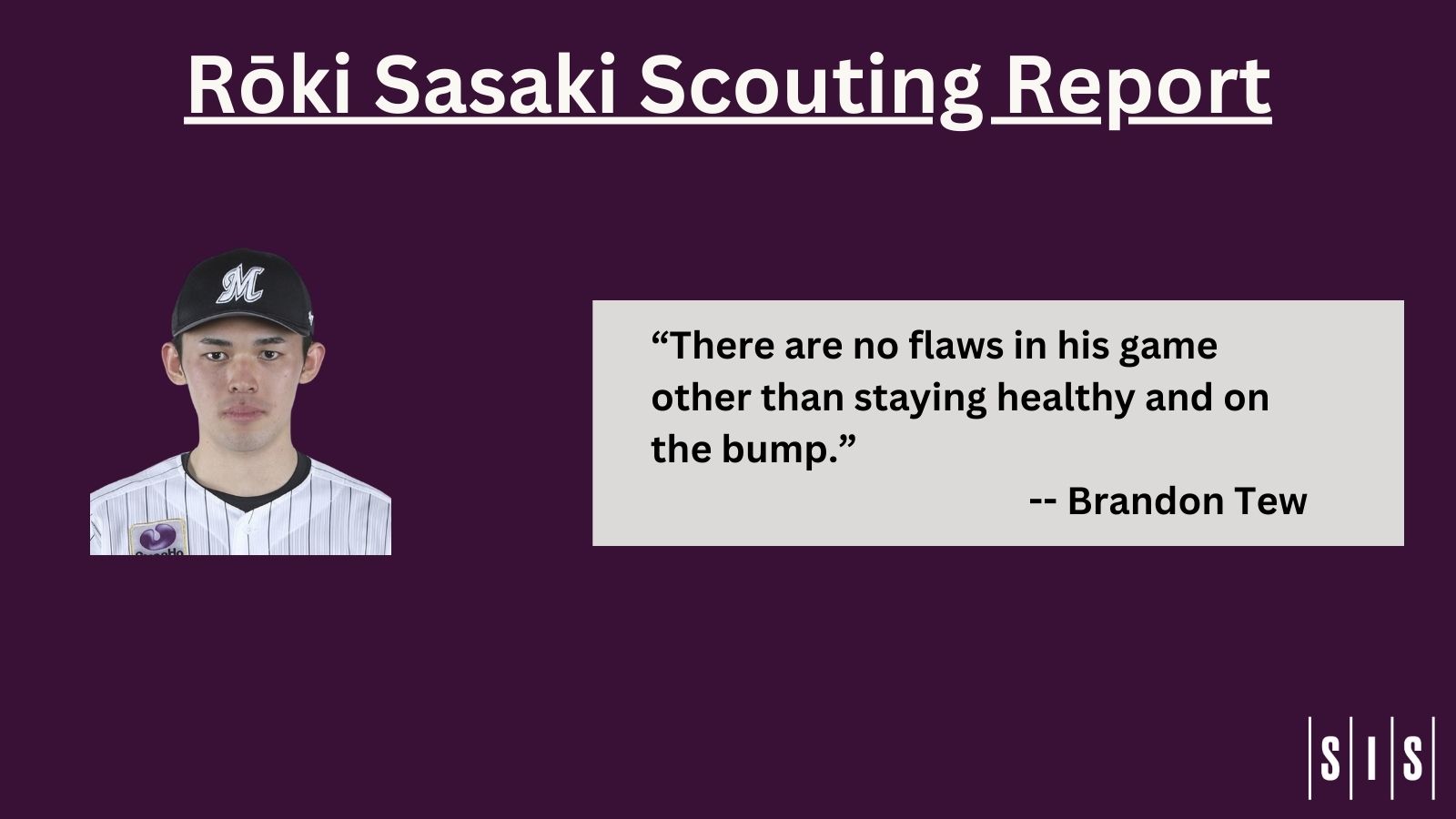
    Sasaki’s utter dominance should likely continue in 2024. There are no flaws in his game other than staying healthy and on the bump. When he’s pitching there’s nobody better than him in NPB and the 22-year-old phenom will likely be the most exciting pitcher to watch come this spring. As for his future in Japan and possible move to MLB, that will have to wait for now, but he’s sensational to watch every time he pitches.

  • 2022 NPB & KBO Fielding Bible Awards

    2022 NPB & KBO Fielding Bible Awards

    For the third straight year, Sports Info Solutions is rewarding defensive excellence on a global level. Today, we announce the winners of the NPB and KBO Fielding Bible Awards.

    The awards were voted on by a panel of experts and members of SIS’ operations staff, who spent the entire season tracking NPB and KBO games. Among our voters were Jeeho Yoo (Yonhap News Agency, South Korea), John Gibson (Japanese Baseball Weekly Podcast), and Jason Coskrey (Japan Times).

    Each voter ranked their top three players at each position in the league they covered, as well as a multi-position (utility) player, with 5 points awarded for a first-place vote, 3 for second and 1 for third. Eligibility for voting was based on playing-time requirements.

    (note that in accordance with Japanese and Korean customs, we are listing the players with their family name first)

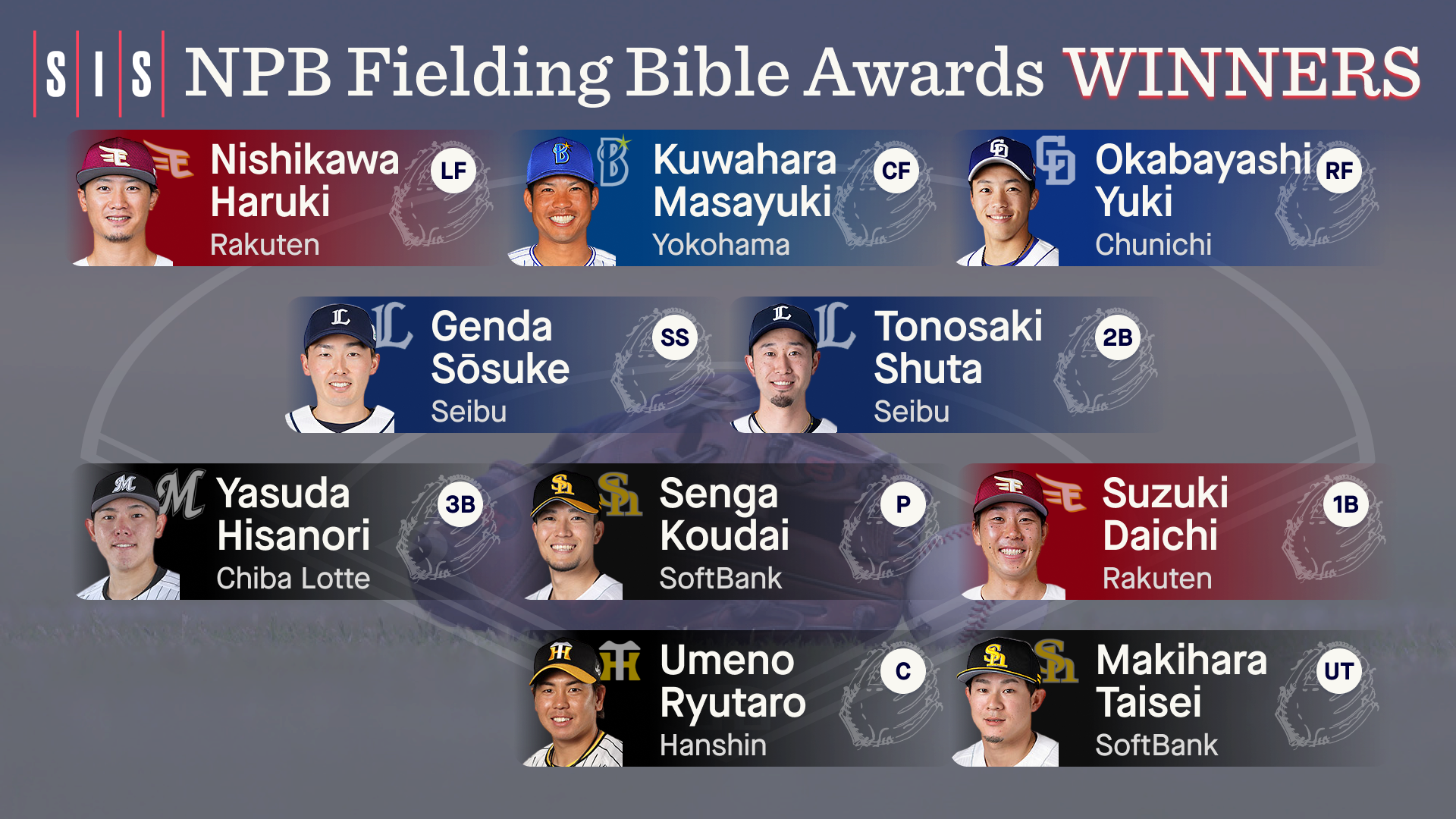
    Seibu Lions shortstop Genda Sōsuke became the first NPB player to win a Fielding Bible Award at the same position twice in the award’s three-year history. Genda, who previously won the award in 2021, saved 20 runs with his defense this season, easily the most among NPB shortstops

    Genda’s Seibu teammate, second baseman Tonosaki Shuta, also won the Fielding Bible Award at his position. Tonosaki led NPB second basemen with 26 Runs Saved. Genda and Tonosaki had more Runs Saved at their positions than any MLB player.

    Two other pairs of teammates won, first baseman Suzuki Daichi and left fielder Nishikawa Haruki of the Rakuten Golden Eagles and pitcher Senga Koudai and multi-position player Makihara Taisei of the Fukuoka SoftBank Hawks. Senga is one of the top free agent pitchers and is available to MLB teams this offseason. Makihara goes by the nickname “King Joker” because of his utility role.

     Nishikawa, Genda, Tonosaki, Okabayashi Yuki (right field), and Umeno Ryutaro (catcher) were the winners who recorded at least 10 Runs Saved at their respective positions. Umeno had arguably the most dominating season in the league, finishing with 23 Runs Saved. The next-closest catcher among eligible candidates had only 12.

    The LG Twins led KBO in Defensive Runs Saved in 2022 and their players earned the rewards of that. Five of them won a Fielding Bible Award at their respective position.

    Catcher Yoo Kang-nam, shortstop Oh Ji-hwan, third baseman Moon Bo-gyeong, center fielder Park Hae-min, and right fielder Hong Chang-ki all were winners for LG. Oh, Kim, and Park each won at their positions for the second time, the only three players who have won twice at their positions in the three-year history of the award

    Yoo, Moon, and Hong were the three winners to finish with at least 5 Runs Saved at their respective positions. Defensive Runs Saved are calculated using an MLB basis and KBO Runs Saved totals are generally considerably lower than their MLB counterparts.

    Two former major leaguers won a Fielding Bible Award. First baseman Park Byung-ho, who played for the Twins in 2016, won in his first season with the KT Wiz, for whom he also hit 35 home runs. And left fielder José Pirela, who also had a great offensive season, was one of two winners on the Samsung Lions along with pitcher Won Tae-in. Pirela formerly played in the majors from 2014 to 2019 for the Yankees, Padres, and Phillies.

  • What to make of Seiya Suzuki? Something more than Tsutsugo

    What to make of Seiya Suzuki? Something more than Tsutsugo

    By TED BAARDA

    Reports have surfaced recently that NPB’s Hiroshima Carp will be posting their star right fielder, Seiya Suzuki, in the coming offseason. Suzuki is coming off a monster season with the Carp, as he led Japan’s Central League in all three triple-slash categories with a batting line of .317/.433/.639, and set a career high with 38 home runs.

    Predicting how that success will translate to MLB performance can be tricky, however. Adjusting for the quality of competition faced is one aspect, but there are also the challenges of moving to a new country and culture, as well as adapting to a new role on a new team that can have an effect on the player’s performance. There is also an argument that certain skill sets are more transferable than others when players move to MLB.

    In order to get a ballpark idea of what to expect from Seiya Suzuki, I am going to compare his last two seasons in NPB to another recent corner outfielder from the same league, Yoshi Tsutsugo. I chose Tsutsugo because he plays a similar position, was close to the same age when posted, and made the transition recently.

    Tsutsugo was known as a power hitter in Japan, and particularly a home run hitter. He had some swing-and-miss in his game, but made up for it by hitting the ball hard when he did make contact and drawing walks as pitchers worked around his power. Here are his numbers from his last two years in Japan, and his combined line in MLB:


    Season League AVG OBP SLG K% BB%
    2018 NPB .295 .393 .596 18% 14%
    2019 NPB .272 .388 .511 25% 16%
    2020-2021 MLB .209 .309 .388 27% 12%


    Tsutsugo had a down year in 2019 before he came to MLB, with a .85-point drop in slugging percentage and an increase of 7 percentage points to his strikeout rate. Facing MLB pitching, his numbers further dipped, showing how good MLB pitchers are.

    Tsutsugo struggled to catch up to fastballs at the beginning of his MLB career, which makes sense since far fewer pitchers in NPB routinely throw 95 MPH or higher. However, he did finish his 2021 season off strong with the Pirates, hitting .268/.347/.535 in 144 plate appearances over 43 games. With Pittsburgh, he was also able to get more regular playing time than he did with the contending Rays and Dodgers.


    For comparison, here are Seiya Suzuki’s numbers over his last two seasons in NPB:


    Season League AVG OBP SLG K% BB%
    2020 NPB .300 .409 .544 14% 14%
    2021 NPB .317 .433 .639 17% 16%

    The high batting averages for Suzuki are no fluke, as this is his sixth consecutive season with an average over .300. He has a fairly flat bat path which produces lots of line drives when he squares up the ball, allowing for higher averages than the fly ball approach of Tsutsugo.

    Suzuki’s athleticism, a key differentiator between him and Tsutsugo, shows in his batting stance. 

    He incorporates a leg kick, lifting his front leg as the pitcher delivers home and balancing with one foot in the air for a second before stepping into his swing and driving his bat towards the ball. He has a selective approach at the plate, taking pitches until he gets the one he wants. 

    With two strikes he loses the leg kick to sacrifice a little power in order to make contact and keep at bats alive.

    Suzuki is coming off a career year in the power department, smashing his previous high of 30 HR with his 38 this season. This also led to a career best slugging percentage of .639, his third season slugging .600 or higher. For comparison’s sake, Tsutsugo only had one season over .600, with a .680 SLG in 2016.

    Offensively, Suzuki has a clear edge over Tsutsugo before coming over to MLB. His career marks in all three triple slash stats beat Tsutsugo’s handily and, if he is posted this off-season, Suzuki will also be coming off a much better platform year than Tsutsugo.

    In other areas of their games, Suzuki also tends to outshine Tsutsugo. Defensively Tsutsugo is more or less a liability. He played a lot of left field in Japan due to the Central League not utilizing a DH, and per DRS he was a negative fielder in both 2018 and 2019:


    Season Position Innings DRS
    2018 LF 1105 -9
    2019 LF 840 -6
    2019 3B 230 -8


    Tsutsugo does not have a large enough sample at any position in MLB to make any conclusive judgements from, but he does have 180 innings of +2 DRS fielding in left in MLB, along with -2 in 89 innings at third. He also has played some first base and right field in MLB, scoring below average at both positions.

    One thing that stands out is that Tsutsugo struggled mightily in both 2018 and 2019 in left field with deep balls. This may not be entirely his fault however, as NPB teams will play their outfielders much shallower than MLB teams at times, giving up the deep ball in the hopes of taking away some singles in front of outfielders.

    Since balls over a fielder’s head are worth more runs than the shallow hits, this positioning can adversely affect an outfielder’s DRS, and might explain why DRS is more of a fan of his work in MLB than in NPB.

    For comparison, here is Seiya Suzuki’s Defensive Runs Saved over his last two seasons:

    Season Position Innings DRS
    2020 RF 1015 6
    2021 RF 1037 2


    Suzuki’s big skill on defense is his arm, and most of his value in the outfield comes from throwing out runners, or preventing them from advancing. He came up as a pitcher and infielder, so his outfield defense was a work in progress earlier in his career, though he has improved at tracking balls down. For the same reason that Tsutsugo’s defense grades out better in MLB, there is a possibility that Suzuki’s defense could play better in MLB as well.

    Playing in right field, where the throw to third base is longer and therefore more challenging, Suzuki has kept runners from advancing extra bases at roughly the same rate that Tsutsugo did from left field, even though Tsutsugo had the advantage of a much shorter throw to third.

    Suzuki also has 12 unaided assists in the last two seasons (assists where the outfielder directly throws out a runner), compared to Tsutsugo’s five over his last two seasons in NPB.

    In terms of baserunning, while Suzuki is more athletic than Tsutsugo, he doesn’t necessarily have as refined baserunning instincts. For their NPB careers, Suzuki is 82-for-134 stealing bases (61% success rate), while Tsutsugo was 5-for-9. I expect Suzuki to be given less free reign to attempt stolen bases in MLB, though his good speed will still be a benefit on the basepaths allowing him to take extra bases on balls in play.

    Two years ago Yoshi Tsutsugo was an intriguing player, and after his run in Pittsburgh to end the 2021 season he still is. However, Seiya Suzuki looks to have a higher chance to be an impact talent and can impact a game in multiple ways. We could see that on display as soon as Opening Day.

  • Scouting some of Japan’s top potential MLB pitchers

    By Will Hoefer

    At SIS, part of our baseball operation involves collecting data on all of the Nippon Professional Baseball (NPB) games. We’ll be sharing detailed profiles on a player from each of these teams.

    Kodai Senga, RHP, Fukuoka SoftBank Hawks

    Age: 26 | Free Agency Eligibility: 2022 | Posting Eligible?: Yes

    Kodai Senga doesn’t just possess some of the best raw stuff in Japan, he possesses some of the best raw stuff in the world. The 26 year old righthander has been electric in 2019. He leads all qualified starters with a 20.4 K-BB%, and his 11.5 K/9 rate also tops the NPB rotation leaderboard. 

    Senga typically averaged around 92 MPH on his heater during his previous four years as staff ace of the Hawks, but has seen his average fastball velocity jump to around 95-96 MPH in 2019, and will touch 98 and 99 routinely in starts. He’s still adjusting to his newfound velocity, and will either need to improve his ability to hit the corners or start attacking the zone more to blow hitters away with his premium velocity and plus spin.

    His main out pitch is a devastating forkball splitter, which has plus plus depth due to Senga’s innate ability to neutralize spin with how he grips the ball. Senga’s been working on a cutter in recent years, which has jumped up in velocity as well. It sits in the high 80s with average bite, but plays up by keeping hitters off his fastball and vice versa. His fourth pitch is an average slider with inconsistent shape and location that flashes above average. 

    Senga has top of the rotation upside, and would easily earn a nine-figure deal if he were posted this offseason. Unfortunately, SoftBank is one of the more intransigent teams when it comes to posting their players. Barring a drastic change of institutional practice, it seems that MLB franchises will have to wait until Senga is eligible for international free agency in 2022.

    Kodai Senga W L IP ERA WHIP HR/9 K% BB%
    2019 13 8 180.1 2.79 1.16 0.9 30.6% 10.3%
    Career 55 29 733.1 2.77 1.12 0.9 28.4% 9.4%

    Tomoyuki Sugano, RHP, Yomiuri Giants

    Age: 29 | Free Agency Eligibility: 2022 | Posting Eligible?: Yes

    When consistency meets excellence in the NPB, it produces a pitcher like Tomoyuki Sugano. From 2014-2018, Sugano never had a season with an ERA lower than 2.33 or less than 150 innings pitched, and did it all for the Yomiuri Giants– the flagship franchise of the NPB. However, in 2019 Sugano has taken a step back. His ERA is a career high 3.89, he’s on pace to pitch fewer than 150 innings, and he’s averaging 1.3 homers per nine–more than double his career rate. 

    Sugano works off a fastball that sits 90-92 and tops out at 94 MPH. In later looks his fastball was sitting 89-91, but he still generates strong armside run and gets good sink on his two seamer. It’s lively enough to be an average pitch at present, though he has lost a tick on his heater and can’t really afford to lose any more velocity. His bread and butter is mixing that fastball with a pair of slider variations, both plus.

    The harder slider, which is classified as a cutter in some reports, has a nice tight hook and sharp gloveside bite. The more traditional slider has a more vertical hook that Sugano is able to finish down with regularly. He’ll mix in a hard forkball splitter that flashes plus depth, but the lack of consistent feel keeps it from projecting any more than an average pitch at the major league level.

    Like Senga, you can pretty much bank on Sugano not coming over to the majors until 2022. Yomiuri has made it very clear that they do not intend to post their players under the current posting agreement between MLB and NPB. That’s a shame, because Sugano still profiles as a No. 4 starter for an MLB team at present. But three years is a ways away, and any further loss of fastball velocity–particularly because of its correlation with an increased home run rate–could quell Sugano’s market abroad by the time he is eligible to negotiate with major league teams.

    Tomoyuki Sugano W L IP ERA WHIP HR/9 K% BB%
    2019 11 6 136.1 3.89 1.25 1.3 20.8% 5.9%
    Career 87 47 1222.2 2.36 1.05 0.6 22.1% 5.1%

    Takahiro Norimoto, RHP, Rakuten Golden Eagles

    Age: 28 | Free Agency Eligibility: 2026 | Posting Eligible?: Yes

    If Senga’s strength is elite stuff, and Sugano’s strength is elite performance, Takahiro Norimoto strength is the blend of both. Rakuten’s ace has been stellar in his seven year career, posting a 3.06 ERA with a 25.3% K rate and a miniscule 6.1% BB rate in nearly 1200 career innings. Unfortunately, Norimoto’s season was delayed by offseason surgery to clean up his pitching elbow, which has limited his starts in 2019. The good news is that he’s been quite good in limited action since returning from the injured list, posting an ERA around 3 and showing the same level of stuff he had pre-injury.

    Norimoto works off a fastball that will sit in the 92-94 MPH range and touch 96. He exhibits very good rise on it, and does a good job hiding it in his delivery to give it the “sneaky hop” that makes hitters late on it. He’ll generally follow up with a variety of three secondary pitches–a slider, a cutter and a splitter.

    The slider and cutter will bleed into each other in terms of shape and velocity, and will often get classified together as one pitch. The cutter has more lateral bite and break than the slider. Flashes plus when he commands it glove side, but it will leak towards the middle. The slider grades out as plus, due to its plus downward break and Norimoto’s ability to command it to both sides of the plate. The splitter flashes plus when Norimoto can get it to dive from the middle of the plate, but inconsistent feel will cause it to spike or hang and keeps it from being plus. A curve and a straight change, both confidently used as change of pace pitches, round out his arsenal.

    It was reported during the summer that Norimoto signed a seven-year extension with Rakuten prior to the 2019 season. If Rakuten chooses not to post Norimoto over the next seven years, he won’t be heading to the majors until his age 36 season. However, given Norimoto’s previously stated desire to be posted, it has been speculated that perhaps Norimoto is still interested in a move to the majors, and sought this extension as a form of insurance. Norimoto at present projects as a No. 3 starter in a major league rotation, with No. 2 upside if he continues to demonstrate the stuff and command he has shown since returning from injury over a larger sample of time. 

    Takahiro Norimoto W L IP ERA WHIP HR/9 K% BB%
    2019 7 5 83.0 2.49 0.98 0.9 24.5% 4.0%
    Career 82 63 1211.1 3.02 1.14 0.7 25.3% 6.2%

    Yudai Ono, LHP, Chunichi Dragons

    Age: 30 | Free Agency Eligibility: 2021 | Posting Eligible? Yes

    The longtime rock of the Dragons’ staff, Yudai Ono has been breathing fire in 2019. On the strength of a subtle increase in fastball velocity, Ono set a career high mark in strikeout rate while also cutting his walk rate down a half percent from career norms. This has helped him post a sparkling 2.63 ERA in over 174 innings pitched in the 2019 regular season. 

    Ono works primarily off a three pitch mix–fastball, splitter, slider. He’ll also mix in a get me over curveball once or twice a start, but those three pitches are what you need to prepare for when you step into the box. The fastball sits at 90 to 93 MPH, and will touch 94. It’s an average pitch with good rise that plays up a half grade due to Ono’s short arm action that hides the ball behind his head and makes batter late on it.

    The splitter is the better of his two secondaries, an out pitch against righties and a weak contact generator against lefties. It’s a hard offering, but the above average fade and depth makes it work despite the lack of velocity separation from the fastball. The slider is a high 70s slurvy offering that’s average at best, but still useful. It will get some whiffs from lefties early on, but the general goal of the pitch is to get hitters out in front and roll over on it, which Ono executes by consistently placing it over the outer edge of the zone. Occasionally a slider or splitter will leak out over the middle, or a fastball doesn’t get high enough. But as a whole, he generally commands all three pitches well to their spots and misses barrels when he does give up contact.

    Ono is not an international free agent until 2021, and it’s not clear if Chunichi is willing to post him, or if he is even interested in being posted. In years past, teams would have a hard time projecting Ono to pitch in anything greater than a relief role. He doesn’t have a very deep arsenal and lacks a plus pitch, making it hard to see him having success against MLB batters when he faces them a third time.

    However, with the advent of the opener strategy, pitchers with a similar profile have had success as the “longman”. I think Ono has enough command and deception to work in this role, where he can avoid having to face batters three times in a game.

    Yudai Ono W L IP ERA WHIP HR/9 K% BB%
    2019 9 8 174.1 2.63 1.00 0.9 22.2% 6.6%
    Career 58 61 1046.1 3.25 1.20 0.8 18.6% 7.1%

    Pierce Johnson, RHP, Hanshin Tigers

    Age: 28 | Free Agency Eligibility: 2020 | Posting Eligible? N/A

    This strays mostly from my focus of domestic players, but outside of catcher Ryutaro Umeno there really aren’t any superlative natives on Hanshin’s roster. Johnson has put up eye-popping numbers in his first year in the NPB; among pitchers with a minimum of 50 innings pitched, he leads the league in ERA (1.43), FIP (1.52) and K-BB% (33.8). His stuff isn’t too much different than his stints in Chicago and San Fran; the curve is a little harder and the fastball lost a half tick or so. What is different is his pitch mix.

     Johnson has completely scrapped his cutter in favor of throwing more curveballs, going 50/50 with his fastball and curve. Sure enough, the curve was by far the most effective offering he had as a major leaguer–he had a .225 xwOBA against on his breaker, compared to a .312 xwOBA on the cutter and a .355 xwOBA on the fastball. He also had an average spin rate of 2946 RPM on that curveball, which was 6th among pitchers with at least 200 curveballs thrown from 2017-2018. This kind of overhaul in approach isn’t uncommon in the majors, and if you close your eyes and picture a pitcher scrapping a secondary fastball for a four seam+curve mix you’d probably visualize an Astros cap on his head. 

    What’s most fascinating isn’t that this happened, but where it happened. NPB teams are certainly more aware of analytical concepts like infield shifting and lineup construction than ever before, but this is the most prominent example in the NPB of a pitcher overhauling his repertoire to pitch off of his best pitch–even if it’s a curveball.

    Johnson, who’s on a one year deal for Hanshin making the equivalent of about $800,000, has made the adjustments that we’ve seen in so many breakouts in the States. However, he didn’t have to toil in the high minors to do it, and has at the very least a multi-million dollar market for his services in Japan. 

    Pierce Johnson G IP ERA WHIP HR/9 K% BB%
    2019 (NPB) 55 55.2 1.43 0.83 0.3 39.4 6.1
    Career (MLB) 38 44.2 5.44 1.41 1.0 19.7% 12.4%


  • Scouting some of Japan’s top potential major league hitters

    By Will Hoefer

    At SIS, part of our baseball operation involves collecting data on all of the Nippon Professional Baseball (NPB) games. We’ll be sharing detailed profiles on a player from each of these teams.

    Our first section will focus on the best MLB-eligible hitters (eligible through the posting system). We’ll touch on pitchers in the next piece.

    There will be some notable exceptions from this series, mainly SS Hayato Sakamoto from Yomiuri, OF Seiya Suzuki from Hiroshima, and OF Yuki Yanagita from Fukuoka SoftBank. But whether it be lack of interest in leaving their current situation (Sakamoto), a more imminent posting candidate on their team (Suzuki), or injury concerns relative to a comparable teammate (Yanagita), I thought it was best to focus on one of their teammates instead of them.

    While the primary focus of this series is to examine the skills and performance of NPB players that I think are most likely to be on the radar of MLB organizations, it should not be taken strictly as a list of players coming to the United States to play baseball in 2020. External factors may contribute to the decisions of some. Also, 10 of the 12 players in this series can only be signed through the posting system. Since the new posting system was ratified in 2013 only five players have been signed through it.

    I hope you enjoy reading this series as much as I have enjoyed writing it. All of the players featured are fun to watch, and I hope this encourages you to learn more about leagues that are outside of affiliated and amateur baseball.

    Stats through September 24
    Tetsuto Yamada, 2B, Yakult

    Yamada is often referred to as the “Mike Trout of Japan.” He has accumulated 311 total runs since the start of the 2018 season, the most among NPB batters by quite a large margin. For comparison purposes, his compatriot Trout has led MLB hitters with 317 total runs over the same timeframe.

    Yamada mixes plus hitting and running ability with above average power that could be a plus if he can demonstrate more barrel control through the zone. He’s also a good defender at second base, registering 8 PART (Positioning, Airball, Range and Throwing) runs above average from the start of 2018 to present day action.

    The multi million dollar question, though, is will any MLB team be willing to match the supremely high posting fees Yakult asks for the right to negotiate a contract with Yamada. Yamada profiles as a middle of the order offensive threat with above average defensive at a premium position, which should command a nine figure payday on the open market when you factor in his relatively young age (27) among other options. The Giants make sense on paper, since they expressed an interest in going after Bryce Harper to jumpstart their rebuild last offseason and have a need in the middle infield.

    Tetsuto Yamada PA AVG OBP SLG HR SB BB% K%
    2019 514 .274 .403 .566 35 33 17.1% 19.1%
    Career 4260 .297 .401 .534 202 168 14.1% 17.1%

    Shogo Akiyama, OF, Seibu

    Shogo Akiyama is certainly a name to watch right now for MLB teams, as he is a free agent at the end of the 2019 season and won’t be subject to the posting system because he has over nine years of NPB service time. Seibu has reportedly offered a 4 year, ¥ 2 billion contract–the equivalent of $19 million USD–to try and keep their star player a Lion for years to come. This puts us in a unique situation to try and evaluate Akiyama’s market. Any MLB team that’s interested will likely need to see him as a starting outfielder for their club, lest he be willing to take a fairly significant pay cut to play in America.

    The good news on that front is that Akiyama has starting outfielder tools right now. His quick hands and good bat speed give him above-average game power and hit tools, albeit with some concerns about rigidity in his wrists and his occasional issues falling out of the batter’s box on contact. He’s an above-average runner in his early 30s, and while he does show good range and jumps in center, advanced defensive metrics–which should be taken with a grain of salt since they are a fairly new phenomenon in evaluating NPB players–are lukewarm at best and show a decline in Runs Saved from his earlier years in center field.

    Akiyama’s combination of strong on base skills and solid power, in addition to solid center field defense should be plenty to stick in the everyday lineup for a first division team in 2020. But there’s reason to believe that this is the beginning of a decline phase defensively for Akiyama, in which case interested teams might need to consider what a move to a corner spot long term would do to their valuation of him. Cleveland would be a strong fit, since it needs offensive in the outfield badly and could probably afford to give Oscar Mercado the reins in center field going forward.

    Shogo Akiyama PA AVG OBP SLG HR SB BB% K%
    2019 675 .305 .394 .474 20 12 11.6% 15.0%
    Career 5181 .301 .376 .454 116 112 9.9% 15.0%

    Yoshitomo Tsutsugoh, OF/1B/3B, Yokohama

    Tsutsugoh has long been viewed as a player who could immediately contribute to any MLB team. One look at his swing and you can see why. He exhibits the bat control and hand quickness of a plus hitter with the bat speed and lower half mechanics to generate plus power. He’s arguably the most polished hitter of any domestic hitter in the NPB, as there’s no wasted movement in his load and his wrists are loose and quick.

    There’s defensive issues that will cap his value. Tsutsugoh is a well below-average runner who shows poor reactions both in the infield and the outfield, though with his plus arm he could be hidden in right field with strong positioning. Yokohama has used him as a third baseman with some frequency this year, but he lacks the foot speed and reflexes necessary to field that position with any long term success.

    With that said, Tsutsugoh should be considered by teams as a DH/1B type if he ends up on the posting market. The White Sox, who not only have a massive hole at DH but will have to make a decision on whether or not they can afford to retain pending free agent first baseman José Abreu, make a lot of sense as a fit for Yokohama’s franchise slugger.

    Yoshitomo Tsutsugoh PA AVG OBP SLG HR SB BB% K%
    2019 553 .272 .388 .511 29 0 15.9% 25.3%
    Career 3426 .285 .382 .528 205 6 13.3% 20.8%

    Ryosuke Kikuchi, 2B/SS, Hiroshima

    Simply put, Ryosuke Kikuchi is one of Japan’s premier glovemen. He leads all NPB second basemen with 20 Defensive Runs Saved since the beginning of 2018–when BIS started keeping track of Runs Saved for NPB fielders. He’s got a plus-plus glove at second base, but he lacks the arm strength to really excel anywhere else on the diamond. He’d probably be OK at shortstop, but his best fit is an everyday role at the keystone.

    Kikuchi’s offensive contributions are light; he’s been a slightly above-average hitter in his career to date. He’s a very small guy–5’7”, 152 lbs–that puts the ball in the air too much. He shows decent bat speed, controls the plate, and demonstrates quick wrists when he’s in a groove that allows him to whip the bat through the zone and hit line drives.

    This approach also lets him take advantage of plus speed to beat out grounders and stretch hits for extra bases. When he starts trying to elevate he loses barrel control and doesn’t really have the requisite strength to take advantage of the juiced ball even if he did control the barrel well on elevated strikes.

    Kikuchi has expressed interest in a move to MLB via the posting system this offseason. He lacks the power to really contribute with his bat, but there are teams that could definitely use his defensive contributions at second base that could take the offensive hit. He’d profile as a bottom of the order contact nuisance that offers plus defense at second base.

    Ryosuke Kikuchi PA AVG OBP SLG HR SB BB% K%
    2019 595 .261 .312 .404 13 14 6.7% 16.6%
    Career 4671 .271 .315 .391 85 107 5.6% 16.2%