Tag: Plate Discipline

  • Which hitters reach favorable counts?

    Which hitters reach favorable counts?

    By Andrew Kyne

    On the most recent episode of the SIS Baseball Podcast, our guest Mike Ferrin talked about analyzing ball-strike count management among hitters.

    Specifically, which hitters get themselves in favorable counts, like 2-0, 3-0, and 3-1? And which hitters then do damage in those plate appearances? Let’s try to find out.

    For 2019, here are the ten players who have reached 2-0/3-0 or 3-1 in the highest percentage of their plate appearances (minimum 200 PA).

    BatterOverall PAPA w/ HCPct.wOBA
    Justin Smoak2617829.9%.432
    Cody Bellinger3379929.4%.508
    Carlos Santana3419828.7%.499
    Mike Trout34910028.7%.685
    Joey Gallo2276528.6%.544
    Mookie Betts37710728.4%.558
    Daniel Vogelbach3048628.3%.500
    Rhys Hoskins3509928.3%.581
    Tyler White2065627.2%.399
    Kendrys Morales2015426.9%.398

    The wOBA column represents their weighted on-base average in those plate appearances in which they got to a favorable count (but didn’t necessarily end the PA in one of them). So, in the 100 plate appearances in which Mike Trout got to a 2-0/3-0 or 3-1 count, he has an absurd .685 wOBA.

    Being a power hitter with exceptional plate discipline is a good way to make this list. But not everyone has ended up doing damage in those plate appearances, as you can see with Tyler White (who has a 91 wRC+ overall on the year) and Kendrys Morales (who has a 63 wRC+ overall and was just designated for assignment by the Yankees). Justin Smoak tops the list in terms of getting into favorable counts, but his wOBA is lagging a bit behind the others as well.

    The other seven players have been among the best at not only getting into hitter-favorable counts, but also finishing with success, all recording a wOBA of .499 or better in those PA. Trout, Rhys Hoskins, Mookie Betts, and Joey Gallo have been especially good.

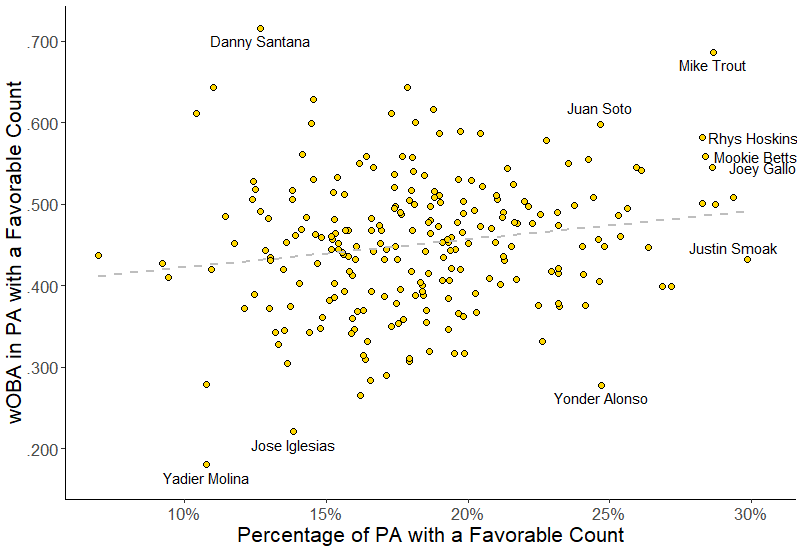
    Here’s a look at the relationship in 2019 between getting into favorable counts and then having success:

    Getting into counts like 2-0 and 3-1 is certainly good for hitters, but is it a repeatable skill? Between 2017 and 2018, there was a strong year-to-year correlation (r = 0.76) for hitters with 400+ PA in each season.

    Between 2018 and 2019, Gallo has had one of the most significant increases in generating plate appearances with favorable counts, going from 20% to 29%. Pitchers are surely fearful of his power, and it helps that he’s cut his chase rate from 32% to 23%.

    On the other side, Cleveland’s Jose Ramirez has had one of the sharpest declines, going from 29% to 22%. After turning in consecutive seasons with a 146 wRC+, Ramirez is hitting just .216/.310/.329 in 2019.

    Finally, what about the ability to repeatedly do damage in plate appearances with a favorable count? The correlation isn’t as strong here (r = 0.33) but still positive.

    It’s good for hitters to be in favorable counts, and there’s evidence that being able to get into those situations may be consistent from year to year. That’s perhaps not a surprising conclusion, given batter quality and plate discipline, but it’s ultimately another important piece in hitter evaluation.

  • Breaking Down Plate Discipline by Pitch Type

    Breaking Down Plate Discipline by Pitch Type

    By ANDREW KYNE

    Last week, I presented a way to visualize plate discipline, referencing some of the numbers on FanGraphs like O-Swing% and Z-Swing% that make use of Baseball Info Solutions’ pitch charting data.

    For each player, those plate discipline metrics obviously come at an aggregated level across pitch types. When we see that Joey Votto swung at 16 percent of pitches thrown outside the strike zone last year, that’s his total performance — against fastballs, curveballs, sliders, changeups, etc.

    But what if we split those out? What kind of discipline does Votto — and the rest of the league — have against different types of pitches?

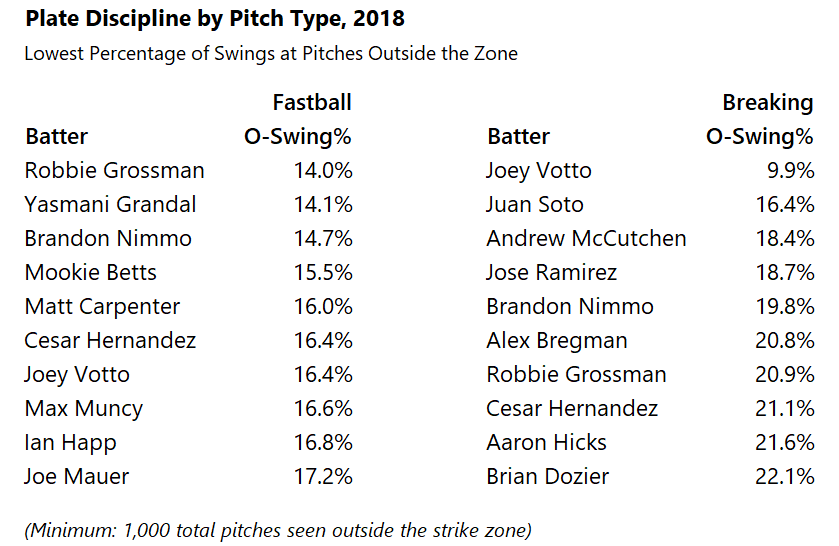
    Let’s consider the chase rates — the percentage of swings taken on pitches outside the zone (O-Swing%) — for the 179 batters who saw at least 1,000 total pitches out of the zone in 2018. For now, let’s just break it down by O-Swing% on fastballs and O-Swing% on breaking balls (curves and sliders).

    Here’s a look at the leaderboard for each:

    And here’s the correlation between those two metrics for these players:

    And some takeaways:

    — There’s a positive relationship, which is expected — batters who chase (or don’t chase) fastballs probably also chase (or don’t chase) a lot of breaking balls.

    — However, the rate of chasing breaking balls is, understandably, higher. Using the trend line on the graph, note that a 20 percent fastball O-Swing% corresponds with something more like a 26 percent breaking ball O-Swing%, on average.

    — Overall, the batters in this sample swung at out-of-zone fastballs 27 percent of the time, compared to 33 percent for out-of-zone breaking balls.

    — Of the 179 batters, 29 had a lower O-Swing% against breaking balls than against fastballs. Three notables are those labeled on the graph: Votto, Juan Soto, and Jose Ramirez. All three showed excellent discipline against all pitch types, but were particularly impressive against breaking balls. And all three are great offensively.

    — On the other side of that is Yasmani Grandal. Overall, he had a very good O-Swing% at 23 percent. But he was outstanding against fastballs (14 percent), and only about average against breaking balls (33 percent). Last season, he hit .279 with a 1.046 OPS in at-bats ending with a fastball, but only .210 with a .555 OPS in at-bats ending with a slider or curveball.

  • Visualizing Plate Discipline

    Visualizing Plate Discipline

    By ANDREW KYNE

    Baseball Info Solutions’ pitch charting data allows for many interesting applications — one being as a way to evaluate a player’s plate discipline.

    By checking out the plate discipline leaderboards at FanGraphs, we can do things like confirm that Joey Votto rarely swings at pitches out of the strike zone or learn that Freddie Freeman swings at a ton of pitches in the strike zone. (O-Swing% shows how frequently hitters chased pitches out of the zone; Z-Swing% shows how frequently hitters swing at pitches in the zone.)

    We can put a number on it. But what does it actually look like? Where are hitters taking their swings, and how far do they extend their zones?

    Using methods similar to what Jim Albert has demonstrated on the Exploring Baseball Data with R blog with generalized additive models and what FanGraphs has on its site, let’s visualize the swing tendencies of baseball’s most and least disciplined hitters.

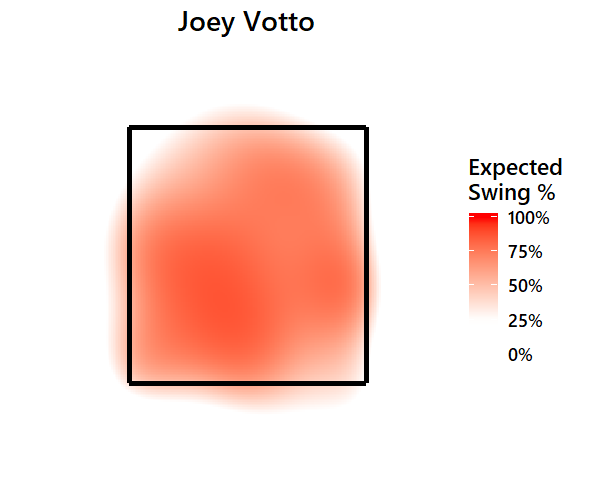
    The plots below show how likely a batter is to swing if a pitch is thrown in a certain location, using data from the 2018 season. As the legends show, anything above a 25% expected swing rate is colored in red, with darker red indicating a higher swing rate. All plots are from the pitcher’s perspective.

    Out-of-Zone Differences

    First, let’s compare some of the extreme hitters who either swung a little or a lot at pitches out of the zone last year.

    Low O-Swing%: Joey Votto

    The stat: Swung at 16% of pitches outside the zone in 2018 (lowest among qualified batters)

    Votto’s plate discipline has long been elite, and his expected swing rate locations almost perfectly fit the strike zone borders. While he covered all in-zone pitches to some degree in 2018, it appears that there’s a bit higher expected swing rate on down-and-in pitches (like this pitch he got from Edgar Santana).

    Low O-Swing%: Andrew McCutchen

    The stat: Swung at 19% of pitches outside the zone in 2018 (second-lowest among qualified batters)

    McCutchen followed Votto among the O-Swing% leaders last year. His 19.4% O-Swing was a career-best. There’s a small patch of dark red there in the heart of the zone, about belt-high, that appears to have been his most likely swing (like this one against Andrew Chafin).

    Now, a couple players who do extend beyond the zone…

    High O-Swing%: Salvador Perez

    The stat: Swung at 48% of pitches outside the zone in 2018 (highest among qualified batters)

    He’ll miss the 2019 season after undergoing Tommy John surgery, but Perez’s tendency is too extreme not to include here. The plot shows how willing he was to swing at anything within the vicinity of the zone.

    High O-Swing%: Javier Baez

    The stat: Swung at 46% of pitches outside the zone in 2018 (second-highest among qualified batters)

    Baez extends the zone in similar fashion, though maybe not as much on far outside pitches as Perez. Interestingly, the up-and-in pitch looks like one that he offers at a lot (or at least did in 2018). Here are some examples of that: a swinging strike against Brandon Woodruff; a popup against Luke Weaver; a home run against Gerson Bautista.

    Votto and Baez each had a 131 wRC+ in 2018, but took different approaches to get there. Here’s a GIF to show their swing rate differences back-to-back:


    In-Zone Differences

    Next, let’s look at two batters who were at the extremes of swinging at pitches in the zone.

    High Z-Swing%: Freddie Freeman

    The stat: Swung at 85% of pitches inside the zone in 2018 (highest among qualified batters)

    If a pitch is anywhere in the strike zone, Freeman is likely to swing. Prior to his 85% rate last year, he swung at 84% of pitches in the zone in 2017 and 81% in 2016.

    Low Z-Swing%: Brett Gardner

    The stat: Swung at 53% of pitches inside the zone in 2018 (second-lowest among qualified batters, behind the now-retired Joe Mauer)

    Gardner’s plot features a much lighter shade of red all around, indicating how much less likely he is to swing at pitches in the zone than Freeman. His Z-Swing% has consistently hovered in the 50-55% range for his career. There appears to be a slightly darker band of red across the middle of the zone, but Gardner is definitely willing to let pitches pass through everywhere.

    And here’s a GIF to compare Freeman and Gardner: