Tag: Tua Tagovailoa

  • Which Quarterback Does Total Points Prefer Among the 2020 NFL Draft Class?

    Which Quarterback Does Total Points Prefer Among the 2020 NFL Draft Class?

    SIS recently updated its Total Points calculation methodology. You can find a complete explanation of what Total Points is and how it works here.

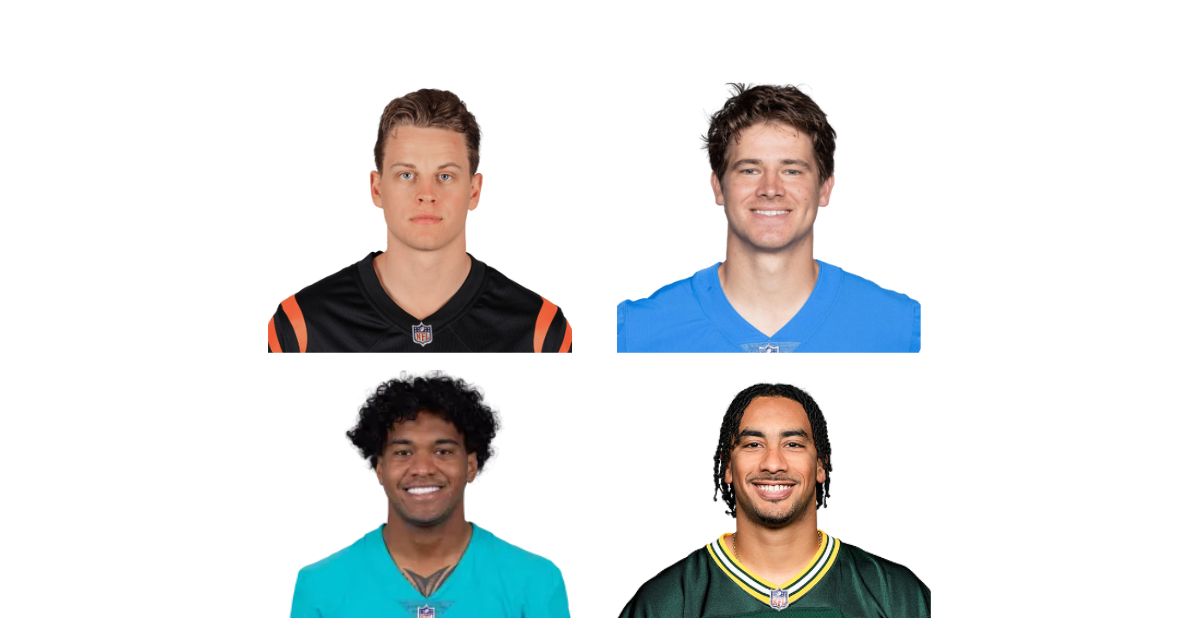
    The top group of quarterbacks taken in the NFL Draft doesn’t always give us a 100% hit rate. But Joe Burrow, Tua Tagovailoa, Justin Herbert, and Jordan Love have each been given championship-caliber-quarterback money over the last year, solidifying the 2020 group as one of the better classes of recent vintage.

    That said, this collection of first rounders haven’t necessarily hit the ceiling that you’d want from a rookie contract. Only Burrow made the conference championship on his rookie contract—with two injury-shortened seasons surrounding those two campaigns. But a lot of fanbases would be happy to have any of these guys, even if the price tag seems shocking on its face.

    With all of their contracts quite similar at this point, which would you take heading into 2024? 

    Total Points has a pretty strong opinion on the subject with the recent enhancements to the passing game calculation. If we take the last few years and weigh the seasons 3/2/1 to lean on recent production, Justin Herbert easily leads. Jordan Love enters the conversation based on his 2023 season, but he didn’t have a starting opportunity before that and we can only be so confident in his partial season of excellence.

    2020 NFL Draft First Round Quarterback Total Points

    Three-year recency-weighted average and 2023 results (including playoffs)

    Total Points (3yr) TP/G (3yr) TP (2023) TP/G (2023)
    Herbert 125 8.2 106 8.2
    Burrow 105 7.2 74 7.4
    Tagovailoa 70 4.6 77 4.3
    Love 69 4.2 134 7.1

    Given that the Chargers haven’t been a very good team with Herbert at the helm, he could be pegged as one of those guys who hasn’t put it together despite his arm talent and athleticism. But his on-field productivity as measured by Total Points outpaces each of his draft class peers in both volume and output, and he’s done so consistently over the last few years.

    What makes Herbert stand out

    Even with all the loud tools that he can wow scouts with, Herbert’s 2023 was most notable for accuracy. He finished third in Expected On-Target Rate +/-, our measure of accuracy relative to an expectation based on throw depth, route, and some other elements. 

    Total Points accounts for accuracy by combining the expected on-target rate from above with an expected value of the throw with and without pinpoint accuracy. Those couple percentage points of accuracy per throw that Herbert offered added up to a roughly 10-point advantage over the other three in 2023. He wasn’t quite so excellent in previous years, but still above average.

    Burrow deserves kudos here, because over the last three years he has the best accuracy numbers in the league. Even with a little bit of missed time, his accuracy has been worth 15 to 20 points per season compared to the average quarterback. His issue has been a combination of availability and a tendency to get himself into trouble with sacks, fumbles, and the like.

    We mentioned Herbert’s athleticism, and at least among this group he separates quite easily. He isn’t a threat as a designed runner, but he scrambles more than any of these guys, and in 2023 those carries were worth 12 EPA more than the other three quarterbacks combined.

    Why is Tagovailoa lagging behind?

    Obviously the end of the 2023 Dolphins’ season put a sour taste in people’s mouths, but there’s no doubt that Tagovailoa helmed a dangerous offense. 

    It’s surprising to see a player who led the league in passing and finished fifth in passer rating sit in the middle of the pack in Total Points. At the same time, to anyone who has watched the Dolphins the last couple years it isn’t surprising that he’s brought down to earth by factors like blocking, turnover-worthy throws, and yards after catch. 

    The combination of good-enough line play and quick-hitter play design meant that Miami’s line blew 20 fewer blocks in the passing game than any other team in 2023. Total Points takes that information and docks Tagovailoa to the tune of about a half a point per game for the clean pockets he was afforded. Even with that, he had the same sack rate as Jordan Love; beyond the blocking itself, Love out-earned him by almost a point per game in sack avoidance.

    After being afforded those clean pockets, Tua introduced quite a bit of risk once the ball left his hands. The combination of 14 actual picks and 7 near-interceptions puts him in good company, I suppose, given that some of the best quarterbacks in the league had high interception totals last year. But he did that on throws that had much lower expected value than those guys. Patrick Mahomes threw passes over a yard shorter on average, but Total Points valued Mahomes’ specific choices of route, depth, and openness 30 points better than Tagovailoa’s in 2023.

    One of the bigger changes we made to Total Points this offseason was to remove the quarterback’s ownership of yards after catch performance—at least, performance above or below the expected amount based on the route, accuracy, and openness. The quarterback still gets credit for the expected YAC when evaluating the throw, accuracy, and catch, but on a Dolphins team that finished second in average YAC before contact per reception in 2023, that’s a lot of quality production that the receivers are claiming from Tagovailoa with the new calculation.

    What to expect in 2024

    In short, a lot of uncertainty in the following … 

    – Burrow’s health. 

    – Tagovailoa’s offensive line. 

    – Herbert’s skill players, San Diego’s coaching change, and a preseason injury.  

    – Love’s limited exposure to the NFL and young skill group. 

    These all present question marks for these well-compensated signal callers. If we assume a full season for everyone, I’d expect Burrow or Love to have the best surface stats, given that their team context feels more bankable. If healthy, I still assume Justin Herbert will deliver the best package in terms of what a quarterback can control, based on his body of work over multiple years.

  • What a difference one change in alignment makes for the Dolphins

    What a difference one change in alignment makes for the Dolphins

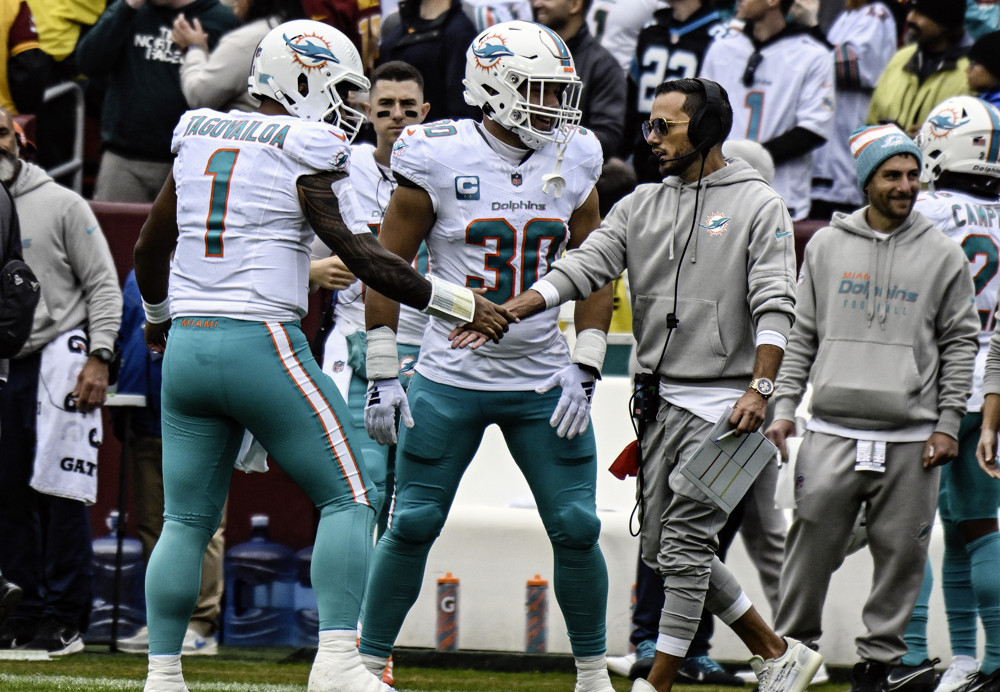
    PHOTO: Mark Goldman/Icon Sportswire

    (All charting numbers in this piece are through Week 16)

    On Sunday night, the Dolphins will host the Bills for a chance to claim their first AFC East title since Tom Brady’s knee popped back in 2008. This game will feature some of the most exciting offensive players in all of football, as well as one of the most exciting coaches. Miami Dolphins head coach Mike McDaniel is the league’s newest offensive genius, and he’s also a media darling who has charmed journalists and fans alike with his earnest and energetic pressers.

    We could spend all day saying nice things about Mike McDaniel. In fact, we’ve spent most of the past year saying nice things about him. So, having established that we love and appreciate Mike for what he’s contributing to this great sport, let’s take a moment to talk about a strange phenomenon happening within his offense right now.

    Miami has been far and away the best 3×1 gun (three receivers to the strong side, one to the weak side in shotgun) team in the NFL this season. On 172 neutral script plays, they’ve averaged a whopping 0.39 EPA/play in this family of formations, which is three times better than the second-best team. It would behoove every coach, offensive or defensive, at every level to take some time this offseason to study what Miami does in 3×1 (and we’ll get into what exactly they do in a bit).

    On the other hand, they have been bad in their 2×2 gun formations (137 plays). They average -0.24 EPA/play – which is 30th in the league, just barely ahead of the New York teams – and the absolute difference between these two formation shells is easily the biggest for any team at a massive 0.63 EPA/play.

    Scatterplot of offensive shotgun efficiency by team in the NFL in 2023, with 2x2 and 3x1 formations on each axis. The Dolphins are the only team off-trend.

    This is seemingly not confounded by any basic scheme split. The pass rates are virtually identical, the motion usage is similar, and they actually use a bit more play action in 2×2. They have had worse fumble luck in 2×2, but even if you strip out the fumbles they’ve lost, there’s still a gap of 0.5 EPA/play. This is also not a single-season aberration, as they ranked 3rd and 27th in these formation shells last year.

    So, let’s first set the table with what they do in 3×1 gun.

    3×1 gun pass game overview

    They attack the intermediate area extremely well (their bread-and-butter is a double overs concept they rake on); they are ruthless about isolating Waddle/Hill on the backside, particularly on digs and skinny posts; they have a variety of outside vertical stretch concepts they use (e.g. Smash, Flood); and they do a good job of abusing their speed via motions in order to stress the back end of the defense horizontally (for example, picture a Cover 1 safety having two seams running at him). 

    Their best motion comes out of 3×1 where they trade a receiver across the formation towards a condensed split X. Most defenses respond with stack checks, which tends to create cushion for the motion player and often exploitable outside leverage for the new #2. Of course, they are also capable of abusing man-to-man in these looks. They try to accomplish a similar thing in 2×2 by motioning #2 outward behind #1 in condensed flanks, but the results have been mixed.

    3×1 run game overview

    Their use of motion in the run game is also effective. Their creativity with TE motion in 3Yx1 (3-receiver side with a tight end/Y attached) formations to create favorable blocking angles on both zone and gap concepts might be first thing you notice, but the way they marry their pass and run game is what stands out the most.

    Screen cap of Dolphins lined up in a 3x1 formation

    3×1 Tight Bunch Gun Strong vs. Patriots 4-2 under front (an even front with a defensive lineman in the A gap to the strength)

    Defensive coverages and fronts go hand in hand, and Miami does an excellent job of abusing the fronts that they get. Take, for example, their same-side power concept in 3×1 gun strong. Teams are willing to play Cover 4 against the Dolphins in 3×1 because they aren’t spamming low horizontal stretches that typically abuse this 4-deep, 3-under coverage, which has a couple of implications:

    1) Defenses generally don’t want the MIKE linebacker to be significantly out-leveraged by #3 (in the above case, the TE) in Cover 4, so it’s difficult for him to fit the strong A gap against the run, which means that, and

    2) Defenses will often be playing an under front to alleviate the MIKE’s run-pass conflict.

    ‘[The problem, then, is that same-side power is typically free real estate against under fronts. Over the last five seasons, power runs against under fronts have averaged 4.6 YPC and 0.02 EPA/play.

    2×2 alignment tendencies

    Their 2×2 gun has deeper issues, but it’s worth briefly mentioning they have a few specific tells that opposing teams may be keying on. For example, any time they’re in 2x2Y gun strong with one of Waddle/Hill aligned on the ball at #2 on the strong side and the other at #1 on the weak side in a condensed split, they run a gap play action shot with a post from one side and a dig from the other. This resulted in the field safety intercepting the post in the Raiders game, although Tua sailing it admittedly didn’t help.

     Screen cap of the Dolphins lined up in a 2x2 formation2x2Y gun strong formation with a 2-open side and a 2-closed side with a cut split from the Z

    Now, to be clear, such trends are not endemic to the Dolphins. Every team has quirks like this that can and will be found if you look hard enough, and sometimes these plays only get called every few games. Furthermore, coaching staffs regularly self-scout to correct for things like this and break tendencies in future games. In fact, Miami seemingly self-identified a tendency in 3×1 earlier this year, in which an outward motion by Tyreek towards a stack would be a tunnel screen if and only if the on-ball player was a tight end. They broke this tendency against the Cowboys by motioning him towards a standard split with Braxton Berrios on the ball, and it went for 10 yards to convert a critical 3rd & 3 in the final drive of the game.

    What is probably more useful is to identify generalizable alignment tendencies, such as the one they have in 2×2 where Tyreek aligning on or off the line of scrimmage sends a pretty strong signal about the verticality of the offense.

    Table showing the effect of Tyreek Hill's alignment (on or off the ball) on the Dolphins' average throw depth. The team's average throw depth is higher when he's on the ball, but the drop-off is much more when Hill is off the ball in 2x2 formations.

    The value proposition of 2×2 pass game and Tua’s compatibility

    Moving onto the nuts and bolts of it all, the Dolphins are generally integrating the back into their dropback passing game more often. They fast-release the back (i.e. he is not staying in to protect, or to chip or check for a blitz before releasing) 10% more often in 2×2 than they do in 3×1, and that’s largely a function of the concepts they’re running. You see more of the classical, West Coast, Shanahan influence in this family of formations; more low horizontal stretch concepts and triangle reads. Slant-flat. Snag. Texas. Stuff like that. And these concepts are fine – Miami runs them a bit in 3×1, as well – but they’re just inherently a lower value proposition compared to what they do in trips.

    Setting aside the relative value of these things, there’s also an argument to be made that Tua just isn’t as good at some of them. He’s checking it down more often, with 17% of his non-screen attempts coming at or behind the line of scrimmage in 2×2, compared to just 5% of the time in 3×1. His turnover-worthy throw rate on passes past the line of scrimmage also jumps from 5% to 8%. More risky throws and more checkdowns is not a good combination!

    Four-open 2×2 (i.e., two receivers to each side with nobody lined up tight) has been particularly tough sledding for the Dolphins. 53% of their passing attempts in 2×2 gun have come from these looks, and they are averaging an NFL-worst -0.53 EPA/pass out of them. They see the sixth-highest rate of middle field open (MOFO) coverage in such formations at 53%, and that is not a function of them being pass-heavy. The league-wide, neutral-script passing rate within these formations is a staggering 90%, so the problem here is that the Dolphins simply have not been good at forcing the issue.

    Defenses playing split field coverages and getting 4 defenders over 3 offensive players (4-over-3) to the strongside and 3-over-2 to the weakside is a tough hill for any offense to climb, and opposing teams can afford to do this to the Dolphins with relative impunity for a couple of reasons. Arguably the most critical factor is that Tua struggles to make some of the throws that typically punish such structures. There are a lot of routes that he excels at throwing, but the slot out/flat is not one of them.

    Among non-screen throws he’s attempted at least 25 times in the last two years, flat routes and out routes from the slot are bottom five in EPA/attempt, On-Target Rate Over Expectation (xOnTgt+/-), and passing Total Points/play. This is where critiques of his arm strength come into play; it’s not that he can’t throw rainbows 50 yards downfield, it’s that he doesn’t consistently have the velocity to beat defenders on throws like these.

    This is not conducive to beating Cover 4. This is not true of all quarters variants, but, as a general rule, these coverage structures are susceptible in the flats. Furthermore, if a defense wants to play split field coverage and is less concerned about throws to that area, they can have their corners play looser techniques in Cover 2 that allow for sinking a bit longer if the outside receiver releases vertically. Anecdotally, the Dolphins are partial to Ohio (#1 on a go, #2 on an out) in 2×2, especially when Tyreek is in the slot, and they typically do well on it. However, some teams have had success playing Cover 2 to the Dolphins’ 2-open flanks despite that route concept being 1) a common pattern for Miami in those looks, and 2) a traditional Cover 2 beater.

    2×2 run game cat-and-mouse

    The run game has been another issue. They average 2 fewer yards per carry in gun 2×2, and have been more zone-heavy whereas in 3×1 they are gap-heavy. This is possibly a function of the fronts they’re getting. A lot of teams have liked to place a 3-tech away from the back against these looks and the Dolphins have a 39% success rate on RB handoffs against such fronts, compared to a 67% success rate when the 3-tech is to the back. There could be a lot of reasons teams are setting their front this way, but it can be difficult to run zone at that 3-tech. 

    Now, what’s interesting is that, in the past few weeks, McDaniel has made a concerted effort to counteract this. When Miami has been getting a 3-tech away from the offset back, they’ve started to do two things: 1) get the offensive linemen on a zone track one way, and path the back the opposite way, which essentially washes down the 3-tech, and 2) run toss away from the 3-tech, which is an unusual mechanism in shotgun but something they’ve also done on pin-pull concepts. Both of these have generally been paired with a TE splitting across the formation to either kick out or serve as a lead blocker, and it’s led to a spike in their overall efficiency in 2×2 gun runs.

    Whether or not this will be some Achilles heel remains to be seen. This umbrella of formations makes up approximately 20% of their offense – so we’re talking about roughly a dozen plays a game – and they’re still 4th in the league in EPA/play regardless. Furthermore, it is difficult for defenses to dictate to the offense what formations they have to use, and players ultimately have to execute on the field, anyways. If nothing else, it’s interesting that the same team can look so different just because someone moved an X on a board. It may not end up being significant, but not everything needs to be. Football is just cool like that.

  • Scouts vs. Stats: Top 10 NFL Quarterbacks

    Scouts vs. Stats: Top 10 NFL Quarterbacks

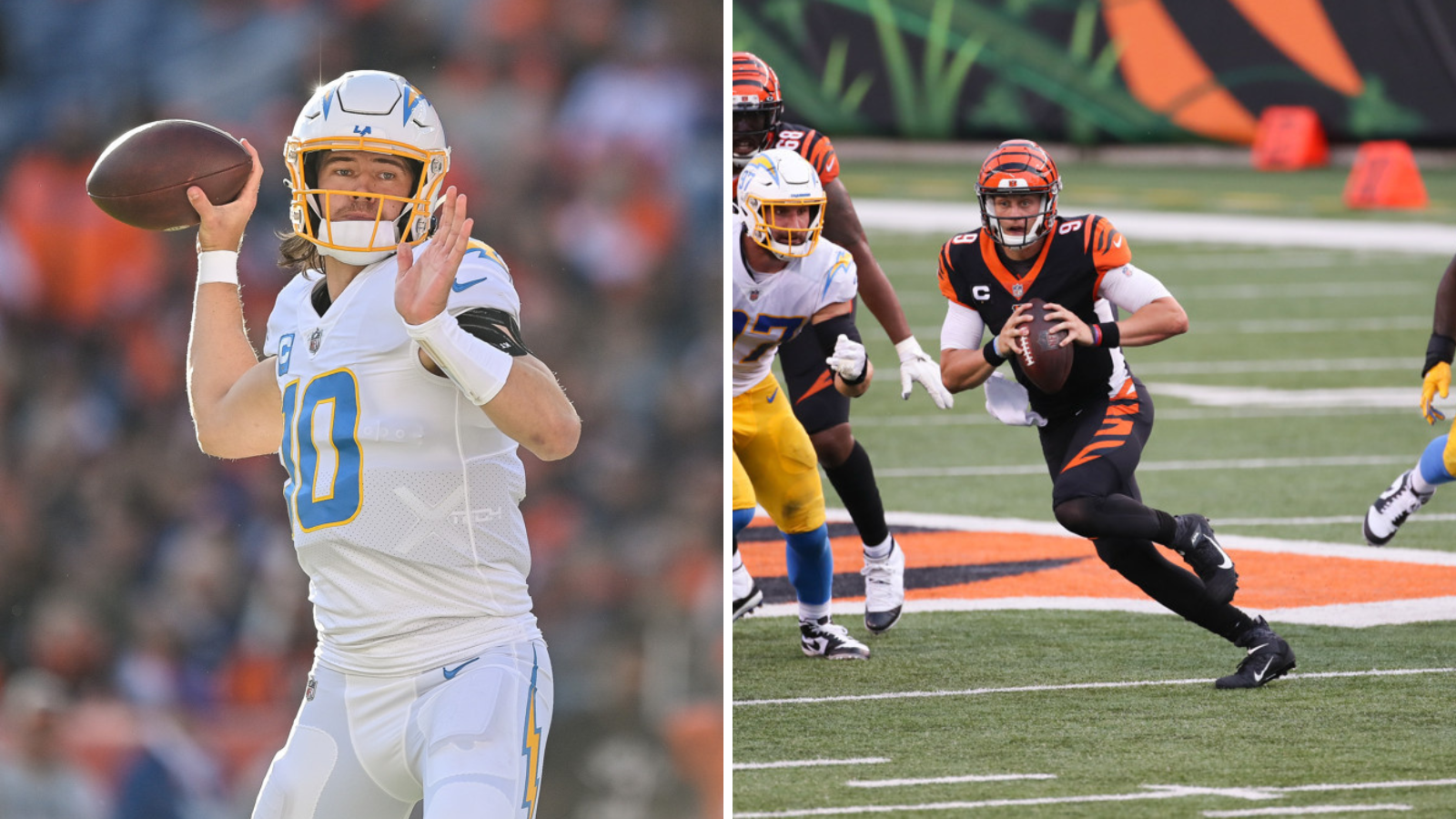
    Photo: Ian Johnson and Dustin Bradford/Icon Sportswire

    Over the spring/summer, the SIS R&D staff is convening on the Off the Charts Podcast to talk about their top ten players at a position. To do this, we pit two methodologies against each other: 

    • The “Scouts,” which comes down to the film-based opinions of Matt Manocherian and Bryce Rossler, each of whom has a lot of experience breaking down film and scouting players (Matt having been a scout for NFL teams).
    • The “Stats,” which involves James Weaver and Alex Vigderman devising a ranking based on a suite of metrics, and having that ranking speak for itself.

    Officially, Sports Info Solutions does not condone the dichotomy between scouting and statistical analysis. Each of them provides data in their own way and should inform our evaluation of a player. 

    When we originally produced the Football Rookie Handbook before transitioning that content to our NFL Draft site, we put the scouting reports and stats side-by-side with the idea that the reader would bounce back and forth between them and leverage both to come to a conclusion about a prospect.

    This week, we flipped sides, with Alex and James providing their scouting insights while Bryce and Matt assumed the mantle of the nerds. With quarterbacks, it was easy for everyone to agree on the No. 1 guy, but there were some differences of opinion along the way.

    Scouts’ Opinion Statistical Analysis
    1. Patrick Mahomes 1. Patrick Mahomes
    2. Joe Burrow 2. Justin Herbert
    3. Josh Allen 3. Josh Allen
    4. Jalen Hurts 4. Aaron Rodgers
    5. Justin Herbert 5. Jalen Hurts
    6. Trevor Lawrence 6. Joe Burrow
    7. Aaron Rodgers 7. Tua Tagovailoa
    8. Lamar Jackson 8. Dak Prescott
    9. Dak Prescott 9. Kirk Cousins
    10. Russell Wilson 10. Derek Carr

    The Stats List Methodology

    The stats-based ranking includes a three-year recency-weighted average of a player’s per-snap performance in Total Points, with their most recent season having a weight of 3, the second-most recent having a weight of 2, and their third-most recent having a weight of 1.

    Total Points arguably evaluates quarterback performance better than any other position, if only because there is an abundance of data points related to quarterback play that factor into it.

    Matt and Bryce initially thought to blend it with a second weighted EPA model that incorporated variables like Expected On-Target +/- (xOnTgt+/-) and throw depth, but concerns about historical sample with respect to xOnTgt+/- ultimately led them to decide that keeping it simple was best.

    It should also be noted that this methodology was not limited to Passing Total Points; Rushing Total Points is equally factored in, and that is reflected in the placement of players like Josh Allen and Jalen Hurts, both of whom have been extremely productive on the ground.

    What the Stats Showed

    As Matt noted, it would have been difficult to tweak the model in a way to dethrone Patrick Mahomes.

    “In terms of Z-scores, the difference between Patrick Mahomes and the second-ranked player, Justin Herbert, was bigger than the difference between Herbert and Derek Carr [the 10th-ranked player],” Matt said, “Mahomes was two standard deviations above average; the next-highest Z-score was Herbert, who was a little over one standard deviation above average.” 

    After a clear tier break, Herbert and Allen rounded out the top three, being the two of the remaining three players on the list to have ranked in the top 10 in Passing Total Points/play each of the last two years. (Herbert ranked 6th and 1st in 2022 and 2021, respectively; with Allen ranking 10th and 8th.)

    Allen’s rushing also proved to be a windfall for him, with Bryce pointing out that, in 2022, the Bills generated 11 EPA on running plays, with Allen himself accounting for 33 rushing EPA.

    Dak Prescott also ranked in the Top 10 in Passing Points/snap each of the past two years, but missed most of 2020 with an injury. Another player whose 2020 hurt them a bit in the stats ranking was Joe Burrow, whose ill-fated rookie season dampened his placement, despite performing well each of the past two years. 

    Following Burrow was Tua Tagovailoa, whose extremely efficient Year 3 with Mike McDaniel and Tyreek Hill was enough to propel him into the Top 10, despite not ranking in the Top 20 in Passing Total Points in either of his first two seasons in the league.

    What the Scouts Thought

    The scouts’ list likewise featured Patrick Mahomes at No. 1 and Josh Allen at No. 3, but Alex and James opted to place Burrow second rather than Herbert.

    Their reasoning?

    Burrow just has that ‘It’ factor and has produced more results at this point than Herbert,” James said, “He went into Kansas City and beat Patrick Mahomes, which is something Herbert hasn’t done yet, and there’s something to be said for that.”

    After that, there was a tier break with Jalen Hurts and the aforementioned Herbert placed at No. 4 and No. 5, respectively. The scouts expressed a bit of apprehension about Hurts simply because the Philadelphia offense was an extremely good fit for him last year, but still asserted that his leadership, his running ability, and his deep ball are reasons to be optimistic about him moving forward.

    The scouts also included Trevor Lawrence (No. 6), Lamar Jackson (No. 8), and Russell Wilson (No. 10) in their list, despite all of them having bad statistical years at some point within the last three seasons. James was bullish on Lawrence’s prospects moving forward, citing his arm talent, his mobility, and his command of the offense in Year 2 as very positive signs. Jackson was given the benefit of the doubt with respect to his injuries and the supporting cast around him the last few seasons, and Wilson likewise got a pass for a dysfunctional first year in Denver, but the scouts did note that he’s likely past his prime.

    Want to hear more discussion and debate? Check out this episode of the podcast: