
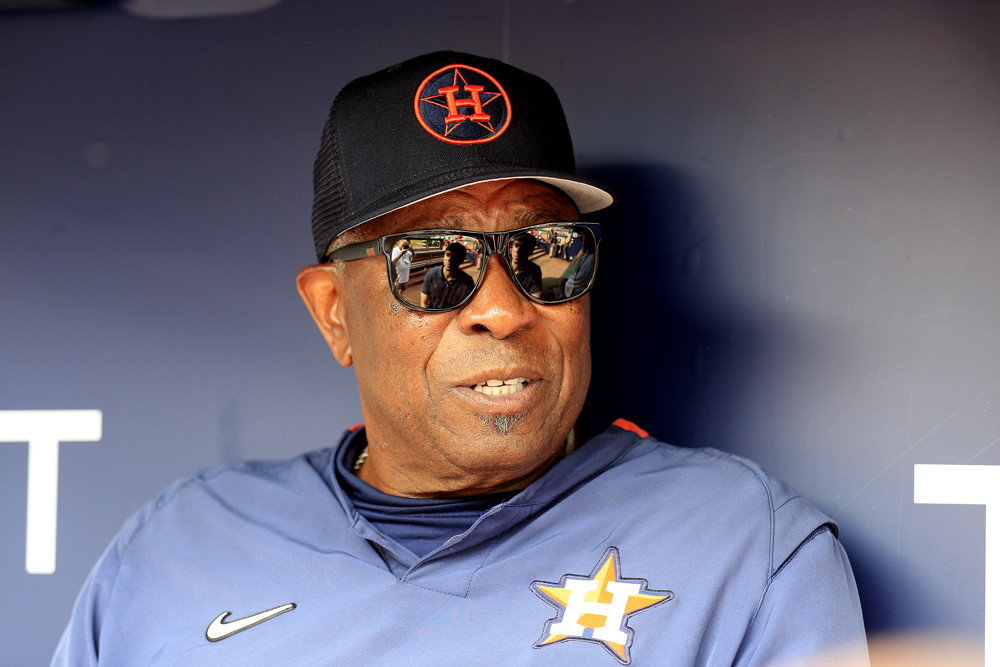
Former major league manager Dusty Baker joined us on The SIS Baseball Podcast to talk about his new book, Crossroads, which details his life and his time in baseball.
You can hear the full interview on the podcast but if you prefer to read it, it is below. Much of the interview touched on the subject of how Dusty played and managed using analytics before they were formally called analytics. We also talked about his favorite defensive play as a kid, who the best dancer he played with was, and why clubhouse guys are so important.
The interview is edited for clarity and length. Enjoy!
Mark: What’s the earliest great defensive play that you remember making?
Dusty: The best play that I made was in Colt League. I made a running, diving play into right center field to save a game in Colt League. We were 15 or 16 years old.
Mark: Can you still picture it in your head?
Dusty: Oh, yeah. I can still picture it, and there was a scout there with the Boston Red Sox, and he came to me afterwards, gave me a card, and so I just knew I was gonna sign to Boston Red Sox after that. And I never heard from the guy again.
Mark: We’re talking crossroads and various points in your career. That’s what the theme of the book, Crossroads, is. How would you describe the book to someone that was going to read it?
Dusty: From the time I was a kid, I was in Riverside, from Riverside to Sacramento. Riverside was a mixed town. I went to school with Mexican kids, Black kids, white kids, everybody. My dad’s job moved to Sacramento, then I was the only Black kid in the school, me and my brother. Two years after that, I signed with the Braves, went to the South and there was complete almost segregation, going from one extreme to the other, going from San Francisco and hanging out t in the South and digging the blues.
From the very beginning my dad didn’t want me to sign, and that was the first crossroad that I had to face, and that’s the first time that I bucked up against my dad and went against him. But see, he and my mom had just gotten divorced and so I was at a turning point in my life to sign.
Back in that day, they had the Jim Thorpe rule that if you were a pro in one sport, you were a pro in everything. So that was a major decision for me because I was more of a football and basketball player than I was a baseball player. But it’s a book that lends itself to being about prayer and having faith, because all my major decisions were made through prayer whether I liked the answer that I got or not, and most of the time I didn’t.
Mark: You’ve lived a full life.
Dusty: Tere’s a lot in there, and I could’ve put a lot more in there. But I really didn’t wanna tell on anybody else. It’s not that kind of book. It’s a book to help people that are in a hopeless situation. It’s a book to help people deal with being famous or dealing with life. And it covers many areas.
Mark: I wanna take you back 57 years ago to the day that you first started a Major League game, which is June 3, 1969, in St. Louis. You were the center fielder, Hank Aaron was in right field, Rico Carty was in left. The center fielder is supposed to be the captain of the outfield, but you’re 19, and it’s Hank Aaron, and it’s Rico Carty. How did you know where to position yourself and guide everyone- against Lou Brock, and Vada Pinson, and Joe Torre, and all the Cardinal great hitters?
Dusty: Hank positioned us. I heard Willie Mays had done the same thing with the Giants.
And back then, people weren’t positioning you. You had to know where to play, and Hank would know. He knew everybody. He could tell by the way you held your hands and how you stood if you were gonna be a pull hitter, your hands were way away from your body. If you were gonna be an opposite-field hitter your hands were usually close to your body.
One day Hank was playing right next to me, right? And I’m like, “Hank, you better scoot over some, because I’m leaving a big gap over here.” Well, the ball’s hit right to me.
Hank was not only a great player, but he was a very smart player and the smartest player that I ever played with.
Mark: With all the technology that’s come into the game in the 50-plus years since then, you had to make some decisions along the way as to how much of that you were going to accept. What was that like for you?
Dusty: The last 10 years it was hard to accept in a way as they- the people giving you the information- they want you to think that’s 100% and there are no absolutes in the game. Not in my experience, not in my brain and not in the numbers. You can think that there are some absolutes, but the opposition will mess you up in a minute. To me, you have to go on percentages. If I’m right about 75% of the time, that’s really high. If it gets down to 50-50, You might as well flip a coin.
The whole time when I was managing, even before sabermetrics, became prevalent, we always had something. We always had first-batter efficiency. We had a ground-ball to fly-ball ratio. We had where to play guys when guys were most likely to steal. And I tried to use some of Sun Tzu’s tactics. The use of spies, and the use of spies are nothing more than advance scouts, and they tell you who’s hurt, who’s hot, who’s not.
That’s the one thing that I wish they would bring back to baseball. Because the numbers tell you one thing, but to actually see a guy play and see what he’s doing, and you can tell who to stay away from, who to pitch to.
Mark: You once showed me a card that you used to use as a manager on which there were a lot of different markings. Pitcher pickoff times, catcher pop times. My favorite thing about it was that for each relief pitcher, for lefty and righty, if you had the guy that day and you liked the guy, you just put “USE.”
I was curious about the prep that you did- Right … like, to have in front of you during a game.
Dusty: Well, what I did for the first game of the series was a lot of work, because I covered everybody and every possible solution that might come up. I mean, you can’t cover everything, but I tried to cover almost everything that was important.
Then for the second, third, or fourth game if there’s a four-game series, I would cover more of the pitcher that day. And then I would use the first game’s card, to fill in everything else. Pop times, when the pitcher most likely will throw a breaking ball, so I’ll know a steal count, or the opposing manager, when they like to pitch out or when they like to squeeze.
There were things that I would check on myself. I would ask our stat guys to see if I was falling into tendencies, which is as important as knowing the other team’s tendencies, because what if that guy’s doing the same thing I’m doing? And so, I wanna know, am I pitching out always, 1-2, or am I hitting and running 1-and-0, just so I wouldn’t fall into a tendency.
Mark: So sometimes it’s not necessarily about the prep, and I have a quote from Shawon Dunston, who played for you at the end of his career. He said: Dusty said, ‘Until you accept your role, you’ll never like it. When you accept it, then you’ll be a good one.’
Shawon Dunston was one of the worst hitters in baseball, and yet he was your starting DH in Game 2 and Game 6 of the 2002 World Series against a right-handed pitcher. He rewarded you with an RBI in Game 2 and a home run in Game 6, and his son is at home plate waiting for him when he hits the home run … which is super cool.
How did you learn what the right thing to say to people is?
Dusty: I don’t know. Just try to be as honest as possible and try to think about when I was in that position.
I was in that position, and I didn’t like being lied to. And if you tell me the truth, at least your version of the truth, I may not like it, but it’d be easier for me to accept the truth than for me to accept a lie. Toward the end of my career, the last couple years, I didn’t play and it wasn’t easy to accept. But you either accept it and try to be the best at it, or else they’re gonna send you home.
I was a coach and on our bench was Chris Speier, who was an everyday player, and about the same age as me, and Phil Garner, and Harry Spillman. And those guys were about the same age. And so, I see how they went about their business, and I see how they accepted their role and became really good at it. And they were better at accepting their role than I was at that time.
Mark: Is Shawon Dunston a good example of someone who was at a crossroads at that moment, who responded well to it?
Dusty: Yeah. I had him and Eric Davis, and it was tough. It’s tough at the end of players’ careers because they still feel like they can be everyday players, and they are on, once or twice a week. But they’re not the same as they were every six out of seven days a week. I remember playing Shawon Dunston in that game because Shawon was one of the best low-ball hitters around (sinkerballer Kevin Apper was pitching for the Angels). A lot of times I would try to match up a low-ball hitter, with a low-ball pitcher.
I remember playing Shawon Dunston in that game because Shawon was one of the best low-ball hitters around (sinkerballer Kevin Apper was pitching for the Angels). A lot of times I would try to match up a low-ball hitter, with a low-ball pitcher.
I remember I had a whole bench my first year (1993). Matt Williams got hurt, I had Paul Faries playing third, I had Mike Benjamin playing third, and I had Steve Scarsone playing third. I played Scarsone against sinker-slider guys because he was an up swinger. I played Mike Benjamin against high fastball guys because he liked high fastball.
Mark: I love the specificity.
Dusty: I would try to mix them in depending on if I needed defense that day or match them up against which guys they were most likely to have success.
Mark: You won the World Series as a manager in 2022. The last out was made, TV cut to you in the dugout, and you’re writing something down on a card. What were you writing?
Dusty: I was writing down that guy had made the last out. A couple of things I always try to do.
Number one, when I first took the job as manager, Tony La Russa told me to never miss a pitch. I missed one pitch at my whole time managing, because I was in the bathroom and I came out and it was one ball and no strikes. And the inning started quicker than I thought. The second thing I did was try to keep track of the games.
And I kept all my scorecards, most of them. Sometimes I would give out my scorecards to guys that had a super game, or if a guy threw a no-hitter, or hit three home runs, or whatever it is, I’d give them a scorecard, to have for the rest of their lives.
But I was writing down whoever made that last out, and I was gonna finish my work before I celebrated.
Mark: Is there a good story from that season about someone helping behind the scenes with preparation or something else that was particularly instrumental to the winning?
Dusty: Yeah, there were a few guys. Some of the guys behind the scenes that, that really don’t get much credit are the clubhouse guys. I remember one guy came over and told me, “You need to go talk to so-and-so player.”
I said, “Why?” And he says “I don’t know. He seems a little down about something.”
I don’t like snitches. I tell them, “Don’t be snitching to me. Whatever’s going on over there, let it stay over there. But if you see something, if you see a personality change in a person, that means something’s going on. Guys wanna talk about it, but they don’t know who to talk to because they don’t know who to entrust their secrets to. I went over to talk to the guy, and he told me that his mom was sick and they had to go to the hospital the night before, and he hadn’t slept all night.
And so, I had to tell him, “Hey, man, go back in the room, back in there and sleep, and then I’ll wake you up right before the game.”
Mark: And that’s what happened
Dusty: Yep, and that’s what happened.
There’s also sometimes I’ll call somebody on another team that I know and I say, “Hey, how do you get this guy out? Or “What do you look for with this guy?” And “Give me a tip on when to steal a base. Does he nod his head, or does he shrug his shoulders or whatever?” Every little tip that I could get might help you win the game.
Mark: You were a hitting coach with the Giants before you were a manager 1989 to 1992. That’s a different time for hitting coaches compared to 2026 when you have all this technology now, as we talked about before.
Dusty: And you had three and four batting coaches.
Mark: And you were just one. How did you make evaluations on swings?
Dusty: I would let a guy hit for a while instead of just coming in changing him. You let him hit, and a lot of times guys will listen better when they’re failing than when they’re going good. I believed in always hitting to music because you gotta have some rhythm. And there I got more satisfaction out of helping a .230 hitter to be a .250 hitter than I got when I did a .300 hitter helping him hit .310 or .320.
A lot of batting coaches spend all their time with the hitters that can hit already because it makes them look better. But I get more satisfaction out of spending more time with the guys that have trouble hitting because it’s fun to see them figure it out.
You gotta spend time with everybody, but those guys are the guys that are gonna make the difference in the ball game, because those are the guys they’re gonna pitch to. And I remember I don’t like when I go into these meetings and they’ll say, “Hey, man okay, this guy here, just don’t walk him.”
Then they go on to the next guy and then they’re like, “Okay, don’t walk him either. He can’t hit.” Well, these are the guys that end up hitting, especially in the playoffs. And I’ve seen it over and over again, so anybody with a bat is dangerous and I don’t underestimate anybody.
Mark: You mentioned music before. Your previous book was about music as it relates to you and your life, Kiss the Sky, which is fantastic.
Did you encourage players to dance?
Dusty: Yeah. Big time. Two things, I asked them: Did they play basketball, and they say, “Oh yeah, I play basketball.” I said, “Well you’re not in a very athletic position. I’ll blow right by you.” Because your stance in baseball is similar to a basketball stance on defense. I learned that from Dick Allen because Dick Allen came up to me one day. I was scuffling. He goes, “Hey man, you play basketball?” I said, “Oh heck yeah, I play basketball.” He said, “You don’t look like it.” He said, “You stand up there like a stick man.
Because your stance in baseball is similar to a basketball stance on defense. I learned that from Dick Allen because Dick Allen came up to me one day. I was scuffling. He goes, “Hey man, you play basketball?” I said, “Oh heck yeah, I play basketball.” He said, “You don’t look like it.” He said, “You stand up there like a stick man.”
Then one day I was in Chicago, and Al Campanis came up to me, and he goes “Dusty, I want you to go dancing tonight.” And this was when you played all day games in Chicago. I’m like, “You want me to do what?” And most of the time they’re trying to keep me in the room in Chicago versus going out.
So he goes, “I want you to go out tonight and go dancing.” I said, “Why?” I thought it was a trap. I say, “Why, man?” He says, “Well, because you don’t have any rhythm.” I said, “What you mean, man? I’m a brother, I got plenty of rhythm.” He said, “You don’t look like it.” So he goes, “I want you to go out and go dancing.” And I went dancing, and then I got hot.
I used that from then on, a lot with my players.
Mark: Was there a player in particular who was really good at dancing?
Dusty: Well, there’s a guy I played with. I mean he swears he was Fred Astaire. Davey Johnson. Davey Johnson could dance, man.
I thought I was a pretty good dancer, but I didn’t like going out on the floor by myself and having everybody looking at me. I waited until a crowd of people got out there. Davey’d go out there if he was the only guy in the whole room.
Mark: Thanks, Dusty
Dusty: Thank you.