“The game has always been, and will always be, about buckets.” Though he was much more famous for his defensive prowess than gaudy point totals, even Bill Russell himself understood that, at the end of the day, nothing matters more than putting the ball in the hoop.
This rings especially true in today’s NBA, where modern rule changes have been explicitly tailored to fuel explosive offensive numbers. Even when the game enters clutch time, elite shotmaking reigns supreme — the most recent Finals serving as Exhibit A.
Consequently, teams place a premium on shooting ability and are constantly on the hunt to add more high-level bucket getters to their rosters.
To that aim, we put our charting metrics to the test and took an initial stab at evaluating how well they could potentially forecast a prospect’s transition to NBA-level scoring efficiency.
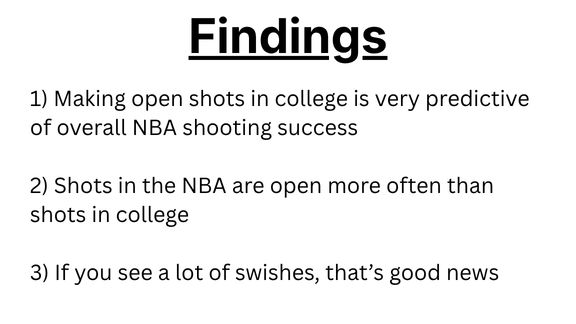
Here’s what we found, in brief:
- Making open shots in college is very predictive of overall NBA shooting success, solidifying a common assumption
- Shots in the NBA are open more often than shots in college, likely owing to better passing and spacing
- Comparing shots in the same area loses more because of sample size than it gains from evaluating apples-to-apples
- If you see a lot of swishes, that’s good news
Methodology
As part of our draft framework, we chart every shot attempted by all players in our prospect pool. Beyond registering the shot type, location, and contest level, we also track more granular details, including the exact nature of the conversion or miss (e.g., swishes, rim-grazes, or long misses), as well as pull-up direction and weak-hand utilization.
We bucketed shots into four groups: threes, outside shots (threes and midrange), attempts at the rim, and overall field goals. From there, we ran a correlation analysis using the following performance metrics:
- FG%
- Shot results: % of shots swished, made but hit rim, and bad misses* (grazed or airball)
- Contest levels: FG% on open, average, and plus contests
- % of shots long or short*
- % of shots left or right*
* Inverse relationship
For each player, we measured the correlation between their college metrics and their NBA field goal percentage over their first four seasons in the league. In addition, our NBA framework also tracks contests, so we also evaluated the relationship across contest levels.
To ensure data integrity, we established a sample size threshold, filtering out any players below the 50th percentile in total attempts in both college and the NBA.
Findings
Predictiveness of various metric splits
The table below depicts correlation coefficients for various college shooting metrics across our shot groups. The relative magnitude is perhaps unsurprising, with shotmaking performance at the rim seemingly more indicative of corresponding pro performance compared to shots from distance.
Correlation Coefficients
| Stat | 3s | Outside | Rim |
| FG% | 0.36 | 0.34 | 0.55 |
| Swish% | 0.36 | 0.35 | 0.55 |
| Open FG% | 0.25 | 0.19 | 0.26 |
| Open FG%* | ** | ** | 0.36 |
* Tested against NBA FG% on open shots specifically
** Deemed statistically insignificant
| Stat | All |
| FG% | 0.64 |
| Swish% | 0.59 |
| Open FG% | 0.61 |
| Open FG%* | 0.76 |
When inspecting specific shot results, swishes appear to be the strongest predictor, outpacing other shot results by a noticeable margin. Under our framework, the majority of made shots are considered swishes, and so while this culminates in sharing a high collinearity with FG%, the cleanliness of a prospect’s makes does seem to more strongly suggest future capability.
When comparing shots at different contest levels, open shots exhibited the strongest carryover to the next level. Intuitively, it does make sense that shooting that’s unbothered by defensive interference could be the most translatable.
Notably, we don’t see significant predictive value in being able to hit tough, contested shots, or an issue with missing in one consistent way in college.
Perhaps the most notable revelation was that correlations across the board peaked when analyzing the entire, aggregated shot chart rather than isolated zones. This uptick is likely driven by the expanded sample size, which more than compensates for the value of comparing the same shot type at both levels.
Ultimately, the highest score in the study occurred between collegiate and NBA field goal percentages on all open looks, further suggesting that “pure” shooting remains the most consistent across the two levels.
Here is a snapshot of the top 10 most efficient shooters on open threes from this year’s prospects:
Most efficient shooters on open 3s
| Player | Team | FG% |
| Christian Anderson | Hornets | 61.5 |
| Labaron Philon | 76ers | 50.9 |
| Sergio De Larrea | Mavericks | 50.0 |
| Milan Momcilovic | ** | 49.0 |
| Lamar Wilkerson* | Thunder | 48.2 |
| Darryn Peterson, | Jazz | 48.1 |
| Milos Uzan* | Celtics | 48.1 |
| Bennett Stirtz | Thunder | 44.4 |
| Richie Saunders | Grizzlies | 44.4 |
| Braylon Mullins | ** | 44.2 |
* Undrafted
** Returning to college
Given that open looks tend to serve as a primary indicator of a prospect’s pure shooting talent, understanding how players generate or receive these opportunities can be helpful. This is particularly relevant because there is a higher rate of open shots in the NBA than in college. It turns out that more effective passing and spacing wins out over longer athletes and better defensive skill.
Impacts of various contest levels
Looking at the contest level distribution across various shot types, catch-and-shoot opportunities predictably yield the highest percentage of open attempts. In contrast, self-created looks like pull-ups and face-ups are met with strong contests over half of the time.
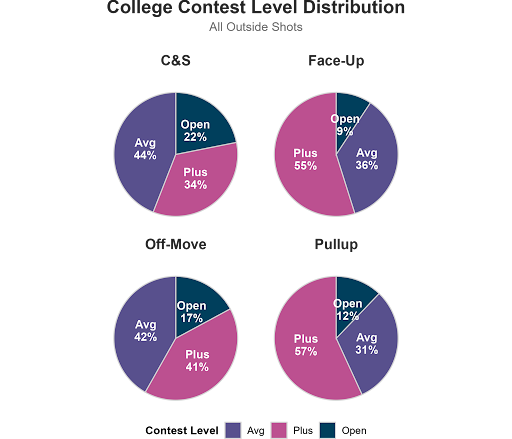
It also validates our intuitions that if players are hunting open looks, particularly of the catch-and-shoot variety, those are going to come outside the arc. Three-point attempts are more likely to be catch-and-shoot opportunities than anything else (40%), while they’re barely represented among midrange shots (8%).
Part of the intuition of the three-point revolution reverberates here; not only is 3 greater than 2, but the additional open space allows for consistent, reliable shooting mechanics to win out.
Conclusion
“An expert eye can watch a single game better than the stats can, but the stats can watch every game.” A corollary to this statement is that stats can help affirm or disavow us of common conceptions that we build through experience and discourse.
It’s not rocket science to say that performance on open shots can help us understand a player’s shooting ability. But it’s useful to know that with confidence, and to tie that in with other findings about the rate of open shots and the value of swishes that are less well-established.
By consistently tracking granular details such as the contest level and computing metrics with them, we can mitigate noise, validate visual impressions, and ultimately drive more informed decision-making.