
The versatility of a tight end has become more and more appealing to the offensive minds of the NFL over the years. The number on the field, where they align, and how they are used have all changed over the decade, favoring the group that has their own national holiday.
How often have teams started to deploy three tight end sets? Have they started to split out wide more compared to the conventional in-line setup? How has the route tree changed and are they running more routes? Has the shift in strategy led to higher production?
These are the questions we have looked into to help determine what tight end trends are meaningful around the league.
Personnel Groupings
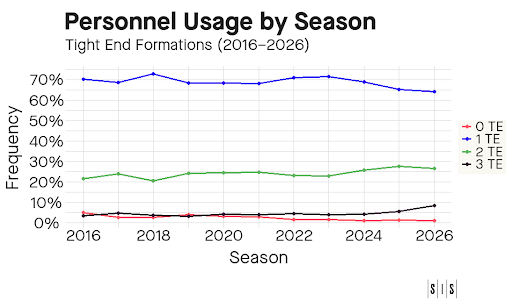
Since 2016, we have seen the increase in tight ends on the field for a given play. Zero tight end personnel has dropped from 5% in 2016 to 1% thus far in 2026. One tight end looks has dropped from 70% to 64%. On the flip side, two tight ends have increased from 22% to 27% and three tight ends have gone up from 3% to 8%.
Sean McVay has become the poster child of three tight end sets, as the Rams have become the only team to utilize 3 tight ends on the field more than 30% of the time in 2025 and are already over 30% again in 2026. Their 2025 utilization of three tight ends is by far the most deployed over the last decade, with the 2021 Browns coming in second at only a 19% clip. However, the Rams are deploying two tight ends at the lowest rate in 2025 at 10% and are only at 5% in 2026 thus far, really leaning into an all or nothing approach when getting tight ends on the field.
Including the Rams, the Bills, Cardinals, Bears, and Ravens 2026 seasons are all in the top 7 in three tight end deployments over the past 10 years. Once again, teams are beginning to follow suit of the McVay ways.
Alignments
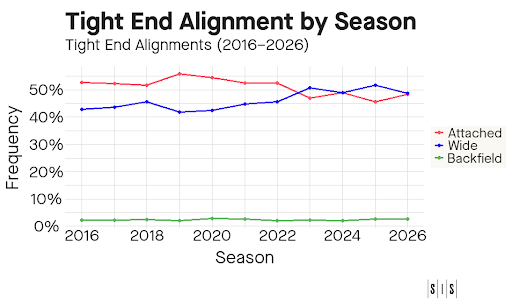
We will take a look at the route tree in a little bit, but it is apparent that playcallers are looking to get their more versatile tight end playmakers out in space lined up against smaller cornerbacks. The recent jump in aligning tight ends in the slot or out wide took a substantial jump in 2023 by a little over 5%, and has maintained similar levels since.
The breed of these big, but very athletic tight ends allows the mismatches to occur when aligned against a corner. Kyle Pitts, Terrance Ferguson, Oronde Gadsden, Isaiah Likely, and Dalton Kincaid all find themselves lining out wide over 70% of the time. Even some of the old guard like Mark Andrews and Mike Gesicki are also over 70%.
Usage
| Season | Block % | Route % | Target % |
| 2016 | 30.1% | 65.6% | 22.5% |
| 2017 | 28.1% | 67% | 21.8% |
| 2018 | 30.2% | 70.9% | 21.7% |
| 2019 | 29.3% | 70.5% | 21% |
| 2020 | 29.8% | 69.9% | 21.4% |
| 2021 | 28.8% | 70.9% | 21.1% |
| 2022 | 26.7% | 73.1% | 21% |
| 2023 | 27.4% | 72.3% | 21.4% |
| 2024 | 25.5% | 74.2% | 22.4% |
| 2025 | 25.4% | 74.2% | 23.9% |
| 2026 | 25.3% | 74.3% | 23.6% |
On pass plays, the way that tight ends are being used is shifting. Decreasing pass block rates with increasing route percentages and target percentages speak to the dynamic of what these newer tight ends are capable of.
Blocking on pass plays has dropped nearly 5% since the highs of the late 2010’s, while route percentages have increased nearly 10% over the past decade.
More routes equals more targets, as there was a near 24% target rate in 2025 and there is no sign of slowing down in 2026 either at a healthy 23.6% thus far. These are the highest levels over the past decade and are correlative with the increase in getting them on the field.
Route Distributions
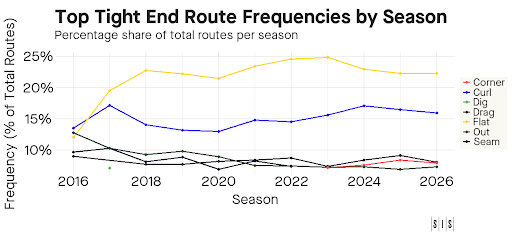
Flat and curl routes are still the king of the crop and have been over the past decade. Curl routes have even stabilized over 15% over the past 4 seasons including 2026.
One noteworthy point here is the popularity of the corner route overtaking the seam route over recent years.This can be attributed to the increase in Cover 2 looks from the defense, as the tight end can get behind the flat defender and in front of the deep safety in open space near the sideline. Running a seam directly into 2-high safety looks can be challenging when the purpose of that look defensively is to mitigate the vertical stretching of the field.
Production
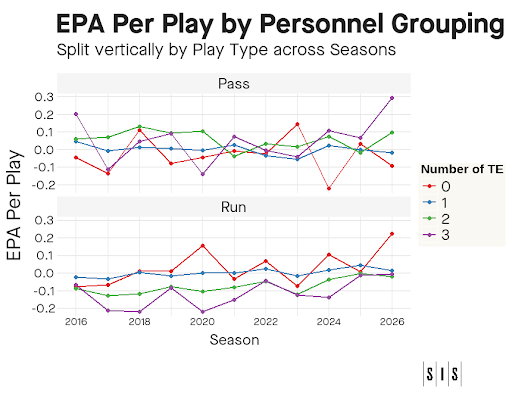
3 tight end looks have taken the cake in terms of EPA per play on pass plays, leading the way over the past 3 seasons and really taking off in 2026 thus far at 0.29. 0 tight ends have seen a roller coaster, coming in second in 2025 at 0.03, but finished last in 2024 and is last thus far in 2026.
The run game, on the other hand, is the opposite. 0 tight ends have seen the most success in 2026 at 0.22 EPA/P, while 2 and 3 tight end sets are neck and neck for the bottom spot.
From an alignment perspective, there isn’t much of an effect on player success. Total Points per play indicates that whether aligning attached to the LOS, out wide, or in the backfield, tight ends have a similar production output around 0.03 Total Points per play.
Conclusion
The way tight ends have been deployed has certainly changed over the years. Personnels, alignments, and usage of all moves in favor of utilizing the skillset of a tight end by getting more of them on the field, aligning them more out wide, and increasing their routes and target percentages.
Production results vary from a personnel perspective depending on the run or pass, while there isn’t much from an alignment standpoint when looking at individual player success.
The growth of the tight end position has been apparent, and there are certainly bigger reasons than granting them their own national holiday.