Category: Baseball

  • Chris Sale Would Have Been Even Better If Not For His Outfield Defense

    Chris Sale Would Have Been Even Better If Not For His Outfield Defense

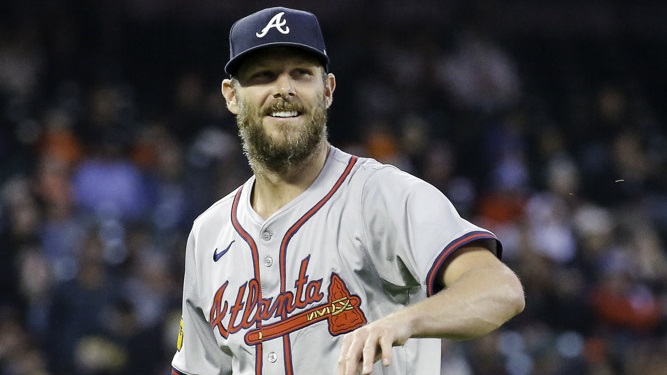
    Braves starter Chris Sale is almost certainly going to win the NL Cy Young Award today and deservedly so. Sale won the NL’s pitching Triple Crown with 18 wins, a 2.38 ERA and 225 strikeouts.

    What’s amazing about Sale’s season is that he actually could have been even better.

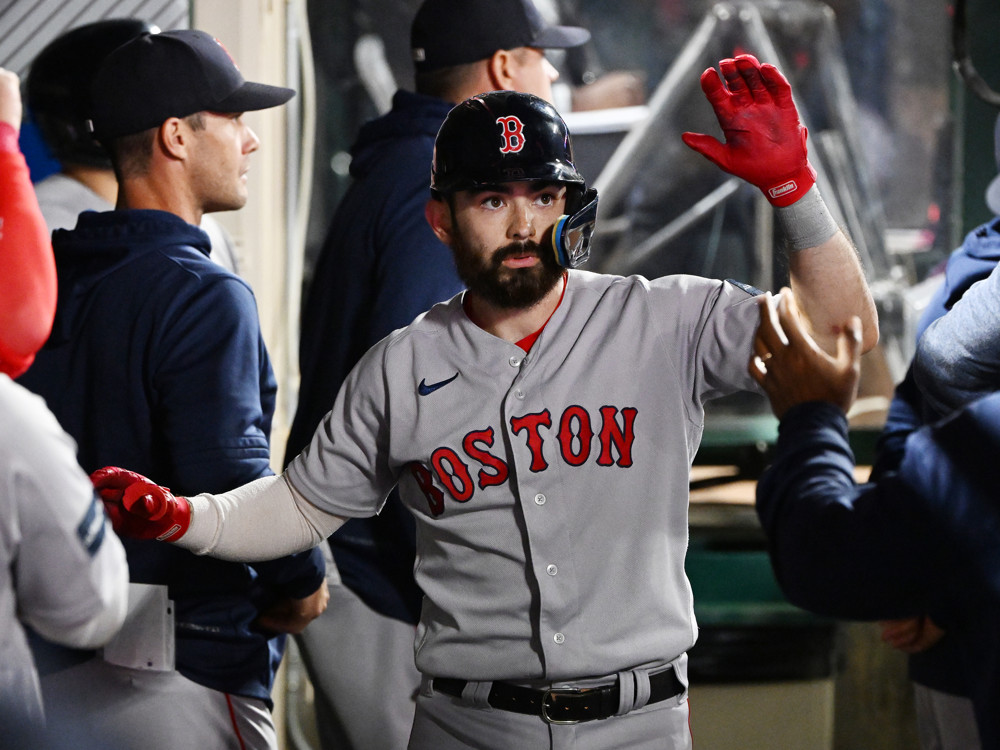
    The Braves finished with -8 Defensive Runs Saved in games in which Sale pitched. Take those runs off Sale’s ledger and his ERA would be right around where his FIP ended up (2.09). Sale was one of 13 pitchers whose teams had -8 Runs Saved or worse on the batted balls against him in 2024.

    By comparison fellow Cy Young finalist Paul Skenes basically had an average defense fielding his balls (-1 Runs Saved) and Zack Wheeler’s defense played well behind him (4 Runs Saved). The pitcher who is going to win the AL Cy Young, Tarik Skubal, got 6 Runs Saved from the Tigers defense. Fellow finalist Seth Lugo got 6 Runs Saved from the Royals defense. And Guardians closer Emmanuel Clase got 11(!) Runs Saved from his defense (we wrote about that).

    Sale was a victim of the adventures (or misadventures) of the Braves outfield. When Sale was on the mound, Braves outfielders combined for -9 Runs Saved. They turned 55% of the fly balls and line drives hit to the outfield against Sale into outs. MLB average is usually in the low 60s. That 55% ranks in the bottom 15% of qualifying pitchers.

    A few examples:

    This ball was scored a triple and the batter, Jahmai Jones, subsequently scored when the next hitter grounded out. To call that an earned run seems unfair to Sale.


    This is a tough one too – a ground rule double that seemed to be a mental error by Jorge Soler, who ran after it as if he thought it was a foul ball. The Braves left fielders and center fielders had good defensive seasons overall. But their right fielders ranked last in Runs Saved.


    Something similar happened here with Eddie Rosario in left field:


    Here’s another one where scoring this a hit is penalizing the pitcher for his defense’s mistake – a fielder overrunning a pop up.

    On that one, Sale more than bailed his defense out. He struck out 12 in 7 scoreless innings, as if he knew he had to be even better with the wind blowing at 14 MPH and the knowledge that his outfield defense was possibly going to struggle.

    That’s not to say that the Braves outfield didn’t do right by Sale too.


    But as the numbers show, the negatives outweighed the positives.

    You’re probably going to hear a lot on Wednesday about all that Sale overcame to win the Cy Young Award, with the injuries he’s dealt with the last few years.

    But saying he overcame physical adversity is only part of the story. He overcame defensive-induced adversity in several games this season too.

  • Several Standout Defenders Join Hall of Fame Ballot

    Several Standout Defenders Join Hall of Fame Ballot

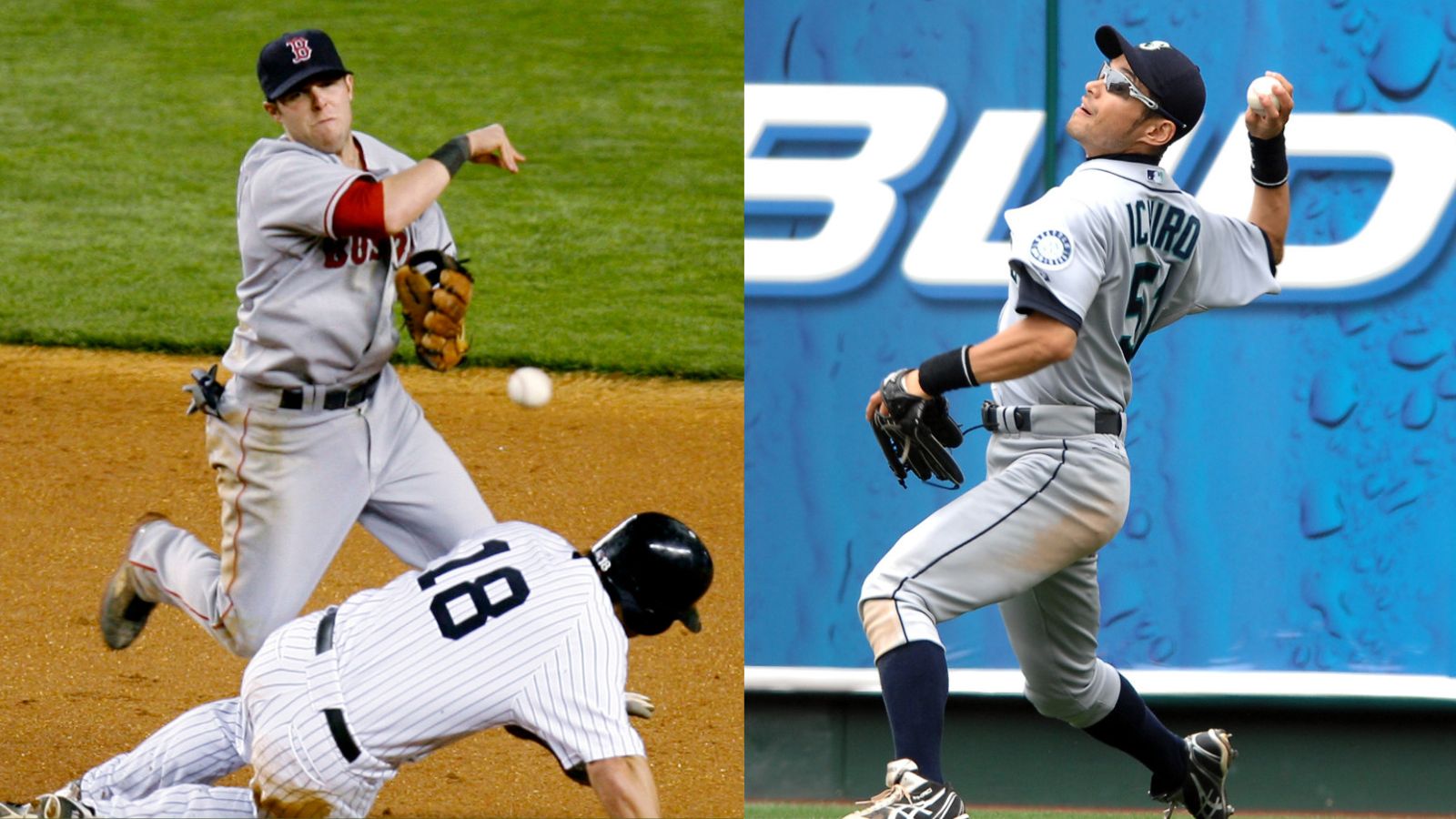
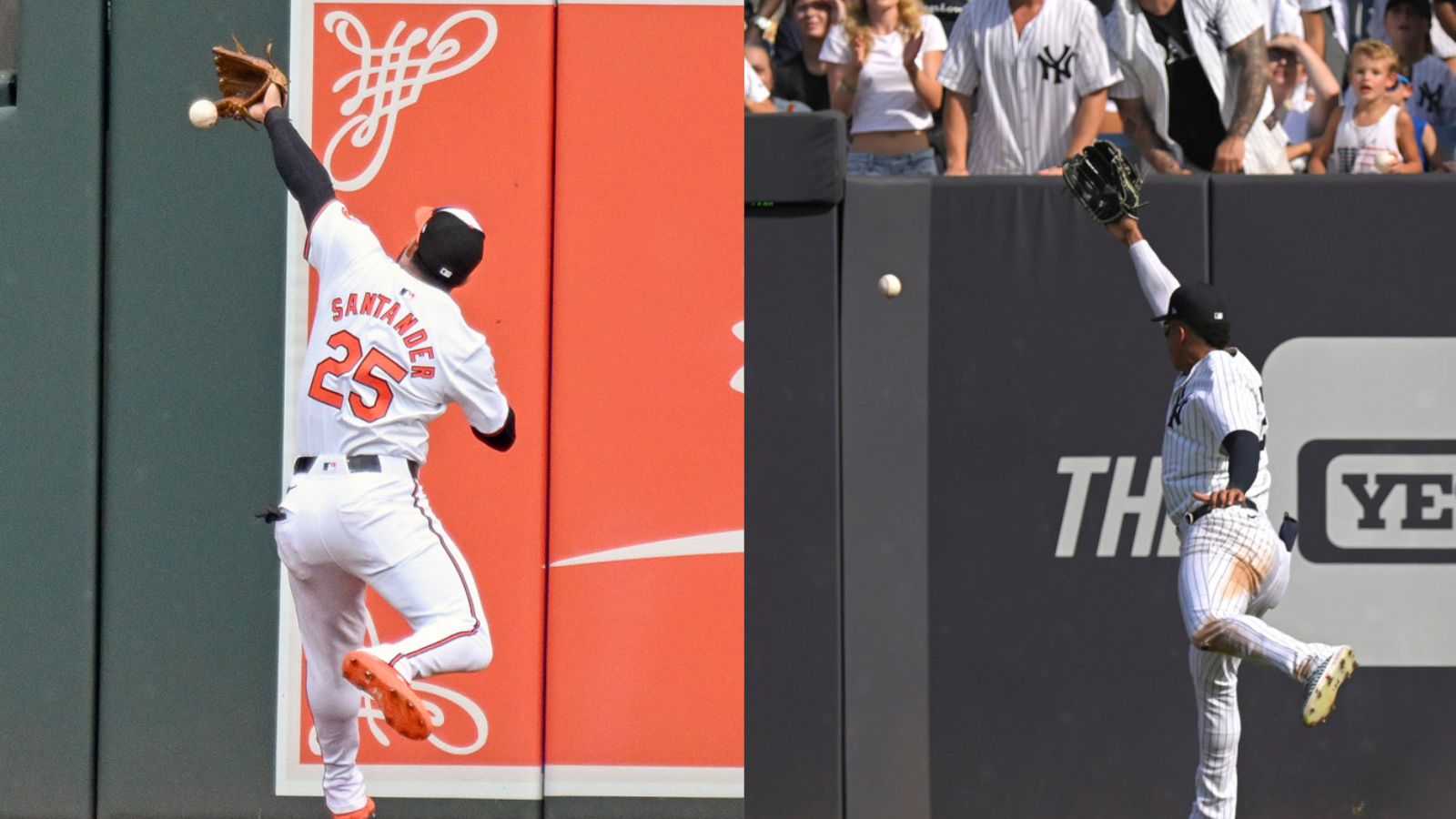
    Photo: John Cordes (l) and Jeff Zelevansky (r)/Icon Sportswire

    Did you notice that the additions to this year’s Hall of Fame class include a bunch of defensive studs?

    There are already some great defensive players on the ballot (we wrote about Chase Utley last year and there are several longtime holdovers, some with problematic off-field histories, too) but the addition of these players makes the ballot really defense-rich.

    Ichiro Suzuki headlines the first-year eligible candidate group and while fans often marvel at his hitting, his defense in his MLB prime was high end.

    Ichiro reached a Defensive Runs Saved total that few right fielders have reached. He had 30 in 2004, the second season for which that stat is tracked. The only right fielder with more in a season is Mookie Betts, who had 33 in 2016 and 32 in 2017. Ichiro was never able to replicate anything close to that 2004 season in terms of defense, but totaled at least 10 Runs Saved in five other seasons. His arm rated best in the early part of his career when he had numerous highlight-reel throws. He also tallied 10 home run robberies from when we first started fully tracking them in 2004. Only five players have more.

    In all, Ichiro is one of three players with at least 100 Runs Saved in right field and is a 3-time Fielding Bible Award winner at that position.

    Most Defensive Runs Saved – Right Field

    Name Runs Saved
    Jason Heyward 159
    Mookie Betts 141
    Ichiro Suzuki 104

    Ichiro isn’t the only ballot newcomer with at least 100 Runs Saved at a position. Dustin Pedroia ranks third among second basemen with 107 Runs Saved. He’s directly behind second-year Hall candidate Chase Utley. And two spots behind Pedroia is another ballot newcomer, Ian Kinsler.

    Both Pedroia and Kinsler were solid players, though most will likely dub them a fit for the ‘Hall of Very Good.’ Pedroia twice led second basemen in Defensive Runs Saved in a season and finished in the top five at that position six times. He perfected a pre-pitch hop that allowed him to get a quick first step in making a play. Pedroia has the most Fielding Bible Awards among second basemen with 4.

    Kinsler has the most Double Play Runs Saved of any second baseman. He ranked in the top five in Defensive Runs Saved at second base seven times in a 14-year career and led the majors in Runs Saved there in 2009. He won a Fielding Bible Award at second base in 2015.

    Most Defensive Runs Saved – Second Base

    Name Runs Saved
    Mark Ellis 128
    Chase Utley 126
    Dustin Pedroia 107
    Orlando Hudson 101
    Ian Kinsler 86

    Shortstop Troy Tulowitzki had one of the best defensive seasons of anyone at that position within the history of Defensive Runs Saved. He led shortstops with 31 Runs Saved in 2007 and finished in the top five in Runs Saved there five other times. Tulowitzki’s specialty when he was at his best, was making plays deep in the shortstop-third base hole that other shortstops weren’t making. Tulowitzki is a 3-time Fielding Bible Award winner at shortstop.

    From 2009 to 2011, Ben Zobrist was one of the best players in baseball and a primary reason for that was his defense. Zobrist ranked tied for second in Runs Saved among right fielders and fourth among second basemen in Defensive Runs Saved over that three-year period.

    SIS began tracking which catchers were getting more strikes than expected for their pitchers in 2010 and from the start, it was apparent that Russell Martin was pretty good at it.

    Since that season, Martin ranks third among catchers in Runs Saved overall and fourth in Strike Zone Runs Saved, which measures pitch framing. Even before that, Martin rated well as a catcher. He led the position in Runs Saved in 2007 and then again in 2013 and ranked in the top five in five other seasons.

    Other newcomers on the ballot who were notable defenders include Curtis Granderson, who finished second among right fielders in Runs Saved in 2015 after finishing third among center fielders in 2007. There’s also the odd case of Adam Jones. Though Jones ranks second-worst in the range component of Defensive Runs Saved for center fielders dating back to 2003, he ranks No. 1 overall in Outfield Arm Runs Saved at the position in that time. Plus, his signature play is a home run robbery at the World Baseball Classic.

  • Roki Sasaki Scouting Report (Updated!)

    Roki Sasaki Scouting Report (Updated!)

    Let me start by saying: Rōki Sasaki is one of the most talented young pitchers on the planet.

    I say that having watched each of his NPB starts from 2022, 2023, and 2024.

    He started to turn heads as a high school pitcher in Japan. On April 10, 2022 he threw a perfect game against the Orix Buffaloes in which he struck out 19 batters, including 13 in a row. I wrote about his perfect game later that summer. He followed up perfection with another eight innings a week later, capping off possibly the greatest two-game stretch in major professional baseball. Sasaki has mesmerizing talent and has continued to put up gaudy stats in NPB.

    Sasaki’s Recent Seasons (2022-2024)

    Season IP ERA Strikeouts Walks K%-BB%
    2022 129 1/3 2.02 173 23 31%
    2023 91 1.78 135 17 34%
    2024 111 2.35 129 32 22%

    The Lotte Marines announced they would post the ace, even though he does not meet the current Japanese posting system requirements, as he is under 25. His contract will be restricted by international bonus pool money, limiting how much he can sign for as an international “amateur.” This opens his posting to every MLB team, many of which will surely pursue the young pitcher.

    What makes him so special?

    Sasaki’s arsenal includes a high-velocity, two-plane fastball, and a devastating splitter, both of which have tormented NPB hitters for years. He’s recently increased the use of his slider, turning it into a reliable weapon against both righties and lefties.

    Sasaki is a control-over-command pitcher, but when he’s dialed in he can spot his fastball on the edges of the zone. Here are some well-located fastballs from Sasaki’s 2024 playoff start.

    via GIPHY

    via GIPHY

    His splitter location is exceptional when it needs to be. Look at these heat maps from this NPB Pitch Profiler that show Sasaki’s command of the pitch.

    vs Left-handed batters 

    vs Right-handed batters  


    With a 56.5% whiff rate in 2024, Sasaki’s splitter is among the best in baseball. His ability to induce swings and misses, especially when the pitch darts below the strike zone, has made it a devastating strikeout pitch.

    A mechanical tweak in 2024?

    via GIPHY

    I wrote up a detailed breakdown of Sasaki’s mechanics in my last report on him and still think it captures a lot of what he does as a mover on the mound. However, in 2024 Sasaki added over 6 inches of extension to his delivery.

    2022

    2024

    The increase in stride length down the mound is noticeable. As noted by Lance Brozdowski in his breakdown, Sasaki’s extension increased but his release height stayed almost identical at 6 feet. As Lance suggests, he might have kicked up his arm angle just a tiny bit which is not as clearcut on video but can be seen. There’s possibly a slight overextension in his stride that played a role in his downtick in velocity.

    There’s a sweet spot in terms of mechanics for Sasaki, and an MLB team will try to find the bullseye. They’ll be trying to unlock more of his 2023 pitch shapes while also balancing injury risk and efficient throwing.

    It’s important to note that the big question mark surrounding Sasaki is his health as he has battled various injuries throughout the last three seasons, including an oblique injury and shoulder fatigue.

    Pitch Usage (2022-2024):

    Pitch 2022 2023 2024
    Fastball 56% 50% 46%
    Splitter 34% 35% 28%
    Slider 5% 13% 26%
    Curveball 5%

    Average Pitch Velocity (MPH):

    Pitch 2022 2023 2024
    Fastball 98.3 98.9 96.9
    Splitter 89.1 89.5 88.2
    Slider 87.7 87.5 83.6
    Curveball 79.6 79.5 76

    Against Right-Handed Batters (RHB)

    Pitch 2022 2023 2024
    Fastball 54% 46% 40%
    Splitter 29% 27% 21%
    Slider 12% 26% 39%
    Curveball 5%

    Against Left-Handed Batters (LHB)

    Pitch 2022 2023 2024
    Fastball 57% 53% 50%
    Splitter 36% 41% 33%
    Slider 1% 4% 18%
    Curveball 5%

    The Arsenal (2024 usage and Average Velocity)

    Pitch Grades (20-80 Scale):

    Fastball: currently a 70, was an 80 in 2023

    Splitter: Currently an 80

    Slider: Currently 55, could rise to 60

    Breaking down the pitches:

    Fastball   46%, 97 mph  

    CSW% 26%, 

    Strike% 71%

    Sasaki’s drop in fastball velo has been a topic of conversation for most of the year. In May I speculated that Sasaki was more or less gas pedaling through starts. In other words, easing his way through starts because he was trying to pitch deep into games for the Marines. He was backing off at that point and then would run his fastball up to the upper 90s or triple digits.

    Most notably May 10 in a start vs Nippon-Ham Sasaki produced one of the most disappointing starts of his NPB career,  5 2/3 innings and 5 earned runs. His next start would come seven days later. Against the same Fighters team, he threw his fastest average fastball velocity of the season, averaging 98.4 MPH.

    Sasaki looked like his old self again until he dealt with a couple of injuries that sidelined him for two starts to begin June. Then he suffered another injury that cost him almost two more months. He was up and down with his velocity throughout the season but there were points where he was averaging 98 mph in some starts.

    While having a dip in velocity, Sasaki also lost some movement both horizontally and vertically. He averaged around 16 inches of vertical movement on his fastball rather than the 18 inches he was averaging in 2024.

    His fastball was still good in 2024. It just was not the unicorn-type pitch it had been the previous season. The whiff rate dropped from 24% in 2023 to 13% in 2024. The pitch in this new shape failed to miss as many bats in the zone.

    Now as I have pointed out before, NPB hitters would sit on Sasaki’s fastball and try to foul off the pitch or shoot it the other way for minimal contact but try to get a base hit. There’s a decent chunk of emergency hack foul balls and swings that are late on his heater.

    He allowed an OPS against of .740 on his fastball in 2024 compared to a .595 OPS against it the season prior. A lot of these hits were singles the other way or weaker contact singles blooped into the outfield.

    Not many hitters in NPB squared up Sasaki’s fastball at any point in his career. He’s allowed a total of 6 home runs with it in the last three seasons, and just 2 all last season. Even with the dead balls in Japan, that’s impressive. Compare that to the 26 homers surrendered on fastballs by Shota Imanaga in his last two seasons in Japan. 

    You can see how good Sasaki’s four-seam is at limiting hard contact. In 2024, Sasaki was less sporadic with his four-seam command. He’s a pitcher who tries to cut the plate in half and work one side or the other with more control than command. However, he will still miss in the middle occasionally, which might lead to more damage on this pitch in MLB outside of normal changes in conditions between the two leagues.

    via GIPHY

    Sasaki was more middle-third vertically than the upper part of the zone with his fastball this season. 

    This could explain why he also gave up more contact and had fewer whiffs to go along with the shape change. He was either choosing to be more efficient as a pitcher or the shape change just didn’t carry his pitches routinely to the upper third of the zone as it had in the past.

    One thing that is likely to change as Sasaki comes stateside is the use of his four-seam at the top part of the zone. In the image below, which shows the heights were the catcher target was set for his pitches last season, the black squares are fastballs. Sasaki’s catcher rarely sets up high. Almost all of those dots are plotted in an area close to where the batter’s knees were. 

    The catcher’s mitt is towards the bottom and shades to both corners. This isn’t to say he doesn’t target the catcher’s mask at times but there’s not a concerted effort to throw high fastballs. Even with his two-plane shape, an MLB team will want a higher percentage of top-shelf fastballs especially if he can harness more of the fastball shape he had at the WBC and during the 2023 season.

    Sasaki’s fastball induces a lot of ground balls because of its horizontal movement. He had a 52% ground ball rate on his four-seam last season. Sasaki can keep the ball out of the air, which is always positive, and while there might be a slight uptick in home run production, don’t expect too much unless he starts to miss more in the middle of the plate. This means his command worsens, and his one big miss command-wise is usually high and arm side, with his fastball rather than yanking or pulling it.

    Whichever MLB team gets Sasaki will want to try and bottle the magic of his 2023 fastball shape but it’s still a double-plus pitch in its current state.

    Splitter 28%, 88 mph 

    CSW% 35% 

    Strike% 53%

    Sasaki’s splitter is an oddity compared to other splitters. It’s the best splitter I’ve ever seen on video. It is a buzzsaw that knifes through the bottom of the zone and darts below it at the last possible second. As previously mentioned, his whiff rates on the pitch are astronomical. The way he throws the pitch and how it moves plays into its brilliance.

    Sasaki throws the pitch with gyro spin but also can create a knuckling appearance on it.  Sasaki can almost cut and fade the pitch based on handedness, as I noted previously.

    In what I have decided is intentional to some extent, Sasaki will cut the splitter to his glove side away from right-handed batters, and pronate more to fade it away from lefties. He does this often enough to almost have a feel for his finger pressure on the pitch, though I can’t confirm this. The pitchability he displays with this specific pitch makes him unique in baseball, and his consistency with it is just as impressive.

    What truly intrigues me is that in 2022 he was throwing his splitter with a different orientation and grip.

    2022

    Sasaki's 2022 splitter grip has the seams of the baseball running across the ball

    2024

    Sasaki's splitter grip has the baseball such that the seams have a horseshoe appearance 

    He now splits across the horseshoe with his fingers more down on the ball and has the pitch slip out of his hand, creating a knuckling or tumble effect while still maintaining hard velocity.

    He still cuts and fades the pitch from time to time possibly by using different finger pressure. He’s opted for this type of movement that is closer to (0,0) on a pitch plot and more gyro.

    via GIPHY

    Sasaki pairs his fastball with his splitter exceptionally well. It’s a wicked offering with almost magic-like qualities as it performs a disappearing act below the zone. Sasaki does have a knack for stealing strikes with it in the zone but does occasionally give up hits on hanging splitters that catch way too much of the plate, though that happens more to lefties than righties.

    His ground ball rate on the pitch was near 71% the last two seasons but this past season it dipped to a still-impressive 57%, which bares out the greater number of line drives and fly balls on the pitch when it’s up in the zone. Sasaki’s splitter is one of the best pitches in all of baseball and will likely continue to be that.

    One last note on the splitter is that Sasaki loves to use the rosin bag provided in NPB games and with no pitch clock he routinely goes to the bag, almost as if it’s part of his routine. He’ll be throwing with a different ball in MLB and it will be fun to see what grip he goes with and how he navigates using the rosin bag behind the mound within the confines of the pitch clock. 

    Slider 26%, 84 mph  

    CSW% 39%  

    STRIKE% 62%   

    A pitch that took a massive leap forward is Sasaki’s slider. He’s been workshopping the pitch for some time now, even having fellow countryman Yu Darvish help him during the World Baseball Classic. Love this video below:

    <#Sasaki’s slider has become different, sharper & dominant

    after receiving coaching from #Darvish !! It has improved
    in vertical movement. pic.twitter.com/S4HTnB5I8s

    — Joseph Kim (@blackwings2011) November 13, 2024

    He upped the usage of the pitch considerably and in certain starts would throw his slider more than his fastball. It’s not yet a polished gem like his splitter but he would turn to the pitch against right-handed batters early in counts and then put away both left-handed batters and right-handed batters with his splitter.

    Against RHBs, he tries to hit the opposite corner with the pitch, and while he will have it back up arm side, he is still working through the kinks with it. But his confidence in the pitch has blossomed.

    While facing LHBs, he can drop backdoor sliders in the zone,  especially early in counts as a first-pitch strike-stealer. The table below illustrates that he upped his first pitch slider usage from 13% in 2023 to 40% in 2024, which was most likely to combat hitters sitting on first-pitch fastballs. The fact he could zone the pitch also helped as the season pressed on.

    2024 Count Usage

    Pitch 1st Pitch Usage 2-Strike Usage
    Fastball 46% 34%
    Splitter 14% 48%
    Slider 40% 18%

    The slider is good and even flashes plus. He throws two slider shapes at times. I think it’s mostly manipulation of a slower one with more drop and the other is a true gyro one. But there’s some inconsistency there. 

    The more vertical one used to go backdoor mainly to left-handed batters but he also uses the vertical shape to both sides as well dropping it below the zone. Japanese pitchers will talk about varying shapes a lot more than most. I think a pitcher like Imanaga also has a wider variance on his slider, though he gets more sweeper movement than a pitcher like Sasaki.

    Harder Slider:

    via GIPHY

    Slower Slider:

    via GIPHY

    Overall, the pitch is good and flashes plus at times, but the inconsistency in shape, whether intentional or not, is something an MLB team might look to refine. Based on pure spin rate numbers he lacks some ability to spin the baseball. It’s hard to be amazing at everything, but he does have a slider that has turned into a weapon that hitters must respect.

    His growth on this particular pitch alone signals a chance to at least mold some fashion of a plus third pitch which would be outstanding for a guy who already obliterates hitters with his other two pitches.

    He could opt for a harder slider like he had in the past, increasing the whiff rate on it. He’s most likely chasing more movement rather than velocity since he already sat around the velo of his splitter with his previous iteration of the pitch. 

    Sasaki might believe this new slider helped him stay in the zone more while having the manipulation factor to get more whiffs below the zone. The harder slider is likely better just from a pure pitch standpoint but comfortability in throwing it should play a massive part as well.

    What about another pitch?

    Well as seen in the above tables Sasaki in 2022 featured a curve that he threw about 5% percent of the time that was used sparingly along with his slider, which was also around 5%. He has thrown just three curveballs in the last two seasons, all but phasing the pitch out of his arsenal. He could bring it back though.

    via GIPHY

    His slider at times would get more in the curve territory though. But it did not look exactly like his previous offering in 2022. Again, that’s going back to his manipulation of the slider. 

    An MLB team will likely experiment with a hard arm-side pitch, probably a sinker, although his two-plane fastball creates grounders already. It might not be worth a real development unless he struggles with right-handed batters. 

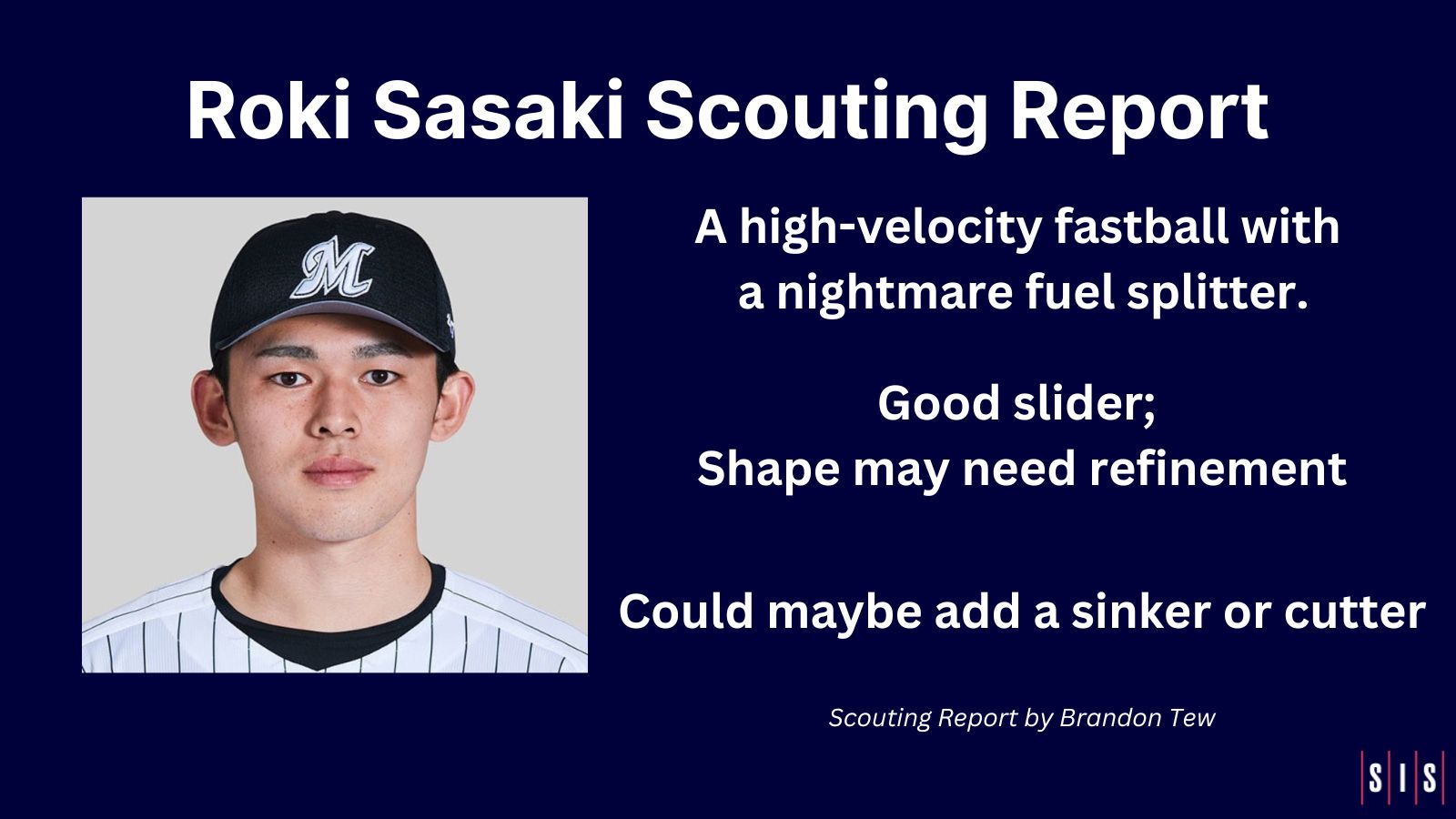
    Other options include upping velocity on his slider or maybe adding a cutter in the low-to-mid 90s, which could be fun! He could add a harder glove-side pitch to pair with his current slider if there’s not a complete rework of that pitch. He could have-in theory- a cutter and slider to use against right-handed batters although I expect the splitter to uptick in usage anyway.

    There’s clay to mold here and while Sasaki can be dominant with just his splitter and fastball, he knows how valuable more pitches are to him as a pitcher. He’s likely going to add at least one more pitch, if not two, for right-handed batters.

    MLB Projection and Future

    You can count on one hand how many pitchers have as much talent as Sasaki. He has a high-velocity fastball with a nightmare fuel splitter. Add in a possible plus third pitch and he’s got all the tools to succeed.

    His NPB career did not end in any major award wins and there was frustration with his health. He dazzled in his brief stint in NPB though, and like a shooting star streaking across the sky, his time there was too brief.

    Sasaki’s ceiling is as high as any pitcher and while he’s not a finished product he has true ace potential and the chance to be one of the best pitchers in baseball. He’s one of the best pitching talents of my lifetime.

  • Stat of the Week: Several Key Free Agents Don’t Have Great Defensive Stats

    Stat of the Week: Several Key Free Agents Don’t Have Great Defensive Stats

    Photo: Mark Goldman (l) and Nick Wosika (r)/Icon Sportswire

    Five of the best hitters available in free agency had negative Defensive Runs Saved in 2024.

    In the grand scheme of things, what these players do at the plate will far outweigh what they do in the field. But that’s not to say that it doesn’t matter at least a little bit. Let’s explore their individual situations.

    Juan Soto

    At the rate Soto is going, he’s going to be an all-time great hitter and he’s going to get paid an incredible amount of money to be one. Soto has shown that he can be a good defensive outfielder, but he’s also shown he can be below-average too.

    After accruing 6 Defensive Runs Saved in 2021, he’s totaled -5, -2, and -1 the last three seasons. He played right field in 2021, 2022, and 2024 and left field in 2023.

    Soto rated well in right field for most of the 2024 season. But in September, he had -5 Runs Saved (worst among right fielders) and 6 Defensive Misplays and Errors (tied for the most in the position). As far as range goes, in both 2022 and 2024, Soto was penalized the most on balls hit to the deepest part of right field.

    Soto’s Runs Saved would have been worse but for the value of his arm. The last two seasons he’s combined for 6 Outfield Arm Runs Saved.

    Soto had 4 outfield assists in the Yankees’ first 19 games in 2024. Both that and playing in a small ballpark like Yankee Stadium may have had something to do with baserunners advancing an extra base against him on 43% of the balls he fielded in 2024. The MLB average rate for right fielders was 51%.

    There isn’t anything about Soto’s defense that should scare teams off. A little below average isn’t going to cause a lot of trouble over 162 games. But it’s important to have a full understanding of what you’re getting when he’s on your team.

    Anthony Santander

    Santander hit a career-high 44 home runs last season, topping the 33 and 28 that he hit the previous two seasons, respectively. But in both 2022 and 2024, his defense held his WAR (Baseball-Reference version) down a little bit.

    Santander played 130 games in right field last season, the most he’d ever played at one position in a season. Our defensive metrics weren’t kind to him. He finished with -7 Runs Saved, which contributed to a  2.9 bWAR. Of the 19 40-homer seasons since 2021, Santander’s bWAR was worse than 16 of them.

    Santander’s defensive issues were different from Soto’s. By our calculations, he made 11 plays fewer than an average fielder on shallow and medium balls hit to the outfield, but he was 5 plays better than expected on balls hit to the deepest part of right field.

    Santander was also dinged for his arm. He allowed 61% of baserunners to take an extra base against him, 10 percentage points worse than the average right fielder. Among the 35 players who played right field the most last season, only Starling Marte had a worse rate.

    Santander had good defensive numbers in the past. He totaled a combined 14 Runs Saved in 85 games in right field in 2019 and 2020 and he had 3 Runs Saved there in 2023. With him it’s a question of whether his future performance will resemble his most recent play.

    Willy Adames

    We mentioned last week that Adames is a curious case. He had 9 Runs Saved as a shortstop in 2022 and 8 Runs Saved in 2023. But then he was a MLB-worst -16 Runs Saved in 2024.

    Our stats showed that Adames completely cratered. He went from 13 plays made above average in 2023 to 19 below average in 2024. As the chart below shows, he went from being one of the most reliable fielders on his forehand to one of the least reliable.

    Willy Adames- 2024 When Fielding On His Forehand

    Year Plays Made-Opportunities Success Rate
    2023 289-304 95% (1st in MLB)
    2024 269-304 89% (30th of 35)

    Interest in Adames is going to be high given his 32 home runs and 21 stolen bases in 161 games last season. Perhaps indicative of concerns about his defense is talk that one team, the Mets, is looking at him as a third baseman. As we wrote in a study done in 2022, moving from shortstop to third base isn’t necessarily an easy switch (spoiler: the study shows some fielders handle it well and others don’t). But perhaps in this case it will be a necessary one.

    Jurickson Profar

    Profar, who had the best offensive year of his career last season with the Padres, has a history of not being a good defensive player. After putting decent defensive numbers up in left field in repeated sets of small samples early in his career, he’s had -11 and -8 Runs Saved in left field the last two years, respectively. He’s played other positions and not fared well at those either.

    Statcast data indicates that Profar doesn’t chase balls down well. He rated below average in the amount of ground he covers in the first three seconds after a hitter makes contact. The team that signs him would do well to work with him on that … if they don’t make him a DH.

    Pete Alonso

    Alonso is an oddity in that he’s had three seasons with negative Runs Saved and three seasons with positive Runs Saved and he’s never had two in a row of either. In sum, he comes out as an average defensive first baseman through the first six years of his career.

    Alonso does two things in high volume. He led all first basemen with 39 Good Fielding Plays related to catching throws in 2024. No one else had more than 26. He also aggressively leaves his feet. He’s finished first or second at the position in the number of times he’s slid, dove, or jumped to make a play. There’s no lacking for effort in how he plays defense, which is good so long as he doesn’t injure himself in the process.


  • 2024 NPB Fielding Bible Awards

    2024 NPB Fielding Bible Awards

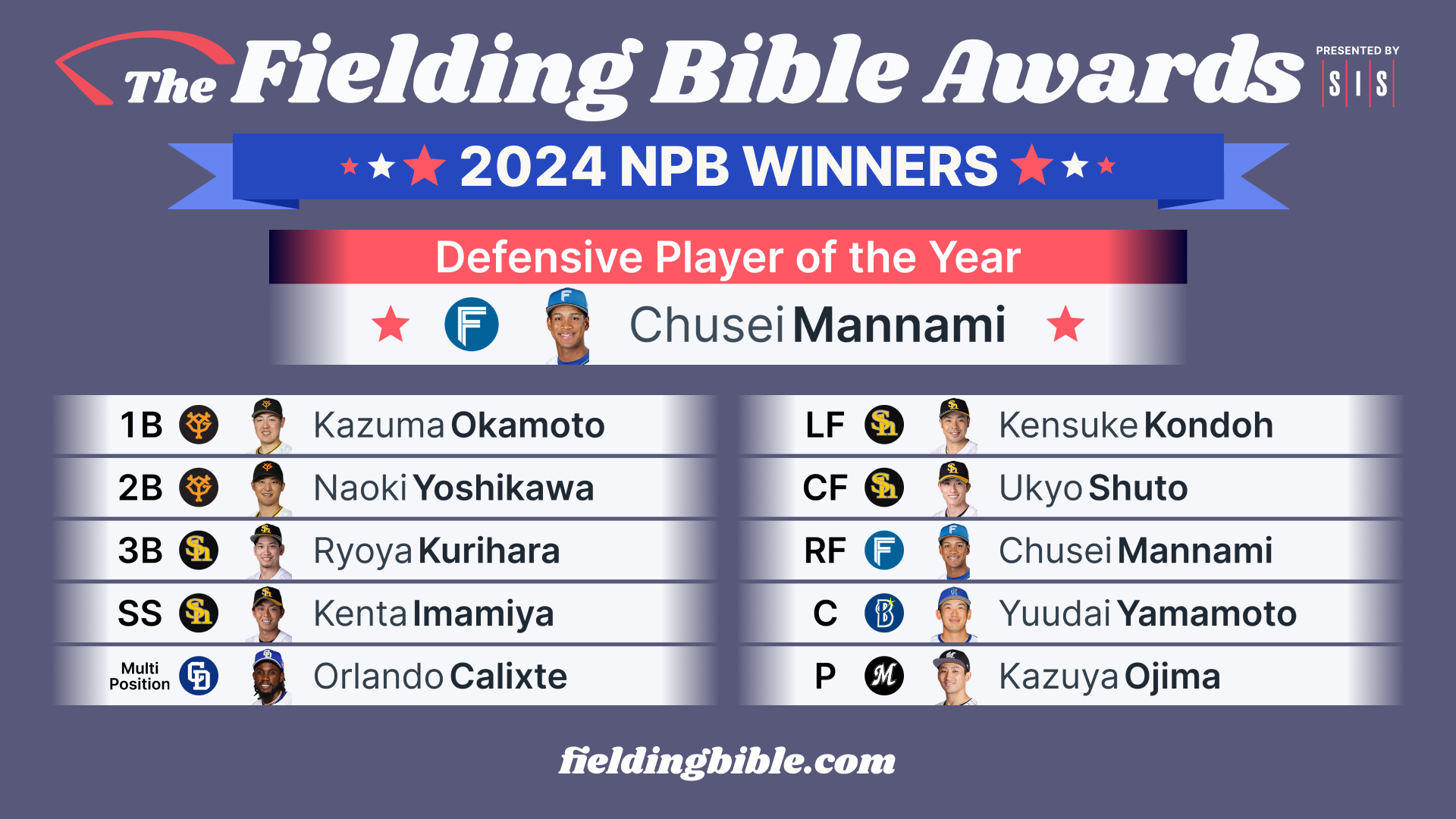
    SIS is pleased to announce the winners of the 2024 NPB Fielding Bible Awards.

    This marks the 5th season that we have honored the best defensive players in NPB. The awards are chosen by a panel of experts who consider statistical analysis, the eye test, and any other factors that they wish to utilize.

    We are also announcing the winner of the NPB Defensive Player of the Year award.

    This year’s winners are:

    Position Name Team
    Player of the Year Chusei Mannami Nippon-Ham
    1B Kazuma Okamoto Yomiuri
    2B Naoki Yoshikawa Yomiuri
    3B Ryoya Kurihara Softbank
    SS Kenta Imamiya Softbank
    LF Kensuke Kondoh Softbank
    CF Ukyo Shuto Softbank
    RF Chusei Mannami Nippon-Ham
    C Yuudai Yamamoto Yokohama
    P Kazuya Ojima Chiba Lotte
    Multi-Position Orlando Calixte Chunichi

    Defensive Player of the Year

    Nippon-Ham Fighters right fielder Chusei Mannami won the Defensive Player of the Year award for the second consecutive year. As good as Mannami was in 2023, he was even better in 2024.

    He improved upon his already amazing 12 Outfield Arm Runs Saved in 2023 by totaling an NPB-best 18 in 2024. He had 8 assists that did not involve the use of a cutoff man. Only one other NPB right fielder had even half that many. And only 29% of runners took an extra base on balls he fielded (NPB average is 38%). Mannami’s presence was felt daily. He played in 136 out of 143 regular season games.

    “The numbers and the eye test, he’s the whole package,” said Awards voter John E. Gibson of the Japan Baseball Weekly Podcast. “His cannon arm rivals that of Ichiro Suzuki and Yoenis Céspedes.”

    Added voter Yuri Kurasawa, who runs a popular YouTube and Twitter (X) account covering Japanese baseball: “He runs good routes and doesn’t let balls get behind him. And if a ball hits the wall, he has a Mookie Betts-ness to him in that he can field the carom off the wall and throw the ball right back in to hold baserunners.”

    Other winners

    The Softbank Hawks had four Fielding Bible Award winners – third baseman Yuri Kurihara, shortstop Kenta Imamiya, left fielder Kensuke Kondoh, and center fielder Ukyo Shuto.

    Softbank led NPB in Defensive Runs Saved, our stat measuring overall defensive value. Imamiya, Kondoh and Kurihara all led at their respective positions.

    The Yomiuri Giants, who led the Central League in Defensive Runs Saved, had two winners – first baseman Kazuma Okamoto and second baseman Naoki Yoshikawa.

    The Yokohama Bay Stars (catcher Yuudai Yamamoto), Chiba Lotte Marines (pitcher Kazuya Ojima) and Chunichi Dragons (multi-position Orlando Calixte) had one winner each. Calixte, whose MLB career spanned 31 games over two seasons with the Royals and Giants in 2015 and 2017, played at least 15 games at first base, third base, center field, and left field this season.

    Kondoh and Yoshikawa each also won a Fielding Bible Award in 2023. Shuto also won once before, taking the multi-position Award in 2020.

    Our expert panel consisted of NPB media: Jim Allen (Japan Baseball Weekly), John E. Gibson (Japan Baseball Weekly), and Yuri Karasawa (Yakyu Cosmopolitan), with oversight from Mark Simon, editorial lead at Sports Info Solutions.

    “We are honored to once again reward the best defensive players in NPB,” Simon said. “Defensive excellence is a foundational component of success in baseball worldwide and we can use both our metrics and the eye test to assess it in a way that wasn’t possible just a few years ago.”

    The NPB Fielding Bible Awards have been presented by SIS since 2020. SIS’ mission is to enhance and optimize the decision-making process for sports teams, sportsbooks, and sports fans. It has been an industry leader in baseball since its founding in 2002.

  • Stat of the Week: Free Agent Defensive Standouts

    Stat of the Week: Free Agent Defensive Standouts

    Two of the best defensive first basemen in baseball head the list of the best defensive players available in free agency this offseason.

    Christian Walker and Carlos Santana finished second and third, respectively, in The Fielding Bible Awards and won the Gold Glove Award in their respective leagues. Walker has won the Fielding Bible Award twice before. Santana has been a strong candidate for that honor in each of the last two seasons.

    Walker’s defense is significant, value wise. The most prominent free agent first baseman is Pete Alonso, but over the last three seasons, Walker has him beat in Defensive Runs Saved by a combined tally of 33-1 and has matched or bettered Alonso in Baseball-Reference’s Wins Above Replacement in each of those three seasons.

    Most Defensive Runs Saved – First Base

    Last 3 Seasons

    Player Runs Saved
    Christian Walker 33
    Matt Olson 27
    Carlos Santana 23
    Michael Toglia 11
    Ryan Mountcastle 11

    Both players should have plenty of suitors. Among those teams that need a first baseman (besides the Mets and Diamondbacks) are the Astros, who ranked last in Runs Saved at that position last season, and the Yankees, who lose Anthony Rizzo to free agency. Santana, the oldest position player to win a Gold Glove, is a solid fallback option.

    Michael A. Taylor seems to always end up on a list of top free agent defenders and in fact, his 11 Runs Saved in 2024 were the most of any free agent. Taylor ranks second to Daulton Varsho in Runs Saved among center fielders over the last three seasons. He may have a hard time finding a deal though after posting career lows in batting average (.193) and OPS (.543).

    Most Defensive Runs Saved – Center Field

    Last 3 Seasons

    Player Runs Saved
    Daulton Varsho 39
    Michael A. Taylor 37
    Kevin Kiermaier 30
    Brenton Doyle 29
    Myles Straw 22

    The other center fielder with a history of being a defensive standout is Harrison Bader. Though Bader fared well in other defensive metrics in 2024, he’s lagged in Defensive Runs Saved. Bader has 3 Runs Saved in 320 games in center field the last three seasons after totaling 15 there in 2019 and 18 there in 2021.

    Of the 44 players with at least 10 Runs Saved last season, the only one besides Taylor who is a free agent is utility infielder Kevin Newman, who totaled 6 Runs Saved in 44 games at second base and 4 Runs Saved in 55 games at shortstop (he also played 41 innings combined at first base, third base, and left field).

    Newman’s defensive history, which comes mostly as a shortstop, is up and down. He’s had as many as 9 Runs Saved in a season there and as few as -6.

    Ha-Seong Kim is also an intriguing option for a team looking for a middle infielder. Kim had 11 Runs Saved at shortstop in 2022 and 10 Runs Saved at second base in 2023. And he also has a credible history at third base.

    Kim moved back to shortstop for 2024 and totaled 2 Runs Saved, but more notably he suffered a shoulder injury that required labrum surgery. How this impacts him for the future is a question teams will have to consider.

    At third base, Alex Bregman is coming off a Gold Glove season and finished a strong 6th in a deep field in Fielding Bible Awards voting. There’s a reliability to Bregman’s defense. In nine seasons, he’s finished with a negative Runs Saved total only once.

    At catcher, Austin Hedges’ situation is similar to Taylor’s in center field – that of an excellent defensive player with poor offensive numbers. Over the last three seasons je ranked tied for 6th among catchers in Defensive Runs Saved and 4th in Strike Zone Runs Saved, the component that measures a catcher’s ability to get more strikes than expected for his pitchers. As we were writing this article, Hedges re-signed with the Guardians, who ranked 2nd in MLB in Defensive Runs Saved last season.

    Other notable free agents with good defensive histories include outfielders Alex Verdugo, who had 10 Runs Saved in right field with the Red Sox in 2023 then had 8 in left field in 2024, and Max Kepler, who has had as many as 12 Runs Saved in right field in a season.

    There is also the curious case of shortstop Willy Adames, who figures to be one of the most sought-after free agents this offseason. Adames had 9 Runs Saved in 2022 and 8 Runs Saved in 2023 and had a decent track record prior to that. But he had -16 Runs Saved in 2024, the worst total for any shortstop. We’ll be looking more closely at his performance and those of other prominent free agents later this offseason.

  • Stat of the Week: Celebrating The Fielding Bible Award Runners-Up

    Stat of the Week: Celebrating The Fielding Bible Award Runners-Up

    It would be inappropriate to say that the winners of this year’s Fielding Bible Awards were the only players deserving of the honor. We had a great field of candidates at each position, so, as we did last year, we thought it would be worthwhile to acknowledge those who were the runners-up in the voting at each position.

    First Base – Christian Walker of the Diamondbacks was the two-time reigning Award winner before being dethroned by four-time Award winner Matt Olson this year. Walker finished fifth at the position in Defensive Runs Saved. His 33 Runs Saved at first base over the last three seasons are the most of anyone at the position.

    Second Base – Brice Turang of the Brewers led all second basemen with 22 Runs Saved in 2024 but lost a close vote to the only repeat winner from 2023, Andrés Giménez of the Guardians. Turang was an MLB-best 22 plays made above average on balls hit to his right, repeatedly taking away hits on balls hit up the middle.

    Third Base – Ryan McMahon of the Rockies was a runner-up for the second straight season after finishing tied for second in Runs Saved at the position. He’s finished in the top four in voting at third base in each of the last four seasons but has never won an Award.

    Shortstop – Ezequiel Tovar of the Rockies was one of six shortstops to record at least 10 Runs Saved in 2024. He ranks second in Runs Saved at this position since the start of the 2023 season. Tovar excelled at turning batted balls into outs and turning double plays, though slightly less so statistically than position Award winner Masyn Winn.

    Left field – Steven Kwan of the Guardians was a two-time reigning winner before being dethroned by Riley Greene of the Tigers this year. This was Kwan’s best year in terms of his throwing. He had 4 Outfield Arm Runs Saved and allowed only 27% of runners to advance an extra base on balls he fielded (MLB average for left field is 39%).

    Center Field – Daulton Varsho of the Blue Jays was the runner-up in center field after finishing with the second-most Defensive Runs Saved there (he also had the second-most in left field). However, Varsho likely isn’t complaining. After all, he won both our Multi-Position Award and Defensive Player of the Year.

    Right Field – Sal Frelick of the Brewers was neck-and-neck with Wilyer Abreu in Runs Saved right up to the very end of the season. In fact, he led the position in the Range component of the stat. But he came up a little short, both in overall Runs Saved and in the Award voting, to Abreu.

    Catcher – Cal Raleigh of the Mariners had standout numbers in our pitch framing and stolen base metrics but had the misfortune of going against a defensive superstar in Giants catcher Patrick Bailey, who rated slightly better than Raleigh in both areas.

    Pitcher – Spencer Schwellenbach of the Braves is a former college shortstop and fields his position like one. He tied for second among pitchers in Defensive Runs Saved and came the closest to winning the voting among the second-place finishers. We wouldn’t be surprised to see him winning the Award next year.

    Multi-Position – Jarren Duran of the Red Sox had the second-most Runs Saved of anyone with his 23 split between center field and left field. Duran made huge improvements in center field in particular. He totaled 17 Runs Saved there after tallying -5, -9, and -5 the previous three seasons.

    For more Fielding Bible Awards content, visit SportsInfoSolutions.com. You can also check out FieldingBible.com for all the latest defense-related stats.

  • 2024 Fielding Bible Awards Ballots & Voting Tally

    2024 Fielding Bible Awards Ballots & Voting Tally

    Last week Sports Info Solutions announced the winners of The Fielding Bible Awards.

    The 2024 Awards were determined by a panel of 16 voters, who ranked the top 10 players at each defensive position (including a spot for multi-position players) on a scale from 1 to 10 at the conclusion of the regular season. A first place vote gets 10 points, second place gets 9 points, third place gets 8 points, etc. Total up the points for each player, and the player with the most points wins the award. A perfect score is 160 points. There were no unanimous selections this year.

    The panel also voted its top three choices for Defensive Player of the Year, with first place getting 5 points, second place 3 points, and third place 1 point.

    Our voting panel consisted of SIS co-founder John Dewan, along with Daniel Álvarez-Montes (El Extra Base, editor/writer), Ben Clemens (FanGraphs, writer), Chris Dial (sabermetrician), Alyson Footer (MLB.com, editor), Tyler Kepner (The Athletic, writer), Bill Ladson (MLB.com, writer), Eduardo Pérez (ESPN, broadcaster), Hal Richman (Strat-O-Matic, founder), Eno Sarris (The Athletic, writer), Travis Sawchik (The Score, writer), Bobby Scales (Detroit Tigers, radio broadcaster), Joe Sheehan (Joe Sheehan’s Baseball Newsletter, writer), Mark Simon (SIS, writer), Dani Wexelman (MLB Network Radio, broadcaster), and an aggregate vote from the SIS Video Scout staff.

    (scroll right, over the table to see the full list of ballots and the overall point total)

    Catcher

    Name Footer Clemens Ladson Scales Dial Wexelman Álvarez-Montes Pérez Sarris Richman Sheehan Dewan Simon SIS Video Scouts Sawchik Kepner Points
    Patrick Bailey 1 1 2 1 2 2 1 1 2 1 3 2 1 1 1 1 153
    Cal Raleigh 2 2 1 2 1 1 2 2 1 2 2 4 2 2 2 2 146
    Alejandro Kirk 7 4 3 3 3 3 4 5 3 7 4 3 7 4 3 4 109
    Jake Rogers 4 3 5 5 7 6 5 4 4 3 5 8 4 5 6 3 99
    Freddy Fermin 3 7 10 4 4 9 3 1 5 3 3 4 5 82
    Austin Wells 6 5 7 7 8 7 6 7 5 10 5 6 7 6 62
    Bo Naylor 5 6 4 6 9 4 7 6 6 6 7 10 7 60
    Gabriel Moreno 8 10 6 10 6 8 8 8 7 9 6 6 8 8 5 52
    William Contreras 8 9 10 5 3 10 10 8 10 8 8 32
    Jose Trevino 9 8 9 8 1 10 9 23

    Others receiving votes: Christian Vázquez 18, Adley Rutschman 10, J.T. Realmuto 7, Will Smith 7, Sean Murphy 6, Francisco Alvarez 5, Elias Díaz 4, Jonah Heim 4, Nick Fortes 1.

    First Base

    Name Footer Clemens Ladson Scales Dial Wexelman Álvarez-Montes Pérez Sarris Richman Sheehan Dewan Simon SIS Video Scouts Sawchik Kepner Points
    Matt Olson 1 2 1 3 1 2 1 1 2 3 1 1 1 1 2 142
    Christian Walker 1 1 2 4 3 1 6 2 1 2 2 3 2 2 1 132
    Carlos Santana 2 3 7 3 1 2 3 3 3 3 1 4 2 3 4 6 126
    Bryce Harper 5 4 6 7 5 6 4 8 4 7 4 6 8 6 5 7 84
    Ryan Mountcastle 4 5 3 5 6 5 6 5 9 9 8 5 5 5 7 9 80
    Michael Toglia 8 7 2 4 4 2 9 3 4 4 3 3 79
    Michael Busch 6 5 6 9 7 8 7 7 10 8 7 7 8 8 51
    Nathaniel Lowe 7 8 10 7 5 5 4 6 10 6 42
    Freddie Freeman 6 10 9 8 7 9 8 8 10 10 9 4 34
    LaMonte Wade Jr. 9 4 10 9 7 6 8 9 10 27

    Others receiving votes:  Vladimir Guerrero Jr. 18, Jake Cronenworth 16, Paul Goldschmidt 13, Anthony Rizzo 12, Vinnie Pasquantino 9, Spencer Torkelson 5, Nolan Schanuel 4, Connor Joe 3, Josh Naylor 2, Pete Alonso 1.

    Second Base

    Name Footer Clemens Ladson Scales Dial Wexelman Álvarez-Montes Pérez Sarris Richman Sheehan Dewan Simon SIS Video Scouts Sawchik Kepner Points
    Andrés Giménez 2 1 1 1 2 2 1 1 1 1 1 1 1 2 1 1 156
    Brice Turang 1 2 3 2 1 1 3 2 4 3 3 2 2 1 3 2 141
    Marcus Semien 3 4 5 3 3 3 2 3 2 2 2 3 3 3 2 7 126
    Ketel Marte 5 5 2 4 6 5 4 4 5 6 8 5 4 4 6 6 97
    Bryson Stott 4 7 4 5 8 4 6 5 7 7 5 4 6 6 7 3 88
    Nico Hoerner 6 6 6 7 7 6 5 3 5 4 6 7 7 4 5 81
    Otto Lopez 3 6 4 10 7 6 6 4 10 7 5 5 5 8 68
    Ozzie Albies 10 8 5 7 7 10 8 6 8 9 8 4 42
    Xander Bogaerts 8 9 10 9 10 9 11
    Isiah Kiner-Falefa 9 9 10 8 8 11

    Others receiving votes: Isiah Kiner-Falefa 10, Jose Iglesias 10, Michael Massey 10, Jeff McNeil 7, Richie Palacios 7, Thairo Estrada 6, Zack Gelof 5, Nicky Lopez 4, Luis García 3, Gavin Lux 3, Brendan Rodgers 3, Brett Wisely 1.

    Third Base

    Name Footer Clemens Ladson Scales Dial Wexelman Álvarez-Montes Pérez Sarris Richman Sheehan Dewan Simon SIS Video Scouts Sawchik Kepner Points
    Matt Chapman 1 1 1 2 1 1 1 1 1 1 1 1 1 1 1 1 159
    Ryan McMahon 2 5 2 1 3 2 3 2 6 2 4 3 2 2 3 2 132
    Joey Ortiz 6 2 3 3 4 4 2 3 2 4 3 8 4 5 6 8 109
    Nolan Arenado 3 4 4 8 2 6 5 4 3 5 5 4 9 6 4 3 101
    Ke’Bryan Hayes 3 6 9 3 6 6 5 3 2 2 3 3 2 4 97
    Alex Bregman 4 7 5 4 6 7 4 5 4 7 7 10 5 7 7 5 82
    José Ramírez 5 9 10 5 5 8 10 8 7 8 9 7 10 5 6 53
    Josh Rojas 10 6 9 7 7 5 8 6 8 9 9 9 10 40
    Ernie Clement 8 9 8 10 5 6 4 8 9 32
    Maikel Garcia 9 10 6 9 7 7 9 10 6 26

    Others receiving votes: Manny Machado 23, Oswaldo Cabrera 8, Alec Bohm 6, Max Muncy 5, Austin Riley 3, Eugenio Suárez 2, Gio Urshela 1, Jordan Westburg 1.

    Shortstops

    Name Footer Clemens Ladson Scales Dial Wexelman Álvarez-Montes Pérez Sarris Richman Sheehan Dewan Simon SIS Video Scouts Sawchik Kepner Points
    Masyn Winn 1 4 1 1 2 1 8 1 2 8 1 4 3 1 1 1 136
    Ezequiel Tovar 3 1 3 4 4 1 4 7 3 6 5 1 4 8 3 108
    Dansby Swanson 4 3 7 5 3 7 4 6 4 1 3 3 4 6 2 7 107
    Brayan Rocchio 6 2 8 3 2 3 6 9 8 7 5 2 5 2 86
    Zach Neto 2 9 3 4 6 2 2 10 6 8 5 3 72
    Francisco Lindor 8 2 5 3 5 1 2 5 9 10 4 67
    Anthony Volpe 6 5 6 6 7 9 9 5 4 4 9 10 4 5 65
    J.P. Crawford 7 5 9 1 5 8 10 2 7 9 9 49
    Taylor Walls 2 10 9 7 1 6 3 6 44
    Bobby Witt Jr. 10 8 10 10 5 10 3 6 2 10 9 6 43

    Others receiving votes: Miguel Rojas 29, Geraldo Perdomo 22, Gunnar Henderson 15, Elly De La Cruz 13, Jeremy Peña 10, Corey Seager 9, Ha-Seong Kim 5.

    Left Field

    Name Footer Clemens Ladson Scales Dial Wexelman Álvarez-Montes Pérez Sarris Richman Sheehan Dewan Simon SIS Video Scouts Sawchik Kepner Points
    Riley Greene 1 2 1 1 4 1 3 3 3 2 2 2 1 1 2 2 145
    Steven Kwan 5 4 3 2 8 3 6 7 2 1 1 1 3 3 1 3 123
    Ian Happ 2 8 4 3 1 4 1 1 5 5 7 3 2 4 4 1 121
    Wyatt Langford 3 7 2 5 3 2 5 6 4 7 3 4 4 2 3 6 110
    Alex Verdugo 4 6 9 4 6 5 2 2 7 6 4 7 5 6 5 87
    Colton Cowser 9 1 6 6 5 9 8 1 4 5 9 8 5 5 73
    Lourdes Gurriel Jr. 6 3 5 8 6 4 8 9 6 6 7 10 6 59
    Brandon Marsh 9 8 7 8 7 10 3 5 6 7 4 47
    Brandon Nimmo 10 7 7 7 10 4 10 10 10 10 7 7 33
    Jackson Chourio 5 9 10 9 6 8 8 9 9 9 28

    Others receiving votes: Taylor Ward 26, Miguel Andujar 9, Joey Loperfido 9, Bryan Reynolds 4, Michael Conforto 2, Tyler O’Neill 2, Brendan Donovan 1, Luke Raley 1.

    Center Field

    Name Footer Clemens Ladson Scales Dial Wexelman Álvarez-Montes Pérez Sarris Richman Sheehan Dewan Simon SIS Video Scouts Sawchik Kepner Points
    Brenton Doyle 5 2 3 1 2 5 1 5 3 1 3 5 3 5 7 1 124
    Daulton Varsho 6 1 6 7 1 8 3 5 1 1 1 1 1 3 109
    Pete Crow-Armstrong 1 3 8 4 1 3 7 7 1 3 5 8 7 3 3 6 106
    Jacob Young 6 1 4 8 3 6 5 6 2 2 4 9 2 6 4 5 103
    Jose Siri 2 8 7 7 5 4 3 1 4 6 6 4 5 4 5 10 95
    Jarren Duran 2 5 10 2 2 2 2 2 4 2 2 2 95
    Michael Harris II 5 2 8 4 8 7 10 7 6 8 8 7 52
    Michael A. Taylor 6 7 4 8 7 3 8 7 38
    Kevin Kiermaier 7 10 9 10 4 6 10 9 6 28
    Jake Meyers 10 4 4 10 6 10 6 10 28

    Others receiving votes: Michael Siani 23, Blake Perkins 18, Jackson Merrill 16, Julio Rodríguez 13, Johan Rojas 13, Parker Meadows 11, Kyle Isbel 8.

    Right Field

    Name Footer Clemens Ladson Scales Dial Wexelman Álvarez-Montes Pérez Sarris Richman Sheehan Dewan Simon SIS Video Scouts Sawchik Kepner Points
    Wilyer Abreu 1 1 3 1 1 1 1 1 1 2 1 1 1 2 1 3 154
    Sal Frelick 3 2 2 2 2 2 2 4 2 1 2 2 2 1 2 1 144
    Mike Yastrzemski 2 3 4 4 4 6 3 6 5 5 6 4 7 4 6 96
    Jo Adell 4 5 3 3 3 4 2 5 7 3 6 3 7 88
    Fernando Tatis Jr. 4 7 5 10 8 8 6 3 3 6 5 8 8 6 2 76
    Tyrone Taylor 1 8 5 4 3 3 7 3 4 61
    Max Kepler 7 5 10 7 7 7 5 4 8 7 5 49
    Jonny Deluca 6 10 3 6 4 8 5 10 36
    Dominic Fletcher 10 8 9 8 4 6 4 5 34
    Seiya Suzuki 8 9 7 9 6 7 10 5 9 8 32

    Others receiving votes: Lawrence Butler 20, Wenceel Pérez 17, Juan Soto 17, Jake Fraley 14, Lars Nootbaar 14, Ramón Laureano 8, Jesús Sánchez 7, George Springer 6, Adolis García 2, Mitch Haniger 2, Josh Lowe 2, Anthony Santander 1.

    Multi-Position 

    Name Footer Clemens Ladson Scales Dial Wexelman Álvarez-Montes Pérez Sarris Richman Sheehan Dewan Simon SIS Video Scouts Sawchik Kepner Points
    Daulton Varsho 1 3 5 6 1 1 1 3 4 3 1 1 1 1 122
    Jarren Duran 3 2 6 2 2 2 2 5 4 3 2 2 3 105
    Isiah Kiner-Falefa 2 4 2 6 9 3 3 6 3 1 2 3 3 5 102
    Mauricio Dubon 4 1 1 1 8 3 9 6 1 2 2 4 6 8 8 101
    Ceddanne Rafaela 6 7 2 7 4 5 4 7 3 1 6 5 4 4 2 98
    Mookie Betts 10 6 1 10 10 4 2 5 7 7 8 5 9 59
    Kevin Newman 9 4 2 5 6 9 6 5 9 4 51
    Tyrone Taylor 10 3 9 6 6 7 8 10 5 9 7 6 7 50
    Jared Triolo 5 8 3 7 8 5 9 8 9 7 6 46
    Kiké Hernández 5 4 5 5 10 9 8 10 9 8 8 10 10 10 43

    Others receiving votes: José Caballero 27, Matt Vierling 16, Vidal Bruján 12, Jazz Chisholm 12, Rickie Palacios 12, Zach McKinstry 8, Willi Castro 7, Jake McCarthy 7, Max Schuemann 1.

    Pitcher

    Name Footer Clemens Ladson Scales Dial Wexelman Álvarez-Montes Pérez Sarris Richman Sheehan Dewan Simon Video Scouts Sawchik Kepner Score
    Tanner Bibee 1 5 3 2 4 2 3 2 8 3 7 3 2 2 2 116
    Spencer Schwellenbach 2 1 1 1 2 1 4 8 5 1 1 1 1 114
    Seth Lugo 2 6 4 8 3 4 5 1 3 1 4 4 5 7 97
    Ranger Suárez 6 5 9 3 6 8 1 2 1 2 7 6 3 84
    Jake Irvin 9 2 3 2 3 8 5 4 10 8 5 3 3 6 83
    Griffin Canning 4 6 5 6 4 5 4 8 5 4 4 66
    Luis Severino 5 1 7 2 8 7 9 2 9 9 9 53
    Martín Pérez 8 7 5 6 3 6 6 7 10 41
    Michael Wacha 10 9 7 5 6 9 6 8 8 8 34
    Michael King 3 8 9 9 1 10 5 32

    Others receiving votes: Zach Eflin 22, José Berríos 17, Chris Flexen 15, Zach Wheeler 15, Shota Imanaga 14, Tarik Skubal 14, Chris Sale 12, Paul Skenes 9, Max Fried 7, Ronel Blanco 6, Sonny Gray 6, Framber Valdez 5, George Kirby 4, Cole Ragans 4, Brady Singer 4, Aaron Civale 3, Michael Lorenzen 1, Charlie Morton 1, Jose Quintana 1.

    Player of the Year

    Player Footer Clemens Ladson Scales Dial Wexelman Álvarez-Montes Pérez Sarris Richman Sheehan Dewan Simon SIS Video Scouts Sawchik Kepner Points
    Daulton Varsho 1 1 2 1 1 1 1 2 36
    Andrés Giménez 2 2 1 2 1 2 2 2 3 29
    Patrick Bailey 1 2 2 3 2 3 3 1 22
    Matt Chapman 1 3 1 11
    Masyn Winn 3 1 1 11

    Others receiving votes: Brice Turang 10, Pete Crow-Armstrong 6, Jarren Duran 5, Cal Raleigh 4, Jacob Young 3, Christian Walker 3, Brenton Doyle 2, Marcus Semien 1, Bobby Witt Jr. 1.

  • 2024 Fielding Bible Award Winners

    2024 Fielding Bible Award Winners

    Fielding Bible Award winners
Defensive Player of the Year - Daulton Varsho
1B- Matt Olson
2B- Andres Gimenez
3B- Matt Chapman
SS- Masyn Winn
LF- Riley Greene
CF- Brenton Doyle
RF- Wilyer Abreu
C- Patrick Bailey
Multi-Position- Daulton Varsho
P- Tanner BibeeSIS is pleased to announce the winners of the 2024 Fielding Bible Awards. This marks the 19th season that we have honored the best defensive players in MLB. The awards are voted on by a panel of experts who consider statistical analysis, the eye test, and any other factors that they wish to utilize. 

    We are also announcing the winner of our second annual Defensive Player of the Year award.

    This year’s group of winners includes three players who previously won a Fielding Bible Award and seven first-time winners. It also marks the first time that two rookies won the Award in the same year (Winn and Abreu). The Giants and Guardians were the only teams to have multiple players win an Award this year.

    The winners are:

    Defensive Player of the Year

    Daulton Varsho is our second annual Defensive Player of the Year. Varsho led all players with 28 Defensive Runs Saved. Varsho’s defensive dominance extends beyond this past season. He leads all players in Defensive Runs Saved over the last three seasons combined.

    “Daulton Varsho is a highly deserving winner of Defensive Player of the Year,” said SIS editorial operations lead, Mark Simon. “He played with an incredible effort level and a determination to make every play he possibly could. He had a fantastic season and this is one of his rewards for it.”  

    Said Blue Jays manager John Schneider: “Daulton never ceases to amaze us. We are really spoiled with him out there. Guys love playing with him because he makes tough plays look routine and makes everyone around him better. It feels like he makes game-changing plays and picks us up every single night. We’ve been saying he’s the best defender in baseball for the last two years, and I’m glad he’s starting to get the proper recognition for it.”

    Individual Positions

    First Base – Matt Olson, Atlanta Braves

    Olson won a Fielding Bible Award for the fourth time in his career. He previously won it in 2018, 2019, and 2020. The only first baseman to win it more often than Olson is Albert Pujols (five times).

    Olson led all first basemen with 13 Defensive Runs Saved. After recording 27 and 26 Defensive Misplays & Errors in 2022 and 2023, respectively, he cut that number to 19 in 2024. As per usual for him, he also rated well above average on balls hit to his right. 

    Olson is also highly durable. He led MLB in innings played at first base and has played 162 games in each of the last three seasons.

    Olson is the first Braves player to win an Award since pitcher Max Fried won in 2020. Olson is the only Braves player to win the Award at first base. 

    Second Base – Andrés Giménez, Cleveland Guardians

    Giménez won his second straight Fielding Bible Award, joining Dustin Pedroia (2013, 2014) and Kolten Wong (2018, 2019, 2020) as second basemen to do that since the Awards began in 2006.

    Giménez put up nearly identical defensive numbers to those he had in 2023. His 20 Defensive Runs Saved ranked second among second basemen. He was 11 plays saved above average on balls hit to his right and 10 plays above average on balls hit to his left, each of which ranked second-best in MLB. He easily led second basemen with 33 Good Fielding Plays.

    The Guardians have now had multiple Fielding Bible Award winners in three straight years, with Steven Kwan and Myles Straw winning in 2022, Giménez and Kwan winning in 2023, and Giménez and Tanner Bibee winning in 2024 .

    Giménez is the only Guardians player to win an Award at second base.

    Third Base – Matt Chapman, San Francisco Giants

    Chapman won a Fielding Bible Award for the third time in his career. He also won it in 2018 and 2019. He was one vote shy of being a unanimous selection in all three instances.

    Chapman easily led third basemen with 17 Defensive Runs Saved. No one else at the position had more than 10 Runs Saved in 2024. Chapman rated above average on balls hit to his right, to his left, and straight-on.

    Chapman and Patrick Bailey are the third and fourth Giants to win an Award, joining Pedro Feliz (third base, 2007) and Buster Posey (catcher, 2015 and 2016).

     Shortstop – Masyn Winn, St. Louis Cardinals

    Winn won his first Fielding Bible Award. He is the seventh different shortstop to win the Award in the last seven years. Winn and Wilyer Abreu are the fifth and sixth rookie to win a Fielding Bible Award, joining Troy Tulowitzki (2007), Mike Trout (2012), Ke’Bryan Hayes (2021), and Steven Kwan (2022).

    Winn was MLB’s premier shortstop when it came to turning double plays. In fact, his 6 Double Play Runs Saved is tied with Andrelton Simmons for the most in a season by a shortstop since Runs Saved was first tracked in 2003.

    The Cardinals have won an MLB-best 21 Fielding Bible Awards since the Awards were first given in 2006. Winn is the first Cardinals shortstop to win an Award. 

    Left Field – Riley Greene, Detroit Tigers

    Greene won his first Fielding Bible Award and snapped Steven Kwan’s two-year run of winning the Award in left field. 

    Greene led all left fielders with 14 Defensive Runs Saved, which was helped by 3 home run robberies. He led the position in Runs Saved despite ranking 19th in innings played.

    Greene is the first Tigers player to win an Award since Ian Kinsler won at second base in 2015 and is the first Tigers left fielder to win a Fielding Bible Award.

    Center Field – Brenton Doyle, Colorado Rockies

    Doyle, runner-up for a Fielding Bible Award last year, won the award in a close vote this year.

    Though Doyle got off to a slow start, he led center fielders in Defensive Runs Saved from May 1 through the end of the season. His 22 Good Fielding Plays for the season were the most among center fielders. He led the position in that stat last year as well.

    Doyle is the first Rockies outfielder to win a Fielding Bible Award.

    Right Field – Wilyer Abreu, Boston Red Sox

    Abreu, a rookie, won his first Fielding Bible Award. He and Masyn Winn are the fifth and sixth rookie to win a Fielding Bible Award, joining Troy Tulowitzki (2007), Mike Trout (2012), Ke’Bryan Hayes (2021), and Steven Kwan (2022).

    Abreu led all right fielders with 17 Defensive Runs Saved and 6 Outfield Arm Runs Saved. He had above-average range on shallow, medium, and deep fly balls.

    Abreu is the second Red Sox player to win an Award in the last four years (Kiké Hernández, multi-position, 2021). He is the second Red Sox right fielder to win a Fielding Bible Award. The other is Mookie Betts, who won it for them in 2016, 2017, and 2018. 

    Catcher – Patrick Bailey, San Francisco Giants

    Bailey, the runner-up for a Fielding Bible Award last year, won for the first time this year.

    Bailey led all catchers with 20 Defensive Runs Saved. He led all catchers in Strike Zone Runs Saved, a stat that measures a catcher’s skill at getting more strikes than expected. He also ranked tied for third in Stolen Bases Runs Saved.

    Bailey joined Buster Posey as the only Giants catchers to win a Fielding Bible Award. Posey won it in 2015 and 2016.

    Pitcher – Tanner Bibee, Cleveland Guardians

    Bibee, the MLB co-leader in Defensive Runs Saved for pitchers, won his first Fielding Bible Award.

    Bibee’s 6 Runs Saved were equally split between the range component and the stolen base component. He held baserunners to 6 stolen bases against 6 caught stealing. He also co-led the American League and ranked third in the major leagues with 4 pickoffs.

    Bibee is the only Guardians pitcher to win a Fielding Bible Award.

    Multi-Position – Daulton Varsho, Toronto Blue Jays

    Varsho narrowly missed out on a Fielding Bible Award last year but would not be denied in 2024. He won the Award for the first time in his career.

    Varsho ranked second among center fielders with 16 Defensive Runs Saved AND tied for second among left fielders with 12 Runs Saved. He did that despite ranking 27th in innings played in center field and 36th in innings played in left field. This is the second consecutive year that Varsho had at least 10 Runs Saved at each of those positions. Varsho excelled at catching both deep and shallow fly balls and also had 3 Outfield Arm Runs Saved.

    Varsho is the first Blue Jays player to win the multi-position Award, which has been voted on annually since 2014. This is the second straight year a Blue Jays player won a Fielding Bible Award. Kevin Kiermaier won in center field last season.

    The 2024 Awards were determined by a panel of 16 voters, who ranked the top 10 players at each defensive position (including a spot for multi-position players) on a scale from 1 to 10 at the conclusion of the regular season. A first place vote gets 10 points, second place gets 9 points, third place gets 8 points, etc. Total up the points for each player, and the player with the most points wins the award. A perfect score is 160 points. There were no unanimous selections this year.

    The panel voted its top three choices for Defensive Player of the Year, with first place getting 5 points, second place 3 points, and third place 1 point. 

    Our voting panel consisted of SIS co-founder John Dewan, along with Daniel Álvarez-Montes (El Extra Base, editor/writer), Ben Clemens (FanGraphs, writer), Chris Dial (sabermetrician), Alyson Footer (MLB.com, editor), Tyler Kepner (The Athletic, writer), Bill Ladson (MLB.com, writer), Eduardo Pérez (ESPN, broadcaster), Hal Richman (Strat-O-Matic, founder), Eno Sarris (The Athletic, writer), Travis Sawchik (The Score, writer), Bobby Scales (Detroit Tigers, radio broadcaster), Joe Sheehan (Joe Sheehan’s Baseball Newsletter, writer), Mark Simon (SIS, writer), Dani Wexelman (MLB Network Radio, broadcaster), and an aggregate vote from the SIS Video Scout staff.

  • Defensive Scouting Report: Los Angeles Dodgers

    Defensive Scouting Report: Los Angeles Dodgers

    The Dodgers ranked 3rd in the majors in Defensive Runs Saved in 2024, which, given the names on the roster, probably leads you to think that certain players must have had big defensive seasons.

    But that’s actually not the case. The Dodgers’ success was a collective effort, one they’ll try to carry through the World Series beginning Friday night.

    Here’s a deeper look at the team’s performance in 2024.

    Strengths

    Defensive Positioning

    We wrote about this back in May. What makes the Dodgers’ defense so good is not so much the skill of their players but that their players are often situated in the best spots to make plays.

    The Dodgers led the majors with 51 Positioning Runs Saved this season. Both their infield positioning total (34) and outfield positioning total (17) ranked No. 1 in MLB.


    Though the sport has made changes to try to limit the usage of shifts, teams still play partial versions of them. They’ll move their shortstop or second baseman adjacent to second base to try to cut balls off and move other infielders around to limit the damage on pulled ground balls.

    During the regular season, the Dodgers had a partial shift on against 83% of the balls in play, the second-highest rate in MLB (Mariners 86%). Against left-handed batters, they had it on for 97% of balls in play, basically matching the Mariners for the highest rate. And it paid off.

    Track record

    The Dodgers have four past Fielding Bible Award winners on their roster in Mookie Betts, Tommy Edman, Kevin Kiermaier, and Kiké Hernández. 

    They also have several other players with strong defensive reputations. Freddie Freeman has been one of the game’s best throw-scoopers. At age 35, Miguel Rojas, even hampered by a thigh strain, is putting up numbers better than his peers, most of whom are at least 5 years younger than him. Will Smith and Max Muncy also have good defensive histories.

    Kiermaier had 10 Runs Saved in center field this season. Edman has 11 Runs Saved in about the equivalent of one season in his career at shortstop. Rojas had 8 Runs Saved at shortstop. Hernández played 6 positions this season (not counting pitcher) and was average or better at all of them. Betts has only 3 Runs Saved over his last 150 games in right field (2023 and 2024 combined) but would have had more if he wasn’t at shortstop for much of the year.

    These players may not be at their peak, but if you’re looking for one good defensive moment from them in a key spot, these players are capable of excellence.

    And this goes hand in hand with …

    Versatility

    If you want to play for the Dodgers you have to be flexible. When someone significant gets hurt (see Freddie Freeman), the Dodgers can replace him without losing as much as other teams would. 

    Look at the Dodgers’ starters around the infield and outfield in Game 6 of the NLCS.

    (career totals)

    1B- Max Muncy: 

    Has made at least 90 starts at 3 positions

    2B- Chris Taylor: 

    Has made at least 10 starts at 6 positions

    SS- Tommy Edman: 

    Has made at least 50 starts at 5 positions

    3B- Kiké Hernández: 

    Has made at least 10 starts at 7 positions

    LF- Teoscar Hernández: 

    Has made at least 75 starts at all 3 outfield positions

    CF- Andy Pages: 

    Has made at least 4 starts at all 3 outfield positions (in less than a full season)

    RF- Mookie Betts: 

    Has made at least 70 starts at 4 positions

    We mentioned that Edman, Kiké Hernández, and Betts have won Fielding Bible Awards. They’ve each won for multi-position play.

    Weaknesses

    Andy Pages and Teoscar Hernández as currently situated

    Andy Pages has posted good defensive numbers in right field this season. So has Tesocar Hernandez. But neither is likely to play there this series barring an injury to Mookie Betts.

    So the Dodgers will live with Pages’ -8 Runs Saved in center field (much of which was accumulated early in the season) and Hernández’s -8 in left field and hope that their bats outweigh whatever happens in the field. 


    Pitch Blocking and Pitch Framing

    This one surprised us because it hasn’t been a noticeable issue in the NLDS or NLCS. Will Smith, normally a solid defensive catcher, had a rough year when it came to both pitch blocking and pitch framing, totaling -5 Runs Saved in each. Only three catchers were worse by Runs Saved in framing, 2 were worse in blocking. Neither of these had been a significant problem for Smith in the past.

    And it should be pointed out that Smith makes up for this. His 8 Runs Saved on stolen bases led MLB (his caught stealing percentage is 28% at a time when average is around 21%).

    Three other things

    * Speaking of stolen bases, here’s a look at how some of the Dodgers’ prominent pitchers fared when it came to limiting them.

    Pitcher SB-CS
    Walker Buehler 12-2
    Blake Treinen 8-1
    Jack Flaherty 5-2 (with Dodgers)
    Alex Vesia 5-5
    Yoshinobu Yamamoto 3-1

    * Gavin Lux’s return from a knee injury this year didn’t go well on the defensive side. Lux had defensive issues in spring training that necessitated his flipping positions with Mookie Betts. 

    Lux played regularly at second base in 2024 but didn’t live up to his past numbers (15 Runs Saved spaced out over four seasons). He totaled -2 Runs Saved, in particular not doing well statistically on balls hit in the 3-4 hole.  He didn’t start Games 4, 5 or 6 of the LCS and it will be interesting to see what his World Series role is.

    * Austin Barnes had a bigger role in postseasons past as Clayton Kershaw’s catcher. He’s appeared in only one game this postseason and probably won’t see the field unless Will Smith is hurt. Though Barnes is a standout pitch framer and pitch blocker, in today’s game he’s a liability. He allowed 48 stolen bases and had only 3 caught stealings during the 2024 regular season.