Category: MLB

  • New podcast: Austin Hedges passionate about pitch-framing

    LISTEN HERE
    On this episode of the Sports Info Solutions baseball podcast, senior research analyst Mark Simon (@MarkASimonSays) begins the show by praising those who played extraordinary defense for sub-.500 teams this season. (0:57)

    Mark is then joined by Padres catcher Austin Hedges, who rates as the No. 1 pitch-framer in baseball. Hedges talks about the value of pitch-framing and explains where he learned to frame so well (2:27). He then explains the drills he uses to improve (4:54), how he gets low pitches called strikes and what it’s like to catch Craig Stammen’s heavy sinker and Chris Paddack’s fastball (5:56). Hedges also talks about his relationship with umpires and why he strongly supports the human element of an umpire rather than the potential robot umpires of the future (8:00) and which catchers he watches most closely (12:17).

    Mark is then joined by research associate Andrew Kyne (@Andrew_Kyne). They discuss the Hedges interview (15:24), go through the leaderboards for Strike Zone Runs Saved, HR robberies, and Hard-Hit Rates (17:32), answer listener questions on pickoffs and the Mets defense behind Jacob deGrom (21:56) and Andrew gives job-hunting tips to aspiring research analysts (23:23). The show closes with ridiculous numbers about defensive support, the tie-in of Khris and Chris Davis, the leader in bunt hits this season, as well as a final pick of their favorite underappreciated players (27:26).

  • How does Dallas Keuchel lead pitchers in Defensive Runs Saved?

    By Mark Simon

    If you saw our Instagram picture of the Defensive Runs Saved leaders by position yesterday, you might have noticed something unusual.

    Atlanta Braves starter Dallas Keuchel leads all pitchers in Defensive Runs Saved with six. That’s not odd because of who the leader is – Keuchel typically ranks among the best-fielding pitchers in the game. It’s odd because Keuchel didn’t throw a pitch in an MLB game until June 21.

    Despite everyone else having a two-plus month head start, Keuchel still leads the field. How does something like that happen?

    It’s simple. He’s just that good.

    Keuchel has made nine plays with an out probability below 50% this season. Entering Monday, no other pitcher had made more than six such plays. “I’m blessed to have good reflexes,” Keuchel said five years ago. It’s still true today.

    Most Plays With Out Probability < 50% – 2019 Season
    Pitchers
    Dallas Keuchel 9
    Clayton Kershaw 6
    Joe Musgrove 6
    Patrick Corbin 6

    Keuchel’s success goes beyond using his glove. The play with the lowest out probability (8%) was this smash by Tim Anderson that went off Keuchel’s foot, but the Braves pitcher was able to field the ball along the first base line and retire Anderson for the out.

    Another was this broken-bat nubber by Todd Frazier down the third base line, on which Keuchel hustled and made a barehand play to get the out. The out probability there was only 21%.

    Additionally, Keuchel has been a part of a career-high four double plays. And with regard to another aspect of pitcher defense, he has not allowed a stolen base all season. In fact, there’s only been one attempt in 96 2/3 innings against him. Keuchel isn’t perfect — he has three Defensive Misplays this season — but that’s not enough to dent his record. He’s only had one batted ball against him with an out probability for him between 65% and 100% on which he failed to make the play.

    Keuchel has garnered praise recently for an 0.97 ERA in his last six starts heading into his start on Tueday. Let’s not overlook how he’s helped his own cause with some outstanding defensive work.

    Follow us on Instagram at @sportsinfosolutions

  • How does Justin Verlander have a .204 Opponents’ BABIP?

    By Mark Simon

    All stats through Tuesday’s games

    Houston Astros ace Justin Verlander’s opponents’ BABIP this season is .204.

    Simply put: That’s ridiculous.

    Verlander has allowed a lot of home runs this season, 33 to be exact.

    He’s barely allowed anything else. He’s yielded 85 hits that were not home runs in 200 innings.

    The next-lowest opponents’ BABIP by a pitcher currently qualified for the ERA title is the .241 by San Francisco Giants starter Jeff Samardzija. If Verlander keeps his BABIP under .210, it will be the lowest for a pitcher who qualified for the ERA title since Jeff Robinson had a .208 for the 1988 Detroit Tigers.

    If he keeps it at .204, it will be the lowest since Dave McNally’s .202 for the 1968 Baltimore Orioles. And if Verlander lowers it below McNally, it will be surpassed in baseball’s modern era by only Ed Reulbach and his .196 for the 1906 Cubs.

    Lowest Opponents BA on Balls in Play – 2019 Season
    Justin Verlander .204
    Jeff Samardzija .241
    Jack Flaherty .253

    Verlander has done a lot of amazing things in his career. How did this happen?

    Let’s look at things a little more closely.

    It’s the ground balls
    Verlander induces ground balls on 35 percent of the balls that are hit against him. That’s not a high rate by any means. But his infielders seem to always be ready for them.

    Opposing hitters are batting .158 (25-for-158) when hitting a ground ball against Verlander this season. That’s 91 points below their average against him on ground balls entering this season.

    Verlander had one year that was sub-.200, 2012 when that number was .181. But last year, it was .280. In five of the previous six seasons, it was .260 or higher. The MLB average is usually around .240.

    So this is atypical for Verlander. It’s atypical for anyone.

    It’s the shifts
    The Astros are an aggressive team when it comes to shifting. Since 2013, they’ve been among the annual leaders. Verlander’s former team, the Tigers, never had the zest for shifting in Verlander’s time there. They shifted some, but not at a notable level.

    Not every pitcher likes defensive shifts, but you would hope that Verlander does. Opponents are 8-for-72 when hitting a ground ball against Verlander with the Astros using a shifted defense. They’re hitting .111, which is less than half of what the average player hits on those balls (.228).

    Sports Info Solutions records net hits saved against shifts* and estimates that the Astros shifts have a net savings of nine hits on Verlander’s ledger (that includes ground balls and line drives … by our calculations, it’s six hits saved on ground balls). Nine hits saved is worth 23 points to Verlander’s BABIP.

    * The methodology for calculating net hits is as follows: If a batter makes an out against the shift on a groundball that is a hit against an unshifted defense 80 percent of the time, the pitcher gains eight-tenths of a hit saved (0.80). And if a batter gets a hit on a ball that is an out against an unshifted defense 80 percent of the time, the pitcher loses 0.80 hits from facing a shifted defense.

    The sum of all of a pitcher’s gains and losses on his groundballs and short line drives over a season or seasons is his net gain or loss for that period.

    In fairness, the Astros defenders are pretty good on the ground balls on which they don’t shift too, but it’s not quite as stark. Batters are hitting .183 on those (15-for-82) compared to an MLB average of .237.

    The air up there
    The difference in BABIP on a line drive and a fly ball is stark. It’s .678 to .119 for the average major league pitcher. Line drives are hard for a defense to field. Of course, if you give up a fly ball, you’re working at an increased risk of giving up a home run. The trade-off isn’t worth it for a lot of pitchers. But it is for Verlander.

    Verlander has a fly ball rate of 47% and a line drive rate of only 18%, which rank third-highest and ninth-lowest respectively. The ratio of fly balls to line drives is 2.6-to-1. The only pitcher with a higher ratio is John Means (2.8). The average ratio is 1.7-to-1. To validate this further: The average launch angle on a ball hit in the air against Verlander is 36 degrees, the highest for any pitcher. Verlander has thrown the sixth-most high pitches* of any pitcher. He plays into the launch tendency by throwing pitches that are tough to launch.

    * high pitch = in the upper-third of the strike zone or above the top of the zone

    Go back to the no-hitter Verlander threw against the Blue Jays. There were seven balls hit in the air against him. None were line drives.

    This is relevant because it explains why Verlander’s BABIP is so low. He’s had lots of easily-catchable fly balls and very few tough-to-catch line drives. Opponents have a .233 BABIP against Verlander when they hit the ball in the air. The MLB average BABIP on air balls is .349 because there is a higher mix of line drives against most pitchers.

    Verlander is not most pitchers.

    Great plays, not so much
    Our video scouts track Good Fielding Plays. They can pick from about 30 categories and most of the options are related to Web Gems.

    There have been eight Good Fielding Plays for Verlander this season. That’s not a lot in total (Eric Lauer leads MLB with 33) and it’s not a lot on a rate basis (2 per 100 balls in play, which ranks in the bottom 20% of pitchers with at least 200 balls in play against them).

    If you’re wondering – the lowest out probability resulting in an out behind Verlander this season is 11% on this line drive hit by Edwin Encarnacion that was snagged by Astros leftfielder Michael Brantley. A nice catch at the shoetops. There haven’t been many like that.

    It’s not the official scoring
    We can go through this quickly. If you were thinking there was some sort of scoring favoritism behind Verlander’s numbers, there isn’t.

    Verlander hasn’t received any favorable treatment from official scoring that would keep his hits allowed down.

    There have been five errors on balls hit against Verlander. Watch them. They’re all easy error calls for the official scorer.

    So in all …
    The answer to the question in our headline turns out to be a rather boring one. Verlander’s BABIP is as low as it is because the Astros have put their infielders in position to make plays on ground balls. And when the ball is hit in the air, it’s usually launched rather than hit on a line. Sometimes it goes out of the ballpark. But when it doesn’t, it’s usually caught.

    Verlander’s expected BABIP allowed is .234. That’s a 30-point jump but would still be better than any ERA-title qualifier. The number is impressive from any perspective.

    It’s a combination that is boring, effective and rare. It may be enough (along with all the strikeouts) to win Verlander another Cy Young.

    For more notable numbers, check out our Stat of the Week

  • Josh Hader’s amazing outing

    Josh Hader’s amazing outing

    By Will Hoefer

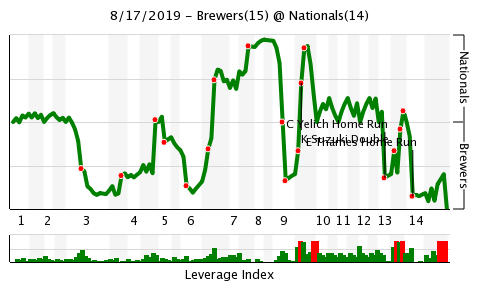
    Milwaukee Brewers closer Josh Hader came into the August 17 game against the Washington Nationals with what was thought to be a lost cause for the Brewers just a half inning prior. Down 11-8, the Brewers socked three home runs against Nats’ closer Sean Doolittle to retake the lead, 12-11, heading into the bottom of the ninth.

    Hader took the ball with a 1 run lead in the bottom of the ninth, promptly yielded a walk, a double and a single to give up the lead and loaded the bases on an intentional pass, all while failing to record a single out. He then reared back and struck out Trea Turner, Adam Eaton and Anthony Rendon to send the game to the top of the tenth inning.

    Josh Hader
    Win Probability graph from Fangraphs.com

    In all, Hader entered the game with an 80% chance to give Milwaukee the win, brought it all the way down to 6.7%, then clawed it back up to a coin flip scenario. In a game fraught with improbabilities, this was some of the most improbable stuff you will ever see in a baseball game. Yet, at the same time, such a feat was most probable for Hader.

    Batter’s Odds Of Striking Out Vs. Hader Vs. League Average Pitcher
    Turner 42.9% 19.8%
    Eaton 35.8% 15.5%
    Rendon 33.0% 13.6%
    Three Straight K Odds 5.0% 0.4%

    (numbers rounded to one decimal)

    Using the Log5 method to factor in the ability of the hitter to avoid a strikeout, we can see that the chance of Hader striking out Turner, Eaton and Rendon in succession is about 5%, which is about 12 times more likely than a league average pitcher. It’s hard to strike out any three major league hitters in a row, much less the very capable 1-2-3 hitters that Washington throws out on most nights. But what happens once in a blue moon for a run-of-the-mill MLB pitcher, happens once in a new moon for baseball’s best strikeout pitcher.

    The only pitchers to strike out three batters in the worst case scenario that Hader put himself in–bottom nine, no outs, winning run on third– since 2002 are erstwhile mid 2000s Diamondbacks closer Greg Aquino in 2006,  Blue Jays’ reliever Brett Cecil in 2014, and Twins reliever Taylor Rogers a little more than two weeks before Hader!  Aquino actually struck out all three batters in a row (like Hader), whereas Cecil used an intentional walk to pitch around Evan Longoria and Rogers allowed a game-tying hit to Neil Walker to set up the situation, and intentionally walked Harold Ramirez in the middle of it.

    In that spot, there’s a 13.4% chance a reliever can merely give his team a chance to regain the lead in the top of the tenth. To take all batted ball chance out of the equation puts a ton of pressure on the pitcher to make great pitches. But with Josh Hader on the mound, the weight of that pressure is as light as it ever could be.

  • New football podcast: NFL season is here!

    Listen here

    Former NFL scout Matt Manocherian (@mattmano) of Sports Info Solutions and football analytics pioneer Aaron Schatz (@FO_ASchatz) of Football Outsiders (@fboutsiders) look ahead to Week 1 of the 2019 NFL season. Matt and Aaron react to the most recent Antonio Brown drama (0:35), discuss some of the things they’re most looking forward to this year (1:40) and break down the three most important games of the week: the New York Giants at Dallas Cowboys (6:45), Los Angeles Rams at Carolina Panthers (18:03) and Tennessee Titans at Cleveland Browns (25:48).

    For more, check out:

    sportsinfosolutions.com

    footballoutsiders.com

    sportsinfosolutionsblog.com

    SISDataHub.com


  • New podcast: Nick Ahmed Dives into Defense

    LISTEN HERE
    On this episode of the SIS Baseball Podcast, senior research analyst Mark Simon (@MarkASimonSays) opens the show by praising the Cardinals infield’s defensive excellence (0:52) and is then joined by Arizona Diamondbacks Gold Glove-winning shortstop Nick Ahmed (@NickAhmed13).

    Ahmed talks about the kinds of things he has improved upon from one year to the next (2:04), the challenge of turning double plays in shifts (3:15), what goes into making a diving play (6:20), changing positioning based on which pitcher is on the mound (7:25), the most underrated Diamondbacks defender (9:20), his impressions of defensive metrics (11:33) and advice he would give to those who want to play defense like him (13:12).

    Mark is also joined by senior research analyst Alex Vigderman (@VigManOnCampus). They discuss some of Ahmed’s observations (15:07), salute Javier Baez as the top defender in August (17:25), run through a list of the Defensive Runs Saved leaders in the minor leagues (18:51) and talk about an unusual defensive alignment against Eric Hosmer (21:47). Alex also gives tips on job hunting in the baseball analytics world (23:51).

    Lastly, the show closes with ridiculous numbers on Minor League Runs Saved leaders of the past (a predictive stat!) and low pitcher BABIP (29:09). Tune in!

  • 4 Players Hoping For a Better Fate This Month

    By Max Greenfield

    With four weeks to go, the playoff push is in full swing, with every at-bat potentially being a critical one.

    This is a time when some players who underachieved can make up for that with one good month. I wanted to try to find a few players along those lines who could play a big role in September if they got hot. Using our expected statistics (calculated off batted ball type, velocity, and location, which is slightly different from the inputs used by Statcast), here are four candidates.

    Jurickson Profar
    The Oakland Athletics’ young second baseman has been underachieving this year. Profar has a .214 batting average, 18 home runs and a below league average OPS of .704. Yet, based off our expected numbers, Profar should be hitting .272 with 20 home runs, and an .843 OPS.

    One reason Profar could be seeing such a stark difference is that his batting average on fly balls is 70 points below the MLB average. Another is that he’s hitting .163 when hitting a ground ball or short line drive against a shift (in fact, his unshifted numbers are of a similar nature).

    Profar could be on the right track. He’s hitting .333 in his last 10 games, with homers on the road against the Royals and Yankees and an extra-base hit in each of his last three home games.

    Dexter Fowler
    The St. Louis Cardinals outfielder has had a decent rebound season after a tough 2018. He’s had a 1.6 bWAR (baseball-reference WAR) which is over 3 wins higher than what he had in 2018.

    Fowler is currently hitting .249 with 16 home runs and a .780 OPS this year but based off our data, his expected numbers are a .292 batting average, with 20 home runs and a .903 OPS. To put that in perspective, he’d rank inside the top 30 with that OPS this year. If he could hit like that for a month, he’d be highly valuable to the Cardinals’ NL Central chances.

    He’s trending the right way. He had an .849 OPS in August.

    Lorenzo Cain
    Another team in the middle of the NL Central and Wild Card race is the Milwaukee Brewers. Cain was a big contributor to the Brewers last year, posting a 6.9 bWAR, the second highest mark of his career.

    But Cain has struggled in 2019 with a .251 batting average, eight home runs, and a .672 OPS. Though our expected numbers have him a little closer to league average offensively with .287 batting average, 10 home runs, and a .766 OPS. If Cain doesn’t hit a line drive, his offensive production is well under MLB average.

    In the past Cain was able to have well above league average production on ground balls, but that has not kept up this year His hard-hit rate is down too.

    Some of that may be explainable by injuries to his knee, thumb, and most recently his oblique. Cain’s defensive value is still very high, as he has 18 Defensive Runs Saved, most among centerfielders. Now, the Brewers are looking for his offense to match that

    Jesus Aguilar, Rays
    Aguilar struggled early in 2019 with the Brewers and the hope was that’d he’d find some success with the Tampa Bay Rays. While Aguilar’s numbers are better with Tampa, increase in batting average, and on base percentage, he’s still seeing below-average results in power.

    Aguilar’s expected batting average is only 18 points higher than his .238 clip. However, his expected OPS is .780, which is 70 points higher than his actual OPS of .710. Aguilar has 12 doubles and 10 home runs. Our expected numbers give him 15 and 12. The Rays could use a little extra carry on his fly balls this month to boost their postseason hopes.

  • Hey, Nicholas Castellanos: Don’t be such a grump about analytics!

    By Mark Simon

    Chicago Cubs right fielder Nicholas Castellanos recently expressed his distaste for analytics in an interview with Bob Nightengale of USA Today.

    In a way, that’s unfortunate. The analytics show that Castellanos has made considerable defensive progress this season, his second full season playing right field.

    In 2018, Castellanos had about as rough a season in right field as any player did anywhere. He cost the Tigers 19 runs, almost entirely based in his struggles hit to the deepest part of ballparks.

    But this season, he’s fared far better at turning those balls into outs, thus taking away potential doubles and triples. Here’s the comparison:

    Balls Hit to Deepest Part of Right Field
    Year Plays Made Opportunities Plays Below Average
    2018 81 134 17
    2019 83 118 1

    Castellanos has gone from performing terribly on those balls to becoming an average fielder on them. He’s got a ways to go to be Cody Bellinger (80 plays made on 95 opportunities) but he’s improved to a reasonable level of adequacy.

    The improvement could be rooted in any number of things, with positional familiarity being the most likely. He’s also played a little deeper than he did last season — moving from an average starting position of 289 feet to 292 feet at Comerica Park, and playing 294 feet deep at Wrigley Field. The one or two steps he may have gained in this could be difference makers.

    Granted, Castellanos still has a ways to go. He’s cost his teams a combined six runs this season and his arm could use improvement in terms of baserunning deterrence. But the analytics are showing something positive for him, and perhaps giving him a reason to give them a chance.

  • What makes Mike Soroka and Max Fried so good?

    What makes Mike Soroka and Max Fried so good?

    By Brandon Tew

    Baseball in 2019 looks drastically different than it did five years ago. Now, hitters worry about launch angles and exit velocities. But this year’s efforts of Atlanta’s dynamic duo of Max Fried and Mike Soroka should worry Braves’ opponents.

    Fried and Soroka lead the Braves rotation with 14 and 10 wins, respectively. They also sit among MLB’s best in a stat that tries to combine launch angles and exit velocities into a quantifiable stat for hard-hit balls. The pair of young arms rank second and third in lowest rate of barrels allowed among pitchers with at least 350 batted ball events this season, with Fried allowing them at a 2.6% rate (15 barrels allowed) and Soroka 3% (18).

    MLB.com notes that the “barrel” classification is assigned to batted-ball events whose comparable hit types (in terms of exit velocity and launch angle) have led to a minimum .500 batting average and 1.500 slugging percentage since Statcast was implemented Major League wide in 2015.

    To be Barreled, a batted ball requires an exit velocity of at least 98 mph. At that speed, balls struck with a launch angle between 26-30 degrees always garner Barreled classification. For every mph over 98, the range of launch angles expands.”

    This stat helps quantifies the number of hard-hit balls on the bat’s “sweet spot.”  With the optimal launch angle and exit velocity, the ball usually goes for a base hit.

    Fried and Soroka minimize this with by allowing low launch angles. They rank second and third in the MLB in average Launch Angle with Fried at 3.5 degrees and Soroka at 4.9 degrees.

    So how has this Atlanta Braves pair missed so many barrels? They accomplish this in slightly different ways.

    How they do it

    Fried, a smooth throwing lefty, uses his four-seam fastball and a wicked curveball to keep hitters off-balance. With a lot of late-life on his fastball, Fried creates weak contact even in favorable counts to the batter.

    Soroka, a right-hander uses pinpoint command and a heavy sinker to induce weak contact. Soroka will throw his sinker at any time and keep hitters off of it with a slider away or four-seam fastball that comes up and in.

    Their different approaches embody the shift in pitching over the past five years, with Fried putting emphasis on a high-velocity four-seamer and good breaking pitch while Soroka favors the old-school pitching combo of a sinker and slider. Soroka pitches to contact and keeps the ball down in the zone.

    When you’re as adept at missing barrels as Fried and Soroka, you try to get ahead in the count and strike out batters or create soft contact, such as a weak ground ball. Both are great at producing ground balls. Soroka and Fried each have 53% ground ball rates, with Soroka ranking fourth and Fried sixth among ERA-title qualifiers.

    As for any pitcher, it is always best when you’re pitching ahead in the count to keep batters on the defensive so they can’t sit on one specific pitch, in one particular zone. First pitch strikes are a vital part of getting ahead in the count. They each are above MLB average of 61%, with Soroka at 64.6% and Fried at 63.7%

    Soroka pounds the arm-side bottom right corner of the zone with his sinker. He does this all game long. When behind in the count hitters have no choice but to either swing and probably make terrible contact or take the pitch for a strike. Hitters constantly smash his sinker into the ground. It’s a pitch that either runs under the hands of a right-handed batter or down and away from a lefty. Soroka also has the command to work this part of the strike zone.

    When he’s not throwing his sinker, he’s working the other side of the plate with his slider, throwing it down underneath the zone, making it almost impossible to square the ball up on this particular pitch.
    Soroka Slider
    Hitters are once again faced with the decision to swing and likely make a soft-contact grounder, or go fishing for a ball destined for the dirt. They’re hitting .136 when an at-bat against Soroka ends with this pitch. That ranks fifth-lowest in MLB among starting pitchers, behind Dinelson Lamet (.095), Justin Verlander (.112), Sonny Gray (.119), and Mike Cleveinger (.119).

    The heat map below shows how Fried utilizes his curveball to keep hitters guessing, while still throwing it in the zone often and inducing weak contact or missed swings. If hitters do connect, they generally swing over the top sending the ball darting towards the ground.
    Fried Curveball
    This also enables him to use his fastball more effectively. A fastball with so much late life  keeps hitters from making great contact with the heater. When  ahead in the count Fried can still be sporadic with his fastball command but he still stays inside the zone.

    What lends to Fried’s remarkable knack for missing the sweet spot of bats or getting a swing and a miss is the tunneling of both of these pitches and how they look so similar to the hitter and have late action to them. Fried can occasionally lose his release point and miss arm side and high with his fastball or hang his curve but when he’s on, he’s excellent at throwing both of these pitches from the same release point. making it hard to pick up which pitch is coming towards the batter.

    Why doesn’t Fried have as good of an ERA as Soroka? When hitters do get the ball in the air, they hit it out of the park. Fried’s home run to fly ball rate is 19%. Soroka’s is 8%. That may not entirely be Fried’s fault. Based on our expected stats (determined by the batted ball type, where the ball was hit, and how hard it is hit), Fried has allowed three more home runs than expected. Soroka has allowed three fewer.

    This one-two punch will be key for Atlanta down the stretch in the NL East. For them to continue racking up wins, Fried and Soroka will have to keep missing Barrels.

  • Stat of the Week: Bellinger, Trout battle for Total Runs lead

    By Mark Simon

    Which player has had the best season in baseball this year?

    That’s a very tough question to answer right now. Cody Bellinger of the Dodgers and Mike Trout of the Angels are basically neck-and-neck in Sports Info Solutions’ measuring stick, the Total Runs leaderboard.

    Total Runs is the sum of a player’s Runs Created (using Bill James’ formula), Defensive Runs Saved, and Baserunning Runs, along with a positional adjustment. The positional adjustment rewards a player for his playing time at a tougher position (for example, it’s harder to be an average shortstop than an average first baseman). For pitchers, Pitching Runs Created are included to account for how much a pitcher has limited opponent scoring.

    Trout has 122 Runs Created, one run better than Christian Yelich and six better than Bellinger. Trout’s edge over Bellinger stems from his big advantage in reaching base (.436 on-base percentage to .409). He also has a six-point edge in slugging percentage (.651 to .645).

    Trout is also eight Baserunning Runs better than Bellinger. He’s credited with six to Bellinger’s negative-two. Trout ranks first in Bill James’ Baserunning Gain stat (+25), which measures how often a runner takes an extra base on hits, wild pitches, and the like, while avoiding outs on the bases.

    Bellinger is hurt by below-average stolen base efficiency. He’s stolen 11-of-16 after stealing 14-of-15 a year ago. He’s also dinged for going second-to-home on a single only six times in 17 opportunities (a 35% rate — the MLB average is about 60%). Trout has scored 12 times from second on 16 singles (75%).

    Summing batting and baserunning gives Trout 128 runs and Bellinger 114 runs.

    Where Bellinger makes up the ground is on defense. His 23 Defensive Runs Saved are tied for most in the majors. Bellinger has taken to right field well in his first full-time season there. He has an MLB-best 19 Runs Saved there, with a combination of outstanding catches and assists (this one and this one are among the best). He also has three Runs Saved in 26 games at first base.

    Trout has saved two runs with his defense, down from eight in 2018. He’s been hindered by 15 Defensive Misplays & Errors as charted by our video scouts. That’s up from seven in 2018.

    Now Bellinger has the advantage, 137 to 130, with only the positional adjustment left to be made.

    Trout narrows the gap there. His adjustment is worth 20 runs. Bellinger’s is worth 15 runs.

    That gives Bellinger 152 Total Runs and Trout 150 Total Runs. Wow, it’s close.

    Here’s the current leaderboard. If you want to keep up to date with this race, follow along at Bill James Online by clicking here.

    Total Runs Leaderboard
    Player Team Total Runs
    Cody Bellinger Dodgers 152
    Mike Trout Angels 150
    Trevor Story Rockies 143
    Ketel Marte Diamondbacks 143
    Ronald Acuna Jr. Braves 138
    Christian Yelich Brewers 136
    Justin Verlander Astros 129
    Marcus Semien Athletics 129
    Mookie Betts Red Sox 129
    Alex Bregman Astros 129