Category: NPB and KBO

  • NPB Free Agent Scouting Report: Yoshinobu Yamamoto

    NPB Free Agent Scouting Report: Yoshinobu Yamamoto

    If you’re not familiar with Yoshinobu Yamamoto, I can sum this up pretty quickly. He is one of the greatest pitchers of his generation and one of the best in NPB history. After seven stellar seasons and three years of utter dominance, the Orix Buffaloes are posting Yamamoto. He can sign an MLB contract this offseason.

    The 25-year-old has produced an incredible three-season stretch.

    Season IP ERA Strikeouts Walks SO/W
    2021 193 2/3 1.39 206 40 5.2
    2022 193 1.68 205 42 4.9
    2023 164 1.21 169 28 6.3

    Yamamoto’s pitching earned him three consecutive Triple Crowns and Sawamura awards, NPB’s equivalent of the Cy Young Award. In his last game for Orix, Yamamoto cemented his status as an NPB legend, throwing a complete game with 14 strikeouts in Game 6 of the Japan Series. The 14 strikeouts broke a Japan Series record formerly held by Yu Darvish. 

    Here’s all 14 strikeouts:

    Why is he so good?

    Yamamoto blends power and command, the traits that teams look for in a starting pitcher. At 5’10” and 176 pounds, he is a smaller pitcher but has a strong frame and the ability to pitch deep into games and throw many innings without injury. He’s thrown at least 160 innings each of the last three seasons. 

    In Game 6 of the Japan Series, he threw 138 pitches. He’s durable and maintains velocity. His 133rd pitch was a 98-MPH fastball. He’s just as effective deep into games as he is at any other point, which is what makes him an ace.


    Yamamoto’s sequencing, arsenal, and control, compounded by his elite command and ability to throw 4 to 5 pitches in specific quadrants in the zone make him a nightmare for hitters.

    Mechanics

    Yamamoto’s change to go from a held leg kick that’s done by many Japanese pitchers to an elimination of his leg kick altogether in 2023 is fascinating. He now replicates his motions from the stretch to his movements in the windup. He still gets good extension down the mound for his height and puts himself in a nice sequence to throw the ball.

    Yamamoto 2022 Mechanics   

    via GIPHY

    Yamamoto 2023 Mechanics 

    via GIPHY

    The repeatability of the delivery is textbook. He had a 68.5% strike rate last season. That would have put him at 5th among qualified starters in MLB behind Joe Ryan and ahead of Spencer Strider. A clean and efficient delivery puts him in optimal fielding position. He is an excellent fielder who won the 2023 NPB Fielding Bible Award for pitchers.

    The Arsenal (2023 usage and Average Velocity)

    Yamamoto’s arsenal is deep and it’s electric with a pitch mix that attacks the zone more vertically, than horizontally. He fits the profile of power pitchers that teams desire. He has velocity along with a killer breaking ball and offspeed pitch; the three make him hard to hit and, with his control, he rarely gives up free passes.

    Fastball  48 %, 95 mph 

    Yamamoto has a four-seam and two-seam fastball and will sprinkle in the two-seam on the hands of righties or he will occasionally front-hip the pitch to lefties. The main attraction is his four-seam. 

    Yamamoto averaged just under 95 mph on his fastballs this season but his four-seamer plays up in the zone with good carry. A lower release point due to his height and 3/4 arm slot make it a unique pitch that explodes at the top of the zone. 

    Yamamoto’s average release height is around 5.5 feet putting him in elite company in terms of that metric. With 17 inches on average of induced vertical break (IVB), he’s able to carry the ball through the top of the zone with ease.

    Yamamoto doesn’t always live at the top of the zone even though his fastball tunnels with his curveball nicely. He opts to tunnel the pitch with his splitter more but his command of the pitch in all four quadrants is what makes him special. Yamamoto can spot his fastball where he wants it and it sets up the rest of his devastating arsenal.

    Curveball  16%, 77 mph

    Yamamoto’s curve is one of the prettiest in the world. It drops out of the sky for strikes but also generates plenty of whiffs. He also can get chases by throwing curves below the zone, or he can steal strikes late and early in the count.

    Throwing with a Ginoza grip as he shows the back of his hand towards the plate, he then pushes or flicks the ball with his thumb, which is what gives the pitch such high spin. It averages 77 mph and he’s also able to take some off or throw it harder when need be.

    I love this overlay from Pitching Ninja that illustrates how good the pitch is:


    Splitter  26%  90 mph

    Yamamoto’s splitter is effective against left-handers with a .178 opponents’ OBP and a .424 OPS. The crazy thing is against right-handed batters it performs even better, a .106 OBA and a .324 OPS. The splitter is his go-to strikeout pitch and is nightmare fuel for batters.

    Also like much of the rest of his arsenal, he’s able to manipulate the speed and shape. Yamamoto can create more backspin and higher velocity when needed or can take some off and kill spin depending on the situation. 

    This was never more evident than in a game in 2022 when he threw a two-seamer and a splitter at the same speed in back-to-back pitches. The pitch averages 90 MPH but he has been able to throw the pitch from 82 mph up to 93 mph. He has the feel to “gas pedal” all his pitches at any time. This messes with the hitter’s timing and rhythm as well as their ability to sit on specific pitches.

    via GIPHY

    If the pitch is put in play he keeps it on the ground. The splitter has a 77% ground ball rate. Couple that with a 60% groundball rate for his curve and you can see that it was difficult for hitters to get his secondaries into the air. His groundball rates should take a dip in MLB with the types of hitters he faces. Remember too that his current numbers may be distorted because NPB is currently in a “dead ball era” but a better positioning of fielders in MLB can also help him out.

    The splitter is a weapon for him against both righties and lefties and with its darting and diving action, he’s able to generate whiffs and chases with a 40% whiff rate each of the last two seasons. The pitch has late action and ducks underneath barrels consistently.

    Here’s Yamamoto’s split that looks like a wiffle ball as it takes off from the batter:

    via GIPHY


    Slider and Cutter (SL) 2% 85 mph / (CUT) 8%  92 mph

    To round out his arsenal we can look at both his cutter and slider together. The slider, rarely thrown, is more of a sweeper. The cutter was thrown more to RHBs than LHBs but he does throw the pitch in on the hands of lefties. With a .366 opponents’ OBP and an OPS of .825, it was by far his worst-performing pitch. 

    via GIPHY


    via GIPHY

    The issue is sometimes the cutter will occasionally leak to his arm side, but he’s still very comfortable spotting the pitch where he wants it and has no lack of confidence in throwing it. Here’s a front-hip cutter to a RHB that’s perfectly painted on the inside getting an emergency hack: 

    via GIPHY

    The slider is rarely thrown, less than two percent of the time. He still spots the pitch very well and it has a good sweep to it.

    It’s a very projectable pitch for him and he has the feel to throw it. He just never had to in NPB because of his three best pitches and because he was facing more left-handed hitters. He might never throw it more in MLB but it could play as a real weapon against MLB hitters, especially right-handed hitters.

    via GIPHY

    What to Expect

    As Yamamoto transitions to facing MLB hitters, he might opt for more high four-seams and more reliance on his curveball as a change of pace early. The MLB ball is slightly bigger and less tacky than its NPB counterpart, and we could see his usage possibly change by adding in more cutters and sliders while he adapts his splitter. However, it is worth mentioning that he threw an MLB ball in the World Baseball Classic this spring with minimal issues. 

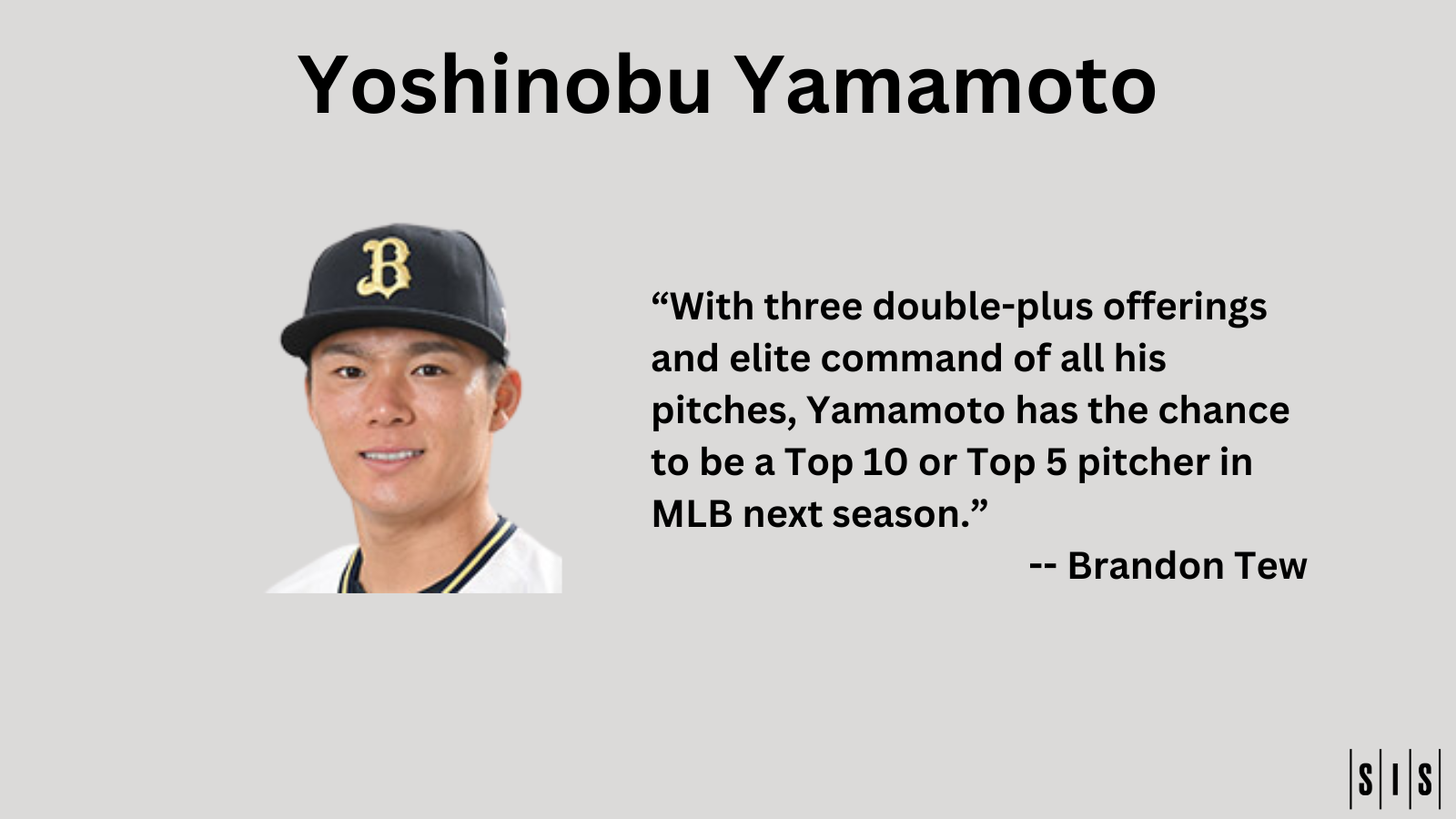
    With three double-plus offerings and elite command of all his pitches, Yamamoto has the chance to be a Top 10 or Top 5 pitcher in MLB next season. There are always questions about the transition from NPB to MLB, but Yamamoto is the most polished pitcher to make this transition.

  • 2023 NPB Fielding Bible Awards

    2023 NPB Fielding Bible Awards

    SIS is pleased to announce the winners of the 2023 NPB Fielding Bible Awards. This marks the 4th season that we have honored the best defensive players in NPB. The awards are chosen by a panel of experts who consider statistical analysis, the eye test, and any other factors that they wish to utilize. 

    We are also announcing the winner of our inaugural NPB Defensive Player of the Year award.

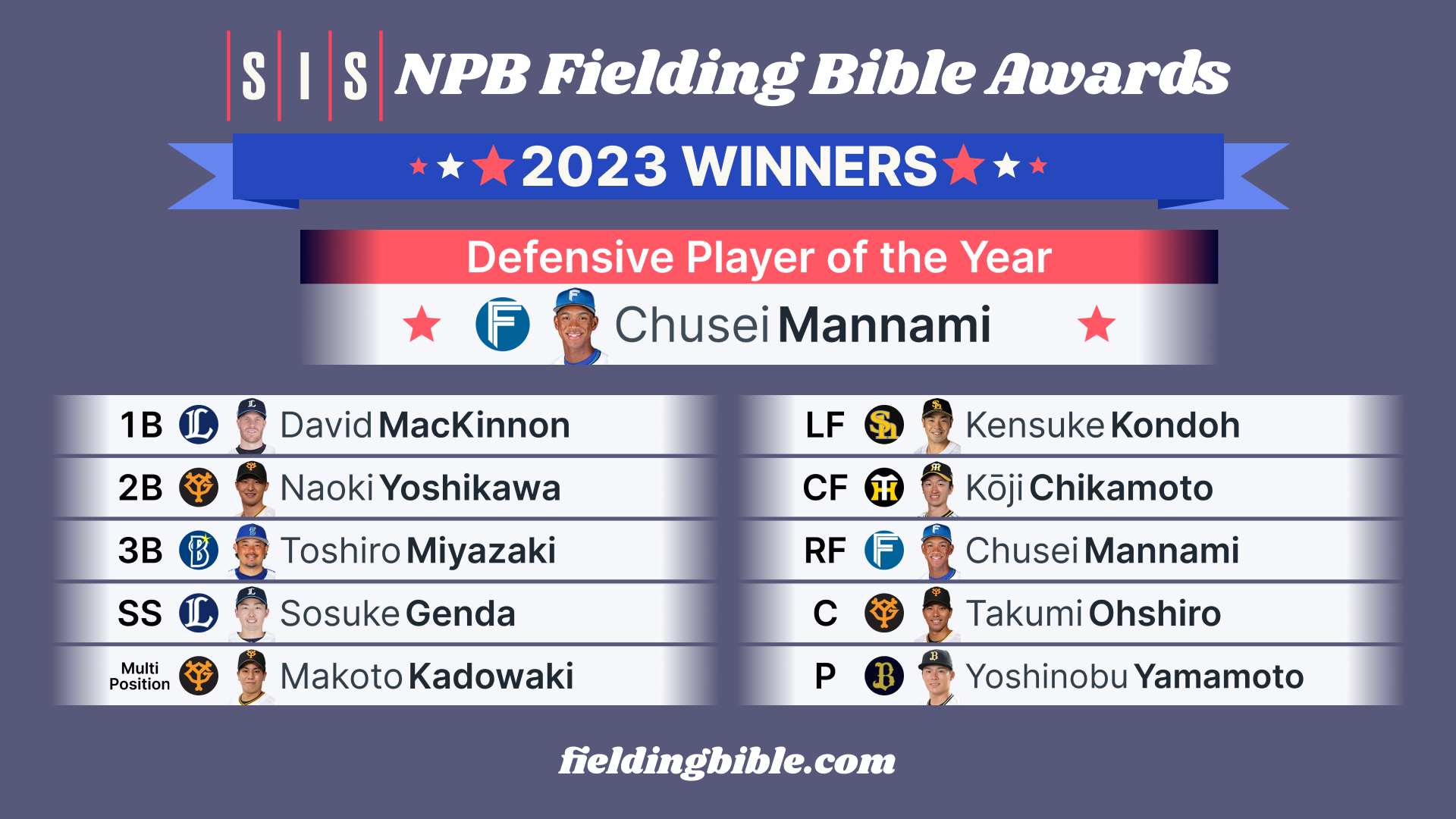
    This year’s winners are

    Position Name Team
    Player of the Year Chusei Mannami Nippon-Ham
    1B David MacKinnon Seibu
    2B Naoki Yoshikawa Yomiuri
    3B Toshiro Miyazaki Yokohama
    SS Sosuke Genda Seibu
    LF Kensuke Kondoh SoftBank
    CF Kōji Chikamoto Hanshin
    RF Chusei Mannami Nippon-Ham
    C Takumi Ohshiro Yomiuri
    P Yoshinobu Yamamoto Orix
    Multi-Position Makoto Kadowaki Yomiuri


    Defensive Player of the Year

    Nippon-Ham right fielder Chusei Mannami is our inaugural NPB Defensive Player of the Year. Mannami’s 18 Defensive Runs Saved in right field were by far the most at that position in 2023.

    The driving factor behind Mannami’s Runs Saved was his throwing arm. He totaled 12 Outfield Arm Runs Saved, which are awarded both for assists and for preventing runners from taking an extra base on hits. By comparison, the MLB leader in Outfield Arm Runs Saved, Nolan Jones, had 11.

    “Having a guy like Mannami in the outfield is equivalent to having an outstanding middle linebacker,” said Awards voter John Gibson of the Japan Baseball Weekly Podcast. “He has the speed to run down a lot of plays and also sack your runners on the bases. The arm is not only strong, but he has the footwork and accuracy to produce magical outfield assists. It’s an MLB-caliber arm. Even speedy runners in Japan throttle down when the ball goes his way unless they’re desperate in late-game situations.”

    Other Winners

    Yomiuri had 3 winners – catcher Takumi Ohshiro, second baseman Naoki Yoshikawa, and infielder Makoto Kadowaki, who won our Multi-Position Award.

    Ohshiro ranked as one of the best called strike-getters in the league and led all catchers in Defensive Runs Saved, which measures all-around defensive excellence. Yoshikawa ranked second in Runs Saved at his position. Kadowaki led third basemen in Runs Saved and ranked second among shortstops despite playing part-time at each spot.

    Seibu shortstop Sosuke Genda, who led the position in Runs Saved, won for the 3rd time in the 4-year history of the Award. His teammate, first baseman David MacKinnon was the only former MLB player to win. MacKinnon had the most Runs Saved among Award-eligible players at first base.

    Yokohama third baseman Toshiro Miyazaki won a close vote at the position. Joining Mannami in the outfield were SoftBank left fielder Kensuke Kondoh and Hanshin center fielder Kōji Chikamoto. Kondoh led his position in Defensive Runs Saved. Chikamoto was 1 Run Saved off the center field lead among Award-eligible players and was one of the standouts on a team that led NPB in Defensive Runs Saved.

    Rounding out the awards was Orix pitcher Yoshinobu Yamamoto who was not just  the top pitcher in NPB this season, but also among the top fielding pitchers. Yamamoto was just posted by Orix and will command a large contract from whichever MLB team signs him.

    “Desire, physical skill, mental acuity and the endurance to perform at an elite level for the duration of a major league season,” said SIS VP, Baseball, Bobby Scales. “That is what defines an elite defender. These 10 individuals have displayed elite defense and then some over the course of the NPB season.”

    Our expert panel consisted of NPB media: Jim Allen (Japan Baseball Weekly), Jason Coskrey (Japan Times), John Gibson (Japan Baseball Weekly), and Yuri Karasawa (Yakyu Cosmopolitan), with consultation from Brandon Tew (Sports Info Solutions).

    The history of the NPB Fielding Bible Awards (which began in 2020) can be found online at FieldingBible.com.

  • 2021 NPB Position Players to Watch

    By TED BAARDA

    With Spring Training underway, baseball fans can look forward to enjoying more baseball in 2021 than we had in 2020. While MLB teams are ramping up, so are players in NPB and the KBO, Japan’s and South Korea’s top leagues respectively. NPB is starting up the earliest, on March 26, while the KBO is starting their season about a week later, on April 3. 

    Both leagues will also be taking a break from mid-June through early August to allow players to represent their countries in the Olympics, which should result in both Japan and South Korea fielding competitive teams in the event. In addition to fielding Olympians, both leagues feature players that have the upside to be future Major League contributors.

    We looked at NPB pitchers a couple of weeks ago. Now here are some hitters from Japan’s NPB who could make their way to MLB at some point in the future. To get a balanced look at different types of players, I will fill out a roster with a player at each position, plus an extra at DH. Some of these players are established stars in Japan, some have high ceilings but are coming off down years, and some are in the process of proving themselves. We wanted to give you a variety.

    Catcher: Tomoya Mori – Seibu Lions

    Before the 2020 season Mori would have been one of the easiest choices for this list, as a young catcher coming off a .329/.413/.547 season in 2019. He is still young (he turns 26 in August), but he is coming off his worst season as a pro by far, slashing .251/.325/.380 in 2020. His worst previous season was 2016, when as a 20 year old he still managed an OPS that was 98 points higher than his 2020. For Mori to be successful, the bat needs to bounce back, since historically his glovework has been below average (and his small stature raises questions as well), as was discussed in my scouting report of him earlier this off-season

    If Mori can bounce back, many teams would be happy to add a lefty-swinging catcher with a career .291/.372/.469 slash line entering his prime years. Given his age and experience he should be eligible for international free agency after the 2023 season but could also find himself posted next off-season if a bounceback year creates a strong market for him.

    First Base: Hotaka Yamakawa – Seibu Lions

    Yamakawa has a lot of similarities to his teammate, Tomoya Mori, as a bounceback candidate from the Seibu Lions with questions about his size and defense. Yamakawa combined to hit 90 home runs in his first two seasons as a full-time player and has 153 career homers in just 530 games (46.8 per 162 games). However, his slugging percentage has dropped off since his big 2018, going from .590, to .540 in 2019, to .450 in 2020. His strikeout rate has also bumped up from 21% to 25% last year, though he has maintained high walk rates during that time as well.

    His athleticism is probably the first place to look to explain his struggles, as he is listed at 5’9 and 227 lbs and is a poor runner. While Japanese teams are not known for embracing defensive shifts, they do get creative with Yamakawa by having their middle infielders back up and play anywhere from 5 to 20 feet deep into the outfield grass since he hits the ball so hard.

    Anything they can reach on the ground is likely an out. Yamakawa’s size also limits him on defense, as 5’9 is very short for a first baseman (taller players are preferred since they can more easily reach errant throws from infielders). His range is poor, even for a first baseman, which leads to poor metrics at the position. While he has played some third base, it has been sparingly and not particularly pretty by the eye test. He is more of a DH than anything else. 

    Yamakawa had a later start to his career than many NPB stars, and that means that despite being 29 years old, he is still years away from free agency. For him to be a big leaguer, he will need to have a resurgence at the plate, and find some success in the posting market in the next couple of years.

    Second Base: Tetsuto Yamada – Yakult Swallows

    Yamada is arguably the biggest name on this list and is a superstar in Japan, commonly referred to as Japan’s Mike Trout. I wrote a scouting report on Yamada a few months ago, but the 2020 season was a disappointment for him. 

    Reports have indicated that Yamada arrived to resumed camps out of shape and then he dealt with injuries in the middle of the season. That being said, a second baseman putting up a .254/.346/.419 line is respectable at the NPB level. 

    Yamada’s batting line in 2020 was so disappointing because he has established that he can perform at an elite level. In the six seasons from 2014-2019 Yamada put up a .299/.406/.555 line with 198 HR and 159 SB (with just 22 CS), producing four 30-30 seasons in that span. Yamada is another player who needs to rebound in 2021, but the rewards for him could be much greater. He should be eligible for international free agency next off-season, and given his established level of performance and age (he turns 29 in July) he could land himself a very nice MLB contract should he rebound to his previous form.

    Shortstop: Hayato Sakamoto – Yomiuiri Giants

    Sakamoto is on the older side for a list of potential future Big Leaguers, having just turned 32. However, he is one of the most accomplished players in NPB history, having surpassed 2,000 career hits at this point in his career, a total he cleared late last season. While 2,000 hits is an impressive total, it is even more impressive when you consider that NPB regular seasons are 19 games shorter than MLB seasons, and as a middle infielder Sakamoto would be required to spend countless hours doing defensive drills in practice in addition to finding time to work on his hitting. 

    Sakamoto is only the 53rd player in league history to reach 2,000 hits. He does more than just collect singles, as he has good gap power and will usually finish the year with home run totals in the teens and around 30 doubles. In 2019 he won the Central League MVP with career highs of 40 HR, 94 RBI, and a .575 SLG.

    In addition to his talent with the bat, Sakamoto is a good fielder too. While he has a large frame for a NPB shortstop (6’1, 190 lbs), Sakamoto has good range, particularly up the middle, and a strong throwing arm. While he has never won a Gold Glove at the position, Sakamoto did win the first NPB Fielding Bible Award at shortstop for his glovework in 2020, when he also led all NPB shortstops with 6 Defensive Runs Saved (Note that DRS in this case is compared to MLB average). This was the best year that he has had defensively by DRS (since we started tracking NPB data in 2018). He grades out as close to MLB average at the position when looking at his 3 year average.

    Sakamoto’s is an interesting case, as he looks to have all the tools to be a MLB-caliber player and has an impressive resume to back it up. However, at only 32 he has a good shot at breaking the all time hits mark in NPB, which is currently 3,085 by Isao Harimoto. A detour to play a few years in North America would severely hinder his chances of breaking the record and the infamy that would come with it. He may have less motivation than most to come stateside, but he will likely go down as one of the best players Japan has ever seen.

    Third Base: Kazuma Okamoto – Yomiuri Giants

    Kazuma Okamoto has spent the past few years building an impressive offensive resume. He made his NPB debut back in 2015, but was used sparingly in his first three years before becoming a full-time player in 2018. His 2018 season is still the best that he has put up with the bat, hitting .309/.394/.541, but he has been a consistent source of offense for the Giants. 

    At only 24 years old (he turns 25 in June) Okamoto could grow into more power. Despite playing 25 fewer games in 2020 than he did in each of the previous two seasons, he managed to match his 2019 home run total of 31, and posted a career best .270 ISO with a career-low 17% strikeout rate (best among his full seasons).

    Defensively Okamoto has settled in as the full-time third baseman for Yomiuri and he has been about MLB average at the position, with a net DRS of 0 over the last three seasons (reminder: MLB average equates to a good defensive player in Japan). He uses his strong arm to make up for below average range. He has also played some first base (where the metrics showed he rated poorly) and left field, where in a small sample he again graded out around MLB average and recorded a couple of outfield kills (assists without a cutoff man), in limited innings, to again demonstrate his strong arm. 

    Yomiuri has started to post some players when requested, but overall is not going to aggressively post their young stars. Okamoto will likely need to wait until his late 20s to either be posted or achieve international free agency to be available to MLB teams.

    Designated Hitter (Third Base): Yusuke Ohyama – Hanshin Tigers

    Calling Ohyama a DH is a bit misleading, since he has been Hanshin’s regular third baseman for the past few years, but for the sake of this exercise he is our ‘DH’. Ohyama has experience at all four corner positions (plus 2 innings in center field last year), grading out as a little below MLB average at both corner infield spots and without enough of a sample size to say how good his outfield defense is. While Ohyama can be played in any corner spot, his bat is what will determine his success.

    Ohyama made his NPB debut in 2017 and appeared in 75 games before becoming a full-time starter in 2018. From 2017-2019 he hit .259/.315/.418, which is an uninspiring batting line for a corner player. However in 2020 he exploded for a .288/.357/.560 line, which is made even more impressive given that his home park, Hanshin Koshien Stadium, is known as a pitcher’s park. 

    Ohyama doubled his previous season-high in home runs by belting 28 in the abbreviated 2020 season, which placed him in a tie for second in the Central League. Now 26 years old, Ohyama will need to show that he can maintain his newfound power stroke over the next few years if he wants an opportunity to play in North America.

    Outfield: Seiya Suzuki – Hiroshima Carp

    Seiya Suzuki is simultaneously the most established and youngest of the outfielders highlighted here, as despite debuting for Hiroshima in 2013 he won’t turn 27 until this August. He is the prototypical right fielder, with a strong arm and a powerful bat, though he is more than just a slugger at the plate. Incredibly, Suzuki’s 2020 slash line of .300/.409/.544 features his lowest AVG and SLG since he became a full-time starter beginning in 2016. His strikeout and walk rates, both right around 14% in 2020, were both a little worse than his 2019 numbers, where his walk rate was a bit higher than his strikeout rate. 

    Defensively Suzuki’s best tool is his cannon of an arm. He is also fairly athletic but doesn’t always read balls well, yet his arm and athleticism have helped him earn three Gold Glove Awards for his work in right field. Similarly on the bases, Suzuki has the speed to steal bases, but doesn’t have great base-stealing instincts and gets thrown out at a high rate. 

    Compared to fellow former Central League outfielder Yoshi Tsutsugo, Suzuki produces better rate stats at the plate and has a better defensive reputation (And it should be noted that Tsutsugo’s home park was considered fairly hitter-friendly). Suzuki will likely still need to wait for a few years to test himself at the MLB level, as he still looks to be three years from international free agency, unless he gets posted before then. 

    Outfield: Masataka Yoshida – Orix Buffaloes

    Coming into 2020 Yoshida was already considered one of the better pure hitters in Japan, coming off a .322/.413/.543 2019 with a career high 29 HR. While many players now make changes to sell out for more power, Yoshida went in the opposite direction in selling out for contact and avoiding striking out in 2020. Last season he put up 72 walks against just 29 strikeouts, for a 6% strikeout rate with a healthy 15% walk rate. His power took a step back, as his .162 ISO was a career low, but he posted career bests in AVG and OBP with a .350/.453/.512 line and still hit 14 home runs in the slightly abbreviated season.

    While Yoshida is not old, he turns 28 in July, he is primarily a left fielder without any loud defensive tools, though Defensive Runs Saved pegged him around average as a left fielder last season with some DH time as well. Orix has struggled to win as a team for a while now, so Yoshida could be a posting candidate in a couple of years if the team can’t build a winner with him. If they hang onto him, he will be a few years into his 30s by the time he can become an international free agent.

    Outfield: Mel Rojas Jr. – Hanshin Tigers

    Mel Rojas Jr. proved everything that he could in the KBO last season, winning KBO MVP, and nearly captured a Triple Crown in the process. He did all of that while enjoying a comfortable lead in hard-hit rate. 

    Moving to NPB, Rojas will look to put up big numbers again, which will be more of a challenge given the better pitching he will face, and the fact that he is moving to a pitcher’s park. Hanshin has had success in transitioning players from the KBO to NPB, evidenced by its signings of reliever Seung-hwan Oh in 2014 and outfielder Jerry Sands last year, and is hoping for more success with Rojas and pitcher Raul Alcantara this year.


    Rojas will likely play right field for the Tigers, replacing veteran Yoshio Itoi in the starting lineup while Sands plays left field on most days. While the 30 year old Rojas was rumored to be considering MLB offers this off-season, they likely were not substantial offers, and he is betting on himself going to NPB and putting up big numbers to earn a more lucrative MLB contract in the next year or two.

  • Need a reliever? A couple from the NPB might work

    By TED BAARDA

    Last season, a few NPB relievers signed small MLB deals and ended up making an impact in the bullpens of playoff teams. Pierce Johnson (Padres) and Rafael Dolis (Blue Jays) both provided value to their teams on cheap contracts during last year’s shortened season. Each year it seems like a reliever or two comes from, or comes back from, overseas to make an impact. This year there are two potential relief options for teams to consider from Japan. Both are free agents, and thus are not bound by the rules of the posting system.

    One good option came off the market when Robert Suarez decided to stay in the NPB for 2021. We’ll give a report on him at the end of this piece.

    Hirokazu Sawamura – RHP – Chiba Lotte Marines

    Hirokazu Sawamura had a rough start to the 2020 season for the Yomiuri Giants but after being traded to Chiba Lotte on September 8, he was able to find his strikeout stuff again and gave them 21 innings of 1.71 ERA ball down the stretch. A starter earlier in his career for the Giants, Sawamura had been essentially a one-inning bullpen arm since 2015.

    Season Games IP ERA WHIP K/9 BB/9
    2018 49 52.1 4.64 1.567 9.3 4.6
    2019 43 48.1 2.61 1.179 10.2 3.2
    2020 35 34.1 3.41 1.223 10.5 4.7

    Sawamura pitches exclusively from the stretch and releases his pitches from a high ¾ arm slot. He also incorporates a slide step with runners on base to help control the running game. Sawamura throws everything hard, with all of his pitches being thrown 90 MPH or above. 

    Sawamura throws a straight, mid 90s fastball that sits around 96 that he can locate well at the bottom of the zone. His primary secondary pitch is a low-mid 90s splitter, which has some late drop but doesn’t have a huge break due to the speed he throws it at. He does a good job of keeping the pitch down, either in or below the zone, and hitters regularly swing over it when it dips out of the zone. Splitters are difficult pitches to command, which is a factor contributing to Sawamura’s high walk rates. 

    His third pitch is a low 90s cutter with a short, late break that he tries to locate inside to lefties, or mix into righties when in a long at-bat. It is clearly his third pitch, as his control of the pitch is hit or miss and he can get under it and throw it above the zone at times.

    Sawamura’s inconsistency could make teams hesitant to offer him a deal, but his stuff is comparable to fellow free agent Hansel Robles, who also relies on throwing a lot of hard splitters (admittedly Robles is a rough comp given his 2020 struggles). Like Robles, Sawamura likely could fit into a MLB bullpen in a middle relief role and attempt to work his way into higher-leverage situations if his performance merits it.

    Spencer Patton – RHP – Yokohama DeNA Baystars

    Spencer Patton has had a winding career, drafted in the 24th round of the 2011 Draft by the Kansas City Royals, pitching in parts of three MLB seasons with the Rangers and Cubs from 2014-2016, and finally ending up in Yokohama for the last four years. 

    While the results have not been there for Patton the last couple of years, his first two years in Yokohama were very promising, and he still features high strikeout rates.

    Season Games IP ERA WHIP K/9 BB/9
    2017 62 60 2.70 1.150 9.9 2.9
    2018 58 56 2.57 1.232 10.8 2.6
    2019 42 36.2 5.15 1.636 11 5.4
    2020 57 53 4.92 1.491 11 4.6

    Patton primarily comes after hitters with his fastball/slider combo from a ¾ arm slot. He pitches out of the windup with no runners on, not a common occurrence for a reliever, and features a high leg kick to power his delivery from the windup or stretch. He likes to work up with his four-seamer which will sit around 93-94 MPH, though if he misses he tends to miss up out of the zone altogether. 

    Patton’s slider sits in the high 80s and typically features some late drop to it. Patton locates the slider well to the outside corner to righties, and tries to run it in off the plate to lefties. He also features an occasional changeup that he will primarily throw away to lefties.

    Patton will likely have to prove himself on a minor-league contract with a small salary if he returns to North America, given how his last two seasons have gone in Japan. It is hard to find a comp for Patton, as two-pitch relievers without elite velocity don’t have a long shelf-life in the Majors. To have sustained MLB success he may need to move towards using the slider as his primary pitch or develop another weapon. As he is now, he profiles as similar to Blake Taylor of the Astros (2.18 ERA in 20 2/3 IP but a 4.55 FIP in 2020).

    Robert Suarez – RHP – Hanshin Tigers

    Robert Suarez is likely the least known pitcher of the three in this article, but he is also likely the best and as such, he re-signed with the Hanshin Tigers. Suarez put together a great 2015 in the Mexican League and turned that into an opportunity with the SoftBank Hawks of the NPB.

    In 53 2/3 innings in 2016 Suarez pitched to a 3.19 ERA for the Hawks, with strong peripherals to back his performance. He earned a spot on Team Venezuela in the 2017 World Baseball Classic, but got injured there and needed Tommy John Surgery. He put up unimpressive numbers the next two years with SoftBank before the team let him go.

    Suarez signed with the Hanshin Tigers for the 2020 season, and with Hanshin losing both Pierce Johnson and Rafael Dolis to MLB teams there was a clear opportunity in their bullpen. When closer Kyuji Fujikawa struggled at the beginning of the season, and Suarez regained his control, the team handed him the closer role and he ran with it, collecting 25 saves in a shortened NPB season.

    Season G IP ERA WHIP K/9 BB/9
    2018 11 10 6.30 2.000 9.0 4.5
    2019 9 26.2 5.74 1.800 9.1 6.8
    2020 51 52.1 2.24 1.051 8.6 3.3

    Suarez pitches exclusively from the stretch and attacks hitters with his high 90s fastball from a high ¾ arm angle. The fastball typically sits around 96 but he can run it up to triple digits on occasion. In addition to his great velocity, Suarez also gets some tailing action on his fastball, letting it run in on right handers and producing ground balls. He also features a splitter with some traditional tumbling action that he throws in the upper 80s, along with the occasional slider that will be slightly harder than the splitter with some sweeping action.

    Suarez’s control was inconsistent early in the season, though he was still able to close out games. In the second half of the year his control took a big step forward, suggesting that he has returned to form following his injury. Throwing hard, inducing grounders, and limiting walks are three big keys for a successful bullpen arm. He profiles as similar to Jeurys Familia, and (like Familia) his ability to limit walks could determine how much success he has.

  • Which KBO teams are executing best?

    By MARK SIMON

    Baseball is a simple game – you try to pitch the ball well, hit the ball well and field the ball well. If you have a team that does all three, you’re likely championship caliber.

    This has shown itself early in the KBO. The teams with the best combination of hitting the ball hard, limiting hard-hit contact, and fielding the ball well are the top two teams in the standings.

    The NC Dinos’ hitters have the fourth-highest hard-hit rate, the third lowest hard-hit rate allowed, and the most Defensive Runs Saved.

    The LG Twins hitters’ rank first in hard-hit rate, their pitchers rank second in lowest hard-hit rate allowed and their defense ranks fifth in Defensive Runs Saved.

    The next three teams in the standings, the Doosan Bears, the Kiwoom Heroes, and the Kia Tigers, are separated by one game. As you can see in the chart below, the Bears don’t rank impressively in any category. The Heroes hit the ball hard and field the ball well, but allow a lot of hard-hit balls. The Tigers have pitched well, but don’t hit the ball hard or field it well.

    If you were going to make a case for a team in the lower half of the league, the SK Wyverns may be one that could make a move. They pitch and field at rates that rank in the upper-half, but don’t hit the ball hard as often as their counterparts.

    Team Ranks By Statistic

    TeamWin PctHard-Hit Rate (B)Hard-Hit Rate (P)DRS
    Dinos1431
    Twins2125
    Bears3589
    Heroes43102
    Tigers59110
    Giants6654
    Lions7797
    Wiz8276
    Wyverns9843
    Eagles101068

  • Scouting the future: Japan’s top players who may get posted down the road

    By Will Hoefer

    At SIS, part of our baseball operation involves collecting data on all of the Nippon Professional Baseball (NPB) games. We’ll be sharing detailed profiles on a player from each of these teams. This piece, the last in our series, focuses on players who could be posted in future years.

    Part I – Position Players

    Part II – Pitchers

    Kohei Arihara, RHP, Nippon-Ham

    Age: 27 | Posting Eligibility: 2021

    Kohei Arihara has long been on the radar of Pacific Rim scouts, due in no small part to his rotation mate Shohei Ohtani drawing massive interest during his first three seasons as a pro. Nevertheless, Arihara has maintained the interest of MLB scouts well after the departure of Ohtani. The 27 year old right hander has ascended to ace status for the Fighters, and has enjoyed a breakout season on the strength of increased changeup usage that allows him to fare much better against left handed hitters. His 25.2 K% and 2.46 ERA this season are by far career highs, and it was encouraging to see him get to 160 innings pitched after a shoulder injury prior to the 2018 season limited him to 110 innings.

    Arihara features a four seamer with decent run and rise as his primary fastball, which will range anywhere from 88 to 95 MPH in a given start. It’s hard to get a great gauge of where he sits with, but his ability to maintain most of the higher range of his velocity late into games suggests he likes to mix speeds rather than try to blow hitters away.

    Against right handed hitters, Arihara goes to his slider and splitter to finish off plate appearances. The slider is his primary breaking ball, and an above-average offering with nice bite that is commanded well gloveside to the black. The splitter features good slashing movement that can get down and in on the shoetops of righties, but it can leak over the plate at times and projects more as an average offering.

    Against left handed batters, Arihara likes to go to his changeup and cutter. The cutter, which has been used less in recent years, is an average offering that Arihara can locate fairly well on the hands of lefties and generate weak contact. The changeup is the one true plus offering that Arihara features, as he demonstrates plus depth and fade with more consistent feel than the splitter. Rounding out his repertoire is a mid to high 80s two seamer that will likely be scrapped at the next level, along with an eephus curve that serves as a change of pace pitch.

    With only being a year away from that all too valuable sixth year of NPB service time, don’t expect Kohei Arihara to be posted until after the 2020 season. He has grown into his wide arsenal of offerings, and seems to have found a pitch mix that best suits him as a starter. Arihara demonstrates strong command of his three best pitches–an above average four seamer, a plus change, and a slider that flashes plus. That, along with his resourceful deployment of his lesser secondary offerings to keep hitters off balance, projects Arihara as a middle of the rotation starter for an MLB team as soon as 2021.


    Kohei Arihara W L IP ERA WHIP HR/9 K% BB%
    2019 15 8 164.1 2.46 0.92 0.8 25.2% 6.3%
    Career 52 41 703.1 3.79 1.22 1.0 17.8% 5.6%

    Masataka Yoshida, OF, Orix

    Age: 26 | Posting Eligibility: 2023

    The shining star in an otherwise bleak Orix sky, Masataka Yoshida is one of the best pure hitters in the NPB. He’s had back to back 25-home run seasons, is one of three qualified hitters to walk more than he struck out in 2019, and has been consistently among the leaders in OPS throughout his NPB career. The only thing Yoshida doesn’t do is run–he’s 9 for 14 in career stolen base attempts–but there are few better inside the batter’s box than this Buffaloes’ basher.

    Yoshida exhibits plus bat speed and plus raw power from the left side, with quiet lower half swing mechanics. His load gets a little long due to a hand hitch keeps him from getting out in front of the ball more on high velocity pitches, but he still has the hand quickness and feel for hitting to spray consistently and drive those pitches up the middle. Being able to get out in front and drive those balls pull side with some regularity is the next step. Defensively, Yoshida is limited to left field, as he has fringe average arm strength and foot speed. He moves very tentatively in the field and doesn’t seem to get good reads on fly balls, which projects him to have below average range.

    Yoshida’s power relative to his size, feel for hitting from the left side, and fringy defensive ability reminds me a lot of Texas Rangers’ DH/LF Willie Calhoun–whose offensive breakout in 2019 shows promise for Yoshida getting an offer to play everyday as a middle of the order masher. Due to a lower back injury that sidelined him for most of 2017, Yoshida is likely not going to gain the requisite six years of service time required to eligible for a major league contract in the posting process until after the 2022 season. Considering his value is almost entirely tied to his bat, he should be able to retain his value over the next three seasons provided he stays healthy–though it remains to be seen if Orix will be willing to post their superstar.

    Masataka Yoshida PA AVG OBP SLG HR SB BB% K%
    2019 610 .322 .413 .543 29 5 13.0% 10.5%
    Career 1734 .315 .401 .535 77 9 12.2% 11.8%

    Atsuki Taneichi, RHP

    Chiba Lotte (Posting: 2026)

    R/R 6-00, 183 lbs

    Date of Birth: 09/07/1998

    NOTE: Due to Taneichi’s age, I’ve decided to take a more pure scouting report approach to his entry in the series. We’ll cover his frame, mechanics, each pitch and his overall command, along with overall thoughts and a long term projection.

    Fastball: 40 (50), Slider: 45 (55), Splitter: 55 (60), Command: 40 (50)

    Build and Mechanics: 6’0”, 183 lbs. Mostly filled out, might be able to add a bit more muscle to his frame. Pitches out of a three-quarter armslot, shows good arm speed and extension with smooth lower-half mechanics; though shortening up his arm action might help him get a bit more zip on his fastball.

    Fastball: Sits 88-91, Tops out at 92. Could probably add some muscle onto his frame, but the velo is going to be no better than average. Can get plus run on it and has shown effectiveness getting weak contact working up in the zone. Gets good rise on his 4-seamer and good sink on 2-seamer.

    Slider: Average pitch that flashes above average bite and depth. Think it should be used more as a change of pace against lefties but should be an out pitch against righties as he refines his command of it.

    Splitter: Plus depth and fade, shows advanced feel but can leak it over the middle. Demonstrates an ability to tunnel it off of sinker against lefties and slice it down against righties.

    Command: Secondary command is developing, showing some difficulty getting over the top of his slider. Both split and slider will miss over the plate, but motion is repeatable and fluid enough to project an increase in hitting spots.

    Overall: Taniechi has been impressive as a second year out of high school in the NPB. His upside is limited due to a fastball with a strong movement profile but lackluster velocity, but he has a splitter that projects as plus along with a slider that should be a reliable out pitch versus righties. Secondary command is still a work in progress, but he generally keeps his fastball out of the middle of the zone. Refinement of his slider will be key for him. If he can consistently get over the top of it he has bottom of rotation upside in an MLB rotation.

    Atsuki Taneichi W L IP ERA WHIP HR/9 K% BB%
    2019 8 2 116.2 3.24 1.41 0.8 26.7% 10.1%
    Career 8 6 155.0 3.95 1.42 0.9 24.1% 9.5%


  • Scouting some of Japan’s top potential MLB pitchers

    By Will Hoefer

    At SIS, part of our baseball operation involves collecting data on all of the Nippon Professional Baseball (NPB) games. We’ll be sharing detailed profiles on a player from each of these teams.

    Kodai Senga, RHP, Fukuoka SoftBank Hawks

    Age: 26 | Free Agency Eligibility: 2022 | Posting Eligible?: Yes

    Kodai Senga doesn’t just possess some of the best raw stuff in Japan, he possesses some of the best raw stuff in the world. The 26 year old righthander has been electric in 2019. He leads all qualified starters with a 20.4 K-BB%, and his 11.5 K/9 rate also tops the NPB rotation leaderboard. 

    Senga typically averaged around 92 MPH on his heater during his previous four years as staff ace of the Hawks, but has seen his average fastball velocity jump to around 95-96 MPH in 2019, and will touch 98 and 99 routinely in starts. He’s still adjusting to his newfound velocity, and will either need to improve his ability to hit the corners or start attacking the zone more to blow hitters away with his premium velocity and plus spin.

    His main out pitch is a devastating forkball splitter, which has plus plus depth due to Senga’s innate ability to neutralize spin with how he grips the ball. Senga’s been working on a cutter in recent years, which has jumped up in velocity as well. It sits in the high 80s with average bite, but plays up by keeping hitters off his fastball and vice versa. His fourth pitch is an average slider with inconsistent shape and location that flashes above average. 

    Senga has top of the rotation upside, and would easily earn a nine-figure deal if he were posted this offseason. Unfortunately, SoftBank is one of the more intransigent teams when it comes to posting their players. Barring a drastic change of institutional practice, it seems that MLB franchises will have to wait until Senga is eligible for international free agency in 2022.

    Kodai Senga W L IP ERA WHIP HR/9 K% BB%
    2019 13 8 180.1 2.79 1.16 0.9 30.6% 10.3%
    Career 55 29 733.1 2.77 1.12 0.9 28.4% 9.4%

    Tomoyuki Sugano, RHP, Yomiuri Giants

    Age: 29 | Free Agency Eligibility: 2022 | Posting Eligible?: Yes

    When consistency meets excellence in the NPB, it produces a pitcher like Tomoyuki Sugano. From 2014-2018, Sugano never had a season with an ERA lower than 2.33 or less than 150 innings pitched, and did it all for the Yomiuri Giants– the flagship franchise of the NPB. However, in 2019 Sugano has taken a step back. His ERA is a career high 3.89, he’s on pace to pitch fewer than 150 innings, and he’s averaging 1.3 homers per nine–more than double his career rate. 

    Sugano works off a fastball that sits 90-92 and tops out at 94 MPH. In later looks his fastball was sitting 89-91, but he still generates strong armside run and gets good sink on his two seamer. It’s lively enough to be an average pitch at present, though he has lost a tick on his heater and can’t really afford to lose any more velocity. His bread and butter is mixing that fastball with a pair of slider variations, both plus.

    The harder slider, which is classified as a cutter in some reports, has a nice tight hook and sharp gloveside bite. The more traditional slider has a more vertical hook that Sugano is able to finish down with regularly. He’ll mix in a hard forkball splitter that flashes plus depth, but the lack of consistent feel keeps it from projecting any more than an average pitch at the major league level.

    Like Senga, you can pretty much bank on Sugano not coming over to the majors until 2022. Yomiuri has made it very clear that they do not intend to post their players under the current posting agreement between MLB and NPB. That’s a shame, because Sugano still profiles as a No. 4 starter for an MLB team at present. But three years is a ways away, and any further loss of fastball velocity–particularly because of its correlation with an increased home run rate–could quell Sugano’s market abroad by the time he is eligible to negotiate with major league teams.

    Tomoyuki Sugano W L IP ERA WHIP HR/9 K% BB%
    2019 11 6 136.1 3.89 1.25 1.3 20.8% 5.9%
    Career 87 47 1222.2 2.36 1.05 0.6 22.1% 5.1%

    Takahiro Norimoto, RHP, Rakuten Golden Eagles

    Age: 28 | Free Agency Eligibility: 2026 | Posting Eligible?: Yes

    If Senga’s strength is elite stuff, and Sugano’s strength is elite performance, Takahiro Norimoto strength is the blend of both. Rakuten’s ace has been stellar in his seven year career, posting a 3.06 ERA with a 25.3% K rate and a miniscule 6.1% BB rate in nearly 1200 career innings. Unfortunately, Norimoto’s season was delayed by offseason surgery to clean up his pitching elbow, which has limited his starts in 2019. The good news is that he’s been quite good in limited action since returning from the injured list, posting an ERA around 3 and showing the same level of stuff he had pre-injury.

    Norimoto works off a fastball that will sit in the 92-94 MPH range and touch 96. He exhibits very good rise on it, and does a good job hiding it in his delivery to give it the “sneaky hop” that makes hitters late on it. He’ll generally follow up with a variety of three secondary pitches–a slider, a cutter and a splitter.

    The slider and cutter will bleed into each other in terms of shape and velocity, and will often get classified together as one pitch. The cutter has more lateral bite and break than the slider. Flashes plus when he commands it glove side, but it will leak towards the middle. The slider grades out as plus, due to its plus downward break and Norimoto’s ability to command it to both sides of the plate. The splitter flashes plus when Norimoto can get it to dive from the middle of the plate, but inconsistent feel will cause it to spike or hang and keeps it from being plus. A curve and a straight change, both confidently used as change of pace pitches, round out his arsenal.

    It was reported during the summer that Norimoto signed a seven-year extension with Rakuten prior to the 2019 season. If Rakuten chooses not to post Norimoto over the next seven years, he won’t be heading to the majors until his age 36 season. However, given Norimoto’s previously stated desire to be posted, it has been speculated that perhaps Norimoto is still interested in a move to the majors, and sought this extension as a form of insurance. Norimoto at present projects as a No. 3 starter in a major league rotation, with No. 2 upside if he continues to demonstrate the stuff and command he has shown since returning from injury over a larger sample of time. 

    Takahiro Norimoto W L IP ERA WHIP HR/9 K% BB%
    2019 7 5 83.0 2.49 0.98 0.9 24.5% 4.0%
    Career 82 63 1211.1 3.02 1.14 0.7 25.3% 6.2%

    Yudai Ono, LHP, Chunichi Dragons

    Age: 30 | Free Agency Eligibility: 2021 | Posting Eligible? Yes

    The longtime rock of the Dragons’ staff, Yudai Ono has been breathing fire in 2019. On the strength of a subtle increase in fastball velocity, Ono set a career high mark in strikeout rate while also cutting his walk rate down a half percent from career norms. This has helped him post a sparkling 2.63 ERA in over 174 innings pitched in the 2019 regular season. 

    Ono works primarily off a three pitch mix–fastball, splitter, slider. He’ll also mix in a get me over curveball once or twice a start, but those three pitches are what you need to prepare for when you step into the box. The fastball sits at 90 to 93 MPH, and will touch 94. It’s an average pitch with good rise that plays up a half grade due to Ono’s short arm action that hides the ball behind his head and makes batter late on it.

    The splitter is the better of his two secondaries, an out pitch against righties and a weak contact generator against lefties. It’s a hard offering, but the above average fade and depth makes it work despite the lack of velocity separation from the fastball. The slider is a high 70s slurvy offering that’s average at best, but still useful. It will get some whiffs from lefties early on, but the general goal of the pitch is to get hitters out in front and roll over on it, which Ono executes by consistently placing it over the outer edge of the zone. Occasionally a slider or splitter will leak out over the middle, or a fastball doesn’t get high enough. But as a whole, he generally commands all three pitches well to their spots and misses barrels when he does give up contact.

    Ono is not an international free agent until 2021, and it’s not clear if Chunichi is willing to post him, or if he is even interested in being posted. In years past, teams would have a hard time projecting Ono to pitch in anything greater than a relief role. He doesn’t have a very deep arsenal and lacks a plus pitch, making it hard to see him having success against MLB batters when he faces them a third time.

    However, with the advent of the opener strategy, pitchers with a similar profile have had success as the “longman”. I think Ono has enough command and deception to work in this role, where he can avoid having to face batters three times in a game.

    Yudai Ono W L IP ERA WHIP HR/9 K% BB%
    2019 9 8 174.1 2.63 1.00 0.9 22.2% 6.6%
    Career 58 61 1046.1 3.25 1.20 0.8 18.6% 7.1%

    Pierce Johnson, RHP, Hanshin Tigers

    Age: 28 | Free Agency Eligibility: 2020 | Posting Eligible? N/A

    This strays mostly from my focus of domestic players, but outside of catcher Ryutaro Umeno there really aren’t any superlative natives on Hanshin’s roster. Johnson has put up eye-popping numbers in his first year in the NPB; among pitchers with a minimum of 50 innings pitched, he leads the league in ERA (1.43), FIP (1.52) and K-BB% (33.8). His stuff isn’t too much different than his stints in Chicago and San Fran; the curve is a little harder and the fastball lost a half tick or so. What is different is his pitch mix.

     Johnson has completely scrapped his cutter in favor of throwing more curveballs, going 50/50 with his fastball and curve. Sure enough, the curve was by far the most effective offering he had as a major leaguer–he had a .225 xwOBA against on his breaker, compared to a .312 xwOBA on the cutter and a .355 xwOBA on the fastball. He also had an average spin rate of 2946 RPM on that curveball, which was 6th among pitchers with at least 200 curveballs thrown from 2017-2018. This kind of overhaul in approach isn’t uncommon in the majors, and if you close your eyes and picture a pitcher scrapping a secondary fastball for a four seam+curve mix you’d probably visualize an Astros cap on his head. 

    What’s most fascinating isn’t that this happened, but where it happened. NPB teams are certainly more aware of analytical concepts like infield shifting and lineup construction than ever before, but this is the most prominent example in the NPB of a pitcher overhauling his repertoire to pitch off of his best pitch–even if it’s a curveball.

    Johnson, who’s on a one year deal for Hanshin making the equivalent of about $800,000, has made the adjustments that we’ve seen in so many breakouts in the States. However, he didn’t have to toil in the high minors to do it, and has at the very least a multi-million dollar market for his services in Japan. 

    Pierce Johnson G IP ERA WHIP HR/9 K% BB%
    2019 (NPB) 55 55.2 1.43 0.83 0.3 39.4 6.1
    Career (MLB) 38 44.2 5.44 1.41 1.0 19.7% 12.4%


  • Scouting some of Japan’s top potential major league hitters

    By Will Hoefer

    At SIS, part of our baseball operation involves collecting data on all of the Nippon Professional Baseball (NPB) games. We’ll be sharing detailed profiles on a player from each of these teams.

    Our first section will focus on the best MLB-eligible hitters (eligible through the posting system). We’ll touch on pitchers in the next piece.

    There will be some notable exceptions from this series, mainly SS Hayato Sakamoto from Yomiuri, OF Seiya Suzuki from Hiroshima, and OF Yuki Yanagita from Fukuoka SoftBank. But whether it be lack of interest in leaving their current situation (Sakamoto), a more imminent posting candidate on their team (Suzuki), or injury concerns relative to a comparable teammate (Yanagita), I thought it was best to focus on one of their teammates instead of them.

    While the primary focus of this series is to examine the skills and performance of NPB players that I think are most likely to be on the radar of MLB organizations, it should not be taken strictly as a list of players coming to the United States to play baseball in 2020. External factors may contribute to the decisions of some. Also, 10 of the 12 players in this series can only be signed through the posting system. Since the new posting system was ratified in 2013 only five players have been signed through it.

    I hope you enjoy reading this series as much as I have enjoyed writing it. All of the players featured are fun to watch, and I hope this encourages you to learn more about leagues that are outside of affiliated and amateur baseball.

    Stats through September 24
    Tetsuto Yamada, 2B, Yakult

    Yamada is often referred to as the “Mike Trout of Japan.” He has accumulated 311 total runs since the start of the 2018 season, the most among NPB batters by quite a large margin. For comparison purposes, his compatriot Trout has led MLB hitters with 317 total runs over the same timeframe.

    Yamada mixes plus hitting and running ability with above average power that could be a plus if he can demonstrate more barrel control through the zone. He’s also a good defender at second base, registering 8 PART (Positioning, Airball, Range and Throwing) runs above average from the start of 2018 to present day action.

    The multi million dollar question, though, is will any MLB team be willing to match the supremely high posting fees Yakult asks for the right to negotiate a contract with Yamada. Yamada profiles as a middle of the order offensive threat with above average defensive at a premium position, which should command a nine figure payday on the open market when you factor in his relatively young age (27) among other options. The Giants make sense on paper, since they expressed an interest in going after Bryce Harper to jumpstart their rebuild last offseason and have a need in the middle infield.

    Tetsuto Yamada PA AVG OBP SLG HR SB BB% K%
    2019 514 .274 .403 .566 35 33 17.1% 19.1%
    Career 4260 .297 .401 .534 202 168 14.1% 17.1%

    Shogo Akiyama, OF, Seibu

    Shogo Akiyama is certainly a name to watch right now for MLB teams, as he is a free agent at the end of the 2019 season and won’t be subject to the posting system because he has over nine years of NPB service time. Seibu has reportedly offered a 4 year, ¥ 2 billion contract–the equivalent of $19 million USD–to try and keep their star player a Lion for years to come. This puts us in a unique situation to try and evaluate Akiyama’s market. Any MLB team that’s interested will likely need to see him as a starting outfielder for their club, lest he be willing to take a fairly significant pay cut to play in America.

    The good news on that front is that Akiyama has starting outfielder tools right now. His quick hands and good bat speed give him above-average game power and hit tools, albeit with some concerns about rigidity in his wrists and his occasional issues falling out of the batter’s box on contact. He’s an above-average runner in his early 30s, and while he does show good range and jumps in center, advanced defensive metrics–which should be taken with a grain of salt since they are a fairly new phenomenon in evaluating NPB players–are lukewarm at best and show a decline in Runs Saved from his earlier years in center field.

    Akiyama’s combination of strong on base skills and solid power, in addition to solid center field defense should be plenty to stick in the everyday lineup for a first division team in 2020. But there’s reason to believe that this is the beginning of a decline phase defensively for Akiyama, in which case interested teams might need to consider what a move to a corner spot long term would do to their valuation of him. Cleveland would be a strong fit, since it needs offensive in the outfield badly and could probably afford to give Oscar Mercado the reins in center field going forward.

    Shogo Akiyama PA AVG OBP SLG HR SB BB% K%
    2019 675 .305 .394 .474 20 12 11.6% 15.0%
    Career 5181 .301 .376 .454 116 112 9.9% 15.0%

    Yoshitomo Tsutsugoh, OF/1B/3B, Yokohama

    Tsutsugoh has long been viewed as a player who could immediately contribute to any MLB team. One look at his swing and you can see why. He exhibits the bat control and hand quickness of a plus hitter with the bat speed and lower half mechanics to generate plus power. He’s arguably the most polished hitter of any domestic hitter in the NPB, as there’s no wasted movement in his load and his wrists are loose and quick.

    There’s defensive issues that will cap his value. Tsutsugoh is a well below-average runner who shows poor reactions both in the infield and the outfield, though with his plus arm he could be hidden in right field with strong positioning. Yokohama has used him as a third baseman with some frequency this year, but he lacks the foot speed and reflexes necessary to field that position with any long term success.

    With that said, Tsutsugoh should be considered by teams as a DH/1B type if he ends up on the posting market. The White Sox, who not only have a massive hole at DH but will have to make a decision on whether or not they can afford to retain pending free agent first baseman José Abreu, make a lot of sense as a fit for Yokohama’s franchise slugger.

    Yoshitomo Tsutsugoh PA AVG OBP SLG HR SB BB% K%
    2019 553 .272 .388 .511 29 0 15.9% 25.3%
    Career 3426 .285 .382 .528 205 6 13.3% 20.8%

    Ryosuke Kikuchi, 2B/SS, Hiroshima

    Simply put, Ryosuke Kikuchi is one of Japan’s premier glovemen. He leads all NPB second basemen with 20 Defensive Runs Saved since the beginning of 2018–when BIS started keeping track of Runs Saved for NPB fielders. He’s got a plus-plus glove at second base, but he lacks the arm strength to really excel anywhere else on the diamond. He’d probably be OK at shortstop, but his best fit is an everyday role at the keystone.

    Kikuchi’s offensive contributions are light; he’s been a slightly above-average hitter in his career to date. He’s a very small guy–5’7”, 152 lbs–that puts the ball in the air too much. He shows decent bat speed, controls the plate, and demonstrates quick wrists when he’s in a groove that allows him to whip the bat through the zone and hit line drives.

    This approach also lets him take advantage of plus speed to beat out grounders and stretch hits for extra bases. When he starts trying to elevate he loses barrel control and doesn’t really have the requisite strength to take advantage of the juiced ball even if he did control the barrel well on elevated strikes.

    Kikuchi has expressed interest in a move to MLB via the posting system this offseason. He lacks the power to really contribute with his bat, but there are teams that could definitely use his defensive contributions at second base that could take the offensive hit. He’d profile as a bottom of the order contact nuisance that offers plus defense at second base.

    Ryosuke Kikuchi PA AVG OBP SLG HR SB BB% K%
    2019 595 .261 .312 .404 13 14 6.7% 16.6%
    Career 4671 .271 .315 .391 85 107 5.6% 16.2%