Category: College Basketball

  • Rethinking Defensive Impact

    Rethinking Defensive Impact

    it’s time to look beyond the defensive metrics we were given.

    By MAX CARLIN AND CONNOR AYUBI

    Public NBA draft analysis is a game of proxies. With some 3,000 games played by 100 or so NBA-relevant prospects each year, no individual could possibly consume — let alone accurately evaluate — the complete sample of players that make up an NBA draft class. So, scouts turn to stand-ins, whether they be subsets of the games each prospect plays, statistical indicators, or ideally some combination of the two.

    In some areas, this approach is relatively sound. Armed with tools like play type information, shot locations, and assist data, one can begin to check and legitimize observations from film analysis. You could, for example, verify that a prospect who appears to self-create a high frequency of rim attempts on film does so with the above information.

    Yet defense remains something of an unquantifiable anomaly. Most commonly, those looking to corroborate their eyes on the defensive end turn to steal, block, and the composite stock (steal + block) percentage. The idea behind using these measures as surrogates rests upon the notion that they correlate to notable defensive impact (or at least to basketball IQ or physical tools). 

    The issues block, steal, and stock percentage present as proxies are two-fold: what they do capture and what they don’t capture.

    An instructive block

    Consider this sequence from Precious Achiuwa, whose lunge at the ball-handler for no discernible reason generates a layup attempt. Likewise, his ability to plant hard, explode in the opposite direction, rise quickly off one, and extend for the block erases it:

    This block represents a false positive in the department of winning impact. Purely by the measure of blocks, this play is indistinguishable from a textbook rotation punctuated by a swat. Instead, a faithful retelling of this scenario would capture that Achiuwa has the physical tools and wherewithal to recover but created his team’s disadvantage in the first place. There are laudable and noteworthy projectional elements to the sequence but it is not a positively impactful one–pieces of information that we at Sports Info Solutions insist on keeping distinct and evaluating separately.

    Instead of approximating what we don’t see, we’re empowered to watch everything and log every defensive contribution a prospect makes (or fails to make) for an entire season.

    Meanwhile, the limitations of what blocks and steals don’t capture far outweigh what they do. Typically, blocks and steals provide results-based information on the conclusions of 2-3% of a prospect’s defensive possessions, while entirely missing the rest of the approximately 80% of possessions in which a prospect engages in at least one meaningful defensive action, according to our research.

    At SIS, we’re lucky to have a staff of basketball experts capable of consuming and evaluating the hundreds of thousands of possessions prospects put on film each draft season.

    Among others, we have at our disposal an overall defensive impact statistic called Defensive Winning Impact (DWIMP). Instead of approximating what we don’t see, we’re empowered to watch everything and log every defensive contribution a prospect makes (or fails to make) for an entire season. With such a powerful metric at our disposal, we are enabled to investigate questions like the validity of stock percentage as a defensive proxy.

    Our findings? Neither stock percentage nor its component parts are particularly useful stand-ins for defensive impact:

    For this analysis, we focused on quality-controlled data from the 2020 NBA Draft. The unimpressive visual relationship between stock percentage and DWIMP translates to a statistically insignificant correlation. 

    Furthermore, a player’s stock percentage provides no indication of their ratings in our Basketball IQ or Physical Tools metrics:

    An illustrative pair

    Since DWIMP is both more comprehensive in its scope and nuanced in its evaluation than stock percentage, we see some players with highly discordant DWIMPs and stock percentages:

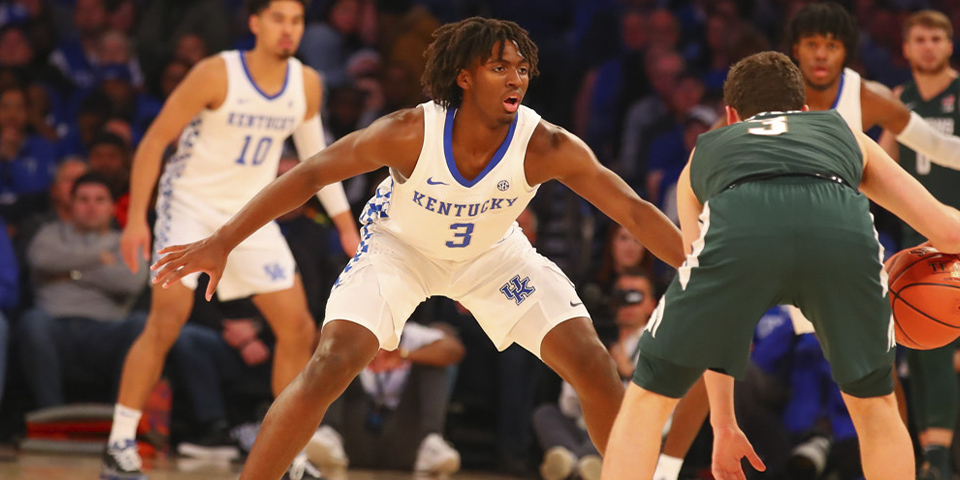
    DWIMP diverges most from stock percentage for a pair of instructive ball-handlers. Both Malachi Flynn and Tyrese Maxey underwhelmed by conventional defensive playmaking stats last year, but the more comprehensive defensive analysis underlying DWIMP captures the steady impact both guards provided through reliability.

    Flynn and Maxey ranked first and second respectively in off-ball defensive consistency among the 18 ball-handlers in our sample last year. While neither player made a ton of plays on the ball, both satisfied their responsibilities as team defenders. It was rarely electric, but it was clinical, and the two significantly improved their teams’ defenses accordingly:

    A tag here, a stunt there, throw in a nice dig to force a ball pickup–the box score tells you Maxey does nothing on this possession, but his true impact is undeniable. 

    On the ball, the pair maintained their steadiness. Flynn sat first and Maxey third among ball-handlers in our point-of-attack defense metric, driven by unsexy factors like ranking first and second respectively in screen avoidance:

    On top of technical excellence, traditional stats fail to even capture the full gamut of defensive playmaking. They miss the effort, activity, and spatial awareness underlying the non-steal deflections that were routine to Flynn, who ranked second among ball-handlers in our On-Ball Disruptions metric, which accounts for things like pressures and deflections in addition to steals and blocks.

    Just as the two did what was demanded of them to add value, they avoided crippling mistakes that concede value. Flynn placed first in our entire 50-player sample in both defensive discipline and defensive IQ, while Maxey ranked second among ball-handlers in those metrics. Avoiding low-effort plays and limiting bad gambles, Flynn and Maxey added defensive value not through occasional excitement but mundane excellence.

    Though Flynn and Maxey succeeded through — broadly speaking — one defensive style, none of this is to say the only way to provide defensive value is by eschewing defensive playmaking in favor of reliability. High lottery picks like Patrick Williams and Onyeka Okongwu, for example, posted both gaudy DWIMPs and stock percentages; high block, steal, or stock percentage does not mean bad defense.

    they do as they say

    Instead, our research indicates block, steal, and stock percentage don’t mean much of anything. They’re not indicative of positive or negative defensive impact, outlier or ordinary physical tools, basketball ingenuity or incompetence.

    Block, steal, and stock percentage are not bashful. They are exactly what they say they are: the rates at which players accumulate blocks and steals. They are limited by the constraints of what blocks and steals themselves are–an inaccurate pass that simply falls into a player’s hands is a steal. 

    To infer more from block, steal, and stock percentage does a disservice to those metrics. As such, basketball discourse is better served by using stock percentage and its components for their designed purposes rather than as proxies for true defensive impact.

  • Stat of the Week: A look at NFL and NBA Power Ratings

    With the baseball postseason over, it’s time to immerse ourselves in the NFL and NBA. If you haven’t paid close attention to this point, or are just curious for some interesting analysis, the Bill James Online Power Ratings are here to help.

    NFL

    Bill James Online Power Ratings
    Team
    1. Saints 111.7
    2. Chiefs 110.9
    3. Rams 110.2
    4. Steelers 109.5
    5. Ravens 108.5

    The top NFL team by the power ratings is the New Orleans Saints, who edge out the Kansas City Chiefs and the Los Angeles Rams. The Pittsburgh Steelers and Baltimore Ravens round out the Top 5 overall. The Power Ratings are intended to show how many points above (or below) average that a team is to that point in the season. The NFL Power Ratings use 100 as a baseline, so the Saints would be 11.7 points better than the average team.

    The 8-1 Saints have eight straight wins, including two wins over Top-5 teams. They’ve beaten the Ravens on the road and the Rams at home. They’ll face the struggling defending Super Bowl champion Eagles on Sunday. Drew Brees is playing like an MVP with 21 touchdown passes and only one interception.

    The Chiefs have looked ultra-impressive thanks largely to quarterback Patrick Mahomes, whose first season as a starter has been a record-setting one. His 31 touchdown passes are a Chiefs single-season record.

    Rams running back Todd Gurley may have something to say about Brees’ and Mahomes’ MVP candidacies. He leads the NFL with 988 rushing yards, 13 rushing touchdowns and 17 touchdowns overall. Gurley has a chance to be the first player to lead the NFL in touchdowns scored in consecutive seasons since Shaun Alexander for the Seahawks in 2004 and 2005.

    NBA

    Bill James Online Power Ratings
    Team
    1. Bucks 214.9
    2. Trail Blazers 209.8
    3. Warriors 207.8
    4. Clippers 206.9
    5. Raptors 206.8

    (Note that the NBA uses 200 as a baseline. The Bucks are 14.9 points better than the average team).

    The early surprise in the NBA’s Power Ratings (which are based entirely on this season’s performance) is that there are two teams ahead of the Golden State Warriors — the Milwaukee Bucks are No. 1 and the Portland Trail Blazers are No. 2.

    Both the Bucks and Trail Blazers are 10-3. The Bucks have shown their mettle by beating the Raptors (No. 5 in our rankings) by 15 and the Warriors by 23, though they’ve lost to both the Clippers (No. 4 in our rankings) and the Trail Blazers. The addition of Brook Lopez has boosted a Bucks team that leads the NBA in three-pointers made and is averaging 121.6 points per game. Giannis Antetokounmpo is averaging 25 points and 13 rebounds to lead the way for them.

    Damian Lillard, C.J. McCollum and the Trail Blazers are trying to bounce back from a disappointing finish to last season when they got swept by the Pelicans in the first round of the playoffs. They’ve won three straight games against prominent teams — the Bucks, Clippers and Celtics– to wrap up a six-game homestand.

    Up next is six straight on the road, including back-to-back games to close the trip against the Bucks and Warriors. Their next home game is against the Clippers on Nov. 25.

    The power ratings will be worth checking again at that point to see whether the Trail Blazers have the staying power to remain among the league’s top teams.

    If you want to keep up with the Power Ratings, you can follow them with a subscription to Bill James Online.