Category: College Football

  • NFL Draft: Best of the Rest

    By John Shirley

    The SIS Football Rookie Handbook provides an in depth analytical and scouting view on the top 254 players in this week’s upcoming NFL Draft. Here we take a look at some intriguing prospects that didn’t quite make the cut.

    The following are a few players that have intriguing analytical profiles and showed traits that suggest they have NFL potential, but had flaws that kept them from being included in the Football Rookie Handbook (FRH).

    Marcus McMaryion, QB, Fresno State:

    Analytical Profile: McMaryion was highly efficient last year, albeit in a non-Power 5 conference and in an offense that didn’t ask him to drive the ball down field often. Though he would have ranked first in On-Target % in our book, he would have ranked next to last in Average Depth of Target (only Gardner Minshew had a lower ADoT).

    StatNumberRank Among SIS FRH QB’s
    (13 Qualified)
    On-Target % 79.5%1st
    ADoT7.612th
    EPA/Dropback0.155th
    IQR112.36th
    IQR under pressure107.92nd

    Scouts Take: He possesses a strong arm with the mobility to work in and out of the pocket. He struggles with overall consistent accuracy and his ability to read defenses as his team ran a lot of RPO/1-read plays.

    Terry McLaurin, WR, Ohio State:

    Analytical Profile: McLaurin was a big-play deep threat that had a high ADOT and EPA/ Target, but would have had by far the lowest Target Share among Handbook WR’s. He also excelled in creating separation.

    To get an estimate of separation we looked at the amount of yards between when a receiver first caught the ball, and when he was first contacted by a defender, where pass breakups and interceptions count as 0 Yards After Catch Before Contact (YACBC). He ranked third in Total Average YACBC and first in YACBC against man coverage with an average of 7.4 yards.

    StatNumberRank Among Handbook WRs
    (33 Qualified)
    On-Target Catch %84.2%6th
    Target Share8.8%Last
    ADoT15.14th
    EPA/Tgt1.081st
    Avg YACBC4.3 yds3rd

    Scouts Take: He is a solid special teams player that can contribute on offense with his toughness and separation ability. He isn’t an incredibly precise route runner and doesn’t have a ton of short area quickness.

    Wyatt Ray, Edge, Boston College:

    Analytical Profile: Ray was solid against the run, ranking in the middle of the pack in Average Depth of Tackle and Caused Bounce % on Runs to his gap. While his pressure and sack numbers are towards the bottom of Edge Rushers in our Handbook, they are still respectable and it should be noted he was competing against teammate (and our 8th ranked DT/5-Tech) Zach Allen for pressures.

    StatNumberRank Among Handbook Edge’s
    (23 Qualified)
    Pressure %10.9%22nd
    Sack %2.2%18th
    Avg Depth of Tackle2.48th
    Tackle Share5.3%18th
    Caused Bounce %32.4%14th

    Scouts Take: He’s explosive and quick off the edge and shows the bend to get to the quarterback. He doesn’t always rush with a plan and doesn’t use any counter moves to try and get into the backfield.

    E.J. Ejiya, LB, North Texas:

    Analytical Profile: Ejiya has one of the strongest all-around analytical profiles among players not in the Handbook. He ranks highly in almost every category, albeit against non-Power 5 competition. Perhaps most impressive is the fact that he ranked seventh in the country in Pressure % among players with at least 150 pass rushes. This is higher than Edge Rushers such as Montez Sweat, Brian Burns, and Clelin Ferrell.

    StatNumberRank Among Handbook LBs
    (25 Qualified)
    Avg Depth of Tackle3.02nd
    Tackle Share15.0%4th
    Broken Tackle %3.4%2nd
    Comp % Allowed0.0%N/A (Only 4 Targets)
    Pressure %18.3%(7th in the Country Among All
    Players w/ 150+ Pass Rushes)

    Scouts Take: He’s a rangy athlete that has solid speed from sideline to sideline. He struggles to shed blockers and navigate through the trash on a consistent basis.

    Mark Fields, CB, Clemson:

    Analytical Profile: Fields compares extremely well against the CBs in the Handbook, as he would have ranked first in many coverage metrics. However, he would have been the least targeted CB in the book, as he was never a true starter at Clemson. It would have been interesting to see if his strong numbers continued with a larger sample size.

    StatNumberRank Among Handbook CBs
    (25 Qualified)
    Deserved Catch % Allowed50.0%1st
    EPA/ Tgt-0.531st
    Positive % Allowed17.4%1st
    Avg YACBC Allowed0.21st
    Broken Tackle %41.7%26th

    Scouts Take: He is a good cover corner that has the speed to be a solid slot player. He struggles against larger receivers and doesn’t possesses great play strength to knock them off of their routes.

  • A closer look at Iowa’s star tight ends

    By Bryce Rossler
    We’re less than two weeks away from the first round of the NFL Draft, and it seems likely that the University of Iowa will have two players selected in the first round. It is not particularly unusual for a Power 5 school to produce multiple first-rounders in a single year – plenty of recent drafts have had multiple programs do so – but it is interesting that both the players in question, TJ Hockenson and Noah Fant, are tight ends.

    As Dan Kadar of SB Nation noted, this would represent the first time that two tight ends from the same school were taken in the first round. And while their paths will almost certainly diverge on April 25, it’s impossible to mention one without the other being brought up.

    However, the two weren’t so inseparable on the field. The Hawkeyes were in 12 personnel on ‘just’ 35% of their offensive snaps in 2018, and Hockenson played 342 snaps with Fant on the sideline, while the inverse was true just 63 times:

      Hockenson In Hockenson Out
    Fant In 421 63
    Fant Out 342 0

    On plays where Hockenson was in and Fant was not (HIFO), the Hawkeyes ran the ball 54% of the time and averaged -0.2 EPA/rush on designed runs.

    As one might expect, they ran less frequently when Fant was in and Hockenson was not (FIHO). The run rate in Hockenson’s absence dropped to 40%, but, interestingly enough, rushes were more effective (-0.02 EPA/rush), albeit in a limited sample.

    But this is not to say that the run game was better because Hockenson was out of the game. It should be noted that Iowa’s coaches were less willing to run behind Fant than Hockenson.

    Iowa dialed up C- and D-gap runs to Fant’s side on just 22% of FIHO run plays, whereas they ran behind Hockenson on 35% of HIFO plays. And indeed, the average yards before contact on HIFO runs to Hockenson’s side was 1.6, compared to just 0.8 on FIHO runs to Fant’s side.

    Unsurprisingly, the EPA-based success rate on run plays improved when both were in the game (41%) as opposed to when just Hockenson (35%) or Fant (33%) was in. The team was, perhaps surprisingly, less successful passing than running, as they posted a 36% success rate on dropbacks. This mark was better than when just Hockenson (28%) was on the field, but slightly worse than when just Fant (40%) was. Additionally, the EPA/dropback on these plays (-0.07) is much higher than the plays that featured just Hockenson (-0.67).

    The last two data points make sense because Fant is generally billed as the better pure receiver, but, once again, it should be noted the sample size is smaller. 

    Their route trees were very similar, but the average target depth on all pass plays which featured only Fant (9 air yards/throw) was higher than the average target depth on those which featured only Hockenson (8.2).

    However, if you look at plays where they were both in the game, Fant was targeted 53 times to Hockenson’s 34 (33 if you exclude interceptions), but Hockenson’s average depth of target (9.4) was higher than Fant’s (8.7). Hockenson’s EPA/target of 0.77 was also well above Fant’s 0.46 EPA/target

    Furthermore, Hockenson’s EPA/target across all plays was 0.77/target and ranked third of 99 tight ends with 20+ targets in 2018. Fant (0.46) ranked 22nd behind several other draft-eligible tight ends; most notably, Trevon Wesco (4th), Irv Smith, Jr. (6th), Isaac Nauta (8thth), Jace Sternberger (14th), and Dawson Knox (15th).

    The numbers indicate that Hockenson is the more well-rounded player, which aligns with media consensus. In our inaugural Football Rookie Handbook, we ranked Hockenson ahead of Fant, with the two comprising our top-graded tight ends. You can purchase the Football Rookie Handbook at this link.

    Editor’s note: a previous version had miscalculated dropback success rates. We regret the error.

  • Two Highly Rated Prospects Have Seen Their Draft Stock Take a Hit: Here’s Why

    Two Highly Rated Prospects Have Seen Their Draft Stock Take a Hit: Here’s Why

    With the draft a little more than a week away, teams and draft analysts alike are finalizing their draft boards. For the most part, they look a lot different than they did only a few months ago. A couple of the highest rated prospects from the SIS Rookie Handbook are among those whose stock has taken a hit during the pre-draft process.

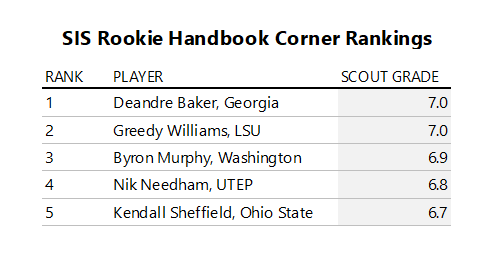
    Greedy Williams

    In the SIS Rookie Handbook, Greedy Williams was one of nine players to receive a grade of 7.0 or better, and was tied with DeAndre Baker as the highest rated corner grade. Initial mock drafts had Williams as a potential top 5 pick, and a virtual lock for top 10. Since then though, Williams has seen his stock taking a bit of a tumble. Mel Kiper has Williams 22nd on his big board, and his 3rd corner overall, trailing both Deandre Baker and Byron Murphy. Most mock drafts now have Williams as a mid to late first round pick, with some putting him as low as the top of the second round.

    What he does well:

    What’s interesting about Williams is that his ability to cover has never really been in question. In 2018 he allowed a deserved catch percentage of only 60%, and a QB Rating against of only 43.3. Both of those figures ranked as the second best among draft eligible cornerbacks, and were ahead of Baker and Murphy.

    Part of what makes Williams so good in coverage is his ability to make quick transitions and stay patient on deep routes and double moves. While there was some worry after he struggled in his combine drills, particularly the pedal and turn, his numbers and film show little reason for concern overall.

    On throws at least 20 yards downfield in 2018 Williams allowed only 6 completions for 172 yards and a touchdown on 22 targets, a yards per attempt of only 7.8. More impressive, while lined up on the outside in man coverage, receivers attempted a double move on Williams 9 times. The lone target fell incomplete. It is a relatively small sample, but illustrates his ability to suppress targets and is strong evidence of his ability to stay patient on long developing routes.

    Where he comes up short:

    The biggest reason for Greedy’s fall from the top of big boards is his tackling ability. Take this quote from Mel Kiper that echoes the concerns of a number of NFL teams:

    “Opinions are already complete now, and I think the tackling and the ability to be an 11th man on that defense, and not play with 10 and have a big running back coming around the corner and make a business decision on whether you tackle or you don’t. Again, you’ve got to tackle these bigger receivers, these tight ends in space, because it’s an extension of the running game. Or these short passes. You can’t be missing tackles in the open field or around the line of scrimmage. Again, tackling not just running backs, but receivers and tight ends, that’s going to be the issue.”

    There is room to debate just how important it is for corners to be strong tacklers, especially when they are as strong in coverage as Williams, but there is no denying that tackling is an issue. Williams had only 34 combined tackles in 2018, which did not even rank him in the top 200 among all college corners. He also had a broken tackle percentage of 15.4%, which was among the worst of all draft eligible corners. Put into perspective, fellow top prospects Deandre Baker and Byron Murphy came in at 2.4% and 8.2% respectively, both ranking in the top 10 among draft eligible corners.

    Some of this is scheme related as Williams spent 63% of his snaps in man coverage in 2018, but his poor tackling technique is certainly a concern for teams that like to use corners in run support, and is the main culprit for his slide as we approach the draft.

    N’Keal Harry

    There has never really been a consensus among draft analysts about the top WRs in this years draft, and the picture hasn’t become much clearer as we approach the draft. One player that seems to be sliding though is N’Keal Harry, who comes in as the top receiver in the SIS Rookie Handbook.

    Once in contention with Metcalf for the top spot among receivers, Harry has been usurped in a most rankings by the likes of A.J Brown, Deebo Samuel, Marqise Brown and even J.J. Arcega-Whiteside. What’s different about his slide though is that there is nothing new you can point to that explains it. Sure, D.K. Metcalf showing up to the combine looking like a super human didn’t help, but Harry had a strong combine performance in his own right, posting a 4.53 40-yard dash, 38.5″ vertical, and 27 reps on the bench.

    What he does well:

    In 2018 Harry turned 90 catchable targets into 73 catches, 1,088 yards and 9 touchdowns, a QB Rating when targeted of 114.9. His ability to use his size to make plays downfield is part of what makes him such an intriguing prospect. Harry ran 47.2% of his routes down the field 2018, and on those targets racked up 17 catches for 421 yards and 5 TDs. Good for a rating of 129.75.

    Harry is also dynamic with the ball in his hands after the catch, using his unique combination of size and speed to generate additional yardage. In 2018 he averaged 7.1 yards after the catch, and his 308 yards after contact ranked 5th in the NCAA.

    Where he comes up short:

    While Harry has shown a knack for finding soft spots in zone coverage, he fails to consistently create separation against man – particularly on shorter routes – and rather relies on his size, length, and catch radius to make plays. While this served him well in the college ranks, relying solely on size and athleticism gets exponentially more difficult against NFL corners.

    To get an estimate of separation we looked at the amount of yards between when a receiver first caught the ball, and when he was first contacted by a defender. (Pass breakups and interceptions are counted as zeroes.) When looking at targets less than 15 yards downfield, Harry averaged about 2.4 yards against zone, but only .13 yards against man coverage. His numbers against man ranked him 2nd worst among draft eligible receivers, and 303rd of 313 receivers with at least 25 targets overall.

    Separation is not always everything though, especially for a player who has the size and athleticism of Harry. While he struggled to consistently separate, it is also worth pointing out that some of the players in the NFL who find themselves amongst the trailers in this metric include A.J. Green, DeAndre Hopkins, and Julio Jones.

  • And Then There Were Three: a Statistical Comparison of Haskins, Lock, and Jones

    The combine is a distant memory, pro days are all but over, and it seems all that’s left to do is twiddle our thumbs as teams make their final preparations for the NFL Draft. But, arguing amongst ourselves about quarterbacks is a rich tradition, so perhaps that is the best way to occupy our time as we countdown to April 26th. From an analytical perspective, the search for QB1 begins and ends with Kyler Murray, who dominated the advanced stats leaderboards in our inaugural Rookie Handbook. Murray is widely expected to go first overall to the Arizona Cardinals, but prognosticators are less certain about how the rest of the chips will fall.

    Three other quarterbacks – Ohio State’s Dwayne Haskins, Missouri’s Drew Lock, and Duke’s Daniel Jones – are also receiving first round consideration, and there’s no shortage of potential landing spots. The Giants, Broncos, Bengals, Dolphins, and Redskins are franchises with long-term uncertainty at the position who pick within the top half of the first round.

    From an Expected Points Added (EPA)/attempt perspective, Haskins (0.3) is head and shoulders above Lock (0.13) and Jones (-0.04). He’s also considerably more accurate, having delivered an on-target ball on 77% of his throws in 2018, whereas roughly 30% of passes thrown by Lock (71.4%) and Jones (71.6%) were uncatchable or required an adjustment.

    Haskins’ detractors will point to his low average depth of target (ADOT) of 7.9 yards and cite that he made lower-difficulty throws, but he targeted shallow routes at a rate comparable to the other two. Although Lock (8.8) and Jones (8.2) had higher ADOTs, their throws traveled five yards or less at virtually the same rate as Haskins:

    Quarterback Shallow Throw Rate
    Haskins 49.1%
    Jones 49.2%
    Lock 48.6%

    Perhaps this is more symptomatic of a concern about Haskins’ mechanics as they pertain to the deep ball. However, our metrics indicate that he was still one of the better passers in the nation at throwing catchable balls to depths of 20+ yards. Out of 151 college quarterbacks who threw twenty or more such passes in 2018, Haskins ranked 15th at 64.9%. That’s notably a tenth of a percentage point better than Alabama’s Tua Tagovailoa, who is, for all intents and purposes, the incumbent 2020 QB1. It also represents a substantial demarcation from Jones, who ranked 47th at 56.8%. That said, he ranked lower than Lock, whose biggest selling point may be his vertical passing acumen. The Missouri signal-caller ranked 6th in the country by throwing a catchable deep ball 67.8% of the time.

    By this point, you’ve probably noticed that Jones doesn’t compare favorably to his counterparts, and his case is a curious one. First and foremost, it should be noted that he played most of the season with a plate and screws in his left clavicle to fuse together a broken collarbone he suffered on September 8th. Nevertheless, the Blue Devil captain played himself into first round consideration and is regarded by some as the most pro-ready quarterback in the draft. However, the numbers don’t necessarily back that assertion up.

    Jones was primarily asked to execute 0/1-step drops, RPOs, screens, and rollouts, concepts that generally indicate simpler, or even singular, reads. He did so on a whopping 72.6% of his dropbacks, the eighth-highest rate among 164 quarterbacks who dropped back 100+ times in 2018. To give you an idea of how that might translate to the NFL, Nick Foles had the highest rate of 43 NFL quarterbacks at 58.3%. Only two other quarterbacks did so at a rate above 50%, and the average rate among quarterbacks who dropped back at least 100 times was 33.8%.

    Fit will be important for all of these quarterbacks, but it seems that Jones’ projection requires a bigger leap of faith than the others. Whereas the numbers can point to ways in which Haskins and Lock win, the statistical picture for Jones is cloudy. For a more in-depth look at each of these quarterbacks, the aforementioned Rookie Handbook has comprehensive stats and scouting reports on each, and can be purchased here.


  • A statistical comparison of Outland winners Quinnen Williams and Ed Oliver

    BY BRYCE ROSSLER

    For the first time in six years, the NFL Draft will feature two Outland Trophy winners, both of whom figure to be selected early. But, this occurrence is especially strange because both players in question, Houston’s Ed Oliver and Alabama’s Quinnen Williams, are defenders (the award is given to the best interior linemen, on offense or defense).

    The last time that two defensive winners of the trophy were in the same draft was 1978, which featured Notre Dame’s Ross Brown and Texas’s Brad Shearer. And perhaps that’s fitting since the defensive line is considered the strength of this class, a group that Oliver and Williams still manage to stand out from.

    For most of last offseason, Oliver was billed by some as the surefire top selection in the class, but that was before Williams ascended to the throne with a dominant 2018 campaign. Whereas the former has been a known commodity for some time now, the latter seemingly came out of nowhere. Both of Williams’ running mates at Alabama, Isaiah Buggs and Raekwon Davis, were certainly attracting more attention in preseason. But, once he hit the field, Williams quickly became the focus of opposing teams.

    The Crimson Tide sophomore ranked first in run stuff rate (i.e. solo tackles for non-positive yardage) among 339 defensive tackles with at least 100 run snaps. His rate of 6.8 percent was about a full percentage point higher than the next-best interior player, South Alabama’s Tyree Turner (5.8). And in case you were wondering – his Outland predecessor ranked third with a rate of 5.3 percent.

    That difference is even further accentuated when you consider that teams aimed runs towards Williams on 19 percent of their rushing attempts, as opposed to 29 percent of the time for Oliver. And when teams did run at Williams, he caused the ballcarrier to bounce the play 43 percent of the time – nearly ten-plus percentage points more often than Oliver did (34 percent).

    Williams was an even bigger difference-maker as a pass-rusher, boasting a hurry rate of 13.8 percent. That dwarfs the second-highest figure, which belongs to San Jose State’s Boogie Roberts, by 2.8 percentage points. Oliver once again ranks fourth with a still-excellent hurry rate of 10.5 percent. But, to give you an idea of just how impactful Williams was, his hurry rate outpaced that of several edge rushers who will merit first round consideration in April, namely: Clemson’s Clelin Ferrell (12.1 percent), Florida State’s Brian Burns (11.5), Mississippi State’s Montez Sweat (10.5), and Michigan’s Rashan Gary (9.5).

    While the NFL will present a new set of challenges for Williams, his hurry rate this year was comparable to Aaron Donald’s at the NFL level. This doesn’t mean that he’ll be able to maintain that productivity on Sundays, but it does serve to illustrate his level of collegiate dominance. (If anything, it should serve to illustrate how futile the search for the next Aaron Donald is)

    The bottom line is that both players project to be three-down difference-makers early in their careers. The advanced metrics seem to favor Williams, but an argument could be made that the already-established and obviously-talented Oliver suffered from a junior-year drop off as Jadeveon Clowney and Myles Garrett once did, and that he was capable of imposing his will more often. At any rate, statistics can only begin to contextualize a player’s performance, and film is what tells the full story.

    A more traditional perspective on each (and more advanced stats like these) can be found in the Football Rookie Handbook (details to come on that in the near-future).

  • A statistical comparison of Outland winners Quinnen Williams and Ed Oliver

    BY BRYCE ROSSLER

    For the first time in six years, the NFL Draft will feature two Outland Trophy winners, both of whom figure to be selected early. But, this occurrence is especially strange because both players in question, Houston’s Ed Oliver and Alabama’s Quinnen Williams, are defenders (the award is given to the best interior linemen, on offense or defense).

    The last time that two defensive winners of the trophy were in the same draft was 1978, which featured Notre Dame’s Ross Brown and Texas’s Brad Shearer. And perhaps that’s fitting since the defensive line is considered the strength of this class, a group that Oliver and Williams still manage to stand out from.

    For most of last offseason, Oliver was billed by some as the surefire top selection in the class, but that was before Williams ascended to the throne with a dominant 2018 campaign. Whereas the former has been a known commodity for some time now, the latter seemingly came out of nowhere. Both of Williams’ running mates at Alabama, Isaiah Buggs and Raekwon Davis, were certainly attracting more attention in preseason. But, once he hit the field, Williams quickly became the focus of opposing teams.

    The Crimson Tide sophomore ranked first in run stuff rate (i.e. solo tackles for non-positive yardage) among 339 defensive tackles with at least 100 run snaps. His rate of 6.8 percent was about a full percentage point higher than the next-best interior player, South Alabama’s Tyree Turner (5.8). And in case you were wondering – his Outland predecessor ranked third with a rate of 5.3 percent.

    That difference is even further accentuated when you consider that teams aimed runs towards Williams on 19 percent of their rushing attempts, as opposed to 29 percent of the time for Oliver. And when teams did run at Williams, he caused the ballcarrier to bounce the play 43 percent of the time – nearly ten-plus percentage points more often than Oliver did (34 percent).

    Williams was an even bigger difference-maker as a pass-rusher, boasting a hurry rate of 13.8 percent. That dwarfs the second-highest figure, which belongs to San Jose State’s Boogie Roberts, by 2.8 percentage points. Oliver once again ranks fourth with a still-excellent hurry rate of 10.5 percent. But, to give you an idea of just how impactful Williams was, his hurry rate outpaced that of several edge rushers who will merit first round consideration in April, namely: Clemson’s Clelin Ferrell (12.1 percent), Florida State’s Brian Burns (11.5), Mississippi State’s Montez Sweat (10.5), and Michigan’s Rashan Gary (9.5).

    While the NFL will present a new set of challenges for Williams, his hurry rate this year was comparable to Aaron Donald’s at the NFL level. This doesn’t mean that he’ll be able to maintain that productivity on Sundays, but it does serve to illustrate his level of collegiate dominance. (If anything, it should serve to illustrate how futile the search for the next Aaron Donald is)

    The bottom line is that both players project to be three-down difference-makers early in their careers. The advanced metrics seem to favor Williams, but an argument could be made that the already-established and obviously-talented Oliver suffered from a junior-year drop off as Jadeveon Clowney and Myles Garrett once did, and that he was capable of imposing his will more often. At any rate, statistics can only begin to contextualize a player’s performance, and film is what tells the full story.

    A more traditional perspective on each (and more advanced stats like these) can be found in the Football Rookie Handbook (details to come on that in the near-future).

  • Preview: Alabama vs. Clemson, College Football National Championship

    Let’s take a brief look at some statistical notes ahead of tonight’s College Football National Championship between No. 1 Alabama and No. 2 Clemson.

    Alabama Passing vs. Clemson Pass Defense

    • Tua Tagovailoa ranks second (142.3) in our Independent Quarterback Rating* metric for the 2018 season, behind only Oklahoma’s Kyler Murray (145.3).
    • That said, Tagovailoa has performed much better when not under pressure: 149.3 IQR with no pressure; 113.1 IQR with pressure (which still ranked sixth in the country, minimum 50 attempts)…
    • …and Clemson’s pass rush, even without Dexter Lawrence, can bring pressure. The Tigers have registered 256 QB pressures this year, third behind only Ohio State (263) and Alabama (260).
    • Tua’s primary targets include Jerry Jeudy and Henry Ruggs III. Among receivers with at least 60 targets on the season, Jeudy ranks third in yards per target (12.4) and Ruggs ranks 12th (11.1).
    • Clemson’s defense recorded only 27 passes-defensed for the season — by far the fewest of any of the playoff teams (Notre Dame 51; Alabama 48; Oklahoma 40).

    Alabama Rushing vs. Clemson Run Defense

    • Clemson’s run defense is dominant, allowing only 2.2 yards per attempt (best in the country).
    • The Tigers are especially good up the middle at 1.95 yards per attempt. Every other FBS team allowed at least 3 YPA. We’ll see if Lawrence’s absence on the interior affects this against Alabama.
    • Alabama has depth in the backfield. It gave 100+ carries to three rushers this season: Damien Harris (139), Josh Jacobs (109), and Najee Harris (108).
    • Among NCAA rushers with at least 100 carries, Jacobs ranks third in broken tackle percentage (38.5%) and first in first down percentage (41.3%).

    Clemson Passing vs. Alabama Pass Defense

    • Trevor Lawrence has picked apart man coverages — his 137.8 IQR in such situations ranks third behind Tagovailoa (139.0) and Murray (138.7).
    • Why is this notable? Alabama plays a lot of man defense — specifically Cover 1 and Man Cover 2.
    • As noted above, Alabama’s pass rush brings the pressure like Clemson’s. But Lawrence has shown so far that he can handle it: his 122.7 IQR under pressure ranks second among quarterbacks with at least 70 attempts in such situations.
    • Keep an eye on Hunter Renfrow, who’s succeeded in previous matchups against the Crimson Tide. The dependable Renfrow is tied for 30th nationally with a 90.4 percent on-target catch rate.

    Clemson Rushing vs. Alabama Run Defense

    • Clemson running back Travis Etienne was one of only three running backs with more than 20 rushing touchdowns on the season, joining Memphis’ Darrell Henderson and Florida Atlantic’s Devin Singletary.
    • Etienne has been one of the nation’s most effective rushers on a per-attempt basis, ranking as one of five running backs with an average of over eight yards per attempt while carrying the ball at least 100 times.
    • Alabama’s run defense has not been as effective on the outside as it has been on the inside. The team ranks 11th among FBS teams in limiting yards per attempt on inside runs, but only 84th on off-tackle and outside runs.
    • That could be something to watch, as Etienne has collected 927 yards on 101 off-tackle and outside carries. That 9.2 YPA ranks second among NCAA running backs with at least 50 such runs.

    Independent Quarterback Rating is Sports Info Solutions’ proprietary quarterback metric. It builds on the traditional Passer Rating formula by accounting for results that are outside of the quarterback’s control – dropped passes, dropped interceptions, throwaways, etc. – to form a better benchmark of QB value.

  • Stat of the Week: A Statistical View of the College Football Playoff Field

    The College Football Playoff field is set: the semifinal games on December 29 will feature No. 1 Alabama against No. 4 Oklahoma, and No. 2 Clemson against No. 3 Notre Dame.

    All four teams have had interesting storylines at quarterback, while also dominating in other facets of the game. Using Sports Info Solutions’ advanced metrics and charting data, let’s take a brief look at each team’s success this season.

    No. 1 Alabama

    Tua Tagovailoa burst onto the scene in last year’s National Championship when he replaced Jalen Hurts and led the Crimson Tide over Georgia. Retaining the starting job this year, Tua has not disappointed. He ranks second in the nation in our Independent Quarterback Rating* (IQR) metric, behind the quarterback Alabama will face in the semifinal: Oklahoma’s Kyler Murray.

    Yet it was Hurts who played the hero in last weekend’s SEC championship victory after replacing an injured Tagovailoa. It’s worth noting that Hurts has done well himself this season, completing 50 of 67 passes and posting a 139.6 IQR—right behind Tagovailoa when considering quarterbacks who have attempted 50 or more passes in 2018.

    Best IQR Among QB with 50+ Attempts
    Player School IQR
    Kyler Murray Oklahoma 147.9
    Tua Tagovailoa Alabama 143.1
    Jalen Hurts Alabama 139.6
    Jake Fromm Georgia 134.2
    Dwayne Haskins Ohio State 131.2

    Alabama has been arguably the best team at throwing the ball deep. On 56 throws of 20-plus yards, they have completed 35 of them and scored 16 touchdowns. On a per-attempt basis, those marks are the best in college football.

    The talented Jerry Jeudy has been the preferred target at wide receiver. Among receivers with at least 75 targets, he ranks third with 12.3 yards per target and fifth with a 134.9 Receiver Rating (which is traditional passer rating on targets).

    No. 2 Clemson

    Trevor Lawrence has excelled since taking over for Kelly Bryant at quarterback. The true freshman has picked apart man coverages; his 137.8 IQR in such situations ranks fourth behind Tagovailoa, Fromm, and Murray.

    Beyond Lawrence, Clemson dominates the running game on both sides of the ball. The defense has allowed 2.1 yards per rush attempt (YPA), the best mark in the nation. With draft prospects Christian Wilkins and Dexter Lawrence on the interior of the defensive line, the Tigers are a force up the middle. Clemson has surrendered only 1.9 yards per attempt on inside runs. Every other FBS team has allowed at least 3 YPA on such plays.

    Offensively, Travis Etienne picks up the bulk of the carries and has been one of the best rushers on a per-attempt basis, averaging 8.3 YPA. Along with Memphis’ Darrell Henderson and Florida Atlantic’s Devin Singletary, Etienne is one of three players with more than 20 rushing touchdowns on the season.

    No. 3 Notre Dame

    Like Alabama and Clemson, a change at quarterback was a major storyline for the Fighting Irish. Through Week 3, Brandon Wimbush registered just a 54.0 IQR, which ranked 117th out of the 122 quarterbacks with at least 50 pass attempts to that point.

    Since taking over the starting job, Ian Book’s 107.2 IQR ranks among the top 30 nationally. Notre Dame gained accuracy in the passing game with the transition, with Book’s 70 percent completion rate signifying a considerable improvement over Wimbush’s 53 percent rate.

    Pass defense has been similarly important. The Irish pass rush leads the country in quarterback hurries, just ahead of college football’s other contenders. Defensive end Julian Okwara ranks among the top ten nationally with 39 hurries, while tackle Jerry Tillery and end Khalid Kareem have contributed 30 and 26, respectively.

    Most QB Hurries
    School Hurries
    Notre Dame 187
    Alabama 186
    Clemson 175
    Ohio State 172

    No. 4 Oklahoma

    Leading the nation with a 147.9 IQR, Kyler Murray has been outstanding as the successor to Baker Mayfield. Murray has been particularly dynamic outside of the pocket; among signal callers with at least 25 attempts in those situations, his 146.3 IQR, 16 percent touchdown rate, and 10.4 yards per attempt all lead the country. He can also push the ball downfield with accuracy, ranking third in on-target percentage on throws of 20 or more yards.

    Murray’s primary targets are Marquise Brown and CeeDee Lamb, who rank first and second, respectively, in yards per target (among receivers with at least 75 targets on the season).

    Despite losing running back Rodney Anderson to a season-ending injury, Oklahoma’s ground game has remained solid with Trey Sermon and Kennedy Brooks. As a team, the Sooners are among the best at breaking tackles (ranking second with a total of 143) and rushing to the outside (ranking second with an average of 8.1 YPA).

    Independent Quarterback Rating is Sports Info Solutions’ proprietary quarterback metric. It builds on the traditional Passer Rating formula by accounting for results that are outside of the quarterback’s control – dropped passes, dropped interceptions, throwaways, etc. – to form a better benchmark of QB value.

  • The most interesting numbers from the NFL Draft

    The most interesting numbers from the NFL Draft

    By KEEGAN ABDOO
    It was a fascinating and exciting NFL Draft, with twists, turns and plenty of interesting selections.

    What numbers were most telling to us about some of the top players selected?

    On Cleveland Browns QB Baker Mayfield
    Baker Mayfield ranked first with a Passing Success Rate of 61% (out of 113 FBS Quarterbacks with 200+ attempts), which is 4.7% better than second and a margin that represents the gap between 2nd and 14th best.

    Mayfield also excelled when plays broke down. He had an 82 percent on-target percentage on 44 throws in those instances.

    On New York Giants RB Saquon Barkley
    There were only eight RBs with at least 100 carries and 50 receptions in 2017. Among them, Barkley’s 7.0 yards/touch, 5.9 yards/attempt and 11.7 yards/reception each ranked first.

    On Denver Broncos Pass Rusher Bradley Chubb
    Bradley Chubb’s 111 pressures were the most in FBS over the last two seasons and 14 more than the second best total, which represents the gap between #2-#10.

    On Browns CB Denzel Ward
    Denzel Ward’s 3.9 Yards Allowed per Target were the best in the nation among CBs with at least 40 targets.

    He was even better in Man Coverage, where he allowed 2.8 Yards Per Target.

    On Bills QB Josh Allen’s escapability
    Josh Allen broke 16 tackles in the pocket last season, which was second only to Lamar Jackson (20). However, he did this on 174 fewer dropbacks.

    Of the 103 QB’s with at least 300 dropbacks last season, Allen’s 4.8% Broken Tackle/Dropback rate led the FBS by a significant amount.

    On a successful Bears LB
    Bears LB Roquan Smith was excellent in man coverage last season:

    Out of 44 LBs with at least 10 man targets, Smith ranked 2nd in Success Rate (83.3%) and Yards/Touch (2.55).

    Success Rate, per Football Outsiders, is how often a defensive player that prevent a successful play by the offense, defined as 45% of needed yards on first down, 60% of needed yards on second down, and 100% of needed yards on third or fourth down.

    On a disruptive CB
    Packers CB Josh Jackson has great ball skills. In 2017, he led the nation with 8 interceptions and ranked 4th among the 100 most targeted cornerbacks with a 31% Pass Disruption Rate.

    On surehanded receivers
    Arizona Cardinals WR Christian Kirk and Jacksonville Jaguars WR D.J. Chark ranked 1-2 in on-target catch percentage among receivers last season. Each caught 84 percent of on-target throws to them.

    On Mason Rudolph being first-round caliber
    When compared to Baker Mayfield, Sam Darnold, Josh Allen, Josh Rosen and Lamar Jackson, new Steelers QB Mason Rudolph had the second-highest Independent Quarterback Rating (IQR). IQR is a stat that measures QB effectiveness, taking into account the factors that he most controls.

    Rudolph also had the highest IQR among himself and the first-round quarterbacks when playing against a man defense.

  • Top 5 QB Prospects: Performance by Throw Location

    Top 5 QB Prospects: Performance by Throw Location

    By KEEGAN ABDOO
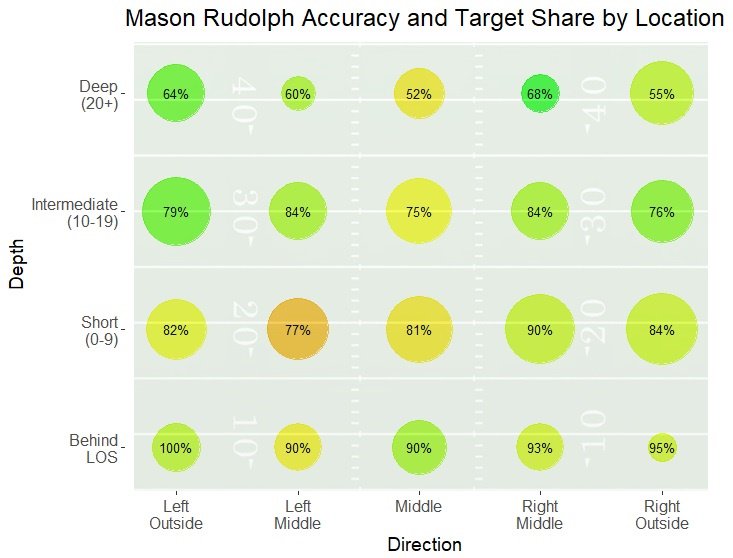
    Here at Sports Info Solutions, we track the direction and throw depth of every throw made at the FBS level, as well whether the ball was catchable or not. A huge conversation this draft season has been about the top five quarterback prospects and how well their true accuracy was represented by their Completion Percentage. Our On-Target Percentage statistic (simply catchable throws divided by all throws) captures a player’s ball placement ability much better than Completion Percentage, as it isolates a quarterback’s accuracy from his target’s ability to catch the ball.

    On that note, we have visualized each of the top five quarterback prospects’ accuracy and Target Share (percent of total attempts) by location of their throw. The size of the circle represents the Target Share, the color represents their On-Target Percentage relative to FBS average for that location (red = bad, yellow = average, green = good), and the number in the circle is their observed On-Target Percentage. We’ve included both 2016 and 2017 for these players to increase their sample sizes.


    Baker Mayfield


    In summary:
    Was consistently accurate all over the field.

    Baker Mayfield has had above average to elite accuracy almost everywhere on the field. Directionally, he most frequently threw passes between the hashes and to the right sideline outside the numbers.

    From a throw depth perspective, he ranked in the top two (amongst these five QBs) in throws behind the line of scrimmage and in deep and intermediate areas. However, he threw by far the fewest passes in the 0-to-9 yard range of any QB in this group at 33% (which was seven percentage points less than any other QB).

    When comparing his accuracy to FBS average, he had four of the five biggest differences in this group in On-Target Percentage: Deep Right Middle (+32%), Deep Left Middle (+31%), Intermediate Right Outside (+27%), and Deep Right Outside (+18%).


    Sam Darnold


    In summary:
    Could stick a deep throw to the right sideline at an elite level.

    Sam Darnold presented more of a mixed bag. Directionally, he slightly favored his right, especially outside the numbers.

    His accuracy was most impressive compared to FBS average in the Deep Middle (+17%) and Deep Right Outside (+15%), but he attempted three times as many throws (52 attempts vs. 17) to that Deep Right Outside area.


    Josh Rosen


    In summary:
    Majority of throws were short, potential West Coast Offense fit.

    Josh Rosen absolutely loved throwing in that bread basket right in front of him in the short middle—he had a higher percentage of his attempts here than any other of these QBs had in any area (13%).

    Likewise, this conservative throw distribution (whether by scheme or a bad offensive line) showed up again in his deep throw percentage, which ranked last by a considerable margin. By direction, nearly two-thirds of his throws were between the numbers.

    His accuracy didn’t really stand out in any area other than the Intermediate Left Outside (+14%); this was his only area which he placed in the top 20 (of the 100 depth and direction combinations) in terms of the difference between his On-Target Percentage and the FBS average.


    Lamar Jackson


    In summary:
    Threw short the most, deep middle sweet spot.

    Jackson did have the highest percentage of throws to the short area (46%), but he had the second fewest percentage of throws behind the LOS (13%) and lowest in the intermediate area (23%).

    Jackson really loved the Deep Middle—his Target Share in this area (6%) was highest of any prospects in any deep section, and his On-Target Percentage was elite (8% above FBS Average) on a big sample. However, his two most accurate areas compared to FBS average were interestingly both to the left and outside the numbers—specifically the Short Left Outside (+13%) and Intermediate Left Outside (+12%).


    Josh Allen


    In summary:
    Works sideline and deep the most.

    And finally, we have Josh Allen, an inaccurate QB whose arm strength and mobility still entice teams to think about his potential. To be fair, Allen’s throw locations were often to some of the hardest places to complete passes on the field, as his 51% Target Share outside the numbers was 12% more than the next QB (Darnold, 39%).

    Correspondingly, he was averse to throwing in the middle and left middle areas, ranking last in both. He also led in the percentage of his throws that were deep (22%) and intermediate (27%), while having the least amount of easy throws behind the LOS.

    While his accuracy generally was below average, he did excel in the Deep Right Middle compared to FBS average (+19%, which ranked fourth overall among these 100 combinations). However, that was on only 19 attempts, so sample size beware.

    After diving deep into accuracy by ball location, a lot of the narratives from this draft season actually hold up pretty well. Allen was, in fact, asked to make harder throws than everyone else.

    But even after controlling for the difficulty of throws, there is no QB who even came close to Mayfield in terms of being consistently accurate no matter where he threw the ball.