Month: March 2021

  • SIS Launches ‘SIS Model 5’ for 2021 MLB season


    Daily Fantasy Baseball projections powered by the most accurate, detailed MLB data.

    Sports Info Solutions has been at the forefront of baseball data and analytics for over 15 years. Formerly “Baseball Info Solutions”, the company has been a driving force behind the Sabermetric Revolution and the Moneyball Era, due largely in part to groundbreaking analytical contributions such as Defensive Runs Saved (DRS).

    Over the past six years, SIS has turned its extensive database and analytical prowess loose on the Daily Fantasy Sports industry.

    Beginning in 2016, John Dewan and our R&D team built the most comprehensive DFS model imaginable using the vast resources at their disposal. From this project spawned the original “Model 1”, which has undergone extensive testing and development behind the scenes to eventually lead us to the tool that is now available for the 2021 MLB season – “SIS Model 5”.

    We believe SIS Model 5 to be the most advanced analysis of daily player performance.

    The model is also used to power SISBets.com (founded in 2019), a prop betting assist tool that guides users to find value against the sportsbook. Pairing subscriptions to the SIS Model 5 projections and SISBets.com is a power play that can help users effectively uncover value in the prop betting market.

    Let’s take a look behind the curtain at SIS Model 5…

    First, the model uses elements involving the player himself, such as:

    — Player age and how each stat is specifically affected by his age
    — Career performance
    — Recent performance and specific recency weightings for each stat
    — Home park of the player (where he plays half his games)

    Secondly, it looks at elements that affect player performance based on game conditions:

    — Performance vs. the handedness of the opposing pitcher
    — Quality of the opposing pitcher including how well the pitcher performs based on batter handedness
    — How the ballpark affects performance (including specialized Coors Field analytics)
    — Temperature at game time
    — Wind speed and direction at game time
    — Pitchers-friendly umps and hitter-friendly umps
    — Where the hitter hits in the lineup
    — Quality of other players in the lineup
    — How offensive support affects a pitcher’s likelihood to get a win
    — How each stat is independently affected by each one of these elements
    — How individual player tendencies and relevant timing data affect stolen bases

    The model also features:
    — Speedy updates thanks to SIS Video Scouts and IT staff churning out the latest roster, lineup, and injury information.
    — SIS’ proprietary Defensive-Independent Batting & Pitching Statistics (DIBS & DIPS) formula, which uses batted ball characteristics (velocity, trajectory, and location) to determine expected outcomes for every ball in play.
    — The renowned player projections system derived by Bill James and John Dewan

    You can sign up for it here

  • 2021 MLB Season Previews: AL East Defenses

    By MARK SIMON

    Leading up to Opening Day, we’re going to preview all 30 MLB teams and how they could fare defensively in 2021.

    A team’s hitting and pitching are easy to evaluate when previewing a season but defense is a little harder because of the nature of the numbers available to assess a player’s skill.

    But that sort of thing is our specialty and we’re happy to take our best shot at it.

    Today’s look is at the AL East.

    Blue Jays

    Greatest Strengths: Center Field

    Biggest Weaknesses: First Base

    George Springer has played a bunch of partial seasons in center field, but because he also played right field for the Astros, he never played a full one there.

    Once he gets healthy, Springer will be an interesting test for how defensive performance in small samples translates to that of larger samples at that position. In the last two seasons, he’s totaled 13 Runs Saved in center in just under 900 innings. His per 1,000-inning rate in that time is comparable to Kevin Kiermaier, who gets praised later in this piece.

    Vladimir Guerrero got a look-see at first base last year and the numbers indicate it didn’t go great. Nonetheless, the Blue Jays are committed to playing him there and Cavan Biggio at the other corner.

    How Biggio and Marcus Semien fare at positions they haven’t typically played recently could dictate whether the Blue Jays are an alright defensive team or a bad one. Biggio has rated slightly above average at second base, but that’s Scutaro’s spot.

    Toronto is counting on the idea that Semien will play second base like the guy who saved 18 runs at shortstop in 2018 and 2019 and not the one who cost the Athletics 6 runs at that position last year. Semien has 29 career games at second base but none since 2014.

    Orioles

    Greatest Strengths: Right Field

    Biggest Weaknesses: Catcher

    Much of the Orioles talent is in the minors with the expectation of seeing time in the majors next season and beyond. The exception is catcher Adley Rutschman, though we don’t have a full enough sample on his minor league performance to make an evaluation of his performance.

    So we focus on what we do know. The Orioles best-performing defender is right fielder Anthony Santander, who has saved 13 runs in about 650 innings there the last two seasons. Santander has added value with some of the catches he’s made in the deepest parts of the ballpark, including three home run robberies in that timespan. He placed third in the Fielding Bible Awards for right field last season.

    Baltimore’s trouble spot is catcher, which Rutschman could solve in due time. For now, Baltimore’s top backstop is Chance Sisco, who cost the Orioles 17 runs behind the plate in the equivalent of about a half-season of playing time combining 2019 and 2020.

    Other than that, the Orioles don’t stray far from average at the other positions. First base will be the biggest question mark with Ryan Mountcastle likely to play there rather than the outfield.

    Rays

    Greatest Strengths: Center Field, Second Base

    Biggest Weaknesses: None.

    Kevin Kiermaier was highly disappointed that he wasn’t an AL Gold Glove finalist in center field last year, but he did win his second Fielding Bible Award. As long as Kiermaier is in the field, the Rays are likely to be in good shape. They’re basically playing with two center fielders, with Manuel Margot stationed in right field

    The Rays infielder to pay attention to is Joey Wendle. As you saw in the postseason Wendle played a solid third base. He’s been good in a little less than 500 innings there in his career but he’s been better at second base, where he’s saved 18 runs in about 1,500 innings (a little more than a season). The Rays already have a solid defensive second baseman in Brandon Lowe, so Wendle is likely to see most of his time at third base.

    Catcher should also be a strength, though Mike Zunino cost Tampa Bay two runs with his defense in the shortened 2020 season. He saved a combined 19 runs in 2018 and 2019 and his rep is as one of the top defensive catchers in the game.

    The Rays have a chance to be a very good defensive team, one with no significant holes. What you saw in the postseason may repeat itself in 2021.

    Red Sox

    Greatest Strengths: Second Base

    Biggest Weaknesses: Shortstop and Third Base

    Kiké Hernández is proud of his versatility but he’s most valuable as a second baseman. His 21 Runs Saved there in the last two seasons ranks second behind Kolten Wong, but Hernández has played nearly 800 fewer innings in that time. Dustin Pedroia won four Fielding Bible Awards for the Red Sox. Hernández has the capability to win one in 2021.

    The outfield will also be interesting with Alex Verdugo likely replacing Jackie Bradley Jr. in center field and Hunter Renfroe taking on right field. Verdugo played only one game in center field last season but saved four runs in a 61-game stint there in 2019. Renfroe is two seasons away from saving 12 runs in right field for the Padres. He graded average in 39 games with the Rays in 2020.

    Boston has put considerable time into shoring up its defensive weakness, the left side of the infield in spring training. Xander Bogaerts and Rafael Devers have ranked in the bottom 25% of the league in Runs Saved throughout their careers, as too many batted balls have not been converted into outs.

    Yankees

    Greatest Strengths: Right Field, Second Base

    Biggest Weaknesses: Shortstop, Center Field, First Base

    The Yankees could regularly start three very good defensive players if Aaron Judge is healthy, DJ LeMahieu locks in at second base, and Giovanny Urshela matches what he did in 2020 at third base.

    Judge’s path to a Fielding Bible Award is blocked by Mookie Betts, but Judge combined good range with a throwing arm that has high deterrent value. His 40 Runs Saved the last three seasons trail only Betts’ 48 among outfielders.

    LeMahieu won a Fielding Bible Award in 2017. He’s established himself as being capable at both corner infield spots, though second base has long been his specialty. Urshela recorded the best Runs Saved total of his career (5) last season, as his stats caught up with the eye test that grades him high.

    Why the Yankees project as a below-average team is that their holes are significant. Gleyber Torres has not handled shortstop well. He’s cost the Yankees 14 runs in a little more than 1,000 career innings there.

    Luke Voit’s defense at first base is statistically problematic. He’s cost his teams 25 runs there the last three seasons, the worst total at the position.

    And Aaron Hicks, who had 12 Runs Saved in center field in 2017, has cost the Yankees 16 runs since then.

    The other big topic is Gary Sánchez at catcher. Sánchez cost the Yankees 4 runs defensively in 2020, the worst total of his career. Sanchez has had trouble in the past both blocking and framing pitches. Work to get better in each has not yet reached fruition, though maybe a full season would help him establish a track record of success.

  • 2021 MLB Preview: NL East Defenses

    By MARK SIMON

    Leading up to Opening Day, we’re going to preview all 30 MLB teams and how they could fare defensively in 2021.

    A team’s hitting and pitching are easy to evaluate when previewing a season but defense is a little harder because of the nature of the numbers available to assess a player’s skill.

    But that sort of thing is our specialty and we’re happy to take our best shot at it.

    Today’s look is at the NL East.

    Braves

    Greatest Strengths: Middle Infield, Corner Outfield, First Base

    Biggest Weaknesses: Catcher, Third Base

    The Braves are definitely an above-average defensive team and how much above average they are will depend on if top prospect Cristian Pache lives up to his billing as the top defensive prospect among outfielders.

    Other than Pache, the Braves are solid in the infield, save for third base. Dansby Swanson has saved 16 runs the last three seasons at shortstop, including a position-leading 9 in 2020. Ozzie Albies saved the Braves a combined 22 runs at second base in 2018 and 2019, though he cost them a run in 2020. Freddie Freeman’s Runs Saved numbers don’t blow you away, but our stats show he’s among the best throw-scoopers in MLB.

    Ronald Acuna Jr. has thrived in right field (9 Runs Saved in just under 400 career innings) and though he looks uncomfortable sometimes, Marcell Ozuna is not a liability in left field.

    The concerns for the Braves are catcher Travis d’Arnaud and third baseman Austin Riley, who combined to cost the Braves 17 runs at those spots. Their bats are what drive their playing time.

    Marlins

    Greatest Strengths: A lack of weaknesses

    Biggest Weaknesses: A lack of strengths

    Ok, so this requires an explanation, and it’s simple as this: The Marlins don’t have any great defensive players. But they don’t have any huge liabilities either.

    The Marlins top defenders in terms of defensive value are third baseman Brian Anderson and shortstop Miguel Rojas. But to show you what we mean: Anderson has 9 Runs Saved at third over the last two seasons (just over 1,000 innings) Rojas has saved 7 runs at shortstop over the last 4 seasons. They’re both reliable but not superstars.

    As far as concerns, Starling Marte’s transition from left field to center field hasn’t gone as well as some would have hoped. His Runs Saved total has gone from 4 to -8 to -2 the last 3 seasons. But he’s within striking distance of being average. If Corey Dickerson and Adam Duvall can find their past success at the other two outfield spots, there’s the potential for the Marlins to be a decent defensive team.

    Mets

    Greatest Strengths: Shortstop

    Biggest Weaknesses: A lack of positions producing positive value

    The Mets have finished 24th or worse in Defensive Runs Saved in each of the last four seasons. They’re likely not going to be much better but could improve a little bit given the transition from Amed Rosario to Francisco Lindor at shortstop, as well as from Wilson Ramos to James McCann at catcher.  Lindor is 45 runs better than Rosario there the last four seasons. McCann is 25 runs better than Ramos defensively the last three seasons.

    The Mets biggest trouble spot is a big one, as they seem willing to give J.D. Davis everyday time at third base ahead of the more defensively-minded Luis Guillorme. First base is a notable issue too with Pete Alonso (-5 Runs Saved in 2020). The Mets also made a move to try to get better in center field but went with Kevin Pillar instead of Jackie Bradley Jr. Pillar has cost his teams 17 runs in center field the last three seasons. He’s better suited to play right, but Michael Conforto is locked in there.

    Nationals

    Greatest Strengths: Third Base, Center Field

    Biggest Weaknesses: Right Field, First Base

    The Nationals finished last in the majors in Defensive Runs Saved in 2020 and there are some questions to answer moving forward.

    Is Victor Robles as good a center fielder as he was in 2019 when he led all players at the position with 23 Runs Saved? Or is he the player who cost his team four runs and whose ratio of Good Fielding Plays to Defensive Misplays & Errors slipped from 22-to-16 to 3-to-9?  

    And can Carter Kieboom build on a season in which he saved 4 runs in a little more than 250 innings at third base?

    If both happen, Washington should be a little better. But the Nationals also have to wonder how the move from left field to right field will impact Juan Soto, who has shown a propensity for a lot of mistakes. He cost the Nationals 8 runs in left field last season.

    Washington did shake things up in the field a bit, though two notable players they added (Josh Bell and Kyle Schwarber) don’t have great recent defensive histories. In fact, Bell cost the Pirates 15 runs at first base the last three seasons, the second-worst total at the position.

    Phillies

    Greatest Strengths: If it’s the right year, right field, shortstop, and catcher

    Biggest Weaknesses: Third Base

    The 2020 Phillies ranked 28th in Defensive Runs Saved and got positive value from only one position – pitcher. But things might get worse before they get better. The team’s likely primary lineup features eight position players who were all on the team last season.

    However, there is talent there that has shown itself in the past.

    The Phillies’ best hope is if Bryce Harper plays right field like its 2019 (11 Runs Saved) and J.T Realmuto catches like it’s that season (12 Runs Saved) and not the negative value years of 2018 and 2020 for each of them, and if Didi Gregorius dials it back to 2017 (8 Runs Saved). Similarly Andrew McCutchen isn’t far removed from a season of 5 Runs Saved before getting injured in 2019. Even Rhys Hoskins produced positive value at first base in 2019 before slipping to -5 Runs Saved in 2020.

    The biggest of several defensive concerns is the hot corner, which will be manned by Alec Bohm. Bohm made a bevvy of mistakes in his 38-game debut season and cost the Phillies 6 runs there.

  • 2021 MLB Previews: AL Central Defenses

    By MARK SIMON

    Leading up to Opening Day, we’re going to preview all 30 MLB teams and how they could fare defensively in 2021.

    Hitting and pitching are easy to evaluate when previewing a season. Defense is a little harder because of the nature of the numbers available to assess a player’s skill.

    But that sort of thing is our specialty and we’re happy to take our best shot at it.

    Today’s look is at the AL Central

    Cleveland

    Greatest Strengths: Catcher, Center Field

    Biggest Weaknesses: Dependent on Playing Time

    Any projection of how the Cleveland defense will fare hinges on a couple things we don’t necessarily have a handle on now. The most significant is who plays shortstop: Andrés Giménez or Amed Rosario?

    Giménez is viewed as someone who could be as good defensively as Francisco Lindor was. He impressed in a brief look with the Mets, though he only saved 1 Run. Rosario’s defense has improved but has been below average in all four seasons he played at the position. If Giménez plays shortstop, that means Rosario could move to center field, where he’s never played in the majors, and could displace a standout defender, Oscar Mercado (11 Runs Saved the last two seasons).

    One thing this team doesn’t have to worry about is catcher, where they have the two top catchers in Defensive Runs Saved the last three seasons in Roberto Pérez and Austin Hedges. Each excels at pitch framing, with Pérez an excellent pitch blocker too.

    The other hinge in their defensive performance is third baseman José Ramírez. From 2016 to 2019, Ramírez saved 10 runs there but in 2020 his numbers dipped and he cost the Indians 6 runs. Whether that’s a blip or the start of a downward trend can be further established in 2021.

    Royals

    Greatest Strengths: Catcher, Second Base, Center Field

    Biggest Weaknesses: Third Base

    The Royals are well built up the middle with veteran Salvador Pérez still going strong behind the plate, Nicky Lopez at second base, and Michael A. Taylor in center field.

    Pérez’s history as a basestealing deterrent and pitch blocker offsets some of his issues with pitch framing. He’s not what he was at his best, but he’s still at least a little above average.

    Lopez tied for the MLB lead in Runs Saved at second base last season showing good range and improvement at converting double plays. Taylor hasn’t played much center field the last two seasons (only 36 games), but in 2017 and 2018, when he was a regular for the Nationals, he combined for 26 Runs Saved there, second to Kevin Kiermaier’s 33.

    Hunter Dozier moved off third base last season, but with Carlos Santana now occupying first base and Jorge Soler entrenched at DH, Dozier likely goes back to the hot corner. This is important to note because he struggled there, costing the Royals a combined 19 runs in 2018 and 2019. That position is Kansas City’s biggest defensive weakness.

    Tigers

    Greatest Strengths: Second Base

    Biggest Weaknesses: Shortstop

    This Tigers team is not likely to be a good defensive team, as it has too many holes. The biggest is at shortstop with Willi Castro, whose .349 batting average and .550 slugging percentage last season necessitate his lineup presence. The problem is that Castro has cost the Tigers a combined 11 runs in two seasons at the position, and he hasn’t even played 500 innings there.

    New acquisitions, catcher Wilson Ramos and first baseman Renato Núñez among others, bring defensive flaws. They’ve cost their teams 12 and 7 runs the last two seasons at those positions, respectively. New right fielder Nomar Mazara saved the White Sox 2 runs in 2020 but cost the Rangers 16 runs in four seasons at that position prior to that.

    Potential for good play comes from second baseman Jonathan Schoop (29 Runs Saved in 2017 and 2018, -1 saved since) and corner infielder Jeimer Candelario (5 Runs Saved split between first base and third base last season). Perhaps we’ll also get a better sense of what to make of outfielder JaCoby Jones, who saved 20 runs in 2018, but has cost the Tigers 16 runs since and missed considerable time due to injury on multiple occasions.

    Twins

    Greatest Strengths: Shortstop, Center Field, Right Field

    Biggest Weaknesses: First Base

    If Andrelton Simmons and Byron Buxton stay healthy this season, the Twins are going to have a formidable defensive team.

    Simmons dealt with both physical and mental health issues last season. His defense cost the Angels 2 runs at shortstop, which was tremendously out of character for him. Hs saved a combined 25 runs there in 2018 and 2019, though injuries took him out of a good chunk of the latter season too.

    Buxton led center fielders with 11 Runs Saved in 2020, the second time in his career that he had the most at the position (also did it in 2017). But he too has health concerns. He’s totaled 152 games in center field over the last three seasons.

    We listed right field as a strength not necessarily because of excellence, but rather consistency. Max Kepler has posted five straight seasons of positive Runs Saved there, peaking with 11 in 2018.

    Miguel Sanós first look as a regular first baseman didn’t go well. He cost the Twins five runs there last season. How Jorge Polanco handles the move to second base is also something to keep an eye on.

    White Sox

    Greatest Strengths: Center Field, Catcher

    Biggest Weaknesses: Left Field

    The White Sox finished second in the majors in Defensive Runs Saved last season. To come close to that again, they’ll need a couple of players to prove that their small-sample excellence wasn’t overachieving.

    We’ll come back to that thought in a second and first point out that Luis Robert had a fine rookie season in center field, saving eight runs, which ranked third among center fielders behind Kevin Kiermaier and Byron Buxton.

    The White Sox will go from alternating between Yasmani Grandal and James McCann behind the plate to Grandal seeing more time with Jonathan Lucroy as a potential backup.

    Lucroy was formerly a very good defensive catcher, but the numbers don’t show him to be one now, so this could be a downgrade. Nonetheless, Grandal had 5 Runs Saved last season and ranks third among catchers in Runs Saved since 2017.

    As far as potential overachieving goes, we were referring to José Abreu, who looked more nimble in the shortened 2020 and saved a career-best 5 runs at first base, and Tim Anderson, whose numbers at shortstop are hard to figure out. He saved the White Sox 12 runs in 2018 and 2 runs in 2020, but cost them 23 in 2017 and 6 in 2019. He’s tough to project going forward.

    Eloy Jiménez is the biggest cause for concern on this roster. He’s cost the White Sox 14 runs in left field the last two seasons, despite Robert’s best efforts last year to help him.

  • 2021 MLB Preview: NL Central Defenses

    By MARK SIMON

    Leading up to Opening Day, we’re going to preview all 30 MLB teams and how they could fare defensively in 2021.

    A team’s hitting and pitching are easy to evaluate when previewing a season but defense is a little harder because of the nature of the numbers available to assess a player’s skill.

    But that sort of thing is our specialty and we’re happy to take our best shot at it.

    Today’s look is at the NL Central, which could have four of the best defensive teams in baseball this season.

    Brewers

    Greatest Strengths: The Center Field/Right Field combo; Second Base

    Biggest Weaknesses: Left Field

    The Brewers made a concerted effort this offseason to return to the look of their 2018 NL Central-winning team, which finished second in the majors in Defensive Runs Saved.

    They added three-time reigning Fielding Bible Award winner Kolten Wong to play second base and Gold Glove-winning outfielder Jackie Bradley Jr. to team up with opt-out returnee Lorenzo Cain in some combo of center field and right field.

    Milwaukee was a combined 13 runs below average at second base and those two outfield spots in 2020. If their players hold to form, they’ll be well above average there in 2021.

    Some might be rankled by the designation of left field as the team’s biggest weakness, but Christian Yelich cost the Brewers six runs there last season. He may fare better working with Bradley and Cain.

    The great unknowns are how Keston Hiura, who has never played first base professionally, handles the move there, and how Omar Narváez fares beind the plate. Hiura’s performance (or that of potential position partner Daniel Vogelbach) could swing the success of the Brewers’ defense.

    Whether Narváez’s 2020 improvements in pitch framing hold could greatly impact Miwaukee’s pitching performance.

    Cardinals

    Greatest Strengths: Third Base, Being average or better elsewhere

    Biggest Weaknesses: None of significance

    The Cardinals are the best defensive team in MLB heading into 2021. They added perennial Gold Glove third baseman Nolan Arenado, which more than offsets the loss of second baseman Kolten Wong to the Brewers.

    Wong will be replaced by Tommy Edman, who has shown himself to be capable of handling that position in a small sample (8 Runs Saved in just over 250 innings). The Cardinals are above-average at first base (Paul Goldschmidt), shortstop (Paul DeJong), and likely all three outfield spots (2020 Fielding Bible Award winner Tyler O’Neill in left field, Harrison Bader, and Dylan Carlson). They even have a Fielding Bible Award candidate at pitcher in Miles Mikolas.

    Amazingly, the Cardinals weakest link may be catcher, where Yadier Molina is 38 and not what he once was. Just don’t tell Molina or José Siri that. Molina’s skill at deterring the running game still holds true.

    Cubs

    Greatest Strengths: Shortstop, Right Field, First Base

    Biggest Weaknesses: Third Base

    For all the heat the Cubs took this offseason in shedding key components of their team, they still retain a very good defensive squad.

    Javier Báez led the majors in Defensive Runs Saved two seasons ago in his first full year at shortstop and was solidly above-average in 2020. He’s way more than a guy with a reputation for making flashy tags.

    Jason Heyward is not the defensive superstar that he once was, but with 15 Runs Saved in right field in the last 3 seasons, he’s still likely to be pretty good, and he’s got a good outfielder Jake Marisnick backing him up. Anthony Rizzo too provides little to worry about at first base.

    Second baseman Nico Hoerner is in a similar boat to Tommy Edman of the Cardinals. Both have good numbers in a small sample (in Hoerner’s case, 5 Runs Saved in just over 200 innings) and will be looking to prove their legitimacy over 162 games.

    Third base is a concern given that Kris Bryant played less than half of the team’s games there last season and David Bote, who fared well there in 2018, posted -4 Runs Saved in 2020. But there isn’t anything else that should greatly worry this team on the defensive side.

    Pirates

    Greatest Strengths: Third Base, Second Base, Catcher, Left Field

    Biggest Weaknesses: Shortstop

    It is possible that the Pirates could be both one of the worst teams in MLB this season and one of the game’s best defensive teams.

    Why do we say that?

    The Pirates are solid in the four spots we listed as strengths. In his 24-game MLB cameo, Ke’Bryan Hayes more than lived up to his billing as a hitter and matched expectations that scouts gave in dubbing him one of the game’s top defensive prospects.

    Second baseman Adam Frazier has totaled 17 Runs Saved at second base the last three seasons, good for sixth-most at the positon. Leftfielder Bryan Reynolds placed second in the Fielding Bible Awards voting last year. Catcher Jacob Stallings, who ranks second in Runs Saved at the position the last two seasons, placed third in Fielding Bible voting in 2020.

    Positions of concern are shortstop, where Kevin Newman has cost the team 14 runs with his defense the last three seasons, and first base, where Colin Moran will replace Josh Bell. The Pirates will hope the move across the diamond helps. Moran cost the Pirates 18 runs at third base in 2019, though only 1 run in 22 games at first base in 2020.

    Reds

    Greatest Strengths: Catcher

    Biggest Weaknesses: Right Field, Third Base

    The NL Central features four of the top defensive teams in baseball … and the Reds, who might be one of the worst.

    The Reds’ best defender is their starting catcher, Tucker Barnhart, who won his second NL Gold Glove last season and finished second in Fielding Bible Award voting to Roberto Pérez. Barnhart has turned his pitch-framing skill from a liability into a strength the last few seasons. And he’s been one of the game’s top pitch blockers for almost his entire career.

    Beyond that, the Reds have question marks.

    A notable one is whether first baseman Joey Votto is the guy who saved them 7 runs in 2019 or the one who cost them 7 in 2020. They also have a couple of liabilities in the field in right fielder Nick Castellanos (an MLB-worst -40 Runs Saved in right field since 2017) and third baseman Eugenio Suárez (-10 Runs Saved the last 2 seasons).

    This is a team that doesn’t have defensive capability to match up with any of the others in the division.

  • 2021 NPB Position Players to Watch

    By TED BAARDA

    With Spring Training underway, baseball fans can look forward to enjoying more baseball in 2021 than we had in 2020. While MLB teams are ramping up, so are players in NPB and the KBO, Japan’s and South Korea’s top leagues respectively. NPB is starting up the earliest, on March 26, while the KBO is starting their season about a week later, on April 3. 

    Both leagues will also be taking a break from mid-June through early August to allow players to represent their countries in the Olympics, which should result in both Japan and South Korea fielding competitive teams in the event. In addition to fielding Olympians, both leagues feature players that have the upside to be future Major League contributors.

    We looked at NPB pitchers a couple of weeks ago. Now here are some hitters from Japan’s NPB who could make their way to MLB at some point in the future. To get a balanced look at different types of players, I will fill out a roster with a player at each position, plus an extra at DH. Some of these players are established stars in Japan, some have high ceilings but are coming off down years, and some are in the process of proving themselves. We wanted to give you a variety.

    Catcher: Tomoya Mori – Seibu Lions

    Before the 2020 season Mori would have been one of the easiest choices for this list, as a young catcher coming off a .329/.413/.547 season in 2019. He is still young (he turns 26 in August), but he is coming off his worst season as a pro by far, slashing .251/.325/.380 in 2020. His worst previous season was 2016, when as a 20 year old he still managed an OPS that was 98 points higher than his 2020. For Mori to be successful, the bat needs to bounce back, since historically his glovework has been below average (and his small stature raises questions as well), as was discussed in my scouting report of him earlier this off-season

    If Mori can bounce back, many teams would be happy to add a lefty-swinging catcher with a career .291/.372/.469 slash line entering his prime years. Given his age and experience he should be eligible for international free agency after the 2023 season but could also find himself posted next off-season if a bounceback year creates a strong market for him.

    First Base: Hotaka Yamakawa – Seibu Lions

    Yamakawa has a lot of similarities to his teammate, Tomoya Mori, as a bounceback candidate from the Seibu Lions with questions about his size and defense. Yamakawa combined to hit 90 home runs in his first two seasons as a full-time player and has 153 career homers in just 530 games (46.8 per 162 games). However, his slugging percentage has dropped off since his big 2018, going from .590, to .540 in 2019, to .450 in 2020. His strikeout rate has also bumped up from 21% to 25% last year, though he has maintained high walk rates during that time as well.

    His athleticism is probably the first place to look to explain his struggles, as he is listed at 5’9 and 227 lbs and is a poor runner. While Japanese teams are not known for embracing defensive shifts, they do get creative with Yamakawa by having their middle infielders back up and play anywhere from 5 to 20 feet deep into the outfield grass since he hits the ball so hard.

    Anything they can reach on the ground is likely an out. Yamakawa’s size also limits him on defense, as 5’9 is very short for a first baseman (taller players are preferred since they can more easily reach errant throws from infielders). His range is poor, even for a first baseman, which leads to poor metrics at the position. While he has played some third base, it has been sparingly and not particularly pretty by the eye test. He is more of a DH than anything else. 

    Yamakawa had a later start to his career than many NPB stars, and that means that despite being 29 years old, he is still years away from free agency. For him to be a big leaguer, he will need to have a resurgence at the plate, and find some success in the posting market in the next couple of years.

    Second Base: Tetsuto Yamada – Yakult Swallows

    Yamada is arguably the biggest name on this list and is a superstar in Japan, commonly referred to as Japan’s Mike Trout. I wrote a scouting report on Yamada a few months ago, but the 2020 season was a disappointment for him. 

    Reports have indicated that Yamada arrived to resumed camps out of shape and then he dealt with injuries in the middle of the season. That being said, a second baseman putting up a .254/.346/.419 line is respectable at the NPB level. 

    Yamada’s batting line in 2020 was so disappointing because he has established that he can perform at an elite level. In the six seasons from 2014-2019 Yamada put up a .299/.406/.555 line with 198 HR and 159 SB (with just 22 CS), producing four 30-30 seasons in that span. Yamada is another player who needs to rebound in 2021, but the rewards for him could be much greater. He should be eligible for international free agency next off-season, and given his established level of performance and age (he turns 29 in July) he could land himself a very nice MLB contract should he rebound to his previous form.

    Shortstop: Hayato Sakamoto – Yomiuiri Giants

    Sakamoto is on the older side for a list of potential future Big Leaguers, having just turned 32. However, he is one of the most accomplished players in NPB history, having surpassed 2,000 career hits at this point in his career, a total he cleared late last season. While 2,000 hits is an impressive total, it is even more impressive when you consider that NPB regular seasons are 19 games shorter than MLB seasons, and as a middle infielder Sakamoto would be required to spend countless hours doing defensive drills in practice in addition to finding time to work on his hitting. 

    Sakamoto is only the 53rd player in league history to reach 2,000 hits. He does more than just collect singles, as he has good gap power and will usually finish the year with home run totals in the teens and around 30 doubles. In 2019 he won the Central League MVP with career highs of 40 HR, 94 RBI, and a .575 SLG.

    In addition to his talent with the bat, Sakamoto is a good fielder too. While he has a large frame for a NPB shortstop (6’1, 190 lbs), Sakamoto has good range, particularly up the middle, and a strong throwing arm. While he has never won a Gold Glove at the position, Sakamoto did win the first NPB Fielding Bible Award at shortstop for his glovework in 2020, when he also led all NPB shortstops with 6 Defensive Runs Saved (Note that DRS in this case is compared to MLB average). This was the best year that he has had defensively by DRS (since we started tracking NPB data in 2018). He grades out as close to MLB average at the position when looking at his 3 year average.

    Sakamoto’s is an interesting case, as he looks to have all the tools to be a MLB-caliber player and has an impressive resume to back it up. However, at only 32 he has a good shot at breaking the all time hits mark in NPB, which is currently 3,085 by Isao Harimoto. A detour to play a few years in North America would severely hinder his chances of breaking the record and the infamy that would come with it. He may have less motivation than most to come stateside, but he will likely go down as one of the best players Japan has ever seen.

    Third Base: Kazuma Okamoto – Yomiuri Giants

    Kazuma Okamoto has spent the past few years building an impressive offensive resume. He made his NPB debut back in 2015, but was used sparingly in his first three years before becoming a full-time player in 2018. His 2018 season is still the best that he has put up with the bat, hitting .309/.394/.541, but he has been a consistent source of offense for the Giants. 

    At only 24 years old (he turns 25 in June) Okamoto could grow into more power. Despite playing 25 fewer games in 2020 than he did in each of the previous two seasons, he managed to match his 2019 home run total of 31, and posted a career best .270 ISO with a career-low 17% strikeout rate (best among his full seasons).

    Defensively Okamoto has settled in as the full-time third baseman for Yomiuri and he has been about MLB average at the position, with a net DRS of 0 over the last three seasons (reminder: MLB average equates to a good defensive player in Japan). He uses his strong arm to make up for below average range. He has also played some first base (where the metrics showed he rated poorly) and left field, where in a small sample he again graded out around MLB average and recorded a couple of outfield kills (assists without a cutoff man), in limited innings, to again demonstrate his strong arm. 

    Yomiuri has started to post some players when requested, but overall is not going to aggressively post their young stars. Okamoto will likely need to wait until his late 20s to either be posted or achieve international free agency to be available to MLB teams.

    Designated Hitter (Third Base): Yusuke Ohyama – Hanshin Tigers

    Calling Ohyama a DH is a bit misleading, since he has been Hanshin’s regular third baseman for the past few years, but for the sake of this exercise he is our ‘DH’. Ohyama has experience at all four corner positions (plus 2 innings in center field last year), grading out as a little below MLB average at both corner infield spots and without enough of a sample size to say how good his outfield defense is. While Ohyama can be played in any corner spot, his bat is what will determine his success.

    Ohyama made his NPB debut in 2017 and appeared in 75 games before becoming a full-time starter in 2018. From 2017-2019 he hit .259/.315/.418, which is an uninspiring batting line for a corner player. However in 2020 he exploded for a .288/.357/.560 line, which is made even more impressive given that his home park, Hanshin Koshien Stadium, is known as a pitcher’s park. 

    Ohyama doubled his previous season-high in home runs by belting 28 in the abbreviated 2020 season, which placed him in a tie for second in the Central League. Now 26 years old, Ohyama will need to show that he can maintain his newfound power stroke over the next few years if he wants an opportunity to play in North America.

    Outfield: Seiya Suzuki – Hiroshima Carp

    Seiya Suzuki is simultaneously the most established and youngest of the outfielders highlighted here, as despite debuting for Hiroshima in 2013 he won’t turn 27 until this August. He is the prototypical right fielder, with a strong arm and a powerful bat, though he is more than just a slugger at the plate. Incredibly, Suzuki’s 2020 slash line of .300/.409/.544 features his lowest AVG and SLG since he became a full-time starter beginning in 2016. His strikeout and walk rates, both right around 14% in 2020, were both a little worse than his 2019 numbers, where his walk rate was a bit higher than his strikeout rate. 

    Defensively Suzuki’s best tool is his cannon of an arm. He is also fairly athletic but doesn’t always read balls well, yet his arm and athleticism have helped him earn three Gold Glove Awards for his work in right field. Similarly on the bases, Suzuki has the speed to steal bases, but doesn’t have great base-stealing instincts and gets thrown out at a high rate. 

    Compared to fellow former Central League outfielder Yoshi Tsutsugo, Suzuki produces better rate stats at the plate and has a better defensive reputation (And it should be noted that Tsutsugo’s home park was considered fairly hitter-friendly). Suzuki will likely still need to wait for a few years to test himself at the MLB level, as he still looks to be three years from international free agency, unless he gets posted before then. 

    Outfield: Masataka Yoshida – Orix Buffaloes

    Coming into 2020 Yoshida was already considered one of the better pure hitters in Japan, coming off a .322/.413/.543 2019 with a career high 29 HR. While many players now make changes to sell out for more power, Yoshida went in the opposite direction in selling out for contact and avoiding striking out in 2020. Last season he put up 72 walks against just 29 strikeouts, for a 6% strikeout rate with a healthy 15% walk rate. His power took a step back, as his .162 ISO was a career low, but he posted career bests in AVG and OBP with a .350/.453/.512 line and still hit 14 home runs in the slightly abbreviated season.

    While Yoshida is not old, he turns 28 in July, he is primarily a left fielder without any loud defensive tools, though Defensive Runs Saved pegged him around average as a left fielder last season with some DH time as well. Orix has struggled to win as a team for a while now, so Yoshida could be a posting candidate in a couple of years if the team can’t build a winner with him. If they hang onto him, he will be a few years into his 30s by the time he can become an international free agent.

    Outfield: Mel Rojas Jr. – Hanshin Tigers

    Mel Rojas Jr. proved everything that he could in the KBO last season, winning KBO MVP, and nearly captured a Triple Crown in the process. He did all of that while enjoying a comfortable lead in hard-hit rate. 

    Moving to NPB, Rojas will look to put up big numbers again, which will be more of a challenge given the better pitching he will face, and the fact that he is moving to a pitcher’s park. Hanshin has had success in transitioning players from the KBO to NPB, evidenced by its signings of reliever Seung-hwan Oh in 2014 and outfielder Jerry Sands last year, and is hoping for more success with Rojas and pitcher Raul Alcantara this year.


    Rojas will likely play right field for the Tigers, replacing veteran Yoshio Itoi in the starting lineup while Sands plays left field on most days. While the 30 year old Rojas was rumored to be considering MLB offers this off-season, they likely were not substantial offers, and he is betting on himself going to NPB and putting up big numbers to earn a more lucrative MLB contract in the next year or two.

  • 2021 MLB Previews: AL West Defenses

    By MARK SIMON

    Leading up to Opening Day, we’re going to preview all 30 MLB teams and how they could fare defensively in 2021.

    Hitting and pitching are easy to evaluate when previewing a season. Defense is a little harder because of the nature of the numbers available to assess a player’s skill.

    But that sort of thing is our specialty and we’re happy to take our best shot at it.

    Today’s look is at the AL West.

    Angels

    Greatest strengths: Second Base, Third Base

    Biggest Weakness: The Outfield

    The Angels have had problems with run prevention lately which is problematic for a team hoping to contend in the AL West.

    Let’s start with what’s good first. David Fletcher should land at second base full time this season and if he does play the whole year there, he could contend for a Fielding Bible Award. Fletcher has 13 career Runs Saved in the equivalent of a little more than a half-season there over the last three years.

    Fletcher is there because José Iglesias is at shortstop, replacing Andrelton Simmons. Iglesias is up and down. He’s had three seasons saving at least 5 runs and two seasons costing his team 5 runs at shortstop. More of a sure thing is Anthony Rendon at third base, where he’s saved at least 9 runs three times, which makes you think his -1 last season was a small-sample aberration.

    But the quality at these spots (and at catcher with Max Stassi) is hindered by the problems in the outfield. In the last two seasons, Justin Upton cost the Angels 17 runs in left field, Mike Trout cost them 13 runs in center field, and new acquisition Dexter Fowler cost the Cardinals 9 runs in right field.

    Of those, Trout has the most upside, but he’s had five seasons with a negative Runs Saved in the eight years since his 21-Runs Saved season in 2012. Jo Adell could also provide a spark, though he cost the Angels 5 runs in right field last season too. Backup Juan Lagares has previously been a defensive star, but he can’t play all three spots at once.

    Astros

    Greatest strengths: Shortstop

    Biggest Weakness: None

    The Astros could be an excellent defensive team this season, particularly if the unknowns among their regulars, Myles Straw and Kyle Tucker, handle the outfield well.

    Carlos Correa is now well established as a standout shortstop. He’s saved 37 runs the last five seasons, which ranks fifth among shortstops. First baseman Yuli Gurriel (9 Runs Saved the last two seasons and third baseman Alex Bregman (14 Runs Saved the last three) are standouts as well. José Altuve might be the weakest link, but he grades out about average the last five seasons by Defensive Runs Saved.

    Tucker’s numbers in right are good (6 career Runs Saved), but keep in mind that it’s only 21 games and not enough sample to render a verdict. Straw comes out slightly above average in sum in a little more than 300 career innings in the outfield. Veteran Michael Brantley has a consistent history in left field.

    Behind the plate, Martín Maldonado has a terrific reputation and the numbers, back that up (averaging 8 Runs Saved over the last five seasons). And on the mound, the Astros have one pitcher who is among the best fielders in recent memory in Zack Greinke.

    If things go right, the Astros could be the best defensive team in the AL and challenge the Cardinals for best in baseball.

    Athletics

    Greatest strengths: Third Base, First Base, Center Field

    Biggest Weakness: Middle infield

    The Athletics have the best corner infield defense by far with Matt Chapman at third and Matt Olson at first. Neither put up big numbers last season (Chapman got hurt and played only 36 games) but there’s nothing to indicate any issues in their performance.

    Center fielder Ramón Laureano could make a case for having the strongest outfield arm. In 2020, he eliminated a weakness from his game (handling deep fly balls) that resulted in his Defensive Runs Saved improving from -8 to 5. He could contend for a Fielding Bible Award if those improvements hold for 162 games.

    Middle infield defense could be a weak spot for the Athletics though. Tony Kemp is expected to be their second baseman. He cost them six runs there last season, though he rated as average by Defensive Runs Saved in 55 games prior to that. New shortstop Elvis Andrus cost the Rangers 12 runs the last two years. His history indicates a mix of good and bad seasons with the latter coming more recently.

    One edge the A’s have is a utility man with solid defensive value, Chad Pinder. Pinder’s value is greatest in the outfield (he has 14 career Runs Saved in left field and 7 in right) but he can also play any other position on the field save catcher and at least be adequate.

    Mariners

    Greatest strengths: First Base, Shortstop, Right Field

    Biggest Weakness: Backup catcher

    You don’t have to make a huge leap to believe that the Mariners are a very good defensive team. First baseman Evan White tied for the MLB lead by saving 7 runs with his defense last season. Shortstop J.P. Crawford ranked tied for third at the position with 6 Runs Saved.

    Two defensive keys are making MLB returns. Mitch Haniger comes back to right field after missing all of 2020 due to injury. That’s where he saved 24 runs in the equivalent of about two full seasons of playing time from 2017 to 2019. Catcher Tom Murphy saved 7 runs as a part-time player in 2019.

    And the concerns are not significant ones. Kyle Lewis graded out about average in center field last season but showed a flare for the spectacular play. Third baseman Kyle Seager’s numbers last season were a little below average and below his norm. But he’s rated as among the most reliable throwing arms in MLB and averaged 4 Runs Saved per season from 2017 to 2019.

    The player who has the biggest defensive concerns is a backup, catcher Luis Torrens, who has cost his teams 15 runs in a little more than 500 career innings behind the plate. But if your biggest worry is a backup catcher, you’re probably doing alright. Other than that, we’ll see how Taylor Trammell and Jarred Kelenic fare in MLB. We don’t have enough minor league info on them to make a guess at how they’ll do.

    Rangers

    Greatest strengths: Right Field, Center Field, Shortstop

    Biggest Weakness: Second Base

    The Rangers have the potential for a very good defensive outfield. Joey Gallo saved an MLB-high 13 runs in right field last season with a good glove and a strong arm and the early returns on Leody Taveras (6 Runs Saved in 33 games) were positive.

    But this is a team that is a puzzle in the infield. Ronald Guzmán regularly rates average at first base. He’s the only one on the infield for whom there aren’t questions. At second base, Nick Solak has cost the Rangers five runs in just under 200 innings, but he’s going to be given a chance there. Their usual second baseman, Rougned Odor, is expected to shift to third base, where he’s never played in his pro career.

    That leaves now-shortstop Isiah Kiner-Falefa. Kiner-Falefa had a breakthrough at the plate last season, as his bat caught up to his excellent glove at third base. He’s saved 17 runs in three seasons at the hot corner for the Rangers, a good enough showing that Texas thinks he can replace Elvis Andrus at shortstop. Kiner-Falefa does have 4 Runs Saved in 17 career games at shortstop, so assessing him as a standout there doesn’t seem like a reach.

  • 2021 MLB Preview: NL West Defenses

    By MARK SIMON

    Leading up to Opening Day, we’re going to preview all 30 MLB teams and how they could fare defensively in 2021.

    A team’s hitting and pitching are easy to evaluate when previewing a season but defense is a little harder because of the nature of the numbers available to assess a player’s skill.

    But that sort of thing is our specialty and we’re happy to take our best shot at it.

    Today’s look is at the NL West.

    Diamondbacks

    Greatest Strengths: Shortstop

    Biggest Weaknesses: That they’re not the team of a few years ago.

    The Diamondbacks have a great defensive shortstop, Nick Ahmed, who has the most Runs Saved at the position the last three seasons, so they don’t have to worry any there. They have two defenders who were very good two seasons ago in first baseman Christian Walker and left fielder David Peralta, who won a Fielding Bible Award. Both Walker and Peralta were around MLB average in the shortened 2020 season.

    Beyond that, most of their players are average. There isn’t a position that would be a major concern, unless Asdrubal Cabrera’s playing every day becomes a necessity (he’s a below-average defender). But there isn’t one that would be a strength either. Their next-best defensive player is probably Ketel Marte, whether he’s at second base or in center field.

    Arizona finished first in the majors in Runs Saved in 2018 and third in 2019, but this team is something closer to middling.

    Dodgers

    Greatest Strengths: Right Field, Versatility

    Biggest Weaknesses: None

    The Dodgers finished tied for fourth in Defensive Runs Saved last season, but they lost one of the biggest reasons for that in second baseman Kiké Hernández, who left in free agency for the Red Sox. However, Gavin Lux has racked up 9 Runs Saved in 40 games there and should be a capable replacement if he wins the job.

    The team is highly secure in right field with Mookie Betts, who has won a Fielding Bible Award in four of the last five seasons. His four are the most of any right fielder in the 16-year history of the award. It should also be more than fine in center field, where Cody Bellinger has totaled 15 career Runs Saved in just over 1,000 innings.


    So long as the Dodgers have Austin Barnes on their roster, they know that they can upgrade from Will Smith’s average glove to Barnes’ excellent one at the end of any game they’re trying to close.

    Finding a Dodgers weakness is hard. Max Muncy, Corey Seager and Justin Turner are, at worst, average defenders. Muncy, Chris Taylor, and Edwin Ríos can play any number of spots, allowing the team to fill whatever hole it has in a given moment.

    Giants

    Greatest Strengths: Catcher, First Base, Right Field

    Biggest Weaknesses: Second Base, Left Field

    The Giants will welcome Buster Posey back behind the plate with open arms. That’s not a knock on Joey Bart so much as it is a tribute to Posey’s excellence. Posey has averaged 13 Runs Saved at catcher over the last 5 seasons. He’s still a complete catcher – an excellent pitch frame, pitch blocker and basestealing deterrent.

    Brandon Belt totaled 0 Runs Saved in 2020 but averaged 9 from 2017 to 2019 by covering a lot of ground and defending bunts well. We’d normally say you can count on him but offseason heel surgery has us wondering if he’ll be able to make plays as well as he previously did.

    Beyond that, Mike Yastrzemski is trying to establish himself as a mainstay. He’s saved 7 runs in just over 600 career innings in right field, which is a good start.

    The Giants don’t match up defensively with the other teams in the division though. Their middle infield rates below average, particularly at second base where the Giants options are Tommy La Stella, Donovan Solano, and Wilmer Flores. It’s possible that Evan Longoria could be quite good at third base, but he’s not even guaranteed being a regular starter.

    Left field could also be problematic. Alex Dickerson is slated for prominent playing time there. He cost the Giants 8 runs in 270 innings with his glove last season.

    Padres

    Greatest strengths: Third Base

    Biggest weaknesses: The uncertainty of second base

    The Padres are projected to hit and pitch at high levels. The defense is pegged to be a little above average, with upside if Fernando Tatis Jr. builds on the improvements he made between his rookie and sophomore seasons.

    Tatis had considerable trouble on his throws in 2019. He rushed a good number of them and that led to the worst Throwing Runs Saved split for any infielder in the majors (-13 Runs Saved). But in 2020, he upgraded to MLB average (0 Runs Saved). Any further such upgrade could produce a nice bump upwards in his overall defense.

    To Tatis’ right is a defensive standout in Manny Machado, who was bettered in Defensive Runs Saved at third base last season by only Nolan Arenado. To his left are some unknowns, depending on how second base is split between Jake Cronenworth, Ha-Seong Kim, and Jurickson Profar.

    In the outfield, keep an eye on Trent Grisham, who handled about 500 innings well in centerfield, ranking fourth last season with 7 Runs Saved. His potential makes for another area of upside for this team’s defense.

    Rockies

    Greatest Strengths: Shortstop

    Biggest Weaknesses: Catcher

    With Nolan Arenado and Daniel Murphy gone, shortstop Trevor Story is the full-fledged captain of the infield. Some of the recent changes to our Defensive Runs Saved calculation gave Story’s 2019 season a boost to 21 Runs Saved, which ranked third among shortstops. His 6 last season tied for third most.

    Josh Fuentes will be hard-pressed to replace Arenado’s excellence at third base. We track Defensive Runs Saved for our team clients at the minor league level and can tell you that Fuentes’ numbers at the hot corner were excellent. He also looked good in a short stint at first base last season.

    Ryan McMahon is slated to play second base, where he’s saved 4 runs in about a season’s worth of games. A small sample size success will get tested if he ever ends up as their regular third baseman. McMahon hasn’t even played 300 innings at the position yet, but he’s already got 10 career Runs Saved. .

    With Tony Wolters gone, Elias Díaz will step into the lead catcher role and that could be a cause for concern. In 2019, Díaz cost the Pirates 21 runs with his defense, with a significant chunk of that due to poor pitch framing numbers. Díaz got limited time last season, finishing with 0 Runs Saved in 126 innings in his Rockies debut.

    The Coors Field outfield is always challenging to play. Charlie Blackmon (0 Runs Saved) held his own in right field last season. If his teammates can match that, perhaps the Rockies will be able to steal a few victories in what could be a very difficult season.

  • 2021 KBO Position Players to Watch

    By TED BAARDA

    With Spring Training underway, baseball fans can look forward to enjoying more baseball in 2021 than we had in 2020. While MLB teams are ramping up, so are players in NPB and the KBO, Japan’s and South Korea’s top leagues respectively. NPB is starting up the earliest, on March 26, while the KBO is starting their season about a week later, on April 3. Both leagues will also be taking a break from mid-June through early August to allow players to represent their countries in the Olympics, which should result in both Japan and South Korea fielding competitive teams in the event. In addition to fielding Olympians, both leagues feature players that have the upside to be future Major League contributors.

    We previously looked at prominent KBO pitchers. Here are some of the most intriguing hitters playing in the KBO this year. Some of these players have some MLB experience, some will be Olympians this summer, and some are young players with bright futures. To capture a variety of players, I will be filling out a full defensive alignment (and adding a DH).

    Catcher: Eui-ji Yang – NC Dinos

    Like many KBO players, Yang gained some international recognition with his strong play in a year where the KBO was more of a focus for baseball fans. Despite being 33 years old with a lengthy catching career, he posted one of the best offensive seasons in his career, with career highs of 33 HR, 124 RBI and a .603 SLG. Yang’s .328/.400/.603 line in 2020 is certainly impressive, but he actually produced his lowest OPS in his last three years, with his 1.003 OPS in 2020 being slightly below the 1.012 OPS he produced in both 2018 and 2019.

    Yang is on a truly impressive three year run at the plate, which is especially remarkable when considering the toll catching takes on one’s body throughout a season. Defensively Yang is a standout as well, winning the inaugural Fielding Bible Award for KBO catchers for his defensive work in 2020. While Yang is older than most players who may have a MLB future, he could attempt a brief cameo like Dae-ho Lee did in 2016 with the Mariners to challenge himself at the highest level.

    First Base: Baek-ho Kang – KT Wiz

    Baek-ho Kang was the first overall pick in the KBO draft before the 2018 season, and he made that look like a wise choice with a monster year. Despite being 18 when he debuted, he went on to post a .290/.356/.524 line as a rookie in 2018 and has made improvements to his game in the following years. Kang cut his strikeout rate from 21% in 2018 to 16% in 2020, while raising his walk rate from 9% to 11.5% over the same time period. His OBP has sat in the low .400s the last 2 seasons and he brought his SLG up to .544 last season, though he still has the potential to turn some of his doubles into home runs in the coming seasons.

    Defensively, Kang is a first baseman and only a first baseman, and the metrics were not appreciative of his glovework, with him ranking near the bottom of the KBO DRS leaderboards for first baseman. He still has four years before he is eligible to be posted, and he still has room to grow, but Kang is the most exciting KBO first base prospect since Byung-ho Park.

    Designated Hitter: Roberto Ramos – LG Twins

    Ramos was a 16th round pick of the Colorado Rockies in the 2014 MLB Draft, and he slowly moved up through their minor league system. As a lefty-swinging first baseman, Ramos didn’t display much power early in his minor league career (outside of a .610 SLG at Asheville in 2015, where the dimensions are 297 ft down the right field line and 373 to straightaway center). He started to show more pop in 2018, breaking out with a .305 ISO split between High-A Lancaster and AA Hartford. He followed that up with a .309/.400/.580 line in 2019 in the hitter-friendly Pacific Coast League. After that season, his sixth in the Rockies organization, the team released him to pursue an opportunity in the KBO.

    Ramos continued to hit well in his debut season in Korea, slashing .278/.362/.592 over 117 games and finishing second in the league with 38 HR. He also finished second in the league in hard hit rate, behind only MVP Mel Rojas Jr. While the power is undeniable, Ramos can have problems making contact at times, as evidenced by his 28% strikeout rate in his first year in the KBO, which lines up with his career 26% strikeout rate in the minors. 

    While a 28% strikeout rate is not bad for a Major Leaguer, MLB pitchers consistently generate many more strikeouts than their KBO counterparts. This means that MLB teams eyeing Ramos are likely concerned about a big strikeout spike should they sign him to a MLB deal. Ramos is young enough, at 26, that he has time to learn to cut down on his whiffs while still producing power at the plate. That will be necessary if he wants to sign with a MLB team in the future.

    Second Base: Min-woo Park – NC Dinos

    Min-woo Park is a throwback type of middle infielder, with a high-contact, low-power profile at the plate. He debuted in 2013, and became a regular fixture in NC’s lineup the following season. Park has hit over .300 in each year since 2015 and has a career slash line of .330/.404/.433. While his career slugging percentage is low, Park has beaten that mark in each of the last four seasons with a career high of .475 in 2020. He has never reached double digits in home runs, but will mix in his share of doubles and triples.

    Early in his career, Park’s offensive game was supported with speed on the bases as he went 96 for 122 in stolen base attempts from 2014-2015. Since then he has not topped 20 steals in a season, though he still uses his speed to help him leg out triples, of which he has 43 in his career. Defensively Park looks like he could play about an average second base in the Majors, but he doesn’t have the arm to consistently play on the left side of the infield.

    Min-woo Park has played more than seven seasons in Korea, so he is eligible to be posted and will likely gain free agency rights in two years. He is 28 now, but profiles as more of a backup at the MLB level, and the posting process has not been kind to players who aren’t viewed as having starter potential. As a 30 year old in two years, reaching free agency then might provide him with his best chance at signing with a MLB team.

    Shortstop: Dixon Machado – Lotte Giants

    Dixon Machado has some similarities to Min-woo Park, as a middle infielder without much power who likely profiles as a bench player on a MLB team. Machado spent nearly a decade with the Tigers organization, who signed as an amateur with the team out of Venezuela, before spending 2019 with the Cubs AAA team. 

    Machado’s career MLB line of .227/.285/.295 in 172 games is uninspiring, and his career minor league line is not much better at .247/.328/.331 over 10 seasons. Throughout his time in the minors, defense was always Machado’s strength. This is shown on his 2017 scouting report from FanGraphs, where he was given future grades of 60 on his fielding and throwing.

    Machado put up a solid .280/.356/.422 line in his first year in the KBO with 12 HR. He also went 15 for 16 stealing bases and played in every game for the Lotte Giants. His glovework was again recognized as he won the Fielding Bible Award as the best defensive shortstop in the KBO. For Machado to get another opportunity at a MLB role, he will need to continue to improve at the plate and maintain his strong fielding skills. He just turned 29, so a strong season this year could open up the opportunity for a bench spot on a MLB team in the future should he want to go that route.

    Third Base: José Miguel Fernandez – Doosan Bears

    While it is a stretch to call Fernandez a third baseman (he primarily is the DH for Doosan), he did play 11 innings at the position for the Los Angeles Angels in 2018. This also allows me to include Fernandez along with Kang and Ramos on this list, as all three are among the best hitters in the KBO.

    Fernandez has had a unique career path, debuting in the Cuban National Series as a 19-year-old in 2007 and playing in the league until 2015. In his eight seasons in Cuba he hit .319/.403/.423, demonstrating both his ability to make solid contact but also less power than is expected for a corner infielder. In 2017 Fernandez played in the Dodgers system and signed with the Angels in 2018. He made a brief appearance in the Majors with the Angles and hit .267/.309/.388 in 123 plate appearances.

    In 2019 Fernandez joined Doosan, and in the two years that have followed he has turned into one of the most prolific hitters in the history of the KBO. The KBO single-season hits record is 201, set in 2014 by Geon-chang Seo. In 2019, Fernandez ended the season with 197 hits, and last year he had 199. During this time Fernandez has slashed an impressive .342/.407/.490 while hitting 36 home runs over the two seasons, again demonstrating remarkable hitting ability but with less power than the typical corner infielder.

    Jose Miguel Fernandez has already appeared in MLB, and he could find his way back again in the future. It is hard for contact-over-power first basemen to find a home in the Majors, so he would need to find a team where his skill set fits in. Due to the nature of his career, Fernadez is on the older side for a “prospect,” set to turn 33 in April. He could have the opportunity to return to the Majors, or continue to build his legacy in Korea and take a few more shots at Seo’s record.

    Outfield: Jung-hoo Lee – Kiwoom Heroes

    The Kiwoom Heroes have been the best team in the KBO at producing MLB position players, with Big Leaguers Jung-ho Kang, Byung-ho Park, and Ha-seong Kim all coming from Kiwoom. 22 year old Jung-hoo Lee might be the next one, as he has demonstrated a strong offensive game early in his career. His career batting line of .336/.397/.468 is impressive considering his youth, and his power is still emerging. 2020 was the first year that Lee produced a SLG over .500, at .524, and his first year reaching double digits in home runs with 15. He also set the single-season KBO record for doubles with 49 last year. With his evolving power, Lee has maintained his elite contact skills, with a career strikeout rate of 9% that matches his career walk rate. He has walked more than he has struck out in each of the last two seasons.

    Listed at 6’1 and 172 lbs, Lee has some raw athleticism. He has stolen between 11 and 13 bases in each of his first four seasons, with his most efficient season being the most recent. He has graded out as only slightly below MLB average in right field by DRS, again demonstrating overall athleticism without any outstanding defensive tools.

    As a young player who debuted early, Lee has played four full KBO seasons already, leaving him three years from posting eligibility. With Kiwoom’s openness to post young stars, Lee could be posted when he is 25, the same age as Ha-seong Kim was this past off-season. Assuming he keeps developing his power and maintains his elite contact skills, a 25 year old Jung-hoo Lee could be a hot commodity in the 2023-2024 off-season.

    Outfield: Sung-bum Na – NC Dinos

    Na was posted by NC this past off-season, though he was unable to find a deal to his liking and returned to NC for the coming season. I wrote a scouting report on Na before he was posted.

    Na is known for being a prolific hitter in Korea, as shown in his career .317/.384/.542 line, and he set career highs in home runs and total bases in 2020. Offensively, strikeouts have always been a bit of a problem for him, with a career 22% strikeout rate and only a 8% walk rate. His strikeout rate spiked to 25% in 2020, with a career high of 148 strikeouts recorded in just 130 games.

    His 2019 season was cut short by a gruesome knee injury, which cut off a terrific start to the season where Na was hitting .366/.443/.645. Since the injury, Na hasn’t been able to get back to his previous levels of athleticism, as he attempted a career low 4 stolen bases in 2020. He also spent more time as a DH in 2020 than he had in previous years. His glovework in right field was graded as below average when he did take the field, due to his lost range from his knee injury.

    While Na was unable to reach a deal this past off-season, he could try to come stateside again in the future. He will have limited chances, since he is 31 already, but he could be a platoon bat in MLB..

    Outfielder: Preston Tucker – Kia Tigers

    Preston Tucker showed significant improvement in his second KBO season and established himself as one of the better hitters in the league. Tucker joined Kia in the middle of the 2019 season and managed only 9 home runs in 95 games with a .479 SLG. In 2020 he finished the season with 32 home runs and a .557 SLG, while walking more than he struck out. He finished 2020 with the fifth highest OPS in the league at .955.

    While his bat took off in his second season in Korea, Tucker struggled in the field. I noted in my scouting report of him that his defense could use some work, and he ended up grading out as the worst defensive right fielder in the KBO by DRS. Tucker lacked the ability to get good reads on balls in the air last year, and he doesn’t have the speed to make up for poor routes and jumps.

    Tucker will turn 31 in July, and another strong year with the bat may convince a team to take a flier on him. He might also benefit from a position change, though that is unlikely to happen with Kia.

  • The not-so-curious case of Mac Jones

    The not-so-curious case of Mac Jones

    By BRYCE ROSSLER

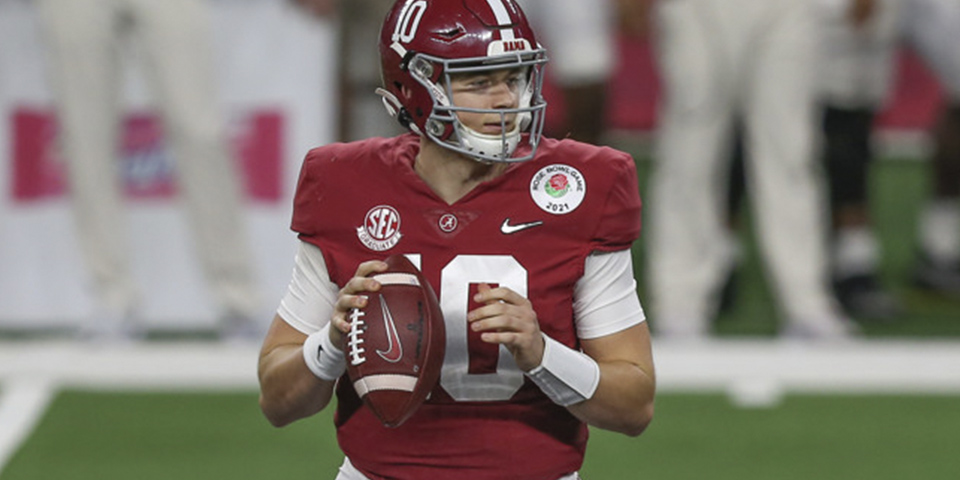
    It’s strange that a prospect as unassuming as Mac Jones has become so polarizing. It would be disingenuous to call his beginnings ‘humble’—Alabama’s out-of-state tuition barely outpaces what his high school alma mater charges—but it is fair to say that he’s been an afterthought for much of his football career.

    The Jacksonville native was glossed over by G5 grassroots recruiters UCF and USF and inexplicably wound up at Alabama despite being a three-star with the physique of a seventh-grader who swims with their shirt on. While less-coveted recruits aren’t quite dead on arrival in Tuscaloosa, just 8% of the last 120,000+ NFL snaps played by Alabama alumni have been played by former three-stars.

    Nevertheless, David joined Goliath and was seemingly on the fast track to a graduate assistant gig as a Saban-adjacent career backup. But, an unprecedented offseason resulted in a failure to launch for the incoming top quarterback recruit, Jones impressed during camp, and the rest is history.

    Now, with the NFL Draft approaching, Jones has become something of a Rorschach test. Many analysts have become enamored with his rhythm, his precision, and his high-volume, high-efficiency production, and we can sympathize with that. Jones’ 2020 campaign was the third-best passing season by volume, and the second-best on a per-snap basis, in the last three years.

    There are also those who see a physically limited prospect reminiscent of early Saban-era game managers.

    So, it would seem that statistical evaluation and traditional evaluation are at odds again, but that’s not really the case. Although numbers and film often induce cognitive dissonance in those who believe in the value of both, they’re actually two sides of the same coin in Jones’ case.

    For example, there are concerns about Jones’ mobility. The NFL is experiencing a changing of the guard at the quarterback position, and there are questions about whether Jones is well-suited for a league that is increasingly featuring some of its best athletes behind center. Only 17% of Jones’ throws in 2020 were made off-platform, one of the lowest rates among Power 5 quarterbacks. That kind of stationary play style is tough to reconcile when you consider the way the pro game is trending. Since 2019, about 27% of NFL throws occurred from a compromised throwing base. Pure pocket passers have been viable in the past, but the trend has been shifting towards mobility for some time now.

    Concerns about Jones’ pedestrian arm are validated by how long his passes spent in flight. Over expectation stats are all the rage nowadays, and we can devise such a method here. Contextualizing air time data with throw depth, where the ball is hashed relative to the target, and the quarterback’s throwing platform creates a baseline we can use to evaluate the relative quickness with which a quarterback’s passes arrive.

    In this category, Jones was dead average for a college quarterback, which is not particularly reassuring. Comparatively, the passes of Zach Wilson (-0.08), Trevor Lawrence (-0.07), Justin Fields (-0.03), and Trey Lance (-0.02) all arrived ahead of schedule. But, because it’s difficult to conceptualize how meaningfully different a few hundredths of a second are, this can be put in more practical terms. If Lawrence and Jones both throw a pass that travels 15 yards, we can expect Lawrence’s throw to win that race by about a yard and a half.

    There are other proxies by which we can judge Jones’ arm talent. His reluctance to throw to the outermost receiver in trips is one of them. A curiosity of the college-to-pro transition is the change in the playing dimensions. The fields are the same width, but the hashes are nearly twice as wide in college as they are in the pros. As a result, throwing the ball to the wide side of the field is more difficult in college, at least in a Pythagorean sense.

    In light of both this phenomenon and the relative inferiority in arm talent, defensive coaches at the college level generally like to know if they need to respect the outside receiver in trips. Wilson (27%), Fields (20%), and Lawrence (17%) came in above the average target rate (15%) to varying degrees, but Jones (11%) fell short of the mark. While this specific aspect is not directly translatable to the NFL, the fact that Jones targeted this alignment at a below average rate could be seen as a feather in the cap of his detractors.

    More generally, his low average depth of target (ADOT) of 8.3 yards is another stat we can use to judge his arm strength. Of course, this is admittedly simplistic and is confounded by the rate at which he threw RPOs and screens. 27% of his dropbacks were RPOs or screens, and while that’s comfortably above the NCAA average of 20%, it is less conspicuous than the players hovering in the 35-50% range. This is, however, a good opportunity to segue into more systemic concerns.

    A whopping 58% of Jones’ dropbacks were RPOs, screens, or play action passes.

    A whopping 58% of Jones’ dropbacks were RPOs, screens, or play action passes. That was the third-highest rate among eligible Power 5 quarterbacks (minimum 100 attempts) and can make evaluating Jones difficult, regardless of whether you choose to do so statistically or traditionally. While he might have been effective outside of this split (0.51 Total Points/Snap), 181 plays is not a lot to work with, especially considering how good his supporting cast at Alabama was.

    Although it is nowhere near as precise as tracking data, yards after the catch before contact (YACBC) is a crude instrument that can give us a sense for how open a quarterback’s receivers generally were. Jones’ receivers averaged 5.4 YACBC, which ranked 3rd among FBS teams and 2nd among Power 5 teams. This is likely unsurprising considering his connection with Heisman winner Devonta Smith.

    Furthermore, Jones was hurried six percentage points below the average rate, and when he was hurried, pressure arrived a tenth of a second later than the average. Of course, a quarterback owns some of his pressure rate, but things won’t be so easy in the NFL.

    Thus far, much of this article has been spent focusing on the criticisms of Jones, but advanced stats also convey the strengths he shows on film. He took great care of the football, as his turnover-worthy throw rate was just 2.0%—good for 7th in the country among the 134 players with at least passes. 

    He also processes quickly and gets the ball out in a timely manner. Time to Throw Over Expectation (TTOE) is a metric that considers drop type and play action to set a benchmark for how quickly the ball should come out. Jones’ TTOE of -0.24 ranked 14th among the aforementioned group, but he was far more productive. The thirteen players who ranked ahead of him combined for 244 Total Points. Jones himself accounted for 196.

    Lastly, he is very accurate by basically any statistical measure. He ranked first in the oft-misleading completion percentage (77.3%), but also placed first in On-Target Rate (85.1%) and fifth in *On-Target +/- (8.8%).

    *On-Target +/- is similar to NextGen’s CPOE, except that passes are judged by whether or not they were thrown accurately when compared to expectation. Read more about this in The SIS Football Rookie Handbook 2021.

    So, what do the stats indicate? They tell us that Jones is a statuesque mover who will need to prove he can be comfortable in NFL pockets after being royally protected in college.

    They tell us that he doesn’t have the juice to make all the throws and that tight windows may be a problem in the pros after making a lot of wide open throws at the college level.

    They also tell us that he avoids mistakes, is accurate, and sees the field and gets the ball out quickly.

    Witnesses to Jones’ play tell similar tales. So, we’ve achieved consensus on who Mac Jones is as a player. The red flags do indeed manifest themselves statistically. The question now is: who will bank on Jones continuing to overcome his physical limitations after leaving the nest?