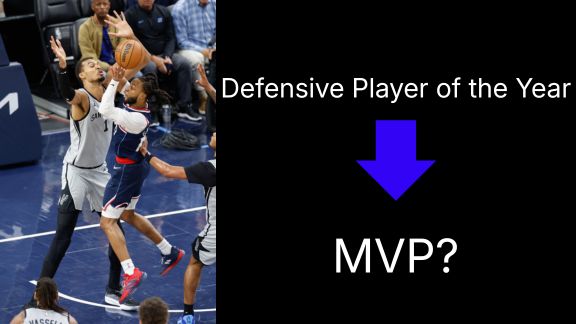
Every MVP season is built on dominance. In today’s NBA, that usually means elite scoring, playmaking, and offensive control. But what if a player is redefining value on the other end?
Defense rarely shows up in the box score the way points or assists do. But certain metrics can help capture what traditional stats miss. That’s where rim deterrence, advantages prevented, and defensive impact metrics begin to tell a deeper story.
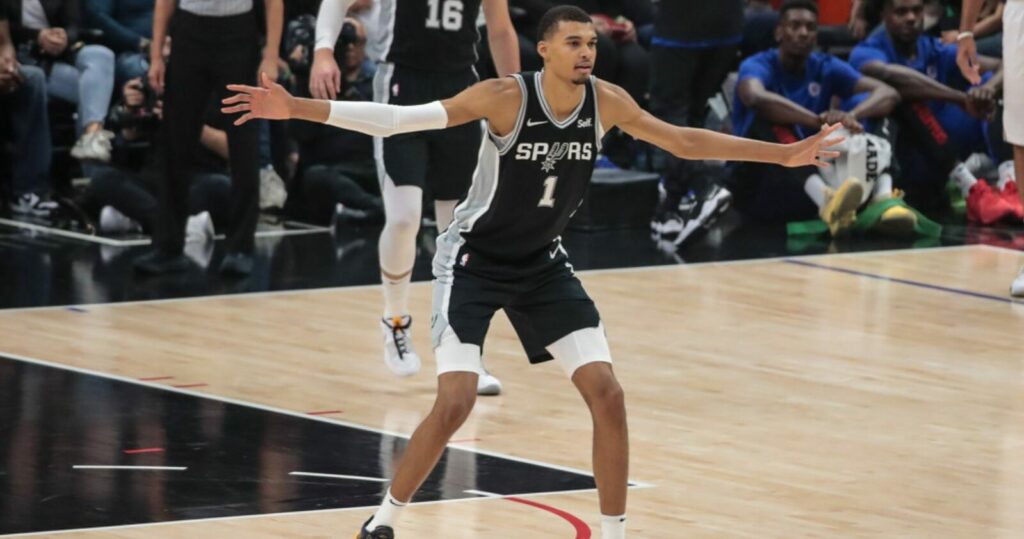
While most MVP cases are built offensively, Victor Wembanyama is building his case through his presence on the defensive end.
Blocks and Defensive Activity
| Player | Blocks per game | Shots defended per game | Opp fg% |
| Victor Wembanyama | 3.1 | 36.8 | 41.1% |
| Alex Sarr | 2 | 31.7 | 43.7% |
| Jay Huff | 1.9 | 21.2 | 41.3% |
| Evan Mobley | 1.7 | 32.1 | 43.2% |
| Donovan Clingan | 1.7 | 30.4 | 43.1% |
The traditional numbers already paint an elite picture.
Wembanyma just became the first unanimous Defensive Player of the Year and it is clear why. He leads this group in blocks while also defending the most shots per game. That combination of volume and rim protection is rare. His opponent FG% remains low despite how often he’s involved, which speaks to both his activity and discipline.
Even these numbers don’t fully capture his presence. Wembanyama’s defensive impact goes far beyond the traditional stat sheet.
What the Stat Sheet Doesn’t Show
Rim Deterrence Leaders
| Player | Rim Deterrences |
| Victor Wembanyama | 51 |
| Rudy Gobert | 27 |
| Chet Holmgren | 18 |
| Jalen Duren | 15 |
| Wendell Carter Jr. | 13 |
Rim deterrence measures how often a defender discourages a shot attempt at the rim entirely. Wembanyama leads this group by a massive margin, nearly doubling the next closest player.
No block. No miss. Just avoidance.
That’s value that doesn’t show up in the box score but directly impacts how offenses operate. Players aren’t just getting blocked by Wembanyama, they are choosing not to challenge him at all.
Stopping Advantageous Situations
| Player | Adv. Prevented Per Game |
| Victor Wembanyama | 9.5 |
| Rudy Gobert | 8.4 |
| Donavon Clingan | 8.1 |
| Evan Mobley | 7.4 |
| Jarrett Allen | 7.2 |
If rim deterrence shows what doesn’t happen, advantages prevented is showing who can make a play on the defensive end even when the offense has an advantageous situation.
An “advantage” refers to any moment where the offense gains an edge. A blow-by, mismatch, or defensive breakdown can all contribute to the offense gaining an advantage. Wembanyama is eliminating nearly 10 of those per game.
That means fewer rotations, fewer open looks, and fewer compromised possessions. He’s not just protecting the rim, he is stabilizing the entire defense.
Impact Metrics: Where Does Defense Fit Within Player Value?
| Player | EPI |
| Shai Gilgeous-Alexander | 4.97 |
| Kawhi Leonard | 3.54 |
| Tyrese Maxey | 3.27 |
| Donovan Mitchell | 3.02 |
| Stephen Curry | 2.75 |
| Victor Wembanyama | 2.26 (12th) |
EPI (Estimated Player Impact) is designed to capture a player’s total effect on the game in one number. It blends overall influence on both ends to estimate how much a player drives winning.
At the top of this list is Shai Gilgeous-Alexander, and it’s not by accident.
SGA isn’t just putting up numbers, he’s controlling games. His scoring efficiency, shot creation, and ability to consistently generate offense place him in a different tier when it comes to overall offensive impact. Night after night, he’s the engine of everything his team does.
And that’s exactly what EPI tends to reward.
Despite Wembanyama’s historic defensive presence, he sits 12th in EPI. That gap highlights something important because metrics like this naturally lean toward offensive production.
Defense can anchor a team, disrupt systems, and erase opportunities, but it’s harder to quantify in a way that rivals high-level offensive creation.
This reflects a long-standing reality in MVP voting: offense is easier to measure, scale, and reward. Defense, even at an elite level, often struggles to match that perceived value.
There is also another layer to this. Wembanyama played only 28 minutes per game. If his minutes were higher, these defensive numbers would look even more extreme, maybe even impossible to ignore. The volume, the presence, and the consistency would start to look less like elite defense and more like something we would expect from an alien.
If MVP is truly about impact on both ends, then the conversation has to evolve. Because while others are creating offense, Victor Wembanyama is taking it away.